1. To understand the definition of molar mass
2. To learn to convert between moles and mass
3. To learn to calculate the mass percent of an element
in a compound
Objectives
Molar Mass and Percentage
Composition
A. Molar Mass
 A compound is a collection of atoms bound together.
• The molar mass of a compound is obtained by summing
the masses of the component atoms.
A. Molar Mass
 For compounds containing ions, the molar mass is
obtained by summing the masses of the component
ions.
 Mass in grams of one mole of the substance:
Molar Mass of N = 14.01 g/mol
Molar Mass of H2O = 18.02 g/mol
(2 × 1.008 g) + 16.00 g
Molar Mass of Ba(NO3)2 = 261.35 g/mol
137.33 g + (2 × 14.01 g) + (6 × 16.00 g)
A. Molar Mass
 Moles of a compound =
Calculations Using Molar Mass
• Mass of a sample (g) = (moles of sample)(molar mass of
compound)
Concept Check
Calculate the number of copper atoms in a
63.55 g sample of copper.
Percentage
composition
Indicates the relative amount of each
element present in a compound.
Calculating percentage
composition
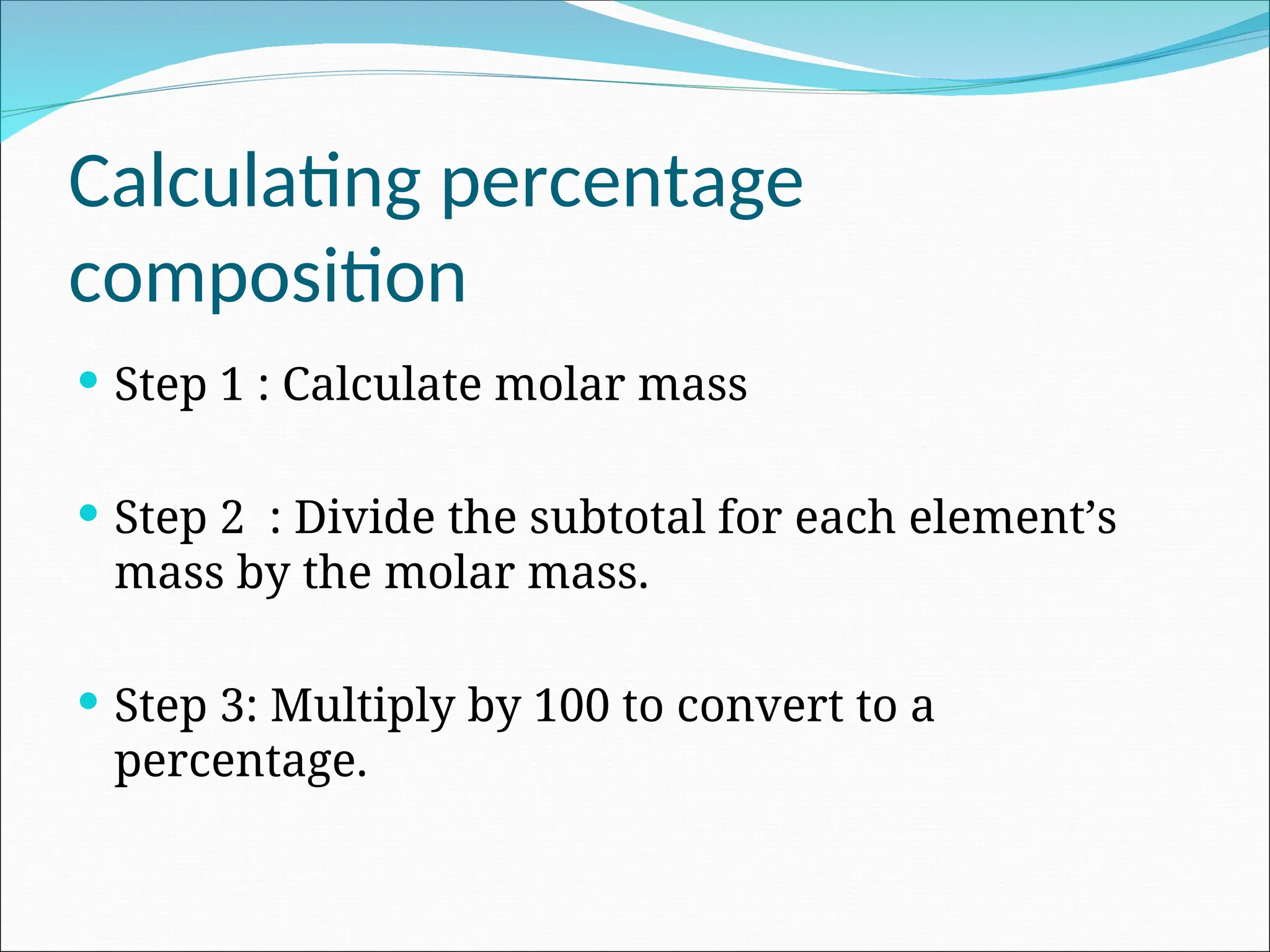
 Step 1 : Calculate molar mass
 Step 2 : Divide the subtotal for each element’s
mass by the molar mass.
 Step 3: Multiply by 100 to convert to a
percentage.
Example 1
 1. Calculate the molar mass of water, H2O.
 Step 1 – H- 2(1.01)= 2.02
 O – 1(16.0)= 16.0
 ________
 18.02
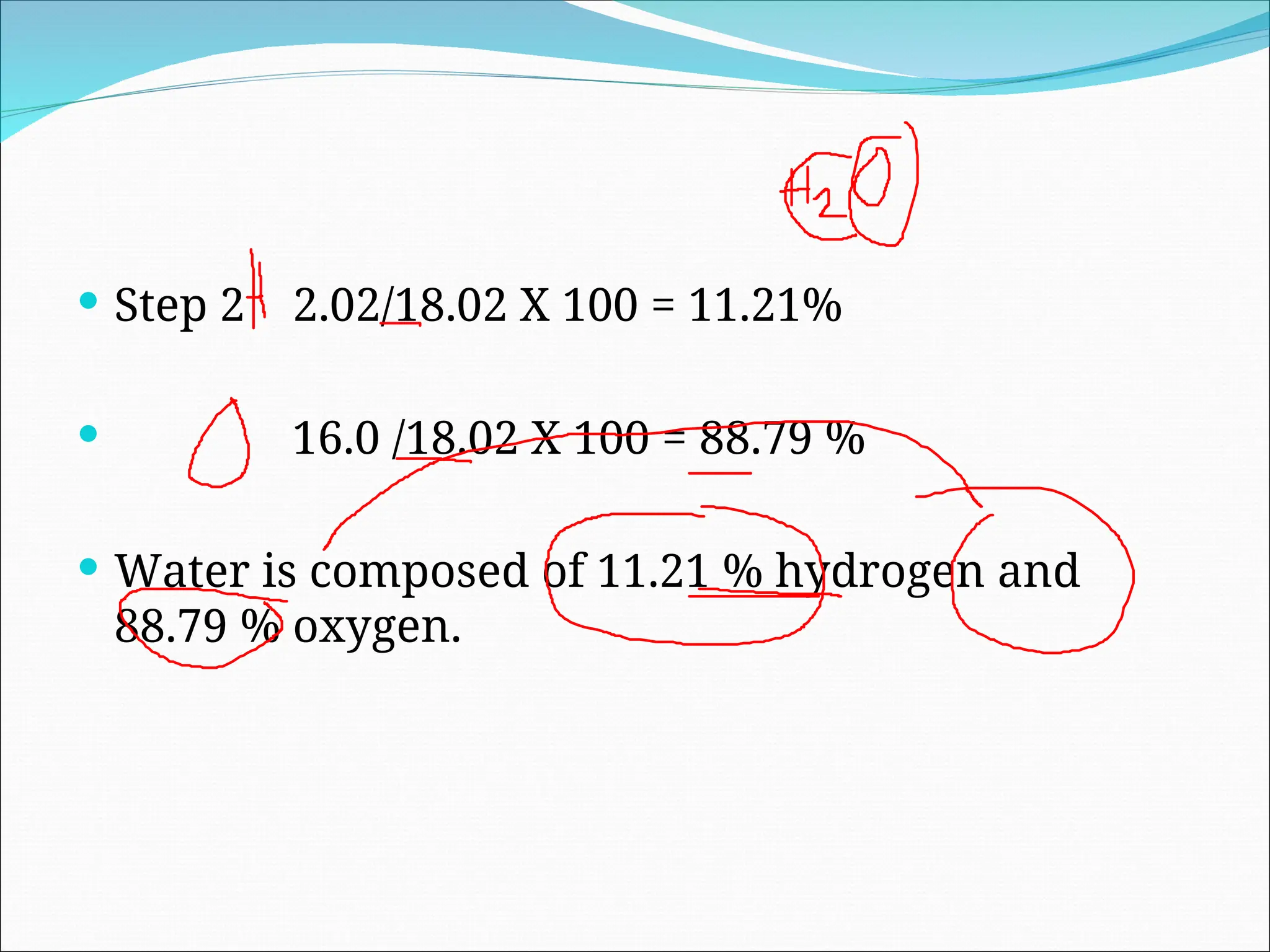
 Step 2 2.02/18.02 X 100 = 11.21%
 16.0 /18.02 X 100 = 88.79 %
 Water is composed of 11.21 % hydrogen and
88.79 % oxygen.
Example 2
 Calculate the percentage composition of Sodium
chloride , NaCl.
Example 3
 Find the percentage composition of hydrogen in
sulfurous acid.
Example 4
 Find the percentage composition of Manganese
in Potassium Permanganate.

Introduction to Percentage Composition.ppt

  • 1.
    1. To understandthe definition of molar mass 2. To learn to convert between moles and mass 3. To learn to calculate the mass percent of an element in a compound Objectives Molar Mass and Percentage Composition
  • 2.
    A. Molar Mass A compound is a collection of atoms bound together. • The molar mass of a compound is obtained by summing the masses of the component atoms.
  • 3.
    A. Molar Mass For compounds containing ions, the molar mass is obtained by summing the masses of the component ions.
  • 4.
     Mass ingrams of one mole of the substance: Molar Mass of N = 14.01 g/mol Molar Mass of H2O = 18.02 g/mol (2 × 1.008 g) + 16.00 g Molar Mass of Ba(NO3)2 = 261.35 g/mol 137.33 g + (2 × 14.01 g) + (6 × 16.00 g)
  • 5.
    A. Molar Mass Moles of a compound = Calculations Using Molar Mass • Mass of a sample (g) = (moles of sample)(molar mass of compound)
  • 6.
    Concept Check Calculate thenumber of copper atoms in a 63.55 g sample of copper.
  • 8.
    Percentage composition Indicates the relativeamount of each element present in a compound.
  • 9.
    Calculating percentage composition  Step1 : Calculate molar mass  Step 2 : Divide the subtotal for each element’s mass by the molar mass.  Step 3: Multiply by 100 to convert to a percentage.
  • 10.
    Example 1  1.Calculate the molar mass of water, H2O.  Step 1 – H- 2(1.01)= 2.02  O – 1(16.0)= 16.0  ________  18.02
  • 11.
     Step 22.02/18.02 X 100 = 11.21%  16.0 /18.02 X 100 = 88.79 %  Water is composed of 11.21 % hydrogen and 88.79 % oxygen.
  • 12.
    Example 2  Calculatethe percentage composition of Sodium chloride , NaCl.
  • 13.
    Example 3  Findthe percentage composition of hydrogen in sulfurous acid.
  • 14.
    Example 4  Findthe percentage composition of Manganese in Potassium Permanganate.

Editor's Notes

  • #6 6.022×10²³ Cu atoms; 63.55 g of Cu is 1 mole of Cu, which is equal to Avogadro’s number.