MOBILE COMPUTING :
WIRELESS TRANSMISSION AND
ELECTROMAGNETIC SPECTRUM
• Wireless communication (or just wireless,
when the context allows) is the transfer of
information between two or more points
without the use of a physical link like optical
fiber, or other continuous guided medium for
the transfer. The most common wireless
technology we use is radio waves.
• Wireless signals are spread over in the air
and are received and interpreted by
appropriate antennas.
. When an antenna is attached to the electrical
circuit of a computer or wireless device, it
converts the digital data into wireless signals
and spreads all over within its frequency
range.
• The receptor on the other end receives
these signals and converts them back to
digital data.
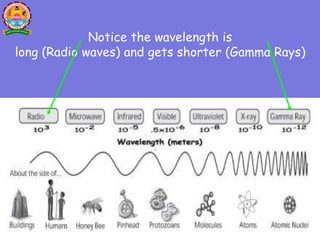
• Electromagnetic energy travels in waves and
spans a broad spectrum from very long radio
waves to very short gamma rays.
• The electromagnetic spectrum is a range of
frequencies, wavelengths, and photon
energies covering frequencies between 1
hertz to above 1025 Hz,
Notice the wavelength is
long (Radio waves) and gets shorter (Gamma Rays)
Wavelength :
Wavelength is the distance between identical points
(adjacent crests) in the adjacent cycles of a
waveform signal propagated in space or along a
wire. In wireless systems, this length is usually
specified in meters (m), centimeters (cm) or
millimeters (mm). Wavelength is usually denoted by
the Greek letter lambda (λ); it is equal to the speed
(v) of a wave train in a medium divided by its
frequency (f): λ = v/f.
Frequency :
Frequency describes the number of waves that
pass a fixed place in a given amount of time. So if
the time it takes for a wave to pass is 1/2 second,
the frequency is 2 per second. If it takes 1/100 of an
hour, the frequency is 100 per hour.
Frequency band spectrum
RADIO WAVES
Have the longest
wavelengths and
lowest
frequencies of
all the
electromagnetic
waves.
Global Positioning Systems (GPS) measure the
time it takes a radio wave to travel from
several satellites to the receiver, determining
the distance to each satellite.
A radio picks up radio waves through an
antenna and converts them to sound
waves.
– Each radio station in an area broadcasts at a
different frequency.
• on radio dial tells frequency.
MRI
(MAGNETIC RESONACE IMAGING)
Uses Short wave radio waves with a
magnet to create an image.
MICROWAVES
Have the
shortest
wavelengths and
the highest
frequency of
the radio
waves.
Used in microwave
ovens.
• Waves transfer
energy to the
water in the food
causing them to
vibrate which in
turn transfers
energy in the
form of heat to
the food.
RADAR (Radio
Detection and
Ranging)
• Used to find the
speed of an object
by sending out radio
waves and measuring
the time it takes
them to return.
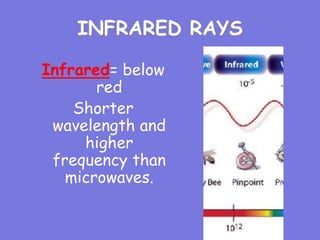
INFRARED RAYS
Infrared= below
red
Shorter
wavelength and
higher
frequency than
microwaves.
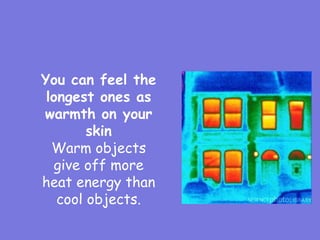
You can feel the
longest ones as
warmth on your
skin
Warm objects
give off more
heat energy than
cool objects.
Thermogram—a picture that shows regions of different
temperatures in the body. Temperatures are calculated by
the amount of infrared radiation given off.
Therefore people give
off infrared rays.
Heat lamps give off
infrared waves.
VISIBLE LIGHT
Shorter wavelength and
higher frequency than
infrared rays.
Electromagnetic waves we
can see.
Longest wavelength= red light
Shortest wavelength= violet (purple)
light
When light enters
a new medium it
bends (refracts).
Each wavelength
bends a different
amount allowing
white light to
separate into it’s
various colors
ROYGBIV.
ULTRAVIOLET RAYS
Shorter
wavelength and
higher
frequency than
visible light
Carry more
energy than
visible light
Used to kill
bacteria.
(Sterilization
of equipment)
Too much can cause skin cancer.
Use sun block to protect against
(UV rays)
Causes your
skin to
produce
vitamin D
(good for
teeth and
bones)
X- RAYS
Shorter
wavelength and
higher
frequency than
UV-rays
Carry a great
amount of
energy
Can penetrate
most matter.
Bones and teeth absorb x-rays. (The light part
of an x-ray image indicates a place where the x-
ray was absorbed)
Too much exposure
can cause cancer
(lead vest at
dentist protects
organs from
unnecessary
exposure)
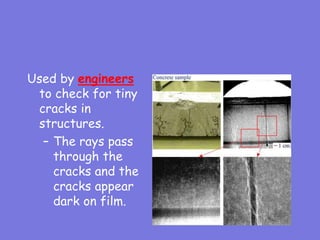
Used by engineers
to check for tiny
cracks in
structures.
– The rays pass
through the
cracks and the
cracks appear
dark on film.
GAMMA RAYS
Shorter wavelength
and higher frequency
than X-rays
Carry the greatest
amount of energy
and penetrate the
most.
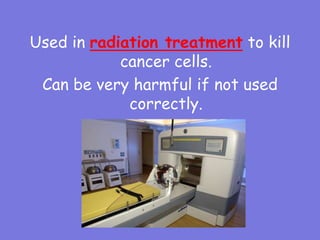
Used in radiation treatment to kill
cancer cells.
Can be very harmful if not used
correctly.
The Incredible
Hulk was the
victim of
gamma
radiation.
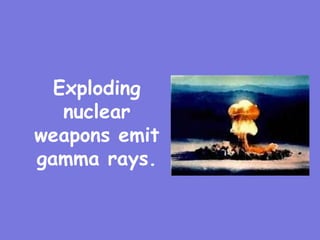
Exploding
nuclear
weapons emit
gamma rays.
Antenna -An antenna is a metallic structure
that acts as a transducer, converting the electrical
power into EM waves. The electric charges are the
source of the EM or electromagnetic waves.
The Antenna can be used as a transmitting
antenna or the receiving antenna.
Types of Antennas
The antennas are categorized based on the
direction of the radiations emitted by them.
The three major types of Antenna based on
the direction are
• Omni-directional antenna,
• Semi-directional antenna, and
• Directional antenna.
Omnidirectional antenna
The Omnidirectional antenna radiations radio
power equally in all the directions. The power
emitted is perpendicular to the axis. It further
declines to zero towards the axis. It is
commonly used in applications that require
communication with multiple devices.
Semi-directional antenna
.
Semi-directional antennas also radiate the
power in a particular direction providing the
radiations across a large area. It is generally
a point-to-point communication used for
short-to medium distance communications.
Thank you

Introduction to Mobile Computing ppt1.ppt

  • 1.
    MOBILE COMPUTING : WIRELESSTRANSMISSION AND ELECTROMAGNETIC SPECTRUM
  • 2.
    • Wireless communication(or just wireless, when the context allows) is the transfer of information between two or more points without the use of a physical link like optical fiber, or other continuous guided medium for the transfer. The most common wireless technology we use is radio waves. • Wireless signals are spread over in the air and are received and interpreted by appropriate antennas.
  • 3.
    . When anantenna is attached to the electrical circuit of a computer or wireless device, it converts the digital data into wireless signals and spreads all over within its frequency range. • The receptor on the other end receives these signals and converts them back to digital data.
  • 4.
    • Electromagnetic energytravels in waves and spans a broad spectrum from very long radio waves to very short gamma rays. • The electromagnetic spectrum is a range of frequencies, wavelengths, and photon energies covering frequencies between 1 hertz to above 1025 Hz,
  • 6.
    Notice the wavelengthis long (Radio waves) and gets shorter (Gamma Rays)
  • 7.
    Wavelength : Wavelength isthe distance between identical points (adjacent crests) in the adjacent cycles of a waveform signal propagated in space or along a wire. In wireless systems, this length is usually specified in meters (m), centimeters (cm) or millimeters (mm). Wavelength is usually denoted by the Greek letter lambda (λ); it is equal to the speed (v) of a wave train in a medium divided by its frequency (f): λ = v/f.
  • 8.
    Frequency : Frequency describesthe number of waves that pass a fixed place in a given amount of time. So if the time it takes for a wave to pass is 1/2 second, the frequency is 2 per second. If it takes 1/100 of an hour, the frequency is 100 per hour.
  • 9.
  • 11.
    RADIO WAVES Have thelongest wavelengths and lowest frequencies of all the electromagnetic waves.
  • 12.
    Global Positioning Systems(GPS) measure the time it takes a radio wave to travel from several satellites to the receiver, determining the distance to each satellite.
  • 13.
    A radio picksup radio waves through an antenna and converts them to sound waves. – Each radio station in an area broadcasts at a different frequency. • on radio dial tells frequency.
  • 14.
    MRI (MAGNETIC RESONACE IMAGING) UsesShort wave radio waves with a magnet to create an image.
  • 15.
    MICROWAVES Have the shortest wavelengths and thehighest frequency of the radio waves.
  • 16.
    Used in microwave ovens. •Waves transfer energy to the water in the food causing them to vibrate which in turn transfers energy in the form of heat to the food.
  • 17.
    RADAR (Radio Detection and Ranging) •Used to find the speed of an object by sending out radio waves and measuring the time it takes them to return.
  • 18.
    INFRARED RAYS Infrared= below red Shorter wavelengthand higher frequency than microwaves.
  • 19.
    You can feelthe longest ones as warmth on your skin Warm objects give off more heat energy than cool objects.
  • 20.
    Thermogram—a picture thatshows regions of different temperatures in the body. Temperatures are calculated by the amount of infrared radiation given off. Therefore people give off infrared rays. Heat lamps give off infrared waves.
  • 21.

    VISIBLE LIGHT Shorter wavelengthand higher frequency than infrared rays. Electromagnetic waves we can see. Longest wavelength= red light Shortest wavelength= violet (purple) light
  • 22.
    When light enters anew medium it bends (refracts). Each wavelength bends a different amount allowing white light to separate into it’s various colors ROYGBIV.
  • 23.
    ULTRAVIOLET RAYS Shorter wavelength and higher frequencythan visible light Carry more energy than visible light
  • 24.
  • 25.
    Too much cancause skin cancer. Use sun block to protect against (UV rays)
  • 26.
    Causes your skin to produce vitaminD (good for teeth and bones)
  • 27.
    X- RAYS Shorter wavelength and higher frequencythan UV-rays Carry a great amount of energy Can penetrate most matter.
  • 28.
    Bones and teethabsorb x-rays. (The light part of an x-ray image indicates a place where the x- ray was absorbed)
  • 29.
    Too much exposure cancause cancer (lead vest at dentist protects organs from unnecessary exposure)
  • 30.
    Used by engineers tocheck for tiny cracks in structures. – The rays pass through the cracks and the cracks appear dark on film.
  • 31.
    GAMMA RAYS Shorter wavelength andhigher frequency than X-rays Carry the greatest amount of energy and penetrate the most.
  • 32.
    Used in radiationtreatment to kill cancer cells. Can be very harmful if not used correctly.
  • 33.
    The Incredible Hulk wasthe victim of gamma radiation.
  • 34.
  • 35.
    Antenna -An antennais a metallic structure that acts as a transducer, converting the electrical power into EM waves. The electric charges are the source of the EM or electromagnetic waves. The Antenna can be used as a transmitting antenna or the receiving antenna.
  • 36.
    Types of Antennas Theantennas are categorized based on the direction of the radiations emitted by them. The three major types of Antenna based on the direction are • Omni-directional antenna, • Semi-directional antenna, and • Directional antenna.
  • 37.
    Omnidirectional antenna The Omnidirectionalantenna radiations radio power equally in all the directions. The power emitted is perpendicular to the axis. It further declines to zero towards the axis. It is commonly used in applications that require communication with multiple devices.
  • 38.
    Semi-directional antenna . Semi-directional antennasalso radiate the power in a particular direction providing the radiations across a large area. It is generally a point-to-point communication used for short-to medium distance communications.
  • 39.