Introduction to Mechanical
Engineering (ME131)
Dr. Mainakh Das
Assistant Professor
2
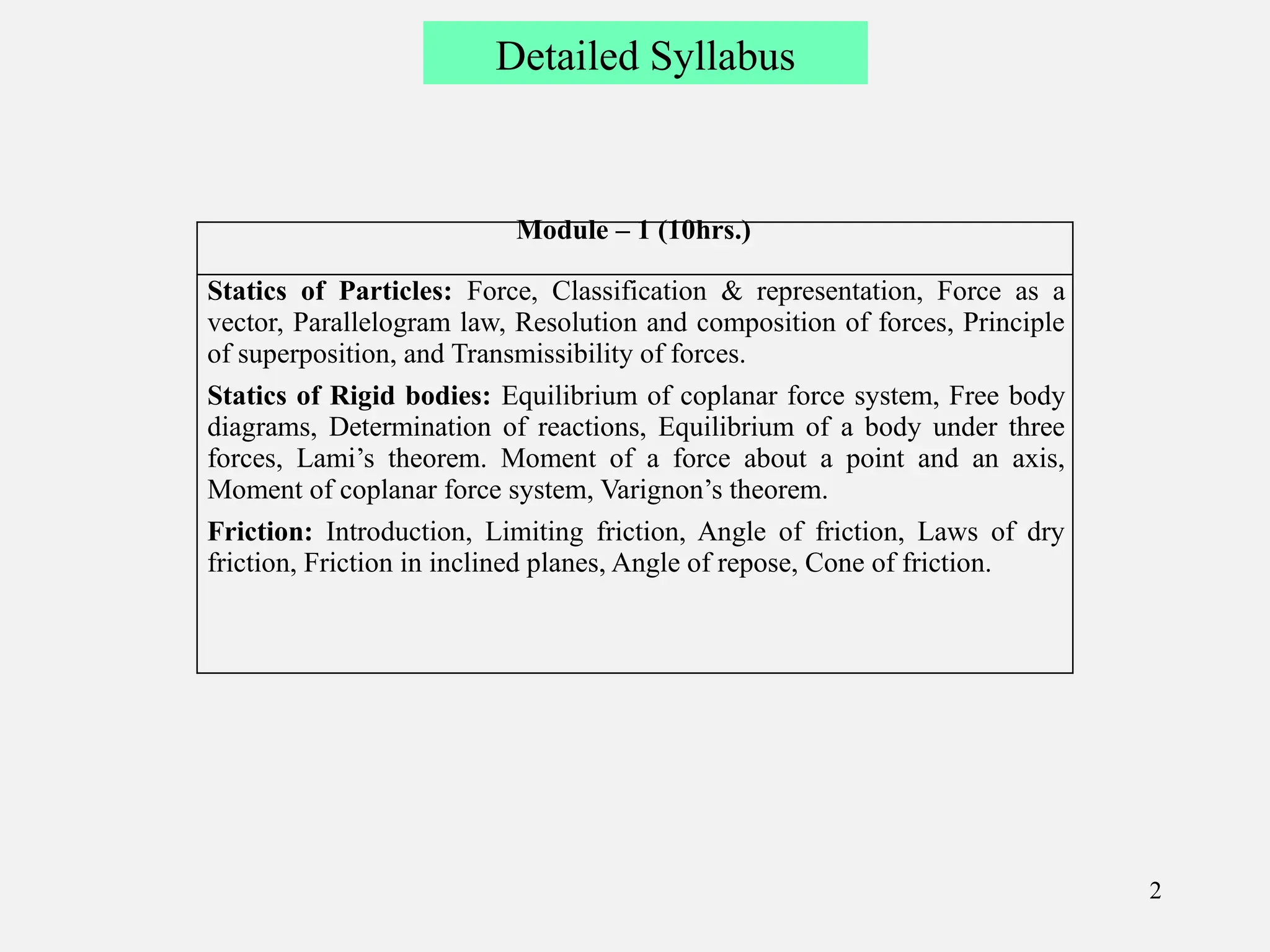
Detailed Syllabus
Module – 1 (10hrs.)
Statics of Particles: Force, Classification & representation, Force as a
vector, Parallelogram law, Resolution and composition of forces, Principle
of superposition, and Transmissibility of forces.
Statics of Rigid bodies: Equilibrium of coplanar force system, Free body
diagrams, Determination of reactions, Equilibrium of a body under three
forces, Lami’s theorem. Moment of a force about a point and an axis,
Moment of coplanar force system, Varignon’s theorem.
Friction: Introduction, Limiting friction, Angle of friction, Laws of dry
friction, Friction in inclined planes, Angle of repose, Cone of friction.
Parallel and Distributed forces: Parallel forces in a plane,
Distributed Parallel forces in a plane, Couple, Resolution of a
force into a force and a couple, Moment of a couple.
Centroid and Moment of Inertia: Determination of center of
gravity, Center of mass, and centroid by direct integration and by
the method of composite bodies, Area moment of inertia of
composite plane figures and mass moment of inertia, Radius of
gyration, Perpendicular and parallel axis theorem, Pappus
theorems, Polar moment of inertia.
Module – 2 (9hrs.)
Module – 3 (7 hrs.)
Basic Structural Analysis: Plane truss, Difference between truss
and frame, Perfect and imperfect truss, Assumptions and analysis
of plane truss, Zero force members, Analysis of perfect plane
trusses by the method of joints, method of section.
Module – 4 (8 hrs.)
Fundamental concepts and definitions in Thermodynamics:
Scope of Thermodynamics, Macroscopic and Microscopic
approaches, Systems, Properties, Process, State, Cycle,
Thermodynamic equilibrium, Pressure, Zeroth Law of
thermodynamics, Concepts of temperature, Energy and its form,
Work and heat, Enthalpy.
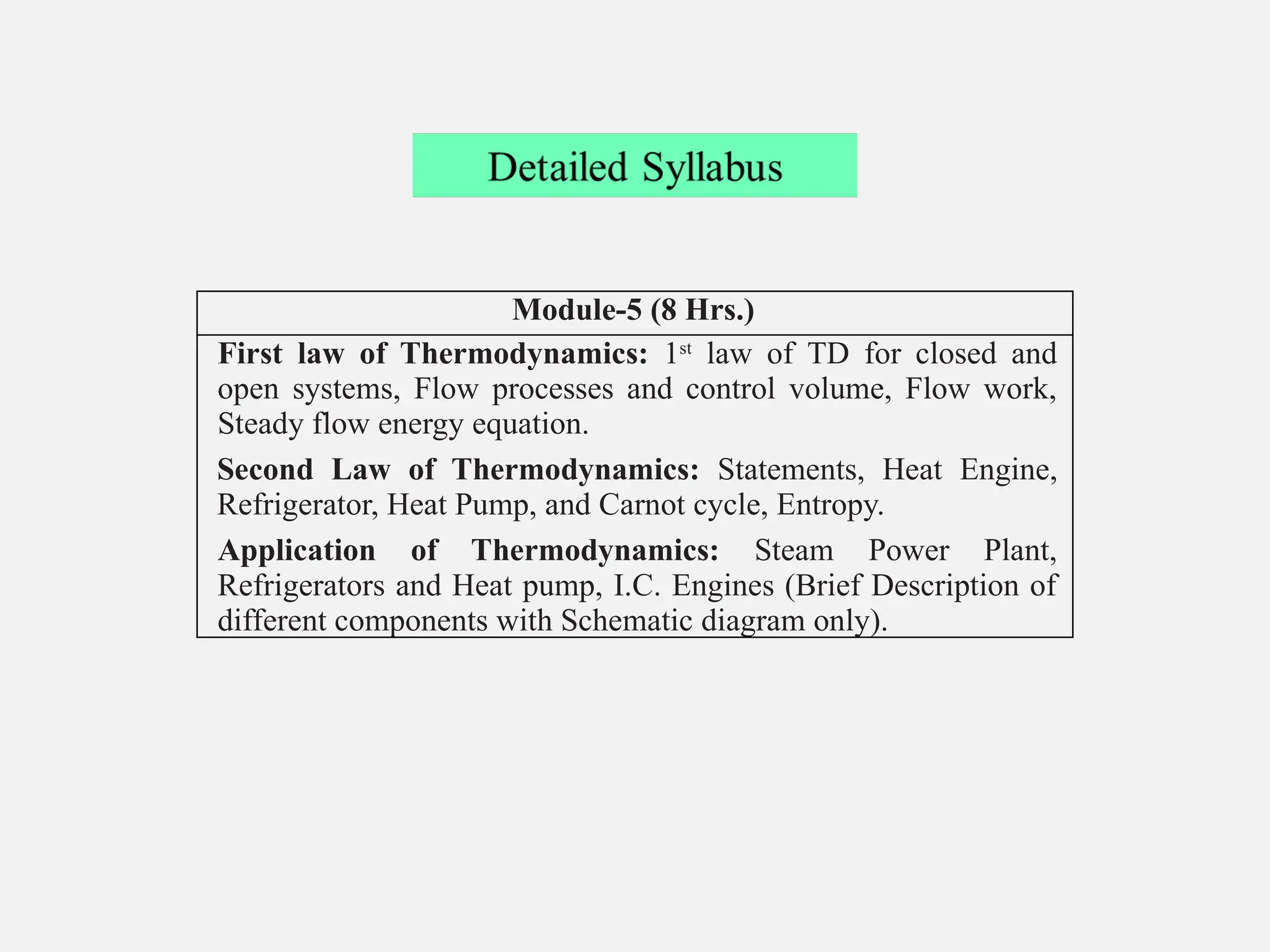
Module-5 (8 Hrs.)
First law of Thermodynamics: 1st
law of TD for closed and
open systems, Flow processes and control volume, Flow work,
Steady flow energy equation.
Second Law of Thermodynamics: Statements, Heat Engine,
Refrigerator, Heat Pump, and Carnot cycle, Entropy.
Application of Thermodynamics: Steam Power Plant,
Refrigerators and Heat pump, I.C. Engines (Brief Description of
different components with Schematic diagram only).
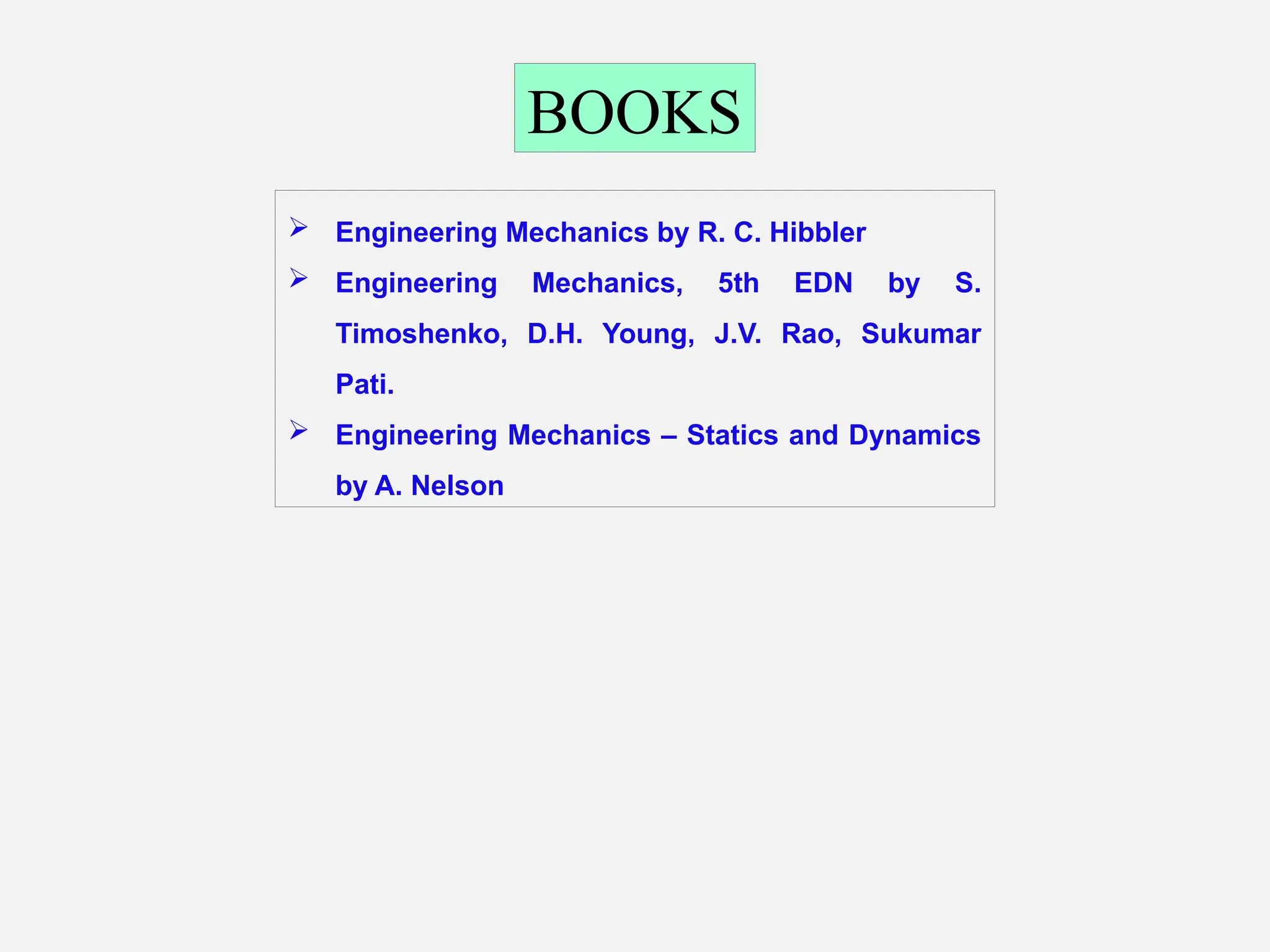
 Engineering Mechanics by R. C. Hibbler
 Engineering Mechanics, 5th EDN by S.
Timoshenko, D.H. Young, J.V. Rao, Sukumar
Pati.
 Engineering Mechanics – Statics and Dynamics
by A. Nelson
BOOKS
Course Outcome
Upon successful completion of this course, students will be able to:
CO-1 Apply laws of mechanics and condition of equilibrium to
determine forces acting on a static body with or without
friction
CO-2 Determine the Centre of gravity and moment of inertia of
different shapes
CO-3 Analyze forces in different members of a truss using method of
joints and method of section principles.
CO-4 Analyse fixed mass and control volume systems using the
conservation of energy principle.
CO-5 Determine the efficiency and COP of heat engines,
refrigerators, heat pumps using second law of thermodynamics
principles.
Application
Upon successful completion of this course, students will be able to apply
their knowledge in following areas:
1 Machine Design: Designing and analyzing machine components such
as shafts, gears, bearings, and fasteners requires understanding stress,
strain, and material properties. Strength of Materials principles ensure
that components can withstand applied loads without failure.
2 Aerospace Engineering: In aerospace applications, materials must
withstand extreme conditions of temperature, pressure, and dynamic
loads. Strength of Materials is used to design aircraft wings, fuselages,
and propulsion systems to ensure structural integrity and performance.
3 Automotive Engineering: Designing vehicles involves optimizing the
strength and weight of components like chassis, suspension systems,
and engine parts. Strength of Materials principles help engineers select
materials and design structures that meet safety, performance, and
efficiency requirements.
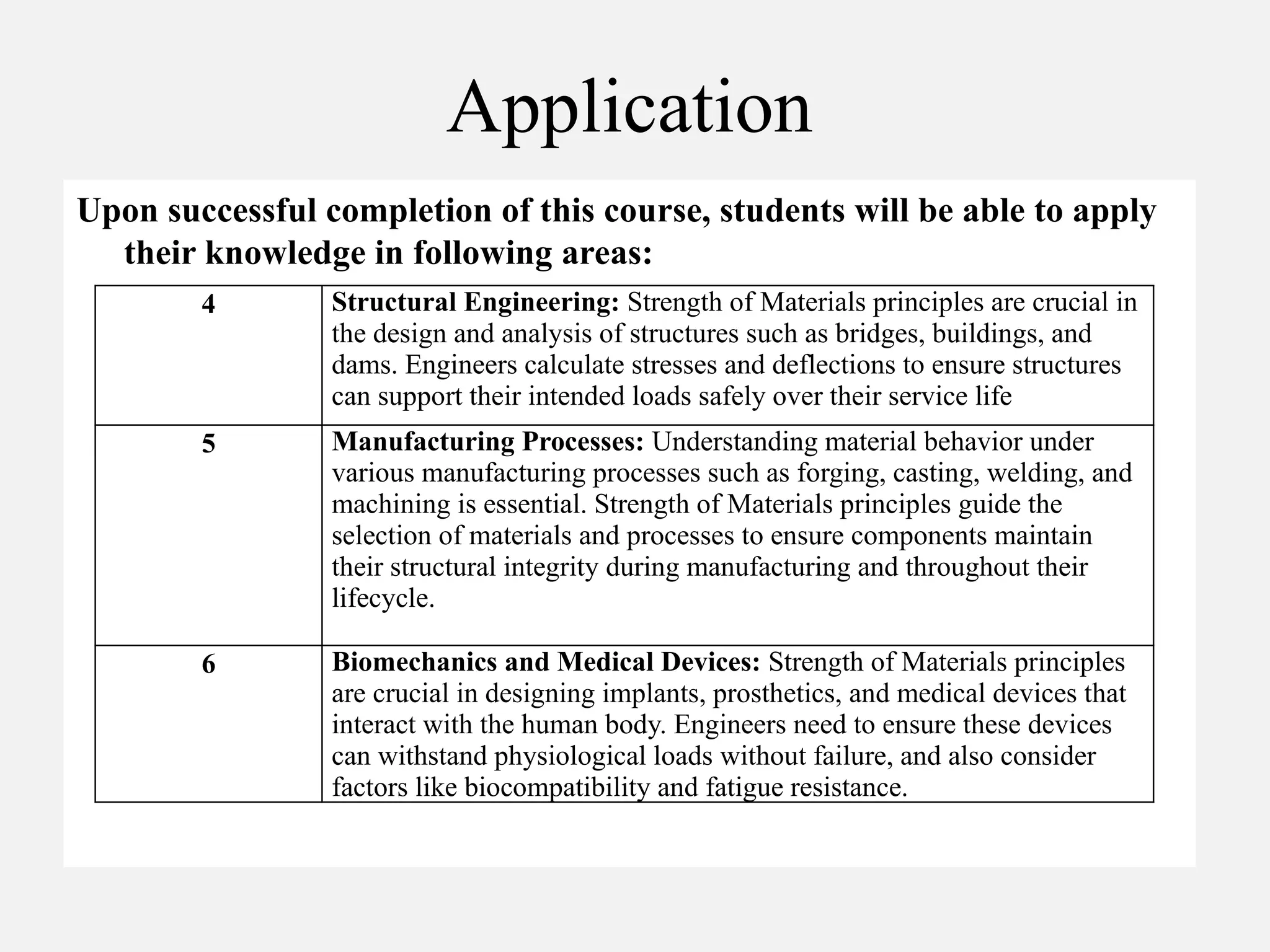
Application
Upon successful completion of this course, students will be able to apply
their knowledge in following areas:
4 Structural Engineering: Strength of Materials principles are crucial in
the design and analysis of structures such as bridges, buildings, and
dams. Engineers calculate stresses and deflections to ensure structures
can support their intended loads safely over their service life
5 Manufacturing Processes: Understanding material behavior under
various manufacturing processes such as forging, casting, welding, and
machining is essential. Strength of Materials principles guide the
selection of materials and processes to ensure components maintain
their structural integrity during manufacturing and throughout their
lifecycle.
6 Biomechanics and Medical Devices: Strength of Materials principles
are crucial in designing implants, prosthetics, and medical devices that
interact with the human body. Engineers need to ensure these devices
can withstand physiological loads without failure, and also consider
factors like biocompatibility and fatigue resistance.
Evaluation Parameter
Mid Sem (20)
Quiz (10)
Presentation (10)
Assignment (10)
Attendance 75% is mandatory
• End Sem (50)
Conclusions
Fundamental Understanding: Engineering mechanics
provides crucial insights into material behavior under varying
conditions.
•Engineering Applications: It forms the backbone of design,
ensuring structures meet safety and performance standards.
•Future Directions: Advancements in computational tools and
materials science promise even more robust innovations ahead.
Thank You

Introduction to mechanical Engineering.pptx

  • 1.
    Introduction to Mechanical Engineering(ME131) Dr. Mainakh Das Assistant Professor
  • 2.
    2 Detailed Syllabus Module –1 (10hrs.) Statics of Particles: Force, Classification & representation, Force as a vector, Parallelogram law, Resolution and composition of forces, Principle of superposition, and Transmissibility of forces. Statics of Rigid bodies: Equilibrium of coplanar force system, Free body diagrams, Determination of reactions, Equilibrium of a body under three forces, Lami’s theorem. Moment of a force about a point and an axis, Moment of coplanar force system, Varignon’s theorem. Friction: Introduction, Limiting friction, Angle of friction, Laws of dry friction, Friction in inclined planes, Angle of repose, Cone of friction.
  • 3.
    Parallel and Distributedforces: Parallel forces in a plane, Distributed Parallel forces in a plane, Couple, Resolution of a force into a force and a couple, Moment of a couple. Centroid and Moment of Inertia: Determination of center of gravity, Center of mass, and centroid by direct integration and by the method of composite bodies, Area moment of inertia of composite plane figures and mass moment of inertia, Radius of gyration, Perpendicular and parallel axis theorem, Pappus theorems, Polar moment of inertia. Module – 2 (9hrs.)
  • 4.
    Module – 3(7 hrs.) Basic Structural Analysis: Plane truss, Difference between truss and frame, Perfect and imperfect truss, Assumptions and analysis of plane truss, Zero force members, Analysis of perfect plane trusses by the method of joints, method of section. Module – 4 (8 hrs.) Fundamental concepts and definitions in Thermodynamics: Scope of Thermodynamics, Macroscopic and Microscopic approaches, Systems, Properties, Process, State, Cycle, Thermodynamic equilibrium, Pressure, Zeroth Law of thermodynamics, Concepts of temperature, Energy and its form, Work and heat, Enthalpy.
  • 5.
    Module-5 (8 Hrs.) Firstlaw of Thermodynamics: 1st law of TD for closed and open systems, Flow processes and control volume, Flow work, Steady flow energy equation. Second Law of Thermodynamics: Statements, Heat Engine, Refrigerator, Heat Pump, and Carnot cycle, Entropy. Application of Thermodynamics: Steam Power Plant, Refrigerators and Heat pump, I.C. Engines (Brief Description of different components with Schematic diagram only).
  • 6.
     Engineering Mechanicsby R. C. Hibbler  Engineering Mechanics, 5th EDN by S. Timoshenko, D.H. Young, J.V. Rao, Sukumar Pati.  Engineering Mechanics – Statics and Dynamics by A. Nelson BOOKS
  • 7.
    Course Outcome Upon successfulcompletion of this course, students will be able to: CO-1 Apply laws of mechanics and condition of equilibrium to determine forces acting on a static body with or without friction CO-2 Determine the Centre of gravity and moment of inertia of different shapes CO-3 Analyze forces in different members of a truss using method of joints and method of section principles. CO-4 Analyse fixed mass and control volume systems using the conservation of energy principle. CO-5 Determine the efficiency and COP of heat engines, refrigerators, heat pumps using second law of thermodynamics principles.
  • 8.
    Application Upon successful completionof this course, students will be able to apply their knowledge in following areas: 1 Machine Design: Designing and analyzing machine components such as shafts, gears, bearings, and fasteners requires understanding stress, strain, and material properties. Strength of Materials principles ensure that components can withstand applied loads without failure. 2 Aerospace Engineering: In aerospace applications, materials must withstand extreme conditions of temperature, pressure, and dynamic loads. Strength of Materials is used to design aircraft wings, fuselages, and propulsion systems to ensure structural integrity and performance. 3 Automotive Engineering: Designing vehicles involves optimizing the strength and weight of components like chassis, suspension systems, and engine parts. Strength of Materials principles help engineers select materials and design structures that meet safety, performance, and efficiency requirements.
  • 9.
    Application Upon successful completionof this course, students will be able to apply their knowledge in following areas: 4 Structural Engineering: Strength of Materials principles are crucial in the design and analysis of structures such as bridges, buildings, and dams. Engineers calculate stresses and deflections to ensure structures can support their intended loads safely over their service life 5 Manufacturing Processes: Understanding material behavior under various manufacturing processes such as forging, casting, welding, and machining is essential. Strength of Materials principles guide the selection of materials and processes to ensure components maintain their structural integrity during manufacturing and throughout their lifecycle. 6 Biomechanics and Medical Devices: Strength of Materials principles are crucial in designing implants, prosthetics, and medical devices that interact with the human body. Engineers need to ensure these devices can withstand physiological loads without failure, and also consider factors like biocompatibility and fatigue resistance.
  • 10.
    Evaluation Parameter Mid Sem(20) Quiz (10) Presentation (10) Assignment (10) Attendance 75% is mandatory • End Sem (50)
  • 11.
    Conclusions Fundamental Understanding: Engineeringmechanics provides crucial insights into material behavior under varying conditions. •Engineering Applications: It forms the backbone of design, ensuring structures meet safety and performance standards. •Future Directions: Advancements in computational tools and materials science promise even more robust innovations ahead.
  • 12.