Introduction to
Marketing
PRINCIPLES OF MARKETING
Marketing Mix
• The marketing mix, often referred to as the "4Ps," is a fundamental
framework in marketing that represents the essential elements a business
needs to consider when planning and executing its marketing strategy.
• The marketing mix consists of four interconnected components:
• Product
• Price
• Place (Physical Distribution)
• Promotion
Product Mix
• Product Lines: These are groups of related products offered by a company. Each product
line typically serves a specific market segment or addresses a particular customer need.
For example, a clothing retailer may have product lines for men's, women's, and children's
apparel.
• Product Width: Product width refers to the number of different product lines a company
offers. A company with a broad product width has a wide variety of product lines, while
one with a narrow product width offers a limited range of product lines.
• Product Depth: Product depth refers to the number of products within each product line.
A product line with a deep product depth offers many variations or models, while one with
shallow product depth offers fewer options.
• Product Consistency: Product consistency assesses how closely related the various
product lines are within the product mix. Companies can have a consistent or diversified
product mix. For example, a company that offers both sports equipment and cosmetics
would have a diversified product mix, while a company that focuses solely on electronics
would have a consistent product mix.
Product Mix
• Product Life Cycle: Understanding where products are in their life cycle (introduction,
growth, maturity, or decline) is crucial for managing the product mix. Companies may
need to introduce new products to replace declining ones or invest in marketing to extend
the life cycle of mature products.
• Product Branding: The way products are branded can also be a component of the product
mix. Companies may offer different brands within their product mix to appeal to different
customer segments or to position themselves differently in the market.
• Product Packaging: Packaging design and quality can be a crucial component, especially in
industries where aesthetics and presentation matter. Packaging can impact a product's
perceived value and attractiveness to customers.
• Product Pricing: The pricing strategy for each product or product line is an important
component. Companies may offer a range of price points within their product mix to cater
to different customer budgets.
• Product Features and Benefits: The unique features, functions, and benefits of each
product or product line are essential considerations. This component focuses on what
makes each product attractive to customers.
Product Mix
• Product Quality and Durability: The level of quality and durability associated with each
product or product line can significantly impact customer satisfaction and brand
reputation.
• Product Positioning: How a company positions its products in the market, whether as
high-end luxury items or affordable essentials, is a key component of the product mix.
• Product Differentiation: Companies may differentiate their products through various
means, such as technology, design, or customer service, to stand out from competitors.
• Product Availability and Distribution: Ensuring that products are readily available to
customers through various distribution channels is crucial. This includes considerations like
retail stores, e-commerce, and wholesalers.
• Product Promotion: Marketing and promotional strategies for each product or product
line play a vital role in the product mix. These strategies can include advertising,
promotions, and public relations efforts.
Product Mix Examples
• Procter & Gamble (P&G): P&G is a consumer goods giant known for its wide-ranging product mix,
including brands like Tide (laundry detergent), Crest (oral care), Pampers (baby diapers), Gillette
(razors and grooming products), and Olay (skincare). They cater to various consumer needs across
multiple product categories.
• General Electric (GE): GE has a diverse product mix that spans various industries, including aviation,
healthcare, energy, and more. They manufacture aircraft engines, medical imaging equipment,
power generation solutions, and locomotives, among other products.
• Samsung: Samsung is a multinational conglomerate with a broad product mix that includes
smartphones, televisions, home appliances, semiconductors, and even construction services. They
serve both consumers and businesses in multiple sectors.
• Amazon: Amazon, originally an online bookstore, has expanded its product mix dramatically. It now
offers e-commerce services, cloud computing through Amazon Web Services (AWS), streaming
media with Amazon Prime Video, and smart home devices like the Amazon Echo.
• Nestlé: Nestlé is a food and beverage company with a diverse product mix that includes brands like
Nescafé (coffee), Nestea (iced tea), Purina (pet food), Kit Kat (chocolate), and more. They operate in
various segments within the food and beverage industry.
Product Mix Examples
• The Walt Disney Company: Disney has a diverse product mix that includes not only its
iconic animated and live-action films but also theme parks, consumer products (toys,
apparel), television networks (ABC, ESPN), and a streaming service (Disney+).
• Coca-Cola: Coca-Cola is a beverage company with a wide-ranging product mix, including
carbonated soft drinks (Coca-Cola, Sprite), juices (Minute Maid), bottled water (Dasani),
and sports drinks (Powerade).
• Toyota: Toyota's product mix extends beyond automobiles to include a variety of vehicles
like trucks and hybrids, as well as financial services, robotics, and even partnerships in the
field of artificial intelligence and mobility.
• Unilever: Unilever offers a diverse range of consumer goods, including food products (Ben
& Jerry's, Lipton), personal care items (Dove, Axe), and cleaning products (Dove, Axe),
making it a prominent example of a company with a broad product mix.
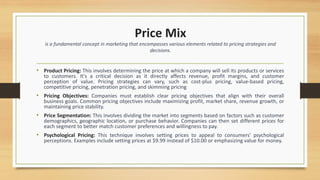
Price Mix
is a fundamental concept in marketing that encompasses various elements related to pricing strategies and
decisions.
• Product Pricing: This involves determining the price at which a company will sell its products or services
to customers. It's a critical decision as it directly affects revenue, profit margins, and customer
perception of value. Pricing strategies can vary, such as cost-plus pricing, value-based pricing,
competitive pricing, penetration pricing, and skimming pricing
• Pricing Objectives: Companies must establish clear pricing objectives that align with their overall
business goals. Common pricing objectives include maximizing profit, market share, revenue growth, or
maintaining price stability.
• Price Segmentation: This involves dividing the market into segments based on factors such as customer
demographics, geographic location, or purchase behavior. Companies can then set different prices for
each segment to better match customer preferences and willingness to pay.
• Psychological Pricing: This technique involves setting prices to appeal to consumers' psychological
perceptions. Examples include setting prices at $9.99 instead of $10.00 or emphasizing value for money.
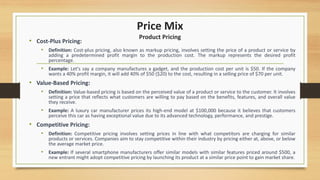
Price Mix
Product Pricing
• Cost-Plus Pricing:
• Definition: Cost-plus pricing, also known as markup pricing, involves setting the price of a product or service by
adding a predetermined profit margin to the production cost. The markup represents the desired profit
percentage.
• Example: Let's say a company manufactures a gadget, and the production cost per unit is $50. If the company
wants a 40% profit margin, it will add 40% of $50 ($20) to the cost, resulting in a selling price of $70 per unit.
• Value-Based Pricing:
• Definition: Value-based pricing is based on the perceived value of a product or service to the customer. It involves
setting a price that reflects what customers are willing to pay based on the benefits, features, and overall value
they receive.
• Example: A luxury car manufacturer prices its high-end model at $100,000 because it believes that customers
perceive this car as having exceptional value due to its advanced technology, performance, and prestige.
• Competitive Pricing:
• Definition: Competitive pricing involves setting prices in line with what competitors are charging for similar
products or services. Companies aim to stay competitive within their industry by pricing either at, above, or below
the average market price.
• Example: If several smartphone manufacturers offer similar models with similar features priced around $500, a
new entrant might adopt competitive pricing by launching its product at a similar price point to gain market share.
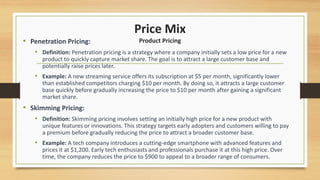
Price Mix
Product Pricing
• Penetration Pricing:
• Definition: Penetration pricing is a strategy where a company initially sets a low price for a new
product to quickly capture market share. The goal is to attract a large customer base and
potentially raise prices later.
• Example: A new streaming service offers its subscription at $5 per month, significantly lower
than established competitors charging $10 per month. By doing so, it attracts a large customer
base quickly before gradually increasing the price to $10 per month after gaining a significant
market share.
• Skimming Pricing:
• Definition: Skimming pricing involves setting an initially high price for a new product with
unique features or innovations. This strategy targets early adopters and customers willing to pay
a premium before gradually reducing the price to attract a broader customer base.
• Example: A tech company introduces a cutting-edge smartphone with advanced features and
prices it at $1,200. Early tech enthusiasts and professionals purchase it at this high price. Over
time, the company reduces the price to $900 to appeal to a broader range of consumers.
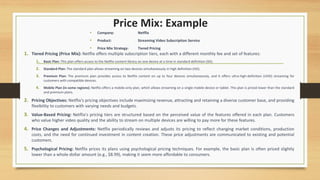
Price Mix: Example
1. Tiered Pricing (Price Mix): Netflix offers multiple subscription tiers, each with a different monthly fee and set of features:
1. Basic Plan: This plan offers access to the Netflix content library on one device at a time in standard definition (SD).
2. Standard Plan: The standard plan allows streaming on two devices simultaneously in high definition (HD).
3. Premium Plan: The premium plan provides access to Netflix content on up to four devices simultaneously, and it offers ultra-high-definition (UHD) streaming for
customers with compatible devices.
4. Mobile Plan (in some regions): Netflix offers a mobile-only plan, which allows streaming on a single mobile device or tablet. This plan is priced lower than the standard
and premium plans.
2. Pricing Objectives: Netflix's pricing objectives include maximizing revenue, attracting and retaining a diverse customer base, and providing
flexibility to customers with varying needs and budgets.
3. Value-Based Pricing: Netflix's pricing tiers are structured based on the perceived value of the features offered in each plan. Customers
who value higher video quality and the ability to stream on multiple devices are willing to pay more for these features.
4. Price Changes and Adjustments: Netflix periodically reviews and adjusts its pricing to reflect changing market conditions, production
costs, and the need for continued investment in content creation. These price adjustments are communicated to existing and potential
customers.
5. Psychological Pricing: Netflix prices its plans using psychological pricing techniques. For example, the basic plan is often priced slightly
lower than a whole-dollar amount (e.g., $8.99), making it seem more affordable to consumers.
• Company: Netflix
• Product: Streaming Video Subscription Service
• Price Mix Strategy: Tiered Pricing
Place Mix
It refers to the strategies and decisions a company makes regarding how it will distribute its products
or services to reach and serve its target customers effectively.
• Distribution Channels: Distribution channels can include direct channels (selling directly
to consumers) and indirect channels (using intermediaries like retailers, wholesalers,
distributors, or agents).
• Physical Distribution: This aspect focuses on the logistical and physical aspects of
distribution, including transportation, warehousing, inventory management, and order
processing.
• E-commerce and Online Sales: Companies also needs to consider online distribution
channels. This may include their own e-commerce websites, third-party online
marketplaces, or digital platforms for sales and distribution.
• Brick-and-Mortar Retail: For physical products, decisions about retail locations, store
formats, and store design play a crucial role in the place mix.
Place Mix : Example 1
Starbucks, a global coffeehouse chain, uses a multi-channel distribution strategy to make its coffee and related products accessible to customers. This strategy
involves various distribution channels to reach a broad and diverse customer base. Here's how Starbucks implements its place mix:
• Company-Owned Stores: Starbucks operates a vast network of company-owned stores worldwide. These physical locations serve as the primary distribution
channel for its coffee products. Customers can visit Starbucks stores to purchase brewed coffee, espresso beverages, whole bean coffee, and a range of
related products like mugs and coffee machines.
• Franchise Stores: In addition to its company-owned stores, Starbucks franchises some of its locations, allowing local entrepreneurs to operate Starbucks
coffee shops. This approach extends the company's reach, especially in regions where it may be challenging to establish company-owned stores.
• Grocery Retailers: Starbucks has partnerships with grocery retailers, such as supermarkets and grocery store chains. It distributes its packaged coffee beans,
ground coffee, and ready-to-drink coffee products to these retailers, making its products available for purchase in grocery store aisles.
• Online Sales: Starbucks maintains an e-commerce platform that enables customers to order coffee beans, merchandise, and other products directly from its
website. This online sales channel provides convenience for customers who prefer to shop from home.
• Mobile Ordering and Delivery: Starbucks has a mobile app that allows customers to place orders for pickup in-store or delivery to their location. This mobile
ordering and delivery service leverages technology to enhance the convenience of accessing Starbucks products.
• Partnerships and Licensing: Starbucks has entered into partnerships and licensing agreements with various businesses, including hotels, airlines, and
colleges. These partnerships allow Starbucks to serve its coffee in these establishments, expanding its presence into different customer segments and
locations.
• Licensed Stores: Beyond franchise stores, Starbucks has licensed stores within other businesses, such as bookstores and airports. These licensed locations
cater to specific customer groups and offer Starbucks products in non-traditional settings.
• Drive-Thru Locations: Many Starbucks stores have drive-thru windows, providing customers with a quick and convenient way to purchase coffee without
leaving their vehicles.
Company: Starbucks Corporation
Product: Coffee and Coffee-Related Products
Place Mix Strategy: Multi-Channel Distribution
Place Mix : Example 2
1. Apple Retail Stores (Place Mix): Apple operates a network of Apple Retail Stores, which are dedicated to showcasing and selling
Apple products, including the iPhone. These retail stores are known for their distinctive architecture, customer service, and in-store
experience.
Distribution Channels: Apple Retail Stores serve as direct distribution channels for the iPhone and other Apple products. Customers can visit these
stores to see and experience the products firsthand, receive technical support, and make purchases.
2. Authorized Retailers (Place Mix): In addition to its own retail stores, Apple partners with authorized retailers and carriers to expand
the distribution of iPhones. These authorized retailers include electronics stores, wireless carriers, and department stores.
Geographic Coverage: By collaborating with authorized retailers, Apple ensures that the iPhone is available in a wide range of locations, both
nationally and globally. Customers can purchase iPhones through these third-party retailers, often with associated carrier plans.
3. Online Apple Store (Place Mix): Apple maintains its online Apple Store, where customers can browse, configure, and purchase
iPhones and other Apple products. The online store serves as a convenient distribution channel for customers who prefer to shop
online.
E-commerce: The online Apple Store complements the physical retail presence by providing customers with access to Apple products from anywhere
with an internet connection.
4. Carrier Partnerships (Place Mix): Apple collaborates with various wireless carriers worldwide to offer iPhones with carrier-specific
plans. These partnerships allow customers to purchase iPhones and activate them with the carrier of their choice.
Customer Choice: Carrier partnerships give customers the flexibility to choose their preferred mobile carrier while still accessing the iPhone.
Company: Apple Inc.
Product: iphones
Place Mix Strategy: Apple Retail Stores and Authorized Retailers
Promotion Mix
refers to the various tools and tactics that a company uses to communicate and promote its products
or services to its target audience.
1. Advertising: Advertising involves paid communication through various media channels, such as
television, radio, print (magazines and newspapers), online banners, social media ads, influencer
marketing, content marketing and billboards. Advertising is used to create awareness, inform, persuade,
and remind customers about a product or service.
2. Sales Promotion: Sales promotion includes short-term promotional activities designed to stimulate
immediate sales or enhance brand loyalty. Examples of sales promotion tactics include discounts,
coupons, contests, sweepstakes, loyalty programs, and free samples.
3. Public Relations (PR): Public relations activities focus on managing and enhancing the company's
reputation and maintaining positive relationships with the public and the media. PR efforts may include
press releases, media coverage, sponsorships, events, and crisis management.
4. Personal Selling: Personal selling involves direct interaction between a salesperson and a potential
customer. This communication method is often used for high-value or complex products and services,
where a personalized approach is necessary to address customer needs and objections.
Promotion Mix : Example 1
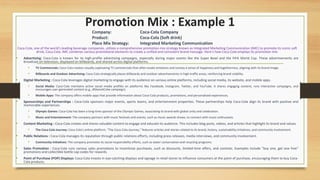
Coca-Cola, one of the world's leading beverage companies, utilizes a comprehensive promotion mix strategy known as Integrated Marketing Communication (IMC) to promote its iconic soft
drink, Coca-Cola. IMC combines various promotional elements to create a unified and consistent brand message. Here's how Coca-Cola employs its promotion mix:
• Advertising: Coca-Cola is known for its high-profile advertising campaigns, especially during major events like the Super Bowl and the FIFA World Cup. These advertisements are
broadcast on television, displayed on billboards, and shared across digital platforms.
• TV Commercials: Coca-Cola creates visually captivating TV commercials that often evoke emotions and convey a sense of happiness and togetherness, aligning with its brand image.
• Billboards and Outdoor Advertising: Coca-Cola strategically places billboards and outdoor advertisements in high-traffic areas, reinforcing brand visibility.
• Digital Marketing : Coca-Cola leverages digital marketing to engage with its audience on various online platforms, including social media, its website, and mobile apps.
• Social Media: Coca-Cola maintains active social media profiles on platforms like Facebook, Instagram, Twitter, and YouTube. It shares engaging content, runs interactive campaigns, and
encourages user-generated content (e.g., #ShareACoke campaign).
• Mobile Apps: The company offers mobile apps that provide information about Coca-Cola products, promotions, and personalized experiences.
• Sponsorships and Partnerships : Coca-Cola sponsors major events, sports teams, and entertainment properties. These partnerships help Coca-Cola align its brand with positive and
memorable experiences.
• Olympic Games: Coca-Cola has been a long-time sponsor of the Olympic Games, associating its brand with global unity and celebration.
• Music and Entertainment: The company partners with music festivals and events, such as music awards shows, to connect with music enthusiasts.
• Content Marketing : Coca-Cola creates and shares valuable content to engage and educate its audience. This includes blog posts, videos, and articles that highlight its brand and values.
• The Coca-Cola Journey: Coca-Cola's online platform, "The Coca-Cola Journey," features articles and stories related to its brand, history, sustainability initiatives, and community involvement.
• Public Relations : Coca-Cola manages its reputation through public relations efforts, including press releases, media interviews, and community involvement.
• Community Initiatives: The company promotes its social responsibility efforts, such as water conservation and recycling programs.
• Sales Promotion : Coca-Cola runs various sales promotions to incentivize purchases, such as discounts, limited-time offers, and contests. Examples include "buy one, get one free"
promotions and collectible bottle cap codes for rewards.
• Point of Purchase (POP) Displays: Coca-Cola invests in eye-catching displays and signage in retail stores to influence consumers at the point of purchase, encouraging them to buy Coca-
Cola products.
Company: Coca-Cola Company
Product: Coca-Cola (Soft drink)
Place Mix Strategy: Integrated Marketing Communication
Promotion Mix : Example 2
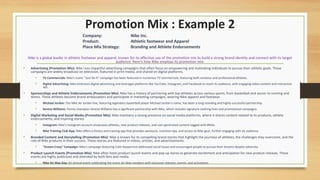
Nike is a global leader in athletic footwear and apparel, known for its effective use of the promotion mix to build a strong brand identity and connect with its target
audience. Here's how Nike employs its promotion mix:
• Advertising (Promotion Mix): Nike runs impactful advertising campaigns that often focus on empowering and motivating individuals to pursue their athletic goals. These
campaigns are widely broadcast on television, featured in print media, and shared on digital platforms.
• TV Commercials: Nike's iconic "Just Do It" campaign has been featured in numerous TV commercials, featuring both amateur and professional athletes.
• Digital Advertising: Nike embraces digital advertising and leverages platforms like YouTube, Instagram, and Facebook to reach its audience, with engaging video content and interactive
ads.
• Sponsorships and Athlete Endorsements (Promotion Mix): Nike has a history of partnering with top athletes across various sports, from basketball and soccer to running and
tennis. These athletes become brand ambassadors and participate in marketing campaigns, wearing Nike apparel and footwear.
• Michael Jordan: The Nike Air Jordan line, featuring legendary basketball player Michael Jordan's name, has been a long-standing and highly successful partnership.
• Serena Williams: Tennis champion Serena Williams has a significant partnership with Nike, which includes signature clothing lines and promotional campaigns.
• Digital Marketing and Social Media (Promotion Mix): Nike maintains a strong presence on social media platforms, where it shares content related to its products, athlete
endorsements, and inspiring stories.
• Instagram: Nike's Instagram account showcases athletes, new product releases, and user-generated content tagged with #Nike.
• Nike Training Club App: Nike offers a fitness and training app that provides workouts, nutrition tips, and access to Nike gear, further engaging with its audience.
• Branded Content and Storytelling (Promotion Mix): Nike is known for its compelling brand stories that highlight the journeys of athletes, the challenges they overcome, and the
role of Nike products in their success. These stories are featured in videos, articles, and advertisements.
• "Dream Crazy" Campaign: Nike's campaign featuring Colin Kaepernick addressed social issues and encouraged people to pursue their dreams despite adversity.
• Product Launch Events (Promotion Mix): Nike often hosts product launch events and pop-up stores to generate excitement and anticipation for new product releases. These
events are highly publicized and attended by both fans and media.
• Nike Air Max Day: An annual event celebrating the iconic Air Max sneakers with exclusive releases, events, and activations
Company: Nike Inc.
Product: Athletic footwear and Apparel
Place Mix Strategy: Branding and Athlete Endorsements
People
• Employees: People are the frontline of a service business. Well-trained and motivated
employees play a significant role in delivering high-quality service. They interact with
customers, provide assistance, and create lasting impressions. Employee attitudes, skills, and
behavior can strongly influence customer satisfaction.
• Customer Service: Excellent customer service is a key component of the "People" aspect.
Businesses must ensure that employees are trained to handle customer inquiries,
complaints, and requests effectively and courteously. Building strong relationships with
customers through personalized service can enhance loyalty.
• Employee Appearance and Behavior: The appearance and behavior of employees, including
their dress code, professionalism, and friendliness, can impact customers' perceptions of the
service quality.
Process
• Service Delivery Process: This involves the step-by-step procedures and workflows that
govern how a service is delivered. A well-defined and efficient process ensures consistency
and quality in service delivery. It helps minimize errors and delays, leading to improved
customer satisfaction.
• Customer Journey: Understanding the customer journey is essential. This includes mapping
out the various touchpoints and interactions a customer has with the business, from initial
contact to post-service follow-up. Analyzing the customer journey helps identify
opportunities for improvement.
• Service Recovery: In the event of service failures or customer complaints, a well-defined
process for service recovery is crucial. This process outlines how employees should handle
issues, resolve complaints, and restore customer satisfaction.
Physical Evidence
• Tangible Elements: Physical evidence refers to the tangible cues or elements that customers encounter when
using a service. These can include the physical environment (e.g., store layout, cleanliness), equipment (e.g.,
tools, machinery), signage, brochures, uniforms, and any other visual or sensory aspects.
• Branding and Presentation: The physical evidence should align with the brand's image and promise.
Consistency in branding, design, and presentation helps reinforce the brand's identity and build trust with
customers.
• Atmosphere: Creating the right atmosphere or ambiance is crucial, especially in businesses like restaurants,
hotels, and spas. It influences how customers perceive and enjoy the service experience.
• Service Documentation: Providing clear and well-designed service-related documents, such as menus,
instruction manuals, or service agreements, can enhance the customer's understanding and confidence in the
service.
Service Marketing
refers to the process of promoting and selling services to customers
1. Intangibility: Services lack physical attributes that customers can touch or see before purchasing. Therefore, service
marketing must emphasize creating a tangible image or perception of the service. This can be achieved through
effective branding, storytelling, and showcasing positive customer experiences.
2. Inseparability: Services are often produced and consumed simultaneously. Customers are active participants in the
service delivery process. Marketing efforts should emphasize the role of skilled and friendly service providers in
delivering exceptional experiences.
3. Variability/Inconsistent: Services can vary in quality from one interaction to another. Service marketing should focus
on standardizing processes and maintaining consistency in service delivery. Quality control measures, employee
training, and feedback mechanisms are essential.
4. Perishability: Services cannot be stored or inventoried like physical products. Empty seats on a plane or unused
appointment slots at a spa represent lost revenue opportunities. Effective pricing, capacity management, and demand
forecasting are critical in service marketing.
5. Transfer of Ownership: , the focus is on promoting and delivering intangible services rather than transferring ownership of physical assets
Service Marketing Example
Company: Airbnb
Service: Peer-to-Peer Accommodation Rental
Service Marketing Strategies:
1. Online Presence and User Experience: Airbnb has a user-friendly website and mobile app that allow hosts to list their properties and travelers to search and book
accommodations. The platform provides high-quality photos, detailed property descriptions, and user reviews to enhance trust and transparency.
2. Content Marketing: Airbnb uses content marketing to educate and engage its audience. They create blog posts, videos, and city guides to inspire travelers and help
them plan their trips. This content builds trust and positions Airbnb as an expert in travel and hospitality.
3. Customer Reviews and Ratings: Customer reviews play a significant role in service marketing for Airbnb. Hosts and guests can leave reviews, which help potential
guests make informed decisions. Positive reviews and high ratings encourage bookings.
4. Personalization: Airbnb uses data-driven personalization to recommend properties and experiences to users based on their search history and preferences. This
enhances the user experience and increases the likelihood of bookings.
5. Social Media Marketing: Airbnb has a strong presence on social media platforms like Instagram, Facebook, and Twitter. They showcase user-generated content,
host stories, and travel inspiration to engage with their community and attract new users.
6. Trust and Safety: Airbnb promotes trust and safety through features like identity verification, secure payment processing, and host guarantees. These measures
reassure both hosts and guests and contribute to the marketing of the platform.
7. Partnerships: Airbnb partners with influencers, brands, and organizations in the travel and hospitality industry to expand its reach. These collaborations create
marketing opportunities and special offers for users.
8. Global Expansion: Airbnb's global presence and marketing campaigns in various countries have helped it become a household name in the hospitality industry.
They tailor their marketing messages to different cultural and regional preferences.
Difference between Product Marketing and Service Marketing
• Nature of Offering:
• Product Marketing: Product marketing focuses on promoting and selling tangible products, which customers can touch, see, and
often evaluate before purchasing. Products can be physical goods such as smartphones, clothing, or appliances.
• Service Marketing: Service marketing, on the other hand, centers on promoting and selling intangible services, which are actions,
experiences, or expertise that customers receive. Services include activities like consulting, healthcare, hospitality, or education.
• Customer Participation:
• Product Marketing: In product marketing, customers are passive recipients. They do not actively participate in the production or
delivery of the product.
• Service Marketing: In service marketing, customers often play an active role in the co-creation of value. For example, patients
provide information to doctors, customers participate in consulting discussions, or diners interact with restaurant staff.
• Pricing Strategies:
• Product Marketing: Pricing products often considers factors like production costs, competitor pricing, and perceived value.
Strategies may include cost-plus pricing or competitive pricing.
• Service Marketing: Pricing services can be more complex. It often considers factors like expertise, time, and customization. Value-
based pricing, tiered pricing, or subscription models are common in service marketing.
Difference between Product Marketing and Service Marketing
• Quality and Consistency:
• Product Marketing: Quality control is primarily focused on the manufacturing process, ensuring consistency and reliability in product
features. Variability in quality is typically lower for products.
• Service Marketing: Service quality can vary due to the human element involved in service delivery. Maintaining consistent service
quality can be more challenging.
• Inventory and Perishability:
• Product Marketing: Products can be manufactured in advance, stored, and sold when needed. They do not perish and can be stored
for extended periods.
• Service Marketing: Services are perishable and often cannot be stored. Unsold service capacity represents lost revenue
opportunities. Managing service capacity and demand is crucial.
• Promotion and Communication:
• Product Marketing: Promotion often emphasizes product features, design, and physical attributes. Visual advertising and packaging
are common promotional tools.
• Service Marketing: Promotion focuses on communicating the benefits and experiences associated with the service. Testimonials,
customer reviews, and storytelling are effective in service marketing.

Introduction to Marketing ppt2.pdf

  • 1.
  • 2.
    Marketing Mix • Themarketing mix, often referred to as the "4Ps," is a fundamental framework in marketing that represents the essential elements a business needs to consider when planning and executing its marketing strategy. • The marketing mix consists of four interconnected components: • Product • Price • Place (Physical Distribution) • Promotion
  • 3.
    Product Mix • ProductLines: These are groups of related products offered by a company. Each product line typically serves a specific market segment or addresses a particular customer need. For example, a clothing retailer may have product lines for men's, women's, and children's apparel. • Product Width: Product width refers to the number of different product lines a company offers. A company with a broad product width has a wide variety of product lines, while one with a narrow product width offers a limited range of product lines. • Product Depth: Product depth refers to the number of products within each product line. A product line with a deep product depth offers many variations or models, while one with shallow product depth offers fewer options. • Product Consistency: Product consistency assesses how closely related the various product lines are within the product mix. Companies can have a consistent or diversified product mix. For example, a company that offers both sports equipment and cosmetics would have a diversified product mix, while a company that focuses solely on electronics would have a consistent product mix.
  • 4.
    Product Mix • ProductLife Cycle: Understanding where products are in their life cycle (introduction, growth, maturity, or decline) is crucial for managing the product mix. Companies may need to introduce new products to replace declining ones or invest in marketing to extend the life cycle of mature products. • Product Branding: The way products are branded can also be a component of the product mix. Companies may offer different brands within their product mix to appeal to different customer segments or to position themselves differently in the market. • Product Packaging: Packaging design and quality can be a crucial component, especially in industries where aesthetics and presentation matter. Packaging can impact a product's perceived value and attractiveness to customers. • Product Pricing: The pricing strategy for each product or product line is an important component. Companies may offer a range of price points within their product mix to cater to different customer budgets. • Product Features and Benefits: The unique features, functions, and benefits of each product or product line are essential considerations. This component focuses on what makes each product attractive to customers.
  • 5.
    Product Mix • ProductQuality and Durability: The level of quality and durability associated with each product or product line can significantly impact customer satisfaction and brand reputation. • Product Positioning: How a company positions its products in the market, whether as high-end luxury items or affordable essentials, is a key component of the product mix. • Product Differentiation: Companies may differentiate their products through various means, such as technology, design, or customer service, to stand out from competitors. • Product Availability and Distribution: Ensuring that products are readily available to customers through various distribution channels is crucial. This includes considerations like retail stores, e-commerce, and wholesalers. • Product Promotion: Marketing and promotional strategies for each product or product line play a vital role in the product mix. These strategies can include advertising, promotions, and public relations efforts.
  • 6.
    Product Mix Examples •Procter & Gamble (P&G): P&G is a consumer goods giant known for its wide-ranging product mix, including brands like Tide (laundry detergent), Crest (oral care), Pampers (baby diapers), Gillette (razors and grooming products), and Olay (skincare). They cater to various consumer needs across multiple product categories. • General Electric (GE): GE has a diverse product mix that spans various industries, including aviation, healthcare, energy, and more. They manufacture aircraft engines, medical imaging equipment, power generation solutions, and locomotives, among other products. • Samsung: Samsung is a multinational conglomerate with a broad product mix that includes smartphones, televisions, home appliances, semiconductors, and even construction services. They serve both consumers and businesses in multiple sectors. • Amazon: Amazon, originally an online bookstore, has expanded its product mix dramatically. It now offers e-commerce services, cloud computing through Amazon Web Services (AWS), streaming media with Amazon Prime Video, and smart home devices like the Amazon Echo. • Nestlé: Nestlé is a food and beverage company with a diverse product mix that includes brands like Nescafé (coffee), Nestea (iced tea), Purina (pet food), Kit Kat (chocolate), and more. They operate in various segments within the food and beverage industry.
  • 7.
    Product Mix Examples •The Walt Disney Company: Disney has a diverse product mix that includes not only its iconic animated and live-action films but also theme parks, consumer products (toys, apparel), television networks (ABC, ESPN), and a streaming service (Disney+). • Coca-Cola: Coca-Cola is a beverage company with a wide-ranging product mix, including carbonated soft drinks (Coca-Cola, Sprite), juices (Minute Maid), bottled water (Dasani), and sports drinks (Powerade). • Toyota: Toyota's product mix extends beyond automobiles to include a variety of vehicles like trucks and hybrids, as well as financial services, robotics, and even partnerships in the field of artificial intelligence and mobility. • Unilever: Unilever offers a diverse range of consumer goods, including food products (Ben & Jerry's, Lipton), personal care items (Dove, Axe), and cleaning products (Dove, Axe), making it a prominent example of a company with a broad product mix.
  • 8.
    Price Mix is afundamental concept in marketing that encompasses various elements related to pricing strategies and decisions. • Product Pricing: This involves determining the price at which a company will sell its products or services to customers. It's a critical decision as it directly affects revenue, profit margins, and customer perception of value. Pricing strategies can vary, such as cost-plus pricing, value-based pricing, competitive pricing, penetration pricing, and skimming pricing • Pricing Objectives: Companies must establish clear pricing objectives that align with their overall business goals. Common pricing objectives include maximizing profit, market share, revenue growth, or maintaining price stability. • Price Segmentation: This involves dividing the market into segments based on factors such as customer demographics, geographic location, or purchase behavior. Companies can then set different prices for each segment to better match customer preferences and willingness to pay. • Psychological Pricing: This technique involves setting prices to appeal to consumers' psychological perceptions. Examples include setting prices at $9.99 instead of $10.00 or emphasizing value for money.
  • 9.
    Price Mix Product Pricing •Cost-Plus Pricing: • Definition: Cost-plus pricing, also known as markup pricing, involves setting the price of a product or service by adding a predetermined profit margin to the production cost. The markup represents the desired profit percentage. • Example: Let's say a company manufactures a gadget, and the production cost per unit is $50. If the company wants a 40% profit margin, it will add 40% of $50 ($20) to the cost, resulting in a selling price of $70 per unit. • Value-Based Pricing: • Definition: Value-based pricing is based on the perceived value of a product or service to the customer. It involves setting a price that reflects what customers are willing to pay based on the benefits, features, and overall value they receive. • Example: A luxury car manufacturer prices its high-end model at $100,000 because it believes that customers perceive this car as having exceptional value due to its advanced technology, performance, and prestige. • Competitive Pricing: • Definition: Competitive pricing involves setting prices in line with what competitors are charging for similar products or services. Companies aim to stay competitive within their industry by pricing either at, above, or below the average market price. • Example: If several smartphone manufacturers offer similar models with similar features priced around $500, a new entrant might adopt competitive pricing by launching its product at a similar price point to gain market share.
  • 10.
    Price Mix Product Pricing •Penetration Pricing: • Definition: Penetration pricing is a strategy where a company initially sets a low price for a new product to quickly capture market share. The goal is to attract a large customer base and potentially raise prices later. • Example: A new streaming service offers its subscription at $5 per month, significantly lower than established competitors charging $10 per month. By doing so, it attracts a large customer base quickly before gradually increasing the price to $10 per month after gaining a significant market share. • Skimming Pricing: • Definition: Skimming pricing involves setting an initially high price for a new product with unique features or innovations. This strategy targets early adopters and customers willing to pay a premium before gradually reducing the price to attract a broader customer base. • Example: A tech company introduces a cutting-edge smartphone with advanced features and prices it at $1,200. Early tech enthusiasts and professionals purchase it at this high price. Over time, the company reduces the price to $900 to appeal to a broader range of consumers.
  • 11.
    Price Mix: Example 1.Tiered Pricing (Price Mix): Netflix offers multiple subscription tiers, each with a different monthly fee and set of features: 1. Basic Plan: This plan offers access to the Netflix content library on one device at a time in standard definition (SD). 2. Standard Plan: The standard plan allows streaming on two devices simultaneously in high definition (HD). 3. Premium Plan: The premium plan provides access to Netflix content on up to four devices simultaneously, and it offers ultra-high-definition (UHD) streaming for customers with compatible devices. 4. Mobile Plan (in some regions): Netflix offers a mobile-only plan, which allows streaming on a single mobile device or tablet. This plan is priced lower than the standard and premium plans. 2. Pricing Objectives: Netflix's pricing objectives include maximizing revenue, attracting and retaining a diverse customer base, and providing flexibility to customers with varying needs and budgets. 3. Value-Based Pricing: Netflix's pricing tiers are structured based on the perceived value of the features offered in each plan. Customers who value higher video quality and the ability to stream on multiple devices are willing to pay more for these features. 4. Price Changes and Adjustments: Netflix periodically reviews and adjusts its pricing to reflect changing market conditions, production costs, and the need for continued investment in content creation. These price adjustments are communicated to existing and potential customers. 5. Psychological Pricing: Netflix prices its plans using psychological pricing techniques. For example, the basic plan is often priced slightly lower than a whole-dollar amount (e.g., $8.99), making it seem more affordable to consumers. • Company: Netflix • Product: Streaming Video Subscription Service • Price Mix Strategy: Tiered Pricing
  • 12.
    Place Mix It refersto the strategies and decisions a company makes regarding how it will distribute its products or services to reach and serve its target customers effectively. • Distribution Channels: Distribution channels can include direct channels (selling directly to consumers) and indirect channels (using intermediaries like retailers, wholesalers, distributors, or agents). • Physical Distribution: This aspect focuses on the logistical and physical aspects of distribution, including transportation, warehousing, inventory management, and order processing. • E-commerce and Online Sales: Companies also needs to consider online distribution channels. This may include their own e-commerce websites, third-party online marketplaces, or digital platforms for sales and distribution. • Brick-and-Mortar Retail: For physical products, decisions about retail locations, store formats, and store design play a crucial role in the place mix.
  • 13.
    Place Mix :Example 1 Starbucks, a global coffeehouse chain, uses a multi-channel distribution strategy to make its coffee and related products accessible to customers. This strategy involves various distribution channels to reach a broad and diverse customer base. Here's how Starbucks implements its place mix: • Company-Owned Stores: Starbucks operates a vast network of company-owned stores worldwide. These physical locations serve as the primary distribution channel for its coffee products. Customers can visit Starbucks stores to purchase brewed coffee, espresso beverages, whole bean coffee, and a range of related products like mugs and coffee machines. • Franchise Stores: In addition to its company-owned stores, Starbucks franchises some of its locations, allowing local entrepreneurs to operate Starbucks coffee shops. This approach extends the company's reach, especially in regions where it may be challenging to establish company-owned stores. • Grocery Retailers: Starbucks has partnerships with grocery retailers, such as supermarkets and grocery store chains. It distributes its packaged coffee beans, ground coffee, and ready-to-drink coffee products to these retailers, making its products available for purchase in grocery store aisles. • Online Sales: Starbucks maintains an e-commerce platform that enables customers to order coffee beans, merchandise, and other products directly from its website. This online sales channel provides convenience for customers who prefer to shop from home. • Mobile Ordering and Delivery: Starbucks has a mobile app that allows customers to place orders for pickup in-store or delivery to their location. This mobile ordering and delivery service leverages technology to enhance the convenience of accessing Starbucks products. • Partnerships and Licensing: Starbucks has entered into partnerships and licensing agreements with various businesses, including hotels, airlines, and colleges. These partnerships allow Starbucks to serve its coffee in these establishments, expanding its presence into different customer segments and locations. • Licensed Stores: Beyond franchise stores, Starbucks has licensed stores within other businesses, such as bookstores and airports. These licensed locations cater to specific customer groups and offer Starbucks products in non-traditional settings. • Drive-Thru Locations: Many Starbucks stores have drive-thru windows, providing customers with a quick and convenient way to purchase coffee without leaving their vehicles. Company: Starbucks Corporation Product: Coffee and Coffee-Related Products Place Mix Strategy: Multi-Channel Distribution
  • 14.
    Place Mix :Example 2 1. Apple Retail Stores (Place Mix): Apple operates a network of Apple Retail Stores, which are dedicated to showcasing and selling Apple products, including the iPhone. These retail stores are known for their distinctive architecture, customer service, and in-store experience. Distribution Channels: Apple Retail Stores serve as direct distribution channels for the iPhone and other Apple products. Customers can visit these stores to see and experience the products firsthand, receive technical support, and make purchases. 2. Authorized Retailers (Place Mix): In addition to its own retail stores, Apple partners with authorized retailers and carriers to expand the distribution of iPhones. These authorized retailers include electronics stores, wireless carriers, and department stores. Geographic Coverage: By collaborating with authorized retailers, Apple ensures that the iPhone is available in a wide range of locations, both nationally and globally. Customers can purchase iPhones through these third-party retailers, often with associated carrier plans. 3. Online Apple Store (Place Mix): Apple maintains its online Apple Store, where customers can browse, configure, and purchase iPhones and other Apple products. The online store serves as a convenient distribution channel for customers who prefer to shop online. E-commerce: The online Apple Store complements the physical retail presence by providing customers with access to Apple products from anywhere with an internet connection. 4. Carrier Partnerships (Place Mix): Apple collaborates with various wireless carriers worldwide to offer iPhones with carrier-specific plans. These partnerships allow customers to purchase iPhones and activate them with the carrier of their choice. Customer Choice: Carrier partnerships give customers the flexibility to choose their preferred mobile carrier while still accessing the iPhone. Company: Apple Inc. Product: iphones Place Mix Strategy: Apple Retail Stores and Authorized Retailers
  • 15.
    Promotion Mix refers tothe various tools and tactics that a company uses to communicate and promote its products or services to its target audience. 1. Advertising: Advertising involves paid communication through various media channels, such as television, radio, print (magazines and newspapers), online banners, social media ads, influencer marketing, content marketing and billboards. Advertising is used to create awareness, inform, persuade, and remind customers about a product or service. 2. Sales Promotion: Sales promotion includes short-term promotional activities designed to stimulate immediate sales or enhance brand loyalty. Examples of sales promotion tactics include discounts, coupons, contests, sweepstakes, loyalty programs, and free samples. 3. Public Relations (PR): Public relations activities focus on managing and enhancing the company's reputation and maintaining positive relationships with the public and the media. PR efforts may include press releases, media coverage, sponsorships, events, and crisis management. 4. Personal Selling: Personal selling involves direct interaction between a salesperson and a potential customer. This communication method is often used for high-value or complex products and services, where a personalized approach is necessary to address customer needs and objections.
  • 16.
    Promotion Mix :Example 1 Coca-Cola, one of the world's leading beverage companies, utilizes a comprehensive promotion mix strategy known as Integrated Marketing Communication (IMC) to promote its iconic soft drink, Coca-Cola. IMC combines various promotional elements to create a unified and consistent brand message. Here's how Coca-Cola employs its promotion mix: • Advertising: Coca-Cola is known for its high-profile advertising campaigns, especially during major events like the Super Bowl and the FIFA World Cup. These advertisements are broadcast on television, displayed on billboards, and shared across digital platforms. • TV Commercials: Coca-Cola creates visually captivating TV commercials that often evoke emotions and convey a sense of happiness and togetherness, aligning with its brand image. • Billboards and Outdoor Advertising: Coca-Cola strategically places billboards and outdoor advertisements in high-traffic areas, reinforcing brand visibility. • Digital Marketing : Coca-Cola leverages digital marketing to engage with its audience on various online platforms, including social media, its website, and mobile apps. • Social Media: Coca-Cola maintains active social media profiles on platforms like Facebook, Instagram, Twitter, and YouTube. It shares engaging content, runs interactive campaigns, and encourages user-generated content (e.g., #ShareACoke campaign). • Mobile Apps: The company offers mobile apps that provide information about Coca-Cola products, promotions, and personalized experiences. • Sponsorships and Partnerships : Coca-Cola sponsors major events, sports teams, and entertainment properties. These partnerships help Coca-Cola align its brand with positive and memorable experiences. • Olympic Games: Coca-Cola has been a long-time sponsor of the Olympic Games, associating its brand with global unity and celebration. • Music and Entertainment: The company partners with music festivals and events, such as music awards shows, to connect with music enthusiasts. • Content Marketing : Coca-Cola creates and shares valuable content to engage and educate its audience. This includes blog posts, videos, and articles that highlight its brand and values. • The Coca-Cola Journey: Coca-Cola's online platform, "The Coca-Cola Journey," features articles and stories related to its brand, history, sustainability initiatives, and community involvement. • Public Relations : Coca-Cola manages its reputation through public relations efforts, including press releases, media interviews, and community involvement. • Community Initiatives: The company promotes its social responsibility efforts, such as water conservation and recycling programs. • Sales Promotion : Coca-Cola runs various sales promotions to incentivize purchases, such as discounts, limited-time offers, and contests. Examples include "buy one, get one free" promotions and collectible bottle cap codes for rewards. • Point of Purchase (POP) Displays: Coca-Cola invests in eye-catching displays and signage in retail stores to influence consumers at the point of purchase, encouraging them to buy Coca- Cola products. Company: Coca-Cola Company Product: Coca-Cola (Soft drink) Place Mix Strategy: Integrated Marketing Communication
  • 17.
    Promotion Mix :Example 2 Nike is a global leader in athletic footwear and apparel, known for its effective use of the promotion mix to build a strong brand identity and connect with its target audience. Here's how Nike employs its promotion mix: • Advertising (Promotion Mix): Nike runs impactful advertising campaigns that often focus on empowering and motivating individuals to pursue their athletic goals. These campaigns are widely broadcast on television, featured in print media, and shared on digital platforms. • TV Commercials: Nike's iconic "Just Do It" campaign has been featured in numerous TV commercials, featuring both amateur and professional athletes. • Digital Advertising: Nike embraces digital advertising and leverages platforms like YouTube, Instagram, and Facebook to reach its audience, with engaging video content and interactive ads. • Sponsorships and Athlete Endorsements (Promotion Mix): Nike has a history of partnering with top athletes across various sports, from basketball and soccer to running and tennis. These athletes become brand ambassadors and participate in marketing campaigns, wearing Nike apparel and footwear. • Michael Jordan: The Nike Air Jordan line, featuring legendary basketball player Michael Jordan's name, has been a long-standing and highly successful partnership. • Serena Williams: Tennis champion Serena Williams has a significant partnership with Nike, which includes signature clothing lines and promotional campaigns. • Digital Marketing and Social Media (Promotion Mix): Nike maintains a strong presence on social media platforms, where it shares content related to its products, athlete endorsements, and inspiring stories. • Instagram: Nike's Instagram account showcases athletes, new product releases, and user-generated content tagged with #Nike. • Nike Training Club App: Nike offers a fitness and training app that provides workouts, nutrition tips, and access to Nike gear, further engaging with its audience. • Branded Content and Storytelling (Promotion Mix): Nike is known for its compelling brand stories that highlight the journeys of athletes, the challenges they overcome, and the role of Nike products in their success. These stories are featured in videos, articles, and advertisements. • "Dream Crazy" Campaign: Nike's campaign featuring Colin Kaepernick addressed social issues and encouraged people to pursue their dreams despite adversity. • Product Launch Events (Promotion Mix): Nike often hosts product launch events and pop-up stores to generate excitement and anticipation for new product releases. These events are highly publicized and attended by both fans and media. • Nike Air Max Day: An annual event celebrating the iconic Air Max sneakers with exclusive releases, events, and activations Company: Nike Inc. Product: Athletic footwear and Apparel Place Mix Strategy: Branding and Athlete Endorsements
  • 18.
    People • Employees: Peopleare the frontline of a service business. Well-trained and motivated employees play a significant role in delivering high-quality service. They interact with customers, provide assistance, and create lasting impressions. Employee attitudes, skills, and behavior can strongly influence customer satisfaction. • Customer Service: Excellent customer service is a key component of the "People" aspect. Businesses must ensure that employees are trained to handle customer inquiries, complaints, and requests effectively and courteously. Building strong relationships with customers through personalized service can enhance loyalty. • Employee Appearance and Behavior: The appearance and behavior of employees, including their dress code, professionalism, and friendliness, can impact customers' perceptions of the service quality.
  • 19.
    Process • Service DeliveryProcess: This involves the step-by-step procedures and workflows that govern how a service is delivered. A well-defined and efficient process ensures consistency and quality in service delivery. It helps minimize errors and delays, leading to improved customer satisfaction. • Customer Journey: Understanding the customer journey is essential. This includes mapping out the various touchpoints and interactions a customer has with the business, from initial contact to post-service follow-up. Analyzing the customer journey helps identify opportunities for improvement. • Service Recovery: In the event of service failures or customer complaints, a well-defined process for service recovery is crucial. This process outlines how employees should handle issues, resolve complaints, and restore customer satisfaction.
  • 20.
    Physical Evidence • TangibleElements: Physical evidence refers to the tangible cues or elements that customers encounter when using a service. These can include the physical environment (e.g., store layout, cleanliness), equipment (e.g., tools, machinery), signage, brochures, uniforms, and any other visual or sensory aspects. • Branding and Presentation: The physical evidence should align with the brand's image and promise. Consistency in branding, design, and presentation helps reinforce the brand's identity and build trust with customers. • Atmosphere: Creating the right atmosphere or ambiance is crucial, especially in businesses like restaurants, hotels, and spas. It influences how customers perceive and enjoy the service experience. • Service Documentation: Providing clear and well-designed service-related documents, such as menus, instruction manuals, or service agreements, can enhance the customer's understanding and confidence in the service.
  • 21.
    Service Marketing refers tothe process of promoting and selling services to customers 1. Intangibility: Services lack physical attributes that customers can touch or see before purchasing. Therefore, service marketing must emphasize creating a tangible image or perception of the service. This can be achieved through effective branding, storytelling, and showcasing positive customer experiences. 2. Inseparability: Services are often produced and consumed simultaneously. Customers are active participants in the service delivery process. Marketing efforts should emphasize the role of skilled and friendly service providers in delivering exceptional experiences. 3. Variability/Inconsistent: Services can vary in quality from one interaction to another. Service marketing should focus on standardizing processes and maintaining consistency in service delivery. Quality control measures, employee training, and feedback mechanisms are essential. 4. Perishability: Services cannot be stored or inventoried like physical products. Empty seats on a plane or unused appointment slots at a spa represent lost revenue opportunities. Effective pricing, capacity management, and demand forecasting are critical in service marketing. 5. Transfer of Ownership: , the focus is on promoting and delivering intangible services rather than transferring ownership of physical assets
  • 22.
    Service Marketing Example Company:Airbnb Service: Peer-to-Peer Accommodation Rental Service Marketing Strategies: 1. Online Presence and User Experience: Airbnb has a user-friendly website and mobile app that allow hosts to list their properties and travelers to search and book accommodations. The platform provides high-quality photos, detailed property descriptions, and user reviews to enhance trust and transparency. 2. Content Marketing: Airbnb uses content marketing to educate and engage its audience. They create blog posts, videos, and city guides to inspire travelers and help them plan their trips. This content builds trust and positions Airbnb as an expert in travel and hospitality. 3. Customer Reviews and Ratings: Customer reviews play a significant role in service marketing for Airbnb. Hosts and guests can leave reviews, which help potential guests make informed decisions. Positive reviews and high ratings encourage bookings. 4. Personalization: Airbnb uses data-driven personalization to recommend properties and experiences to users based on their search history and preferences. This enhances the user experience and increases the likelihood of bookings. 5. Social Media Marketing: Airbnb has a strong presence on social media platforms like Instagram, Facebook, and Twitter. They showcase user-generated content, host stories, and travel inspiration to engage with their community and attract new users. 6. Trust and Safety: Airbnb promotes trust and safety through features like identity verification, secure payment processing, and host guarantees. These measures reassure both hosts and guests and contribute to the marketing of the platform. 7. Partnerships: Airbnb partners with influencers, brands, and organizations in the travel and hospitality industry to expand its reach. These collaborations create marketing opportunities and special offers for users. 8. Global Expansion: Airbnb's global presence and marketing campaigns in various countries have helped it become a household name in the hospitality industry. They tailor their marketing messages to different cultural and regional preferences.
  • 23.
    Difference between ProductMarketing and Service Marketing • Nature of Offering: • Product Marketing: Product marketing focuses on promoting and selling tangible products, which customers can touch, see, and often evaluate before purchasing. Products can be physical goods such as smartphones, clothing, or appliances. • Service Marketing: Service marketing, on the other hand, centers on promoting and selling intangible services, which are actions, experiences, or expertise that customers receive. Services include activities like consulting, healthcare, hospitality, or education. • Customer Participation: • Product Marketing: In product marketing, customers are passive recipients. They do not actively participate in the production or delivery of the product. • Service Marketing: In service marketing, customers often play an active role in the co-creation of value. For example, patients provide information to doctors, customers participate in consulting discussions, or diners interact with restaurant staff. • Pricing Strategies: • Product Marketing: Pricing products often considers factors like production costs, competitor pricing, and perceived value. Strategies may include cost-plus pricing or competitive pricing. • Service Marketing: Pricing services can be more complex. It often considers factors like expertise, time, and customization. Value- based pricing, tiered pricing, or subscription models are common in service marketing.
  • 24.
    Difference between ProductMarketing and Service Marketing • Quality and Consistency: • Product Marketing: Quality control is primarily focused on the manufacturing process, ensuring consistency and reliability in product features. Variability in quality is typically lower for products. • Service Marketing: Service quality can vary due to the human element involved in service delivery. Maintaining consistent service quality can be more challenging. • Inventory and Perishability: • Product Marketing: Products can be manufactured in advance, stored, and sold when needed. They do not perish and can be stored for extended periods. • Service Marketing: Services are perishable and often cannot be stored. Unsold service capacity represents lost revenue opportunities. Managing service capacity and demand is crucial. • Promotion and Communication: • Product Marketing: Promotion often emphasizes product features, design, and physical attributes. Visual advertising and packaging are common promotional tools. • Service Marketing: Promotion focuses on communicating the benefits and experiences associated with the service. Testimonials, customer reviews, and storytelling are effective in service marketing.