INTRODUCTION TO
               MARKETING


           Lars Perner, Ph.D.
Assistant Professor of Clinical Marketing
        Department of Marketing
Marshall School of Business
              University of Southern California
              Los Angeles, CA 90089-0443, USA
                       (213) 740-7127


         NEW! Dr. Perner's new book Delightful Reflections:
Quips, Conjectues, and Pontifications is now avilable on Amazon.com!


                        Lars Perner, Ph.D.
             Assistant Professor of Clinical Marketing
                     Department of Marketing
                    Marshall School of Business
                 University of Southern California
                Los Angeles, CA 90089-0443, USA
                          (213) 740-7127


   INTRODUCTION TO MARKETING
Background
Marketing. Several definitions have been proposed for the term marketing. Each tends to
emphasize different issues. Memorizing a definition is unlikely to be useful; ultimately, it
makes more sense to thinking of ways to benefit from creating customer value in the most
effective way, subject to ethical and other constraints that one may have. The 2006 and
2007 definitions offered by the American Marketing Association are relatively similar, with
the 2007 appearing a bit more concise. Note that the definitions make several points:

                                               A main objective of marketing is to create
                                               customer value.
                                               Marketing usually involves an exchange
                                               between buyers and sellers or between
                                               other parties.
                                               Marketing has an impact on the firm, its
                                               suppliers, its customers, and others
                                               affected by the firm’s choices.
                                               Marketing frequently involves enduring
                                               relationships between buyers, sellers, and
                                               other parties.
                                               Processes involved include ―creating,
                                               communicating, delivering, and exchanging
                                               offerings.”

Delivering customer value. The central idea behind marketing is the idea that a firm or
other entity will create something of value to one or more customers who, in turn, are
willing to pay enough (or contribute other forms of value) to make the venture worthwhile
considering opportunity costs. Value can be created in a number of different ways. Some
firms manufacture basic products (e.g., bricks) but provide relatively little value above
that. Other firms make products whose tangible value is supplemented by services (e.g., a
computer manufacturer provides a computer loaded with software and provides a
warranty, technical support, and software updates). It is not necessary for a firm to
physically handle a product to add value—e.g., online airline reservation systems add value
by (1) compiling information about available flight connections and fares, (2) allowing the
customer to buy a ticket, (3) forwarding billing information to the airline, and (4)
forwarding reservation information to the customer.

It should be noted that value must be examined from the point of view of the customer.
Some customer segments value certain product attributes more than others. A very
expensive product—relative to others in the category—may, in fact, represent great value
to a particular customer segment because the benefits received are seen as even greater
than the sacrifice made (usually in terms of money). Some segments have very unique and
specific desires, and may value what—to some individuals—may seem a ―lower quality‖
item—very highly.

Some forms of customer value. The marketing process involves ways that value can be
created for the customer. Form utility involves the idea that the product is made
available to the consumer in some form that is more useful than any commodities that are
used to create it. A customer buys a chair, for example, rather than the wood and other
components used to create the chair. Thus, the customer benefits from the specialization
that allows the manufacturer to more efficiently create a chair than the customer could
do himself or herself. Place utility refers to the idea that a product made available to the
customer at a preferred location is worth more than one at the place of manufacture. It is
much more convenient for the customer to be able to buy food items in a supermarket in
his or her neighborhood than it is to pick up these from the farmer. Time utility involves
the idea of having the product made available when needed by the customer. The
customer may buy a turkey a few days before Thanksgiving without having to plan to have
it available. Intermediaries take care of the logistics to have the turkeys—which are easily
perishable and bulky to store in a freezer—available when customers demand them.
Possession utility involves the idea that the consumer can go to one store and obtain a
large assortment of goods from different manufacturers during one shopping occasion.
Supermarkets combine food and other household items from a number of different
suppliers in one place. Certain ―superstores‖ such as the European hypermarkets and the
Wal-Mart ―super centers‖ combine even more items into one setting.

The marketing vs. the selling concept. Two approaches to marketing exist. The
traditional selling concept emphasizes selling existing products. The philosophy here is
that if a product is not selling, more aggressive measures must be taken to sell it—e.g.,
cutting price, advertising more, or hiring more aggressive (and obnoxious) sales-people.
When the railroads started to lose business due to the advent of more effective trucks that
could deliver goods right to the customer’s door, the railroads cut prices instead of
recognizing that the customers ultimately wanted transportation of goods, not necessarily
railroad transportation. Smith Corona, a manufacturer of typewriters, was too slow to
realize that consumers wanted the ability to process documents and not typewriters per
se. The marketing concept, in contrast, focuses on getting consumers what they seek,
regardless of whether this entails coming up with entirely new products.

The 4 Ps—product, place (distribution), promotion, and price—represent the variables that
are within the control of the firm (at least in the medium to long run). In contrast, the
firm is faced with uncertainty from the environment.


The Marketing Environment
Elements of the environment. The marketing environment involves factors that, for the
most part, are beyond the control of the company. Thus, the company must adapt to these
factors. It is important to observe how the environment changes so that a firm can adapt
its strategies appropriately. Consider these environmental forces:

                                               Competition: Competitors often ―creep‖ in
                                               and threaten to take away markets from
                                               firms. For example, Japanese auto
                                               manufacturers became a serious threat to
American car makers in the late 1970s and
early 1980s. Similarly, the Lotus
Corporation, maker of one of the first
commercially successful spreadsheets, soon
faced competition from other software
firms. Note that while competition may be
frustrating for the firm, it is good for
consumers. (In fact, we will come back to
this point when we consider the legal
environment).Note that competition today
is increasingly global in scope. It is
important to recognize that competition can
happen at different ―levels.‖ At the brand
level, two firms compete in providing a very
similar product or service. Coca Cola and
Pepsi, for example, compete for the cola
drink market, and United and American
Airlines compete for the passenger air
transportation market. Firms also face less
direct—but frequently very serious—
competition at the product level. For
example, cola drinks compete against
bottled water. Products or services can
serve as substitutes for each other even
though they are very different in form.
Teleconferencing facilities, for example,
are very different from airline passenger
transportation, but both can ―bring
together‖ people for a ―meeting.‖ At the
budget level, different products or services
provide very different benefits, but buyers
have to make choices as to what they will
buy when they cannot afford—or are
unwilling to spend on—both. For example, a
family may decide between buying a new
car or a high definition television set. The
family may also have to choose between
going on a foreign vacation or remodeling
its kitchen. Firms, too, may have to make
choices. The firm has the cash flow either
to remodel its offices or install a more
energy efficient climate control system; or
the firm can choose either to invest in new
product development or in a promotional
campaign to increase awareness of its brand
among consumers.
Economics. Two economic forces strongly
affect firms and their customers:
   o Economic Cycles. Some firms in
       particular are extremely vulnerable
       to changes in the economy.
       Consumers tend to put off buying a
       new car, going out to eat, or building
       new homes in bad times. In contrast,
       in good times, firms serving those
       needs may have difficulty keeping up
       with demand. One important point to
       realize is that different industries are
       affected to different degrees by
       changes in the economy. Although
       families can cut down on the quality
       of the food they buy—going with
       lower priced brands, for example—
       there are limits to the savings that
       can be made without greatly
       affecting the living standard of the
       family. On the other hand, it is often
       much easier to put off the purchase
       of a new car for a year or hold off on
       remodeling the family home. If need
       be, firms can keep the current
       computers—even though they are
       getting a bit slow—when sales are
       down. The economy goes through
       cycles. In the late 1990s, the U.S.
       economy was quite strong, and many
       luxury goods were sold. Currently,
       the economy fluctuates between
       increasing strength, stagnation, or
       slight decline. Many firms face
       consequences of economic
       downturns. Car makers, for example,
       have seen declining profit margins
       (and even losses) as they have had to
       cut prices and offer low interest
       rates on financing. Generally, in good
       economic times, there is a great deal
       of demand, but this introduces a fear
       of possible inflation. In the U.S., the
       Federal Reserve will then try to
       prevent the economy from
       ―overheating.‖ This is usually done by
       raising interest rates. This makes
businesses less willing to invest, and
    as a result, people tend to make less
    money. During a recession,
    unemployment tends to rise, causing
    consumers to spend less. This may
    result in a ―bad circle,‖ with more
    people losing their jobs due to
    lowered demands. Some businesses,
    however, may take this opportunity
    to invest in growth now that things
    can be bought more cheaply.
o   Inflation. Over time, most economies
    experience some level of inflation.
    Therefore, it is useful to explicitly
    state whether a reference to money
    over time involves the actual dollar
    (or other currency) amount
    exchanged at any point (e.g., one
    dollar spent in 1960 and one dollar in
    2007) or an ―inflation adjusted‖
    figure that ―anchors‖ a given amount
    of money to the value of that money
    at some point in time. Suppose, for
    example, that cumulative inflation
    between 1960 and 2007 has been
    1,000%--that is, on the average, it
    costs ten times as much to buy the
    same thing in 2007 as it did 47 years
    earlier. If the cumulative inflation
    between 1960 and 1984 had been
    500%, we could talk about one 1984
    dollar being worth fifty 1960 cents or
    two 2007 dollars. It is important to
    note that inflation is uneven. Some
    goods and services—such as health
    care and college tuition—are
    currently increasing in cost much
    higher than the average rate of
    inflation. Prices of computers,
    actually decline both in absolute
    numbers (e.g., an average computer
    cost $1,000 one year and then goes
    for $800 two years later) and in terms
    of the value for money paid once an
    adjustment has been made for the
    improvement in quality. That is, two
    years later, the computer has not
only declined in price by 20%, but it
                                                  may also be 30% better (based on an
                                                  index of speed and other
                                                  performance factors). In that case,
                                                  then, there has actually been, over
                                                  the period, a net deflation of 38.5%
                                                  for the category.

Some articles of possible interest:

Coffee, Lipsticks, and the Economy
The 2008 Tax Rebate and Consumer Behavior
Gasoline Prices and ConsumerBehavior

                                            Political. Businesses are very vulnerable to
                                            changes in the political situation. For
                                            example, because consumer groups lobbied
                                            Congress, more stringent rules were made
                                            on the terms of car leases. The tobacco
                                            industry is currently the target of much
                                            negative attention from government and
                                            public interest groups. Currently, the desire
                                            to avoid aiding the enemy may result in
                                            laws that make it more difficult for
                                            American firms to export goods to other
                                            countries. Many industries have a strong
                                            economic interest in policies that benefit
                                            the industry may have a negative impact on
                                            the nation as a whole but enhance profits
                                            for the industry. For example, regulations
                                            that limit the amount of sugar that can be
                                            imported into the United States is estimated
                                            to cost each American approximately $10.00
                                            a year. The total increase in profits to the
                                            sugar industry is difficult to estimate
                                            because many of the large producers of
                                            refined sugar are privately held
                                            corporations, but it is likely that the net
                                            gain to the industry is as much as the
                                            roughly $3 billion lost by Americans a
                                            whole. However, the interests of the
                                            industry are much more concentrated. The
                                            industry can rally its stockholders, unions
                                            and employees, and suppliers (e.g.,
                                            fertilizer manufacturers and manufacturers
                                            of sugar cane processing equipment)
                                            together to lobby for their special interests.
In turn, the industry can join forces with
other agricultural interests which each
support each other’s programs.
Legal. Firms are very vulnerable to changing
laws and changing interpretations by the
courts. Firms in the U.S. are very vulnerable
to lawsuits. McDonald’s, for example, is
currently being sued by people who claim
that eating the chain’s hamburgers caused
them to get fat. Firms are significantly
limited in what they can do by various
laws—some laws, for example, require that
disclosures be made to consumers on the
effective interest rates they pay on
products bought on installment. A
particularly interesting group of laws relate
to antitrust. These laws basically exist to
promote fair competition among firms. We
will consider such laws when we cover
pricing later in the term.
Technological. Changes in technology may
significantly influence the demand for a
product. For example, the advent of the fax
machine was bad news for Federal Express.
The Internet is a major threat to travel
agents. Many record stores have been wiped
out of business by the trend toward
downloading songs (or illegally ―ripping‖
songs from friends’ CDs—an act to which
even the President of the United States has
confessed). Although technological change
eliminates or at least greatly diminishes
some markets, it creates opportunities for
others. For example, although Federal
Express has lost a considerable amount of
business from documents that can now be
faxed or sent by the Internet rather than
having to be physically shipped, there has
been a large increase in demand for
packages to be delivered overnight or
―second day air.‖ Just-in-time
manufacturing techniques, in addition to
online sales, have dramatically increased
the market for such shipments. Online sites
such as eBay now makes it possible to sell
specialty products that, in the old days,
would have been difficult to distribute.
Although it has been possible for more than
                                               a hundred years to sell merchandise by
                                               catalog, buyers of these specialty products
                                               often had no easy access to the catalogs.
                                               Social: Changes in customs or demographics
                                               greatly influence firms. Fewer babies today
                                               are being born, resulting in a decreased
                                               demand for baby foods. More women work
                                               outside the home today, so there is a
                                               greater demand for prepared foods. There
                                               are more unmarried singles today. This
                                               provides opportunities for some firms (e.g.,
                                               fast food restaurants) but creates problems
                                               for others (e.g., manufacturers of high
                                               quality furniture that many people put off
                                               buying until marriage). Today, there are
                                               more ―blended‖ families that result as
                                               parents remarry after divorce. These
                                               families are often strapped for money but
                                               may require ―duplicate‖ items for children
                                               at each parent’s residence.


Strategic Planning
Plans and planning. Plans are needed to clarify what kinds of strategic objectives an
organization would like to achieve and how this is to be done. Such plans must consider
the amount of resources available. One critical resource is capital. Microsoft keeps a great
deal of cash on hand to be able to ―jump‖ on opportunities that come about. Small startup
software firms, on the other hand, may have limited cash on hand. This means that they
may have to forego what would have been a good investment because they do not have
the cash to invest and cannot find a way to raise the capital. Other resources that affect
what a firm may be able to achieve include factors such as:

                                               Trademarks/brand names: It would be very
                                               difficult to compete against Coke and Pepsi
                                               in the cola market.
                                               Patents: It would be difficult to compete
                                               against Intel and AMD in the microprocessor
                                               market since both these firms have a
                                               number of patents that it is difficult to get
                                               around.
                                               People: Even with all of Microsoft’s money
                                               available, it could not immediately hire the
                                               people needed to manufacture computer
                                               chips.
Distribution: Stores have space for only a
                                                fraction of the products they are offered, so
                                                they must turn many away. A firm that does
                                                not have an established relationship with
                                                stores will be at a disadvantage in trying to
                                                introduce a new product.

Plans are subject to the choices and policies that the organization has made. Some firms
have goals of social responsibility, for example. Some firms are willing to take a greater
risk, which may result in a very large payoff but also involve the risk of a large loss, than
others.
Strategic marketing is best seen as an ongoing and never-ending process. Typically:

                                                The organization will identify the objectives
                                                it wishes to achieve. This could involve
                                                profitability directly, but often profitability
                                                is a long term goal that may require some
                                                intermediate steps. The firm may seek to
                                                increase market share, achieve distribution
                                                in more outlets, have sales grow by a
                                                certain percentage, or have consumers
                                                evaluate the product more favorably. Some
                                                organizations have objectives that are not
                                                focused on monetary profit—e.g., promoting
                                                literacy or preventing breast cancer.
                                                An analysis is made, taking into
                                                consideration issues such as organizational
                                                resources, competitors, the competitors’
                                                strengths, different types of customers,
                                                changes in the market, or the impact of
                                                new technology.
                                                Based on this analysis, a plan is made based
                                                on tradeoffs between the advantages and
                                                disadvantages of different options available.
                                                This strategy is then carried out. The firm
                                                may design new products, revamp its
                                                advertising strategy, invest in getting more
                                                stores to carry the product, or decide to
                                                focus on a new customer segment.
                                                After implementation, the results or
                                                outcome are evaluated. If results are not as
                                                desired, a change may have to be made to
                                                the strategy. Even if results are
                                                satisfactory, the firm still needs to monitor
                                                the environment for changes.
Levels of planning and strategies. Plans for a firm can be made at several different
levels. At the corporate level, the management considers the objectives of the firm as a
whole. For example, Microsoft may want seek to grow by providing high quality software,
hardware, and services to consumers. To achieve this goal, the firm may be willing to
invest aggressively.

Plans can also be made at the business unit level. For example, although Microsoft is best
known for its operating systems and applications software, the firm also provides Internet
access and makes video games. Different managers will have responsibilities for different
areas, and goals may best be made by those closest to the business area being considered.
It is also more practical to hold managers accountable for performance if the plan is being
made at a more specific level. Boeing has both commercial aircraft and defense divisions.
Each is run by different managers, although there is some overlap in technology between
the two. Therefore, plans are needed both at the corporate and at the business levels.

Occasionally, plans will be made at the functional level, to allow managers to specialize
and to increase managerial accountability. Marketing, for example, may be charged with
increasing awareness of Microsoft game consoles to 55% of the U.S. population or to
increase the number of units of Microsoft Office sold. Finance may be charged with raising
a given amount of capital at a given cost. Manufacturing may be charged with decreasing
production costs by 5%.

The firm needs to identify the business it is in. Here, a balance must be made so that the
firm’s scope is not defined too narrowly or too broadly. A firm may define its goal very
narrowly and then miss opportunities in the market place. For example, if Dell were to
define itself only as a computer company, it might miss an opportunity to branch into PDAs
or Internet service. Thus, they might instead define themselves as a provider of
―information solutions.‖ A company should not define itself too broadly, however, since
this may result in loss of focus. For example, a manufacturer of baking soda should
probably not see itself as a manufacturer of all types of chemicals. Sometimes, companies
can define themselves in terms of a customer need. For example, 3M sees itself as being in
the business of making products whose surfaces are bonded together. This accounts for
both Post-It notes and computer disks.

A firm’s mission should generally include a discussion of the customers served (e.g., Wal-
Mart and Nordstrom’s serve different groups), the kind of technology involved, and the
markets served.
Several issues are involved in selecting target customers. We will consider these in more
detail within the context of segmentation, but for now, the firm needs to consider issues
such as:

                                               The size of various market segments;
                                               How well these segments are being served
                                               by existing firms;
                                               Changes in the market—e.g., growth of
                                               segments or change in technology;
How the firm should be positioned, or seen
                                               by customers. For example, Wal-Mart
                                               positions itself as providing value in
                                               retailing, while Nordstrom’s defines itself
                                               more in terms of high levels of customer
                                               service.

The Boston Consulting Group (BCG) matrix provides a firm an opportunity to assess how
well its business units work together. Each business unit is evaluated in terms of two
factors: market share and the growth prospects in the market. Generally, the larger a
firm’s share, the stronger its position, and the greater the growth in a market, the better
future possibilities. Four combinations emerge:

                                               A star represents a business unit that has a
                                               high share in a growing market. For
                                               example, Motorola has a large share in the
                                               rapidly growing market for cellular phones.
                                               A question mark results when a unit has a
                                               small share in a rapidly growing market. The
                                               firm’s position, then, is not as strong as it
                                               would have been had its market share been
                                               greater, but there is an opportunity to
                                               grow. For example, Hewlett-Packard has a
                                               small share of the digital camera market,
                                               but this is a very rapidly growing market.
                                               A cash cow results when a firm has a large
                                               share in a market that is not growing, and
                                               may even be shrinking. Brother has a large
                                               share of the typewriter market.
                                               A dog results when a business unit has a
                                               small share in a market that is not growing.
                                               This is generally a somewhat unattractive
                                               situation, although dogs can still be
                                               profitable in the short run. For example,
                                               Smith Corona how has a small share of the
                                               typewriter market.

Firms are usually best of with a portfolio that has a balance of firms in each category. The
cash cows tend to generate cash but require little future investment. On the other hand,
stars generate some cash, but even more cash is needed to invest in the future—for
research and development, marketing campaigns, and building new manufacturing
facilities. Therefore, a firm may take excess cash from the cash cow and divert it to the
star. For example, Brother could ―harvest‖ its profits from typewriters and invest this in
the unit making color laser printers, which will need the cash to grow. If a firm has cash
cows that generate a lot of cash, this may be used to try to improve the market share of a
question mark. A firm that has a number of promising stars in its portfolio may be in
serious trouble if it does not have any cash cows to support it. If it is about to run out of
cash—regardless of how profitable it is— is becomes vulnerable as a takeover target from a
firm that has the cash to continue running it.

A SWOT (“Strengths, Opportunities, Weaknesses, and Threats”) analysis is used to help
the firm identify effective strategies. Successful firms such as Microsoft have certain
strengths. Microsoft, for example, has a great deal of technology, a huge staff of very
talented engineers, a great deal of experience in designing software, a very large market
share, a well respected brand name, and a great deal of cash. Microsoft also has some
weaknesses, however: The game console and MSN units are currently running at a loss, and
MSN has been unable to achieve desired levels of growth. Firms may face opportunities in
the current market. Microsoft, for example, may have the opportunity to take advantage
of its brand name to enter into the hardware market. Microsoft may also become a trusted
source of consumer services. Microsoft currently faces several threats, including the weak
economy. Because fewer new computers are bough during a recession, fewer operating
systems and software packages.

Rather than merely listing strengths, weaknesses, opportunities, and threats, a SWOT
analysis should suggest how the firm may use its strengths and opportunities to
overcome weaknesses and threats. Decisions should also be made as to how resources
should be allocated. For example, Microsoft could either decide to put more resources into
MSN or to abandon this unit entirely. Microsoft has a great deal of cash ready to spend, so
the option to put resources toward MSN is available. Microsoft will also need to see how
threats can be addressed. The firm can earn political good will by engaging in charitable
acts, which it has money available to fund. For example, Microsoft has donated software
and computers to schools. It can forego temporary profits by reducing prices temporarily
to increase demand, or can ―hold out‖ by maintaining current prices while not selling as
many units.

Criteria for effective marketing plans. Marketing plans should meet several criteria:

                                              The plan must be specific enough so that it
                                              can be implemented and communicated to
                                              people in the firm. ―Improving profitability‖
                                              is usually too vague, but increasing net
                                              profits by 5%, increasing market share by
                                              10%, gaining distribution in 2,000 more
                                              stores, and reducing manufacturing costs by
                                              2% are all specific.
                                              The plan must be measurable so that one
                                              can see if it has been achieved. The above
                                              plans involve specific numbers.
                                              The goal must be achievable or realistic.
                                              Plans that are unrealistic may result in poor
                                              use of resources or lowered morale within
                                              the firm.
                                              The goals must be consistent. For example,
                                              a firm cannot ordinarily simultaneously plan
improve product features, increase profits,
                                                and reduce prices.


Social Responsibility in Marketing
Ethical responsibilities and constraints. Businesses and people face some constraints on
what can ethically be done to make money or to pursue other goals. Fraud and deception
are not only morally wrong but also inhibit the efficient functioning of the economy. There
are also behaviors that, even if they are not strictly illegal in a given jurisdiction, cannot
be undertaken with a good conscience. There are a number of areas where an individual
must consider his or her conscience to decide if a venture is acceptable. Some ―paycheck
advance‖ loan operators charge very high interest rates on small loans made in
anticipation of a consumer’s next paycheck. Depending on state laws, effective interest
rates (interest rates plus other fees involved) may exceed 20% per month. In some cases,
borrowers put up their automobiles as security, with many losing their only source of
transportation through default. Although some consider this practice unconscionable,
others assert that such loans may be the only way that a family can obtain cash to fill an
immediate need. Because of costs of administration are high, these costs, when spread
over a small amount, will amount to a large percentage. Further, because the customer
groups in question tend to have poor credit ratings with high anticipated rates of default,
rates must be high enough to cover this.

Sustainability. Sustainability is a notion that proposes that socially responsible firms will
somehow financially outperform other less responsible firms in the long run. This might
result from customer loyalty, better employee morale, or public policy favoring ethical
conduct. Empirical results testing this hypothesis are mixed, neither suggesting that more
responsible firms, on the average, have a clear financial advantage nor a large burden.
Thus, a useful approach may be to determine (1) specific circumstances under which a
firm may actually find the more responsible approach to be more profitable, (2) under
which circumstances responsible behavior can be pursued without an overall significant
downside, and (3) the ethical responsibilities that a firm faces when a more responsible
approach may be more costly.

The individual, the firm, and society. Different individuals vary in their ethical
convictions. Some are willing to work for the tobacco industry, for example, while others
are not. Some are willing to mislead potential customers while others will normally not do
this. There are, however, also broader societal and companywide values that may
influence the individual business decision maker. Some religions, including Islam, disfavor
the charging of interest. Although different groups differ somewhat in their interpretations
of this issue, the Koran at the very least prohibits usury—charging excessive interest rates.
There is some disagreement as to whether more modest, fair interest rates are
acceptable. In cultures where the stricter interpretation applies, a firm may be unwilling
to set up an interest-based financing plan for customers who cannot pay cash. The firm
might, instead, charge a higher price, with no additional charge for interest. Some firms
also have their own ethical stands, either implicitly or explicitly. For example, Google has
the motto ―Do no evil.‖ Other firms, on the other hand, may actively encourage lies,
deception, and other reprehensible behavior. Some firms elect to sell in less developed
countries products that have been banned as unsafe in their own countries.

Making it profitable for the tobacco industry to “harvest.” Many see the tobacco
industry as the ―enemy‖ and may not want to do anything that can benefit the industry.
However, in principle, it may actually be possible to make it profitable for the tobacco
industry to ―harvest‖—to spend less money on brand building and gradually reduce the
quantities sold. The tobacco industry is heavily concentrated, with three firms controlling
most of the market. Some other industries are exempt from many antitrust law provisions.
If the tobacco companies were allowed to collude and set prices, the equilibrium market
price would probably go up, and the quantity of tobacco demanded would then go down. It
is been found that among teenagers, smoking rates are especially likely to decrease when
prices increase. The tobacco companies could also be given some immediate tax breaks in
return for giving up their trademarks some thirty years in the future. This would reduce
the incentive to advertise, again leading to decreased demand in the future. The tax
benefits needed might have to be very high, thus making the idea infeasible unless the
nation is willing to trade off better health for such large revenue losses.

“Win-win” marketing. In some cases, it may actually be profitable for companies to do
good deeds. This may be the case, for example, when a firm receives a large amount of
favorable publicity for its contributions, resulting in customer goodwill and an enhanced
brand value. A pharmacy chain, for example, might pay for charitable good to develop
information about treating diabetes. The chain could then make this information on its
web site, paying for bandwidth and other hosting expenses that may be considerably less
than the value of the positive publicity received.

“Sponsored Fundraising.” Non-profit groups often spend a large proportion of the money
they take in on fundraising. This is problematic both because of the inefficiency of the
process and the loss of potential proceeds that result and because potential donors who
learn about or suspect high fundraising expenses may be less likely to donor. This is an
especially critical issue now that information on fundraising overhead for different
organizations is readily available on the Internet.

An alternative approach to fundraising that does not currently appear to be much in use is
the idea of ―sponsored‖ fundraising. The idea here is that some firm might volunteer to
send out fundraising appeals on behalf of the organization. For example, Microsoft might
volunteer to send out letters asking people to donate to the American Red Cross. This may
be a very cost effective method of promotion for the firm since the sponsor would benefit
from both the positive publicity for its involvement and from the greater attention that
would likely be given a fundraising appeal for a group of special interest than would be
given to an ordinary advertisement or direct mail piece advertising the sponsor in a
traditional way.

One issue that comes up is the potential match between the sponsor and sponsee
organization. This may or may not be a critical issue since respondents are selected for the
solicitation based on their predicted interest in the organization. Microsoft—directly or
indirectly through the Bill and Melinda Gates Foundation—has been credited with a large
number of charitable ventures and has the Congressional Black Caucus as one of its
greatest supporters. In many cases, firms might volunteer for this fundraising effort in
large part because of the spear heading efforts of high level executives whose families are
affected by autism.

Commercial Comedy. Another win-win deal potential between industry and non-profit
groups involves the idea of commercial comedy. Many non-profit groups are interested in
finding low cost, high quality entertainment for fundraising events. After all, money spent
on buying entertainment reduces the net proceeds available for the organization’s
program. Firms, on the other hand, have difficulty getting current and potential customers
to give attention to advertising in traditional media. If firms were able to create some high
quality entertainment involving their mascotss—e.g., the Energizer Bunny, the Pillsbury
Doughboy, and the AFLAC Duck—the audience at a fundraising event would give attention
for an extended period of time. Good will would also be generated, and it is likely that the
act would receive considerable media coverage.


Segmentation, Targeting, and Positioning
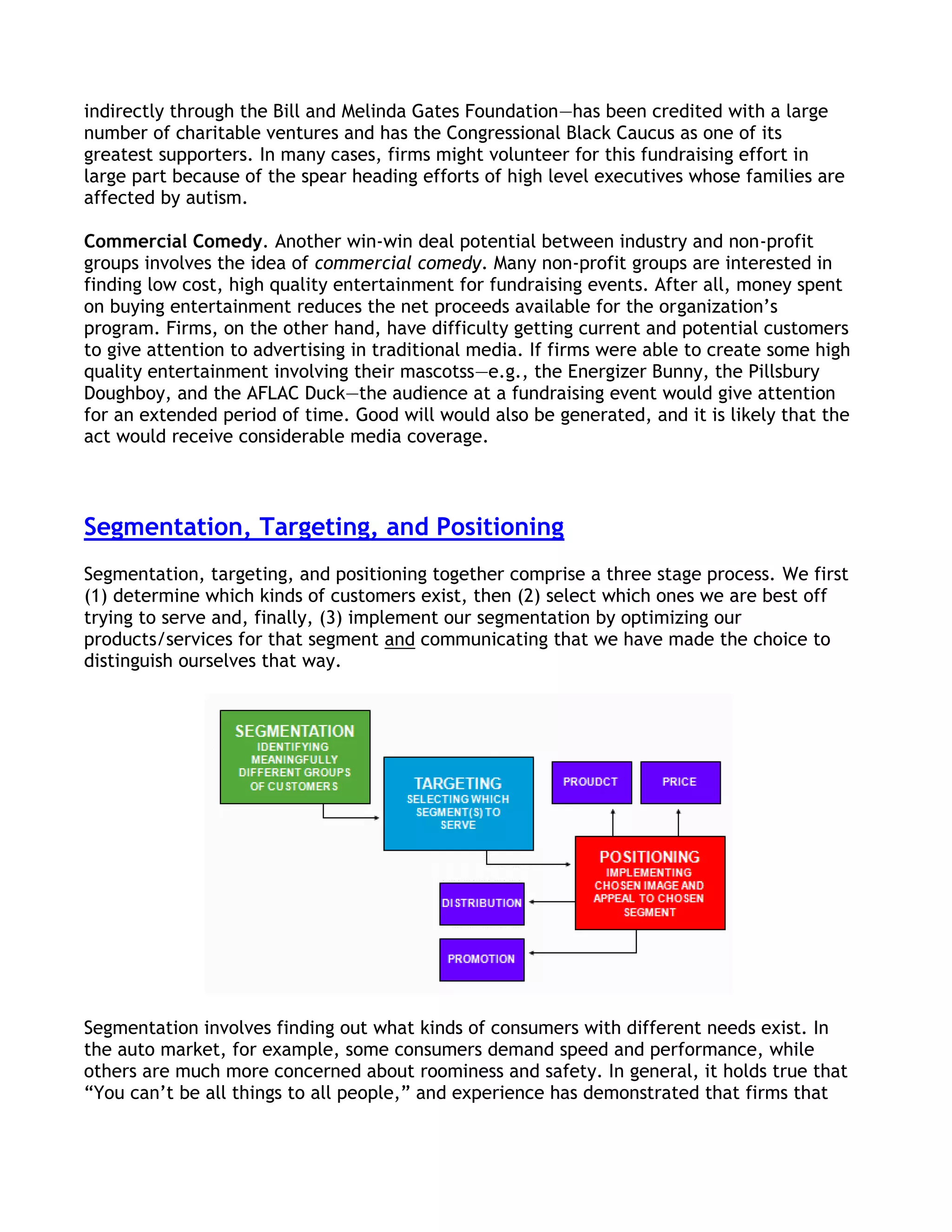
Segmentation, targeting, and positioning together comprise a three stage process. We first
(1) determine which kinds of customers exist, then (2) select which ones we are best off
trying to serve and, finally, (3) implement our segmentation by optimizing our
products/services for that segment and communicating that we have made the choice to
distinguish ourselves that way.


Segmentation involves finding out what kinds of consumers with different needs exist. In
the auto market, for example, some consumers demand speed and performance, while
others are much more concerned about roominess and safety. In general, it holds true that
―You can’t be all things to all people,‖ and experience has demonstrated that firms that
specialize in meeting the needs of one group of consumers over another tend to be more
profitable.

Generically, there are three approaches to marketing. In the undifferentiated strategy, all
consumers are treated as the same, with firms not making any specific efforts to satisfy
particular groups. This may work when the product is a standard one where one
competitor really can’t offer much that another one can’t. Usually, this is the case only
for commodities. In the concentrated strategy, one firm chooses to focus on one of several
segments that exist while leaving other segments to competitors. For example, Southwest
Airlines focuses on price sensitive consumers who will forego meals and assigned seating
for low prices. In contrast, most airlines follow the differentiated strategy: They offer
high priced tickets to those who are inflexible in that they cannot tell in advance when
they need to fly and find it impractical to stay over a Saturday. These travelers—usually
business travelers—pay high fares but can only fill the planes up partially. The same
airlines then sell some of the remaining seats to more price sensitive customers who can
buy two weeks in advance and stay over.

Note that segmentation calls for some tough choices. There may be a large number of
variables that can be used to differentiate consumers of a given product category; yet, in
practice, it becomes impossibly cumbersome to work with more than a few at a time.
Thus, we need to determine which variables will be most useful in distinguishing different
groups of consumers. We might thus decide, for example, that the variables that are most
relevant in separating different kinds of soft drink consumers are (1) preference for taste
vs. low calories, (2) preference for Cola vs. non-cola taste, (3) price sensitivity—
willingness to pay for brand names; and (4) heavy vs. light consumers. We now put these
variables together to arrive at various combinations.
Several different kinds of variables can be used for segmentation.

                                               Demographic variables essentially refer to
                                               personal statistics such as income, gender,
                                               education, location (rural vs. urban, East vs.
                                               West), ethnicity, and family size.
                                               Campbell’s soup, for instance, has found
                                               that Western U.S. consumers on the average
                                               prefer spicier soups—thus, you get a
                                               different product in the same cans at the
                                               East and West coasts. Facing flat sales of
                                               guns in the traditional male dominated
                                               market, a manufacturer came out with the
                                               Lady Remmington, a more compact, handier
                                               gun more attractive to women. Taking this a
                                               step farther, it is also possible to segment
                                               on lifestyle and values.‖
                                               Some consumers want to be seen as similar
                                               to others, while a different segment wants
                                               to stand apart from the crowd.
Another basis for segmentation is behavior.
                                               Some consumers are ―brand loyal‖—i.e.,
                                               they tend to stick with their preferred
                                               brands even when a competing one is on
                                               sale. Some consumers are ―heavy‖ users
                                               while others are ―light‖ users. For example,
                                               research conducted by the wine industry
                                               shows that some 80% of the product is
                                               consumed by 20% of the consumers—
                                               presumably a rather intoxicated group.
                                               One can also segment on benefits sought,
                                               essentially bypassing demographic
                                               explanatory variables. Some consumers, for
                                               example, like scented soap (a segment
                                               likely to be attracted to brands such as Irish
                                               Spring), while others prefer the ―clean‖
                                               feeling of unscented soap (the ―Ivory‖
                                               segment). Some consumers use toothpaste
                                               primarily to promote oral health, while
                                               another segment is more interested in
                                               breath freshening.

In the next step, we decide to target one or more segments. Our choice should generally
depend on several factors. First, how well are existing segments served by other
manufacturers? It will be more difficult to appeal to a segment that is already well served
than to one whose needs are not currently being served well. Secondly, how large is the
segment, and how can we expect it to grow? (Note that a downside to a large, rapidly
growing segment is that it tends to attract competition). Thirdly, do we have strengths as
a company that will help us appeal particularly to one group of consumers? Firms may
already have an established reputation. While McDonald’s has a great reputation for fast,
consistent quality, family friendly food, it would be difficult to convince consumers that
McDonald’s now offers gourmet food. Thus, McD’s would probably be better off targeting
families in search of consistent quality food in nice, clean restaurants.

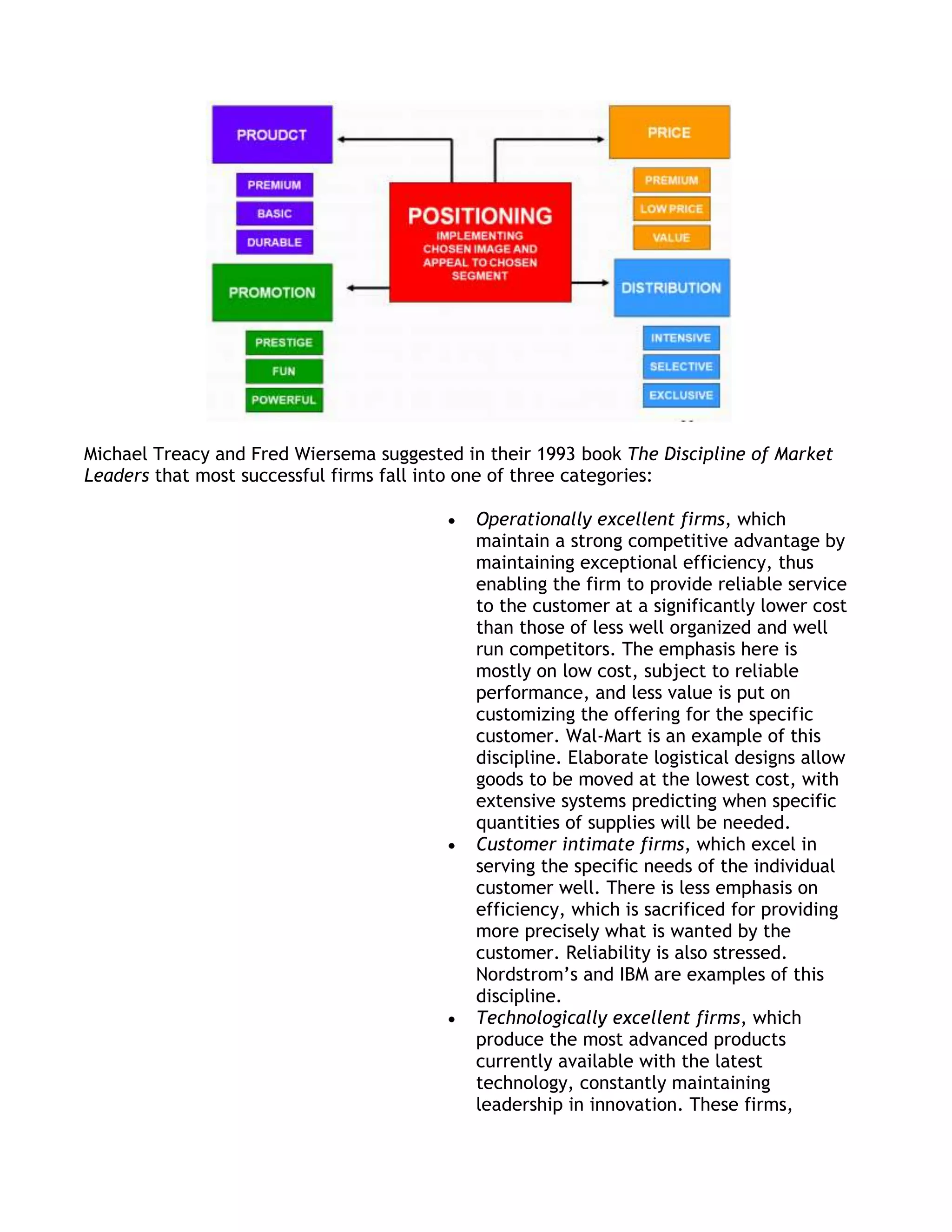
Positioning involves implementing our targeting. For example, Apple Computer has chosen
to position itself as a maker of user-friendly computers. Thus, Apple has done a lot
through its advertising to promote itself, through its unintimidating icons, as a computer
for ―non-geeks.‖ The Visual C software programming language, in contrast, is aimed a
―techies.‖
Michael Treacy and Fred Wiersema suggested in their 1993 book The Discipline of Market
Leaders that most successful firms fall into one of three categories:

                                             Operationally excellent firms, which
                                             maintain a strong competitive advantage by
                                             maintaining exceptional efficiency, thus
                                             enabling the firm to provide reliable service
                                             to the customer at a significantly lower cost
                                             than those of less well organized and well
                                             run competitors. The emphasis here is
                                             mostly on low cost, subject to reliable
                                             performance, and less value is put on
                                             customizing the offering for the specific
                                             customer. Wal-Mart is an example of this
                                             discipline. Elaborate logistical designs allow
                                             goods to be moved at the lowest cost, with
                                             extensive systems predicting when specific
                                             quantities of supplies will be needed.
                                             Customer intimate firms, which excel in
                                             serving the specific needs of the individual
                                             customer well. There is less emphasis on
                                             efficiency, which is sacrificed for providing
                                             more precisely what is wanted by the
                                             customer. Reliability is also stressed.
                                             Nordstrom’s and IBM are examples of this
                                             discipline.
                                             Technologically excellent firms, which
                                             produce the most advanced products
                                             currently available with the latest
                                             technology, constantly maintaining
                                             leadership in innovation. These firms,
because they work with costly technology
                                                that need constant refinement, cannot be
                                                as efficient as the operationally excellent
                                                firms and often cannot adapt their products
                                                as well to the needs of the individual
                                                customer. Intel is an example of this
                                                discipline.

Treacy and Wiersema suggest that in addition to excelling on one of the three value
dimensions, firms must meet acceptable levels on the other two. Wal-Mart, for example,
does maintain some level of customer service. Nordstrom’s and Intel both must meet some
standards of cost effectiveness. The emphasis, beyond meeting the minimum required
level in the two other dimensions, is on the dimension of strength.
Repositioning involves an attempt to change consumer perceptions of a brand, usually
because the existing position that the brand holds has become less attractive. Sears, for
example, attempted to reposition itself from a place that offered great sales but
unattractive prices the rest of the time to a store that consistently offered ―everyday low
prices.‖ Repositioning in practice is very difficult to accomplish. A great deal of money is
often needed for advertising and other promotional efforts, and in many cases, the
repositioning fails.

To effectively attempt repositioning, it is important to understand how one’s brand and
those of competitors are perceived. One approach to identifying consumer product
perceptions is multidimensional scaling. Here, we identify how products are perceived on
two or more ―dimensions,‖ allowing us to plot brands against each other. It may then be
possible to attempt to ―move‖ one’s brand in a more desirable direction by selectively
promoting certain points. There are two main approaches to multi-dimensional scaling. In
the a priori approach, market researchers identify dimensions of interest and then ask
consumers about their perceptions on each dimension for each brand. This is useful when
(1) the market researcher knows which dimensions are of interest and (2) the customer’s
perception on each dimension is relatively clear (as opposed to being ―made up‖ on the
spot to be able to give the researcher a desired answer). In the similarity rating approach,
respondents are not asked about their perceptions of brands on any specific dimensions.
Instead, subjects are asked to rate the extent of similarity of different pairs of products
(e.g., How similar, on a scale of 1-7, is Snicker’s to Kitkat, and how similar is Toblerone to
Three Musketeers?) Using a computer algorithms, the computer then identifies positions of
each brand on a map of a given number of dimensions. The computer does not reveal what
each dimension means—that must be left to human interpretation based on what the
variations in each dimension appears to reveal. This second method is more useful when
no specific product dimensions have been identified as being of particular interest or when
it is not clear what the variables of difference are for the product category.


Consumer Behavior
Note: The issues discussed below are covered in more detail at
consumer behavior section of this site.
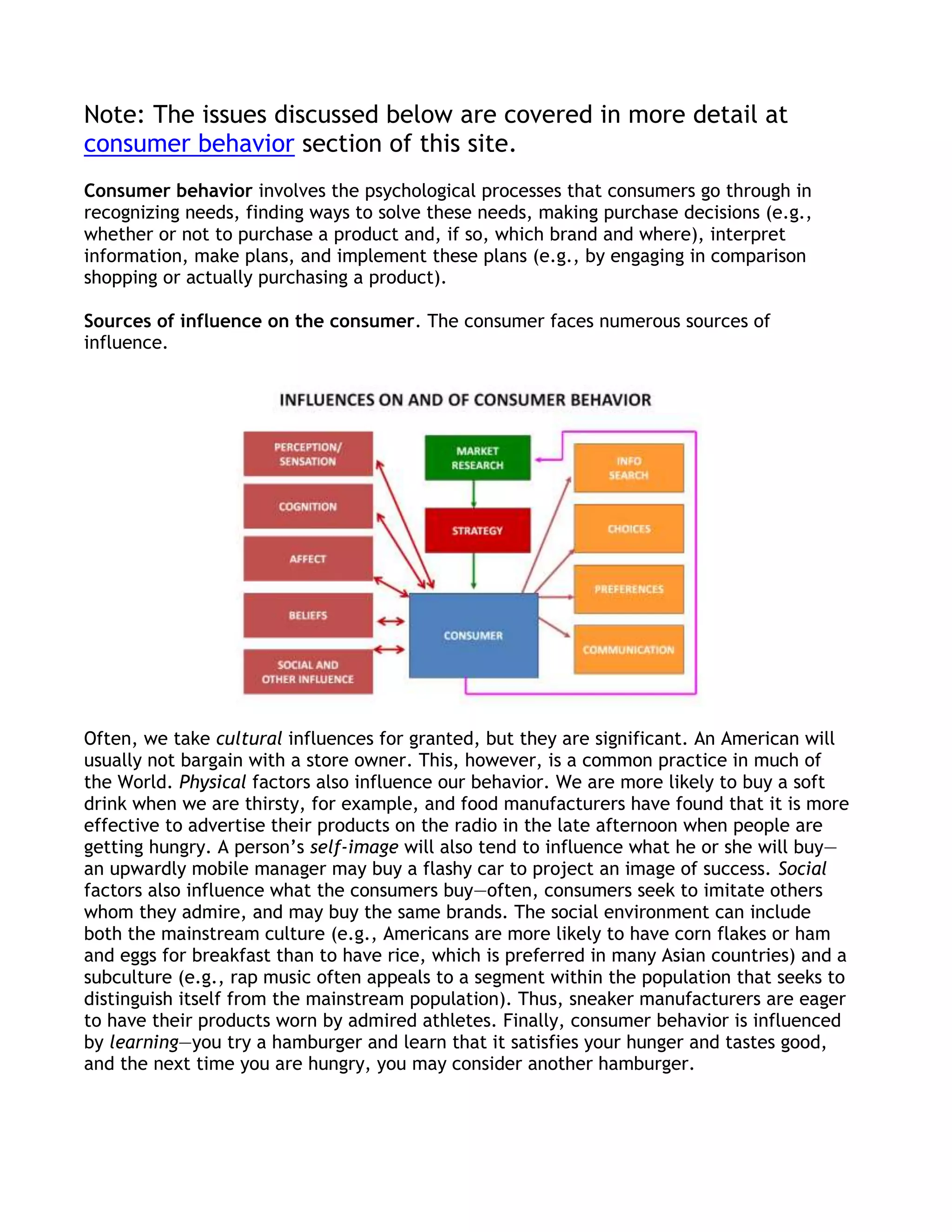
Consumer behavior involves the psychological processes that consumers go through in
recognizing needs, finding ways to solve these needs, making purchase decisions (e.g.,
whether or not to purchase a product and, if so, which brand and where), interpret
information, make plans, and implement these plans (e.g., by engaging in comparison
shopping or actually purchasing a product).

Sources of influence on the consumer. The consumer faces numerous sources of
influence.


Often, we take cultural influences for granted, but they are significant. An American will
usually not bargain with a store owner. This, however, is a common practice in much of
the World. Physical factors also influence our behavior. We are more likely to buy a soft
drink when we are thirsty, for example, and food manufacturers have found that it is more
effective to advertise their products on the radio in the late afternoon when people are
getting hungry. A person’s self-image will also tend to influence what he or she will buy—
an upwardly mobile manager may buy a flashy car to project an image of success. Social
factors also influence what the consumers buy—often, consumers seek to imitate others
whom they admire, and may buy the same brands. The social environment can include
both the mainstream culture (e.g., Americans are more likely to have corn flakes or ham
and eggs for breakfast than to have rice, which is preferred in many Asian countries) and a
subculture (e.g., rap music often appeals to a segment within the population that seeks to
distinguish itself from the mainstream population). Thus, sneaker manufacturers are eager
to have their products worn by admired athletes. Finally, consumer behavior is influenced
by learning—you try a hamburger and learn that it satisfies your hunger and tastes good,
and the next time you are hungry, you may consider another hamburger.
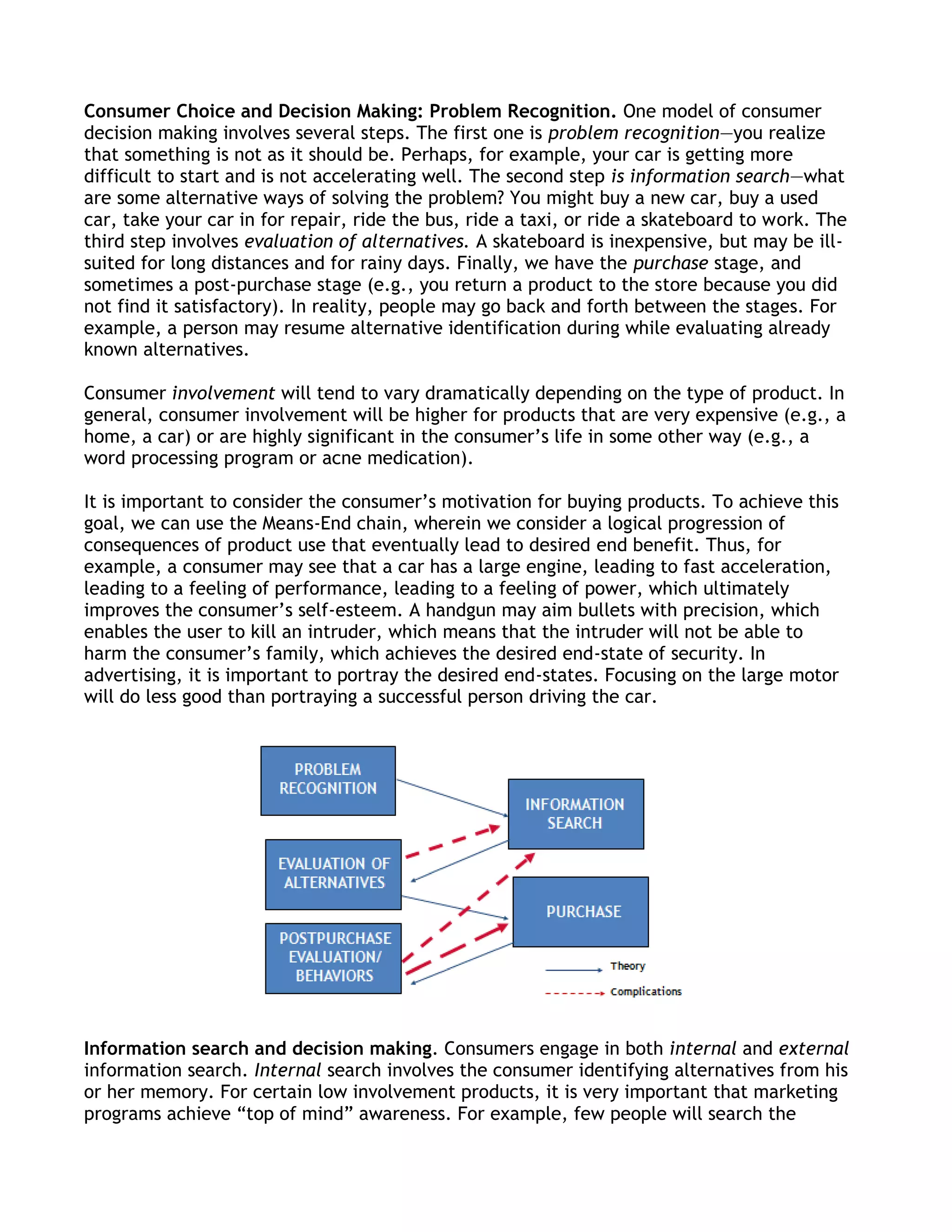
Consumer Choice and Decision Making: Problem Recognition. One model of consumer
decision making involves several steps. The first one is problem recognition—you realize
that something is not as it should be. Perhaps, for example, your car is getting more
difficult to start and is not accelerating well. The second step is information search—what
are some alternative ways of solving the problem? You might buy a new car, buy a used
car, take your car in for repair, ride the bus, ride a taxi, or ride a skateboard to work. The
third step involves evaluation of alternatives. A skateboard is inexpensive, but may be ill-
suited for long distances and for rainy days. Finally, we have the purchase stage, and
sometimes a post-purchase stage (e.g., you return a product to the store because you did
not find it satisfactory). In reality, people may go back and forth between the stages. For
example, a person may resume alternative identification during while evaluating already
known alternatives.

Consumer involvement will tend to vary dramatically depending on the type of product. In
general, consumer involvement will be higher for products that are very expensive (e.g., a
home, a car) or are highly significant in the consumer’s life in some other way (e.g., a
word processing program or acne medication).

It is important to consider the consumer’s motivation for buying products. To achieve this
goal, we can use the Means-End chain, wherein we consider a logical progression of
consequences of product use that eventually lead to desired end benefit. Thus, for
example, a consumer may see that a car has a large engine, leading to fast acceleration,
leading to a feeling of performance, leading to a feeling of power, which ultimately
improves the consumer’s self-esteem. A handgun may aim bullets with precision, which
enables the user to kill an intruder, which means that the intruder will not be able to
harm the consumer’s family, which achieves the desired end-state of security. In
advertising, it is important to portray the desired end-states. Focusing on the large motor
will do less good than portraying a successful person driving the car.


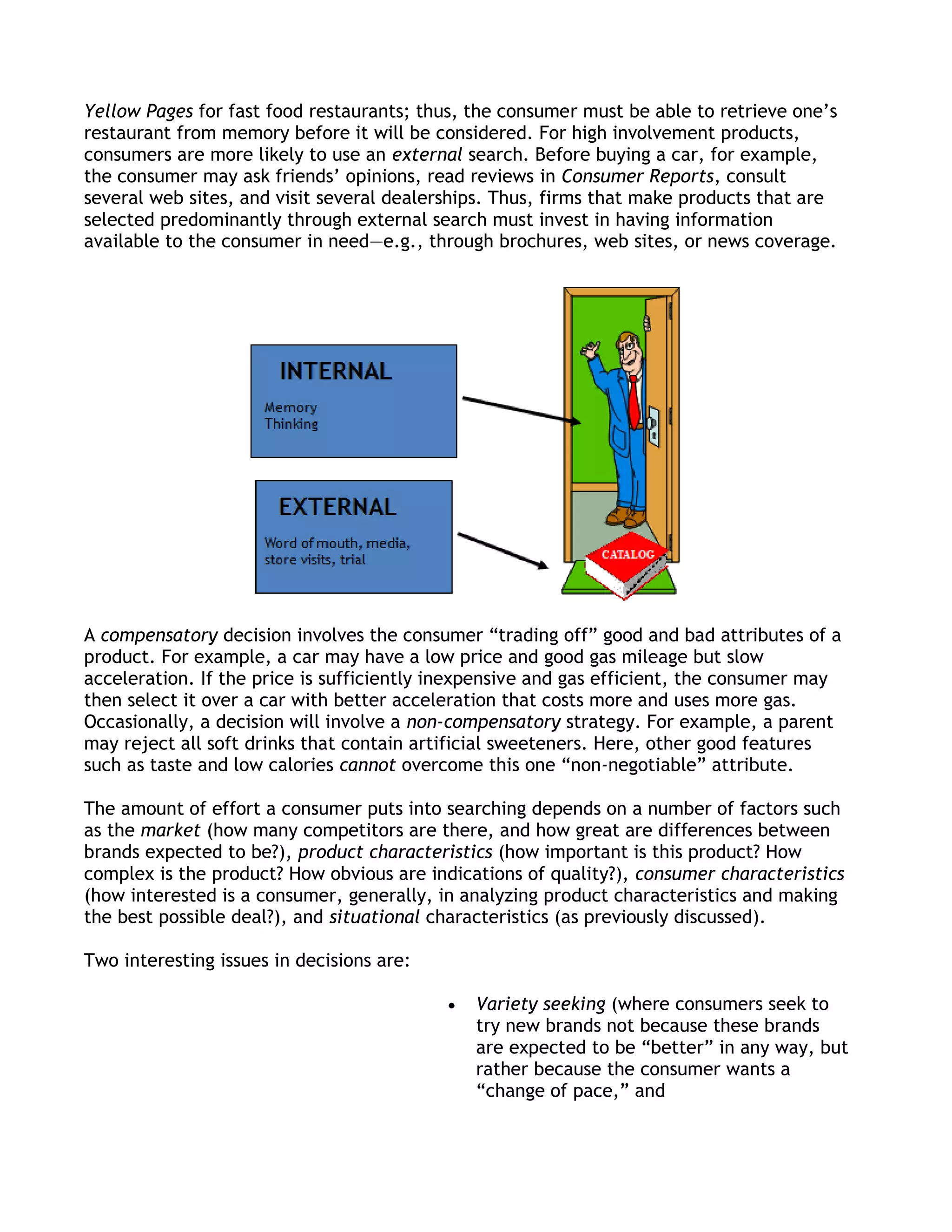
Information search and decision making. Consumers engage in both internal and external
information search. Internal search involves the consumer identifying alternatives from his
or her memory. For certain low involvement products, it is very important that marketing
programs achieve ―top of mind‖ awareness. For example, few people will search the
Yellow Pages for fast food restaurants; thus, the consumer must be able to retrieve one’s
restaurant from memory before it will be considered. For high involvement products,
consumers are more likely to use an external search. Before buying a car, for example,
the consumer may ask friends’ opinions, read reviews in Consumer Reports, consult
several web sites, and visit several dealerships. Thus, firms that make products that are
selected predominantly through external search must invest in having information
available to the consumer in need—e.g., through brochures, web sites, or news coverage.


A compensatory decision involves the consumer ―trading off‖ good and bad attributes of a
product. For example, a car may have a low price and good gas mileage but slow
acceleration. If the price is sufficiently inexpensive and gas efficient, the consumer may
then select it over a car with better acceleration that costs more and uses more gas.
Occasionally, a decision will involve a non-compensatory strategy. For example, a parent
may reject all soft drinks that contain artificial sweeteners. Here, other good features
such as taste and low calories cannot overcome this one ―non-negotiable‖ attribute.

The amount of effort a consumer puts into searching depends on a number of factors such
as the market (how many competitors are there, and how great are differences between
brands expected to be?), product characteristics (how important is this product? How
complex is the product? How obvious are indications of quality?), consumer characteristics
(how interested is a consumer, generally, in analyzing product characteristics and making
the best possible deal?), and situational characteristics (as previously discussed).

Two interesting issues in decisions are:

                                              Variety seeking (where consumers seek to
                                              try new brands not because these brands
                                              are expected to be ―better‖ in any way, but
                                              rather because the consumer wants a
                                              ―change of pace,‖ and
“Impulse” purchases—unplanned buys. This
                                               represents a somewhat ―fuzzy‖ group. For
                                               example, a shopper may plan to buy
                                               vegetables but only decide in the store to
                                               actually buy broccoli and corn.
                                               Alternatively, a person may buy an item
                                               which is currently on sale, or one that he or
                                               she remembers that is needed only once
                                               inside the store.

A number of factors involve consumer choices. In some cases, consumers will be more
motivated. For example, one may be more careful choosing a gift for an in-law than when
buying the same thing for one self. Some consumers are also more motivated to
comparison shop for the best prices, while others are more convenience oriented.
Personality impacts decisions. Some like variety more than others, and some are more
receptive to stimulation and excitement in trying new stores. Perception influences
decisions. Some people, for example, can taste the difference between generic and name
brand foods while many cannot. Selective perception occurs when a person is paying
attention only to information of interest. For example, when looking for a new car, the
consumer may pay more attention to car ads than when this is not in the horizon. Some
consumers are put off by perceived risk. Thus, many marketers offer a money back
guarantee. Consumers will tend to change their behavior through learning—e.g., they will
avoid restaurants they have found to be crowded and will settle on brands that best meet
their tastes. Consumers differ in the values they hold (e.g., some people are more
committed to recycling than others who will not want to go through the hassle). We will
consider the issue of lifestyle under segmentation.

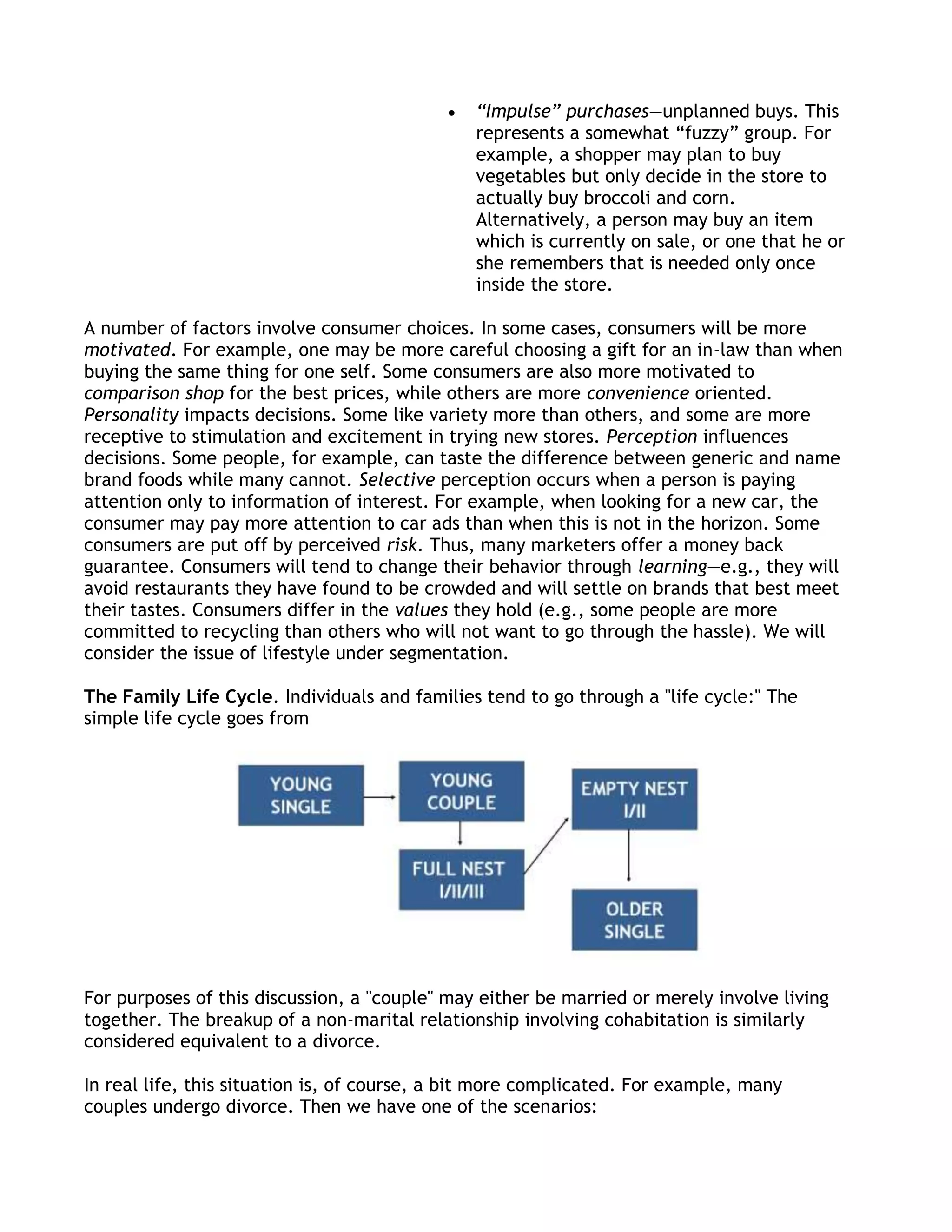
The Family Life Cycle. Individuals and families tend to go through a "life cycle:" The
simple life cycle goes from


For purposes of this discussion, a "couple" may either be married or merely involve living
together. The breakup of a non-marital relationship involving cohabitation is similarly
considered equivalent to a divorce.

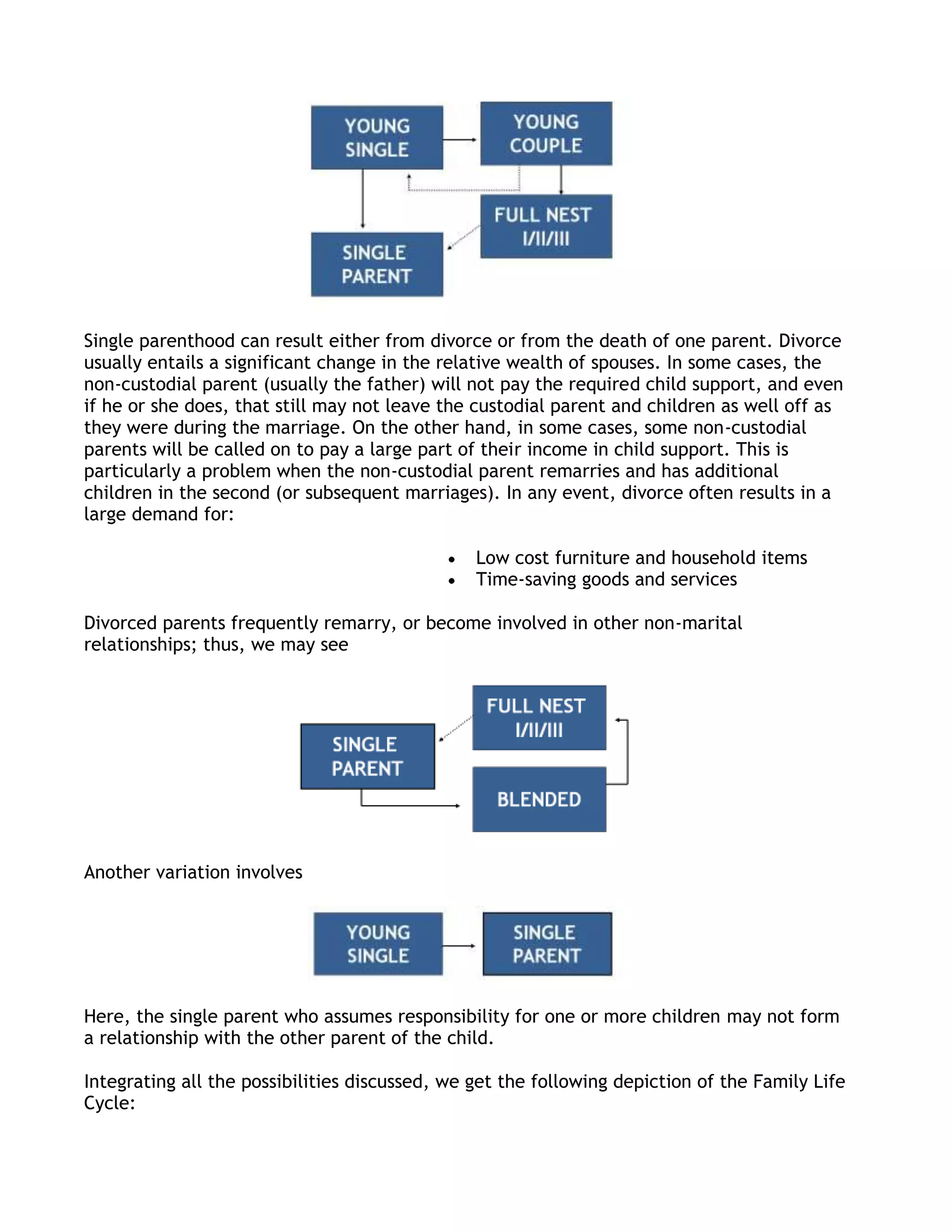
In real life, this situation is, of course, a bit more complicated. For example, many
couples undergo divorce. Then we have one of the scenarios:
Single parenthood can result either from divorce or from the death of one parent. Divorce
usually entails a significant change in the relative wealth of spouses. In some cases, the
non-custodial parent (usually the father) will not pay the required child support, and even
if he or she does, that still may not leave the custodial parent and children as well off as
they were during the marriage. On the other hand, in some cases, some non-custodial
parents will be called on to pay a large part of their income in child support. This is
particularly a problem when the non-custodial parent remarries and has additional
children in the second (or subsequent marriages). In any event, divorce often results in a
large demand for:

                                                Low cost furniture and household items
                                                Time-saving goods and services

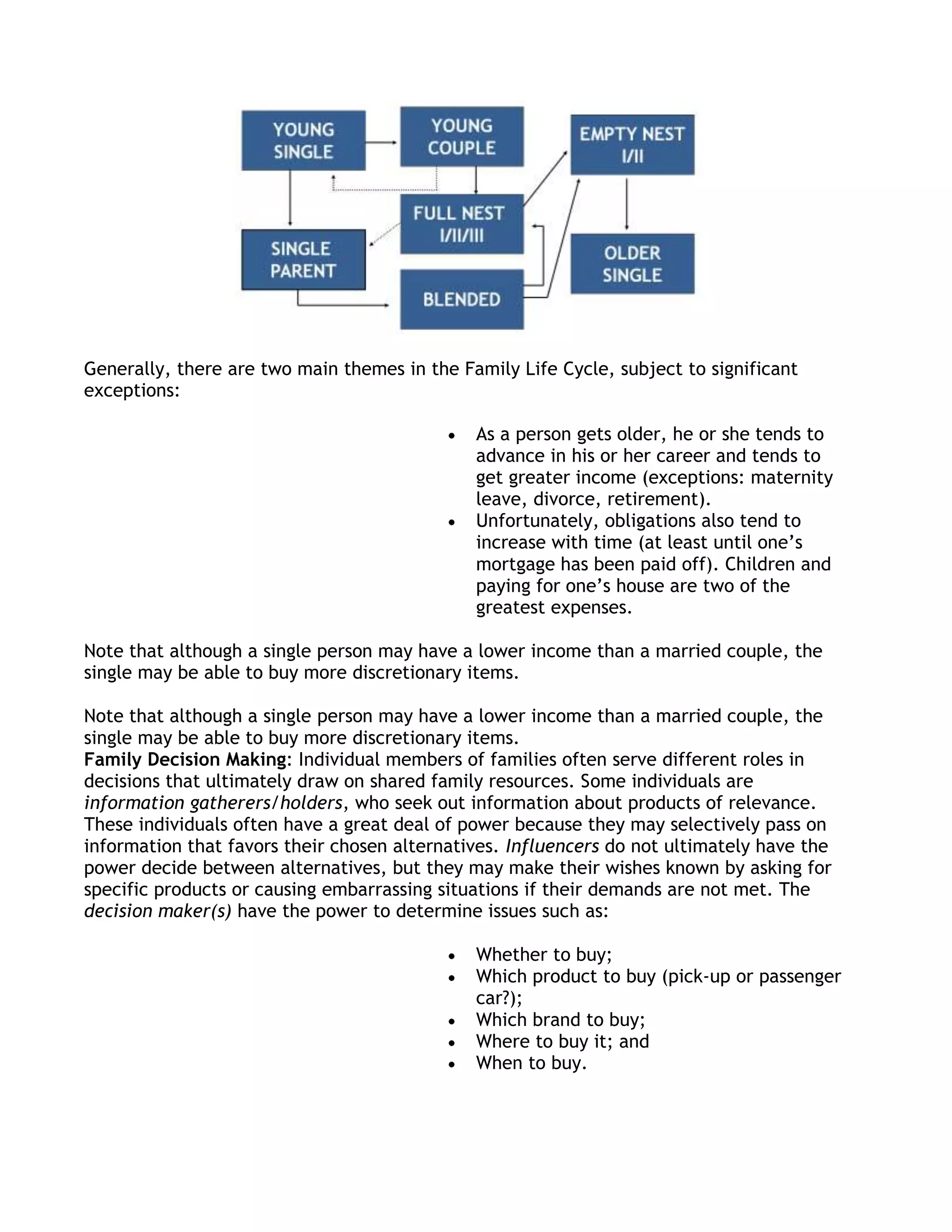
Divorced parents frequently remarry, or become involved in other non-marital
relationships; thus, we may see


Another variation involves


Here, the single parent who assumes responsibility for one or more children may not form
a relationship with the other parent of the child.

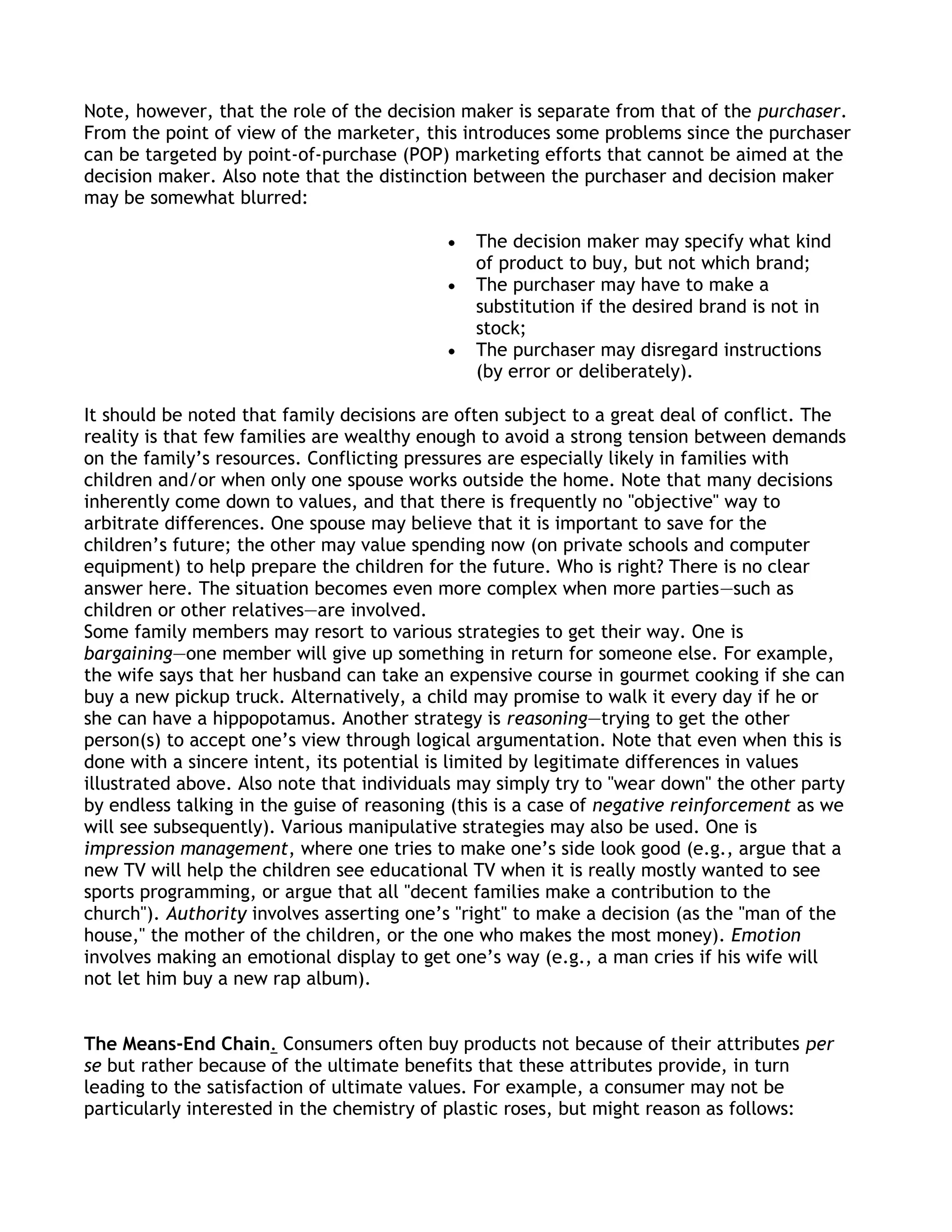
Integrating all the possibilities discussed, we get the following depiction of the Family Life
Cycle:
Generally, there are two main themes in the Family Life Cycle, subject to significant
exceptions:

                                              As a person gets older, he or she tends to
                                              advance in his or her career and tends to
                                              get greater income (exceptions: maternity
                                              leave, divorce, retirement).
                                              Unfortunately, obligations also tend to
                                              increase with time (at least until one’s
                                              mortgage has been paid off). Children and
                                              paying for one’s house are two of the
                                              greatest expenses.

Note that although a single person may have a lower income than a married couple, the
single may be able to buy more discretionary items.

Note that although a single person may have a lower income than a married couple, the
single may be able to buy more discretionary items.
Family Decision Making: Individual members of families often serve different roles in
decisions that ultimately draw on shared family resources. Some individuals are
information gatherers/holders, who seek out information about products of relevance.
These individuals often have a great deal of power because they may selectively pass on
information that favors their chosen alternatives. Influencers do not ultimately have the
power decide between alternatives, but they may make their wishes known by asking for
specific products or causing embarrassing situations if their demands are not met. The
decision maker(s) have the power to determine issues such as:

                                              Whether to buy;
                                              Which product to buy (pick-up or passenger
                                              car?);
                                              Which brand to buy;
                                              Where to buy it; and
                                              When to buy.
Note, however, that the role of the decision maker is separate from that of the purchaser.
From the point of view of the marketer, this introduces some problems since the purchaser
can be targeted by point-of-purchase (POP) marketing efforts that cannot be aimed at the
decision maker. Also note that the distinction between the purchaser and decision maker
may be somewhat blurred:

                                               The decision maker may specify what kind
                                               of product to buy, but not which brand;
                                               The purchaser may have to make a
                                               substitution if the desired brand is not in
                                               stock;
                                               The purchaser may disregard instructions
                                               (by error or deliberately).

It should be noted that family decisions are often subject to a great deal of conflict. The
reality is that few families are wealthy enough to avoid a strong tension between demands
on the family’s resources. Conflicting pressures are especially likely in families with
children and/or when only one spouse works outside the home. Note that many decisions
inherently come down to values, and that there is frequently no "objective" way to
arbitrate differences. One spouse may believe that it is important to save for the
children’s future; the other may value spending now (on private schools and computer
equipment) to help prepare the children for the future. Who is right? There is no clear
answer here. The situation becomes even more complex when more parties—such as
children or other relatives—are involved.
Some family members may resort to various strategies to get their way. One is
bargaining—one member will give up something in return for someone else. For example,
the wife says that her husband can take an expensive course in gourmet cooking if she can
buy a new pickup truck. Alternatively, a child may promise to walk it every day if he or
she can have a hippopotamus. Another strategy is reasoning—trying to get the other
person(s) to accept one’s view through logical argumentation. Note that even when this is
done with a sincere intent, its potential is limited by legitimate differences in values
illustrated above. Also note that individuals may simply try to "wear down" the other party
by endless talking in the guise of reasoning (this is a case of negative reinforcement as we
will see subsequently). Various manipulative strategies may also be used. One is
impression management, where one tries to make one’s side look good (e.g., argue that a
new TV will help the children see educational TV when it is really mostly wanted to see
sports programming, or argue that all "decent families make a contribution to the
church"). Authority involves asserting one’s "right" to make a decision (as the "man of the
house," the mother of the children, or the one who makes the most money). Emotion
involves making an emotional display to get one’s way (e.g., a man cries if his wife will
not let him buy a new rap album).


The Means-End Chain. Consumers often buy products not because of their attributes per
se but rather because of the ultimate benefits that these attributes provide, in turn
leading to the satisfaction of ultimate values. For example, a consumer may not be
particularly interested in the chemistry of plastic roses, but might reason as follows:
The important thing in a means-end chain is to start with an attribute, a concrete
characteristic of the product, and then logically progress to a series of consequences
(which tend to become progressively more abstract) that end with a value being satisfied.
Thus, each chain must start with an attribute and end with a value. An important
implication of means-end chains is that it is usually most effective in advertising to focus
on higher level items. For example, in the flower example above, an individual giving the
flowers to the significant other might better be portrayed than the flowers alone.

Attitudes. Consumer attitudes are a composite of a consumer’s (1) beliefs about, (2)
feelings about, (3) and behavioral intentions toward some ―object‖—within the context of
marketing, usually a brand, product category, or retail store. These components are
viewed together since they are highly interdependent and together represent forces that
influence how the consumer will react to the object.

Beliefs. The first component is beliefs. A consumer may hold both positive beliefs toward
an object (e.g., coffee tastes good) as well as negative beliefs (e.g., coffee is easily
spilled and stains papers). In addition, some beliefs may be neutral (coffee is black), and
some may be differ in valance depending on the person or the situation (e.g., coffee is hot
and stimulates--good on a cold morning, but not good on a hot summer evening when one
wants to sleep). Note also that the beliefs that consumers hold need not be accurate (e.g.,
that pork contains little fat), and some beliefs may, upon closer examination, be
contradictory.

Affect. Consumers also hold certain feelings toward brands or other objects. Sometimes
these feelings are based on the beliefs (e.g., a person feels nauseated when thinking
about a hamburger because of the tremendous amount of fat it contains), but there may
also be feelings which are relatively independent of beliefs. For example, an extreme
environmentalist may believe that cutting down trees is morally wrong, but may have
positive affect toward Christmas trees because he or she unconsciously associates these
trees with the experience that he or she had at Christmas as a child.
Behavioral intention. The behavioral intention is what the consumer plans to do with
respect to the object (e.g., buy or not buy the brand). As with affect, this is sometimes a
logical consequence of beliefs (or affect), but may sometimes reflect other circumstances-
-e.g., although a consumer does not really like a restaurant, he or she will go there
because it is a hangout for his or her friends.

Changing attitudes is generally very difficult, particularly when consumers suspect that
the marketer has a self-serving ―agenda‖ in bringing about this change (e.g., to get the
consumer to buy more or to switch brands). Here are some possible methods:

                                              Changing affect. One approach is to try to
                                              change affect, which may or may not
                                              involve getting consumers to change their
                                              beliefs. One strategy uses the approach of
                                              classical conditioning try to ―pair‖ the
                                              product with a liked stimulus. For example,
                                              we ―pair‖ a car with a beautiful woman.
                                              Alternatively, we can try to get people to
                                              like the advertisement and hope that this
                                              liking will ―spill over‖ into the purchase of a
                                              product. For example, the Pillsbury
                                              Doughboy does not really emphasize the
                                              conveyance of much information to the
                                              consumer; instead, it attempts to create a
                                              warm, ―fuzzy‖ image. Although Energizer
                                              Bunny ads try to get people to believe that
                                              their batteries last longer, the main
                                              emphasis is on the likeable bunny. Finally,
                                              products which are better known, through
                                              the mere exposure effect, tend to be better
                                              liked—that is, the more a product is
                                              advertised and seen in stores, the more it
                                              will generally be liked, even if consumers to
                                              do not develop any specific beliefs about
                                              the product.
                                              Changing behavior. People like to believe
                                              that their behavior is rational; thus, once
                                              they use our products, chances are that
                                              they will continue unless someone is able to
                                              get them to switch. One way to get people
                                              to switch to our brand is to use temporary
                                              price discounts and coupons; however,
                                              when consumers buy a product on deal,
                                              they may justify the purchase based on that
                                              deal (i.e., the low price) and may then
                                              switch to other brands on deal later. A
                                              better way to get people to switch to our
brand is to at least temporarily obtain
better shelf space so that the product is
more convenient. Consumers are less likely
to use this availability as a rationale for
their purchase and may continue to buy the
product even when the product is less
conveniently located.
Changing beliefs. Although attempting to
change beliefs is the obvious way to
attempt attitude change, particularly when
consumers hold unfavorable or inaccurate
ones, this is often difficult to achieve
because consumers tend to resist. Several
approaches to belief change exist:
Change currently held beliefs. It is
generally very difficult to attempt to
change beliefs that people hold, particularly
those that are strongly held, even if they
are inaccurate. For example, the petroleum
industry advertised for a long time that its
profits were lower than were commonly
believed, and provided extensive factual
evidence in its advertising to support this
reality. Consumers were suspicious and
rejected this information, however.
Change the importance of beliefs. Although
the sugar manufacturers would undoubtedly
like to decrease the importance of healthy
teeth, it is usually not feasible to make
beliefs less important--consumers are likely
to reason, why, then, would you bother
bringing them up in the first place?
However, it may be possible to strengthen
beliefs that favor us--e.g., a vitamin
supplement manufacturer may advertise
that it is extremely important for women to
replace iron lost through menstruation. Most
consumers already agree with this, but the
belief can be made stronger.
Add beliefs. Consumers are less likely to
resist the addition of beliefs so long as they
do not conflict with existing beliefs. Thus,
the beef industry has added beliefs that
beef (1) is convenient and (2) can be used
to make a number of creative dishes.
Vitamin manufacturers attempt to add the
belief that stress causes vitamin depletion,
which sounds quite plausible to most
                                                people.
                                                Change ideal. It usually difficult, and very
                                                risky, to attempt to change ideals, and only
                                                few firms succeed. For example, Hard
                                                Candy may have attempted to change the
                                                ideal away from traditional beauty toward
                                                more unique self expression.

One-sided vs. two-sided appeals. Attitude research has shown that consumers often tend
to react more favorably to advertisements which either (1) admit something negative
about the sponsoring brand (e.g., the Volvo is a clumsy car, but very safe) or (2) admits
something positive about a competing brand (e.g., a competing supermarket has slightly
lower prices, but offers less service and selection). Two-sided appeals must, contain
overriding arguments why the sponsoring brand is ultimately superior—that is, in the above
examples, the ―but‖ part must be emphasized.

Perception. Our perception is an approximation of reality. Our brain attempts to make
sense out of the stimuli to which we are exposed. This works well, for example, when we
―see‖ a friend three hundred feet away at his or her correct height; however, our
perception is sometimes ―off‖—for example, certain shapes of ice cream containers look
like they contain more than rectangular ones with the same volume.

Subliminal stimuli. Back in the 1960s, it was reported that on selected evenings, movie
goers in a theater had been exposed to isolated frames with the words ―Drink Coca Cola‖
and ―Eat Popcorn‖ imbedded into the movie. These frames went by so fast that people did
not consciously notice them, but it was reported that on nights with frames present, Coke
and popcorn sales were significantly higher than on days they were left off. This led
Congress to ban the use of subliminal advertising. First of all, there is a question as to
whether this experiment ever took place or whether this information was simply made up.
Secondly, no one has been able to replicate these findings. There is research to show that
people will start to giggle with embarrassment when they are briefly exposed to ―dirty‖
words in an experimental machine. Here, again, the exposure is so brief that the subjects
are not aware of the actual words they saw, but it is evident that something has been
recognized by the embarrassment displayed.

Organizational buyers. A large portion of the market for goods and services is attributable
to organizational, as opposed to individual, buyers. In general, organizational buyers, who
make buying decisions for their companies for a living, tend to be somewhat more
sophisticated than ordinary consumers. However, these organizational buyers are also
often more risk averse. There is a risk in going with a new, possibly better (lower price or
higher quality) supplier whose product is unproven and may turn out to be problematic.
Often the fear of running this risk is greater than the potential rewards for getting a better
deal. In the old days, it used to be said that ―You can’t get fired for buying IBM.‖ This
attitude is beginning to soften a bit today as firms face increasing pressures to cut costs.
Organizational buyers come in several forms. Resellers involve either wholesalers or
retailers that buy from one organization and resell to some other entity. For example,
large grocery chains sometimes buy products directly from the manufacturer and resell
them to end-consumers. Wholesalers may sell to retailers who in turn sell to consumers.
Producers also buy products from sub-manufacturers to create a finished product. For
example, rather than manufacturing the parts themselves, computer manufacturers often
buy hard drives, motherboards, cases, monitors, keyboards, and other components from
manufacturers and put them together to create a finished product. Governments buy a
great deal of things. For example, the military needs an incredible amount of supplies to
feed and equip troops. Finally, large institutions buy products in huge quantities. For
example, UCR probably buys thousands of reams of paper every month.

Organizational buying usually involves more people than individual buying. Often, many
people are involved in making decisions as to (a) whether to buy, (b) what to buy, (c) at
what quantity, and (d) from whom. An engineer may make a specification as to what is
needed, which may be approved by a manager, with the final purchase being made by a
purchase specialist who spends all his or her time finding the best deal on the goods that
the organization needs. Often, such long purchase processes can cause long delays. In the
government, rules are often especially stringent—e.g., vendors of fruit cake have to meet
fourteen pages of specifications put out by the General Services Administration. In many
cases, government buyers are also heavily bound to go with the lowest price. Even if it is
obvious that a higher priced vendor will offer a superior product, it may be difficult to
accept that bid.


Consumer Research Methods
Market research is often needed to ensure that we produce what customers really want
and not what we think they want.

Primary vs. secondary research methods. There are two main approaches to marketing.
Secondary research involves using information that others have already put together. For
example, if you are thinking about starting a business making clothes for tall people, you
don’t need to question people about how tall they are to find out how many tall people
exist—that information has already been published by the U.S. Government. Primary
research, in contrast, is research that you design and conduct yourself. For example, you
may need to find out whether consumers would prefer that your soft drinks be sweater or
tarter.

Research will often help us reduce risks associated with a new product, but it cannot take
the risk away entirely. It is also important to ascertain whether the research has been
complete. For example, Coca Cola did a great deal of research prior to releasing the New
Coke, and consumers seemed to prefer the taste. However, consumers were not prepared
to have this drink replace traditional Coke.
Secondary Methods. For more information about secondary market research tools and
issues, please see http://buad307.com/PDF/Secondary.pdf .

Primary Methods. Several tools are available to the market researcher—e.g., mail
questionnaires, phone surveys, observation, and focus groups. Please see
http://buad307.com/PDF/ResearchMethods.pdf for advantages and disadvantages of each.

Surveys are useful for getting a great deal of specific information. Surveys can contain
open-ended questions (e.g., ―In which city and state were you born? ____________‖) or
closed-ended, where the respondent is asked to select answers from a brief list (e.g.,
―__Male ___ Female.‖ Open ended questions have the advantage that the respondent is
not limited to the options listed, and that the respondent is not being influenced by seeing
a list of responses. However, open-ended questions are often skipped by respondents, and
coding them can be quite a challenge. In general, for surveys to yield meaningful
responses, sample sizes of over 100 are usually required because precision is essential. For
example, if a market share of twenty percent would result in a loss while thirty percent
would be profitable, a confidence interval of 20-35% is too wide to be useful.

Surveys come in several different forms. Mail surveys are relatively inexpensive, but
response rates are typically quite low—typically from 5-20%. Phone-surveys get somewhat
higher response rates, but not many questions can be asked because many answer options
have to be repeated and few people are willing to stay on the phone for more than five
minutes. Mall intercepts are a convenient way to reach consumers, but respondents may
be reluctant to discuss anything sensitive face-to-face with an interviewer.

Surveys, as any kind of research, are vulnerable to bias. The wording of a question can
influence the outcome a great deal. For example, more people answered no to the
question ―Should speeches against democracy be allowed?‖ than answered yes to ―Should
speeches against democracy be forbidden?‖ For face-to-face interviews, interviewer bias is
a danger, too. Interviewer bias occurs when the interviewer influences the way the
respondent answers. For example, unconsciously an interviewer that works for the firm
manufacturing the product in question may smile a little when something good is being
said about the product and frown a little when something negative is being said. The
respondent may catch on and say something more positive than his or her real opinion.
Finally, a response bias may occur—if only part of the sample responds to a survey, the
respondents’ answers may not be representative of the population.

Focus groups are useful when the marketer wants to launch a new product or modify an
existing one. A focus group usually involves having some 8-12 people come together in a
room to discuss their consumption preferences and experiences. The group is usually led
by a moderator, who will start out talking broadly about topics related broadly to the
product without mentioning the product itself. For example, a focus group aimed at sugar-
free cookies might first address consumers’ snacking preferences, only gradually moving
toward the specific product of sugar-free cookies. By not mentioning the product up front,
we avoid biasing the participants into thinking only in terms of the specific product
brought out. Thus, instead of having consumers think primarily in terms of what might be
good or bad about the product, we can ask them to discuss more broadly the ultimate
benefits they really seek. For example, instead of having consumers merely discuss what
they think about some sugar-free cookies that we are considering releasing to the market,
we can have consumers speak about their motivations for using snacks and what general
kinds of benefits they seek. Such a discussion might reveal a concern about healthfulness
and a desire for wholesome foods. Probing on the meaning of wholesomeness, consumers
might indicate a desire to avoid artificial ingredients. This would be an important concern
in the marketing of sugar-free cookies, but might not have come up if consumers were
asked to comment directly on the product where the use of artificial ingredients is, by
virtue of the nature of the product, necessary.

Focus groups are well suited for some purposes, but poorly suited for others. In general,
focus groups are very good for getting breadth—i.e., finding out what kinds of issues are
important for consumers in a given product category. Here, it is helpful that focus groups
are completely ―open-ended:‖ The consumer mentions his or her preferences and
opinions, and the focus group moderator can ask the consumer to elaborate. In a
questionnaire, if one did not think to ask about something, chances are that few
consumers would take the time to write out an elaborate answer. Focus groups also have
some drawbacks, for example:

                                               They represent small sample sizes. Because
                                               of the cost of running focus groups, only a
                                               few groups can be run. Suppose you run four
                                               focus groups with ten members each. This
                                               will result in an n of 4(10)=40, which is too
                                               small to generalize from. Therefore, focus
                                               groups cannot give us a good idea of:
                                               What proportion of the population is likely
                                               to buy the product.
                                               What price consumers are willing to pay.
                                               The groups are inherently social. This means
                                               that:
                                               Consumers will often say things that may
                                               make them look good (i.e., they watch
                                               public television rather than soap operas or
                                               cook fresh meals for their families daily)
                                               even if that is not true.
                                               Consumers may be reluctant to speak about
                                               embarrassing issues (e.g., weight control,
                                               birth control).

Personal interviews involve in-depth questioning of an individual about his or her interest
in or experiences with a product. The benefit here is that we can get really into depth
(when the respondent says something interesting, we can ask him or her to elaborate), but
this method of research is costly and can be extremely vulnerable to interviewer bias.

To get a person to elaborate, it may help to try a common tool of psychologists and
psychiatrists—simply repeating what the person said. He or she will often become
uncomfortable with the silence that follows and will then tend to elaborate. This approach
has the benefit that it minimizes the interference with the respondent’s own ideas and
thoughts. He or she is not influenced by a new question but will, instead, go more in depth
on what he or she was saying.

Personal interviews are highly susceptible to inadvertent ―signaling‖ to the respondent.
Although an interviewer is looking to get at the truth, he or she may have a significant
interest in a positive consumer response. Unconsciously, then, he or she may inadvertently
smile a little when something positive is said and frown a little when something negative is
said. Consciously, this will often not be noticeable, and the respondent often will not
consciously be aware that he or she is being ―reinforced‖ and ―punished‖ for saying
positive or negative things, but at an unconscious level, the cumulative effect of several
facial expressions are likely to be felt. Although this type of conditioning will not get a
completely negative respondent to say all positive things, it may ―swing‖ the balance a bit
so that respondents are more likely to say positive thoughts and withhold, or limit the
duration of, negative thoughts.

Projective techniques are used when a consumer may feel embarrassed to admit to certain
opinions, feelings, or preferences. For example, many older executives may not be
comfortable admitting to being intimidated by computers. It has been found that in such
cases, people will tend to respond more openly about ―someone else.‖ Thus, we may ask
them to explain reasons why a friend has not yet bought a computer, or to tell a story
about a person in a picture who is or is not using a product. The main problem with this
method is that it is difficult to analyze responses.

Projective techniques are inherently inefficient to use. The elaborate context that has to
be put into place takes time and energy away from the main question. There may also be
real differences between the respondent and the third party. Saying or thinking about
something that ―hits too close to home‖ may also influence the respondent, who may or
may not be able to see through the ruse.

Observation of consumers is often a powerful tool. Looking at how consumers select
products may yield insights into how they make decisions and what they look for. For
example, some American manufacturers were concerned about low sales of their products
in Japan. Observing Japanese consumers, it was found that many of these Japanese
consumers scrutinized packages looking for a name of a major manufacturer—the product
specific-brands that are common in the U.S. (e.g., Tide) were not impressive to the
Japanese, who wanted a name of a major firm like Mitsubishi or Proctor & Gamble.
Observation may help us determine how much time consumers spend comparing prices, or
whether nutritional labels are being consulted.

A question arises as to whether this type of ―spying‖ inappropriately invades the privacy of
consumers. Although there may be cause for some concern in that the particular
individuals have not consented to be part of this research, it should be noted that there is
no particular interest in what the individual customer being watched does. The question is
what consumers—either as an entire group or as segments—do. Consumers benefit, for
example, from stores that are designed effectively to promote efficient shopping. If it is
found that women are more uncomfortable than men about others standing too close, the
areas of the store heavily trafficked by women can be designed accordingly. What is being
reported here, then, are averages and tendencies in response. The intent is not to find
―juicy‖ observations specific to one customer.

The video clip with Paco Underhill that we saw in class demonstrated the application of
observation research to the retail setting. By understanding the phenomena such as the
tendency toward a right turn, the location of merchandise can be observed. It is also
possible to identify problem areas where customers may be overly vulnerable to the ―but
brush,‖ or overly close encounter with others. This method can be used to identify
problems that the customer experiences, such as difficulty finding a product, a mirror, a
changing room, or a store employee for help.

Online research methods. The Internet now reaches the great majority of households in
the U.S., and thus, online research provides new opportunity and has increased in use.

One potential benefit of online surveys is the use of ―conditional branching.‖ In
conventional paper and pencil surveys, one question might ask if the respondent has
shopped for a new car during the last eight months. If the respondent answers ―no,‖ he or
she will be asked to skip ahead several questions—e.g., going straight to question 17
instead of proceeding to number 9. If the respondent answered ―yes,‖ he or she would be
instructed to go to the next question which, along with the next several ones, would
address issues related to this shopping experience. Conditional branching allows the
computer to skip directly to the appropriate question. If a respondent is asked which
brands he or she considered, it is also possible to customize brand comparison questions to
those listed. Suppose, for example, that the respondent considered Ford, Toyota, and
Hyundai, it would be possible to ask the subject questions about his or her view of the
relative quality of each respective pair—in this case, Ford vs. Toyota, Ford vs. Hyundai,
and Toyota vs. Hyundai.

There are certain drawbacks to online surveys. Some consumers may be more comfortable
with online activities than others—and not all households will have access. Today,
however, this type of response bias is probably not significantly greater than that
associated with other types of research methods. A more serious problem is that it has
consistently been found in online research that it is very difficult—if not impossible—to get
respondents to carefully read instructions and other information online—there is a
tendency to move quickly. This makes it difficult to perform research that depends on the
respondent’s reading of a situation or product description.

Online search data and page visit logs provides valuable ground for analysis. It is possible
to see how frequently various terms are used by those who use a firm’s web site search
feature or to see the route taken by most consumers to get to the page with the
information they ultimately want. If consumers use a certain term frequently that is not
used by the firm in its product descriptions, the need to include this term in online
content can be seen in search logs. If consumers take a long, ―torturous‖ route to
information frequently accessed, it may be appropriate to redesign the menu structure
and/or insert hyperlinks in ―intermediate‖ pages that are found in many users’ routes.
Scanner data. Many consumers are members of supermarket ―clubs.‖ In return for signing
p for a card and presenting this when making purchases, consumers are often eligible for
considerable discounts on selected products.

Researchers use a more elaborate version of this type of program in some communities.
Here, a number of consumers receive small payments and/or other incentives to sign up to
be part of a research panel. They then receive a card that they are asked to present any
time they go shopping. Nearly all retailers in the area usually cooperate. It is now possible
to track what the consumer bought in all stores and to have a historical record.

The consumer’s shopping record is usually combined with demographic information (e.g.,
income, educational level of adults in the household, occupations of adults, ages of
children, and whether the family owns and rents) and the family’s television watching
habits. (Electronic equipment run by firms such as A. C. Nielsen will actually recognize the
face of each family member when he or she sits down to watch).


It is now possible to assess the relative impact of a number of factors on the consumer’s
choice—e.g.,

                                               What brand in a given product category was
                                               bought during the last, or a series of past,
                                               purchase occasions;
                                               Whether, and if so, how many times a
                                               consumer has seen an ad for the brand in
                                               question or a competing one;
                                               Whether the target brand (and/or a
                                               competing one) is on sale during the store
                                               visit;
Whether any brand had preferential display
                                                space;
                                                The impact of income and/or family size on
                                                purchase patterns; and
                                                Whether a coupon was used for the
                                                purchase and, if so, its value.

A ―split cable‖ technology allows the researchers to randomly select half the panel
members in a given community to receive one advertising treatment and the other half
another. The selection is truly random since each household, as opposed to neighborhood,
is selected to get one treatment or the other. Thus, observed differences should, allowing
for sampling error, the be result of advertising exposure since there are no other
systematic differences between groups.

Interestingly, it has been found that consumers tend to be more influenced by
commercials that they ―zap‖ through while channel surfing even if they only see part of
the commercial. This most likely results from the reality that one must pay greater
attention while channel surfing than when watching a commercial in order to determine
which program is worth watching.

Scanner data is, at the present time, only available for certain grocery item product
categories—e.g., food items, beverages, cleaning items, laundry detergent, paper towels,
and toilet paper. It is not available for most non-grocery product items. Scanner data
analysis is most useful for frequently purchased items (e.g., drinks, food items, snacks,
and toilet paper) since a series of purchases in the same product category yield more
information with greater precision than would a record of one purchase at one point in
time. Even if scanner data were available for electronic products such as printers,
computers, and MP3 players, for example, these products would be purchased quite
infrequently. A single purchase, then, would not be as effective in effectively
distinguishing the effects of different factors—e.g., advertising, shelf space, pricing of the
product and competitors, and availability of a coupon—since we have at most one
purchase instance during a long period of time during which several of these factors would
apply at the same time. In the case of items that are purchased frequently, the consumer
has the opportunity to buy a product, buy a competing product, or buy nothing at all
depending on the status of the brand of interest and competing brands. In the case of the
purchase of an MP3 player, in contrast, there may be promotions associated with several
brands going on at the same time, and each may advertise. It may also be that the
purchase was motivated by the breakdown of an existing product or dissatisfaction or a
desire to add more capabilities.

Physiological measures are occasionally used to examine consumer response. For example,
advertisers may want to measure a consumer’s level of arousal during various parts of an
advertisement. This can be used to assess possible discomfort on the negative side and
level of attention on the positive side.

By attaching a tiny camera to plain eye glasses worn by the subject while watching an
advertisement, it is possible to determine where on screen or other ad display the subject
focuses at any one time. If the focus remains fixed throughout an ad sequence where the
interesting and active part area changes, we can track whether the respondent is
following the sequence intended. If he or she is not, he or she is likely either not to be
paying as much attention as desired or to be confused by an overly complex sequence. In
situations where the subject’s eyes do move, we can assess whether this movement is
going in the intended direction.

Mind-reading would clearly not be ethical and is, at the present time, not possible in any
event. However, it is possible to measure brain waves by attaching electrodes. These
readings will not reveal what the subject actually thinks, but it is possible to distinguish
between beta waves—indicating active thought and analysis—and alpha waves, indicating
lower levels of attention.

An important feature of physiological measures is that we can often track performance
over time. A subject may, for example, be demonstrating good characteristics—such as
appropriate level of arousal and eye movement—during some of the ad sequence and not
during other parts. This, then, gives some guidance as to which parts of the ad are
effective and which ones need to be reworked.

In a variation of direct physiological measures, a subject may be asked, at various points
during an advertisement, to indicate his or her level of interest, liking, comfort, and
approval by moving a lever or some instrument (much like one would adjust the volume on
a radio or MP3 player). Republican strategist used this technique during the impeachment
and trial of Bill Clinton in the late 1990s. By watching approval during various phases of a
speech by the former President, it was found that viewers tended to respond negatively
when he referred to ―speaking truthfully‖ but favorably when the President referred to
the issues in controversy as part of his ―private life.‖ The Republican researchers were
able to separate average results from Democrats, Independents, and Republicans,
effectively looking at different segments to make sure that differences between each did
not cancel out effects of the different segments. (For example, if at one point Democrats
reacted positively and Republicans responded negatively with the same intensity, the
average result of apparent indifference would have been very misleading).

Research sequence. In general, if more than one type of research is to be used, the more
flexible and less precise method—such as focus groups and/or individual interviews—should
generally be used before the less flexible but more precise methods (e.g., surveys and
scanner data) are used. Focus groups and interviews are flexible and allow the researcher
to follow up on interesting issues raised by participants who can be probed. However,
because the sample sizes are small and because participants in a focus group are
influenced by each other, few data points are collected. If we run five focus groups with
eight people each, for example, we would have a total of forty responses. Even if we
assume that these are independent, a sample size of forty would give very imprecise
results. We might conclude, for example, that somewhere between 5% and 40% of the
target market would be interested in the product we have to offer. This is usually no more
precise than what we already reasonably new. Questionnaires, in contrast, are highly
inflexible. It is not possible to ask follow-up questions. Therefore, we can use our insights
from focus groups and interviews to develop questionnaires that contain specific questions
that can be asked to a larger number of people. There will still be some sampling error,
but with a sample size of 1,000+ responses, we may be able to narrow the 95% confidence
interval for the percentage of the target market that is seriously interested in our product
to, say, 17-21%, a range that is much more meaningful.

Cautions. Some cautions should be heeded in marketing research. First, in general,
research should only be commissioned when it is worth the cost. Thus, research should
normally be useful in making specific decisions (what size should the product be? Should
the product be launched? Should we charge $1.75 or $2.25?)

Secondly, marketing research can be, and often is, abused. Managers frequently have their
own ―agendas‖ (e.g., they either would like a product to be launched or would prefer that
it not be launched so that the firm will have more resources left over to tackle their
favorite products). Often, a way to get your way is to demonstrate through ―objective‖
research that your opinions make economic sense. One example of misleading research,
which was reported nationwide in the media, involved the case of ―The Pentagon Declares
War on Rush Limbaugh.‖ The Pentagon, within a year of the election of Democrat Bill
Clinton, reported that only 4.2% of soldiers listening to the Armed Forces Network wanted
to hear Rush Limbaugh. However, although this finding was reported without question in
the media, it was later found that the conclusion was based on the question ―What single
thing can we do to improve programming?‖ If you did not write in something like ―Carry
Rush Limbaugh,‖ you were counted as not wanting to hear him.


International Marketing
Note: The issues covered below are discussed in more detail in the International Marketing
section of this site.

Scope. A number of issues are involved in marketing internationally and cross-culturally:
Protectionism. Although trade generally benefits a country as a whole, powerful interests
within countries frequently put obstacles—i.e., they seek to inhibit free trade. There are
several ways this can be done:

                                               Tariff barriers: A duty, or tax or fee, is put
                                               on products imported. This is usually a
                                               percentage of the cost of the good.
                                               Quotas: A country can export only a certain
                                               number of goods to the importing country.
                                               For example, Mexico can export only a
                                               certain quantity of tomatoes to the United
                                               States, and Asian countries can send only a
                                               certain quota of textiles here.
                                               “Voluntary” export restraints: These are
                                               not official quotas, but involve agreements
                                               made by countries to limit the amount of
                                               goods they export to an importing country.
                                               Such restraints are typically motivated by
                                               the desire to avoid more stringent
                                               restrictions if the exporters do not agree to
                                               limit themselves. For example, Japanese
                                               car manufacturers have agreed to limit the
                                               number of automobiles they export to the
                                               United States.
                                               Subsidies to domestic products: If the
                                               government supports domestic producers of
                                               a product, these may end up with a cost
                                               advantage relative to foreign producers who
                                               do not get this subsidy. U.S. honey
                                               manufacturers receive such subsidies.
                                               Non-tariff barriers, such as differential
                                               standards in testing foreign and domestic
                                               products for safety, disclosure of less
                                               information to foreign manufacturers
                                               needed to get products approved, slow
                                               processing of imports at ports of entry, or
                                               arbitrary laws which favor domestic
                                               manufacturers.

Cultural lessons. We considered several cultural lessons in class; the important thing here
is the big picture. For example, within the Muslim tradition, the dog is considered a
―dirty‖ animal, so portraying it as ―man’s best friend‖ in an advertisement is counter-
productive. Packaging, seen as a reflection of the quality of the ―real‖ product, is
considerably more important in Asia than in the U.S., where there is a tendency to focus
on the contents which ―really count.‖ Many cultures observe significantly greater levels of
formality than that typical in the U.S., and Japanese negotiator tend to observe long silent
pauses as a speaker’s point is considered.
Product Need Satisfaction. We often take for granted the ―obvious‖ need that products
seem to fill in our own culture; however, functions served may be very different in
others—for example, while cars have a large transportation role in the U.S., they are
impractical to drive in Japan, and thus cars there serve more of a role of being a status
symbol or providing for individual indulgence. In the U.S., fast food and instant drinks such
as Tang are intended for convenience; elsewhere, they may represent more of a treat.
Thus, it is important to examine through marketing research consumers’ true motives,
desires, and expectations in buying a product.

Approaches to Product Introduction. Firms face a choice of alternatives in marketing
their products across markets. An extreme strategy involves customization, whereby the
firm introduces a unique product in each country, usually with the belief tastes differ so
much between countries that it is necessary more or less to start from ―scratch‖ in
creating a product for each market. On the other extreme, standardization involves
making one global product in the belief the same product can be sold across markets
without significant modification—e.g., Intel microprocessors are the same regardless of
the country in which they are sold. Finally, in most cases firms will resort to some kind of
adaptation, whereby a common product is modified to some extent when moved between
some markets—e.g., in the United States, where fuel is relatively less expensive, many
cars have larger engines than their comparable models in Europe and Asia; however, much
of the design is similar or identical, so some economies are achieved. Similarly, while
Kentucky Fried Chicken serves much the same chicken with the eleven herbs and spices in
Japan, a lesser amount of sugar is used in the potato salad, and fries are substituted for
mashed potatoes.

There are certain benefits to standardization. Firms that produce a global product can
obtain economies of scale in manufacturing, and higher quantities produced also lead to a
faster advancement along the experience curve. Further, it is more feasible to establish a
global brand as less confusion will occur when consumers travel across countries and see
the same product. On the down side, there may be significant differences in desires
between cultures and physical environments—e.g., software sold in the U.S. and Europe
will often utter a ―beep‖ to alert the user when a mistake has been made; however, in
Asia, where office workers are often seated closely together, this could cause
embarrassment.

Adaptations come in several forms. Mandatory adaptations involve changes that have to be
made before the product can be used—e.g., appliances made for the U.S. and Europe must
run on different voltages, and a major problem was experienced in the European Union
when hoses for restaurant frying machines could not simultaneously meet the legal
requirements of different countries. “Discretionary‖ changes are changes that do not have
to be made before a product can be introduced (e.g., there is nothing to prevent an
American firm from introducing an overly sweet soft drink into the Japanese market),
although products may face poor sales if such changes are not made. Discretionary
changes may also involve cultural adaptations—e.g., in Sesame Street, the Big Bird became
the Big Camel in Saudi Arabia.
Another distinction involves physical product vs. communication adaptations. In order for
gasoline to be effective in high altitude regions, its octane must be higher, but it can be
promoted much the same way. On the other hand, while the same bicycle might be sold in
China and the U.S., it might be positioned as a serious means of transportation in the
former and as a recreational tool in the latter. In some cases, products may not need to be
adapted in either way (e.g., industrial equipment), while in other cases, it might have to
be adapted in both (e.g., greeting cards, where the both occasions, language, and
motivations for sending differ). Finally, a market may exist abroad for a product which has
no analogue at home—e.g., hand-powered washing machines.

Country of origin effects. Traditionally, a product’s country of origin has had a
considerable impact on how the product is perceived by consumers. Some countries were
thought to be good at making certain things (e.g., the French being famous for wine and
cheese with the Germans and Japanese being known for manufacturing excellence). One
country could have a good reputation for one type of product but not for another. For
example, the British might be perceived as a high quality maker of sports automobiles but
a poor quality maker of food. A beer brewer in France and a wine maker in Germany—both
being near the border to the other country—deliberately obscured the origin of the
products to avoid being judged negatively. Some firms may engage in the dubiously ethical
practice of giving a product an appearance of being associated with—if not being outright
manufactured in—a country with a favorable origin impact on the product. For example, a
manufacturer of perfume might print the instructions on the container in French even if
there is no intention of exporting the product to—let alone making the product in—France.

Today, the world of manufacturing is more complicated. Consumers are increasingly aware
that products are often not made in the country associated with the brand. Many Sony
products, for example, are produced in countries other than Japan. Many ―Japanese‖ cars
made for the U.S. market are now manufactured in North America. It is now also
recognized that high quality products can be designed and made in countries such as South
Korea and even China. Few people know in which country a particular model of the Apple
iPod® has been made. The country-of-origin effect today, then, is considerably less than it
has been in the past.

Measuring country wealth. There are two ways to measure the wealth of a country. The
nominal per capita gross national income (GNI) refers to the value of goods and services
produced per person in a country if this value in local currency were to be exchanged into
dollars. Suppose, for example, that the per capita GDP of Japan is 3,500,000 yen and the
dollar exchanges for 100 yen, so that the per capita GDP is (3,500,000/100)=$35,000.
However, that $35,000 will not buy as much in Japan—food and housing are much more
expensive there. Therefore, we introduce the idea of purchase parity adjusted per capita
GNI, which reflects what this money can buy in the country. This is typically based on the
relative costs of a weighted ―basket‖ of goods in a country. The actual formula is very
lengthy and complicated, but as a simple illustration, one might example a weighting
based on 35% of the cost of housing, 40% the cost of food, 10% the cost of clothing, and
15% cost of other items. If it turns out that this measure of cost of living is 30% higher in
Japan, the purchase parity adjusted GPD in Japan would then be ($35,000/(130%) =
$26,923.
In general, the nominal per capita GNI is more useful for determining local consumers’
ability to buy imported goods, the cost of which are determined in large measure by the
costs in the home market, while the purchase parity adjusted measure is more useful
when products are produced, at local costs, in the country of purchase. For example, the
ability of Argentineans to purchase micro computer chips, which are produced mostly in
the U.S. and Japan, is better predicted by nominal income, while the ability to purchase
toothpaste made by a U.S. firm in a factory in Argentina is better predicted by purchase
parity adjusted income.

It should be noted that, in some countries, income is quite unevenly distributed so that
these average measures may not be very meaningful. In Brazil, for example, there is a
very large ―underclass‖ making significantly less than the national average, and thus, the
national figure is not a good indicator of the purchase power of the mass market.
Similarly, great regional differences exist within some countries—income is much higher in
northern Germany than it is in the former East Germany, and income in southern Italy is
much lower than in northern Italy. The relevant figures, then, should generally be based
on the segments of interest within the respective country. For example, if it is estimated
that only homes in the upper 30% of income in a given country would be able to afford the
product in question, this is the group that should be used for comparison.

U.S. laws of particular interest to firms doing business abroad.

                                              Anti-trust. U.S. antitrust laws are generally
                                              enforced in U.S. courts even if the alleged
                                              transgression occurred outside U.S.
                                              jurisdiction. For example, if two Japanese
                                              firms collude to limit the World supply of
                                              VCRs, they may be sued by the U.S.
                                              government (or injured third parties) in U.S.
                                              courts, and may have their U.S. assets
                                              seized.
                                              The Foreign Corrupt Influences Act came
                                              about as Congress was upset with U.S.
                                              firms’ bribery of foreign officials. Although
                                              most if not all countries ban the payment of
                                              bribes, such laws are widely flaunted in
                                              many countries, and it is often useful to pay
                                              a bribe to get foreign government officials
                                              to act favorably. Firms engaging in this
                                              behavior, even if it takes place entirely
                                              outside the U.S., can be prosecuted in U.S.
                                              courts, and many executives have served
                                              long prison sentences for giving in to
                                              temptation. In contrast, in the past some
                                              European firms could actually deduct the
                                              cost of foreign bribes from their taxes!
                                              There are some gray areas here—it may be
legal to pay certain ―tips‖ –known as
                             ―facilitating payments‖—to low level
                             government workers in some countries who
                             rely on such payments as part of their salary
                             so long as these payments are intended only
                             to speed up actions that would be taken
                             anyway. For example, it may be acceptable
                             to give a reasonable (not large) facilitating
                             payment to get customs workers to process
                             a shipment faster, but it would not be legal
                             to pay these individuals to change the
                             classification of a product into one that
                             carries a lower tariff.
                             Anti-boycott laws. Many Arab countries
                             maintain a boycott of Israel, and foreigners
                             that want to do business with them may be
                             asked to join in this boycott by stopping any
                             deals they do with Israel and certifying that
                             they do not trade with that country. It is
                             illegal for U.S. firms to make this
                             certification even if they have not dropped
                             any actual deals with Israel to get a deal
                             with boycotters.
                             Trading With the Enemy. It is illegal for U.S.
                             firms to trade with certain countries that
                             are viewed to be hostile to the U.S.—e.g.,
                             Libya and Iraq.


The Marketing Mix: Product
Products come in several forms. Consumer products can be categorized as convenience
goods, for which consumers are willing to invest very limited shopping efforts. Thus, it is
essential to have these products readily available and have the brand name well known.
Shopping goods, in contrast, are goods in which the consumer is willing to invest a great
deal of time and effort. For example, consumers will spend a great deal of time looking
for a new car or a medical procedure. Specialty goods are those that are of interest only
to a narrow segment of the population—e.g., drilling machines. Industrial goods can also
be broken down into subgroups, depending on their uses. It should also be noted that,
within the context of marketing decisions, the term product refers to more than tangible
goods—a service can be a product, too.


A firm’s product line or lines refers to the assortment of similar things that the firm holds.
Brother, for example, has both a line of laser printers and one of typewriters. In contrast,
the firm’s product mix describes the combination of different product lines that the firm
holds. Boeing, for example, has both a commercial aircraft and a defense line of products
that each take advantage of some of the same core competencies and technologies of the
firm. Some firms have one very focused or narrow product line (e.g., KFC does only
chicken right) while others maintain numerous lines that hopefully all have some common
theme. This represents a wide product mix 3M, for example, makes a large assortment of
goods that are thought to be related in the sense that they use the firm’s ability to bond
surfaces together. Depth refers to the variety that is offered within each product line.
Maybelline offers a great deal of depth in lipsticks with subtle differences in shades while
Morton Salt offers few varieties of its product.

Products may be differentiated in several ways. Some may be represented as being of
superior quality (e.g., Maytag), or they may differ in more arbitrary ways in terms of
styles—some people like one style better than another, while there is no real consensus on
which one is the superior one. Finally, products can be differentiated in terms of offering
different levels of service—for example, Volvo offers a guarantee of free, reliable towing
anywhere should the vehicle break down. American Express offers services not offered by
many other charge cards.
NEW PRODUCT DEVELOLOPMENT
New product development tends to happen in stages. Although firms often go back and
forth between these idealized stages, the following sequence is illustrative of the
development of a new product:

                                            New product strategy development.
                                            Different firms will have different strategies
                                            on how to approach new products. Some
                                            firms have stockholders who want to
                                            minimize risk and avoid investing in too
                                            many new innovations. Some firms can only
                                            survive if they innovate frequently and have
                                            stockholders who are willing to take this
                                            risk. For example, Hewlett-Packard has to
                                            constantly invent new products since
                                            competitors learn to work around its
                                            patents and will be able to manufacture the
                                            products at a lower cost.
                                            Idea generation. Firms solicit ideas as to
                                            new products it can make. Ideas might
                                            come from customers, employees,
                                            consultants, or engineers. Many firms
                                            receive a large number of ideas each year
                                            and can only invest in some of them.
                                            Screening and evaluation: Some products
                                            that after some analysis are clearly not
                                            feasible or are not consistent with the core
                                            competencies of the firm are eliminated.
                                            Business analysis. Ideas are now exposed to
                                            more rigorous analysis. Profit projections,
                                            risks, market size, and competitive response
                                            are considered. If promising, market
                                            research may be done.
                                            Development: The product is designed and
                                            manufacturing facilities are planned.
                                            Market testing: Frequently, firms will try to
                                            ―test‖ a product in one region to see if it
                                            will sell in reality before it is released
                                            nationally and internationally. There is a
                                            lesser risk if the firm only commits money
                                            to advertising and other marketing efforts in
                                            one region. Retailers will also be more
                                            receptive in other parts of the country and
                                            world if it has been demonstrated that the
                                            product sold well in one region. The firm
may also experiment with different prices
                                                for the product.
                                                Commercialization: Facilities to
                                                manufacture the product on a larger scale
                                                are now put into operation and the firm
                                                starts a national marketing campaign and
                                                distribution effort.

THE PRODUCT LIFE CYCLE
Products often go through a life cycle. Initially, a product is introduced.


Since the product is not well known and is usually expensive (e.g., as microwave ovens
were in the late 1970s), sales are usually limited. Eventually, however, many products
reach a growth phase—sales increase dramatically. More firms enter with their models of
the product. Frequently, unfortunately, the product will reach a maturity stage where
little growth will be seen. For example, in the United States, almost every household has
at least one color TV set. Some products may also reach a decline stage, usually because
the product category is being replaced by something better. For example, typewriters
experienced declining sales as more consumers switched to computers or other word
processing equipment. The product life cycle is tied to the phenomenon of diffusion of
innovation. When a new product comes out, it is likely to first be adopted by consumers
who are more innovative than others—they are willing to pay a premium price for the new
product and take a risk on unproven technology. It is important to be on the good side of
innovators since many other later adopters will tend to rely for advice on the innovators
who are thought to be more knowledgeable about new products for advice.
At later phases of the PLC, the firm may need to modify its market strategy. For example,
facing a saturated market for baking soda in its traditional use, Arm & Hammer launched a
major campaign to get consumers to use the product to deodorize refrigerators.
Deodorizing powders to be used before vacuuming were also created.

It is sometimes useful to think of products as being either new or existing.
Many firms today rely increasingly on new products for a large part of their sales. New
products can be new in several ways. They can be new to the market—noone else ever
made a product like this before. For example, Chrysler invented the minivan. Products can
also be new to the firm—another firm invented the product, but the firm is now making its
own version. For example, IBM did not invent the personal computer, but entered after
other firms showed the market to have a high potential. Products can be new to the
segment—e.g., cellular phones and pagers were first aimed at physicians and other price-
insensitive segments. Later, firms decided to target the more price-sensitive mass market.
A product can be new for legal purposes. Because consumers tend to be attracted to ―new
and improved‖ products, the Federal Trade Commission (FTC) only allows firms to put that
label on reformulated products for six months after a significant change has been made.


DIFFUSION OF INNOVATION
The diffusion of innovation refers to the tendency of new products, practices, or ideas to
spread among people.


Usually, when new products or ideas come about, they are initially only adopted by a small
group of people. Later, many innovations spread to other people. The bell shaped curve
frequently illustrates the rate of adoption of a new product. Cumulative adoptions are
reflected by the S-shaped curve.
The saturation point is the maximum proportion of consumers likely to adopt a product. In
the case of refrigerators in the U.S., the saturation level is nearly one hundred percent of
households. The figure will almost certainly be well below that for video games that, even
when spread out to a large part of the population, will be of interest to far from everyone.


Several specific product categories have case histories that illustrate important issues in
adoption. Until some time in the 1800s, few physicians bothered to scrub prior to surgery,
even though new scientific theories predicted that small microbes not visible to the naked
eye could cause infection. Younger and more progressive physicians began scrubbing early
on, but they lacked the stature to make their older colleagues follow.

                                               ATM cards spread relatively quickly. Since
                                               the cards were used in public, others who
                                               did not yet hold the cards could see how
                                               convenient they were. Although some
                                               people were concerned about security, the
                                               convenience factors seemed to be a decisive
                                               factor in the ―tug-of-war‖ for and against
                                               adoption.
                                               The case of credit cards was a bit more
                                               complicated and involved a ―chickenand-
                                               egg‖ paradox. Accepting credit cards was
                                               not a particularly attractive option for
                                               retailers until they were carried by a large
                                               enough number of consumers. Consumers,
                                               in contrast, were not particularly interested
                                               in cards that were not accepted by a large
                                               number of retailers. Thus, it was necessary
                                               to ―jump start‖ the process, signing up
                                               large corporate accounts, under favorable
                                               terms, early in the cycle, after which the
                                               cards became worthwhile for retailers to
                                               accept.
                                               Rap music initially spread quickly among
                                               urban youths in large part because of the
low costs of recording. Later, rap music
                                               became popular among a very different
                                               segment, suburban youths, because of its
                                               apparently authentic depiction of an exotic
                                               urban lifestyle.
                                               Hybrid corn was adopted only slowly among
                                               many farmers. Although hybrid corn
                                               provided yields of about 20% more than
                                               traditional corn, many farmers had
                                               difficulty believing that this smaller seed
                                               could provide a superior harvest. They were
                                               usually reluctant to try it because a failed
                                               harvest could have serious economic
                                               consequences, including a possible loss of
                                               the farm. Agricultural extension agents then
                                               sought out the most progressive farmers to
                                               try hybrid corn, also aiming for farmers who
                                               were most respected and most likely to be
                                               imitated by others. Few farmers switched to
                                               hybrid corn outright from year to year.
                                               Instead, many started out with a fraction of
                                               their land, and gradually switched to 100%
                                               hybrid corn when this innovation had proven
                                               itself useful.

Several forces often work against innovation. One is risk, which can be either social or
financial. For example, early buyers of the CD player risked that few CDs would be
recorded before the CD player went the way of the 8 track player. Another risk is being
perceived by others as being weird for trying a ―fringe‖ product or idea. For example,
Barbara Mandrel sings the song ―I Was Country When Country Wasn’t Cool.‖ Other sources
of resistance include the initial effort needed to learn to use new products (e.g., it takes
time to learn to meditate or to learn how to use a computer) and concerns about
compatibility with the existing culture or technology. For example, birth control is
incompatible with religious beliefs that predominate in some areas, and a computer
database is incompatible with a large, established card file.

Innovations come in different degrees. A continuous innovation includes slight
improvements over time. Very little usually changes from year to year in automobiles, and
even automobiles of the 1990s are driven much the same way that automobiles of the 1950
were driven. A dynamically continuous innovation involves some change in technology,
although the product is used much the same way that its predecessors were used—e.g., jet
vs. propeller aircraft. A discontinuous innovation involves a product that fundamentally
changes the way that things are done—e.g., the fax and photocopiers. In general,
discontinuous innovations are more difficult to market since greater changes are required
in the way things are done, but the rewards are also often significant.
Several factors influence the speed with which an innovation spreads. One issue is relative
advantage (i.e., the ratio of risk or cost to benefits). Some products, such as cellular
phones, fax machines, and ATM cards, have a strong relative advantage. Other products,
such as automobile satellite navigation systems, entail some advantages, but the cost ratio
is high. Lower priced products often spread more quickly, and the extent to which the
product is trialable (farmers did not have to plant all their land with hybrid corn at once,
while one usually has to buy a cellular phone to try it out) influence the speed of
diffusion. Finally, the extent of switching difficulties influences speed—many offices were
slow to adopt computers because users had to learn how to use them.

Some cultures tend to adopt new products more quickly than others, based on several
factors:

                                               Modernity: The extent to which the culture
                                               is receptive to new things. In some
                                               countries, such as Britain and Saudi Arabia,
                                               tradition is greatly valued—thus, new
                                               products often don’t fare too well. The
                                               United States, in contrast, tends to value
                                               progress.
                                               Homophily: The more similar to each other
                                               that members of a culture are, the more
                                               likely an innovation is to spread—people are
                                               more likely to imitate similar than different
                                               models. The two most rapidly adopting
                                               countries in the World are the U.S. and
                                               Japan. While the U.S. interestingly scores
                                               very low, Japan scores high.
                                               Physical distance: The greater the distance
                                               between people, the less likely innovation is
                                               to spread.
                                               Opinion leadership: The more opinion
                                               leaders are valued and respected,
                                               the more likely an innovation is to spread.
                                               The style of opinion leadersmoderates this
                                               influence, however. In less innovative
                                               countries, opinion leaders tend to be more
                                               conservative, i.e., to reflect the local norms
                                               of resistance.

It should be noted that innovation is not always an unqualifiedly good thing. Some
innovations, such as infant formula adopted in developing countries, may do more harm
than good. Individuals may also become dependent on the innovations. For example,
travel agents who get used to booking online may be unable to process manual
reservations.
Sometimes innovations are disadopted. For example, many individuals disadopt cellular
phones if they find out that they don’t end up using them much.

BRANDS AND BRANDING
An essential issue in product management is branding. Different firms have different
policies on the branding on their products. While 3M puts its brand name on a great
diversity of products, Proctor & Gamble, on the opposite extreme, maintains a separate
brand name for each product. In general, the use of brand extensions should be evaluated
on the basis of the compatibility of various products—can the same brand name represent
different products without conflict or confusion? Coca Cola for many years resisted putting
its coveted brand name on a diet soft drink. In the old days, available sweeteners such as
saccharin added an undesirable aftertaste, implying a clear sacrifice in taste for the
reduction in calories. Thus, to avoid damaging the brand name Coca Cola, Coke instead
named its diet cola Tab. Only after NutraSweet was introduced was the brand extension
allowed. Research shows that consumers are more receptive to brand extensions when (1)
the company appears to have the expertise to make the product [McDonald’s was not
thought as credible as a photo-finishing service], (2) the products are congruent
(compatible), and (3) the brand extension is not seen as being exploitative of a high
quality brand name [e.g., one should not use a premium brand name like Heineken to
make a trivially easy product like popcorn].

In many markets, brands of different strength compete against each other. At the top
level are national or international brands. A large investment has usually been put into
extensive brand building—including advertising, distribution and, if needed, infrastructure
support. Although some national brands are better regarded than others—e.g., Dell has a
better reputation than e-Machines—the national brands usually sell at higher prices than to
regional and store brands. Regional brands, as the name suggests, are typically sold only in
one area. In some cases, regional distribution is all that firms can initially accomplish with
the investment capital and other resources that they have. This means that advertising is
usually done at the regional level. This limits the advertising opportunities and thus the
effect of advertising. In some cases, regional brands may eventually grow into national
ones. For example, Snapple® was a regional beverage. While a regional beverage, it
became so successful that it was able to attract investments to allow a national launch. In
a similar manner, some brands often start in a narrow niche—either nationally or
regionally—and may eventually work their way up to a more inclusive national brand. For
example, Mars was originally a small brand that focused on liquor filled chocolate candy.
Eventually, the firm was able to expand. Store, or private label brands are, as the name
suggests, brands that are owned by retail store chains or consortia thereof. (For example,
Vons and Safeway have the same corporate parent and both carry the ―Select‖ brand).
Typically, store brands sell at lower prices than do national brands. However, because the
chains do not have the external brand building costs, the margins on the store brands are
often higher. Retailers have a great deal of power because they control the placement of
products within the store. Many place the store brand right next to the national brand and
place a sign highlighting the cost savings on the store brand.

Co-branding involves firms using two or more brands together to maximize appeal to
consumers. Some ice cream makers, for example, use their own brand name in addition to
naming the brands of ingredients contained. Sometimes, this strategy may help one brand
at the expense of the other. It is widely believed, for example, that the ―Intel inside‖
messages, which Intel paid computer makers to put on their products and packaging,
reduced the value of the computer makers’ brand names because the emphasis was now
put on the Intel component.

Certain ―peripheral‖ characteristics of products may ―signal‖ quality or other value to
consumers. For some products, packaging accounts for a large part of the total product
manufacturing cost. Long warranties often signal to consumers that the product is of good
quality since the manufacturer is willing to take responsibility for its functioning.

THE PRODUCT-SERVICE CONTINUUM
There is no clear distinction between a ―pure‖ tangible product and a service. Most
products contain some of both. A computer, for example, is a tangible product, but it
often comes with a warranty and software updates.


Promotion: Integrated Marketing Communication
Integrated Marketing Communication (IMC) involves the idea that a firm’s promotional
efforts should be coordinated to achieve the best combined effects of the firm’s efforts.
Resources are allocated to achieve those outcomes that the firm values the most.
Promotion involves a number of tools we can use to increase demand for our The most
well known component of promotion is advertising, but we can also use tools such as the
following:

                                              Public relations (the firm’s staff provides
                                              information to the media in the hopes of
                                              getting coverage). This strategy has benefits
                                              (it is often less expensive and media
                                              coverage is usually more credible than
                                              advertising) but it also entails a risk in that
                                              we can’t control what the media will say.
                                              Note that this is particularly a useful tool
                                              for small and growing businesses—especially
                                              those that make a product which is
                                              inherently interesting to the audience.
                                              Trade promotion. Here, the firm offers
                                              retailers and wholesalers temporary
                                              discounts, which may or may not be passed
                                              on to the consumer, to stimulate sales.
                                              Sales promotion. Consumers are given
                                              either price discounts, coupons, or rebates.
                                              Personal selling. Sales people either make
                                              ―cold‖ calls on potential customers and/or
                                              respond to inquiries.
In-store displays. Firms often pay a great
                                               deal of money to have their goods displayed
                                               prominently in the store. More desirable
                                               display spaces include: end of an aisle, free-
                                               standing displays, and near the check-out
                                               counter. Occasionally, a representative may
                                               display the product.
                                               Samples
                                               Premiums

                     PROMOTIONAL OBJECTIVES AND EFFECTIVENESS

Generally, a sequence of events is needed before a consumer will buy a product. This is
known as a ―hierarchy of effects.‖ The consumer must first be aware that the product
exists. He or she must then be motivated to give some attention to the product and what
it may provide. In the next stage, the need is for the consumer to evaluate the merits of
the product, hopefully giving the product a try. A good experience may lead to continued
use. Note that the consumer must go through the earlier phases before the later ones can
be accomplished.

Promotional objectives that are appropriate differ across the Product Life Cycle (PLC).
Early in the PLC—during the introduction stage—the most important objective is creating
awareness among consumers. For example, many consumers currently do not know the
Garmin is making auto navigation devices based on the global position satellite (GPS)
system and what this system can do for them. A second step is to induce trial—to get
consumers to buy the product for the first time. During the growth stage, important needs
are persuading the consumer to buy the product and prefer the brand over competing
ones. Here, it is also important to persuade retailers to carry the brand, and thus, a large
proportion of promotional resources may need to be devoted to retailer incentives. During
the maturity stage, the firm may need to focus on maintaining shelf space, distribution
channels, and sales.

Different promotional approaches will be appropriate depending on the stage of the
consumer’s decision process that the marketer wishes to influence. Prior to the purchase,
the marketer will want to establish a decision to purchase the product and the specific
brand. Here, samples might be used to induce trial. During the purchase stage, when the
consumer is in the retail store, efforts may be made to ensure that the consumer will
choose one’s specific brands. Paying retailers for preferred shelf space as well as point of
purchase (POP) displays and coupons may be appropriate. After the purchase, an
appropriate objective may be to induce a repurchase or to influence the consumer to
choose the same brand again. Thus, the package may contain a coupon for future
purchase.

There are two main approaches to promoting products. The ―push‖ strategy is closely
related to the ―selling concept‖ and involves ―hard‖ sell and aggressive price promotions
to sell at this specific purchase occasion. In contrast, the ―pull‖ strategy emphasizes
creating demand for the brand so that consumers will come to the store with the intention
of buying the product. Hallmark, for example, has invested a great deal in creating a
preference for its greeting cards among consumers.

There are several types of advertising. In terms of product advertising, the ―pioneering‖
ad seeks to create awareness of a product and brand and to instill an appreciation among
consumers for its possibilities. The competitive or persuasive ad attempts to convince the
consumer either of the performance of the product and/or how it is superior in some way
to that of others. Comparative advertisements are a prime example of this. For instance,
note the ads that show that some trash bags are more durable than others. Reminder
advertising seeks to keep the consumer believing what other ads have already established.
For example, Coca Cola ads tend not to provide new information but keep reinforcing what
a great drink it is.

                        DEVELOPING AN ADVERTISING PROGRAM

Developing an advertising program entails several steps:

                                              Identifying the target audience. Market
                                              reports can be bought that investigate the
                                              media habits of consumers of different
                                              products and/or the segments that the firm
                                              has chosen to target.
                                              Determining appropriate advertising
                                              objectives. As discussed, these objectives
                                              might include awareness, trial, repurchase,
                                              inducing consumers to switch from another
                                              brand, or developing a preference for the
                                              brand.
                                              Settling on an advertising budget.
                                              Designing the advertisements. Numerous
                                              media are available for the advertiser to
                                              choose from. A list of some of the more
                                              common ones may be found on PowerPoint
                                              slide #11. Each medium tends to have
                                              advantages and disadvantages.

It is essential to pretest advertisements to see how effective they actually are in
influencing consumers. An ad may have to be redesigned if it is found not be to be as
effective as targeted. Note that selecting advertisements is often a ―numbers game‖
where a lot of advertisements are created and the ones that ―test‖ best are selected.

                                ADVERTISING STRATEGIES

Depending of the promotional objectives sought by a particular firm, different advertising
strategies and approaches may be taken. The following are some content strategies
commonly used.
Information dissemination/persuasion.
Comparative ads attempt to get consumers
to believe that the sponsoring product is
better. Although these are frequently
disliked by Americans, they tend to be
among the most effective ads in the U.S.
Comparative advertising is illegal in some
countries and is considered very
inappropriate culturally in some societies,
especially in Asia.
Fear appeals try to motivate consumers by
telling them the consequences of not using
a product. Mouthwash ads, for example,
talk about the how gingivitis and tooth loss
can result from poor oral hygiene. It is
important, however, that a specific way to
avoid the feared stimulus be suggested
directly in the ad. Thus, simply by using the
mouthwash advertised, these terrible things
can be avoided.
Attitude change through the addition of a
belief. This topic was covered under
consumer behavior. As a reminder, it is
usually easier to get the consumer to accept
a new belief which is not inconsistent with
what he or she already believes than it is to
change currently held beliefs.
Classical conditioning. A more favorable
brand image can often be created among
the consumer when an association to a liked
object or idea is created. For example, an
automobile can be paired with a beautiful
woman or a product can be shown in a very
upscale setting.
Humor appeal. The use of humor in
advertisements is quite common. This
method tends not to be particularly useful
in persuading the consumer. However, more
and more advertisers find themselves using
humor in order to compete for the
consumer’s attention. Often, the humor
actually draws attention away from the
product—people will remember what was
funny in the ad but not the product that
was advertised. Thus, for ads to be
effective, the product advertised should be
an integral part of what is funny.
Repetition. Whatever specific objective is
                                                sought, repetition is critical. This is
                                                especially the case when the objective is to
                                                communicate specific information to the
                                                customer. Advertising messages—even
                                                simple ones—are often understood by
                                                consumers who have little motive to give
                                                much attention to advertisements to which
                                                they are exposed. Therefore, very little
                                                processing of messages is likely to be done
                                                at any one time of exposure. Cumulatively,
                                                however, a greater effect may result.
                                                Celebrity endorsements. Celebrities are
                                                likely to increase the amount of attention
                                                given to an advertisement. However, these
                                                celebrities may not be consistently
                                                persuasive. The Elaboration Likelihood
                                                Model discussed below identifies conditions
                                                when celebrity endorsements are more
                                                likely to be effective.

                           ADVERTISING AND ATTITUDE CHANGE

A significant objective of advertising is attitude change. A consumer’s attitude toward a
product refers to his or her beliefs about, feeling toward, and purchase intentions for the
product. Beliefs can be both positive (e.g., for McDonald’s food: tastes good, is
convenient) and negative (is high in fat). In general, it is usually very difficult to change
deeply held beliefs. Thus, in most cases, the advertiser may better off trying to add a
belief (e.g., beef is convenient) rather than trying to change one (beef is really not very
fatty).
Consumer receptivity to messages aimed at altering their beliefs will tend to vary a great
deal depending on the nature of the product. For unimportant products such as soft
drinks, research suggests that consumers are often persuaded by having a large number of
arguments with little merit presented (e.g., the soda comes in a neat bottle, the bottle
contains five percent more soda than competing ones). In contrast, for high involvement,
more important products, consumers tend to scrutinize arguments more closely, and will
tend to be persuaded more by high quality arguments.

Celebrity endorsements are believed to follow a similar pattern of effectiveness. The
Elaboration Likelihood Model (ELM) suggests that or trivial products, a popular endorser is
likely to be at least somewhat effective regardless of his or her qualifications to endorse
(e.g., Bill Cosby endorses Coca Cola and Jell-O without having particular credentials to do
so). On the other hand, for more important products, consumers will often scrutinize the
endorser’s credentials.
For example, a basket ball player may be perceived as knowledgeable about athletic
shoes, but not particularly so about life insurance. In practice, many celebrities do not
appear to have a strong connection to the products they endorse. Tiger Woods might be
quite knowledgeable about golf carts, it is not clear why he has any particular
qualifications to endorse Cadillac automobiles.

                     ADVERTISING EFFECTIVENESS AND EVALUATION

The effectiveness of advertising is a highly controversial topic. Research suggests that in
many cases advertising leads to a relatively modest increase in sales. One study suggests,
for example, that when a firm increases its advertising spending by 1%, sales go up by
0.05%. (The same research found that, in contrast, if prices are lowered by 1%, sales tend
to increase by 2%). In general, it appears that advertising is more effective in selling
durable goods (e.g., stereo systems, cars, refrigerators, and furniture) than for non-
durable goods (e.g., restaurant meals, candy bars, toilet paper, and bottled water). Also,
advertising appears to be more effective for new products. This suggests that advertising
is probably most effective for providing information (rather than persuading people). Note
that many advertising agencies make a large part of their money on commissions on
advertising sold. Thus, they have a vested interest in selling as much advertising as
possible, and may strongly advise clients to spend excessive amounts on advertising.

Research suggests that advertising effectiveness follows a sort of ―S-― shaped curve:
Very small amounts of advertising are too small to truly register with consumers. At the
medium level, advertising may be effective. However, above a certain level (labeled
―saturation point‖ on the chart), additional adverting appears to have a limited effect.
(This is comparable to the notion of ―diminishing returns to scale‖ encountered in
economics).

There are several potential ways to measure advertising effectiveness. Two main
categories include:

                                              “Field” based studies. These studies look
                                              at what happens with real consumers in real
                                              life. Thus, for example, we can examine
                                              what happens to sales of a company’s
                                              products when the firm increases
                                              advertising. Unfortunately, this is often a
                                              misleading way to measure advertising
                                              impact because we live in a ―messy‖ world
                                              where other factors influence sales as well.
                                              For example, a soft drink firm could
                                              conclude that there is very little correlation
                                              between advertising and sales because
                                              another, much more powerful factor is at
                                              work: temperature. That is, the firm may
                                              find that although a great deal of
                                              advertising is done in the winter, sales are
                                              greater in summer months because people
                                              drink more soft drinks in hot weather. Note
                                              that the choice of brand of soft drink
                                              purchased in the summer may very well be
                                              influenced by advertising heard at other
                                              times.
                                              Laboratory studies. To get around the
                                              confounds imposed by nature, advertising
                                              researchers often use artificial situations to
                                              evaluate advertising. This sacrifices the use
of real consumers in real settings, but
                                             allows the marketer to control sources of
                                             influence. An advertising firm may hire
                                             people to come in and participate in
                                             research. The consumers may come in and
                                             be asked to view some television and
                                             respond to a questionnaire about the
                                             programming later. Half of the subjects can
                                             then see a version which includes an ad to
                                             be tested (the other half is known as the
                                             ―control‖ group, which will serve as a basis
                                             for comparison). We can now compare the
                                             two groups on factors such as attitude
                                             toward the brand, purchase intention, and
                                             preference.

                                   PUBLIC RELATIONS

Consumers will often perceive what they perceive to be ―independent‖ media news stories
as more credible than paid advertising. Therefore, getting favorable media coverage can
be quite valuable. One downside, of course, is that the marketer does not get to control
what the media will say. This type of coverage is not necessarily less expensive than
traditional advertising, either, since a lot of labor is often needed to generate media
interest.

News releases should generally be brief. Ordinarily, these should not exceed two double
spaced pages in length although additional information can be made available. The media
will generally react negatively to ―advertising‖ or sensational language such as
―revolutionary‖ or ―breakthrough.‖ There is generally a preference for precise, factual
information although a human interest story may also be of interest. It is important to
quote actual people—whether customers, neutral experts, or employees of the firm. This
may mean ―drafting‖ a quote and asking the appropriate person for permission to quote
him or her saying this.

Pricing
Background. Pricing decisions are extremely important for the firm. Some of the reasons:

                                             Pricing is the only part of the marketing mix
                                             which brings in revenue.
                                             Once a price has been set, consumers will
                                             often show a great deal of resistance to any
                                             attempts to change it.
                                             Pricing frequently has important
                                             implications for the positioning of a
                                             product.
Price is the marketing mix variable for
                                               which a competitive response can be most
                                               quickly implemented.

Conceptualizing price. A logical examination suggests that price should be defined as


That is, we need to consider the quantity you receive as well as the amount of money you
have to fork out. To say that gasoline costs $1.29 is meaningless outside the context that
this cost is per gallon.

                                 WAYS TO CHANGE PRICE

The above conceptualization suggests that the marketer has several ways available to
change price:

                                               Increasing or decreasing the "sticker price"
                                               of a product.
                                               Increasing or decreasing the quantity of
                                               material received. As prices of chocolate
                                               increased in the 1970s, firms found it
                                               difficult to raise candy bar prices. Instead,
                                               they simply made them smaller.
                                               Changing the quality of a product. Firms
                                               may cut back on services or dilute products
                                               more, possibly reducing or cutting out
                                               expensive ingredients.
                                               Change the terms of a sale. Firms may begin
                                               charging for previously free delivery. In
                                               recent years, many software manufacturers
                                               have stopped providing free telephone
                                               support for their programs.

                                   PRICING STRATEGIES

Pricing strategies can be categorized based on several different variables. One variable of
interest relates to the consistency of the prices. Some retailers today attempt to follow a
strategy of "everyday low pricing." Although few firms tend to practice this method with
perfect consistency, certain retailers like Wal-Mart tend to focus on providing constant low
prices without any real sales. Other retailers instead feature prices which, when not
discounted, are somewhat higher. To compensate, periodic sales feature price reductions.
Sales can be implemented either with a predictable pattern (e.g., a product is put on sale
every fourth week) or in a random manner (e.g., in any given week, there is a 25% chance
that the product will offered on sale). (See chart on overheads).

Note that "high-low" and "everyday low price" strategies are intended to take advantage of
different price elasticities across people. Some consumers are price sensitive and will tend
to buy only during sales; other people, in contrast, will buy all the time. Thus, people who
are not willing to switch brands will have to pay full price for your products when they are
not on sale; while they are on sale, a large number of "switchers" are attracted and sales
volumes are increased.

Another dimension of interest in pricing the price introductory strategy. The "skimming"
strategy entails offering a product first at a relatively high price.


Consider, for example, what we can do when there is a large degree of price elasticity—
i.e., when some consumers are willing to pay more than others. In the chart above, we see
that some consumers are willing to pay a lot of money to get a new product quickly, while
others are not willing to pay as much. This often happens, for example, with new
computer chips. It may be possible, then, to charge the first segment more money, and
then lower the price enough so that the next segment will buy it. The process continues
until all segments that can be profitably served have bought. In the chart below, we
introduce the product at price P1. This means that we will only sell a limited quantity--Q1.
Later, we reduce the price to P2, enabling us to sell a quantity of Q2. Eventually, we
lower to P3, selling Q3.
Since consumers differ in how much they are willing to pay for a product, it is possible to
make large margins on the price inelastic segment. For example, Intel tends to charge high
prices for its most recent chips, gradually lowering prices as a new generation is
introduced.

Alternatively, firms may choose to use the "penetration" pricing strategy. This strategy
also takes advantage of price elasticity and attempts to dramatically boost the number of
units sold by offering the product at a low price.


Since costs of production tend to go down as cumulative production increases, this
strategy may be effective. Penetration pricing is also useful when a firm wishes to
establish a large market share early on, and it may be useful to develop a market for
accessories to products. For example, a manufacturer of a new computer system may want
to increase sales volumes in order to encourage the development of compatible software
so that the computer brand will become more competitively attractive.

Note that "skimming" and penetration pricing involve tradeoffs. A clearly preferred
strategy may not be obvious, and managers may need to engage in some serious
consideration to arrive at a desired strategy. Both strategies involve some level of risk.
The main risk to "skimming" is the attraction of aggressive competitors who see an
opportunity to make large profits by entering. Penetration pricing, in contrast, gambles on
the possibility that sales volumes will in fact increase with lower prices.

Two other concepts are worth noting. A "cost-plus" pricing strategy entails marking up the
estimated cost of producing a product by a certain, fixed percentage. We will discuss
deficiencies of this approach later. In contrast, pricing based on consumer perceived value
keeps the firm in closer proximity to the market.

Several objectives can be pursued in pricing. One is product line pricing. In some cases, it
may be useful to settle for small margins on some members of the product line in order to
assure the success of others. For example, Avery, the maker of adhesive labels, sells
relatively inexpensive software for printing on the labels in order to stimulate demand for
the higher margin labels. Two-tier pricing involves an attempt to entice the consumer into
buying a product at a low price with the expectation that he or she will buy accessories
later. For example, makers of razor blades tend to sell the razors at low prices so that the
consumer has an incentive to go with the same brand of blades later on. Tying, which is
often illegal in the U.S. when it is based on unreasonable exercise of monopoly power by a
dominant firm in a market, involves requiring the consumer to buy a less desirable product
in order to be able to buy a more desired one. Back when Xerox was the dominant
manufacturer of copy machines, for example, a court case forced the company to abandon
its policy of including service of the copiers with machine purchase; consumers were now
free to seek out any cheaper third party service available. For a more contemporary
example, let's imagine that rap singer Joyoys J has two albums on the market: A Rated X-
Mas and X-Mas Gift 'rappin'. If market research suggests that X-Mas Gift 'rapping' will be
received as a mediocre album while A Rated X-mas is likely to reach Platinum status,
Joyoys J might refuse to sell A Rated X-Mas without a simultaneous purchase of the less
desirable product. The legal issues here are complex, in part because there are often
serious questions about the extent to which it is reasonable for the customer to be able to
buy only one product when most customers would want to buy the combination. It is
probably not reasonable, for example, to insist on being allowed to buy only pink M&Ms®
since most customers appear to prefer a mix of colors.

Product price bundling, generally legal, presents an alternative to outright tying. Here,
the consumer can buy each product separately, but a discount is offered for buying two or
more items simultaneously. In Joyoys J’s case, a possible pricing schedule might be:

A Rated X-mas $20.00
X-Mas Gift 'rapping' $10.00
Both for $25.00 (>$20.00+$10.00=$30.00)

In general, simple "cost-plus" pricing is inappropriate because:

                                               Your costs, in a market which is not
                                               perfectly competitive, may not be
                                               reflective of the costs of your competitors.
                                               If theirs are lower than yours, you may be
over pricing your products; if it is higher
                                               than yours, you may be able to charge
                                               higher prices than cost-plus would suggest.
                                               Your costs are not reflective of the value of
                                               the product to consumers.
                                               The prices of some products are more
                                               salient than those of others; thus, you may
                                               want to use some products as "loss leaders."

Cost should, however, play some role in pricing decisions:

                                               Whether you can produce products at a cost
                                               low enough to compete effectively against
                                               market existing market prices should help
                                               determine whether to enter (or exit) a given
                                               market.
                                               Understanding the relationship between
                                               price and quantity demanded as well as the
                                               cost of producing this quantity will help
                                               make decisions on pricing and quantity
                                               produced. In this context, note the effects
                                               of experience previously discussed in the
                                               text. That is, it may be profitable to
                                               sacrifice margin immediately to move along
                                               the experience curve and enjoy a cost
                                               advantage relative to competitors later.

                              CONSUMER PRICE AWARENESS

Research suggests a large segment of consumers does not give much attention to the
prices of individual products. Consumers were found on the average to spend only about
12 seconds between arriving at the site within a store where a frequently purchased
product was located and departing; on the average, consumers inspected only 1.2
products. Only 55.6%, seconds after having selected a product, could specify its price
within 5% of accuracy. Note that this study does not indicate a total lack of consumer
price sensitivity since consumers are undoubtedly making some inferences about the
overall price levels of a store. Thus, the store has some incentive to maintain reasonable
overall prices.

                    COMPETITION AND ANTITRUST ISSUES IN PRICING

The United States maintains relatively stringent (by international standards) antitrust
laws. Much of the rest of the World is catching up with us, but traditionally, anti-
competitive laws in many European and Asian countries were either non-existent, intended
to actively encourage collusion, or not enforced. In fact, a professor at INSEAD, the
premier French business school, reported that his students—who came from countries
throughout Europe—actually expected him to teach them how to collude with each other.
Antitrust issues relevant to prices can be categorized into the following main categories:

                                              Minimum prices: It is generally, with a few
                                              relatively complicated exceptions, illegal to
                                              sell products below your cost of production.
                                              (For firms holding a large market share,
                                              these costs, in accounting terms, must be
                                              "fully absorbed"—that is, overhead and
                                              development costs must be apportioned
                                              among products sold).
                                              In selling to entities that compete against
                                              each other, price discrimination or volume
                                              discounts are generally only legal to the
                                              extent that a manufacturer can prove
                                              actual cost savings associated with serving a
                                              large account. In the U.S. criminal justice
                                              system, we are used to think of a person
                                              being "innocent until proven guilty," but this
                                              standard does not apply in this kind of civil
                                              case. The law provides that the
                                              manufacturer has the burden of proof to
                                              establish that cost savings exist. The
                                              overheads indicate the pricing structure of
                                              Morton Salt employed in the 1940s.
                                              Although the volume discounts are modest
                                              and seem reasonable, the U.S. Supreme
                                              Court held against Morton because the firm
                                              failed to prove cost savings. (Federal Trade
                                              Commission v. Morton Salt Company, 334
                                              U.S. 37 [1948]). The prohibition on price
                                              discrimination generally applies only to
                                              entities competing against each other. This
                                              means that differences in prices charged by
                                              a firm to competing restaurants must be
                                              justified by demonstrable cost savings, but
                                              it may be legal to charge supermarkets
                                              different prices than those charged to
                                              grocery stores to the extent that
                                              restaurants and grocery stores do not
                                              significantly compete in the affected
                                              product category. Restaurants, for example,
                                              tend to use hot sauce as an ingredient in
                                              food served while grocery stores tend to
                                              resell the hot sauce.
                                              Anti-competitive pricing: In general,
                                              collusion, or firms getting together to fix
prices, is outright illegal in the U.S. (but not
in all countries—it is sometimes legal, for
example, in Switzerland). In the late 1980s
and early 1990s, certain airlines were
accused of fixing prices by communication
through their computerized reservation
systems. Most airlines settled the suit,
agreeing to certain injunctions limiting this
practice.
Price maintenance refers to the practice of
encouraging a certain minimum resale price
of products. In 2007, the U.S. Supreme
Court reversed its previous holding and
ruled in the case Leegin Creative Leather
Products, Inc. v. PSKS, Inc. that it is not
automatically (―per se”) illegal for
manufacturers to require as a condition of
sale that retailers of its products agree to
charge a price no lower than a ―floor‖ price
established by contract. Courts may still
decide, depending on the facts and
conditions of a particular case, that certain
minimum price agreements between
manufacturers and retailers result in a
―restraint of trade‖ in violation of the
Sherman Act. This conclusion is, however,
no longer automatic and has to be
established through the ―rule of reason.‖ A
theory asserted is that, under some
circumstances, retail price maintenance
may actually increase inter-brand
competition, or competition among brands
since retailers will now have a greater
incentive to provide services and make
investments in brand building knowing that
they will not be undersold by retailers not
offering these services. Intra-brand
competition—or competition among the
retailers selling the same brand—is likely to
be reduced, but it is argued that the non-
price benefits of increased service may be
more valuable to customers in some
circumstances than facing the lowest
possible prices. In the U.S., manufacturers
generally cannot prevent retailers from
selling their inventory at a lower priced
than what has been contractually specified,
but the manufacturer can stop selling to
                                              such discounting retailers without being in
                                              automatic violation. As a matter of
                                              pragmatics, very few manufacturers would
                                              actually want to enforce price maintenance
                                              today. Discounters have now become a
                                              major force in the economy and the source
                                              of a large number of sales. Refusing to sell
                                              to discounters, or pressuring them to charge
                                              higher prices, is almost certainly not a
                                              viable strategy for most firms today.
                                              Tying: it is generally illegal to require a
                                              customer to buy a less desired product in
                                              order to buy a more desired one. In
                                              practice, it is difficult to decide where to
                                              draw the line. For example, most consumers
                                              would probably prefer to buy a fishing rod
                                              and reel together; so it is not unreasonable,
                                              for the sake of expediency, to sell the two
                                              only together. On the other hand, Ford in
                                              the 1950s refused to drill holes in auto
                                              dashboards if the consumer did not
                                              purchase a radio with the vehicle. This
                                              made buying third party radios quite
                                              unattractive, and Ford was forced by
                                              litigation to abandon this practice.

                             CONSUMER REFERENCE PRICES

Consumers typically maintain reference prices for products. These are typically based on
prices they have seen or paid in the past or perceived fairness of prices.

There are two kinds of reference prices:

                                              Internal reference prices are price
                                              expectations based on the consumer's
                                              experience. These are:
                                                 o Typically lower than actual retail
                                                     prices; thus, consumers frequently
                                                     experience "sticker shock" when
                                                     shopping for certain products.
                                                 o Frequently updated, but somewhat
                                                     difficult to change dramatically.
                                                 o Confined to a narrower range for
                                                     some products than others.
                                              External reference prices are prices
                                              supplied by a marketer as a means of
influencing a consumer's price
                                               expectations—e.g., "Regularly $3.99; Now
                                               $2.99." Although one might think that an
                                               implausible (unbelievable) external
                                               reference price would suggest to the
                                               consumer that the retailer is lying, research
                                               has shown that clearly implausibly high
                                               external reference prices actually increase
                                               internal reference prices.

Research shows that both experience (prices previously paid) and the sale context (prices
of competing brands) influence a consumer's internal reference price.

Consumers tend to experience two sources of value for a product. Acquisition utility
refers to the utility of obtaining a product, while transaction utility refers to the
difference between a subject's reference price and the featured price.

Traditionally, managers have believed that you need to approach a certain threshold of
some 15-20% discount before consumers will respond significantly to sales. More recent
research, however, shows that a large segment of the population will apparently respond
to "negligible" discounts. For example, if a product is reduced in price from $3.98 to $3.96
(a "whopping" one half of one percent price cut!), a large number of consumers will "bite."
A store manager similarly found that just placing a sign saying "EVERYDAY LOW PRICE"
randomly among store products increased sales of the affected products by some 20%.

There is some question as to whether "odd" product prices (those ending in "9," "95," or
"99) actually increase sales. Some effect has been found in the U.S., but no effect was
found in Germany. Note, however, that "odd" prices may communicate the idea that you
are receiving a bargain, which may nor may not be consistent with the desired positioning
of the product.

As some firms have painfully learned, changing the price of a product can be difficult.
Some experimenters tried to introduce a laundry detergent both at a "high" and "low" price
in stores. After eight weeks, the price of the laundry detergent under the "low" intro price
condition was changed to match that of the "high" introductory condition.
Although sales were higher in the low introductory price condition while the price was
low, sales dropped dramatically after the price had been raised—in fact, after sixteen
weeks, cumulative sales were higher in those stores where the price had been high all
along. This suggests that consumers started thinking about the product as a "low price" one
and had difficulty adjusting when the price was later changed.

There are other cases where changing product prices has proven difficult. In the 1970s,
consumers were reluctant to pay above an effective $2.00 "ceiling" for cereal. The Coca
Cola Company also found it difficult to raise its price above its highly salient 5 cent level.

The "framing" of products tends to dramatically influence consumer response. The
Automobile Club of Southern California, for example, indicates that upgrading to "AAA
Plus" service costs "only pennies a day" rather than emphasizing the yearly cost. Note that
this framing effect may also have implications for the practice of sales—when the sale is
retracted, consumers may see this as a loss rather than the termination of a gain.

                    MANUFACTURER VS. RETAILER PRICING INTERESTS

Retailers and manufacturers often have conflicting interests since:

                                                Retailers seek to maximize category
                                                profits. For many product categories,
                                                consumers simply switch brands (but do not
                                                buy more) when one brand goes on sale.
                                                Thus, the retailer might as well "pocket"
much of the price difference. In fact, U.S.C.
                                               marketing professors Gerard Tellis and Fred
                                               Zufryden have developed an econometric
                                               model (based on observations of consumer
                                               response to price changes across brands)
                                               indicating to retailers the optimal
                                               proportion of price cuts passed on to pass
                                               on to consumers. This is one reason why it
                                               may pay to for manufacturers to use
                                               coupons or mail-in rebates, which
                                               circumvent retailer efforts to pocket
                                               discounts.
                                               Manufacturers may resent having their
                                               products used as loss-leaders (possibly
                                               damaging their brand image).

           ADVERTISING: DOES IT INCREASE OR DECREASE PRICE ELASTICITY?

Economists such as John Kenneth Galbraith have traditionally held that advertising serves
to create artificial differentiation among products where few real differences exist and
thus allows the firm to charge higher prices. This effect can be observed on whole-sale
prices, where heavily advertised products tend to sell for higher prices.

Research shows, however, that advertising may have the opposite effect on prices at the
retail level. Retailers will often use highly advertised products as loss leaders, and thus
advertising may depress retail prices of products. It has also been found that prices of eye-
glasses are lower in those states that allow advertising (containing price information), and
after deregulation, air fares were negatively correlated with advertising on the route in
question (again making prices more readily comparable).


Distribution: Channels and Logistics
Distribution (also known as the place variable in the marketing mix, or the 4 Ps) involves
getting the product from the manufacturer to the ultimate consumer. Distribution is often
a much underestimated factor in marketing. Many marketers fall for the trap that if you
make a better product, consumers will buy it. The problem is that retailers may not be
willing to devote shelf-space to new products. Retailers would often rather use that shelf-
space for existing products have that proven records of selling.
Although many firms advertise that they save the consumer money by selling "direct" and
―eliminating the middleman,‖ this is a dubious claim in most instances. The truth is that
intermediaries, such as retailers and wholesalers, tend to add efficiency because they can
do specialized tasks better than the consumer or the manufacturer. Because wholesalers
and retailers exist, the consumer can buy one pen at a time in a store located
conveniently rather than having to order it from a distant factory. Thus, distributors add
efficiency by:

                                              Breaking bulk—the consumer can buy small
                                              quantities at a time. Small and modest scale
                                              retailers (e.g., the USC bookstore) can buy
                                              modest quantities. This service reduces
                                              quantity discrepancy in the supply-demand
                                              relationship between manufacturers and
                                              end customers.
                                              Consolidation and Distribution. It would be
                                              highly inconvenient for customers to have to
                                              buy each product at a different store. Most
                                              American consumers today also have limited
                                              patience with specialty stores in most
                                              categories. Rather than having to go to one
                                              store to buy produce, one store to buy
                                              meat, and other stores for other household
                                              products, there is considerable value in
                                              having everything available in a
                                              supermarket. The consumers can buy at a
                                              neighborhood store, which in turn can buy
                                              from a regional warehouse. It would also be
                                              very inconvenient for supermarkets and
                                              most other retailers to have to receive
                                              deliveries individually from each
                                              manufacturer. Wholesalers consolidate
                                              products from different manufacturers so
that a large number of different products
                                               can be received in one shipment. This
                                               reduces costs by increasing the efficiency
                                               with which products can be (1) delivered
                                               and (2) received. Consolidation and
                                               distribution services offered by wholesalers
                                               reduce the assortment discrepancy between
                                               manufacturers on the one hand and local
                                               retailers and consumers on the other. NOTE:
                                               Some very large retail chains such as Wal-
                                               Mart may be able to handle distribution
                                               more effectively than outside wholesalers.
                                               Wal-Mart often insists on sales directly to
                                               the chain from the manufacturer rather
                                               than sales through wholesalers. This is the
                                               exception to the rule since Wal-Mart is large
                                               enough to be able to handle distribution
                                               itself rather than going through retailers. It
                                               should be noted that Wal-Mart has made
                                               very large investments to make this
                                               possible, and these capabilities have taken
                                               a long time to develop. Wal-Mart had a very
                                               difficult time breaking into the grocery
                                               business—especially for perishable items—
                                               and took several years to perfect this
                                               capability.
                                               Carrying inventory. This service reduces the
                                               temporal discrepancy between
                                                   o Manufacturers who may need to
                                                       schedule production at relatively
                                                       constant levels and consumers who
                                                       need certain products only at certain
                                                       times (e.g., turkeys needed mostly at
                                                       Thanksgiving and Christmas)
                                               Financing. Certain small manufacturers may
                                               have difficulty waiting for payment until
                                               goods are sold to the end-customer.
                                               Wholesalers and retailers may negotiate
                                               lower prices from the manufacturer in
                                               return for quick payment.

Many of the cost savings associated with having an efficient system of intermediaries
result from specialization. Manufacturers specialize in what they do well—manufacturing
products—while others specialize in handling various phases of the distribution path. Some
specialize in retailing—usually selling a large assortment of goods in small quantities to a
large number of end customers. Wholesalers, in turn, specialize in moving and goods from
numerous manufacturers to a large number of retailers.
Channel structures vary somewhat by the nature of the product.


Jet aircraft are custom made and shipped directly to the airline. Automobiles, because
they are difficult to move, are shipped directly to a dealer. Other products are shipped
through a wholesaler who can more efficiently handle, and combine, products from many
different suppliers. Several layers of wholesalers may exist, depending on the product.
Occasionally, agents may also be involved. Agents usually do not handle products, but
instead take care of the business aspect of negotiating with distributors, which
manufacturers may feel uncomfortable or ill prepared for doing themselves.

"Wheel of Retailing.‖ An interesting phenomenon that has been consistently observed in
the retail world is the tendency of stores to progressively add to their services. Many
stores have started out as discount facilities but have gradually added services that
customers have desired. For example, the main purpose of shopping at establishments like
Costco and Sam’s Club is to get low prices. These stores have, however, added a
tremendous number of services—e.g., eye examinations, eye glass prescription services,
tire installation, insurance services, upscale coffee, and vaccinations.
MANUFACTURER DISTRIBUTION PREFERENCES
Most manufacturers would prefer to have their products distributed widely—that is, for the
products to be available in as many stores as possible. This is especially the case for
convenience products where the customer has little motivation to go to a less convenient
retail outlet to get his or her preferred brand. Soft drinks would be an extreme example
here. The vast majority of people would settle for their less preferred brand in a vending
machine rather than going elsewhere to get their top choice. This is one reason why being
a small share brand in certain categories can become a vicious cycle that perpetuates
itself.

For most manufacturers, wide distribution is not realistically obtainable. In food product
categories, for example, the larger supermarkets can carry a large number of brands.
Smaller convenience stores and warehouse stores, however, are likely to carefully pick a
few brands. After all, if convenience stores were to carry as many products as
supermarkets, the purpose of having a neighborhood store with easy entry and exit would
be defeated.
In a very small number of cases, some manufacturers prefer to have their products
selectively, or even exclusively, distributed. This is usually the case for high prestige
brands (e.g., Estee Lauder) or premium quality image brands (e.g., high end electronic
products) that require considerable before and after sales service.

DISTRIBUTION INTERESTS: RETAILERS VS. MANUFACTURERS
Manufacturers of different kinds of products have different interests with respect to the
availability of their products. For convenience products such as soft drinks, it is essential
that your product be available widely. Chances are that if a store does not have a
consumer’s preferred brand of soft drinks, the consumer will settle for another brand
rather than taking the trouble to go to another store. Occasionally, however,
manufacturers will prefer selective distribution since they prefer to have their products
available only in upscale stores.

Parallel distribution structures refer to the fact that products may reach consumers in
different ways. Most products flow through the traditional manufacturer - -> retailer -->
consumer channel. Certain large chains may, however, demand to buy directly from the
manufacturer since they believe they can provide the distribution services at a lower cost
themselves. In turn, of course, they want lower prices, which may anger the traditional
retailers who feel that this represents unfair competition. Firms may also choose to utilize
factory outlet stores. To allay concerns held by conventional stores, however, these
factory outlet stores are usually located in areas where they are not easily accessible.


We must consider what is realistically available to each firm. A small manufacturer of
potato chips would like to be available in grocery stores nationally, but this may not be
realistic. We need to consider, then, both who will be willing to carry our products and
whom we would actually like to carry them. In general, for convenience products, intense
distribution is desirable, but only brands that have a certain amount of power—e.g., an
established brand name—can hope to gain national intense distribution. Note that for
convenience goods, intense distribution is less likely to harm the brand image—it is not a
problem, for example, for Haagen Dazs to be available in a convenience store along with
bargain brands—it is expected that people will not travel much for these products, so they
should be available anywhere the consumer demands them. However, in the category of
shopping goods, having Rolex watches sold in discount stores would be undesirable—here,
consumers do travel, and goods are evaluated by customers to some extent based on the
surrounding merchandise.

In general, a brand can expect lesser distribution in its early stages—fewer retailers are
motivated to carry it. Similarly, when a product category is new, it will be available in
fewer stores—e.g., in the early days, computer disks were available only in specialty
stores, but now they can be found in supermarkets and convenience stores as well. Certain
products that are not well established may have to get their start on "infomercials," only
slowly getting entry into other types out outlets. (Please see PowerPoint chart).
Different parties involved in the marketing of products tend to have different, and often
conflicting, interests:
Full service retailers tend dislike intensive
                                               distribution.
                                               Low service channel members can "free
                                               ride" on full service sellers.
                                               Manufacturers may be tempted toward
                                               intensive distribution—appropriate only for
                                               some; may be profitable in the short run.
                                               Market balance suggests a need for diversity
                                               in product categories where intensive
                                               distribution is appropriate.
                                               Service requirements differ by product
                                               category.

Diversion occurs when merchandise intended for one market is bought up by a distributor
that then ships it to a different market. Sometimes, a manufacturer will run a promotion
in one region but not in another, and speculators will then buy extra quantity in the
promoted area and ship it another area. The speculator will then sell it to local retailers
or distributors for a price slightly lower than what is being charged through the regular
channel but at a price that still allows a nice profit. Certain products sell for different
prices in different countries. As we discussed in the unit of international marketing, a gray
market occurs when a product is bought in one country and exported to another where the
price is generally higher. Both Louis Vuitton suitcases and golf clubs were imported to
Japan, depressing prices there.

Recent retail trends. Over the past decade, there has been considerable growth in both
extremes of the continuum from low price, low service to high price, high service
retailers. There has been considerably growth both in the Wal-Mart and Nordstrom-type
retailers than there has been in between.
For some time, during difficult economic times in the mid 2000s, discount stores like Wal-
Mart actually tended to increase sales as consumers seemed to switch their purchases of
the same products from higher priced to lower priced stores rather than reducing the
quantity and quality bought in the product categories. It appears that consumers have
done most of the switching that can be reasonably done this way already. More recently,
Wal-Mart has felt more of an effect of weak economic times. Observations have been
made that more and more customers seem to be running out of money at the end of the
month.
During the last two decades, there has been strong growth in the ―category killer‖ chains
which specialize in a moderate assortment of goods. Chains like CompUSA, Best Buy,
Staples, Circuit City, Office Depot, and Home Depot—which were rare before the 1990s—
have expanded rapidly and have captured a very large share of the market in their
respective areas of emphasis. These chains operate from two sources of strength:

                                                   o   Although their total purchase
                                                       volumes are usually smaller than
                                                       those of the giants such as Wal-Mart
                                                       and Target, these purchases are
                                                       focused in more limited areas. Thus,
the purchases of each ―giant‖
       account for a large proportion of the
       sales of many firms. Best Buy, for
       example, accounts for a large
       percentage of the sales of firms that
       make DVD players, TV sets, video
       games, and, to a lesser extent,
       computers and printers.
   o   The mega store chains will often
       negotiate very large contracts early
       in the purchasing cycle.
       Manufacturers are often willing to
       offer especially low prices to a buyer
       who will commit to taking large
       quantities well ahead of the time
       that these products are actually
       needed. This guarantees the
       manufacturers a certain volume—
       albeit at small margins—freeing the
       firm to commit to production and
       produce large quantities without
       having to worry about selling a large
       portion the production. Such deals
       often account for the very low sale
       prices that can be offered on select
       models in various product categories.

Internet Marketing (Electronic
Commerce)
Online marketing can serve several
purposes:

   o   Actual sales of products—e.g.,
       Amazon.com.
   o   Promotion/advertising: Customers
       can be quite effectively targeted in
       many situations because of the
       context that they, themselves, have
       sought out. For example, when a
       consumer searches for a specific term
       in a search engine, a ―banner‖ or link
       to a firm selling products in that area
       can be displayed. Print and television
       advertisements can also feature the
       firm’s web address, thus
inexpensively drawing in those who
       would like additional information.
   o   Customer service: The site may
       contain information for those who no
       longer have their manuals handy and,
       for electronic products, provide
       updated drivers and software
       patches.
   o   Market research: Data can be
       collected relatively inexpensively on
       the Net. However, the response rates
       are likely to be very unrepresentative
       and recent research shows that it is
       very difficult to get consumers to
       read instructions. This is one of the
       reasons why the quality of data
       collected online is often suspect.

   CHALLENGES IN RUNNING WEB SITES

There are a number of problems in running
and developing web sites. First of all, the
desired domain name may not be available—
e.g., American Airlines could not get
―American.com‖ and had to settle for
―AmericanAir.com.‖ There is also a question
having your site identified to potential
users. Research has found that most search
engines have a great deal of ―false hits‖
(sites irrelevant that are identified in a
search—e.g., information about computer
languages when the user searches for
foreign language instruction) and ―misses‖
(sites that would have been relevant but are
not identified). It is crucial for a firm to
have its site indexed favorably in major
search engines such as Yahoo, AOLFind, and
Google. However, there is often a constant
struggle between web site operators and
the search engines to outguess each other,
with the web promoters trying to ―spam‖
the search engines with repeated usage of
terms and ―meta tags.‖ The fact that many
computer users employ different web
browsers raises questions about
compatibility. A major problem is that many
of the more recent, fancier web sites rely
on ―java script‖ to provide animation and
various other impressive features. These
animations have proven very unreliable.
Sites may ―crash‖ on the user or prove
unreliable, and many consumers have found
themselves unable to complete their
transactions.

 ECONOMICS OF ELECTRONIC COMMERCE:
   SELLING ONLINE IS USUALLY MORE
             EXPENSIVE

Some people have suggested that the
Internet may be a less expensive way to
distribute products than traditional ―brick-
and-mortar‖ stores. However, in most
cases, selling online will probably be more
costly than selling in traditional stores due
to the high costs of processing orders and
direct shipping to the customer. Some
products may, however, be economically
marketed online. Some factors that are
relevant in assessing the potential for e-
commerce to be an effective way to sell a
specific products are:

      “Value-to-bulk” ratio. Products that
      have a lot of value squeezed into a
      small volume (e.g., high end jewelry
      and certain electronic products) are
      often more cost-effective to ship to
      end-customers than are bulkier
      products with less value (e.g., low
      end furniture).
      Absolute margins. Some products
      may have a rather high percentage
      margin—e.g., a scarf bought at
      wholesale at $10 and marked up 100%
      to be sold at $20. However, the
      absolute margin is only $20-$10=$10.
      In contrast, a laptop computer may
      be bought at $1,000 and be marked
      up by only 15%, or $150, for a total
      price of $1,150. Here, however, the
      absolute margin will be larger--$150.
      This allows the merchant to spend
      money on processing, packaging, and
shipping the order. Ten dollars, in
contrast, can only cover a small
amount of employee time and very
limited packaging and shipping. Some
online merchants do charge for
shipping, but doing so will ultimately
make the online merchant less
competitive.
Extent of customization needed.
Some products need to be
customized—e.g., checks have to be
personalized and airline tickets have
to be issued for a specific departure
site, destination time, and travel
time. Here, online processing may be
useful because the customer can do
much of the work.
Willingness of customers to pay for
convenience. Some consumers may
be willing to pay for the convenience
of having products delivered to their
door. For example, delivering high
bulk, generally low value groceries is
generally not efficient. However, for
some customers, it may be
worthwhile to pay to avoid an
inconvenient trip to the grocery
store.
Geographic dispersal of customers.
Electronic commerce, when value-to-
bulk ratios and absolute margins are
not favorable, is often not viable
when customers are located
conveniently close to a retail outlet.
However, for some products—e.g.,
bee keeping equipment—customers
are widely geographically dispersed
and thus, a centralized distribution
center may be more economically
viable. Specialty books—e.g., for
collectors of vintage automobiles—
may not be worthwhile for bookstores
to stock, and these may thus be
economically sold online.
Vulnerability of inventory to loss of
value. Some products—especially high
tech products—have a very high
effective carrying costs. It has been
      estimated that because of the rapid
      technological progress made in the
      computer field, computer parts may
      lose as much as 1.5% of their value
      per week. If shipping directly to the
      customer can reduce the channel
      time by five weeks, this potentially
      ―rescues‖ as much as 7.5% of the
      product value. In such a situation,
      then, trying to reach the customer
      directly may make sense, even if the
      direct costs of distribution are
      higher, because of the inventory
      value issue.

There are a number of economic realities of
online competition:

      As discussed, costs of handling online
      orders is often higher than that of
      distributing through traditional
      stores.
      Even if online selling is more cost
      effective in some situations, a firm
      selling online will, in the long run, be
      competing with other online
      merchants—not just against
      traditional ―brick-and-mortar‖ stores.
      By the forces of supply and demand,
      online prices will then be driven
      down so that the profit from selling
      online will be no greater than that
      from traditional retailing. Any
      reduced costs would then be
      expected to go to customers.
      Competition will be greater for
      products that have large markets
      than for those where markets are
      smaller and more specialized.
      Amazon.com, for example, has found
      it necessary to discount best selling
      books deeply. Higher prices—closer to
      the list price—can be charged for
      specialty books, but for a large part
      of the market, competition will be
      intense.
A new online merchant will face
      competition from established
      traditional merchants. These will
      often have the cash reserves to stay
      in business for a long time even with
      temporary competition. The online
      merchant, if it has no cash reserves
      other than stockholders’ investment,
      may run out of cash before it can
      become profitable.

        ISSUES IN WEB SITE DESIGN

Web site design: The web designer must
make various issues into consideration:

      Speed vs. aesthetics: As we saw,
      some of the fancier sites have serious
      problems functioning practically.
      Consumers may be impressed by a
      fancy site, or may lack confidence in
      a firm that offers a simple one. Yet,
      fancier sites with extensive graphics
      take time to download—particularly
      for users dialing in with a modem as
      opposed to being ―hard‖ wired—and
      may result in site crashes.
      Keeping users on the site: A large
      number of ―baskets‖ are abandoned
      online as consumers fail to complete
      the ―check-out‖ process for the
      products they have selected. One
      problem here is that many consumers
      are drawn away from a site and then
      are unlikely to come back. A large
      number of links may be desirable to
      consumers, but they tend to draw
      people away. Taking banner
      advertisers on your site from other
      sites may be profitable, but it may
      result in customers lost.
      Information collection: An increasing
      number of consumers resist collection
      of information about them, and a
      number of consumers have set up
      their browsers to disallow ―cookies,‖
files that contain information about
      their computers and shopping habits.


Cyber-consumer behavior: In principle, it
is fairly easy to search and compare online,
and it was feared that this might wipe out
all margins online. More recent research
suggests that consumers in fact do not tend
to search very intently and that large price
differences between sites persist. We saw
above the problem of keeping consumers
from prematurely departing from one’s site.

Site content. The content of a site should
generally be based on the purposes of
operating a site. For most sites, however,
having a clear purpose be evident is
essential. The site should generally provide
some evidence for this position. For
example, if the site claims a large selection,
the vast choices offered should be evident.
Sites that claim convenience should make
this evident. A main purpose of the Internet
is to make information readily available,
and the site should be designed so that
finding the needed information among all
the content of the site is as easy as
possible. Since it is easy for consumers to
move to other sites, the site should be
made interesting. To provide the
information and options desired by
customers, two-way interaction capabilities
are essential.

      WEB SITE TRAFFIC GENERATION

The web is now so large that getting traffic
to any one site can be difficult. One method
is search engine optimization, a topic that
will be covered below. Other methods
include ―viral‖ campaigns wherein current
users are used to spread the word about a
site, firm, or service. For example, Hotmail
attaches a message to every e-mail sent
from its service alerting the recipient that a
free e-mail account can be had there.
Google offers a free e-mail account with a
full gigabyte of storage. This is available
only by invitation from others who have
such e-mail accounts. Amazon.com at one
point invited people, when they had
completed a purchase, to automatically e-
mail friends whose e-mail addresses they
provided with a message about what they
had just bought. If the friend bought any of
the same items, both the original customer
and the friend would get a discount.

Another method of gaining traffic is through
online advertising. Sites like Yahoo! are
mainly sponsored by advertisers, as are
many sites for newspapers and magazines.
Individuals who see an ad on these sites can
usually click to go to the sponsor’s web site.
Occasionally, a firm may advertise their
sites in traditional media. Geico, Dell
Computer, and Progressive Insurance do
this. Overstock.com has also advertised a
lot on traditional TV programs. Conventional
advertising may also contain a web site
address as part of a larger advertising
message.

Viral marketing is more suitable for some
products than for others. To get others
involved in spreading the word, the product
usually must be interesting and unique. It
must also be simple enough so that it can be
explained briefly. It is most useful when
switching or trial costs are low. It is more
difficult, for example, getting people to
sign up for a satellite system or cellular
phone service where equipment has to be
bought up front and/or a long term contract
is required makes viral marketing more
difficult. Viral marketing does raise some
problems about control of the campaign.
For example, if a service is aimed at higher
income countries and residents there spread
the word to consumers in lower income
countries, people attracted may be
unprofitable. For Google’s one gigabyte e-
mail account, for example, there are large
costs that may be covered by advertising
revenues from ads aimed at people who can
afford to buy products and services.
Advertisers, however, may not be willing to
pay for targets who cannot afford their
products. It is also difficult to control ―word
of mouth‖ (or ―word of keyboard‖).
Measuring the effectiveness of a campaign
may be difficult. When a viral campaign
relies on e-mail, messages received may be
considered spam by some recipients,
leading to potential brand damage and loss
of goodwill.

Online promotions. One way to generate
traffic is promotions. Many sites often offer
new customers discounts or free gifts. This
can be expensive, but sometimes, the gifts
can be ones that have a low marginal cost.
For example, once the firms pays for the
development of a game, the cost of letting
new users download it is modest. The U.S.
army uses this approach in making a game
available. To be allowed to use some of the
―cooler‖ features, the user has to go
through various stages of ―basic training.‖

      SEARCH ENGINE OPTIMIZATION

Many Internet users find desired information
and sites through search engines such as
Google. Research shows that a large
proportion of the traffic goes to the first
three sites listed, and few people go so sites
that appear beyond the first ―page‖ or
screen. On Google, the default screen size
is ten sites, so being in the top ten is
essential.

Because of the importance of search
engines, getting a good ranking or coming
up early on the list for important keywords
is vitally important. Many consultants offer,
for large fees, to help improve a site’s
ranking.
There are several types of sites that are
similar to search engines. Directories
involve sites that index information based
on human analysis. Yahoo! started out that
way, but now most of the information is
accessed through search engine features.
The Open Directory Project at
http://www.dmoz.org indexes sites by
volunteer human analysts. Some sites
contain link collections as part of their
sites—e.g., business magazines may have
links to business information sites.

Several issues in search engines and
directories are important. Some search
engines, such as Google, base rankings
strictly on merit (although sites are allowed
to get preferred paid listings on the right
side of the screen). Other search engines
allow sites to ―bid‖ to get listed first. Some
sites may end up paying as much as a dollar
for each surfer who clicks through. If a
potential customer is valuable enough, it
may be worth paying for enhanced listings.
Often, however, it is better to be listed as
number two or three since only more
serious searchers are likely to go beyond the
first site. The first listed site may attract a
number of people who click through without
much serious inspection of the site.

Some search engines are more specific than
others. The goal of Google, Yahoo! and MSN
is to contain as many sites as possible.
Others may specialize in sites of a specific
type to reduce the amount of irrelevant
information that may come up.

Search engines often have different types of
strategies. Google is very much technology
oriented while Yahoo! appears to be more
market oriented. Another major goal of
Google is speed. Some sites may contain
more content of one type than another. For
example, AltaVista appears to have more
images, as opposed to text pages, indexed.
Search engine rankings. The order in which
different sites are listed for a given term is
determined by a secret algorithm
developed by the search engine. An
algorithm is a collection of rules put
together to identify the most relevant sites.
The specific algorithms are highly guarded
trade secrets, but most tend to heavily
weigh the number of links from other sites
to a site and the keywords involved. More
credit is given for a link from a highly rated
site—thus, having a link from CNN.com
would count much more than one from the
site of the Imperial Valley Press. On any
given page, the weight given from a link will
depend on the total number of links on that
page. Having one of one hundred links will
count less than being the only one. One
source reports that the weight appears to
be proportional so that one out of one
hundred links would carry one percent of
the weight of being the sole link, but that
may change and/or vary among search
engines.

For Google, some of the main ranking
factors appear to be:

      Number and quality of links to the
      site, as discussed above.
      Relevant keywords. Note that the
      ranking algorithm tests for ―spam.‖
      Reckless repeating keywords may
      actually count against the rating of
      the site.
      The ―click-through‖ share of the site.
      Since late 2006 or early 2007, Google
      reportedly fine-tunes rankings by
      observing the percentage of the time
      that a particular site is chosen for a
      given set of search terms. Sites that
      are selected more frequently may
      improve in rank and those less
      frequently selected—despite their
      merits presumed from the other
      factors—may move down.
Types of search engines. Some engines,
such as Google, are general purpose search
engines. Some are specialized. Some are
hybrids, containing some directory structure
in addition to search engine capabilities.
Some ―reward‖ sites such as iwon.com
attract people by allowing them to enter a
lottery when doing a search. Some sites are
aggregator sites—they do not have their own
databases but instead combine the results
from simultaneous searches on other search
engines.

Text optimization. It is important to repeat
important words as much as possible subject
to credibility. Search engines today are
increasingly sophisticated in identifying
―spamming‖ through frivolous repetition of
the same words or early use of words that
are not relevant to the main content of the
site. Words that appear early in the text
and on the index page will tend to be
weighted more heavily. For some search
engines, it may be useful to include
common misspellings of a word so that the
site will come up when that spelling is used.
Some web site owners have attempted to
include hidden text so that a search engine
would find the desired words while the
visitor would see something else. Some web
designers, for example, would hide text
behind a graphic, make the text in a very
small font, and/or make the font color the
same, or nearly the same, as the
background. Other web site designers have
made a ―legitimate‖ site, only to have a
command to move the visitor to another site
when they go to the searched site. Search
engines today are increasingly able to
detect this type of abuse, and sites may be
penalized as a result.

Early search engines relied heavily on ―meta
tags‖ where the web site creator specified
what he or she believed to be appropriate
keywords, content descriptions, and titles.
Because these tags are subject to a lot of
abuse, these no longer appear to be
significant.

Link optimization. Many web sites engage
in ―link exchanges‖—that is, complementary
sites will agree to feature links to each
other. It may be useful for a webmaster to
ask firms whose content does not compete
for a link. Sites should register with the
Open Directory Project at
http://www.dmoz.org since, if a site is
classified favorably, this may help rankings.

The bottom line on Google. Today, the
most significant factor in search engine
rankings appears to be the ―value‖ of the
links that reach a site. Links from ―low
value‖ sites (those that are not rated
highly, and especially those considered to
the ―spam‖) count for very little. Links from
highly rated sites on the relevant keywords
count for literally thousands—sometimes
tens and hundreds of thousands—times as
much as less important site. In the past, the
presence of important key terms on a site
was the main driver of rankings, subject to
some rudimentary safeguards against
obvious ―spamming‖ sites which used the
words as a way to gain rankings without
providing relevant information. Now, the
effect of keywords is secondary except for
searches that involve a very unique key
term. Search engines cannot usually
measure the amount of traffic that goes to
a site.[1] Traditionally, then, the traffic of
a site was not directly incorporated into the
ranking system. Today, however, Google is
reported to weigh the percentage that a
site is chosen for click-through when the
site comes up in a search. That is, if a site is
initially highly ranked, if a small proportion
of searchers actually choose to go to that
site, this site is likely to have its rank
reduced.

Google now offers a set of ―Analytics‖ tools,
including a set of web traffic statistics.
Webmasters can sign up voluntarily to
                                       participate in this by placing certain ―meta
                                       tag‖ code in their web pages. (This code is
                                       invisible to people viewing the respective
                                       web page in its regular display mode).
                                       Therefore, for such sites, Google does, in
                                       principle, have access to traffic information
                                       from all sources, including other search
                                       engines or links from other sites. It is not
                                       clear whether Google actually uses this
                                       information, however.


Copyright (c) Lars Perner 1999-2008.

Introduction to marketing

  • 1.
    INTRODUCTION TO MARKETING Lars Perner, Ph.D. Assistant Professor of Clinical Marketing Department of Marketing
  • 2.
    Marshall School ofBusiness University of Southern California Los Angeles, CA 90089-0443, USA (213) 740-7127 NEW! Dr. Perner's new book Delightful Reflections: Quips, Conjectues, and Pontifications is now avilable on Amazon.com! Lars Perner, Ph.D. Assistant Professor of Clinical Marketing Department of Marketing Marshall School of Business University of Southern California Los Angeles, CA 90089-0443, USA (213) 740-7127 INTRODUCTION TO MARKETING
  • 3.
    Background Marketing. Several definitionshave been proposed for the term marketing. Each tends to emphasize different issues. Memorizing a definition is unlikely to be useful; ultimately, it makes more sense to thinking of ways to benefit from creating customer value in the most effective way, subject to ethical and other constraints that one may have. The 2006 and 2007 definitions offered by the American Marketing Association are relatively similar, with the 2007 appearing a bit more concise. Note that the definitions make several points: A main objective of marketing is to create customer value. Marketing usually involves an exchange between buyers and sellers or between other parties. Marketing has an impact on the firm, its suppliers, its customers, and others affected by the firm’s choices. Marketing frequently involves enduring relationships between buyers, sellers, and other parties. Processes involved include ―creating, communicating, delivering, and exchanging offerings.” Delivering customer value. The central idea behind marketing is the idea that a firm or other entity will create something of value to one or more customers who, in turn, are willing to pay enough (or contribute other forms of value) to make the venture worthwhile considering opportunity costs. Value can be created in a number of different ways. Some firms manufacture basic products (e.g., bricks) but provide relatively little value above that. Other firms make products whose tangible value is supplemented by services (e.g., a computer manufacturer provides a computer loaded with software and provides a warranty, technical support, and software updates). It is not necessary for a firm to physically handle a product to add value—e.g., online airline reservation systems add value by (1) compiling information about available flight connections and fares, (2) allowing the customer to buy a ticket, (3) forwarding billing information to the airline, and (4) forwarding reservation information to the customer. It should be noted that value must be examined from the point of view of the customer. Some customer segments value certain product attributes more than others. A very expensive product—relative to others in the category—may, in fact, represent great value to a particular customer segment because the benefits received are seen as even greater than the sacrifice made (usually in terms of money). Some segments have very unique and specific desires, and may value what—to some individuals—may seem a ―lower quality‖ item—very highly. Some forms of customer value. The marketing process involves ways that value can be created for the customer. Form utility involves the idea that the product is made
  • 4.
    available to theconsumer in some form that is more useful than any commodities that are used to create it. A customer buys a chair, for example, rather than the wood and other components used to create the chair. Thus, the customer benefits from the specialization that allows the manufacturer to more efficiently create a chair than the customer could do himself or herself. Place utility refers to the idea that a product made available to the customer at a preferred location is worth more than one at the place of manufacture. It is much more convenient for the customer to be able to buy food items in a supermarket in his or her neighborhood than it is to pick up these from the farmer. Time utility involves the idea of having the product made available when needed by the customer. The customer may buy a turkey a few days before Thanksgiving without having to plan to have it available. Intermediaries take care of the logistics to have the turkeys—which are easily perishable and bulky to store in a freezer—available when customers demand them. Possession utility involves the idea that the consumer can go to one store and obtain a large assortment of goods from different manufacturers during one shopping occasion. Supermarkets combine food and other household items from a number of different suppliers in one place. Certain ―superstores‖ such as the European hypermarkets and the Wal-Mart ―super centers‖ combine even more items into one setting. The marketing vs. the selling concept. Two approaches to marketing exist. The traditional selling concept emphasizes selling existing products. The philosophy here is that if a product is not selling, more aggressive measures must be taken to sell it—e.g., cutting price, advertising more, or hiring more aggressive (and obnoxious) sales-people. When the railroads started to lose business due to the advent of more effective trucks that could deliver goods right to the customer’s door, the railroads cut prices instead of recognizing that the customers ultimately wanted transportation of goods, not necessarily railroad transportation. Smith Corona, a manufacturer of typewriters, was too slow to realize that consumers wanted the ability to process documents and not typewriters per se. The marketing concept, in contrast, focuses on getting consumers what they seek, regardless of whether this entails coming up with entirely new products. The 4 Ps—product, place (distribution), promotion, and price—represent the variables that are within the control of the firm (at least in the medium to long run). In contrast, the firm is faced with uncertainty from the environment. The Marketing Environment Elements of the environment. The marketing environment involves factors that, for the most part, are beyond the control of the company. Thus, the company must adapt to these factors. It is important to observe how the environment changes so that a firm can adapt its strategies appropriately. Consider these environmental forces: Competition: Competitors often ―creep‖ in and threaten to take away markets from firms. For example, Japanese auto manufacturers became a serious threat to
  • 5.
    American car makersin the late 1970s and early 1980s. Similarly, the Lotus Corporation, maker of one of the first commercially successful spreadsheets, soon faced competition from other software firms. Note that while competition may be frustrating for the firm, it is good for consumers. (In fact, we will come back to this point when we consider the legal environment).Note that competition today is increasingly global in scope. It is important to recognize that competition can happen at different ―levels.‖ At the brand level, two firms compete in providing a very similar product or service. Coca Cola and Pepsi, for example, compete for the cola drink market, and United and American Airlines compete for the passenger air transportation market. Firms also face less direct—but frequently very serious— competition at the product level. For example, cola drinks compete against bottled water. Products or services can serve as substitutes for each other even though they are very different in form. Teleconferencing facilities, for example, are very different from airline passenger transportation, but both can ―bring together‖ people for a ―meeting.‖ At the budget level, different products or services provide very different benefits, but buyers have to make choices as to what they will buy when they cannot afford—or are unwilling to spend on—both. For example, a family may decide between buying a new car or a high definition television set. The family may also have to choose between going on a foreign vacation or remodeling its kitchen. Firms, too, may have to make choices. The firm has the cash flow either to remodel its offices or install a more energy efficient climate control system; or the firm can choose either to invest in new product development or in a promotional campaign to increase awareness of its brand among consumers.
  • 6.
    Economics. Two economicforces strongly affect firms and their customers: o Economic Cycles. Some firms in particular are extremely vulnerable to changes in the economy. Consumers tend to put off buying a new car, going out to eat, or building new homes in bad times. In contrast, in good times, firms serving those needs may have difficulty keeping up with demand. One important point to realize is that different industries are affected to different degrees by changes in the economy. Although families can cut down on the quality of the food they buy—going with lower priced brands, for example— there are limits to the savings that can be made without greatly affecting the living standard of the family. On the other hand, it is often much easier to put off the purchase of a new car for a year or hold off on remodeling the family home. If need be, firms can keep the current computers—even though they are getting a bit slow—when sales are down. The economy goes through cycles. In the late 1990s, the U.S. economy was quite strong, and many luxury goods were sold. Currently, the economy fluctuates between increasing strength, stagnation, or slight decline. Many firms face consequences of economic downturns. Car makers, for example, have seen declining profit margins (and even losses) as they have had to cut prices and offer low interest rates on financing. Generally, in good economic times, there is a great deal of demand, but this introduces a fear of possible inflation. In the U.S., the Federal Reserve will then try to prevent the economy from ―overheating.‖ This is usually done by raising interest rates. This makes
  • 7.
    businesses less willingto invest, and as a result, people tend to make less money. During a recession, unemployment tends to rise, causing consumers to spend less. This may result in a ―bad circle,‖ with more people losing their jobs due to lowered demands. Some businesses, however, may take this opportunity to invest in growth now that things can be bought more cheaply. o Inflation. Over time, most economies experience some level of inflation. Therefore, it is useful to explicitly state whether a reference to money over time involves the actual dollar (or other currency) amount exchanged at any point (e.g., one dollar spent in 1960 and one dollar in 2007) or an ―inflation adjusted‖ figure that ―anchors‖ a given amount of money to the value of that money at some point in time. Suppose, for example, that cumulative inflation between 1960 and 2007 has been 1,000%--that is, on the average, it costs ten times as much to buy the same thing in 2007 as it did 47 years earlier. If the cumulative inflation between 1960 and 1984 had been 500%, we could talk about one 1984 dollar being worth fifty 1960 cents or two 2007 dollars. It is important to note that inflation is uneven. Some goods and services—such as health care and college tuition—are currently increasing in cost much higher than the average rate of inflation. Prices of computers, actually decline both in absolute numbers (e.g., an average computer cost $1,000 one year and then goes for $800 two years later) and in terms of the value for money paid once an adjustment has been made for the improvement in quality. That is, two years later, the computer has not
  • 8.
    only declined inprice by 20%, but it may also be 30% better (based on an index of speed and other performance factors). In that case, then, there has actually been, over the period, a net deflation of 38.5% for the category. Some articles of possible interest: Coffee, Lipsticks, and the Economy The 2008 Tax Rebate and Consumer Behavior Gasoline Prices and ConsumerBehavior Political. Businesses are very vulnerable to changes in the political situation. For example, because consumer groups lobbied Congress, more stringent rules were made on the terms of car leases. The tobacco industry is currently the target of much negative attention from government and public interest groups. Currently, the desire to avoid aiding the enemy may result in laws that make it more difficult for American firms to export goods to other countries. Many industries have a strong economic interest in policies that benefit the industry may have a negative impact on the nation as a whole but enhance profits for the industry. For example, regulations that limit the amount of sugar that can be imported into the United States is estimated to cost each American approximately $10.00 a year. The total increase in profits to the sugar industry is difficult to estimate because many of the large producers of refined sugar are privately held corporations, but it is likely that the net gain to the industry is as much as the roughly $3 billion lost by Americans a whole. However, the interests of the industry are much more concentrated. The industry can rally its stockholders, unions and employees, and suppliers (e.g., fertilizer manufacturers and manufacturers of sugar cane processing equipment) together to lobby for their special interests.
  • 9.
    In turn, theindustry can join forces with other agricultural interests which each support each other’s programs. Legal. Firms are very vulnerable to changing laws and changing interpretations by the courts. Firms in the U.S. are very vulnerable to lawsuits. McDonald’s, for example, is currently being sued by people who claim that eating the chain’s hamburgers caused them to get fat. Firms are significantly limited in what they can do by various laws—some laws, for example, require that disclosures be made to consumers on the effective interest rates they pay on products bought on installment. A particularly interesting group of laws relate to antitrust. These laws basically exist to promote fair competition among firms. We will consider such laws when we cover pricing later in the term. Technological. Changes in technology may significantly influence the demand for a product. For example, the advent of the fax machine was bad news for Federal Express. The Internet is a major threat to travel agents. Many record stores have been wiped out of business by the trend toward downloading songs (or illegally ―ripping‖ songs from friends’ CDs—an act to which even the President of the United States has confessed). Although technological change eliminates or at least greatly diminishes some markets, it creates opportunities for others. For example, although Federal Express has lost a considerable amount of business from documents that can now be faxed or sent by the Internet rather than having to be physically shipped, there has been a large increase in demand for packages to be delivered overnight or ―second day air.‖ Just-in-time manufacturing techniques, in addition to online sales, have dramatically increased the market for such shipments. Online sites such as eBay now makes it possible to sell specialty products that, in the old days, would have been difficult to distribute.
  • 10.
    Although it hasbeen possible for more than a hundred years to sell merchandise by catalog, buyers of these specialty products often had no easy access to the catalogs. Social: Changes in customs or demographics greatly influence firms. Fewer babies today are being born, resulting in a decreased demand for baby foods. More women work outside the home today, so there is a greater demand for prepared foods. There are more unmarried singles today. This provides opportunities for some firms (e.g., fast food restaurants) but creates problems for others (e.g., manufacturers of high quality furniture that many people put off buying until marriage). Today, there are more ―blended‖ families that result as parents remarry after divorce. These families are often strapped for money but may require ―duplicate‖ items for children at each parent’s residence. Strategic Planning Plans and planning. Plans are needed to clarify what kinds of strategic objectives an organization would like to achieve and how this is to be done. Such plans must consider the amount of resources available. One critical resource is capital. Microsoft keeps a great deal of cash on hand to be able to ―jump‖ on opportunities that come about. Small startup software firms, on the other hand, may have limited cash on hand. This means that they may have to forego what would have been a good investment because they do not have the cash to invest and cannot find a way to raise the capital. Other resources that affect what a firm may be able to achieve include factors such as: Trademarks/brand names: It would be very difficult to compete against Coke and Pepsi in the cola market. Patents: It would be difficult to compete against Intel and AMD in the microprocessor market since both these firms have a number of patents that it is difficult to get around. People: Even with all of Microsoft’s money available, it could not immediately hire the people needed to manufacture computer chips.
  • 11.
    Distribution: Stores havespace for only a fraction of the products they are offered, so they must turn many away. A firm that does not have an established relationship with stores will be at a disadvantage in trying to introduce a new product. Plans are subject to the choices and policies that the organization has made. Some firms have goals of social responsibility, for example. Some firms are willing to take a greater risk, which may result in a very large payoff but also involve the risk of a large loss, than others. Strategic marketing is best seen as an ongoing and never-ending process. Typically: The organization will identify the objectives it wishes to achieve. This could involve profitability directly, but often profitability is a long term goal that may require some intermediate steps. The firm may seek to increase market share, achieve distribution in more outlets, have sales grow by a certain percentage, or have consumers evaluate the product more favorably. Some organizations have objectives that are not focused on monetary profit—e.g., promoting literacy or preventing breast cancer. An analysis is made, taking into consideration issues such as organizational resources, competitors, the competitors’ strengths, different types of customers, changes in the market, or the impact of new technology. Based on this analysis, a plan is made based on tradeoffs between the advantages and disadvantages of different options available. This strategy is then carried out. The firm may design new products, revamp its advertising strategy, invest in getting more stores to carry the product, or decide to focus on a new customer segment. After implementation, the results or outcome are evaluated. If results are not as desired, a change may have to be made to the strategy. Even if results are satisfactory, the firm still needs to monitor the environment for changes.
  • 12.
    Levels of planningand strategies. Plans for a firm can be made at several different levels. At the corporate level, the management considers the objectives of the firm as a whole. For example, Microsoft may want seek to grow by providing high quality software, hardware, and services to consumers. To achieve this goal, the firm may be willing to invest aggressively. Plans can also be made at the business unit level. For example, although Microsoft is best known for its operating systems and applications software, the firm also provides Internet access and makes video games. Different managers will have responsibilities for different areas, and goals may best be made by those closest to the business area being considered. It is also more practical to hold managers accountable for performance if the plan is being made at a more specific level. Boeing has both commercial aircraft and defense divisions. Each is run by different managers, although there is some overlap in technology between the two. Therefore, plans are needed both at the corporate and at the business levels. Occasionally, plans will be made at the functional level, to allow managers to specialize and to increase managerial accountability. Marketing, for example, may be charged with increasing awareness of Microsoft game consoles to 55% of the U.S. population or to increase the number of units of Microsoft Office sold. Finance may be charged with raising a given amount of capital at a given cost. Manufacturing may be charged with decreasing production costs by 5%. The firm needs to identify the business it is in. Here, a balance must be made so that the firm’s scope is not defined too narrowly or too broadly. A firm may define its goal very narrowly and then miss opportunities in the market place. For example, if Dell were to define itself only as a computer company, it might miss an opportunity to branch into PDAs or Internet service. Thus, they might instead define themselves as a provider of ―information solutions.‖ A company should not define itself too broadly, however, since this may result in loss of focus. For example, a manufacturer of baking soda should probably not see itself as a manufacturer of all types of chemicals. Sometimes, companies can define themselves in terms of a customer need. For example, 3M sees itself as being in the business of making products whose surfaces are bonded together. This accounts for both Post-It notes and computer disks. A firm’s mission should generally include a discussion of the customers served (e.g., Wal- Mart and Nordstrom’s serve different groups), the kind of technology involved, and the markets served. Several issues are involved in selecting target customers. We will consider these in more detail within the context of segmentation, but for now, the firm needs to consider issues such as: The size of various market segments; How well these segments are being served by existing firms; Changes in the market—e.g., growth of segments or change in technology;
  • 13.
    How the firmshould be positioned, or seen by customers. For example, Wal-Mart positions itself as providing value in retailing, while Nordstrom’s defines itself more in terms of high levels of customer service. The Boston Consulting Group (BCG) matrix provides a firm an opportunity to assess how well its business units work together. Each business unit is evaluated in terms of two factors: market share and the growth prospects in the market. Generally, the larger a firm’s share, the stronger its position, and the greater the growth in a market, the better future possibilities. Four combinations emerge: A star represents a business unit that has a high share in a growing market. For example, Motorola has a large share in the rapidly growing market for cellular phones. A question mark results when a unit has a small share in a rapidly growing market. The firm’s position, then, is not as strong as it would have been had its market share been greater, but there is an opportunity to grow. For example, Hewlett-Packard has a small share of the digital camera market, but this is a very rapidly growing market. A cash cow results when a firm has a large share in a market that is not growing, and may even be shrinking. Brother has a large share of the typewriter market. A dog results when a business unit has a small share in a market that is not growing. This is generally a somewhat unattractive situation, although dogs can still be profitable in the short run. For example, Smith Corona how has a small share of the typewriter market. Firms are usually best of with a portfolio that has a balance of firms in each category. The cash cows tend to generate cash but require little future investment. On the other hand, stars generate some cash, but even more cash is needed to invest in the future—for research and development, marketing campaigns, and building new manufacturing facilities. Therefore, a firm may take excess cash from the cash cow and divert it to the star. For example, Brother could ―harvest‖ its profits from typewriters and invest this in the unit making color laser printers, which will need the cash to grow. If a firm has cash cows that generate a lot of cash, this may be used to try to improve the market share of a question mark. A firm that has a number of promising stars in its portfolio may be in serious trouble if it does not have any cash cows to support it. If it is about to run out of
  • 14.
    cash—regardless of howprofitable it is— is becomes vulnerable as a takeover target from a firm that has the cash to continue running it. A SWOT (“Strengths, Opportunities, Weaknesses, and Threats”) analysis is used to help the firm identify effective strategies. Successful firms such as Microsoft have certain strengths. Microsoft, for example, has a great deal of technology, a huge staff of very talented engineers, a great deal of experience in designing software, a very large market share, a well respected brand name, and a great deal of cash. Microsoft also has some weaknesses, however: The game console and MSN units are currently running at a loss, and MSN has been unable to achieve desired levels of growth. Firms may face opportunities in the current market. Microsoft, for example, may have the opportunity to take advantage of its brand name to enter into the hardware market. Microsoft may also become a trusted source of consumer services. Microsoft currently faces several threats, including the weak economy. Because fewer new computers are bough during a recession, fewer operating systems and software packages. Rather than merely listing strengths, weaknesses, opportunities, and threats, a SWOT analysis should suggest how the firm may use its strengths and opportunities to overcome weaknesses and threats. Decisions should also be made as to how resources should be allocated. For example, Microsoft could either decide to put more resources into MSN or to abandon this unit entirely. Microsoft has a great deal of cash ready to spend, so the option to put resources toward MSN is available. Microsoft will also need to see how threats can be addressed. The firm can earn political good will by engaging in charitable acts, which it has money available to fund. For example, Microsoft has donated software and computers to schools. It can forego temporary profits by reducing prices temporarily to increase demand, or can ―hold out‖ by maintaining current prices while not selling as many units. Criteria for effective marketing plans. Marketing plans should meet several criteria: The plan must be specific enough so that it can be implemented and communicated to people in the firm. ―Improving profitability‖ is usually too vague, but increasing net profits by 5%, increasing market share by 10%, gaining distribution in 2,000 more stores, and reducing manufacturing costs by 2% are all specific. The plan must be measurable so that one can see if it has been achieved. The above plans involve specific numbers. The goal must be achievable or realistic. Plans that are unrealistic may result in poor use of resources or lowered morale within the firm. The goals must be consistent. For example, a firm cannot ordinarily simultaneously plan
  • 15.
    improve product features,increase profits, and reduce prices. Social Responsibility in Marketing Ethical responsibilities and constraints. Businesses and people face some constraints on what can ethically be done to make money or to pursue other goals. Fraud and deception are not only morally wrong but also inhibit the efficient functioning of the economy. There are also behaviors that, even if they are not strictly illegal in a given jurisdiction, cannot be undertaken with a good conscience. There are a number of areas where an individual must consider his or her conscience to decide if a venture is acceptable. Some ―paycheck advance‖ loan operators charge very high interest rates on small loans made in anticipation of a consumer’s next paycheck. Depending on state laws, effective interest rates (interest rates plus other fees involved) may exceed 20% per month. In some cases, borrowers put up their automobiles as security, with many losing their only source of transportation through default. Although some consider this practice unconscionable, others assert that such loans may be the only way that a family can obtain cash to fill an immediate need. Because of costs of administration are high, these costs, when spread over a small amount, will amount to a large percentage. Further, because the customer groups in question tend to have poor credit ratings with high anticipated rates of default, rates must be high enough to cover this. Sustainability. Sustainability is a notion that proposes that socially responsible firms will somehow financially outperform other less responsible firms in the long run. This might result from customer loyalty, better employee morale, or public policy favoring ethical conduct. Empirical results testing this hypothesis are mixed, neither suggesting that more responsible firms, on the average, have a clear financial advantage nor a large burden. Thus, a useful approach may be to determine (1) specific circumstances under which a firm may actually find the more responsible approach to be more profitable, (2) under which circumstances responsible behavior can be pursued without an overall significant downside, and (3) the ethical responsibilities that a firm faces when a more responsible approach may be more costly. The individual, the firm, and society. Different individuals vary in their ethical convictions. Some are willing to work for the tobacco industry, for example, while others are not. Some are willing to mislead potential customers while others will normally not do this. There are, however, also broader societal and companywide values that may influence the individual business decision maker. Some religions, including Islam, disfavor the charging of interest. Although different groups differ somewhat in their interpretations of this issue, the Koran at the very least prohibits usury—charging excessive interest rates. There is some disagreement as to whether more modest, fair interest rates are acceptable. In cultures where the stricter interpretation applies, a firm may be unwilling to set up an interest-based financing plan for customers who cannot pay cash. The firm might, instead, charge a higher price, with no additional charge for interest. Some firms also have their own ethical stands, either implicitly or explicitly. For example, Google has
  • 16.
    the motto ―Dono evil.‖ Other firms, on the other hand, may actively encourage lies, deception, and other reprehensible behavior. Some firms elect to sell in less developed countries products that have been banned as unsafe in their own countries. Making it profitable for the tobacco industry to “harvest.” Many see the tobacco industry as the ―enemy‖ and may not want to do anything that can benefit the industry. However, in principle, it may actually be possible to make it profitable for the tobacco industry to ―harvest‖—to spend less money on brand building and gradually reduce the quantities sold. The tobacco industry is heavily concentrated, with three firms controlling most of the market. Some other industries are exempt from many antitrust law provisions. If the tobacco companies were allowed to collude and set prices, the equilibrium market price would probably go up, and the quantity of tobacco demanded would then go down. It is been found that among teenagers, smoking rates are especially likely to decrease when prices increase. The tobacco companies could also be given some immediate tax breaks in return for giving up their trademarks some thirty years in the future. This would reduce the incentive to advertise, again leading to decreased demand in the future. The tax benefits needed might have to be very high, thus making the idea infeasible unless the nation is willing to trade off better health for such large revenue losses. “Win-win” marketing. In some cases, it may actually be profitable for companies to do good deeds. This may be the case, for example, when a firm receives a large amount of favorable publicity for its contributions, resulting in customer goodwill and an enhanced brand value. A pharmacy chain, for example, might pay for charitable good to develop information about treating diabetes. The chain could then make this information on its web site, paying for bandwidth and other hosting expenses that may be considerably less than the value of the positive publicity received. “Sponsored Fundraising.” Non-profit groups often spend a large proportion of the money they take in on fundraising. This is problematic both because of the inefficiency of the process and the loss of potential proceeds that result and because potential donors who learn about or suspect high fundraising expenses may be less likely to donor. This is an especially critical issue now that information on fundraising overhead for different organizations is readily available on the Internet. An alternative approach to fundraising that does not currently appear to be much in use is the idea of ―sponsored‖ fundraising. The idea here is that some firm might volunteer to send out fundraising appeals on behalf of the organization. For example, Microsoft might volunteer to send out letters asking people to donate to the American Red Cross. This may be a very cost effective method of promotion for the firm since the sponsor would benefit from both the positive publicity for its involvement and from the greater attention that would likely be given a fundraising appeal for a group of special interest than would be given to an ordinary advertisement or direct mail piece advertising the sponsor in a traditional way. One issue that comes up is the potential match between the sponsor and sponsee organization. This may or may not be a critical issue since respondents are selected for the solicitation based on their predicted interest in the organization. Microsoft—directly or
  • 17.
    indirectly through theBill and Melinda Gates Foundation—has been credited with a large number of charitable ventures and has the Congressional Black Caucus as one of its greatest supporters. In many cases, firms might volunteer for this fundraising effort in large part because of the spear heading efforts of high level executives whose families are affected by autism. Commercial Comedy. Another win-win deal potential between industry and non-profit groups involves the idea of commercial comedy. Many non-profit groups are interested in finding low cost, high quality entertainment for fundraising events. After all, money spent on buying entertainment reduces the net proceeds available for the organization’s program. Firms, on the other hand, have difficulty getting current and potential customers to give attention to advertising in traditional media. If firms were able to create some high quality entertainment involving their mascotss—e.g., the Energizer Bunny, the Pillsbury Doughboy, and the AFLAC Duck—the audience at a fundraising event would give attention for an extended period of time. Good will would also be generated, and it is likely that the act would receive considerable media coverage. Segmentation, Targeting, and Positioning Segmentation, targeting, and positioning together comprise a three stage process. We first (1) determine which kinds of customers exist, then (2) select which ones we are best off trying to serve and, finally, (3) implement our segmentation by optimizing our products/services for that segment and communicating that we have made the choice to distinguish ourselves that way. Segmentation involves finding out what kinds of consumers with different needs exist. In the auto market, for example, some consumers demand speed and performance, while others are much more concerned about roominess and safety. In general, it holds true that ―You can’t be all things to all people,‖ and experience has demonstrated that firms that
  • 18.
    specialize in meetingthe needs of one group of consumers over another tend to be more profitable. Generically, there are three approaches to marketing. In the undifferentiated strategy, all consumers are treated as the same, with firms not making any specific efforts to satisfy particular groups. This may work when the product is a standard one where one competitor really can’t offer much that another one can’t. Usually, this is the case only for commodities. In the concentrated strategy, one firm chooses to focus on one of several segments that exist while leaving other segments to competitors. For example, Southwest Airlines focuses on price sensitive consumers who will forego meals and assigned seating for low prices. In contrast, most airlines follow the differentiated strategy: They offer high priced tickets to those who are inflexible in that they cannot tell in advance when they need to fly and find it impractical to stay over a Saturday. These travelers—usually business travelers—pay high fares but can only fill the planes up partially. The same airlines then sell some of the remaining seats to more price sensitive customers who can buy two weeks in advance and stay over. Note that segmentation calls for some tough choices. There may be a large number of variables that can be used to differentiate consumers of a given product category; yet, in practice, it becomes impossibly cumbersome to work with more than a few at a time. Thus, we need to determine which variables will be most useful in distinguishing different groups of consumers. We might thus decide, for example, that the variables that are most relevant in separating different kinds of soft drink consumers are (1) preference for taste vs. low calories, (2) preference for Cola vs. non-cola taste, (3) price sensitivity— willingness to pay for brand names; and (4) heavy vs. light consumers. We now put these variables together to arrive at various combinations. Several different kinds of variables can be used for segmentation. Demographic variables essentially refer to personal statistics such as income, gender, education, location (rural vs. urban, East vs. West), ethnicity, and family size. Campbell’s soup, for instance, has found that Western U.S. consumers on the average prefer spicier soups—thus, you get a different product in the same cans at the East and West coasts. Facing flat sales of guns in the traditional male dominated market, a manufacturer came out with the Lady Remmington, a more compact, handier gun more attractive to women. Taking this a step farther, it is also possible to segment on lifestyle and values.‖ Some consumers want to be seen as similar to others, while a different segment wants to stand apart from the crowd.
  • 19.
    Another basis forsegmentation is behavior. Some consumers are ―brand loyal‖—i.e., they tend to stick with their preferred brands even when a competing one is on sale. Some consumers are ―heavy‖ users while others are ―light‖ users. For example, research conducted by the wine industry shows that some 80% of the product is consumed by 20% of the consumers— presumably a rather intoxicated group. One can also segment on benefits sought, essentially bypassing demographic explanatory variables. Some consumers, for example, like scented soap (a segment likely to be attracted to brands such as Irish Spring), while others prefer the ―clean‖ feeling of unscented soap (the ―Ivory‖ segment). Some consumers use toothpaste primarily to promote oral health, while another segment is more interested in breath freshening. In the next step, we decide to target one or more segments. Our choice should generally depend on several factors. First, how well are existing segments served by other manufacturers? It will be more difficult to appeal to a segment that is already well served than to one whose needs are not currently being served well. Secondly, how large is the segment, and how can we expect it to grow? (Note that a downside to a large, rapidly growing segment is that it tends to attract competition). Thirdly, do we have strengths as a company that will help us appeal particularly to one group of consumers? Firms may already have an established reputation. While McDonald’s has a great reputation for fast, consistent quality, family friendly food, it would be difficult to convince consumers that McDonald’s now offers gourmet food. Thus, McD’s would probably be better off targeting families in search of consistent quality food in nice, clean restaurants. Positioning involves implementing our targeting. For example, Apple Computer has chosen to position itself as a maker of user-friendly computers. Thus, Apple has done a lot through its advertising to promote itself, through its unintimidating icons, as a computer for ―non-geeks.‖ The Visual C software programming language, in contrast, is aimed a ―techies.‖
  • 20.
    Michael Treacy andFred Wiersema suggested in their 1993 book The Discipline of Market Leaders that most successful firms fall into one of three categories: Operationally excellent firms, which maintain a strong competitive advantage by maintaining exceptional efficiency, thus enabling the firm to provide reliable service to the customer at a significantly lower cost than those of less well organized and well run competitors. The emphasis here is mostly on low cost, subject to reliable performance, and less value is put on customizing the offering for the specific customer. Wal-Mart is an example of this discipline. Elaborate logistical designs allow goods to be moved at the lowest cost, with extensive systems predicting when specific quantities of supplies will be needed. Customer intimate firms, which excel in serving the specific needs of the individual customer well. There is less emphasis on efficiency, which is sacrificed for providing more precisely what is wanted by the customer. Reliability is also stressed. Nordstrom’s and IBM are examples of this discipline. Technologically excellent firms, which produce the most advanced products currently available with the latest technology, constantly maintaining leadership in innovation. These firms,
  • 21.
    because they workwith costly technology that need constant refinement, cannot be as efficient as the operationally excellent firms and often cannot adapt their products as well to the needs of the individual customer. Intel is an example of this discipline. Treacy and Wiersema suggest that in addition to excelling on one of the three value dimensions, firms must meet acceptable levels on the other two. Wal-Mart, for example, does maintain some level of customer service. Nordstrom’s and Intel both must meet some standards of cost effectiveness. The emphasis, beyond meeting the minimum required level in the two other dimensions, is on the dimension of strength. Repositioning involves an attempt to change consumer perceptions of a brand, usually because the existing position that the brand holds has become less attractive. Sears, for example, attempted to reposition itself from a place that offered great sales but unattractive prices the rest of the time to a store that consistently offered ―everyday low prices.‖ Repositioning in practice is very difficult to accomplish. A great deal of money is often needed for advertising and other promotional efforts, and in many cases, the repositioning fails. To effectively attempt repositioning, it is important to understand how one’s brand and those of competitors are perceived. One approach to identifying consumer product perceptions is multidimensional scaling. Here, we identify how products are perceived on two or more ―dimensions,‖ allowing us to plot brands against each other. It may then be possible to attempt to ―move‖ one’s brand in a more desirable direction by selectively promoting certain points. There are two main approaches to multi-dimensional scaling. In the a priori approach, market researchers identify dimensions of interest and then ask consumers about their perceptions on each dimension for each brand. This is useful when (1) the market researcher knows which dimensions are of interest and (2) the customer’s perception on each dimension is relatively clear (as opposed to being ―made up‖ on the spot to be able to give the researcher a desired answer). In the similarity rating approach, respondents are not asked about their perceptions of brands on any specific dimensions. Instead, subjects are asked to rate the extent of similarity of different pairs of products (e.g., How similar, on a scale of 1-7, is Snicker’s to Kitkat, and how similar is Toblerone to Three Musketeers?) Using a computer algorithms, the computer then identifies positions of each brand on a map of a given number of dimensions. The computer does not reveal what each dimension means—that must be left to human interpretation based on what the variations in each dimension appears to reveal. This second method is more useful when no specific product dimensions have been identified as being of particular interest or when it is not clear what the variables of difference are for the product category. Consumer Behavior
  • 22.
    Note: The issuesdiscussed below are covered in more detail at consumer behavior section of this site. Consumer behavior involves the psychological processes that consumers go through in recognizing needs, finding ways to solve these needs, making purchase decisions (e.g., whether or not to purchase a product and, if so, which brand and where), interpret information, make plans, and implement these plans (e.g., by engaging in comparison shopping or actually purchasing a product). Sources of influence on the consumer. The consumer faces numerous sources of influence. Often, we take cultural influences for granted, but they are significant. An American will usually not bargain with a store owner. This, however, is a common practice in much of the World. Physical factors also influence our behavior. We are more likely to buy a soft drink when we are thirsty, for example, and food manufacturers have found that it is more effective to advertise their products on the radio in the late afternoon when people are getting hungry. A person’s self-image will also tend to influence what he or she will buy— an upwardly mobile manager may buy a flashy car to project an image of success. Social factors also influence what the consumers buy—often, consumers seek to imitate others whom they admire, and may buy the same brands. The social environment can include both the mainstream culture (e.g., Americans are more likely to have corn flakes or ham and eggs for breakfast than to have rice, which is preferred in many Asian countries) and a subculture (e.g., rap music often appeals to a segment within the population that seeks to distinguish itself from the mainstream population). Thus, sneaker manufacturers are eager to have their products worn by admired athletes. Finally, consumer behavior is influenced by learning—you try a hamburger and learn that it satisfies your hunger and tastes good, and the next time you are hungry, you may consider another hamburger.
  • 23.
    Consumer Choice andDecision Making: Problem Recognition. One model of consumer decision making involves several steps. The first one is problem recognition—you realize that something is not as it should be. Perhaps, for example, your car is getting more difficult to start and is not accelerating well. The second step is information search—what are some alternative ways of solving the problem? You might buy a new car, buy a used car, take your car in for repair, ride the bus, ride a taxi, or ride a skateboard to work. The third step involves evaluation of alternatives. A skateboard is inexpensive, but may be ill- suited for long distances and for rainy days. Finally, we have the purchase stage, and sometimes a post-purchase stage (e.g., you return a product to the store because you did not find it satisfactory). In reality, people may go back and forth between the stages. For example, a person may resume alternative identification during while evaluating already known alternatives. Consumer involvement will tend to vary dramatically depending on the type of product. In general, consumer involvement will be higher for products that are very expensive (e.g., a home, a car) or are highly significant in the consumer’s life in some other way (e.g., a word processing program or acne medication). It is important to consider the consumer’s motivation for buying products. To achieve this goal, we can use the Means-End chain, wherein we consider a logical progression of consequences of product use that eventually lead to desired end benefit. Thus, for example, a consumer may see that a car has a large engine, leading to fast acceleration, leading to a feeling of performance, leading to a feeling of power, which ultimately improves the consumer’s self-esteem. A handgun may aim bullets with precision, which enables the user to kill an intruder, which means that the intruder will not be able to harm the consumer’s family, which achieves the desired end-state of security. In advertising, it is important to portray the desired end-states. Focusing on the large motor will do less good than portraying a successful person driving the car. Information search and decision making. Consumers engage in both internal and external information search. Internal search involves the consumer identifying alternatives from his or her memory. For certain low involvement products, it is very important that marketing programs achieve ―top of mind‖ awareness. For example, few people will search the
  • 24.
    Yellow Pages forfast food restaurants; thus, the consumer must be able to retrieve one’s restaurant from memory before it will be considered. For high involvement products, consumers are more likely to use an external search. Before buying a car, for example, the consumer may ask friends’ opinions, read reviews in Consumer Reports, consult several web sites, and visit several dealerships. Thus, firms that make products that are selected predominantly through external search must invest in having information available to the consumer in need—e.g., through brochures, web sites, or news coverage. A compensatory decision involves the consumer ―trading off‖ good and bad attributes of a product. For example, a car may have a low price and good gas mileage but slow acceleration. If the price is sufficiently inexpensive and gas efficient, the consumer may then select it over a car with better acceleration that costs more and uses more gas. Occasionally, a decision will involve a non-compensatory strategy. For example, a parent may reject all soft drinks that contain artificial sweeteners. Here, other good features such as taste and low calories cannot overcome this one ―non-negotiable‖ attribute. The amount of effort a consumer puts into searching depends on a number of factors such as the market (how many competitors are there, and how great are differences between brands expected to be?), product characteristics (how important is this product? How complex is the product? How obvious are indications of quality?), consumer characteristics (how interested is a consumer, generally, in analyzing product characteristics and making the best possible deal?), and situational characteristics (as previously discussed). Two interesting issues in decisions are: Variety seeking (where consumers seek to try new brands not because these brands are expected to be ―better‖ in any way, but rather because the consumer wants a ―change of pace,‖ and
  • 25.
    “Impulse” purchases—unplanned buys.This represents a somewhat ―fuzzy‖ group. For example, a shopper may plan to buy vegetables but only decide in the store to actually buy broccoli and corn. Alternatively, a person may buy an item which is currently on sale, or one that he or she remembers that is needed only once inside the store. A number of factors involve consumer choices. In some cases, consumers will be more motivated. For example, one may be more careful choosing a gift for an in-law than when buying the same thing for one self. Some consumers are also more motivated to comparison shop for the best prices, while others are more convenience oriented. Personality impacts decisions. Some like variety more than others, and some are more receptive to stimulation and excitement in trying new stores. Perception influences decisions. Some people, for example, can taste the difference between generic and name brand foods while many cannot. Selective perception occurs when a person is paying attention only to information of interest. For example, when looking for a new car, the consumer may pay more attention to car ads than when this is not in the horizon. Some consumers are put off by perceived risk. Thus, many marketers offer a money back guarantee. Consumers will tend to change their behavior through learning—e.g., they will avoid restaurants they have found to be crowded and will settle on brands that best meet their tastes. Consumers differ in the values they hold (e.g., some people are more committed to recycling than others who will not want to go through the hassle). We will consider the issue of lifestyle under segmentation. The Family Life Cycle. Individuals and families tend to go through a "life cycle:" The simple life cycle goes from For purposes of this discussion, a "couple" may either be married or merely involve living together. The breakup of a non-marital relationship involving cohabitation is similarly considered equivalent to a divorce. In real life, this situation is, of course, a bit more complicated. For example, many couples undergo divorce. Then we have one of the scenarios:
  • 26.
    Single parenthood canresult either from divorce or from the death of one parent. Divorce usually entails a significant change in the relative wealth of spouses. In some cases, the non-custodial parent (usually the father) will not pay the required child support, and even if he or she does, that still may not leave the custodial parent and children as well off as they were during the marriage. On the other hand, in some cases, some non-custodial parents will be called on to pay a large part of their income in child support. This is particularly a problem when the non-custodial parent remarries and has additional children in the second (or subsequent marriages). In any event, divorce often results in a large demand for: Low cost furniture and household items Time-saving goods and services Divorced parents frequently remarry, or become involved in other non-marital relationships; thus, we may see Another variation involves Here, the single parent who assumes responsibility for one or more children may not form a relationship with the other parent of the child. Integrating all the possibilities discussed, we get the following depiction of the Family Life Cycle:
  • 27.
    Generally, there aretwo main themes in the Family Life Cycle, subject to significant exceptions: As a person gets older, he or she tends to advance in his or her career and tends to get greater income (exceptions: maternity leave, divorce, retirement). Unfortunately, obligations also tend to increase with time (at least until one’s mortgage has been paid off). Children and paying for one’s house are two of the greatest expenses. Note that although a single person may have a lower income than a married couple, the single may be able to buy more discretionary items. Note that although a single person may have a lower income than a married couple, the single may be able to buy more discretionary items. Family Decision Making: Individual members of families often serve different roles in decisions that ultimately draw on shared family resources. Some individuals are information gatherers/holders, who seek out information about products of relevance. These individuals often have a great deal of power because they may selectively pass on information that favors their chosen alternatives. Influencers do not ultimately have the power decide between alternatives, but they may make their wishes known by asking for specific products or causing embarrassing situations if their demands are not met. The decision maker(s) have the power to determine issues such as: Whether to buy; Which product to buy (pick-up or passenger car?); Which brand to buy; Where to buy it; and When to buy.
  • 28.
    Note, however, thatthe role of the decision maker is separate from that of the purchaser. From the point of view of the marketer, this introduces some problems since the purchaser can be targeted by point-of-purchase (POP) marketing efforts that cannot be aimed at the decision maker. Also note that the distinction between the purchaser and decision maker may be somewhat blurred: The decision maker may specify what kind of product to buy, but not which brand; The purchaser may have to make a substitution if the desired brand is not in stock; The purchaser may disregard instructions (by error or deliberately). It should be noted that family decisions are often subject to a great deal of conflict. The reality is that few families are wealthy enough to avoid a strong tension between demands on the family’s resources. Conflicting pressures are especially likely in families with children and/or when only one spouse works outside the home. Note that many decisions inherently come down to values, and that there is frequently no "objective" way to arbitrate differences. One spouse may believe that it is important to save for the children’s future; the other may value spending now (on private schools and computer equipment) to help prepare the children for the future. Who is right? There is no clear answer here. The situation becomes even more complex when more parties—such as children or other relatives—are involved. Some family members may resort to various strategies to get their way. One is bargaining—one member will give up something in return for someone else. For example, the wife says that her husband can take an expensive course in gourmet cooking if she can buy a new pickup truck. Alternatively, a child may promise to walk it every day if he or she can have a hippopotamus. Another strategy is reasoning—trying to get the other person(s) to accept one’s view through logical argumentation. Note that even when this is done with a sincere intent, its potential is limited by legitimate differences in values illustrated above. Also note that individuals may simply try to "wear down" the other party by endless talking in the guise of reasoning (this is a case of negative reinforcement as we will see subsequently). Various manipulative strategies may also be used. One is impression management, where one tries to make one’s side look good (e.g., argue that a new TV will help the children see educational TV when it is really mostly wanted to see sports programming, or argue that all "decent families make a contribution to the church"). Authority involves asserting one’s "right" to make a decision (as the "man of the house," the mother of the children, or the one who makes the most money). Emotion involves making an emotional display to get one’s way (e.g., a man cries if his wife will not let him buy a new rap album). The Means-End Chain. Consumers often buy products not because of their attributes per se but rather because of the ultimate benefits that these attributes provide, in turn leading to the satisfaction of ultimate values. For example, a consumer may not be particularly interested in the chemistry of plastic roses, but might reason as follows:
  • 29.
    The important thingin a means-end chain is to start with an attribute, a concrete characteristic of the product, and then logically progress to a series of consequences (which tend to become progressively more abstract) that end with a value being satisfied. Thus, each chain must start with an attribute and end with a value. An important implication of means-end chains is that it is usually most effective in advertising to focus on higher level items. For example, in the flower example above, an individual giving the flowers to the significant other might better be portrayed than the flowers alone. Attitudes. Consumer attitudes are a composite of a consumer’s (1) beliefs about, (2) feelings about, (3) and behavioral intentions toward some ―object‖—within the context of marketing, usually a brand, product category, or retail store. These components are viewed together since they are highly interdependent and together represent forces that influence how the consumer will react to the object. Beliefs. The first component is beliefs. A consumer may hold both positive beliefs toward an object (e.g., coffee tastes good) as well as negative beliefs (e.g., coffee is easily spilled and stains papers). In addition, some beliefs may be neutral (coffee is black), and some may be differ in valance depending on the person or the situation (e.g., coffee is hot and stimulates--good on a cold morning, but not good on a hot summer evening when one wants to sleep). Note also that the beliefs that consumers hold need not be accurate (e.g., that pork contains little fat), and some beliefs may, upon closer examination, be contradictory. Affect. Consumers also hold certain feelings toward brands or other objects. Sometimes these feelings are based on the beliefs (e.g., a person feels nauseated when thinking about a hamburger because of the tremendous amount of fat it contains), but there may also be feelings which are relatively independent of beliefs. For example, an extreme environmentalist may believe that cutting down trees is morally wrong, but may have positive affect toward Christmas trees because he or she unconsciously associates these trees with the experience that he or she had at Christmas as a child.
  • 30.
    Behavioral intention. Thebehavioral intention is what the consumer plans to do with respect to the object (e.g., buy or not buy the brand). As with affect, this is sometimes a logical consequence of beliefs (or affect), but may sometimes reflect other circumstances- -e.g., although a consumer does not really like a restaurant, he or she will go there because it is a hangout for his or her friends. Changing attitudes is generally very difficult, particularly when consumers suspect that the marketer has a self-serving ―agenda‖ in bringing about this change (e.g., to get the consumer to buy more or to switch brands). Here are some possible methods: Changing affect. One approach is to try to change affect, which may or may not involve getting consumers to change their beliefs. One strategy uses the approach of classical conditioning try to ―pair‖ the product with a liked stimulus. For example, we ―pair‖ a car with a beautiful woman. Alternatively, we can try to get people to like the advertisement and hope that this liking will ―spill over‖ into the purchase of a product. For example, the Pillsbury Doughboy does not really emphasize the conveyance of much information to the consumer; instead, it attempts to create a warm, ―fuzzy‖ image. Although Energizer Bunny ads try to get people to believe that their batteries last longer, the main emphasis is on the likeable bunny. Finally, products which are better known, through the mere exposure effect, tend to be better liked—that is, the more a product is advertised and seen in stores, the more it will generally be liked, even if consumers to do not develop any specific beliefs about the product. Changing behavior. People like to believe that their behavior is rational; thus, once they use our products, chances are that they will continue unless someone is able to get them to switch. One way to get people to switch to our brand is to use temporary price discounts and coupons; however, when consumers buy a product on deal, they may justify the purchase based on that deal (i.e., the low price) and may then switch to other brands on deal later. A better way to get people to switch to our
  • 31.
    brand is toat least temporarily obtain better shelf space so that the product is more convenient. Consumers are less likely to use this availability as a rationale for their purchase and may continue to buy the product even when the product is less conveniently located. Changing beliefs. Although attempting to change beliefs is the obvious way to attempt attitude change, particularly when consumers hold unfavorable or inaccurate ones, this is often difficult to achieve because consumers tend to resist. Several approaches to belief change exist: Change currently held beliefs. It is generally very difficult to attempt to change beliefs that people hold, particularly those that are strongly held, even if they are inaccurate. For example, the petroleum industry advertised for a long time that its profits were lower than were commonly believed, and provided extensive factual evidence in its advertising to support this reality. Consumers were suspicious and rejected this information, however. Change the importance of beliefs. Although the sugar manufacturers would undoubtedly like to decrease the importance of healthy teeth, it is usually not feasible to make beliefs less important--consumers are likely to reason, why, then, would you bother bringing them up in the first place? However, it may be possible to strengthen beliefs that favor us--e.g., a vitamin supplement manufacturer may advertise that it is extremely important for women to replace iron lost through menstruation. Most consumers already agree with this, but the belief can be made stronger. Add beliefs. Consumers are less likely to resist the addition of beliefs so long as they do not conflict with existing beliefs. Thus, the beef industry has added beliefs that beef (1) is convenient and (2) can be used to make a number of creative dishes. Vitamin manufacturers attempt to add the belief that stress causes vitamin depletion,
  • 32.
    which sounds quiteplausible to most people. Change ideal. It usually difficult, and very risky, to attempt to change ideals, and only few firms succeed. For example, Hard Candy may have attempted to change the ideal away from traditional beauty toward more unique self expression. One-sided vs. two-sided appeals. Attitude research has shown that consumers often tend to react more favorably to advertisements which either (1) admit something negative about the sponsoring brand (e.g., the Volvo is a clumsy car, but very safe) or (2) admits something positive about a competing brand (e.g., a competing supermarket has slightly lower prices, but offers less service and selection). Two-sided appeals must, contain overriding arguments why the sponsoring brand is ultimately superior—that is, in the above examples, the ―but‖ part must be emphasized. Perception. Our perception is an approximation of reality. Our brain attempts to make sense out of the stimuli to which we are exposed. This works well, for example, when we ―see‖ a friend three hundred feet away at his or her correct height; however, our perception is sometimes ―off‖—for example, certain shapes of ice cream containers look like they contain more than rectangular ones with the same volume. Subliminal stimuli. Back in the 1960s, it was reported that on selected evenings, movie goers in a theater had been exposed to isolated frames with the words ―Drink Coca Cola‖ and ―Eat Popcorn‖ imbedded into the movie. These frames went by so fast that people did not consciously notice them, but it was reported that on nights with frames present, Coke and popcorn sales were significantly higher than on days they were left off. This led Congress to ban the use of subliminal advertising. First of all, there is a question as to whether this experiment ever took place or whether this information was simply made up. Secondly, no one has been able to replicate these findings. There is research to show that people will start to giggle with embarrassment when they are briefly exposed to ―dirty‖ words in an experimental machine. Here, again, the exposure is so brief that the subjects are not aware of the actual words they saw, but it is evident that something has been recognized by the embarrassment displayed. Organizational buyers. A large portion of the market for goods and services is attributable to organizational, as opposed to individual, buyers. In general, organizational buyers, who make buying decisions for their companies for a living, tend to be somewhat more sophisticated than ordinary consumers. However, these organizational buyers are also often more risk averse. There is a risk in going with a new, possibly better (lower price or higher quality) supplier whose product is unproven and may turn out to be problematic. Often the fear of running this risk is greater than the potential rewards for getting a better deal. In the old days, it used to be said that ―You can’t get fired for buying IBM.‖ This attitude is beginning to soften a bit today as firms face increasing pressures to cut costs.
  • 33.
    Organizational buyers comein several forms. Resellers involve either wholesalers or retailers that buy from one organization and resell to some other entity. For example, large grocery chains sometimes buy products directly from the manufacturer and resell them to end-consumers. Wholesalers may sell to retailers who in turn sell to consumers. Producers also buy products from sub-manufacturers to create a finished product. For example, rather than manufacturing the parts themselves, computer manufacturers often buy hard drives, motherboards, cases, monitors, keyboards, and other components from manufacturers and put them together to create a finished product. Governments buy a great deal of things. For example, the military needs an incredible amount of supplies to feed and equip troops. Finally, large institutions buy products in huge quantities. For example, UCR probably buys thousands of reams of paper every month. Organizational buying usually involves more people than individual buying. Often, many people are involved in making decisions as to (a) whether to buy, (b) what to buy, (c) at what quantity, and (d) from whom. An engineer may make a specification as to what is needed, which may be approved by a manager, with the final purchase being made by a purchase specialist who spends all his or her time finding the best deal on the goods that the organization needs. Often, such long purchase processes can cause long delays. In the government, rules are often especially stringent—e.g., vendors of fruit cake have to meet fourteen pages of specifications put out by the General Services Administration. In many cases, government buyers are also heavily bound to go with the lowest price. Even if it is obvious that a higher priced vendor will offer a superior product, it may be difficult to accept that bid. Consumer Research Methods Market research is often needed to ensure that we produce what customers really want and not what we think they want. Primary vs. secondary research methods. There are two main approaches to marketing. Secondary research involves using information that others have already put together. For example, if you are thinking about starting a business making clothes for tall people, you don’t need to question people about how tall they are to find out how many tall people exist—that information has already been published by the U.S. Government. Primary research, in contrast, is research that you design and conduct yourself. For example, you may need to find out whether consumers would prefer that your soft drinks be sweater or tarter. Research will often help us reduce risks associated with a new product, but it cannot take the risk away entirely. It is also important to ascertain whether the research has been complete. For example, Coca Cola did a great deal of research prior to releasing the New Coke, and consumers seemed to prefer the taste. However, consumers were not prepared to have this drink replace traditional Coke.
  • 34.
    Secondary Methods. Formore information about secondary market research tools and issues, please see http://buad307.com/PDF/Secondary.pdf . Primary Methods. Several tools are available to the market researcher—e.g., mail questionnaires, phone surveys, observation, and focus groups. Please see http://buad307.com/PDF/ResearchMethods.pdf for advantages and disadvantages of each. Surveys are useful for getting a great deal of specific information. Surveys can contain open-ended questions (e.g., ―In which city and state were you born? ____________‖) or closed-ended, where the respondent is asked to select answers from a brief list (e.g., ―__Male ___ Female.‖ Open ended questions have the advantage that the respondent is not limited to the options listed, and that the respondent is not being influenced by seeing a list of responses. However, open-ended questions are often skipped by respondents, and coding them can be quite a challenge. In general, for surveys to yield meaningful responses, sample sizes of over 100 are usually required because precision is essential. For example, if a market share of twenty percent would result in a loss while thirty percent would be profitable, a confidence interval of 20-35% is too wide to be useful. Surveys come in several different forms. Mail surveys are relatively inexpensive, but response rates are typically quite low—typically from 5-20%. Phone-surveys get somewhat higher response rates, but not many questions can be asked because many answer options have to be repeated and few people are willing to stay on the phone for more than five minutes. Mall intercepts are a convenient way to reach consumers, but respondents may be reluctant to discuss anything sensitive face-to-face with an interviewer. Surveys, as any kind of research, are vulnerable to bias. The wording of a question can influence the outcome a great deal. For example, more people answered no to the question ―Should speeches against democracy be allowed?‖ than answered yes to ―Should speeches against democracy be forbidden?‖ For face-to-face interviews, interviewer bias is a danger, too. Interviewer bias occurs when the interviewer influences the way the respondent answers. For example, unconsciously an interviewer that works for the firm manufacturing the product in question may smile a little when something good is being said about the product and frown a little when something negative is being said. The respondent may catch on and say something more positive than his or her real opinion. Finally, a response bias may occur—if only part of the sample responds to a survey, the respondents’ answers may not be representative of the population. Focus groups are useful when the marketer wants to launch a new product or modify an existing one. A focus group usually involves having some 8-12 people come together in a room to discuss their consumption preferences and experiences. The group is usually led by a moderator, who will start out talking broadly about topics related broadly to the product without mentioning the product itself. For example, a focus group aimed at sugar- free cookies might first address consumers’ snacking preferences, only gradually moving toward the specific product of sugar-free cookies. By not mentioning the product up front, we avoid biasing the participants into thinking only in terms of the specific product brought out. Thus, instead of having consumers think primarily in terms of what might be good or bad about the product, we can ask them to discuss more broadly the ultimate
  • 35.
    benefits they reallyseek. For example, instead of having consumers merely discuss what they think about some sugar-free cookies that we are considering releasing to the market, we can have consumers speak about their motivations for using snacks and what general kinds of benefits they seek. Such a discussion might reveal a concern about healthfulness and a desire for wholesome foods. Probing on the meaning of wholesomeness, consumers might indicate a desire to avoid artificial ingredients. This would be an important concern in the marketing of sugar-free cookies, but might not have come up if consumers were asked to comment directly on the product where the use of artificial ingredients is, by virtue of the nature of the product, necessary. Focus groups are well suited for some purposes, but poorly suited for others. In general, focus groups are very good for getting breadth—i.e., finding out what kinds of issues are important for consumers in a given product category. Here, it is helpful that focus groups are completely ―open-ended:‖ The consumer mentions his or her preferences and opinions, and the focus group moderator can ask the consumer to elaborate. In a questionnaire, if one did not think to ask about something, chances are that few consumers would take the time to write out an elaborate answer. Focus groups also have some drawbacks, for example: They represent small sample sizes. Because of the cost of running focus groups, only a few groups can be run. Suppose you run four focus groups with ten members each. This will result in an n of 4(10)=40, which is too small to generalize from. Therefore, focus groups cannot give us a good idea of: What proportion of the population is likely to buy the product. What price consumers are willing to pay. The groups are inherently social. This means that: Consumers will often say things that may make them look good (i.e., they watch public television rather than soap operas or cook fresh meals for their families daily) even if that is not true. Consumers may be reluctant to speak about embarrassing issues (e.g., weight control, birth control). Personal interviews involve in-depth questioning of an individual about his or her interest in or experiences with a product. The benefit here is that we can get really into depth (when the respondent says something interesting, we can ask him or her to elaborate), but this method of research is costly and can be extremely vulnerable to interviewer bias. To get a person to elaborate, it may help to try a common tool of psychologists and psychiatrists—simply repeating what the person said. He or she will often become
  • 36.
    uncomfortable with thesilence that follows and will then tend to elaborate. This approach has the benefit that it minimizes the interference with the respondent’s own ideas and thoughts. He or she is not influenced by a new question but will, instead, go more in depth on what he or she was saying. Personal interviews are highly susceptible to inadvertent ―signaling‖ to the respondent. Although an interviewer is looking to get at the truth, he or she may have a significant interest in a positive consumer response. Unconsciously, then, he or she may inadvertently smile a little when something positive is said and frown a little when something negative is said. Consciously, this will often not be noticeable, and the respondent often will not consciously be aware that he or she is being ―reinforced‖ and ―punished‖ for saying positive or negative things, but at an unconscious level, the cumulative effect of several facial expressions are likely to be felt. Although this type of conditioning will not get a completely negative respondent to say all positive things, it may ―swing‖ the balance a bit so that respondents are more likely to say positive thoughts and withhold, or limit the duration of, negative thoughts. Projective techniques are used when a consumer may feel embarrassed to admit to certain opinions, feelings, or preferences. For example, many older executives may not be comfortable admitting to being intimidated by computers. It has been found that in such cases, people will tend to respond more openly about ―someone else.‖ Thus, we may ask them to explain reasons why a friend has not yet bought a computer, or to tell a story about a person in a picture who is or is not using a product. The main problem with this method is that it is difficult to analyze responses. Projective techniques are inherently inefficient to use. The elaborate context that has to be put into place takes time and energy away from the main question. There may also be real differences between the respondent and the third party. Saying or thinking about something that ―hits too close to home‖ may also influence the respondent, who may or may not be able to see through the ruse. Observation of consumers is often a powerful tool. Looking at how consumers select products may yield insights into how they make decisions and what they look for. For example, some American manufacturers were concerned about low sales of their products in Japan. Observing Japanese consumers, it was found that many of these Japanese consumers scrutinized packages looking for a name of a major manufacturer—the product specific-brands that are common in the U.S. (e.g., Tide) were not impressive to the Japanese, who wanted a name of a major firm like Mitsubishi or Proctor & Gamble. Observation may help us determine how much time consumers spend comparing prices, or whether nutritional labels are being consulted. A question arises as to whether this type of ―spying‖ inappropriately invades the privacy of consumers. Although there may be cause for some concern in that the particular individuals have not consented to be part of this research, it should be noted that there is no particular interest in what the individual customer being watched does. The question is what consumers—either as an entire group or as segments—do. Consumers benefit, for example, from stores that are designed effectively to promote efficient shopping. If it is
  • 37.
    found that womenare more uncomfortable than men about others standing too close, the areas of the store heavily trafficked by women can be designed accordingly. What is being reported here, then, are averages and tendencies in response. The intent is not to find ―juicy‖ observations specific to one customer. The video clip with Paco Underhill that we saw in class demonstrated the application of observation research to the retail setting. By understanding the phenomena such as the tendency toward a right turn, the location of merchandise can be observed. It is also possible to identify problem areas where customers may be overly vulnerable to the ―but brush,‖ or overly close encounter with others. This method can be used to identify problems that the customer experiences, such as difficulty finding a product, a mirror, a changing room, or a store employee for help. Online research methods. The Internet now reaches the great majority of households in the U.S., and thus, online research provides new opportunity and has increased in use. One potential benefit of online surveys is the use of ―conditional branching.‖ In conventional paper and pencil surveys, one question might ask if the respondent has shopped for a new car during the last eight months. If the respondent answers ―no,‖ he or she will be asked to skip ahead several questions—e.g., going straight to question 17 instead of proceeding to number 9. If the respondent answered ―yes,‖ he or she would be instructed to go to the next question which, along with the next several ones, would address issues related to this shopping experience. Conditional branching allows the computer to skip directly to the appropriate question. If a respondent is asked which brands he or she considered, it is also possible to customize brand comparison questions to those listed. Suppose, for example, that the respondent considered Ford, Toyota, and Hyundai, it would be possible to ask the subject questions about his or her view of the relative quality of each respective pair—in this case, Ford vs. Toyota, Ford vs. Hyundai, and Toyota vs. Hyundai. There are certain drawbacks to online surveys. Some consumers may be more comfortable with online activities than others—and not all households will have access. Today, however, this type of response bias is probably not significantly greater than that associated with other types of research methods. A more serious problem is that it has consistently been found in online research that it is very difficult—if not impossible—to get respondents to carefully read instructions and other information online—there is a tendency to move quickly. This makes it difficult to perform research that depends on the respondent’s reading of a situation or product description. Online search data and page visit logs provides valuable ground for analysis. It is possible to see how frequently various terms are used by those who use a firm’s web site search feature or to see the route taken by most consumers to get to the page with the information they ultimately want. If consumers use a certain term frequently that is not used by the firm in its product descriptions, the need to include this term in online content can be seen in search logs. If consumers take a long, ―torturous‖ route to information frequently accessed, it may be appropriate to redesign the menu structure and/or insert hyperlinks in ―intermediate‖ pages that are found in many users’ routes.
  • 38.
    Scanner data. Manyconsumers are members of supermarket ―clubs.‖ In return for signing p for a card and presenting this when making purchases, consumers are often eligible for considerable discounts on selected products. Researchers use a more elaborate version of this type of program in some communities. Here, a number of consumers receive small payments and/or other incentives to sign up to be part of a research panel. They then receive a card that they are asked to present any time they go shopping. Nearly all retailers in the area usually cooperate. It is now possible to track what the consumer bought in all stores and to have a historical record. The consumer’s shopping record is usually combined with demographic information (e.g., income, educational level of adults in the household, occupations of adults, ages of children, and whether the family owns and rents) and the family’s television watching habits. (Electronic equipment run by firms such as A. C. Nielsen will actually recognize the face of each family member when he or she sits down to watch). It is now possible to assess the relative impact of a number of factors on the consumer’s choice—e.g., What brand in a given product category was bought during the last, or a series of past, purchase occasions; Whether, and if so, how many times a consumer has seen an ad for the brand in question or a competing one; Whether the target brand (and/or a competing one) is on sale during the store visit;
  • 39.
    Whether any brandhad preferential display space; The impact of income and/or family size on purchase patterns; and Whether a coupon was used for the purchase and, if so, its value. A ―split cable‖ technology allows the researchers to randomly select half the panel members in a given community to receive one advertising treatment and the other half another. The selection is truly random since each household, as opposed to neighborhood, is selected to get one treatment or the other. Thus, observed differences should, allowing for sampling error, the be result of advertising exposure since there are no other systematic differences between groups. Interestingly, it has been found that consumers tend to be more influenced by commercials that they ―zap‖ through while channel surfing even if they only see part of the commercial. This most likely results from the reality that one must pay greater attention while channel surfing than when watching a commercial in order to determine which program is worth watching. Scanner data is, at the present time, only available for certain grocery item product categories—e.g., food items, beverages, cleaning items, laundry detergent, paper towels, and toilet paper. It is not available for most non-grocery product items. Scanner data analysis is most useful for frequently purchased items (e.g., drinks, food items, snacks, and toilet paper) since a series of purchases in the same product category yield more information with greater precision than would a record of one purchase at one point in time. Even if scanner data were available for electronic products such as printers, computers, and MP3 players, for example, these products would be purchased quite infrequently. A single purchase, then, would not be as effective in effectively distinguishing the effects of different factors—e.g., advertising, shelf space, pricing of the product and competitors, and availability of a coupon—since we have at most one purchase instance during a long period of time during which several of these factors would apply at the same time. In the case of items that are purchased frequently, the consumer has the opportunity to buy a product, buy a competing product, or buy nothing at all depending on the status of the brand of interest and competing brands. In the case of the purchase of an MP3 player, in contrast, there may be promotions associated with several brands going on at the same time, and each may advertise. It may also be that the purchase was motivated by the breakdown of an existing product or dissatisfaction or a desire to add more capabilities. Physiological measures are occasionally used to examine consumer response. For example, advertisers may want to measure a consumer’s level of arousal during various parts of an advertisement. This can be used to assess possible discomfort on the negative side and level of attention on the positive side. By attaching a tiny camera to plain eye glasses worn by the subject while watching an advertisement, it is possible to determine where on screen or other ad display the subject
  • 40.
    focuses at anyone time. If the focus remains fixed throughout an ad sequence where the interesting and active part area changes, we can track whether the respondent is following the sequence intended. If he or she is not, he or she is likely either not to be paying as much attention as desired or to be confused by an overly complex sequence. In situations where the subject’s eyes do move, we can assess whether this movement is going in the intended direction. Mind-reading would clearly not be ethical and is, at the present time, not possible in any event. However, it is possible to measure brain waves by attaching electrodes. These readings will not reveal what the subject actually thinks, but it is possible to distinguish between beta waves—indicating active thought and analysis—and alpha waves, indicating lower levels of attention. An important feature of physiological measures is that we can often track performance over time. A subject may, for example, be demonstrating good characteristics—such as appropriate level of arousal and eye movement—during some of the ad sequence and not during other parts. This, then, gives some guidance as to which parts of the ad are effective and which ones need to be reworked. In a variation of direct physiological measures, a subject may be asked, at various points during an advertisement, to indicate his or her level of interest, liking, comfort, and approval by moving a lever or some instrument (much like one would adjust the volume on a radio or MP3 player). Republican strategist used this technique during the impeachment and trial of Bill Clinton in the late 1990s. By watching approval during various phases of a speech by the former President, it was found that viewers tended to respond negatively when he referred to ―speaking truthfully‖ but favorably when the President referred to the issues in controversy as part of his ―private life.‖ The Republican researchers were able to separate average results from Democrats, Independents, and Republicans, effectively looking at different segments to make sure that differences between each did not cancel out effects of the different segments. (For example, if at one point Democrats reacted positively and Republicans responded negatively with the same intensity, the average result of apparent indifference would have been very misleading). Research sequence. In general, if more than one type of research is to be used, the more flexible and less precise method—such as focus groups and/or individual interviews—should generally be used before the less flexible but more precise methods (e.g., surveys and scanner data) are used. Focus groups and interviews are flexible and allow the researcher to follow up on interesting issues raised by participants who can be probed. However, because the sample sizes are small and because participants in a focus group are influenced by each other, few data points are collected. If we run five focus groups with eight people each, for example, we would have a total of forty responses. Even if we assume that these are independent, a sample size of forty would give very imprecise results. We might conclude, for example, that somewhere between 5% and 40% of the target market would be interested in the product we have to offer. This is usually no more precise than what we already reasonably new. Questionnaires, in contrast, are highly inflexible. It is not possible to ask follow-up questions. Therefore, we can use our insights from focus groups and interviews to develop questionnaires that contain specific questions
  • 41.
    that can beasked to a larger number of people. There will still be some sampling error, but with a sample size of 1,000+ responses, we may be able to narrow the 95% confidence interval for the percentage of the target market that is seriously interested in our product to, say, 17-21%, a range that is much more meaningful. Cautions. Some cautions should be heeded in marketing research. First, in general, research should only be commissioned when it is worth the cost. Thus, research should normally be useful in making specific decisions (what size should the product be? Should the product be launched? Should we charge $1.75 or $2.25?) Secondly, marketing research can be, and often is, abused. Managers frequently have their own ―agendas‖ (e.g., they either would like a product to be launched or would prefer that it not be launched so that the firm will have more resources left over to tackle their favorite products). Often, a way to get your way is to demonstrate through ―objective‖ research that your opinions make economic sense. One example of misleading research, which was reported nationwide in the media, involved the case of ―The Pentagon Declares War on Rush Limbaugh.‖ The Pentagon, within a year of the election of Democrat Bill Clinton, reported that only 4.2% of soldiers listening to the Armed Forces Network wanted to hear Rush Limbaugh. However, although this finding was reported without question in the media, it was later found that the conclusion was based on the question ―What single thing can we do to improve programming?‖ If you did not write in something like ―Carry Rush Limbaugh,‖ you were counted as not wanting to hear him. International Marketing Note: The issues covered below are discussed in more detail in the International Marketing section of this site. Scope. A number of issues are involved in marketing internationally and cross-culturally:
  • 42.
    Protectionism. Although tradegenerally benefits a country as a whole, powerful interests within countries frequently put obstacles—i.e., they seek to inhibit free trade. There are several ways this can be done: Tariff barriers: A duty, or tax or fee, is put on products imported. This is usually a percentage of the cost of the good. Quotas: A country can export only a certain number of goods to the importing country. For example, Mexico can export only a certain quantity of tomatoes to the United States, and Asian countries can send only a certain quota of textiles here. “Voluntary” export restraints: These are not official quotas, but involve agreements made by countries to limit the amount of goods they export to an importing country. Such restraints are typically motivated by the desire to avoid more stringent restrictions if the exporters do not agree to limit themselves. For example, Japanese car manufacturers have agreed to limit the number of automobiles they export to the United States. Subsidies to domestic products: If the government supports domestic producers of a product, these may end up with a cost advantage relative to foreign producers who do not get this subsidy. U.S. honey manufacturers receive such subsidies. Non-tariff barriers, such as differential standards in testing foreign and domestic products for safety, disclosure of less information to foreign manufacturers needed to get products approved, slow processing of imports at ports of entry, or arbitrary laws which favor domestic manufacturers. Cultural lessons. We considered several cultural lessons in class; the important thing here is the big picture. For example, within the Muslim tradition, the dog is considered a ―dirty‖ animal, so portraying it as ―man’s best friend‖ in an advertisement is counter- productive. Packaging, seen as a reflection of the quality of the ―real‖ product, is considerably more important in Asia than in the U.S., where there is a tendency to focus on the contents which ―really count.‖ Many cultures observe significantly greater levels of formality than that typical in the U.S., and Japanese negotiator tend to observe long silent pauses as a speaker’s point is considered.
  • 43.
    Product Need Satisfaction.We often take for granted the ―obvious‖ need that products seem to fill in our own culture; however, functions served may be very different in others—for example, while cars have a large transportation role in the U.S., they are impractical to drive in Japan, and thus cars there serve more of a role of being a status symbol or providing for individual indulgence. In the U.S., fast food and instant drinks such as Tang are intended for convenience; elsewhere, they may represent more of a treat. Thus, it is important to examine through marketing research consumers’ true motives, desires, and expectations in buying a product. Approaches to Product Introduction. Firms face a choice of alternatives in marketing their products across markets. An extreme strategy involves customization, whereby the firm introduces a unique product in each country, usually with the belief tastes differ so much between countries that it is necessary more or less to start from ―scratch‖ in creating a product for each market. On the other extreme, standardization involves making one global product in the belief the same product can be sold across markets without significant modification—e.g., Intel microprocessors are the same regardless of the country in which they are sold. Finally, in most cases firms will resort to some kind of adaptation, whereby a common product is modified to some extent when moved between some markets—e.g., in the United States, where fuel is relatively less expensive, many cars have larger engines than their comparable models in Europe and Asia; however, much of the design is similar or identical, so some economies are achieved. Similarly, while Kentucky Fried Chicken serves much the same chicken with the eleven herbs and spices in Japan, a lesser amount of sugar is used in the potato salad, and fries are substituted for mashed potatoes. There are certain benefits to standardization. Firms that produce a global product can obtain economies of scale in manufacturing, and higher quantities produced also lead to a faster advancement along the experience curve. Further, it is more feasible to establish a global brand as less confusion will occur when consumers travel across countries and see the same product. On the down side, there may be significant differences in desires between cultures and physical environments—e.g., software sold in the U.S. and Europe will often utter a ―beep‖ to alert the user when a mistake has been made; however, in Asia, where office workers are often seated closely together, this could cause embarrassment. Adaptations come in several forms. Mandatory adaptations involve changes that have to be made before the product can be used—e.g., appliances made for the U.S. and Europe must run on different voltages, and a major problem was experienced in the European Union when hoses for restaurant frying machines could not simultaneously meet the legal requirements of different countries. “Discretionary‖ changes are changes that do not have to be made before a product can be introduced (e.g., there is nothing to prevent an American firm from introducing an overly sweet soft drink into the Japanese market), although products may face poor sales if such changes are not made. Discretionary changes may also involve cultural adaptations—e.g., in Sesame Street, the Big Bird became the Big Camel in Saudi Arabia.
  • 44.
    Another distinction involvesphysical product vs. communication adaptations. In order for gasoline to be effective in high altitude regions, its octane must be higher, but it can be promoted much the same way. On the other hand, while the same bicycle might be sold in China and the U.S., it might be positioned as a serious means of transportation in the former and as a recreational tool in the latter. In some cases, products may not need to be adapted in either way (e.g., industrial equipment), while in other cases, it might have to be adapted in both (e.g., greeting cards, where the both occasions, language, and motivations for sending differ). Finally, a market may exist abroad for a product which has no analogue at home—e.g., hand-powered washing machines. Country of origin effects. Traditionally, a product’s country of origin has had a considerable impact on how the product is perceived by consumers. Some countries were thought to be good at making certain things (e.g., the French being famous for wine and cheese with the Germans and Japanese being known for manufacturing excellence). One country could have a good reputation for one type of product but not for another. For example, the British might be perceived as a high quality maker of sports automobiles but a poor quality maker of food. A beer brewer in France and a wine maker in Germany—both being near the border to the other country—deliberately obscured the origin of the products to avoid being judged negatively. Some firms may engage in the dubiously ethical practice of giving a product an appearance of being associated with—if not being outright manufactured in—a country with a favorable origin impact on the product. For example, a manufacturer of perfume might print the instructions on the container in French even if there is no intention of exporting the product to—let alone making the product in—France. Today, the world of manufacturing is more complicated. Consumers are increasingly aware that products are often not made in the country associated with the brand. Many Sony products, for example, are produced in countries other than Japan. Many ―Japanese‖ cars made for the U.S. market are now manufactured in North America. It is now also recognized that high quality products can be designed and made in countries such as South Korea and even China. Few people know in which country a particular model of the Apple iPod® has been made. The country-of-origin effect today, then, is considerably less than it has been in the past. Measuring country wealth. There are two ways to measure the wealth of a country. The nominal per capita gross national income (GNI) refers to the value of goods and services produced per person in a country if this value in local currency were to be exchanged into dollars. Suppose, for example, that the per capita GDP of Japan is 3,500,000 yen and the dollar exchanges for 100 yen, so that the per capita GDP is (3,500,000/100)=$35,000. However, that $35,000 will not buy as much in Japan—food and housing are much more expensive there. Therefore, we introduce the idea of purchase parity adjusted per capita GNI, which reflects what this money can buy in the country. This is typically based on the relative costs of a weighted ―basket‖ of goods in a country. The actual formula is very lengthy and complicated, but as a simple illustration, one might example a weighting based on 35% of the cost of housing, 40% the cost of food, 10% the cost of clothing, and 15% cost of other items. If it turns out that this measure of cost of living is 30% higher in Japan, the purchase parity adjusted GPD in Japan would then be ($35,000/(130%) = $26,923.
  • 45.
    In general, thenominal per capita GNI is more useful for determining local consumers’ ability to buy imported goods, the cost of which are determined in large measure by the costs in the home market, while the purchase parity adjusted measure is more useful when products are produced, at local costs, in the country of purchase. For example, the ability of Argentineans to purchase micro computer chips, which are produced mostly in the U.S. and Japan, is better predicted by nominal income, while the ability to purchase toothpaste made by a U.S. firm in a factory in Argentina is better predicted by purchase parity adjusted income. It should be noted that, in some countries, income is quite unevenly distributed so that these average measures may not be very meaningful. In Brazil, for example, there is a very large ―underclass‖ making significantly less than the national average, and thus, the national figure is not a good indicator of the purchase power of the mass market. Similarly, great regional differences exist within some countries—income is much higher in northern Germany than it is in the former East Germany, and income in southern Italy is much lower than in northern Italy. The relevant figures, then, should generally be based on the segments of interest within the respective country. For example, if it is estimated that only homes in the upper 30% of income in a given country would be able to afford the product in question, this is the group that should be used for comparison. U.S. laws of particular interest to firms doing business abroad. Anti-trust. U.S. antitrust laws are generally enforced in U.S. courts even if the alleged transgression occurred outside U.S. jurisdiction. For example, if two Japanese firms collude to limit the World supply of VCRs, they may be sued by the U.S. government (or injured third parties) in U.S. courts, and may have their U.S. assets seized. The Foreign Corrupt Influences Act came about as Congress was upset with U.S. firms’ bribery of foreign officials. Although most if not all countries ban the payment of bribes, such laws are widely flaunted in many countries, and it is often useful to pay a bribe to get foreign government officials to act favorably. Firms engaging in this behavior, even if it takes place entirely outside the U.S., can be prosecuted in U.S. courts, and many executives have served long prison sentences for giving in to temptation. In contrast, in the past some European firms could actually deduct the cost of foreign bribes from their taxes! There are some gray areas here—it may be
  • 46.
    legal to paycertain ―tips‖ –known as ―facilitating payments‖—to low level government workers in some countries who rely on such payments as part of their salary so long as these payments are intended only to speed up actions that would be taken anyway. For example, it may be acceptable to give a reasonable (not large) facilitating payment to get customs workers to process a shipment faster, but it would not be legal to pay these individuals to change the classification of a product into one that carries a lower tariff. Anti-boycott laws. Many Arab countries maintain a boycott of Israel, and foreigners that want to do business with them may be asked to join in this boycott by stopping any deals they do with Israel and certifying that they do not trade with that country. It is illegal for U.S. firms to make this certification even if they have not dropped any actual deals with Israel to get a deal with boycotters. Trading With the Enemy. It is illegal for U.S. firms to trade with certain countries that are viewed to be hostile to the U.S.—e.g., Libya and Iraq. The Marketing Mix: Product
  • 47.
    Products come inseveral forms. Consumer products can be categorized as convenience goods, for which consumers are willing to invest very limited shopping efforts. Thus, it is essential to have these products readily available and have the brand name well known. Shopping goods, in contrast, are goods in which the consumer is willing to invest a great deal of time and effort. For example, consumers will spend a great deal of time looking for a new car or a medical procedure. Specialty goods are those that are of interest only to a narrow segment of the population—e.g., drilling machines. Industrial goods can also be broken down into subgroups, depending on their uses. It should also be noted that, within the context of marketing decisions, the term product refers to more than tangible goods—a service can be a product, too. A firm’s product line or lines refers to the assortment of similar things that the firm holds. Brother, for example, has both a line of laser printers and one of typewriters. In contrast, the firm’s product mix describes the combination of different product lines that the firm holds. Boeing, for example, has both a commercial aircraft and a defense line of products that each take advantage of some of the same core competencies and technologies of the firm. Some firms have one very focused or narrow product line (e.g., KFC does only chicken right) while others maintain numerous lines that hopefully all have some common theme. This represents a wide product mix 3M, for example, makes a large assortment of goods that are thought to be related in the sense that they use the firm’s ability to bond surfaces together. Depth refers to the variety that is offered within each product line. Maybelline offers a great deal of depth in lipsticks with subtle differences in shades while Morton Salt offers few varieties of its product. Products may be differentiated in several ways. Some may be represented as being of superior quality (e.g., Maytag), or they may differ in more arbitrary ways in terms of styles—some people like one style better than another, while there is no real consensus on which one is the superior one. Finally, products can be differentiated in terms of offering different levels of service—for example, Volvo offers a guarantee of free, reliable towing anywhere should the vehicle break down. American Express offers services not offered by many other charge cards.
  • 48.
    NEW PRODUCT DEVELOLOPMENT Newproduct development tends to happen in stages. Although firms often go back and forth between these idealized stages, the following sequence is illustrative of the development of a new product: New product strategy development. Different firms will have different strategies on how to approach new products. Some firms have stockholders who want to minimize risk and avoid investing in too many new innovations. Some firms can only survive if they innovate frequently and have stockholders who are willing to take this risk. For example, Hewlett-Packard has to constantly invent new products since competitors learn to work around its patents and will be able to manufacture the products at a lower cost. Idea generation. Firms solicit ideas as to new products it can make. Ideas might come from customers, employees, consultants, or engineers. Many firms receive a large number of ideas each year and can only invest in some of them. Screening and evaluation: Some products that after some analysis are clearly not feasible or are not consistent with the core competencies of the firm are eliminated. Business analysis. Ideas are now exposed to more rigorous analysis. Profit projections, risks, market size, and competitive response are considered. If promising, market research may be done. Development: The product is designed and manufacturing facilities are planned. Market testing: Frequently, firms will try to ―test‖ a product in one region to see if it will sell in reality before it is released nationally and internationally. There is a lesser risk if the firm only commits money to advertising and other marketing efforts in one region. Retailers will also be more receptive in other parts of the country and world if it has been demonstrated that the product sold well in one region. The firm
  • 49.
    may also experimentwith different prices for the product. Commercialization: Facilities to manufacture the product on a larger scale are now put into operation and the firm starts a national marketing campaign and distribution effort. THE PRODUCT LIFE CYCLE Products often go through a life cycle. Initially, a product is introduced. Since the product is not well known and is usually expensive (e.g., as microwave ovens were in the late 1970s), sales are usually limited. Eventually, however, many products reach a growth phase—sales increase dramatically. More firms enter with their models of the product. Frequently, unfortunately, the product will reach a maturity stage where little growth will be seen. For example, in the United States, almost every household has at least one color TV set. Some products may also reach a decline stage, usually because the product category is being replaced by something better. For example, typewriters experienced declining sales as more consumers switched to computers or other word processing equipment. The product life cycle is tied to the phenomenon of diffusion of innovation. When a new product comes out, it is likely to first be adopted by consumers who are more innovative than others—they are willing to pay a premium price for the new product and take a risk on unproven technology. It is important to be on the good side of innovators since many other later adopters will tend to rely for advice on the innovators who are thought to be more knowledgeable about new products for advice. At later phases of the PLC, the firm may need to modify its market strategy. For example, facing a saturated market for baking soda in its traditional use, Arm & Hammer launched a major campaign to get consumers to use the product to deodorize refrigerators. Deodorizing powders to be used before vacuuming were also created. It is sometimes useful to think of products as being either new or existing. Many firms today rely increasingly on new products for a large part of their sales. New products can be new in several ways. They can be new to the market—noone else ever made a product like this before. For example, Chrysler invented the minivan. Products can
  • 50.
    also be newto the firm—another firm invented the product, but the firm is now making its own version. For example, IBM did not invent the personal computer, but entered after other firms showed the market to have a high potential. Products can be new to the segment—e.g., cellular phones and pagers were first aimed at physicians and other price- insensitive segments. Later, firms decided to target the more price-sensitive mass market. A product can be new for legal purposes. Because consumers tend to be attracted to ―new and improved‖ products, the Federal Trade Commission (FTC) only allows firms to put that label on reformulated products for six months after a significant change has been made. DIFFUSION OF INNOVATION The diffusion of innovation refers to the tendency of new products, practices, or ideas to spread among people. Usually, when new products or ideas come about, they are initially only adopted by a small group of people. Later, many innovations spread to other people. The bell shaped curve frequently illustrates the rate of adoption of a new product. Cumulative adoptions are reflected by the S-shaped curve.
  • 51.
    The saturation pointis the maximum proportion of consumers likely to adopt a product. In the case of refrigerators in the U.S., the saturation level is nearly one hundred percent of households. The figure will almost certainly be well below that for video games that, even when spread out to a large part of the population, will be of interest to far from everyone. Several specific product categories have case histories that illustrate important issues in adoption. Until some time in the 1800s, few physicians bothered to scrub prior to surgery, even though new scientific theories predicted that small microbes not visible to the naked eye could cause infection. Younger and more progressive physicians began scrubbing early on, but they lacked the stature to make their older colleagues follow. ATM cards spread relatively quickly. Since the cards were used in public, others who did not yet hold the cards could see how convenient they were. Although some people were concerned about security, the convenience factors seemed to be a decisive factor in the ―tug-of-war‖ for and against adoption. The case of credit cards was a bit more complicated and involved a ―chickenand- egg‖ paradox. Accepting credit cards was not a particularly attractive option for retailers until they were carried by a large enough number of consumers. Consumers, in contrast, were not particularly interested in cards that were not accepted by a large number of retailers. Thus, it was necessary to ―jump start‖ the process, signing up large corporate accounts, under favorable terms, early in the cycle, after which the cards became worthwhile for retailers to accept. Rap music initially spread quickly among urban youths in large part because of the
  • 52.
    low costs ofrecording. Later, rap music became popular among a very different segment, suburban youths, because of its apparently authentic depiction of an exotic urban lifestyle. Hybrid corn was adopted only slowly among many farmers. Although hybrid corn provided yields of about 20% more than traditional corn, many farmers had difficulty believing that this smaller seed could provide a superior harvest. They were usually reluctant to try it because a failed harvest could have serious economic consequences, including a possible loss of the farm. Agricultural extension agents then sought out the most progressive farmers to try hybrid corn, also aiming for farmers who were most respected and most likely to be imitated by others. Few farmers switched to hybrid corn outright from year to year. Instead, many started out with a fraction of their land, and gradually switched to 100% hybrid corn when this innovation had proven itself useful. Several forces often work against innovation. One is risk, which can be either social or financial. For example, early buyers of the CD player risked that few CDs would be recorded before the CD player went the way of the 8 track player. Another risk is being perceived by others as being weird for trying a ―fringe‖ product or idea. For example, Barbara Mandrel sings the song ―I Was Country When Country Wasn’t Cool.‖ Other sources of resistance include the initial effort needed to learn to use new products (e.g., it takes time to learn to meditate or to learn how to use a computer) and concerns about compatibility with the existing culture or technology. For example, birth control is incompatible with religious beliefs that predominate in some areas, and a computer database is incompatible with a large, established card file. Innovations come in different degrees. A continuous innovation includes slight improvements over time. Very little usually changes from year to year in automobiles, and even automobiles of the 1990s are driven much the same way that automobiles of the 1950 were driven. A dynamically continuous innovation involves some change in technology, although the product is used much the same way that its predecessors were used—e.g., jet vs. propeller aircraft. A discontinuous innovation involves a product that fundamentally changes the way that things are done—e.g., the fax and photocopiers. In general, discontinuous innovations are more difficult to market since greater changes are required in the way things are done, but the rewards are also often significant.
  • 53.
    Several factors influencethe speed with which an innovation spreads. One issue is relative advantage (i.e., the ratio of risk or cost to benefits). Some products, such as cellular phones, fax machines, and ATM cards, have a strong relative advantage. Other products, such as automobile satellite navigation systems, entail some advantages, but the cost ratio is high. Lower priced products often spread more quickly, and the extent to which the product is trialable (farmers did not have to plant all their land with hybrid corn at once, while one usually has to buy a cellular phone to try it out) influence the speed of diffusion. Finally, the extent of switching difficulties influences speed—many offices were slow to adopt computers because users had to learn how to use them. Some cultures tend to adopt new products more quickly than others, based on several factors: Modernity: The extent to which the culture is receptive to new things. In some countries, such as Britain and Saudi Arabia, tradition is greatly valued—thus, new products often don’t fare too well. The United States, in contrast, tends to value progress. Homophily: The more similar to each other that members of a culture are, the more likely an innovation is to spread—people are more likely to imitate similar than different models. The two most rapidly adopting countries in the World are the U.S. and Japan. While the U.S. interestingly scores very low, Japan scores high. Physical distance: The greater the distance between people, the less likely innovation is to spread. Opinion leadership: The more opinion leaders are valued and respected, the more likely an innovation is to spread. The style of opinion leadersmoderates this influence, however. In less innovative countries, opinion leaders tend to be more conservative, i.e., to reflect the local norms of resistance. It should be noted that innovation is not always an unqualifiedly good thing. Some innovations, such as infant formula adopted in developing countries, may do more harm than good. Individuals may also become dependent on the innovations. For example, travel agents who get used to booking online may be unable to process manual reservations.
  • 54.
    Sometimes innovations aredisadopted. For example, many individuals disadopt cellular phones if they find out that they don’t end up using them much. BRANDS AND BRANDING An essential issue in product management is branding. Different firms have different policies on the branding on their products. While 3M puts its brand name on a great diversity of products, Proctor & Gamble, on the opposite extreme, maintains a separate brand name for each product. In general, the use of brand extensions should be evaluated on the basis of the compatibility of various products—can the same brand name represent different products without conflict or confusion? Coca Cola for many years resisted putting its coveted brand name on a diet soft drink. In the old days, available sweeteners such as saccharin added an undesirable aftertaste, implying a clear sacrifice in taste for the reduction in calories. Thus, to avoid damaging the brand name Coca Cola, Coke instead named its diet cola Tab. Only after NutraSweet was introduced was the brand extension allowed. Research shows that consumers are more receptive to brand extensions when (1) the company appears to have the expertise to make the product [McDonald’s was not thought as credible as a photo-finishing service], (2) the products are congruent (compatible), and (3) the brand extension is not seen as being exploitative of a high quality brand name [e.g., one should not use a premium brand name like Heineken to make a trivially easy product like popcorn]. In many markets, brands of different strength compete against each other. At the top level are national or international brands. A large investment has usually been put into extensive brand building—including advertising, distribution and, if needed, infrastructure support. Although some national brands are better regarded than others—e.g., Dell has a better reputation than e-Machines—the national brands usually sell at higher prices than to regional and store brands. Regional brands, as the name suggests, are typically sold only in one area. In some cases, regional distribution is all that firms can initially accomplish with the investment capital and other resources that they have. This means that advertising is usually done at the regional level. This limits the advertising opportunities and thus the effect of advertising. In some cases, regional brands may eventually grow into national ones. For example, Snapple® was a regional beverage. While a regional beverage, it became so successful that it was able to attract investments to allow a national launch. In a similar manner, some brands often start in a narrow niche—either nationally or regionally—and may eventually work their way up to a more inclusive national brand. For example, Mars was originally a small brand that focused on liquor filled chocolate candy. Eventually, the firm was able to expand. Store, or private label brands are, as the name suggests, brands that are owned by retail store chains or consortia thereof. (For example, Vons and Safeway have the same corporate parent and both carry the ―Select‖ brand). Typically, store brands sell at lower prices than do national brands. However, because the chains do not have the external brand building costs, the margins on the store brands are often higher. Retailers have a great deal of power because they control the placement of products within the store. Many place the store brand right next to the national brand and place a sign highlighting the cost savings on the store brand. Co-branding involves firms using two or more brands together to maximize appeal to consumers. Some ice cream makers, for example, use their own brand name in addition to
  • 55.
    naming the brandsof ingredients contained. Sometimes, this strategy may help one brand at the expense of the other. It is widely believed, for example, that the ―Intel inside‖ messages, which Intel paid computer makers to put on their products and packaging, reduced the value of the computer makers’ brand names because the emphasis was now put on the Intel component. Certain ―peripheral‖ characteristics of products may ―signal‖ quality or other value to consumers. For some products, packaging accounts for a large part of the total product manufacturing cost. Long warranties often signal to consumers that the product is of good quality since the manufacturer is willing to take responsibility for its functioning. THE PRODUCT-SERVICE CONTINUUM There is no clear distinction between a ―pure‖ tangible product and a service. Most products contain some of both. A computer, for example, is a tangible product, but it often comes with a warranty and software updates. Promotion: Integrated Marketing Communication Integrated Marketing Communication (IMC) involves the idea that a firm’s promotional efforts should be coordinated to achieve the best combined effects of the firm’s efforts. Resources are allocated to achieve those outcomes that the firm values the most. Promotion involves a number of tools we can use to increase demand for our The most well known component of promotion is advertising, but we can also use tools such as the following: Public relations (the firm’s staff provides information to the media in the hopes of getting coverage). This strategy has benefits (it is often less expensive and media coverage is usually more credible than advertising) but it also entails a risk in that we can’t control what the media will say. Note that this is particularly a useful tool for small and growing businesses—especially those that make a product which is inherently interesting to the audience. Trade promotion. Here, the firm offers retailers and wholesalers temporary discounts, which may or may not be passed on to the consumer, to stimulate sales. Sales promotion. Consumers are given either price discounts, coupons, or rebates. Personal selling. Sales people either make ―cold‖ calls on potential customers and/or respond to inquiries.
  • 56.
    In-store displays. Firmsoften pay a great deal of money to have their goods displayed prominently in the store. More desirable display spaces include: end of an aisle, free- standing displays, and near the check-out counter. Occasionally, a representative may display the product. Samples Premiums PROMOTIONAL OBJECTIVES AND EFFECTIVENESS Generally, a sequence of events is needed before a consumer will buy a product. This is known as a ―hierarchy of effects.‖ The consumer must first be aware that the product exists. He or she must then be motivated to give some attention to the product and what it may provide. In the next stage, the need is for the consumer to evaluate the merits of the product, hopefully giving the product a try. A good experience may lead to continued use. Note that the consumer must go through the earlier phases before the later ones can be accomplished. Promotional objectives that are appropriate differ across the Product Life Cycle (PLC). Early in the PLC—during the introduction stage—the most important objective is creating awareness among consumers. For example, many consumers currently do not know the Garmin is making auto navigation devices based on the global position satellite (GPS) system and what this system can do for them. A second step is to induce trial—to get consumers to buy the product for the first time. During the growth stage, important needs are persuading the consumer to buy the product and prefer the brand over competing ones. Here, it is also important to persuade retailers to carry the brand, and thus, a large proportion of promotional resources may need to be devoted to retailer incentives. During the maturity stage, the firm may need to focus on maintaining shelf space, distribution channels, and sales. Different promotional approaches will be appropriate depending on the stage of the consumer’s decision process that the marketer wishes to influence. Prior to the purchase, the marketer will want to establish a decision to purchase the product and the specific brand. Here, samples might be used to induce trial. During the purchase stage, when the consumer is in the retail store, efforts may be made to ensure that the consumer will choose one’s specific brands. Paying retailers for preferred shelf space as well as point of purchase (POP) displays and coupons may be appropriate. After the purchase, an appropriate objective may be to induce a repurchase or to influence the consumer to choose the same brand again. Thus, the package may contain a coupon for future purchase. There are two main approaches to promoting products. The ―push‖ strategy is closely related to the ―selling concept‖ and involves ―hard‖ sell and aggressive price promotions to sell at this specific purchase occasion. In contrast, the ―pull‖ strategy emphasizes creating demand for the brand so that consumers will come to the store with the intention
  • 57.
    of buying theproduct. Hallmark, for example, has invested a great deal in creating a preference for its greeting cards among consumers. There are several types of advertising. In terms of product advertising, the ―pioneering‖ ad seeks to create awareness of a product and brand and to instill an appreciation among consumers for its possibilities. The competitive or persuasive ad attempts to convince the consumer either of the performance of the product and/or how it is superior in some way to that of others. Comparative advertisements are a prime example of this. For instance, note the ads that show that some trash bags are more durable than others. Reminder advertising seeks to keep the consumer believing what other ads have already established. For example, Coca Cola ads tend not to provide new information but keep reinforcing what a great drink it is. DEVELOPING AN ADVERTISING PROGRAM Developing an advertising program entails several steps: Identifying the target audience. Market reports can be bought that investigate the media habits of consumers of different products and/or the segments that the firm has chosen to target. Determining appropriate advertising objectives. As discussed, these objectives might include awareness, trial, repurchase, inducing consumers to switch from another brand, or developing a preference for the brand. Settling on an advertising budget. Designing the advertisements. Numerous media are available for the advertiser to choose from. A list of some of the more common ones may be found on PowerPoint slide #11. Each medium tends to have advantages and disadvantages. It is essential to pretest advertisements to see how effective they actually are in influencing consumers. An ad may have to be redesigned if it is found not be to be as effective as targeted. Note that selecting advertisements is often a ―numbers game‖ where a lot of advertisements are created and the ones that ―test‖ best are selected. ADVERTISING STRATEGIES Depending of the promotional objectives sought by a particular firm, different advertising strategies and approaches may be taken. The following are some content strategies commonly used.
  • 58.
    Information dissemination/persuasion. Comparative adsattempt to get consumers to believe that the sponsoring product is better. Although these are frequently disliked by Americans, they tend to be among the most effective ads in the U.S. Comparative advertising is illegal in some countries and is considered very inappropriate culturally in some societies, especially in Asia. Fear appeals try to motivate consumers by telling them the consequences of not using a product. Mouthwash ads, for example, talk about the how gingivitis and tooth loss can result from poor oral hygiene. It is important, however, that a specific way to avoid the feared stimulus be suggested directly in the ad. Thus, simply by using the mouthwash advertised, these terrible things can be avoided. Attitude change through the addition of a belief. This topic was covered under consumer behavior. As a reminder, it is usually easier to get the consumer to accept a new belief which is not inconsistent with what he or she already believes than it is to change currently held beliefs. Classical conditioning. A more favorable brand image can often be created among the consumer when an association to a liked object or idea is created. For example, an automobile can be paired with a beautiful woman or a product can be shown in a very upscale setting. Humor appeal. The use of humor in advertisements is quite common. This method tends not to be particularly useful in persuading the consumer. However, more and more advertisers find themselves using humor in order to compete for the consumer’s attention. Often, the humor actually draws attention away from the product—people will remember what was funny in the ad but not the product that was advertised. Thus, for ads to be effective, the product advertised should be an integral part of what is funny.
  • 59.
    Repetition. Whatever specificobjective is sought, repetition is critical. This is especially the case when the objective is to communicate specific information to the customer. Advertising messages—even simple ones—are often understood by consumers who have little motive to give much attention to advertisements to which they are exposed. Therefore, very little processing of messages is likely to be done at any one time of exposure. Cumulatively, however, a greater effect may result. Celebrity endorsements. Celebrities are likely to increase the amount of attention given to an advertisement. However, these celebrities may not be consistently persuasive. The Elaboration Likelihood Model discussed below identifies conditions when celebrity endorsements are more likely to be effective. ADVERTISING AND ATTITUDE CHANGE A significant objective of advertising is attitude change. A consumer’s attitude toward a product refers to his or her beliefs about, feeling toward, and purchase intentions for the product. Beliefs can be both positive (e.g., for McDonald’s food: tastes good, is convenient) and negative (is high in fat). In general, it is usually very difficult to change deeply held beliefs. Thus, in most cases, the advertiser may better off trying to add a belief (e.g., beef is convenient) rather than trying to change one (beef is really not very fatty). Consumer receptivity to messages aimed at altering their beliefs will tend to vary a great deal depending on the nature of the product. For unimportant products such as soft drinks, research suggests that consumers are often persuaded by having a large number of arguments with little merit presented (e.g., the soda comes in a neat bottle, the bottle contains five percent more soda than competing ones). In contrast, for high involvement, more important products, consumers tend to scrutinize arguments more closely, and will tend to be persuaded more by high quality arguments. Celebrity endorsements are believed to follow a similar pattern of effectiveness. The Elaboration Likelihood Model (ELM) suggests that or trivial products, a popular endorser is likely to be at least somewhat effective regardless of his or her qualifications to endorse (e.g., Bill Cosby endorses Coca Cola and Jell-O without having particular credentials to do so). On the other hand, for more important products, consumers will often scrutinize the endorser’s credentials.
  • 60.
    For example, abasket ball player may be perceived as knowledgeable about athletic shoes, but not particularly so about life insurance. In practice, many celebrities do not appear to have a strong connection to the products they endorse. Tiger Woods might be quite knowledgeable about golf carts, it is not clear why he has any particular qualifications to endorse Cadillac automobiles. ADVERTISING EFFECTIVENESS AND EVALUATION The effectiveness of advertising is a highly controversial topic. Research suggests that in many cases advertising leads to a relatively modest increase in sales. One study suggests, for example, that when a firm increases its advertising spending by 1%, sales go up by 0.05%. (The same research found that, in contrast, if prices are lowered by 1%, sales tend to increase by 2%). In general, it appears that advertising is more effective in selling durable goods (e.g., stereo systems, cars, refrigerators, and furniture) than for non- durable goods (e.g., restaurant meals, candy bars, toilet paper, and bottled water). Also, advertising appears to be more effective for new products. This suggests that advertising is probably most effective for providing information (rather than persuading people). Note that many advertising agencies make a large part of their money on commissions on advertising sold. Thus, they have a vested interest in selling as much advertising as possible, and may strongly advise clients to spend excessive amounts on advertising. Research suggests that advertising effectiveness follows a sort of ―S-― shaped curve:
  • 61.
    Very small amountsof advertising are too small to truly register with consumers. At the medium level, advertising may be effective. However, above a certain level (labeled ―saturation point‖ on the chart), additional adverting appears to have a limited effect. (This is comparable to the notion of ―diminishing returns to scale‖ encountered in economics). There are several potential ways to measure advertising effectiveness. Two main categories include: “Field” based studies. These studies look at what happens with real consumers in real life. Thus, for example, we can examine what happens to sales of a company’s products when the firm increases advertising. Unfortunately, this is often a misleading way to measure advertising impact because we live in a ―messy‖ world where other factors influence sales as well. For example, a soft drink firm could conclude that there is very little correlation between advertising and sales because another, much more powerful factor is at work: temperature. That is, the firm may find that although a great deal of advertising is done in the winter, sales are greater in summer months because people drink more soft drinks in hot weather. Note that the choice of brand of soft drink purchased in the summer may very well be influenced by advertising heard at other times. Laboratory studies. To get around the confounds imposed by nature, advertising researchers often use artificial situations to evaluate advertising. This sacrifices the use
  • 62.
    of real consumersin real settings, but allows the marketer to control sources of influence. An advertising firm may hire people to come in and participate in research. The consumers may come in and be asked to view some television and respond to a questionnaire about the programming later. Half of the subjects can then see a version which includes an ad to be tested (the other half is known as the ―control‖ group, which will serve as a basis for comparison). We can now compare the two groups on factors such as attitude toward the brand, purchase intention, and preference. PUBLIC RELATIONS Consumers will often perceive what they perceive to be ―independent‖ media news stories as more credible than paid advertising. Therefore, getting favorable media coverage can be quite valuable. One downside, of course, is that the marketer does not get to control what the media will say. This type of coverage is not necessarily less expensive than traditional advertising, either, since a lot of labor is often needed to generate media interest. News releases should generally be brief. Ordinarily, these should not exceed two double spaced pages in length although additional information can be made available. The media will generally react negatively to ―advertising‖ or sensational language such as ―revolutionary‖ or ―breakthrough.‖ There is generally a preference for precise, factual information although a human interest story may also be of interest. It is important to quote actual people—whether customers, neutral experts, or employees of the firm. This may mean ―drafting‖ a quote and asking the appropriate person for permission to quote him or her saying this. Pricing Background. Pricing decisions are extremely important for the firm. Some of the reasons: Pricing is the only part of the marketing mix which brings in revenue. Once a price has been set, consumers will often show a great deal of resistance to any attempts to change it. Pricing frequently has important implications for the positioning of a product.
  • 63.
    Price is themarketing mix variable for which a competitive response can be most quickly implemented. Conceptualizing price. A logical examination suggests that price should be defined as That is, we need to consider the quantity you receive as well as the amount of money you have to fork out. To say that gasoline costs $1.29 is meaningless outside the context that this cost is per gallon. WAYS TO CHANGE PRICE The above conceptualization suggests that the marketer has several ways available to change price: Increasing or decreasing the "sticker price" of a product. Increasing or decreasing the quantity of material received. As prices of chocolate increased in the 1970s, firms found it difficult to raise candy bar prices. Instead, they simply made them smaller. Changing the quality of a product. Firms may cut back on services or dilute products more, possibly reducing or cutting out expensive ingredients. Change the terms of a sale. Firms may begin charging for previously free delivery. In recent years, many software manufacturers have stopped providing free telephone support for their programs. PRICING STRATEGIES Pricing strategies can be categorized based on several different variables. One variable of interest relates to the consistency of the prices. Some retailers today attempt to follow a strategy of "everyday low pricing." Although few firms tend to practice this method with perfect consistency, certain retailers like Wal-Mart tend to focus on providing constant low prices without any real sales. Other retailers instead feature prices which, when not discounted, are somewhat higher. To compensate, periodic sales feature price reductions. Sales can be implemented either with a predictable pattern (e.g., a product is put on sale
  • 64.
    every fourth week)or in a random manner (e.g., in any given week, there is a 25% chance that the product will offered on sale). (See chart on overheads). Note that "high-low" and "everyday low price" strategies are intended to take advantage of different price elasticities across people. Some consumers are price sensitive and will tend to buy only during sales; other people, in contrast, will buy all the time. Thus, people who are not willing to switch brands will have to pay full price for your products when they are not on sale; while they are on sale, a large number of "switchers" are attracted and sales volumes are increased. Another dimension of interest in pricing the price introductory strategy. The "skimming" strategy entails offering a product first at a relatively high price. Consider, for example, what we can do when there is a large degree of price elasticity— i.e., when some consumers are willing to pay more than others. In the chart above, we see that some consumers are willing to pay a lot of money to get a new product quickly, while others are not willing to pay as much. This often happens, for example, with new computer chips. It may be possible, then, to charge the first segment more money, and then lower the price enough so that the next segment will buy it. The process continues until all segments that can be profitably served have bought. In the chart below, we introduce the product at price P1. This means that we will only sell a limited quantity--Q1. Later, we reduce the price to P2, enabling us to sell a quantity of Q2. Eventually, we lower to P3, selling Q3.
  • 65.
    Since consumers differin how much they are willing to pay for a product, it is possible to make large margins on the price inelastic segment. For example, Intel tends to charge high prices for its most recent chips, gradually lowering prices as a new generation is introduced. Alternatively, firms may choose to use the "penetration" pricing strategy. This strategy also takes advantage of price elasticity and attempts to dramatically boost the number of units sold by offering the product at a low price. Since costs of production tend to go down as cumulative production increases, this strategy may be effective. Penetration pricing is also useful when a firm wishes to establish a large market share early on, and it may be useful to develop a market for accessories to products. For example, a manufacturer of a new computer system may want to increase sales volumes in order to encourage the development of compatible software so that the computer brand will become more competitively attractive. Note that "skimming" and penetration pricing involve tradeoffs. A clearly preferred strategy may not be obvious, and managers may need to engage in some serious consideration to arrive at a desired strategy. Both strategies involve some level of risk.
  • 66.
    The main riskto "skimming" is the attraction of aggressive competitors who see an opportunity to make large profits by entering. Penetration pricing, in contrast, gambles on the possibility that sales volumes will in fact increase with lower prices. Two other concepts are worth noting. A "cost-plus" pricing strategy entails marking up the estimated cost of producing a product by a certain, fixed percentage. We will discuss deficiencies of this approach later. In contrast, pricing based on consumer perceived value keeps the firm in closer proximity to the market. Several objectives can be pursued in pricing. One is product line pricing. In some cases, it may be useful to settle for small margins on some members of the product line in order to assure the success of others. For example, Avery, the maker of adhesive labels, sells relatively inexpensive software for printing on the labels in order to stimulate demand for the higher margin labels. Two-tier pricing involves an attempt to entice the consumer into buying a product at a low price with the expectation that he or she will buy accessories later. For example, makers of razor blades tend to sell the razors at low prices so that the consumer has an incentive to go with the same brand of blades later on. Tying, which is often illegal in the U.S. when it is based on unreasonable exercise of monopoly power by a dominant firm in a market, involves requiring the consumer to buy a less desirable product in order to be able to buy a more desired one. Back when Xerox was the dominant manufacturer of copy machines, for example, a court case forced the company to abandon its policy of including service of the copiers with machine purchase; consumers were now free to seek out any cheaper third party service available. For a more contemporary example, let's imagine that rap singer Joyoys J has two albums on the market: A Rated X- Mas and X-Mas Gift 'rappin'. If market research suggests that X-Mas Gift 'rapping' will be received as a mediocre album while A Rated X-mas is likely to reach Platinum status, Joyoys J might refuse to sell A Rated X-Mas without a simultaneous purchase of the less desirable product. The legal issues here are complex, in part because there are often serious questions about the extent to which it is reasonable for the customer to be able to buy only one product when most customers would want to buy the combination. It is probably not reasonable, for example, to insist on being allowed to buy only pink M&Ms® since most customers appear to prefer a mix of colors. Product price bundling, generally legal, presents an alternative to outright tying. Here, the consumer can buy each product separately, but a discount is offered for buying two or more items simultaneously. In Joyoys J’s case, a possible pricing schedule might be: A Rated X-mas $20.00 X-Mas Gift 'rapping' $10.00 Both for $25.00 (>$20.00+$10.00=$30.00) In general, simple "cost-plus" pricing is inappropriate because: Your costs, in a market which is not perfectly competitive, may not be reflective of the costs of your competitors. If theirs are lower than yours, you may be
  • 67.
    over pricing yourproducts; if it is higher than yours, you may be able to charge higher prices than cost-plus would suggest. Your costs are not reflective of the value of the product to consumers. The prices of some products are more salient than those of others; thus, you may want to use some products as "loss leaders." Cost should, however, play some role in pricing decisions: Whether you can produce products at a cost low enough to compete effectively against market existing market prices should help determine whether to enter (or exit) a given market. Understanding the relationship between price and quantity demanded as well as the cost of producing this quantity will help make decisions on pricing and quantity produced. In this context, note the effects of experience previously discussed in the text. That is, it may be profitable to sacrifice margin immediately to move along the experience curve and enjoy a cost advantage relative to competitors later. CONSUMER PRICE AWARENESS Research suggests a large segment of consumers does not give much attention to the prices of individual products. Consumers were found on the average to spend only about 12 seconds between arriving at the site within a store where a frequently purchased product was located and departing; on the average, consumers inspected only 1.2 products. Only 55.6%, seconds after having selected a product, could specify its price within 5% of accuracy. Note that this study does not indicate a total lack of consumer price sensitivity since consumers are undoubtedly making some inferences about the overall price levels of a store. Thus, the store has some incentive to maintain reasonable overall prices. COMPETITION AND ANTITRUST ISSUES IN PRICING The United States maintains relatively stringent (by international standards) antitrust laws. Much of the rest of the World is catching up with us, but traditionally, anti- competitive laws in many European and Asian countries were either non-existent, intended to actively encourage collusion, or not enforced. In fact, a professor at INSEAD, the premier French business school, reported that his students—who came from countries
  • 68.
    throughout Europe—actually expectedhim to teach them how to collude with each other. Antitrust issues relevant to prices can be categorized into the following main categories: Minimum prices: It is generally, with a few relatively complicated exceptions, illegal to sell products below your cost of production. (For firms holding a large market share, these costs, in accounting terms, must be "fully absorbed"—that is, overhead and development costs must be apportioned among products sold). In selling to entities that compete against each other, price discrimination or volume discounts are generally only legal to the extent that a manufacturer can prove actual cost savings associated with serving a large account. In the U.S. criminal justice system, we are used to think of a person being "innocent until proven guilty," but this standard does not apply in this kind of civil case. The law provides that the manufacturer has the burden of proof to establish that cost savings exist. The overheads indicate the pricing structure of Morton Salt employed in the 1940s. Although the volume discounts are modest and seem reasonable, the U.S. Supreme Court held against Morton because the firm failed to prove cost savings. (Federal Trade Commission v. Morton Salt Company, 334 U.S. 37 [1948]). The prohibition on price discrimination generally applies only to entities competing against each other. This means that differences in prices charged by a firm to competing restaurants must be justified by demonstrable cost savings, but it may be legal to charge supermarkets different prices than those charged to grocery stores to the extent that restaurants and grocery stores do not significantly compete in the affected product category. Restaurants, for example, tend to use hot sauce as an ingredient in food served while grocery stores tend to resell the hot sauce. Anti-competitive pricing: In general, collusion, or firms getting together to fix
  • 69.
    prices, is outrightillegal in the U.S. (but not in all countries—it is sometimes legal, for example, in Switzerland). In the late 1980s and early 1990s, certain airlines were accused of fixing prices by communication through their computerized reservation systems. Most airlines settled the suit, agreeing to certain injunctions limiting this practice. Price maintenance refers to the practice of encouraging a certain minimum resale price of products. In 2007, the U.S. Supreme Court reversed its previous holding and ruled in the case Leegin Creative Leather Products, Inc. v. PSKS, Inc. that it is not automatically (―per se”) illegal for manufacturers to require as a condition of sale that retailers of its products agree to charge a price no lower than a ―floor‖ price established by contract. Courts may still decide, depending on the facts and conditions of a particular case, that certain minimum price agreements between manufacturers and retailers result in a ―restraint of trade‖ in violation of the Sherman Act. This conclusion is, however, no longer automatic and has to be established through the ―rule of reason.‖ A theory asserted is that, under some circumstances, retail price maintenance may actually increase inter-brand competition, or competition among brands since retailers will now have a greater incentive to provide services and make investments in brand building knowing that they will not be undersold by retailers not offering these services. Intra-brand competition—or competition among the retailers selling the same brand—is likely to be reduced, but it is argued that the non- price benefits of increased service may be more valuable to customers in some circumstances than facing the lowest possible prices. In the U.S., manufacturers generally cannot prevent retailers from selling their inventory at a lower priced than what has been contractually specified,
  • 70.
    but the manufacturercan stop selling to such discounting retailers without being in automatic violation. As a matter of pragmatics, very few manufacturers would actually want to enforce price maintenance today. Discounters have now become a major force in the economy and the source of a large number of sales. Refusing to sell to discounters, or pressuring them to charge higher prices, is almost certainly not a viable strategy for most firms today. Tying: it is generally illegal to require a customer to buy a less desired product in order to buy a more desired one. In practice, it is difficult to decide where to draw the line. For example, most consumers would probably prefer to buy a fishing rod and reel together; so it is not unreasonable, for the sake of expediency, to sell the two only together. On the other hand, Ford in the 1950s refused to drill holes in auto dashboards if the consumer did not purchase a radio with the vehicle. This made buying third party radios quite unattractive, and Ford was forced by litigation to abandon this practice. CONSUMER REFERENCE PRICES Consumers typically maintain reference prices for products. These are typically based on prices they have seen or paid in the past or perceived fairness of prices. There are two kinds of reference prices: Internal reference prices are price expectations based on the consumer's experience. These are: o Typically lower than actual retail prices; thus, consumers frequently experience "sticker shock" when shopping for certain products. o Frequently updated, but somewhat difficult to change dramatically. o Confined to a narrower range for some products than others. External reference prices are prices supplied by a marketer as a means of
  • 71.
    influencing a consumer'sprice expectations—e.g., "Regularly $3.99; Now $2.99." Although one might think that an implausible (unbelievable) external reference price would suggest to the consumer that the retailer is lying, research has shown that clearly implausibly high external reference prices actually increase internal reference prices. Research shows that both experience (prices previously paid) and the sale context (prices of competing brands) influence a consumer's internal reference price. Consumers tend to experience two sources of value for a product. Acquisition utility refers to the utility of obtaining a product, while transaction utility refers to the difference between a subject's reference price and the featured price. Traditionally, managers have believed that you need to approach a certain threshold of some 15-20% discount before consumers will respond significantly to sales. More recent research, however, shows that a large segment of the population will apparently respond to "negligible" discounts. For example, if a product is reduced in price from $3.98 to $3.96 (a "whopping" one half of one percent price cut!), a large number of consumers will "bite." A store manager similarly found that just placing a sign saying "EVERYDAY LOW PRICE" randomly among store products increased sales of the affected products by some 20%. There is some question as to whether "odd" product prices (those ending in "9," "95," or "99) actually increase sales. Some effect has been found in the U.S., but no effect was found in Germany. Note, however, that "odd" prices may communicate the idea that you are receiving a bargain, which may nor may not be consistent with the desired positioning of the product. As some firms have painfully learned, changing the price of a product can be difficult. Some experimenters tried to introduce a laundry detergent both at a "high" and "low" price in stores. After eight weeks, the price of the laundry detergent under the "low" intro price condition was changed to match that of the "high" introductory condition.
  • 72.
    Although sales werehigher in the low introductory price condition while the price was low, sales dropped dramatically after the price had been raised—in fact, after sixteen weeks, cumulative sales were higher in those stores where the price had been high all along. This suggests that consumers started thinking about the product as a "low price" one and had difficulty adjusting when the price was later changed. There are other cases where changing product prices has proven difficult. In the 1970s, consumers were reluctant to pay above an effective $2.00 "ceiling" for cereal. The Coca Cola Company also found it difficult to raise its price above its highly salient 5 cent level. The "framing" of products tends to dramatically influence consumer response. The Automobile Club of Southern California, for example, indicates that upgrading to "AAA Plus" service costs "only pennies a day" rather than emphasizing the yearly cost. Note that this framing effect may also have implications for the practice of sales—when the sale is retracted, consumers may see this as a loss rather than the termination of a gain. MANUFACTURER VS. RETAILER PRICING INTERESTS Retailers and manufacturers often have conflicting interests since: Retailers seek to maximize category profits. For many product categories, consumers simply switch brands (but do not buy more) when one brand goes on sale. Thus, the retailer might as well "pocket"
  • 73.
    much of theprice difference. In fact, U.S.C. marketing professors Gerard Tellis and Fred Zufryden have developed an econometric model (based on observations of consumer response to price changes across brands) indicating to retailers the optimal proportion of price cuts passed on to pass on to consumers. This is one reason why it may pay to for manufacturers to use coupons or mail-in rebates, which circumvent retailer efforts to pocket discounts. Manufacturers may resent having their products used as loss-leaders (possibly damaging their brand image). ADVERTISING: DOES IT INCREASE OR DECREASE PRICE ELASTICITY? Economists such as John Kenneth Galbraith have traditionally held that advertising serves to create artificial differentiation among products where few real differences exist and thus allows the firm to charge higher prices. This effect can be observed on whole-sale prices, where heavily advertised products tend to sell for higher prices. Research shows, however, that advertising may have the opposite effect on prices at the retail level. Retailers will often use highly advertised products as loss leaders, and thus advertising may depress retail prices of products. It has also been found that prices of eye- glasses are lower in those states that allow advertising (containing price information), and after deregulation, air fares were negatively correlated with advertising on the route in question (again making prices more readily comparable). Distribution: Channels and Logistics Distribution (also known as the place variable in the marketing mix, or the 4 Ps) involves getting the product from the manufacturer to the ultimate consumer. Distribution is often a much underestimated factor in marketing. Many marketers fall for the trap that if you make a better product, consumers will buy it. The problem is that retailers may not be willing to devote shelf-space to new products. Retailers would often rather use that shelf- space for existing products have that proven records of selling.
  • 74.
    Although many firmsadvertise that they save the consumer money by selling "direct" and ―eliminating the middleman,‖ this is a dubious claim in most instances. The truth is that intermediaries, such as retailers and wholesalers, tend to add efficiency because they can do specialized tasks better than the consumer or the manufacturer. Because wholesalers and retailers exist, the consumer can buy one pen at a time in a store located conveniently rather than having to order it from a distant factory. Thus, distributors add efficiency by: Breaking bulk—the consumer can buy small quantities at a time. Small and modest scale retailers (e.g., the USC bookstore) can buy modest quantities. This service reduces quantity discrepancy in the supply-demand relationship between manufacturers and end customers. Consolidation and Distribution. It would be highly inconvenient for customers to have to buy each product at a different store. Most American consumers today also have limited patience with specialty stores in most categories. Rather than having to go to one store to buy produce, one store to buy meat, and other stores for other household products, there is considerable value in having everything available in a supermarket. The consumers can buy at a neighborhood store, which in turn can buy from a regional warehouse. It would also be very inconvenient for supermarkets and most other retailers to have to receive deliveries individually from each manufacturer. Wholesalers consolidate products from different manufacturers so
  • 75.
    that a largenumber of different products can be received in one shipment. This reduces costs by increasing the efficiency with which products can be (1) delivered and (2) received. Consolidation and distribution services offered by wholesalers reduce the assortment discrepancy between manufacturers on the one hand and local retailers and consumers on the other. NOTE: Some very large retail chains such as Wal- Mart may be able to handle distribution more effectively than outside wholesalers. Wal-Mart often insists on sales directly to the chain from the manufacturer rather than sales through wholesalers. This is the exception to the rule since Wal-Mart is large enough to be able to handle distribution itself rather than going through retailers. It should be noted that Wal-Mart has made very large investments to make this possible, and these capabilities have taken a long time to develop. Wal-Mart had a very difficult time breaking into the grocery business—especially for perishable items— and took several years to perfect this capability. Carrying inventory. This service reduces the temporal discrepancy between o Manufacturers who may need to schedule production at relatively constant levels and consumers who need certain products only at certain times (e.g., turkeys needed mostly at Thanksgiving and Christmas) Financing. Certain small manufacturers may have difficulty waiting for payment until goods are sold to the end-customer. Wholesalers and retailers may negotiate lower prices from the manufacturer in return for quick payment. Many of the cost savings associated with having an efficient system of intermediaries result from specialization. Manufacturers specialize in what they do well—manufacturing products—while others specialize in handling various phases of the distribution path. Some specialize in retailing—usually selling a large assortment of goods in small quantities to a large number of end customers. Wholesalers, in turn, specialize in moving and goods from numerous manufacturers to a large number of retailers.
  • 76.
    Channel structures varysomewhat by the nature of the product. Jet aircraft are custom made and shipped directly to the airline. Automobiles, because they are difficult to move, are shipped directly to a dealer. Other products are shipped through a wholesaler who can more efficiently handle, and combine, products from many different suppliers. Several layers of wholesalers may exist, depending on the product. Occasionally, agents may also be involved. Agents usually do not handle products, but instead take care of the business aspect of negotiating with distributors, which manufacturers may feel uncomfortable or ill prepared for doing themselves. "Wheel of Retailing.‖ An interesting phenomenon that has been consistently observed in the retail world is the tendency of stores to progressively add to their services. Many stores have started out as discount facilities but have gradually added services that customers have desired. For example, the main purpose of shopping at establishments like Costco and Sam’s Club is to get low prices. These stores have, however, added a tremendous number of services—e.g., eye examinations, eye glass prescription services, tire installation, insurance services, upscale coffee, and vaccinations.
  • 77.
    MANUFACTURER DISTRIBUTION PREFERENCES Mostmanufacturers would prefer to have their products distributed widely—that is, for the products to be available in as many stores as possible. This is especially the case for convenience products where the customer has little motivation to go to a less convenient retail outlet to get his or her preferred brand. Soft drinks would be an extreme example here. The vast majority of people would settle for their less preferred brand in a vending machine rather than going elsewhere to get their top choice. This is one reason why being a small share brand in certain categories can become a vicious cycle that perpetuates itself. For most manufacturers, wide distribution is not realistically obtainable. In food product categories, for example, the larger supermarkets can carry a large number of brands. Smaller convenience stores and warehouse stores, however, are likely to carefully pick a few brands. After all, if convenience stores were to carry as many products as supermarkets, the purpose of having a neighborhood store with easy entry and exit would be defeated. In a very small number of cases, some manufacturers prefer to have their products selectively, or even exclusively, distributed. This is usually the case for high prestige brands (e.g., Estee Lauder) or premium quality image brands (e.g., high end electronic products) that require considerable before and after sales service. DISTRIBUTION INTERESTS: RETAILERS VS. MANUFACTURERS Manufacturers of different kinds of products have different interests with respect to the availability of their products. For convenience products such as soft drinks, it is essential that your product be available widely. Chances are that if a store does not have a consumer’s preferred brand of soft drinks, the consumer will settle for another brand rather than taking the trouble to go to another store. Occasionally, however, manufacturers will prefer selective distribution since they prefer to have their products available only in upscale stores. Parallel distribution structures refer to the fact that products may reach consumers in different ways. Most products flow through the traditional manufacturer - -> retailer -->
  • 78.
    consumer channel. Certainlarge chains may, however, demand to buy directly from the manufacturer since they believe they can provide the distribution services at a lower cost themselves. In turn, of course, they want lower prices, which may anger the traditional retailers who feel that this represents unfair competition. Firms may also choose to utilize factory outlet stores. To allay concerns held by conventional stores, however, these factory outlet stores are usually located in areas where they are not easily accessible. We must consider what is realistically available to each firm. A small manufacturer of potato chips would like to be available in grocery stores nationally, but this may not be realistic. We need to consider, then, both who will be willing to carry our products and whom we would actually like to carry them. In general, for convenience products, intense distribution is desirable, but only brands that have a certain amount of power—e.g., an established brand name—can hope to gain national intense distribution. Note that for convenience goods, intense distribution is less likely to harm the brand image—it is not a problem, for example, for Haagen Dazs to be available in a convenience store along with bargain brands—it is expected that people will not travel much for these products, so they should be available anywhere the consumer demands them. However, in the category of shopping goods, having Rolex watches sold in discount stores would be undesirable—here, consumers do travel, and goods are evaluated by customers to some extent based on the surrounding merchandise. In general, a brand can expect lesser distribution in its early stages—fewer retailers are motivated to carry it. Similarly, when a product category is new, it will be available in fewer stores—e.g., in the early days, computer disks were available only in specialty stores, but now they can be found in supermarkets and convenience stores as well. Certain products that are not well established may have to get their start on "infomercials," only slowly getting entry into other types out outlets. (Please see PowerPoint chart). Different parties involved in the marketing of products tend to have different, and often conflicting, interests:
  • 79.
    Full service retailerstend dislike intensive distribution. Low service channel members can "free ride" on full service sellers. Manufacturers may be tempted toward intensive distribution—appropriate only for some; may be profitable in the short run. Market balance suggests a need for diversity in product categories where intensive distribution is appropriate. Service requirements differ by product category. Diversion occurs when merchandise intended for one market is bought up by a distributor that then ships it to a different market. Sometimes, a manufacturer will run a promotion in one region but not in another, and speculators will then buy extra quantity in the promoted area and ship it another area. The speculator will then sell it to local retailers or distributors for a price slightly lower than what is being charged through the regular channel but at a price that still allows a nice profit. Certain products sell for different prices in different countries. As we discussed in the unit of international marketing, a gray market occurs when a product is bought in one country and exported to another where the price is generally higher. Both Louis Vuitton suitcases and golf clubs were imported to Japan, depressing prices there. Recent retail trends. Over the past decade, there has been considerable growth in both extremes of the continuum from low price, low service to high price, high service retailers. There has been considerably growth both in the Wal-Mart and Nordstrom-type retailers than there has been in between. For some time, during difficult economic times in the mid 2000s, discount stores like Wal- Mart actually tended to increase sales as consumers seemed to switch their purchases of the same products from higher priced to lower priced stores rather than reducing the quantity and quality bought in the product categories. It appears that consumers have done most of the switching that can be reasonably done this way already. More recently, Wal-Mart has felt more of an effect of weak economic times. Observations have been made that more and more customers seem to be running out of money at the end of the month. During the last two decades, there has been strong growth in the ―category killer‖ chains which specialize in a moderate assortment of goods. Chains like CompUSA, Best Buy, Staples, Circuit City, Office Depot, and Home Depot—which were rare before the 1990s— have expanded rapidly and have captured a very large share of the market in their respective areas of emphasis. These chains operate from two sources of strength: o Although their total purchase volumes are usually smaller than those of the giants such as Wal-Mart and Target, these purchases are focused in more limited areas. Thus,
  • 80.
    the purchases ofeach ―giant‖ account for a large proportion of the sales of many firms. Best Buy, for example, accounts for a large percentage of the sales of firms that make DVD players, TV sets, video games, and, to a lesser extent, computers and printers. o The mega store chains will often negotiate very large contracts early in the purchasing cycle. Manufacturers are often willing to offer especially low prices to a buyer who will commit to taking large quantities well ahead of the time that these products are actually needed. This guarantees the manufacturers a certain volume— albeit at small margins—freeing the firm to commit to production and produce large quantities without having to worry about selling a large portion the production. Such deals often account for the very low sale prices that can be offered on select models in various product categories. Internet Marketing (Electronic Commerce) Online marketing can serve several purposes: o Actual sales of products—e.g., Amazon.com. o Promotion/advertising: Customers can be quite effectively targeted in many situations because of the context that they, themselves, have sought out. For example, when a consumer searches for a specific term in a search engine, a ―banner‖ or link to a firm selling products in that area can be displayed. Print and television advertisements can also feature the firm’s web address, thus
  • 81.
    inexpensively drawing inthose who would like additional information. o Customer service: The site may contain information for those who no longer have their manuals handy and, for electronic products, provide updated drivers and software patches. o Market research: Data can be collected relatively inexpensively on the Net. However, the response rates are likely to be very unrepresentative and recent research shows that it is very difficult to get consumers to read instructions. This is one of the reasons why the quality of data collected online is often suspect. CHALLENGES IN RUNNING WEB SITES There are a number of problems in running and developing web sites. First of all, the desired domain name may not be available— e.g., American Airlines could not get ―American.com‖ and had to settle for ―AmericanAir.com.‖ There is also a question having your site identified to potential users. Research has found that most search engines have a great deal of ―false hits‖ (sites irrelevant that are identified in a search—e.g., information about computer languages when the user searches for foreign language instruction) and ―misses‖ (sites that would have been relevant but are not identified). It is crucial for a firm to have its site indexed favorably in major search engines such as Yahoo, AOLFind, and Google. However, there is often a constant struggle between web site operators and the search engines to outguess each other, with the web promoters trying to ―spam‖ the search engines with repeated usage of terms and ―meta tags.‖ The fact that many computer users employ different web browsers raises questions about compatibility. A major problem is that many of the more recent, fancier web sites rely
  • 82.
    on ―java script‖to provide animation and various other impressive features. These animations have proven very unreliable. Sites may ―crash‖ on the user or prove unreliable, and many consumers have found themselves unable to complete their transactions. ECONOMICS OF ELECTRONIC COMMERCE: SELLING ONLINE IS USUALLY MORE EXPENSIVE Some people have suggested that the Internet may be a less expensive way to distribute products than traditional ―brick- and-mortar‖ stores. However, in most cases, selling online will probably be more costly than selling in traditional stores due to the high costs of processing orders and direct shipping to the customer. Some products may, however, be economically marketed online. Some factors that are relevant in assessing the potential for e- commerce to be an effective way to sell a specific products are: “Value-to-bulk” ratio. Products that have a lot of value squeezed into a small volume (e.g., high end jewelry and certain electronic products) are often more cost-effective to ship to end-customers than are bulkier products with less value (e.g., low end furniture). Absolute margins. Some products may have a rather high percentage margin—e.g., a scarf bought at wholesale at $10 and marked up 100% to be sold at $20. However, the absolute margin is only $20-$10=$10. In contrast, a laptop computer may be bought at $1,000 and be marked up by only 15%, or $150, for a total price of $1,150. Here, however, the absolute margin will be larger--$150. This allows the merchant to spend money on processing, packaging, and
  • 83.
    shipping the order.Ten dollars, in contrast, can only cover a small amount of employee time and very limited packaging and shipping. Some online merchants do charge for shipping, but doing so will ultimately make the online merchant less competitive. Extent of customization needed. Some products need to be customized—e.g., checks have to be personalized and airline tickets have to be issued for a specific departure site, destination time, and travel time. Here, online processing may be useful because the customer can do much of the work. Willingness of customers to pay for convenience. Some consumers may be willing to pay for the convenience of having products delivered to their door. For example, delivering high bulk, generally low value groceries is generally not efficient. However, for some customers, it may be worthwhile to pay to avoid an inconvenient trip to the grocery store. Geographic dispersal of customers. Electronic commerce, when value-to- bulk ratios and absolute margins are not favorable, is often not viable when customers are located conveniently close to a retail outlet. However, for some products—e.g., bee keeping equipment—customers are widely geographically dispersed and thus, a centralized distribution center may be more economically viable. Specialty books—e.g., for collectors of vintage automobiles— may not be worthwhile for bookstores to stock, and these may thus be economically sold online. Vulnerability of inventory to loss of value. Some products—especially high tech products—have a very high
  • 84.
    effective carrying costs.It has been estimated that because of the rapid technological progress made in the computer field, computer parts may lose as much as 1.5% of their value per week. If shipping directly to the customer can reduce the channel time by five weeks, this potentially ―rescues‖ as much as 7.5% of the product value. In such a situation, then, trying to reach the customer directly may make sense, even if the direct costs of distribution are higher, because of the inventory value issue. There are a number of economic realities of online competition: As discussed, costs of handling online orders is often higher than that of distributing through traditional stores. Even if online selling is more cost effective in some situations, a firm selling online will, in the long run, be competing with other online merchants—not just against traditional ―brick-and-mortar‖ stores. By the forces of supply and demand, online prices will then be driven down so that the profit from selling online will be no greater than that from traditional retailing. Any reduced costs would then be expected to go to customers. Competition will be greater for products that have large markets than for those where markets are smaller and more specialized. Amazon.com, for example, has found it necessary to discount best selling books deeply. Higher prices—closer to the list price—can be charged for specialty books, but for a large part of the market, competition will be intense.
  • 85.
    A new onlinemerchant will face competition from established traditional merchants. These will often have the cash reserves to stay in business for a long time even with temporary competition. The online merchant, if it has no cash reserves other than stockholders’ investment, may run out of cash before it can become profitable. ISSUES IN WEB SITE DESIGN Web site design: The web designer must make various issues into consideration: Speed vs. aesthetics: As we saw, some of the fancier sites have serious problems functioning practically. Consumers may be impressed by a fancy site, or may lack confidence in a firm that offers a simple one. Yet, fancier sites with extensive graphics take time to download—particularly for users dialing in with a modem as opposed to being ―hard‖ wired—and may result in site crashes. Keeping users on the site: A large number of ―baskets‖ are abandoned online as consumers fail to complete the ―check-out‖ process for the products they have selected. One problem here is that many consumers are drawn away from a site and then are unlikely to come back. A large number of links may be desirable to consumers, but they tend to draw people away. Taking banner advertisers on your site from other sites may be profitable, but it may result in customers lost. Information collection: An increasing number of consumers resist collection of information about them, and a number of consumers have set up their browsers to disallow ―cookies,‖
  • 86.
    files that containinformation about their computers and shopping habits. Cyber-consumer behavior: In principle, it is fairly easy to search and compare online, and it was feared that this might wipe out all margins online. More recent research suggests that consumers in fact do not tend to search very intently and that large price differences between sites persist. We saw above the problem of keeping consumers from prematurely departing from one’s site. Site content. The content of a site should generally be based on the purposes of operating a site. For most sites, however, having a clear purpose be evident is essential. The site should generally provide some evidence for this position. For example, if the site claims a large selection, the vast choices offered should be evident. Sites that claim convenience should make this evident. A main purpose of the Internet is to make information readily available, and the site should be designed so that finding the needed information among all the content of the site is as easy as possible. Since it is easy for consumers to move to other sites, the site should be made interesting. To provide the information and options desired by customers, two-way interaction capabilities are essential. WEB SITE TRAFFIC GENERATION The web is now so large that getting traffic to any one site can be difficult. One method is search engine optimization, a topic that will be covered below. Other methods include ―viral‖ campaigns wherein current users are used to spread the word about a site, firm, or service. For example, Hotmail attaches a message to every e-mail sent from its service alerting the recipient that a free e-mail account can be had there.
  • 87.
    Google offers afree e-mail account with a full gigabyte of storage. This is available only by invitation from others who have such e-mail accounts. Amazon.com at one point invited people, when they had completed a purchase, to automatically e- mail friends whose e-mail addresses they provided with a message about what they had just bought. If the friend bought any of the same items, both the original customer and the friend would get a discount. Another method of gaining traffic is through online advertising. Sites like Yahoo! are mainly sponsored by advertisers, as are many sites for newspapers and magazines. Individuals who see an ad on these sites can usually click to go to the sponsor’s web site. Occasionally, a firm may advertise their sites in traditional media. Geico, Dell Computer, and Progressive Insurance do this. Overstock.com has also advertised a lot on traditional TV programs. Conventional advertising may also contain a web site address as part of a larger advertising message. Viral marketing is more suitable for some products than for others. To get others involved in spreading the word, the product usually must be interesting and unique. It must also be simple enough so that it can be explained briefly. It is most useful when switching or trial costs are low. It is more difficult, for example, getting people to sign up for a satellite system or cellular phone service where equipment has to be bought up front and/or a long term contract is required makes viral marketing more difficult. Viral marketing does raise some problems about control of the campaign. For example, if a service is aimed at higher income countries and residents there spread the word to consumers in lower income countries, people attracted may be unprofitable. For Google’s one gigabyte e- mail account, for example, there are large
  • 88.
    costs that maybe covered by advertising revenues from ads aimed at people who can afford to buy products and services. Advertisers, however, may not be willing to pay for targets who cannot afford their products. It is also difficult to control ―word of mouth‖ (or ―word of keyboard‖). Measuring the effectiveness of a campaign may be difficult. When a viral campaign relies on e-mail, messages received may be considered spam by some recipients, leading to potential brand damage and loss of goodwill. Online promotions. One way to generate traffic is promotions. Many sites often offer new customers discounts or free gifts. This can be expensive, but sometimes, the gifts can be ones that have a low marginal cost. For example, once the firms pays for the development of a game, the cost of letting new users download it is modest. The U.S. army uses this approach in making a game available. To be allowed to use some of the ―cooler‖ features, the user has to go through various stages of ―basic training.‖ SEARCH ENGINE OPTIMIZATION Many Internet users find desired information and sites through search engines such as Google. Research shows that a large proportion of the traffic goes to the first three sites listed, and few people go so sites that appear beyond the first ―page‖ or screen. On Google, the default screen size is ten sites, so being in the top ten is essential. Because of the importance of search engines, getting a good ranking or coming up early on the list for important keywords is vitally important. Many consultants offer, for large fees, to help improve a site’s ranking.
  • 89.
    There are severaltypes of sites that are similar to search engines. Directories involve sites that index information based on human analysis. Yahoo! started out that way, but now most of the information is accessed through search engine features. The Open Directory Project at http://www.dmoz.org indexes sites by volunteer human analysts. Some sites contain link collections as part of their sites—e.g., business magazines may have links to business information sites. Several issues in search engines and directories are important. Some search engines, such as Google, base rankings strictly on merit (although sites are allowed to get preferred paid listings on the right side of the screen). Other search engines allow sites to ―bid‖ to get listed first. Some sites may end up paying as much as a dollar for each surfer who clicks through. If a potential customer is valuable enough, it may be worth paying for enhanced listings. Often, however, it is better to be listed as number two or three since only more serious searchers are likely to go beyond the first site. The first listed site may attract a number of people who click through without much serious inspection of the site. Some search engines are more specific than others. The goal of Google, Yahoo! and MSN is to contain as many sites as possible. Others may specialize in sites of a specific type to reduce the amount of irrelevant information that may come up. Search engines often have different types of strategies. Google is very much technology oriented while Yahoo! appears to be more market oriented. Another major goal of Google is speed. Some sites may contain more content of one type than another. For example, AltaVista appears to have more images, as opposed to text pages, indexed.
  • 90.
    Search engine rankings.The order in which different sites are listed for a given term is determined by a secret algorithm developed by the search engine. An algorithm is a collection of rules put together to identify the most relevant sites. The specific algorithms are highly guarded trade secrets, but most tend to heavily weigh the number of links from other sites to a site and the keywords involved. More credit is given for a link from a highly rated site—thus, having a link from CNN.com would count much more than one from the site of the Imperial Valley Press. On any given page, the weight given from a link will depend on the total number of links on that page. Having one of one hundred links will count less than being the only one. One source reports that the weight appears to be proportional so that one out of one hundred links would carry one percent of the weight of being the sole link, but that may change and/or vary among search engines. For Google, some of the main ranking factors appear to be: Number and quality of links to the site, as discussed above. Relevant keywords. Note that the ranking algorithm tests for ―spam.‖ Reckless repeating keywords may actually count against the rating of the site. The ―click-through‖ share of the site. Since late 2006 or early 2007, Google reportedly fine-tunes rankings by observing the percentage of the time that a particular site is chosen for a given set of search terms. Sites that are selected more frequently may improve in rank and those less frequently selected—despite their merits presumed from the other factors—may move down.
  • 91.
    Types of searchengines. Some engines, such as Google, are general purpose search engines. Some are specialized. Some are hybrids, containing some directory structure in addition to search engine capabilities. Some ―reward‖ sites such as iwon.com attract people by allowing them to enter a lottery when doing a search. Some sites are aggregator sites—they do not have their own databases but instead combine the results from simultaneous searches on other search engines. Text optimization. It is important to repeat important words as much as possible subject to credibility. Search engines today are increasingly sophisticated in identifying ―spamming‖ through frivolous repetition of the same words or early use of words that are not relevant to the main content of the site. Words that appear early in the text and on the index page will tend to be weighted more heavily. For some search engines, it may be useful to include common misspellings of a word so that the site will come up when that spelling is used. Some web site owners have attempted to include hidden text so that a search engine would find the desired words while the visitor would see something else. Some web designers, for example, would hide text behind a graphic, make the text in a very small font, and/or make the font color the same, or nearly the same, as the background. Other web site designers have made a ―legitimate‖ site, only to have a command to move the visitor to another site when they go to the searched site. Search engines today are increasingly able to detect this type of abuse, and sites may be penalized as a result. Early search engines relied heavily on ―meta tags‖ where the web site creator specified what he or she believed to be appropriate keywords, content descriptions, and titles. Because these tags are subject to a lot of
  • 92.
    abuse, these nolonger appear to be significant. Link optimization. Many web sites engage in ―link exchanges‖—that is, complementary sites will agree to feature links to each other. It may be useful for a webmaster to ask firms whose content does not compete for a link. Sites should register with the Open Directory Project at http://www.dmoz.org since, if a site is classified favorably, this may help rankings. The bottom line on Google. Today, the most significant factor in search engine rankings appears to be the ―value‖ of the links that reach a site. Links from ―low value‖ sites (those that are not rated highly, and especially those considered to the ―spam‖) count for very little. Links from highly rated sites on the relevant keywords count for literally thousands—sometimes tens and hundreds of thousands—times as much as less important site. In the past, the presence of important key terms on a site was the main driver of rankings, subject to some rudimentary safeguards against obvious ―spamming‖ sites which used the words as a way to gain rankings without providing relevant information. Now, the effect of keywords is secondary except for searches that involve a very unique key term. Search engines cannot usually measure the amount of traffic that goes to a site.[1] Traditionally, then, the traffic of a site was not directly incorporated into the ranking system. Today, however, Google is reported to weigh the percentage that a site is chosen for click-through when the site comes up in a search. That is, if a site is initially highly ranked, if a small proportion of searchers actually choose to go to that site, this site is likely to have its rank reduced. Google now offers a set of ―Analytics‖ tools, including a set of web traffic statistics.
  • 93.
    Webmasters can signup voluntarily to participate in this by placing certain ―meta tag‖ code in their web pages. (This code is invisible to people viewing the respective web page in its regular display mode). Therefore, for such sites, Google does, in principle, have access to traffic information from all sources, including other search engines or links from other sites. It is not clear whether Google actually uses this information, however. Copyright (c) Lars Perner 1999-2008.