Law – AS LevelEnglish Legal System
ExpectationsAttend all lessons on timeComplete all work to the set deadlineCollect any work that is missed and ensure it is up to date before the next lessonIf there are any concerns during the course regarding work, assignments, revision etc my email is: thorogl01@leedslearning.net
Exam DatesBoth exams will take place in May / June 2010
Exam ContentThe subject content of the AS is divided into two units:	Understanding Legal Structures and Processes	and	Understanding Legal Reasoning, Methods and Personnel.
Why did you choose Law?
Introduction to Law
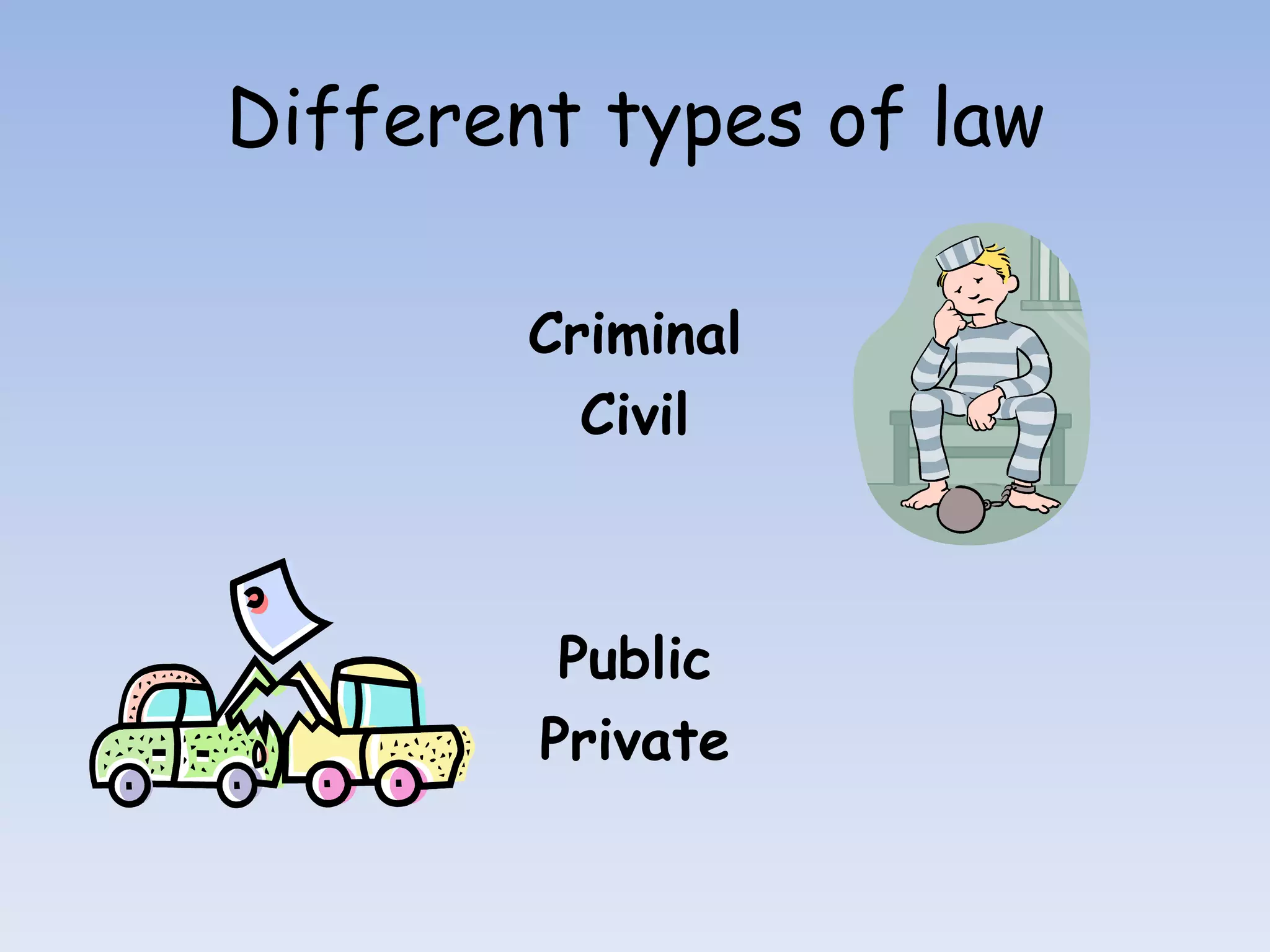
Different types of lawCriminalCivilPublic Private
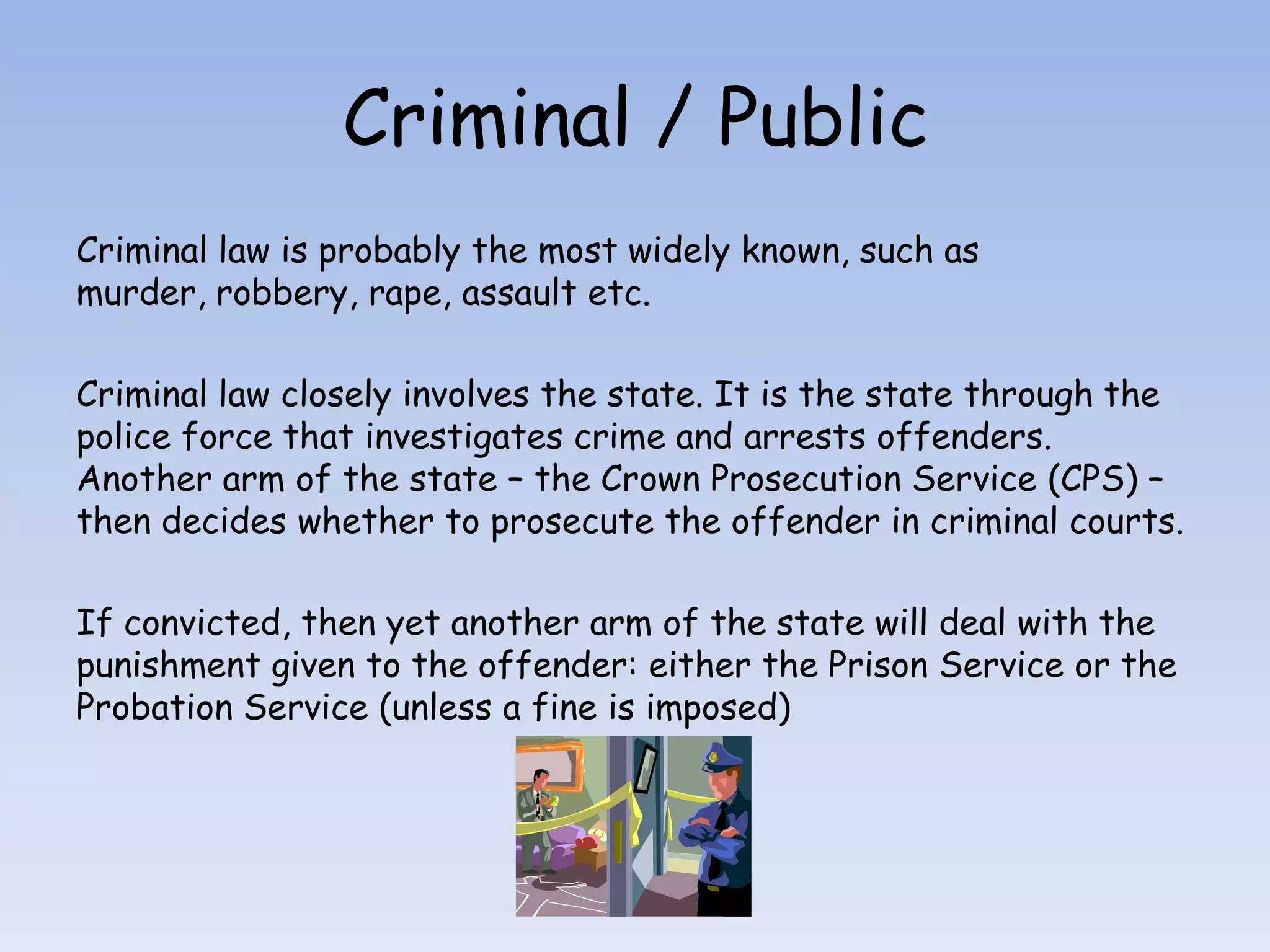
Criminal / PublicCriminal law is probably the most widely known, such as murder, robbery, rape, assault etc.Criminal law closely involves the state. It is the state through the police force that investigates crime and arrests offenders. Another arm of the state – the Crown Prosecution Service (CPS) – then decides whether to prosecute the offender in criminal courts.If convicted, then yet another arm of the state will deal with the punishment given to the offender: either the Prison Service or the Probation Service (unless a fine is imposed)
Criminal / PublicOther branches of public law are constitutional law and public international law.Constitutional law deals with the powers of the government, how laws are made by Parliament, what powers are given to the civil service or to the Scottish Parliament or the Welsh Assembly. Public international law governs relationships between different states and is regulated by international treaties.
Civil / PrivateCivil law is concerned mostly with disputes between individuals or corporate bodies. Cases must be proved on the balance of probabilities (more than a 50 per cent probability that the defendant is liable).
QuestionsWhy do we need laws?What are the 2 branches of public law that were mentioned?Give 2 examples of the law’s involvement with sport.
Lord of the flies“Roger gathered a handful of stones and began to throw them. Yet there was a space round Henry, perhaps six yards in diameter, into which he dare not throw. Here, invisible yet strong, was the taboo of the old life. Round the squatting child was the protection of parents and school and policemen and the law."
Lord of the fliesDiscussion Point:What does this quotation show you about how law affects the world around us?
The Unwritten ConstitutionBritain does not have a written constitution – this is unusual. Just because it is not written does not mean we don’t have one. If a country has rules about who holds the power to govern, what they can and cannot do with that power, and how that power is to be passed on or transferred, it has a constitution.In our constitution it is established that the Government is formed by the political part which wins a general election, and that power is transferred from that party when they lose an election.
The separation of powersThis principle was developed by the 18th century French philosopher Montesquieu, and claimed that all state power can be divided into three types: executive, legislative and judicial.The executive = Government, policeLegislative = ParliamentJudicial = Judges
Role of the Lord ChancellorThe Lord Chancellor has had many roles in the past, including:Legislature – Speaker of the House of 		             LordsExecutive –   Government MinisterJudiciary –   Judge in the House of Lords 		    and Privy Council. President of 		    the Supreme Court and 			    President of the Chancery 			    Division of the High Court.
Role of the Lord ChancellorSince the passing of the Constitutional Reform Act 2005, four major changes to the role of the Lord Chancellor have been made. As a result he or she no longer:  Sits as a judge  Heads the judiciary  Takes a central role in the judicial appointment   process; or  Automatically becomes the Speaker of the    House of Lords.He or she remains as the head of a Government department (now called the Ministry of Justice), but his or her powers and links to the judges have been removed to satisfy the principle of the separation of powers.
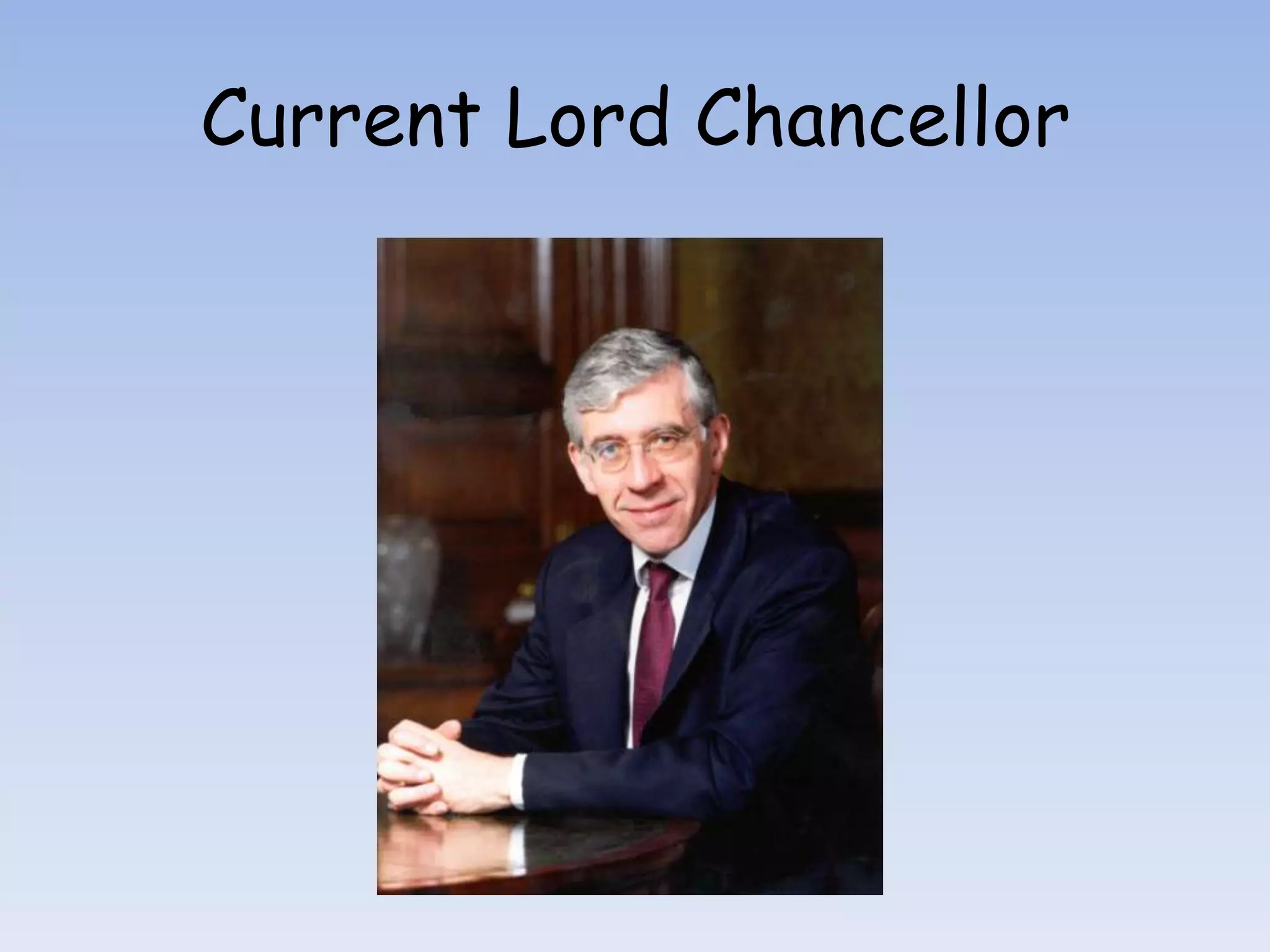
Current Lord Chancellor

Introduction to Law

  • 1.
    Law – ASLevelEnglish Legal System
  • 2.
    ExpectationsAttend all lessonson timeComplete all work to the set deadlineCollect any work that is missed and ensure it is up to date before the next lessonIf there are any concerns during the course regarding work, assignments, revision etc my email is: thorogl01@leedslearning.net
  • 3.
    Exam DatesBoth examswill take place in May / June 2010
  • 4.
    Exam ContentThe subjectcontent of the AS is divided into two units: Understanding Legal Structures and Processes and Understanding Legal Reasoning, Methods and Personnel.
  • 5.
    Why did youchoose Law?
  • 6.
  • 7.
    Different types oflawCriminalCivilPublic Private
  • 8.
    Criminal / PublicCriminallaw is probably the most widely known, such as murder, robbery, rape, assault etc.Criminal law closely involves the state. It is the state through the police force that investigates crime and arrests offenders. Another arm of the state – the Crown Prosecution Service (CPS) – then decides whether to prosecute the offender in criminal courts.If convicted, then yet another arm of the state will deal with the punishment given to the offender: either the Prison Service or the Probation Service (unless a fine is imposed)
  • 9.
    Criminal / PublicOtherbranches of public law are constitutional law and public international law.Constitutional law deals with the powers of the government, how laws are made by Parliament, what powers are given to the civil service or to the Scottish Parliament or the Welsh Assembly. Public international law governs relationships between different states and is regulated by international treaties.
  • 10.
    Civil / PrivateCivillaw is concerned mostly with disputes between individuals or corporate bodies. Cases must be proved on the balance of probabilities (more than a 50 per cent probability that the defendant is liable).
  • 11.
    QuestionsWhy do weneed laws?What are the 2 branches of public law that were mentioned?Give 2 examples of the law’s involvement with sport.
  • 12.
    Lord of theflies“Roger gathered a handful of stones and began to throw them. Yet there was a space round Henry, perhaps six yards in diameter, into which he dare not throw. Here, invisible yet strong, was the taboo of the old life. Round the squatting child was the protection of parents and school and policemen and the law."
  • 13.
    Lord of thefliesDiscussion Point:What does this quotation show you about how law affects the world around us?
  • 14.
    The Unwritten ConstitutionBritaindoes not have a written constitution – this is unusual. Just because it is not written does not mean we don’t have one. If a country has rules about who holds the power to govern, what they can and cannot do with that power, and how that power is to be passed on or transferred, it has a constitution.In our constitution it is established that the Government is formed by the political part which wins a general election, and that power is transferred from that party when they lose an election.
  • 15.
    The separation ofpowersThis principle was developed by the 18th century French philosopher Montesquieu, and claimed that all state power can be divided into three types: executive, legislative and judicial.The executive = Government, policeLegislative = ParliamentJudicial = Judges
  • 16.
    Role of theLord ChancellorThe Lord Chancellor has had many roles in the past, including:Legislature – Speaker of the House of LordsExecutive – Government MinisterJudiciary – Judge in the House of Lords and Privy Council. President of the Supreme Court and President of the Chancery Division of the High Court.
  • 17.
    Role of theLord ChancellorSince the passing of the Constitutional Reform Act 2005, four major changes to the role of the Lord Chancellor have been made. As a result he or she no longer: Sits as a judge Heads the judiciary Takes a central role in the judicial appointment process; or Automatically becomes the Speaker of the House of Lords.He or she remains as the head of a Government department (now called the Ministry of Justice), but his or her powers and links to the judges have been removed to satisfy the principle of the separation of powers.
  • 18.