Statutory Interpretation 4
ObjectivesTo complete your learning on Statutory InterpretationTo understand internal and extrinsic aids to Interpretation
Starter – 3 2 1!Provide:-  Types of Statutory Interpretation Rule (with case examples- Advantages of Statutory Interpretation (with reference to a rule)- Disadvantage of Statutory Interpretation (with reference to a rule)
Internal Aids to Interpretation The Statute The long title of the Act The preamble – sets out the need for the legislation and its intended effect Headings Schedules – Parts of the Act and may be looked at if there is ambiguity in the main body of the Act
Internal Aids to Interpretation Explanatory notes – since 1999 Presumptions – The courts assume that certain points are implied in all legislation.   These presumptions include the following:Statutes do not change the common law Legislature does not intent to remove any matters from the jurisdiction of the courtsExisting rights are not to be interfered withLaws which create crimes should be interpreted in favour of the citizen where there is ambiguity Legislation does not operate retrospectively: its provisions operate from the day it comes into forceStatutes do not affect the Monarch
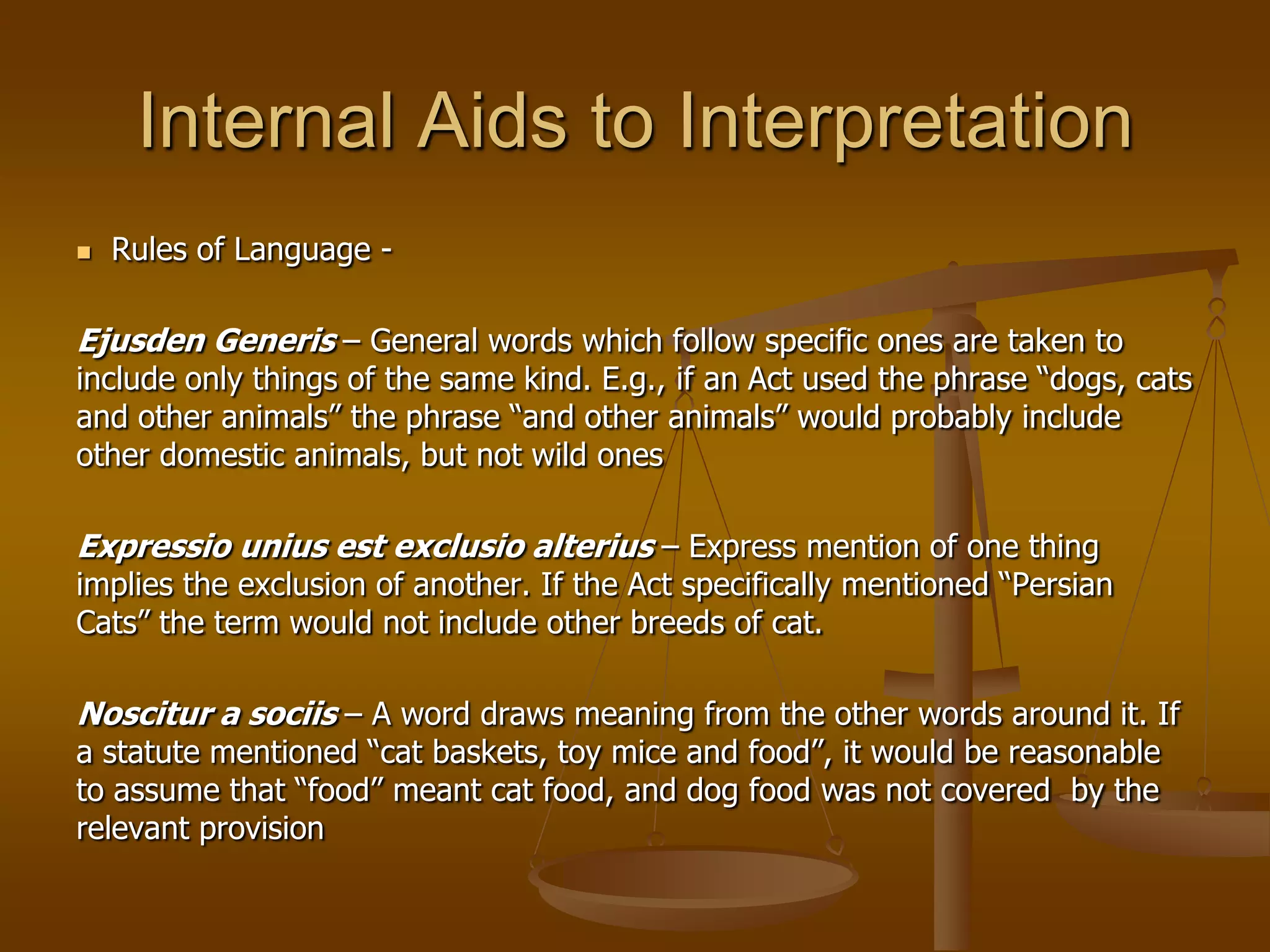
Internal Aids to Interpretation Rules of Language - Ejusden Generis – General words which follow specific ones are taken to include only things of the same kind. E.g., if an Act used the phrase “dogs, cats and other animals” the phrase “and other animals” would probably include other domestic animals, but not wild onesExpressiouniusestexclusioalterius– Express mention of one thing implies the exclusion of another. If the Act specifically mentioned “Persian Cats” the term would not include other breeds of cat.Noscitur a sociis– A word draws meaning from the other words around it. If a statute mentioned “cat baskets, toy mice and food”, it would be reasonable to assume that “food” meant cat food, and dog food was not covered  by the relevant provision
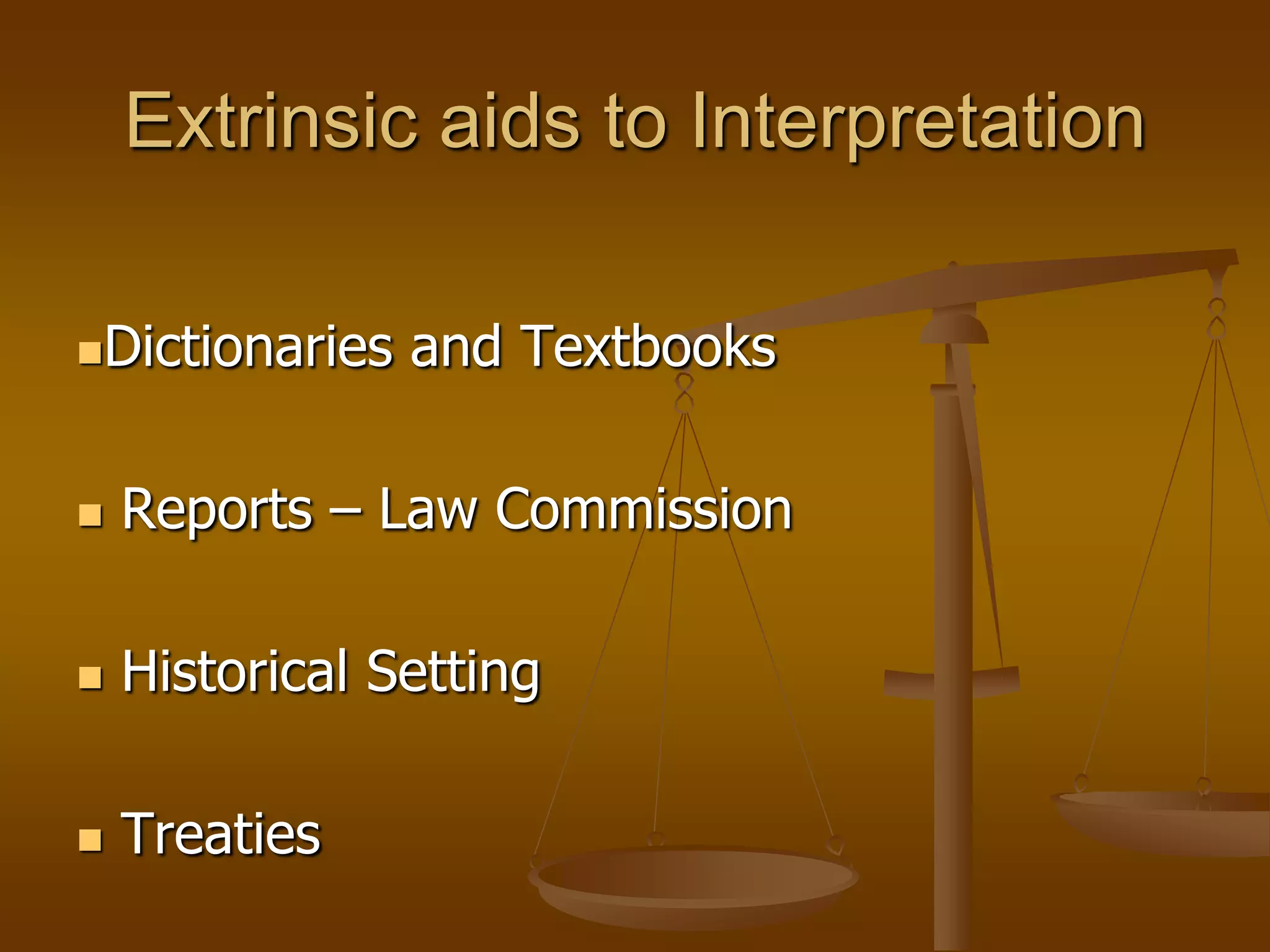
Extrinsic aids to InterpretationDictionaries and Textbooks Reports – Law Commission Historical Setting Treaties
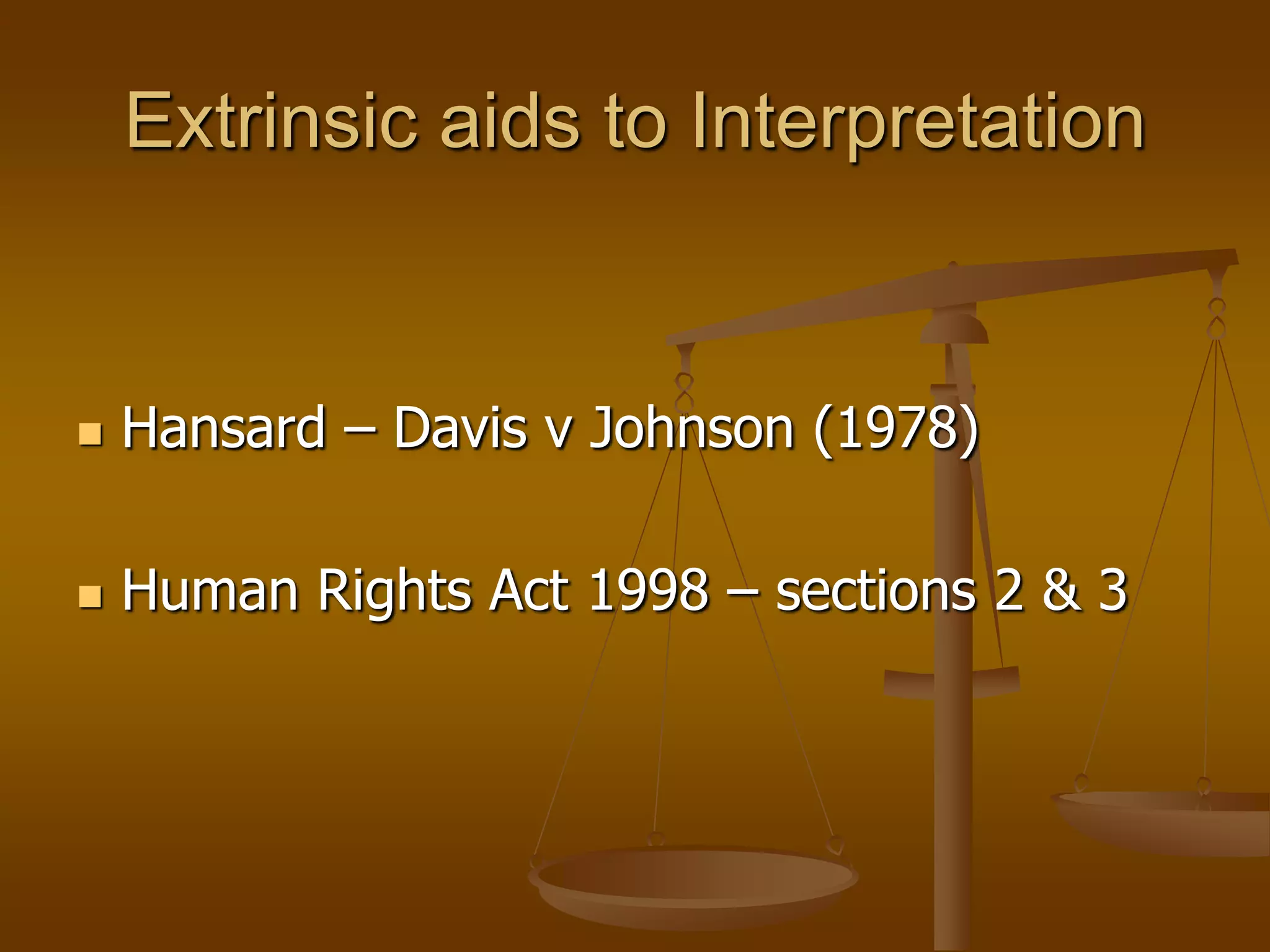
Extrinsic aids to InterpretationHansard– Davis v Johnson (1978)  Human Rights Act 1998 – sections 2 & 3
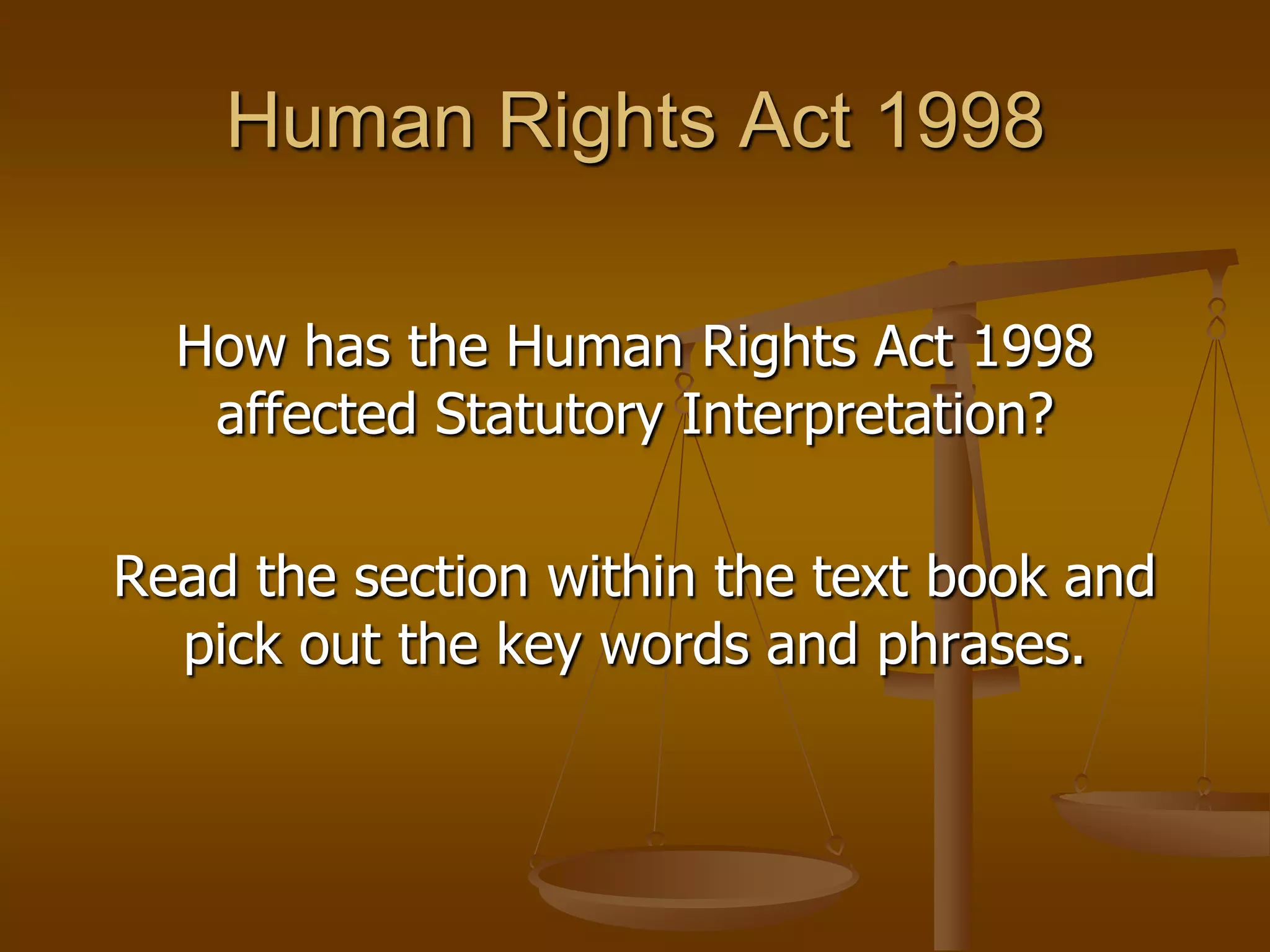
Human Rights Act 1998How has the Human Rights Act 1998 affected Statutory Interpretation?Read the section within the text book and pick out the key words and phrases.
PrecedentWhat is the relationship between Statutory Interpretation and Precedent?Once the courts have interpreted a statute that then becomes part of case law in the same way as any other judicial decision, subject to the rules of precedent
PrecedentHow has our membership of the EU affected judges approaches to Statutory Interpretation?Growth of a more purposive approach & effect of S2(4) European Communities Act 1972 – all parliamentary legislation must be construed and applied in accordance with Union law – R v Secretary of State for transport, ex parte Factortame(1990)  - pg 103
PlenaryThink about everything we have learnt about regarding Statutory Interpretation.Come up with ideas on what you would have done if you had taught this topic. Think about:What activities you would have usedHow you would have checked understandingWhat types of starters or plenaries could you have used?
Period 2Complete the worksheet using the textbook and the internet sites: sixthformlaw.info and a-level-law.co.ukIf you complete this you will be given a country and you need to research it.

Statutory Interpretation 4

  • 1.
  • 2.
    ObjectivesTo complete yourlearning on Statutory InterpretationTo understand internal and extrinsic aids to Interpretation
  • 3.
    Starter – 32 1!Provide:- Types of Statutory Interpretation Rule (with case examples- Advantages of Statutory Interpretation (with reference to a rule)- Disadvantage of Statutory Interpretation (with reference to a rule)
  • 4.
    Internal Aids toInterpretation The Statute The long title of the Act The preamble – sets out the need for the legislation and its intended effect Headings Schedules – Parts of the Act and may be looked at if there is ambiguity in the main body of the Act
  • 5.
    Internal Aids toInterpretation Explanatory notes – since 1999 Presumptions – The courts assume that certain points are implied in all legislation. These presumptions include the following:Statutes do not change the common law Legislature does not intent to remove any matters from the jurisdiction of the courtsExisting rights are not to be interfered withLaws which create crimes should be interpreted in favour of the citizen where there is ambiguity Legislation does not operate retrospectively: its provisions operate from the day it comes into forceStatutes do not affect the Monarch
  • 6.
    Internal Aids toInterpretation Rules of Language - Ejusden Generis – General words which follow specific ones are taken to include only things of the same kind. E.g., if an Act used the phrase “dogs, cats and other animals” the phrase “and other animals” would probably include other domestic animals, but not wild onesExpressiouniusestexclusioalterius– Express mention of one thing implies the exclusion of another. If the Act specifically mentioned “Persian Cats” the term would not include other breeds of cat.Noscitur a sociis– A word draws meaning from the other words around it. If a statute mentioned “cat baskets, toy mice and food”, it would be reasonable to assume that “food” meant cat food, and dog food was not covered by the relevant provision
  • 7.
    Extrinsic aids toInterpretationDictionaries and Textbooks Reports – Law Commission Historical Setting Treaties
  • 8.
    Extrinsic aids toInterpretationHansard– Davis v Johnson (1978) Human Rights Act 1998 – sections 2 & 3
  • 9.
    Human Rights Act1998How has the Human Rights Act 1998 affected Statutory Interpretation?Read the section within the text book and pick out the key words and phrases.
  • 10.
    PrecedentWhat is therelationship between Statutory Interpretation and Precedent?Once the courts have interpreted a statute that then becomes part of case law in the same way as any other judicial decision, subject to the rules of precedent
  • 11.
    PrecedentHow has ourmembership of the EU affected judges approaches to Statutory Interpretation?Growth of a more purposive approach & effect of S2(4) European Communities Act 1972 – all parliamentary legislation must be construed and applied in accordance with Union law – R v Secretary of State for transport, ex parte Factortame(1990) - pg 103
  • 12.
    PlenaryThink about everythingwe have learnt about regarding Statutory Interpretation.Come up with ideas on what you would have done if you had taught this topic. Think about:What activities you would have usedHow you would have checked understandingWhat types of starters or plenaries could you have used?
  • 13.
    Period 2Complete theworksheet using the textbook and the internet sites: sixthformlaw.info and a-level-law.co.ukIf you complete this you will be given a country and you need to research it.