Submitted By
Riju Maskay
Saraswati Saud
MIS
Chapter 1: Introduction
Organization And Management
1. Organization
2. Prerequisite part while forming an organization
❏ Organization structure
❏ Organization culture
❏ Motivation
❏ Upward mobility
2
Organization And Management
3. Core areas of organization
❏ Sales and Marketing
❏ Manufacturing and Production
❏ Finance and Accounting
❏ HRM
3
Organization And Management
1. Management
2. Level of management
❏ Top level
❏ Middle level
❏ Bottom level
4
System and its types
System
Types of System
i. Open system
ii. Closed system
iii. Cybernating system
5
Information System
1. Information System
2. Role of IS in business
❏ Support of business process and operations
❏ Support of business decision making
❏ Support of strategies for competitive advantage
6
Continue….
3. Information System Resources
People, Hardware, Software, Data, Network
4. IS Activities
Input, Process, Output, Control, Storage
5. IS framework for Business Professionals
❏Foundation concept
❏Information technology
❏Business application
❏Development process
❏Managerial challenges
7
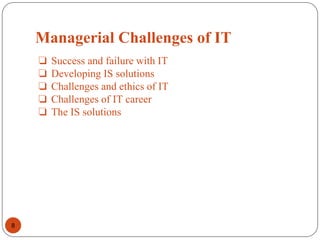
Managerial Challenges of IT
8
❏ Success and failure with IT
❏ Developing IS solutions
❏ Challenges and ethics of IT
❏ Challenges of IT career
❏ The IS solutions
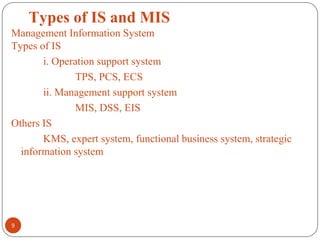
Types of IS and MIS
Management Information System
Types of IS
i. Operation support system
TPS, PCS, ECS
ii. Management support system
MIS, DSS, EIS
Others IS
KMS, expert system, functional business system, strategic
information system
9
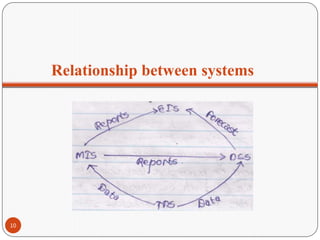
Relationship between systems
10
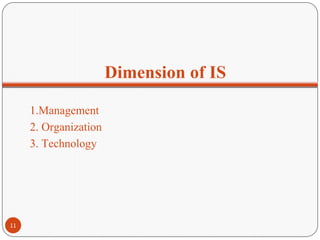
Dimension of IS
1.Management
2. Organization
3. Technology
11
Contemporary approaches to IS
1. Technical approach
2. Behavioral approach
12
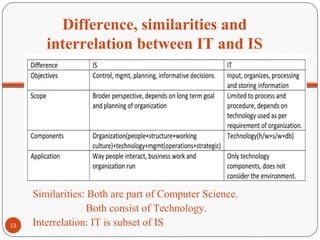
Difference, similarities and
interrelation between IT and IS
Similarities: Both are part of Computer Science.
Both consist of Technology.
Interrelation: IT is subset of IS13

Introduction to Information System

  • 1.
    Submitted By Riju Maskay SaraswatiSaud MIS Chapter 1: Introduction
  • 2.
    Organization And Management 1.Organization 2. Prerequisite part while forming an organization ❏ Organization structure ❏ Organization culture ❏ Motivation ❏ Upward mobility 2
  • 3.
    Organization And Management 3.Core areas of organization ❏ Sales and Marketing ❏ Manufacturing and Production ❏ Finance and Accounting ❏ HRM 3
  • 4.
    Organization And Management 1.Management 2. Level of management ❏ Top level ❏ Middle level ❏ Bottom level 4
  • 5.
    System and itstypes System Types of System i. Open system ii. Closed system iii. Cybernating system 5
  • 6.
    Information System 1. InformationSystem 2. Role of IS in business ❏ Support of business process and operations ❏ Support of business decision making ❏ Support of strategies for competitive advantage 6
  • 7.
    Continue…. 3. Information SystemResources People, Hardware, Software, Data, Network 4. IS Activities Input, Process, Output, Control, Storage 5. IS framework for Business Professionals ❏Foundation concept ❏Information technology ❏Business application ❏Development process ❏Managerial challenges 7
  • 8.
    Managerial Challenges ofIT 8 ❏ Success and failure with IT ❏ Developing IS solutions ❏ Challenges and ethics of IT ❏ Challenges of IT career ❏ The IS solutions
  • 9.
    Types of ISand MIS Management Information System Types of IS i. Operation support system TPS, PCS, ECS ii. Management support system MIS, DSS, EIS Others IS KMS, expert system, functional business system, strategic information system 9
  • 10.
  • 11.
    Dimension of IS 1.Management 2.Organization 3. Technology 11
  • 12.
    Contemporary approaches toIS 1. Technical approach 2. Behavioral approach 12
  • 13.
    Difference, similarities and interrelationbetween IT and IS Similarities: Both are part of Computer Science. Both consist of Technology. Interrelation: IT is subset of IS13