
Inroduction to Grails

Hiten Pratap Singh
hitenpratap99@gmail.com
http://github.com/hitenpratap
Agenda
●

What is Grails?

●

Why Grails?

●

History of Grails

●

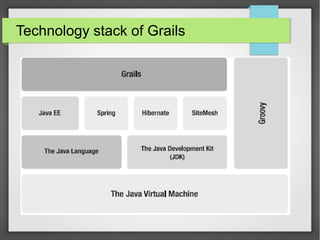
Technology stack of Grails

●

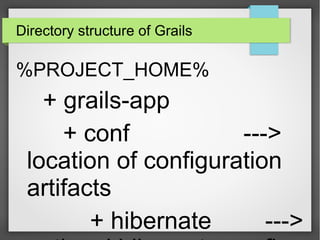
Directory structure of Grails

●

Main Components of Grails

●

Pros and Cons of Grails

●

WebSites using Grails
Agenda
●

Future of Grails

●

References
What is Grails?
●

Grails is an open source web application framework

●

uses the Groovy programming language

●

●

●

●

following the "coding by convention" paradigm
providing a stand-alone development environment and
hiding much of the configuration detail
Also following DRY(don't repeat yourself) paradigm
Grails is highly inspired from Ruby on Rails web framework
like DRY and COC principles.
Why Grails?
●

According to its official websites–
–

●

●

Grails is Dynamic

–
●

Grails is Robust
Grails is Rapid

Most important reasion to use it is that it runs on JVM and
leverages all plus points of JAVA
Any Java developer can learn it very quickly rather than
migrate to other framework for RAD development.
Grails is agile and based on plugins means any
functionality can be attach/detach to it very easily.
Why Grails?
●

Grails is actually Spring and Hibernate plus trending
concepts from Ruby on Rails like DRY and COC etc.

●

It's very dynamic ecosystem

●

Very active developer community

●

Grails removes the need to add configuration in XML files
History of Grails
●

●

●

●

●

Grails was previously known as 'Groovy on Rails
Work began in July 2005, with the 0.1 release on March
29, 2006
Graeme Rocher is project head and creator of Grails
framework.
Grails is made by G2One, later acquired by Spring Source.
It developed due to need of RAD framework for JAVA
programmer community like Ruby on Rails in Ruby
programmer community.
Technology stack of Grails
Directory structure of Grails

%PROJECT_HOME%

+ grails-app
+ conf
--->
location of configuration
artifacts
+ hibernate
--->
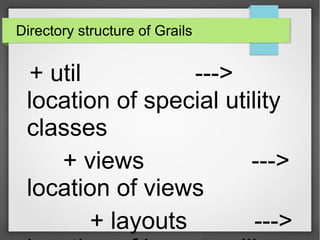
Directory structure of Grails

+ util
--->
location of special utility
classes
+ views
--->
location of views
+ layouts
--->
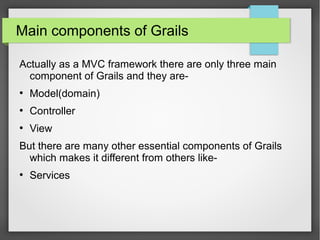
Main components of Grails
Actually as a MVC framework there are only three main
component of Grails and they are●

Model(domain)

●

Controller

●

View

But there are many other essential components of Grails
which makes it different from others like●

Services
Main components of Grails
●

Taglib

●

Plugins

●

Templating
Pros and cons of using Grails
What are the advantages?
●

●

●

●

●

It provides a rapid development cycle.
The framework offers a range of plug-ins to make your
development simple.
You can see the changes by hitting the refresh button.
Dynamic configuration feature. Therefore, you can change
the configuration without server restart.
The setup process is very simple. Therefore, you should
be able to start building an app in an hour.
Pros and cons of using Grails
What are the disadvantages?
●

●

●

●

Interpreted languages increase weight and that directly
affects the run time.
It works with GORM but not with any other ORMs.
Developers generally declare variables with “def” which is
equivalent to “object”. It’s very hard to maintain.
You have to deal with runtime language.
WebSites Using Grails
Folowing websites are currently using Grails●

Netflix Asgard - https://github.com/Netflix/asgard

●

NOW TV - http://nowtv.com

●

Vodafone Music - http://music.vodafone360.com/gb/en

●

Sky TV Guide - http://tv.sky.com/

and many more.......

source:
http://grails.org
Future of Grails
●

●

●

Grails 3.0 will separate Grails from the traditional
application server and extend Grails’ reach to allow for the
development of lightweight, asynchronous applications.
Grails’ persistence technology GORM has also been
evolving beyond the traditional relational database, with
implementations for NoSQL databases now available.
GORM will continue to be an important technology for us
as enterprise data fabrics evolve.
Source:http://www.cacoethes.co.uk/blog/groovyandgrails/where-next-for-grails
References
●

http://grails.org

●

http://grails.org/websites

●

http://www.cacoethes.co.uk/blog/groovyandgrails/where-next-fo

●

http://en.wikipedia.org/wiki/Grails_(framework)
Any questions?
Thank You.......

Introduction to Grails

  • 1.
    Inroduction to Grails HitenPratap Singh hitenpratap99@gmail.com http://github.com/hitenpratap
  • 2.
    Agenda ● What is Grails? ● WhyGrails? ● History of Grails ● Technology stack of Grails ● Directory structure of Grails ● Main Components of Grails ● Pros and Cons of Grails ● WebSites using Grails
  • 3.
  • 4.
    What is Grails? ● Grailsis an open source web application framework ● uses the Groovy programming language ● ● ● ● following the "coding by convention" paradigm providing a stand-alone development environment and hiding much of the configuration detail Also following DRY(don't repeat yourself) paradigm Grails is highly inspired from Ruby on Rails web framework like DRY and COC principles.
  • 5.
    Why Grails? ● According toits official websites– – ● ● Grails is Dynamic – ● Grails is Robust Grails is Rapid Most important reasion to use it is that it runs on JVM and leverages all plus points of JAVA Any Java developer can learn it very quickly rather than migrate to other framework for RAD development. Grails is agile and based on plugins means any functionality can be attach/detach to it very easily.
  • 6.
    Why Grails? ● Grails isactually Spring and Hibernate plus trending concepts from Ruby on Rails like DRY and COC etc. ● It's very dynamic ecosystem ● Very active developer community ● Grails removes the need to add configuration in XML files
  • 7.
    History of Grails ● ● ● ● ● Grailswas previously known as 'Groovy on Rails Work began in July 2005, with the 0.1 release on March 29, 2006 Graeme Rocher is project head and creator of Grails framework. Grails is made by G2One, later acquired by Spring Source. It developed due to need of RAD framework for JAVA programmer community like Ruby on Rails in Ruby programmer community.
  • 8.
  • 9.
    Directory structure ofGrails %PROJECT_HOME% + grails-app + conf ---> location of configuration artifacts + hibernate --->
  • 10.
    Directory structure ofGrails + util ---> location of special utility classes + views ---> location of views + layouts --->
  • 11.
    Main components ofGrails Actually as a MVC framework there are only three main component of Grails and they are● Model(domain) ● Controller ● View But there are many other essential components of Grails which makes it different from others like● Services
  • 12.
    Main components ofGrails ● Taglib ● Plugins ● Templating
  • 13.
    Pros and consof using Grails What are the advantages? ● ● ● ● ● It provides a rapid development cycle. The framework offers a range of plug-ins to make your development simple. You can see the changes by hitting the refresh button. Dynamic configuration feature. Therefore, you can change the configuration without server restart. The setup process is very simple. Therefore, you should be able to start building an app in an hour.
  • 14.
    Pros and consof using Grails What are the disadvantages? ● ● ● ● Interpreted languages increase weight and that directly affects the run time. It works with GORM but not with any other ORMs. Developers generally declare variables with “def” which is equivalent to “object”. It’s very hard to maintain. You have to deal with runtime language.
  • 15.
    WebSites Using Grails Folowingwebsites are currently using Grails● Netflix Asgard - https://github.com/Netflix/asgard ● NOW TV - http://nowtv.com ● Vodafone Music - http://music.vodafone360.com/gb/en ● Sky TV Guide - http://tv.sky.com/ and many more....... source: http://grails.org
  • 16.
    Future of Grails ● ● ● Grails3.0 will separate Grails from the traditional application server and extend Grails’ reach to allow for the development of lightweight, asynchronous applications. Grails’ persistence technology GORM has also been evolving beyond the traditional relational database, with implementations for NoSQL databases now available. GORM will continue to be an important technology for us as enterprise data fabrics evolve. Source:http://www.cacoethes.co.uk/blog/groovyandgrails/where-next-for-grails
  • 17.
  • 18.
  • 19.