Definition of Economics Rational of Economics Scope of Economics Method of analysis in Economic
Introduction to Economics
Chapter 1
Tadele Bayu
Department of Economics
Bahir Dar University
August 31, 2022
Tadele Bayu (Bahir Dar University) Introduction to Economics Chapter 1 August 31, 2022 1/47
Definition of Economics Rational of Economics Scope of Economics Method of analysis in Economic
Table of contents
1 Definition of Economics
2 Rational of Economics
3 Scope of Economics
4 Method of analysis in Economics
5 PPF
6 Economic Questions
7 Economic System
Tadele Bayu (Bahir Dar University) Introduction to Economics Chapter 1 August 31, 2022 2/47
Economic System Definition of Economics Rational of Economics Scope of Economics Method of analysis in Economic
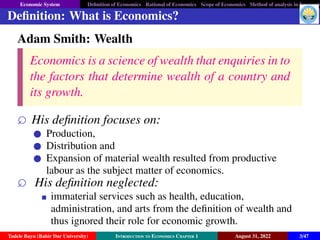
Definition: What is Economics?
Adam Smith: Wealth
Economics is a science of wealth that enquiries in to
the factors that determine wealth of a country and
its growth.
 His definition focuses on:
Production,
Distribution and
Expansion of material wealth resulted from productive
labour as the subject matter of economics.
 His definition neglected:
immaterial services such as health, education,
administration, and arts from the definition of wealth and
thus ignored their role for economic growth.
Tadele Bayu (Bahir Dar University) Introduction to Economics Chapter 1 August 31, 2022 3/47
Economic System Definition of Economics Rational of Economics Scope of Economics Method of analysis in Economic
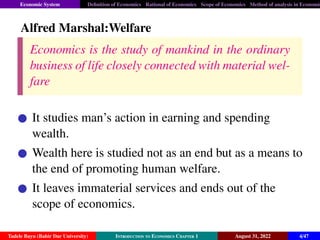
Alfred Marshal:Welfare
Economics is the study of mankind in the ordinary
business of life closely connected with material wel-
fare
It studies man’s action in earning and spending
wealth.
Wealth here is studied not as an end but as a means to
the end of promoting human welfare.
It leaves immaterial services and ends out of the
scope of economics.
Tadele Bayu (Bahir Dar University) Introduction to Economics Chapter 1 August 31, 2022 4/47
Economic System Definition of Economics Rational of Economics Scope of Economics Method of analysis in Economic
Lionel Charles Robbins:Scarcity1
Economics is a science which studies human behav-
ior as a relationship between unlimited ends and
scarce resources with alternative uses.
It studies human action regarding how he satisfies his
wants (all goods and services) with scarce resources.
This definition leaves macroeconomic issues such as
determination of national income and employment,
and the theory of economic growth and development
untouched that are the major concerns of modern macroe-
conomics.
1
Robbins, L. C. (1932). An Essay on the Nature and Significance of Economic
Science. London: Macmillan.
Tadele Bayu (Bahir Dar University) Introduction to Economics Chapter 1 August 31, 2022 5/47
Economic System Definition of Economics Rational of Economics Scope of Economics Method of analysis in Economic
Generally speaking
These definitions do not indicate the full range of issues studied by economists.
For starters, a good way to understand the scope of economics is to con-
sider the following short list.
(1) How markets work to determine prices and allocate resources.
(2) How governments influence, for better or for worse, market outcomes through tax
policy, tariffs, subsidies, patent protection, environmental policy, etc.
(3) How a nations central bank (e.g., the Federal Reserve System of the United States)
may influence the money supply, interest rates, unemployment, inflation, and the
rate of growth of output.
(4) How we measure income inequality, inflation, unemployment, and productivity
growth.
This is only a short list. Economic researchers today are interested in a
much longer list of topics.
Tadele Bayu (Bahir Dar University) Introduction to Economics Chapter 1 August 31, 2022 6/47
Economic System Definition of Economics Rational of Economics Scope of Economics Method of analysis in Economic
Conclusion
The definition varies as the nature and scope of the
subject grows over time. But, we can have a common
definition is as follow:
Economics is a social science which studies about
efficient allocation of scarce resources so as to at-
tain the maximum fulfillment of unlimited human
needs.
Tadele Bayu (Bahir Dar University) Introduction to Economics Chapter 1 August 31, 2022 7/47
Economic System Definition of Economics Rational of Economics Scope of Economics Method of analysis in Economic
The rationales of economics
Economists say human wants are unlimited due to the
facts that some human wants are recurring and others
are hierarchical
The same needs reappear after being satisfied and
needs emerge with higher order ones.
For example, the need to eat recurs within a certain interval.
Likewise, once you attain your Bachelor degree, you aspire to get better education like a
master degree and then PhD.
Human wants for goods and services remain ahead of resources and capacity to
produce.
The basic economic problem is about scarcity and
choice.
Choice is at the heart of all decision making !!
Tadele Bayu (Bahir Dar University) Introduction to Economics Chapter 1 August 31, 2022 8/47
Economic System Definition of Economics Rational of Economics Scope of Economics Method of analysis in Economic
Foundation of Economics
The scarcity of resources and the choices it forces us to make is the source of all of the
problems studied in economics
Households allocate limited income among goods and services
Business firms choices of what to produce and how much are limited by costs of
production
Government agencies work with limited budgets and must carefully choose which
goals to pursue
Economists study about how these choices are made in various set-
tings; evaluate the outcomes in terms of criteria such as efficiency,
equity, and stability; and search for alternative forms of economic
organization that might produce higher living standards.
QPPPPPPR Explain how our economic system works
QPPPPPPR Forecast the future of our economy
QPPPPPPR Suggest ways to make that future even better
Tadele Bayu (Bahir Dar University) Introduction to Economics Chapter 1 August 31, 2022 9/47
Economic System Definition of Economics Rational of Economics Scope of Economics Method of analysis in Economic
Scope of Economics
The core of modern economics is formed by its two major branches: mi-
croeconomics and macroeconomics
QPPPPPPR Micro comes from Greek word
mikros, meaning small
QPPPPPPR Study the behavior of individual
households, firms, and
governments
Choices they make
Interaction in specific
markets
Focuses on individual parts of
an economy, rather than the
whole
QPPPPPPR tools are DD and SS of a
particular commodity and factor.
QPPPPPPR It helps to solve the central
problems of what to produce,
how and for whom to produce.
QPPPPPPR Discusses issues related with
Macro comes from Greek word, makros,
meaning large
Study of the economy as a whole
Focuses on big picture and ignores fine
details
Unemployment
General price level
Economic growth
BOP
etc
Determination of level of income and
employment are its central problems.
Its main tools are aggregate demand and
aggregate supply.
Tadele Bayu (Bahir Dar University) Introduction to Economics Chapter 1 August 31, 2022 10/47
Economic System Definition of Economics Rational of Economics Scope of Economics Method of analysis in Economic
Method of analysis in economics
Is economics a positive science or normative science, or both? What is
your justification?
Positive Economics
analyzes facts and attempts to describe the world as it is.
It tries to answer the questions what was; what is; or what
will be?
It does not judge a system as good or bad, better or worse.
Statements about how the economy works
Accuracy can be tested by looking at the facts.
QPPPPPPR The current inflation rate in Ethiopia is 12 percent.
QPPPPPPR Poverty and unemployment are the biggest problems in Ethiopia.
QPPPPPPR The life expectancy at birth in Ethiopia is rising.
Tadele Bayu (Bahir Dar University) Introduction to Economics Chapter 1 August 31, 2022 11/47
Economic System Definition of Economics Rational of Economics Scope of Economics Method of analysis in Economic
Normative Economics
Study of what should be, what ought to be.
Used to make value judgments, identify problems, and
prescribe solutions
Statements that suggest what we should do about
economic facts,based on values
Normative statements cannot be proved or disproved by
the facts alone
It evaluates the desirability of alternative outcomes based
on ones value judgments about what is good or what is
bad.
QPPPPPPR The poor should not pay any taxes
QPPPPPPR Female students must get better job opportunities than male students.
Tadele Bayu (Bahir Dar University) Introduction to Economics Chapter 1 August 31, 2022 12/47
Economic System Definition of Economics Rational of Economics Scope of Economics Method of analysis in Economic
Inductive and Deductive Reasoning
QPPPPPPR The fundamental objective of economics, like any
science, is the establishment of valid generalizations
about certain aspects of human behaviour.
QPPPPPPR Those generalizations are known as theories .
QPPPPPPR Economic theory provides the basis for economic
analysis which uses logical reasoning
QPPPPPPR There are three methods of logical reasoning:
(a) Inductive
(b) Deductive
(c) Abductive
Tadele Bayu (Bahir Dar University) Introduction to Economics Chapter 1 August 31, 2022 13/47
Economic System Definition of Economics Rational of Economics Scope of Economics Method of analysis in Economic
Inductive reasoning
It is a logical method of reaching at a correct general statement or
theory based on several independent and specific correct statements.
In short, it is the process of deriving a principle or theory by mov-
ing from facts to theories and from particular to general economic
analysis.
Inductive method involves the following steps.
QPPPPPPR Selecting problem for analysis
QPPPPPPR Collection, classification, and analysis of data
QPPPPPPR Establishing cause and effect relationship
between economic phenomena.
Tadele Bayu (Bahir Dar University) Introduction to Economics Chapter 1 August 31, 2022 14/47
Economic System Definition of Economics Rational of Economics Scope of Economics Method of analysis in Economic
Deductive reasoning
It is a logical way of arriving at a particular or specific correct statement start-
ing from a correct general statement.
In short, it deals with conclusions about economic phenomenon from certain
fundamental assumptions or truths or axioms through a process of logical ar-
guments.
we should check the validity of the theory to facts by moving from general to
particular.
Major steps in the deductive approach include:
QPPPPPPR Problem identification
QPPPPPPR Specification of the assumptions
QPPPPPPR Formulating hypotheses
QPPPPPPR Testing the validity of the hypotheses
Tadele Bayu (Bahir Dar University) Introduction to Economics Chapter 1 August 31, 2022 15/47
Economic System Definition of Economics Rational of Economics Scope of Economics Method of analysis in Economic
Scarcity, choice, opportunity cost and PPF
q Scarcity refers to the fact that all economic resources
that a society needs to produce goods and services
are finite or limited in supply.
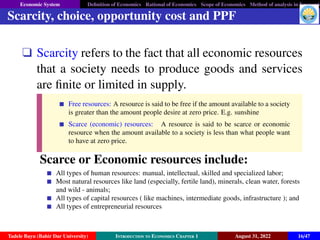
Free resources: A resource is said to be free if the amount available to a society
is greater than the amount people desire at zero price. E.g. sunshine
Scarce (economic) resources: A resource is said to be scarce or economic
resource when the amount available to a society is less than what people want
to have at zero price.
Scarce or Economic resources include:
All types of human resources: manual, intellectual, skilled and specialized labor;
Most natural resources like land (especially, fertile land), minerals, clean water, forests
and wild - animals;
All types of capital resources ( like machines, intermediate goods, infrastructure ); and
All types of entrepreneurial resources
Tadele Bayu (Bahir Dar University) Introduction to Economics Chapter 1 August 31, 2022 16/47
Economic System Definition of Economics Rational of Economics Scope of Economics Method of analysis in Economic
Economic resources
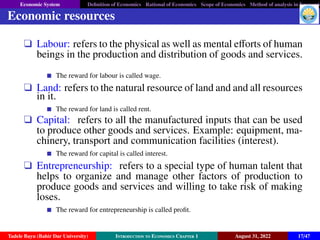
q Labour: refers to the physical as well as mental efforts of human
beings in the production and distribution of goods and services.
The reward for labour is called wage.
q Land: refers to the natural resource of land and and all resources
in it.
The reward for land is called rent.
q Capital: refers to all the manufactured inputs that can be used
to produce other goods and services. Example: equipment, ma-
chinery, transport and communication facilities (interest).
The reward for capital is called interest.
q Entrepreneurship: refers to a special type of human talent that
helps to organize and manage other factors of production to
produce goods and services and willing to take risk of making
loses.
The reward for entrepreneurship is called profit.
Tadele Bayu (Bahir Dar University) Introduction to Economics Chapter 1 August 31, 2022 17/47
Economic System Definition of Economics Rational of Economics Scope of Economics Method of analysis in Economic
Entrepreneurs
Entrepreneurs are individuals who:
q Organize factors of production to produce goods and services.
q Make basic business policy decisions.
q Introduce new inventions and technologies into business practice.
q Look for new business opportunities.
q Take risks of making losses.
Note: Scarcity does not mean shortage !
 We have already said that a good is said to be scarce if the amount available is less
than the amount people wish to have at zero price.
 But we say that there is shortage of goods and services when people are unable to get
the amount they want at the prevailing or on going price.
 Shortage is a specific and short term problem but scarcity is a universal and
everlasting problem
Tadele Bayu (Bahir Dar University) Introduction to Economics Chapter 1 August 31, 2022 18/47
Economic System Definition of Economics Rational of Economics Scope of Economics Method of analysis in Economic
Choice
q Due to the problem of scarcity, individuals, firms and government are forced to
choose as to what output to produce, in what quantity, and what output not to pro-
duce.
q In short, scarcity implies choice. Choice, in turn, implies cost.
q That means whenever choice is made, an alternative opportunity is sacrificed.
q This cost is known as opportunity cost.
Scarcity 7→choice 7→opportunity cost
Tadele Bayu (Bahir Dar University) Introduction to Economics Chapter 1 August 31, 2022 19/47
Economic System Definition of Economics Rational of Economics Scope of Economics Method of analysis in Economic
Opportunity cost
q In a world of scarcity, a decision to have more of one thing, at the same time, means
a decision to have less of another thing.
q The value of the next best alternative that must be sacrificed is, therefore, the
opportunity cost of the decision.
Opportunity cost is the amount or value of the next best alternative that must be
sacrificed (forgone) in order to obtain one more unit of a product.
q When we say opportunity cost, we mean that:
It is measured in goods  services but not in money costs
It should be in line with the principle of substitution.
when opportunity cost of an activity increases people substitute other activities in its
place.
Tadele Bayu (Bahir Dar University) Introduction to Economics Chapter 1 August 31, 2022 20/47
Economic System Definition of Economics Rational of Economics Scope of Economics Method of analysis in Economic
Production Possibilities Frontier or Curve
q PPF: a curve that shows the various possible combinations of goods and services that
the society can produce given its resources and technology.
q Assumptions.
Two goods
Fixed resources
Fixed in quantity
Fixed in quality
Full employment  Efficiency.
Fixed Technology
Imperfect substitute.
Tadele Bayu (Bahir Dar University) Introduction to Economics Chapter 1 August 31, 2022 21/47
Economic System Definition of Economics Rational of Economics Scope of Economics Method of analysis in Economic
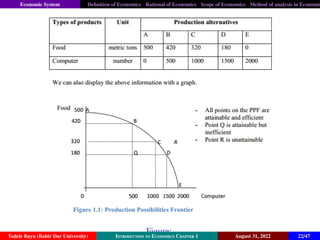
Figure:
Tadele Bayu (Bahir Dar University) Introduction to Economics Chapter 1 August 31, 2022 22/47
Economic System Definition of Economics Rational of Economics Scope of Economics Method of analysis in Economic
The PPF describes three important concepts
q The concepts of scarcity : the society cannot have unlimited amount of outputs even
if it employs all of its resources and utilizes them in the best possible way.
q The concept of choice: any movement along the curve indicates the change in
choice.
q The concept of opportunity cost: when the economy produces on the PPF,
production of more of one good requires sacrificing some of another product which
is reflected by the downward sloping PPF. Related to the opportunity cost we have a
law known as the law of increasing opportunity cost.
It states that as we produce more and more of a product, the opportunity cost per unit of
the additional output increases.
This makes the shape of the PPF concave to the origin.
Tadele Bayu (Bahir Dar University) Introduction to Economics Chapter 1 August 31, 2022 23/47
Economic System Definition of Economics Rational of Economics Scope of Economics Method of analysis in Economic
Inefficiency,Efficiency and Unattainable
(1) Any point along the line shows the economy operating at maximum efficiency
(2) Any point below the line is under utilization they are not getting all that they could
(3) Any point above the line is presently impossible , until new resources are available
(4) Why does the graph curve instead of making a straight line?
Law of Increasing Costs as production increases for one item, more and more
resources are necessary to increase production of the second item!
Every resource is best suited for certain types of goods
Farmland and cows make butter where as Metals and factories make guns
(5) Technical efficiency relates to how much output can be obtained from a given input,
such as a worker or a machine, or a specific combination of inputs. Maximum
technical efficiency occurs when output is maximised from a given quantity of
inputs.
(6) Think of productive efficiency in terms of cost minimisation by adjusting the mix of
inputs, whereas technical efficiency is output maximisation from a given mix of
inputs.
q Productive efficiency is attained when the maximum possible output of any one
good is produced, given the output of other goods.
Tadele Bayu (Bahir Dar University) Introduction to Economics Chapter 1 August 31, 2022 24/47
Economic System Definition of Economics Rational of Economics Scope of Economics Method of analysis in Economic
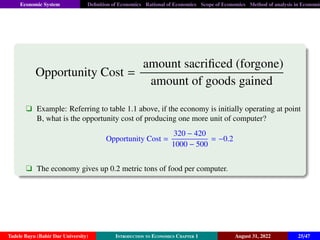
Opportunity Cost =
amount sacrificed (forgone)
amount of goods gained
q Example: Referring to table 1.1 above, if the economy is initially operating at point
B, what is the opportunity cost of producing one more unit of computer?
Opportunity Cost =
320 − 420
1000 − 500
= −0.2
q The economy gives up 0.2 metric tons of food per computer.
Tadele Bayu (Bahir Dar University) Introduction to Economics Chapter 1 August 31, 2022 25/47
Economic System Definition of Economics Rational of Economics Scope of Economics Method of analysis in Economic
Economic Growth and the PPF
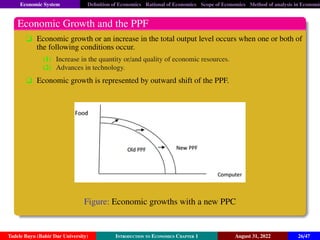
q Economic growth or an increase in the total output level occurs when one or both of
the following conditions occur.
(1) Increase in the quantity or/and quality of economic resources.
(2) Advances in technology.
q Economic growth is represented by outward shift of the PPF.
Figure: Economic growths with a new PPC
Tadele Bayu (Bahir Dar University) Introduction to Economics Chapter 1 August 31, 2022 26/47
Economic System Definition of Economics Rational of Economics Scope of Economics Method of analysis in Economic
asymmetric growth
q An economy can grow because of an increase in productivity in one sector of the
economy.
q For example, an improvement in technology applied to either food or computer
would be illustrated by a shift of the PPF along the Y- axis or X-axis.
Figure: Asymmetric growth
Tadele Bayu (Bahir Dar University) Introduction to Economics Chapter 1 August 31, 2022 27/47
Economic System Definition of Economics Rational of Economics Scope of Economics Method of analysis in Economic
Three basic economic questions
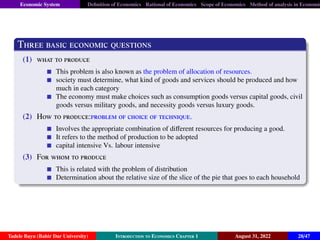
(1) what to produce
This problem is also known as the problem of allocation of resources.
society must determine, what kind of goods and services should be produced and how
much in each category
The economy must make choices such as consumption goods versus capital goods, civil
goods versus military goods, and necessity goods versus luxury goods.
(2) How to produce:problem of choice of technique.
Involves the appropriate combination of different resources for producing a good.
It refers to the method of production to be adopted
capital intensive Vs. labour intensive
(3) For whom to produce
This is related with the problem of distribution
Determination about the relative size of the slice of the pie that goes to each household
Tadele Bayu (Bahir Dar University) Introduction to Economics Chapter 1 August 31, 2022 28/47
Economic System Definition of Economics Rational of Economics Scope of Economics Method of analysis in Economic
Economic systems
q The way a society tries to answer the above fundamental questions is summarized by
a concept known as economic system.
q It is a set of organizational and institutional arrangements established to answer the
basic economic questions.
q Three types of economic system.
q These are capitalism , command and mixed economy.
Tadele Bayu (Bahir Dar University) Introduction to Economics Chapter 1 August 31, 2022 29/47
Economic System Definition of Economics Rational of Economics Scope of Economics Method of analysis in Economic
Capitalist economy
q Capitalism is the oldest formal economic system in the world.
q It became widespread in the middle of the 19th
century.
q In this economic system, all means of production are privately owned, and
production takes place at the initiative of individual private entrepreneurs who work
mainly for private profit.
q Government intervention in the economy is minimal. This system is also called free
market economy or market system or laissez faire.
Tadele Bayu (Bahir Dar University) Introduction to Economics Chapter 1 August 31, 2022 30/47
Economic System Definition of Economics Rational of Economics Scope of Economics Method of analysis in Economic
Features of Capitalistic Economy
q private property.
Individuals have the right to:
own
controle and
dispose means of production
q Freedom of choice:
Consumers can what they are willing and able to get.
Producers produce goods in accordance with the wishes of the consumers. This is
known as the principle of consumer sovereignty.
q Profit motive:
Entrepreneurs, in their productive activity, are guided by the motive of profit-making.
q Competition:
Among sellers or producers of similar goods to attract customers.
Among buyers to obtain goods.
Among workers to get jobs.
Among employers to get workers and investment funds.
Tadele Bayu (Bahir Dar University) Introduction to Economics Chapter 1 August 31, 2022 31/47
Economic System Definition of Economics Rational of Economics Scope of Economics Method of analysis in Economic
q Price mechanism:
All basic economic problems are solved through the price.
Producers determine supply and
Buyers determine demand
Interction of DD and SS detetrmine equm price.
q Minor role of government:
Do not interfere in day-to-day economic activities
confines itself to defense and maintenance of law and order.
q Self-interest:
Each Economic agent attempt to do what is best for it self
Motivated by the desire for economic gain.
Consuers- highest satisfaction
Producers-maximum profit
workers -higher wage
q Inequalities of income:
There is a wide economic gap between the rich and the poor.
q Existence of negative externalities:
Tadele Bayu (Bahir Dar University) Introduction to Economics Chapter 1 August 31, 2022 32/47
Economic System Definition of Economics Rational of Economics Scope of Economics Method of analysis in Economic
Advantages of Capitalistic Economy
q Flexibility or adaptability: It successfully adapts itself to changing environments.
q Decentralization of economic power: Market mechanisms work as a decentralizing
force against the concentration of economic power.
q Increase in per-capita income and standard of living: Rapid growth in levels of pro-
duction and income leads to higher per-capita income and standards of living.
q New types of consumer goods: new consumer goods are developed and produced at
large scale.
q Growth of entrepreneurship: Profit motive creates and supports new entrepreneurial
skills and approaches.
Tadele Bayu (Bahir Dar University) Introduction to Economics Chapter 1 August 31, 2022 33/47
Economic System Definition of Economics Rational of Economics Scope of Economics Method of analysis in Economic
q Optimum utilization of productive resources: Full utilization of productive
resources is possible due to innovations and technological progress.
q High rate of capital formation: The right to private property helps in capital
formation.
Disadvantages of Capitalistic Economy
q Inequality of income: Capitalism promotes economic inequalities and creates
social imbalance.
q Unbalanced economic activity: the economy can develop in an unbalanced way in
terms of different geographic regions and different sections of society.
q Exploitation of labour: paying low wages is common.
q Negative externalities: pollution.
Tadele Bayu (Bahir Dar University) Introduction to Economics Chapter 1 August 31, 2022 34/47
Economic System Definition of Economics Rational of Economics Scope of Economics Method of analysis in Economic
Command economy
q Command economy is also known as socialistic economy.
q Under this economic system, the economic institutions that are engaged in produc-
tion and distribution are owned and controlled by the state.
q In the recent past, socialism has lost its popularity and most of the socialist countries
are trying free market economies.
Tadele Bayu (Bahir Dar University) Introduction to Economics Chapter 1 August 31, 2022 35/47
Economic System Definition of Economics Rational of Economics Scope of Economics Method of analysis in Economic
Main Features of Command Economy
A. Collective ownership: All means of production are owned by the society as a whole,
and there is no right to private property.
B. Central economic planning: Planning for resource allocation is performed by the
controlling authority according to given socio-economic goals.
C. Strong government role: Government has complete control over all economic activi-
ties.
D. Maximum social welfare: Command economy aims at maximizing social welfare and
does not allow the exploitation of labour.
E. Relative equality of incomes: Private property does not exist, the profit motive is
absent.
Tadele Bayu (Bahir Dar University) Introduction to Economics Chapter 1 August 31, 2022 36/47
Economic System Definition of Economics Rational of Economics Scope of Economics Method of analysis in Economic
Advantages of Command Economy
I. Absence of wasteful competition: There is no place for wasteful use of productive
resources through unhealthy competition.
II. Balanced economic growth: Allocation of resources through centralized planning
leads to balanced economic development. Different regions and different sectors of
the economy can develop equally.
III. Elimination of private monopolies and inequalities: Command economies avoid the
major evils of capitalism such as inequality of income and wealth, private
monopolies, and concentration of economic, political and social power.
Tadele Bayu (Bahir Dar University) Introduction to Economics Chapter 1 August 31, 2022 37/47
Economic System Definition of Economics Rational of Economics Scope of Economics Method of analysis in Economic
Disadvantages of Command Economy
A. Absence of automatic price determination: Since all economic activities are
controlled by the government, there is no automatic price mechanism.
B. Absence of incentives for hard work and efficiency:
a. The entire system depends on bureaucrats who are considered inefficient in running
businesses.
b. There is no financial incentive for hard work and efficiency.
c. The economy grows at a relatively slow rate.
C. Lack of economic freedom:
(a) Economic freedom for consumers, producers, investors, and employers is totally absent,
and all economic powers are concentrated in the hands of the government.
D. Red-tapism (i.e., excessive regulation): it is widely prevalent in a command economy
because all decisions are made by government officials.
Tadele Bayu (Bahir Dar University) Introduction to Economics Chapter 1 August 31, 2022 38/47
Economic System Definition of Economics Rational of Economics Scope of Economics Method of analysis in Economic
Mixed economy
q A mixed economy is an attempt to combine the advantages of both the capitalistic
economy and the command economy.
q It incorporates some of the features of both and allows private and public sectors to
co-exist.
Main Features of Mixed Economy
A. Co-existence of public and private sectors:
Industries of national and strategic importance, such as heavy and basic industry, defense
production, power generation, etc. are set up in the public sector, whereas
consumer-goods industry and small-scale industry are developed through the private
sector.
B. Economic welfare:
The public sector tries to remove regional imbalances, provides large employment
opportunities and seeks economic welfare through its price policy. Government control
over the private sector leads to economic welfare of society at large.
Tadele Bayu (Bahir Dar University) Introduction to Economics Chapter 1 August 31, 2022 39/47
Economic System Definition of Economics Rational of Economics Scope of Economics Method of analysis in Economic
C. Economic planning:
(a) The government uses instruments of economic planning to achieve co-ordinated rapid
economic development, making use of both the private and the public sector.
D. Price mechanism:
(a) The price mechanism operates for goods produced in the private sector, but not for essential
commodities and goods produced in the public sector.
(b) Those prices are defined and regulated by the government.
E. Economic equality:
Private property is allowed, but rules exist to prevent concentration of wealth.
Limits are fixed for owning land and property.
Progressive taxation, concessions and subsides are implemented to achieve economic
equality.
Tadele Bayu (Bahir Dar University) Introduction to Economics Chapter 1 August 31, 2022 40/47
Economic System Definition of Economics Rational of Economics Scope of Economics Method of analysis in Economic
Advantages of Mixed Economy
(1) Private property, profit motive and price mechanism:
All the advantages of a capitalistic economy, such as the right to private property,
motivation through the profit motive, and control of economic activity through the price
mechanism, are available in a mixed economy.
At the same time, government control ensures that they do not lead to exploitation.
(2) Adequate freedom:
Mixed economies allow adequate freedom to different economic units such as
consumers, employees, producers, and investors.
(3) Rapid and planned economic development:
Planned economic growth takes place, resources are properly and efficiently utilized,
and fast economic development takes place because the private and public sector
complement each other.
(4) Social welfare and fewer economic inequalities:
The governments restricted control over economic activities helps in achieving social
welfare and economic equality.
Tadele Bayu (Bahir Dar University) Introduction to Economics Chapter 1 August 31, 2022 41/47
Economic System Definition of Economics Rational of Economics Scope of Economics Method of analysis in Economic
Disadvantages of Mixed Economy
A. Ineffectiveness and inefficiency:
A mixed economy might not actually have the usual advantages of either the public
sector or the private sector.
The public sector might be inefficient due to lack of incentive and responsibility, and the
private sector might be made ineffective by government regulation and control.
B. Economic fluctuations:
If the private sector is not properly controlled by the government, economic fluctuations
and unemployment can occur.
C. Corruption and black markets:
if government policies, rules and directives are not effectively implemented, the
economy can be vulnerable to increased corruption and black market activities.
Tadele Bayu (Bahir Dar University) Introduction to Economics Chapter 1 August 31, 2022 42/47
Economic System Definition of Economics Rational of Economics Scope of Economics Method of analysis in Economic
Decision making units and the circular flow model
(1) There are three decision making units in a closed economy . These are households,
firms and the government.
Household: A household can be one person or more who live under one roof and make
joint financial decisions. Households make two decisions.
(a) Selling of their resources, and
(b) Buying of goods and services.
Firm: A firm is a production unit that uses economic resources to produce goods and
services. Firms also make two decisions:
(a) Buying of economic resources
(b) Selling of their products.
Government:
(a) A government is an organization that has legal and political power to control or
influence households, firms and markets.
(b) Government also provides some types of goods and services known as public
goods and services for the society.
Tadele Bayu (Bahir Dar University) Introduction to Economics Chapter 1 August 31, 2022 43/47
Economic System Definition of Economics Rational of Economics Scope of Economics Method of analysis in Economic
two markets
The three economic agents interact in two markets:
q Product market:
It is a market where goods and services are transacted/ exchanged.
That is, a market where households and governments buy goods and services from
business firms.
q Factor market (input market):
it is a market where economic units transact/exchange factors of production (inputs). In
this market, owners of resources (households) sell their resources to business firms and
governments.
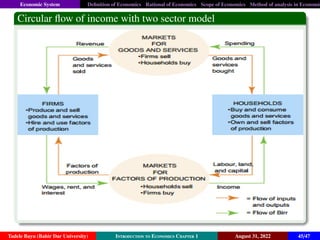
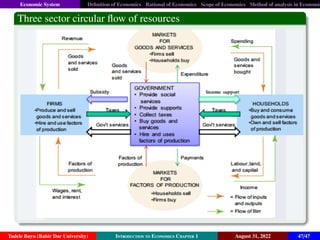
q The circular-flow diagram is a visual model of the economy that shows how money
(Birr), economic resources and goods and services flows through markets among
the decision making units.
Tadele Bayu (Bahir Dar University) Introduction to Economics Chapter 1 August 31, 2022 44/47
Economic System Definition of Economics Rational of Economics Scope of Economics Method of analysis in Economic
Circular flow of income with two sector model
Tadele Bayu (Bahir Dar University) Introduction to Economics Chapter 1 August 31, 2022 45/47
Economic System Definition of Economics Rational of Economics Scope of Economics Method of analysis in Economic
q The clock wise direction
shows the flow of economic resources and final goods and services.
q The anti clock wise direction indicates the flow of birr (in the form of revenue,
income and spending on consumption)
q We have also a three sector model in which the government is involved in the
economic activities.
q The government to provide public services purchase goods and services from
business firms through the product market with a given amount of expenditure.
q On the other hand, the government also needs resources required for the provision
of the services.
Tadele Bayu (Bahir Dar University) Introduction to Economics Chapter 1 August 31, 2022 46/47
Economic System Definition of Economics Rational of Economics Scope of Economics Method of analysis in Economic
Three sector circular flow of resources
Tadele Bayu (Bahir Dar University) Introduction to Economics Chapter 1 August 31, 2022 47/47

introduction to Economics chapter 1-slide.pdf

  • 1.
    Definition of EconomicsRational of Economics Scope of Economics Method of analysis in Economic Introduction to Economics Chapter 1 Tadele Bayu Department of Economics Bahir Dar University August 31, 2022 Tadele Bayu (Bahir Dar University) Introduction to Economics Chapter 1 August 31, 2022 1/47
  • 2.
    Definition of EconomicsRational of Economics Scope of Economics Method of analysis in Economic Table of contents 1 Definition of Economics 2 Rational of Economics 3 Scope of Economics 4 Method of analysis in Economics 5 PPF 6 Economic Questions 7 Economic System Tadele Bayu (Bahir Dar University) Introduction to Economics Chapter 1 August 31, 2022 2/47
  • 3.
    Economic System Definitionof Economics Rational of Economics Scope of Economics Method of analysis in Economic Definition: What is Economics? Adam Smith: Wealth Economics is a science of wealth that enquiries in to the factors that determine wealth of a country and its growth. His definition focuses on: Production, Distribution and Expansion of material wealth resulted from productive labour as the subject matter of economics. His definition neglected: immaterial services such as health, education, administration, and arts from the definition of wealth and thus ignored their role for economic growth. Tadele Bayu (Bahir Dar University) Introduction to Economics Chapter 1 August 31, 2022 3/47
  • 4.
    Economic System Definitionof Economics Rational of Economics Scope of Economics Method of analysis in Economic Alfred Marshal:Welfare Economics is the study of mankind in the ordinary business of life closely connected with material wel- fare It studies man’s action in earning and spending wealth. Wealth here is studied not as an end but as a means to the end of promoting human welfare. It leaves immaterial services and ends out of the scope of economics. Tadele Bayu (Bahir Dar University) Introduction to Economics Chapter 1 August 31, 2022 4/47
  • 5.
    Economic System Definitionof Economics Rational of Economics Scope of Economics Method of analysis in Economic Lionel Charles Robbins:Scarcity1 Economics is a science which studies human behav- ior as a relationship between unlimited ends and scarce resources with alternative uses. It studies human action regarding how he satisfies his wants (all goods and services) with scarce resources. This definition leaves macroeconomic issues such as determination of national income and employment, and the theory of economic growth and development untouched that are the major concerns of modern macroe- conomics. 1 Robbins, L. C. (1932). An Essay on the Nature and Significance of Economic Science. London: Macmillan. Tadele Bayu (Bahir Dar University) Introduction to Economics Chapter 1 August 31, 2022 5/47
  • 6.
    Economic System Definitionof Economics Rational of Economics Scope of Economics Method of analysis in Economic Generally speaking These definitions do not indicate the full range of issues studied by economists. For starters, a good way to understand the scope of economics is to con- sider the following short list. (1) How markets work to determine prices and allocate resources. (2) How governments influence, for better or for worse, market outcomes through tax policy, tariffs, subsidies, patent protection, environmental policy, etc. (3) How a nations central bank (e.g., the Federal Reserve System of the United States) may influence the money supply, interest rates, unemployment, inflation, and the rate of growth of output. (4) How we measure income inequality, inflation, unemployment, and productivity growth. This is only a short list. Economic researchers today are interested in a much longer list of topics. Tadele Bayu (Bahir Dar University) Introduction to Economics Chapter 1 August 31, 2022 6/47
  • 7.
    Economic System Definitionof Economics Rational of Economics Scope of Economics Method of analysis in Economic Conclusion The definition varies as the nature and scope of the subject grows over time. But, we can have a common definition is as follow: Economics is a social science which studies about efficient allocation of scarce resources so as to at- tain the maximum fulfillment of unlimited human needs. Tadele Bayu (Bahir Dar University) Introduction to Economics Chapter 1 August 31, 2022 7/47
  • 8.
    Economic System Definitionof Economics Rational of Economics Scope of Economics Method of analysis in Economic The rationales of economics Economists say human wants are unlimited due to the facts that some human wants are recurring and others are hierarchical The same needs reappear after being satisfied and needs emerge with higher order ones. For example, the need to eat recurs within a certain interval. Likewise, once you attain your Bachelor degree, you aspire to get better education like a master degree and then PhD. Human wants for goods and services remain ahead of resources and capacity to produce. The basic economic problem is about scarcity and choice. Choice is at the heart of all decision making !! Tadele Bayu (Bahir Dar University) Introduction to Economics Chapter 1 August 31, 2022 8/47
  • 9.
    Economic System Definitionof Economics Rational of Economics Scope of Economics Method of analysis in Economic Foundation of Economics The scarcity of resources and the choices it forces us to make is the source of all of the problems studied in economics Households allocate limited income among goods and services Business firms choices of what to produce and how much are limited by costs of production Government agencies work with limited budgets and must carefully choose which goals to pursue Economists study about how these choices are made in various set- tings; evaluate the outcomes in terms of criteria such as efficiency, equity, and stability; and search for alternative forms of economic organization that might produce higher living standards. QPPPPPPR Explain how our economic system works QPPPPPPR Forecast the future of our economy QPPPPPPR Suggest ways to make that future even better Tadele Bayu (Bahir Dar University) Introduction to Economics Chapter 1 August 31, 2022 9/47
  • 10.
    Economic System Definitionof Economics Rational of Economics Scope of Economics Method of analysis in Economic Scope of Economics The core of modern economics is formed by its two major branches: mi- croeconomics and macroeconomics QPPPPPPR Micro comes from Greek word mikros, meaning small QPPPPPPR Study the behavior of individual households, firms, and governments Choices they make Interaction in specific markets Focuses on individual parts of an economy, rather than the whole QPPPPPPR tools are DD and SS of a particular commodity and factor. QPPPPPPR It helps to solve the central problems of what to produce, how and for whom to produce. QPPPPPPR Discusses issues related with Macro comes from Greek word, makros, meaning large Study of the economy as a whole Focuses on big picture and ignores fine details Unemployment General price level Economic growth BOP etc Determination of level of income and employment are its central problems. Its main tools are aggregate demand and aggregate supply. Tadele Bayu (Bahir Dar University) Introduction to Economics Chapter 1 August 31, 2022 10/47
  • 11.
    Economic System Definitionof Economics Rational of Economics Scope of Economics Method of analysis in Economic Method of analysis in economics Is economics a positive science or normative science, or both? What is your justification? Positive Economics analyzes facts and attempts to describe the world as it is. It tries to answer the questions what was; what is; or what will be? It does not judge a system as good or bad, better or worse. Statements about how the economy works Accuracy can be tested by looking at the facts. QPPPPPPR The current inflation rate in Ethiopia is 12 percent. QPPPPPPR Poverty and unemployment are the biggest problems in Ethiopia. QPPPPPPR The life expectancy at birth in Ethiopia is rising. Tadele Bayu (Bahir Dar University) Introduction to Economics Chapter 1 August 31, 2022 11/47
  • 12.
    Economic System Definitionof Economics Rational of Economics Scope of Economics Method of analysis in Economic Normative Economics Study of what should be, what ought to be. Used to make value judgments, identify problems, and prescribe solutions Statements that suggest what we should do about economic facts,based on values Normative statements cannot be proved or disproved by the facts alone It evaluates the desirability of alternative outcomes based on ones value judgments about what is good or what is bad. QPPPPPPR The poor should not pay any taxes QPPPPPPR Female students must get better job opportunities than male students. Tadele Bayu (Bahir Dar University) Introduction to Economics Chapter 1 August 31, 2022 12/47
  • 13.
    Economic System Definitionof Economics Rational of Economics Scope of Economics Method of analysis in Economic Inductive and Deductive Reasoning QPPPPPPR The fundamental objective of economics, like any science, is the establishment of valid generalizations about certain aspects of human behaviour. QPPPPPPR Those generalizations are known as theories . QPPPPPPR Economic theory provides the basis for economic analysis which uses logical reasoning QPPPPPPR There are three methods of logical reasoning: (a) Inductive (b) Deductive (c) Abductive Tadele Bayu (Bahir Dar University) Introduction to Economics Chapter 1 August 31, 2022 13/47
  • 14.
    Economic System Definitionof Economics Rational of Economics Scope of Economics Method of analysis in Economic Inductive reasoning It is a logical method of reaching at a correct general statement or theory based on several independent and specific correct statements. In short, it is the process of deriving a principle or theory by mov- ing from facts to theories and from particular to general economic analysis. Inductive method involves the following steps. QPPPPPPR Selecting problem for analysis QPPPPPPR Collection, classification, and analysis of data QPPPPPPR Establishing cause and effect relationship between economic phenomena. Tadele Bayu (Bahir Dar University) Introduction to Economics Chapter 1 August 31, 2022 14/47
  • 15.
    Economic System Definitionof Economics Rational of Economics Scope of Economics Method of analysis in Economic Deductive reasoning It is a logical way of arriving at a particular or specific correct statement start- ing from a correct general statement. In short, it deals with conclusions about economic phenomenon from certain fundamental assumptions or truths or axioms through a process of logical ar- guments. we should check the validity of the theory to facts by moving from general to particular. Major steps in the deductive approach include: QPPPPPPR Problem identification QPPPPPPR Specification of the assumptions QPPPPPPR Formulating hypotheses QPPPPPPR Testing the validity of the hypotheses Tadele Bayu (Bahir Dar University) Introduction to Economics Chapter 1 August 31, 2022 15/47
  • 16.
    Economic System Definitionof Economics Rational of Economics Scope of Economics Method of analysis in Economic Scarcity, choice, opportunity cost and PPF q Scarcity refers to the fact that all economic resources that a society needs to produce goods and services are finite or limited in supply. Free resources: A resource is said to be free if the amount available to a society is greater than the amount people desire at zero price. E.g. sunshine Scarce (economic) resources: A resource is said to be scarce or economic resource when the amount available to a society is less than what people want to have at zero price. Scarce or Economic resources include: All types of human resources: manual, intellectual, skilled and specialized labor; Most natural resources like land (especially, fertile land), minerals, clean water, forests and wild - animals; All types of capital resources ( like machines, intermediate goods, infrastructure ); and All types of entrepreneurial resources Tadele Bayu (Bahir Dar University) Introduction to Economics Chapter 1 August 31, 2022 16/47
  • 17.
    Economic System Definitionof Economics Rational of Economics Scope of Economics Method of analysis in Economic Economic resources q Labour: refers to the physical as well as mental efforts of human beings in the production and distribution of goods and services. The reward for labour is called wage. q Land: refers to the natural resource of land and and all resources in it. The reward for land is called rent. q Capital: refers to all the manufactured inputs that can be used to produce other goods and services. Example: equipment, ma- chinery, transport and communication facilities (interest). The reward for capital is called interest. q Entrepreneurship: refers to a special type of human talent that helps to organize and manage other factors of production to produce goods and services and willing to take risk of making loses. The reward for entrepreneurship is called profit. Tadele Bayu (Bahir Dar University) Introduction to Economics Chapter 1 August 31, 2022 17/47
  • 18.
    Economic System Definitionof Economics Rational of Economics Scope of Economics Method of analysis in Economic Entrepreneurs Entrepreneurs are individuals who: q Organize factors of production to produce goods and services. q Make basic business policy decisions. q Introduce new inventions and technologies into business practice. q Look for new business opportunities. q Take risks of making losses. Note: Scarcity does not mean shortage ! We have already said that a good is said to be scarce if the amount available is less than the amount people wish to have at zero price. But we say that there is shortage of goods and services when people are unable to get the amount they want at the prevailing or on going price. Shortage is a specific and short term problem but scarcity is a universal and everlasting problem Tadele Bayu (Bahir Dar University) Introduction to Economics Chapter 1 August 31, 2022 18/47
  • 19.
    Economic System Definitionof Economics Rational of Economics Scope of Economics Method of analysis in Economic Choice q Due to the problem of scarcity, individuals, firms and government are forced to choose as to what output to produce, in what quantity, and what output not to pro- duce. q In short, scarcity implies choice. Choice, in turn, implies cost. q That means whenever choice is made, an alternative opportunity is sacrificed. q This cost is known as opportunity cost. Scarcity 7→choice 7→opportunity cost Tadele Bayu (Bahir Dar University) Introduction to Economics Chapter 1 August 31, 2022 19/47
  • 20.
    Economic System Definitionof Economics Rational of Economics Scope of Economics Method of analysis in Economic Opportunity cost q In a world of scarcity, a decision to have more of one thing, at the same time, means a decision to have less of another thing. q The value of the next best alternative that must be sacrificed is, therefore, the opportunity cost of the decision. Opportunity cost is the amount or value of the next best alternative that must be sacrificed (forgone) in order to obtain one more unit of a product. q When we say opportunity cost, we mean that: It is measured in goods services but not in money costs It should be in line with the principle of substitution. when opportunity cost of an activity increases people substitute other activities in its place. Tadele Bayu (Bahir Dar University) Introduction to Economics Chapter 1 August 31, 2022 20/47
  • 21.
    Economic System Definitionof Economics Rational of Economics Scope of Economics Method of analysis in Economic Production Possibilities Frontier or Curve q PPF: a curve that shows the various possible combinations of goods and services that the society can produce given its resources and technology. q Assumptions. Two goods Fixed resources Fixed in quantity Fixed in quality Full employment Efficiency. Fixed Technology Imperfect substitute. Tadele Bayu (Bahir Dar University) Introduction to Economics Chapter 1 August 31, 2022 21/47
  • 22.
    Economic System Definitionof Economics Rational of Economics Scope of Economics Method of analysis in Economic Figure: Tadele Bayu (Bahir Dar University) Introduction to Economics Chapter 1 August 31, 2022 22/47
  • 23.
    Economic System Definitionof Economics Rational of Economics Scope of Economics Method of analysis in Economic The PPF describes three important concepts q The concepts of scarcity : the society cannot have unlimited amount of outputs even if it employs all of its resources and utilizes them in the best possible way. q The concept of choice: any movement along the curve indicates the change in choice. q The concept of opportunity cost: when the economy produces on the PPF, production of more of one good requires sacrificing some of another product which is reflected by the downward sloping PPF. Related to the opportunity cost we have a law known as the law of increasing opportunity cost. It states that as we produce more and more of a product, the opportunity cost per unit of the additional output increases. This makes the shape of the PPF concave to the origin. Tadele Bayu (Bahir Dar University) Introduction to Economics Chapter 1 August 31, 2022 23/47
  • 24.
    Economic System Definitionof Economics Rational of Economics Scope of Economics Method of analysis in Economic Inefficiency,Efficiency and Unattainable (1) Any point along the line shows the economy operating at maximum efficiency (2) Any point below the line is under utilization they are not getting all that they could (3) Any point above the line is presently impossible , until new resources are available (4) Why does the graph curve instead of making a straight line? Law of Increasing Costs as production increases for one item, more and more resources are necessary to increase production of the second item! Every resource is best suited for certain types of goods Farmland and cows make butter where as Metals and factories make guns (5) Technical efficiency relates to how much output can be obtained from a given input, such as a worker or a machine, or a specific combination of inputs. Maximum technical efficiency occurs when output is maximised from a given quantity of inputs. (6) Think of productive efficiency in terms of cost minimisation by adjusting the mix of inputs, whereas technical efficiency is output maximisation from a given mix of inputs. q Productive efficiency is attained when the maximum possible output of any one good is produced, given the output of other goods. Tadele Bayu (Bahir Dar University) Introduction to Economics Chapter 1 August 31, 2022 24/47
  • 25.
    Economic System Definitionof Economics Rational of Economics Scope of Economics Method of analysis in Economic Opportunity Cost = amount sacrificed (forgone) amount of goods gained q Example: Referring to table 1.1 above, if the economy is initially operating at point B, what is the opportunity cost of producing one more unit of computer? Opportunity Cost = 320 − 420 1000 − 500 = −0.2 q The economy gives up 0.2 metric tons of food per computer. Tadele Bayu (Bahir Dar University) Introduction to Economics Chapter 1 August 31, 2022 25/47
  • 26.
    Economic System Definitionof Economics Rational of Economics Scope of Economics Method of analysis in Economic Economic Growth and the PPF q Economic growth or an increase in the total output level occurs when one or both of the following conditions occur. (1) Increase in the quantity or/and quality of economic resources. (2) Advances in technology. q Economic growth is represented by outward shift of the PPF. Figure: Economic growths with a new PPC Tadele Bayu (Bahir Dar University) Introduction to Economics Chapter 1 August 31, 2022 26/47
  • 27.
    Economic System Definitionof Economics Rational of Economics Scope of Economics Method of analysis in Economic asymmetric growth q An economy can grow because of an increase in productivity in one sector of the economy. q For example, an improvement in technology applied to either food or computer would be illustrated by a shift of the PPF along the Y- axis or X-axis. Figure: Asymmetric growth Tadele Bayu (Bahir Dar University) Introduction to Economics Chapter 1 August 31, 2022 27/47
  • 28.
    Economic System Definitionof Economics Rational of Economics Scope of Economics Method of analysis in Economic Three basic economic questions (1) what to produce This problem is also known as the problem of allocation of resources. society must determine, what kind of goods and services should be produced and how much in each category The economy must make choices such as consumption goods versus capital goods, civil goods versus military goods, and necessity goods versus luxury goods. (2) How to produce:problem of choice of technique. Involves the appropriate combination of different resources for producing a good. It refers to the method of production to be adopted capital intensive Vs. labour intensive (3) For whom to produce This is related with the problem of distribution Determination about the relative size of the slice of the pie that goes to each household Tadele Bayu (Bahir Dar University) Introduction to Economics Chapter 1 August 31, 2022 28/47
  • 29.
    Economic System Definitionof Economics Rational of Economics Scope of Economics Method of analysis in Economic Economic systems q The way a society tries to answer the above fundamental questions is summarized by a concept known as economic system. q It is a set of organizational and institutional arrangements established to answer the basic economic questions. q Three types of economic system. q These are capitalism , command and mixed economy. Tadele Bayu (Bahir Dar University) Introduction to Economics Chapter 1 August 31, 2022 29/47
  • 30.
    Economic System Definitionof Economics Rational of Economics Scope of Economics Method of analysis in Economic Capitalist economy q Capitalism is the oldest formal economic system in the world. q It became widespread in the middle of the 19th century. q In this economic system, all means of production are privately owned, and production takes place at the initiative of individual private entrepreneurs who work mainly for private profit. q Government intervention in the economy is minimal. This system is also called free market economy or market system or laissez faire. Tadele Bayu (Bahir Dar University) Introduction to Economics Chapter 1 August 31, 2022 30/47
  • 31.
    Economic System Definitionof Economics Rational of Economics Scope of Economics Method of analysis in Economic Features of Capitalistic Economy q private property. Individuals have the right to: own controle and dispose means of production q Freedom of choice: Consumers can what they are willing and able to get. Producers produce goods in accordance with the wishes of the consumers. This is known as the principle of consumer sovereignty. q Profit motive: Entrepreneurs, in their productive activity, are guided by the motive of profit-making. q Competition: Among sellers or producers of similar goods to attract customers. Among buyers to obtain goods. Among workers to get jobs. Among employers to get workers and investment funds. Tadele Bayu (Bahir Dar University) Introduction to Economics Chapter 1 August 31, 2022 31/47
  • 32.
    Economic System Definitionof Economics Rational of Economics Scope of Economics Method of analysis in Economic q Price mechanism: All basic economic problems are solved through the price. Producers determine supply and Buyers determine demand Interction of DD and SS detetrmine equm price. q Minor role of government: Do not interfere in day-to-day economic activities confines itself to defense and maintenance of law and order. q Self-interest: Each Economic agent attempt to do what is best for it self Motivated by the desire for economic gain. Consuers- highest satisfaction Producers-maximum profit workers -higher wage q Inequalities of income: There is a wide economic gap between the rich and the poor. q Existence of negative externalities: Tadele Bayu (Bahir Dar University) Introduction to Economics Chapter 1 August 31, 2022 32/47
  • 33.
    Economic System Definitionof Economics Rational of Economics Scope of Economics Method of analysis in Economic Advantages of Capitalistic Economy q Flexibility or adaptability: It successfully adapts itself to changing environments. q Decentralization of economic power: Market mechanisms work as a decentralizing force against the concentration of economic power. q Increase in per-capita income and standard of living: Rapid growth in levels of pro- duction and income leads to higher per-capita income and standards of living. q New types of consumer goods: new consumer goods are developed and produced at large scale. q Growth of entrepreneurship: Profit motive creates and supports new entrepreneurial skills and approaches. Tadele Bayu (Bahir Dar University) Introduction to Economics Chapter 1 August 31, 2022 33/47
  • 34.
    Economic System Definitionof Economics Rational of Economics Scope of Economics Method of analysis in Economic q Optimum utilization of productive resources: Full utilization of productive resources is possible due to innovations and technological progress. q High rate of capital formation: The right to private property helps in capital formation. Disadvantages of Capitalistic Economy q Inequality of income: Capitalism promotes economic inequalities and creates social imbalance. q Unbalanced economic activity: the economy can develop in an unbalanced way in terms of different geographic regions and different sections of society. q Exploitation of labour: paying low wages is common. q Negative externalities: pollution. Tadele Bayu (Bahir Dar University) Introduction to Economics Chapter 1 August 31, 2022 34/47
  • 35.
    Economic System Definitionof Economics Rational of Economics Scope of Economics Method of analysis in Economic Command economy q Command economy is also known as socialistic economy. q Under this economic system, the economic institutions that are engaged in produc- tion and distribution are owned and controlled by the state. q In the recent past, socialism has lost its popularity and most of the socialist countries are trying free market economies. Tadele Bayu (Bahir Dar University) Introduction to Economics Chapter 1 August 31, 2022 35/47
  • 36.
    Economic System Definitionof Economics Rational of Economics Scope of Economics Method of analysis in Economic Main Features of Command Economy A. Collective ownership: All means of production are owned by the society as a whole, and there is no right to private property. B. Central economic planning: Planning for resource allocation is performed by the controlling authority according to given socio-economic goals. C. Strong government role: Government has complete control over all economic activi- ties. D. Maximum social welfare: Command economy aims at maximizing social welfare and does not allow the exploitation of labour. E. Relative equality of incomes: Private property does not exist, the profit motive is absent. Tadele Bayu (Bahir Dar University) Introduction to Economics Chapter 1 August 31, 2022 36/47
  • 37.
    Economic System Definitionof Economics Rational of Economics Scope of Economics Method of analysis in Economic Advantages of Command Economy I. Absence of wasteful competition: There is no place for wasteful use of productive resources through unhealthy competition. II. Balanced economic growth: Allocation of resources through centralized planning leads to balanced economic development. Different regions and different sectors of the economy can develop equally. III. Elimination of private monopolies and inequalities: Command economies avoid the major evils of capitalism such as inequality of income and wealth, private monopolies, and concentration of economic, political and social power. Tadele Bayu (Bahir Dar University) Introduction to Economics Chapter 1 August 31, 2022 37/47
  • 38.
    Economic System Definitionof Economics Rational of Economics Scope of Economics Method of analysis in Economic Disadvantages of Command Economy A. Absence of automatic price determination: Since all economic activities are controlled by the government, there is no automatic price mechanism. B. Absence of incentives for hard work and efficiency: a. The entire system depends on bureaucrats who are considered inefficient in running businesses. b. There is no financial incentive for hard work and efficiency. c. The economy grows at a relatively slow rate. C. Lack of economic freedom: (a) Economic freedom for consumers, producers, investors, and employers is totally absent, and all economic powers are concentrated in the hands of the government. D. Red-tapism (i.e., excessive regulation): it is widely prevalent in a command economy because all decisions are made by government officials. Tadele Bayu (Bahir Dar University) Introduction to Economics Chapter 1 August 31, 2022 38/47
  • 39.
    Economic System Definitionof Economics Rational of Economics Scope of Economics Method of analysis in Economic Mixed economy q A mixed economy is an attempt to combine the advantages of both the capitalistic economy and the command economy. q It incorporates some of the features of both and allows private and public sectors to co-exist. Main Features of Mixed Economy A. Co-existence of public and private sectors: Industries of national and strategic importance, such as heavy and basic industry, defense production, power generation, etc. are set up in the public sector, whereas consumer-goods industry and small-scale industry are developed through the private sector. B. Economic welfare: The public sector tries to remove regional imbalances, provides large employment opportunities and seeks economic welfare through its price policy. Government control over the private sector leads to economic welfare of society at large. Tadele Bayu (Bahir Dar University) Introduction to Economics Chapter 1 August 31, 2022 39/47
  • 40.
    Economic System Definitionof Economics Rational of Economics Scope of Economics Method of analysis in Economic C. Economic planning: (a) The government uses instruments of economic planning to achieve co-ordinated rapid economic development, making use of both the private and the public sector. D. Price mechanism: (a) The price mechanism operates for goods produced in the private sector, but not for essential commodities and goods produced in the public sector. (b) Those prices are defined and regulated by the government. E. Economic equality: Private property is allowed, but rules exist to prevent concentration of wealth. Limits are fixed for owning land and property. Progressive taxation, concessions and subsides are implemented to achieve economic equality. Tadele Bayu (Bahir Dar University) Introduction to Economics Chapter 1 August 31, 2022 40/47
  • 41.
    Economic System Definitionof Economics Rational of Economics Scope of Economics Method of analysis in Economic Advantages of Mixed Economy (1) Private property, profit motive and price mechanism: All the advantages of a capitalistic economy, such as the right to private property, motivation through the profit motive, and control of economic activity through the price mechanism, are available in a mixed economy. At the same time, government control ensures that they do not lead to exploitation. (2) Adequate freedom: Mixed economies allow adequate freedom to different economic units such as consumers, employees, producers, and investors. (3) Rapid and planned economic development: Planned economic growth takes place, resources are properly and efficiently utilized, and fast economic development takes place because the private and public sector complement each other. (4) Social welfare and fewer economic inequalities: The governments restricted control over economic activities helps in achieving social welfare and economic equality. Tadele Bayu (Bahir Dar University) Introduction to Economics Chapter 1 August 31, 2022 41/47
  • 42.
    Economic System Definitionof Economics Rational of Economics Scope of Economics Method of analysis in Economic Disadvantages of Mixed Economy A. Ineffectiveness and inefficiency: A mixed economy might not actually have the usual advantages of either the public sector or the private sector. The public sector might be inefficient due to lack of incentive and responsibility, and the private sector might be made ineffective by government regulation and control. B. Economic fluctuations: If the private sector is not properly controlled by the government, economic fluctuations and unemployment can occur. C. Corruption and black markets: if government policies, rules and directives are not effectively implemented, the economy can be vulnerable to increased corruption and black market activities. Tadele Bayu (Bahir Dar University) Introduction to Economics Chapter 1 August 31, 2022 42/47
  • 43.
    Economic System Definitionof Economics Rational of Economics Scope of Economics Method of analysis in Economic Decision making units and the circular flow model (1) There are three decision making units in a closed economy . These are households, firms and the government. Household: A household can be one person or more who live under one roof and make joint financial decisions. Households make two decisions. (a) Selling of their resources, and (b) Buying of goods and services. Firm: A firm is a production unit that uses economic resources to produce goods and services. Firms also make two decisions: (a) Buying of economic resources (b) Selling of their products. Government: (a) A government is an organization that has legal and political power to control or influence households, firms and markets. (b) Government also provides some types of goods and services known as public goods and services for the society. Tadele Bayu (Bahir Dar University) Introduction to Economics Chapter 1 August 31, 2022 43/47
  • 44.
    Economic System Definitionof Economics Rational of Economics Scope of Economics Method of analysis in Economic two markets The three economic agents interact in two markets: q Product market: It is a market where goods and services are transacted/ exchanged. That is, a market where households and governments buy goods and services from business firms. q Factor market (input market): it is a market where economic units transact/exchange factors of production (inputs). In this market, owners of resources (households) sell their resources to business firms and governments. q The circular-flow diagram is a visual model of the economy that shows how money (Birr), economic resources and goods and services flows through markets among the decision making units. Tadele Bayu (Bahir Dar University) Introduction to Economics Chapter 1 August 31, 2022 44/47
  • 45.
    Economic System Definitionof Economics Rational of Economics Scope of Economics Method of analysis in Economic Circular flow of income with two sector model Tadele Bayu (Bahir Dar University) Introduction to Economics Chapter 1 August 31, 2022 45/47
  • 46.
    Economic System Definitionof Economics Rational of Economics Scope of Economics Method of analysis in Economic q The clock wise direction shows the flow of economic resources and final goods and services. q The anti clock wise direction indicates the flow of birr (in the form of revenue, income and spending on consumption) q We have also a three sector model in which the government is involved in the economic activities. q The government to provide public services purchase goods and services from business firms through the product market with a given amount of expenditure. q On the other hand, the government also needs resources required for the provision of the services. Tadele Bayu (Bahir Dar University) Introduction to Economics Chapter 1 August 31, 2022 46/47
  • 47.
    Economic System Definitionof Economics Rational of Economics Scope of Economics Method of analysis in Economic Three sector circular flow of resources Tadele Bayu (Bahir Dar University) Introduction to Economics Chapter 1 August 31, 2022 47/47