Welcome
http://www.mahergelle.com
By Eng.Adulahi M. Adan
Database 1
Course Outline Introduction to Database
01
Database System
02
Database Types and
Relations
03
Organizing Data into
Tables
04
Chapter One: -
Introduction to
Database
Data, information, and knowledge
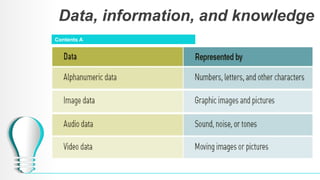
Data: refers to raw facts,
observations, or measurements that
have not been processed or organized
to convey any meaning.
It represents the basic building
blocks of information.
Data can be structured (e.g dates,
numbers,, or categories) or
unstructured (e.g., text, images, or
audio)
Data is row input or unprocessed
information
Contents A Contents B
Data, information, and knowledge
 Information: Collection of facts
organized in such a way that they
have additional value beyond the
value of the facts themselves or data
processed in a form meaningful to the
recipient.
Information is the result of
processing and organizing data in a
meaningful way.
In a database, information can be
obtained through queries, reports, or
data analysis operations.
Contents A Contents B
Data, information, and knowledge
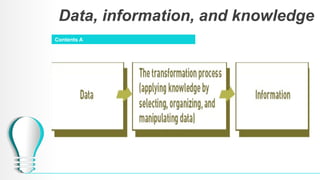
 Process: Set of logically related
tasks performed to achieve a defined 
outcome or conversion /manipulation
and analysis of raw input into
a meaningful form.
 Process involves a series of
actions
or transformations applied to data to
generate meaningful information.
 The process acts as a bridge
between data and information,
converting raw data into meaningful
Contents A Contents B
Data, information, and knowledge
 Knowledge: Awareness and
understanding of a set of
information.
 knowledge represents the insights
and understanding gained from
information and experience.
 Knowledge goes beyond the
scope of data and information. It
involves the understanding,
insights, and expertise gained from
information and experience.
Contents A Contents B
Data, information, and knowledge
Contents A
Data, information, and knowledge
Contents A
Information System
 System is many related
components integrity work together
to achieve common goals
 System refers to a collection of
interconnected components or
elements that work together to
achieve a common objective or
purpose.
 It involves the arrangement and
coordination of various parts to
function as a unified whole.
Contents A Contents B
Information System
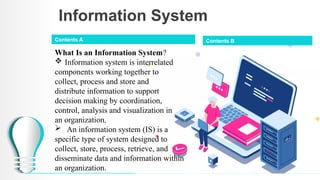
What Is an Information System?
 Information system is interrelated
components working together to
collect, process and store and
distribute information to support
decision making by coordination,
control, analysis and visualization in
an organization.
 An information system (IS) is a
specific type of system designed to
collect, store, process, retrieve, and
disseminate data and information within
an organization.
Contents A Contents B
Information System
 Information system is a software
system to capture, transmit, store,
retrieve, manipulate, or display
information, thereby supporting
people, organizations, or software
systems.
 It encompasses the people,
processes, data, technology, and
infrastructure that work together to
manage and support the flow of
information within an organizational
context.
Contents A Contents B
Information System
Contents A
Information System
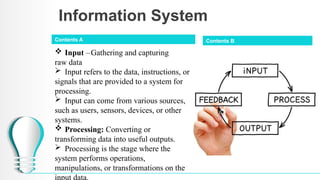
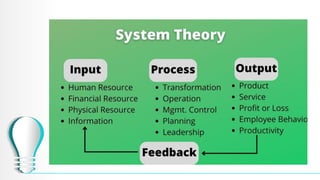
 Input –Gathering and capturing
raw data
 Input refers to the data, instructions, or
signals that are provided to a system for
processing.
 Input can come from various sources,
such as users, sensors, devices, or other
systems.
 Processing: Converting or
transforming data into useful outputs.
 Processing is the stage where the
system performs operations,
manipulations, or transformations on the
input data.
Contents A Contents B
Information System
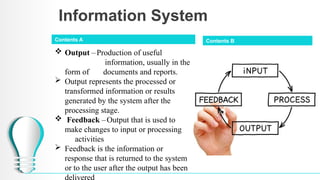
 Output –Production of useful
information, usually in the
form of documents and reports.
 Output represents the processed or
transformed information or results
generated by the system after the
processing stage.
 Feedback –Output that is used to
make changes to input or processing
activities
 Feedback is the information or
response that is returned to the system
or to the user after the output has been
delivered
Contents A Contents B
Types of information systems
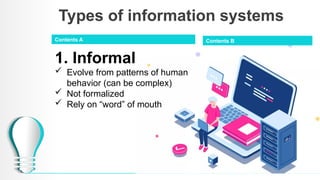
1. Informal
 Evolve from patterns of human
behavior (can be complex)
 Not formalized
 Rely on “word” of mouth
Contents A Contents B
Types of information systems
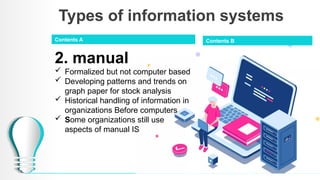
2. manual
 Formalized but not computer based
 Developing patterns and trends on
graph paper for stock analysis
 Historical handling of information in
organizations Before computers
 Some organizations still use
aspects of manual IS
Contents A Contents B
Types of information systems
3. Computer-Based Information
System
A computer-based information system
(CBIS) is an information system that
uses computer technology to perform
some or all of its intended tasks.
Such a system can include as little as
a personal computer and software.
or it may include several thousand
computers of various sizes with
hundreds of printers, plotters, and
other devices, and databases. In most
cases an information system
Contents A Contents B
Components of Information Systems
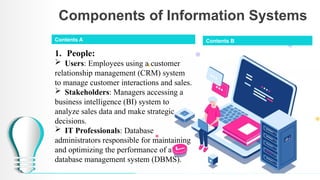
1. People:
 Users: Employees using a customer
relationship management (CRM) system
to manage customer interactions and sales.
 Stakeholders: Managers accessing a
business intelligence (BI) system to
analyze sales data and make strategic
decisions.
 IT Professionals: Database
administrators responsible for maintaining
and optimizing the performance of a
database management system (DBMS).
Contents A Contents B
Components of Information Systems
2. Data:
 Customer Data:
Contact information, purchase history,
and demographic details stored in a
CRM system.
 Sales Data: Revenue figures,
product quantities sold, and sales
channels recorded in a sales
management system.
 Inventory Data: Stock levels,
item descriptions, and supplier details
stored in an inventory management
system.
Contents A Contents B
Components of Information Systems
3. Processes:
 Order Processing: An order
management system that receives and
processes customer orders, updates
inventory, and generates invoices.
 Data Entry: Employees entering
sales data into a database through a
web-based form or a point-of-sale
(POS) system.
 Report Generation: A reporting
system that automatically generates
daily, weekly, and monthly sales
reports based on predefined criteria.
Contents A Contents B
Components of Information Systems
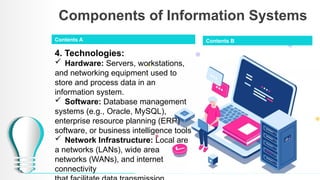
4. Technologies:
 Hardware: Servers, workstations,
and networking equipment used to
store and process data in an
information system.
 Software: Database management
systems (e.g., Oracle, MySQL),
enterprise resource planning (ERP)
software, or business intelligence tools
 Network Infrastructure: Local are
a networks (LANs), wide area
networks (WANs), and internet
connectivity
Contents A Contents B
Components of Information Systems
5. Procedures:
 Data Entry Guidelines: Standards
for inputting data into a system, such
as required fields, formatting rules,
and validation checks.
 Backup and Recovery Procedure
s: Regularly scheduled backups of
databases and procedures to restore
data in case of system failures.
 Security Protocols: Password
policies, user access controls, and
encryption methods to protect
sensitive data from unauthorized
Contents A Contents B
Components of Information Systems
6. Feedback:
 Sales Reports: Analytical reports
generated by a BI system that provide
insights into sales trends, customer
behavior, and revenue growth.
 Customer Feedback: Surveys, reviews
, and ratings collected through customer
feedback systems to assess satisfaction
and make improvements.
 System Performance Metrics:
Monitoring system response time, error
rates, and availability to identify areas for
optimization and improvement.
Contents A Contents B
Components of Information Systems
7. Control and Security:
 User Access Controls: Assigning
different levels of access privileges to
users based on their roles and
responsibilities.
 Data Encryption: Encrypting
sensitive data, such as customer
information or financial records, to
protect against unauthorized access.
 Firewalls and Intrusion Detection
Systems: Implementing network
security measures to prevent
unauthorized access and detect
Contents A Contents B
Chapter End
Chapter
Summery
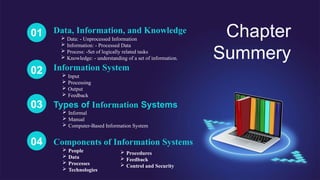
01 Data, Information, and Knowledge
 Data: - Unprocessed Information
 Information: - Processed Data
 Process: -Set of logically related tasks
 Knowledge: - understanding of a set of information.
02 Information System
 Input
 Processing
 Output
 Feedback
03 Types of Information Systems
 Informal
 Manual
 Computer-Based Information System
04 Components of Information Systems
 People
 Data
 Processes
 Technologies
 Procedures
 Feedback
 Control and Security
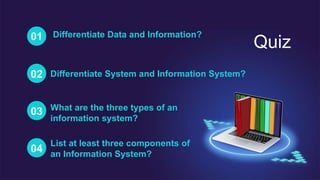
Quiz
01 Differentiate Data and Information?
02 Differentiate System and Information System?
03 What are the three types of an
information system?
04
List at least three components of
an Information System?
Thank you
@Eng.Abdulahi Mohamed

Introduction to database Chapter One DB1.pptx

  • 1.
  • 2.
  • 3.
    Course Outline Introductionto Database 01 Database System 02 Database Types and Relations 03 Organizing Data into Tables 04
  • 4.
  • 5.
    Data, information, andknowledge Data: refers to raw facts, observations, or measurements that have not been processed or organized to convey any meaning. It represents the basic building blocks of information. Data can be structured (e.g dates, numbers,, or categories) or unstructured (e.g., text, images, or audio) Data is row input or unprocessed information Contents A Contents B
  • 6.
    Data, information, andknowledge  Information: Collection of facts organized in such a way that they have additional value beyond the value of the facts themselves or data processed in a form meaningful to the recipient. Information is the result of processing and organizing data in a meaningful way. In a database, information can be obtained through queries, reports, or data analysis operations. Contents A Contents B
  • 7.
    Data, information, andknowledge  Process: Set of logically related tasks performed to achieve a defined outcome or conversion /manipulation and analysis of raw input into a meaningful form.  Process involves a series of actions or transformations applied to data to generate meaningful information.  The process acts as a bridge between data and information, converting raw data into meaningful Contents A Contents B
  • 8.
    Data, information, andknowledge  Knowledge: Awareness and understanding of a set of information.  knowledge represents the insights and understanding gained from information and experience.  Knowledge goes beyond the scope of data and information. It involves the understanding, insights, and expertise gained from information and experience. Contents A Contents B
  • 9.
    Data, information, andknowledge Contents A
  • 10.
    Data, information, andknowledge Contents A
  • 11.
    Information System  Systemis many related components integrity work together to achieve common goals  System refers to a collection of interconnected components or elements that work together to achieve a common objective or purpose.  It involves the arrangement and coordination of various parts to function as a unified whole. Contents A Contents B
  • 12.
    Information System What Isan Information System?  Information system is interrelated components working together to collect, process and store and distribute information to support decision making by coordination, control, analysis and visualization in an organization.  An information system (IS) is a specific type of system designed to collect, store, process, retrieve, and disseminate data and information within an organization. Contents A Contents B
  • 13.
    Information System  Informationsystem is a software system to capture, transmit, store, retrieve, manipulate, or display information, thereby supporting people, organizations, or software systems.  It encompasses the people, processes, data, technology, and infrastructure that work together to manage and support the flow of information within an organizational context. Contents A Contents B
  • 14.
  • 15.
    Information System  Input–Gathering and capturing raw data  Input refers to the data, instructions, or signals that are provided to a system for processing.  Input can come from various sources, such as users, sensors, devices, or other systems.  Processing: Converting or transforming data into useful outputs.  Processing is the stage where the system performs operations, manipulations, or transformations on the input data. Contents A Contents B
  • 16.
    Information System  Output–Production of useful information, usually in the form of documents and reports.  Output represents the processed or transformed information or results generated by the system after the processing stage.  Feedback –Output that is used to make changes to input or processing activities  Feedback is the information or response that is returned to the system or to the user after the output has been delivered Contents A Contents B
  • 18.
    Types of informationsystems 1. Informal  Evolve from patterns of human behavior (can be complex)  Not formalized  Rely on “word” of mouth Contents A Contents B
  • 19.
    Types of informationsystems 2. manual  Formalized but not computer based  Developing patterns and trends on graph paper for stock analysis  Historical handling of information in organizations Before computers  Some organizations still use aspects of manual IS Contents A Contents B
  • 20.
    Types of informationsystems 3. Computer-Based Information System A computer-based information system (CBIS) is an information system that uses computer technology to perform some or all of its intended tasks. Such a system can include as little as a personal computer and software. or it may include several thousand computers of various sizes with hundreds of printers, plotters, and other devices, and databases. In most cases an information system Contents A Contents B
  • 21.
    Components of InformationSystems 1. People:  Users: Employees using a customer relationship management (CRM) system to manage customer interactions and sales.  Stakeholders: Managers accessing a business intelligence (BI) system to analyze sales data and make strategic decisions.  IT Professionals: Database administrators responsible for maintaining and optimizing the performance of a database management system (DBMS). Contents A Contents B
  • 22.
    Components of InformationSystems 2. Data:  Customer Data: Contact information, purchase history, and demographic details stored in a CRM system.  Sales Data: Revenue figures, product quantities sold, and sales channels recorded in a sales management system.  Inventory Data: Stock levels, item descriptions, and supplier details stored in an inventory management system. Contents A Contents B
  • 23.
    Components of InformationSystems 3. Processes:  Order Processing: An order management system that receives and processes customer orders, updates inventory, and generates invoices.  Data Entry: Employees entering sales data into a database through a web-based form or a point-of-sale (POS) system.  Report Generation: A reporting system that automatically generates daily, weekly, and monthly sales reports based on predefined criteria. Contents A Contents B
  • 24.
    Components of InformationSystems 4. Technologies:  Hardware: Servers, workstations, and networking equipment used to store and process data in an information system.  Software: Database management systems (e.g., Oracle, MySQL), enterprise resource planning (ERP) software, or business intelligence tools  Network Infrastructure: Local are a networks (LANs), wide area networks (WANs), and internet connectivity Contents A Contents B
  • 25.
    Components of InformationSystems 5. Procedures:  Data Entry Guidelines: Standards for inputting data into a system, such as required fields, formatting rules, and validation checks.  Backup and Recovery Procedure s: Regularly scheduled backups of databases and procedures to restore data in case of system failures.  Security Protocols: Password policies, user access controls, and encryption methods to protect sensitive data from unauthorized Contents A Contents B
  • 26.
    Components of InformationSystems 6. Feedback:  Sales Reports: Analytical reports generated by a BI system that provide insights into sales trends, customer behavior, and revenue growth.  Customer Feedback: Surveys, reviews , and ratings collected through customer feedback systems to assess satisfaction and make improvements.  System Performance Metrics: Monitoring system response time, error rates, and availability to identify areas for optimization and improvement. Contents A Contents B
  • 27.
    Components of InformationSystems 7. Control and Security:  User Access Controls: Assigning different levels of access privileges to users based on their roles and responsibilities.  Data Encryption: Encrypting sensitive data, such as customer information or financial records, to protect against unauthorized access.  Firewalls and Intrusion Detection Systems: Implementing network security measures to prevent unauthorized access and detect Contents A Contents B
  • 28.
  • 29.
    Chapter Summery 01 Data, Information,and Knowledge  Data: - Unprocessed Information  Information: - Processed Data  Process: -Set of logically related tasks  Knowledge: - understanding of a set of information. 02 Information System  Input  Processing  Output  Feedback 03 Types of Information Systems  Informal  Manual  Computer-Based Information System 04 Components of Information Systems  People  Data  Processes  Technologies  Procedures  Feedback  Control and Security
  • 31.
    Quiz 01 Differentiate Dataand Information? 02 Differentiate System and Information System? 03 What are the three types of an information system? 04 List at least three components of an Information System?
  • 32.