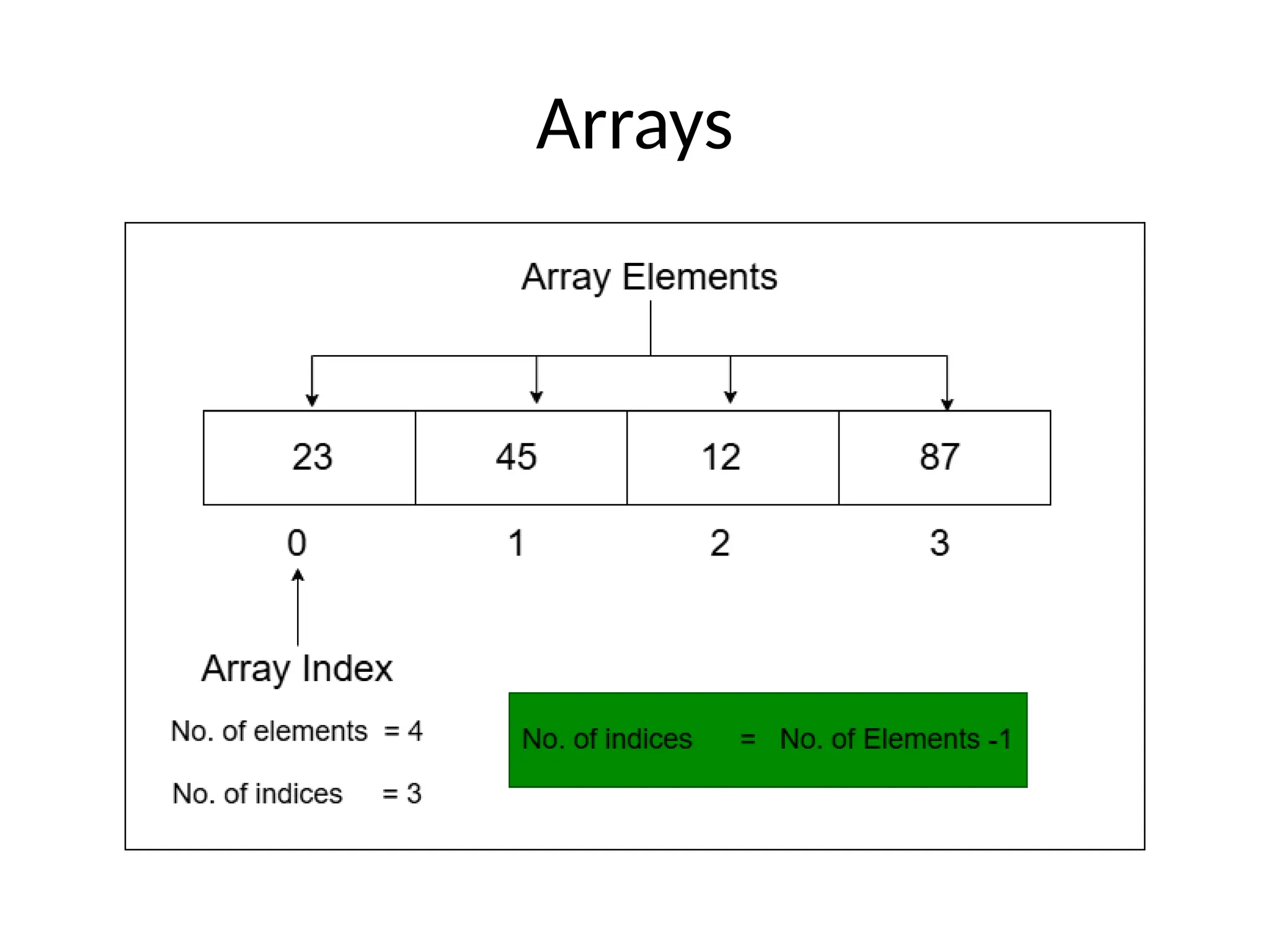
• Syntax: typearr.name[size];
• Eg: int marks[5];
• Let ‘A’ be a array in the memory
• Loc(A[K]) = address of the element A[K] of the array A.
• Elements of A are stored in successive memory cells, the address
of the first element of A is denoted by
• base(A)
called base address of A.
We can calculate the address of any element oa A by
the formula
Loc(A[K]) = Base(A)+W(K-lowerbound)
4.
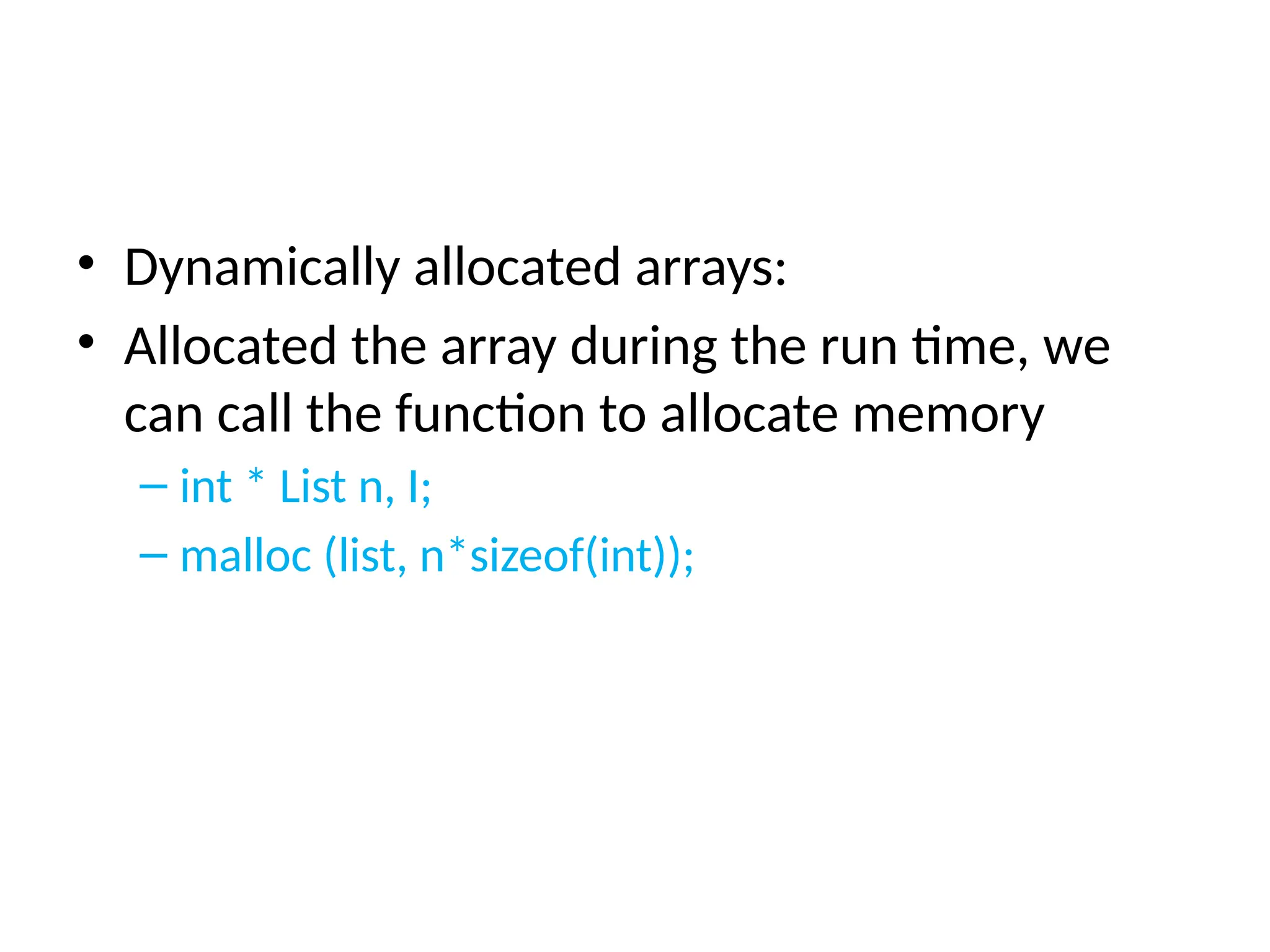
• Dynamically allocatedarrays:
• Allocated the array during the run time, we
can call the function to allocate memory
– int * List n, I;
– malloc (list, n*sizeof(int));
5.
Structures and Unions
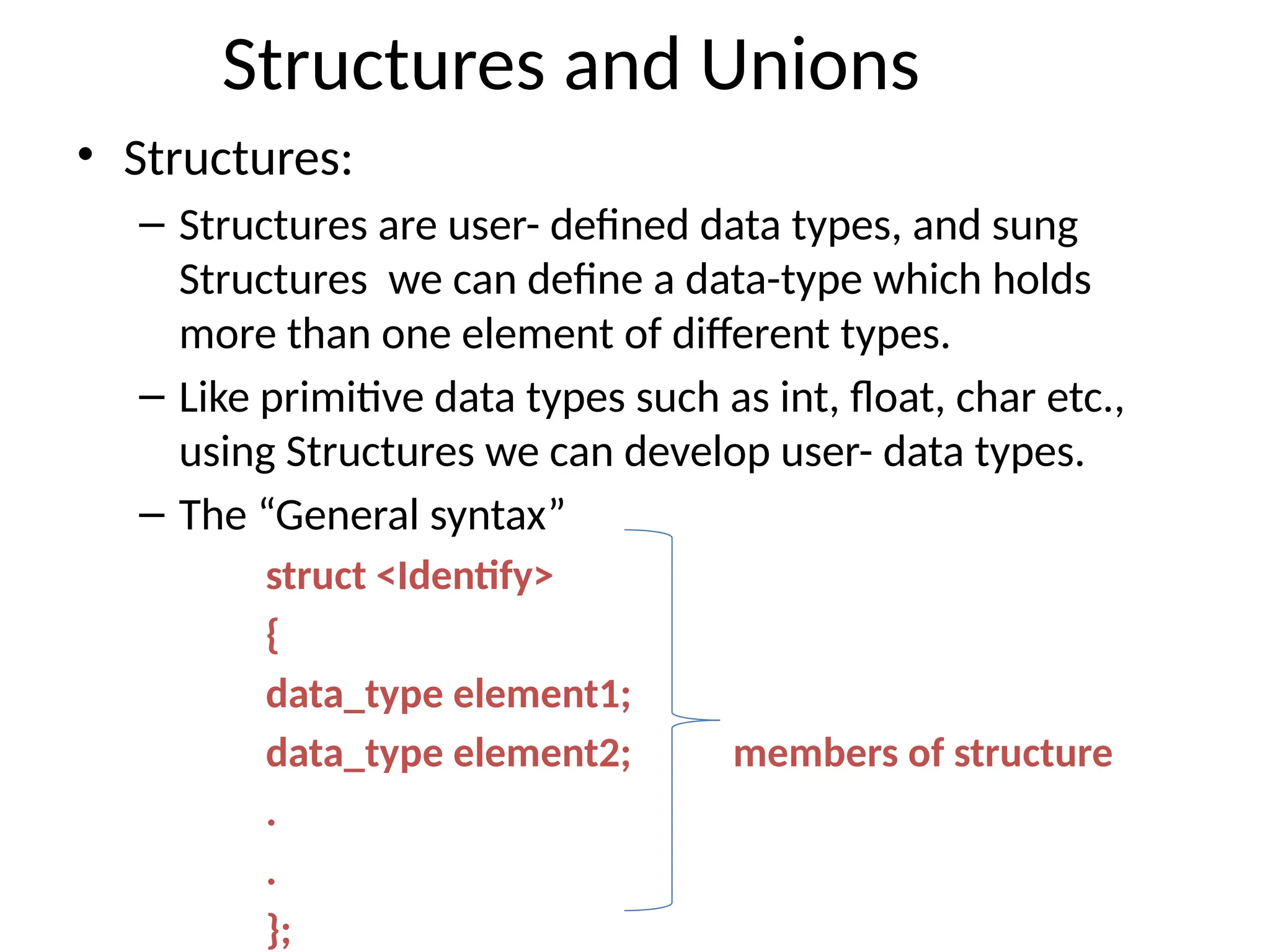
•Structures:
– Structures are user- defined data types, and sung
Structures we can define a data-type which holds
more than one element of different types.
– Like primitive data types such as int, float, char etc.,
using Structures we can develop user- data types.
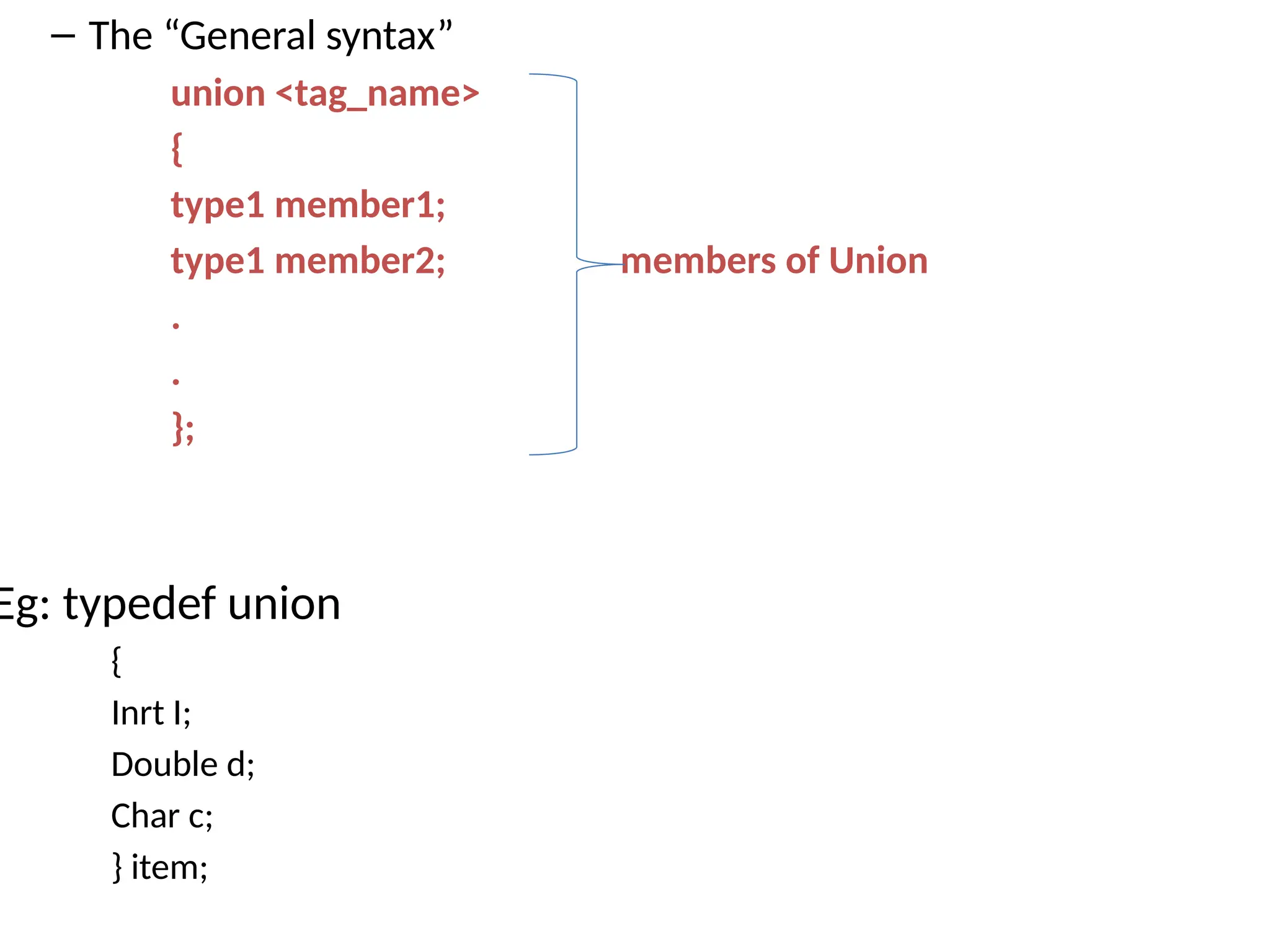
– The “General syntax”
struct <Identify>
{
data_type element1;
data_type element2; members of structure
.
.
};
6.
• Eg: employeestructure
struct employee
{
Int eno;
Char ename[20];
Float esal;
};
Struct Employee
26
bytes
Eno Ename esal
7.
Type – definedstructure
• The structure associated with keyword typedef is
called type-defined structure. This is the most
powerful way of defining the structure.
• Syntax:
Typedef struct {
{
Char name[10];
Int roll_no;
Float avq_marks;
} STUDENT;
– Where STUDENT is the datatype
8.
Union
• A unionis similar to a structure which is also
collection of data items of similar/ dissimilar
data types which are identified by unique
names using identifiers.
• All members of union share same memory
• All any point during execution only one
member is active.

![• Syntax: type arr.name[size];
• Eg: int marks[5];
• Let ‘A’ be a array in the memory
• Loc(A[K]) = address of the element A[K] of the array A.
• Elements of A are stored in successive memory cells, the address
of the first element of A is denoted by
• base(A)
called base address of A.
We can calculate the address of any element oa A by
the formula
Loc(A[K]) = Base(A)+W(K-lowerbound)](https://image.slidesharecdn.com/dsa1-251111051804-316940d7/75/introduction-to-data-structure-dsa1-pptx-3-2048.jpg)
![• Eg: employee structure
struct employee
{
Int eno;
Char ename[20];
Float esal;
};
Struct Employee
26
bytes
Eno Ename esal](https://image.slidesharecdn.com/dsa1-251111051804-316940d7/75/introduction-to-data-structure-dsa1-pptx-6-2048.jpg)
![Type – defined structure
• The structure associated with keyword typedef is
called type-defined structure. This is the most
powerful way of defining the structure.
• Syntax:
Typedef struct {
{
Char name[10];
Int roll_no;
Float avq_marks;
} STUDENT;
– Where STUDENT is the datatype](https://image.slidesharecdn.com/dsa1-251111051804-316940d7/75/introduction-to-data-structure-dsa1-pptx-7-2048.jpg)