Introduction to data communication
and networking
Introduction
Introduction to data communication and
networking
Data communications refers to the
transmission of this digital data between two
or more computers and a computer network
or data network is a telecommunications
network that allows computers to exchange
data.
Introduction to data communication and
networking
…The physical connection between
networked computing devices is established
using either cable media or wireless media.
The best-known computer network is the
Internet.
Introduction to data communication and
networking
This module should teach you basics of Data
Communication and Computer Network
(DCN) and will also take you through various
advanced concepts related to Data
Communication and Computer Network.
Introduction to data communication and
networking
Data communication refers to the exchange of data
between two or more devices via a transmission
medium.
Networking involves connecting multiple devices to
facilitate communication and resource sharing.
The purpose of data communication and
networking is to enable the efficient transfer of
information.
Introduction to data communication
Data communication is the process of
transmitting data or information from one
point to another through a communication
medium.
Introduction to data communication
…In the modern digital era, data
communication has become an integral part
of our daily lives and is crucial for businesses,
organizations, and individuals to exchange
information, collaborate, and access
resources over networks.
introduction to Data
communication
Key Concepts of Data Communication:
Data: Data refers to the raw and unprocessed
facts, figures, or symbols that represent
information.
Communication: Communication is the
exchange of data or information between
devices or entities using a common set of rules
or protocols.
introduction to Data
communication
…Data Transmission: Data transmission
involves sending data from the source to the
destination over a communication channel or
medium.
introduction to Data
communication
…Communication Medium: The
communication medium is the physical path
or channel through which data is transmitted,
such as wired cables, fiber optics, or wireless
radio waves.
introduction to Data
communication
Components of Data Communication:
Sender: The device that initiates the data
communication process and generates the
data to be transmitted.
Receiver: The device that receives the data
sent by the sender and processes it.
introduction to Data
communication
…Transmission Medium: The physical path
through which data is transmitted, such as
copper wires, fiber optics, or wireless channels.
Message: The information or data being
transmitted from the sender to the receiver.
Protocol: The set of rules and procedures
governing the format and transmission of the
message.
introduction to Data
communication
Characteristics of Data Communication:
Speed: The rate at which data is transmitted,
usually measured in bits per second (bps) or
megabits per second (Mbps).
introduction to Data
communication
…Accuracy: The extent to which the
transmitted data remains uncorrupted and
error-free.
Reliability: The degree to which data
transmission is consistent and free from
failures or disruptions.
introduction to Data
communication
Security: Measures taken to protect data
from unauthorized access or tampering
during transmission.
Scalability: The ability of a communication
system to accommodate an increasing
number of users or devices.
introduction to Data
communication
…Compatibility: The ability of different
devices and systems to work together and
exchange data seamlessly.
introduction to Data
communication
Standards
Standards are established guidelines,
specifications, or criteria that serve as a basis
for ensuring uniformity, interoperability,
safety, and efficiency in various industries,
products, systems, and processes.
introduction to Data
communication
…They play a crucial role in promoting
innovation, supporting global trade, and
enhancing quality and safety standards.
Standards can be classified into different
types based on their application and scope.
introduction to Data
communication
International Standards Organisation (ISO)
ISO (International Organization for Standardization):
ISO is an international standard-setting body that
develops and publishes standards covering various
aspects of technology, industry, and commerce.
It is a non-governmental organization with a
membership of national standards bodies from more
than 160 countries.
introduction to Data communication
ISO standards are developed through a
consensus-based process involving experts
from different industries and countries.
ISO standards aim to promote global
interoperability, quality, safety, and efficiency
in products, services, and systems across
various sectors.
introduction to Data communication
ISO standards are developed through a
consensus-based process involving experts
from different industries and countries.
ISO standards aim to promote global
interoperability, quality, safety, and efficiency
in products, services, and systems across
various sectors.
introduction to Data communication
…Some well-known ISO standards include
ISO 9001 for quality management systems,
ISO 14001 for environmental management
systems, ISO 27001 for information security
management, and ISO 3166 for country
codes, among many others.
introduction to Data
communication
Communication standards are established sets of rules,
protocols, and specifications that ensure
interoperability, consistency, and seamless
communication between various devices, systems, and
networks. These standards are critical for enabling
reliable data exchange and efficient communication in
both wired and wireless environments. There are
numerous communication standards developed by
various standardization organizations, industry
consortia, and governing bodies.
introduction to Data
communication
OSI (Open Systems Interconnection) Model:
The OSI model is a conceptual framework that
standardizes the functions of a
telecommunication or computing system into
seven distinct layers.
It was developed by the International
Organization for Standardization (ISO) in the late
1970s and published in 1984 as ISO 7498-1.
introduction to Data
communication
…The OSI model aims to promote
interoperability between different network
protocols and technologies by defining clear
interfaces and responsibilities for each layer.
introduction to Data
communication
…Each layer of the OSI model performs
specific functions, and communication
between devices relies on standardized
protocols and data formats.
The seven layers of the OSI model, from the
bottom to the top, are: Physical, Data Link,
Network, Transport, Session, Presentation,
and Application.
introduction to Data
communication
The OSI (Open Systems Interconnection) model is
a conceptual framework used to understand and
describe how different networking protocols and
technologies interact and communicate within a
network. It consists of seven layers, each with
specific responsibilities and functions. The OSI
model helps in the development of network
protocols, ensuring interoperability and modular
design.
introduction to Data communication
and networking
Layer 7: Application Layer:
The Application Layer is the topmost layer
and provides network services directly to
end-users or applications.
It enables communication between different
software applications and interacts with
users.
introduction to Data communication
and networking
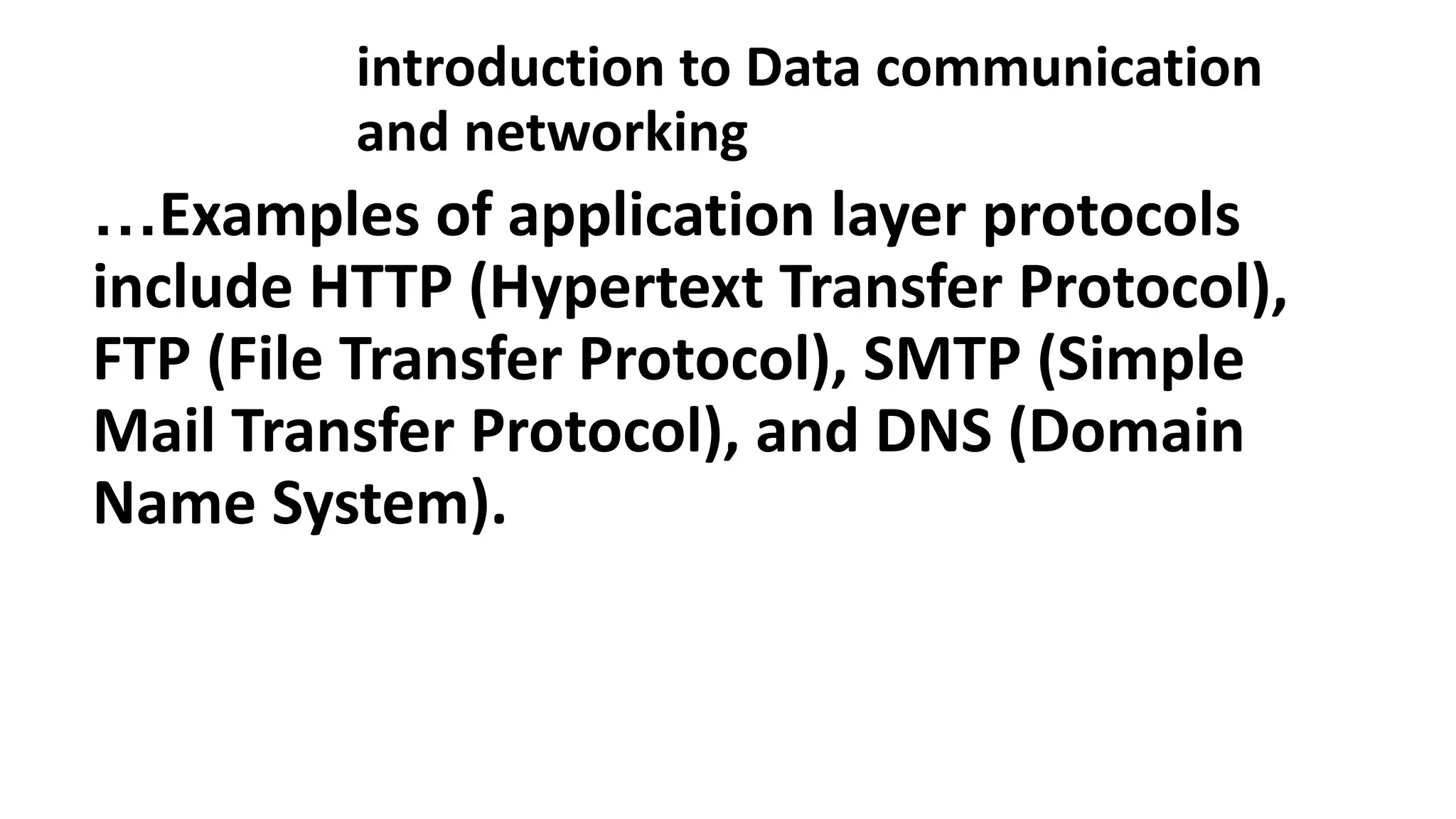
…Examples of application layer protocols
include HTTP (Hypertext Transfer Protocol),
FTP (File Transfer Protocol), SMTP (Simple
Mail Transfer Protocol), and DNS (Domain
Name System).
introduction to Data communication
and networking
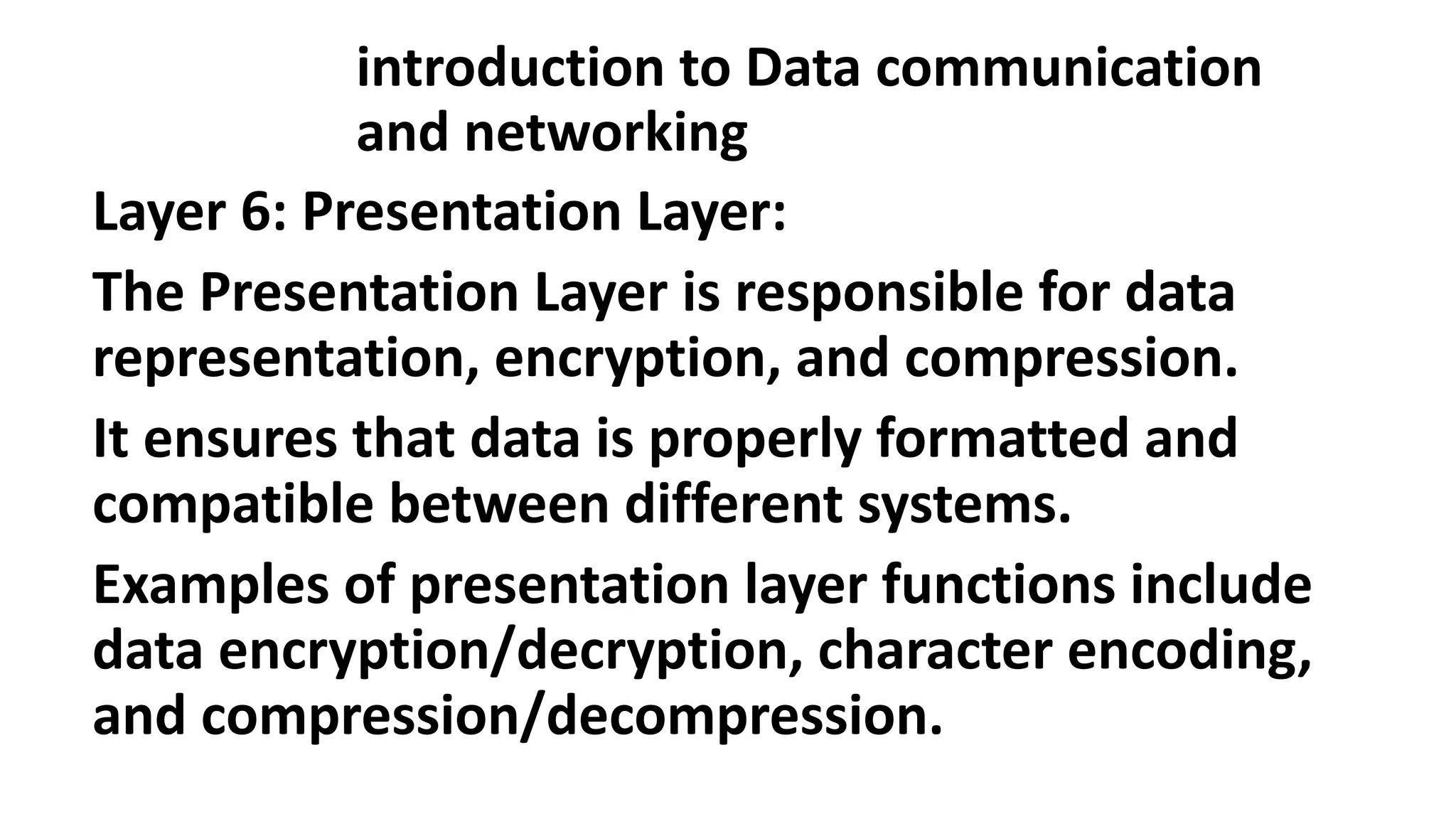
Layer 6: Presentation Layer:
The Presentation Layer is responsible for data
representation, encryption, and compression.
It ensures that data is properly formatted and
compatible between different systems.
Examples of presentation layer functions include
data encryption/decryption, character encoding,
and compression/decompression.
introduction to Data communication and
networking
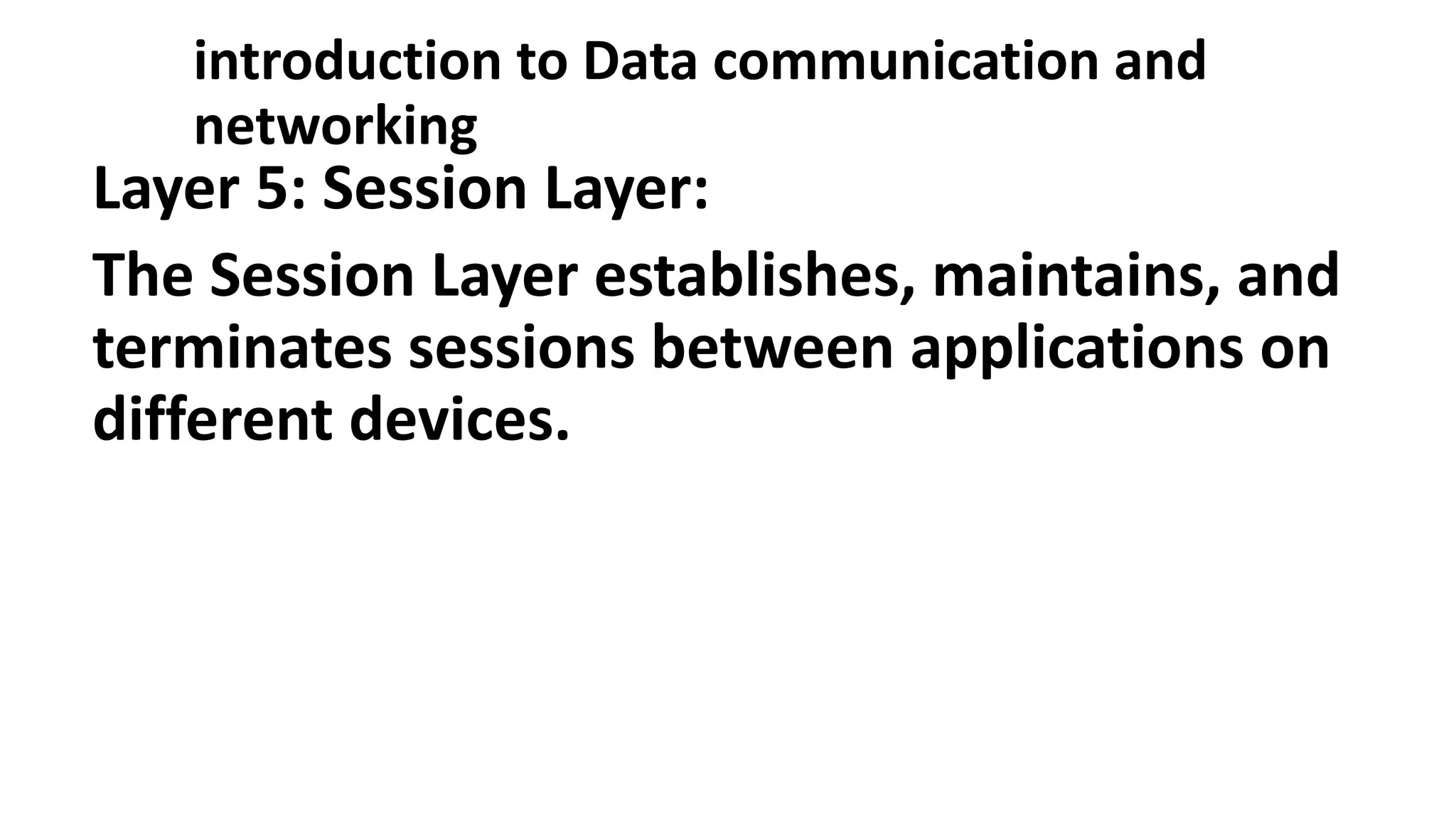
Layer 5: Session Layer:
The Session Layer establishes, maintains, and
terminates sessions between applications on
different devices.
introduction to Data communication and
networking
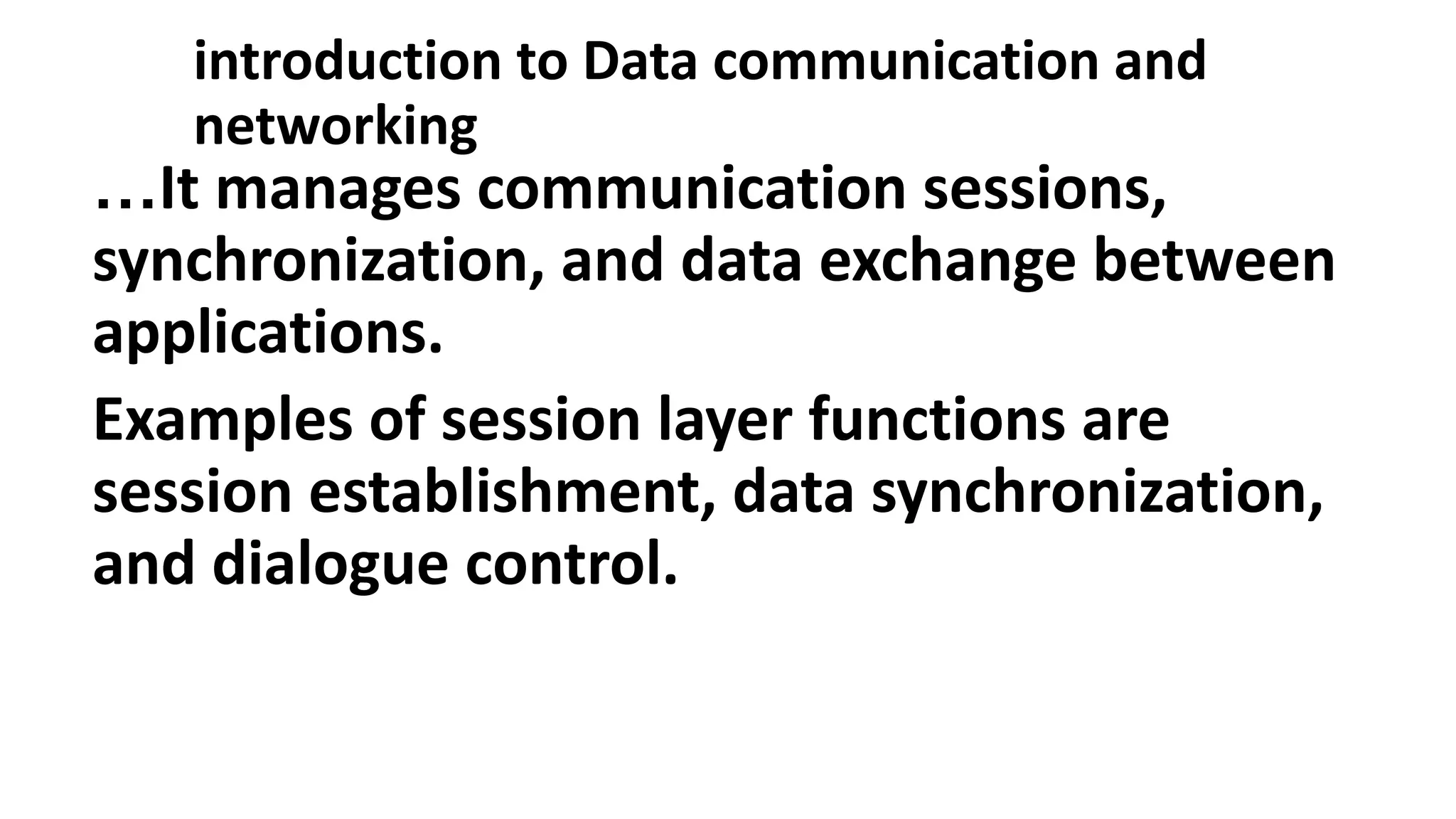
…It manages communication sessions,
synchronization, and data exchange between
applications.
Examples of session layer functions are
session establishment, data synchronization,
and dialogue control.
introduction to Data communication
and networking
Layer 4: Transport Layer:
The Transport Layer provides end-to-end
communication between devices and ensures
reliable and error-free data transfer.
introduction to Data communication
and networking
…It segments data into smaller packets, adds
sequence numbers, and handles flow control
and error recovery.
Examples of protocols used at this layer
include TCP (Transmission Control Protocol)
and UDP (User Datagram Protocol).
introduction to Data communication
and networking
Layer 3: Network Layer:
The Network Layer deals with logical
addressing and routing of data packets from
the source to the destination across multiple
networks.
Introduction to Data communication
and networking
…It uses IP (Internet Protocol) addresses to
identify devices on the network and
determines the best path for data delivery.
Examples of protocols used at this layer
include IP (IPv4 and IPv6), ICMP (Internet
Control Message Protocol), and OSPF (Open
Shortest Path First).
Introduction to Data
communication
Layer 3: Network Layer:
The Network Layer deals with logical
addressing and routing of data packets from
the source to the destination across multiple
networks.
Introduction to Data
communication
…It uses IP (Internet Protocol) addresses to
identify devices on the network and
determines the best path for data delivery.
Examples of protocols used at this layer
include IP (IPv4 and IPv6), ICMP (Internet
Control Message Protocol), and OSPF (Open
Shortest Path First).
Introduction to Data
communication
Layer 2: Data Link Layer:
The Data Link Layer provides reliable data
transfer between two directly connected
devices over a physical link.
It is responsible for framing data into frames,
adding MAC (Media Access Control) addresses,
and performing error detection and correction.
Introduction to Data
communication
…Divided into two sub-layers: Logical Link
Control (LLC) and Media Access Control (MAC).
Examples of protocols used at this layer include
Ethernet (802.3), Wi-Fi (802.11), and PPP
(Point-to-Point Protocol).
Introduction to Data
communication
Layer 1: Physical Layer:
The Physical Layer is the lowest layer and
deals with the physical transmission of data
bits over the network medium.
It defines the characteristics of the hardware,
such as cables, switches, and network
interface cards (NICs).
Introduction to Data
communication
…Functions include data encoding,
modulation, and error detection at the bit
level.
Examples of technologies used at this layer
include Ethernet, Wi-Fi, and fiber-optic
cables.

Introduction to data communication and networking

  • 1.
    Introduction to datacommunication and networking Introduction
  • 2.
    Introduction to datacommunication and networking Data communications refers to the transmission of this digital data between two or more computers and a computer network or data network is a telecommunications network that allows computers to exchange data.
  • 3.
    Introduction to datacommunication and networking …The physical connection between networked computing devices is established using either cable media or wireless media. The best-known computer network is the Internet.
  • 4.
    Introduction to datacommunication and networking This module should teach you basics of Data Communication and Computer Network (DCN) and will also take you through various advanced concepts related to Data Communication and Computer Network.
  • 5.
    Introduction to datacommunication and networking Data communication refers to the exchange of data between two or more devices via a transmission medium. Networking involves connecting multiple devices to facilitate communication and resource sharing. The purpose of data communication and networking is to enable the efficient transfer of information.
  • 6.
    Introduction to datacommunication Data communication is the process of transmitting data or information from one point to another through a communication medium.
  • 7.
    Introduction to datacommunication …In the modern digital era, data communication has become an integral part of our daily lives and is crucial for businesses, organizations, and individuals to exchange information, collaborate, and access resources over networks.
  • 8.
    introduction to Data communication KeyConcepts of Data Communication: Data: Data refers to the raw and unprocessed facts, figures, or symbols that represent information. Communication: Communication is the exchange of data or information between devices or entities using a common set of rules or protocols.
  • 9.
    introduction to Data communication …DataTransmission: Data transmission involves sending data from the source to the destination over a communication channel or medium.
  • 10.
    introduction to Data communication …CommunicationMedium: The communication medium is the physical path or channel through which data is transmitted, such as wired cables, fiber optics, or wireless radio waves.
  • 11.
    introduction to Data communication Componentsof Data Communication: Sender: The device that initiates the data communication process and generates the data to be transmitted. Receiver: The device that receives the data sent by the sender and processes it.
  • 12.
    introduction to Data communication …TransmissionMedium: The physical path through which data is transmitted, such as copper wires, fiber optics, or wireless channels. Message: The information or data being transmitted from the sender to the receiver. Protocol: The set of rules and procedures governing the format and transmission of the message.
  • 13.
    introduction to Data communication Characteristicsof Data Communication: Speed: The rate at which data is transmitted, usually measured in bits per second (bps) or megabits per second (Mbps).
  • 14.
    introduction to Data communication …Accuracy:The extent to which the transmitted data remains uncorrupted and error-free. Reliability: The degree to which data transmission is consistent and free from failures or disruptions.
  • 15.
    introduction to Data communication Security:Measures taken to protect data from unauthorized access or tampering during transmission. Scalability: The ability of a communication system to accommodate an increasing number of users or devices.
  • 16.
    introduction to Data communication …Compatibility:The ability of different devices and systems to work together and exchange data seamlessly.
  • 17.
    introduction to Data communication Standards Standardsare established guidelines, specifications, or criteria that serve as a basis for ensuring uniformity, interoperability, safety, and efficiency in various industries, products, systems, and processes.
  • 18.
    introduction to Data communication …Theyplay a crucial role in promoting innovation, supporting global trade, and enhancing quality and safety standards. Standards can be classified into different types based on their application and scope.
  • 19.
    introduction to Data communication InternationalStandards Organisation (ISO) ISO (International Organization for Standardization): ISO is an international standard-setting body that develops and publishes standards covering various aspects of technology, industry, and commerce. It is a non-governmental organization with a membership of national standards bodies from more than 160 countries.
  • 20.
    introduction to Datacommunication ISO standards are developed through a consensus-based process involving experts from different industries and countries. ISO standards aim to promote global interoperability, quality, safety, and efficiency in products, services, and systems across various sectors.
  • 21.
    introduction to Datacommunication ISO standards are developed through a consensus-based process involving experts from different industries and countries. ISO standards aim to promote global interoperability, quality, safety, and efficiency in products, services, and systems across various sectors.
  • 22.
    introduction to Datacommunication …Some well-known ISO standards include ISO 9001 for quality management systems, ISO 14001 for environmental management systems, ISO 27001 for information security management, and ISO 3166 for country codes, among many others.
  • 23.
    introduction to Data communication Communicationstandards are established sets of rules, protocols, and specifications that ensure interoperability, consistency, and seamless communication between various devices, systems, and networks. These standards are critical for enabling reliable data exchange and efficient communication in both wired and wireless environments. There are numerous communication standards developed by various standardization organizations, industry consortia, and governing bodies.
  • 24.
    introduction to Data communication OSI(Open Systems Interconnection) Model: The OSI model is a conceptual framework that standardizes the functions of a telecommunication or computing system into seven distinct layers. It was developed by the International Organization for Standardization (ISO) in the late 1970s and published in 1984 as ISO 7498-1.
  • 25.
    introduction to Data communication …TheOSI model aims to promote interoperability between different network protocols and technologies by defining clear interfaces and responsibilities for each layer.
  • 26.
    introduction to Data communication …Eachlayer of the OSI model performs specific functions, and communication between devices relies on standardized protocols and data formats. The seven layers of the OSI model, from the bottom to the top, are: Physical, Data Link, Network, Transport, Session, Presentation, and Application.
  • 27.
    introduction to Data communication TheOSI (Open Systems Interconnection) model is a conceptual framework used to understand and describe how different networking protocols and technologies interact and communicate within a network. It consists of seven layers, each with specific responsibilities and functions. The OSI model helps in the development of network protocols, ensuring interoperability and modular design.
  • 28.
    introduction to Datacommunication and networking Layer 7: Application Layer: The Application Layer is the topmost layer and provides network services directly to end-users or applications. It enables communication between different software applications and interacts with users.
  • 29.
    introduction to Datacommunication and networking …Examples of application layer protocols include HTTP (Hypertext Transfer Protocol), FTP (File Transfer Protocol), SMTP (Simple Mail Transfer Protocol), and DNS (Domain Name System).
  • 30.
    introduction to Datacommunication and networking Layer 6: Presentation Layer: The Presentation Layer is responsible for data representation, encryption, and compression. It ensures that data is properly formatted and compatible between different systems. Examples of presentation layer functions include data encryption/decryption, character encoding, and compression/decompression.
  • 31.
    introduction to Datacommunication and networking Layer 5: Session Layer: The Session Layer establishes, maintains, and terminates sessions between applications on different devices.
  • 32.
    introduction to Datacommunication and networking …It manages communication sessions, synchronization, and data exchange between applications. Examples of session layer functions are session establishment, data synchronization, and dialogue control.
  • 33.
    introduction to Datacommunication and networking Layer 4: Transport Layer: The Transport Layer provides end-to-end communication between devices and ensures reliable and error-free data transfer.
  • 34.
    introduction to Datacommunication and networking …It segments data into smaller packets, adds sequence numbers, and handles flow control and error recovery. Examples of protocols used at this layer include TCP (Transmission Control Protocol) and UDP (User Datagram Protocol).
  • 35.
    introduction to Datacommunication and networking Layer 3: Network Layer: The Network Layer deals with logical addressing and routing of data packets from the source to the destination across multiple networks.
  • 36.
    Introduction to Datacommunication and networking …It uses IP (Internet Protocol) addresses to identify devices on the network and determines the best path for data delivery. Examples of protocols used at this layer include IP (IPv4 and IPv6), ICMP (Internet Control Message Protocol), and OSPF (Open Shortest Path First).
  • 37.
    Introduction to Data communication Layer3: Network Layer: The Network Layer deals with logical addressing and routing of data packets from the source to the destination across multiple networks.
  • 38.
    Introduction to Data communication …Ituses IP (Internet Protocol) addresses to identify devices on the network and determines the best path for data delivery. Examples of protocols used at this layer include IP (IPv4 and IPv6), ICMP (Internet Control Message Protocol), and OSPF (Open Shortest Path First).
  • 39.
    Introduction to Data communication Layer2: Data Link Layer: The Data Link Layer provides reliable data transfer between two directly connected devices over a physical link. It is responsible for framing data into frames, adding MAC (Media Access Control) addresses, and performing error detection and correction.
  • 40.
    Introduction to Data communication …Dividedinto two sub-layers: Logical Link Control (LLC) and Media Access Control (MAC). Examples of protocols used at this layer include Ethernet (802.3), Wi-Fi (802.11), and PPP (Point-to-Point Protocol).
  • 41.
    Introduction to Data communication Layer1: Physical Layer: The Physical Layer is the lowest layer and deals with the physical transmission of data bits over the network medium. It defines the characteristics of the hardware, such as cables, switches, and network interface cards (NICs).
  • 42.
    Introduction to Data communication …Functionsinclude data encoding, modulation, and error detection at the bit level. Examples of technologies used at this layer include Ethernet, Wi-Fi, and fiber-optic cables.