Introduction to business finance part 2 which explain in details
1.
INTRODUCTION TO
BUSINESS FINANCE
Dr.Muhammad Rehan
Assistant Professor
Department of Accounting and Finance, IoBM
Ph.D. in Finance, Turkey
MS, MBA, (Fin.) MA in Islamic Finance
2.
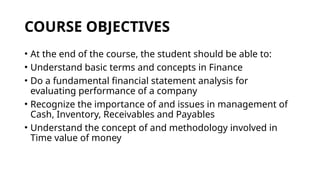
COURSE OBJECTIVES
• Atthe end of the course, the student should be able to:
• Understand basic terms and concepts in Finance
• Do a fundamental financial statement analysis for
evaluating performance of a company
• Recognize the importance of and issues in management of
Cash, Inventory, Receivables and Payables
• Understand the concept of and methodology involved in
Time value of money
3.
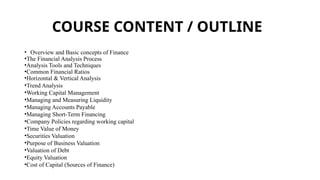
COURSE CONTENT /OUTLINE
• Overview and Basic concepts of Finance
•The Financial Analysis Process
•Analysis Tools and Techniques
•Common Financial Ratios
•Horizontal & Vertical Analysis
•Trend Analysis
•Working Capital Management
•Managing and Measuring Liquidity
•Managing Accounts Payable
•Managing Short-Term Financing
•Company Policies regarding working capital
•Time Value of Money
•Securities Valuation
•Purpose of Business Valuation
•Valuation of Debt
•Equity Valuation
•Cost of Capital (Sources of Finance)
4.
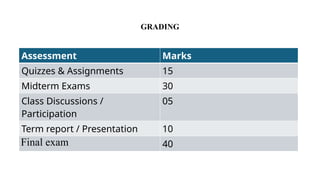
GRADING
Assessment Marks
Quizzes &Assignments 15
Midterm Exams 30
Class Discussions /
Participation
05
Term report / Presentation 10
Final exam 40
5.
REQUIRED TEXTBOOK
• Fundamentalsof Financial Management, 16th
Edition, by Brigham
& Houston
Recommended Textbooks:
- Fundamentals of Financial Management, Eleventh Edition by
James C. Van Horne & John M. Wachowicz, JR.
- Introduction to Financial Management by Iqbal Mathur
6.
AFTER THIS LECTURE
•When you finish this chapter, you should be able to do the
following
• Explain the role of finance and the different types of jobs in finance.
• Identify the advantages and disadvantages of different forms of business
organization.
• Explain the links between stock price, intrinsic value, and executive
compensation.
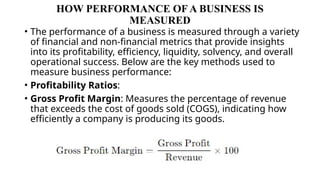
• Identify the potential conflicts that arise within the firm between
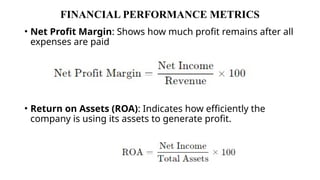
stockholders and managers and between stockholders and bond holders,
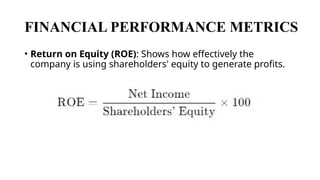
and discuss the techniques that firms can use to mitigate these potential
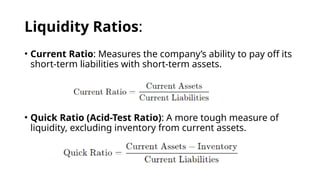
conflicts.
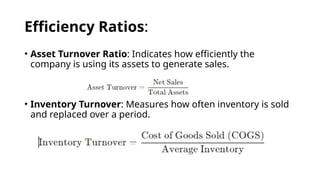
• Discuss the importance of business ethics and the consequences of
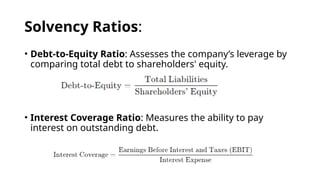
unethical behavior.
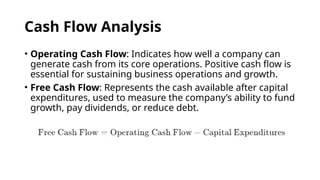
7.
WHAT IS FINANCE?
•Finance is defined by Webster’s Dictionary as “the system
that includes the circulation of money, the granting of
credit, the making of investments, and the provision of
banking facilities.” Finance has many facets, which makes it
difficult to provide one concise definition.
• Finance is the management, creation, and study of money,
investments, and other financial instruments. It involves the
processes of acquiring funds, allocating resources,
managing risks, and ensuring the optimal use of assets to
achieve personal, corporate, or government financial goals.
8.
THREE QUESTIONS ADDRESSEDBY
THE STUDY OF FINANCE:
1. What long-term investments should the firm undertake?
(capital budgeting decisions)
2. How should the firm fund these investments? (capital
structure decisions)
3. How can the firm best manage its cash flows as they arise
in its day-to-day operations? (working capital management
decisions)
9.
WHY STUDY FINANCE?
•Knowledge of financial tools is critical to
making good decisions in both professional
world and personal lives.
• Finance is an integral part of corporate world
• How will GM’s strategic decision to invest $740
million to produce the Chevy Volt require the
expertise of different disciplines within the business
school such as marketing, management,
accounting, operations management, and finance?
10.
AREAS OF FINANCE
•Financial Management / corporate finance
• how much and what types of assets to acquire
• how to raise the capital needed to purchase assets
• how to run the firm so as to maximize its value.
• Capital markets
• Examines the functioning of financial markets, institutions, and the
instruments they trade.
• Markets where interest rates and stock /bond price determined
• Financial Institution: supply capital to businesses. Banks, investment
banks, stockbrokers, mutual funds, insurance companies.
• Governmental organizations: i.e. SBP, Securities and Exchange
Commission (SEC)
11.
AREAS OF FINANCE
•Investments:
• Security analysis deals with finding the proper values of individual
securities (i.e., stocks and bonds)
• Portfolio theory deals with the best way to structure portfolios, or
“baskets,” of stocks and bonds.
• Market analysis deals with the issue of whether stock and bond
markets at any given time are “too high,” “too low,” or “about right.”
12.
OTHER IMPORTANT AREASIN
FINANCE
• International Finance: Focuses on financial activities that
cross national borders, including international investments,
exchange rates, and global markets.
• Key areas: (i) Foreign exchange markets (ii) International capital
markets (iii) Exchange rate risk and hedging (iv) International trade
finance (v) Multinational financial management
• Behavioral Finance: Examines how psychological factors
and biases affect financial decision-making.
• Key topics: (i) Investor behavior and market anomalies (ii)
Heuristics and biases in decision-making (iii) Behavioral asset
pricing
13.
OTHER IMPORTANT AREASIN
FINANCE
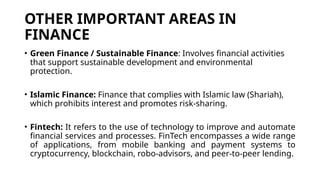
• Green Finance / Sustainable Finance: Involves financial activities
that support sustainable development and environmental
protection.
• Islamic Finance: Finance that complies with Islamic law (Shariah),
which prohibits interest and promotes risk-sharing.
• Fintech: It refers to the use of technology to improve and automate
financial services and processes. FinTech encompasses a wide range
of applications, from mobile banking and payment systems to
cryptocurrency, blockchain, robo-advisors, and peer-to-peer lending.
14.
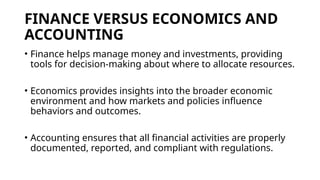
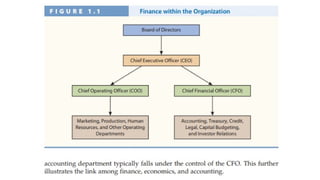
FINANCE VERSUS ECONOMICSAND
ACCOUNTING
• Finance helps manage money and investments, providing
tools for decision-making about where to allocate resources.
• Economics provides insights into the broader economic
environment and how markets and policies influence
behaviors and outcomes.
• Accounting ensures that all financial activities are properly
documented, reported, and compliant with regulations.
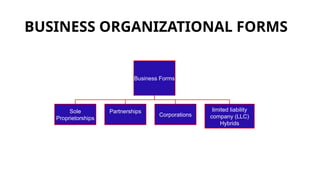
SOLE PROPRIETORSHIP
• Itis a business owned by a single individual that is entitled to all
the firm’s profits and is responsible for all the firm’s debt.
• There is no separation between the business and the owner
when it comes to debts or being sued.
• Sole proprietorships are generally financed by personal loans
from family and friends and business loans from banks.
19.
SOLE PROPRIETORSHIP (CONT.)
•Advantages:
• Easy to start
• No need to consult others while making decisions
• Taxed at the personal tax rate
• Disadvantages:
• Personally liable for the business debts
• Ceases on the death of the Proprietor
20.
PARTNERSHIP
• A generalpartnership is an association of two or more
persons who come together as co-owners for the purpose
of operating a business for profit.
• There is no separation between the partnership and the
owners with respect to debts or being sued.
21.
PARTNERSHIP (CONT.)
• Advantages:
•Relatively easy to start
• Taxed at the personal tax rate
• Access to funds from multiple sources or partners
• Disadvantages:
• Partners jointly share unlimited liability
22.
PARTNERSHIP (CONT.)
• Inlimited partnerships, there are two
classes of partners: general and limited.
• The general partners runs the business and
face unlimited liability for the firm’s debts,
while the limited partners are only liable on
the amount invested.
• One of the drawback of this form is that it is
difficult to transfer the ownership of the
general partner.
23.
CORPORATION
• A corporationis a legal entity that is separate and distinct from its
owners. It is created by law and has many of the rights and
responsibilities of an individual, such as the ability to own assets, incur
liabilities, enter contracts, sue and be sued. A corporation's owners are its
shareholders, and they enjoy limited liability, meaning they are not
personally liable for the company's debts beyond their investment in the
company. Corporations are typically managed by a Board of Directors
elected by the shareholders.
24.
CORPORATION (CONT.)
• Advantages
•Liability of owners limited to invested funds
• Life of corporation is not tied to the owner
• Easier to transfer ownership
• Easier to raise Capital
• Disadvantages
• Greater regulation
• Double taxation of dividends
26.
LLC / HYBRID
•A limited liability company (LLC) is a popular type of
organization that is a hybrid between a partnership and a
corporation. A limited liability partnership (LLP) is similar to
an LLC. LLPs are used for professional firms in the fields of
accounting, law, and architecture, while LLCs are used by
other businesses. Similar to corporations, LLCs and LLPs
AGENCY CONSIDERATIONS IN
CORPORATEFINANCE
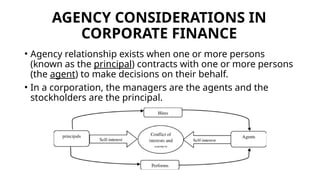
• Agency relationship exists when one or more persons
(known as the principal) contracts with one or more persons
(the agent) to make decisions on their behalf.
• In a corporation, the managers are the agents and the
stockholders are the principal.
30.
AGENCY CONSIDERATIONS IN
CORPORATEFINANCE (CONT.)
• Agency problems arise when there is conflict of interest
between the stockholders and the managers. Such
problems are likely to arise more when the managers
have little or no ownership in the firm.
• Examples:
• Not pursuing risky project for fear of losing jobs, stealing,
expensive perks.
• All else equal, agency problems will reduce the firm
value.
31.
HOW TO REDUCEAGENCY
PROBLEMS?
1. Monitoring
(Examples: Reports, Meetings, Auditors, board of directors, financial markets,
bankers, credit agencies)
2. Compensation plans
(Examples: Performance based bonus, salary, stock options, benefits)
The above will help to reduce agency problems/costs.
32.
THE MAIN FINANCIALGOAL:
CREATING VALUE FOR INVESTORS
• To maximize firm value shareholder’s wealth (as measured by
share prices)
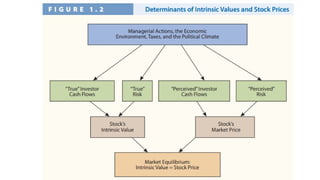
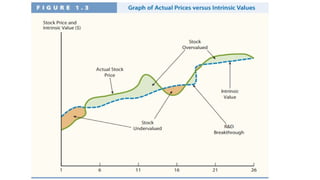
• DETERMINANTS OF VALUE OF SHARE
• Managerial actions, combined with the economy, taxes, and
political conditions, influence the level and riskiness of the
company’s future cash flows, which ultimately determine the
company’s stock price.
• Expectation of investors: higher return, dislike risk and the
higher stock price
35.
BUSINESS ETHICS
• Businessethics refers to a company’s attitude and conduct
toward its stakeholders, guided by laws, regulations, and
moral standards.
• Importance: Companies are rewarded for good reputations
and penalized for bad ones.
• Financial Scandals: Recent financial scandals have pushed
the need for stronger business ethics.
36.
FINANCIAL MANAGEMENT INTHE NEW
MILLENNIUM: GLOBALIZATION & TECHNOLOGY
• Globalization in Financial Management:
• Increased Connectivity: Companies now operate in a global
marketplace, with access to international markets, investors, and
capital.
• Cross-border Capital Flows: Greater access to foreign investments
and capital markets.
• Currency Risks: Managing fluctuations in exchange rates and
financial volatility.
• Regulatory Diversity: Navigating different legal and regulatory
frameworks across countries.
37.
TECHNOLOGICAL ADVANCEMENTS
• Automation& AI: Automating financial processes (e.g.,
data analysis, trading) to improve efficiency.
• Big Data & Analytics: Using large data sets for better
forecasting, risk management, and decision-making.
• FinTech Innovations: The rise of financial technology
(blockchain, digital payments, cryptocurrency), currently not
legal in Pakistan.
• Cybersecurity: Protecting financial data in an era of
increasing cyber threats.
38.
CHALLENGES AND OPPORTUNITIES
•Opportunities: Expansion of global markets, improved
efficiency, and innovation in financial services.
Examples: crypto currency, mobile banking, instant
payment.
• Challenges: Managing global risks, regulatory compliance,
and ensuring data security.
39.
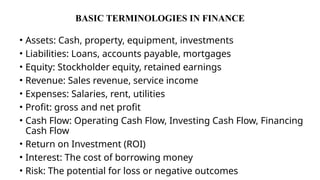
BASIC TERMINOLOGIES INFINANCE
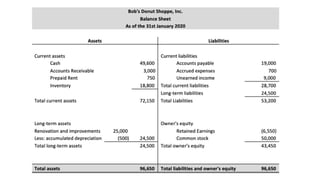
• Assets: Cash, property, equipment, investments
• Liabilities: Loans, accounts payable, mortgages
• Equity: Stockholder equity, retained earnings
• Revenue: Sales revenue, service income
• Expenses: Salaries, rent, utilities
• Profit: gross and net profit
• Cash Flow: Operating Cash Flow, Investing Cash Flow, Financing
Cash Flow
• Return on Investment (ROI)
• Interest: The cost of borrowing money
• Risk: The potential for loss or negative outcomes
40.
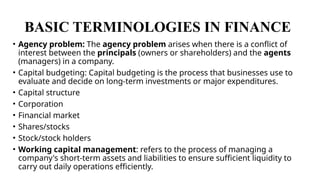
BASIC TERMINOLOGIES INFINANCE
• Agency problem: The agency problem arises when there is a conflict of
interest between the principals (owners or shareholders) and the agents
(managers) in a company.
• Capital budgeting: Capital budgeting is the process that businesses use to
evaluate and decide on long-term investments or major expenditures.
• Capital structure
• Corporation
• Financial market
• Shares/stocks
• Stock/stock holders
• Working capital management: refers to the process of managing a
company's short-term assets and liabilities to ensure sufficient liquidity to
carry out daily operations efficiently.
42.
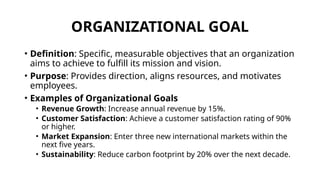
ORGANIZATIONAL GOAL
• Definition:Specific, measurable objectives that an organization
aims to achieve to fulfill its mission and vision.
• Purpose: Provides direction, aligns resources, and motivates
employees.
• Examples of Organizational Goals
• Revenue Growth: Increase annual revenue by 15%.
• Customer Satisfaction: Achieve a customer satisfaction rating of 90%
or higher.
• Market Expansion: Enter three new international markets within the
next five years.
• Sustainability: Reduce carbon footprint by 20% over the next decade.
43.
IMPACT OF THEENVIRONMENT ON
FINANCIAL MANAGEMENT
• Definition: The environment refers to both internal and
external factors that influence financial management
practices within an organization.
• Importance: Understanding these factors is crucial for
effective financial planning and decision-making.
44.
INTERNAL ENVIRONMENT
• OrganizationalStructure:
• Impact: Affects financial decision-making processes and budget
allocation.
• Examples: Centralized vs. decentralized financial control.
• Corporate Culture:
• Impact: Influences financial policies and ethical behavior.
• Examples: Risk tolerance, investment strategies.
• Financial Resources:
• Impact: Availability of capital and cash flow affects investment and
operational decisions.
• Examples: Working capital management, debt levels.
FINANCIAL MANAGEMENT
FUNCTION:
• Definition:Financial management involves planning,
organizing, directing, and controlling financial activities such
as procurement and utilization of funds.
• Key Focus: Managing corporate assets and financial
structure to optimize financial performance and stability.
47.
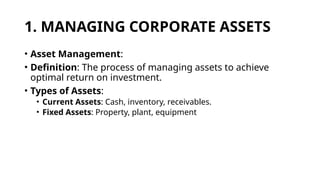
1. MANAGING CORPORATEASSETS
• Asset Management:
• Definition: The process of managing assets to achieve
optimal return on investment.
• Types of Assets:
• Current Assets: Cash, inventory, receivables.
• Fixed Assets: Property, plant, equipment
48.
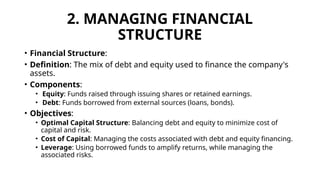
2. MANAGING FINANCIAL
STRUCTURE
•Financial Structure:
• Definition: The mix of debt and equity used to finance the company's
assets.
• Components:
• Equity: Funds raised through issuing shares or retained earnings.
• Debt: Funds borrowed from external sources (loans, bonds).
• Objectives:
• Optimal Capital Structure: Balancing debt and equity to minimize cost of
capital and risk.
• Cost of Capital: Managing the costs associated with debt and equity financing.
• Leverage: Using borrowed funds to amplify returns, while managing the
associated risks.
49.
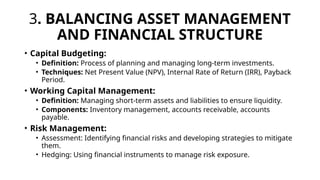
3. BALANCING ASSETMANAGEMENT
AND FINANCIAL STRUCTURE
• Capital Budgeting:
• Definition: Process of planning and managing long-term investments.
• Techniques: Net Present Value (NPV), Internal Rate of Return (IRR), Payback
Period.
• Working Capital Management:
• Definition: Managing short-term assets and liabilities to ensure liquidity.
• Components: Inventory management, accounts receivable, accounts
payable.
• Risk Management:
• Assessment: Identifying financial risks and developing strategies to mitigate
them.
• Hedging: Using financial instruments to manage risk exposure.
50.
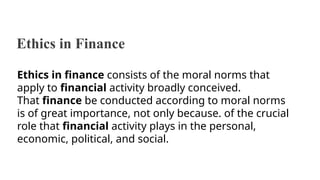
Ethics in Finance
Ethicsin finance consists of the moral norms that
apply to financial activity broadly conceived.
That finance be conducted according to moral norms
is of great importance, not only because. of the crucial
role that financial activity plays in the personal,
economic, political, and social.
51.
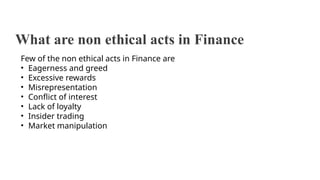
What are nonethical acts in Finance
Few of the non ethical acts in Finance are
• Eagerness and greed
• Excessive rewards
• Misrepresentation
• Conflict of interest
• Lack of loyalty
• Insider trading
• Market manipulation
52.
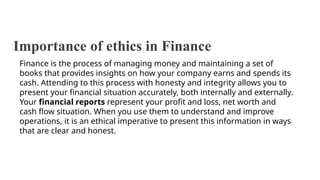
Importance of ethicsin Finance
Finance is the process of managing money and maintaining a set of
books that provides insights on how your company earns and spends its
cash. Attending to this process with honesty and integrity allows you to
present your financial situation accurately, both internally and externally.
Your financial reports represent your profit and loss, net worth and
cash flow situation. When you use them to understand and improve
operations, it is an ethical imperative to present this information in ways
that are clear and honest.
53.
Continue……
Business partners andstakeholders have a right to know whether
your business is earning or losing money and whether they are making
investments in an organization with a firm or shaky foundation.
Showing a crooked set of books may help you to secure financing that
will be convenient and expedient but may be in neither your best
interest nor the lender's if your business model is not sound enough for
you to repay what you borrow.
54.
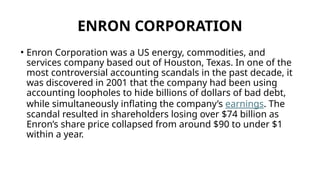
ENRON CORPORATION
• EnronCorporation was a US energy, commodities, and
services company based out of Houston, Texas. In one of the
most controversial accounting scandals in the past decade, it
was discovered in 2001 that the company had been using
accounting loopholes to hide billions of dollars of bad debt,
while simultaneously inflating the company’s earnings. The
scandal resulted in shareholders losing over $74 billion as
Enron’s share price collapsed from around $90 to under $1
within a year.
ETHICS IN FINANCE
•What do we mean by Ethics?
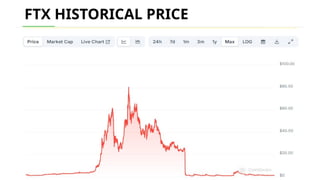
• Overview: In 2023, FTX, a prominent cryptocurrency exchange, was at
the center of a major financial scandal.
• What Went Wrong?
• Financial Mismanagement:
• Details: Misappropriation of funds and risky financial practices led to the
collapse of FTX.
• Impact: Approximately $16 billion entrusted to FTX was lost, contributing to
the larger $30-$35 billion cryptocurrency bankruptcy crisis.
• Lack of Transparency:
• Details: FTX failed to disclose critical information about its financial health
and operations to investors.
• Impact: Investors were left unaware of the true state of their investments
and the risks involved.
58.
ETHICAL PROBLEMS
• DeceptivePractices:
• Details: Bankman-Fried and FTX were accused of concealing the truth
about their financial practices and health.
• Ethical Issue: Misleading investors and stakeholders is a serious breach
of trust and ethical standards.
• Conflict of Interest:
• Details: FTX's management may have engaged in practices that
benefited themselves at the expense of investors.
• Ethical Issue: Conflicts of interest undermine the integrity of financial
management and decision-making.
• Lack of Accountability:
• Details: FTX's failure to implement proper oversight and controls
contributed to the scandal.
• Ethical Issue: Inadequate accountability mechanisms lead to unethical
behavior and financial misconduct.
59.
What are FinancialMarkets
A financial market is a broad term describing any marketplace where
buyers and sellers participate in the trade of assets such as bonds and
currencies. Financial markets are typically defined by having
transparent pricing, basic regulations on trading, costs and fees, and
market forces determining the prices of securities that trade.
Financial markets can be found in nearly every nation in the world.
Some are very small, with only a few participants, while others - like the
New York Stock Exchange (NYSE) and the forex markets - trade trillions
of dollars daily.
60.
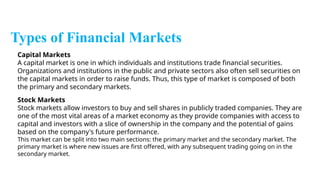
Types of FinancialMarkets
Capital Markets
A capital market is one in which individuals and institutions trade financial securities.
Organizations and institutions in the public and private sectors also often sell securities on
the capital markets in order to raise funds. Thus, this type of market is composed of both
the primary and secondary markets.
Stock Markets
Stock markets allow investors to buy and sell shares in publicly traded companies. They are
one of the most vital areas of a market economy as they provide companies with access to
capital and investors with a slice of ownership in the company and the potential of gains
based on the company's future performance.
This market can be split into two main sections: the primary market and the secondary market. The
primary market is where new issues are first offered, with any subsequent trading going on in the
secondary market.
61.
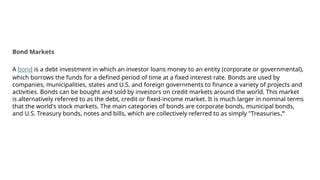
Bond Markets
A bondis a debt investment in which an investor loans money to an entity (corporate or governmental),
which borrows the funds for a defined period of time at a fixed interest rate. Bonds are used by
companies, municipalities, states and U.S. and foreign governments to finance a variety of projects and
activities. Bonds can be bought and sold by investors on credit markets around the world. This market
is alternatively referred to as the debt, credit or fixed-income market. It is much larger in nominal terms
that the world's stock markets. The main categories of bonds are corporate bonds, municipal bonds,
and U.S. Treasury bonds, notes and bills, which are collectively referred to as simply "Treasuries."
62.
Money Market
The moneymarket is a segment of the financial market in which financial instruments with high
liquidity and very short maturities are traded. The money market is used by participants as a
means for borrowing and lending in the short term, from several days to just under a year.
Money market securities consist of negotiable certificates of deposit (CDs), banker's
acceptances, U.S. Treasury bills, commercial paper, municipal notes, euro dollars, federal funds
and repurchase agreements (repos). Money market investments are also called cash
investments because of their short maturities.
63.
Need of FinancialAnalysis
• Financial analysis is essential for various stakeholders—
businesses, investors, creditors, and managers—because it
helps them make informed decisions. Here are the key
reasons for its necessity:
• Decision-Making: Financial analysis helps managers, investors, and
stakeholders make informed decisions by evaluating the financial
health of a company. It assists in understanding profitability,
liquidity, solvency, and efficiency, enabling better choices about
investments, operations, and financing.
• Performance Evaluation: It allows for an assessment of a
company's performance over time by comparing financial ratios and
other metrics. This helps identify trends, strengths, and weaknesses,
and can lead to necessary corrective actions.
64.
Need of FinancialAnalysis
• Investment Evaluation: Investors use financial analysis to evaluate
potential investments. By analyzing profitability, cash flow, and
growth potential, they can decide whether to invest in a company or
industry.
• Risk Assessment: Financial analysis helps assess the risk level
associated with a company or project. By analyzing leverage,
liquidity, and cash flow, stakeholders can understand the risks of
financial distress or default.
• Creditworthiness: Lenders and creditors use financial analysis to
determine whether a company can meet its debt obligations. This is
essential for granting loans or setting credit terms.
• Valuation of a Business: For mergers, acquisitions, or selling parts
of a company, financial analysis helps in determining the fair market
value of the business by analyzing its assets, earnings, and potential
growth.
65.
Need of FinancialAnalysis
• Resource Allocation: By analyzing profitability and cash flow, companies can
allocate resources effectively to areas that promise higher returns, improving
operational efficiency and strategic growth.
• Benchmarking: Financial analysis helps companies benchmark their
performance against competitors or industry standards, offering insights into
their relative position and competitive advantages.
• Compliance and Reporting: Financial analysis is crucial for regulatory
compliance and financial reporting. It ensures transparency and provides
shareholders and regulatory bodies with a clear picture of a company's
financial health.
• Strategic Planning: Financial analysis supports long-term strategic planning
by forecasting future performance, identifying areas for growth, and providing
insights into how to optimize financial strategies.
66.
HOW PERFORMANCE OFA BUSINESS IS
MEASURED
• The performance of a business is measured through a variety
of financial and non-financial metrics that provide insights
into its profitability, efficiency, liquidity, solvency, and overall
operational success. Below are the key methods used to
measure business performance:
• Profitability Ratios:
• Gross Profit Margin: Measures the percentage of revenue
that exceeds the cost of goods sold (COGS), indicating how
efficiently a company is producing its goods.
67.
FINANCIAL PERFORMANCE METRICS
•Net Profit Margin: Shows how much profit remains after all
expenses are paid
• Return on Assets (ROA): Indicates how efficiently the
company is using its assets to generate profit.
68.
FINANCIAL PERFORMANCE METRICS
•Return on Equity (ROE): Shows how effectively the
company is using shareholders' equity to generate profits.
69.
Liquidity Ratios:
• CurrentRatio: Measures the company’s ability to pay off its
short-term liabilities with short-term assets.
• Quick Ratio (Acid-Test Ratio): A more tough measure of
liquidity, excluding inventory from current assets.
70.
Efficiency Ratios:
• AssetTurnover Ratio: Indicates how efficiently the
company is using its assets to generate sales.
• Inventory Turnover: Measures how often inventory is sold
and replaced over a period.
71.
Solvency Ratios:
• Debt-to-EquityRatio: Assesses the company’s leverage by
comparing total debt to shareholders' equity.
• Interest Coverage Ratio: Measures the ability to pay
interest on outstanding debt.
72.
Cash Flow Analysis
•Operating Cash Flow: Indicates how well a company can
generate cash from its core operations. Positive cash flow is
essential for sustaining business operations and growth.
• Free Cash Flow: Represents the cash available after capital
expenditures, used to measure the company’s ability to fund
growth, pay dividends, or reduce debt.
73.
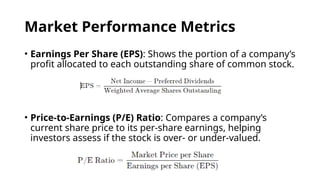
Market Performance Metrics
•Earnings Per Share (EPS): Shows the portion of a company’s
profit allocated to each outstanding share of common stock.
• Price-to-Earnings (P/E) Ratio: Compares a company’s
current share price to its per-share earnings, helping
investors assess if the stock is over- or under-valued.
Editor's Notes
#9 critical الحرجة, integral part of corporate world جزء لا يتجزأ من عالم الشركات, disciplines التخصصات,