APPROXIMATE
ENTROPY
(ApEn)
Submitted to:
Prof. R. Kanda
Department of Mechanical
Engineering
Submitted by:
GAURAV KUMAR SHARMA
ME17209004
Keywords
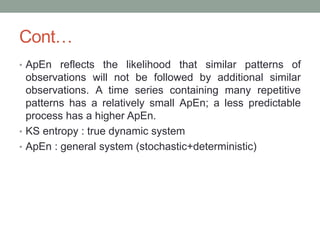
• Deterministic Model: No randomness in development of
future states.(i/p = same o/p)
• Stochastic: having a random prob distribution or pattern
that may be analyzed statistically but may not be
predicted precisely.
• Information Theory: studies quantification, storage and
communication of info.
• Entropy (statically): it quantifies the amount of regularity
or uncertainty involved in value of random variable or the
outcome of a random process
• Dynamic system: fn describes time dependence of aa
point in a geometric space. Eg flow of water in a pipe.
Introduction
• Developed by Steve M. Pincus
• an approximate entropy (ApEn) is a technique used to
quantify the amount of regularity and the unpredictability
of fluctuations over time-series data, which appears to
have potential application to a wide variety of relatively
short (range 50-5000) and noisy time-series data.
• motivated by data length constraints commonly
encountered, e.g., in heart rate, EEG, and endocrine
hormone secretion data sets.
• Findings have discriminated groups of subjects via ApEn,
in instances where classical [mean, standard deviation
(SD)] statistics did not show clear group distinctions
Cont…
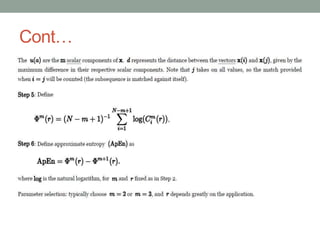
• ApEn reflects the likelihood that similar patterns of
observations will not be followed by additional similar
observations. A time series containing many repetitive
patterns has a relatively small ApEn; a less predictable
process has a higher ApEn.
• KS entropy : true dynamic system
• ApEn : general system (stochastic+deterministic)
Cont…
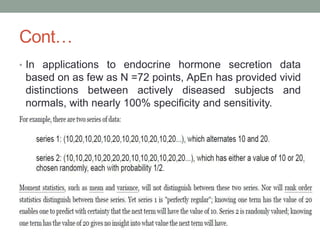
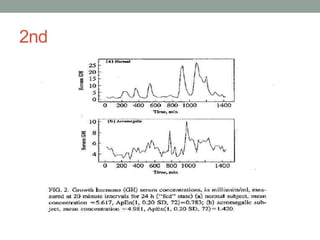
• In applications to endocrine hormone secretion data
based on as few as N =72 points, ApEn has provided vivid
distinctions between actively diseased subjects and
normals, with nearly 100% specificity and sensitivity.
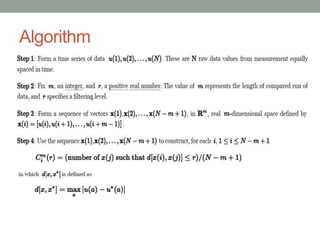
Algorithm
Cont…
Example
Cont…
Cont..
Cont…
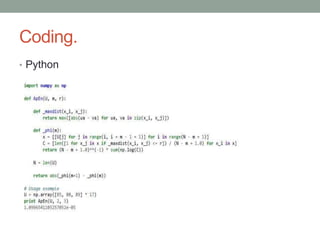
Coding.
• Python
Other examples
2nd
3rd
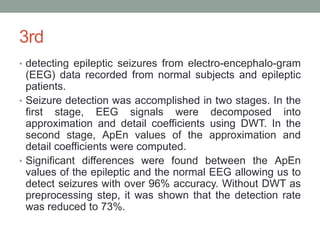
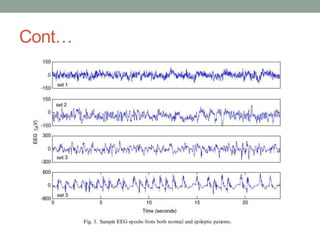
• detecting epileptic seizures from electro-encephalo-gram
(EEG) data recorded from normal subjects and epileptic
patients.
• Seizure detection was accomplished in two stages. In the
first stage, EEG signals were decomposed into
approximation and detail coefficients using DWT. In the
second stage, ApEn values of the approximation and
detail coefficients were computed.
• Significant differences were found between the ApEn
values of the epileptic and the normal EEG allowing us to
detect seizures with over 96% accuracy. Without DWT as
preprocessing step, it was shown that the detection rate
was reduced to 73%.
Cont..
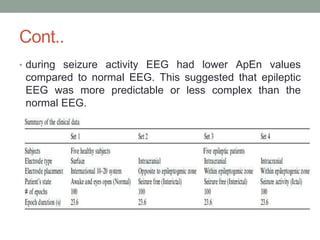
• during seizure activity EEG had lower ApEn values
compared to normal EEG. This suggested that epileptic
EEG was more predictable or less complex than the
normal EEG.
Cont…
Advantages & applications
• Advantages
• Lower computational demand. ApEn can be designed to work for
small data samples (n < 50 points) and can be applied in real time.
• Less effect from noise. If data are noisy, the ApEn measure can be
compared to the noise level in the data to determine what quality of
true information may be present in the data.
• Applications
• ApEn has been applied to classify EEG in psychiatric diseases, such
as schizophrenia, epilepsy, and addiction
THANK YOU….

Introduction to Approximate entropy

  • 1.
    APPROXIMATE ENTROPY (ApEn) Submitted to: Prof. R.Kanda Department of Mechanical Engineering Submitted by: GAURAV KUMAR SHARMA ME17209004
  • 2.
    Keywords • Deterministic Model:No randomness in development of future states.(i/p = same o/p) • Stochastic: having a random prob distribution or pattern that may be analyzed statistically but may not be predicted precisely. • Information Theory: studies quantification, storage and communication of info. • Entropy (statically): it quantifies the amount of regularity or uncertainty involved in value of random variable or the outcome of a random process • Dynamic system: fn describes time dependence of aa point in a geometric space. Eg flow of water in a pipe.
  • 3.
    Introduction • Developed bySteve M. Pincus • an approximate entropy (ApEn) is a technique used to quantify the amount of regularity and the unpredictability of fluctuations over time-series data, which appears to have potential application to a wide variety of relatively short (range 50-5000) and noisy time-series data. • motivated by data length constraints commonly encountered, e.g., in heart rate, EEG, and endocrine hormone secretion data sets. • Findings have discriminated groups of subjects via ApEn, in instances where classical [mean, standard deviation (SD)] statistics did not show clear group distinctions
  • 4.
    Cont… • ApEn reflectsthe likelihood that similar patterns of observations will not be followed by additional similar observations. A time series containing many repetitive patterns has a relatively small ApEn; a less predictable process has a higher ApEn. • KS entropy : true dynamic system • ApEn : general system (stochastic+deterministic)
  • 5.
    Cont… • In applicationsto endocrine hormone secretion data based on as few as N =72 points, ApEn has provided vivid distinctions between actively diseased subjects and normals, with nearly 100% specificity and sensitivity.
  • 6.
  • 7.
  • 8.
  • 9.
  • 10.
  • 11.
  • 12.
  • 13.
  • 14.
  • 15.
    3rd • detecting epilepticseizures from electro-encephalo-gram (EEG) data recorded from normal subjects and epileptic patients. • Seizure detection was accomplished in two stages. In the first stage, EEG signals were decomposed into approximation and detail coefficients using DWT. In the second stage, ApEn values of the approximation and detail coefficients were computed. • Significant differences were found between the ApEn values of the epileptic and the normal EEG allowing us to detect seizures with over 96% accuracy. Without DWT as preprocessing step, it was shown that the detection rate was reduced to 73%.
  • 16.
    Cont.. • during seizureactivity EEG had lower ApEn values compared to normal EEG. This suggested that epileptic EEG was more predictable or less complex than the normal EEG.
  • 17.
  • 18.
    Advantages & applications •Advantages • Lower computational demand. ApEn can be designed to work for small data samples (n < 50 points) and can be applied in real time. • Less effect from noise. If data are noisy, the ApEn measure can be compared to the noise level in the data to determine what quality of true information may be present in the data. • Applications • ApEn has been applied to classify EEG in psychiatric diseases, such as schizophrenia, epilepsy, and addiction
  • 19.