HISTORY PROJECT
GORGORA /DEBRE SINA
MONASTRY
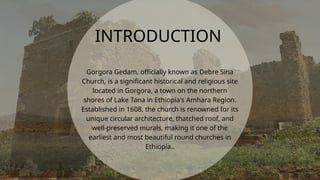
Gorgora Gedam, officially known as Debre Sina
Church, is a significant historical and religious site
located in Gorgora, a town on the northern
shores of Lake Tana in Ethiopia's Amhara Region.
Established in 1608, the church is renowned for its
unique circular architecture, thatched roof, and
well-preserved murals, making it one of the
earliest and most beautiful round churches in
Ethiopia..
INTRODUCTION
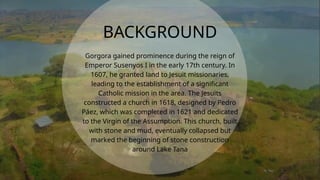
Gorgora gained prominence during the reign of
Emperor Susenyos I in the early 17th century. In
1607, he granted land to Jesuit missionaries,
leading to the establishment of a significant
Catholic mission in the area. The Jesuits
constructed a church in 1618, designed by Pedro
Páez, which was completed in 1621 and dedicated
to the Virgin of the Assumption. This church, built
with stone and mud, eventually collapsed but
marked the beginning of stone construction
around Lake Tana
BACKGROUND
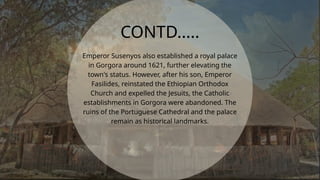
Emperor Susenyos also established a royal palace
in Gorgora around 1621, further elevating the
town's status. However, after his son, Emperor
Fasilides, reinstated the Ethiopian Orthodox
Church and expelled the Jesuits, the Catholic
establishments in Gorgora were abandoned. The
ruins of the Portuguese Cathedral and the palace
remain as historical landmarks.
CONTD.....
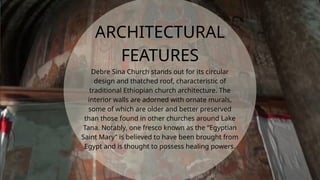
Debre Sina Church stands out for its circular
design and thatched roof, characteristic of
traditional Ethiopian church architecture. The
interior walls are adorned with ornate murals,
some of which are older and better preserved
than those found in other churches around Lake
Tana. Notably, one fresco known as the “Egyptian
Saint Mary” is believed to have been brought from
Egypt and is thought to possess healing powers.
ARCHITECTURAL
FEATURES
CURRENT STATUS
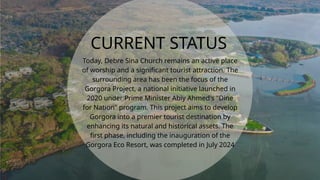
Today, Debre Sina Church remains an active place
of worship and a significant tourist attraction. The
surrounding area has been the focus of the
Gorgora Project, a national initiative launched in
2020 under Prime Minister Abiy Ahmed's "Dine
for Nation" program. This project aims to develop
Gorgora into a premier tourist destination by
enhancing its natural and historical assets. The
first phase, including the inauguration of the
Gorgora Eco Resort, was completed in July 2024
CONTD....
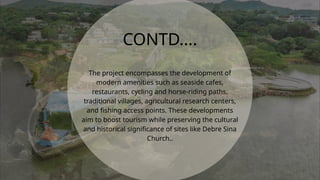
The project encompasses the development of
modern amenities such as seaside cafes,
restaurants, cycling and horse-riding paths,
traditional villages, agricultural research centers,
and fishing access points. These developments
aim to boost tourism while preserving the cultural
and historical significance of sites like Debre Sina
Church..
Documentation
Gorgora Gedam (Debre Sina Church) is a
testament to Ethiopia's rich religious and
architectural heritage. Its historical significance,
coupled with recent development initiatives,
positions it as a vital cultural and tourist hub in
the region. The ongoing efforts to preserve and
promote this heritage site ensure that it
continues to be a source of inspiration and
learning for future generations.
Conclusion
THANK YOU
MEMBERS ID
ASAMINEW SILAS ETS 0168/15
BESUFIKAD DARGAZE ETS 0252/15
DEREJE DUBALE ETS 0392/15
YABETS HAILU ETS1353/15

INTRODUCTION.pptxzbjdvsb...............b.sv

  • 1.
  • 2.
    Gorgora Gedam, officiallyknown as Debre Sina Church, is a significant historical and religious site located in Gorgora, a town on the northern shores of Lake Tana in Ethiopia's Amhara Region. Established in 1608, the church is renowned for its unique circular architecture, thatched roof, and well-preserved murals, making it one of the earliest and most beautiful round churches in Ethiopia.. INTRODUCTION
  • 3.
    Gorgora gained prominenceduring the reign of Emperor Susenyos I in the early 17th century. In 1607, he granted land to Jesuit missionaries, leading to the establishment of a significant Catholic mission in the area. The Jesuits constructed a church in 1618, designed by Pedro Páez, which was completed in 1621 and dedicated to the Virgin of the Assumption. This church, built with stone and mud, eventually collapsed but marked the beginning of stone construction around Lake Tana BACKGROUND
  • 4.
    Emperor Susenyos alsoestablished a royal palace in Gorgora around 1621, further elevating the town's status. However, after his son, Emperor Fasilides, reinstated the Ethiopian Orthodox Church and expelled the Jesuits, the Catholic establishments in Gorgora were abandoned. The ruins of the Portuguese Cathedral and the palace remain as historical landmarks. CONTD.....
  • 5.
    Debre Sina Churchstands out for its circular design and thatched roof, characteristic of traditional Ethiopian church architecture. The interior walls are adorned with ornate murals, some of which are older and better preserved than those found in other churches around Lake Tana. Notably, one fresco known as the “Egyptian Saint Mary” is believed to have been brought from Egypt and is thought to possess healing powers. ARCHITECTURAL FEATURES
  • 6.
    CURRENT STATUS Today, DebreSina Church remains an active place of worship and a significant tourist attraction. The surrounding area has been the focus of the Gorgora Project, a national initiative launched in 2020 under Prime Minister Abiy Ahmed's "Dine for Nation" program. This project aims to develop Gorgora into a premier tourist destination by enhancing its natural and historical assets. The first phase, including the inauguration of the Gorgora Eco Resort, was completed in July 2024
  • 7.
    CONTD.... The project encompassesthe development of modern amenities such as seaside cafes, restaurants, cycling and horse-riding paths, traditional villages, agricultural research centers, and fishing access points. These developments aim to boost tourism while preserving the cultural and historical significance of sites like Debre Sina Church..
  • 8.
  • 9.
    Gorgora Gedam (DebreSina Church) is a testament to Ethiopia's rich religious and architectural heritage. Its historical significance, coupled with recent development initiatives, positions it as a vital cultural and tourist hub in the region. The ongoing efforts to preserve and promote this heritage site ensure that it continues to be a source of inspiration and learning for future generations. Conclusion
  • 10.
    THANK YOU MEMBERS ID ASAMINEWSILAS ETS 0168/15 BESUFIKAD DARGAZE ETS 0252/15 DEREJE DUBALE ETS 0392/15 YABETS HAILU ETS1353/15