Sanjivani Rural Education Society’s
Sanjivani College of Engineering, Kopargaon-423 603
(An Autonomous Institute, Affiliated to Savitribai Phule Pune University, Pune)
NACC ‘A’ Grade Accredited, ISO 9001:2015 Certified
Department of Computer Engineering
(NBA Accredited)
Prof. S. N. Gunjal
Assistant Professor
E-mail : gunjasanjay@sanjivani.org.in
Contact No: 91301 91301 Ext :145, 9503916876
Course- Java Programming for Beginners
Topic – Introduction of Java programming
Prof. Gunjal S.N
Contents
DEPARTMENT OF COMPUTER ENGINEERING, Sanjivani COE, Kopargaon 2
 History of Java Programming
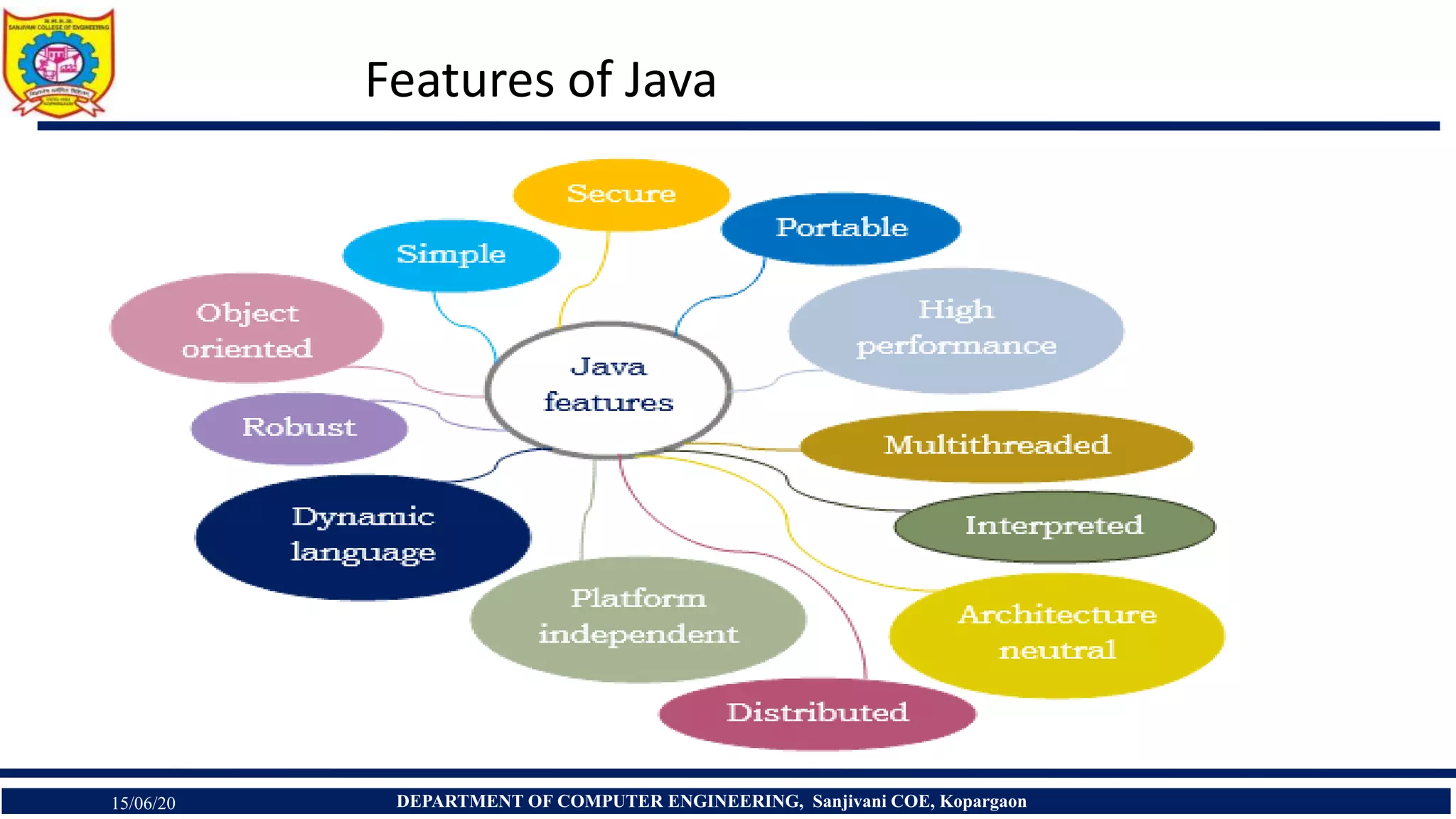
 Features of Java Programming
 Simple, Small and Familiar
 Object Oriented
 Compiled and Interpreted
 Robust & Secure
 Platform Independent and Portable
 Distributed and Network Oriented
 Multithreaded and Interactive
 High Performance
History of Java Programming
DEPARTMENT OF COMPUTER ENGINEERING, Sanjivani COE, Kopargaon 3
 Java is a general purpose object oriented programming language.
 Java was Developed by James Gosling, Patrick Naughton, Chris Warth, Ed
Frank, and Mike Sheridan at Sun Microsystems, Inc. in 1991. Small team
of Sun Microsystems called green team. And they give the name of the
programming has Greentalk initially; as it is from the green team so they
call it as a Greentalk.
 its extension is .gt. later on they developed a more improved version of the
concept and they gave the name is called Oak.
 Later on was searching that the name should be very suitable as the
programming favor it is. Programming really is very cool, lively, dynamic,
revolutionary and easy to spell and fun to say.
History of Java Programming
DEPARTMENT OF COMPUTER ENGINEERING, Sanjivani COE, Kopargaon 4
 In 1995 the Gosling introduced the name Java in 1995. In fact, Java is
an island of Indonesia, where best coffee of the world is produced.
 Sun Micro system first times, introduced a full set of programming
environment, they call it as JDK- Java Development Kit it was
released in January 23 1996.
 Initial motivation is to develop a platform independent language &
Java initially was designed for a small embedded system and suitable
for many electronic appliances like set of boxes.
 Become the language of internet. (portability and security).
15/06/20 DEPARTMENT OF COMPUTER ENGINEERING, Sanjivani COE, Kopargaon
Features of Java
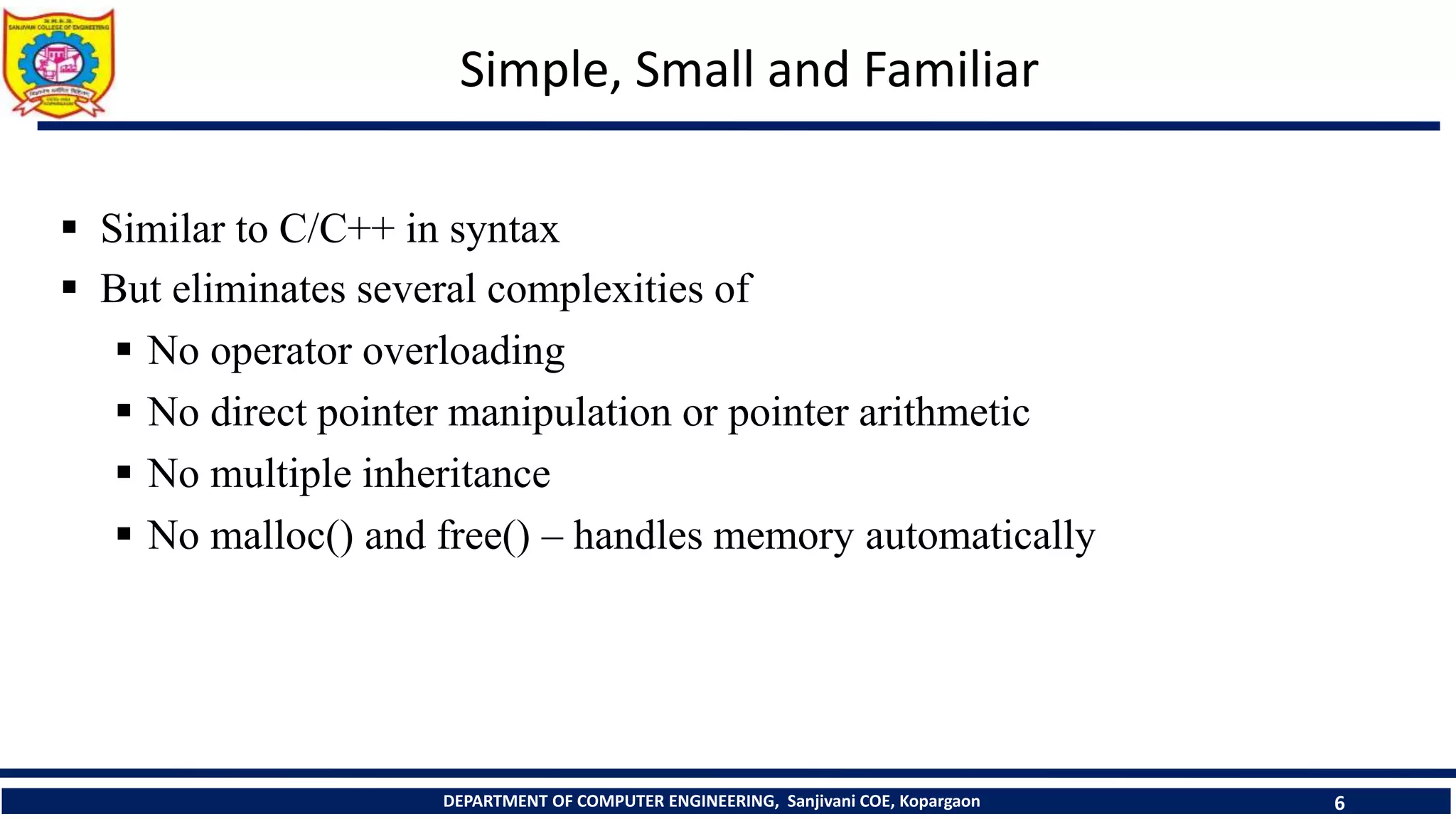
Simple, Small and Familiar
DEPARTMENT OF COMPUTER ENGINEERING, Sanjivani COE, Kopargaon 6
 Similar to C/C++ in syntax
 But eliminates several complexities of
 No operator overloading
 No direct pointer manipulation or pointer arithmetic
 No multiple inheritance
 No malloc() and free() – handles memory automatically
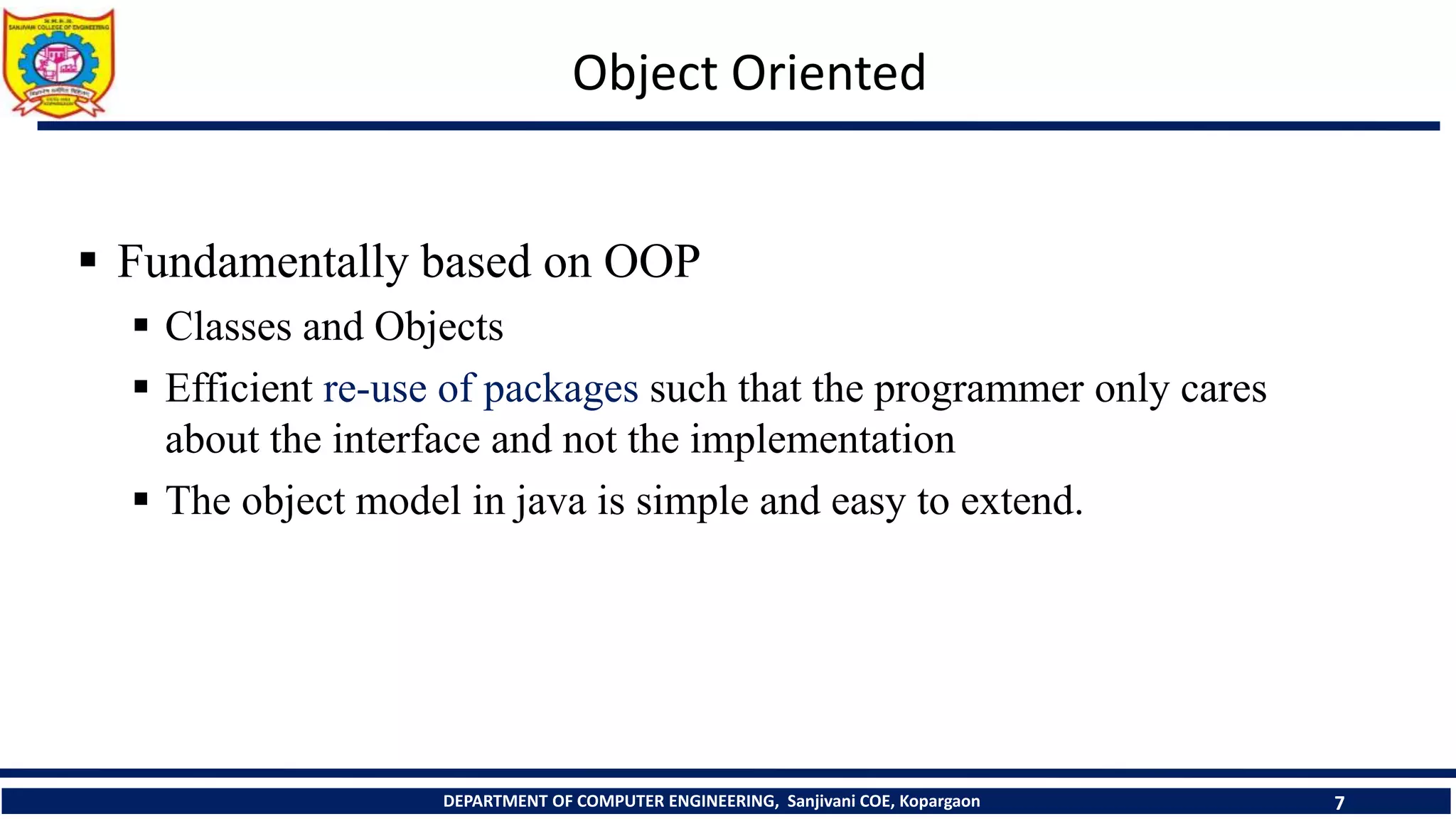
Object Oriented
DEPARTMENT OF COMPUTER ENGINEERING, Sanjivani COE, Kopargaon 7
 Fundamentally based on OOP
 Classes and Objects
 Efficient re-use of packages such that the programmer only cares
about the interface and not the implementation
 The object model in java is simple and easy to extend.
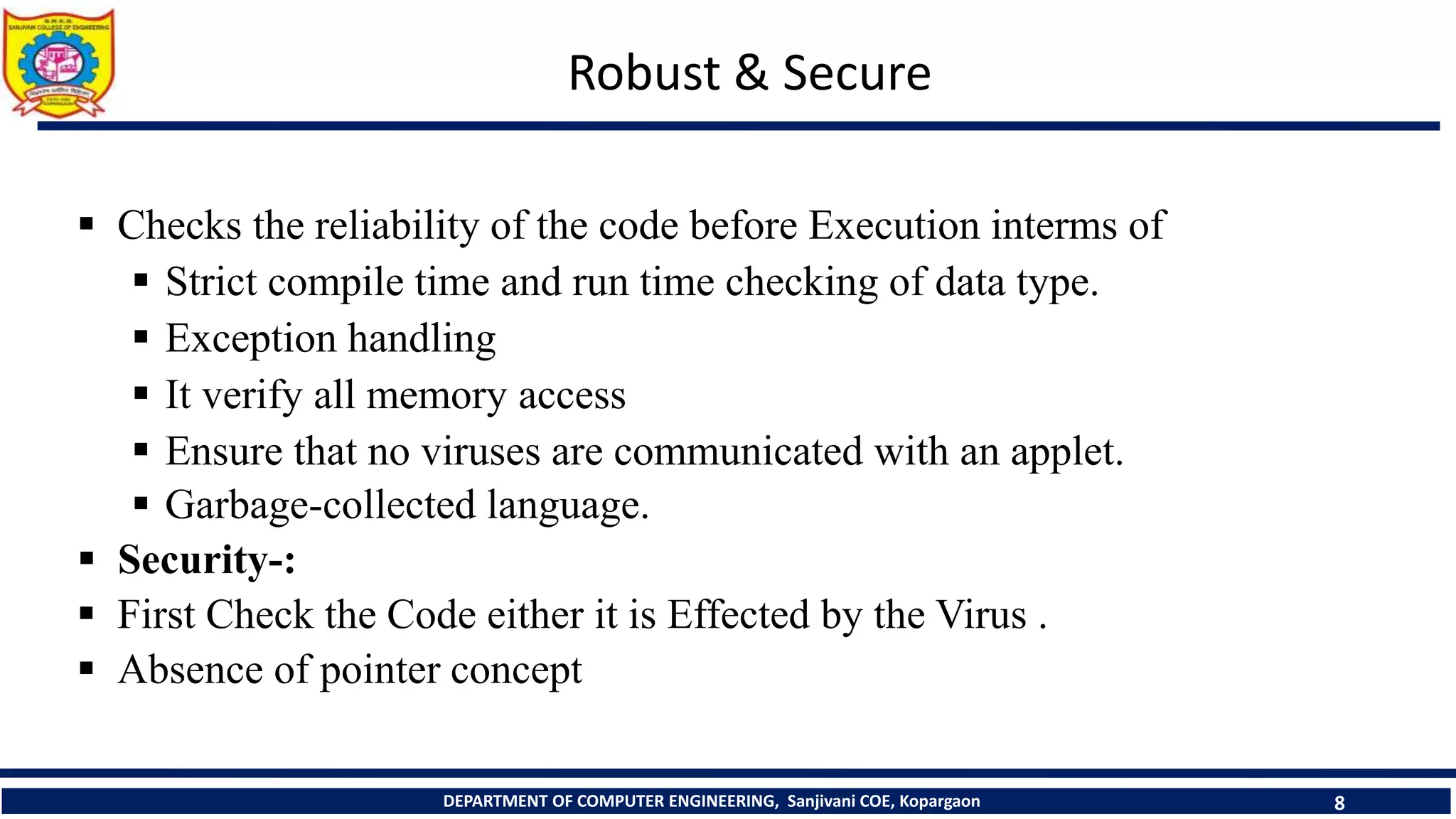
Robust & Secure
DEPARTMENT OF COMPUTER ENGINEERING, Sanjivani COE, Kopargaon 8
 Checks the reliability of the code before Execution interms of
 Strict compile time and run time checking of data type.
 Exception handling
 It verify all memory access
 Ensure that no viruses are communicated with an applet.
 Garbage-collected language.
 Security-:
 First Check the Code either it is Effected by the Virus .
 Absence of pointer concept
Compiled and Interpreted
DEPARTMENT OF COMPUTER ENGINEERING, Sanjivani COE, Kopargaon 9
Java works in two stage
 Java compiler :translate the source code into byte code.
 Java interpreter converts the byte code into machine level
representation.
Byte Code:
 A highly optimized set of instructions to be executed by the java
runtime system, known as java virtual machine (JVM).
 Not executable code.
Java Virtual Machine (JVM):
 Need to be implemented for each platform.
 Although the details vary from machine to machine, all JVM
understand the same byte code.
Platform Independent and Portable
DEPARTMENT OF COMPUTER ENGINEERING, Sanjivani COE, Kopargaon 10
 “Write-Once Run-Anywhere”
 A Java program written and compiled on one machine can be executed
on any other machine
 Changes in system resources will not force any change in the program.
 The Java Virtual Machine (JVM) Convert byte code into machine level
representation
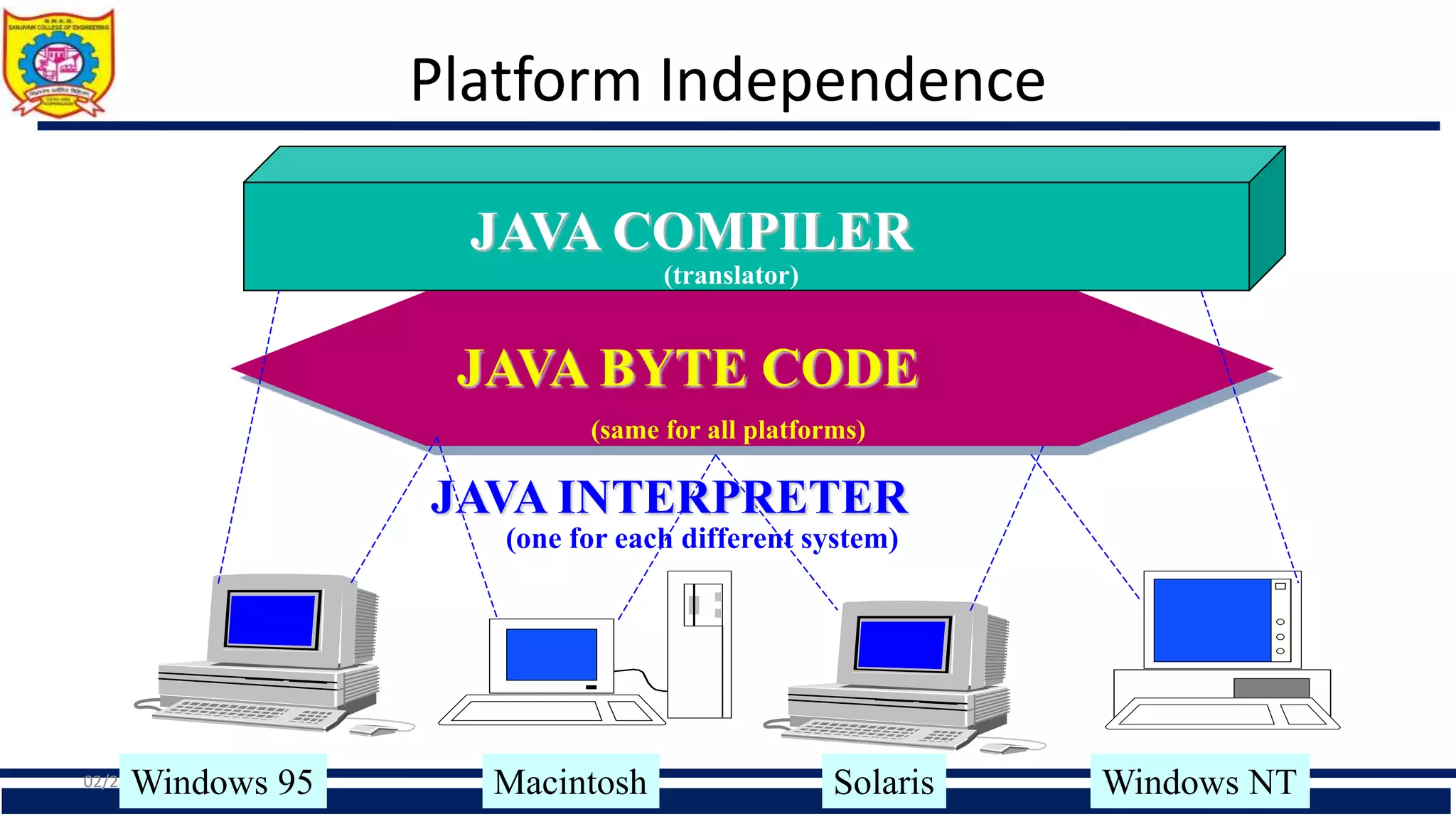
Platform Independence
02/23/18
JAVA COMPILER
JAVA BYTE CODE
JAVA INTERPRETER
Windows 95 Macintosh Solaris Windows NT
(translator)
(same for all platforms)
(one for each different system)
Distributed and Network Oriented
DEPARTMENT OF COMPUTER ENGINEERING, Sanjivani COE, Kopargaon 12
• Java grew up in the days of the Internet
– Inherently network friendly
– Original release of Java came with Networking libraries
– Newer releases contain even more for handling distributed
applications
• RMI, RPC
Multithreaded and Interactive
DEPARTMENT OF COMPUTER ENGINEERING, Sanjivani COE, Kopargaon 13
 Handles multiple tasks simultaneously.
 Java runtime system contains tools to support multiprocess
synchronization and construct smoothly running interactive systems.
High Performance
DEPARTMENT OF COMPUTER ENGINEERING, Sanjivani COE, Kopargaon 14
 Java performance is slower than C
 Provisions are added to reduce overhead at runtime.
 Incorporation of multithreading enhance the overall execution speed.
 Just-in-Time (JIT) can compile the byte code into machine code.
 Can sometimes be even faster than compiled C code!
Dynamic
DEPARTMENT OF COMPUTER ENGINEERING, Sanjivani COE, Kopargaon 15
 Capable of dynamically linking a new class libraries, methods and
objects.
 Java can use efficient functions available in C/C++.
 Installing new version of library automatically updates all programs
Summary
DEPARTMENT OF COMPUTER ENGINEERING, Sanjivani COE, Kopargaon 16
 Java is a general purpose object oriented programming language.
 Java was Developed by James Gosling, Patrick Naughton, Chris Warth, Ed Frank,
and Mike Sheridan at Sun Microsystems, Inc. in 1991. Small team of Sun
Microsystems called green team.
 Features of Java Programming
 Simple, Small and Familiar
 Object Oriented
 Compiled and Interpreted
 Robust & Secure
 Platform Independent and Portable
 Distributed and Network Oriented
 Multithreaded and Interactive
 High Performance
References:
DEPARTMENT OF COMPUTER ENGINEERING, Sanjivani COE, Kopargaon 17
1. Herbert Schildt, “Java: The Complete Reference” 10th Edition , McGraw-Hill
Education, ISBN: 978-1-25-958934-8 .
2. Samanta “The Object Oriented Programming with C++ and Java”,Prentise Hall.
.

Introduction of Java Programming.ppt

  • 1.
    Sanjivani Rural EducationSociety’s Sanjivani College of Engineering, Kopargaon-423 603 (An Autonomous Institute, Affiliated to Savitribai Phule Pune University, Pune) NACC ‘A’ Grade Accredited, ISO 9001:2015 Certified Department of Computer Engineering (NBA Accredited) Prof. S. N. Gunjal Assistant Professor E-mail : gunjasanjay@sanjivani.org.in Contact No: 91301 91301 Ext :145, 9503916876 Course- Java Programming for Beginners Topic – Introduction of Java programming Prof. Gunjal S.N
  • 2.
    Contents DEPARTMENT OF COMPUTERENGINEERING, Sanjivani COE, Kopargaon 2  History of Java Programming  Features of Java Programming  Simple, Small and Familiar  Object Oriented  Compiled and Interpreted  Robust & Secure  Platform Independent and Portable  Distributed and Network Oriented  Multithreaded and Interactive  High Performance
  • 3.
    History of JavaProgramming DEPARTMENT OF COMPUTER ENGINEERING, Sanjivani COE, Kopargaon 3  Java is a general purpose object oriented programming language.  Java was Developed by James Gosling, Patrick Naughton, Chris Warth, Ed Frank, and Mike Sheridan at Sun Microsystems, Inc. in 1991. Small team of Sun Microsystems called green team. And they give the name of the programming has Greentalk initially; as it is from the green team so they call it as a Greentalk.  its extension is .gt. later on they developed a more improved version of the concept and they gave the name is called Oak.  Later on was searching that the name should be very suitable as the programming favor it is. Programming really is very cool, lively, dynamic, revolutionary and easy to spell and fun to say.
  • 4.
    History of JavaProgramming DEPARTMENT OF COMPUTER ENGINEERING, Sanjivani COE, Kopargaon 4  In 1995 the Gosling introduced the name Java in 1995. In fact, Java is an island of Indonesia, where best coffee of the world is produced.  Sun Micro system first times, introduced a full set of programming environment, they call it as JDK- Java Development Kit it was released in January 23 1996.  Initial motivation is to develop a platform independent language & Java initially was designed for a small embedded system and suitable for many electronic appliances like set of boxes.  Become the language of internet. (portability and security).
  • 5.
    15/06/20 DEPARTMENT OFCOMPUTER ENGINEERING, Sanjivani COE, Kopargaon Features of Java
  • 6.
    Simple, Small andFamiliar DEPARTMENT OF COMPUTER ENGINEERING, Sanjivani COE, Kopargaon 6  Similar to C/C++ in syntax  But eliminates several complexities of  No operator overloading  No direct pointer manipulation or pointer arithmetic  No multiple inheritance  No malloc() and free() – handles memory automatically
  • 7.
    Object Oriented DEPARTMENT OFCOMPUTER ENGINEERING, Sanjivani COE, Kopargaon 7  Fundamentally based on OOP  Classes and Objects  Efficient re-use of packages such that the programmer only cares about the interface and not the implementation  The object model in java is simple and easy to extend.
  • 8.
    Robust & Secure DEPARTMENTOF COMPUTER ENGINEERING, Sanjivani COE, Kopargaon 8  Checks the reliability of the code before Execution interms of  Strict compile time and run time checking of data type.  Exception handling  It verify all memory access  Ensure that no viruses are communicated with an applet.  Garbage-collected language.  Security-:  First Check the Code either it is Effected by the Virus .  Absence of pointer concept
  • 9.
    Compiled and Interpreted DEPARTMENTOF COMPUTER ENGINEERING, Sanjivani COE, Kopargaon 9 Java works in two stage  Java compiler :translate the source code into byte code.  Java interpreter converts the byte code into machine level representation. Byte Code:  A highly optimized set of instructions to be executed by the java runtime system, known as java virtual machine (JVM).  Not executable code. Java Virtual Machine (JVM):  Need to be implemented for each platform.  Although the details vary from machine to machine, all JVM understand the same byte code.
  • 10.
    Platform Independent andPortable DEPARTMENT OF COMPUTER ENGINEERING, Sanjivani COE, Kopargaon 10  “Write-Once Run-Anywhere”  A Java program written and compiled on one machine can be executed on any other machine  Changes in system resources will not force any change in the program.  The Java Virtual Machine (JVM) Convert byte code into machine level representation
  • 11.
    Platform Independence 02/23/18 JAVA COMPILER JAVABYTE CODE JAVA INTERPRETER Windows 95 Macintosh Solaris Windows NT (translator) (same for all platforms) (one for each different system)
  • 12.
    Distributed and NetworkOriented DEPARTMENT OF COMPUTER ENGINEERING, Sanjivani COE, Kopargaon 12 • Java grew up in the days of the Internet – Inherently network friendly – Original release of Java came with Networking libraries – Newer releases contain even more for handling distributed applications • RMI, RPC
  • 13.
    Multithreaded and Interactive DEPARTMENTOF COMPUTER ENGINEERING, Sanjivani COE, Kopargaon 13  Handles multiple tasks simultaneously.  Java runtime system contains tools to support multiprocess synchronization and construct smoothly running interactive systems.
  • 14.
    High Performance DEPARTMENT OFCOMPUTER ENGINEERING, Sanjivani COE, Kopargaon 14  Java performance is slower than C  Provisions are added to reduce overhead at runtime.  Incorporation of multithreading enhance the overall execution speed.  Just-in-Time (JIT) can compile the byte code into machine code.  Can sometimes be even faster than compiled C code!
  • 15.
    Dynamic DEPARTMENT OF COMPUTERENGINEERING, Sanjivani COE, Kopargaon 15  Capable of dynamically linking a new class libraries, methods and objects.  Java can use efficient functions available in C/C++.  Installing new version of library automatically updates all programs
  • 16.
    Summary DEPARTMENT OF COMPUTERENGINEERING, Sanjivani COE, Kopargaon 16  Java is a general purpose object oriented programming language.  Java was Developed by James Gosling, Patrick Naughton, Chris Warth, Ed Frank, and Mike Sheridan at Sun Microsystems, Inc. in 1991. Small team of Sun Microsystems called green team.  Features of Java Programming  Simple, Small and Familiar  Object Oriented  Compiled and Interpreted  Robust & Secure  Platform Independent and Portable  Distributed and Network Oriented  Multithreaded and Interactive  High Performance
  • 17.
    References: DEPARTMENT OF COMPUTERENGINEERING, Sanjivani COE, Kopargaon 17 1. Herbert Schildt, “Java: The Complete Reference” 10th Edition , McGraw-Hill Education, ISBN: 978-1-25-958934-8 . 2. Samanta “The Object Oriented Programming with C++ and Java”,Prentise Hall. .