CODE BLUE WORKSHOP:
AWARENESS AND
RELOOK
18/10/2024
Nareshiman
Emergency Physician
Hospital Shah Alam
WHO HAS
ATTENDED TO
TRUE CODE
BLUE ?
Where?
What happened ?
Was it smooth ?
Can be better ?
OUTLINE
▶Introduction
▶Roles and Pathway
▶Revision
INTRODUCTION
▶Emergency codes are used worldwide to alert
staff and members of the public for various
emergency situations in hospitals
▶Minimize misunderstanding to the health care
personnel
▶There may be visitors, staff or patients that require
immediate medical care in hospital, in cases such
as cardiac arrest or seizure
▶Rapid response team will be deployed from the
nearest clinical area then supported by an
advance team if required
TWO-
PRONGED
APPROACH
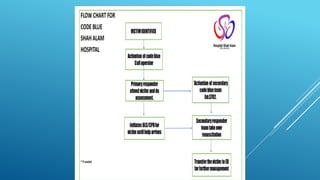
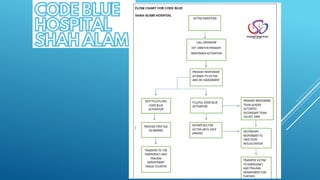
The response system is in 2 phases:
▶Initial response is by personnel in
vicinity of patient-BLS trained
▶Secondary response is by a well
equipped and trained team
appointed by the hospital to
respond to the particular area
WHEN TO
ACTIVATE CODE
BLUE?
▶ First person: public, not medically trained
WHEN TO
ACTIVATE CODE
BLUE?
▶ First person: public, not medically trained
▶ Primary responder: Local BLS team
WHEN TO
ACTIVATE CODE
BLUE?
▶ First person: public, not medically trained
▶ Primary responder: Local BLS team
▶ Secondary responder: Emergency dept ALS
team
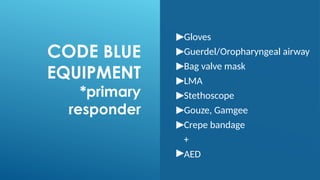
CODE BLUE
EQUIPMENT
*primary
responder
▶Gloves
▶Guerdel/Oropharyngeal airway
▶Bag valve mask
▶LMA
▶Stethoscope
▶Gouze, Gamgee
▶Crepe bandage
+
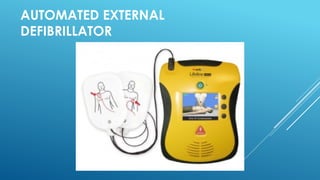
▶AED
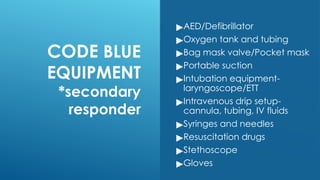
CODE BLUE
EQUIPMENT
*secondary
responder
▶AED/Defibrillator
▶Oxygen tank and tubing
▶Bag mask valve/Pocket mask
▶Portable suction
▶Intubation equipment-
laryngoscope/ETT
▶Intravenous drip setup-
cannula, tubing, IV fluids
▶Syringes and needles
▶Resuscitation drugs
▶Stethoscope
▶Gloves
NO CODE BLUE BEG .. IS
YOUR EMERGENCY
TROLLEY WELL EQUIPPED ?
AUTOMATED EXTERNAL
DEFIBRILLATOR
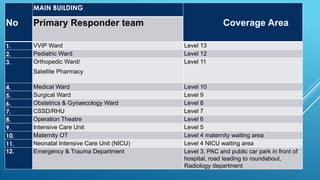
No
MAIN BUILDING
Coverage Area
Primary Responder team
1. VVIP Ward Level 13
2. Pediatric Ward Level 12
3. Orthopedic Ward/
Satellite Pharmacy
Level 11
4. Medical Ward Level 10
5. Surgical Ward Level 9
6. Obstetrics & Gynaecology Ward Level 8
7. CSSD/RHU Level 7
8. Operation Theatre Level 6
9. Intensive Care Unit Level 5
10. Maternity OT Level 4 maternity waiting area
11. Neonatal Intensive Care Unit (NICU) Level 4 NICU waiting area
12. Emergency & Trauma Department Level 3, PAC and public car park in front of
hospital, road leading to roundabout,
Radiology department
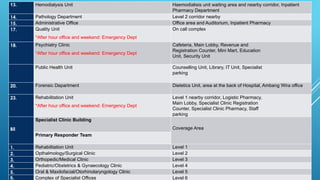
13. Hemodialysis Unit Haemodialisis unit waiting area and nearby corridor, Inpatient
Pharmacy Department
14. Pathology Department Level 2 corridor nearby
15. Administrative Office Office area and Auditorium, Inpatient Pharmacy
17. Quality Unit
*After hour office and weekend: Emergency Dept
On call complex
18. Psychiatry Clinic
*After hour office and weekend: Emergency Dept
Cafeteria, Main Lobby, Revenue and
Registration Counter, Mini Mart, Education
Unit, Security Unit
Public Health Unit Counselling Unit, Library, IT Unit, Specialist
parking
20. Forensic Department Dietetics Unit, area at the back of Hospital, Ambang Wira office
23. Rehabilitation Unit
*After hour office and weekend: Emergency Dept
Level 1 nearby corridor, Logistic Pharmacy,
Main Lobby, Specialist Clinic Registration
Counter, Specialist Clinic Pharmacy, Staff
parking
Bil
Specialist Clinic Building
Coverage Area
Primary Responder Team
1. Rehabilitation Unit Level 1
2. Opthalmology/Surgical Clinic Level 2
3. Orthopedic/Medical Clinic Level 3
4. Pediatric/Obstetrics & Gynaecology Clinic Level 4
5. Oral & Maxilofacial/Otorhinolaryngology Clinic Level 5
6. Complex of Specialist Offices Level 6
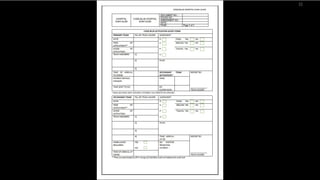
AUDIT FORM
Only true method of
tracking the volume and for
future improvement
Must be filled up for each
Code Blue encounter
PLAN
▶Each department and unit must run their own stimulation
and identify high risk situation, location, training for staff.
▶By running stimulation, you will automatically identify the
equipment needed.
▶Code blue posters to be put up at high-risk areas.
▶BLS is absolutely necessary for all staff. (re-certification every
3 years)

intro_CODE_BLUE_WORKSHOP.pptx and updates

  • 1.
    CODE BLUE WORKSHOP: AWARENESSAND RELOOK 18/10/2024 Nareshiman Emergency Physician Hospital Shah Alam
  • 2.
    WHO HAS ATTENDED TO TRUECODE BLUE ? Where? What happened ? Was it smooth ? Can be better ?
  • 3.
  • 5.
    INTRODUCTION ▶Emergency codes areused worldwide to alert staff and members of the public for various emergency situations in hospitals ▶Minimize misunderstanding to the health care personnel
  • 6.
    ▶There may bevisitors, staff or patients that require immediate medical care in hospital, in cases such as cardiac arrest or seizure ▶Rapid response team will be deployed from the nearest clinical area then supported by an advance team if required
  • 9.
    TWO- PRONGED APPROACH The response systemis in 2 phases: ▶Initial response is by personnel in vicinity of patient-BLS trained ▶Secondary response is by a well equipped and trained team appointed by the hospital to respond to the particular area
  • 10.
    WHEN TO ACTIVATE CODE BLUE? ▶First person: public, not medically trained
  • 11.
    WHEN TO ACTIVATE CODE BLUE? ▶First person: public, not medically trained ▶ Primary responder: Local BLS team
  • 12.
    WHEN TO ACTIVATE CODE BLUE? ▶First person: public, not medically trained ▶ Primary responder: Local BLS team ▶ Secondary responder: Emergency dept ALS team
  • 15.
    CODE BLUE EQUIPMENT *primary responder ▶Gloves ▶Guerdel/Oropharyngeal airway ▶Bagvalve mask ▶LMA ▶Stethoscope ▶Gouze, Gamgee ▶Crepe bandage + ▶AED
  • 16.
    CODE BLUE EQUIPMENT *secondary responder ▶AED/Defibrillator ▶Oxygen tankand tubing ▶Bag mask valve/Pocket mask ▶Portable suction ▶Intubation equipment- laryngoscope/ETT ▶Intravenous drip setup- cannula, tubing, IV fluids ▶Syringes and needles ▶Resuscitation drugs ▶Stethoscope ▶Gloves
  • 17.
    NO CODE BLUEBEG .. IS YOUR EMERGENCY TROLLEY WELL EQUIPPED ?
  • 18.
  • 19.
    No MAIN BUILDING Coverage Area PrimaryResponder team 1. VVIP Ward Level 13 2. Pediatric Ward Level 12 3. Orthopedic Ward/ Satellite Pharmacy Level 11 4. Medical Ward Level 10 5. Surgical Ward Level 9 6. Obstetrics & Gynaecology Ward Level 8 7. CSSD/RHU Level 7 8. Operation Theatre Level 6 9. Intensive Care Unit Level 5 10. Maternity OT Level 4 maternity waiting area 11. Neonatal Intensive Care Unit (NICU) Level 4 NICU waiting area 12. Emergency & Trauma Department Level 3, PAC and public car park in front of hospital, road leading to roundabout, Radiology department
  • 20.
    13. Hemodialysis UnitHaemodialisis unit waiting area and nearby corridor, Inpatient Pharmacy Department 14. Pathology Department Level 2 corridor nearby 15. Administrative Office Office area and Auditorium, Inpatient Pharmacy 17. Quality Unit *After hour office and weekend: Emergency Dept On call complex 18. Psychiatry Clinic *After hour office and weekend: Emergency Dept Cafeteria, Main Lobby, Revenue and Registration Counter, Mini Mart, Education Unit, Security Unit Public Health Unit Counselling Unit, Library, IT Unit, Specialist parking 20. Forensic Department Dietetics Unit, area at the back of Hospital, Ambang Wira office 23. Rehabilitation Unit *After hour office and weekend: Emergency Dept Level 1 nearby corridor, Logistic Pharmacy, Main Lobby, Specialist Clinic Registration Counter, Specialist Clinic Pharmacy, Staff parking Bil Specialist Clinic Building Coverage Area Primary Responder Team 1. Rehabilitation Unit Level 1 2. Opthalmology/Surgical Clinic Level 2 3. Orthopedic/Medical Clinic Level 3 4. Pediatric/Obstetrics & Gynaecology Clinic Level 4 5. Oral & Maxilofacial/Otorhinolaryngology Clinic Level 5 6. Complex of Specialist Offices Level 6
  • 21.
    AUDIT FORM Only truemethod of tracking the volume and for future improvement Must be filled up for each Code Blue encounter
  • 23.
    PLAN ▶Each department andunit must run their own stimulation and identify high risk situation, location, training for staff. ▶By running stimulation, you will automatically identify the equipment needed. ▶Code blue posters to be put up at high-risk areas. ▶BLS is absolutely necessary for all staff. (re-certification every 3 years)