BLE2133
Occupational
Safety & Health
@DRNK
Chapter 2
OSH Management
Learning Outcomes
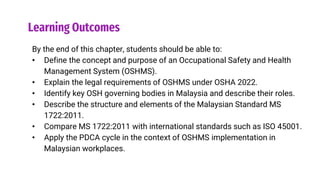
By the end of this chapter, students should be able to:
• Define the concept and purpose of an Occupational Safety and Health
Management System (OSHMS).
• Explain the legal requirements of OSHMS under OSHA 2022.
• Identify key OSH governing bodies in Malaysia and describe their roles.
• Describe the structure and elements of the Malaysian Standard MS
1722:2011.
• Compare MS 1722:2011 with international standards such as ISO 45001.
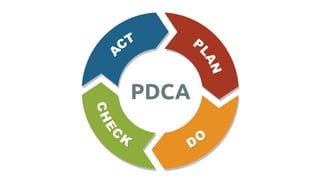
• Apply the PDCA cycle in the context of OSHMS implementation in
Malaysian workplaces.
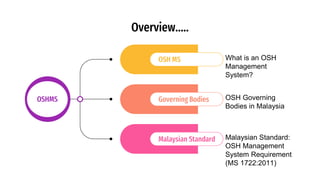
Overview…..
Governing Bodies OSH Governing
Bodies in Malaysia
Malaysian Standard Malaysian Standard:
OSH Management
System Requirement
(MS 1722:2011)
OSH MS What is an OSH
Management
System?
OSHMS
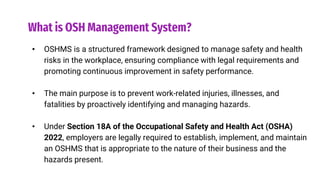
What is OSH Management System?
• OSHMS is a structured framework designed to manage safety and health
risks in the workplace, ensuring compliance with legal requirements and
promoting continuous improvement in safety performance.
• The main purpose is to prevent work-related injuries, illnesses, and
fatalities by proactively identifying and managing hazards.
• Under Section 18A of the Occupational Safety and Health Act (OSHA)
2022, employers are legally required to establish, implement, and maintain
an OSHMS that is appropriate to the nature of their business and the
hazards present.
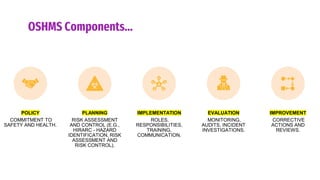
OSHMS Components…
POLICY
COMMITMENT TO
SAFETY AND HEALTH.
PLANNING
RISK ASSESSMENT
AND CONTROL (E.G.,
HIRARC - HAZARD
IDENTIFICATION, RISK
ASSESSMENT AND
RISK CONTROL).
IMPLEMENTATION
ROLES,
RESPONSIBILITIES,
TRAINING,
COMMUNICATION.
EVALUATION
MONITORING,
AUDITS, INCIDENT
INVESTIGATIONS.
IMPROVEMENT
CORRECTIVE
ACTIONS AND
REVIEWS.
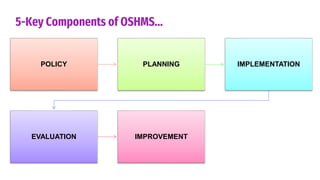
5-Key Components of OSHMS…
POLICY PLANNING IMPLEMENTATION
EVALUATION IMPROVEMENT
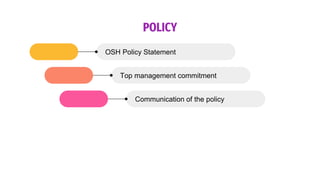
POLICY
OSH Policy Statement
Top management commitment
Communication of the policy
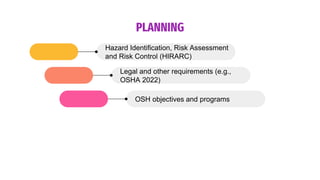
PLANNING
Hazard Identification, Risk Assessment
and Risk Control (HIRARC)
Legal and other requirements (e.g.,
OSHA 2022)
OSH objectives and programs
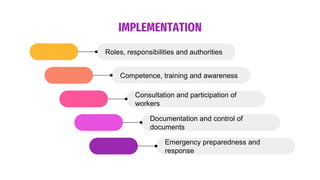
IMPLEMENTATION
Roles, responsibilities and authorities
Competence, training and awareness
Consultation and participation of
workers
Documentation and control of
documents
Emergency preparedness and
response
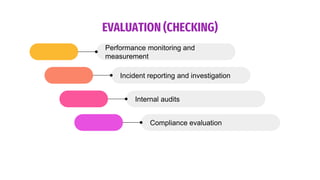
EVALUATION (CHECKING)
Performance monitoring and
measurement
Incident reporting and investigation
Internal audits
Compliance evaluation
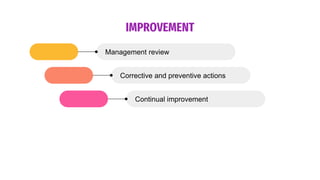
IMPROVEMENT
Management review
Corrective and preventive actions
Continual improvement
Scenario 1
• A glove manufacturing company implements an OSHMS by conducting
HIRARC on chemical use, setting up a chemical safety program, and
providing PPE such as gloves and respirators.
• They perform monthly safety audits, hold regular safety committee
meetings, and submit JKKP 8 forms for accident reporting.
Scenario 2
• A private hospital sets up an OSHMS by identifying biological hazards
(e.g., exposure to infectious diseases).
• Staff are trained in infection control practices, receive hepatitis B
vaccinations, and are monitored through health surveillance programs.
• Incident reports and near misses are reviewed monthly by the OSH
Committee.
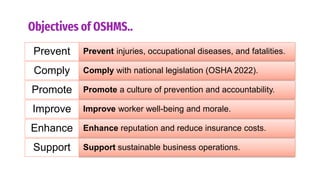
Objectives of OSHMS..
Prevent injuries, occupational diseases, and fatalities.
Prevent
Comply with national legislation (OSHA 2022).
Comply
Promote a culture of prevention and accountability.
Promote
Improve worker well-being and morale.
Improve
Enhance reputation and reduce insurance costs.
Enhance
Support sustainable business operations.
Support
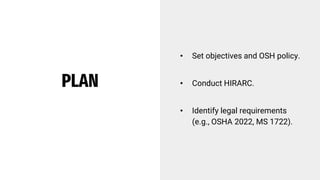
PLAN
• Set objectives and OSH policy.
• Conduct HIRARC.
• Identify legal requirements
(e.g., OSHA 2022, MS 1722).
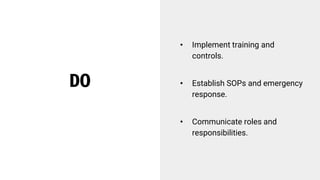
DO
• Implement training and
controls.
• Establish SOPs and emergency
response.
• Communicate roles and
responsibilities.
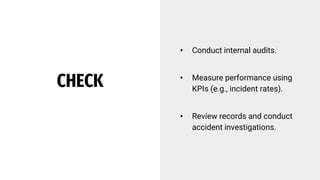
CHECK
• Conduct internal audits.
• Measure performance using
KPIs (e.g., incident rates).
• Review records and conduct
accident investigations.
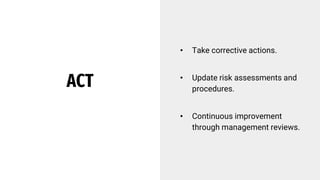
ACT
• Take corrective actions.
• Update risk assessments and
procedures.
• Continuous improvement
through management reviews.
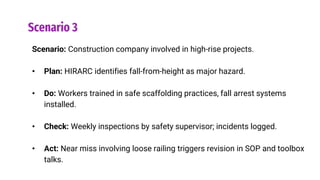
Scenario 3
Scenario: Construction company involved in high-rise projects.
• Plan: HIRARC identifies fall-from-height as major hazard.
• Do: Workers trained in safe scaffolding practices, fall arrest systems
installed.
• Check: Weekly inspections by safety supervisor; incidents logged.
• Act: Near miss involving loose railing triggers revision in SOP and toolbox
talks.
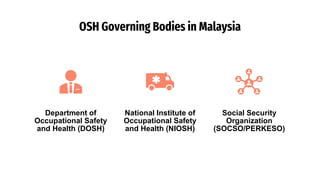
OSH Governing Bodies in Malaysia
Department of
Occupational Safety
and Health (DOSH)
National Institute of
Occupational Safety
and Health (NIOSH)
Social Security
Organization
(SOCSO/PERKESO)
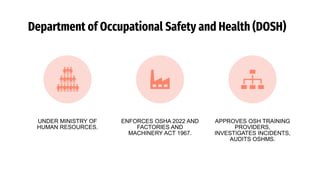
Department of Occupational Safety and Health (DOSH)
UNDER MINISTRY OF
HUMAN RESOURCES.
ENFORCES OSHA 2022 AND
FACTORIES AND
MACHINERY ACT 1967.
APPROVES OSH TRAINING
PROVIDERS,
INVESTIGATES INCIDENTS,
AUDITS OSHMS.
National Institute of Occupational
Safety and Health
(NIOSH)
• Provides training, research,
consultation, and promotion on
OSH matters.
• Offers OSH certifications such
as SHO (Safety and Health
Officer).
Social Security
Organization
(SOCSO / PERKESO)
• Manages compensation and
rehabilitation for workplace
injuries and occupational
diseases.
• Administers Employment Injury
Scheme and Invalidity Pension
• Promotes rehabilitation through
the Return-to-Work (RTW)
program.
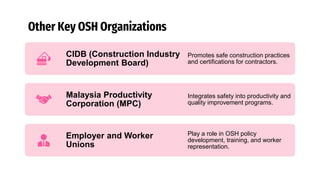
Other Key OSH Organizations
CIDB (Construction Industry
Development Board)
Promotes safe construction practices
and certifications for contractors.
Malaysia Productivity
Corporation (MPC)
Integrates safety into productivity and
quality improvement programs.
Employer and Worker
Unions
Play a role in OSH policy
development, training, and worker
representation.
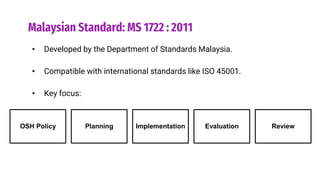
Malaysian Standard: MS 1722 : 2011
• Developed by the Department of Standards Malaysia.
• Compatible with international standards like ISO 45001.
• Key focus:
OSH Policy Planning Implementation Evaluation Review
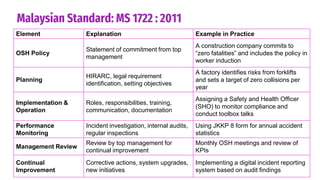
Element Explanation Example in Practice
OSH Policy
Statement of commitment from top
management
A construction company commits to
“zero fatalities” and includes the policy in
worker induction
Planning
HIRARC, legal requirement
identification, setting objectives
A factory identifies risks from forklifts
and sets a target of zero collisions per
year
Implementation &
Operation
Roles, responsibilities, training,
communication, documentation
Assigning a Safety and Health Officer
(SHO) to monitor compliance and
conduct toolbox talks
Performance
Monitoring
Incident investigation, internal audits,
regular inspections
Using JKKP 8 form for annual accident
statistics
Management Review
Review by top management for
continual improvement
Monthly OSH meetings and review of
KPIs
Continual
Improvement
Corrective actions, system upgrades,
new initiatives
Implementing a digital incident reporting
system based on audit findings
Malaysian Standard: MS 1722 : 2011
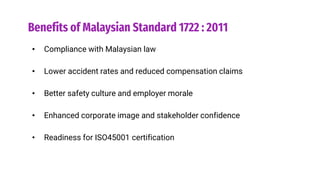
Benefits of Malaysian Standard 1722 : 2011
• Compliance with Malaysian law
• Lower accident rates and reduced compensation claims
• Better safety culture and employer morale
• Enhanced corporate image and stakeholder confidence
• Readiness for ISO45001 certification
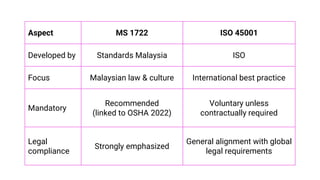
Aspect MS 1722 ISO 45001
Developed by Standards Malaysia ISO
Focus Malaysian law & culture International best practice
Mandatory
Recommended
(linked to OSHA 2022)
Voluntary unless
contractually required
Legal
compliance
Strongly emphasized
General alignment with global
legal requirements
Case Study…
Summary…
• OSHMS is crucial for legal compliance and worker safety.
• OSHA 2022 mandates implementation of OSHMS.
• DOSH, NIOSH, and SOCSO are key regulatory and support bodies.
• MS 1722:2011 provides detailed requirements for implementing OSHMS
in Malaysia.
• Continuous improvement and worker participation are essential for
success.
Intro to OSH Management Presentation for

Intro to OSH Management Presentation for

  • 1.
  • 2.
    Learning Outcomes By theend of this chapter, students should be able to: • Define the concept and purpose of an Occupational Safety and Health Management System (OSHMS). • Explain the legal requirements of OSHMS under OSHA 2022. • Identify key OSH governing bodies in Malaysia and describe their roles. • Describe the structure and elements of the Malaysian Standard MS 1722:2011. • Compare MS 1722:2011 with international standards such as ISO 45001. • Apply the PDCA cycle in the context of OSHMS implementation in Malaysian workplaces.
  • 3.
    Overview….. Governing Bodies OSHGoverning Bodies in Malaysia Malaysian Standard Malaysian Standard: OSH Management System Requirement (MS 1722:2011) OSH MS What is an OSH Management System? OSHMS
  • 4.
    What is OSHManagement System? • OSHMS is a structured framework designed to manage safety and health risks in the workplace, ensuring compliance with legal requirements and promoting continuous improvement in safety performance. • The main purpose is to prevent work-related injuries, illnesses, and fatalities by proactively identifying and managing hazards. • Under Section 18A of the Occupational Safety and Health Act (OSHA) 2022, employers are legally required to establish, implement, and maintain an OSHMS that is appropriate to the nature of their business and the hazards present.
  • 5.
    OSHMS Components… POLICY COMMITMENT TO SAFETYAND HEALTH. PLANNING RISK ASSESSMENT AND CONTROL (E.G., HIRARC - HAZARD IDENTIFICATION, RISK ASSESSMENT AND RISK CONTROL). IMPLEMENTATION ROLES, RESPONSIBILITIES, TRAINING, COMMUNICATION. EVALUATION MONITORING, AUDITS, INCIDENT INVESTIGATIONS. IMPROVEMENT CORRECTIVE ACTIONS AND REVIEWS.
  • 6.
    5-Key Components ofOSHMS… POLICY PLANNING IMPLEMENTATION EVALUATION IMPROVEMENT
  • 7.
    POLICY OSH Policy Statement Topmanagement commitment Communication of the policy
  • 8.
    PLANNING Hazard Identification, RiskAssessment and Risk Control (HIRARC) Legal and other requirements (e.g., OSHA 2022) OSH objectives and programs
  • 9.
    IMPLEMENTATION Roles, responsibilities andauthorities Competence, training and awareness Consultation and participation of workers Documentation and control of documents Emergency preparedness and response
  • 10.
    EVALUATION (CHECKING) Performance monitoringand measurement Incident reporting and investigation Internal audits Compliance evaluation
  • 11.
    IMPROVEMENT Management review Corrective andpreventive actions Continual improvement
  • 12.
    Scenario 1 • Aglove manufacturing company implements an OSHMS by conducting HIRARC on chemical use, setting up a chemical safety program, and providing PPE such as gloves and respirators. • They perform monthly safety audits, hold regular safety committee meetings, and submit JKKP 8 forms for accident reporting.
  • 13.
    Scenario 2 • Aprivate hospital sets up an OSHMS by identifying biological hazards (e.g., exposure to infectious diseases). • Staff are trained in infection control practices, receive hepatitis B vaccinations, and are monitored through health surveillance programs. • Incident reports and near misses are reviewed monthly by the OSH Committee.
  • 14.
    Objectives of OSHMS.. Preventinjuries, occupational diseases, and fatalities. Prevent Comply with national legislation (OSHA 2022). Comply Promote a culture of prevention and accountability. Promote Improve worker well-being and morale. Improve Enhance reputation and reduce insurance costs. Enhance Support sustainable business operations. Support
  • 16.
    PLAN • Set objectivesand OSH policy. • Conduct HIRARC. • Identify legal requirements (e.g., OSHA 2022, MS 1722).
  • 17.
    DO • Implement trainingand controls. • Establish SOPs and emergency response. • Communicate roles and responsibilities.
  • 18.
    CHECK • Conduct internalaudits. • Measure performance using KPIs (e.g., incident rates). • Review records and conduct accident investigations.
  • 19.
    ACT • Take correctiveactions. • Update risk assessments and procedures. • Continuous improvement through management reviews.
  • 20.
    Scenario 3 Scenario: Constructioncompany involved in high-rise projects. • Plan: HIRARC identifies fall-from-height as major hazard. • Do: Workers trained in safe scaffolding practices, fall arrest systems installed. • Check: Weekly inspections by safety supervisor; incidents logged. • Act: Near miss involving loose railing triggers revision in SOP and toolbox talks.
  • 21.
    OSH Governing Bodiesin Malaysia Department of Occupational Safety and Health (DOSH) National Institute of Occupational Safety and Health (NIOSH) Social Security Organization (SOCSO/PERKESO)
  • 22.
    Department of OccupationalSafety and Health (DOSH) UNDER MINISTRY OF HUMAN RESOURCES. ENFORCES OSHA 2022 AND FACTORIES AND MACHINERY ACT 1967. APPROVES OSH TRAINING PROVIDERS, INVESTIGATES INCIDENTS, AUDITS OSHMS.
  • 23.
    National Institute ofOccupational Safety and Health (NIOSH) • Provides training, research, consultation, and promotion on OSH matters. • Offers OSH certifications such as SHO (Safety and Health Officer).
  • 24.
    Social Security Organization (SOCSO /PERKESO) • Manages compensation and rehabilitation for workplace injuries and occupational diseases. • Administers Employment Injury Scheme and Invalidity Pension • Promotes rehabilitation through the Return-to-Work (RTW) program.
  • 25.
    Other Key OSHOrganizations CIDB (Construction Industry Development Board) Promotes safe construction practices and certifications for contractors. Malaysia Productivity Corporation (MPC) Integrates safety into productivity and quality improvement programs. Employer and Worker Unions Play a role in OSH policy development, training, and worker representation.
  • 26.
    Malaysian Standard: MS1722 : 2011 • Developed by the Department of Standards Malaysia. • Compatible with international standards like ISO 45001. • Key focus: OSH Policy Planning Implementation Evaluation Review
  • 27.
    Element Explanation Examplein Practice OSH Policy Statement of commitment from top management A construction company commits to “zero fatalities” and includes the policy in worker induction Planning HIRARC, legal requirement identification, setting objectives A factory identifies risks from forklifts and sets a target of zero collisions per year Implementation & Operation Roles, responsibilities, training, communication, documentation Assigning a Safety and Health Officer (SHO) to monitor compliance and conduct toolbox talks Performance Monitoring Incident investigation, internal audits, regular inspections Using JKKP 8 form for annual accident statistics Management Review Review by top management for continual improvement Monthly OSH meetings and review of KPIs Continual Improvement Corrective actions, system upgrades, new initiatives Implementing a digital incident reporting system based on audit findings Malaysian Standard: MS 1722 : 2011
  • 28.
    Benefits of MalaysianStandard 1722 : 2011 • Compliance with Malaysian law • Lower accident rates and reduced compensation claims • Better safety culture and employer morale • Enhanced corporate image and stakeholder confidence • Readiness for ISO45001 certification
  • 29.
    Aspect MS 1722ISO 45001 Developed by Standards Malaysia ISO Focus Malaysian law & culture International best practice Mandatory Recommended (linked to OSHA 2022) Voluntary unless contractually required Legal compliance Strongly emphasized General alignment with global legal requirements
  • 30.
  • 31.
    Summary… • OSHMS iscrucial for legal compliance and worker safety. • OSHA 2022 mandates implementation of OSHMS. • DOSH, NIOSH, and SOCSO are key regulatory and support bodies. • MS 1722:2011 provides detailed requirements for implementing OSHMS in Malaysia. • Continuous improvement and worker participation are essential for success.