Demand-Driven Open Data
More info:
Contact:
http://ddod.us
David.Portnoy@HHS.gov, @DPortnoy
Introduction to DDOD for
Data Users
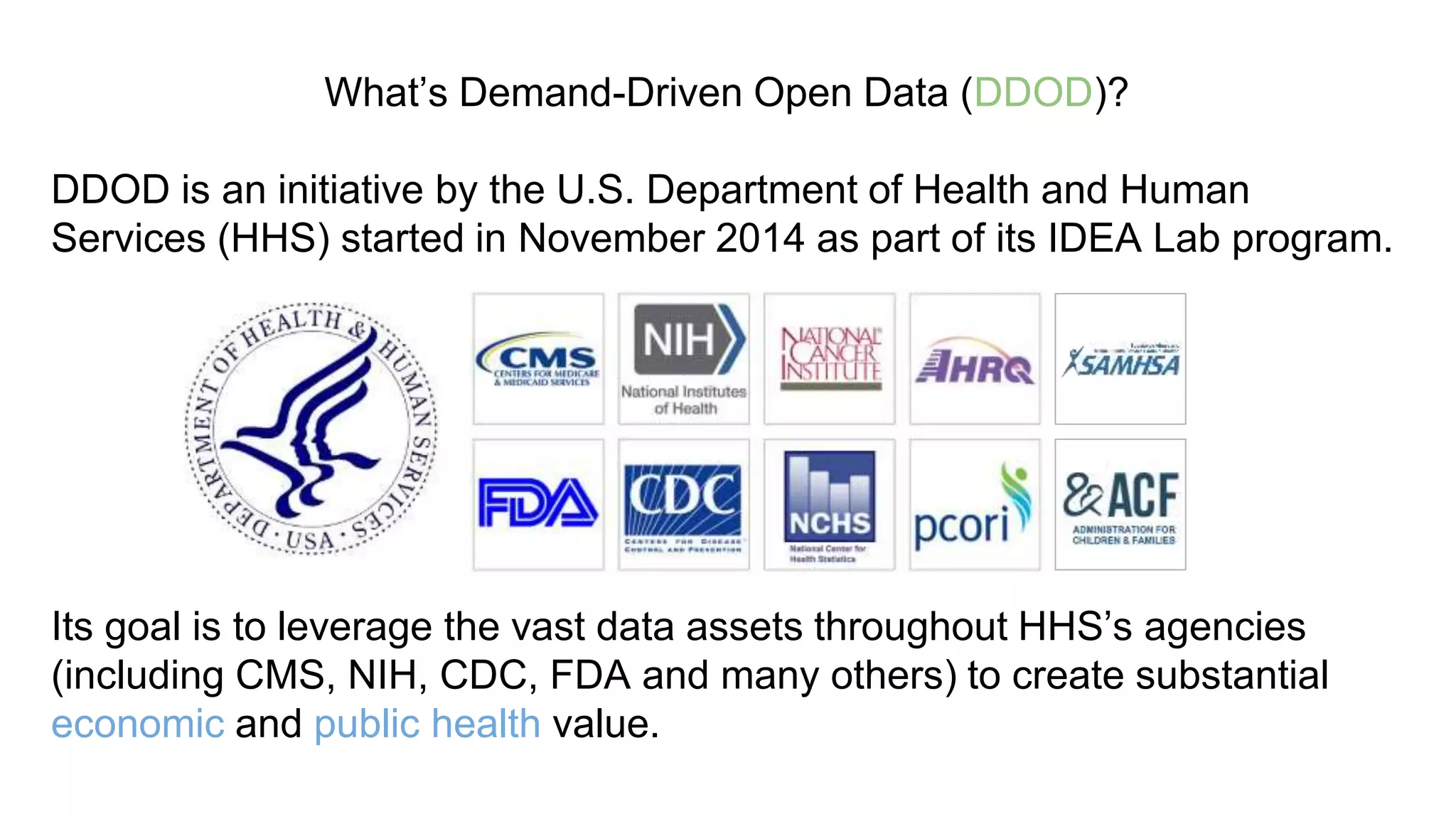
What’s Demand-Driven Open Data (DDOD)?
DDOD is an initiative by the U.S. Department of Health and Human
Services (HHS) started in November 2014 as part of its IDEA Lab program.
Its goal is to leverage the vast data assets throughout HHS’s agencies
(including CMS, NIH, CDC, FDA and many others) to create substantial
economic and public health value.
What can DDOD do for you?
It provides you with a systematic, ongoing and transparent
mechanism to tell HHS and its agencies what data you need
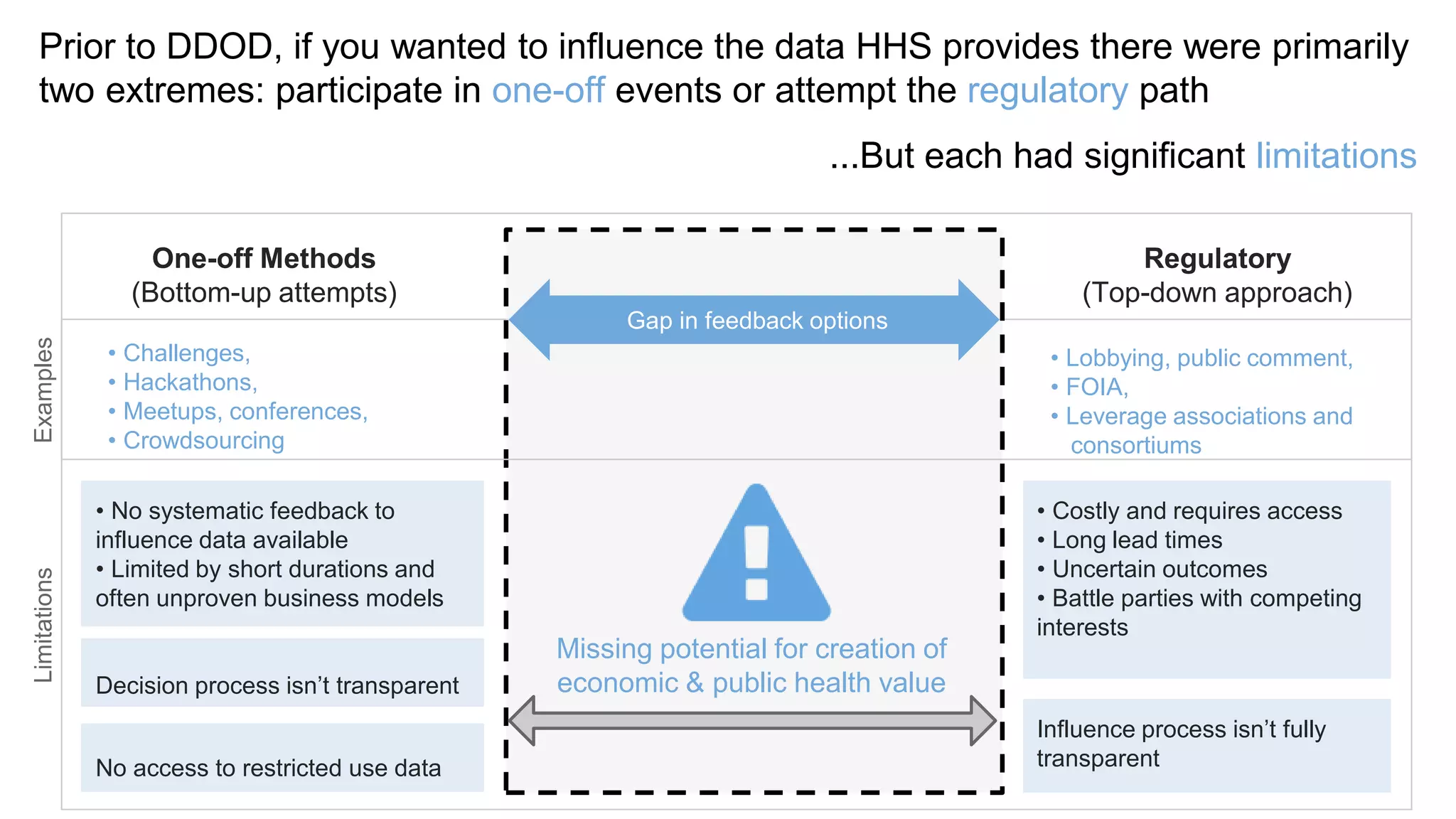
Prior to DDOD, if you wanted to influence the data HHS provides there were primarily
two extremes: participate in one-off events or attempt the regulatory path
...But each had significant limitations
• No systematic feedback to
influence data available
• Limited by short durations and
often unproven business models
Decision process isn’t transparent
No access to restricted use data
• Costly and requires access
• Long lead times
• Uncertain outcomes
• Battle parties with competing
interests
Influence process isn’t fully
transparent
Gap in feedback options
One-off Methods
(Bottom-up attempts)
• Challenges,
• Hackathons,
• Meetups, conferences,
• Crowdsourcing
Regulatory
(Top-down approach)
• Lobbying, public comment,
• FOIA,
• Leverage associations and
consortiums
ExamplesLimitations
Missing potential for creation of
economic & public health value
• No systematic feedback to
influence data available
• Limited by short durations and
often unproven business models
Decision process isn’t transparent
No access to restricted use data
• Costly and requires access
• Long lead times
• Uncertain outcomes
• Battle parties with competing
interests
Influence process isn’t fully
transparent
Gap in feedback options
Demand-Driven Open Data
Need a mechanism that’s
systematic, ongoing, and transparent
Not limited to arbitrary time frames and
short durations of one-off methods
Mitigate the long lead times, expense
and uncertainty of influencing
legislation
Gain transparency on how your needs
are weighed against competing
interests and costs
Use an approach more compatible with
gaining access to restricted use data
One-off Methods
(Bottom-up attempts)
• Challenges,
• Hackathons,
• Meetups, conferences,
• Crowdsourcing
Regulatory
(Top-down approach)
• Lobbying, public comment,
• FOIA,
• Leverage associations and
consortiums
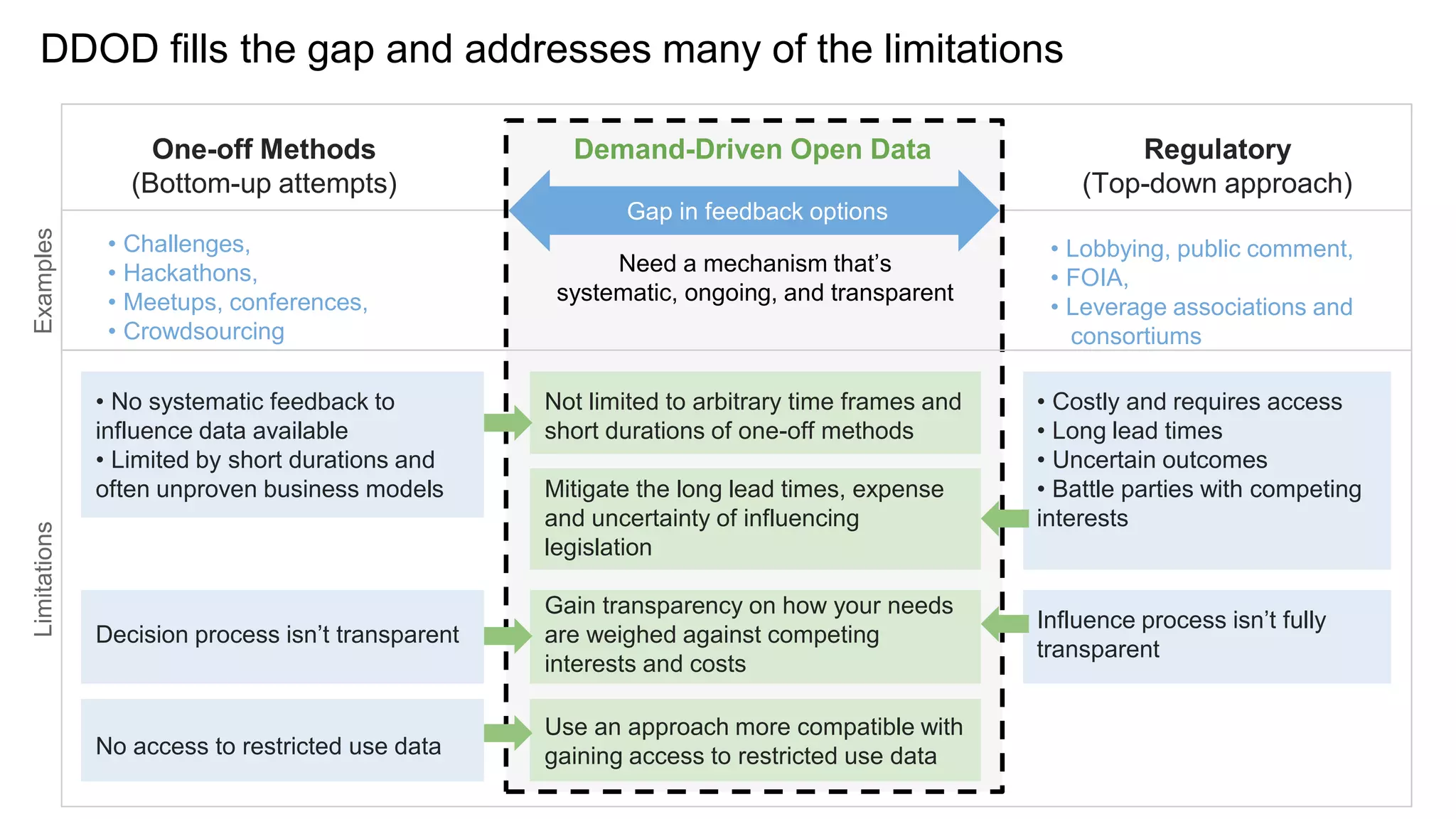
ExamplesLimitationsDDOD fills the gap and addresses many of the limitations
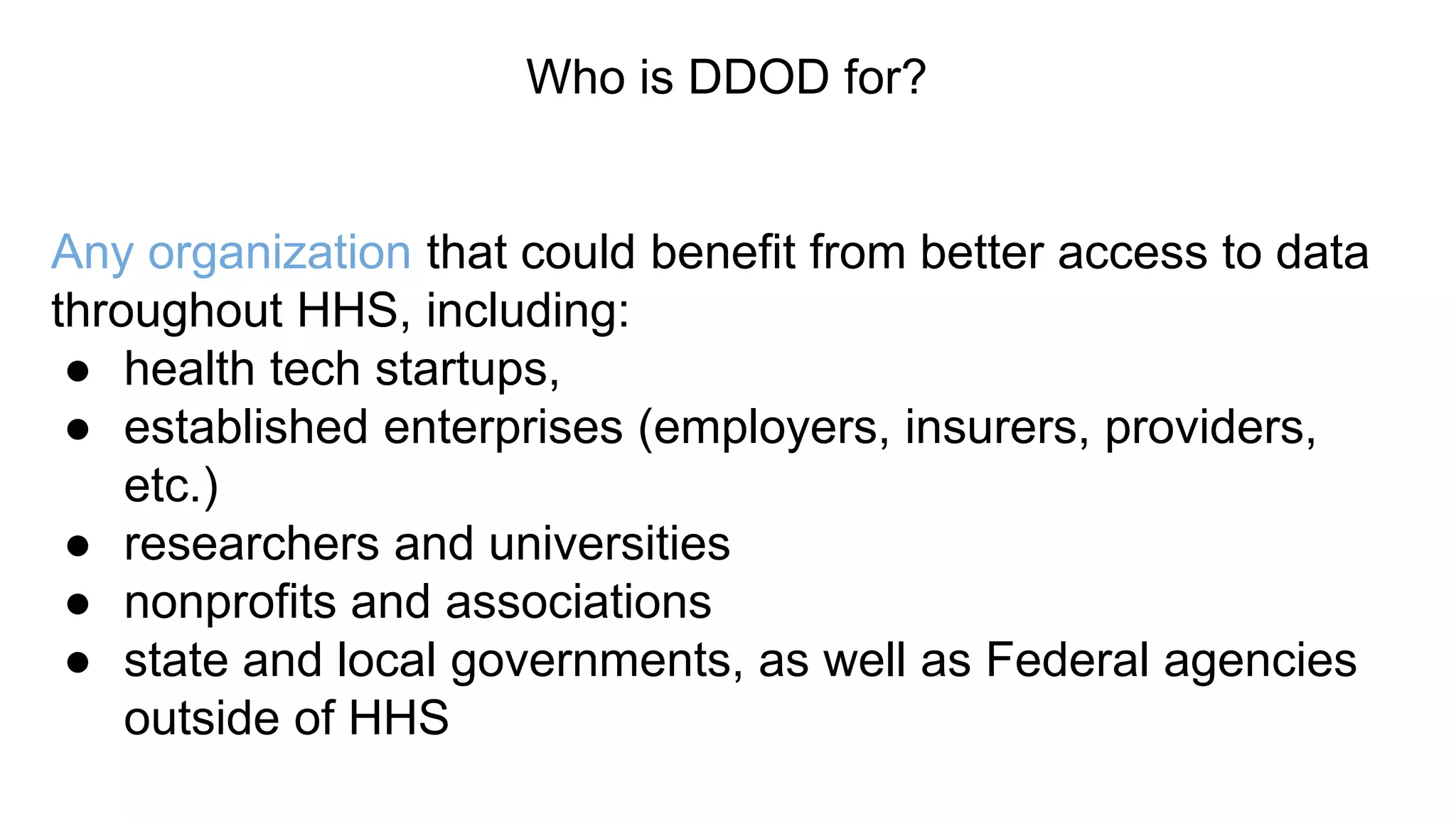
Who is DDOD for?
Any organization that could benefit from better access to data throughout
HHS, including:
● Health tech startups
● Established enterprises (employers, insurers, providers, etc.)
● Researchers and universities
● Nonprofits and associations
● State and local governments, as well as Federal agencies outside of
HHS
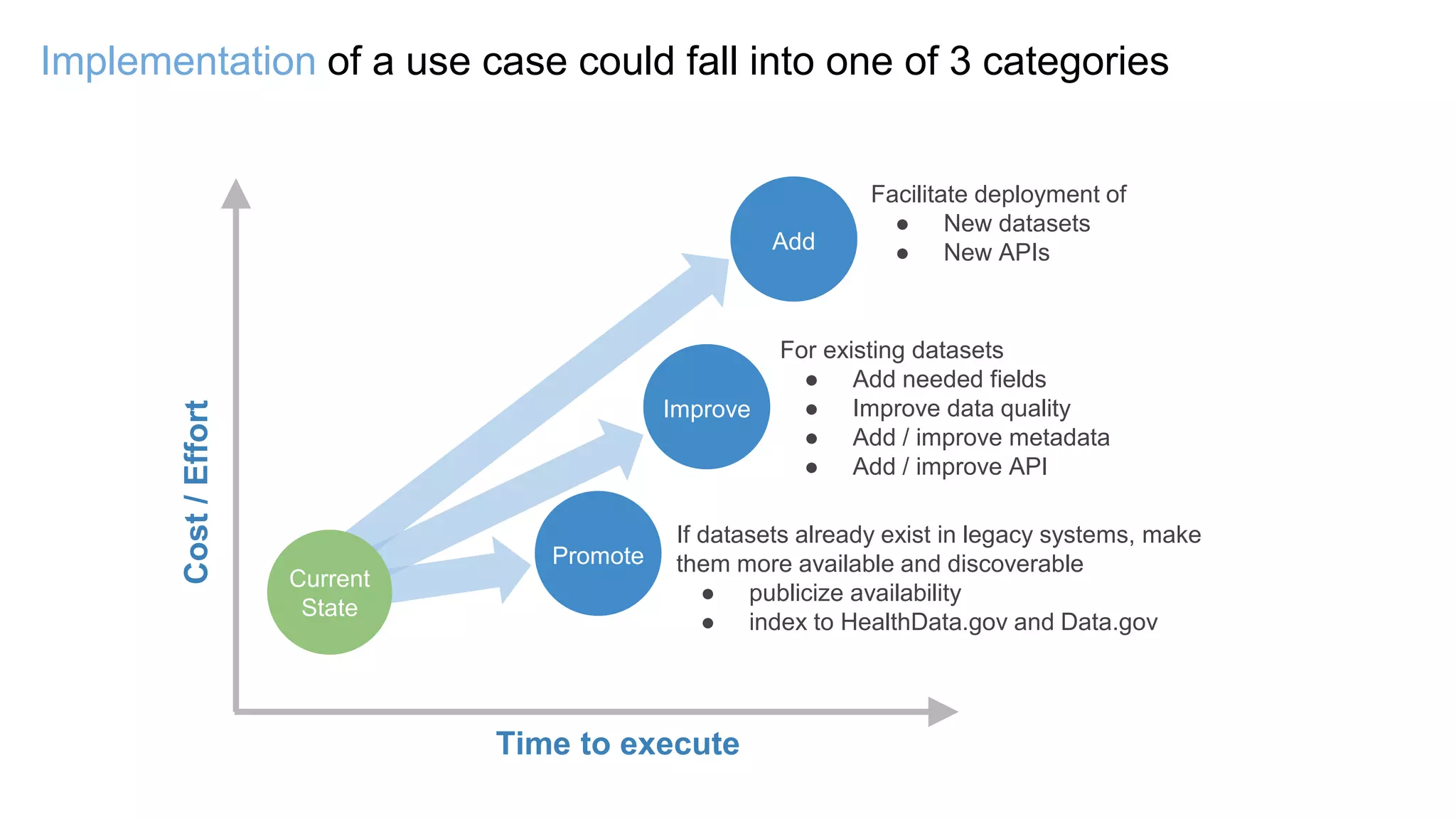
Implementation of a use case could fall into one of 3 categories
Time to execute
Cost/Effort
Improve
Promote
Add
Facilitate deployment of
● New datasets
● New APIs
For existing datasets
● Add needed fields
● Improve data quality
● Add / improve metadata
● Add / improve API
If datasets already exist in legacy systems, make
them more available and discoverable
● publicize availability
● index to HealthData.gov and Data.gov
Current
State
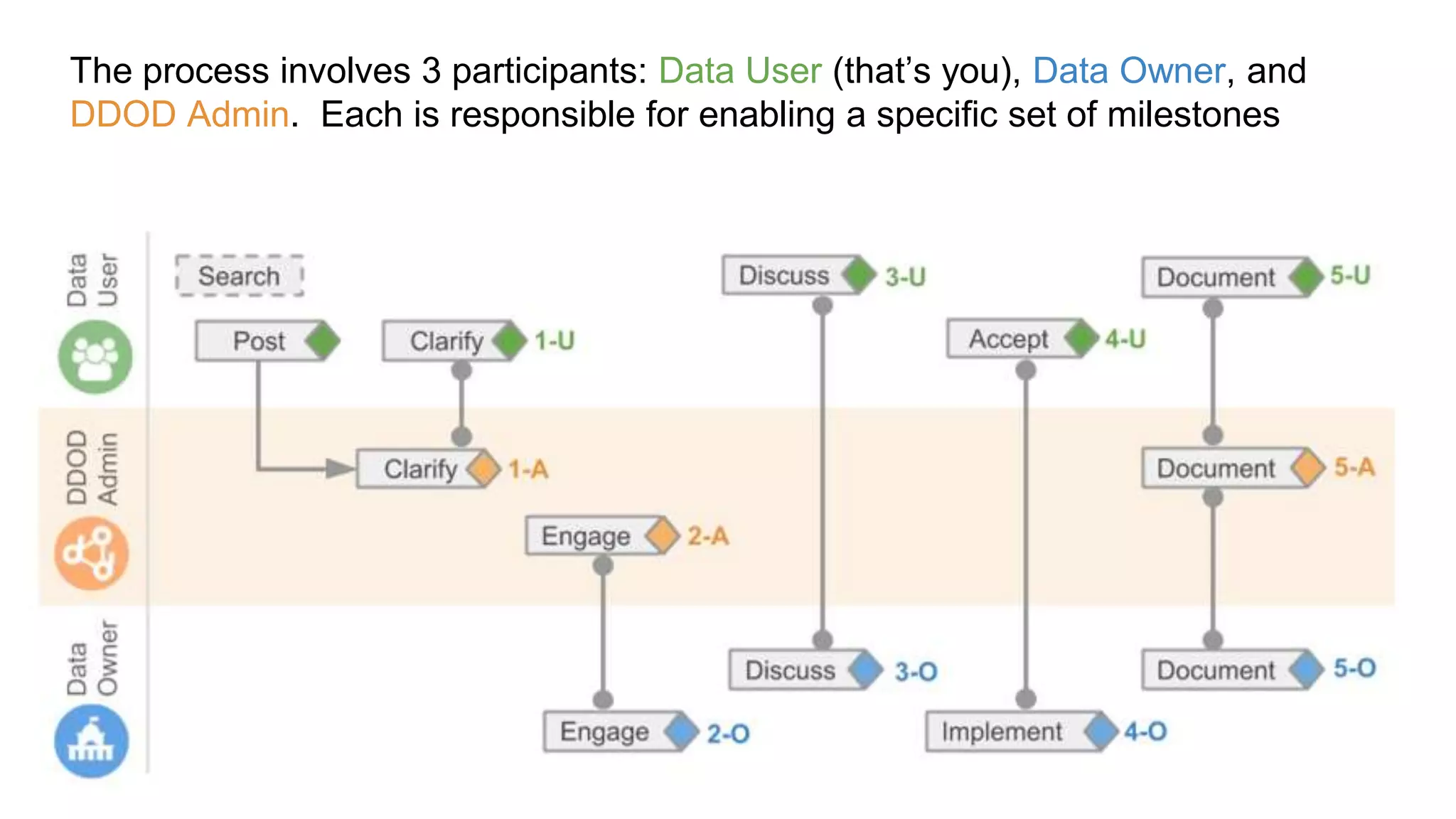
The process involves 3 participants: Data User (that’s you), Data Owner, and
DDOD Admin. Each is responsible for enabling a specific set of milestones
So how do you get started?
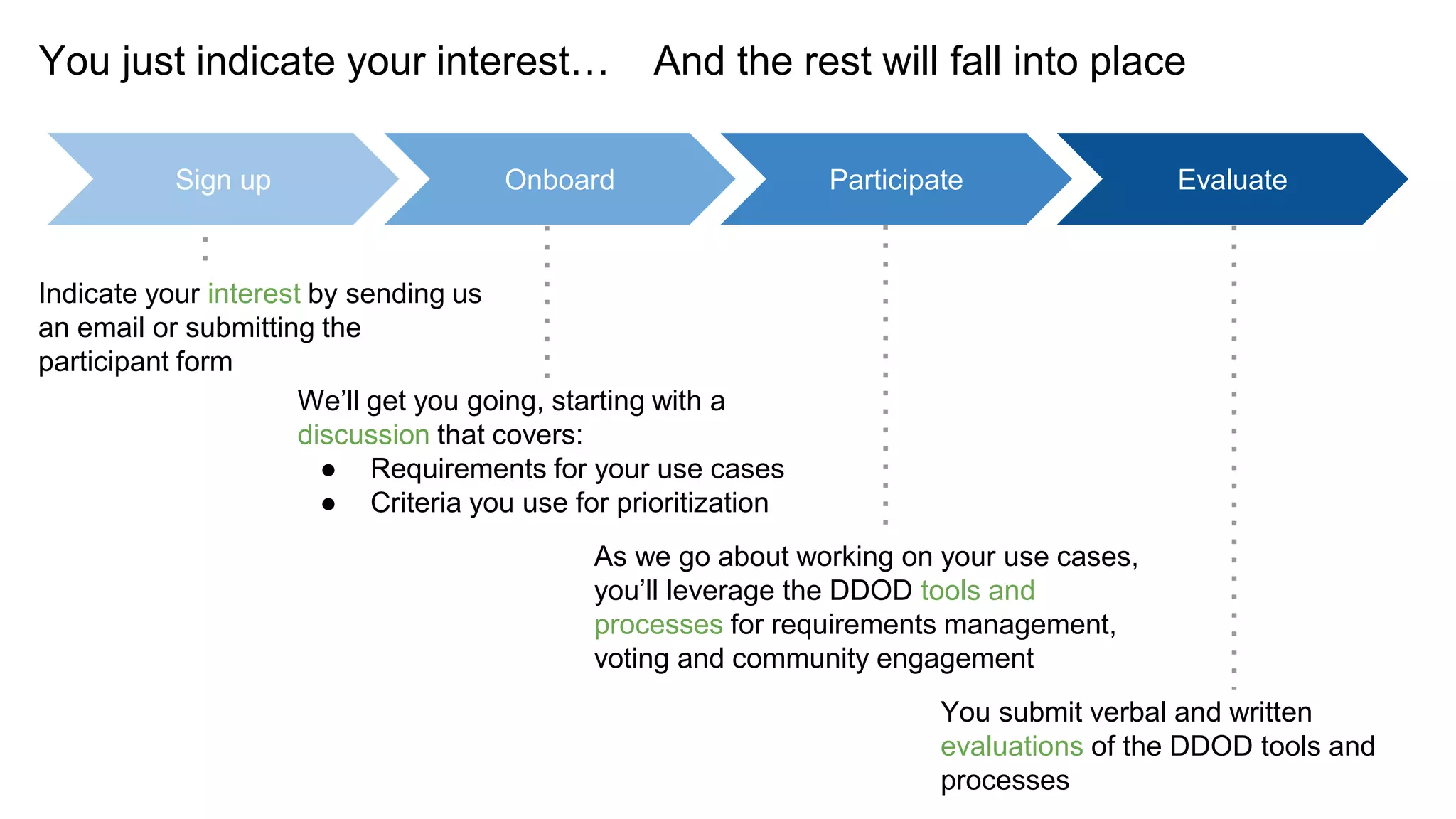
You just add your use case… And the rest will fall into place
Get started by simply adding
your use case [✽]
We’ll get you going, starting with a
discussion that covers:
● Requirements for your use cases
● Criteria you use for prioritization
As we go about working on your use cases,
you’ll leverage the DDOD tools and
processes for requirements management,
voting and community engagement
You submit verbal and written
evaluations of the DDOD tools and
processes
✽ First search HealthData.gov to see if
the dataset or use case already exists
EvaluateParticipateOnboardAdd
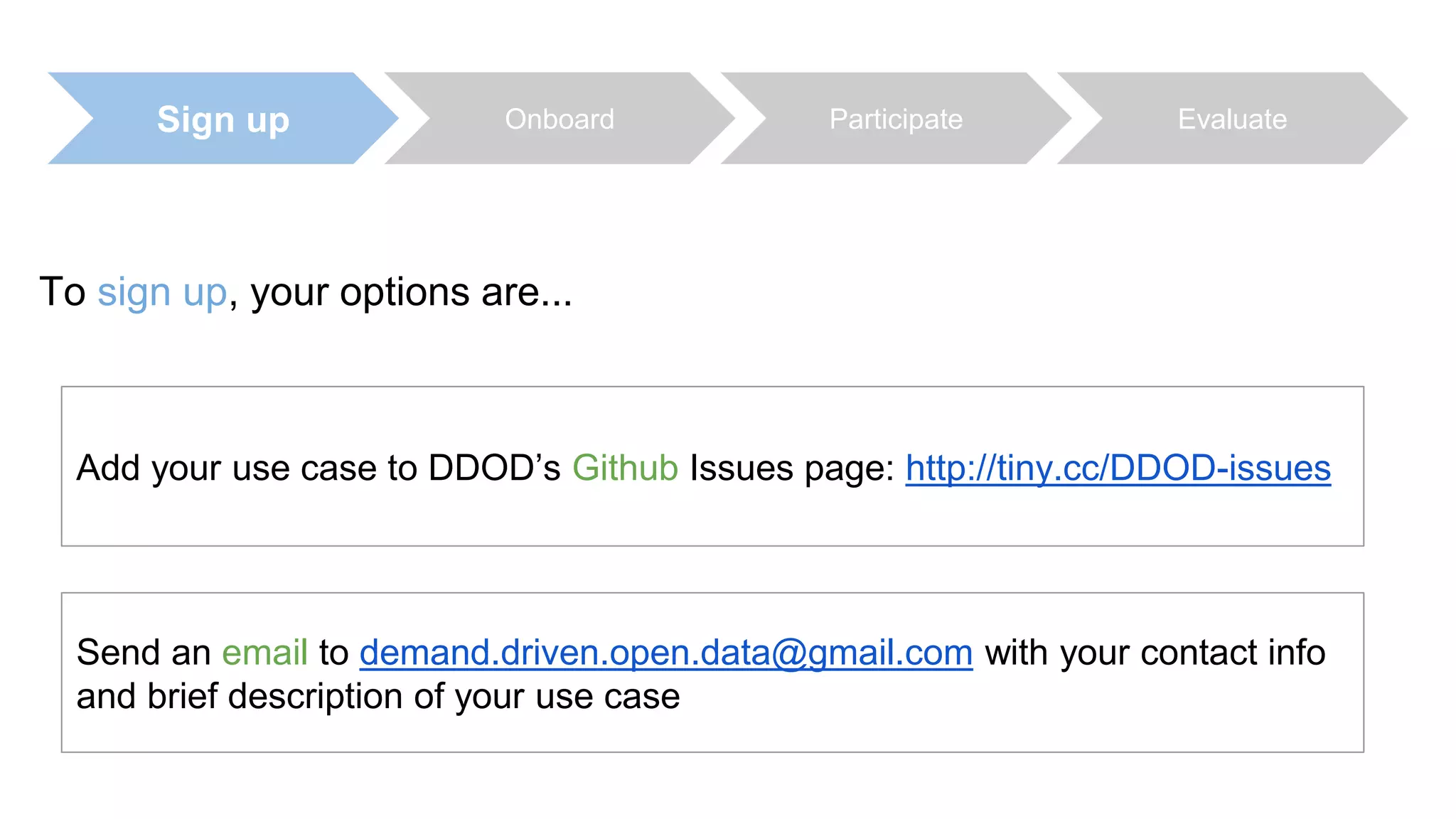
To get started, go to DDOD’s Github Issues page github.com/demand-driven-open-
data/ddod-intake/issues and add your Use Case by clicking “New Issue”.
If you need help, send an email to demand.driven.open.data@gmail.com with your
contact info and brief description of your use case
EvaluateParticipateOnboardAdd
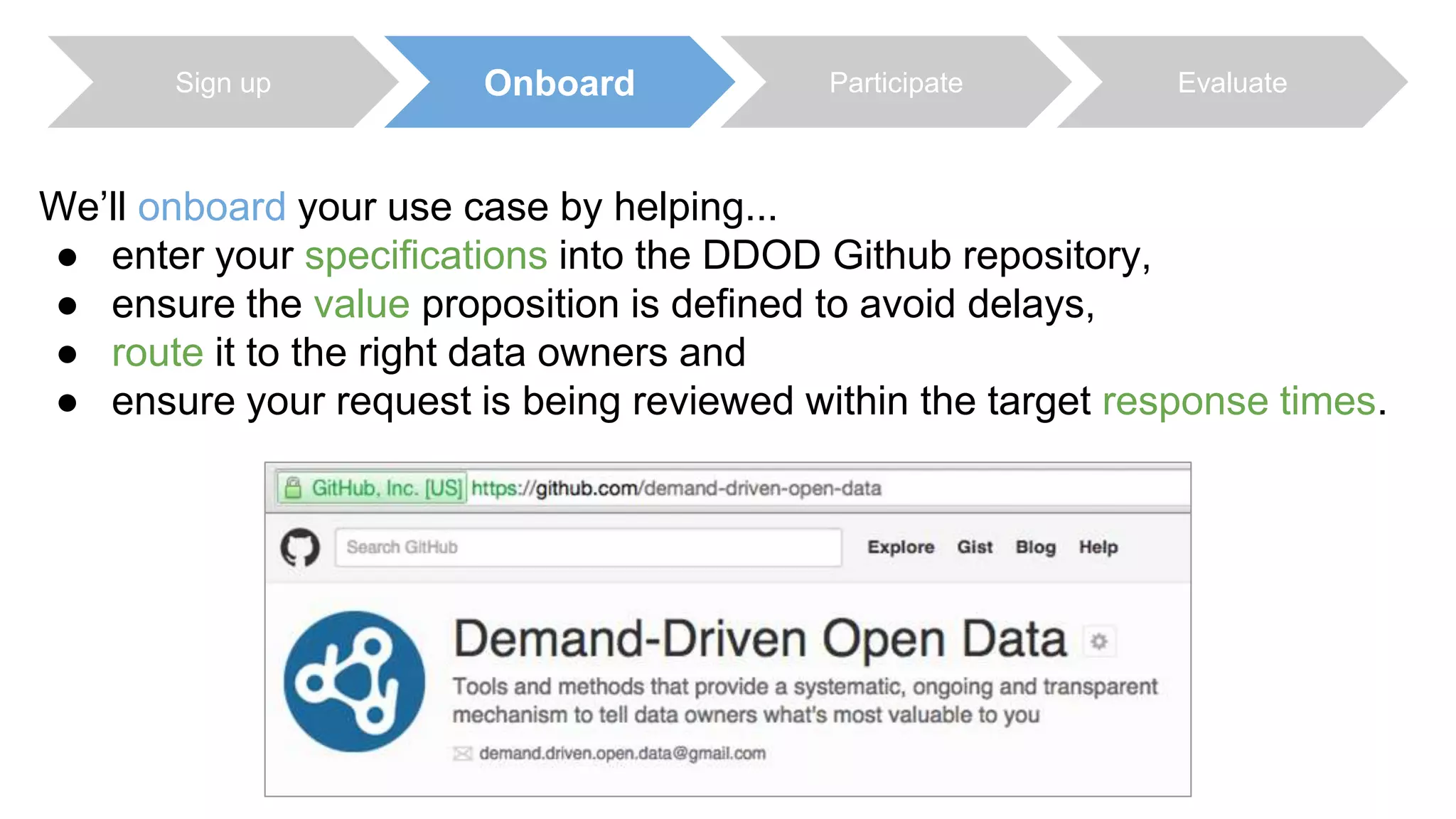
We’ll onboard your use case by helping...
● enter your specifications into the DDOD Github repository,
● ensure the value proposition is defined to avoid delays,
● route it to the right data owners and
● ensure your request is being reviewed within the target response times.
EvaluateParticipateOnboardAdd
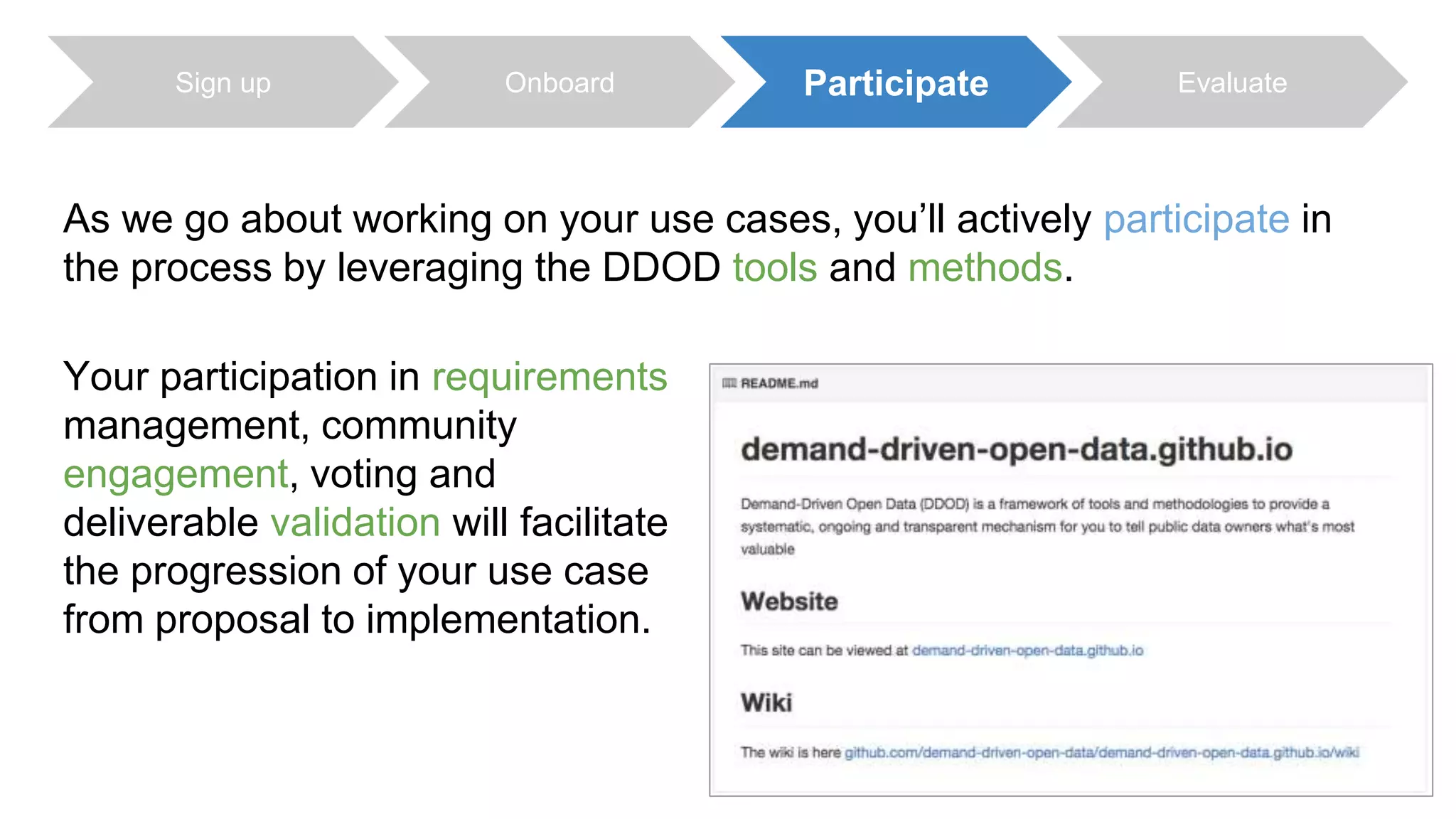
As we go about working on your use cases, you’ll actively participate in
the process by leveraging the DDOD tools and methods.
Your participation in requirements
management, community
engagement, voting and
deliverable validation will facilitate
the progression of your use case
from proposal to implementation.
EvaluateParticipateOnboardAdd
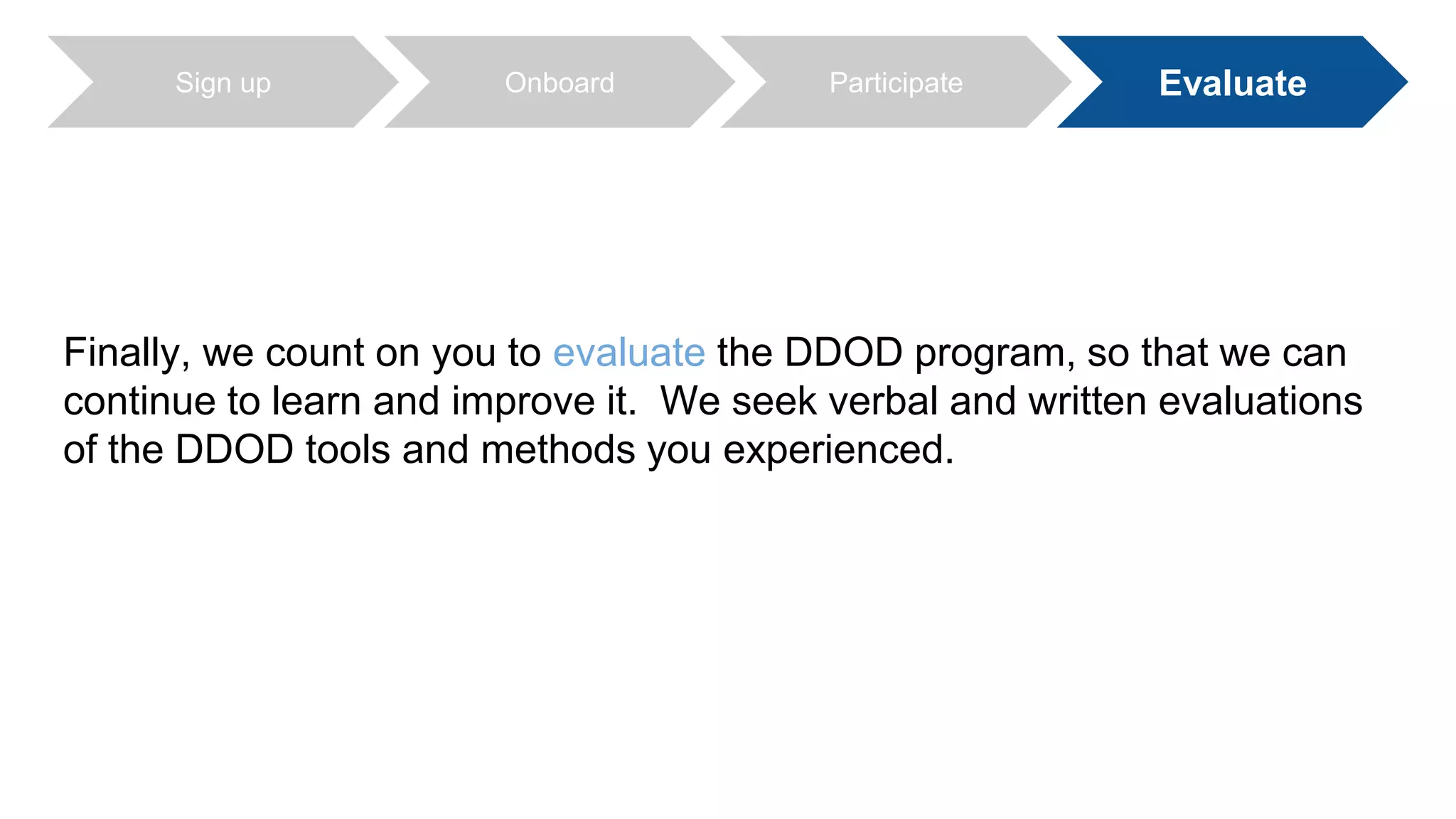
Finally, we count on you to evaluate the DDOD program, so that we can
continue to learn and improve it. We seek verbal and written evaluations
of the DDOD tools and methods you experienced.
EvaluateParticipateOnboardAdd
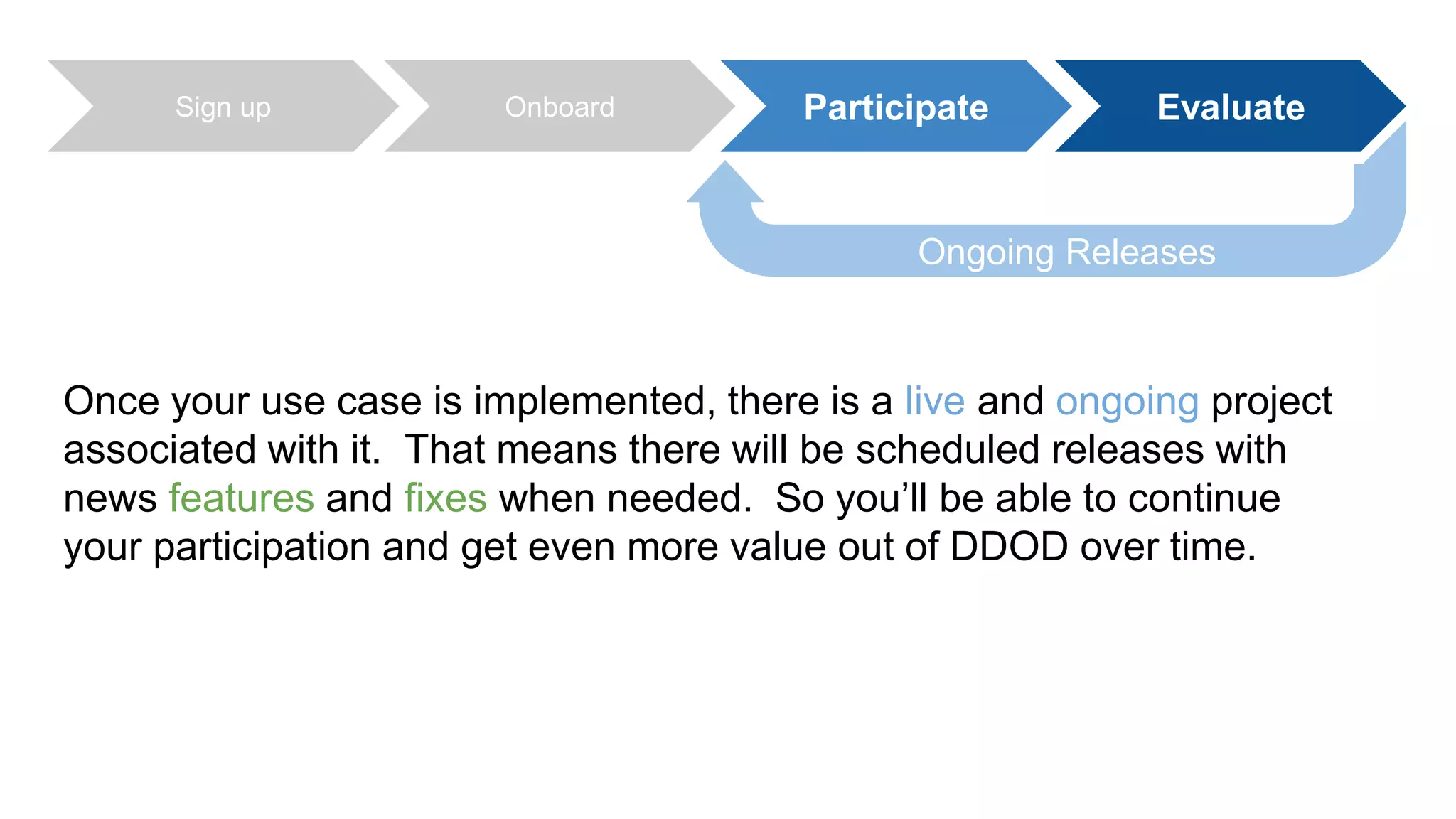
Once your use case is implemented, there is a live and ongoing project
associated with it. That means there will be scheduled releases with
new features and fixes when needed. So you’ll be able to continue
your participation and get even more value out of DDOD over time.
Ongoing Releases
EvaluateParticipateOnboardAdd
Add your use case on Github
or ask for help with by sending
us an email
So take the first step
Add

Intro to Demand Driven Open Data for Data Users

  • 1.
    Demand-Driven Open Data Moreinfo: Contact: http://ddod.us David.Portnoy@HHS.gov, @DPortnoy Introduction to DDOD for Data Users
  • 2.
    What’s Demand-Driven OpenData (DDOD)? DDOD is an initiative by the U.S. Department of Health and Human Services (HHS) started in November 2014 as part of its IDEA Lab program. Its goal is to leverage the vast data assets throughout HHS’s agencies (including CMS, NIH, CDC, FDA and many others) to create substantial economic and public health value.
  • 3.
    What can DDODdo for you? It provides you with a systematic, ongoing and transparent mechanism to tell HHS and its agencies what data you need
  • 4.
    Prior to DDOD,if you wanted to influence the data HHS provides there were primarily two extremes: participate in one-off events or attempt the regulatory path ...But each had significant limitations • No systematic feedback to influence data available • Limited by short durations and often unproven business models Decision process isn’t transparent No access to restricted use data • Costly and requires access • Long lead times • Uncertain outcomes • Battle parties with competing interests Influence process isn’t fully transparent Gap in feedback options One-off Methods (Bottom-up attempts) • Challenges, • Hackathons, • Meetups, conferences, • Crowdsourcing Regulatory (Top-down approach) • Lobbying, public comment, • FOIA, • Leverage associations and consortiums ExamplesLimitations Missing potential for creation of economic & public health value
  • 5.
    • No systematicfeedback to influence data available • Limited by short durations and often unproven business models Decision process isn’t transparent No access to restricted use data • Costly and requires access • Long lead times • Uncertain outcomes • Battle parties with competing interests Influence process isn’t fully transparent Gap in feedback options Demand-Driven Open Data Need a mechanism that’s systematic, ongoing, and transparent Not limited to arbitrary time frames and short durations of one-off methods Mitigate the long lead times, expense and uncertainty of influencing legislation Gain transparency on how your needs are weighed against competing interests and costs Use an approach more compatible with gaining access to restricted use data One-off Methods (Bottom-up attempts) • Challenges, • Hackathons, • Meetups, conferences, • Crowdsourcing Regulatory (Top-down approach) • Lobbying, public comment, • FOIA, • Leverage associations and consortiums ExamplesLimitationsDDOD fills the gap and addresses many of the limitations
  • 6.
    Who is DDODfor? Any organization that could benefit from better access to data throughout HHS, including: ● Health tech startups ● Established enterprises (employers, insurers, providers, etc.) ● Researchers and universities ● Nonprofits and associations ● State and local governments, as well as Federal agencies outside of HHS
  • 7.
    Implementation of ause case could fall into one of 3 categories Time to execute Cost/Effort Improve Promote Add Facilitate deployment of ● New datasets ● New APIs For existing datasets ● Add needed fields ● Improve data quality ● Add / improve metadata ● Add / improve API If datasets already exist in legacy systems, make them more available and discoverable ● publicize availability ● index to HealthData.gov and Data.gov Current State
  • 8.
    The process involves3 participants: Data User (that’s you), Data Owner, and DDOD Admin. Each is responsible for enabling a specific set of milestones
  • 9.
    So how doyou get started?
  • 10.
    You just addyour use case… And the rest will fall into place Get started by simply adding your use case [✽] We’ll get you going, starting with a discussion that covers: ● Requirements for your use cases ● Criteria you use for prioritization As we go about working on your use cases, you’ll leverage the DDOD tools and processes for requirements management, voting and community engagement You submit verbal and written evaluations of the DDOD tools and processes ✽ First search HealthData.gov to see if the dataset or use case already exists EvaluateParticipateOnboardAdd
  • 11.
    To get started,go to DDOD’s Github Issues page github.com/demand-driven-open- data/ddod-intake/issues and add your Use Case by clicking “New Issue”. If you need help, send an email to demand.driven.open.data@gmail.com with your contact info and brief description of your use case EvaluateParticipateOnboardAdd
  • 12.
    We’ll onboard youruse case by helping... ● enter your specifications into the DDOD Github repository, ● ensure the value proposition is defined to avoid delays, ● route it to the right data owners and ● ensure your request is being reviewed within the target response times. EvaluateParticipateOnboardAdd
  • 13.
    As we goabout working on your use cases, you’ll actively participate in the process by leveraging the DDOD tools and methods. Your participation in requirements management, community engagement, voting and deliverable validation will facilitate the progression of your use case from proposal to implementation. EvaluateParticipateOnboardAdd
  • 14.
    Finally, we counton you to evaluate the DDOD program, so that we can continue to learn and improve it. We seek verbal and written evaluations of the DDOD tools and methods you experienced. EvaluateParticipateOnboardAdd
  • 15.
    Once your usecase is implemented, there is a live and ongoing project associated with it. That means there will be scheduled releases with new features and fixes when needed. So you’ll be able to continue your participation and get even more value out of DDOD over time. Ongoing Releases EvaluateParticipateOnboardAdd
  • 16.
    Add your usecase on Github or ask for help with by sending us an email So take the first step Add