Introduction to Music Industry Musical taste can be a controversial topic- almost to the point of tribalism.  It is contentious because it defines and often signifies personality and lifestyle. Musical taste is about the way you dress, speak and sometimes act.  However, all commentators agree that Music and its trends -  sit at the epicentre of popular culture.  Not only to the extent that an individual can derive a sense of identity but to the extent the global community can be changed by Musical Trends
Key Tensions It is this ‘dynamic tension’ that exists between the artistic and commercial forces of underpins the success of this vast media business. A tension between the organic and synthetic Another feature to consider is the music industry ‘synergetic connections’ with other media forms – this codependence with other media means that a ‘mutual reliance’ can be productive and but also risky.
The Music Industry Dominated by 4 transnational corporations Universal SonyBMG Warner Bros EMI Known as ‘The Majors’
The Music Industry Most majors also own, or licence, a string of smaller subsidiary companies in order to reach different kinds of audiences in different kinds of genre These companies are known as ‘major-independents’
The Music Industry Finally, there are a huge number of small companies with little or no financial connection to the majors These companies often concentrate on a small number of artists, within specialised niches in the industry Known as ‘independents’
The Music Industry It is misleading to see the industry simply as a ‘hierarchy’, dominated by the majors A better description is a ‘web’ of companies, whose connections allow: smaller companies to gain access to bigger markets bigger companies to gain access to new artists and movements in popular music
The Music Industry In turn, most record companies organise themselves internally into several key areas: Artists and Repertoire (A&R) Marketing/Artist Development Promotions Legal Financial
The Music Industry The industry as a whole has a complex relationship with a number of different media and puposes Radio, TV, Print media, Film, New Media Synergy and symbiosis
The purpose of the Music Video Music video serves a number of different functions: Promotes a specific single and, normally, an album Promotes a specific artist or band Creates, adapts or feeds into a ‘star image’ Entertains as product in its own right Reinforces, adapts or undermines the ‘meanings’ of a song
Music Video Often contains a number of different elements: Performance Narrative Thematic Symbolic
Music Video Visually stylish – ‘artistic’ mise-en-scene ‘ Rhythmic’ montage, fragmented style Intercutting Experimental use of camera/editing Fast pace Conspicuous lighting and cinematography Often break the rules of continuity editing
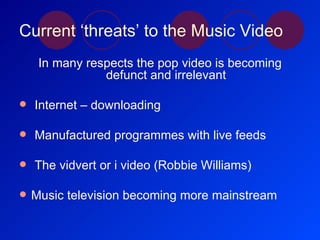
Current ‘threats’ to the Music Video In many respects the pop video is becoming defunct and irrelevant Internet – downloading Manufactured programmes with live feeds  The vidvert or i video (Robbie Williams) Music television becoming more mainstream

intro music

  • 1.
    Introduction to MusicIndustry Musical taste can be a controversial topic- almost to the point of tribalism. It is contentious because it defines and often signifies personality and lifestyle. Musical taste is about the way you dress, speak and sometimes act. However, all commentators agree that Music and its trends - sit at the epicentre of popular culture. Not only to the extent that an individual can derive a sense of identity but to the extent the global community can be changed by Musical Trends
  • 2.
    Key Tensions Itis this ‘dynamic tension’ that exists between the artistic and commercial forces of underpins the success of this vast media business. A tension between the organic and synthetic Another feature to consider is the music industry ‘synergetic connections’ with other media forms – this codependence with other media means that a ‘mutual reliance’ can be productive and but also risky.
  • 3.
    The Music IndustryDominated by 4 transnational corporations Universal SonyBMG Warner Bros EMI Known as ‘The Majors’
  • 4.
    The Music IndustryMost majors also own, or licence, a string of smaller subsidiary companies in order to reach different kinds of audiences in different kinds of genre These companies are known as ‘major-independents’
  • 5.
    The Music IndustryFinally, there are a huge number of small companies with little or no financial connection to the majors These companies often concentrate on a small number of artists, within specialised niches in the industry Known as ‘independents’
  • 6.
    The Music IndustryIt is misleading to see the industry simply as a ‘hierarchy’, dominated by the majors A better description is a ‘web’ of companies, whose connections allow: smaller companies to gain access to bigger markets bigger companies to gain access to new artists and movements in popular music
  • 7.
    The Music IndustryIn turn, most record companies organise themselves internally into several key areas: Artists and Repertoire (A&R) Marketing/Artist Development Promotions Legal Financial
  • 8.
    The Music IndustryThe industry as a whole has a complex relationship with a number of different media and puposes Radio, TV, Print media, Film, New Media Synergy and symbiosis
  • 9.
    The purpose ofthe Music Video Music video serves a number of different functions: Promotes a specific single and, normally, an album Promotes a specific artist or band Creates, adapts or feeds into a ‘star image’ Entertains as product in its own right Reinforces, adapts or undermines the ‘meanings’ of a song
  • 10.
    Music Video Oftencontains a number of different elements: Performance Narrative Thematic Symbolic
  • 11.
    Music Video Visuallystylish – ‘artistic’ mise-en-scene ‘ Rhythmic’ montage, fragmented style Intercutting Experimental use of camera/editing Fast pace Conspicuous lighting and cinematography Often break the rules of continuity editing
  • 12.
    Current ‘threats’ tothe Music Video In many respects the pop video is becoming defunct and irrelevant Internet – downloading Manufactured programmes with live feeds The vidvert or i video (Robbie Williams) Music television becoming more mainstream