HEALTH-RELATED FITNESS (HRF)
THE HEALTH-RELATED
FITNESS COMPONENTS
Before engaging any physical activities, you
need to self- assess your health-related fitness status
and determine barriers to physical activity
participation. Health-related fitness involves exercise
activities that you do in order to try to improve your
physical health and stay healthy.
THE HEALTH-RELATED
FITNESS COMPONENTS
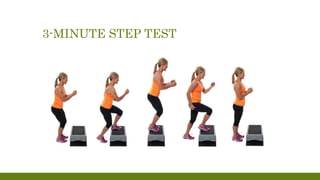
Cardiovascular endurance is the ability of
the heart and lungs to work together to provide
the needed oxygen and fuel to the body during
sustained workloads. The 3-minute Step Test
is used to test cardiovascular endurance.
3-MINUTE STEP TEST
THE HEALTH-RELATED
FITNESS COMPONENTS
Muscular strength is the amount of force a
muscle can produce. The Push-up Test is most
often used to test muscular strength.
PUSH-UP TEST
THE HEALTH-RELATED
FITNESS COMPONENTS
Muscular endurance is the ability of the
muscles to perform continuous without
fatiguing. The Basic Plank is most often used
to test muscular endurance.
BASIC PLANK
THE HEALTH-RELATED
FITNESS COMPONENTS
Flexibility is the ability of each joint to
move through the available range of motion for
a specific joint. The Zipper Test and Sit and
Reach Test infrequently used to test body
flexibility.
ZIPPER TEST AND SIT AND REACH
TEST
THE HEALTH-RELATED
FITNESS COMPONENTS
Body composition is the amount of fat
mass compared to lean muscle mass, bones and
organs. The BMI is defined as the body mass
divided by the square of the body height and is
universally expressed in units of kg/m²,
resulting from mass in kilograms and height in
meters.
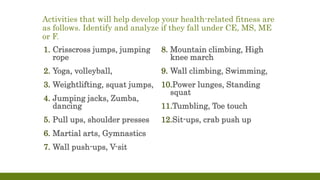
Activities that will help develop your health-related fitness are
as follows. Identify and analyze if they fall under CE, MS, ME
or F.
1. Crisscross jumps, jumping
rope
2. Yoga, volleyball,
3. Weightlifting, squat jumps,
4. Jumping jacks, Zumba,
dancing
5. Pull ups, shoulder presses
6. Martial arts, Gymnastics
7. Wall push-ups, V-sit
8. Mountain climbing, High
knee march
9. Wall climbing, Swimming,
10.Power lunges, Standing
squat
11.Tumbling, Toe touch
12.Sit-ups, crab push up

Intoduction lesson PEH3.pptx

  • 1.
  • 2.
    THE HEALTH-RELATED FITNESS COMPONENTS Beforeengaging any physical activities, you need to self- assess your health-related fitness status and determine barriers to physical activity participation. Health-related fitness involves exercise activities that you do in order to try to improve your physical health and stay healthy.
  • 3.
    THE HEALTH-RELATED FITNESS COMPONENTS Cardiovascularendurance is the ability of the heart and lungs to work together to provide the needed oxygen and fuel to the body during sustained workloads. The 3-minute Step Test is used to test cardiovascular endurance.
  • 4.
  • 5.
    THE HEALTH-RELATED FITNESS COMPONENTS Muscularstrength is the amount of force a muscle can produce. The Push-up Test is most often used to test muscular strength.
  • 6.
  • 7.
    THE HEALTH-RELATED FITNESS COMPONENTS Muscularendurance is the ability of the muscles to perform continuous without fatiguing. The Basic Plank is most often used to test muscular endurance.
  • 8.
  • 9.
    THE HEALTH-RELATED FITNESS COMPONENTS Flexibilityis the ability of each joint to move through the available range of motion for a specific joint. The Zipper Test and Sit and Reach Test infrequently used to test body flexibility.
  • 10.
    ZIPPER TEST ANDSIT AND REACH TEST
  • 11.
    THE HEALTH-RELATED FITNESS COMPONENTS Bodycomposition is the amount of fat mass compared to lean muscle mass, bones and organs. The BMI is defined as the body mass divided by the square of the body height and is universally expressed in units of kg/m², resulting from mass in kilograms and height in meters.
  • 13.
    Activities that willhelp develop your health-related fitness are as follows. Identify and analyze if they fall under CE, MS, ME or F. 1. Crisscross jumps, jumping rope 2. Yoga, volleyball, 3. Weightlifting, squat jumps, 4. Jumping jacks, Zumba, dancing 5. Pull ups, shoulder presses 6. Martial arts, Gymnastics 7. Wall push-ups, V-sit 8. Mountain climbing, High knee march 9. Wall climbing, Swimming, 10.Power lunges, Standing squat 11.Tumbling, Toe touch 12.Sit-ups, crab push up