Your job search Presented by: Bruce Fieggen Vice President of Project Management Thursday, August 27, 2009
Who’s looking for a job? Where are jobs advertised? How to make a good resume Where should you post your resume? Networking The Phone Screen The Interview After the Interview Agenda
9.5% unemployment? …or more Who is looking for a job?
Where are jobs advertised? Paper Career Site Job Boards Organization Sites Career Fairs  Universities
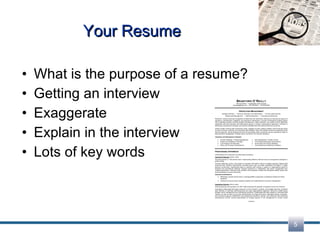
Your Resume What is the purpose of a resume? Getting an interview Exaggerate Explain in the interview Lots of key words
The Job Description Style Operations Quality Manager / Quality Systems Manager at Stryker Howmedica Osteonics o Re-design of the Process Validation procedure and system  o Process Validation system management, and training  o Review and approval of process validation protocols  o Management of Documentation Control and Change Control systems  o Management of Design Control System
The Job Description Style So What?! Maybe you sucked at that job, that’s why you’re in the job market
The Job Description Style Review and approval of process validation protocols… … took so long reviewing and never approved anything so they fired me
The Impact Statement Style Reviewed and approved process validation protocols, maintaining a consistent 2-day turnaround, while adding FDA perspective
The Impact Statement Style Three elements to the Impact Statement Style P I R roblem mpact esult
The Impact Statement Style Problem is usually implied Documents require review, projects hit snags, something needs to be done
The Impact Statement Style Impact is what you did about it May be only one word but make it a power word and place it first in the sentence Reviewed Created Designed
The Impact Statement Style Result is the part lacking in most people’s resumes Try to make this a number of some kind This is the reason the last company hired you This is what makes you special
The Job Description Style Resolved major product and process failures pinpointing and permanently eliminating root causes
Workshop Create one Impact Statement and share with the class
The Paragraph Ultimate responsibility for all strategic training and development programs and processes throughout the global organization. Directs the headquarters based Training and Development team. Manages the training activities of subject matter experts in manufacturing, sales, marketing, engineering, quality system, IT, and other cross-functional areas.  Develops and delivers international sales and product training programs throughout North America, South America, Europe, South Africa, China, Japan, India, New Zealand, and Australia. Facilitates and/or conducts corporate training programs, such as Leadership Development, Front Line Supervision, Tools for Profit, Project Management, and the Microsoft Office Suite of programs.  Team leader for HR Personnel and Training within the corporate project Operational Excellence.
The Paragraph Did you get that? Or was it just one big, black, block of text?
The Impact Statement Designed a 5000 sq. ft., full service Corporate Training Center to centralize learning and demonstrate an organizational commitment to workforce development That’s what she was most proud of
The One Page Resume Only if you have no relevant experience If you’ve worked three relevant co-ops, go ahead and move halfway onto the second page Don’t fill up the second page until you’ve been in the industry 5 years
Where do you post your resume? Monster  Dice if you’re in IT Six-figure jobs Career sites Where are you most likely to get a job?
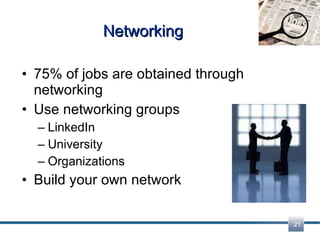
Networking 75% of jobs are obtained through networking Use networking groups LinkedIn University Organizations Build your own network
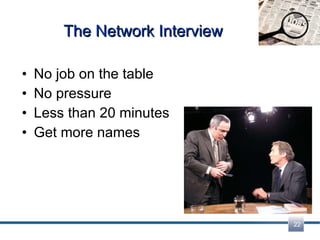
The Network Interview No job on the table No pressure Less than 20 minutes Get more names
Phone Screen They are looking for a reason not to get you in for an interview Don’t give it to them Switch to a land-line No distractions
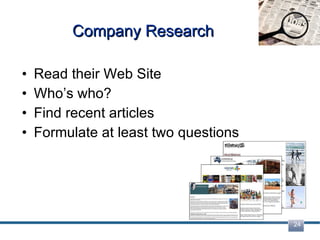
Company Research Read their Web Site Who’s who? Find recent articles Formulate at least two questions
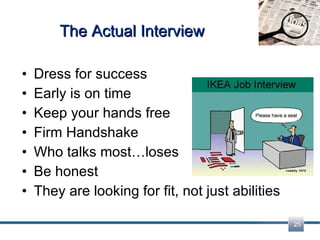
The Actual Interview Dress for success Early is on time Keep your hands free Firm Handshake Who talks most…loses Be honest They are looking for fit, not just abilities
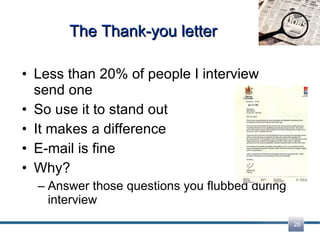
The Thank-you letter Less than 20% of people I interview send one So use it to stand out It makes a difference E-mail is fine Why? Answer those questions you flubbed during interview
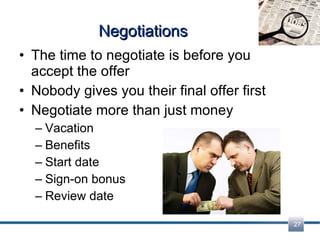
Negotiations The time to negotiate is before you accept the offer Nobody gives you their final offer first Negotiate more than just money Vacation Benefits Start date Sign-on bonus Review date
Questions?
Thank You! Bruce Fieggen [email_address] “ Meet me on LinkedIn.com”

Interviewing And Resume Building

  • 1.
    Your job searchPresented by: Bruce Fieggen Vice President of Project Management Thursday, August 27, 2009
  • 2.
    Who’s looking fora job? Where are jobs advertised? How to make a good resume Where should you post your resume? Networking The Phone Screen The Interview After the Interview Agenda
  • 3.
    9.5% unemployment? …ormore Who is looking for a job?
  • 4.
    Where are jobsadvertised? Paper Career Site Job Boards Organization Sites Career Fairs Universities
  • 5.
    Your Resume Whatis the purpose of a resume? Getting an interview Exaggerate Explain in the interview Lots of key words
  • 6.
    The Job DescriptionStyle Operations Quality Manager / Quality Systems Manager at Stryker Howmedica Osteonics o Re-design of the Process Validation procedure and system o Process Validation system management, and training o Review and approval of process validation protocols o Management of Documentation Control and Change Control systems o Management of Design Control System
  • 7.
    The Job DescriptionStyle So What?! Maybe you sucked at that job, that’s why you’re in the job market
  • 8.
    The Job DescriptionStyle Review and approval of process validation protocols… … took so long reviewing and never approved anything so they fired me
  • 9.
    The Impact StatementStyle Reviewed and approved process validation protocols, maintaining a consistent 2-day turnaround, while adding FDA perspective
  • 10.
    The Impact StatementStyle Three elements to the Impact Statement Style P I R roblem mpact esult
  • 11.
    The Impact StatementStyle Problem is usually implied Documents require review, projects hit snags, something needs to be done
  • 12.
    The Impact StatementStyle Impact is what you did about it May be only one word but make it a power word and place it first in the sentence Reviewed Created Designed
  • 13.
    The Impact StatementStyle Result is the part lacking in most people’s resumes Try to make this a number of some kind This is the reason the last company hired you This is what makes you special
  • 14.
    The Job DescriptionStyle Resolved major product and process failures pinpointing and permanently eliminating root causes
  • 15.
    Workshop Create oneImpact Statement and share with the class
  • 16.
    The Paragraph Ultimateresponsibility for all strategic training and development programs and processes throughout the global organization. Directs the headquarters based Training and Development team. Manages the training activities of subject matter experts in manufacturing, sales, marketing, engineering, quality system, IT, and other cross-functional areas. Develops and delivers international sales and product training programs throughout North America, South America, Europe, South Africa, China, Japan, India, New Zealand, and Australia. Facilitates and/or conducts corporate training programs, such as Leadership Development, Front Line Supervision, Tools for Profit, Project Management, and the Microsoft Office Suite of programs. Team leader for HR Personnel and Training within the corporate project Operational Excellence.
  • 17.
    The Paragraph Didyou get that? Or was it just one big, black, block of text?
  • 18.
    The Impact StatementDesigned a 5000 sq. ft., full service Corporate Training Center to centralize learning and demonstrate an organizational commitment to workforce development That’s what she was most proud of
  • 19.
    The One PageResume Only if you have no relevant experience If you’ve worked three relevant co-ops, go ahead and move halfway onto the second page Don’t fill up the second page until you’ve been in the industry 5 years
  • 20.
    Where do youpost your resume? Monster Dice if you’re in IT Six-figure jobs Career sites Where are you most likely to get a job?
  • 21.
    Networking 75% ofjobs are obtained through networking Use networking groups LinkedIn University Organizations Build your own network
  • 22.
    The Network InterviewNo job on the table No pressure Less than 20 minutes Get more names
  • 23.
    Phone Screen Theyare looking for a reason not to get you in for an interview Don’t give it to them Switch to a land-line No distractions
  • 24.
    Company Research Readtheir Web Site Who’s who? Find recent articles Formulate at least two questions
  • 25.
    The Actual InterviewDress for success Early is on time Keep your hands free Firm Handshake Who talks most…loses Be honest They are looking for fit, not just abilities
  • 26.
    The Thank-you letterLess than 20% of people I interview send one So use it to stand out It makes a difference E-mail is fine Why? Answer those questions you flubbed during interview
  • 27.
    Negotiations The timeto negotiate is before you accept the offer Nobody gives you their final offer first Negotiate more than just money Vacation Benefits Start date Sign-on bonus Review date
  • 28.
  • 29.
    Thank You! BruceFieggen [email_address] “ Meet me on LinkedIn.com”

Editor's Notes

  • #3 Impact – Complicate protocol authoring – Some steps may be unknown – Unnecessary protocol revisions Solution – Limit detail to high level and document major steps – Manage in a separate deliverable
  • #4 Impact – Complicate protocol authoring – Some steps may be unknown – Unnecessary protocol revisions Solution – Limit detail to high level and document major steps – Manage in a separate deliverable
  • #5 Impact – Complicate protocol authoring – Some steps may be unknown – Unnecessary protocol revisions Solution – Limit detail to high level and document major steps – Manage in a separate deliverable
  • #6 1:07 – 1:10 How many just start a project by yourself and bring in people when needed? What about, create a MS-Project Gantt chart and pass it out to your team? How successful are these strategies? Why not? Do you get their support? What about their commitment? How many here conduct formal kick-off meetings? Tell me about them? How long? What do you do there?
  • #7 1:01 – 1:04 My PM history. Discussion: How do you currently plan projects? No matter what your project is, these two things will slow it down or doom it. Today I will teach you two simple techniques to overcome them. Support comes from understanding Commitments must be visible
  • #8 1:04 – 1:07 How my history led to CSV. Who works in, or closely with, an IT organization? What % of the workers in that organization are consultants/contractors? Why do IT organizations use more consultants than others? Knowledge is specific and temporary CSSC validates the same systems in different companies many times a year. Why reinvent the wheel? Hire specialists and let them go when they’re done. More $ per hour, less $ per year. Is this a trend outside of IT?
  • #9 1:04 – 1:07 How my history led to CSV. Who works in, or closely with, an IT organization? What % of the workers in that organization are consultants/contractors? Why do IT organizations use more consultants than others? Knowledge is specific and temporary CSSC validates the same systems in different companies many times a year. Why reinvent the wheel? Hire specialists and let them go when they’re done. More $ per hour, less $ per year. Is this a trend outside of IT?
  • #10 1:04 – 1:07 How my history led to CSV. Who works in, or closely with, an IT organization? What % of the workers in that organization are consultants/contractors? Why do IT organizations use more consultants than others? Knowledge is specific and temporary CSSC validates the same systems in different companies many times a year. Why reinvent the wheel? Hire specialists and let them go when they’re done. More $ per hour, less $ per year. Is this a trend outside of IT?
  • #11 1:04 – 1:07 How my history led to CSV. Who works in, or closely with, an IT organization? What % of the workers in that organization are consultants/contractors? Why do IT organizations use more consultants than others? Knowledge is specific and temporary CSSC validates the same systems in different companies many times a year. Why reinvent the wheel? Hire specialists and let them go when they’re done. More $ per hour, less $ per year. Is this a trend outside of IT?
  • #12 1:04 – 1:07 How my history led to CSV. Who works in, or closely with, an IT organization? What % of the workers in that organization are consultants/contractors? Why do IT organizations use more consultants than others? Knowledge is specific and temporary CSSC validates the same systems in different companies many times a year. Why reinvent the wheel? Hire specialists and let them go when they’re done. More $ per hour, less $ per year. Is this a trend outside of IT?
  • #13 1:04 – 1:07 How my history led to CSV. Who works in, or closely with, an IT organization? What % of the workers in that organization are consultants/contractors? Why do IT organizations use more consultants than others? Knowledge is specific and temporary CSSC validates the same systems in different companies many times a year. Why reinvent the wheel? Hire specialists and let them go when they’re done. More $ per hour, less $ per year. Is this a trend outside of IT?
  • #14 1:04 – 1:07 How my history led to CSV. Who works in, or closely with, an IT organization? What % of the workers in that organization are consultants/contractors? Why do IT organizations use more consultants than others? Knowledge is specific and temporary CSSC validates the same systems in different companies many times a year. Why reinvent the wheel? Hire specialists and let them go when they’re done. More $ per hour, less $ per year. Is this a trend outside of IT?
  • #15 1:04 – 1:07 How my history led to CSV. Who works in, or closely with, an IT organization? What % of the workers in that organization are consultants/contractors? Why do IT organizations use more consultants than others? Knowledge is specific and temporary CSSC validates the same systems in different companies many times a year. Why reinvent the wheel? Hire specialists and let them go when they’re done. More $ per hour, less $ per year. Is this a trend outside of IT?
  • #16 1:04 – 1:07 How my history led to CSV. Who works in, or closely with, an IT organization? What % of the workers in that organization are consultants/contractors? Why do IT organizations use more consultants than others? Knowledge is specific and temporary CSSC validates the same systems in different companies many times a year. Why reinvent the wheel? Hire specialists and let them go when they’re done. More $ per hour, less $ per year. Is this a trend outside of IT?
  • #17 1:04 – 1:07 How my history led to CSV. Who works in, or closely with, an IT organization? What % of the workers in that organization are consultants/contractors? Why do IT organizations use more consultants than others? Knowledge is specific and temporary CSSC validates the same systems in different companies many times a year. Why reinvent the wheel? Hire specialists and let them go when they’re done. More $ per hour, less $ per year. Is this a trend outside of IT?
  • #18 1:04 – 1:07 How my history led to CSV. Who works in, or closely with, an IT organization? What % of the workers in that organization are consultants/contractors? Why do IT organizations use more consultants than others? Knowledge is specific and temporary CSSC validates the same systems in different companies many times a year. Why reinvent the wheel? Hire specialists and let them go when they’re done. More $ per hour, less $ per year. Is this a trend outside of IT?
  • #19 1:07 – 1:10 How many just start a project by yourself and bring in people when needed? What about, create a MS-Project Gantt chart and pass it out to your team? How successful are these strategies? Why not? Do you get their support? What about their commitment? How many here conduct formal kick-off meetings? Tell me about them? How long? What do you do there?
  • #20 1:07 – 1:10 How many just start a project by yourself and bring in people when needed? What about, create a MS-Project Gantt chart and pass it out to your team? How successful are these strategies? Why not? Do you get their support? What about their commitment? How many here conduct formal kick-off meetings? Tell me about them? How long? What do you do there?
  • #21 1:07 – 1:10 How many just start a project by yourself and bring in people when needed? What about, create a MS-Project Gantt chart and pass it out to your team? How successful are these strategies? Why not? Do you get their support? What about their commitment? How many here conduct formal kick-off meetings? Tell me about them? How long? What do you do there?
  • #22 1:07 – 1:10 How many just start a project by yourself and bring in people when needed? What about, create a MS-Project Gantt chart and pass it out to your team? How successful are these strategies? Why not? Do you get their support? What about their commitment? How many here conduct formal kick-off meetings? Tell me about them? How long? What do you do there?
  • #23 1:07 – 1:10 How many just start a project by yourself and bring in people when needed? What about, create a MS-Project Gantt chart and pass it out to your team? How successful are these strategies? Why not? Do you get their support? What about their commitment? How many here conduct formal kick-off meetings? Tell me about them? How long? What do you do there?
  • #24 1:07 – 1:10 How many just start a project by yourself and bring in people when needed? What about, create a MS-Project Gantt chart and pass it out to your team? How successful are these strategies? Why not? Do you get their support? What about their commitment? How many here conduct formal kick-off meetings? Tell me about them? How long? What do you do there?
  • #25 1:07 – 1:10 How many just start a project by yourself and bring in people when needed? What about, create a MS-Project Gantt chart and pass it out to your team? How successful are these strategies? Why not? Do you get their support? What about their commitment? How many here conduct formal kick-off meetings? Tell me about them? How long? What do you do there?
  • #26 1:07 – 1:10 How many just start a project by yourself and bring in people when needed? What about, create a MS-Project Gantt chart and pass it out to your team? How successful are these strategies? Why not? Do you get their support? What about their commitment? How many here conduct formal kick-off meetings? Tell me about them? How long? What do you do there?
  • #27 1:07 – 1:10 How many just start a project by yourself and bring in people when needed? What about, create a MS-Project Gantt chart and pass it out to your team? How successful are these strategies? Why not? Do you get their support? What about their commitment? How many here conduct formal kick-off meetings? Tell me about them? How long? What do you do there?
  • #28 1:07 – 1:10 How many just start a project by yourself and bring in people when needed? What about, create a MS-Project Gantt chart and pass it out to your team? How successful are these strategies? Why not? Do you get their support? What about their commitment? How many here conduct formal kick-off meetings? Tell me about them? How long? What do you do there?