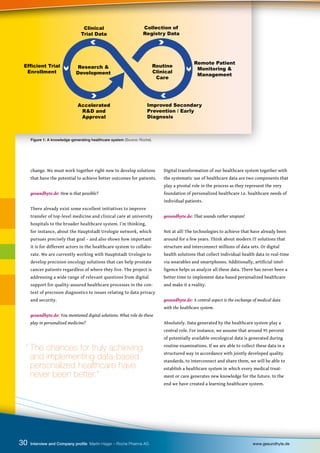
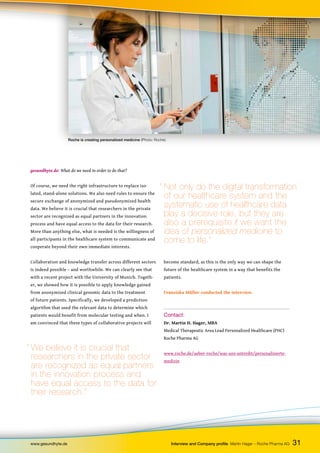
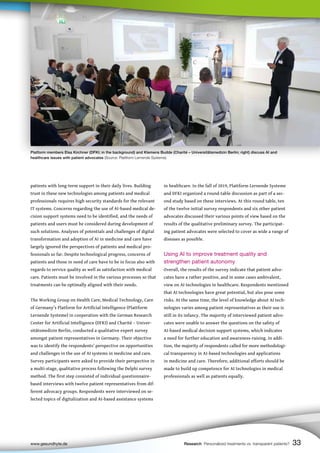
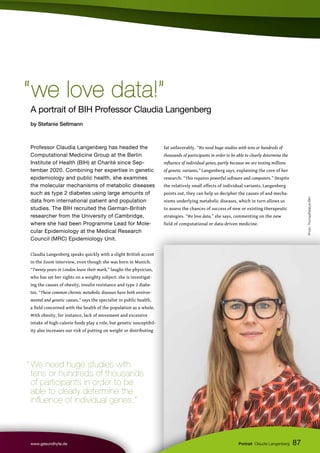
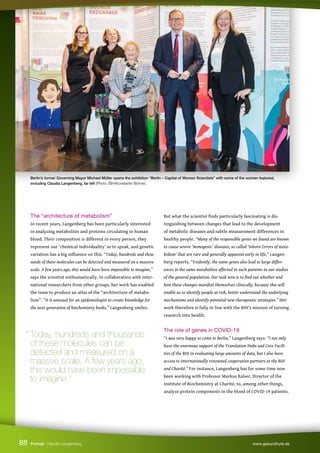
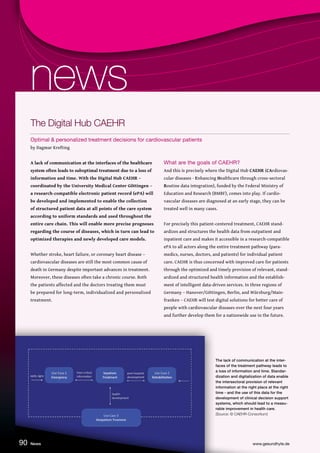
1
www.systembiologie.de Blindrubrik Dies ist eine prototypische Blindüberschrift
focus:
research data
saves lives
from page 14
personalized
treatments vs.
transparent
patients?
page 32
SmICS – a smart
solution for the
automated detection
of hospital outbreaks
page 46
interviews with
Martin Hager
Dana Westphal and Michael Seifert
Simon Haas
page 29, 73 and 82
ISSN
2748-3533
gesundhyte
gesundhyte.
.de
de
THE MAGAZINE FOR DIGITAL HEALTH IN GERMANY ISSUE 14 JUNE 2022
INTERNATIONAL EDITION
Cover photo: iStock © Lan Zhang
Photo:
AdobeStock
©
SergeyBitos
gesundhyte
gesundhyte.
.de
de
is dedicated to finding solutions for today's most important challenges in
health care focusing on Digital Health and Systems Medicine, two young
disciplines that are considered to form the medicine of the future. The key is
the combination of laboratory research data of different kinds with real-world
data – from bench to bed-site. Innovative technologies and methods will pave
the way for more precise predictions and personalised therapy. Already today,
this approach is successfully used in Oncology and will be extended to other
diseases in the future. Here, the establishment of robust and standardized
IT infrastructure plays a major role to allow for the secure exchange of patient
data with research teams. Read the magazine gesundhyte.de to find out how
this innovative branch of science works to provide solutions for our current
and future challenges in medicine.
greetings
greetings
Dear Reader,
Photo:
Prof.
Dr.
Veronika
von
Messling
With more than two years of COVID-19 pandemic under our belt, we are looking back on an intensely
challenging period in which research has achieved major breakthroughs. The majority of the popu-
lation has become keenly aware of the need for strong and effective health research and medical care.
Rapid access to reliable data and its exchange between research and patient care have been
decisive factors for success. Extensive data sets related to the new virus had to be gathered,
shared, and analysed in the shortest possible time.
For this task, the scientific community was able to take advantage of research infrastructures that have been actively sup-
ported by the Federal Ministry of Education and Research (BMBF) in recent years. For example, the bioinformatics tools and
the data cloud of the German Network for Bioinformatics Infrastructure (de.NBI) were used by researchers across Germany to
better understand the virus and to study its mechanisms.
BMBF has also established structures for connecting medical data. The core element of the Medical Informatics Initiative,
which has been BMBF-funded since 2018, are data integration centres to facilitate analyses across different university hospi-
tals. To support and strengthen the COVID-19 research effort, BMBF further intensified the networking of university hospitals
by funding the National Network of University Medicine (NUM). The COVID-19 Data Exchange Platform (CODEX), which makes
research data related to COVID-19 available to all university hospitals in Germany, has evolved in a central element of this
initiative. The extensive prior developments of the Medical Informatics Initiative, in particular the data integration centres,
provided the foundation for this purpose.
This edition of gesundhyte.de provides insight into diverse projects funded under this and other
measures. The results highlight the great potential of research data and its analysis in the life
sciences and medicine. I wish you all inspiring reading.
Prof. Dr. Veronika von Messling
Director-General for Life Sciences
Federal Ministry of Education and Research
3
www.gesundhyte.de Greetings Prof. Dr. Veronika von Messling, Director-General for Life Sciences, Federal Ministry of Education and Research
Another year of the pandemic has shown us how vital it is to make healthcare data available to the
research community. With the integration of the Berlin Institute of Health (BIH) into Charité, we have
taken a major step towards our goal of strengthening translational research. On January 1, 2021,
under the motto “We belong together!” the BIH became the translational research unit and has since
formed – alongside the university hospital and the medical faculty – Charité’s third pillar.
The collaboration between Charité and BIH has already proven to be extremely valuable during the pandemic. Thanks to the
close connection between the BIH and our hospital, we were able to respond quickly and incorporate patient care data directly
into research. In recent months, research on scientific and medical solutions to combat the pandemic has been running at full
speed, also at Charité, where we contribute to the fight against COVID-19 in many collaborations. The pandemic situation is
a prime example of the importance of closely integrating routine clinical and research activities. As a result of the crisis, a
strong and collaborative network, the German Network of University Medicine (NUM), has been established under the coor-
dination of Charité. We are confident that this alliance of all German university hospitals will continue to produce success in
the future.
In the longer term, the new translational research unit will particularly benefit our patients. For this reason, I look forward
to working with the BIH to further accelerate the translation of research findings into clinical applications for our patients.
The synergies that are now being formed between Charité and the BIH must be used in a constructive and targeted manner.
That is why the integration of the BIH into Charité is so crucially important.
This issue of gesundhyte.de provides numerous examples of promising translational research.
I hope you enjoy reading the individual articles.
Prof. Dr. Heyo K. Kroemer
Chief Executive Officer, Charité – Universitätsmedizin Berlin
greetings
greetings
Dear Reader,
Photo:
Wiebke
Peitz
/
Charité
4 Greetings Prof. Dr. Heyo K. Kroemer, Chief Executive Officer, Charité – Universitätsmedizin Berlin www.gesundhyte.de
“The ball is round and a game lasts 90 minutes.” this famous wisdom quote from Sepp Herberger,
a German soccer player and coach, describes a fact. Facts are based on data and describe an
indisputable truth. However, facts can also describe a generally accepted circumstance. What
could be true or false becomes a statement of fact.
The infamous statement by former U. S. president Donald Trump’s chief advisor Kellyanne Conway, who defended Trump’s
then spokesperson Sean Spicer against accusations of lying by commenting that he had not lied but offered alternative facts,
was the sad birth of an era in which factual assertions are readily put forward without data to back them up. As we all know,
such factual claims spread on social media much faster than data-based conclusions, which are often perceived as dry or
boring. “If 50 million people say something foolish, it is still foolish,” said the famous French writer Anatole France a century ago,
and this proclamation has taken on a whole new meaning in the age of social media.
Ascertaining facts by collecting data is the core business of science. Not only there, but also in the field of health management,
data provides the basis for prognoses, assessments, and diagnoses. Especially at a time when data-free assertions of fact are readily
published and replicated millions of times, it is all the more important to remind people that knowledge and facts must be based
on data. However, a disturbing perception among the public is that factual claims can change – even in the field of science. What
was considered “true” yesterday may appear “false” tomorrow. Science has always faced errors and subsequent revisions. There are
numerous examples of how a shifting basis of data has generated new findings, and not just in the relatively short history of the
current pandemic.
Data reflect a snapshot of the description of reality, and the data landscape is constantly and dynamically evolving. The foun-
dation of data-centric science includes platforms accompanied by frameworks that allow the scientific community broad access
to and the best use of data. This issue of gesundhyte.de presents fascinating insights into this. The portrait of Claudia Langenberg
shows that scientists sometimes also take an emotional approach to data. “We love data,” is an apt characterization of her field
of work in just three words – and at the same time, also an excellent summary of this issue.
I hope you enjoy reading the remaining 40,962 words and are able to gain numerous insights.
We look forward to your continued loyalty – both to us and to data!
Yours,
Roland Eils
Editor-in-Chief, gesundhyte.de
foreword
foreword
Dear Reader,
Photo:
David
Ausserhofer
/
BIH
www.gesundhyte.de Foreword Prof. Dr. Roland Eils, Editor-in-Chief, Founding Director of the BIH Center for Digital Health at Charité 5
Index www.gesundhyte.de
6
index
index
greetings 3
Prof. Dr. Veronika von Messling, Director-General for Life Sciences, Federal Ministry of Education and Research 		
greetings 4
Prof. Dr. Heyo K. Kroemer, Chief Executive Officer, Charité – Universitätsmedizin Berlin
foreword 5
Prof. Dr. Roland Eils, Editor-in-Chief, Founding Director of the BIH Center for Digital Health at Charité
“life is unpredictable!” 8
Portrait: Barbara Di Ventura
by Katharina Kalhoff and Gesa Terstiege
my experience of the pandemic 11
2 years of COVID-19 from the perspective of a young scientist
by Sören Lukassen
focus: research data saves lives
improving access to clinically relevant data 14
BMBF funding measure "i:DSem” summing up positively
by Björn Dreesen-Daun, Markus Löffler, Stephan Kiefer, Juliane Fluck, Mischa Ubachs and Maksims Fiosins
use of routine clinical data for research and care 21
Prerequisite: digital modular broad consent
by Clemens Spitzenpfeil, Alexandra Stein, Martin Bialke, Torsten Leddig and Wolfgang Hoffmann
lost in translation? semantic standardization! 25
Terminologies like LOINC and SNOMED CT reduce Babylonian Confusion of tongues
by Cora Drenkhahn and Josef Ingenerf
a learning healthcare system could already be a reality 29
Interview and Company profile:
Martin Hager, Roche Pharma AG
personalized treatments vs. 32
transparent patients?
How patient advocacy groups assess opportunities and challenges of AI in medicine and care
by Klemens Budde, Matthieu-P. Schapranow, Elsa Kirchner and Thomas Zahn – Plattform Lernende Systeme
innovative software tools for the life sciences 37
BMBF initiative CompLS provides €34 million in funding
for the development of computational methods and analytical tools
by Daniel Heinrichs, René Wolf-Eulenfeld, Bernhard Renard, Jakub Bartoszewicz, Melania Nowicka, Birte Kehr and Sebastian Niehus
future-oriented analysis of research data 42
Members of the de.NBI network use AI-based technologies
by Vera Ortseifen, Peter Belmann and Alfred Pühler
SmICS 46
A smart solution for the automated detection of hospital outbreaks
by Antje Wulff, Claas Baier, Michael Marschollek, and Simone Scheithauer on behalf of all members and sites
of the HiGHmed project’s Infection Control use case and Infection Control Study Group
www.gesundhyte.de Index 7
7
national research data infrastructure NFDI 50
Working together to build a FAIR research data management in Germany
by Nathalie Hartl
GAIA-X as an enabler for a health data space 54
Launched in 2019, the Franco-German project GAIA-X is entering its third year. Here is a snapshot.
by Harald Wagener
FAIR data: 57
experiences from collaborative research projects
Requirements and step-by-step implementation for data-driven collaborations
by Matthias Ganzinger and Matthieu-P. Schapranow
news from the BMBF 62
news from the BIH 66
mTOMADY – 70
a digital health wallet for people without insurance
Company profile: mTOMADY
by Stefanie Seltmann
“interdisciplinarity is the only way 73
to answer complex questions”
Interview: Dana Westphal and Michael Seifert
by Marco Leuer
INCOME – integrative, collaborative modeling 77
in systems medicine
Hackathons for a culture of data and model sharing
by Nina Fischer, Wolfgang Müller, Dagmar Waltemath, Olaf Wolkenhauer and Jan Hasenauer
e:Med junior research alliance LeukoSyStem 82
Interview: Simon Haas
by Silke Argo
“we love data!” 87
Portrait: Claudia Langenberg
by Stefanie Seltmann
news 90
events 94
imprint 101
about us 102
contact 103
Optogenetics aims to precisely control cell activity
using light. The discipline has made considerable
progress since it first emerged around 20 years
ago. Prof. Barbara Di Ventura is committed to fur-
ther exploring the potential of optogenetics, par-
ticularly for the treatment of disease. Her efforts
to advance the promising field are aided by her
background in computer engineering and molecular
biology and by her passion for her subject. She
is convinced that one day optogenetics will con-
siderably improve cancer treatment.
As a child her father thought she should become a lawyer
because little Barbara would not stop talking until she had
convinced every one of her opinion. “My mother worried that
would bring me into contact with mafiosi and other corrupt indi-
viduals,” explains the scientist Di Ventura from the Univer-
sity of Freiburg and laughs. “But what put me off was a glance
at the Italian civil code – it looked so boring.” So instead of law,
she opted to study computer engineering at La Sapienza
University in Rome. Today, she is a professor of Biological
Signaling Studies at the University of Freiburg and hopes
that her research will lead to improved cancer treatment in
the future.
Di Ventura began to make the switch to biology when she
embarked on a master thesis that focused on modeling gene
networks. The young engineer was not originally interested in
pursuing a PhD, but an opportunity to go abroad attracted her.
The European Molecular Biology Laboratory (EMBL) in Germany
was recruiting PhD students from across Europe. “I had never
considered Germany as a place to settle down, but I quickly fell in love
with Heidelberg,” she says. “Life is unpredictable!” Her original
plan was to develop computer models based on biological ex-
periments. “My supervisor told me few months into the PhD that it
would be way better for me to generate my own data rather than hav-
ing to wait on other people’s experiments,” she says. “I took on the
challenge – with no prior knowledge. Fortunately, my supervisor at
that time, Luis Serrano, was very supportive.”
Teamwork is decisive
An important step in the right direction was the establish-
ment of her own research group. This was achieved thanks
to the German Federal Ministry of Education and Research,
which provided almost €1.5 million in funding for an e:Bio
junior research group. “That funding was very important in
launching my career. Without the junior research group, I probably
would not have gotten the professorship in Freiburg. It enabled me
to demonstrate that I could work independently and make progress
on relevant topics,” says Di Ventura. “I always had inspiring
8
“life is
“life is
unpredictable!”
unpredictable!”
A portrait of systems biologist Barbara Di Ventura
by Katharina Kalhoff and Gesa Terstiege
“ My supervisor told me few months
into the PhD that it would be way
better for me to generate my own
data rather than having to wait on
other people’s experiments. I took
on the challenge – with no prior
knowledge”
Portrait Barbara Di Ventura www.gesundhyte.de
“ I always had inspiring mentors and 		
supporters who have pushed me
forward and always believed in my 		
scientific vision – science is all about
teamwork.”
As the name suggests, optogenetics is a combination of optics
and genetics. Researchers in the field use light to, for exam-
ple, “switch on” or “switch off” individual genes. Using light as
a trigger for molecular processes has a number of advantages.
For a start, it elicits fast responses and is easy to use. In ad-
dition, light has no unintended effects on cells – unlike the
small molecules that are otherwise frequently used to manipu-
late cells.
Her enthusiasm for her work is apparent in every sentence
she utters: “The development of a small, single-component, easy-to-
operate optogenetic tool that responds to red light would represent
a real breakthrough in optogenetics. Red light can penetrate more
deeply into body tissue and with such a tool cancer patients might be
treated one day.”
As a computer engineer who got into molecular biology at
a relatively late stage in life synthetic biology is the perfect
discipline for her. “It enables me to perfectly combine my know-
mentors and supporters who have pushed me forward and always
believed in my scientific vision – science is all about teamwork.” Her
field depends on people who can work together and approach
various biological questions from different angles. Some
members of her team develop optogenetic tools, others model
the processes, and others employ the tools to gain important
answers.
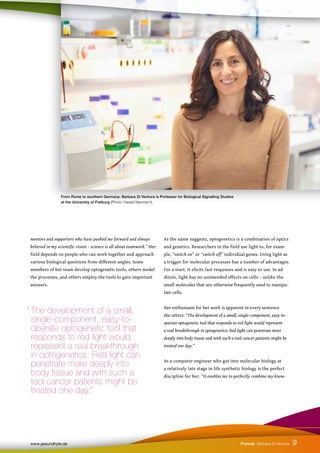
From Rome to southern Germany: Barbara Di Ventura is Professor for Biological Signalling Studies
at the University of Freiburg (Photo: Harald Neumann).
9
www.gesundhyte.de Portrait Barbara Di Ventura
“ The development of a small,
single-component, easy-to-
operate optogenetic tool that
responds to red light would
represent a real breakthrough
in optogenetics. Red light can 		
penetrate more deeply into
body tissue and with such a
tool cancer patients might be
treated one day.”
ledge from both areas,” she says with a broad smile. Her lab has
now grown to ten members. Eight of them perform wet lab
experiments while two work on theoretical models.
“It may sound crazy, but I enjoy every day at work”
The Italian scientist feels very much at home in southern
Germany, where she lives with her husband and son. But the
international research is still very important to her. She
enjoys the freedom and creativity that her research activities
offer and loves interacting with her team and the students
at the university: “It may sound crazy, but I enjoy every day at
work.”
There is only one thing that dims the joy of the lively Italian
a bit: “Because I’m such a committed and motivated individual my-
self, I get frustrated if a student seems unmotivated. I am annoyed
by a lack of dedication.” Outside of lockdown periods, when Di
Ventura is not at the university or an international conference,
she can be found enjoying her other passion: music. “I sing in a
rock band, which I totally love to do. Of course, it’s not a prerequisite
or anything, but any highly motivated scientist who also plays an in-
strument is really welcome to join our team!” she jokes.
Contact:
Prof. Dr. Barbara Di Ventura
Institute of Biology II
BIOSS and CIBSS Signalling Research Centers
Molecular and Cellular Engineering Group
University of Freiburg
barbara.diventura@biologie.uni-freiburg.de
http://diventura.bioss.uni-freiburg.de
10
“ Because I’m such a committed
and motivated individual myself,
I get frustrated if a student seems 		
unmotivated. I am annoyed by a
lack of dedication.”
Portrait Barbara Di Ventura www.gesundhyte.de
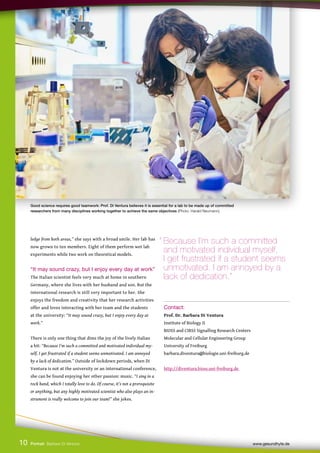
Good science requires good teamwork: Prof. Di Ventura believes it is essential for a lab to be made up of committed
researchers from many disciplines working together to achieve the same objectives (Photo: Harald Neumann).
11
When COVID-19 began to spread around the
world in early 2020, it was clear that this pan-
demic was going to have a dramatic impact on
our lives – at least in the short term. The situation
in Wuhan showed that even a local outbreak in a
country with good resources could push the
healthcare system to its limits. Plus, very little
was known at the time about the transmission,
risk factors, and lethality of this novel coronavirus.
My concerns back then revolved around existen-
tial and logistical questions: How can I prevent
infection? What happens if my friends, family, or
I get infected? But I didn’t realize at this time the
biggest upheaval the pandemic would cause in
my life: How it would affect my work as a scien-
tist.
As a bioinformatician, I was in the fortunate situation of be-
ing able to work from home, a lockdown would not have posed
much of an obstacle for my work. Nevertheless, even before
the first COVID-19 case was recorded in Berlin, my past caught
up with me: Before I began my postdoc research on identifying
functional gene sets in single-cell RNA sequencing data, I had
worked for a while as a bioinformatician in a core unit where I
was responsible for analyzing RNA-seq and single-cell RNA-seq
data sets. My research group worked on several projects deal-
ing with lung disease, and now someone was needed who could
quickly merge the various control data sets, analyze them and
turn them into a reference data set for other researchers. In the
meantime, samples from as many COVID-19 patients as possible
needed to be taken and sequenced in order to characterize the
disease at the single-cell level.
What started as a short-term, impromptu project quickly devel-
oped into a Herculean task that involved many different par-
ties. Our work put out several publications and data sets, which
in turn were used by dozens of other groups for their own
research. Working on this project was certainly exhausting for
an early career scientist like me, but it was also a great learning
experience. The fast pace of the work magnifies any problems
and conflicts, but it also allows one to watch processes play out
in fast motion that would usually take years and are difficult for
younger scientists to grasp. In this article, I would like to share
a few of the things I have learned in the past 24 months.
The urgency of a pandemic demands cooperation
Many research projects have one or a few scientists at the helm
who drive the work forward. A major goal of doctoral and post-
doctoral students is to be lead author of one’s “own” paper.
Although there is the possibility to share lead authorship, the
fact that a paper’s authors are often referred to as “Doe et al.”
shows that particular importance is placed on being first in the
list. Generally, this person is a postdoc or doctoral student who
has spent many years gaining the necessary expertise and who
has been the main driving force behind the project.
www.gesundhyte.de Research My experience of the pandemic 11
2 years of COVID-19 from the perspective
of a young scientist
by Sören Lukassen
“ What started as a short-term,
impromptu project quickly
developed into a Herculean
task that involved many different 		
parties.”
my experience
my experience
of the pandemic
of the pandemic
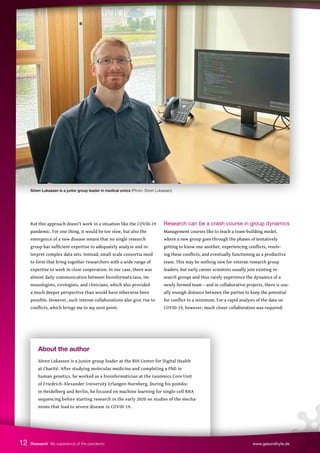
Sören Lukassen is a junior group leader in medical omics (Photo: Sören Lukassen).
About the author
Sören Lukassen is a junior group leader at the BIH Center for Digital Health
at Charité. After studying molecular medicine and completing a PhD in
human genetics, he worked as a bioinformatician at the Genomics Core Unit
of Friedrich-Alexander University Erlangen-Nurnberg. During his postdoc
in Heidelberg and Berlin, he focused on machine learning for single-cell RNA
sequencing before starting research in the early 2020 on studies of the mecha-
nisms that lead to severe disease in COVID-19.
But this approach doesn’t work in a situation like the COVID-19
pandemic. For one thing, it would be too slow, but also the
emergence of a new disease means that no single research
group has sufficient expertise to adequately analyze and in-
terpret complex data sets. Instead, small-scale consortia need
to form that bring together researchers with a wide range of
expertise to work in close cooperation. In our case, there was
almost daily communication between bioinformaticians, im-
munologists, virologists, and clinicians, which also provided
a much deeper perspective than would have otherwise been
possible. However, such intense collaborations also give rise to
conflicts, which brings me to my next point.
Research can be a crash course in group dynamics
Management courses like to teach a team-building model,
where a new group goes through the phases of tentatively
getting to know one another, experiencing conflicts, resolv-
ing these conflicts, and eventually functioning as a productive
team. This may be nothing new for veteran research group
leaders, but early career scientists usually join existing re-
search groups and thus rarely experience the dynamics of a
newly formed team – and in collaborative projects, there is usu-
ally enough distance between the parties to keep the potential
for conflict to a minimum. For a rapid analysis of the data on
COVID-19, however, much closer collaboration was required:
12 Research My experience of the pandemic www.gesundhyte.de
13
www.gesundhyte.de Research My experience of the pandemic 13
data generation, analysis and interpretation were conducted
simultaneously by groups with a wide range of expertise. In our
case, these groups exchanged information on a daily basis. As
there were no pre-existing structures, responsibilities had to be
defined and clarified as we went. The participants had to agree
on a plan for the entire project that represented the interests
and capabilities of all groups. This led to heated discussions and
conflicts in the early days, but it paid off in the medium term.
Instead of avoiding differences of opinion, we had to confront
and discuss these issues head-on – which, after an initial period
of settling in, created a high level of mutual trust and a very
efficient working atmosphere that would probably not have
arisen in a looser sort of cooperation.
Short-term projects still require long-term planning
This close collaboration quickly resulted in several joint pub-
lications, the volume of data grew, and new ideas for projects
kept emerging. In the beginning, our single-cell RNA-seq data
sets contained some 20 samples and a few tens of thousands
of cells – but this quickly grew to well over a hundred samples
and hundreds of thousands of cells. While this provided us
with unique insight into the biology of COVID-19, it was also
becoming more and more of a problem, as our analysis pipe-
line couldn’t keep up with the growing volume of data. When
choosing our tools in early 2020, we had primarily looked for
pipelines that were tried and tested and, most importantly,
that had backward compatibility with other projects. This al-
lowed for the rapid transfer of healthy control samples from
other projects and significantly reduced the amount of work
involved in the analysis. We also knew that our analysis scripts
would work with up to 150,000 or 200,000 cells, which seemed
sufficient given that we envisaged using perhaps 100,000 cells.
However, as our initial projects quickly led to others, the pipe-
line’s limitations started to become an issue. At first, we stuck
with it anyway because we had already published findings using
this approach and wanted to maintain consistency. In the finan-
cial world, this would be called a “sunk cost fallacy” – we had
invested so much time in the analysis scripts and generated so
much data with this pipeline that we couldn’t bring ourselves
to part ways. But eventually, of course, it got to the point where
we had to rebuild the pipeline from scratch. The faster runtime
the new pipeline provided far outweighed the time invested in
the changeover – and got rid of the horror associated with the
request: “Could you run this again with additional samples?”.
This experience has made me realize several things:
1. Analysis pipelines and infrastructure should be designed
to cope with data volumes that may seem unrealistic at
first glance.
2. The scalability of an algorithm is as important as its
absolute performance. If this information is lacking, you
should take the time to determine it yourself.
3. As soon as it becomes apparent that the volume of data
might end up too large for the procedures currently in
use, you should promptly start planning a changeover;
time invested in the old pipeline is not a reason to delay
making this move.
During the pandemic, a number of insights that were not en-
tirely new have gained widespread acceptance. In the world of
science, these include the pros and cons of preprints and the
associated benefits of post-publication peer review. But in ad-
dition to what we have learned as a community, we have also
gained smaller, personal insights – be it with regard to time
management, working from home, or collaboration and project
planning. If we can apply what we’ve learned from this whole
experience, then at least in one respect some good will have
come out of the past 2 years.
Contact:
Dr. Sören Lukassen
Group leader Medical Omics
BIH Center for Digital Health
Berlin Institute of Health at Charité
soeren.lukassen@charite.de
www.hidih.org/research/medicalomics
14 Research Improving access to clinically relevant data www.gesundhyte.de
improving access
improving access
to clinically relevant data
Both clinical and experimental primary data, but
also secondary data such as specialist publica-
tions, are growing explosively. The situation is
magnified by the fact that these data are often
very heterogeneous, i.e. they are unstructured, in
different formats, and of varying quality. The
research approach taken by “integrative data
semantics” addresses this dilemma. The aim is
to develop tools for homogenizing these hetero-
geneous data and to facilitate predominantly
computer-based processing. This is a necessary
prerequisite for using all clinically relevant data to
develop better therapies in the future.
The funding measure “i:DSem – Integrative Data Semantics
in Systems Medicine” is one of the initiatives of the German
Federal Ministry of Education and Research (BMBF) aimed at
advancing health research through innovations in computer-
based data processing. The reason for launching the initiative
in 2016 was that while more and more knowledge is being pro-
duced, significant hurdles stood in the way to making it avail-
able to physicians for problem solving. This challenge requires
the development of novel tools, so-called semantic technolo-
gies, which are at the heart of the i:DSem measure.
At the end of 2021, the funding came to an end after just over
five years and quite a number of successes. During the funding
period, the BMBF spent more than €20 million to support eight
interdisciplinary research projects.
The projects in the funding measure were divided into two
phases. There was initially a three-year development phase,
which was followed in 2019 by an interim evaluation. All pro-
jects then successfully entered a two-year translation phase, in
which the developments made were validated for specific ap-
plications. With the completion of this phase, the projects have
come to an end in the course of 2021.
Overall, the BMBF can look back on a successful measure, whose
achievements were highlighted at the closing event in sum-
mer 2021. Since the launch of i:DSem, the BMBF has initiated
further funding schemes to strengthen computer-based health
research. For example, the measure “CompLS – Computational
Life Sciences” aims in particular to explore the considerable
potential of artificial intelligence for life sciences research. In
addition, the BMBF-funded “Medical Informatics Initiative” is
establishing important IT infrastructures at university hospi-
tals. The goal is, among other things, to prepare and process
routine clinical data in such a way that they can be used for
medical research across institutions.
Using three projects as examples, we will illus-
trate the successes of the i:DSem scheme on
the following pages.
Contact:
		
		 Dr. Björn Dreesen-Daun
		 Project Management Juelich
		 Forschungszentrum Juelich GmbH
		 b.dreesen@fz-juelich.de
		www.ptj.de/idsem
BMBF funding measure "i:DSem”
summing up positively
by Björn Dreesen-Daun
Photo:
FZJ,
R.
U.
Limbach
As an interoperable health research platform based
on the FAIR data principles, the Health Atlas (www.
health-atlas.de) gives clinical and epidemiological
researchers access to publications, structured data,
models and applications.
In medicine, as in other fields, specialist publications present
the latest research findings. To ensure the research is repro-
ducible and confirmable, scientific journals are increasingly
requiring the submission of the data and analyses – including
analysis plans and scripts – on which these findings are based.
Making these resources available drives the further develop-
ment of ideas and the emergence of new research questions.
Through the work of the Health Atlas, research resources
become accessible on a platform that makes quality-assured
data and metadata available for interoperable use along with
publications. After registering on the platform, users can up-
load their publications including the underlying research data,
supplements and metadata. Publication metadata, including au-
thors’ names, keywords, project descriptions, and the relevant
identifier in the Human Disease Ontology, optimize the publica-
tion’s findability and reusability. While publications are freely
accessible on the Health Atlas, access to data can be restricted.
Options include password-only access, access on request, and
free access.
What’s unique about the Health Atlas?
In addition to publications and data, the Health Atlas provides
access to numerous models, including disease prediction and
risk assessment models as well as novel models for 3D-laser
scan based body typing and COVID-19 pandemic models. All
models have been created with modern web applications that
allow for experimentation and use in research projects. This
enables researchers to choose, for example, between vari-
ous published genetic prediction models for familial breast
15
www.gesundhyte.de Research Improving access to clinically relevant data 15
health atlas as a platform
for health research
Structured research (meta)data, models and applications:
the Health Atlas provides resources and follows the FAIR principles
by Markus Löffler
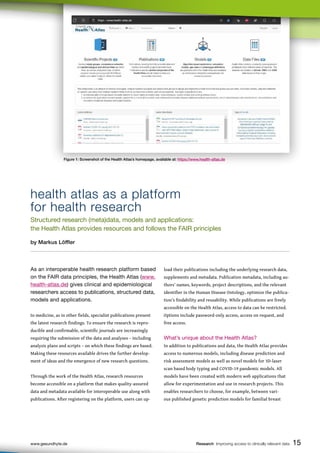
Figure 1: Screenshot of the Health Atlas’s homepage, available at: https://www.health-atlas.de
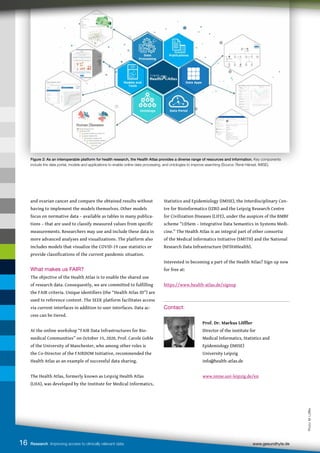
Figure 2: As an interoperable platform for health research, the Health Atlas provides a diverse range of resources and information. Key components
include the data portal, models and applications to enable online data processing, and ontologies to improve searching (Source: René Hänsel, IMISE).
16 Research Improving access to clinically relevant data www.gesundhyte.de
and ovarian cancer and compare the obtained results without
having to implement the models themselves. Other models
focus on normative data – available as tables in many publica-
tions – that are used to classify measured values from specific
measurements. Researchers may use and include these data in
more advanced analyses and visualizations. The platform also
includes models that visualize the COVID-19 case statistics or
provide classifications of the current pandemic situation.
What makes us FAIR?
The objective of the Health Atlas is to enable the shared use
of research data. Consequently, we are committed to fulfilling
the FAIR criteria. Unique identifiers (the “Health Atlas ID”) are
used to reference content. The SEEK platform facilitates access
via current interfaces in addition to user interfaces. Data ac-
cess can be tiered.
At the online workshop “FAIR Data Infrastructures for Bio-
medical Communities” on October 15, 2020, Prof. Carole Goble
of the University of Manchester, who among other roles is
the Co-Director of the FAIRDOM Initiative, recommended the
Health Atlas as an example of successful data sharing.
The Health Atlas, formerly known as Leipzig Health Atlas
(LHA), was developed by the Institute for Medical Informatics,
Statistics and Epidemiology (IMISE), the Interdisciplinary Cen-
tre for Bioinformatics (IZBI) and the Leipzig Research Centre
for Civilization Diseases (LIFE), under the auspices of the BMBF
scheme “i:DSem – Integrative Data Semantics in Systems Medi-
cine.” The Health Atlas is an integral part of other consortia
of the Medical Informatics Initiative (SMITH) and the National
Research Data Infrastructure (NFDI4Health).
Interested in becoming a part of the Health Atlas? Sign up now
for free at:
https://www.health-atlas.de/signup
Contact:
		
Prof. Dr. Markus Löffler
		 Director of the institute for
		 Medical Informatics, Statistics and 		
		 Epidemiology (IMISE)
		 University Leipzig
		 info@health-atlas.de
		www.imise.uni-leipzig.de/en
Photo:
M.
Löffler
17
www.gesundhyte.de Research Improving access to clinically relevant data 17
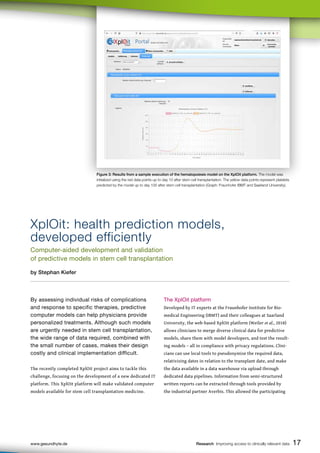
Figure 3: Results from a sample execution of the hematopoiesis model on the XplOit platform. The model was
initialized using the red data points up to day 10 after stem cell transplantation. The yellow data points represent platelets
predicted by the model up to day 100 after stem cell transplantation (Graph: Fraunhofer IBMT and Saarland University).
By assessing individual risks of complications
and response to specific therapies, predictive
computer models can help physicians provide
personalized treatments. Although such models
are urgently needed in stem cell transplantation,
the wide range of data required, combined with
the small number of cases, makes their design
costly and clinical implementation difficult.
The recently completed XplOit project aims to tackle this
challenge, focusing on the development of a new dedicated IT
platform. This XplOit platform will make validated computer
models available for stem cell transplantation medicine.
The XplOit platform
Developed by IT experts at the Fraunhofer Institute for Bio-
medical Engineering (IBMT) and their colleagues at Saarland
University, the web-based XplOit platform (Weiler et al., 2018)
allows clinicians to merge diverse clinical data for predictive
models, share them with model developers, and test the result-
ing models – all in compliance with privacy regulations. Clini-
cians can use local tools to pseudonymize the required data,
relativizing dates in relation to the transplant date, and make
the data available in a data warehouse via upload through
dedicated data pipelines. Information from semi-structured
written reports can be extracted through tools provided by
the industrial partner Averbis. This allowed the participating
XplOit: health prediction models,
developed efficiently
Computer-aided development and validation
of predictive models in stem cell transplantation
by Stephan Kiefer
18 Research Improving access to clinically relevant data www.gesundhyte.de
transplant centers and virology institutes at Essen University
Hospital and Saarland University Hospital to capture data from
over 2,500 patients after allogeneic stem cell transplantation,
with more than 15 million data points for model development.
In order to harmonize different data formats and terminolo-
gies, the project followed a data integration approach that
employs ontology as a knowledge base for identifying the
technical terms in transplantation medicine and their respec-
tive relationships. Using a designated tool, concepts that are
required for this project-specific ontology can be extracted
from established ontologies. This allows developers to an-
notate and merge data relevant to their planned model in the
provided data sets, and then use analysis and visualization
tools to find correlations and generate hypotheses. The data
needed to train models can be transferred to the relevant en-
vironments. Newly developed models are then uploaded to a
model repository and, after annotation of the required input
parameters, fed with data from the platform’s data warehouse
and executed. To check a model’s usefulness, it can be run ret-
rospectively for different points in time in a treatment course
and compared with the patient’s actual health development or
with assessments made by the clinicians treating the patient at
the respective dates.
Predictive models for post-hematopoietic stem cell
transplantation
Project partners at the University of Tübingen and Saarland
University developed the first predictive models for patients
after cell transplantation that individually predict possible
life-threatening complications, such as the dreaded graft-
versus-host disease and CMV reactivation on the one hand
and new blood formation and survival on the other hand. This
helps clinicians to initiate life-saving measures earlier. Both
machine learning models for predicting events and systems
biology models for time course predictions were developed.
Figure 3 shows an example of the prediction of platelet regen-
eration (highlighted as yellow data points) in a hypothetical
patient after stem cell transplantation.
The XplOit platform supports evaluations that show how the
models developed in XplOit stack up against clinician assess-
ments and actual outcomes. The first such evaluation is cur-
rently nearing completion.
References:
Weiler, G., Schwarz, U., Rauch, J., Rohm, K., Lehr, T., Theobald,
S., Kiefer, S., Götz, K., Och, K., Pfeifer, N., Handl, L., Smola, S., Ihle,
M., Turki, AT., Beelen, DW., Rissland, J., Bittenbring, J. and Graf, N.
(2018). XplOit: An Ontology-Based Data Integration Platform Sup-
porting the Development of Predictive Models for Personalized
Medicine. Stud Health Technol Inform.247:21-25.
Contact:
		
		Stephan Kiefer
		 Deputy Head of the WG
		 Biomedical data and bioethics
		 Fraunhofer Institute for
		 Biomedical Engineering
		 stephan.kiefer@ibmt.fraunhofer.de
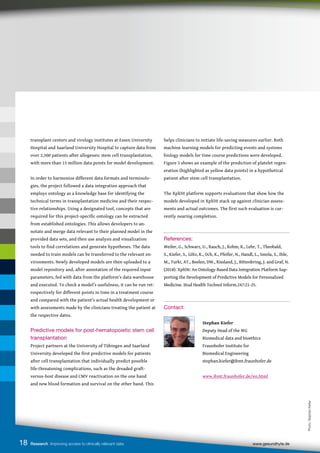
		www.ibmt.fraunhofer.de/en.html
Photo:
Stephan
Kiefer
19
www.gesundhyte.de Research Improving access to clinically relevant data 19
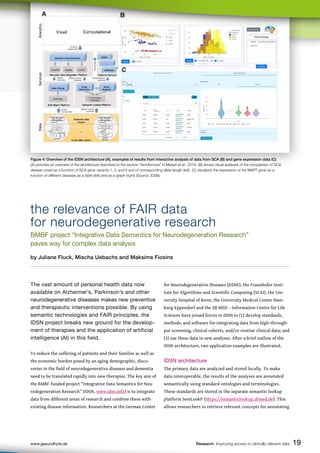
Figure 4: Overview of the IDSN architecture (A), examples of results from interactive analysis of data from SCA (B) and gene expression data (C).
(A) provides an overview of the architecture described in the section “Architecture” in Madan et al., 2018. (B) shows visual analyses of the comparison of SCA
disease onset as a function of SCA gene variants 1, 3, and 6 and of corresponding allele length (left). (C) visualizes the expression of the MAPT gene as a
function of different diseases as a table (left) and as a graph (right) (Source: IDSN).
The vast amount of personal health data now
available on Alzheimer’s, Parkinson’s and other
neurodegenerative diseases makes new preventive
and therapeutic interventions possible. By using
semantic technologies and FAIR principles, the
IDSN project breaks new ground for the develop-
ment of therapies and the application of artificial
intelligence (AI) in this field.
To reduce the suffering of patients and their families as well as
the economic burden posed by an aging demographic, disco-
veries in the field of neurodegenerative diseases and dementia
need to be translated rapidly into new therapies. The key aim of
the BMBF-funded project “Integrative Data Semantics for Neu-
rodegeneration Research” (IDSN, www.idsn.info) is to integrate
data from different areas of research and combine these with
existing disease information. Researchers at the German Center
for Neurodegenerative Diseases (DZNE), the Fraunhofer Insti-
tute for Algorithms and Scientific Computing (SCAI), the Uni-
versity Hospital of Bonn, the University Medical Center Ham-
burg-Eppendorf and the ZB MED – Information Centre for Life
Sciences have joined forces in IDSN to (1) develop standards,
methods, and software for integrating data from high-through-
put screening, clinical cohorts, and/or routine clinical data; and
(2) use these data in new analyses. After a brief outline of the
IDSN architecture, two application examples are illustrated.
IDSN architecture
The primary data are analyzed and stored locally. To make
data interoperable, the results of the analyses are annotated
semantically using standard ontologies and terminologies.
These standards are stored in the separate semantic lookup
platform SemLookP (https://semanticlookup.zbmed.de). This
allows researchers to retrieve relevant concepts for annotating
the relevance of FAIR data
for neurodegenerative research
BMBF project “Integrative Data Semantics for Neurodegeneration Research”
paves way for complex data analysis
by Juliane Fluck, Mischa Uebachs and Maksims Fiosins
20 Research Improving access to clinically relevant data www.gesundhyte.de
data, to make information about the concepts available, and
to provide mappings between different standards (for an over-
view, see Figure 4A). The semantically enriched data, including
provenance of the original data, are transferred to a central
data management platform (Madan et al., 2018). Semantic inde-
xing facilitates fast data queries and retrievals, while interacti-
ve graphical user interfaces allow for dedicated data visualiza-
tion and fast and flexible data analysis (see Figures 4B and 4C).
Mechanisms of frontotemporal dementia
Frontotemporal dementias (FTD) are a heterogeneous group of
dementia diseases associated with loss of function in the fron-
tal and temporal lobes, often with early onset (before age 65)
and frequently genetically determined or caused by metabolic
abnormalities. One focus of IDSN is the combined AI analysis of
clinical data and genetic, epigenetic, gene and protein expressi-
on data to gain new insights into FTD. The semantic annotation
in IDSN allows these different data types to be related, enabling
integral analysis of expression data and clinical patient data.
Another benefit of IDSN semantics is the ease with which secon-
dary data (e.g., associations between genes and diseases) can
be linked and used. The combination of semantically annotated
metadata, large data sets and novel AI models allowed us to dis-
cover new potential disease mechanisms of FTD, such as greatly
increased vascularization of the diseased brain (Menden et al.:
2020 [1] and [2]).
Analysis of cohort data on spinocerebellar ataxias
Spinocerebellar ataxias (SCA) are rare inherited disorders of the
cerebellum that result in a progressive impairment of balance
and coordination along with physical disability. Collecting suf-
ficient amounts of clinical data is extremely time- and resour-
ce-intensive. Within the IDSN project, four globally available
clinical trials were merged by means of a specially developed
semantic standard and import software to allow integrated ana-
lyses of the data (Uebachs et al., 2020). Developing and mapping
to this standard is far from trivial – it requires both clinical
expertise and the capturing of similar information collected by
different methods and scales. The result is a combined analysis
in an intuitive interactive user interface developed in close
cooperation with clinicians in IDSN (see Figure 4).
References:
Madan, S. et al. (2018). A Semantic Data Integration Methodology
for Translational Neurodegenerative Disease Research. 11th
Semantic Web Applications and Tools for Healthcare and Life
Sciences (SWAT4(HC)LS). Antwerp, Belgium, December 3-6, 2018.
CEUR Workshop Proceedings, Vol-2275, C.J.O. Baker, A. Waag-
meester, A. Splendiani, O. Beyan, M Scott-Marshall, eds. Paper 9.
Menden, K. et al. [1] (2020). Deep learning–based cell compo-
sition analysis from tissue expression profiles. Science advan-
ces 6(30).
Menden, K. et al. [2] (2020). Integrated multi-omics analysis re-
veals common and distinct dysregulated pathways for genetic
subtypes of Frontotemporal Dementia. https://www.biorxiv.org/
content/10.1101/2020.12.01.405894v3
Uebachs, M. et al. (2020). A new tool for prompt and compre-
hensive visualization and comparison of cohort characteristics
in spinocerebellar ataxias. SCA &ARCA Global Conference 19.-
21.10.2020.
Contact:
		
		 Prof. Dr. Juliane Fluck
		 Head of Knowledge Management
		 Information Centre for Life Sciences
		 (ZB MED)
		 and Fraunhofer Institute for Algorithms and
		 Scientific Computing (SCAI)
		 and University of Bonn
		 fluck@zbmed.de
www.scai.fraunhofer.de/en/business-research-areas/
bioinformatics.html
		 Dr. Mischa Uebachs
		 Specialist neurology
		 Clinic and Polyclinic for Neurology
		 Univeristy Hospital Bonn (UKB)
		 m.uebachs@gmail.com
https://neurologie.uni-bonn.de
		 Dr. Maksims Fiosins
		 Scientific associate
		 Medical Center Hamburg-Eppendorf (UKE)
		 Maksims.fiosins@gmail.com
www.uke.de/english/departments-institutes/institutes/
medical-systems-biology/index.html
Photos:
ZB
MED,
Uebachs,
Fiosins
21
www.gesundhyte.de Research Use of routine clinical data for research and care 21
Information on disease progression and on the
effect of therapies is of great importance for phy-
sicians and researchers alike. Until now, clinical
trials and epidemiological studies have provided
the basis for such information, whereas routine
treatment data have typically not played a role.
The advantage of these data is that their many
different forms allow realistic insights into daily
clinical practice. That is precisely the focus of the
MII’s efforts in the area of broad consent: it seeks
to make such data available for research purposes.
To ensure the success of this project, both an
understanding of consent procedures by patients
and an efficient implementation of the consent
process are indispensable.
What is the potential of healthcare data?
Understanding the impact of risk and influencing factors on
disease development and progression as well as the interac-
tions between various pathologies is essential for improving
diagnostics and therapy. Different clinical trials are currently
compared to ensure a sufficient amount of data as reference
material. However, as knowledge advances, the complexity of
disease patterns is also increasing, and with it the demands
on clinical trials. Data collection is further complicated by
comorbidities or delayed effects, which are not always known
in advance. The requirement for studies to specify a precise
purpose cannot be fulfilled when such disease connections
are not yet known. For many patients, this means participat-
ing in numerous studies and repeatedly undergoing extensive
interviews and examinations.
Healthcare data, as it represents the entire spectrum of dis-
eases encountered in clinical settings, offers the potential of
significantly reducing effort on the part of both researchers
and patients. Thus, they enable the investigation of disease
interactions and the potential discovery of previously un-
known illnesses. The data complement clinical trials, allowing
researchers to discover new connections while also generat-
ing targeted hypotheses.
A crucial prerequisite for exploiting this potential is the
adequate mapping of disease progression and treatment path-
ways through long-term, cross-sector collection of healthcare
data. This data collection only works on the basis of pseudo-
nymized data sets. The secondary use of such personal data
is permitted under certain circumstances in accordance
with Article 6 of the EU’s General Data Protection Regulation
(GDPR), with the informed consent of patients usually being
the method of choice. The challenge in broad consent lies in
obtaining consent for data use for as-yet undefined research
projects over a long time period compared to consent for spe-
cific clinical trials that are limited in time and content. In ad-
dition, patient data can be stored and used for research pur-
poses for up to 30 years after consent has been given, unless
this consent is withdrawn. An independent ethics committee
and a panel of experts at each participating hospital decide
whether the data may be used for a research project.
The patient’s perspective
As Richter et al. (2017) were able to show, patients generally
have a positive attitude toward broad consent without any re-
strictions on the research area. The reasons for giving consent
use of routine
use of routine
clinical data for
clinical data for
research and care
research and care
Prerequisite: digital modular broad consent
by Clemens Spitzenpfeil, Alexandra Stein, Martin Bialke, Torsten Leddig and Wolfgang Hoffmann
22
22
22
22 Research Use of routine clinical data for research and care www.gesundhyte.de
Figure 1: Thanks to the open-source software gICS®
, the
process of obtaining broad consent is fully digital at the
University Medicine Greifswald
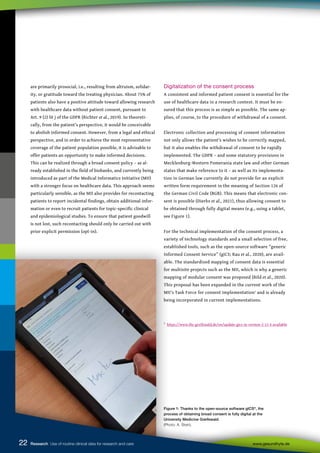
(Photo: A. Stein).
are primarily prosocial, i.e., resulting from altruism, solidar-
ity, or gratitude toward the treating physician. About 75% of
patients also have a positive attitude toward allowing research
with healthcare data without patient consent, pursuant to
Art. 9 (2) lit j of the GDPR (Richter et al., 2019). So theoreti-
cally, from the patient’s perspective, it would be conceivable
to abolish informed consent. However, from a legal and ethical
perspective, and in order to achieve the most representative
coverage of the patient population possible, it is advisable to
offer patients an opportunity to make informed decisions.
This can be realized through a broad consent policy – as al-
ready established in the field of biobanks, and currently being
introduced as part of the Medical Informatics Initiative (MII)
with a stronger focus on healthcare data. This approach seems
particularly sensible, as the MII also provides for recontacting
patients to report incidental findings, obtain additional infor-
mation or even to recruit patients for topic-specific clinical
and epidemiological studies. To ensure that patient goodwill
is not lost, such recontacting should only be carried out with
prior explicit permission (opt-in).
Digitalization of the consent process
A consistent and informed patient consent is essential for the
use of healthcare data in a research context. It must be en-
sured that this process is as simple as possible. The same ap-
plies, of course, to the procedure of withdrawal of a consent.
Electronic collection and processing of consent information
not only allows the patient’s wishes to be correctly mapped,
but it also enables the withdrawal of consent to be rapidly
implemented. The GDPR – and some statutory provisions in
Mecklenburg-Western Pomerania state law and other German
states that make reference to it – as well as its implementa-
tion in German law currently do not provide for an explicit
written form requirement in the meaning of Section 126 of
the German Civil Code (BGB). This means that electronic con-
sent is possible (Dierks et al., 2021), thus allowing consent to
be obtained through fully digital means (e.g., using a tablet,
see Figure 1).
For the technical implementation of the consent process, a
variety of technology standards and a small selection of free,
established tools, such as the open-source software “generic
Informed Consent Service” (gICS; Rau et al., 2020), are avail-
able. The standardized mapping of consent data is essential
for multisite projects such as the MII, which is why a generic
mapping of modular consent was proposed (Bild et al., 2020).
This proposal has been expanded in the current work of the
MII’s Task Force for consent implementation1
and is already
being incorporated in current implementations.
1
https://www.ths-greifswald.de/en/update-gics-in-version-2-13-4-available
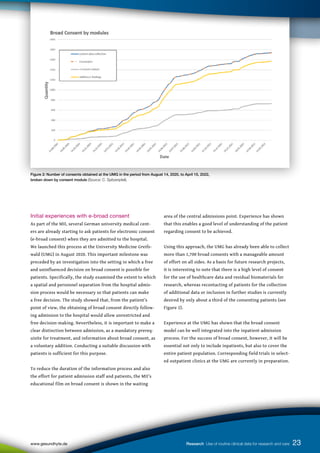
Figure 2: Number of consents obtained at the UMG in the period from August 14, 2020, to April 15, 2022,
broken down by consent module (Source: C. Spitzenpfeil).
23
www.gesundhyte.de Research Use of routine clinical data for research and care
Initial experiences with e-broad consent
As part of the MII, several German university medical cent-
ers are already starting to ask patients for electronic consent
(e-broad consent) when they are admitted to the hospital.
We launched this process at the University Medicine Greifs-
wald (UMG) in August 2020. This important milestone was
preceded by an investigation into the setting in which a free
and uninfluenced decision on broad consent is possible for
patients. Specifically, the study examined the extent to which
a spatial and personnel separation from the hospital admis-
sion process would be necessary so that patients can make
a free decision. The study showed that, from the patient’s
point of view, the obtaining of broad consent directly follow-
ing admission to the hospital would allow unrestricted and
free decision-making. Nevertheless, it is important to make a
clear distinction between admission, as a mandatory prereq-
uisite for treatment, and information about broad consent, as
a voluntary addition. Conducting a suitable discussion with
patients is sufficient for this purpose.
To reduce the duration of the information process and also
the effort for patient admission staff and patients, the MII’s
educational film on broad consent is shown in the waiting
area of the central admissions point. Experience has shown
that this enables a good level of understanding of the patient
regarding consent to be achieved.
Using this approach, the UMG has already been able to collect
more than 1,700 broad consents with a manageable amount
of effort on all sides. As a basis for future research projects,
it is interesting to note that there is a high level of consent
for the use of healthcare data and residual biomaterials for
research, whereas recontacting of patients for the collection
of additional data or inclusion in further studies is currently
desired by only about a third of the consenting patients (see
Figure 2).
Experience at the UMG has shown that the broad consent
model can be well integrated into the inpatient admission
process. For the success of broad consent, however, it will be
essential not only to include inpatients, but also to cover the
entire patient population. Corresponding field trials in select-
ed outpatient clinics at the UMG are currently in preparation.
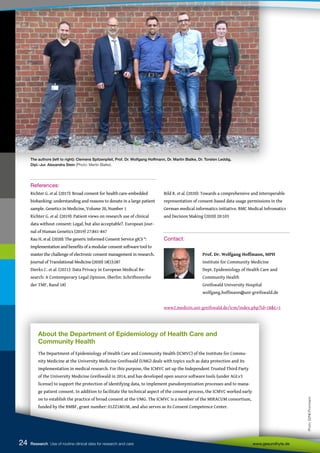
The authors (left to right): Clemens Spitzenpfeil, Prof. Dr. Wolfgang Hoffmann, Dr. Martin Bialke, Dr. Torsten Leddig,
Dipl.-Jur. Alexandra Stein (Photo: Martin Bialke).
About the Department of Epidemiology of Health Care and
Community Health
The Department of Epidemiology of Health Care and Community Health (ICMVC) of the Institute for Commu-
nity Medicine at the University Medicine Greifswald (UMG) deals with topics such as data protection and its
implementation in medical research. For this purpose, the ICMVC set up the Independent Trusted Third Party
of the University Medicine Greifswald in 2014, and has developed open source software tools (under AGLv3
license) to support the protection of identifying data, to implement pseudonymization processes and to mana-
ge patient consent. In addition to facilitate the technical aspect of the consent process, the ICMVC worked early
on to establish the practice of broad consent at the UMG. The ICMVC is a member of the MIRACUM consortium,
funded by the BMBF, grant number: 01ZZ1801M, and also serves as its Consent Competence Center.
References:
Richter G. et al. (2017): Broad consent for health care-embedded
biobanking: understanding and reasons to donate in a large patient
sample. Genetics in Medicine, Volume 20, Number 1
Richter G. et al. (2019): Patient views on research use of clinical
data without consent: Legal, but also acceptable?. European Jour-
nal of Human Genetics (2019) 27:841-847
Rau H. et al. (2020): The generic Informed Consent Service gICS ®:
implementation and benefits of a modular consent software tool to
master the challenge of electronic consent management in research.
Journal of Translational Medicine (2020) 18(1):287
Dierks C. et al. (2021): Data Privacy in European Medical Re-
search: A Contemporary Legal Opinion. (Berlin: Schriftenreihe
der TMF, Band 18)
Bild R. et al. (2020): Towards a comprehensive and interoperable
representation of consent-based data usage permissions in the
German medical informatics initiative. BMC Medical Infromatics
and Decision Making (2020) 20:103
Contact:
		
		 Prof. Dr. Wolfgang Hoffmann, MPH
		 Institute for Community Medicine
		 Dept. Epidemiology of Health Care and
		 Community Health
		 Greifswald University Hospital
		 wolfgang.hoffmann@uni-greifswald.de
www2.medizin.uni-greifswald.de/icm/index.php?id=18&L=1
24
24
24
24 Research Use of routine clinical data for research and care www.gesundhyte.de
Photo:
DZNE/Frommann
25
www.gesundhyte.de Research Lost in Translation? Semantic standardization!
Healthcare data are increasingly being stored
digitally and thus contain a treasure trove of hidden
insights for research and quality assurance. Yet a
lack of semantic standardization and shortcomings
in the currently used coding systems prevent a
targeted analysis of these data. In order to exploit
this wealth of knowledge, it is essential that we
record the data in a meaning-preserving way using
terminologies like LOINC or SNOMED CT. In com-
bination with the internationally emerging stand-
ard HL7 FHIR, a number of promising interoperable
software solutions are currently arising. In this
article we will illustrate why it is worth to invest in
the use of codes from more sophisticated termi-
nologies.
Routine healthcare continuously generates substantial
amounts of medical data on hundreds of thousands of indi-
vidual patient cases. With the advance of digitalization, these
data are being documented and communicated electronically
at an increasing pace. This includes essential core information
such as diagnoses, procedures, laboratory tests and medica-
tions that are documented and billed by the healthcare pro-
vider. Ideally, this and other information would be reused for
further purposes. Firstly, an improvement of the quality of
patient care itself could be achieved by avoiding unnecessary
redundant examinations and medical errors due to a lack of
documented diseases and medications – as long as the relevant
information is available in the right form, at the right time and
place. Secondly, in the long term an improvement in treatment
options results from the comprehensive use of patient data for
clinical research – provided the patient’s consent is obtained.
By pooling large amounts of data and analyzing them jointly,
researchers can identify overarching developments and deduce
disease-relevant correlations, which inevitably lead to new
scientific discoveries that will ultimately benefit individual pa-
tients (Safran et al., 2007).
Natural language variability hinders the reusability
of collected data
Yet the vast potential of such healthcare data, which are avail-
able in principle, has so far remained largely untapped. One
major reason is the vagueness of human communication in
general, and medical language in particular. Abbreviations
such as “PIN” contribute further to this Babylonian confusion
of tongues. The ambiguous abbreviation (homonymy) can be
interpreted as meaning ”Prostatic intraepithelial neoplasia” or
”Pressure-induced nystagmus”, depending on the context. Con-
versely, a condition such as a skin abscess can be paraphrased
in different ways (synonymy), for example, with “abscess of
the skin”, “cutaneous abscess”, or “Hautabszess” in German.
Multilingual synonyms are particularly relevant for interna-
tional research. Many other phenomena such as quasi-synon-
ymy (e.g., “abscess” versus “furuncle”: are the two the same
thing?) and negation (e.g., “not an extensive abscess”: is the
abscess not extensive or is there no abscess at all?) make reli-
able interpretation of linguistic data difficult. This is true for
humans, but it is especially true for computers, which is the
subject of this article.
lost in translation?
semantic
semantic
standardization!
standardization!
Terminologies like LOINC and SNOMED CT reduce
Babylonian Confusion of tongues
by Cora Drenkhahn and Josef Ingenerf
25
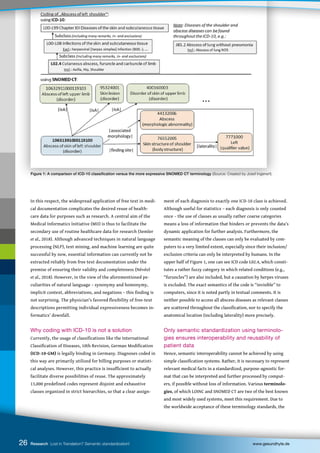
Figure 1: A comparison of ICD-10 classification versus the more expressive SNOMED CT terminology (Source: Created by Josef Ingenerf).
In this respect, the widespread application of free text in medi-
cal documentation complicates the desired reuse of health-
care data for purposes such as research. A central aim of the
Medical Informatics Initiative (MII) is thus to facilitate the
secondary use of routine healthcare data for research (Semler
et al., 2018). Although advanced techniques in natural language
processing (NLP), text mining, and machine learning are quite
successful by now, essential information can currently not be
extracted reliably from free text documentation under the
premise of ensuring their validity and completeness (Névéol
et al., 2018). However, in the view of the aforementioned pe-
culiarities of natural language – synonymy and homonymy,
implicit context, abbreviations, and negations – this finding is
not surprising. The physician's favored flexibility of free-text
descriptions permitting individual expressiveness becomes in-
formatics’ downfall.
Why coding with ICD-10 is not a solution
Currently, the usage of classifications like the International
Classification of Diseases, 10th Revision, German Modification
(ICD-10-GM) is legally binding in Germany. Diagnoses coded in
this way are primarily utilized for billing purposes or statisti-
cal analyses. However, this practice is insufficient to actually
facilitate diverse possibilities of reuse. The approximately
13,000 predefined codes represent disjoint and exhaustive
classes organized in strict hierarchies, so that a clear assign-
ment of each diagnosis to exactly one ICD-10 class is achieved.
Although useful for statistics – each diagnosis is only counted
once – the use of classes as usually rather coarse categories
means a loss of information that hinders or prevents the data’s
dynamic application for further analysis. Furthermore, the
semantic meaning of the classes can only be evaluated by com-
puters to a very limited extent, especially since their inclusion/
exclusion criteria can only be interpreted by humans. In the
upper half of Figure 1, one can see ICD code L02.4, which consti-
tutes a rather fuzzy category in which related conditions (e.g.,
“furuncles”) are also included, but a causation by herpes viruses
is excluded. The exact semantics of the code is “invisible” to
computers, since it is noted partly in textual comments. It is
neither possible to access all abscess diseases as relevant classes
are scattered throughout the classification, nor to specify the
anatomical location (including laterality) more precisely.
Only semantic standardization using terminolo-
gies ensures interoperability and reusability of
patient data
Hence, semantic interoperability cannot be achieved by using
simple classification systems. Rather, it is necessary to represent
relevant medical facts in a standardized, purpose-agnostic for-
mat that can be interpreted and further processed by comput-
ers, if possible without loss of information. Various terminolo-
gies, of which LOINC and SNOMED CT are two of the best known
and most widely used systems, meet this requirement. Due to
the worldwide acceptance of these terminology standards, the
26
26
26
26 Research Lost in Translation? Semantic standardization! www.gesundhyte.de
Recent developments: FHIR advances terminology
standards
As is already becoming apparent, the lacking adoption of se-
mantic standards within clinical IT-systems is not the only
reason for their slow uptake. In particular, the complex and
heterogeneous nature of the various terminologies has so far
hampered a widespread implementation (Rector, 1999). But
recently, there are promising developments in this area: At the
level of necessary information models, the structural standard
Health Level 7 – Fast Healthcare Interoperability Resources
(HL7 FHIR) has been providing new momentum for several
years. In addition to standardized data structures – called
resources - for describing medical facts (e.g., for patients, aller-
gies or medications), FHIR also offers a specialized module for
terminology services. With the data structures and functionali-
ties defined here, terminology content can be uniformly re-
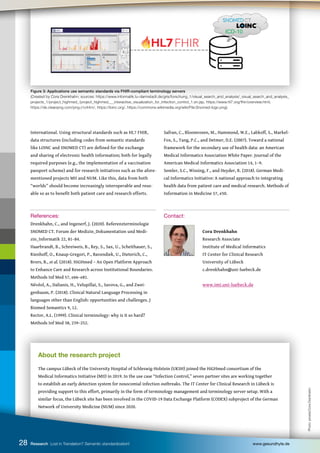
presented as well as queried. Based on these premises, seman-
tic components can be outsourced to a dedicated terminology
server with which relevant applications can easily communi-
cate via FHIR’s standardized operations, as shown in Figure 3.
Several current projects and initiatives are already demon-
strating the synergistic benefits achievable by combining
semantic and structural standards with terminology servers.
Firstly, the MII’s HiGHmed consortium is using the FHIR-based
Ontoserver from the Australian company CSIRO as a central
hub for providing semantic content relevant to its three use
cases: Cardiology, Oncology, and Infection Control (Haarbrandt
et al., 2018). Secondly, a similar approach applies to the CODEX
project of the German Network of University Medicine (NUM)
which aims to establish a national research data platform for
COVID-19. And thirdly, the German National Association of
Statutory Health Insurance Physicians (NASHIP, German:
Kassenärztliche Bundesvereinigung (KBV)) also sets an increas-
ing focus on standardization using FHIR on the one hand and
terminologies – primarily SNOMED CT – on the other hand
for the specification of so-called medical information objects
(MIOs).
In summary, much needed progress in semantically interop-
erable health information systems is becoming apparent in
recent times. At the beginning of last year, Germany became
the 40th country to join the non-profit organization SNOMED
data can even be communicated and used for computer-based
analyses on an international level. Nevertheless, medical docu-
mentalists are not confronted with long, obscure codes as the
corresponding medical concepts in the standards are linked to
natural language terms that can be read and understood by hu-
man users. By ensuring a good integration of these standards
into (existing) software systems, the burden of documentation
can be relieved while preventing incorrect entries.
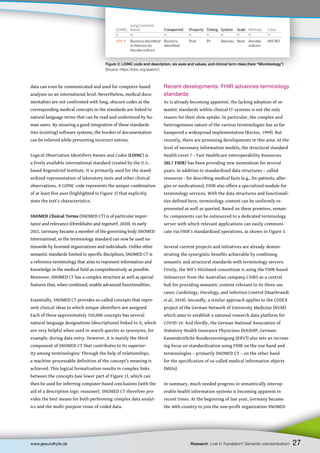
Logical Observation Identifiers Names and Codes (LOINC) is
a freely available international standard created by the U.S.-
based Regenstrief Institute. It is primarily used for the stand-
ardized representation of laboratory tests and other clinical
observations. A LOINC code represents the unique combination
of at least five axes (highlighted in Figure 2) that explicitly
state the test’s characteristics.
SNOMED Clinical Terms (SNOMED CT) is of particular impor-
tance and relevance (Drenkhahn and Ingenerf, 2020). In early
2021, Germany became a member of the governing body SNOMED
International, so the terminology standard can now be used na-
tionwide by licensed organizations and individuals. Unlike other
semantic standards limited to specific disciplines, SNOMED CT is
a reference terminology that aims to represent information and
knowledge in the medical field as comprehensively as possible.
Moreover, SNOMED CT has a complex structure as well as special
features that, when combined, enable advanced functionalities.
Essentially, SNOMED CT provides so-called concepts that repre-
sent clinical ideas to which unique identifiers are assigned.
Each of these approximately 350,000 concepts has several
natural language designations (descriptions) linked to it, which
are very helpful when used in search queries as synonyms, for
example, during data entry. However, it is mainly the third
component of SNOMED CT that contributes to its superior-
ity among terminologies: Through the help of relationships,
a machine-processable definition of the concept’s meaning is
achieved. This logical formalization results in complex links
between the concepts (see lower part of Figure 1), which can
then be used for inferring computer-based conclusions (with the
aid of a description logic reasoner). SNOMED CT therefore pro-
vides the best means for both performing complex data analyt-
ics and the multi-purpose reuse of coded data.
27
www.gesundhyte.de Research Lost in Translation? Semantic standardization!
Figure 2: LOINC code and description, six axes and values, and clinical term class (here “Microbiology”)
(Source: https://loinc.org/search/).
About the research project
The campus Lübeck of the University Hospital of Schleswig-Holstein (UKSH) joined the HiGHmed consortium of the
Medical Informatics Initiative (MII) in 2019. In the use case “Infection Control,” seven partner sites are working together
to establish an early detection system for nosocomial infection outbreaks. The IT Center for Clinical Research in Lübeck is
providing support to this effort, primarily in the form of terminology management and terminology server setup. With a
similar focus, the Lübeck site has been involved in the COVID-19 Data Exchange Platform (CODEX) subproject of the German
Network of University Medicine (NUM) since 2020.
Figure 3: Applications use semantic standards via FHIR-compliant terminology servers
(Created by Cora Drenkhahn; sources: https://www.informatik.tu-darmstadt.de/gris/forschung_1/visual_search_and_analysis/_visual_search_and_analysis_
projects_1/project_highmed_/project_highmed___interactive_visualization_for_infection_control_1.en.jsp, https://www.hl7.org/fhir/overview.html,
https://de.cleanpng.com/png-j1o44m/, https://loinc.org/, https://commons.wikimedia.org/wiki/File:Snomed-logo.png).
ICD-10
International. Using structural standards such as HL7 FHIR,
data structures (including codes from semantic standards
like LOINC and SNOMED CT) are defined for the exchange
and sharing of electronic health information; both for legally
required purposes (e.g., the implementation of a vaccination
passport scheme) and for research initiatives such as the afore-
mentioned projects MII and NUM. Like this, data from both
“worlds” should become increasingly interoperable and reus-
able so as to benefit both patient care and research efforts.
References:
Drenkhahn, C., and Ingenerf, J. (2020). Referenzterminologie
SNOMED CT. Forum der Medizin_Dokumentation und Medi-
zin_Informatik 22, 81–84.
Haarbrandt, B., Schreiweis, B., Rey, S., Sax, U., Scheithauer, S.,
Rienhoff, O., Knaup-Gregori, P., Bavendiek, U., Dieterich, C.,
Brors, B., et al. (2018). HiGHmed – An Open Platform Approach
to Enhance Care and Research across Institutional Boundaries.
Methods Inf Med 57, e66–e81.
Névéol, A., Dalianis, H., Velupillai, S., Savova, G., and Zwei-
genbaum, P. (2018). Clinical Natural Language Processing in
languages other than English: opportunities and challenges. J
Biomed Semantics 9, 12.
Rector, A.L. (1999). Clinical terminology: why is it so hard?
Methods Inf Med 38, 239–252.
Safran, C., Bloomrosen, M., Hammond, W.E., Labkoff, S., Markel-
Fox, S., Tang, P.C., and Detmer, D.E. (2007). Toward a national
framework for the secondary use of health data: an American
Medical Informatics Association White Paper. Journal of the
American Medical Informatics Association 14, 1–9.
Semler, S.C., Wissing, F., and Heyder, R. (2018). German Medi-
cal Informatics Initiative: A national approach to integrating
health data from patient care and medical research. Methods of
Information in Medicine 57, e50.
Contact:
		
		Cora Drenkhahn
		 Research Associate
		 Institute of Medical Informatics
		 IT Center for Clinical Research
		 University of Lübeck
		 c.drenkhahn@uni-luebeck.de
		www.imi.uni-luebeck.de
28
28
28
28 Research Lost in Translation? Semantic standardization! www.gesundhyte.de
Photo:
private/Cora
Drenkhahn
Photo:
Roche
29
www.gesundhyte.de Interview and Company profile Martin Hager – Roche Pharma AG
Interview with Dr. Martin Hager
Medical Therapeutic Area Lead in the Personalized Healthcare (PHC) division
at Roche Pharma
“a learning
“a learning
healthcare system could
already be a reality”
Dr. Martin Hager is convinced that personalized
healthcare, where every instance of medical treat-
ment or care generates new knowledge for the
future, has already been possible for a long time.
In this interview, he talks about the current oppor-
tunities and challenges and emphasizes the central
role of networking and exchange.
gesundhyte.de: Dr. Hager, Swiss multinational Roche is committed
to personalized medicine. What role does this already play in medical
treatment today?
Dr. Martin Hager: First of all, I have to say that enormous
progress has unquestionably been made in personalized medi-
cine in recent years. Look at oncology, for instance, which has
undoubtedly played a pioneering role. Nowadays, we have a
wide range of biomarker-based therapies available. And every
year, new therapies are added that are specifically tailored to
even small patient populations. We have witnessed remark-
able progress in our understanding of diseases ushering in an
era of new treatment approaches that would have been un-
imaginable just a few years ago. But that’s not the whole story.
In reality, these advances are not benefiting all patients, and
the concept of personalized medicine has not been widely
incorporated in all aspects of our healthcare system – at least
not to the extent it could be.
gesundhyte.de: How do you explain that?
There are many reasons, but a lot of them have to do with the
fact that healthcare structures are simply not keeping up with
the pace of innovation and technological progress. Take mo-
lecular diagnostics, for instance. Comprehensive tumor profil-
ing using next generation sequencing is still the exception in
routine clinical care. And so we have to ask ourselves: What is
the benefit of having more and more personalized therapies
targeting rare genetic alterations if the broader healthcare
system does not identify the patients who could benefit from
those therapies? What is needed is the courage to initiate
“ We need to work together
right now to develop solutions
targeted purely at achieving
better outcomes for patients.”
Figure 1: A knowledge-generating healthcare system (Source: Roche).
Research &
Development
Routine
Clinical
Care
Collection of
Registry Data
Clinical
Trial Data
Improved Secondary
Prevention / Early
Diagnosis
Remote Patient
Monitoring &
Management
Efficient Trial
Enrollment
Accelerated
R&D and
Approval
change. We must work together right now to develop solutions
that have the potential to achieve better outcomes for patients.
gesundhyte.de: How is that possible?
There already exist some excellent initiatives to improve
transfer of top-level medicine and clinical care at university
hospitals to the broader healthcare system. I’m thinking,
for instance, about the Hauptstadt Urologie network, which
pursues precisely that goal – and also shows how important
it is for different actors in the healthcare system to collabo-
rate. We are currently working with Hauptstadt Urologie to
develop precision oncology solutions that can help prostate
cancer patients regardless of where they live. The project is
addressing a wide range of relevant questions from digital
support for quality-assured healthcare processes in the con-
text of precision diagnostics to issues relating to data privacy
and security.
gesundhyte.de: You mentioned digital solutions. What role do these
play in personalized medicine?
Digital transformation of our healthcare system together with
the systematic use of healthcare data are two components that
play a pivotal role in the process as they represent the very
foundation of personalized healthcare i.e. healthcare needs of
individual patients.
gesundhyte.de: That sounds rather utopian!
Not at all! The technologies to achieve that have already been
around for a few years. Think about modern IT solutions that
structure and interconnect millions of data sets. Or digital
health solutions that collect individual health data in real-time
via wearables and smartphones. Additionally, artificial intel-
ligence helps us analyze all these data. There has never been a
better time to implement data-based personalized healthcare
and make it a reality.
gesundhyte.de: A central aspect is the exchange of medical data
with the healthcare system.
Absolutely. Data generated by the healthcare system play a
central role. For instance, we assume that around 95 percent
of potentially available oncological data is generated during
routine examinations. If we are able to collect these data in a
structured way in accordance with jointly developed quality
standards, to interconnect and share them, we will be able to
establish a healthcare system in which every medical treat-
ment or care generates new knowledge for the future. In the
end we have created a learning healthcare system.
30 Interview and Company profile Martin Hager – Roche Pharma AG www.gesundhyte.de
“ The chances for truly achieving
and implementing data-based
personalized healthcare have
never been better.”
become standard, as this is the only way we can shape the
future of the healthcare system in a way that benefits the
patients.
Franziska Müller conducted the interview.
Contact:
Dr. Martin H. Hager, MBA
Medical Therapeutic Area Lead Personalized Healthcare (PHC)
Roche Pharma AG
www.roche.de/ueber-roche/was-uns-antreibt/personalisierte-
medizin
www.gesundhyte.de Interview and Company profile Martin Hager – Roche Pharma AG 31
gesundhyte.de: What do we need in order to do that?
Of course, we need the right infrastructure to replace iso-
lated, stand-alone solutions. We also need rules to ensure the
secure exchange of anonymized and pseudonymized health
data. We believe it is crucial that researchers in the private
sector are recognized as equal partners in the innovation
process and have equal access to the data for their research.
More than anything else, what is needed is the willingness of
all participants in the healthcare system to communicate and
cooperate beyond their own immediate interests.
Collaboration and knowledge transfer across different sectors
is indeed possible – and worthwhile. We can clearly see that
with a recent project with the University of Munich. Togeth-
er, we showed how it is possible to apply knowledge gained
from anonymized clinical genomic data to the treatment
of future patients. Specifically, we developed a prediction
algorithm that used the relevant data to determine which
patients would benefit from molecular testing and when. I
am convinced that these types of collaborative projects will
Roche is creating personalized medicine (Photo: Roche).
“ We believe it is crucial that
researchers in the private sector
are recognized as equal partners
in the innovation process and
have equal access to the data for
their research.”
“ Not only do the digital transformation
of our healthcare system and the
systematic use of healthcare data
play a decisive role, but they are
also a prerequisite if we want the
idea of personalized medicine to
come to life.”
Publication “AI in medicine and care from the perspective of patients”
The paper is based on a report by the Working Group on Health Care, Medical Technology,
Care of German Plattform Lernende Systeme. This report on a round-table discussion with
representatives of various patient advocacy groups summarizes the participants’ assessment
of the opportunities and challenges for using AI systems in healthcare.
Klemens Budde et al. (ed.): “AI in medicine and care from the perspective of patients – A
report on the round-table discussion with patient advocates,” Munich, 2020. The full German
version is available online at: https://www.plattform-lernende-systeme.de/files/Downloads/
Publikationen/AG6_Whitepaper_Medizin_Pflege_Tagungsbericht.pdf
An executive summary in English is available at: https://www.plattform-lernende-systeme.de/
files/Downloads/Publikationen_EN/AG6_WP_Patienten_Round_Table_Executive Summary.pdf
The study’s key findings were also presented in a paper published in Deutsches Ärzteblatt,
which is available online: https://www.aerzteblatt.de/archiv/216998/Kuenstliche-Intelligenz-
Patienten-im-Fokus
32
Learning systems built upon latest artificial intelli-
gence (AI) algorithms can be effective software tools
for patients, physicians and medical professionals.
Amongst others, they can support early prevention,
improved decision making or the better selection of
individual treatments. A qualitative survey shows
that patient advocates believe AI in medicine and
care holds potential for more personalized treat-
ments as well as for faster, more comprehensive di-
agnoses. However, Deployment challenges include
data misuse, cybercrime, erroneous and discrimina-
tory decisions made by AI systems, poor data sets
and poorly optimized algorithms. To overcome these
challenges, experts call for greater cooperation
among stakeholders involved in the research, devel-
opment and application of AI technologies.
The debate over digital vaccination certificates has shown
that Germany still faces major challenges in the digital trans-
formation of healthcare. Pushing the digital transformation
forward is important as it not only helps to control the spread
of infections, but it is also a key prerequisite for adoption of
learning systems in healthcare. Patient-specific medical data
and AI-based systems have the potential to improve healthcare
quality. They can support medical experts to optimize treat-
ment outcomes through early prevention, improved decision
making or better selection of individual treatments. Further-
more, they can accelerate the discovery of previously unknown
medical correlations and innovative preventive approaches.
Nowadays, learning systems make use of machine learning
(ML) algorithms – a special subset of AI algorithms – to identify
correlations within high-dimensional data, which otherwise
requires manual and time-consuming involvement of medical
experts. Thus, the adoption of learning systems can release
medical and nursing staff from manual repetitive work, help
them to spend more time in direct patient care, and provide
32 Research Personalized treatments vs. transparent patients? 		 www.gesundhyte.de
personalized treatments vs.
transparent patients?
How patient advocacy groups assess opportunities
and challenges of AI in medicine and care
by Klemens Budde, Matthieu-P. Schapranow, Elsa Kirchner and
Thomas Zahn – Plattform Lernende Systeme
in healthcare. In the fall of 2019, Plattform Lernende Systeme
and DFKI organized a round-table discussion as part of a sec-
ond study based on these interviews. At this round table, ten
of the twelve initial survey respondents and six other patient
advocates discussed their various points of view based on the
results of the qualitative preliminary survey. The participat-
ing patient advocates were selected to cover as wide a range of
diseases as possible.
Using AI to improve treatment quality and
strengthen patient autonomy
Overall, the results of the survey indicate that patient advo-
cates have a rather positive, and in some cases ambivalent,
view on AI technologies in healthcare. Respondents mentioned
that AI technologies have great potential, but also pose some
risks. At the same time, the level of knowledge about AI tech-
nologies varies among patient representatives as their use is
still in its infancy. The majority of interviewed patient advo-
cates were unable to answer the questions on the safety of
AI-based medical decision support systems, which indicates
a need for further education and awareness-raising. In addi-
tion, the majority of respondents called for more methodologi-
cal transparency in AI-based technologies and applications
in medicine and care. Therefore, additional efforts should be
made to build up competence for AI technologies in medical
professionals as well as patients equally.
patients with long-term support in their daily lives. Building
trust in these new technologies among patients and medical
professionals requires high security standards for the relevant
IT systems. Concerns regarding the use of AI-based medical de-
cision support systems need to be identified, and the needs of
patients and users must be considered during development of
such solutions. Analyses of potentials and challenges of digital
transformation and adoption of AI in medicine and care have
largely ignored the perspectives of patients and medical pro-
fessionals so far. Despite technological progress, concerns of
patients and those in need of care have to be in focus also with
regards to service quality as well as satisfaction with medical
care. Patients must be involved in the various processes so that
treatments can be optimally aligned with their needs.
The Working Group on Health Care, Medical Technology, Care
of Germany’s Platform for Artificial Intelligence (Plattform
Lernende Systeme) in cooperation with the German Research
Center for Artificial Intelligence (DFKI) and Charité – Univer-
sitätsmedizin Berlin, conducted a qualitative expert survey
amongst patient representatives in Germany. Their objective
was to identify the respondents’ perspective on opportunities
and challenges in the use of AI systems in medicine and care.
Survey participants were asked to provide their perspective in
a multi-stage, qualitative process following the Delphi survey
method. The first step consisted of individual questionnaire-
based interviews with twelve patient representatives from dif-
ferent advocacy groups. Respondents were interviewed on se-
lected topics of digitalization and AI-based assistance systems
www.gesundhyte.de Research Personalized treatments vs. transparent patients? 33
Platform members Elsa Kirchner (DFKI; in the background) and Klemens Budde (Charité – Universitätsmedizin Berlin; right) discuss AI and
healthcare issues with patient advocates (Source: Plattform Lernende Systeme).
Table 2: Prioritizations of the patient
representative groups
RISKS AND CHALLENGES OF KI
IN MEDICINE
! Erroneous and discriminatory decisions of
		 AI systems
! Risks to quality of care
! Dependencies and economization of the
		 health care system
! Ethical issues
34
In the early stage of the discussion among all 16 participants of
the second study, topics relating to opportunities and patient
advocates’ hopes regarding AI in medicine and care were rat-
ed more important than possible risks and privacy concerns.
This shows that the potential opportunities of AI in healthcare
are seen as outweighing the risks. Patient advocates are open-
minded and have a generally positive attitude towards new
technologies and their potential.
Patient advocates saw two key areas in which AI-based learn-
ing systems in medicine and care offer opportunities: AI-based
medical decision support systems may improve the quality
of treatment and strengthen patient autonomy. According to
patient advocates, the most promising benefits of such systems
would be improved diagnoses and a replacement of one-size-
fits-all treatments towards more personalized treatments re-
sulting in reduced side effects and treatment failures. Factors
rated as important by the respondents include personalized
treatment goals, optimized therapy selection and timing, early
detection of disease exacerbations, and new options for more
holistic treatments. Frequently mentioned topics also included
new diagnostic possibilities to detect disease earlier and more
comprehensively. Just as frequently, respondents expressed a
desire for improved cross-sectional treatment processes. They
also argued for using learning systems to increase the trans-
parency and efficiency of healthcare processes. For example,
healthcare staff could make use of automated care documen-
tation based on voice recognition to reduce documentation
overhead. In addition, learning systems could promote better
faster adoption of clinical guidelines in standard care, e.g.
through medical decision support systems that are automati-
cally kept up to date. Equally important for patient advocates
is optimized access to knowledge (knowledge diffusion) and
the acquisition of new scientific knowledge, such as through
AI-supported analysis of study data and health-related data,
including genetic data. Somewhat less importance was as-
signed to the possibility of offsetting shortages in medical care
with new ways of accessing treatment, such as telemedicine
and AI-based applications.
Furthermore, patients’ rights could be strengthened by using
AI-based medical devices. Particularly important in this con-
text, according to the patient advocates surveyed, is providing
patients with easy access to their electronic health records.
New possibilities for inclusion and social participation as well
as the resulting increased autonomy through AI technologies
are also rated as important in this context – exoskeletons that
34 Research Personalized treatments vs. transparent patients? 		 www.gesundhyte.de
Table 1: Potentials of AI in medicine from the perspective
of patient representatives
IMPROVING THE QUALITY OF TREATMENT
 Personalized medicine
 Cross-sector processes and networked treatment
 Diagnostics
 Process and workflow optimization
 Knowledge diffusion and knowledge gain
 Counteracting underuse
 Reduction of side effects of treatment
STRENGTHENING PATIENT SOVEREIGNTY
 Strengthening patient rights
 Social participation and inclusion
 Support in everyday life
Table 3: Prioritizations of patient advocacy –
Key privacy concerns for AI in medicine
DATA MISUSE AND CYBERCRIME
! Sanctioning of data misuse
! Secure and stable IT systems
INFORMATIONAL SELF-DETERMINATION
! Ownership and use of data
! Lack of data storage requirements
! Legal assistance for data subjects
! Data collection without consent
! Right to be forgotten
Patient advocates also expressed concerns that the deployment
of AI systems may lead to new dependencies, such as regarding
the access to data and software. In this context, study partici-
pants warned that overly strict regulations could hinder inno-
vation and prevent the emergence of new start-ups.
The greatest danger the representatives of the various patient
advocacy groups see in AI in healthcare is the possible lack of
data security, data misuse, and cybercrime (see Table 3). To
prevent this, they called for solid IT security as well as penal-
ties for data misuse. Health data is essential for the develop-
ment and deployment of AI-based medical decision support
systems. Consequently, strengthening AI-based care while
protecting data subjects requires judicious privacy protec-
tion. Key considerations in this context are the data subjects’
informational self-determination as well as clear rules on who
may use the sensitive data. Study participants pressed for clear
data storage requirements on issues, such as confidentiality,
availability, legally binding nature and data access rights.
They fear that without such measures, data may be collected
without subjects’ consent or that the right to be forgotten may
no longer be guaranteed. In addition, a contact point for legal
assistance should be created, so that those affected can assert
their rights in a self-determined manner.
The results of the survey of various stakeholder group rep-
resentatives suggest options for action and the perspective
of stakeholders on political regulatory requirements for the
deployment of AI in medicine and care. The exchange with the
patient advocates also revealed an ongoing need for awareness
and education on how AI-based decision support systems work
and what they can be used for already today. Thus, the poten-
support the recovery of motoric skills were mentioned as an
example. Furthermore, daily living aids received great atten-
tion, such as new ways of maintaining health with AI-based
applications.
Concerns about inadequate privacy protection
and misuse of data
A main concern reported by patient advocates was that medi-
cal or nursing staff might make erroneous or biased treatment
decisions based on recommendations of learning systems (see
Table 2). Patient advocates fear that incorrect interpretations
of AI results or inferior data quality sets and algorithms may
lead to wrong decisions or decisions that are detrimental to the
patient. Thus, algorithms might use insufficiently traceable de-
cision-making processes or be trained on irrelevant data points.
While a critical analysis of the purpose, quality and size of data
sets is required, there is a lack of universally accepted metrics
and standards. Experts from the Plattform Lernende Systeme
investigated specific attacks against AI systems and protective
measures against such attacks in a recent publication.
Another aspect that patient advocacy groups are particularly
critical of is the risk to the quality of care that AI technolo-
gies might pose. The greatest concern is that human inter-
action may be restricted by standardized treatment. Study
participants also feared the dangers resulting from the fact
that patients’ concerns are not addressed sufficiently during
the development of and the use of AI-based learning systems
in medicine and care. Ethical questions about the social con-
sequences of unhealthy self-optimization were also rated as
relevant, and patient advocates declared it necessary that an
ethical framework be developed to prevent adverse effects.
www.gesundhyte.de Research Personalized treatments vs. transparent patients? 35
ABOUT PLATTFORM LERNENDE SYSTEME
Initiated in 2017 by the Federal Ministry of Education and Research (BMBF), the Plattform Lernende Systeme brings together
expertise from science, industry, government and society and supports Germany’s further path to becoming an internatio-
nally leading technology provider. Approx. 200 members of the platform are organized in working groups coordinated by
a steering committee. They demonstrate the personal, social and economic benefits of self-learning systems and identify
challenges and design options.
36
tial and limitations of AI systems in medicine and care must be
communicated to the public and discussed by policymakers.
This will help to strengthen the perception of AI’s social rel-
evance and further increase acceptance. To this end, we need a
broad public dialog that includes AI developers, future users as
well as additional stakeholders.
Contact:
		 Prof. Dr. med. Klemens Budde is Co-Head
		 of the Working Group on Health Care,
		 Medical Technology, Care of Plattform
		 Lernende Systeme and Deputy Medical
		 Director of the Medical Department,
		 Division of Nephrology and Internal
		 Intensive Care Medicine at Charité –
		 Universitätsmedizin Berlin.
		 klemens.budde@charite.de
https://nephrologie-intensivmedizin.charite.de/metas/person/
person/address_detail/budde-1/
		 Dr.-Ing. Matthieu-P. Schapranow is
		 member of the Working Group on Health
		 Care, Medical Technology, Care of Plattform
		 Lernende Systeme, Working Group Leader
		 “In-Memory Computing for Digital Health”,
		 and Scientific Manager Digital Health
		 Innovations at HPI Digital Health Center,
		 Hasso Plattner Institute, University of
		 Potsdam.
		 schapranow@hpi.de
https://hpi.de/digital-health-center/members/working-group-
in-memory-computing-for-digital-health/dr-ing-matthieu-p-
schapranow.html
Prof. Dr. Thomas Zahn is member
		 of the Working Group on Health Care,
		 Medical Technology, Care of Plattform
		 Lernende Systeme, and Vice Rector
		 Research @ bbw as well as Professor of
		 Business Information Systems, Data
		 Science and Health Information Systems
		 at the bbw University of Applied Sciences
		 Berlin.
		 thomas.zahn@bbw-hochschule.de
www.bbw-hochschule.de/Home.html
		 Prof. Dr. Elsa Andrea Kirchner is
		 member of the Working Group on Health
		 Care, Medical Technology, Care of
		 Plattform Lernende Systeme and
		 Professor of Medical Technoloy Systems at
		 University Duisburg-Essen as well as team
		 lead of the team “Intelligent Healthcare
		 Systems” at DFKI Robotics Innovation
		 Center, Bremen.
		 elsa.kirchner@dfki.de
https://www.dfki.de/en/web/research/research-
departments/robotics-innovation-center
36 Research Personalized treatments vs. transparent patients? 		 www.gesundhyte.de
Photos:
Budde:
Wiebke
Peitz,
Schapranow:
private,
Elsa
Kirchner:
©
DFKI,
Thomas
Zahn:
©
GeWINO
www.gesundhyte.de Research Innovative software tools for the life sciences 37
To foster the development of innovative compu-
tational methods and analytical tools in the life sci-
ences, the German Federal Ministry of Education
and Research (BMBF) launched its Computational
Life Sciences (CompLS) funding scheme in 2018.
To date, 53 projects have been granted a total of
€34 million in four funding rounds.
In the life sciences, advances in experimental methods and
modern (high-throughput) technologies play a significant role
in the development of innovative new tools and ideas. Today,
more and more quantitative, time-resolved measurements of
cellular systems are being carried out. At the same time, the
volume of digitized data in patient care and clinical research is
growing at a rapid pace. This increases the need for new bio-
informatics tools and intelligent algorithms that enable the
efficient processing and analysis of the data obtained, as well
as new methods for the mathematical modelling and simula-
tion of complex biological systems.
With its Computational Life Sciences (CompLS) funding scheme,
the BMBF wants to further advance the development of inno-
vative methods and software tools for bioinformatics process-
ing, modelling and simulation in the life sciences. The aim is
to provide life science research in Germany with efficient and
reliable tools – particularly ones that incorporate artificial
intelligence (AI) – that can adequately model and analyze data
sets from various sources and data obtained using the latest
experimental methods.
While the first call for proposals was open to all research top-
ics, each subsequent call has focused on a different key area:
deep learning in biomedicine, machine learning for cancer re-
search, and AI methods for infection research.
The following two examples serve to illustrate
the successes of the initiative so far.
Contact:
		
		 Dr. René Wolf-Eulenfeld
		 Project Management Juelich
		 Forschungszentrum Juelich GmbH
		 r.wolf-eulenfeld@fz-juelich.de
		
		 Dr. Daniel Heinrichs
		 Project Management Juelich
		 Forschungszentrum Juelich GmbH
		 d.heinrichs@fz-juelich.de
https://www.ptj.de/computational-life-sciences
innovative
innovative
software tools for the
life sciences
life sciences
BMBF initiative CompLS provides €34 million
in funding for the development of computational methods
and analytical tools
by Daniel Heinrichs and René Wolf-Eulenfeld
Photos:
FZJ,
R.
U.
Limbach
and
Daniel
Heinrichs
38 Research Innovative software tools for the life sciences www.gesundhyte.de
Figure 1: Workflow for predicting infectivity.
A biological sample is sequenced and the resulting reads are matched to genomes of known pathogens and non-pathogens.
Reads derived from unknown viruses are then passed to a neural network to predict whether the new virus is capable of
infecting humans (Source: Jakub Bartoszewicz and Melania Nowicka).
New diseases are constantly emerging. However,
standard molecular diagnostic methods rely on
finding very specific matches to previously studied
organisms and viruses, and can therefore only de-
tect pathogens that are already known. Any new,
significantly different viruses are easily missed.
Researchers at the Hasso Plattner Institute are
now developing new deep learning methods that
can predict whether a novel virus has the potential
to infect humans. The DeepPath project should
allow scientists to identify pathogens very quickly
from just a small amount of data, and to analyze
entire genomes.
Over the past year, we have seen rapid progress in the de-
velopment of tests to detect the SARS-CoV-2 virus: PCR tests,
antibody tests, and eventually rapid or even self-administered
antigen tests quickly became part of everyday life in many
countries. However, at the very beginning of the pandemic,
no targeted tests had been developed. The best method for
identifying and analyzing a completely novel threat is genome
sequencing. This technology is particularly important in a time
when more new pathogens – many of which are still unidenti-
fied and which evolve extremely quickly – are expected to
emerge.
Genome sequencing and neural networks
Instead of looking for very specific pathogen signatures,
genome sequencing aims to decipher the pathogen’s entire
genomic information. The sequencers read billions of nucleo-
tides per sample, but the resulting reads only show fragments
of the original genome – orders of magnitude shorter and
pulled out of context. Putting these reads back in their origi-
nal order is still a complicated task. Standard bioinformatics
predicting the infection potential
of novel viruses
Interpretable neural networks can quickly identify new viral pathogens
from their genomes
by Jakub Bartoszewicz, Melania Nowicka and Bernhard Renard
developed as part of the DeepPath project offer new possibili-
ties for extremely fast predictions from extremely little data.
This could save precious time and allow us to thwart future
biological threats before they even start to spread.
Project profile:
The DeepPath project is funded by the BMBF as part of its
Computational Life Science funding scheme and is being car-
ried out at the Hasso Plattner Institute with the support of the
Robert Koch Institute. It is coordinated by Prof. Dr. rer. nat.
Bernhard Renard, head of the Data Analytics and Computa-
tional Statistics research group at the HPI.
Contact:
		
		 Prof. Dr. rer. nat. Bernhard Renard
		 Hasso Plattner Institute,
		 Digital Engineering Faculty,
		 University of Potsdam
		 Bernhard.Renard@hpi.de
https://hpi.de/forschung/fachgebiete/data-analytics-and-
computational-statistics.html
		
		Jakub Bartoszewicz
		 Hasso Plattner Institute,
		 Digital Engineering Faculty,
		 University of Potsdam
		 Jakub.Bartoszewicz@hpi.de
		
		Melania Nowicka
		 Hasso Plattner Institute,
		 Digital Engineering Faculty,
		 University of Potsdam
		 Melania.Nowicka@hpi.de
39
www.gesundhyte.de Research Innovative software tools for the life sciences 39
methods for identifying pathogens therefore rely on matching
these reads to databases of known genomes – and, as a result,
can only identify pathogens that have already been studied.
The DeepPath project, which is being funded by the BMBF and
conducted by the Data Analytics and Computational Statistics
research group at the Hasso Plattner Institute (HPI) in Pots-
dam, aims to change this.
The deep neural networks developed as part of the project can
predict whether reads come from viruses capable of infecting
humans or not. These machine learning processes recognize
patterns that they associate with pathogens. They can there-
fore predict the “infectious potential” of any sequence – not
just of those that resemble known genomes. This results in far
more accurate identification. It even enables partial results
to be analyzed while the sequencing device is still running,
providing near real-time results. However, while the direct
matching of similar sequences is relatively easy for an expert
to interpret, neural networks only predict whether a sequence
could be indicative of a new pathogen, without explaining why.
Interpretability for networks and new genomes
There are two different ways to address this challenge. First,
the standard methods can be used in combination with the
neural networks. This approach can both accurately predict
the pathogenicity of all reads in a sample and match the reads
to the genomes of closely related viruses. The second approach
uses computational methods that visualize the most important
patterns learned by the network. Regions with particularly
high infectious potential can even be detected in previously
unseen genomes. This allows scientists to both understand how
the neural network arrives at its predictions, and to see which
of the analyzed pathogens’ genes are markers for their ability
to infect humans.
In the future, similar technology could be used to simultane-
ously analyze clinical samples that contain a mix of several dif-
ferent classes of pathogens (e.g., viruses, bacteria and fungi),
or even to address safety issues in synthetic biology – as syn-
thetic DNA sequences could be screened for potential hazards
before they are actually synthesized. While the detection and
study of novel pathogens will always require the participation
of human experts, the interpretable deep learning approaches
Photos:
Kay
Herschelmann,
HPI;
Kay
Herschelmann,
HPI
and
Melania
Nowicka/private
!#
 $%
#'(%)


!#
 %)*
#'(*$


!#
 %$%*%%
#'(


!#
 $*%$
#'(%


!#%
 %$*%)
#'(*
+++
 $%
40 Research Innovative software tools for the life sciences www.gesundhyte.de
Figure 2: Overview of the calculation steps in PopDel.
First, PopDel reduces the input data of each genome into a small profile. Next, it uses likelihood ratio (LR) tests to determine for all genomes at once
whether structural variants are present in each possible genomic region. The output of PopDel contains information on the position and size of the
variants as well as the corresponding genotypes of all genomes (Source: Birte Kehr).
The DNA sequence of every human being con-
tains a multitude of genetic variants that signifi-
cantly influence our appearance and health. To
uncover these differences and better understand
their effects, the genomes of tens of thousands
of individuals need to be searched and analyzed
– a difficult and time-consuming task that has
pushed traditional computational methods to
their limits. However, new methods for analyzing
huge amounts of data can overcome this chal-
lenge – providing valuable research insights and
assisting in the development of new therapies for
serious diseases.
In addition to the millions of variations at single DNA posi-
tions, thousands of variants that alter the structure of our
genome sequences exist. These so-called structural vari-
ants (SVs) can take a wide variety of forms: DNA segments
may be reversed (inversions), doubled (duplications), newly
introduced (insertions) or lost (deletions). Certain SVs are
associated with genetic diseases like Alzheimer’s, muscular
dystrophies and autism. Therefore, these variants are of great
medical interest. To better understand SVs and their effects,
thousands of human genomes are sequenced and analyzed.
Special computer programs analyze digitized DNA sequences
and provide information about the presence of SVs. The rap-
idly growing amount of available sequencing data represents
a great opportunity – but also poses an enormous technical
challenge. As more and more genomes are sequenced, special
approaches are required to cope with the vast quantities of
data produced.
Information from tens of thousands of genomes
Our project Cohort-SV addresses this challenge. We developed
a program called PopDel (Niehus et al., 2021), which can jointly
analyze the genomes of tens of thousands of people thanks to
efficient algorithms, clever data management, and a tailored
statistical model. This allows us to find out what SVs are present
in each individual genome while also gaining information about
the inheritance and distribution of SVs within a particular popu-
lation.
To handle such huge quantities of data, PopDel works in two
steps. In the first step, it extracts the relevant information from
each sequenced genome and creates small individual “profiles”
in which to store this information. This reduces the amount of
data that needs to be analyzed to one to two percent of the origi-
nal size, allowing PopDel to subsequently analyze the profiles of a
searching for variation in the
sequence structure of our genomes
How the PopDel software can harness the potential of large volumes of data
by Sebastian Niehus and Birte Kehr
41
www.gesundhyte.de Research Innovative software tools for the life sciences 41
Supporting institutions:
Leibniz Institute for Immunotherapy (formerly RCI); Berlin
Institute of Health at Charité – Universitätsmedizin Berlin
Participating partner:
Prof. Dr. Birte Kehr
References:
Niehus, S., Jónsson, H., Schönberger, J., Björnsson, E., Beyter,
D., Eggertsson, H. P., Sulem, P., Stefánsson, K., Halldórsson, B.
V., and Kehr, B. (2021). PopDel identifies medium-size deletions
simultaneously in tens of thousands of genomes. Nature com-
munications, 12(1), 1-10.
Björnsson, E., Gunnarsdóttir, K., Halldórsson, G. H., Sigurðsson,
Á., Árnadóttir, G. A., Jónsson, H., Olafsdottir, E. F., Niehus, S.,
Kehr, B., Sveinbjörnsson, G., Gudmundsdottir, S., Helgadottir,
A., Andersen, K., Thorleifsson, G., Eyjolfsson, G. I., Olafsson, I.,
Sigurdardottir, O., Saemundsdottir, J., Magnusson, O. Th., Mas-
son, G., Stafansson, H., Gudbjartsson, D. F., Thorgeirsson, G.,
Holm, H., Halldorsson, B. V., Melsted, P., Norddahl, G. L., Sulem,
P., Thorsteinsdottir, U., and Stefánsson, K. (2020). Lifelong Re-
duction in LDL Cholesterol Due to a Gain-of-Function Mutation
in LDLR. Circulation: Genomic and Precision Medicine.
Contact:
		
		 Prof. Dr. Birte Kehr
		 Head of Algorithmic Bioinformatics
		 Leibniz Institute for Immunotherapy
		 (formerly RCI)
		 Birte.Kehr@ukr.de
		Sebastian Niehus
		 PhD Student Algorithmic Bioinformatics
		 Leibniz Institute for Immunotherapy
		 (formerly RCI)
		 Sebastian.Niehus@ukr.de
		https://www.rcii.de
great many genomes simultaneously. In the second step, it reads
the genetic information of all available profiles in small genomic
sections and compares them against each other using a statisti-
cal model to provide reliable information about the presence
of SVs. A particular challenge here is that, when analyzing very
large numbers of genomes, different SVs may occur at the same
site that need to be identified as different variants. In addition, it
must be ensured that SVs that only occur in a single genome are
not obscured by the thousands of other genomes. Our aim is to
ensure that the quality of the individual results obtained when
jointly analyzing tens of thousands of genomes is at least as good
as those obtained by analyzing a single genome.
Discovery of a new genetic variant
To prove the quality of the results and their suitability for
practical use, we put PopDel to the test in a variety of scenarios.
Using simulated as well as real data from a single genome and
from almost 50,000 genomes, PopDel succeeded in providing
high-quality results. The most significant PopDel finding to
date was a previously unknown deletion in the so-called LDL
receptor gene by our partner deCODE genetics (Björnsson et
al., 2020). Since then, deCODE genetics has conducted further
experiments to confirm that the deletion has a positive influ-
ence on the function of the LDL receptor. Given that the LDL
receptor plays a central role in the cholesterol metabolism of
our body, the discovery of this deletion can serve as a starting
point for future research into the treatment of cardiovascular
diseases.
Looking ahead
PopDel is presently able to reliably identify genomic deletions.
In the current project phase, we are expanding the program to
identify other types of SVs. Thanks to its fast running time and
the fact, it is explicitly designed for use with large amounts of
data, we will be able to apply PopDel to the ever-larger DNA
sequencing studies of the future, helping us better understand
SVs and the diseases associated with them.
Project profile:
Name of the project:
SV Cohort – Identifying and genotyping structural variation in
whole genome sequencing data in large cohorts
Photos:
University
of
Regensburg,
Birte
Kehr
42 Research Future-oriented analysis of research data www.gesundhyte.de
future-oriented analysis
of research data
of research data
In the digital age, research data are the basic
currency of data-driven innovation. This new gold
is playing a significant role in the rapid advance-
ment of artificial intelligence (AI). But this also ap-
plies vice versa – the analysis of data can benefit
immensely from AI-based methods. The potential
is evident in the context of the German Network
for Bioinformatics Infrastructure (de.NBI) with
regard to AI-based projects. These projects also
benefit from the excellent resources of the de.NBI
Cloud, which is available free of charge to all
researchers in the life sciences.
The importance of research data for AI-based
developments
Making research data usable in a sustainable and long-term
manner is the order of the day. The so-called FAIR data princi-
ples (Findable, Accessible, Interoperable, and Reusable) define
the fundamental criteria for achieving this objective, and these
are also lived out in the German Network for Bioinformatics
Infrastructure (de.NBI) and the European Life Science Infra-
structure for Biological Information (ELIXIR). In this context,
the storage and management of data according to the FAIR data
principles play an essential role in the current development of
artificial intelligence (AI). It can be expected that the further
development of AI will influence the progress of many research
fields worldwide. Machine learning (ML) and deep learning (DL),
for instance, thrive on the availability of data. The larger the
amount of data, or the larger the training and testing data sets,
the better the AI programs can be trained. For years this simple
relationship has been leading to the increasing importance of
AI approaches, driven by the constant growth in the size of data
sets. The use of AI in the life sciences is therefore not only indis-
pensable, but also holds enormous potential for advancing areas
such as personalized medicine, drug development, and basic
biological research.
In this context, de.NBI (see “About the German Network for
Bioinformatics Infrastructure” below) is growing in response
to current developments and has recognized early on the op-
portunities that AI-based methods present for the analysis of
research data. For this reason, the network’s members are also
increasingly using AI-based technologies to analyze research
data. The scope of AI projects results from a query within the
network, according to which 25 projects from the areas of
modelling, phenotyping, omics as well as meta-analysis, data-
bases and support were reported back (Figure 1). Some of these
AI-based projects of the de.NBI members will be explained in
more detail below.
Identification of new antimicrobial resistance targets
by high-throughput deep learning
Scientists in the research groups of Alexander Goesmann,
Dominik Heider, and Trinad Chakraborty at the Universities of
Giessen and Marburg are working to identify new antimicrobi-
al resistance targets. Antibiotic-resistant bacteria have become
a serious threat to public health worldwide. Their surveillance
and containment, as well as the timely identification of new
genetic determinants of antibiotic resistances, are important
tools in combating both emergent and established pathogens.
To address these challenges, researchers from the Universities
of Giessen and Marburg have launched a BMBF-funded project
called “Deep-iAMR – Identification of new antimicrobial resist-
ance targets by high-throughput deep learning.” This project
combines expertise in medical microbiology, machine learn-
ing, and cloud computing techniques (Figure 2) to develop
Members of the de.NBI network
use AI-based technologies
by Vera Ortseifen, Peter Belmann and Alfred Pühler
Figure 1: The members of the de.NBI network are conducting 25 AI-based projects in different life science areas
(Source: de.NBI office; background image: Ipopba – stock.adobe.com).
automated, scalable bioinformatics workflows. Novel deep
learning approaches are being used to rapidly and reliably pre-
dict antimicrobial resistances and uncover previously hidden
signaling pathways and novel targets for the development of
new antibiotics. This involves examining data for complex pat-
terns between genomic and phenotypic data to find the genetic
determinants of hard-to-detect or previously unknown anti-
microbial resistances. Yet the application of modern artificial
intelligence methods to find these patterns requires massive
computational resources as well as specialized hardware, such
as graphics processing units (GPUs) and tensors. Research-
ers within the Deep-iAMR project are taking advantage of the
de.NBI network’s cloud computing infrastructure, which pro-
vides both the computational resources needed and the spe-
cialized hardware on demand.
Further information can be found on the project web page:
https://www.gesundheitsforschung-bmbf.de/de/deep-iamr-
identifizierung-von-neuen-antimikrobiellen-resistenz-targets-
durch-deep-learning-10900.php
43
www.gesundhyte.de Research Future-oriented analysis of research data 43
Figure 2: The data flow within the Deep-iAMR project.
The project aims to combine various omics data sets with clinical
and phenotypic information for a large, well-characterized set of
multidrug-resistant E. coli isolates. These data will then be used
to train deep neural networks. Our software is deployed via user-
friendly containerization techniques and scalable cloud solutions.
WGS = whole-genome sequencing, MIC = minimal inhibitory con-
centration, AMR = antimicrobial resistance (Source: O. Schwengers,
K. Brinkrolf, S. Doijad, T. Chakraborty, D. Heider, A. Goesmann).
Figure 3: Deep neural network for segmentation of cell microscopy images (Source: C. Krug, K. Rohr).
44 Research Future-oriented analysis of research data www.gesundhyte.de
Deep learning for microscopy image analysis and
cellular phenotyping
The automated analysis of high-throughput and high-content
microscopy image data is important to elucidate cellular
processes. Yet analyzing such data poses a number of chal-
lenges. Deep learning methods within the field of artificial
intelligence have recently emerged that yield superior results
compared to classical image analysis methods.
The Biomedical Computer Vision Group at Heidelberg Uni-
versity, led by Karl Rohr, develops DL methods for the com-
puter-based analysis of cell microscopy images. The aim is to
improve the automated quantification of cellular phenotypes
at the single-cell level and process large-scale microscopy
data efficiently. This has mainly involved the development of
deep learning methods for cell segmentation. The methods
combine different types of neural network architectures,
such as convolutional neural networks and recurrent neural
networks.
The developed DL methods for cell segmentation have been
used to analyze high-throughput and high-content micros-
copy image data. An example of a segmentation result for
a cell microscopy image is shown in Figure 3. It can be seen
that cells with high and low image contrast can be segmented
well. The developed methods have been employed, for exam-
ple, to segment cells in tissue images to subsequently quan-
tify the length of the telomeres (chromosome ends), which
can be used in medical diagnosis. This work was carried out
as part of the BMBF project “CancerTelSys – Identifying can-
cer telomere maintenance networks for diagnosis, prognosis,
patient stratification and therapy response prediction.” The
development and application of the DL methods benefited
from the de.NBI computing infrastructure and the de.NBI
Cloud.
Further information can be found on the Biomedical Computer
Vision Group’s web pages:
http://www.bioquant.uni-heidelberg.de/research/groups/
biomedical_computer_vision.html
de.NBI Cloud: Computational resources for
the application of artificial intelligence in the
life sciences
Even though many important software programs in the
life sciences employ machine and deep learning, there are
requirements for their successful, high-performance ap-
plication. In addition, artificial intelligence methods can
be accelerated by the use of GPUs and benefit from access
to enormous amounts of data, especially in DL. As already
indicated in the two projects described above, the de.NBI
Cloud (https://cloud.denbi.de) offers optimal computational
resources for this purpose. GPUs are available in different
versions and types and can be used flexibly depending on the
requirements of the ML application. The de.NBI Cloud stores
great volumes of scientific data, such as the Sequence Read Ar-
chive (SRA) metagenome data sets, allowing fast access to the
information and eliminating the need to download data from
different resources. GPUs, virtual processors (vCPUs), random
access memory (RAM), and storage solutions are available free
of charge to researchers in Germany and help foster the deve-
lopment and application of artificial intelligence methods in
the life sciences (Figure 4).
The de.NBI Cloud already provides resources for a wide range
of ML applications. Bioinformatics topics range from image
analysis to antimicrobial resistance prediction to the mod-
eling of 3D genome analyses, fluorescence microscopy, cancer
diagnosis, and antiviral peptide prediction. Of the more than
600 projects computed in the de.NBI Cloud, at least 55 pro-
jects are employing machine learning methods within their
research activities (status 02/2022). Numerous projects using
DL or ML have already been published. Due to its federated
structure, the fully academic de.NBI Cloud operates across
six sites (Figure 4). Substantial staff support enables even
inexperienced researchers to access the resources. A total of
nearly € 50 million has been invested in setting up the de.NBI
Cloud.
Acknowledgments
The work on this article was supported by O. Schwengers,
K. Brinkrolf, A. Goesmann (Deep-iAMR project), and C. Krug
and K. Rohr (CancerTelSys subproject).
About the German Network for Bioinformatics
Infrastructure
The German Network for Bioinformatics Infrastructure (de.NBI)
was established in 2015 by the German Federal Ministry of
Education and Research (BMBF) to provide researchers in the
life sciences with an appropriate infrastructure for analyzing
large amounts of data. In doing so, de.NBI offers comprehen-
sive state-of-the-art bioinformatics services to users in basic
and applied life science research from academia, industry and
medicine. In addition, de.NBI promotes the cooperation of the
German bioinformatics community with international network
structures. Currently, the network consists of over 300 mem-
ber scientists and 40 projects located across eight thematically
focused service centers. The de.NBI infrastructure encom-
passes the areas of services, training, and cloud computing.
The de.NBI Cloud is available free of charge to all life science
researchers (see https://www.denbi.de/cloud). This unique
computational resource is supplemented by analysis tools,
workflows, and databases offered in the services area, whose
use is supported by training courses.
Further information:
www.denbi.de
Contact:
		
		 Dr. Vera Ortseifen
		 Node Coordinator of the German Node of
		 ELIXIR (European Life Sciences
		 Infrastructure for Biological Information)
		 de.NBI Administration Office
		 c/o Center for Biotechnology
		 Bielefeld University
		 vera@cebitec.uni-bielefeld.de
		
		Peter Belmann
		 de.NBI Cloud Governance
		 de.NBI Administration Office
		 c/o Center for Biotechnology
		 Bielefeld University
		 pbelmann@cebitec.uni-bielefeld.de
		 Prof. Dr. Alfred Pühler
		 Coordinator of the German Network for
		 Bioinformatics Infrastructure
		 de.NBI Administration Office
		 c/o Center for Biotechnology
		 Bielefeld University
		 puehler@cebitec.uni-bielefeld.de
		www.denbi.de
45
www.gesundhyte.de Research Future-oriented analysis of research data 45
Figure 4: Information on the de.NBI Cloud
Sites across Germany, technical data, and computing
facility usage (Source: de.NBI Administration Office,
status 02/2022).
Photos:
private/Ortseifen,
private/Belmann,
private/Pühler
46
A smart solution for the automated detection
of hospital outbreaks
by Antje Wulff, Claas Baier, Michael Marschollek, and Simone Scheithauer on behalf of all members and
sites of the HiGHmed project’s Infection Control use case and Infection Control Study Group
SmICS
SmICS
Background
It has been a well-known phenomenon for centuries that
wherever people live together in groups, clusters of infectious
diseases occur. To limit the spread of such diseases, it is im-
portant to trace the transmission routes and understand how
clusters emerge. Depending on the epidemiological circum-
stances, we refer to such occurrences as endemic, epidemic or
– as in the case of the current COVID-19 situation – pandemic.
The term “outbreak” is often to describe clusters of pathogens
and infections. Detecting such outbreaks at an early stage is a
central challenge.
The challenge
For inpatient healthcare facilities like hospitals and rehabili-
tation clinics, outbreaks – particularly those caused by the
spread of multidrug-resistant bacteria (MDRB) – have been a
major topic in recent years (David et al., 2019). This has con-
tinued to be the case throughout the COVID-19 pandemic. An
MDRB outbreak poses enormous challenges for all health care
workers. In addition, such outbreaks must be reported to the
relevant public health authority, regardless of where they
occur. Judging by the overview of all reported outbreaks pre-
sented by the Robert Koch Institute in its annual report, it
seems that the number of outbreaks in hospitals is significantly
underestimated. We are therefore developing an IT solution – a
kind of smart contact tracing system – that can provide early
warning of potential outbreaks and perhaps prevent them from
occurring in the first place.
As stated above Outbreaks can be caused by MDRB – pathogens
like methicillin-resistant Staphylococcus aureus (MRSA) or, in-
creasingly in recent years, the group of multidrug-resistant
Gram-negative bacteria or vancomycin-resistant enterococci
(VRE). These MDRB represent a problem in patient care for
many reasons – on a global level, but also locally in Germany
and Europe. From an infection medicine standpoint, the main
clinical feature of bacterial multidrug resistance is the loss
of efficacy of established, highly effective, and well-tolerated
antibiotics in treating an infection. As a result, MDRB infec-
tions are often associated with poorer clinical outcomes and
increased costs for the health system – as, for example, less
effective and more expensive “reserve” antibiotics have to be
used, or adequate therapy is delayed. If an infection occurs in a
hospital setting (e.g., as a result of medically necessary proce-
dures like surgeries or the insertion of central vascular cathe-
ters), it is referred to as a “nosocomial infection”. In Germany,
the majority of nosocomial infections are not caused by MDRB.
Often, MRB detections are merely so-called colonizations with
these pathogens on the mucous membranes, e.g. in the intes-
tine (especially with MRGN and VRE) and in the nasopharynx
(MRSA).. Due to a lack of symptoms, these colonizations are
not always promptly detected, which can lead to the spread
of MDRB pathogens. However, colonization with multidrug-
resistant pathogens can also develop into an infection that
requires treatment.
The Central aim of the Infection Control use case
In the Infection Control use case (https://www.highmed.org/
highmed-use-case-infection-control) of the HiGHmed consor-
tium (https://www.highmed.org/), we have researched and de-
veloped a system for the early detection of nosocomial trans-
mission chains – an automated outbreak detection system. A
digital solution is being developed that can automatically de-
tect and visualize the clustered spread of multidrug-resistant
bacterial pathogens and, perhaps in the future, susceptible
bacterial pathogens (Baumgartl et al., 2021). The idea is that
Research SmICS www.gesundhyte.de
47
47
47
www.gesundhyte.de Research SmICS 47
by recognizing an infection chain at a very early stage, an
outbreak can be minimized or even – in some cases completely
avoided – by the appropriate measures being implemented to
break this chain early on, thus protecting patients, preventing
infections, reducing costs, and allowing resources to be used
more wisely.
A technical solution and platform
The algorithm-based Smart Infection Control System, or SmICS
(see Figure 1), enables the automated detection of outbreaks.
Our system utilizes data that is already collected as part of rou-
tine care. The HiGHmed consortium is working in close coop-
eration with university and non-university institutions to set
up so-called medical data integration centers (MeDICs; gesund-
hyte.de featured an article on this topic in Issue 13, July 2021) –
initially at German university hospitals. These centers fulfill a
variety of purposes in the project. On the one hand, they serve
as communication nodes, allowing the participating locations
to network with one another. On the other, they function as
local repositories and integration sites for the administrative
and care-relevant data that is generated at each respective site
during treatment (Haarbrandt et al., 2018). Particularly impor-
tant for the detection of outbreaks are movement data (i.e., the
whereabouts of patients in the hospital) and microbiological
findings. Linking these two data sources is a core element of
SmICS, as it allows to determine the specific temporal and local
context in which pathogens are detected. Using algorithms and
standardized – e.g., threshold-based – queries, the system can
then automatically detect potential clusters or outbreaks.
At the MeDICs, all relevant data (e.g., microbiological findings)
(Wulff et al., 2021) are modeled in full granularity using an
open standard for the representation and storage of medical
data (openEHR) (Beale, 2022), and are thus available via the
MeDICs data platform for complex queries from the field of
healthcare and research. We are also currently implementing
a system that takes into account molecular typing results from
microbiological findings – i.e., the exact breakdown of whether
it is the identical pathogen. Robust and consistent modeling
with the openEHR standard (semantic interoperability) allows
for the integration of source data from different systems – in-
cluding commercial laboratory information systems – to create
a harmonized, standardized data platform that is accessible
via open source interfaces. From the very beginning, we have
placed great importance on uniform data management and the
consistent use of standardized query options and interfaces,
so the SmICS application can be used at all participating sites
without the need for significant programming modifications.
Digitalization helps detect pathogen spread at an early stage and break transmission chains.
(Photo: shutterstock © Andrii Yalanskyi)
48
Improving infection prevention
The early detection of potential outbreaks is of central impor-
tance, as it functions as an “alert system” that can limit the num-
ber of patients affected. In addition, an automated system has
the advantage of being able to detect transmission chains that
are difficult to identify using manual tracking methods, and thus
often remain undetected. Manual outbreak detection – which is
not automated but may, in a best-case scenario, be supported
by digital tools – is also very time-consuming and ties up many
of the hygienists’ resources. Time, for example, can be spent
much more effectively verifying or falsifying the alerts gener-
ated by SmICS. SmICS can therefore help significantly reduce
the number of previously undetected and/or unreported
outbreaks, protect patients from infection, and ensure that
personnel resources in infection prevention are put to more
effective use. It must be taken into account that there will
be an increase in the number of suspected cases, which must
then be analyzed by qualified experts. Overall, this results in
a higher quality infection prevention system with no extra
strain on resources.
Looking ahead
Established as part of the Medical Informatics Initiative, the
HiGHmed project has used concrete use cases to create an
open IT infrastructure (platform) that is rigorously built ac-
cording to international standards and that has many possible
applications in networked medical care. In our initial use case
Infection Control, we focused on creating a system for smart,
automated outbreak detection (SmICS), which we developed
from 2018 to 2021. Other use cases from the field of infection
prevention, such as the automated surveillance of nosocomial
infections or syndromic surveillance (which is based on clini-
cal symptoms rather than pathogen detection), would be a few
examples of logical further steps. Particularly if additional
healthcare data – such as drugs administered, vital signs, or
clinical chemical laboratory results – were to be incorporated
into the system, a multitude of possible further use cases
would emerge. The technical scalability and portability of the
platform have been demonstrated, for example, in the devel-
opment of a tool for the surveillance of COVID-19 infections
in healthcare facilities as part of the B-FAST project (https://
www.umg.eu/forschung/corona-forschung/num/b-fast/) of
the German Network of University Medicine (NUM).
Use Case Infection Control Study Group:
University Medical Center Göttingen (UMG):
Simone Scheithauer, Martin Kaase, Patrick Fehling, Sabine Rey,
Markus Suhr
Heidelberg University Hospital:
Vanessa M. Eichel, Nico T. Mutters, Klaus Heeg, Angela
Merzweiler
Hannover Medical School:
Dirk Schlüter, Claas Baier, Michael Marschollek, Antje Wulff,
Pascal Biermann
Charité – Universitätsmedizin Berlin:
Petra Gastmeier, Michael Behnke, Luis Alberto Peña Diaz,
Sylvia Thun, Roland Eils
University of Münster (WWU)/
University Medical Centre of Münster (UKM):
Alexander Mellmann, Hauke Tönnies, Martin Dugas, Michael Storck
Technical University of Darmstadt:
Tatiana von Landesberger, Tom Baumgartl
University Hospital Schleswig-Holstein (UKSH):
Benjamin Gebel, Cora Drenkhahn
Helmholtz Centre for Infection Research (HZI):
Thorsten Klingen, Stephan Glöckner
Robert Koch Institute:
Benedikt Zacher, Tim Eckmanns
NEC Laboratories Europe GmbH:
Timo Sztyler, Brandon Malone
About the research project
The HiGHmed consortium (www.highmed.org), which is funded
by the German Federal Ministry of Education and Research as
part of the Medical Informatics Initiative, is developing interop-
erable solutions in medical informatics with the goal of making
patient data available in digital form for clinical research and
education. This should also strengthen clinical patient care in a
long-term sustainable manner. By establishing secure data inte-
gration centers at the participating university sites, the project
aims to provide scientific and medical staff with precisely the
digital resources they need for making decisions. In addition to
the university sites, many other public and private institutions
are participating in the HiGHmed consortium. The Infection
Control use case focuses on developing and studying a digital
system for the early detection of outbreaks.
References:
David S, Reuter S, Harris SR, Glasner C, Feltwell T, Argimon S,
et al. Epidemic of carbapenem-resistant Klebsiella pneumoni-
ae in Europe is driven by nosocomial spread. Nat Microbiol.
2019;4:1919–29. doi:10.1038/s41564-019-0492-8.
Research SmICS www.gesundhyte.de
49
49
49
www.gesundhyte.de Research SmICS 49
Baumgartl T, Petzold M, Wunderlich M, Hohn M, Archam-
bault D, Lieser M, et al. In Search of Patient Zero: Visual
Analytics of Pathogen Transmission Pathways in Hospitals.
IEEE Trans Vis Comput Graph. 2021;27:711–21. doi:10.1109/
TVCG.2020.3030437.
Haarbrandt B, Schreiweis B, Rey S, Sax U, Scheithauer S, Rien-
hoff O, et al. HiGHmed - An Open Platform Approach to Enhance
Care and Research across Institutional Boundaries. Methods Inf
Med. 2018;57 S 01:e66–81. doi:10.3414/ME18-02-0002.
Beale T. Archetypes: Constraint-based Domain Models for
Future-proof Information Systems, Revision: 2.2.1. In: Eleventh
OOPSLA Workshop on Behavioral Semantics: Serving the Cus-
tomer. Seattle, Washington, USA. Northeastern University,
Boston; 2002. p. 16–32.
Wulff A, Baier C, Ballout S, Tute E, Sommer KK, Kaase M, et
al. Transformation of microbiology data into a standardised
data representation using OpenEHR. Sci Rep. 2021;11:10556.
doi:10.1038/s41598-021-89796-y.
Contact:
		
		 Dr. med. Claas Baier
		 Institute for Medical Microbiology and
		 Hospital Epidemiology
		 Hannover Medical School
		 baier.claas@mh-hannover.de
		 Dr. rer. nat. Antje Wulff
		 Peter L. Reichertz Institute for Medical
		 Informatics of TU Braunschweig and
		 Hannover Medical School
		 wulff.antje@mh-hannover.de
		 Univ.-Prof. Michael Marschollek
		 Executive Director, Director Campus
		 Hannover
		 Peter L. Reichertz Institute for Medical
		 Informatics of TU Braunschweig and
		 Hannover Medical School, Germany
		 Co-Leader of Use Case Infection Control
		 within the HiGHmed Project
		 marschollek.michael@mh-hannover.de
		Univ.-Prof. Simone Scheithauer
		 Head of the Department for Infection
		 Control  Infectious Diseases
		 University Medical Center Göttingen 		
		 (UMG), Institute of Infection Control and
		 Infectious Diseases
		 simone.scheithauer@med.uni-goettingen.de
www.highmed.org
Figure 1: Knowledge of patient movement, microbiological data on pathogens, and contact network information are central
to better understanding cluster situations. SmICS provides critical assistance with visualization (shown here on the example
of COVID-19) (Source: HiGHmed, Infection Control use case).
Photos:
private/Antje
Wulff,
private/Claas
Baier,
Simone
Scheithauer:
umg/fskimmel,
Michael
Marschollek:
Karin
Kaiser/MHH
Every day, new research data is being amassed
to help us gain a better understanding of the
world, solve problems, and develop innovations.
A wealth of insights also lies dormant in existing
data sets, waiting to be accessed through new
connections or research questions. All too often,
however, data are currently not sufficiently stand-
ardized and only available with limitations or on a
temporary basis. This is due in part to the lack of
sustainable data management integration. As a
result, the potential for subsequent data use re-
mains untapped. The German National Research
Data Infrastructure (NFDI) addresses this issue
and aims to make research data management in
Germany more effective.
NFDI pursues the vision of making relevant research data
available in line with the FAIR Guiding Principles for scientif-
ic data management and stewardship (Wilkinson et al., 2016).
(The acronym FAIR stands for Findable, Accessible, Interop-
erable, and Reusable.) To meet this objective as well as the
multiple requirements of diverse disciplines, NFDI is set up as
a nationwide, distributed, and growing network. Currently,
it consists of nineteen consortia – associations of universities
and research institutions within one discipline – funded by
the German federal and state governments.
From recommendation to association
The nonprofit association National Research Data Infrastruc-
ture (NFDI) e.V., based in Karlsruhe, was established as a
joint body that allows the consortia to align their efforts and
contribute to the development of a national research data
infrastructure. The association is where everything comes
together. It coordinates the consortia’s interactions and ad-
dresses thematic and strategic issues that concern both the
future of research data management in Germany and interna-
tional connections.
In a paper published in 2016 (https://rfii.de/?p=2075), the
German Council for Scientific Information Infrastructures
(RfII) advocated establishing a coordinated research data
infrastructure. To build a digital knowledge repository, the
authors suggested, existing structures need to be intercon-
nected more effectively and new potentials tapped.
The RfII proposal met with wide acceptance in German re-
search communities. Both the federal and state governments
endorsed the recommendation, and in November 2018 agreed
to establish and fund NFDI. The long-term goal is to strengthen
Germany as a science hub by providing better research data
management, and to reap societal benefits from new insights
gained from existing data resources.
Up to 30 consortia are to be funded under NFDI. The German
Research Foundation (DFG) manages the selection process,
with the DFG’s NFDI Expert Committee evaluating proposals
and providing recommendations to the Joint Science Confer-
ence (GWK), which then decides on the funding.
Research National research data infrastructure NFDI www.gesundhyte.de
50
national
national
research data infrastructure
NFDI
NFDI
Working together to build a FAIR
research data management in Germany
by Nathalie Hartl
Effective research data management as the key to
success
The consortia are united by their common goal of building
an optimized data infrastructure that will allow for better
processing of specific research questions. The following three
examples of NFDI consortia serve to illustrate NFDI’s signifi-
cance for health research.
NFDI4Health, the National Research Data Infrastructure for
Personal Health Data, focuses on data generated in clinical
trials as well as epidemiological and public health studies.
The consortium aims to increase the effectiveness and qual-
ity of medical research and contribute to improving public
health. Projects include increasing the effectiveness of COV-
ID-19 pandemic research. Participating institutions are work-
ing on establishing a process that will improve the way that
health data from different studies and databases are linked,
leading to accelerated insights on infection pathways and dis-
ease progression. The consortium also addresses privacy and
data protection issues in connection with the exchange and
linking of sensitive personal data.
The GHGA (German Human Genome-Phenome Archive) con-
sortium is another example of the relevance of a function-
ing research data infrastructure. As more and more genome
data are being collected to enable improved diagnostics and
personalized treatments, linking as many local data sets as
possible and mining them with the help of AI can contribute
significantly to research on rare genetic diseases. In the fu-
ture, oncologists should be able to compare observed tumor-
specific genetic changes with similar cases in the GHGA da-
tabase. To access the most comprehensive collection of data
sets possible, GHGA is networking with the European Genome
Archive (EGA).
A third of many possible examples is a consortium in the field
of chemistry. NFDI4Chem is leveraging effective research
data management in combination with machine learning
methods in order to accelerate the search for therapeutic
agents and facilitate meta-studies across families
Challenges of making data available
Improving data findability, accessibility, and long-term ar-
chiving, as envisaged by NFDI, does not mean that data will
be available to everyone at all times, without access restric-
tions. Strong data protection is particularly relevant for sen-
sitive, personal data (as collected in medicine and social sci-
ences); proprietary and business data (e.g., in the context of
Opening of NFDI office on October 15, 2020, in Karlsruhe
Pictured, from left to right: Sabine Brünger-Weilandt (FIZ Karlsruhe), Holger Hanselka (KIT), Eva Lübke (NFDI Directorate),
York Sure-Vetter (NFDI Directorate), Frank Mentrup (Mayor of Karlsruhe) (Photo: Cynthia Ruf/KIT).
51
www.gesundhyte.de Research National research data infrastructure NFDI
technical innovations); and intellectual property data (e.g., in
the arts and cultural sciences). NFDI therefore also addresses
legal issues affecting all consortia. The goal is open access
to metadata and persistent identifiers that contain, among
other things, information about the requirements for data
retrieval, provenance, and user licenses. Efficient sharing of
research data requires the use of uniform (machine-readable)
formats, commonly defined underlying terminologies and on-
tologies, and the establishment of standards. This is precisely
why NFDI follows a community approach.
Only if enough scientists and institutions integrate effec-
tive data management into their research process, applying
shared standards, can data be reused in a sustainable way,
and the potential of existing data sets be exploited. Estab-
lishing a reputation system may motivate researchers to
address the issue of research data management and to share
their data – always in compliance with legal requirements,
of course. Sharing research data should be rewarded just as
publishing articles is.
Strengthening data literacy among (early career) scientists is
another approach. Relevant qualification and education pro-
grams should raise awareness of the enormous importance of
high-quality research data management and strengthen skills
in the area of data literacy.
The challenges shared by all NFDI consortia are to be ad-
dressed as cross-cutting topics in so-called cross-consortia
sections. As a first step, four sections on “(Meta)data, Ter-
minologies and Provenance”, “Common Infrastructures”,
“Training  Education” and “Ethical, Legal  Social Aspects
were established in October 2021.
Projects at the European level
Big Data in research poses great challenges but offers even
greater opportunities. NFDI wants to seize these opportunities
and, together with hundreds of scientists, create standards
for optimized research data management in Germany and be-
yond. Similar efforts are also underway at the European level.
The European Union has launched the European Open Science
Cloud (EOSC) project, in which various countries are working
together to establish a cloud infrastructure. NFDI is involved in
this undertaking.
Research National research data infrastructure NFDI www.gesundhyte.de
52
THE ASSOCIATION
The NFDI Association was founded in October 2020. The NFDI Directorate is the Executive Board of the Asso-
ciation and is supported by the staff of the Karlsruhe-based managing office. The Association bodies include
the Board of Trustees as an administrative-strategic supervisory body; the Scientific Senate as the substan-
tive and strategic body; the Consortia Assembly, which determines the substantive and technical principles
for the work of the consortia in a cross-disciplinary way; and the Members Assembly. (https://www.nfdi.de/
membership/?lang=en)
Currently, the Association has 188 members (as of September 10, 2021), including the Federal Republic of
Germany and the 16 federal states as founding members as well as numerous universities and scientific
institutions. The extensive exchange among the consortia enables synergy effects to be achieved and new
cooperation opportunities to be realized. Up to €90 million will be provided annually until 2028 to develop
the infrastructure.
More and more research data are being collected. NFDI was created to make use of this vast treasure trove of data.
(Source: iStock © in future).
THE CONSORTIA
The nine consortia DataPLANT, GHGA, KonsortSWD, NFDI4Bio-
Diversity, NFDI4Cat, NFDI4Chem, NFDI4Culture, NFDI4Health
and NFDI4Ing have been receiving funding since October 2020. In
a second round, it was decided to fund a further ten consortia
starting October 2021. BERD@NFDI, DAPHNE4NFDI, FAIRmat,
MaRDI, NFDI4DataScience, NFDI4Earth, NFDI4Microbiota, NFDI-
MatWerk, PUNCH4NFDI and Text+ will be integrated into the
existing structures in the coming months.
The joint project FAIR Data Spaces combines the European ini-
tiative Gaia-X, which involves both science and industry, and
NFDI. Funded by the German Federal Ministry of Education and
Research (BMBF), the project aims to establish a cloud-based
FAIR Data Space for knowledge transfer between industry and
science.
NFDI is active on the national and international levels to create
solutions that are compatible with the global science system
and provide synergies that drive new developments.
References:
Wilkinson, M. (2016): The FAIR Guiding Principles for scientific
data management and stewardship. In: Sci Data 3, Article num-
ber: 160018. https://www.nature.com/articles/sdata201618
(last visited: 05/03/2022).
German Council for Scientific Information Infrastruktu-
res: Enhancing Research Data Management: Performance
through Diversity. Recommendations regarding structures,
processes, and financing for research data management in
Germany, Göttingen 2016, 90 p. https://rfii.de/download/
rfii-recommendations-2016-performance-through-diversity/
(last visited: 05/03/2022)
Association statutes of the Association German National Data
Infrastructure (Nationale Forschungsdateninfrastruktur (NFDI)
e.V.: https://www.nfdi.de/membership/?lang=en (last visited
05/03/2022)
Contact:
		Nathalie Hartl
		 Scientific Officer PR/Communication
		 Tel.: +49 721 988 994 20
		 nathalie.hartl[at]nfdi.de
		
		www.nfdi.de/?lang=en
53
www.gesundhyte.de Research National research data infrastructure NFDI
Photo:
NFDI
GAIA-X
GAIA-X
as an enabler
as an enabler
for a health data space
GAIA-X stands for the strategy of building com-
petitive digital ecosystems in Europe that enable
secure and privacy-protecting applications based
on the principles of cooperation and transparency.
The aim is to provide a counterweight to the large
hyperscalers from the United States and Asia and
to lay the foundation for distributed and federated
infrastructures that allow many independent partici-
pants across this ecosystem to create innovative
and new ways of exploiting data without giving up
sovereignty over that data.
How is GAIA-X organized?
Gaia-X is organized into several groups that overlap and com-
plement each other: The GAIA-X Association, the official
body, is a nonprofit organization under Belgian law. It has
definitional authority over the official GAIA-X architecture and
over the procedures and rules for participating in the GAIA-X
ecosystem. The Association also provides an open-source refer-
ence implementation of the GAIA-X Federation Services, which
acts as an interface between infrastructure and service provid-
ers on the one hand and users on the other.
The interests of the member states and the companies and
institutions domiciled in them are bundled together in the
GAIA-X Hubs. Here, the requirements for Gaia-X are consoli-
dated on a regional level. Representatives of the Gaia-X Hubs
comprise the Representative Board, which is in direct contact
with the GAIA-X Association and thus ensures that the inter-
ests and requirements of the Hubs are taken into account in
the decisions and publications of the Association. There are
also Domain Working Groups at the regional and European
level, which in addition to the requirements for a federated
infrastructure common to all domains, gather and forward
specific requirements, such as in the area of health or mobility,
to the Association based on concrete use cases.
And serving as the connecting link between these Groups is
the GAIA-X Community, which complements the Association’s
subgroups by preparing proposals for technical and regulatory
standards in work packages that form the basis for developing
the GAIA-X ecosystem.
GAIA-X and the healthcare sector
In the healthcare sector, too, digital progress will only be fea-
sible through cloud technologies. It will be necessary in the
future to be able to link and process health data from various
sources. On the one hand, high security and data protection
requirements must be met, while on the other hand, solutions
that have been largely isolated so far must be freed from their
silo systems to enable better diagnostic procedures and indi-
vidualized therapeutic approaches with integrative methods.
The health domain has been strongly represented in all areas
of the GAIA-X project from the very beginning. The initial pa-
pers on GAIA-X were substantially co-conceived by represent-
atives of the health domain. Moreover, the health domain was
significantly involved in the differentiation of concrete re-
quirements for a GAIA-X ecosystem, formulating more than 20
use cases in the early phase of GAIA-X. Here, it was possible to
54 Research GAIA-X as an enabler for a health data space www.gesundhyte.de
Launched in 2019, the Franco-German project GAIA-X
is entering its third year. Here is a snapshot.
by Harald Wagener
Figure 1: HEALTH-X dataLOFT’s technical realization. (Source: BIH, LANGEundPFLANZ)
In spring 2021, the German Federal Ministry for Economic
Affairs and Climate Action (BMWK) held a funding competition
aimed at identifying projects that are worthy of support as
“beacon” projects for implementing Gaia-X in the various
domains. One of the eleven winners of this competition is the
HEALTH-X dataLOFT project under the consortium leadership
of Charité, whose goal is to drive the transformation of the
healthcare sector with citizens as active partners instead of
passive recipients of services. Sovereignty concerning data
usage lies in the hands of citizens via a data wallet. This en-
sures the secure and trustworthy use of data in the European
Health Data Space. A second essential cornerstone of the
HEALTH-X dataLOFT idea is the linking together of data from
the primary and secondary healthcare market, for example,
through a data donation mechanism. This generates ecosys-
tems that offer modular platform services like AI analysis and
enables the connection of self-tracking data to new diagnostic
and therapeutic approaches. In short, the idea of data-based
real-world evidence research becomes a usable reality, pro-
viding immediate benefits to citizens in terms of prevention
and care.
incorporate real-life experience with federated cloud systems
like the de.NBI Cloud, ELIXIR, and the European Open Science
Cloud (EOSC), could already practically demonstrate many
aspects of possible implementation in the life sciences at the
national and European levels. Today, the GAIA-X Association
and the EOSC Association are in close exchange to enable even
better collaboration going forward and to determine which
interfaces are necessary to ensure interoperability between
EOSC and GAIA-X.
GAIA-X in practice
With a few exceptions, the use cases of GAIA-X have so far
been considered theoretically. In the MVG Working Group
of the GAIA-X Community, sub-areas of the existing GAIA-X
specifications are now being tested for practical applicabil-
ity in pilots organized as hackathons. There are also initial
smaller funded projects in the context of GAIA-X, such as
Smart Health Connect, which addresses the real-time collec-
tion of health data from patients with heart disease. These
data are evaluated using AI methods to help healthcare pro-
viders select individualized therapy steps. This project was
also part of MVG’s Pilot 003 Hackathon, which was held in
August 2021 and focused on the distributed AI analysis of
data.
55
www.gesundhyte.de Research GAIA-X as an enabler for a health data space
GAIA-X IN PRACTICE: FEDERATION SERVICES AND COMMUNITY
The Gaia-X Association has produced a short video introducing the Federation Services:
https://www.youtube.com/watch?v=68tZh_wkeYY
and detailed information is available at https://www.gxfs.eu
Community driven development of Gaia-X on GitLab:
https://gitlab.com/gaia-x/gaia-x-community/
HEALTH-X dataLOFT website:
https://www.health-x.org/
This will be demonstrated through various use cases from the
thematic areas of Self-Determined Everyday Health, Clinical
Companions, Personalized Health Services, and Secondary Use
of Data. These use cases bring together data from clinical care,
electronic patient records (ePA), and self-collected fitness and
health data via citizen-centered data access, so that citizens
can receive the best possible data-based healthcare in every
phase of life in a self-determined way according to the use
cases.
Contact:
		Harald Wagener
		 Center for digital Health
		 Group leader Cloud
		 BIH at Charité, Berlin
		 Harald.Wagener@charite.de
		
		www.hidih.org/research/health-data
56 Research GAIA-X as an enabler for a health data space www.gesundhyte.de
Figure 2: HEALTH-X dataLOFT provides a variety of use cases based on unified data sources, technologies, and processes.
(Source: BIH, LANGEundPFLANZ, shutterstock © Alexander Raths, shutterstock © Andrey Popov, shutterstock © Arsenii Palivoda, shutterstock ©
ESB Professional, shutterstock © Gorodenkoff, iStock © ljubaphoto)
Photo:
Wagener
57
57
57
57
www.gesundhyte.de Research FAIR data: experiences from collaborative research projects
FAIR data: experiences
from collaborative
from collaborative
research projects
research projects
Requirements and step-by-step implementation
for data-driven collaborations
by Matthias Ganzinger and Matthieu-P. Schapranow
In the following, we share details about the integration of
multiple data sources and the application of FAIR principles
to exploit them. Further details can be found in the chapter
on “Biomedical and Clinical Research Data Management” in
the text book “Systems Medicine: Integrative, Qualitative and
Computational Approaches”, which provides a more in-depth
discussion of the group’s work.
Integrating heterogeneous data sources
Real-world data build the foundation for biomedical research,
as they comprehensively reflect reality and often deviate from
synthetic or simulated data. However, the use of real data
requires that privacy concerns are addressed. Therefore, it
is advisable to obtain approval for the research project from
relevant ethics committees and institutional review boards
prior to use of data. In case you plan to use prospective data,
i.e., data that needs to be acquired in future, it is mandatory to
be compliant with the EU’s General Data Protection Regulation
(GDPR) and Good Clinical Practices (GCP) from the beginning
on. For example, inform individuals – legally also called data
subjects – about their rights and obtain their consent for the
acquisition and use of their data.
Occasionally, additional data use scenarios for already collected
data arise in the course of a project. In this case, it might nei-
ther be possible to inform data subjects nor to acquire their
Once funding for a new collaborative research
project has been approved, researchers are eager
to get started. However, making data available for
joint use requires the right approach to prevent
pitfalls. Based on real-world observations, the
following overview covers the most important
aspects to consider when beginning a data-driven
collaborative project.
Sharing data is a prerequisite for many research projects, e.g.
because partner institutions contribute their respective ex-
isting data or new data are collected for the project and made
available to all partners and the scientific community. Typi-
cally, data management starts at the same time as all project
activities. Consequently, numerous questions have to be an-
swered already in the early project stages to ensure that data
are made available in a proper way to all involved partners.
This is precisely the focus of the project group “Data Manage-
ment and Bioinformatics”, which was founded in 2014 as part
of the e:Med research program to establish systems medicine.
The project group offers workshops in which designated data
managers can share their experiences and approaches to data
management in collaborative projects. Over the course of
these workshops, members of the project group have identi-
fied the challenges presented in Figure 1. Since these were
relevant across numerous projects, it seemed sensible to
address them together.
Data-driven Cooperation Project
Data Integration
Data Protection
IT Infrastructure
Data Quality Management
FAIR Principles FAIR Principles
Data Use Agreements Data Use Agreements
Project
Start
Follow-up
Project
Follow-up
Project
…
Data
Acquisition
Extract,
Transform and
Load
Processing
Analysis and
Exploration
Interpretation
© M. Schapranow, M. Ganzinger
Figure 1: Challenges for data-driven collaborative projects from the project idea to the use of the results by follow-up
projects: data protection, data usage rules, FAIR principles, data integration, project internal IT infrastructure, and data quality
management (Source: M.-P. Schapranow / M. Ganzinger).
consent. If it is not possible to obtain a new consent for the
particular use (in the case of retrospective data from another
study, e.g.), data anonymization methods need be applied.
They are used to randomize or remove personal identifiers
from the data sets so that it is no longer possible to link them
to individuals. For most research projects, the anonymized
data set will be sufficient as they typically consider patient
cohorts instead of individual patients. As a rule, researchers
should focus on minimal data use, i.e., only collect or extract
the data necessary for your specific research question. So,
when in doubt, the less data the better.
Data sharing and FAIR principles
For numerous publicly funded projects, making results avail-
able to follow-up projects is already a requirement. Over the
past few years, the FAIR guiding principles for scientific data
management and stewardship have become a de facto standard
in the scientific community. The acronym FAIR stands for:
 Findable: metadata and data should be findable, e.g., via
search engines or data repositories, and uniquely identi-
fiable, e.g., via Digital Object Identifiers (DOI),
 Accessible: access to metadata and data should be possible
without barriers,
 Interoperable: data and metadata should conform to stand-
ardized definitions in order to be interoperable and able to
be merged with data from other sources, and
 Reusable: data should be accompanied by extensive, well-
described metadata.
Data management step by step
Real-world experiences have shown that the integration of
different heterogeneous data sources represents a major chal-
lenge in collaborative research. Figure 1 shows the individual
process steps for data management in data-driven collabora-
tive projects.
The first step is data acquisition. This includes both the
identification of existing data sources when already available
data are being used and the definition of a data acquisition
process whenever additional or new data need to be collected.
Amongst others, it might include the selection of relevant sen-
sors and measuring devices as well as the definition of quality
58 Research FAIR data: experiences from collaborative research projects www.gesundhyte.de
59
59
criteria, e.g., measurement accuracy. In biomedical research,
processing of personal data is often unavoidable. All process-
ing of personal data must follow required data protection
measured as prescribed by corresponding privacy laws such as
the EU’s GDPR.
The second step involves extracting data from their source
or the measuring device respectively, transforming them
into well-defined data formats and data models, and loading
the data into a data repository for the collaborative project.
This so-called ETL process is a well-established concept for
data warehousing and enterprise software. For data from het-
erogeneous sources without a uniform data model, the ETL
process also includes data harmonization. The effort involved
in data harmonization is often underestimated; it requires all
participating disciplines to develop a common data model for
the joint research partnership. Data from relational models,
which can be easily represented in database tables, should be
integrated into a shared database management system as this
will not only ensure the integrity of the data but also provide
standardized interfaces for data retrieval, e.g., Structured
Query Language (SQL).
In the next step, data are processed. First, they are checked
using suitable algorithms and prepared for analysis. If neces-
sary, this may include steps to clean the data or interpolate
missing data, depending on how the data are to be used spe-
cifically. Next, the data are analyzed and explored using data
analysis methods to gain insights from the data. Examples are
machine learning methods used to classify data semi-automat-
ically or calculate missing entries from existing data. Finally,
the analysis results are interpreted within the context of the
intended use case. This should include the consultation of ex-
perts from the respective discipline, such as biology or medi-
cine, to contextualize the findings within the present state of
scientific knowledge.
Outlook: Federated learning
Federated IT infrastructures are an alternative option for
data-driven collaborative research projects. In these feder-
ated architectures, services are provided by multiple research
partners in a decentralized network instead of a single central
system providing services to all the partners. However, the
underlying complexity is hidden and users can access and use
these services like in a centralized architecture model. De-
centralized IT systems are often available already. Setting up
and managing a new federated infrastructure offers potential
savings in time and resources compared to central IT infra-
structures. Then, data can remain at their point of origin in
federated infrastructures, a major advantage especially in the
case of sensitive personal data. In contrast to centralized ap-
proaches, data analysis algorithms are transferred to the data
and executed locally on systems belonging to the data owners.
Only aggregated results of the analysis are returned, making
the transfer of potentially identifying data obsolete.
Let us consider a federated prognostic model based on AI to
illustrate how a federated infrastructure could be used. The
model’s objective should be to identify high-risk patients after
kidney transplantations in order to prevent tissue rejection or
even organ failure. For this purpose, a clinical prognosis model
V1
is trained at clinic site A using local training data. Next, the
trained model is sent to another clinic (site B), where data of
another transplant-patient cohort is available. If the model V1
is tested on site B data, the prognosis quality might be lower
compared to site A because the model does not know all the
special cases present at site B, yet. If you were to use transfer
learning and optimize the model V1
with data from site B, you
will obtain a new model version V2
. This procedure can be re-
peated with an arbitrary number of sites and model versions
in the hope that the forecast quality will improve continuously
thanks to the additional training data available.
59
www.gesundhyte.de Research FAIR data: experiences from collaborative research projects
E:MED PROJECT GROUPS –
CROSS-SECTIONAL TOPICS IN FOCUS
The e:Med PGs on substantive and methodological cross-sectional topics in systems medicine offer the
opportunity for content-driven networking and an open, direct exchange of ideas. The PGs are independently
formed by the scientific community following calls issued by the e:Med Project Committee. Each PG is led
by scientists, usually as a team, and participation is open to all e:Med scientists.
The aims of the thematically focused PGs are to:
1 Discuss current scientific content and technologies from the field of systems medicine across research 		
partnerships and, if necessary, launch specific initiatives, and
2 Enable content-driven networking and interaction among members and ensure access to and exchange
of scientifically relevant information.
Thematic focuses of the PGs:
Data management and bioinformatics, data security and ethics, image processing, multiscale sequence-based
analysis tools in systems medicine, MS- and NMR-based omics, modeling of disease processes, in vitro and in
vivo model systems
The PGs are an example of the added value of networked interdisciplinary research made possible by e:Med,
the BMBF’s research and funding initiative to establish systems medicine in Germany.
www.sys-med.de/en
Conclusion
Today, a number of data management approaches for data-
driven collaboration projects are available. However, none of
them is a one-size-fits-all solution. The selection of the right
approach should be guided by the specific project require-
ments. Regardless of the chosen method, collaboration beyond
one’s own project network offers valuable insights regarding
both the use of one’s own results and data management in
follow-up projects.
Project profile:
The project group (PG) Data Management and Bioinformatics
was founded in 2014 as part of the e:Med research program
aimed at establishing systems medicine. The PG facilitates cross-
project exchange on the topic of data management and on the
joint use of standardized procedures to optimize the utilization
of data both during the project and after its completion.
References:
Ganzinger M, Glaab E, Kerssemakers J, Nahnsen S, Sax U, Schaadt
NS, Schapranow M-P, Tiede T. Biomedical and Clinical Research
Data Management. In: Wolkenhauer O, editor. Systems Medicine:
Integrative, qualitative and computational approaches. Elsevier
Academic Press; 2021. p. 532–43.
60 Research FAIR data: experiences from collaborative research projects www.gesundhyte.de
61
61
Schapranow M-P, Perscheid C, Wachsmann A, Siegert A, Bock C,
Horschig F, Liedke F, Brauer J, Plattner H. A Federated In-memo-
ry Database System for Life Sciences. In: Castellanos M, Chrysanthis
PK, Pelechrinis K, editors. Real-Time Business Intelligence and
Analytics, Springer International Publishing, 2019, ISBN: 978-3-
030-24123-0
Contact:
		 Dr. Matthias Ganzinger
		 Institute of Medical Informatics
		 Heidelberg University Hospital
		 matthias.ganzinger@med.uni-heidelberg.de
https://www.klinikum.uni-heidelberg.de/personen/dr-sc-
hum-matthias-ganzinger-3732
		 Dr.-Ing. Matthieu-P. Schapranow
		 Dr.-Ing. Matthieu-P. Schapranow
		 Working Group Leader
		 “In-Memory Computing for Digital Health”
		 Scientific Manager Digital Health Innovations
		 HPI Digital Health Center,
		 Hasso Plattner Institute for Digital
		 Engineering gGmbH,
		 University of Potsdam
		 schapranow@hpi.de
https://hpi.de/digital-health-center/members/working-group-
in-memory-computing-for-digital-health/dr-ing-matthieu-p-
schapranow.html
61
www.gesundhyte.de Research FAIR data: experiences from collaborative research projects
Sharing data is a prerequisite in many research projects, whether because partner institutions contribute
existing data or because new data are collected for the project. Symbolic photo of a group of scientists
jointly analyzing project data (Photo: shutterstock © puhhha).
Photos:
private/Schapranow,
and
Heidelberg
University
Hospital
Faster detection of antibiotic resistance
More than 50,000 people are infected with antibiotic-
resistant germs in Germany every year. And resistance
is on the rise. Antibiotics, which have been one of the
strongest weapons in the fight against infectious dis-
eases, are therefore on the verge of becoming ineffec-
tive. The World Health Organization (WHO) estimates
that ten million people will be dying due to resistant
germs every year in 30 years if this trend continues
unimpeded. However, it is sometimes not easy to detect
antibiotic resistance. That is why patients are often
treated with ineffective antibiotics in the first instance.
With severe cases in particular, we can lose precious
time and the dangerous germs infect even more people,
explains Professor Alexander Goesmann of Justus
Liebig University Giessen.
He and his team want to use machine learning to de-
tect resistance more rapidly and to identify targets for
new antibiotics in the long term. The Federal Ministry
of Education and Research (BMBF) is funding the in-
terdisciplinary team from (the universities of) Giessen
and Marburg with approx. one million euros under its
Computational Life Sciences funding measure.
Resistances are complex
A rapid and secure identification of multiresistant
pathogens is essential when it comes to helping in-
fected patients effectively and preventing their spread
News from the BMBF
to more people. Modern genetic analyses can quickly
provide clarity if a single gene conveys the resistance.
Yet resistances are often much more complex. There
are different gradations, and often further genes are
involved, explains Goesmann. Individual mutations
can therefore be harmless but become dangerous in
combination with other mutations. The research team
relies on machine learning methods to identify these
complex interrelationships. The algorithms can ana-
lyse huge data sets and detect inherent relationships,
says Professor Dominik Heider of Philipps University
Marburg. The ultimate aim of the scientists is to en-
able the development of a rapid and simple test for
such complex resistance mechanisms.
For the purpose of collecting data, Professor Goes-
mann's team collaborates with the Department for
Medical Microbiology in Giessen under its director
Professor Trinad Chakraborty. His team regularly
takes samples from patients populated with multire-
sistant pathogens and studies them using molecular
biology methods. Besides the genome sequences of
bacteria, his research team is mainly interested in the
reaction of bacteria to antibiotics. In order to study
this, they examine which genes the bacteria switch on
and off after the administration of antibiotics, but also
how bacterial growth changes under given concentra-
tions of different antibiotics. To do this, researchers
let bacteria grow under standardized conditions in the
lab, treat them with a predetermined dose of antibi-
otics at set points in time and analyse how bacterial
growth changes.
Approaches to new antibiotics
With the help of algorithms, a computer programme
then uses this data to learn what genes must be
present and switched on for bacteria to continue to
Antibiotic resistance is a major threat.
In future, AI will help hospitals to detect
it more rapidly and to take the appropriate
measures.
Source: Adobe Stock / eremit08
grow despite the administration of a certain group of
antibiotics. Despite the complex patterns it is pos-
sible to rapidly classify the bacterial strain at hand
with regard to its resistance to certain antibiotics. For
later practical use the bioinformaticians also want to
understand why the programme takes a specific deci-
sion. Ultimately, the research is about finding what has
changed at molecular and genetic level in the bacteria.
How dangerous bacteria are is not only determined
by resistance mechanisms but also by other properties,
such as their potential to spread.
In future, computer-aided analysis could enable faster
and more reliable diagnosis than at present. Shortly
after a patient's admission to hospital the attend-
ing physicians will then receive an assessment if one
or more of the pathogens are resistant, if effective
antibiotics are available and if the patient needs to
be isolated. The research team will have to further
validate and certify the procedure to facilitate safe
application for patients. We assume that we will be
ready in five to ten years, Goesmann says. In addition
we hope that our analyses will provide starting points
for novel antibiotics and that we can contribute to the
development of new weapons in the struggle against
multiresistant pathogens.
Further information is available at:
YouTube video on the project:
youtube.com/watch?v=UCv8QEKwXts
Better care based on digital innovation
The digital future of medicine has started already:
Wearable sensors, for example, can record vital data
on the heart health of patients with cardiac insuf-
ficiency even in their home environment and can
communicate the data directly to their hospital.
Indications of impending critical developments can
thus be recognized at an early stage by physicians who
can then take targeted countermeasures. Intelligent
smartphone apps have long supported physicians in
taking the best possible therapeutic decisions includ-
ing in emergencies. An important pacemaker for such
innovation in Germany is the medical informatics ini-
tiative (MII) of the Federal Ministry of Education and
Research (BMBF). The MII has set up pathbreaking
data infrastructure in four consortia which involve
63
all German university hospitals and has developed
innovative IT solutions which have already improved
patient care in many university hospitals.
Transfer models for the medical care of the future
Most people first consult their family doctor or a
local hospital rather than a university hospital for
their medical care. The pioneering work of university
hospitals in the digital transformation of medicine
must therefore become part of as many areas of the
health system as possible, from out-patient care in GP
practices to in-patient care in local hospitals to care
in nursing and rehab facilities. This is a challenging
task. Model solutions will have to be developed and
optimized for everyone to benefit in future – which is
the task of the six BMBF funded Digital Progress Hubs
for the Health Sector. The BMBF is providing about 50
million euros for this flagship initiative of its Digital
Strategy until 2025. The Progress Hubs also contribute
to the Federal Government’s Artificial Intelligence
Strategy.
In Focus: Innovation that benefits people in many
diverse ways
The Digital Progress Hubs for the Health Sector focus
on applications in which data exchange between
regional players, university hospitals and research
institutions benefits a large number of people. Several
Progress Hubs for instance address cancer treatment
and pursue the objectives of the National Decade
against Cancer which the BMBF initiated in 2019. The
management of pandemics is also part of the range of
topics covered by the Progress Hubs. The solutions they
develop and test are expected to contribute to prepar-
ing the health system even better for future crises. As
diverse as the medical topics are the technical solutions
that are being used. This is highlighted by the follow-
ing examples:
Platforms for the exchange of data are aimed at im-
proving the study, diagnostics and therapy of diseases
by means of intelligent networking and exchange of
information – namely between hospitals, out-patient
care, rehab and nursing care. At the same time the
communication between therapists in different pro-
fessions – including medicine, psychology and physio-
therapy – and between therapists and their patients
is to be promoted. The exchange and availability of
data is an important precondition for the personalized
treatment of patients and also – for instance in the case
of cancer – for the best possible long-term care from
the hospital to rehabilitation and beyond.
NEWS FROM THE BMBF
Data helping to cure people. Digital innovation
is expected to help not only university hospitals
but also neighbourhood medical practices, local
hospitals and care and rehabilitation institutions
to improve patient care.
Source: Adobe Stock/lenetsnikolai
AI improves COPD therapy
People often ignore early symptoms of COPD like
coughing and shortness of breath when climbing
stairs. However, Chronic Obstructive Pulmonary Dis-
ease is a serious illness. If it is not treated, irreparable
lung damage results and the disease progressively
worsens. During the later stages, many patients suffer
from a shortage of breath even if they are just sitting
on the sofa. The symptoms can be reduced by medica-
tion and the worsening of the condition can at least
be decelerated.
However, there is still no treatment to stop the
progression of the disease or even reverse it. A major
problem is that it develops differently with differ-
ent patients. Further impairments such as diabetes
or osteoporosis play a significant role. Depending on
the comorbidities and the health status of patients,
different therapeutic approaches are needed. This is
the starting point for the team of Marburg pulmo-
nary specialist Professor Bernd Schmeck. They want
to better classify patients by means of methods based
on machine learning and thus enable personalized
treatment. The Federal Ministry of Education and
Research (BMBF) supports them under its ERACoSys-
Med funding measure with almost 600,000 euros.
Schmeck's team uses data from several thousand
patients. His Marburg colleague Professor Claus
Vogelmeier was able to build up a patient study group
with data from over 2,700 patients over a period of
more than five years. Besides clinical data on disease
progression, the medical experts also record more
specific data from laboratory tests such as certain
proteins and molecular markers in order to learn
more about the disease. We need an AI approach
because of the sheer volume of data – people can no
longer process these vast amounts of data without
AI, explains Schmeck.
Keeping an eye on comorbidities
Based on thousands of combinations of lab data and
disease progressions, the algorithm employed learns
NEWS FROM THE BMBF
64
Artificial Intelligence is expected to help physicians
for example in critical time-sensitive situations to
rapidly take the right measures and save lives – e.g.
when tending to a stroke victim during an emergency
call-out.
Telemedicine and mobile sensors which transmit
health data to treating physicians will also improve
health care in rural areas. The data recorded will
also help to better understand common diseases such
as mental illness and cancer and to optimize thera-
pies.
How Digital Progress Hubs work
The starting point for a Hub is the data integration
centre of a university hospital. These centres are cur-
rently being set up as part of the IT infrastructure
at almost all university hospitals in Germany under
the medical informatics initiative. They network
with regional partners – including hospitals, medi-
cal practices, rehab centres, care institutions and also
emergency services. Research institutions and health
insurance providers are also partners of the hubs.
All partners share and make joint use of their data.
This involves close collaboration between science, IT,
health care providers, physicians, nursing staff and
patients.
Further information is available at:
medizininformatik-initiative.de
65
65
Laboratory data is among the infor-
mation used for the complex computer
algorithm to better classify COPD
patients.
Source: Philipps-Universität Marburg
to recognize matches between patients and to classify
them into groups with similar symptoms and progres-
sions. These results are then compared by researchers
with data from a patient study group in the Nether-
lands under a European collaboration. Researchers
want to find out in particular what parameters and
data are or are not relevant to disease progression. The
aim is to be able to identify which group a patient be-
longs to as early as possible in order to enable optimal
treatment.
It is important to keep an eye on all aspects of a dis-
ease like COPD which primarily concerns people aged
over 50 and often goes hand in hand with additional
health issues such as cardiovascular diseases, diabetes,
osteoporosis or even psychological disorders. Once
patients are hospitalized the treatment generally aims
at what appears to be the biggest problem and focuses
initially on improving the pulmonary function. Yet
in some cases it is necessary to treat comorbidities
first in order to improve the overall situation of the
patient. It might be that patients have pain with every
movement due to osteoporosis and therefore inhale
less. The team is hoping that the new software will
also help them with these cases. Once the available
data is evaluated, the system could for instance sug-
gest measuring bone density and draw the attention
of the treating physicians to the above-mentioned
osteoporosis-related issue.
First software tests in a year
The researchers are already collaborating with a com-
pany which develops and uses software for hospitals
so that their new software can be rapidly translated
into application. The software should be as simple,
uncomplicated and non-time-consuming as possible
in order to provide concrete support in daily clini-
cal practice. The software should ideally be installed
as part of the regular hospital IT and have access to
existing patient data in order to be able to make on-
the-spot suggestions for diagnosis and therapy to the
treating physicians. The software is expected to be
ready for preliminary hospital trials in just a year's
time, says Schmeck. In the longer term, the team is
planning for a larger test phase followed by certifica-
tion as a medical product.
The division of patients into different groups might
not only help in therapy decisions but also provide
for further possibilities, such as the trialing of new
drugs. Medical drugs which help one patient do not
necessarily improve the health of patients with dif-
NEWS FROM THE BMBF
ferent comorbidities. The researchers therefore hope
that the findings generated by the software will not
only improve the understanding of the disease but
also lead to new approaches in the development of
new therapies.
Further information is available at:
gesundheitsforschung-bmbf.de/
de/systemmedizin-9458.php
BMBF-Newsletter:
A monthly overview of important news
from the BMBF
bmbf.de/newsletter
Stay up to date with the BMBF on Twitter,
Facebook and Instagram:
twitter.com/BMBF_Bund
facebook.com/bmbf.de
instagram.com/bmbf.bund
66 news from the BIH www.gesundhyte.de
news from the BIH
news from the BIH
The German Federal Ministry for Economic Affairs
and Climate Action has officially handed over the
funding award notices for the projects in the Euro-
pean digital ecosystem initiative Gaia-X. Professor
Roland Eils, founding director of the Digital Health
Center at the Berlin Institute of Health at Charité
(BIH), accepted a check for €13 million euros
on behalf of the consortium for the HEALTH-X
dataLOFT project. The project aims to create a
“citizen-centered health data space” that places
citizens at the center of its focus, transforming
them from passive recipients of services to active
partners. In addition to the BIH, numerous other
research institutions as well as companies and
institutions in the healthcare sector and patient
associations are involved in the project.
The Bundesnetzagentur has approved the first eleven projects
for the Gaia-X funding competition “Innovative and practical
applications and data spaces in the Gaia-X digital ecosystem.”
Eleven projects were selected from over 130 submitted project
outlines to receive funding in the first tranche. A total of around
€117.4 million in funding will be awarded by the end of 2024.
In his video message at the presentation of the funding award
notices for the Gaia-X funding competition, Germany´s
Economics Minister, Dr. Robert Habeck, highlighted the im-
portance and innovation of the Gaia-X projects in the context
of digital transformation: “The launch of Gaia-X can only be
described as a success. Now it is a matter of quickly paving the
way for broader application.”
Transformation in the healthcare sector
“HEALTH-X dataLOFT has set itself the ambitious goal of
achieving a transformation in the healthcare sector,” says
Roland Eils, spokesperson for HEALTH-X and founding director
of the BIH Center for Digital Health.
HEALTH-X involves a total of 14 partners from across Germany.
They include research institutions such as the BIH, the Hasso
Plattner Institute, Fraunhofer-Gesellschaft institutes, numer-
ous companies from the medical technology sector, start-ups
and SMEs from the healthcare sector, as well as cloud and IT
companies from Europe and the United States.
www.health-x.org
€13 million goes to the HEALTH-X
dataLOFT health data space in Gaia-X
Professor Roland Eils, founding director of the Digital Health Center
at the Berlin Institute of Health at Charité (BIH), accepted a check
for €13 million euros on behalf of the consortium for the HEALTH-X
dataLOFT project. Source: BIH
67
www.gesundhyte.de BIH NEWS 67
Sylvia Thun receives
German Cross of Merit
German President Frank-Walter Steinmeier has awarded Professor
Sylvia Thun the Cross of Merit on Ribbon of the Order of Merit of the
Federal Republic of Germany in recognition of her services in the field
of healthcare digitalization. Source: BIH/Thomas Rafalzyk
German President Frank-Walter Steinmeier has
awarded Professor Sylvia Thun the Cross of Merit
on Ribbon of the Order of Merit of the Federal
Republic of Germany in recognition of her services
in the field of healthcare digitalization. Both a
physician and engineer by training, Thun is the
Director of the Core Facility Digital Medicine and
Interoperability at the Berlin Institute of Health at
Charité (BIH). She has made special contributions
to medical data standardization, with the aim of
pulling together health data from different sources
in order to facilitate better diagnostic and thera-
peutic decisions.
The healthcare sector generates countless data every day – in-
formation about diagnoses, treatments and disease progression
as well as information about molecular details and metabolic
processes. “We have a vast treasure trove of data,” Professor
Sylvia Thun says. “It would be unethical not to use these data.”
Yet data from research and healthcare are recorded differently
in every laboratory and every hospital – they are formulated
differently, formatted differently and stored in different soft-
ware systems, if not on paper. That makes the data difficult to
use. Interoperability, the ability to exchange and share data
from a variety of sources, is now being addressed by a new ex-
pert panel.
Communication standards in healthcare
“We need communication standards in the healthcare system,”
says Thun, a physician and medical IT specialist. But her real
goal is to improve the care patients receive. “There are excel-
lent projects that have shown how well things can be done
when everybody works together. Many projects have clearly
demonstrated that digitalization and interoperability can
make healthcare better. And that’s what drives me: a desire to
make healthcare better.”
“We have a vast
treasure trove of
data. It would be
unethical not to 			
use these data.”
68 news from the BIH www.gesundhyte.de
Scientists at the Berlin Institute of Health at Charité
(BIH) have teamed up with a company called Cell-
bricks to develop a 3D printer that can produce a
biological wound closure: Using a mix of gelatin and
skin cells, the device prints a perfectly fitting bandage
that can be used to close large wounds. This could
be a good alternative to autologous skin grafting,
and not just for burn victims on Earth: Astronauts
could also be treated individually far away from any
hospital. The researchers have conducted a para-
bolic flight experiment to prove that the printer even
works in zero gravity.
When it comes to burns or abrasions that measure several square
centimeters in total area, the body’s self-healing powers are over-
whelmed and often only an autologous skin graft can help. But
problems arise both during the removal and transplantation of
skin, explains Professor Georg Duda, director of the Julius Wolff
Institute of Biomechanics and Musculoskeletal Regeneration at
the BIH and spokesperson for the BIH Center for Regenerative
Therapies (BCRT). “Unfortunately, skin grafts often lead to scar-
ring, which is not a satisfactory outcome, both medically and
cosmetically, for either the physician or the patient.” In their
search for an alternative, Duda’s team of scientists came across
Cellbricks, a company that has developed a 3D printer capable of
producing custom skin patches of various sizes and shapes.
Biological printing ink
“In our case the printing ink is biological,” explains Bianca
Lemke, a PhD student working with Professor Duda. “It con-
sists of a special form of gelatin with methacrylate ends that
hardens when exposed to UV light. We mix that with skin
cells that ideally come from the graft recipient. And if we go
to great technical lengths, we can even print tiny tubes into
the mixture, which we then populate with blood vessel cells to
ensure that the skin patch contains blood vessels.” The shape
and size of the required wound closure can be adjusted on the
printer, and printing can take one or several hours depending
on how challenging the particular bandage is.
Parabolic flight experiment
During the five-hour flight, 31 parabolas were flown, which
means the plane flew upward on a parabolic arc and then
descended steeply before flying upward again. During the
upper part of the parabola, zero gravity was experienced for
about 20 seconds; during the ascent and descent, multiple
gravitational forces were produced for a short time. To check
how the Earth’s gravitational force affects the printing result,
Lemke had integrated microbeads into the printing ink.
Professor Duda stayed on earth but was happy to learn the re-
sults: “We really hoped the printing results were stable at least
during weightlessness, and they were! That does mean we will
hopefully be able to offer astronauts personalized wound care
one day. Even though there is still a long way to go until then.”
biological bandages from a 3D printer,
for use in outer space
Bianca Lemke (JWI) and
Lutz Kloke (Cellbricks) with
the 3D printer on the para-
bolic flight. The test takes
place in zero gravity.
Source: Cellbricks
69
www.gesundhyte.de news from the BIH 69
the fatal role
of T cells in COVID-19
Scientists from the Berlin Institute of Health at
Charité (BIH), together with colleagues from
Charité – Universitätsmedizin Berlin and the uni-
versity hospitals in Bonn and Aachen, have found
a type of immune cells that is particularly active in
severely ill COVID-19 patients. The CD16 positive
T cells have an increased cytotoxic effect, espe-
cially on the inner cell layer of blood vessels. Their
presence, along with complement system factors,
is associated with a highly fatal outcome of the
disease. The scientists published their findings in
the scientific journal Cell.
It is now virtually certain that a dysfunctional immune system
plays a key role in severe COVID-19: Overactive immune cells at-
tack and destroy the body’s own tissue, even if the actual viral in-
fection has already been contained or even overcome. Professor
Birgit Sawitzki, head of the Translational Immunology Depart-
ment at the BIH, is particularly interested in the role of T cells in
SARS-CoV-2 infection. “T cells are the conductors of the whole
orchestra of immune cells and signaling molecules,” she explains.
“T helper cells make it possible to develop a targeted defense us-
ing tailored antibodies, T killer cells specifically destroy infected
or malignant cells in the body, and regulatory T cells make sure
everything stays in sync. Unfortunately, certain T cells are re-
sponsible for a particularly severe course of COVID-19.”
Safety mechanism is put out of action
To find out what role T cells play in COVID-19, the scientists
used single-cell analyses to examine the blood of patients with
mild or severe COVID-19 disease and compared it with the
blood of healthy subjects and of patients with other viral infec-
tions. They discovered T cells carrying the CD16 molecule on
their surface in individuals with severe COVID-19. “This was
a surprise to the immunology community,” Sawitzki reports,
“because CD16 is actually expected on cells of the innate im-
mune system like natural killer cells or monocytes, but not on
T cells that belong to the acquired or specific immune system.”
CD16 helps cells of the innate immune system recognize and
kill virus-infected cells in the body. The molecule detects
antibodies bound to virus-infected cells and then stimulates
immune cells to release cytolytic enzymes, which destroy the
virus-infected cells. Yet, T cells are not in need of such help.
The complement system is also involved
The researchers observed in laboratory experiments that upon
contact with antibodies, the CD16 positive T cells released cy-
totoxic molecules and damaged pulmonary vascular cells. In
collaboration with researchers from Aachen, they also discov-
ered CD16-positive T cells in the lungs of deceased COVID-19
patients. While searching for the origin of CD16 positive T
cells, the scientists came across the so-called complement
system: This encompasses over 30 proteins that are dissolved
in the blood plasma to help fend off microorganisms. They
are activated in the course of the immune response by vari-
ous mechanisms, such as by bound antibodies, and lead to the
elimination of infected cells. “We have found that certain com-
ponents of this system are abundantly produced in patients
with a severe course of COVID-19 and contribute to the emer-
gence of CD16 positive T cells. Here we seem to have discov-
ered an important new link,” Sawitzki suspects. “If this link is
confirmed, inhibiting the complement system could potentially
help reduce severe courses to a minimum.”
The CD16 positive T cells have
an increased cytotoxic effect,
especially on the inner cell layer
of blood vessels.
Source: Translational Immunology
Department at the BIH
A digital health wallet
for people without insurance
Company profile: mTOMADY
by Stefanie Seltmann
More than one billion people in low- and middle-
income countries lack access to essential health
care services, mainly due to inadequate safety
networks. Physicians and global health research-
ers from Charité – Universitätsmedizin Berlin
developed a digital solution to this problem and
launched the social enterprise mTOMADY in late
2020. mTOMADY users can send, save, and
spend funds for medical services securely and
efficiently via a mobile phone-based system. The
BIH Charité Digital Clinician Scientist Program
and the Digital Health Accelerator Program of the
Berlin Institute of Health (BIH) at Charité have
supported this initiative. The mTOMADY health
platform was initially rolled out in Madagascar,
with other African countries to follow.
For many years now, physicians in the Department of Neuro-
logy and Experimental Neurology at the Charité – Universitäts-
medizin Berlin, Dr. Julius Emmrich and Dr. Samuel Knauß, have
been volunteering in developing countries such as Madagascar.
Some 93 % of the population of this island nation lives below
the poverty line and less than 5 % of Malagasy citizens have
a bank account. As a result, the doctors have witnessed their
fair share of distressing moments during their volunteer work.
“For example, a patient who had been seriously injured in a
car accident died because his family could not afford to pay
for his treatment in advance.” Knauß recounts. Likewise Julius
Emmrich recalls: “We often saw seriously ill or injured patients
refuse to go to the hospital due to fear of the high costs of
treatment.”
Mobile money for healthcare
In recent years, Madagascar has made significant progress in
terms of digitalization and large parts of the country have been
equipped with cell towers, providing mobile network coverage
even in the most remote areas. More than half of Madagascar’s
population has a mobile phone, and more than one million new
users are added every year. This increasing digitalization has
spurred an enormous boom in mobile money, through which
money can be transferred securely via mobile networks from the
sender to the recipient, much like text messaging.
The challenging circumstances that Emmrich and Knauß en-
countered in their work, along with developments in mobile
and digital technologies in Madagascar, led to the idea to cre-
ate a health platform called mTOMADY, which means “strong
and healthy” in Malagasy. mTOMADY works like a digital
health wallet. To use the service, all you need is a SIM card that
connects you to a local mobile network. Cash can be converted
into mobile money at mobile cash points, which are available
on almost every street corner in Madagascar. Users can effi-
ciently and securely transfer their funds via the mobile money
system to an account reserved for medical expenses.
A special feature of mTOMADY is that the money loaded onto
the health account can only be used to pay for healthcare
services. This ensures that users build up a financial cushion
mTOMADY
mTOMADY
70 Company profile mTOMADY www.gesundhyte.de
for emergencies or unforeseen expenses due to illness or ac-
cidents, which can save lives in critical situations. In addition,
users can enroll in health insurance through the platform.
Donations can also be made to a digital donation platform from
which all mTOMADY members benefit.
BIH supported development and spin-off
Emmrich and Knauss have been participants in the BIH Charité
Digital Clinician Scientist Program since 2019, which has allowed
them to develop mTOMADY during their residency as neuro-
logists. The BIH’s Digital Health Accelerator provided around
€1 million to the project from July 2018 to December 2020. The
team received mentoring from experienced experts in areas
such as mobile technology, software development, product de-
velopment, and health insurance, as well as help in planning
and preparing for the spin-off, which was completed in Decem-
ber 2020 with the founding of mTOMADY gGmbH. “We are ex-
cited that through our support of mTOMADY, a digital health
solution is now available for developing countries and that we
can contribute to social value creation in local communities,”
says Thomas Gazlig, head of BIH Charité Innovation, the joint
technology transfer office of Charité and the BIH.
In January 2020, mTOMADY was an award winner in the Global
Health Hub Germany's “New Ideas for Global Health” innova-
Healthy and happy children in Ejeda, a town and commune in
southwest Madagascar (Photos: © Doctors for Madagascar).
71
www.gesundhyte.de Company profile mTOMADY 71
Medical personnel in Madagascar: (left) a training course and (right) mTOMADY in use at a clinic (Photos: © Doctors for Madagascar).
tion contest. The Malagasy Ministry of Health is currently
working with mTOMADY to make the mTOMADY health wallet
an integral part of the country’s healthcare system.
Initial focus was on helping pregnant women
mTOMADY began by supporting pregnant women in Madagas-
car’s central highlands. “Madagascar has a high maternal and
infant mortality rate, and few births are attended by skilled
health personnel,” says Emmrich in explaining the choice.
Knauß adds: “Starting with support for pregnant women
first lays an important cornerstone for the country’s future.”
mTOMADY has since opened up its service to other patient
groups as well. Emmrich and Knauß are also in the process of
integrating several local insurance companies into the health
platform, to improve the efficiency of the service and offer
patients more comprehensive support. The mTOMADY team,
which now includes staff from nine different countries, plans
to expand the service to Ghana and Uganda soon.
In a BIH Podcast, Samuel Knauss and Julius Emmrich talk about
their experiences in Madagascar and the launching of mTOMADY
(German only): https://www.bihealth.org/de/aktuell/wie-
bezahlt-man-den-arzt-in-madagaskar
About the company:
 Founded by a German-Malagasy team in 2020
 25 employees in Antananarivo and Berlin
 Over 200,000 registered users
 Over 45,000 treatments
www.mtomady.de
If anyone would like to support the project, the organizers
are always happy to receive donations. These can be made
out to the nonprofit organization Doctors for Madagascar:
https://www.doctorsformadagascar.com
Contact:
Dr. Samuel Knauß and Dr. Julius Emmrich
Department of Neurology and Experimental Neurology
Charité – Universitätsmedizin Berlin
samuel.knauss@charite.de
julius.emmrich@charite.de
72 Company profile mTOMADY www.gesundhyte.de
Samuel Knauß (middle) and Julius Emmrich (right) with local medical
personnel in front of a healthcare center in Antananarivo, Madagascar
(Photo: © Doctors for Madagascar).
73
73
www.gesundhyte.de Interview Dana Westphal and Michael Seifert
Interview with Dana Westphal and Michael Seifert
Interdisciplinary junior research alliance is investigating new therapeutic approaches
to melanoma brain metastases
“Interdisciplinarity
is the only way
is the only way
to answer complex
to answer complex
questions”
questions”
Dana Westphal and Michael Seifert are leading one
of the seven junior research alliances that began
receiving support in 2020 as part of the BMBF’s
e:Med funding concept. In this interview with ge-
sundhyte.de, Dr. Dana Westphal (a biologist) and
Dr. Michael Seifert (a bioinformatician) talk about
their interdisciplinary collaboration as well as goals
and successes of their research alliance.
gesundhyte.de: Melanoma is the most dangerous form of skin
cancer. What makes it such a threat to our health?
Dr. Dana Westphal: Every year, about 21 in 100,000 people
will develop melanoma in Germany alone. Unfortunately,
the incidence is rising, especially among young people.
Melanomas are especially dangerous because they metasta-
size to different parts of the body much more frequently
than non-melanoma skin cancers. In addition, roughly half
of all patients with malignant melanoma develop brain
metastases, which drastically reduces their chances of sur-
vival. Early and regular screenings are therefore necessary
to detect and remove malignant precursors before metastases
develop.
gesundhyte.de: You have been conducting research on melanoma for
six years. What do you hope to achieve with the e:Med junior research
alliance MelBrainSys?
Dr. Dana Westphal: Thankfully, effective therapies for malig-
nant melanoma have been available since 2011. However, brain
metastases remain a therapeutic challenge, especially when they
become symptomatic. Our project aims at examining the differ-
ences between brain metastases and metastases in other organs
and identifying targets for new brain-specific therapies.
Dr. Michael Seifert: Our research builds on a preceding pro-
ject in which we established a data set of DNA-methylation
and gene expression profiles from local melanoma patients.
This data set contains one metastases pair for each patient,
made up of its brain and non-brain metastasis. These patient-
specific pairs allow us to determine differences between brain
and non-brain metastases in much greater detail. Previously,
researchers mainly compared brain and non-brain metasta-
ses from different patients. Our data set can contribute to
overcome this. Hopefully, it will help us to identify candidate
genes and altered signaling pathways for new types of thera-
pies for brain metastases.
74
gesundhyte.de: Did the first year of your project go well?
Dr. Dana Westphal: Like many other scientists, we have been
affected by the coronavirus pandemic. Our laboratory had to
shut down for three months. We used the time to characterize
the patient samples we just talked about and prepare them for
future analyses.
gesundhyte.de: What have you achieved in your first year?
Dr. Michael Seifert: We can now analyze the omics data of
the individual metastases pairs in detail using the models we
developed. In addition, we were able to prepare a large pub-
lic data set in such a way that we can use the expression and
methylation data to learn a genome-wide melanoma-specific
gene regulatory network. Through this network and with the
help of our patient data, we can now start to determine how
specific gene alterations affect signaling pathways or immune
signatures.
gesundhyte.de: What do you hope to learn from your research?
Dr. Dana Westphal: We are hoping to uncover cellular mecha-
nisms that differ between brain and non-brain metastases. This
could provide us with a starting point for new therapies that
act specific against brain metastases. It would be wonderful if
we would be successful with that.
Dr. Michael Seifert: Another joint long term goal of our work
is to support physicians in their treatment decisions with the
help of a classification system established on the basis of bio-
markers that we hope to identify in our molecular data.
gesundhyte.de: How is your alliance structured?
Dr. Dana Westphal: In addition to Dr. Seifert and myself,
Dr. Rebekka Wehner and Dr. Matthia Karreman are part of the
project team. Dr. Wehner is an immunologist at the Institute
of Immunology here in Dresden, and Dr. Karreman is a neuro-
oncologist at the German Cancer Research Center in Heidel-
berg. The collaboration is going very well. We each bring our
expertise to the project.
Dr. Michael Seifert: Interdisciplinarity is one of the most
important features of our junior research alliance. As a bio-
informatician, I could not perform my work if I do not get the
molecular data from my project partners. On the other hand,
Interview Dana Westphal and Michael Seifert www.gesundhyte.de
74
Dana Westphal and Michael Seifert are jointly coordinating MelBrainSys, an e:Med junior research alliance investigating new therapeutic
approaches to melanoma brain metastases (Source: University Hospital Dresden/I. Starke, D. Westphal and M. Seifert/private).
my three project partners would not really be able to do a
targeted investigation of any signaling pathways or candidate
genes without the results of my subproject. We are working on
a very complex research question that can only be tackled by
an interdisciplinary approach, because none of us can be an
expert in each discipline.
gesundhyte.de: Did it take a while to get into your stride as a team?
Or did you work well together from the start?
Dr. Michael Seifert: Dr. Westphal and I had already worked
well together on a previous project. During that time, we
realized that we had to look at the molecular data of each
patient much more individually and that we had to expand
our research systematically. In order to look for new thera-
peutic approaches, we realized that we require a larger team
with more diverse expertise. Already in the beginning of the
grant writing process, we discovered that the four of us can
work well together. But I also learned that some things that
are obvious to me are not really obvious for others. A common
language and detailed explanations of basic things in each
discipline are needed to avoid misunderstandings.
Dr. Dana Westphal: It is important to talk to each other con-
stantly. Thus, we have regular meetings to discuss the direc-
tion of the project and keep it on the right track.
gesundhyte.de: What made you decide to become a scientist?
Dr. Michael Seifert: When I was in school, I was really inter-
ested in informatics and biology and topics related to medicine
also fascinated me. At the time when I graduated from high
school, bioinformatics centers were established in Germany
with a lot of funding. This gave bioinformatics a real boost
and opened up new career pathways in science or industry. All
these things supported my decision to study bioinformatics. As
a scientist, I really like that my work can hopefully contribute
to the development of better therapies.
Dr. Dana Westphal: I became a scientist because my biology
teacher brought this topic across in such a great manner.
Eventually, my journey led me to the other side of the world,
and I did my PhD in New Zealand. Thereafter, I spent five years
in Australia before coming back to Dresden. What I like most
about my current position here at the University Hospital
Dresden is the patient-oriented research and the feeling that
my work is contributing to improving their well-being.
Marco Leuer conducted the interview.
75
www.gesundhyte.de Interview Dana Westphal and Michael Seifert
Hematoxylin-eosin staining of tumor tissue: melanoma cells (purple) grow along blood vessels (black arrow) and invade the
surrounding brain tissue (green arrow) (Source: Dr. med. Matthias Meinhardt, Institute of Pathology, University Hospital Dresden).
76
MelBrainSys:
Investigating therapeutic targets for melanoma
brain metastases
Melanoma is a form of skin cancer that has increased signifi-
cantly in recent years. The tumor frequently metastasizes, even
at the early stages of the disease. Almost half of all patients
with malignant melanoma develop brain metastases during the
course of the disease. Compared to metastases in other organs,
those in the brain are much harder to treat with existing thera-
pies. So far, little research has been performed to determine
the key molecular factors and how they can be used to develop
more effective therapeutic approaches in the future.
In addition to the specific genetic mutations in melanoma brain
metastases, epigenetic reprogramming may also play an impor-
tant role in the diminished effectiveness or resistance to exist-
ing treatment strategies. The research on the complex interplay
of these molecular levels is very difficult and was further ham-
pered in the past, because most of the available brain and organ
metastases (e.g. in lung, liver, or kidney) were from different
melanoma patients.
This is where the BMBF-funded e:Med junior research alliance
MelBrainSys comes in. The project provides access to a special
data set containing gene expression and methylation profiles of
brain and organ metastases from the same patient. This allows
us to perform patient-specific analyses that provide deeper
insights into molecular changes of melanoma brain metasta-
ses. Using an innovative systems medicine approach, which
includes both bioinformatics and wet lab experiments, we want
to identify candidate genes and altered signaling pathways that
differ between brain and non-brain metastases. These compre-
hensive analyses will then be used to identify potential targets
for new brain-specific therapies.
The interdisciplinary collaboration between dermatooncology,
immunology, neurooncology, and bioinformatics is crucial to
the success of this junior research alliance. It allows the team to
meaningfully connect laboratory experiments and computer-
based analyses to identify candidate genes and signaling path-
ways for further experiments in cell cultures and in vivo models.
The results obtained by the alliance’s work have the potential
to lay important foundations for future clinical studies to im-
prove the treatment of melanoma brain metastases.
Contact:
Dana Westphal, PhD
Junior Group Leader WG Brain Metastases
Clinic and Polyclinic for Dermatology
Faculty of Medicine and University Hospital Carl Gustav Carus
TU Dresden
dana.westphal@uniklinikum-dresden.de
Dr. Michael Seifert
Group Leader Bioinformatics Core Unit
Institute for Medical Informatics and Biometry (IMB)
Faculty of Medicine Carl Gustav Carus
TU Dresden
michael.seifert@tu-dresden.de
Interview Dana Westphal and Michael Seifert www.gesundhyte.de
76
77
77
www.gesundhyte.de Research INCOME – integrative, collaborative modeling in systems medicine
Systems medicine is an interdisciplinary approach
in which physicians and clinical researchers col-
laborate with experts from the fields of biology,
biostatistics, informatics and mathematics to im-
prove the diagnosis, prevention and treatment of
diseases. For this, large-scale, heterogeneous
data sets must be collected experimentally and
merged using holistic models. In reality, however,
most projects are limited to individual cellular
processes and develop customized models for
these. In the e:Med project INCOME, funded by
the German Federal Ministry of Education and Re-
search (BMBF), we were able to promote collabo-
ration and exchange between research groups
through targeted networking activities. In numer-
ous INCOME meetings, researchers and developers
have jointly created a culture of data and model
sharing, developing methods to improve the tech-
nical links and reusability of existing simulation
models. In this way, the meetings provided a plat-
form for strengthening the community.
Mathematical models are used in systems medicine to study
disease-related biochemical processes behind diagnostic, prog-
nostic and therapeutic decisions. These models can be formu-
lated in open standards such as the Systems Biology Markup
Language (SBML) and stored in model databases such as Bio-
Models. Standards such as the Simulation Experiment Descrip-
tion Language (SED-ML) aim to unambiguously link data and
models and describe various experimental conditions. The
development and establishment of standards and databases
have had a huge impact on improving the availability and reus-
ability of models and the reproducibility of research results.
Nevertheless, many research groups and even widely used
software tools have not yet adapted these standards. Instead,
they use their own, less standardized formats, which often do
not allow rigorous annotation. Correspondingly, according to
recent surveys, only about 50% of published modeling studies
are still reproducible (Tiwari et al., 2021).
In addition to the models themselves, the data sets used for
parameterization and validation are often difficult to access.
They are not published, sufficiently annotated, or clearly
linked to the model. The aforementioned factors prevent the
reuse and expansion of existing models and data sets, thus
compromising the success of research projects.
The severely limited reusability and the time required to de-
velop high-quality models are two reasons why many mecha-
nistic models represent only single signaling pathways and of-
ten ignore interactions with others. It is high time to leverage
existing infrastructures, familiarize researchers with available
resources, and make software developers explicitly aware of
available libraries and tools for standard-compliant modeling.
INCOME – integrative,
collaborative modeling in
systems medicine
systems medicine
Hackathons for a culture of data
and model sharing
by Nina Fischer, Wolfgang Müller, Dagmar Waltemath, Olaf Wolkenhauer and Jan Hasenauer
78
Main objectives of the INCOME project
The objectives of the INCOME alliance project were to:
1. improve networking between research groups and to
promote the use of standards
2. establish an integrated database for models and data
3. facilitate collaborative development of large-scale
models
Work toward implementing these goals was carried out at
several locations in Germany. INCOME (2017–2021) was coor-
dinated by Jan Hasenauer (Helmholtz Zentrum München and
University of Bonn). Wolfgang Müller (HITS Heidelberg), Olaf
Wolkenhauer (University of Rostock) and Dagmar Waltemath
(University Medicine Greifswald, formerly University of Ros-
tock) also worked on the project.
Training, networking and community-building
INCOME held a total of five events: three conferences with inte-
grated hackathons and two separate hackathons (see Figure 1).
The conferences provided information on recent results in the
areas of model building, method development and application.
A diverse range of presentations also introduced standards
to a new generation of systems biologists and systems physi-
cians and demonstrated their utility. Panel discussions, as well
as group and individual meetings, were used to address open
problems and develop solution approaches. The conferences
offered extensive networking opportunities, enabling young
scientists to exchange ideas with experienced scientists in the
community.
Complementing the conferences, the hackathons offered
enough space and time for working on joint projects. To sig-
nificantly simplify the use of standards and improve both
reproducibility and reusability, support for standards was
provided in many available software tools (e.g., Copasi, Data-
2Dynamics, Dmod and pyPESTO). In addition, developers took
time to demonstrate new software and advise users on any
problems. In return, they received direct feedback on their
own tools and were able to align further development with
user needs.
The events attracted participants from over 20 countries. This
internationality and the interdisciplinarity contributed signifi-
cantly to the development of a strong community at the inter-
section of modeling, method development and standardization.
The increasing number of participants in the events reflects
Research INCOME – integrative, collaborative modeling in systems medicine www.gesundhyte.de
78
Figure 1: Impressions from two INCOME events.
INCOME 2019 in Berlin and INCOME 2021 as a virtual event. (Photos: Jan Hasenauer)
79
79
www.gesundhyte.de Research INCOME – integrative, collaborative modeling in systems medicine
the growing interest in this area, as well a general interest in
collaborating more intensively (see Figure 2). Many aspects of
the INCOME events have been directly incorporated into the
development of the global standardization network COMBINE
(www.co.mbine.org).
Closing gaps
In addition to implementing standards in existing workflows,
INCOME also identified and addressed open issues. For exam-
ple, at the first event in October 2018, it already became clear
that there was no suitable solution to formulate parameteriza-
tion problems. To address this gap, the Parameter Estimation
table (PEtab) format was developed during the hackathons,
but also between meetings (see Figure 3). PEtab allows a new
level of standardization, improving the reusability of data and
models for new studies, such as the development of integrated
models.
A large number of research groups have collaborated in the
development of PEtab, and as a result, the new standard has
already been made accessible to thousands of users in eight
software tools in a very short time (Schmiester et al., 2021).
This would not have been possible without a strong, themati-
cally focused community and the joint hackathons.
Creating resources
INCOME has helped create community resources for advancing
systems biology and systems medicine as research disciplines.
For example, a previously established repository for data sets
and models (Hass et al., 2019) was transferred to PEtab and has
been continuously expanded. This not only facilitates reuse,
but also enables a realistic benchmarking of methods. A study
on the scalability and robustness of existing numerical solu-
tion methods has already been completed (Städter et al., 2021),
and several more studies on optimization and sample genera-
tion methods should be available soon. In addition, as part of
a large global community led by Marek Ostaszewski (Luxem-
bourg Centre for Systems Biomedicine), the INCOME consor-
tium has been working on a model for SARS-CoV-2 infections
(Ostaszewski et al., 2020). The resulting COVID-19 Disease Map
is probably the most comprehensive description of molecular
and cellular processes during infection.
Figure 2: A shows statistics from registration data (number of participants) of the five events held from 2018–2021, while B shows statistics from
registration data of the virtual event held in 2021 (Source: Jan Hasenauer).
80
All resources that have been created are freely available and
can be easily used in further projects due to their high degree
of standardization. This facilitates knowledge transfer and
simplifies a holistic view of diseases.
But where do we go from here?
INCOME has shown all consortium members how much more
can be achieved when they are part of a strong community,
and also how important community-building is. The training
sessions during the conferences, exchange and collaborative
work during the hackathons, and numerous discussions have
all helped create a closer connection between model, soft-
ware and standards development. This has been a process.
Individual meetings would not have been sufficient, and
there was substantial added value gained from repeated ex-
change between returning participants, who in turn promot-
ed the meetings in their research circles. We firmly believe
that the knowledge that has been and continues to be carried
into individual research institutions through INCOME events
has significantly improved and will continue to increase
the reusability of models. Our goal is to reach many more
researchers in the future. We therefore plan to continue the
event series beyond the end of the project (and are working
on the feasibility).
We thank all the participants from the conferences
and hackathons who have contributed to the success
of INCOME.
References:
Tiwari et al. (2021). Reproducibility in systems biology model-
ling. Molecular Systems Biology, 17:e9982.
Schmiester et al. (2021). PEtab - Interoperable specification of
parameter estimation problems in systems biology. PLOS
Computational Biology, 17(1):e1008646.
Hass et al. (2019). Benchmark problems for dynamic modeling
of intracellular processes. Bioinformatics, 35(17):3073-3082.
Städter et al. (2021). Benchmarking of numerical integration
methods for ODE models of biological systems. Scientific Re-
ports, 11:2696.
Research INCOME – integrative, collaborative modeling in systems medicine www.gesundhyte.de
80
E:MED
NETWORKING FUNDS
The projects supported by the e:Med Networking Funds show
how valuable resources like software tools, repositories and stan-
dards can be developed in hackathons, workshops and summer
schools. One success of these projects is specific translational
applications in clinical trials on diseases like gastric cancer,
breast cancer and inflammatory bowel disorders. Six research
alliances link together several e:Med projects in a targeted man-
ner. The scientists contribute their expertise on relevant cross-
cutting topics, thereby generating crucial added value through
their interdisciplinary collaboration on clinical research, basic
research, bioinformatics and modeling. This initiative has been
made possible by the BMBF as part of its e:Med funding scheme
through resources from the Networking Funds.
www.sys-med.de/en
Figure 3: Development of the PEtab standard within the framework of the INCOME conferences (Source: Jan Hasenauer).
INCOME
Events
10/2018
Munich
11/2019
Berlin
03/2019
Frankfurt
02/2020
Bonn
01/2021
virtual
Process
and
Achievements
Supporting
tools
D2D
dMod
SBML2Julia
Initial
discussion of
requirements
Implementation of PEtab support in various tools
Refinement of
requirements
Submission of
article
Publication
(Schmiester et al.,
PLoS CB, 2021)
First
PEtab
version
Establishment of editorial board
81
81
www.gesundhyte.de Research INCOME – integrative, collaborative modeling in systems medicine
Ostaszewski et al. (2020). COVID-19 Disease Map, building a
computational repository of SARS-CoV-2 virus-host interaction
mechanisms. Scientific Data, 1:136.
Contact:
		 Prof. Dr. Jan Hasenauer
		 Life and Medical Sciences (LIMES) Institute
		 University of Bonn
		 jan.hasenauer@uni-bonn.de
www.mathematics-and-life-sciences.uni-bonn.de
Photo:
Corporate
Communications
Center
of
Technical
University
Munich
Simon Haas researches like he jogs: he constantly
explores new directions. He was one of the first
scientists in the world to examine hematopoiesis
using novel single-cell technologies – and in doing
so he turned conventional knowledge about blood
formation on its head. Where a method is lacking,
he develops it: most recently spatial single-cell
multi-omics to detect leukemia stem cells and tar-
get them with therapies.
gesundhyte.de: You are leading the junior research alliance
LeukoSyStem within e:Med, a major funding scheme for systems
medicine set up by the German Federal Ministry of Education and
Research (BMBF). This is not the first project you have led, so what is
LeukoSyStem aiming to do?
Dr. Simon Haas: Our main aim with the alliance is to better
understand leukemias (blood cancers) by focusing on stem
cells and using single-cell methods to identify new thera-
peutic avenues. Leukemias are typically treated with tradi-
tional chemotherapy. But that’s a bit like using a bulldozer. Al-
though it effectively fights cancer cells, it also damages healthy
cells and this leads to severe side effects. Moreover, chemother-
apy frequently leaves behind cancer cells, and these are often
so-called cancer stem cells. They are only a part of the tumor,
but these few cells can completely regenerate the entire tumor
mass. It is precisely these cancer stem cells that often provide
the reservoir for relapse after successful therapy.
So we’re aiming to develop therapeutic approaches that spe-
cifically kill leukemia cells and especially leukemia stem cells,
but leave healthy cells untouched. These therapies should have
fewer side effects and at the same time prevent relapse, which
is the main cause of death in most forms of leukemias. To ac-
complish this, we are using so-called single-cell technologies.
We obtain a wealth of information from individual cells, which
enable us to understand in particular which cell is healthy and
which is diseased. In this way, we can specifically identify tar-
get structures on the cancer cells and render these cells harm-
less while keeping healthy cells alive.
gesundhyte.de: That sounds plausible and very effective. What meth-
ods are you using to pursue this? Did you develop them yourself?
The single-cell field is a relatively new research direction that
has emerged only in the last few years. LeukoSyStem’s mem-
bers have been involved in the field since its inception and
have developed many of the methods themselves. These in-
clude a spectrum of methods, from molecular experimentation
to data analytics to medicine.
gesundhyte.de: Your publications give the impression of an extraordi-
nary goal-oriented journey. Has that been the case, or has each answer
you found opened up a hundred new questions from which to choose?
Interview Simon Haas www.gesundhyte.de
82
Interview with Simon Haas
Single-cell multi-omics leukemia researcher;
e:Med alliance leader; BIH, Charité and MDC in Berlin;
DKFZ and HI-STEM in Heidelberg
e:Med junior
e:Med junior
research alliance
research alliance
LeukoSyStem
LeukoSyStem
“ Leukemias are frequently
treated with traditional
chemotherapy. But that’s
a bit like using a bulldozer.
Although it effectively fights
cancer cells, it also damages 		
healthy cells.”
Simon Haas is developing single-cell multi-omics in order to detect leukemia stem cells – and target them with therapies.
(Source: © Felix Petermann, MDC)
83
www.gesundhyte.de Interview Simon Haas
Of course, it’s a combination of both: Ideally you have a goal in
mind, but you’ve also got new results coming in daily so you
make adjustments according to what they say. You see what’s
possible with a new, specific method and you do things that
weren’t possible before. Science really does thrive on unex-
pected results. It’s quite wonderful to follow them and per-
haps arrive at findings that are even more exciting than those
we expected from the initial research question.
gesundhyte.de: What about the discovery that the microenvironment
is so important? Did that come as a surprise, or were you expecting it?
We’ve known that the cellular environment plays a key role in
cancers for a while now. The immune system in particular is
constantly working to fight the cancer. We’ve developed meth-
ods that allow us to examine this microenvironment in more
detail. Initially, this was to help us understand the healthy
stem cell system. But now we’re also using it to better un-
derstand leukemias.
gesundhyte.de: What are those methods and why do they work so well?
Single-cell methods allow us to deconstruct tissue into its in-
dividual cells and see which components make up the healthy
tissue and which make up the cancerous tissue. Our consortium
has developed a variety of single-cell multi-omics methods
that allow us to gather different types of information from in-
dividual cells at the same time. So for instance, we can simulta-
neously detect the activity of thousands of genes, DNA damage
(such as mutations), and cell surface molecules in individual
cells. This is particularly promising because many targeted
therapies are directed toward cell surface structures. We’re
now using the methods we developed to identify very specific
molecular targets so that we can accurately attack and elimi-
nate cancer cells.
However, one limitation of the single-cell method is that we
lose the spatial information. We understand the individual
cells that form a tissue’s scaffolding, but we can no longer see
where they’re located spatially. Traditionally, scientists are us-
ing microscopes to see how the cells are arranged spatially in a
piece of tissue, but one can only examine a few parameters at a
time like that. That’s why we and other researchers have spent
the past few years developing “spatial omics.” These are meth-
ods that allow us to visualize thousands of pieces of spatially
resolved molecular information. The idea is to join these two
worlds – spatial omics and single-cell omics methods – so that
we can better understand how an organ or tumor is constructed
and organized.
“ We’re now using the methods
we developed to identify very
specific molecular targets so
that we can accurately attack
and eliminate cancer cells.”
gesundhyte.de: That’s fascinating. Are these novel methods also
helping you understand physiological processes better? Which
methods do you think have the most potential?
We recently showed how blood stem cells develop – these
stem cells are responsible for creating new blood and im-
mune cells throughout a person’s life. This was the first time
these rare cells had ever been characterized using single-cell
multi-omics technologies. As well as giving us a detailed un-
derstanding of these important processes at a molecular and
cellular level, it also provided a new model for hematopoiesis
that is now recognized as the standard. Prior to this, the text-
book knowledge of how blood and immune cells are formed
in the bone marrow was that stem cells develop step-wise and
then gradually branch out, like a tree. It turns out that it’s
not a step-by-step process at all. We demonstrated that a) the
stem cells choose a blood cell line very early on, and b) this
differentiation occurs in a continuous flow. This model has
now essentially replaced the old one.
The spatial omics methods that we developed also allowed us
to examine at an extremely high resolution the bone marrow
environment in which the blood stem cells exist. This led to
the discovery of several new cell types that help the stem cells
do their job.
I think single-cell multi-omics analyses that allow us to exam-
ine hundreds of surface markers have the greatest potential
for the future. The methods could bring vast therapeutic
benefits. We’re currently working on a way to use them in a
clinical setting.
gesundhyte.de: That would be a really important step. Does Charité
offer especially good conditions for this? You’ve only been in Berlin
for about a year. What where the reasons for your choice?
Berlin is really the place to be right now. There’s so much
going on – exciting research, new institutions. I’m associ-
ated with three institutions here: the BIH, which specializes
in medical translation; Charité, one of the largest university
hospitals in Europe; and the MDC, which is a leader in devel-
oping single-cell technologies. The joint focus area “Single
Cell Approaches for Personalized Medicine,” which was set up
by Professor Angelika Eggert and Professor Nikolaus Rajew-
sky, gives the institutes a platform where they can develop
single-cell methods together. At Charité, I’m part of the De-
partment of Hematology, Oncology and Tumor Immunology.
This means I can interact closely with the clinicians and we
can integrate the new methods directly into clinical routines.
Interview Simon Haas www.gesundhyte.de
84
Figure 1: A) Classical model of blood formation (hematopoiesis), B) Revised model of blood formation.
(Source: https://www.sciencedirect.com/science/article/abs/pii/S0301472X20302678).
“ Berlin is really the place to be
right now. There’s so much
going on – exciting research,
new institutions.”
Figure 2: Single-cell sequencing enables the study of leukemias. Healthy hematopoietic stem cells in the bone marrow produce blood and immune cells.
The cellular environment in the bone marrow (niche) is essential for hematopoiesis. Leukemias develop from hematopoietic stem cells or progenitor cells
through the accumulation of DNA damage (e.g. mutations). Single-cell sequencing provides a detailed understanding of the molecular processes that occur
during the transformation of healthy stem cells into leukemia cells. The interaction between leukemia cells and the cellular bone marrow environment can also
be studied. (Source: © Simon Haas, Created with BioRender.com)
85
www.gesundhyte.de Interview Simon Haas
What I like most about Berlin is the energy and the willing-
ness to work together – across different institutes in a really
interdisciplinary way – to achieve something meaningful.
The funding that the BMBF provided through e:Med has
helped get things in Berlin off to a good start. The support
for young scientists is especially valuable as it carves out
space for creative ideas. Systems medicine is going to be
important in all areas of modern medicine and will play a sig-
nificant part in improving medical care.
gesundhyte.de: You “grew up” in the scientific community in
Heidelberg. Until recently, you were working at the German Cancer
Research Center (DKFZ) and the Heidelberg Institute for Stem Cell
Technology and Experimental Medicine (HI-STEM). How has that
shaped you as a scientist?
I’ve studied and done research in the UK, the USA and Ger-
many. But the Heidelberg research scene definitely had the
biggest influence on me. Heidelberg is an incredible research
location, especially when it comes to biomedicine and can-
cer research – and that’s primarily thanks to the DKFZ, the
European Molecular Biology Laboratory, and the university
hospital. I owe an enormous amount to this environment.
Even when I was still a student, I was able to participate in
research activities, such as the iGEM program for synthetic
biology that Professor Roland Eils coordinated. I wrote my
doctoral thesis under Dr. Marieke Essers at the DKFZ, and set
up my first research group at HI-STEM under the leadership
of Professor Andreas Trumpp. I actually still lead a research
group there and am involved in a lot of collaborations with
Heidelberg.
“ It’s very gratifying to see
your work advance
understanding in a field.”
Simon Haas in his laboratory at BIMSB-MDC/BIH.
(Source: @ Thomas Rafalzyk, BIH)
gesundhyte.de: Do you see your work being translated into clinical
practice?
Absolutely. It’s not an easy road, but it’s our goal. We’ll keep
going until we get it right – and that means sparing no ef-
fort and working in close collaboration with the Departments
of Hematology and Oncology at Charité and the Heidelberg
University Hospital. I’m very confident that we’ll be able to
use many aspects of basic research to achieve significantly
better prognoses, diagnoses and therapies for patients. Right
now, when a cancer patient comes to the hospital, they’re
examined using a battery of different diagnostic assays. With
the single-cell multi-omics analyses, we’re trying to develop
diagnostic tests that combine everything into one test so that
we can predict as accurately as possible which patient will
respond best to which targeted therapy. That’s still a long
way off, but hopefully we’ll get there soon.
gesundhyte.de: You are very creative and go-getting. What drives you
in your daily work?
I love breaking new ground and going down new paths.
What’s motivating about science is that you face new chal-
lenges every day and are always learning something new. You
develop yourself along with your own research and discover-
ies. It’s very gratifying to see your work advance under-
standing in a field. The scientist’s profession may come with
many obstacles, but it’s a great advantage to be able to set
your own research agenda.
gesundhyte.de: Let’s come back to your newly adopted city of Berlin.
How do you perceive it, and what do you do when you have free time?
I love Berlin. It’s just incredibly diverse, it never stands still and
there’s always something new. Berlin’s history is of course also
particularly interesting, and it’s very evident in many places.
Outside of work, I exercise a lot. From my apartment in Mitte,
it’s easy to go jogging and explore Berlin in all directions. The
COVID-19 pandemic has had us in its grip since I’ve been in Berlin,
so I’m looking forward to being able to immerse myself in Berlin’s
cultural life more than is currently possible.
Dr. Silke Argo conducted the interview.
Contact:
Dr. Simon Haas
BIH, Charité, MDC Berlin
DKFZ, HI-STEM gGmbH Heidelberg
Simon.haas@bih-charite.de
https://www.bihealth.org/en/research/research-group/
systems-hematology-stem-cells-precision-medicine
Interview Simon Haas www.gesundhyte.de
86
“ I’m very confident that we’ll be
able to use many aspects of
basic research to achieve
significantly better prognoses,
diagnoses and therapies for
patients.”
87
www.gesundhyte.de Portrait Claudia Langenberg
Photo:
ThomasRafalzyk/BIH
A portrait of BIH Professor Claudia Langenberg
by Stefanie Seltmann
“we love data!”
“we love data!”
Professor Claudia Langenberg has headed the
Computational Medicine Group at the Berlin
Institute of Health (BIH) at Charité since Sep-
tember 2020. Combining her expertise in genetic
epidemiology and public health, she examines
the molecular mechanisms of metabolic diseases
such as type 2 diabetes using large amounts of
data from international patient and population
studies. The BIH recruited the German-British
researcher from the University of Cambridge,
where she had been Programme Lead for Mole-
cular Epidemiology at the Medical Research
Council (MRC) Epidemiology Unit.
Claudia Langenberg speaks quickly with a slight British accent
in the Zoom interview, even though she was born in Munich.
“Twenty years in London leave their mark,” laughs the physician,
who has set her sights on a weighty subject: she is investigat-
ing the causes of obesity, insulin resistance and type 2 diabe-
tes. “These common chronic metabolic diseases have both environ-
mental and genetic causes,” says the specialist in public health,
a field concerned with the health of the population as a whole.
With obesity, for instance, lack of movement and excessive
intake of high-calorie foods play a role, but genetic susceptibil-
ity also increases our risk of putting on weight or distributing
fat unfavorably. “We need huge studies with tens or hundreds of
thousands of participants in order to be able to clearly determine the
influence of individual genes, partly because we are testing millions
of genetic variants,” Langenberg says, explaining the core of her
research. “This requires powerful software and computers.” Despite
the relatively small effects of individual variants, Langenberg
points out, they can help us decipher the causes of and mecha-
nisms underlying metabolic diseases, which in turn allows us
to assess the chances of success of new or existing therapeutic
strategies. “We love data,” she says, commenting on the new
field of computational or data-driven medicine.
“ We need huge studies with
tens or hundreds of thousands
of participants in order to be
able to clearly determine the
influence of individual genes.”
Berlin’s former Governing Mayor Michael Müller opens the exhibition “Berlin – Capital of Women Scientists” with some of the women featured,
including Claudia Langenberg, far left (Photo: BIH/Konstantin Börner).
The “architecture of metabolism”
In recent years, Langenberg has been particularly interested
in analyzing metabolites and proteins circulating in human
blood. Their composition is different in every person, they
represent our ‘chemical individuality’ so to speak, and genetic
variation has a big influence on this. “Today, hundreds and thou-
sands of these molecules can be detected and measured on a massive
scale. A few years ago, this would have been impossible to imagine,”
says the scientist enthusiastically. In collaboration with inter-
national researchers from other groups, her work has enabled
the team to produce an atlas of the “architecture of metabo-
lism”. “It is unusual for an epidemiologist to create knowledge for
the next generation of biochemistry books,” Langenberg smiles.
But what the scientist finds particularly fascinating is dis-
tinguishing between changes that lead to the development
of metabolic diseases and subtle measurement differences in
healthy people. “Many of the responsible genes we found are known
to cause severe ‘monogenic’ diseases, so called ‘Inborn Errors of meta-
bolism’ that are rare and generally apparent early in life,” Langen-
berg reports. “Evidently, the same genes also lead to large differ-
ences in the same metabolites affected in such patients in our studies
of the general population. Our task now is to find out whether and
how these changes manifest themselves clinically, because this will
enable us to identify people at risk, better understand the underlying
mechanisms and identify potential new therapeutic strategies.” Her
work therefore is fully in line with the BIH’s mission of turning
research into health.
The role of genes in COVID-19
“I was very happy to come to Berlin,” Langenberg says. “I not only
have the enormous support of the Translation Hubs and Core Facili-
ties of the BIH in evaluating large amounts of data, but I also have
access to internationally renowned cooperation partners at the BIH
and Charité.” For instance, Langenberg has for some time now
been working with Professor Markus Ralser, Director of the
Institute of Biochemistry at Charité, to, among other things,
analyze protein components in the blood of COVID-19 patients.
Portrait Claudia Langenberg www.gesundhyte.de
88
“ Today, hundreds and thousands
of these molecules can be
detected and measured on a
massive scale. A few years ago,
this would have been impossible
to imagine.”
About Claudia Langenberg
Claudia Langenberg was born in Munich and studied medicine in Münster. After completing clinical training
in Germany, she moved to the United Kingdom and the United States to obtain her master’s and PhD in epide-
miology. In 2016, she completed specialist training in public health and the following year was appointed Pro-
gramme Lead for Molecular Epidemiology at the University of Cambridge, where she had previously uncovered
the genetic basis and risk factors of metabolic diseases and was involved in setting up international consortia
and meta-analyses. Langenberg has published over 250 scientific papers, many in prestigious journals, and is
recognized as a Highly Cited Researcher by Thomson Reuters, a distinction received for being among the most
cited researchers in her field. She has received numerous awards for her scientific work and served as editor
in chief of “Generation Genome,” an annual report of the UK’s chief medical officer which contributed signifi-
cantly to the reorganization of genomic medicine in the country’s National Health Service (NHS).
89
www.gesundhyte.de Portrait Claudia Langenberg
“We were able to use the results of the Berlin study to identify genetic
influences on COVID-19-relevant proteins in our Cambridge stud-
ies and quickly make them available to the scientific community,”
Langenberg explains. For this purpose, she adds, we teamed
up with colleagues from Munich to develop an interactive web
server (https://www.omicscience.org).
Claudia Langenberg is also a big fan of Berlin in general: “It’s
a terrific city. My father was born in Berlin, and I think there’s no
better place for my family to get acquainted with German history.
The ‘Berliner Schnauze’ is pretty much the exact opposite of British
politeness and understatement, but such contrasts are what make
living a binational life so exciting,” laughs the mother of twin
daughters. That was also one reason for the move to Germany.
“I really wanted my daughters to go to a bilingual German school and
grow up among different cultures and languages. The international
community there is really great, even though of course school got off
to a bumpy start in the coronavirus years.” Langenberg says. Her
British husband, who is also a scientist, is currently working as
a visiting scientist at the BIH, in addition to his leading the In-
stitute of Health Informatics at University College London, UK.
Claudia Langenberg continues aspects of her work in the UK
and is still leading a team at the University of Cambridge.
“Some large, ongoing studies will not be completed for one or two
years, and we are in the process of forming new international collabo-
rations, which will be managed from Berlin. It’s a win-win situation
for both sides.”
Contact:
Prof. Dr. Claudia Langenberg
Computational Medicine,
Berlin Institute of Health (BIH) at Charité
and MRC Epidemiology Unit, University of Cambridge, UK
Claudia.Langenberg@charite.de
www.bihealth.org/en/research/research-group/computational-
medicine
“ We were able to use the results
of the Berlin study to identify genetic
influences on COVID-19-relevant
proteins in our Cambridge studies
and quickly make them available to
the scientific community.”
A lack of communication at the interfaces of the healthcare
system often leads to suboptimal treatment due to a loss of
information and time. With the Digital Hub CAEHR –
coordinated by the University Medical Center Göttingen –
a research-compatible electronic patient record (ePA) will
be developed and implemented to enable the collection
of structured patient data at all points of the care system
according to uniform standards and used throughout the
entire care chain. This will enable more precise prognoses
regarding the course of diseases, which in turn can lead to
optimized therapies and newly developed care models.
Whether stroke, heart failure, or coronary heart disease –
cardiovascular diseases are still the most common cause of
death in Germany despite important advances in treatment.
Moreover, these diseases often take a chronic course. Both
the patients affected and the doctors treating them must
be prepared for long-term, individualized and personalized
treatment.
What are the goals of CAEHR?
And this is precisely where the Digital Hub CAEHR (CArdiovas-
cular diseases - Enhancing Healthcare through cross-sectoral
Routine data integration), funded by the Federal Ministry of
Education and Research (BMBF), comes into play. If cardio-
vascular diseases are diagnosed at an early stage, they can be
treated well in many cases.
For precisely this patient-centered treatment, CAEHR stand-
ardizes and structures the health data from outpatient and
inpatient care and makes it accessible in a research-compatible
ePA to all actors along the entire treatment pathway (para-
medics, nurses, doctors, and patients) for individual patient
care. CAEHR is thus concerned with improved care for patients
through the optimized and timely provision of relevant, stand-
ardized and structured health information and the establish-
ment of intelligent data-driven services. In three regions of
Germany – Hanover/Göttingen, Berlin, and Würzburg/Main-
franken – CAEHR will test digital solutions for better care of
people with cardiovascular diseases over the next four years
and further develop them for a nationwide use in the future.
News www.gesundhyte.de
90
news
news
The Digital Hub CAEHR
Optimal  personalized treatment decisions for cardiovascular patients
by Dagmar Krefting
The lack of communication at the inter-
faces of the treatment pathway leads to
a loss of information and time. Standar-
dization and digitalization of data enable
the intersectoral provision of relevant
information at the right place at the right
time - and the use of this data for the
development of clinical decision support
systems, which should lead to a measu-
rable improvement in health care.
(Source: © CAEHR-Consortium)
www.gesundhyte.de News 91
91
What are Digital Hubs?
The Digital Hubs, funded by the Federal Ministry of Education
and Research (BMBF), aim to incorporate the pioneering work of
the Medical Informatics Initiative (MII) on digitalization in med-
icine from university hospitals – initially in pilot projects – into
all areas of the health care system: from outpatient care in the
general practitioner’s office to inpatient stays at local hospitals
and care in rehabilitation and nursing facilities.
Use Cases
At the various points along the treatment pathway, healthcare
providers often have incomplete access to patient data. CAEHR
therefore, focuses on the flow of information between the differ-
ent sectors of the health system by means of three use cases:
The use case “Emergency Stroke Care” is dedicated to stroke
patients and the interface between acute inpatient and emer-
gency care. The use case “Rehabilitation” focuses on the inter-
face between inpatient care and rehabilitation for patients after
aortic valve replacement using catheter technology, and the use
case “Outpatient care” focuses on the interface between inpa-
tient and outpatient care for patients with chronic heart failure
and coronary heart disease.
The resulting added value for the patients, the specialist staff
involved, the scientists involved and the healthcare system as a
whole is to be demonstrated in the three mentioned use cases.
Use Case 1: Emergency Stroke Care
This use case deals with optimized resource allocation. The
relevant patient data already generated in the ambulance is
to be transferred directly to the target hospital and the emer-
gency physicians are to be supported by AI-supported systems
in making time-critical therapy decisions.
Use Case 2: Rehabilitation after heart surgery
In this use case, individual rehabilitation services are developed.
The documentation should be digital and no longer paper-based.
In addition, the interprofessional planning of individual therapies
is to be strengthened.
Use Case 3: Outpatient care for coronary heart disease
This use case aims to improve data interfaces through IT solu-
tions. Wearable sensor technology should increasingly be used
in the home environment. In addition, seamless documentation
in diagnostics and therapy should contribute to strengthening
prevention.
Project partners
The CAEHR project comprises of a total of 28 collaborative part-
ners and consists of the following nine direct grant partners:
 University Medical Center Göttingen and Georg-August
University Göttingen
 Hannover Medical School
 Charité – Universitätsmedizin Berlin
 University Hospital Würzburg
 Osnabrück University of Applied Sciences
 HiGHmed Association
 Vitasystems GmbH
 AOK Lower Saxony
 System Vertrieb Alexander GmbH
In addition, numerous other institutions from science and
industry, as well as patient representatives are active partners
in the CAEHR project. An overview can be found here:
www.gesundheitsforschung-bmbf.de
Contact:
Prof. Dr. Dagmar Krefting
Head of the Digital Hub CAEHR
University Medical Center Göttingen
dagmar.krefting@med.uni-goettingen.de
Eva König
Press and Public Relations HiGHmed
communications@highmed.org
Prof. Dr. Udo Bavendiek, Clinical Leadership of CAEHR, Hannover Medical School (Source: © HiGHmed)
Photo:
shutterstock
©
Syda
Productions
This year’s winners of the MTZ® Award for Systems Medi-
cine have been announced: Dr. Paul Stapor (Technical
University of Munich), Dr. Marcus Rosenblatt (Albert
Ludwig University of Freiburg) and Dr. Fabian Kern
(Saarland University) convinced the national review
panel and the board of the MTZ® Foundation with their
excellent doctoral theses.
The MTZ® Foundation awards the prize to young scientists who
have achieved groundbreaking and outstanding results in the
field of system-oriented health research in their doctoral theses.
The focus of the dissertation can be a molecular genetic, clinical,
mathematical or informatics approach. However, the work should
be part of an interdisciplinary environment, as it is characteristic
for a systems medicine approach. Only by sharing expertise,
complex biological phenomena can be deciphered and made
useful for personalized medicine.
The prize wants to highlight promising young scientists and
help them to gain public recognition. The MTZ® Foundation
cooperates with the German Federal Ministry of Education and
Research (BMBF) and Project Management Jülich (PtJ).
The MTZ® Prize for Systems Medicine 2022 has been awarded
for the first time under this name, but continues the successful
series of the MTZ® Award for Medical Systems Biology. That has
already 21 prizewinners since 2008. The award consists of a cer-
tificate and prize money (€10,000 divided by three prizewinners).
The award ceremony was part of the national conference “Systems
Biology of Mammalian Cells” in Heidelberg in May 2022.
Further information (in German):
www.mtzstiftung.de
https://www.mtzstiftung.de/stiftung/mtzfoundation/mtzaward
www.ptj.de/systembiologie
https://sbmc2022.de
Source: Project Management Jülich (PtJ)
News www.gesundhyte.de
92
news
news
And the winners are…
MTZ®
Award for Systems Medicine 2022
93
93
de.NBI TRAINING
Bioinformatics Training and
Competence Building
linkedin.com/company/de-nbi
in
contact@denbi.de
@denbiOf�ice
Find out more at: www.denbi.de/training
The German Network for Bioinformatics Infrastructure (de.NBI) orga-
nizes training events and provides online training materials to enable
bioinformaticians and life scientists to exploit their own and publicly
available data more effectively.
35
961
89
368
51
49
7556
1,383,840
de.NBI
TRAINING
linkedin.com/company/de-nbi
in
contact@denbi.de
@denbiOf�ice
Findoutmoreat:www.denbi.de/training
94 Events
“Right at the right time”
Systems Biology of Human Disease (SBHD)
conference goes hybrid in 2021 for the first time
by Franziska Müller and Julius Upmeier zu Belzen
on behalf of SBHD 2021’s organizers
If not now, when? Under this motto, the thirteenth annual
International Conference on Systems Biology of Human Dis-
eases (SBHD) took place in early July. After being held suc-
cessfully in Berlin for the first time in 2019, the conference
was back at the Kaiserin-Friedrich-Haus for SBHD 2021. The
venue, located right next to the famous Charité-tower, has
hosted scientific events for over a century.  
Despite a quite manageable number of on-site participants
and a considerable number of hygienic precautions, the event
was a complete success. After more than a year of only virtual
meetings, the systems biology community could hardly be
restrained in their excitement to see each other face to face
again.
“It felt like being at a festival,” was among the many pieces of
feedback we heard. It is strange how two years of pandemic
change our perceptions: there were barely 60 people in a room
designed for 170. But we can only agree with that comment:
We also felt like we were at a festival, the energy and atmos-
phere were just incredible. This was certainly also felt by the
65 online participants, who, although not physically present,
equally gave talks, took part in discussions, and presented
posters.
However, it was not only the side program, which was visibly
enjoyed by all participants, which made the event such a suc-
cess, but rather the very interesting presentations and discus-
sions.
The current COVID-19 pandemic not only left its mark in terms
of the hygiene measures and the hybrid format, but also many
of the talks directly addressed COVID-19 research. Various
approaches were explored ranging from single-cell transcript-
omics to proteomics and fluorescence microscopy to conven-
tional mathematical modeling and machine learning. Besides
shedding more light on the novel coronavirus and its molecu-
lar mechanisms, these analyses aimed to identify potential
therapeutic agents against the virus.
In addition to the study of COVID-19, these methods will of
course continue to be used in research into diseases such as
cancer, Alzheimer’s disease, tuberculosis, and ALS. This means
there were exciting findings to report here as well.
Yet not only projects on specific diseases were presented, but
also projects such as the Human Lung Cell Atlas, which provide
valuable insights into a wide range of medical issues. Along-
side these extremely detailed datasets about a small number
of individuals, another topic covered was their counterpart,
population cohorts. These consist of a few select data points
for a large number of individuals, enabling scientists to gain a
further perspective on human diseases.
And last but not least, method development was discussed in
detail at SBHD 2021 as it plays a fundamental role in current
advances in systems biology. The methods covered included
improved statistical methods, differential equation systems,
classical machine learning, and deep learning. Recurring
themes in these diverse methodological approaches were the
identification and critique of underlying assumptions, as well
as improvements in the evaluation and testing of the possible
biases of these models.
A highlight of the conference certainly was the talk by Helena
Radbruch of the Institute of Neuropathology at Charité on the
entry of SARS-Cov-2 into the brain, research for which she was
awarded the Anne Heidenthal Prize for Fluorescence Micros-
copy by Chroma Technology.
events
events
The winner of last year’s Anne Heidenthal Prize, Helena Radbruch, with Ro-
land Eils (SBHD’s Chair) to her left and Georg Draude (Chroma Technology
Corp.) to her right. (Source: Franziska Müller)
www.gesundhyte.de Events 95
95
Two additional prizes, sponsored by the journal Molecular Sys-
tems Biology from EMBO Press, were awarded that day for the
best short talk and poster. The Best Poster Award, worth €200,
was won by Jens Hansen of the Mount Sinai Health System in
New York for his poster on the pathway network analysis of
multi-omics data from the Kidney Precision Medicine Project,
and the Best Short Talk Award went to Brian Orcutt-Jahns of
UCLA for his talk on multivalency as a critical, unexplored axis
of regulatory T cell-specific therapies.
In addition to these distinguished speakers, the program was
enriched by many other excellent scientists, including among
others, Bree Aldridge (Tufts School of Medicine), Bernd
Bodenmiller (University of Zurich), Monique van der Wijst
(University of Groningen), Trey Ideker (UC San Diego) and
Claudia Langenberg (Berlin Institute of Health at Charité).
With presentations and discussions on method development, on
data collection, and on specific research into individual diseases
like ALS, tuberculosis, and COVID-19, SBHD 2021 was a fantastic
kick-off for many in the community to return to in-person events.
It once again became apparent just how important face-to-face
events are for networking and scientific exchange.
Roland Eils delivers the opening remarks at the conference dinner.
(Source: Claudia Böckermann)
We, along with the rest of the systems biology community,
look forward to another successful edition of this popular
conference, which is held June 19-22, 2022, in Nashville
Tennessee.
Contact:
Franziska Müller
BIH at Charité – Center for Digital Health
franziska.mueller@charite.de
www.sbhdberlin.org
96 Events
Clinical decision support systems (CDSS) incorporating
artificial intelligence (AI) algorithms will be available to
assist physicians in finding diagnoses and personal treat-
ment decision in near future. Is there a patient right to
consult such learning systems if patients make an explicit
request for such assistance? The Plattform Lernende Sys-
teme (PLS) teamed up with Leibniz Universität Hannover to
explore this issue in a fictious lawsuit based on a realistic
case, which was held at the Center for Art and Media (ZKM)
in Karlsruhe on September 22, 2021.
What is the issue in dispute?
The trial was based on the application scenario entitled
“Using artificial intelligence to fight cancer” that PLS experts
had developed. It employs a realistic medical case to dem-
onstrate the potentials of learning systems in for optimizing
cancer patient treatment. In the specific case a male patient
named Anton Merk was recently confronted with the diagnosis
lung cancer.
Mr. Merk is now looking for the best therapy for himself. His
research led him to a pulmonary clinic specialized for tumor
diseases, where he wants to have his tumor treated.
His treating oncologist does not only want to rely on her
personal expertise, but also wants to make use of a clinical
decision support system. This tool is able to analyze data of
many similar lung cancer cases while making use of latest AI
algorithms. Thus, CDSS can support the physician’s work by
providing additional insights into similar cases. Mr. Merk’s
treating oncologists has already experience in working with
the AI-based CDSS.
Therefore, Mr. Merk insists that his oncologist is making use
of the AI-based CDSS , but the management of the clinic re-
jects the use of the special software.
The clinic management fears the unclear liability situation in
the event of a medical error or damage to Mr. Merk. In addi-
tion, the costs for using the AI-based CDSS are not covered by
health insurance, yet. Furthermore, the managament argues
that the clinic would not be equipped adequately to effective-
ly employ the software in medical care so far.
During an surgery, an AI-based navigation system assists Mr.
Merk’s physician and reliably warns her, for example, if she
gets too close to blood vessels – a big help for surgeons. Mr.
events
events
A matter for the court
Do patients have a right to AI-based treatment?
by Matthieu-P. Schapranow, Hannelore Loskill and Klemens Budde
To support its work in Karlsruhe, the
court questioned experts via live stream.
Among the experts taking part was Dr.
Matthieu-P. Schapranow of the Digital
Health Center of the Hasso Plattner
Institute in Potsdam (Photo: ZKM | Center
for Art and Media Karlsruhe / Elias Siebert).
www.gesundhyte.de Events 97
97
Merk also wants the AI-based CDSS to be used to assist
selecting his personal medical therapy.
Mr. Merk is now suing in court to force the clinic to use
the AI-based CDSS. The dispute centers on whether pa-
tients have a right to AI-based treatment.
Expertise in assessing AI recommendations is a
key requirement
PLS experts from the fields of patient rights, artificial intel-
ligence, medicine and ethics serve as expert witnesses to help
guide the court in its decision-making.
Hannelore Loskill, the Federal Chairwoman of BAG Selbst-
hilfe, represented the patient’s perspective and stressed
that Mr. Merk’s wishes should be at the center of any
medical decisions so that he can be treated based on latest
available medical knowledge.
Dr. Matthieu-P. Schapranow, lecturer and researcher at
the Digital Health Center of the Hasso Plattner Institute,
informed the court and those watching the trial about the
technical capabilities of AI-based CDSS and the explicability
of results obtained by such systems.
Prof. Dr. Klemens Budde, senior physician at Charité –
Universitätsmedizin Berlin, served as the third expert
witness and represented the position of medical profes-
sionals. In his opinion, AI-based support systems are an
add-on that supplement a physician’s knowledge and
even provides access to the experiences of other doctors
around the world. At the same time, he also pointed out
risks posed by incomplete or biased data used for build-
ing such systems that might result in a less reliable prog-
nosis. In the end, he said it will be Mr. Merk’s oncologist,
who will evaluate the recommendations proposed by
the software and decide which treatment to pursue. Yet,
Budde went on to call attention to the perils of “cook-
book medicine” in which physicians rely too much on AI-
based CDSS. That is why it is important, he said, that doctors
in the future know how to assess the system’s recommenda-
tions as well as the probabilities and data on which they are
based – and that humans have to make final decisions – not
only in cases of doubt.
However, the use of AI-based CDSSs also raises ethical ques-
tions. Dr. Jessica Heesen, media ethicist at the University of
Tübingen, pointed out that these systems could call into ques-
tion the physician’s competence and authority. Ultimately,
who do people trust more – technology or their doctor? Who
will decide in the future whether a medical decision is right or
wrong? These are questions that cannot be answered conclu-
sively by the court.
The verdict was a compromise for everyone
Even though many arguments were made in favor of using the
AI-based CDSS, it was not possible to definitively resolve all issues.
It also remains to be seen whether patients will have the right to
receive treatment with the help of an AI-based CDSS in the future.
On the stage of the ZKM, Mr. Merk and his lung clinic agreed to
define an individual treatment contract. On the one hand, it limits
the clinic’s liability and on the other hand specified the costs Mr.
Merk has to cover. Thanks to the individual treatment contract,
the use of the AI-based CDSS is possible in this particular case.
The fictious lawsuit format used here is a modern form of science
communication. In an exemplary case, facts, arguments and the
current legal situation are presented in a serious manner by ex-
perts playing the different roles. The event is geared toward in-
terested citizens and requires neither legal nor medical expertise.
The aim of the PLS’s work is to raise awareness of the possibilities
of learning systems, while critically reflecting on their use and
clarifying the legal requirements that enable their deployment at
the same time.
Interested citizens were invited to par-
ticipate in the evening event not only
on site in Karlsruhe but also via internet
livestream. Neither legal nor medical
expertise was assumed (Photo: ZKM |
Center for Art and Media Karlsruhe / Elias
Siebert).
98 Events
The trial was presided over by Dr. Jessica Heesen, who made sure
that ethical aspects were not given short shrift by the court. Prof.
Dr. Susanne Beck placed the possibilities of such a medical pro-
cedure in a legal context.
Links:
Further details on the event and the PLS’s work as well as a
video recording of the trial are available at:
www.plattform-lernende-systeme.de/streitsache.html
Kontakt:
Dr.-Ing. Matthieu-P. Schapranow is member of the Working
Group on Health Care, Medical Technology, Care of Plattform
Lernende Systeme, Working Group Leader “In-Memory Comput-
ing for Digital Health”, and Scientific Manager Digital Health
Innovations at HPI Digital Health Center, Hasso Plattner Institute,
University of Potsdam.
schapranow@hpi.de
https://hpi.de/digital-health-center/members/working-group-
in-memory-computing-for-digital-health/dr-ing-matthieu-p-
schapranow.html
Hannelore Loskill is Federal Chairwoman of the Federal Associ-
ation of Self-Help for People with Disabilities, Chronic Illnesses
and their Relatives e.V. (BAG Selbsthilfe) and member of the
Working Group on Health Care, Medical Technology, Care of
Plattform Lernende Systeme.
info@bag-selbsthilfe.de
https://www.bag-selbsthilfe.de/bag-selbsthilfe/ueber-uns/
vorstand
Prof. Dr. med. Klemens Budde is Co-Head of the Working
Group on Health Care, Medical Technology, Care of Plattform
Lernende Systeme and Deputy Medical Director of the Medical
Department, Division of Nephrology and Internal Intensive Care
Medicine at Charité – Universitätsmedizin Berlin.
klemens.budde@charite.de
https://nephrologie-intensivmedizin.charite.de/metas/person/
person/address_detail/budde-1
events
events
www.gesundhyte.de Events 99
99
• In-person conference
• Poster exhibitions
• International keynote speakers
• Technology sessions
• Community sessions
• Flash talks
• Breaking news talks
• Company exhibitions
• Networking!
Find out more at:
www.sys-med.de/de/meeting
November 28 - 30, 2022
Heidelberg, DKFZ
e:Med Meeting on
Systems Medicine
SAVE THE DATE!
Virtual networking in
systems medicine
e:Med Meeting 2021
by Ann-Cathrin Hofer and Silke Argo
The 2021 e:Med Meeting on Systems Medicine was held
from September 20–22 and provided a welcome meeting
place for the German systems medicine community. New
features included community sessions and a wider variety
of opportunities to network and communicate, which were
expanded in response to feedback from the e:Med com-
munity. As has long been standard for e:Med, the 2021
conference once again covered a broad range of topics. A
visitor-friendly virtual conference space for the event’s 230
participants was provided by the e:Med@scoocs platform.
A live piano recital is not exactly the norm at a digital confer-
ence, which made the opening performance by Berlin-based
pianist Michael Nickel all the more enthusiastically received
by those attending the high-profile research event.
Dr. Lorna Moll (DLR-PT Bonn) of the funding body BMBF
and Dr. Matthia Karreman (DKFZ and Heidelberg University
Hospital), then co-spokesperson of the e:Med Project Commit-
tee, opened the conference with a welcome address, sharing
motivational highlights from the German systems medicine
community. Right from the start, e:Med 2021 participants
enjoyed exciting presentations not only by e:Med researchers
from current and first phase projects, but also by international
scientists – all of whom were there to present and discuss
their latest research and to expand their network.
Professor Philip Rosenstiel (UKSH Kiel) gave the opening
keynote lecture, in which he presented his systems medicine
research into the treatment of chronic inflammatory diseases,
and provided an outlook on future clinical applications and
further developments. On the second day of the conference,
Professor Heribert Schunkert (DHZ Munich) explained
in his keynote how genetic changes can be incorporated
Glimpses from the 2021 e:Med Meeting
on Systems Medicine, incl. menu, dash-
board, program, poster session, and
video screenshot of talk by Dr. Matthia
Karreman, then spokesperson of the
e:Med Project Committee (Source: e:Med/
scoocs).
100 Events
into the assessment of coronary heart disease. The final key-
note speaker, Professor Julie George (University of Cologne),
presented her current work on the molecular landscape of lung
tumors with a focus on translational medicine.
Following seven thematic strands spanning methods, modeling,
and translation, selected researchers shared their latest scientific
findings in over 20 inspiring presentations, all of which prompted
lively discussions from the interested audience. COVID-19 also
featured – not in the form of restrictions, but as a focus of the
presentations in the session “Systems Medicine of COVID-19.”
In the 20 flash talks, meanwhile, researchers had just two min-
utes to impress an audience with their scientific poster by pre-
senting their work in a concise and creative way. Participants
voted digitally for their favorite talks, resulting in Lea Zillich
(ZI Mannheim) receiving the 2021 Creative Award – a voucher for
a NaWik workshop valued at €275.
The virtual poster exhibition featured almost 50 posters offer-
ing insight into cutting-edge research from all fields of systems
medicine. There was a very wide variety of content and graphic
approaches on display – in formats ranging from classic posters
to video and audio contributions. Five winners received an e:Med
Poster Award 2021, each endowed with €150: Dr. Ulrike Träger
(DKFZ Heidelberg), Liza Vinhoven (UMG Göttingen), Dr. Raik
Otto (HU Berlin), Robert Müller (TU Dresden) and Zhijian Li
(RWTH Aachen).
As well as enabling participants to watch the presentations and
take a virtual stroll through the poster exhibition, the digital
e:Med platform also provided networking tables where researchers
could sit down with other participants to connect and share ideas.
Targeted networking was further facilitated through individual
profiles and the option to set up spontaneous video meetings.For
the first time, the e:Med Project Committee initiated a community
session on the future of systems medicine – a brainstorming event
that brought together all participants to discuss their vision of the
systems medicine of tomorrow. The conference was brought to a
close by Professor Rainer Spanagel (ZI Mannheim), co-spokesper-
son of the e:Med Project Committee, who emphasized the vital im-
portance of the BMBF’s funding and the generous support shown
by longstanding sponsors of the e:Med meetings, Life  Brain and
Illumina, as well as by partners de.NBI and NaWik.
The 2021 e:Med Meeting was a big success – as the participant
survey also shows. However, there is still a great desire to
meet in person. So we’re especially looking forward to seeing
the e:Med community face to face next year from November
28–30, 2022, in Heidelberg.
Contact:
Dr. Silke Argo, e:Med Management Office
c/o German Cancer Research Center (DKFZ)
Im Neuenheimer Feld 581, D-69120 Heidelberg
s.argo@dkfz.de
www.sys-med.de
www.sys-med.de/de/meeting
events
events
www.gesundhyte.de Events 101
101
101
MTZ®
-Award for Medical Systems Biology 2018
Mit dem MTZ®-Awards for Medical Systems Biology sollen zu-
kunftsorientierte innovative Doktorarbeiten auf dem Gebiet
der medizinisch orientierten Systembiologie gewürdigt werden.
Der Förderpreis wird von der MTZ®stiftung zum sechsten Mal
ausgelobt und soll dem vielversprechenden wissenschaftlichen
Nachwuchs besondere Sichtbarkeit und öffentliche Anerkennung
verschaffen. Hierzu arbeitet die MTZ®stiftung mit dem Bundes-
ministerium für Bildung und Forschung (BMBF) sowie dem
Projektträger Jülich (PtJ) zusammen.
Die Bewerbungsfrist für den MTZ®-Award for Medical Systems
Biology 2018 endet am 15. Februar 2018. Der Förderpreis soll
junge Wissenschaftler/-innen fördern, die einen hervorragenden
Beitrag in der systembiologischen Forschung geleistet haben. Die
Preissumme ist teilbar und soll für die drei besten Doktorarbeiten
vergeben werden. Die feierliche Preisverleihung findet während
der 7. Internationalen Konferenz SBMC „Systems Biology of
Mammalian Cells“ vom 4. bis 6. Juli in Bremen statt.
Nähere Informationen sowie erforderliche Details für eine
erfolgreiche Bewerbung finden sich im Internet unter:
www.mtzstiftung.de, www.systembiologie.de
oder beim Projektträger Jülich, PtJ unter:
https://www.ptj.de/mtzaward
Quelle: Projektträger Jülich
101
Please visit our homepage if you
would like to find out more about
the topics of our magazine.
What you can expect:
 Exciting stories from everyday
research – find out more about
ongoing projects
 Interviews and profiles – get to know
the faces behind the research
 Extensive overview of events – never
miss another important date
 Information about current funding –
stay up to date
 Get involved – suggest your own topic
We look forward
to your visit
on our homepage!
systembiologie
systembiologie.
.de
de
becomes
becomes
gesundhyte
gesundhyte.
.de
de!!
imprint
imprint
gesundhyte.de
The magazine for Digital Health in Germany –
International Edition Issue 14, June 2022
gesundhyte.de is an annually published magazine with information from
German research in the fields of Digital Health and Systems Medicine.
ISSN 2748-3533
This issue is an adapted version of the already published German magazine.
Publisher:
gesundhyte.de is published by the Berlin Institute of Health (BIH) at Charité
and the Project Management Jülich (PtJ).
Editors:
Editor-in-Chief: Prof. Dr. Roland Eils
(BIH at Charité)
Editorial Coordination: Franziska Müller
(BIH at Charité)
Editorial Team:
Dr. Judith Albrecht (BIH at Charité), Dr. Silke Argo (e:Med), Melanie Bergs (PtJ),
Dr. Stefanie Gehring (DLR-PT), Prof. Dr. Lars Kaderali (University of Greifs-
wald), Katharina Kalhoff (BIH at Charité), Dr. Marco Leuer (DLR-PT),
Dr. Yvonne Pfeiffenschneider (PtJ), Dr. Matthieu-P. Schapranow (Hasso-
Plattner-Institute), Dr. Thomas Schmidt (Plattform Lernende Systeme),
Dr. Stefanie Seltmann (BIH at Charité), and Dr. Gesa Terstiege (PtJ).
Address:
Editorial office gesundhyte.de
c/o BIH at Charité
Center for Digital Health
Kapelle-Ufer-2, 10117 Berlin, Germany
The authors are responsible for the content of bylined articles. Unless
otherwise stated, the authors hold the copyright to the accompanying
photos and illustrations. The editorial board accepts no further responsibility
for the content of URLs cited by the authors in their articles.
Design and layout:
Kai Ludwig, LANGEundPFLANZ Werbeagentur GmbH, Speyer (www.LPsp.de)
Translation:
Todd Brown, Berlin, Germany
Printed by:
Ottweiler Druckerei und Verlag GmbH, Ottweiler; Germany
Subscriptions:
The magazine is funded by the German Federal Ministry of Education and
Research (BMBF). It is published as part of the public relations work of the
publishers. It is supplied free of charge and must not be sold.
For subscription please visit www.gesundhyte.de or contact:
Editorial office gesundhyte.de
c/o BIH at Charité
Center for Digital Health
Kapelle-Ufer-2; D-10117 Berlin
franziska.mueller@bih-charite.de
102 About us Presenting the gesundhyte.de editorial team
gesundhyte.de aims to communicate the successes of the Ger-
man research to a broad audience in a descriptive way. The
magazine is created once a year in German and English by
a multidisciplinary editorial team from various German
research institutions: Berlin Institute of Health at Charité,
Hasso Plattner Institute Potsdam, University of Greifswald,
Project Management Jülich, DLR Project Management and
representatives of the initiatives: Lernende Systeme – the
Platform for Artificial Intelligence in Germany and e:Med
Systems Medicine. The magazine is financed by the Berlin
Institute of Health (BIH) at Charité and the German Federal
Ministry of Education and Research (BMBF).
Front row, left to right: Prof. Dr. Roland Eils (BIH at Charité), Franziska Müller (BIH at Charité), Dr. Judith Albrecht (BIH at Charité),
Dr. Silke Argo (e:Med), Melanie Bergs (PtJ),
second row, left to right: Dr. Stefanie Gehring (DLR-PT), Prof. Dr. Lars Kaderali (University of Greifswald), Katharina Kalhoff (BIH at Charité),
Dr. Marco Leuer (DLR-PT), Dr. Yvonne Pfeiffenschneider (PtJ),
third row, left to right: Dr. Matthieu-P. Schapranow (Hasso Plattner Institute), Dr. Thomas Schmidt (Plattform Lernende Systeme),
Dr. Stefanie Seltmann (BIH at Charité), Dr. Gesa Terstiege (PtJ), and Kai Ludwig (LANGEundPFLANZ)
about us
about us
Presenting the gesundhyte.de editorial team
Photos:
shutterstock_©
RAY-BON,
©
David
Ausserhofer,
Müller,
Albrecht,
Argo,
Gehring,
Kaderali,
©
Thomas
Rafalzyk,
Leuer,
Pfeiffenschneider,
Schapranow,
©
Thilo
Schoch,
Terstiege,
Ludwig
103
www.gesundhyte.de Contact
contact
contact
Berlin Institute of Health at Charité
Editor in Chief: Prof. Dr. Roland Eils
Editorial coordination and subscription services: Franziska Müller
Editorial assistance: Dr. Judith Albrecht
c/o BIH at Charité
Center for Digital Health
Kapelle-Ufer-2; D-10117 Berlin, Germany
E-Mail: franziska.mueller@bih-charite.de
www.hidih.org
Communication and Marketing, Press Office:
Dr. Stefanie Seltmann
Anna-Louisa-Karsch-Str. 2; D-10178 Berlin, Germany
E-Mail: stefanie.seltmann@bih-charite.de
www.bihealth.org
Lernende Systeme – Germany’s Platform for Artificial Intelligence
Contact persons:
Dr. Thomas Schmidt and Dr. Ursula Ohliger
Managing Office: c/o acatech
Pariser Platz 4a; D-10117 Berlin, Germany
E-Mail: t.schmidt@acatech.de, ohliger@acatech.de
www.plattform-lernende-systeme.de
Project Management Jülich
Forschungszentrum Jülich GmbH
Universities, Innovation Structures and Health (HIG)
Contact persons:
Dr. Yvonne Pfeiffenschneider, Dr. Gesa Terstiege and Melanie Bergs
D-52425 Jülich, Germany
E-Mail: y.pfeiffenschneider@fz-juelich.de, g.terstiege@fz-juelich.de, m.bergs@fz-juelich.de
www.ptj.de
German Aerospace Center (DLR)
Project Management Agency
Department Health (OE20)
Contact persons:
Dr. Marco Leuer and Dr. Stefanie Gehring
Heinrich-Konen-Str. 1; D-53227 Bonn, Germany
E-Mail: marco.leuer@dlr.de, stefanie.gehring@dlr.de
www.dlr-pt.de
e:Med Management Office
Managing Director:
Dr. Silke Argo
c/o Deutsches Krebsforschungszentrum (DKFZ) – V025
Im Neuenheimer Feld 581; D-69120 Heidelberg, Germany
E-Mail: s.argo@dkfz.de
www.sys-med.de
SUPPORTED BY:
Photo:
shutterstock
©
canadastock

Dr. Hager 2022 Interview Gesundhyte.de Magazine, page 29

  • 1.
    1 www.systembiologie.de Blindrubrik Diesist eine prototypische Blindüberschrift focus: research data saves lives from page 14 personalized treatments vs. transparent patients? page 32 SmICS – a smart solution for the automated detection of hospital outbreaks page 46 interviews with Martin Hager Dana Westphal and Michael Seifert Simon Haas page 29, 73 and 82 ISSN 2748-3533 gesundhyte gesundhyte. .de de THE MAGAZINE FOR DIGITAL HEALTH IN GERMANY ISSUE 14 JUNE 2022 INTERNATIONAL EDITION
  • 2.
    Cover photo: iStock© Lan Zhang Photo: AdobeStock © SergeyBitos gesundhyte gesundhyte. .de de is dedicated to finding solutions for today's most important challenges in health care focusing on Digital Health and Systems Medicine, two young disciplines that are considered to form the medicine of the future. The key is the combination of laboratory research data of different kinds with real-world data – from bench to bed-site. Innovative technologies and methods will pave the way for more precise predictions and personalised therapy. Already today, this approach is successfully used in Oncology and will be extended to other diseases in the future. Here, the establishment of robust and standardized IT infrastructure plays a major role to allow for the secure exchange of patient data with research teams. Read the magazine gesundhyte.de to find out how this innovative branch of science works to provide solutions for our current and future challenges in medicine.
  • 3.
    greetings greetings Dear Reader, Photo: Prof. Dr. Veronika von Messling With morethan two years of COVID-19 pandemic under our belt, we are looking back on an intensely challenging period in which research has achieved major breakthroughs. The majority of the popu- lation has become keenly aware of the need for strong and effective health research and medical care. Rapid access to reliable data and its exchange between research and patient care have been decisive factors for success. Extensive data sets related to the new virus had to be gathered, shared, and analysed in the shortest possible time. For this task, the scientific community was able to take advantage of research infrastructures that have been actively sup- ported by the Federal Ministry of Education and Research (BMBF) in recent years. For example, the bioinformatics tools and the data cloud of the German Network for Bioinformatics Infrastructure (de.NBI) were used by researchers across Germany to better understand the virus and to study its mechanisms. BMBF has also established structures for connecting medical data. The core element of the Medical Informatics Initiative, which has been BMBF-funded since 2018, are data integration centres to facilitate analyses across different university hospi- tals. To support and strengthen the COVID-19 research effort, BMBF further intensified the networking of university hospitals by funding the National Network of University Medicine (NUM). The COVID-19 Data Exchange Platform (CODEX), which makes research data related to COVID-19 available to all university hospitals in Germany, has evolved in a central element of this initiative. The extensive prior developments of the Medical Informatics Initiative, in particular the data integration centres, provided the foundation for this purpose. This edition of gesundhyte.de provides insight into diverse projects funded under this and other measures. The results highlight the great potential of research data and its analysis in the life sciences and medicine. I wish you all inspiring reading. Prof. Dr. Veronika von Messling Director-General for Life Sciences Federal Ministry of Education and Research 3 www.gesundhyte.de Greetings Prof. Dr. Veronika von Messling, Director-General for Life Sciences, Federal Ministry of Education and Research
  • 4.
    Another year ofthe pandemic has shown us how vital it is to make healthcare data available to the research community. With the integration of the Berlin Institute of Health (BIH) into Charité, we have taken a major step towards our goal of strengthening translational research. On January 1, 2021, under the motto “We belong together!” the BIH became the translational research unit and has since formed – alongside the university hospital and the medical faculty – Charité’s third pillar. The collaboration between Charité and BIH has already proven to be extremely valuable during the pandemic. Thanks to the close connection between the BIH and our hospital, we were able to respond quickly and incorporate patient care data directly into research. In recent months, research on scientific and medical solutions to combat the pandemic has been running at full speed, also at Charité, where we contribute to the fight against COVID-19 in many collaborations. The pandemic situation is a prime example of the importance of closely integrating routine clinical and research activities. As a result of the crisis, a strong and collaborative network, the German Network of University Medicine (NUM), has been established under the coor- dination of Charité. We are confident that this alliance of all German university hospitals will continue to produce success in the future. In the longer term, the new translational research unit will particularly benefit our patients. For this reason, I look forward to working with the BIH to further accelerate the translation of research findings into clinical applications for our patients. The synergies that are now being formed between Charité and the BIH must be used in a constructive and targeted manner. That is why the integration of the BIH into Charité is so crucially important. This issue of gesundhyte.de provides numerous examples of promising translational research. I hope you enjoy reading the individual articles. Prof. Dr. Heyo K. Kroemer Chief Executive Officer, Charité – Universitätsmedizin Berlin greetings greetings Dear Reader, Photo: Wiebke Peitz / Charité 4 Greetings Prof. Dr. Heyo K. Kroemer, Chief Executive Officer, Charité – Universitätsmedizin Berlin www.gesundhyte.de
  • 5.
    “The ball isround and a game lasts 90 minutes.” this famous wisdom quote from Sepp Herberger, a German soccer player and coach, describes a fact. Facts are based on data and describe an indisputable truth. However, facts can also describe a generally accepted circumstance. What could be true or false becomes a statement of fact. The infamous statement by former U. S. president Donald Trump’s chief advisor Kellyanne Conway, who defended Trump’s then spokesperson Sean Spicer against accusations of lying by commenting that he had not lied but offered alternative facts, was the sad birth of an era in which factual assertions are readily put forward without data to back them up. As we all know, such factual claims spread on social media much faster than data-based conclusions, which are often perceived as dry or boring. “If 50 million people say something foolish, it is still foolish,” said the famous French writer Anatole France a century ago, and this proclamation has taken on a whole new meaning in the age of social media. Ascertaining facts by collecting data is the core business of science. Not only there, but also in the field of health management, data provides the basis for prognoses, assessments, and diagnoses. Especially at a time when data-free assertions of fact are readily published and replicated millions of times, it is all the more important to remind people that knowledge and facts must be based on data. However, a disturbing perception among the public is that factual claims can change – even in the field of science. What was considered “true” yesterday may appear “false” tomorrow. Science has always faced errors and subsequent revisions. There are numerous examples of how a shifting basis of data has generated new findings, and not just in the relatively short history of the current pandemic. Data reflect a snapshot of the description of reality, and the data landscape is constantly and dynamically evolving. The foun- dation of data-centric science includes platforms accompanied by frameworks that allow the scientific community broad access to and the best use of data. This issue of gesundhyte.de presents fascinating insights into this. The portrait of Claudia Langenberg shows that scientists sometimes also take an emotional approach to data. “We love data,” is an apt characterization of her field of work in just three words – and at the same time, also an excellent summary of this issue. I hope you enjoy reading the remaining 40,962 words and are able to gain numerous insights. We look forward to your continued loyalty – both to us and to data! Yours, Roland Eils Editor-in-Chief, gesundhyte.de foreword foreword Dear Reader, Photo: David Ausserhofer / BIH www.gesundhyte.de Foreword Prof. Dr. Roland Eils, Editor-in-Chief, Founding Director of the BIH Center for Digital Health at Charité 5
  • 6.
    Index www.gesundhyte.de 6 index index greetings 3 Prof.Dr. Veronika von Messling, Director-General for Life Sciences, Federal Ministry of Education and Research greetings 4 Prof. Dr. Heyo K. Kroemer, Chief Executive Officer, Charité – Universitätsmedizin Berlin foreword 5 Prof. Dr. Roland Eils, Editor-in-Chief, Founding Director of the BIH Center for Digital Health at Charité “life is unpredictable!” 8 Portrait: Barbara Di Ventura by Katharina Kalhoff and Gesa Terstiege my experience of the pandemic 11 2 years of COVID-19 from the perspective of a young scientist by Sören Lukassen focus: research data saves lives improving access to clinically relevant data 14 BMBF funding measure "i:DSem” summing up positively by Björn Dreesen-Daun, Markus Löffler, Stephan Kiefer, Juliane Fluck, Mischa Ubachs and Maksims Fiosins use of routine clinical data for research and care 21 Prerequisite: digital modular broad consent by Clemens Spitzenpfeil, Alexandra Stein, Martin Bialke, Torsten Leddig and Wolfgang Hoffmann lost in translation? semantic standardization! 25 Terminologies like LOINC and SNOMED CT reduce Babylonian Confusion of tongues by Cora Drenkhahn and Josef Ingenerf a learning healthcare system could already be a reality 29 Interview and Company profile: Martin Hager, Roche Pharma AG personalized treatments vs. 32 transparent patients? How patient advocacy groups assess opportunities and challenges of AI in medicine and care by Klemens Budde, Matthieu-P. Schapranow, Elsa Kirchner and Thomas Zahn – Plattform Lernende Systeme innovative software tools for the life sciences 37 BMBF initiative CompLS provides €34 million in funding for the development of computational methods and analytical tools by Daniel Heinrichs, René Wolf-Eulenfeld, Bernhard Renard, Jakub Bartoszewicz, Melania Nowicka, Birte Kehr and Sebastian Niehus future-oriented analysis of research data 42 Members of the de.NBI network use AI-based technologies by Vera Ortseifen, Peter Belmann and Alfred Pühler SmICS 46 A smart solution for the automated detection of hospital outbreaks by Antje Wulff, Claas Baier, Michael Marschollek, and Simone Scheithauer on behalf of all members and sites of the HiGHmed project’s Infection Control use case and Infection Control Study Group
  • 7.
    www.gesundhyte.de Index 7 7 nationalresearch data infrastructure NFDI 50 Working together to build a FAIR research data management in Germany by Nathalie Hartl GAIA-X as an enabler for a health data space 54 Launched in 2019, the Franco-German project GAIA-X is entering its third year. Here is a snapshot. by Harald Wagener FAIR data: 57 experiences from collaborative research projects Requirements and step-by-step implementation for data-driven collaborations by Matthias Ganzinger and Matthieu-P. Schapranow news from the BMBF 62 news from the BIH 66 mTOMADY – 70 a digital health wallet for people without insurance Company profile: mTOMADY by Stefanie Seltmann “interdisciplinarity is the only way 73 to answer complex questions” Interview: Dana Westphal and Michael Seifert by Marco Leuer INCOME – integrative, collaborative modeling 77 in systems medicine Hackathons for a culture of data and model sharing by Nina Fischer, Wolfgang Müller, Dagmar Waltemath, Olaf Wolkenhauer and Jan Hasenauer e:Med junior research alliance LeukoSyStem 82 Interview: Simon Haas by Silke Argo “we love data!” 87 Portrait: Claudia Langenberg by Stefanie Seltmann news 90 events 94 imprint 101 about us 102 contact 103
  • 8.
    Optogenetics aims toprecisely control cell activity using light. The discipline has made considerable progress since it first emerged around 20 years ago. Prof. Barbara Di Ventura is committed to fur- ther exploring the potential of optogenetics, par- ticularly for the treatment of disease. Her efforts to advance the promising field are aided by her background in computer engineering and molecular biology and by her passion for her subject. She is convinced that one day optogenetics will con- siderably improve cancer treatment. As a child her father thought she should become a lawyer because little Barbara would not stop talking until she had convinced every one of her opinion. “My mother worried that would bring me into contact with mafiosi and other corrupt indi- viduals,” explains the scientist Di Ventura from the Univer- sity of Freiburg and laughs. “But what put me off was a glance at the Italian civil code – it looked so boring.” So instead of law, she opted to study computer engineering at La Sapienza University in Rome. Today, she is a professor of Biological Signaling Studies at the University of Freiburg and hopes that her research will lead to improved cancer treatment in the future. Di Ventura began to make the switch to biology when she embarked on a master thesis that focused on modeling gene networks. The young engineer was not originally interested in pursuing a PhD, but an opportunity to go abroad attracted her. The European Molecular Biology Laboratory (EMBL) in Germany was recruiting PhD students from across Europe. “I had never considered Germany as a place to settle down, but I quickly fell in love with Heidelberg,” she says. “Life is unpredictable!” Her original plan was to develop computer models based on biological ex- periments. “My supervisor told me few months into the PhD that it would be way better for me to generate my own data rather than hav- ing to wait on other people’s experiments,” she says. “I took on the challenge – with no prior knowledge. Fortunately, my supervisor at that time, Luis Serrano, was very supportive.” Teamwork is decisive An important step in the right direction was the establish- ment of her own research group. This was achieved thanks to the German Federal Ministry of Education and Research, which provided almost €1.5 million in funding for an e:Bio junior research group. “That funding was very important in launching my career. Without the junior research group, I probably would not have gotten the professorship in Freiburg. It enabled me to demonstrate that I could work independently and make progress on relevant topics,” says Di Ventura. “I always had inspiring 8 “life is “life is unpredictable!” unpredictable!” A portrait of systems biologist Barbara Di Ventura by Katharina Kalhoff and Gesa Terstiege “ My supervisor told me few months into the PhD that it would be way better for me to generate my own data rather than having to wait on other people’s experiments. I took on the challenge – with no prior knowledge” Portrait Barbara Di Ventura www.gesundhyte.de “ I always had inspiring mentors and supporters who have pushed me forward and always believed in my scientific vision – science is all about teamwork.”
  • 9.
    As the namesuggests, optogenetics is a combination of optics and genetics. Researchers in the field use light to, for exam- ple, “switch on” or “switch off” individual genes. Using light as a trigger for molecular processes has a number of advantages. For a start, it elicits fast responses and is easy to use. In ad- dition, light has no unintended effects on cells – unlike the small molecules that are otherwise frequently used to manipu- late cells. Her enthusiasm for her work is apparent in every sentence she utters: “The development of a small, single-component, easy-to- operate optogenetic tool that responds to red light would represent a real breakthrough in optogenetics. Red light can penetrate more deeply into body tissue and with such a tool cancer patients might be treated one day.” As a computer engineer who got into molecular biology at a relatively late stage in life synthetic biology is the perfect discipline for her. “It enables me to perfectly combine my know- mentors and supporters who have pushed me forward and always believed in my scientific vision – science is all about teamwork.” Her field depends on people who can work together and approach various biological questions from different angles. Some members of her team develop optogenetic tools, others model the processes, and others employ the tools to gain important answers. From Rome to southern Germany: Barbara Di Ventura is Professor for Biological Signalling Studies at the University of Freiburg (Photo: Harald Neumann). 9 www.gesundhyte.de Portrait Barbara Di Ventura “ The development of a small, single-component, easy-to- operate optogenetic tool that responds to red light would represent a real breakthrough in optogenetics. Red light can penetrate more deeply into body tissue and with such a tool cancer patients might be treated one day.”
  • 10.
    ledge from bothareas,” she says with a broad smile. Her lab has now grown to ten members. Eight of them perform wet lab experiments while two work on theoretical models. “It may sound crazy, but I enjoy every day at work” The Italian scientist feels very much at home in southern Germany, where she lives with her husband and son. But the international research is still very important to her. She enjoys the freedom and creativity that her research activities offer and loves interacting with her team and the students at the university: “It may sound crazy, but I enjoy every day at work.” There is only one thing that dims the joy of the lively Italian a bit: “Because I’m such a committed and motivated individual my- self, I get frustrated if a student seems unmotivated. I am annoyed by a lack of dedication.” Outside of lockdown periods, when Di Ventura is not at the university or an international conference, she can be found enjoying her other passion: music. “I sing in a rock band, which I totally love to do. Of course, it’s not a prerequisite or anything, but any highly motivated scientist who also plays an in- strument is really welcome to join our team!” she jokes. Contact: Prof. Dr. Barbara Di Ventura Institute of Biology II BIOSS and CIBSS Signalling Research Centers Molecular and Cellular Engineering Group University of Freiburg barbara.diventura@biologie.uni-freiburg.de http://diventura.bioss.uni-freiburg.de 10 “ Because I’m such a committed and motivated individual myself, I get frustrated if a student seems unmotivated. I am annoyed by a lack of dedication.” Portrait Barbara Di Ventura www.gesundhyte.de Good science requires good teamwork: Prof. Di Ventura believes it is essential for a lab to be made up of committed researchers from many disciplines working together to achieve the same objectives (Photo: Harald Neumann).
  • 11.
    11 When COVID-19 beganto spread around the world in early 2020, it was clear that this pan- demic was going to have a dramatic impact on our lives – at least in the short term. The situation in Wuhan showed that even a local outbreak in a country with good resources could push the healthcare system to its limits. Plus, very little was known at the time about the transmission, risk factors, and lethality of this novel coronavirus. My concerns back then revolved around existen- tial and logistical questions: How can I prevent infection? What happens if my friends, family, or I get infected? But I didn’t realize at this time the biggest upheaval the pandemic would cause in my life: How it would affect my work as a scien- tist. As a bioinformatician, I was in the fortunate situation of be- ing able to work from home, a lockdown would not have posed much of an obstacle for my work. Nevertheless, even before the first COVID-19 case was recorded in Berlin, my past caught up with me: Before I began my postdoc research on identifying functional gene sets in single-cell RNA sequencing data, I had worked for a while as a bioinformatician in a core unit where I was responsible for analyzing RNA-seq and single-cell RNA-seq data sets. My research group worked on several projects deal- ing with lung disease, and now someone was needed who could quickly merge the various control data sets, analyze them and turn them into a reference data set for other researchers. In the meantime, samples from as many COVID-19 patients as possible needed to be taken and sequenced in order to characterize the disease at the single-cell level. What started as a short-term, impromptu project quickly devel- oped into a Herculean task that involved many different par- ties. Our work put out several publications and data sets, which in turn were used by dozens of other groups for their own research. Working on this project was certainly exhausting for an early career scientist like me, but it was also a great learning experience. The fast pace of the work magnifies any problems and conflicts, but it also allows one to watch processes play out in fast motion that would usually take years and are difficult for younger scientists to grasp. In this article, I would like to share a few of the things I have learned in the past 24 months. The urgency of a pandemic demands cooperation Many research projects have one or a few scientists at the helm who drive the work forward. A major goal of doctoral and post- doctoral students is to be lead author of one’s “own” paper. Although there is the possibility to share lead authorship, the fact that a paper’s authors are often referred to as “Doe et al.” shows that particular importance is placed on being first in the list. Generally, this person is a postdoc or doctoral student who has spent many years gaining the necessary expertise and who has been the main driving force behind the project. www.gesundhyte.de Research My experience of the pandemic 11 2 years of COVID-19 from the perspective of a young scientist by Sören Lukassen “ What started as a short-term, impromptu project quickly developed into a Herculean task that involved many different parties.” my experience my experience of the pandemic of the pandemic
  • 12.
    Sören Lukassen isa junior group leader in medical omics (Photo: Sören Lukassen). About the author Sören Lukassen is a junior group leader at the BIH Center for Digital Health at Charité. After studying molecular medicine and completing a PhD in human genetics, he worked as a bioinformatician at the Genomics Core Unit of Friedrich-Alexander University Erlangen-Nurnberg. During his postdoc in Heidelberg and Berlin, he focused on machine learning for single-cell RNA sequencing before starting research in the early 2020 on studies of the mecha- nisms that lead to severe disease in COVID-19. But this approach doesn’t work in a situation like the COVID-19 pandemic. For one thing, it would be too slow, but also the emergence of a new disease means that no single research group has sufficient expertise to adequately analyze and in- terpret complex data sets. Instead, small-scale consortia need to form that bring together researchers with a wide range of expertise to work in close cooperation. In our case, there was almost daily communication between bioinformaticians, im- munologists, virologists, and clinicians, which also provided a much deeper perspective than would have otherwise been possible. However, such intense collaborations also give rise to conflicts, which brings me to my next point. Research can be a crash course in group dynamics Management courses like to teach a team-building model, where a new group goes through the phases of tentatively getting to know one another, experiencing conflicts, resolv- ing these conflicts, and eventually functioning as a productive team. This may be nothing new for veteran research group leaders, but early career scientists usually join existing re- search groups and thus rarely experience the dynamics of a newly formed team – and in collaborative projects, there is usu- ally enough distance between the parties to keep the potential for conflict to a minimum. For a rapid analysis of the data on COVID-19, however, much closer collaboration was required: 12 Research My experience of the pandemic www.gesundhyte.de
  • 13.
    13 www.gesundhyte.de Research Myexperience of the pandemic 13 data generation, analysis and interpretation were conducted simultaneously by groups with a wide range of expertise. In our case, these groups exchanged information on a daily basis. As there were no pre-existing structures, responsibilities had to be defined and clarified as we went. The participants had to agree on a plan for the entire project that represented the interests and capabilities of all groups. This led to heated discussions and conflicts in the early days, but it paid off in the medium term. Instead of avoiding differences of opinion, we had to confront and discuss these issues head-on – which, after an initial period of settling in, created a high level of mutual trust and a very efficient working atmosphere that would probably not have arisen in a looser sort of cooperation. Short-term projects still require long-term planning This close collaboration quickly resulted in several joint pub- lications, the volume of data grew, and new ideas for projects kept emerging. In the beginning, our single-cell RNA-seq data sets contained some 20 samples and a few tens of thousands of cells – but this quickly grew to well over a hundred samples and hundreds of thousands of cells. While this provided us with unique insight into the biology of COVID-19, it was also becoming more and more of a problem, as our analysis pipe- line couldn’t keep up with the growing volume of data. When choosing our tools in early 2020, we had primarily looked for pipelines that were tried and tested and, most importantly, that had backward compatibility with other projects. This al- lowed for the rapid transfer of healthy control samples from other projects and significantly reduced the amount of work involved in the analysis. We also knew that our analysis scripts would work with up to 150,000 or 200,000 cells, which seemed sufficient given that we envisaged using perhaps 100,000 cells. However, as our initial projects quickly led to others, the pipe- line’s limitations started to become an issue. At first, we stuck with it anyway because we had already published findings using this approach and wanted to maintain consistency. In the finan- cial world, this would be called a “sunk cost fallacy” – we had invested so much time in the analysis scripts and generated so much data with this pipeline that we couldn’t bring ourselves to part ways. But eventually, of course, it got to the point where we had to rebuild the pipeline from scratch. The faster runtime the new pipeline provided far outweighed the time invested in the changeover – and got rid of the horror associated with the request: “Could you run this again with additional samples?”. This experience has made me realize several things: 1. Analysis pipelines and infrastructure should be designed to cope with data volumes that may seem unrealistic at first glance. 2. The scalability of an algorithm is as important as its absolute performance. If this information is lacking, you should take the time to determine it yourself. 3. As soon as it becomes apparent that the volume of data might end up too large for the procedures currently in use, you should promptly start planning a changeover; time invested in the old pipeline is not a reason to delay making this move. During the pandemic, a number of insights that were not en- tirely new have gained widespread acceptance. In the world of science, these include the pros and cons of preprints and the associated benefits of post-publication peer review. But in ad- dition to what we have learned as a community, we have also gained smaller, personal insights – be it with regard to time management, working from home, or collaboration and project planning. If we can apply what we’ve learned from this whole experience, then at least in one respect some good will have come out of the past 2 years. Contact: Dr. Sören Lukassen Group leader Medical Omics BIH Center for Digital Health Berlin Institute of Health at Charité soeren.lukassen@charite.de www.hidih.org/research/medicalomics
  • 14.
    14 Research Improvingaccess to clinically relevant data www.gesundhyte.de improving access improving access to clinically relevant data to clinically relevant data Both clinical and experimental primary data, but also secondary data such as specialist publica- tions, are growing explosively. The situation is magnified by the fact that these data are often very heterogeneous, i.e. they are unstructured, in different formats, and of varying quality. The research approach taken by “integrative data semantics” addresses this dilemma. The aim is to develop tools for homogenizing these hetero- geneous data and to facilitate predominantly computer-based processing. This is a necessary prerequisite for using all clinically relevant data to develop better therapies in the future. The funding measure “i:DSem – Integrative Data Semantics in Systems Medicine” is one of the initiatives of the German Federal Ministry of Education and Research (BMBF) aimed at advancing health research through innovations in computer- based data processing. The reason for launching the initiative in 2016 was that while more and more knowledge is being pro- duced, significant hurdles stood in the way to making it avail- able to physicians for problem solving. This challenge requires the development of novel tools, so-called semantic technolo- gies, which are at the heart of the i:DSem measure. At the end of 2021, the funding came to an end after just over five years and quite a number of successes. During the funding period, the BMBF spent more than €20 million to support eight interdisciplinary research projects. The projects in the funding measure were divided into two phases. There was initially a three-year development phase, which was followed in 2019 by an interim evaluation. All pro- jects then successfully entered a two-year translation phase, in which the developments made were validated for specific ap- plications. With the completion of this phase, the projects have come to an end in the course of 2021. Overall, the BMBF can look back on a successful measure, whose achievements were highlighted at the closing event in sum- mer 2021. Since the launch of i:DSem, the BMBF has initiated further funding schemes to strengthen computer-based health research. For example, the measure “CompLS – Computational Life Sciences” aims in particular to explore the considerable potential of artificial intelligence for life sciences research. In addition, the BMBF-funded “Medical Informatics Initiative” is establishing important IT infrastructures at university hospi- tals. The goal is, among other things, to prepare and process routine clinical data in such a way that they can be used for medical research across institutions. Using three projects as examples, we will illus- trate the successes of the i:DSem scheme on the following pages. Contact: Dr. Björn Dreesen-Daun Project Management Juelich Forschungszentrum Juelich GmbH b.dreesen@fz-juelich.de www.ptj.de/idsem BMBF funding measure "i:DSem” summing up positively by Björn Dreesen-Daun Photo: FZJ, R. U. Limbach
  • 15.
    As an interoperablehealth research platform based on the FAIR data principles, the Health Atlas (www. health-atlas.de) gives clinical and epidemiological researchers access to publications, structured data, models and applications. In medicine, as in other fields, specialist publications present the latest research findings. To ensure the research is repro- ducible and confirmable, scientific journals are increasingly requiring the submission of the data and analyses – including analysis plans and scripts – on which these findings are based. Making these resources available drives the further develop- ment of ideas and the emergence of new research questions. Through the work of the Health Atlas, research resources become accessible on a platform that makes quality-assured data and metadata available for interoperable use along with publications. After registering on the platform, users can up- load their publications including the underlying research data, supplements and metadata. Publication metadata, including au- thors’ names, keywords, project descriptions, and the relevant identifier in the Human Disease Ontology, optimize the publica- tion’s findability and reusability. While publications are freely accessible on the Health Atlas, access to data can be restricted. Options include password-only access, access on request, and free access. What’s unique about the Health Atlas? In addition to publications and data, the Health Atlas provides access to numerous models, including disease prediction and risk assessment models as well as novel models for 3D-laser scan based body typing and COVID-19 pandemic models. All models have been created with modern web applications that allow for experimentation and use in research projects. This enables researchers to choose, for example, between vari- ous published genetic prediction models for familial breast 15 www.gesundhyte.de Research Improving access to clinically relevant data 15 health atlas as a platform for health research Structured research (meta)data, models and applications: the Health Atlas provides resources and follows the FAIR principles by Markus Löffler Figure 1: Screenshot of the Health Atlas’s homepage, available at: https://www.health-atlas.de
  • 16.
    Figure 2: Asan interoperable platform for health research, the Health Atlas provides a diverse range of resources and information. Key components include the data portal, models and applications to enable online data processing, and ontologies to improve searching (Source: René Hänsel, IMISE). 16 Research Improving access to clinically relevant data www.gesundhyte.de and ovarian cancer and compare the obtained results without having to implement the models themselves. Other models focus on normative data – available as tables in many publica- tions – that are used to classify measured values from specific measurements. Researchers may use and include these data in more advanced analyses and visualizations. The platform also includes models that visualize the COVID-19 case statistics or provide classifications of the current pandemic situation. What makes us FAIR? The objective of the Health Atlas is to enable the shared use of research data. Consequently, we are committed to fulfilling the FAIR criteria. Unique identifiers (the “Health Atlas ID”) are used to reference content. The SEEK platform facilitates access via current interfaces in addition to user interfaces. Data ac- cess can be tiered. At the online workshop “FAIR Data Infrastructures for Bio- medical Communities” on October 15, 2020, Prof. Carole Goble of the University of Manchester, who among other roles is the Co-Director of the FAIRDOM Initiative, recommended the Health Atlas as an example of successful data sharing. The Health Atlas, formerly known as Leipzig Health Atlas (LHA), was developed by the Institute for Medical Informatics, Statistics and Epidemiology (IMISE), the Interdisciplinary Cen- tre for Bioinformatics (IZBI) and the Leipzig Research Centre for Civilization Diseases (LIFE), under the auspices of the BMBF scheme “i:DSem – Integrative Data Semantics in Systems Medi- cine.” The Health Atlas is an integral part of other consortia of the Medical Informatics Initiative (SMITH) and the National Research Data Infrastructure (NFDI4Health). Interested in becoming a part of the Health Atlas? Sign up now for free at: https://www.health-atlas.de/signup Contact: Prof. Dr. Markus Löffler Director of the institute for Medical Informatics, Statistics and Epidemiology (IMISE) University Leipzig info@health-atlas.de www.imise.uni-leipzig.de/en Photo: M. Löffler
  • 17.
    17 www.gesundhyte.de Research Improvingaccess to clinically relevant data 17 Figure 3: Results from a sample execution of the hematopoiesis model on the XplOit platform. The model was initialized using the red data points up to day 10 after stem cell transplantation. The yellow data points represent platelets predicted by the model up to day 100 after stem cell transplantation (Graph: Fraunhofer IBMT and Saarland University). By assessing individual risks of complications and response to specific therapies, predictive computer models can help physicians provide personalized treatments. Although such models are urgently needed in stem cell transplantation, the wide range of data required, combined with the small number of cases, makes their design costly and clinical implementation difficult. The recently completed XplOit project aims to tackle this challenge, focusing on the development of a new dedicated IT platform. This XplOit platform will make validated computer models available for stem cell transplantation medicine. The XplOit platform Developed by IT experts at the Fraunhofer Institute for Bio- medical Engineering (IBMT) and their colleagues at Saarland University, the web-based XplOit platform (Weiler et al., 2018) allows clinicians to merge diverse clinical data for predictive models, share them with model developers, and test the result- ing models – all in compliance with privacy regulations. Clini- cians can use local tools to pseudonymize the required data, relativizing dates in relation to the transplant date, and make the data available in a data warehouse via upload through dedicated data pipelines. Information from semi-structured written reports can be extracted through tools provided by the industrial partner Averbis. This allowed the participating XplOit: health prediction models, developed efficiently Computer-aided development and validation of predictive models in stem cell transplantation by Stephan Kiefer
  • 18.
    18 Research Improvingaccess to clinically relevant data www.gesundhyte.de transplant centers and virology institutes at Essen University Hospital and Saarland University Hospital to capture data from over 2,500 patients after allogeneic stem cell transplantation, with more than 15 million data points for model development. In order to harmonize different data formats and terminolo- gies, the project followed a data integration approach that employs ontology as a knowledge base for identifying the technical terms in transplantation medicine and their respec- tive relationships. Using a designated tool, concepts that are required for this project-specific ontology can be extracted from established ontologies. This allows developers to an- notate and merge data relevant to their planned model in the provided data sets, and then use analysis and visualization tools to find correlations and generate hypotheses. The data needed to train models can be transferred to the relevant en- vironments. Newly developed models are then uploaded to a model repository and, after annotation of the required input parameters, fed with data from the platform’s data warehouse and executed. To check a model’s usefulness, it can be run ret- rospectively for different points in time in a treatment course and compared with the patient’s actual health development or with assessments made by the clinicians treating the patient at the respective dates. Predictive models for post-hematopoietic stem cell transplantation Project partners at the University of Tübingen and Saarland University developed the first predictive models for patients after cell transplantation that individually predict possible life-threatening complications, such as the dreaded graft- versus-host disease and CMV reactivation on the one hand and new blood formation and survival on the other hand. This helps clinicians to initiate life-saving measures earlier. Both machine learning models for predicting events and systems biology models for time course predictions were developed. Figure 3 shows an example of the prediction of platelet regen- eration (highlighted as yellow data points) in a hypothetical patient after stem cell transplantation. The XplOit platform supports evaluations that show how the models developed in XplOit stack up against clinician assess- ments and actual outcomes. The first such evaluation is cur- rently nearing completion. References: Weiler, G., Schwarz, U., Rauch, J., Rohm, K., Lehr, T., Theobald, S., Kiefer, S., Götz, K., Och, K., Pfeifer, N., Handl, L., Smola, S., Ihle, M., Turki, AT., Beelen, DW., Rissland, J., Bittenbring, J. and Graf, N. (2018). XplOit: An Ontology-Based Data Integration Platform Sup- porting the Development of Predictive Models for Personalized Medicine. Stud Health Technol Inform.247:21-25. Contact: Stephan Kiefer Deputy Head of the WG Biomedical data and bioethics Fraunhofer Institute for Biomedical Engineering stephan.kiefer@ibmt.fraunhofer.de www.ibmt.fraunhofer.de/en.html Photo: Stephan Kiefer
  • 19.
    19 www.gesundhyte.de Research Improvingaccess to clinically relevant data 19 Figure 4: Overview of the IDSN architecture (A), examples of results from interactive analysis of data from SCA (B) and gene expression data (C). (A) provides an overview of the architecture described in the section “Architecture” in Madan et al., 2018. (B) shows visual analyses of the comparison of SCA disease onset as a function of SCA gene variants 1, 3, and 6 and of corresponding allele length (left). (C) visualizes the expression of the MAPT gene as a function of different diseases as a table (left) and as a graph (right) (Source: IDSN). The vast amount of personal health data now available on Alzheimer’s, Parkinson’s and other neurodegenerative diseases makes new preventive and therapeutic interventions possible. By using semantic technologies and FAIR principles, the IDSN project breaks new ground for the develop- ment of therapies and the application of artificial intelligence (AI) in this field. To reduce the suffering of patients and their families as well as the economic burden posed by an aging demographic, disco- veries in the field of neurodegenerative diseases and dementia need to be translated rapidly into new therapies. The key aim of the BMBF-funded project “Integrative Data Semantics for Neu- rodegeneration Research” (IDSN, www.idsn.info) is to integrate data from different areas of research and combine these with existing disease information. Researchers at the German Center for Neurodegenerative Diseases (DZNE), the Fraunhofer Insti- tute for Algorithms and Scientific Computing (SCAI), the Uni- versity Hospital of Bonn, the University Medical Center Ham- burg-Eppendorf and the ZB MED – Information Centre for Life Sciences have joined forces in IDSN to (1) develop standards, methods, and software for integrating data from high-through- put screening, clinical cohorts, and/or routine clinical data; and (2) use these data in new analyses. After a brief outline of the IDSN architecture, two application examples are illustrated. IDSN architecture The primary data are analyzed and stored locally. To make data interoperable, the results of the analyses are annotated semantically using standard ontologies and terminologies. These standards are stored in the separate semantic lookup platform SemLookP (https://semanticlookup.zbmed.de). This allows researchers to retrieve relevant concepts for annotating the relevance of FAIR data for neurodegenerative research BMBF project “Integrative Data Semantics for Neurodegeneration Research” paves way for complex data analysis by Juliane Fluck, Mischa Uebachs and Maksims Fiosins
  • 20.
    20 Research Improvingaccess to clinically relevant data www.gesundhyte.de data, to make information about the concepts available, and to provide mappings between different standards (for an over- view, see Figure 4A). The semantically enriched data, including provenance of the original data, are transferred to a central data management platform (Madan et al., 2018). Semantic inde- xing facilitates fast data queries and retrievals, while interacti- ve graphical user interfaces allow for dedicated data visualiza- tion and fast and flexible data analysis (see Figures 4B and 4C). Mechanisms of frontotemporal dementia Frontotemporal dementias (FTD) are a heterogeneous group of dementia diseases associated with loss of function in the fron- tal and temporal lobes, often with early onset (before age 65) and frequently genetically determined or caused by metabolic abnormalities. One focus of IDSN is the combined AI analysis of clinical data and genetic, epigenetic, gene and protein expressi- on data to gain new insights into FTD. The semantic annotation in IDSN allows these different data types to be related, enabling integral analysis of expression data and clinical patient data. Another benefit of IDSN semantics is the ease with which secon- dary data (e.g., associations between genes and diseases) can be linked and used. The combination of semantically annotated metadata, large data sets and novel AI models allowed us to dis- cover new potential disease mechanisms of FTD, such as greatly increased vascularization of the diseased brain (Menden et al.: 2020 [1] and [2]). Analysis of cohort data on spinocerebellar ataxias Spinocerebellar ataxias (SCA) are rare inherited disorders of the cerebellum that result in a progressive impairment of balance and coordination along with physical disability. Collecting suf- ficient amounts of clinical data is extremely time- and resour- ce-intensive. Within the IDSN project, four globally available clinical trials were merged by means of a specially developed semantic standard and import software to allow integrated ana- lyses of the data (Uebachs et al., 2020). Developing and mapping to this standard is far from trivial – it requires both clinical expertise and the capturing of similar information collected by different methods and scales. The result is a combined analysis in an intuitive interactive user interface developed in close cooperation with clinicians in IDSN (see Figure 4). References: Madan, S. et al. (2018). A Semantic Data Integration Methodology for Translational Neurodegenerative Disease Research. 11th Semantic Web Applications and Tools for Healthcare and Life Sciences (SWAT4(HC)LS). Antwerp, Belgium, December 3-6, 2018. CEUR Workshop Proceedings, Vol-2275, C.J.O. Baker, A. Waag- meester, A. Splendiani, O. Beyan, M Scott-Marshall, eds. Paper 9. Menden, K. et al. [1] (2020). Deep learning–based cell compo- sition analysis from tissue expression profiles. Science advan- ces 6(30). Menden, K. et al. [2] (2020). Integrated multi-omics analysis re- veals common and distinct dysregulated pathways for genetic subtypes of Frontotemporal Dementia. https://www.biorxiv.org/ content/10.1101/2020.12.01.405894v3 Uebachs, M. et al. (2020). A new tool for prompt and compre- hensive visualization and comparison of cohort characteristics in spinocerebellar ataxias. SCA &ARCA Global Conference 19.- 21.10.2020. Contact: Prof. Dr. Juliane Fluck Head of Knowledge Management Information Centre for Life Sciences (ZB MED) and Fraunhofer Institute for Algorithms and Scientific Computing (SCAI) and University of Bonn fluck@zbmed.de www.scai.fraunhofer.de/en/business-research-areas/ bioinformatics.html Dr. Mischa Uebachs Specialist neurology Clinic and Polyclinic for Neurology Univeristy Hospital Bonn (UKB) m.uebachs@gmail.com https://neurologie.uni-bonn.de Dr. Maksims Fiosins Scientific associate Medical Center Hamburg-Eppendorf (UKE) Maksims.fiosins@gmail.com www.uke.de/english/departments-institutes/institutes/ medical-systems-biology/index.html Photos: ZB MED, Uebachs, Fiosins
  • 21.
    21 www.gesundhyte.de Research Useof routine clinical data for research and care 21 Information on disease progression and on the effect of therapies is of great importance for phy- sicians and researchers alike. Until now, clinical trials and epidemiological studies have provided the basis for such information, whereas routine treatment data have typically not played a role. The advantage of these data is that their many different forms allow realistic insights into daily clinical practice. That is precisely the focus of the MII’s efforts in the area of broad consent: it seeks to make such data available for research purposes. To ensure the success of this project, both an understanding of consent procedures by patients and an efficient implementation of the consent process are indispensable. What is the potential of healthcare data? Understanding the impact of risk and influencing factors on disease development and progression as well as the interac- tions between various pathologies is essential for improving diagnostics and therapy. Different clinical trials are currently compared to ensure a sufficient amount of data as reference material. However, as knowledge advances, the complexity of disease patterns is also increasing, and with it the demands on clinical trials. Data collection is further complicated by comorbidities or delayed effects, which are not always known in advance. The requirement for studies to specify a precise purpose cannot be fulfilled when such disease connections are not yet known. For many patients, this means participat- ing in numerous studies and repeatedly undergoing extensive interviews and examinations. Healthcare data, as it represents the entire spectrum of dis- eases encountered in clinical settings, offers the potential of significantly reducing effort on the part of both researchers and patients. Thus, they enable the investigation of disease interactions and the potential discovery of previously un- known illnesses. The data complement clinical trials, allowing researchers to discover new connections while also generat- ing targeted hypotheses. A crucial prerequisite for exploiting this potential is the adequate mapping of disease progression and treatment path- ways through long-term, cross-sector collection of healthcare data. This data collection only works on the basis of pseudo- nymized data sets. The secondary use of such personal data is permitted under certain circumstances in accordance with Article 6 of the EU’s General Data Protection Regulation (GDPR), with the informed consent of patients usually being the method of choice. The challenge in broad consent lies in obtaining consent for data use for as-yet undefined research projects over a long time period compared to consent for spe- cific clinical trials that are limited in time and content. In ad- dition, patient data can be stored and used for research pur- poses for up to 30 years after consent has been given, unless this consent is withdrawn. An independent ethics committee and a panel of experts at each participating hospital decide whether the data may be used for a research project. The patient’s perspective As Richter et al. (2017) were able to show, patients generally have a positive attitude toward broad consent without any re- strictions on the research area. The reasons for giving consent use of routine use of routine clinical data for clinical data for research and care research and care Prerequisite: digital modular broad consent by Clemens Spitzenpfeil, Alexandra Stein, Martin Bialke, Torsten Leddig and Wolfgang Hoffmann
  • 22.
    22 22 22 22 Research Useof routine clinical data for research and care www.gesundhyte.de Figure 1: Thanks to the open-source software gICS® , the process of obtaining broad consent is fully digital at the University Medicine Greifswald (Photo: A. Stein). are primarily prosocial, i.e., resulting from altruism, solidar- ity, or gratitude toward the treating physician. About 75% of patients also have a positive attitude toward allowing research with healthcare data without patient consent, pursuant to Art. 9 (2) lit j of the GDPR (Richter et al., 2019). So theoreti- cally, from the patient’s perspective, it would be conceivable to abolish informed consent. However, from a legal and ethical perspective, and in order to achieve the most representative coverage of the patient population possible, it is advisable to offer patients an opportunity to make informed decisions. This can be realized through a broad consent policy – as al- ready established in the field of biobanks, and currently being introduced as part of the Medical Informatics Initiative (MII) with a stronger focus on healthcare data. This approach seems particularly sensible, as the MII also provides for recontacting patients to report incidental findings, obtain additional infor- mation or even to recruit patients for topic-specific clinical and epidemiological studies. To ensure that patient goodwill is not lost, such recontacting should only be carried out with prior explicit permission (opt-in). Digitalization of the consent process A consistent and informed patient consent is essential for the use of healthcare data in a research context. It must be en- sured that this process is as simple as possible. The same ap- plies, of course, to the procedure of withdrawal of a consent. Electronic collection and processing of consent information not only allows the patient’s wishes to be correctly mapped, but it also enables the withdrawal of consent to be rapidly implemented. The GDPR – and some statutory provisions in Mecklenburg-Western Pomerania state law and other German states that make reference to it – as well as its implementa- tion in German law currently do not provide for an explicit written form requirement in the meaning of Section 126 of the German Civil Code (BGB). This means that electronic con- sent is possible (Dierks et al., 2021), thus allowing consent to be obtained through fully digital means (e.g., using a tablet, see Figure 1). For the technical implementation of the consent process, a variety of technology standards and a small selection of free, established tools, such as the open-source software “generic Informed Consent Service” (gICS; Rau et al., 2020), are avail- able. The standardized mapping of consent data is essential for multisite projects such as the MII, which is why a generic mapping of modular consent was proposed (Bild et al., 2020). This proposal has been expanded in the current work of the MII’s Task Force for consent implementation1 and is already being incorporated in current implementations. 1 https://www.ths-greifswald.de/en/update-gics-in-version-2-13-4-available
  • 23.
    Figure 2: Numberof consents obtained at the UMG in the period from August 14, 2020, to April 15, 2022, broken down by consent module (Source: C. Spitzenpfeil). 23 www.gesundhyte.de Research Use of routine clinical data for research and care Initial experiences with e-broad consent As part of the MII, several German university medical cent- ers are already starting to ask patients for electronic consent (e-broad consent) when they are admitted to the hospital. We launched this process at the University Medicine Greifs- wald (UMG) in August 2020. This important milestone was preceded by an investigation into the setting in which a free and uninfluenced decision on broad consent is possible for patients. Specifically, the study examined the extent to which a spatial and personnel separation from the hospital admis- sion process would be necessary so that patients can make a free decision. The study showed that, from the patient’s point of view, the obtaining of broad consent directly follow- ing admission to the hospital would allow unrestricted and free decision-making. Nevertheless, it is important to make a clear distinction between admission, as a mandatory prereq- uisite for treatment, and information about broad consent, as a voluntary addition. Conducting a suitable discussion with patients is sufficient for this purpose. To reduce the duration of the information process and also the effort for patient admission staff and patients, the MII’s educational film on broad consent is shown in the waiting area of the central admissions point. Experience has shown that this enables a good level of understanding of the patient regarding consent to be achieved. Using this approach, the UMG has already been able to collect more than 1,700 broad consents with a manageable amount of effort on all sides. As a basis for future research projects, it is interesting to note that there is a high level of consent for the use of healthcare data and residual biomaterials for research, whereas recontacting of patients for the collection of additional data or inclusion in further studies is currently desired by only about a third of the consenting patients (see Figure 2). Experience at the UMG has shown that the broad consent model can be well integrated into the inpatient admission process. For the success of broad consent, however, it will be essential not only to include inpatients, but also to cover the entire patient population. Corresponding field trials in select- ed outpatient clinics at the UMG are currently in preparation.
  • 24.
    The authors (leftto right): Clemens Spitzenpfeil, Prof. Dr. Wolfgang Hoffmann, Dr. Martin Bialke, Dr. Torsten Leddig, Dipl.-Jur. Alexandra Stein (Photo: Martin Bialke). About the Department of Epidemiology of Health Care and Community Health The Department of Epidemiology of Health Care and Community Health (ICMVC) of the Institute for Commu- nity Medicine at the University Medicine Greifswald (UMG) deals with topics such as data protection and its implementation in medical research. For this purpose, the ICMVC set up the Independent Trusted Third Party of the University Medicine Greifswald in 2014, and has developed open source software tools (under AGLv3 license) to support the protection of identifying data, to implement pseudonymization processes and to mana- ge patient consent. In addition to facilitate the technical aspect of the consent process, the ICMVC worked early on to establish the practice of broad consent at the UMG. The ICMVC is a member of the MIRACUM consortium, funded by the BMBF, grant number: 01ZZ1801M, and also serves as its Consent Competence Center. References: Richter G. et al. (2017): Broad consent for health care-embedded biobanking: understanding and reasons to donate in a large patient sample. Genetics in Medicine, Volume 20, Number 1 Richter G. et al. (2019): Patient views on research use of clinical data without consent: Legal, but also acceptable?. European Jour- nal of Human Genetics (2019) 27:841-847 Rau H. et al. (2020): The generic Informed Consent Service gICS ®: implementation and benefits of a modular consent software tool to master the challenge of electronic consent management in research. Journal of Translational Medicine (2020) 18(1):287 Dierks C. et al. (2021): Data Privacy in European Medical Re- search: A Contemporary Legal Opinion. (Berlin: Schriftenreihe der TMF, Band 18) Bild R. et al. (2020): Towards a comprehensive and interoperable representation of consent-based data usage permissions in the German medical informatics initiative. BMC Medical Infromatics and Decision Making (2020) 20:103 Contact: Prof. Dr. Wolfgang Hoffmann, MPH Institute for Community Medicine Dept. Epidemiology of Health Care and Community Health Greifswald University Hospital wolfgang.hoffmann@uni-greifswald.de www2.medizin.uni-greifswald.de/icm/index.php?id=18&L=1 24 24 24 24 Research Use of routine clinical data for research and care www.gesundhyte.de Photo: DZNE/Frommann
  • 25.
    25 www.gesundhyte.de Research Lostin Translation? Semantic standardization! Healthcare data are increasingly being stored digitally and thus contain a treasure trove of hidden insights for research and quality assurance. Yet a lack of semantic standardization and shortcomings in the currently used coding systems prevent a targeted analysis of these data. In order to exploit this wealth of knowledge, it is essential that we record the data in a meaning-preserving way using terminologies like LOINC or SNOMED CT. In com- bination with the internationally emerging stand- ard HL7 FHIR, a number of promising interoperable software solutions are currently arising. In this article we will illustrate why it is worth to invest in the use of codes from more sophisticated termi- nologies. Routine healthcare continuously generates substantial amounts of medical data on hundreds of thousands of indi- vidual patient cases. With the advance of digitalization, these data are being documented and communicated electronically at an increasing pace. This includes essential core information such as diagnoses, procedures, laboratory tests and medica- tions that are documented and billed by the healthcare pro- vider. Ideally, this and other information would be reused for further purposes. Firstly, an improvement of the quality of patient care itself could be achieved by avoiding unnecessary redundant examinations and medical errors due to a lack of documented diseases and medications – as long as the relevant information is available in the right form, at the right time and place. Secondly, in the long term an improvement in treatment options results from the comprehensive use of patient data for clinical research – provided the patient’s consent is obtained. By pooling large amounts of data and analyzing them jointly, researchers can identify overarching developments and deduce disease-relevant correlations, which inevitably lead to new scientific discoveries that will ultimately benefit individual pa- tients (Safran et al., 2007). Natural language variability hinders the reusability of collected data Yet the vast potential of such healthcare data, which are avail- able in principle, has so far remained largely untapped. One major reason is the vagueness of human communication in general, and medical language in particular. Abbreviations such as “PIN” contribute further to this Babylonian confusion of tongues. The ambiguous abbreviation (homonymy) can be interpreted as meaning ”Prostatic intraepithelial neoplasia” or ”Pressure-induced nystagmus”, depending on the context. Con- versely, a condition such as a skin abscess can be paraphrased in different ways (synonymy), for example, with “abscess of the skin”, “cutaneous abscess”, or “Hautabszess” in German. Multilingual synonyms are particularly relevant for interna- tional research. Many other phenomena such as quasi-synon- ymy (e.g., “abscess” versus “furuncle”: are the two the same thing?) and negation (e.g., “not an extensive abscess”: is the abscess not extensive or is there no abscess at all?) make reli- able interpretation of linguistic data difficult. This is true for humans, but it is especially true for computers, which is the subject of this article. lost in translation? lost in translation? semantic semantic standardization! standardization! Terminologies like LOINC and SNOMED CT reduce Babylonian Confusion of tongues by Cora Drenkhahn and Josef Ingenerf 25
  • 26.
    Figure 1: Acomparison of ICD-10 classification versus the more expressive SNOMED CT terminology (Source: Created by Josef Ingenerf). In this respect, the widespread application of free text in medi- cal documentation complicates the desired reuse of health- care data for purposes such as research. A central aim of the Medical Informatics Initiative (MII) is thus to facilitate the secondary use of routine healthcare data for research (Semler et al., 2018). Although advanced techniques in natural language processing (NLP), text mining, and machine learning are quite successful by now, essential information can currently not be extracted reliably from free text documentation under the premise of ensuring their validity and completeness (Névéol et al., 2018). However, in the view of the aforementioned pe- culiarities of natural language – synonymy and homonymy, implicit context, abbreviations, and negations – this finding is not surprising. The physician's favored flexibility of free-text descriptions permitting individual expressiveness becomes in- formatics’ downfall. Why coding with ICD-10 is not a solution Currently, the usage of classifications like the International Classification of Diseases, 10th Revision, German Modification (ICD-10-GM) is legally binding in Germany. Diagnoses coded in this way are primarily utilized for billing purposes or statisti- cal analyses. However, this practice is insufficient to actually facilitate diverse possibilities of reuse. The approximately 13,000 predefined codes represent disjoint and exhaustive classes organized in strict hierarchies, so that a clear assign- ment of each diagnosis to exactly one ICD-10 class is achieved. Although useful for statistics – each diagnosis is only counted once – the use of classes as usually rather coarse categories means a loss of information that hinders or prevents the data’s dynamic application for further analysis. Furthermore, the semantic meaning of the classes can only be evaluated by com- puters to a very limited extent, especially since their inclusion/ exclusion criteria can only be interpreted by humans. In the upper half of Figure 1, one can see ICD code L02.4, which consti- tutes a rather fuzzy category in which related conditions (e.g., “furuncles”) are also included, but a causation by herpes viruses is excluded. The exact semantics of the code is “invisible” to computers, since it is noted partly in textual comments. It is neither possible to access all abscess diseases as relevant classes are scattered throughout the classification, nor to specify the anatomical location (including laterality) more precisely. Only semantic standardization using terminolo- gies ensures interoperability and reusability of patient data Hence, semantic interoperability cannot be achieved by using simple classification systems. Rather, it is necessary to represent relevant medical facts in a standardized, purpose-agnostic for- mat that can be interpreted and further processed by comput- ers, if possible without loss of information. Various terminolo- gies, of which LOINC and SNOMED CT are two of the best known and most widely used systems, meet this requirement. Due to the worldwide acceptance of these terminology standards, the 26 26 26 26 Research Lost in Translation? Semantic standardization! www.gesundhyte.de
  • 27.
    Recent developments: FHIRadvances terminology standards As is already becoming apparent, the lacking adoption of se- mantic standards within clinical IT-systems is not the only reason for their slow uptake. In particular, the complex and heterogeneous nature of the various terminologies has so far hampered a widespread implementation (Rector, 1999). But recently, there are promising developments in this area: At the level of necessary information models, the structural standard Health Level 7 – Fast Healthcare Interoperability Resources (HL7 FHIR) has been providing new momentum for several years. In addition to standardized data structures – called resources - for describing medical facts (e.g., for patients, aller- gies or medications), FHIR also offers a specialized module for terminology services. With the data structures and functionali- ties defined here, terminology content can be uniformly re- presented as well as queried. Based on these premises, seman- tic components can be outsourced to a dedicated terminology server with which relevant applications can easily communi- cate via FHIR’s standardized operations, as shown in Figure 3. Several current projects and initiatives are already demon- strating the synergistic benefits achievable by combining semantic and structural standards with terminology servers. Firstly, the MII’s HiGHmed consortium is using the FHIR-based Ontoserver from the Australian company CSIRO as a central hub for providing semantic content relevant to its three use cases: Cardiology, Oncology, and Infection Control (Haarbrandt et al., 2018). Secondly, a similar approach applies to the CODEX project of the German Network of University Medicine (NUM) which aims to establish a national research data platform for COVID-19. And thirdly, the German National Association of Statutory Health Insurance Physicians (NASHIP, German: Kassenärztliche Bundesvereinigung (KBV)) also sets an increas- ing focus on standardization using FHIR on the one hand and terminologies – primarily SNOMED CT – on the other hand for the specification of so-called medical information objects (MIOs). In summary, much needed progress in semantically interop- erable health information systems is becoming apparent in recent times. At the beginning of last year, Germany became the 40th country to join the non-profit organization SNOMED data can even be communicated and used for computer-based analyses on an international level. Nevertheless, medical docu- mentalists are not confronted with long, obscure codes as the corresponding medical concepts in the standards are linked to natural language terms that can be read and understood by hu- man users. By ensuring a good integration of these standards into (existing) software systems, the burden of documentation can be relieved while preventing incorrect entries. Logical Observation Identifiers Names and Codes (LOINC) is a freely available international standard created by the U.S.- based Regenstrief Institute. It is primarily used for the stand- ardized representation of laboratory tests and other clinical observations. A LOINC code represents the unique combination of at least five axes (highlighted in Figure 2) that explicitly state the test’s characteristics. SNOMED Clinical Terms (SNOMED CT) is of particular impor- tance and relevance (Drenkhahn and Ingenerf, 2020). In early 2021, Germany became a member of the governing body SNOMED International, so the terminology standard can now be used na- tionwide by licensed organizations and individuals. Unlike other semantic standards limited to specific disciplines, SNOMED CT is a reference terminology that aims to represent information and knowledge in the medical field as comprehensively as possible. Moreover, SNOMED CT has a complex structure as well as special features that, when combined, enable advanced functionalities. Essentially, SNOMED CT provides so-called concepts that repre- sent clinical ideas to which unique identifiers are assigned. Each of these approximately 350,000 concepts has several natural language designations (descriptions) linked to it, which are very helpful when used in search queries as synonyms, for example, during data entry. However, it is mainly the third component of SNOMED CT that contributes to its superior- ity among terminologies: Through the help of relationships, a machine-processable definition of the concept’s meaning is achieved. This logical formalization results in complex links between the concepts (see lower part of Figure 1), which can then be used for inferring computer-based conclusions (with the aid of a description logic reasoner). SNOMED CT therefore pro- vides the best means for both performing complex data analyt- ics and the multi-purpose reuse of coded data. 27 www.gesundhyte.de Research Lost in Translation? Semantic standardization! Figure 2: LOINC code and description, six axes and values, and clinical term class (here “Microbiology”) (Source: https://loinc.org/search/).
  • 28.
    About the researchproject The campus Lübeck of the University Hospital of Schleswig-Holstein (UKSH) joined the HiGHmed consortium of the Medical Informatics Initiative (MII) in 2019. In the use case “Infection Control,” seven partner sites are working together to establish an early detection system for nosocomial infection outbreaks. The IT Center for Clinical Research in Lübeck is providing support to this effort, primarily in the form of terminology management and terminology server setup. With a similar focus, the Lübeck site has been involved in the COVID-19 Data Exchange Platform (CODEX) subproject of the German Network of University Medicine (NUM) since 2020. Figure 3: Applications use semantic standards via FHIR-compliant terminology servers (Created by Cora Drenkhahn; sources: https://www.informatik.tu-darmstadt.de/gris/forschung_1/visual_search_and_analysis/_visual_search_and_analysis_ projects_1/project_highmed_/project_highmed___interactive_visualization_for_infection_control_1.en.jsp, https://www.hl7.org/fhir/overview.html, https://de.cleanpng.com/png-j1o44m/, https://loinc.org/, https://commons.wikimedia.org/wiki/File:Snomed-logo.png). ICD-10 International. Using structural standards such as HL7 FHIR, data structures (including codes from semantic standards like LOINC and SNOMED CT) are defined for the exchange and sharing of electronic health information; both for legally required purposes (e.g., the implementation of a vaccination passport scheme) and for research initiatives such as the afore- mentioned projects MII and NUM. Like this, data from both “worlds” should become increasingly interoperable and reus- able so as to benefit both patient care and research efforts. References: Drenkhahn, C., and Ingenerf, J. (2020). Referenzterminologie SNOMED CT. Forum der Medizin_Dokumentation und Medi- zin_Informatik 22, 81–84. Haarbrandt, B., Schreiweis, B., Rey, S., Sax, U., Scheithauer, S., Rienhoff, O., Knaup-Gregori, P., Bavendiek, U., Dieterich, C., Brors, B., et al. (2018). HiGHmed – An Open Platform Approach to Enhance Care and Research across Institutional Boundaries. Methods Inf Med 57, e66–e81. Névéol, A., Dalianis, H., Velupillai, S., Savova, G., and Zwei- genbaum, P. (2018). Clinical Natural Language Processing in languages other than English: opportunities and challenges. J Biomed Semantics 9, 12. Rector, A.L. (1999). Clinical terminology: why is it so hard? Methods Inf Med 38, 239–252. Safran, C., Bloomrosen, M., Hammond, W.E., Labkoff, S., Markel- Fox, S., Tang, P.C., and Detmer, D.E. (2007). Toward a national framework for the secondary use of health data: an American Medical Informatics Association White Paper. Journal of the American Medical Informatics Association 14, 1–9. Semler, S.C., Wissing, F., and Heyder, R. (2018). German Medi- cal Informatics Initiative: A national approach to integrating health data from patient care and medical research. Methods of Information in Medicine 57, e50. Contact: Cora Drenkhahn Research Associate Institute of Medical Informatics IT Center for Clinical Research University of Lübeck c.drenkhahn@uni-luebeck.de www.imi.uni-luebeck.de 28 28 28 28 Research Lost in Translation? Semantic standardization! www.gesundhyte.de Photo: private/Cora Drenkhahn
  • 29.
    Photo: Roche 29 www.gesundhyte.de Interview andCompany profile Martin Hager – Roche Pharma AG Interview with Dr. Martin Hager Medical Therapeutic Area Lead in the Personalized Healthcare (PHC) division at Roche Pharma “a learning “a learning healthcare system could healthcare system could already be a reality” already be a reality” Dr. Martin Hager is convinced that personalized healthcare, where every instance of medical treat- ment or care generates new knowledge for the future, has already been possible for a long time. In this interview, he talks about the current oppor- tunities and challenges and emphasizes the central role of networking and exchange. gesundhyte.de: Dr. Hager, Swiss multinational Roche is committed to personalized medicine. What role does this already play in medical treatment today? Dr. Martin Hager: First of all, I have to say that enormous progress has unquestionably been made in personalized medi- cine in recent years. Look at oncology, for instance, which has undoubtedly played a pioneering role. Nowadays, we have a wide range of biomarker-based therapies available. And every year, new therapies are added that are specifically tailored to even small patient populations. We have witnessed remark- able progress in our understanding of diseases ushering in an era of new treatment approaches that would have been un- imaginable just a few years ago. But that’s not the whole story. In reality, these advances are not benefiting all patients, and the concept of personalized medicine has not been widely incorporated in all aspects of our healthcare system – at least not to the extent it could be. gesundhyte.de: How do you explain that? There are many reasons, but a lot of them have to do with the fact that healthcare structures are simply not keeping up with the pace of innovation and technological progress. Take mo- lecular diagnostics, for instance. Comprehensive tumor profil- ing using next generation sequencing is still the exception in routine clinical care. And so we have to ask ourselves: What is the benefit of having more and more personalized therapies targeting rare genetic alterations if the broader healthcare system does not identify the patients who could benefit from those therapies? What is needed is the courage to initiate “ We need to work together right now to develop solutions targeted purely at achieving better outcomes for patients.”
  • 30.
    Figure 1: Aknowledge-generating healthcare system (Source: Roche). Research & Development Routine Clinical Care Collection of Registry Data Clinical Trial Data Improved Secondary Prevention / Early Diagnosis Remote Patient Monitoring & Management Efficient Trial Enrollment Accelerated R&D and Approval change. We must work together right now to develop solutions that have the potential to achieve better outcomes for patients. gesundhyte.de: How is that possible? There already exist some excellent initiatives to improve transfer of top-level medicine and clinical care at university hospitals to the broader healthcare system. I’m thinking, for instance, about the Hauptstadt Urologie network, which pursues precisely that goal – and also shows how important it is for different actors in the healthcare system to collabo- rate. We are currently working with Hauptstadt Urologie to develop precision oncology solutions that can help prostate cancer patients regardless of where they live. The project is addressing a wide range of relevant questions from digital support for quality-assured healthcare processes in the con- text of precision diagnostics to issues relating to data privacy and security. gesundhyte.de: You mentioned digital solutions. What role do these play in personalized medicine? Digital transformation of our healthcare system together with the systematic use of healthcare data are two components that play a pivotal role in the process as they represent the very foundation of personalized healthcare i.e. healthcare needs of individual patients. gesundhyte.de: That sounds rather utopian! Not at all! The technologies to achieve that have already been around for a few years. Think about modern IT solutions that structure and interconnect millions of data sets. Or digital health solutions that collect individual health data in real-time via wearables and smartphones. Additionally, artificial intel- ligence helps us analyze all these data. There has never been a better time to implement data-based personalized healthcare and make it a reality. gesundhyte.de: A central aspect is the exchange of medical data with the healthcare system. Absolutely. Data generated by the healthcare system play a central role. For instance, we assume that around 95 percent of potentially available oncological data is generated during routine examinations. If we are able to collect these data in a structured way in accordance with jointly developed quality standards, to interconnect and share them, we will be able to establish a healthcare system in which every medical treat- ment or care generates new knowledge for the future. In the end we have created a learning healthcare system. 30 Interview and Company profile Martin Hager – Roche Pharma AG www.gesundhyte.de “ The chances for truly achieving and implementing data-based personalized healthcare have never been better.”
  • 31.
    become standard, asthis is the only way we can shape the future of the healthcare system in a way that benefits the patients. Franziska Müller conducted the interview. Contact: Dr. Martin H. Hager, MBA Medical Therapeutic Area Lead Personalized Healthcare (PHC) Roche Pharma AG www.roche.de/ueber-roche/was-uns-antreibt/personalisierte- medizin www.gesundhyte.de Interview and Company profile Martin Hager – Roche Pharma AG 31 gesundhyte.de: What do we need in order to do that? Of course, we need the right infrastructure to replace iso- lated, stand-alone solutions. We also need rules to ensure the secure exchange of anonymized and pseudonymized health data. We believe it is crucial that researchers in the private sector are recognized as equal partners in the innovation process and have equal access to the data for their research. More than anything else, what is needed is the willingness of all participants in the healthcare system to communicate and cooperate beyond their own immediate interests. Collaboration and knowledge transfer across different sectors is indeed possible – and worthwhile. We can clearly see that with a recent project with the University of Munich. Togeth- er, we showed how it is possible to apply knowledge gained from anonymized clinical genomic data to the treatment of future patients. Specifically, we developed a prediction algorithm that used the relevant data to determine which patients would benefit from molecular testing and when. I am convinced that these types of collaborative projects will Roche is creating personalized medicine (Photo: Roche). “ We believe it is crucial that researchers in the private sector are recognized as equal partners in the innovation process and have equal access to the data for their research.” “ Not only do the digital transformation of our healthcare system and the systematic use of healthcare data play a decisive role, but they are also a prerequisite if we want the idea of personalized medicine to come to life.”
  • 32.
    Publication “AI inmedicine and care from the perspective of patients” The paper is based on a report by the Working Group on Health Care, Medical Technology, Care of German Plattform Lernende Systeme. This report on a round-table discussion with representatives of various patient advocacy groups summarizes the participants’ assessment of the opportunities and challenges for using AI systems in healthcare. Klemens Budde et al. (ed.): “AI in medicine and care from the perspective of patients – A report on the round-table discussion with patient advocates,” Munich, 2020. The full German version is available online at: https://www.plattform-lernende-systeme.de/files/Downloads/ Publikationen/AG6_Whitepaper_Medizin_Pflege_Tagungsbericht.pdf An executive summary in English is available at: https://www.plattform-lernende-systeme.de/ files/Downloads/Publikationen_EN/AG6_WP_Patienten_Round_Table_Executive Summary.pdf The study’s key findings were also presented in a paper published in Deutsches Ärzteblatt, which is available online: https://www.aerzteblatt.de/archiv/216998/Kuenstliche-Intelligenz- Patienten-im-Fokus 32 Learning systems built upon latest artificial intelli- gence (AI) algorithms can be effective software tools for patients, physicians and medical professionals. Amongst others, they can support early prevention, improved decision making or the better selection of individual treatments. A qualitative survey shows that patient advocates believe AI in medicine and care holds potential for more personalized treat- ments as well as for faster, more comprehensive di- agnoses. However, Deployment challenges include data misuse, cybercrime, erroneous and discrimina- tory decisions made by AI systems, poor data sets and poorly optimized algorithms. To overcome these challenges, experts call for greater cooperation among stakeholders involved in the research, devel- opment and application of AI technologies. The debate over digital vaccination certificates has shown that Germany still faces major challenges in the digital trans- formation of healthcare. Pushing the digital transformation forward is important as it not only helps to control the spread of infections, but it is also a key prerequisite for adoption of learning systems in healthcare. Patient-specific medical data and AI-based systems have the potential to improve healthcare quality. They can support medical experts to optimize treat- ment outcomes through early prevention, improved decision making or better selection of individual treatments. Further- more, they can accelerate the discovery of previously unknown medical correlations and innovative preventive approaches. Nowadays, learning systems make use of machine learning (ML) algorithms – a special subset of AI algorithms – to identify correlations within high-dimensional data, which otherwise requires manual and time-consuming involvement of medical experts. Thus, the adoption of learning systems can release medical and nursing staff from manual repetitive work, help them to spend more time in direct patient care, and provide 32 Research Personalized treatments vs. transparent patients? www.gesundhyte.de personalized treatments vs. personalized treatments vs. transparent patients? transparent patients? How patient advocacy groups assess opportunities and challenges of AI in medicine and care by Klemens Budde, Matthieu-P. Schapranow, Elsa Kirchner and Thomas Zahn – Plattform Lernende Systeme
  • 33.
    in healthcare. Inthe fall of 2019, Plattform Lernende Systeme and DFKI organized a round-table discussion as part of a sec- ond study based on these interviews. At this round table, ten of the twelve initial survey respondents and six other patient advocates discussed their various points of view based on the results of the qualitative preliminary survey. The participat- ing patient advocates were selected to cover as wide a range of diseases as possible. Using AI to improve treatment quality and strengthen patient autonomy Overall, the results of the survey indicate that patient advo- cates have a rather positive, and in some cases ambivalent, view on AI technologies in healthcare. Respondents mentioned that AI technologies have great potential, but also pose some risks. At the same time, the level of knowledge about AI tech- nologies varies among patient representatives as their use is still in its infancy. The majority of interviewed patient advo- cates were unable to answer the questions on the safety of AI-based medical decision support systems, which indicates a need for further education and awareness-raising. In addi- tion, the majority of respondents called for more methodologi- cal transparency in AI-based technologies and applications in medicine and care. Therefore, additional efforts should be made to build up competence for AI technologies in medical professionals as well as patients equally. patients with long-term support in their daily lives. Building trust in these new technologies among patients and medical professionals requires high security standards for the relevant IT systems. Concerns regarding the use of AI-based medical de- cision support systems need to be identified, and the needs of patients and users must be considered during development of such solutions. Analyses of potentials and challenges of digital transformation and adoption of AI in medicine and care have largely ignored the perspectives of patients and medical pro- fessionals so far. Despite technological progress, concerns of patients and those in need of care have to be in focus also with regards to service quality as well as satisfaction with medical care. Patients must be involved in the various processes so that treatments can be optimally aligned with their needs. The Working Group on Health Care, Medical Technology, Care of Germany’s Platform for Artificial Intelligence (Plattform Lernende Systeme) in cooperation with the German Research Center for Artificial Intelligence (DFKI) and Charité – Univer- sitätsmedizin Berlin, conducted a qualitative expert survey amongst patient representatives in Germany. Their objective was to identify the respondents’ perspective on opportunities and challenges in the use of AI systems in medicine and care. Survey participants were asked to provide their perspective in a multi-stage, qualitative process following the Delphi survey method. The first step consisted of individual questionnaire- based interviews with twelve patient representatives from dif- ferent advocacy groups. Respondents were interviewed on se- lected topics of digitalization and AI-based assistance systems www.gesundhyte.de Research Personalized treatments vs. transparent patients? 33 Platform members Elsa Kirchner (DFKI; in the background) and Klemens Budde (Charité – Universitätsmedizin Berlin; right) discuss AI and healthcare issues with patient advocates (Source: Plattform Lernende Systeme).
  • 34.
    Table 2: Prioritizationsof the patient representative groups RISKS AND CHALLENGES OF KI IN MEDICINE ! Erroneous and discriminatory decisions of AI systems ! Risks to quality of care ! Dependencies and economization of the health care system ! Ethical issues 34 In the early stage of the discussion among all 16 participants of the second study, topics relating to opportunities and patient advocates’ hopes regarding AI in medicine and care were rat- ed more important than possible risks and privacy concerns. This shows that the potential opportunities of AI in healthcare are seen as outweighing the risks. Patient advocates are open- minded and have a generally positive attitude towards new technologies and their potential. Patient advocates saw two key areas in which AI-based learn- ing systems in medicine and care offer opportunities: AI-based medical decision support systems may improve the quality of treatment and strengthen patient autonomy. According to patient advocates, the most promising benefits of such systems would be improved diagnoses and a replacement of one-size- fits-all treatments towards more personalized treatments re- sulting in reduced side effects and treatment failures. Factors rated as important by the respondents include personalized treatment goals, optimized therapy selection and timing, early detection of disease exacerbations, and new options for more holistic treatments. Frequently mentioned topics also included new diagnostic possibilities to detect disease earlier and more comprehensively. Just as frequently, respondents expressed a desire for improved cross-sectional treatment processes. They also argued for using learning systems to increase the trans- parency and efficiency of healthcare processes. For example, healthcare staff could make use of automated care documen- tation based on voice recognition to reduce documentation overhead. In addition, learning systems could promote better faster adoption of clinical guidelines in standard care, e.g. through medical decision support systems that are automati- cally kept up to date. Equally important for patient advocates is optimized access to knowledge (knowledge diffusion) and the acquisition of new scientific knowledge, such as through AI-supported analysis of study data and health-related data, including genetic data. Somewhat less importance was as- signed to the possibility of offsetting shortages in medical care with new ways of accessing treatment, such as telemedicine and AI-based applications. Furthermore, patients’ rights could be strengthened by using AI-based medical devices. Particularly important in this con- text, according to the patient advocates surveyed, is providing patients with easy access to their electronic health records. New possibilities for inclusion and social participation as well as the resulting increased autonomy through AI technologies are also rated as important in this context – exoskeletons that 34 Research Personalized treatments vs. transparent patients? www.gesundhyte.de Table 1: Potentials of AI in medicine from the perspective of patient representatives IMPROVING THE QUALITY OF TREATMENT  Personalized medicine  Cross-sector processes and networked treatment  Diagnostics  Process and workflow optimization  Knowledge diffusion and knowledge gain  Counteracting underuse  Reduction of side effects of treatment STRENGTHENING PATIENT SOVEREIGNTY  Strengthening patient rights  Social participation and inclusion  Support in everyday life
  • 35.
    Table 3: Prioritizationsof patient advocacy – Key privacy concerns for AI in medicine DATA MISUSE AND CYBERCRIME ! Sanctioning of data misuse ! Secure and stable IT systems INFORMATIONAL SELF-DETERMINATION ! Ownership and use of data ! Lack of data storage requirements ! Legal assistance for data subjects ! Data collection without consent ! Right to be forgotten Patient advocates also expressed concerns that the deployment of AI systems may lead to new dependencies, such as regarding the access to data and software. In this context, study partici- pants warned that overly strict regulations could hinder inno- vation and prevent the emergence of new start-ups. The greatest danger the representatives of the various patient advocacy groups see in AI in healthcare is the possible lack of data security, data misuse, and cybercrime (see Table 3). To prevent this, they called for solid IT security as well as penal- ties for data misuse. Health data is essential for the develop- ment and deployment of AI-based medical decision support systems. Consequently, strengthening AI-based care while protecting data subjects requires judicious privacy protec- tion. Key considerations in this context are the data subjects’ informational self-determination as well as clear rules on who may use the sensitive data. Study participants pressed for clear data storage requirements on issues, such as confidentiality, availability, legally binding nature and data access rights. They fear that without such measures, data may be collected without subjects’ consent or that the right to be forgotten may no longer be guaranteed. In addition, a contact point for legal assistance should be created, so that those affected can assert their rights in a self-determined manner. The results of the survey of various stakeholder group rep- resentatives suggest options for action and the perspective of stakeholders on political regulatory requirements for the deployment of AI in medicine and care. The exchange with the patient advocates also revealed an ongoing need for awareness and education on how AI-based decision support systems work and what they can be used for already today. Thus, the poten- support the recovery of motoric skills were mentioned as an example. Furthermore, daily living aids received great atten- tion, such as new ways of maintaining health with AI-based applications. Concerns about inadequate privacy protection and misuse of data A main concern reported by patient advocates was that medi- cal or nursing staff might make erroneous or biased treatment decisions based on recommendations of learning systems (see Table 2). Patient advocates fear that incorrect interpretations of AI results or inferior data quality sets and algorithms may lead to wrong decisions or decisions that are detrimental to the patient. Thus, algorithms might use insufficiently traceable de- cision-making processes or be trained on irrelevant data points. While a critical analysis of the purpose, quality and size of data sets is required, there is a lack of universally accepted metrics and standards. Experts from the Plattform Lernende Systeme investigated specific attacks against AI systems and protective measures against such attacks in a recent publication. Another aspect that patient advocacy groups are particularly critical of is the risk to the quality of care that AI technolo- gies might pose. The greatest concern is that human inter- action may be restricted by standardized treatment. Study participants also feared the dangers resulting from the fact that patients’ concerns are not addressed sufficiently during the development of and the use of AI-based learning systems in medicine and care. Ethical questions about the social con- sequences of unhealthy self-optimization were also rated as relevant, and patient advocates declared it necessary that an ethical framework be developed to prevent adverse effects. www.gesundhyte.de Research Personalized treatments vs. transparent patients? 35
  • 36.
    ABOUT PLATTFORM LERNENDESYSTEME Initiated in 2017 by the Federal Ministry of Education and Research (BMBF), the Plattform Lernende Systeme brings together expertise from science, industry, government and society and supports Germany’s further path to becoming an internatio- nally leading technology provider. Approx. 200 members of the platform are organized in working groups coordinated by a steering committee. They demonstrate the personal, social and economic benefits of self-learning systems and identify challenges and design options. 36 tial and limitations of AI systems in medicine and care must be communicated to the public and discussed by policymakers. This will help to strengthen the perception of AI’s social rel- evance and further increase acceptance. To this end, we need a broad public dialog that includes AI developers, future users as well as additional stakeholders. Contact: Prof. Dr. med. Klemens Budde is Co-Head of the Working Group on Health Care, Medical Technology, Care of Plattform Lernende Systeme and Deputy Medical Director of the Medical Department, Division of Nephrology and Internal Intensive Care Medicine at Charité – Universitätsmedizin Berlin. klemens.budde@charite.de https://nephrologie-intensivmedizin.charite.de/metas/person/ person/address_detail/budde-1/ Dr.-Ing. Matthieu-P. Schapranow is member of the Working Group on Health Care, Medical Technology, Care of Plattform Lernende Systeme, Working Group Leader “In-Memory Computing for Digital Health”, and Scientific Manager Digital Health Innovations at HPI Digital Health Center, Hasso Plattner Institute, University of Potsdam. schapranow@hpi.de https://hpi.de/digital-health-center/members/working-group- in-memory-computing-for-digital-health/dr-ing-matthieu-p- schapranow.html Prof. Dr. Thomas Zahn is member of the Working Group on Health Care, Medical Technology, Care of Plattform Lernende Systeme, and Vice Rector Research @ bbw as well as Professor of Business Information Systems, Data Science and Health Information Systems at the bbw University of Applied Sciences Berlin. thomas.zahn@bbw-hochschule.de www.bbw-hochschule.de/Home.html Prof. Dr. Elsa Andrea Kirchner is member of the Working Group on Health Care, Medical Technology, Care of Plattform Lernende Systeme and Professor of Medical Technoloy Systems at University Duisburg-Essen as well as team lead of the team “Intelligent Healthcare Systems” at DFKI Robotics Innovation Center, Bremen. elsa.kirchner@dfki.de https://www.dfki.de/en/web/research/research- departments/robotics-innovation-center 36 Research Personalized treatments vs. transparent patients? www.gesundhyte.de Photos: Budde: Wiebke Peitz, Schapranow: private, Elsa Kirchner: © DFKI, Thomas Zahn: © GeWINO
  • 37.
    www.gesundhyte.de Research Innovativesoftware tools for the life sciences 37 To foster the development of innovative compu- tational methods and analytical tools in the life sci- ences, the German Federal Ministry of Education and Research (BMBF) launched its Computational Life Sciences (CompLS) funding scheme in 2018. To date, 53 projects have been granted a total of €34 million in four funding rounds. In the life sciences, advances in experimental methods and modern (high-throughput) technologies play a significant role in the development of innovative new tools and ideas. Today, more and more quantitative, time-resolved measurements of cellular systems are being carried out. At the same time, the volume of digitized data in patient care and clinical research is growing at a rapid pace. This increases the need for new bio- informatics tools and intelligent algorithms that enable the efficient processing and analysis of the data obtained, as well as new methods for the mathematical modelling and simula- tion of complex biological systems. With its Computational Life Sciences (CompLS) funding scheme, the BMBF wants to further advance the development of inno- vative methods and software tools for bioinformatics process- ing, modelling and simulation in the life sciences. The aim is to provide life science research in Germany with efficient and reliable tools – particularly ones that incorporate artificial intelligence (AI) – that can adequately model and analyze data sets from various sources and data obtained using the latest experimental methods. While the first call for proposals was open to all research top- ics, each subsequent call has focused on a different key area: deep learning in biomedicine, machine learning for cancer re- search, and AI methods for infection research. The following two examples serve to illustrate the successes of the initiative so far. Contact: Dr. René Wolf-Eulenfeld Project Management Juelich Forschungszentrum Juelich GmbH r.wolf-eulenfeld@fz-juelich.de Dr. Daniel Heinrichs Project Management Juelich Forschungszentrum Juelich GmbH d.heinrichs@fz-juelich.de https://www.ptj.de/computational-life-sciences innovative innovative software tools for the software tools for the life sciences life sciences BMBF initiative CompLS provides €34 million in funding for the development of computational methods and analytical tools by Daniel Heinrichs and René Wolf-Eulenfeld Photos: FZJ, R. U. Limbach and Daniel Heinrichs
  • 38.
    38 Research Innovativesoftware tools for the life sciences www.gesundhyte.de Figure 1: Workflow for predicting infectivity. A biological sample is sequenced and the resulting reads are matched to genomes of known pathogens and non-pathogens. Reads derived from unknown viruses are then passed to a neural network to predict whether the new virus is capable of infecting humans (Source: Jakub Bartoszewicz and Melania Nowicka). New diseases are constantly emerging. However, standard molecular diagnostic methods rely on finding very specific matches to previously studied organisms and viruses, and can therefore only de- tect pathogens that are already known. Any new, significantly different viruses are easily missed. Researchers at the Hasso Plattner Institute are now developing new deep learning methods that can predict whether a novel virus has the potential to infect humans. The DeepPath project should allow scientists to identify pathogens very quickly from just a small amount of data, and to analyze entire genomes. Over the past year, we have seen rapid progress in the de- velopment of tests to detect the SARS-CoV-2 virus: PCR tests, antibody tests, and eventually rapid or even self-administered antigen tests quickly became part of everyday life in many countries. However, at the very beginning of the pandemic, no targeted tests had been developed. The best method for identifying and analyzing a completely novel threat is genome sequencing. This technology is particularly important in a time when more new pathogens – many of which are still unidenti- fied and which evolve extremely quickly – are expected to emerge. Genome sequencing and neural networks Instead of looking for very specific pathogen signatures, genome sequencing aims to decipher the pathogen’s entire genomic information. The sequencers read billions of nucleo- tides per sample, but the resulting reads only show fragments of the original genome – orders of magnitude shorter and pulled out of context. Putting these reads back in their origi- nal order is still a complicated task. Standard bioinformatics predicting the infection potential of novel viruses Interpretable neural networks can quickly identify new viral pathogens from their genomes by Jakub Bartoszewicz, Melania Nowicka and Bernhard Renard
  • 39.
    developed as partof the DeepPath project offer new possibili- ties for extremely fast predictions from extremely little data. This could save precious time and allow us to thwart future biological threats before they even start to spread. Project profile: The DeepPath project is funded by the BMBF as part of its Computational Life Science funding scheme and is being car- ried out at the Hasso Plattner Institute with the support of the Robert Koch Institute. It is coordinated by Prof. Dr. rer. nat. Bernhard Renard, head of the Data Analytics and Computa- tional Statistics research group at the HPI. Contact: Prof. Dr. rer. nat. Bernhard Renard Hasso Plattner Institute, Digital Engineering Faculty, University of Potsdam Bernhard.Renard@hpi.de https://hpi.de/forschung/fachgebiete/data-analytics-and- computational-statistics.html Jakub Bartoszewicz Hasso Plattner Institute, Digital Engineering Faculty, University of Potsdam Jakub.Bartoszewicz@hpi.de Melania Nowicka Hasso Plattner Institute, Digital Engineering Faculty, University of Potsdam Melania.Nowicka@hpi.de 39 www.gesundhyte.de Research Innovative software tools for the life sciences 39 methods for identifying pathogens therefore rely on matching these reads to databases of known genomes – and, as a result, can only identify pathogens that have already been studied. The DeepPath project, which is being funded by the BMBF and conducted by the Data Analytics and Computational Statistics research group at the Hasso Plattner Institute (HPI) in Pots- dam, aims to change this. The deep neural networks developed as part of the project can predict whether reads come from viruses capable of infecting humans or not. These machine learning processes recognize patterns that they associate with pathogens. They can there- fore predict the “infectious potential” of any sequence – not just of those that resemble known genomes. This results in far more accurate identification. It even enables partial results to be analyzed while the sequencing device is still running, providing near real-time results. However, while the direct matching of similar sequences is relatively easy for an expert to interpret, neural networks only predict whether a sequence could be indicative of a new pathogen, without explaining why. Interpretability for networks and new genomes There are two different ways to address this challenge. First, the standard methods can be used in combination with the neural networks. This approach can both accurately predict the pathogenicity of all reads in a sample and match the reads to the genomes of closely related viruses. The second approach uses computational methods that visualize the most important patterns learned by the network. Regions with particularly high infectious potential can even be detected in previously unseen genomes. This allows scientists to both understand how the neural network arrives at its predictions, and to see which of the analyzed pathogens’ genes are markers for their ability to infect humans. In the future, similar technology could be used to simultane- ously analyze clinical samples that contain a mix of several dif- ferent classes of pathogens (e.g., viruses, bacteria and fungi), or even to address safety issues in synthetic biology – as syn- thetic DNA sequences could be screened for potential hazards before they are actually synthesized. While the detection and study of novel pathogens will always require the participation of human experts, the interpretable deep learning approaches Photos: Kay Herschelmann, HPI; Kay Herschelmann, HPI and Melania Nowicka/private
  • 40.
    !# $% #'(%) !# %)* #'(*$ !# %$%*%% #'( !# $*%$ #'(% !#% %$*%) #'(* +++ $% 40 Research Innovative software tools for the life sciences www.gesundhyte.de Figure 2: Overview of the calculation steps in PopDel. First, PopDel reduces the input data of each genome into a small profile. Next, it uses likelihood ratio (LR) tests to determine for all genomes at once whether structural variants are present in each possible genomic region. The output of PopDel contains information on the position and size of the variants as well as the corresponding genotypes of all genomes (Source: Birte Kehr). The DNA sequence of every human being con- tains a multitude of genetic variants that signifi- cantly influence our appearance and health. To uncover these differences and better understand their effects, the genomes of tens of thousands of individuals need to be searched and analyzed – a difficult and time-consuming task that has pushed traditional computational methods to their limits. However, new methods for analyzing huge amounts of data can overcome this chal- lenge – providing valuable research insights and assisting in the development of new therapies for serious diseases. In addition to the millions of variations at single DNA posi- tions, thousands of variants that alter the structure of our genome sequences exist. These so-called structural vari- ants (SVs) can take a wide variety of forms: DNA segments may be reversed (inversions), doubled (duplications), newly introduced (insertions) or lost (deletions). Certain SVs are associated with genetic diseases like Alzheimer’s, muscular dystrophies and autism. Therefore, these variants are of great medical interest. To better understand SVs and their effects, thousands of human genomes are sequenced and analyzed. Special computer programs analyze digitized DNA sequences and provide information about the presence of SVs. The rap- idly growing amount of available sequencing data represents a great opportunity – but also poses an enormous technical challenge. As more and more genomes are sequenced, special approaches are required to cope with the vast quantities of data produced. Information from tens of thousands of genomes Our project Cohort-SV addresses this challenge. We developed a program called PopDel (Niehus et al., 2021), which can jointly analyze the genomes of tens of thousands of people thanks to efficient algorithms, clever data management, and a tailored statistical model. This allows us to find out what SVs are present in each individual genome while also gaining information about the inheritance and distribution of SVs within a particular popu- lation. To handle such huge quantities of data, PopDel works in two steps. In the first step, it extracts the relevant information from each sequenced genome and creates small individual “profiles” in which to store this information. This reduces the amount of data that needs to be analyzed to one to two percent of the origi- nal size, allowing PopDel to subsequently analyze the profiles of a searching for variation in the sequence structure of our genomes How the PopDel software can harness the potential of large volumes of data by Sebastian Niehus and Birte Kehr
  • 41.
    41 www.gesundhyte.de Research Innovativesoftware tools for the life sciences 41 Supporting institutions: Leibniz Institute for Immunotherapy (formerly RCI); Berlin Institute of Health at Charité – Universitätsmedizin Berlin Participating partner: Prof. Dr. Birte Kehr References: Niehus, S., Jónsson, H., Schönberger, J., Björnsson, E., Beyter, D., Eggertsson, H. P., Sulem, P., Stefánsson, K., Halldórsson, B. V., and Kehr, B. (2021). PopDel identifies medium-size deletions simultaneously in tens of thousands of genomes. Nature com- munications, 12(1), 1-10. Björnsson, E., Gunnarsdóttir, K., Halldórsson, G. H., Sigurðsson, Á., Árnadóttir, G. A., Jónsson, H., Olafsdottir, E. F., Niehus, S., Kehr, B., Sveinbjörnsson, G., Gudmundsdottir, S., Helgadottir, A., Andersen, K., Thorleifsson, G., Eyjolfsson, G. I., Olafsson, I., Sigurdardottir, O., Saemundsdottir, J., Magnusson, O. Th., Mas- son, G., Stafansson, H., Gudbjartsson, D. F., Thorgeirsson, G., Holm, H., Halldorsson, B. V., Melsted, P., Norddahl, G. L., Sulem, P., Thorsteinsdottir, U., and Stefánsson, K. (2020). Lifelong Re- duction in LDL Cholesterol Due to a Gain-of-Function Mutation in LDLR. Circulation: Genomic and Precision Medicine. Contact: Prof. Dr. Birte Kehr Head of Algorithmic Bioinformatics Leibniz Institute for Immunotherapy (formerly RCI) Birte.Kehr@ukr.de Sebastian Niehus PhD Student Algorithmic Bioinformatics Leibniz Institute for Immunotherapy (formerly RCI) Sebastian.Niehus@ukr.de https://www.rcii.de great many genomes simultaneously. In the second step, it reads the genetic information of all available profiles in small genomic sections and compares them against each other using a statisti- cal model to provide reliable information about the presence of SVs. A particular challenge here is that, when analyzing very large numbers of genomes, different SVs may occur at the same site that need to be identified as different variants. In addition, it must be ensured that SVs that only occur in a single genome are not obscured by the thousands of other genomes. Our aim is to ensure that the quality of the individual results obtained when jointly analyzing tens of thousands of genomes is at least as good as those obtained by analyzing a single genome. Discovery of a new genetic variant To prove the quality of the results and their suitability for practical use, we put PopDel to the test in a variety of scenarios. Using simulated as well as real data from a single genome and from almost 50,000 genomes, PopDel succeeded in providing high-quality results. The most significant PopDel finding to date was a previously unknown deletion in the so-called LDL receptor gene by our partner deCODE genetics (Björnsson et al., 2020). Since then, deCODE genetics has conducted further experiments to confirm that the deletion has a positive influ- ence on the function of the LDL receptor. Given that the LDL receptor plays a central role in the cholesterol metabolism of our body, the discovery of this deletion can serve as a starting point for future research into the treatment of cardiovascular diseases. Looking ahead PopDel is presently able to reliably identify genomic deletions. In the current project phase, we are expanding the program to identify other types of SVs. Thanks to its fast running time and the fact, it is explicitly designed for use with large amounts of data, we will be able to apply PopDel to the ever-larger DNA sequencing studies of the future, helping us better understand SVs and the diseases associated with them. Project profile: Name of the project: SV Cohort – Identifying and genotyping structural variation in whole genome sequencing data in large cohorts Photos: University of Regensburg, Birte Kehr
  • 42.
    42 Research Future-orientedanalysis of research data www.gesundhyte.de future-oriented analysis future-oriented analysis of research data of research data In the digital age, research data are the basic currency of data-driven innovation. This new gold is playing a significant role in the rapid advance- ment of artificial intelligence (AI). But this also ap- plies vice versa – the analysis of data can benefit immensely from AI-based methods. The potential is evident in the context of the German Network for Bioinformatics Infrastructure (de.NBI) with regard to AI-based projects. These projects also benefit from the excellent resources of the de.NBI Cloud, which is available free of charge to all researchers in the life sciences. The importance of research data for AI-based developments Making research data usable in a sustainable and long-term manner is the order of the day. The so-called FAIR data princi- ples (Findable, Accessible, Interoperable, and Reusable) define the fundamental criteria for achieving this objective, and these are also lived out in the German Network for Bioinformatics Infrastructure (de.NBI) and the European Life Science Infra- structure for Biological Information (ELIXIR). In this context, the storage and management of data according to the FAIR data principles play an essential role in the current development of artificial intelligence (AI). It can be expected that the further development of AI will influence the progress of many research fields worldwide. Machine learning (ML) and deep learning (DL), for instance, thrive on the availability of data. The larger the amount of data, or the larger the training and testing data sets, the better the AI programs can be trained. For years this simple relationship has been leading to the increasing importance of AI approaches, driven by the constant growth in the size of data sets. The use of AI in the life sciences is therefore not only indis- pensable, but also holds enormous potential for advancing areas such as personalized medicine, drug development, and basic biological research. In this context, de.NBI (see “About the German Network for Bioinformatics Infrastructure” below) is growing in response to current developments and has recognized early on the op- portunities that AI-based methods present for the analysis of research data. For this reason, the network’s members are also increasingly using AI-based technologies to analyze research data. The scope of AI projects results from a query within the network, according to which 25 projects from the areas of modelling, phenotyping, omics as well as meta-analysis, data- bases and support were reported back (Figure 1). Some of these AI-based projects of the de.NBI members will be explained in more detail below. Identification of new antimicrobial resistance targets by high-throughput deep learning Scientists in the research groups of Alexander Goesmann, Dominik Heider, and Trinad Chakraborty at the Universities of Giessen and Marburg are working to identify new antimicrobi- al resistance targets. Antibiotic-resistant bacteria have become a serious threat to public health worldwide. Their surveillance and containment, as well as the timely identification of new genetic determinants of antibiotic resistances, are important tools in combating both emergent and established pathogens. To address these challenges, researchers from the Universities of Giessen and Marburg have launched a BMBF-funded project called “Deep-iAMR – Identification of new antimicrobial resist- ance targets by high-throughput deep learning.” This project combines expertise in medical microbiology, machine learn- ing, and cloud computing techniques (Figure 2) to develop Members of the de.NBI network use AI-based technologies by Vera Ortseifen, Peter Belmann and Alfred Pühler
  • 43.
    Figure 1: Themembers of the de.NBI network are conducting 25 AI-based projects in different life science areas (Source: de.NBI office; background image: Ipopba – stock.adobe.com). automated, scalable bioinformatics workflows. Novel deep learning approaches are being used to rapidly and reliably pre- dict antimicrobial resistances and uncover previously hidden signaling pathways and novel targets for the development of new antibiotics. This involves examining data for complex pat- terns between genomic and phenotypic data to find the genetic determinants of hard-to-detect or previously unknown anti- microbial resistances. Yet the application of modern artificial intelligence methods to find these patterns requires massive computational resources as well as specialized hardware, such as graphics processing units (GPUs) and tensors. Research- ers within the Deep-iAMR project are taking advantage of the de.NBI network’s cloud computing infrastructure, which pro- vides both the computational resources needed and the spe- cialized hardware on demand. Further information can be found on the project web page: https://www.gesundheitsforschung-bmbf.de/de/deep-iamr- identifizierung-von-neuen-antimikrobiellen-resistenz-targets- durch-deep-learning-10900.php 43 www.gesundhyte.de Research Future-oriented analysis of research data 43 Figure 2: The data flow within the Deep-iAMR project. The project aims to combine various omics data sets with clinical and phenotypic information for a large, well-characterized set of multidrug-resistant E. coli isolates. These data will then be used to train deep neural networks. Our software is deployed via user- friendly containerization techniques and scalable cloud solutions. WGS = whole-genome sequencing, MIC = minimal inhibitory con- centration, AMR = antimicrobial resistance (Source: O. Schwengers, K. Brinkrolf, S. Doijad, T. Chakraborty, D. Heider, A. Goesmann).
  • 44.
    Figure 3: Deepneural network for segmentation of cell microscopy images (Source: C. Krug, K. Rohr). 44 Research Future-oriented analysis of research data www.gesundhyte.de Deep learning for microscopy image analysis and cellular phenotyping The automated analysis of high-throughput and high-content microscopy image data is important to elucidate cellular processes. Yet analyzing such data poses a number of chal- lenges. Deep learning methods within the field of artificial intelligence have recently emerged that yield superior results compared to classical image analysis methods. The Biomedical Computer Vision Group at Heidelberg Uni- versity, led by Karl Rohr, develops DL methods for the com- puter-based analysis of cell microscopy images. The aim is to improve the automated quantification of cellular phenotypes at the single-cell level and process large-scale microscopy data efficiently. This has mainly involved the development of deep learning methods for cell segmentation. The methods combine different types of neural network architectures, such as convolutional neural networks and recurrent neural networks. The developed DL methods for cell segmentation have been used to analyze high-throughput and high-content micros- copy image data. An example of a segmentation result for a cell microscopy image is shown in Figure 3. It can be seen that cells with high and low image contrast can be segmented well. The developed methods have been employed, for exam- ple, to segment cells in tissue images to subsequently quan- tify the length of the telomeres (chromosome ends), which can be used in medical diagnosis. This work was carried out as part of the BMBF project “CancerTelSys – Identifying can- cer telomere maintenance networks for diagnosis, prognosis, patient stratification and therapy response prediction.” The development and application of the DL methods benefited from the de.NBI computing infrastructure and the de.NBI Cloud. Further information can be found on the Biomedical Computer Vision Group’s web pages: http://www.bioquant.uni-heidelberg.de/research/groups/ biomedical_computer_vision.html de.NBI Cloud: Computational resources for the application of artificial intelligence in the life sciences Even though many important software programs in the life sciences employ machine and deep learning, there are requirements for their successful, high-performance ap- plication. In addition, artificial intelligence methods can be accelerated by the use of GPUs and benefit from access to enormous amounts of data, especially in DL. As already indicated in the two projects described above, the de.NBI Cloud (https://cloud.denbi.de) offers optimal computational resources for this purpose. GPUs are available in different versions and types and can be used flexibly depending on the requirements of the ML application. The de.NBI Cloud stores great volumes of scientific data, such as the Sequence Read Ar- chive (SRA) metagenome data sets, allowing fast access to the information and eliminating the need to download data from different resources. GPUs, virtual processors (vCPUs), random access memory (RAM), and storage solutions are available free of charge to researchers in Germany and help foster the deve- lopment and application of artificial intelligence methods in the life sciences (Figure 4). The de.NBI Cloud already provides resources for a wide range of ML applications. Bioinformatics topics range from image analysis to antimicrobial resistance prediction to the mod- eling of 3D genome analyses, fluorescence microscopy, cancer diagnosis, and antiviral peptide prediction. Of the more than 600 projects computed in the de.NBI Cloud, at least 55 pro- jects are employing machine learning methods within their research activities (status 02/2022). Numerous projects using DL or ML have already been published. Due to its federated structure, the fully academic de.NBI Cloud operates across six sites (Figure 4). Substantial staff support enables even
  • 45.
    inexperienced researchers toaccess the resources. A total of nearly € 50 million has been invested in setting up the de.NBI Cloud. Acknowledgments The work on this article was supported by O. Schwengers, K. Brinkrolf, A. Goesmann (Deep-iAMR project), and C. Krug and K. Rohr (CancerTelSys subproject). About the German Network for Bioinformatics Infrastructure The German Network for Bioinformatics Infrastructure (de.NBI) was established in 2015 by the German Federal Ministry of Education and Research (BMBF) to provide researchers in the life sciences with an appropriate infrastructure for analyzing large amounts of data. In doing so, de.NBI offers comprehen- sive state-of-the-art bioinformatics services to users in basic and applied life science research from academia, industry and medicine. In addition, de.NBI promotes the cooperation of the German bioinformatics community with international network structures. Currently, the network consists of over 300 mem- ber scientists and 40 projects located across eight thematically focused service centers. The de.NBI infrastructure encom- passes the areas of services, training, and cloud computing. The de.NBI Cloud is available free of charge to all life science researchers (see https://www.denbi.de/cloud). This unique computational resource is supplemented by analysis tools, workflows, and databases offered in the services area, whose use is supported by training courses. Further information: www.denbi.de Contact: Dr. Vera Ortseifen Node Coordinator of the German Node of ELIXIR (European Life Sciences Infrastructure for Biological Information) de.NBI Administration Office c/o Center for Biotechnology Bielefeld University vera@cebitec.uni-bielefeld.de Peter Belmann de.NBI Cloud Governance de.NBI Administration Office c/o Center for Biotechnology Bielefeld University pbelmann@cebitec.uni-bielefeld.de Prof. Dr. Alfred Pühler Coordinator of the German Network for Bioinformatics Infrastructure de.NBI Administration Office c/o Center for Biotechnology Bielefeld University puehler@cebitec.uni-bielefeld.de www.denbi.de 45 www.gesundhyte.de Research Future-oriented analysis of research data 45 Figure 4: Information on the de.NBI Cloud Sites across Germany, technical data, and computing facility usage (Source: de.NBI Administration Office, status 02/2022). Photos: private/Ortseifen, private/Belmann, private/Pühler
  • 46.
    46 A smart solutionfor the automated detection of hospital outbreaks by Antje Wulff, Claas Baier, Michael Marschollek, and Simone Scheithauer on behalf of all members and sites of the HiGHmed project’s Infection Control use case and Infection Control Study Group SmICS SmICS Background It has been a well-known phenomenon for centuries that wherever people live together in groups, clusters of infectious diseases occur. To limit the spread of such diseases, it is im- portant to trace the transmission routes and understand how clusters emerge. Depending on the epidemiological circum- stances, we refer to such occurrences as endemic, epidemic or – as in the case of the current COVID-19 situation – pandemic. The term “outbreak” is often to describe clusters of pathogens and infections. Detecting such outbreaks at an early stage is a central challenge. The challenge For inpatient healthcare facilities like hospitals and rehabili- tation clinics, outbreaks – particularly those caused by the spread of multidrug-resistant bacteria (MDRB) – have been a major topic in recent years (David et al., 2019). This has con- tinued to be the case throughout the COVID-19 pandemic. An MDRB outbreak poses enormous challenges for all health care workers. In addition, such outbreaks must be reported to the relevant public health authority, regardless of where they occur. Judging by the overview of all reported outbreaks pre- sented by the Robert Koch Institute in its annual report, it seems that the number of outbreaks in hospitals is significantly underestimated. We are therefore developing an IT solution – a kind of smart contact tracing system – that can provide early warning of potential outbreaks and perhaps prevent them from occurring in the first place. As stated above Outbreaks can be caused by MDRB – pathogens like methicillin-resistant Staphylococcus aureus (MRSA) or, in- creasingly in recent years, the group of multidrug-resistant Gram-negative bacteria or vancomycin-resistant enterococci (VRE). These MDRB represent a problem in patient care for many reasons – on a global level, but also locally in Germany and Europe. From an infection medicine standpoint, the main clinical feature of bacterial multidrug resistance is the loss of efficacy of established, highly effective, and well-tolerated antibiotics in treating an infection. As a result, MDRB infec- tions are often associated with poorer clinical outcomes and increased costs for the health system – as, for example, less effective and more expensive “reserve” antibiotics have to be used, or adequate therapy is delayed. If an infection occurs in a hospital setting (e.g., as a result of medically necessary proce- dures like surgeries or the insertion of central vascular cathe- ters), it is referred to as a “nosocomial infection”. In Germany, the majority of nosocomial infections are not caused by MDRB. Often, MRB detections are merely so-called colonizations with these pathogens on the mucous membranes, e.g. in the intes- tine (especially with MRGN and VRE) and in the nasopharynx (MRSA).. Due to a lack of symptoms, these colonizations are not always promptly detected, which can lead to the spread of MDRB pathogens. However, colonization with multidrug- resistant pathogens can also develop into an infection that requires treatment. The Central aim of the Infection Control use case In the Infection Control use case (https://www.highmed.org/ highmed-use-case-infection-control) of the HiGHmed consor- tium (https://www.highmed.org/), we have researched and de- veloped a system for the early detection of nosocomial trans- mission chains – an automated outbreak detection system. A digital solution is being developed that can automatically de- tect and visualize the clustered spread of multidrug-resistant bacterial pathogens and, perhaps in the future, susceptible bacterial pathogens (Baumgartl et al., 2021). The idea is that Research SmICS www.gesundhyte.de
  • 47.
    47 47 47 www.gesundhyte.de Research SmICS47 by recognizing an infection chain at a very early stage, an outbreak can be minimized or even – in some cases completely avoided – by the appropriate measures being implemented to break this chain early on, thus protecting patients, preventing infections, reducing costs, and allowing resources to be used more wisely. A technical solution and platform The algorithm-based Smart Infection Control System, or SmICS (see Figure 1), enables the automated detection of outbreaks. Our system utilizes data that is already collected as part of rou- tine care. The HiGHmed consortium is working in close coop- eration with university and non-university institutions to set up so-called medical data integration centers (MeDICs; gesund- hyte.de featured an article on this topic in Issue 13, July 2021) – initially at German university hospitals. These centers fulfill a variety of purposes in the project. On the one hand, they serve as communication nodes, allowing the participating locations to network with one another. On the other, they function as local repositories and integration sites for the administrative and care-relevant data that is generated at each respective site during treatment (Haarbrandt et al., 2018). Particularly impor- tant for the detection of outbreaks are movement data (i.e., the whereabouts of patients in the hospital) and microbiological findings. Linking these two data sources is a core element of SmICS, as it allows to determine the specific temporal and local context in which pathogens are detected. Using algorithms and standardized – e.g., threshold-based – queries, the system can then automatically detect potential clusters or outbreaks. At the MeDICs, all relevant data (e.g., microbiological findings) (Wulff et al., 2021) are modeled in full granularity using an open standard for the representation and storage of medical data (openEHR) (Beale, 2022), and are thus available via the MeDICs data platform for complex queries from the field of healthcare and research. We are also currently implementing a system that takes into account molecular typing results from microbiological findings – i.e., the exact breakdown of whether it is the identical pathogen. Robust and consistent modeling with the openEHR standard (semantic interoperability) allows for the integration of source data from different systems – in- cluding commercial laboratory information systems – to create a harmonized, standardized data platform that is accessible via open source interfaces. From the very beginning, we have placed great importance on uniform data management and the consistent use of standardized query options and interfaces, so the SmICS application can be used at all participating sites without the need for significant programming modifications. Digitalization helps detect pathogen spread at an early stage and break transmission chains. (Photo: shutterstock © Andrii Yalanskyi)
  • 48.
    48 Improving infection prevention Theearly detection of potential outbreaks is of central impor- tance, as it functions as an “alert system” that can limit the num- ber of patients affected. In addition, an automated system has the advantage of being able to detect transmission chains that are difficult to identify using manual tracking methods, and thus often remain undetected. Manual outbreak detection – which is not automated but may, in a best-case scenario, be supported by digital tools – is also very time-consuming and ties up many of the hygienists’ resources. Time, for example, can be spent much more effectively verifying or falsifying the alerts gener- ated by SmICS. SmICS can therefore help significantly reduce the number of previously undetected and/or unreported outbreaks, protect patients from infection, and ensure that personnel resources in infection prevention are put to more effective use. It must be taken into account that there will be an increase in the number of suspected cases, which must then be analyzed by qualified experts. Overall, this results in a higher quality infection prevention system with no extra strain on resources. Looking ahead Established as part of the Medical Informatics Initiative, the HiGHmed project has used concrete use cases to create an open IT infrastructure (platform) that is rigorously built ac- cording to international standards and that has many possible applications in networked medical care. In our initial use case Infection Control, we focused on creating a system for smart, automated outbreak detection (SmICS), which we developed from 2018 to 2021. Other use cases from the field of infection prevention, such as the automated surveillance of nosocomial infections or syndromic surveillance (which is based on clini- cal symptoms rather than pathogen detection), would be a few examples of logical further steps. Particularly if additional healthcare data – such as drugs administered, vital signs, or clinical chemical laboratory results – were to be incorporated into the system, a multitude of possible further use cases would emerge. The technical scalability and portability of the platform have been demonstrated, for example, in the devel- opment of a tool for the surveillance of COVID-19 infections in healthcare facilities as part of the B-FAST project (https:// www.umg.eu/forschung/corona-forschung/num/b-fast/) of the German Network of University Medicine (NUM). Use Case Infection Control Study Group: University Medical Center Göttingen (UMG): Simone Scheithauer, Martin Kaase, Patrick Fehling, Sabine Rey, Markus Suhr Heidelberg University Hospital: Vanessa M. Eichel, Nico T. Mutters, Klaus Heeg, Angela Merzweiler Hannover Medical School: Dirk Schlüter, Claas Baier, Michael Marschollek, Antje Wulff, Pascal Biermann Charité – Universitätsmedizin Berlin: Petra Gastmeier, Michael Behnke, Luis Alberto Peña Diaz, Sylvia Thun, Roland Eils University of Münster (WWU)/ University Medical Centre of Münster (UKM): Alexander Mellmann, Hauke Tönnies, Martin Dugas, Michael Storck Technical University of Darmstadt: Tatiana von Landesberger, Tom Baumgartl University Hospital Schleswig-Holstein (UKSH): Benjamin Gebel, Cora Drenkhahn Helmholtz Centre for Infection Research (HZI): Thorsten Klingen, Stephan Glöckner Robert Koch Institute: Benedikt Zacher, Tim Eckmanns NEC Laboratories Europe GmbH: Timo Sztyler, Brandon Malone About the research project The HiGHmed consortium (www.highmed.org), which is funded by the German Federal Ministry of Education and Research as part of the Medical Informatics Initiative, is developing interop- erable solutions in medical informatics with the goal of making patient data available in digital form for clinical research and education. This should also strengthen clinical patient care in a long-term sustainable manner. By establishing secure data inte- gration centers at the participating university sites, the project aims to provide scientific and medical staff with precisely the digital resources they need for making decisions. In addition to the university sites, many other public and private institutions are participating in the HiGHmed consortium. The Infection Control use case focuses on developing and studying a digital system for the early detection of outbreaks. References: David S, Reuter S, Harris SR, Glasner C, Feltwell T, Argimon S, et al. Epidemic of carbapenem-resistant Klebsiella pneumoni- ae in Europe is driven by nosocomial spread. Nat Microbiol. 2019;4:1919–29. doi:10.1038/s41564-019-0492-8. Research SmICS www.gesundhyte.de
  • 49.
    49 49 49 www.gesundhyte.de Research SmICS49 Baumgartl T, Petzold M, Wunderlich M, Hohn M, Archam- bault D, Lieser M, et al. In Search of Patient Zero: Visual Analytics of Pathogen Transmission Pathways in Hospitals. IEEE Trans Vis Comput Graph. 2021;27:711–21. doi:10.1109/ TVCG.2020.3030437. Haarbrandt B, Schreiweis B, Rey S, Sax U, Scheithauer S, Rien- hoff O, et al. HiGHmed - An Open Platform Approach to Enhance Care and Research across Institutional Boundaries. Methods Inf Med. 2018;57 S 01:e66–81. doi:10.3414/ME18-02-0002. Beale T. Archetypes: Constraint-based Domain Models for Future-proof Information Systems, Revision: 2.2.1. In: Eleventh OOPSLA Workshop on Behavioral Semantics: Serving the Cus- tomer. Seattle, Washington, USA. Northeastern University, Boston; 2002. p. 16–32. Wulff A, Baier C, Ballout S, Tute E, Sommer KK, Kaase M, et al. Transformation of microbiology data into a standardised data representation using OpenEHR. Sci Rep. 2021;11:10556. doi:10.1038/s41598-021-89796-y. Contact: Dr. med. Claas Baier Institute for Medical Microbiology and Hospital Epidemiology Hannover Medical School baier.claas@mh-hannover.de Dr. rer. nat. Antje Wulff Peter L. Reichertz Institute for Medical Informatics of TU Braunschweig and Hannover Medical School wulff.antje@mh-hannover.de Univ.-Prof. Michael Marschollek Executive Director, Director Campus Hannover Peter L. Reichertz Institute for Medical Informatics of TU Braunschweig and Hannover Medical School, Germany Co-Leader of Use Case Infection Control within the HiGHmed Project marschollek.michael@mh-hannover.de Univ.-Prof. Simone Scheithauer Head of the Department for Infection Control Infectious Diseases University Medical Center Göttingen (UMG), Institute of Infection Control and Infectious Diseases simone.scheithauer@med.uni-goettingen.de www.highmed.org Figure 1: Knowledge of patient movement, microbiological data on pathogens, and contact network information are central to better understanding cluster situations. SmICS provides critical assistance with visualization (shown here on the example of COVID-19) (Source: HiGHmed, Infection Control use case). Photos: private/Antje Wulff, private/Claas Baier, Simone Scheithauer: umg/fskimmel, Michael Marschollek: Karin Kaiser/MHH
  • 50.
    Every day, newresearch data is being amassed to help us gain a better understanding of the world, solve problems, and develop innovations. A wealth of insights also lies dormant in existing data sets, waiting to be accessed through new connections or research questions. All too often, however, data are currently not sufficiently stand- ardized and only available with limitations or on a temporary basis. This is due in part to the lack of sustainable data management integration. As a result, the potential for subsequent data use re- mains untapped. The German National Research Data Infrastructure (NFDI) addresses this issue and aims to make research data management in Germany more effective. NFDI pursues the vision of making relevant research data available in line with the FAIR Guiding Principles for scientif- ic data management and stewardship (Wilkinson et al., 2016). (The acronym FAIR stands for Findable, Accessible, Interop- erable, and Reusable.) To meet this objective as well as the multiple requirements of diverse disciplines, NFDI is set up as a nationwide, distributed, and growing network. Currently, it consists of nineteen consortia – associations of universities and research institutions within one discipline – funded by the German federal and state governments. From recommendation to association The nonprofit association National Research Data Infrastruc- ture (NFDI) e.V., based in Karlsruhe, was established as a joint body that allows the consortia to align their efforts and contribute to the development of a national research data infrastructure. The association is where everything comes together. It coordinates the consortia’s interactions and ad- dresses thematic and strategic issues that concern both the future of research data management in Germany and interna- tional connections. In a paper published in 2016 (https://rfii.de/?p=2075), the German Council for Scientific Information Infrastructures (RfII) advocated establishing a coordinated research data infrastructure. To build a digital knowledge repository, the authors suggested, existing structures need to be intercon- nected more effectively and new potentials tapped. The RfII proposal met with wide acceptance in German re- search communities. Both the federal and state governments endorsed the recommendation, and in November 2018 agreed to establish and fund NFDI. The long-term goal is to strengthen Germany as a science hub by providing better research data management, and to reap societal benefits from new insights gained from existing data resources. Up to 30 consortia are to be funded under NFDI. The German Research Foundation (DFG) manages the selection process, with the DFG’s NFDI Expert Committee evaluating proposals and providing recommendations to the Joint Science Confer- ence (GWK), which then decides on the funding. Research National research data infrastructure NFDI www.gesundhyte.de 50 national national research data infrastructure research data infrastructure NFDI NFDI Working together to build a FAIR research data management in Germany by Nathalie Hartl
  • 51.
    Effective research datamanagement as the key to success The consortia are united by their common goal of building an optimized data infrastructure that will allow for better processing of specific research questions. The following three examples of NFDI consortia serve to illustrate NFDI’s signifi- cance for health research. NFDI4Health, the National Research Data Infrastructure for Personal Health Data, focuses on data generated in clinical trials as well as epidemiological and public health studies. The consortium aims to increase the effectiveness and qual- ity of medical research and contribute to improving public health. Projects include increasing the effectiveness of COV- ID-19 pandemic research. Participating institutions are work- ing on establishing a process that will improve the way that health data from different studies and databases are linked, leading to accelerated insights on infection pathways and dis- ease progression. The consortium also addresses privacy and data protection issues in connection with the exchange and linking of sensitive personal data. The GHGA (German Human Genome-Phenome Archive) con- sortium is another example of the relevance of a function- ing research data infrastructure. As more and more genome data are being collected to enable improved diagnostics and personalized treatments, linking as many local data sets as possible and mining them with the help of AI can contribute significantly to research on rare genetic diseases. In the fu- ture, oncologists should be able to compare observed tumor- specific genetic changes with similar cases in the GHGA da- tabase. To access the most comprehensive collection of data sets possible, GHGA is networking with the European Genome Archive (EGA). A third of many possible examples is a consortium in the field of chemistry. NFDI4Chem is leveraging effective research data management in combination with machine learning methods in order to accelerate the search for therapeutic agents and facilitate meta-studies across families Challenges of making data available Improving data findability, accessibility, and long-term ar- chiving, as envisaged by NFDI, does not mean that data will be available to everyone at all times, without access restric- tions. Strong data protection is particularly relevant for sen- sitive, personal data (as collected in medicine and social sci- ences); proprietary and business data (e.g., in the context of Opening of NFDI office on October 15, 2020, in Karlsruhe Pictured, from left to right: Sabine Brünger-Weilandt (FIZ Karlsruhe), Holger Hanselka (KIT), Eva Lübke (NFDI Directorate), York Sure-Vetter (NFDI Directorate), Frank Mentrup (Mayor of Karlsruhe) (Photo: Cynthia Ruf/KIT). 51 www.gesundhyte.de Research National research data infrastructure NFDI
  • 52.
    technical innovations); andintellectual property data (e.g., in the arts and cultural sciences). NFDI therefore also addresses legal issues affecting all consortia. The goal is open access to metadata and persistent identifiers that contain, among other things, information about the requirements for data retrieval, provenance, and user licenses. Efficient sharing of research data requires the use of uniform (machine-readable) formats, commonly defined underlying terminologies and on- tologies, and the establishment of standards. This is precisely why NFDI follows a community approach. Only if enough scientists and institutions integrate effec- tive data management into their research process, applying shared standards, can data be reused in a sustainable way, and the potential of existing data sets be exploited. Estab- lishing a reputation system may motivate researchers to address the issue of research data management and to share their data – always in compliance with legal requirements, of course. Sharing research data should be rewarded just as publishing articles is. Strengthening data literacy among (early career) scientists is another approach. Relevant qualification and education pro- grams should raise awareness of the enormous importance of high-quality research data management and strengthen skills in the area of data literacy. The challenges shared by all NFDI consortia are to be ad- dressed as cross-cutting topics in so-called cross-consortia sections. As a first step, four sections on “(Meta)data, Ter- minologies and Provenance”, “Common Infrastructures”, “Training Education” and “Ethical, Legal Social Aspects were established in October 2021. Projects at the European level Big Data in research poses great challenges but offers even greater opportunities. NFDI wants to seize these opportunities and, together with hundreds of scientists, create standards for optimized research data management in Germany and be- yond. Similar efforts are also underway at the European level. The European Union has launched the European Open Science Cloud (EOSC) project, in which various countries are working together to establish a cloud infrastructure. NFDI is involved in this undertaking. Research National research data infrastructure NFDI www.gesundhyte.de 52 THE ASSOCIATION The NFDI Association was founded in October 2020. The NFDI Directorate is the Executive Board of the Asso- ciation and is supported by the staff of the Karlsruhe-based managing office. The Association bodies include the Board of Trustees as an administrative-strategic supervisory body; the Scientific Senate as the substan- tive and strategic body; the Consortia Assembly, which determines the substantive and technical principles for the work of the consortia in a cross-disciplinary way; and the Members Assembly. (https://www.nfdi.de/ membership/?lang=en) Currently, the Association has 188 members (as of September 10, 2021), including the Federal Republic of Germany and the 16 federal states as founding members as well as numerous universities and scientific institutions. The extensive exchange among the consortia enables synergy effects to be achieved and new cooperation opportunities to be realized. Up to €90 million will be provided annually until 2028 to develop the infrastructure.
  • 53.
    More and moreresearch data are being collected. NFDI was created to make use of this vast treasure trove of data. (Source: iStock © in future). THE CONSORTIA The nine consortia DataPLANT, GHGA, KonsortSWD, NFDI4Bio- Diversity, NFDI4Cat, NFDI4Chem, NFDI4Culture, NFDI4Health and NFDI4Ing have been receiving funding since October 2020. In a second round, it was decided to fund a further ten consortia starting October 2021. BERD@NFDI, DAPHNE4NFDI, FAIRmat, MaRDI, NFDI4DataScience, NFDI4Earth, NFDI4Microbiota, NFDI- MatWerk, PUNCH4NFDI and Text+ will be integrated into the existing structures in the coming months. The joint project FAIR Data Spaces combines the European ini- tiative Gaia-X, which involves both science and industry, and NFDI. Funded by the German Federal Ministry of Education and Research (BMBF), the project aims to establish a cloud-based FAIR Data Space for knowledge transfer between industry and science. NFDI is active on the national and international levels to create solutions that are compatible with the global science system and provide synergies that drive new developments. References: Wilkinson, M. (2016): The FAIR Guiding Principles for scientific data management and stewardship. In: Sci Data 3, Article num- ber: 160018. https://www.nature.com/articles/sdata201618 (last visited: 05/03/2022). German Council for Scientific Information Infrastruktu- res: Enhancing Research Data Management: Performance through Diversity. Recommendations regarding structures, processes, and financing for research data management in Germany, Göttingen 2016, 90 p. https://rfii.de/download/ rfii-recommendations-2016-performance-through-diversity/ (last visited: 05/03/2022) Association statutes of the Association German National Data Infrastructure (Nationale Forschungsdateninfrastruktur (NFDI) e.V.: https://www.nfdi.de/membership/?lang=en (last visited 05/03/2022) Contact: Nathalie Hartl Scientific Officer PR/Communication Tel.: +49 721 988 994 20 nathalie.hartl[at]nfdi.de www.nfdi.de/?lang=en 53 www.gesundhyte.de Research National research data infrastructure NFDI Photo: NFDI
  • 54.
    GAIA-X GAIA-X as an enabler asan enabler for a health data space for a health data space GAIA-X stands for the strategy of building com- petitive digital ecosystems in Europe that enable secure and privacy-protecting applications based on the principles of cooperation and transparency. The aim is to provide a counterweight to the large hyperscalers from the United States and Asia and to lay the foundation for distributed and federated infrastructures that allow many independent partici- pants across this ecosystem to create innovative and new ways of exploiting data without giving up sovereignty over that data. How is GAIA-X organized? Gaia-X is organized into several groups that overlap and com- plement each other: The GAIA-X Association, the official body, is a nonprofit organization under Belgian law. It has definitional authority over the official GAIA-X architecture and over the procedures and rules for participating in the GAIA-X ecosystem. The Association also provides an open-source refer- ence implementation of the GAIA-X Federation Services, which acts as an interface between infrastructure and service provid- ers on the one hand and users on the other. The interests of the member states and the companies and institutions domiciled in them are bundled together in the GAIA-X Hubs. Here, the requirements for Gaia-X are consoli- dated on a regional level. Representatives of the Gaia-X Hubs comprise the Representative Board, which is in direct contact with the GAIA-X Association and thus ensures that the inter- ests and requirements of the Hubs are taken into account in the decisions and publications of the Association. There are also Domain Working Groups at the regional and European level, which in addition to the requirements for a federated infrastructure common to all domains, gather and forward specific requirements, such as in the area of health or mobility, to the Association based on concrete use cases. And serving as the connecting link between these Groups is the GAIA-X Community, which complements the Association’s subgroups by preparing proposals for technical and regulatory standards in work packages that form the basis for developing the GAIA-X ecosystem. GAIA-X and the healthcare sector In the healthcare sector, too, digital progress will only be fea- sible through cloud technologies. It will be necessary in the future to be able to link and process health data from various sources. On the one hand, high security and data protection requirements must be met, while on the other hand, solutions that have been largely isolated so far must be freed from their silo systems to enable better diagnostic procedures and indi- vidualized therapeutic approaches with integrative methods. The health domain has been strongly represented in all areas of the GAIA-X project from the very beginning. The initial pa- pers on GAIA-X were substantially co-conceived by represent- atives of the health domain. Moreover, the health domain was significantly involved in the differentiation of concrete re- quirements for a GAIA-X ecosystem, formulating more than 20 use cases in the early phase of GAIA-X. Here, it was possible to 54 Research GAIA-X as an enabler for a health data space www.gesundhyte.de Launched in 2019, the Franco-German project GAIA-X is entering its third year. Here is a snapshot. by Harald Wagener
  • 55.
    Figure 1: HEALTH-XdataLOFT’s technical realization. (Source: BIH, LANGEundPFLANZ) In spring 2021, the German Federal Ministry for Economic Affairs and Climate Action (BMWK) held a funding competition aimed at identifying projects that are worthy of support as “beacon” projects for implementing Gaia-X in the various domains. One of the eleven winners of this competition is the HEALTH-X dataLOFT project under the consortium leadership of Charité, whose goal is to drive the transformation of the healthcare sector with citizens as active partners instead of passive recipients of services. Sovereignty concerning data usage lies in the hands of citizens via a data wallet. This en- sures the secure and trustworthy use of data in the European Health Data Space. A second essential cornerstone of the HEALTH-X dataLOFT idea is the linking together of data from the primary and secondary healthcare market, for example, through a data donation mechanism. This generates ecosys- tems that offer modular platform services like AI analysis and enables the connection of self-tracking data to new diagnostic and therapeutic approaches. In short, the idea of data-based real-world evidence research becomes a usable reality, pro- viding immediate benefits to citizens in terms of prevention and care. incorporate real-life experience with federated cloud systems like the de.NBI Cloud, ELIXIR, and the European Open Science Cloud (EOSC), could already practically demonstrate many aspects of possible implementation in the life sciences at the national and European levels. Today, the GAIA-X Association and the EOSC Association are in close exchange to enable even better collaboration going forward and to determine which interfaces are necessary to ensure interoperability between EOSC and GAIA-X. GAIA-X in practice With a few exceptions, the use cases of GAIA-X have so far been considered theoretically. In the MVG Working Group of the GAIA-X Community, sub-areas of the existing GAIA-X specifications are now being tested for practical applicabil- ity in pilots organized as hackathons. There are also initial smaller funded projects in the context of GAIA-X, such as Smart Health Connect, which addresses the real-time collec- tion of health data from patients with heart disease. These data are evaluated using AI methods to help healthcare pro- viders select individualized therapy steps. This project was also part of MVG’s Pilot 003 Hackathon, which was held in August 2021 and focused on the distributed AI analysis of data. 55 www.gesundhyte.de Research GAIA-X as an enabler for a health data space
  • 56.
    GAIA-X IN PRACTICE:FEDERATION SERVICES AND COMMUNITY The Gaia-X Association has produced a short video introducing the Federation Services: https://www.youtube.com/watch?v=68tZh_wkeYY and detailed information is available at https://www.gxfs.eu Community driven development of Gaia-X on GitLab: https://gitlab.com/gaia-x/gaia-x-community/ HEALTH-X dataLOFT website: https://www.health-x.org/ This will be demonstrated through various use cases from the thematic areas of Self-Determined Everyday Health, Clinical Companions, Personalized Health Services, and Secondary Use of Data. These use cases bring together data from clinical care, electronic patient records (ePA), and self-collected fitness and health data via citizen-centered data access, so that citizens can receive the best possible data-based healthcare in every phase of life in a self-determined way according to the use cases. Contact: Harald Wagener Center for digital Health Group leader Cloud BIH at Charité, Berlin Harald.Wagener@charite.de www.hidih.org/research/health-data 56 Research GAIA-X as an enabler for a health data space www.gesundhyte.de Figure 2: HEALTH-X dataLOFT provides a variety of use cases based on unified data sources, technologies, and processes. (Source: BIH, LANGEundPFLANZ, shutterstock © Alexander Raths, shutterstock © Andrey Popov, shutterstock © Arsenii Palivoda, shutterstock © ESB Professional, shutterstock © Gorodenkoff, iStock © ljubaphoto) Photo: Wagener
  • 57.
    57 57 57 57 www.gesundhyte.de Research FAIRdata: experiences from collaborative research projects FAIR data: experiences FAIR data: experiences from collaborative from collaborative research projects research projects Requirements and step-by-step implementation for data-driven collaborations by Matthias Ganzinger and Matthieu-P. Schapranow In the following, we share details about the integration of multiple data sources and the application of FAIR principles to exploit them. Further details can be found in the chapter on “Biomedical and Clinical Research Data Management” in the text book “Systems Medicine: Integrative, Qualitative and Computational Approaches”, which provides a more in-depth discussion of the group’s work. Integrating heterogeneous data sources Real-world data build the foundation for biomedical research, as they comprehensively reflect reality and often deviate from synthetic or simulated data. However, the use of real data requires that privacy concerns are addressed. Therefore, it is advisable to obtain approval for the research project from relevant ethics committees and institutional review boards prior to use of data. In case you plan to use prospective data, i.e., data that needs to be acquired in future, it is mandatory to be compliant with the EU’s General Data Protection Regulation (GDPR) and Good Clinical Practices (GCP) from the beginning on. For example, inform individuals – legally also called data subjects – about their rights and obtain their consent for the acquisition and use of their data. Occasionally, additional data use scenarios for already collected data arise in the course of a project. In this case, it might nei- ther be possible to inform data subjects nor to acquire their Once funding for a new collaborative research project has been approved, researchers are eager to get started. However, making data available for joint use requires the right approach to prevent pitfalls. Based on real-world observations, the following overview covers the most important aspects to consider when beginning a data-driven collaborative project. Sharing data is a prerequisite for many research projects, e.g. because partner institutions contribute their respective ex- isting data or new data are collected for the project and made available to all partners and the scientific community. Typi- cally, data management starts at the same time as all project activities. Consequently, numerous questions have to be an- swered already in the early project stages to ensure that data are made available in a proper way to all involved partners. This is precisely the focus of the project group “Data Manage- ment and Bioinformatics”, which was founded in 2014 as part of the e:Med research program to establish systems medicine. The project group offers workshops in which designated data managers can share their experiences and approaches to data management in collaborative projects. Over the course of these workshops, members of the project group have identi- fied the challenges presented in Figure 1. Since these were relevant across numerous projects, it seemed sensible to address them together.
  • 58.
    Data-driven Cooperation Project DataIntegration Data Protection IT Infrastructure Data Quality Management FAIR Principles FAIR Principles Data Use Agreements Data Use Agreements Project Start Follow-up Project Follow-up Project … Data Acquisition Extract, Transform and Load Processing Analysis and Exploration Interpretation © M. Schapranow, M. Ganzinger Figure 1: Challenges for data-driven collaborative projects from the project idea to the use of the results by follow-up projects: data protection, data usage rules, FAIR principles, data integration, project internal IT infrastructure, and data quality management (Source: M.-P. Schapranow / M. Ganzinger). consent. If it is not possible to obtain a new consent for the particular use (in the case of retrospective data from another study, e.g.), data anonymization methods need be applied. They are used to randomize or remove personal identifiers from the data sets so that it is no longer possible to link them to individuals. For most research projects, the anonymized data set will be sufficient as they typically consider patient cohorts instead of individual patients. As a rule, researchers should focus on minimal data use, i.e., only collect or extract the data necessary for your specific research question. So, when in doubt, the less data the better. Data sharing and FAIR principles For numerous publicly funded projects, making results avail- able to follow-up projects is already a requirement. Over the past few years, the FAIR guiding principles for scientific data management and stewardship have become a de facto standard in the scientific community. The acronym FAIR stands for:  Findable: metadata and data should be findable, e.g., via search engines or data repositories, and uniquely identi- fiable, e.g., via Digital Object Identifiers (DOI),  Accessible: access to metadata and data should be possible without barriers,  Interoperable: data and metadata should conform to stand- ardized definitions in order to be interoperable and able to be merged with data from other sources, and  Reusable: data should be accompanied by extensive, well- described metadata. Data management step by step Real-world experiences have shown that the integration of different heterogeneous data sources represents a major chal- lenge in collaborative research. Figure 1 shows the individual process steps for data management in data-driven collabora- tive projects. The first step is data acquisition. This includes both the identification of existing data sources when already available data are being used and the definition of a data acquisition process whenever additional or new data need to be collected. Amongst others, it might include the selection of relevant sen- sors and measuring devices as well as the definition of quality 58 Research FAIR data: experiences from collaborative research projects www.gesundhyte.de
  • 59.
    59 59 criteria, e.g., measurementaccuracy. In biomedical research, processing of personal data is often unavoidable. All process- ing of personal data must follow required data protection measured as prescribed by corresponding privacy laws such as the EU’s GDPR. The second step involves extracting data from their source or the measuring device respectively, transforming them into well-defined data formats and data models, and loading the data into a data repository for the collaborative project. This so-called ETL process is a well-established concept for data warehousing and enterprise software. For data from het- erogeneous sources without a uniform data model, the ETL process also includes data harmonization. The effort involved in data harmonization is often underestimated; it requires all participating disciplines to develop a common data model for the joint research partnership. Data from relational models, which can be easily represented in database tables, should be integrated into a shared database management system as this will not only ensure the integrity of the data but also provide standardized interfaces for data retrieval, e.g., Structured Query Language (SQL). In the next step, data are processed. First, they are checked using suitable algorithms and prepared for analysis. If neces- sary, this may include steps to clean the data or interpolate missing data, depending on how the data are to be used spe- cifically. Next, the data are analyzed and explored using data analysis methods to gain insights from the data. Examples are machine learning methods used to classify data semi-automat- ically or calculate missing entries from existing data. Finally, the analysis results are interpreted within the context of the intended use case. This should include the consultation of ex- perts from the respective discipline, such as biology or medi- cine, to contextualize the findings within the present state of scientific knowledge. Outlook: Federated learning Federated IT infrastructures are an alternative option for data-driven collaborative research projects. In these feder- ated architectures, services are provided by multiple research partners in a decentralized network instead of a single central system providing services to all the partners. However, the underlying complexity is hidden and users can access and use these services like in a centralized architecture model. De- centralized IT systems are often available already. Setting up and managing a new federated infrastructure offers potential savings in time and resources compared to central IT infra- structures. Then, data can remain at their point of origin in federated infrastructures, a major advantage especially in the case of sensitive personal data. In contrast to centralized ap- proaches, data analysis algorithms are transferred to the data and executed locally on systems belonging to the data owners. Only aggregated results of the analysis are returned, making the transfer of potentially identifying data obsolete. Let us consider a federated prognostic model based on AI to illustrate how a federated infrastructure could be used. The model’s objective should be to identify high-risk patients after kidney transplantations in order to prevent tissue rejection or even organ failure. For this purpose, a clinical prognosis model V1 is trained at clinic site A using local training data. Next, the trained model is sent to another clinic (site B), where data of another transplant-patient cohort is available. If the model V1 is tested on site B data, the prognosis quality might be lower compared to site A because the model does not know all the special cases present at site B, yet. If you were to use transfer learning and optimize the model V1 with data from site B, you will obtain a new model version V2 . This procedure can be re- peated with an arbitrary number of sites and model versions in the hope that the forecast quality will improve continuously thanks to the additional training data available. 59 www.gesundhyte.de Research FAIR data: experiences from collaborative research projects
  • 60.
    E:MED PROJECT GROUPS– CROSS-SECTIONAL TOPICS IN FOCUS The e:Med PGs on substantive and methodological cross-sectional topics in systems medicine offer the opportunity for content-driven networking and an open, direct exchange of ideas. The PGs are independently formed by the scientific community following calls issued by the e:Med Project Committee. Each PG is led by scientists, usually as a team, and participation is open to all e:Med scientists. The aims of the thematically focused PGs are to: 1 Discuss current scientific content and technologies from the field of systems medicine across research partnerships and, if necessary, launch specific initiatives, and 2 Enable content-driven networking and interaction among members and ensure access to and exchange of scientifically relevant information. Thematic focuses of the PGs: Data management and bioinformatics, data security and ethics, image processing, multiscale sequence-based analysis tools in systems medicine, MS- and NMR-based omics, modeling of disease processes, in vitro and in vivo model systems The PGs are an example of the added value of networked interdisciplinary research made possible by e:Med, the BMBF’s research and funding initiative to establish systems medicine in Germany. www.sys-med.de/en Conclusion Today, a number of data management approaches for data- driven collaboration projects are available. However, none of them is a one-size-fits-all solution. The selection of the right approach should be guided by the specific project require- ments. Regardless of the chosen method, collaboration beyond one’s own project network offers valuable insights regarding both the use of one’s own results and data management in follow-up projects. Project profile: The project group (PG) Data Management and Bioinformatics was founded in 2014 as part of the e:Med research program aimed at establishing systems medicine. The PG facilitates cross- project exchange on the topic of data management and on the joint use of standardized procedures to optimize the utilization of data both during the project and after its completion. References: Ganzinger M, Glaab E, Kerssemakers J, Nahnsen S, Sax U, Schaadt NS, Schapranow M-P, Tiede T. Biomedical and Clinical Research Data Management. In: Wolkenhauer O, editor. Systems Medicine: Integrative, qualitative and computational approaches. Elsevier Academic Press; 2021. p. 532–43. 60 Research FAIR data: experiences from collaborative research projects www.gesundhyte.de
  • 61.
    61 61 Schapranow M-P, PerscheidC, Wachsmann A, Siegert A, Bock C, Horschig F, Liedke F, Brauer J, Plattner H. A Federated In-memo- ry Database System for Life Sciences. In: Castellanos M, Chrysanthis PK, Pelechrinis K, editors. Real-Time Business Intelligence and Analytics, Springer International Publishing, 2019, ISBN: 978-3- 030-24123-0 Contact: Dr. Matthias Ganzinger Institute of Medical Informatics Heidelberg University Hospital matthias.ganzinger@med.uni-heidelberg.de https://www.klinikum.uni-heidelberg.de/personen/dr-sc- hum-matthias-ganzinger-3732 Dr.-Ing. Matthieu-P. Schapranow Dr.-Ing. Matthieu-P. Schapranow Working Group Leader “In-Memory Computing for Digital Health” Scientific Manager Digital Health Innovations HPI Digital Health Center, Hasso Plattner Institute for Digital Engineering gGmbH, University of Potsdam schapranow@hpi.de https://hpi.de/digital-health-center/members/working-group- in-memory-computing-for-digital-health/dr-ing-matthieu-p- schapranow.html 61 www.gesundhyte.de Research FAIR data: experiences from collaborative research projects Sharing data is a prerequisite in many research projects, whether because partner institutions contribute existing data or because new data are collected for the project. Symbolic photo of a group of scientists jointly analyzing project data (Photo: shutterstock © puhhha). Photos: private/Schapranow, and Heidelberg University Hospital
  • 62.
    Faster detection ofantibiotic resistance More than 50,000 people are infected with antibiotic- resistant germs in Germany every year. And resistance is on the rise. Antibiotics, which have been one of the strongest weapons in the fight against infectious dis- eases, are therefore on the verge of becoming ineffec- tive. The World Health Organization (WHO) estimates that ten million people will be dying due to resistant germs every year in 30 years if this trend continues unimpeded. However, it is sometimes not easy to detect antibiotic resistance. That is why patients are often treated with ineffective antibiotics in the first instance. With severe cases in particular, we can lose precious time and the dangerous germs infect even more people, explains Professor Alexander Goesmann of Justus Liebig University Giessen. He and his team want to use machine learning to de- tect resistance more rapidly and to identify targets for new antibiotics in the long term. The Federal Ministry of Education and Research (BMBF) is funding the in- terdisciplinary team from (the universities of) Giessen and Marburg with approx. one million euros under its Computational Life Sciences funding measure. Resistances are complex A rapid and secure identification of multiresistant pathogens is essential when it comes to helping in- fected patients effectively and preventing their spread News from the BMBF to more people. Modern genetic analyses can quickly provide clarity if a single gene conveys the resistance. Yet resistances are often much more complex. There are different gradations, and often further genes are involved, explains Goesmann. Individual mutations can therefore be harmless but become dangerous in combination with other mutations. The research team relies on machine learning methods to identify these complex interrelationships. The algorithms can ana- lyse huge data sets and detect inherent relationships, says Professor Dominik Heider of Philipps University Marburg. The ultimate aim of the scientists is to en- able the development of a rapid and simple test for such complex resistance mechanisms. For the purpose of collecting data, Professor Goes- mann's team collaborates with the Department for Medical Microbiology in Giessen under its director Professor Trinad Chakraborty. His team regularly takes samples from patients populated with multire- sistant pathogens and studies them using molecular biology methods. Besides the genome sequences of bacteria, his research team is mainly interested in the reaction of bacteria to antibiotics. In order to study this, they examine which genes the bacteria switch on and off after the administration of antibiotics, but also how bacterial growth changes under given concentra- tions of different antibiotics. To do this, researchers let bacteria grow under standardized conditions in the lab, treat them with a predetermined dose of antibi- otics at set points in time and analyse how bacterial growth changes. Approaches to new antibiotics With the help of algorithms, a computer programme then uses this data to learn what genes must be present and switched on for bacteria to continue to Antibiotic resistance is a major threat. In future, AI will help hospitals to detect it more rapidly and to take the appropriate measures. Source: Adobe Stock / eremit08
  • 63.
    grow despite theadministration of a certain group of antibiotics. Despite the complex patterns it is pos- sible to rapidly classify the bacterial strain at hand with regard to its resistance to certain antibiotics. For later practical use the bioinformaticians also want to understand why the programme takes a specific deci- sion. Ultimately, the research is about finding what has changed at molecular and genetic level in the bacteria. How dangerous bacteria are is not only determined by resistance mechanisms but also by other properties, such as their potential to spread. In future, computer-aided analysis could enable faster and more reliable diagnosis than at present. Shortly after a patient's admission to hospital the attend- ing physicians will then receive an assessment if one or more of the pathogens are resistant, if effective antibiotics are available and if the patient needs to be isolated. The research team will have to further validate and certify the procedure to facilitate safe application for patients. We assume that we will be ready in five to ten years, Goesmann says. In addition we hope that our analyses will provide starting points for novel antibiotics and that we can contribute to the development of new weapons in the struggle against multiresistant pathogens. Further information is available at: YouTube video on the project: youtube.com/watch?v=UCv8QEKwXts Better care based on digital innovation The digital future of medicine has started already: Wearable sensors, for example, can record vital data on the heart health of patients with cardiac insuf- ficiency even in their home environment and can communicate the data directly to their hospital. Indications of impending critical developments can thus be recognized at an early stage by physicians who can then take targeted countermeasures. Intelligent smartphone apps have long supported physicians in taking the best possible therapeutic decisions includ- ing in emergencies. An important pacemaker for such innovation in Germany is the medical informatics ini- tiative (MII) of the Federal Ministry of Education and Research (BMBF). The MII has set up pathbreaking data infrastructure in four consortia which involve 63 all German university hospitals and has developed innovative IT solutions which have already improved patient care in many university hospitals. Transfer models for the medical care of the future Most people first consult their family doctor or a local hospital rather than a university hospital for their medical care. The pioneering work of university hospitals in the digital transformation of medicine must therefore become part of as many areas of the health system as possible, from out-patient care in GP practices to in-patient care in local hospitals to care in nursing and rehab facilities. This is a challenging task. Model solutions will have to be developed and optimized for everyone to benefit in future – which is the task of the six BMBF funded Digital Progress Hubs for the Health Sector. The BMBF is providing about 50 million euros for this flagship initiative of its Digital Strategy until 2025. The Progress Hubs also contribute to the Federal Government’s Artificial Intelligence Strategy. In Focus: Innovation that benefits people in many diverse ways The Digital Progress Hubs for the Health Sector focus on applications in which data exchange between regional players, university hospitals and research institutions benefits a large number of people. Several Progress Hubs for instance address cancer treatment and pursue the objectives of the National Decade against Cancer which the BMBF initiated in 2019. The management of pandemics is also part of the range of topics covered by the Progress Hubs. The solutions they develop and test are expected to contribute to prepar- ing the health system even better for future crises. As diverse as the medical topics are the technical solutions that are being used. This is highlighted by the follow- ing examples: Platforms for the exchange of data are aimed at im- proving the study, diagnostics and therapy of diseases by means of intelligent networking and exchange of information – namely between hospitals, out-patient care, rehab and nursing care. At the same time the communication between therapists in different pro- fessions – including medicine, psychology and physio- therapy – and between therapists and their patients is to be promoted. The exchange and availability of data is an important precondition for the personalized treatment of patients and also – for instance in the case of cancer – for the best possible long-term care from the hospital to rehabilitation and beyond. NEWS FROM THE BMBF
  • 64.
    Data helping tocure people. Digital innovation is expected to help not only university hospitals but also neighbourhood medical practices, local hospitals and care and rehabilitation institutions to improve patient care. Source: Adobe Stock/lenetsnikolai AI improves COPD therapy People often ignore early symptoms of COPD like coughing and shortness of breath when climbing stairs. However, Chronic Obstructive Pulmonary Dis- ease is a serious illness. If it is not treated, irreparable lung damage results and the disease progressively worsens. During the later stages, many patients suffer from a shortage of breath even if they are just sitting on the sofa. The symptoms can be reduced by medica- tion and the worsening of the condition can at least be decelerated. However, there is still no treatment to stop the progression of the disease or even reverse it. A major problem is that it develops differently with differ- ent patients. Further impairments such as diabetes or osteoporosis play a significant role. Depending on the comorbidities and the health status of patients, different therapeutic approaches are needed. This is the starting point for the team of Marburg pulmo- nary specialist Professor Bernd Schmeck. They want to better classify patients by means of methods based on machine learning and thus enable personalized treatment. The Federal Ministry of Education and Research (BMBF) supports them under its ERACoSys- Med funding measure with almost 600,000 euros. Schmeck's team uses data from several thousand patients. His Marburg colleague Professor Claus Vogelmeier was able to build up a patient study group with data from over 2,700 patients over a period of more than five years. Besides clinical data on disease progression, the medical experts also record more specific data from laboratory tests such as certain proteins and molecular markers in order to learn more about the disease. We need an AI approach because of the sheer volume of data – people can no longer process these vast amounts of data without AI, explains Schmeck. Keeping an eye on comorbidities Based on thousands of combinations of lab data and disease progressions, the algorithm employed learns NEWS FROM THE BMBF 64 Artificial Intelligence is expected to help physicians for example in critical time-sensitive situations to rapidly take the right measures and save lives – e.g. when tending to a stroke victim during an emergency call-out. Telemedicine and mobile sensors which transmit health data to treating physicians will also improve health care in rural areas. The data recorded will also help to better understand common diseases such as mental illness and cancer and to optimize thera- pies. How Digital Progress Hubs work The starting point for a Hub is the data integration centre of a university hospital. These centres are cur- rently being set up as part of the IT infrastructure at almost all university hospitals in Germany under the medical informatics initiative. They network with regional partners – including hospitals, medi- cal practices, rehab centres, care institutions and also emergency services. Research institutions and health insurance providers are also partners of the hubs. All partners share and make joint use of their data. This involves close collaboration between science, IT, health care providers, physicians, nursing staff and patients. Further information is available at: medizininformatik-initiative.de
  • 65.
    65 65 Laboratory data isamong the infor- mation used for the complex computer algorithm to better classify COPD patients. Source: Philipps-Universität Marburg to recognize matches between patients and to classify them into groups with similar symptoms and progres- sions. These results are then compared by researchers with data from a patient study group in the Nether- lands under a European collaboration. Researchers want to find out in particular what parameters and data are or are not relevant to disease progression. The aim is to be able to identify which group a patient be- longs to as early as possible in order to enable optimal treatment. It is important to keep an eye on all aspects of a dis- ease like COPD which primarily concerns people aged over 50 and often goes hand in hand with additional health issues such as cardiovascular diseases, diabetes, osteoporosis or even psychological disorders. Once patients are hospitalized the treatment generally aims at what appears to be the biggest problem and focuses initially on improving the pulmonary function. Yet in some cases it is necessary to treat comorbidities first in order to improve the overall situation of the patient. It might be that patients have pain with every movement due to osteoporosis and therefore inhale less. The team is hoping that the new software will also help them with these cases. Once the available data is evaluated, the system could for instance sug- gest measuring bone density and draw the attention of the treating physicians to the above-mentioned osteoporosis-related issue. First software tests in a year The researchers are already collaborating with a com- pany which develops and uses software for hospitals so that their new software can be rapidly translated into application. The software should be as simple, uncomplicated and non-time-consuming as possible in order to provide concrete support in daily clini- cal practice. The software should ideally be installed as part of the regular hospital IT and have access to existing patient data in order to be able to make on- the-spot suggestions for diagnosis and therapy to the treating physicians. The software is expected to be ready for preliminary hospital trials in just a year's time, says Schmeck. In the longer term, the team is planning for a larger test phase followed by certifica- tion as a medical product. The division of patients into different groups might not only help in therapy decisions but also provide for further possibilities, such as the trialing of new drugs. Medical drugs which help one patient do not necessarily improve the health of patients with dif- NEWS FROM THE BMBF ferent comorbidities. The researchers therefore hope that the findings generated by the software will not only improve the understanding of the disease but also lead to new approaches in the development of new therapies. Further information is available at: gesundheitsforschung-bmbf.de/ de/systemmedizin-9458.php BMBF-Newsletter: A monthly overview of important news from the BMBF bmbf.de/newsletter Stay up to date with the BMBF on Twitter, Facebook and Instagram: twitter.com/BMBF_Bund facebook.com/bmbf.de instagram.com/bmbf.bund
  • 66.
    66 news fromthe BIH www.gesundhyte.de news from the BIH news from the BIH The German Federal Ministry for Economic Affairs and Climate Action has officially handed over the funding award notices for the projects in the Euro- pean digital ecosystem initiative Gaia-X. Professor Roland Eils, founding director of the Digital Health Center at the Berlin Institute of Health at Charité (BIH), accepted a check for €13 million euros on behalf of the consortium for the HEALTH-X dataLOFT project. The project aims to create a “citizen-centered health data space” that places citizens at the center of its focus, transforming them from passive recipients of services to active partners. In addition to the BIH, numerous other research institutions as well as companies and institutions in the healthcare sector and patient associations are involved in the project. The Bundesnetzagentur has approved the first eleven projects for the Gaia-X funding competition “Innovative and practical applications and data spaces in the Gaia-X digital ecosystem.” Eleven projects were selected from over 130 submitted project outlines to receive funding in the first tranche. A total of around €117.4 million in funding will be awarded by the end of 2024. In his video message at the presentation of the funding award notices for the Gaia-X funding competition, Germany´s Economics Minister, Dr. Robert Habeck, highlighted the im- portance and innovation of the Gaia-X projects in the context of digital transformation: “The launch of Gaia-X can only be described as a success. Now it is a matter of quickly paving the way for broader application.” Transformation in the healthcare sector “HEALTH-X dataLOFT has set itself the ambitious goal of achieving a transformation in the healthcare sector,” says Roland Eils, spokesperson for HEALTH-X and founding director of the BIH Center for Digital Health. HEALTH-X involves a total of 14 partners from across Germany. They include research institutions such as the BIH, the Hasso Plattner Institute, Fraunhofer-Gesellschaft institutes, numer- ous companies from the medical technology sector, start-ups and SMEs from the healthcare sector, as well as cloud and IT companies from Europe and the United States. www.health-x.org €13 million goes to the HEALTH-X dataLOFT health data space in Gaia-X Professor Roland Eils, founding director of the Digital Health Center at the Berlin Institute of Health at Charité (BIH), accepted a check for €13 million euros on behalf of the consortium for the HEALTH-X dataLOFT project. Source: BIH
  • 67.
    67 www.gesundhyte.de BIH NEWS67 Sylvia Thun receives German Cross of Merit German President Frank-Walter Steinmeier has awarded Professor Sylvia Thun the Cross of Merit on Ribbon of the Order of Merit of the Federal Republic of Germany in recognition of her services in the field of healthcare digitalization. Source: BIH/Thomas Rafalzyk German President Frank-Walter Steinmeier has awarded Professor Sylvia Thun the Cross of Merit on Ribbon of the Order of Merit of the Federal Republic of Germany in recognition of her services in the field of healthcare digitalization. Both a physician and engineer by training, Thun is the Director of the Core Facility Digital Medicine and Interoperability at the Berlin Institute of Health at Charité (BIH). She has made special contributions to medical data standardization, with the aim of pulling together health data from different sources in order to facilitate better diagnostic and thera- peutic decisions. The healthcare sector generates countless data every day – in- formation about diagnoses, treatments and disease progression as well as information about molecular details and metabolic processes. “We have a vast treasure trove of data,” Professor Sylvia Thun says. “It would be unethical not to use these data.” Yet data from research and healthcare are recorded differently in every laboratory and every hospital – they are formulated differently, formatted differently and stored in different soft- ware systems, if not on paper. That makes the data difficult to use. Interoperability, the ability to exchange and share data from a variety of sources, is now being addressed by a new ex- pert panel. Communication standards in healthcare “We need communication standards in the healthcare system,” says Thun, a physician and medical IT specialist. But her real goal is to improve the care patients receive. “There are excel- lent projects that have shown how well things can be done when everybody works together. Many projects have clearly demonstrated that digitalization and interoperability can make healthcare better. And that’s what drives me: a desire to make healthcare better.” “We have a vast treasure trove of data. It would be unethical not to use these data.”
  • 68.
    68 news fromthe BIH www.gesundhyte.de Scientists at the Berlin Institute of Health at Charité (BIH) have teamed up with a company called Cell- bricks to develop a 3D printer that can produce a biological wound closure: Using a mix of gelatin and skin cells, the device prints a perfectly fitting bandage that can be used to close large wounds. This could be a good alternative to autologous skin grafting, and not just for burn victims on Earth: Astronauts could also be treated individually far away from any hospital. The researchers have conducted a para- bolic flight experiment to prove that the printer even works in zero gravity. When it comes to burns or abrasions that measure several square centimeters in total area, the body’s self-healing powers are over- whelmed and often only an autologous skin graft can help. But problems arise both during the removal and transplantation of skin, explains Professor Georg Duda, director of the Julius Wolff Institute of Biomechanics and Musculoskeletal Regeneration at the BIH and spokesperson for the BIH Center for Regenerative Therapies (BCRT). “Unfortunately, skin grafts often lead to scar- ring, which is not a satisfactory outcome, both medically and cosmetically, for either the physician or the patient.” In their search for an alternative, Duda’s team of scientists came across Cellbricks, a company that has developed a 3D printer capable of producing custom skin patches of various sizes and shapes. Biological printing ink “In our case the printing ink is biological,” explains Bianca Lemke, a PhD student working with Professor Duda. “It con- sists of a special form of gelatin with methacrylate ends that hardens when exposed to UV light. We mix that with skin cells that ideally come from the graft recipient. And if we go to great technical lengths, we can even print tiny tubes into the mixture, which we then populate with blood vessel cells to ensure that the skin patch contains blood vessels.” The shape and size of the required wound closure can be adjusted on the printer, and printing can take one or several hours depending on how challenging the particular bandage is. Parabolic flight experiment During the five-hour flight, 31 parabolas were flown, which means the plane flew upward on a parabolic arc and then descended steeply before flying upward again. During the upper part of the parabola, zero gravity was experienced for about 20 seconds; during the ascent and descent, multiple gravitational forces were produced for a short time. To check how the Earth’s gravitational force affects the printing result, Lemke had integrated microbeads into the printing ink. Professor Duda stayed on earth but was happy to learn the re- sults: “We really hoped the printing results were stable at least during weightlessness, and they were! That does mean we will hopefully be able to offer astronauts personalized wound care one day. Even though there is still a long way to go until then.” biological bandages from a 3D printer, for use in outer space Bianca Lemke (JWI) and Lutz Kloke (Cellbricks) with the 3D printer on the para- bolic flight. The test takes place in zero gravity. Source: Cellbricks
  • 69.
    69 www.gesundhyte.de news fromthe BIH 69 the fatal role of T cells in COVID-19 Scientists from the Berlin Institute of Health at Charité (BIH), together with colleagues from Charité – Universitätsmedizin Berlin and the uni- versity hospitals in Bonn and Aachen, have found a type of immune cells that is particularly active in severely ill COVID-19 patients. The CD16 positive T cells have an increased cytotoxic effect, espe- cially on the inner cell layer of blood vessels. Their presence, along with complement system factors, is associated with a highly fatal outcome of the disease. The scientists published their findings in the scientific journal Cell. It is now virtually certain that a dysfunctional immune system plays a key role in severe COVID-19: Overactive immune cells at- tack and destroy the body’s own tissue, even if the actual viral in- fection has already been contained or even overcome. Professor Birgit Sawitzki, head of the Translational Immunology Depart- ment at the BIH, is particularly interested in the role of T cells in SARS-CoV-2 infection. “T cells are the conductors of the whole orchestra of immune cells and signaling molecules,” she explains. “T helper cells make it possible to develop a targeted defense us- ing tailored antibodies, T killer cells specifically destroy infected or malignant cells in the body, and regulatory T cells make sure everything stays in sync. Unfortunately, certain T cells are re- sponsible for a particularly severe course of COVID-19.” Safety mechanism is put out of action To find out what role T cells play in COVID-19, the scientists used single-cell analyses to examine the blood of patients with mild or severe COVID-19 disease and compared it with the blood of healthy subjects and of patients with other viral infec- tions. They discovered T cells carrying the CD16 molecule on their surface in individuals with severe COVID-19. “This was a surprise to the immunology community,” Sawitzki reports, “because CD16 is actually expected on cells of the innate im- mune system like natural killer cells or monocytes, but not on T cells that belong to the acquired or specific immune system.” CD16 helps cells of the innate immune system recognize and kill virus-infected cells in the body. The molecule detects antibodies bound to virus-infected cells and then stimulates immune cells to release cytolytic enzymes, which destroy the virus-infected cells. Yet, T cells are not in need of such help. The complement system is also involved The researchers observed in laboratory experiments that upon contact with antibodies, the CD16 positive T cells released cy- totoxic molecules and damaged pulmonary vascular cells. In collaboration with researchers from Aachen, they also discov- ered CD16-positive T cells in the lungs of deceased COVID-19 patients. While searching for the origin of CD16 positive T cells, the scientists came across the so-called complement system: This encompasses over 30 proteins that are dissolved in the blood plasma to help fend off microorganisms. They are activated in the course of the immune response by vari- ous mechanisms, such as by bound antibodies, and lead to the elimination of infected cells. “We have found that certain com- ponents of this system are abundantly produced in patients with a severe course of COVID-19 and contribute to the emer- gence of CD16 positive T cells. Here we seem to have discov- ered an important new link,” Sawitzki suspects. “If this link is confirmed, inhibiting the complement system could potentially help reduce severe courses to a minimum.” The CD16 positive T cells have an increased cytotoxic effect, especially on the inner cell layer of blood vessels. Source: Translational Immunology Department at the BIH
  • 70.
    A digital healthwallet for people without insurance Company profile: mTOMADY by Stefanie Seltmann More than one billion people in low- and middle- income countries lack access to essential health care services, mainly due to inadequate safety networks. Physicians and global health research- ers from Charité – Universitätsmedizin Berlin developed a digital solution to this problem and launched the social enterprise mTOMADY in late 2020. mTOMADY users can send, save, and spend funds for medical services securely and efficiently via a mobile phone-based system. The BIH Charité Digital Clinician Scientist Program and the Digital Health Accelerator Program of the Berlin Institute of Health (BIH) at Charité have supported this initiative. The mTOMADY health platform was initially rolled out in Madagascar, with other African countries to follow. For many years now, physicians in the Department of Neuro- logy and Experimental Neurology at the Charité – Universitäts- medizin Berlin, Dr. Julius Emmrich and Dr. Samuel Knauß, have been volunteering in developing countries such as Madagascar. Some 93 % of the population of this island nation lives below the poverty line and less than 5 % of Malagasy citizens have a bank account. As a result, the doctors have witnessed their fair share of distressing moments during their volunteer work. “For example, a patient who had been seriously injured in a car accident died because his family could not afford to pay for his treatment in advance.” Knauß recounts. Likewise Julius Emmrich recalls: “We often saw seriously ill or injured patients refuse to go to the hospital due to fear of the high costs of treatment.” Mobile money for healthcare In recent years, Madagascar has made significant progress in terms of digitalization and large parts of the country have been equipped with cell towers, providing mobile network coverage even in the most remote areas. More than half of Madagascar’s population has a mobile phone, and more than one million new users are added every year. This increasing digitalization has spurred an enormous boom in mobile money, through which money can be transferred securely via mobile networks from the sender to the recipient, much like text messaging. The challenging circumstances that Emmrich and Knauß en- countered in their work, along with developments in mobile and digital technologies in Madagascar, led to the idea to cre- ate a health platform called mTOMADY, which means “strong and healthy” in Malagasy. mTOMADY works like a digital health wallet. To use the service, all you need is a SIM card that connects you to a local mobile network. Cash can be converted into mobile money at mobile cash points, which are available on almost every street corner in Madagascar. Users can effi- ciently and securely transfer their funds via the mobile money system to an account reserved for medical expenses. A special feature of mTOMADY is that the money loaded onto the health account can only be used to pay for healthcare services. This ensures that users build up a financial cushion mTOMADY mTOMADY 70 Company profile mTOMADY www.gesundhyte.de
  • 71.
    for emergencies orunforeseen expenses due to illness or ac- cidents, which can save lives in critical situations. In addition, users can enroll in health insurance through the platform. Donations can also be made to a digital donation platform from which all mTOMADY members benefit. BIH supported development and spin-off Emmrich and Knauss have been participants in the BIH Charité Digital Clinician Scientist Program since 2019, which has allowed them to develop mTOMADY during their residency as neuro- logists. The BIH’s Digital Health Accelerator provided around €1 million to the project from July 2018 to December 2020. The team received mentoring from experienced experts in areas such as mobile technology, software development, product de- velopment, and health insurance, as well as help in planning and preparing for the spin-off, which was completed in Decem- ber 2020 with the founding of mTOMADY gGmbH. “We are ex- cited that through our support of mTOMADY, a digital health solution is now available for developing countries and that we can contribute to social value creation in local communities,” says Thomas Gazlig, head of BIH Charité Innovation, the joint technology transfer office of Charité and the BIH. In January 2020, mTOMADY was an award winner in the Global Health Hub Germany's “New Ideas for Global Health” innova- Healthy and happy children in Ejeda, a town and commune in southwest Madagascar (Photos: © Doctors for Madagascar). 71 www.gesundhyte.de Company profile mTOMADY 71
  • 72.
    Medical personnel inMadagascar: (left) a training course and (right) mTOMADY in use at a clinic (Photos: © Doctors for Madagascar). tion contest. The Malagasy Ministry of Health is currently working with mTOMADY to make the mTOMADY health wallet an integral part of the country’s healthcare system. Initial focus was on helping pregnant women mTOMADY began by supporting pregnant women in Madagas- car’s central highlands. “Madagascar has a high maternal and infant mortality rate, and few births are attended by skilled health personnel,” says Emmrich in explaining the choice. Knauß adds: “Starting with support for pregnant women first lays an important cornerstone for the country’s future.” mTOMADY has since opened up its service to other patient groups as well. Emmrich and Knauß are also in the process of integrating several local insurance companies into the health platform, to improve the efficiency of the service and offer patients more comprehensive support. The mTOMADY team, which now includes staff from nine different countries, plans to expand the service to Ghana and Uganda soon. In a BIH Podcast, Samuel Knauss and Julius Emmrich talk about their experiences in Madagascar and the launching of mTOMADY (German only): https://www.bihealth.org/de/aktuell/wie- bezahlt-man-den-arzt-in-madagaskar About the company:  Founded by a German-Malagasy team in 2020  25 employees in Antananarivo and Berlin  Over 200,000 registered users  Over 45,000 treatments www.mtomady.de If anyone would like to support the project, the organizers are always happy to receive donations. These can be made out to the nonprofit organization Doctors for Madagascar: https://www.doctorsformadagascar.com Contact: Dr. Samuel Knauß and Dr. Julius Emmrich Department of Neurology and Experimental Neurology Charité – Universitätsmedizin Berlin samuel.knauss@charite.de julius.emmrich@charite.de 72 Company profile mTOMADY www.gesundhyte.de Samuel Knauß (middle) and Julius Emmrich (right) with local medical personnel in front of a healthcare center in Antananarivo, Madagascar (Photo: © Doctors for Madagascar).
  • 73.
    73 73 www.gesundhyte.de Interview DanaWestphal and Michael Seifert Interview with Dana Westphal and Michael Seifert Interdisciplinary junior research alliance is investigating new therapeutic approaches to melanoma brain metastases “Interdisciplinarity “Interdisciplinarity is the only way is the only way to answer complex to answer complex questions” questions” Dana Westphal and Michael Seifert are leading one of the seven junior research alliances that began receiving support in 2020 as part of the BMBF’s e:Med funding concept. In this interview with ge- sundhyte.de, Dr. Dana Westphal (a biologist) and Dr. Michael Seifert (a bioinformatician) talk about their interdisciplinary collaboration as well as goals and successes of their research alliance. gesundhyte.de: Melanoma is the most dangerous form of skin cancer. What makes it such a threat to our health? Dr. Dana Westphal: Every year, about 21 in 100,000 people will develop melanoma in Germany alone. Unfortunately, the incidence is rising, especially among young people. Melanomas are especially dangerous because they metasta- size to different parts of the body much more frequently than non-melanoma skin cancers. In addition, roughly half of all patients with malignant melanoma develop brain metastases, which drastically reduces their chances of sur- vival. Early and regular screenings are therefore necessary to detect and remove malignant precursors before metastases develop. gesundhyte.de: You have been conducting research on melanoma for six years. What do you hope to achieve with the e:Med junior research alliance MelBrainSys? Dr. Dana Westphal: Thankfully, effective therapies for malig- nant melanoma have been available since 2011. However, brain metastases remain a therapeutic challenge, especially when they become symptomatic. Our project aims at examining the differ- ences between brain metastases and metastases in other organs and identifying targets for new brain-specific therapies. Dr. Michael Seifert: Our research builds on a preceding pro- ject in which we established a data set of DNA-methylation and gene expression profiles from local melanoma patients. This data set contains one metastases pair for each patient, made up of its brain and non-brain metastasis. These patient- specific pairs allow us to determine differences between brain and non-brain metastases in much greater detail. Previously, researchers mainly compared brain and non-brain metasta- ses from different patients. Our data set can contribute to overcome this. Hopefully, it will help us to identify candidate genes and altered signaling pathways for new types of thera- pies for brain metastases.
  • 74.
    74 gesundhyte.de: Did thefirst year of your project go well? Dr. Dana Westphal: Like many other scientists, we have been affected by the coronavirus pandemic. Our laboratory had to shut down for three months. We used the time to characterize the patient samples we just talked about and prepare them for future analyses. gesundhyte.de: What have you achieved in your first year? Dr. Michael Seifert: We can now analyze the omics data of the individual metastases pairs in detail using the models we developed. In addition, we were able to prepare a large pub- lic data set in such a way that we can use the expression and methylation data to learn a genome-wide melanoma-specific gene regulatory network. Through this network and with the help of our patient data, we can now start to determine how specific gene alterations affect signaling pathways or immune signatures. gesundhyte.de: What do you hope to learn from your research? Dr. Dana Westphal: We are hoping to uncover cellular mecha- nisms that differ between brain and non-brain metastases. This could provide us with a starting point for new therapies that act specific against brain metastases. It would be wonderful if we would be successful with that. Dr. Michael Seifert: Another joint long term goal of our work is to support physicians in their treatment decisions with the help of a classification system established on the basis of bio- markers that we hope to identify in our molecular data. gesundhyte.de: How is your alliance structured? Dr. Dana Westphal: In addition to Dr. Seifert and myself, Dr. Rebekka Wehner and Dr. Matthia Karreman are part of the project team. Dr. Wehner is an immunologist at the Institute of Immunology here in Dresden, and Dr. Karreman is a neuro- oncologist at the German Cancer Research Center in Heidel- berg. The collaboration is going very well. We each bring our expertise to the project. Dr. Michael Seifert: Interdisciplinarity is one of the most important features of our junior research alliance. As a bio- informatician, I could not perform my work if I do not get the molecular data from my project partners. On the other hand, Interview Dana Westphal and Michael Seifert www.gesundhyte.de 74 Dana Westphal and Michael Seifert are jointly coordinating MelBrainSys, an e:Med junior research alliance investigating new therapeutic approaches to melanoma brain metastases (Source: University Hospital Dresden/I. Starke, D. Westphal and M. Seifert/private).
  • 75.
    my three projectpartners would not really be able to do a targeted investigation of any signaling pathways or candidate genes without the results of my subproject. We are working on a very complex research question that can only be tackled by an interdisciplinary approach, because none of us can be an expert in each discipline. gesundhyte.de: Did it take a while to get into your stride as a team? Or did you work well together from the start? Dr. Michael Seifert: Dr. Westphal and I had already worked well together on a previous project. During that time, we realized that we had to look at the molecular data of each patient much more individually and that we had to expand our research systematically. In order to look for new thera- peutic approaches, we realized that we require a larger team with more diverse expertise. Already in the beginning of the grant writing process, we discovered that the four of us can work well together. But I also learned that some things that are obvious to me are not really obvious for others. A common language and detailed explanations of basic things in each discipline are needed to avoid misunderstandings. Dr. Dana Westphal: It is important to talk to each other con- stantly. Thus, we have regular meetings to discuss the direc- tion of the project and keep it on the right track. gesundhyte.de: What made you decide to become a scientist? Dr. Michael Seifert: When I was in school, I was really inter- ested in informatics and biology and topics related to medicine also fascinated me. At the time when I graduated from high school, bioinformatics centers were established in Germany with a lot of funding. This gave bioinformatics a real boost and opened up new career pathways in science or industry. All these things supported my decision to study bioinformatics. As a scientist, I really like that my work can hopefully contribute to the development of better therapies. Dr. Dana Westphal: I became a scientist because my biology teacher brought this topic across in such a great manner. Eventually, my journey led me to the other side of the world, and I did my PhD in New Zealand. Thereafter, I spent five years in Australia before coming back to Dresden. What I like most about my current position here at the University Hospital Dresden is the patient-oriented research and the feeling that my work is contributing to improving their well-being. Marco Leuer conducted the interview. 75 www.gesundhyte.de Interview Dana Westphal and Michael Seifert Hematoxylin-eosin staining of tumor tissue: melanoma cells (purple) grow along blood vessels (black arrow) and invade the surrounding brain tissue (green arrow) (Source: Dr. med. Matthias Meinhardt, Institute of Pathology, University Hospital Dresden).
  • 76.
    76 MelBrainSys: Investigating therapeutic targetsfor melanoma brain metastases Melanoma is a form of skin cancer that has increased signifi- cantly in recent years. The tumor frequently metastasizes, even at the early stages of the disease. Almost half of all patients with malignant melanoma develop brain metastases during the course of the disease. Compared to metastases in other organs, those in the brain are much harder to treat with existing thera- pies. So far, little research has been performed to determine the key molecular factors and how they can be used to develop more effective therapeutic approaches in the future. In addition to the specific genetic mutations in melanoma brain metastases, epigenetic reprogramming may also play an impor- tant role in the diminished effectiveness or resistance to exist- ing treatment strategies. The research on the complex interplay of these molecular levels is very difficult and was further ham- pered in the past, because most of the available brain and organ metastases (e.g. in lung, liver, or kidney) were from different melanoma patients. This is where the BMBF-funded e:Med junior research alliance MelBrainSys comes in. The project provides access to a special data set containing gene expression and methylation profiles of brain and organ metastases from the same patient. This allows us to perform patient-specific analyses that provide deeper insights into molecular changes of melanoma brain metasta- ses. Using an innovative systems medicine approach, which includes both bioinformatics and wet lab experiments, we want to identify candidate genes and altered signaling pathways that differ between brain and non-brain metastases. These compre- hensive analyses will then be used to identify potential targets for new brain-specific therapies. The interdisciplinary collaboration between dermatooncology, immunology, neurooncology, and bioinformatics is crucial to the success of this junior research alliance. It allows the team to meaningfully connect laboratory experiments and computer- based analyses to identify candidate genes and signaling path- ways for further experiments in cell cultures and in vivo models. The results obtained by the alliance’s work have the potential to lay important foundations for future clinical studies to im- prove the treatment of melanoma brain metastases. Contact: Dana Westphal, PhD Junior Group Leader WG Brain Metastases Clinic and Polyclinic for Dermatology Faculty of Medicine and University Hospital Carl Gustav Carus TU Dresden dana.westphal@uniklinikum-dresden.de Dr. Michael Seifert Group Leader Bioinformatics Core Unit Institute for Medical Informatics and Biometry (IMB) Faculty of Medicine Carl Gustav Carus TU Dresden michael.seifert@tu-dresden.de Interview Dana Westphal and Michael Seifert www.gesundhyte.de 76
  • 77.
    77 77 www.gesundhyte.de Research INCOME– integrative, collaborative modeling in systems medicine Systems medicine is an interdisciplinary approach in which physicians and clinical researchers col- laborate with experts from the fields of biology, biostatistics, informatics and mathematics to im- prove the diagnosis, prevention and treatment of diseases. For this, large-scale, heterogeneous data sets must be collected experimentally and merged using holistic models. In reality, however, most projects are limited to individual cellular processes and develop customized models for these. In the e:Med project INCOME, funded by the German Federal Ministry of Education and Re- search (BMBF), we were able to promote collabo- ration and exchange between research groups through targeted networking activities. In numer- ous INCOME meetings, researchers and developers have jointly created a culture of data and model sharing, developing methods to improve the tech- nical links and reusability of existing simulation models. In this way, the meetings provided a plat- form for strengthening the community. Mathematical models are used in systems medicine to study disease-related biochemical processes behind diagnostic, prog- nostic and therapeutic decisions. These models can be formu- lated in open standards such as the Systems Biology Markup Language (SBML) and stored in model databases such as Bio- Models. Standards such as the Simulation Experiment Descrip- tion Language (SED-ML) aim to unambiguously link data and models and describe various experimental conditions. The development and establishment of standards and databases have had a huge impact on improving the availability and reus- ability of models and the reproducibility of research results. Nevertheless, many research groups and even widely used software tools have not yet adapted these standards. Instead, they use their own, less standardized formats, which often do not allow rigorous annotation. Correspondingly, according to recent surveys, only about 50% of published modeling studies are still reproducible (Tiwari et al., 2021). In addition to the models themselves, the data sets used for parameterization and validation are often difficult to access. They are not published, sufficiently annotated, or clearly linked to the model. The aforementioned factors prevent the reuse and expansion of existing models and data sets, thus compromising the success of research projects. The severely limited reusability and the time required to de- velop high-quality models are two reasons why many mecha- nistic models represent only single signaling pathways and of- ten ignore interactions with others. It is high time to leverage existing infrastructures, familiarize researchers with available resources, and make software developers explicitly aware of available libraries and tools for standard-compliant modeling. INCOME – integrative, INCOME – integrative, collaborative modeling in collaborative modeling in systems medicine systems medicine Hackathons for a culture of data and model sharing by Nina Fischer, Wolfgang Müller, Dagmar Waltemath, Olaf Wolkenhauer and Jan Hasenauer
  • 78.
    78 Main objectives ofthe INCOME project The objectives of the INCOME alliance project were to: 1. improve networking between research groups and to promote the use of standards 2. establish an integrated database for models and data 3. facilitate collaborative development of large-scale models Work toward implementing these goals was carried out at several locations in Germany. INCOME (2017–2021) was coor- dinated by Jan Hasenauer (Helmholtz Zentrum München and University of Bonn). Wolfgang Müller (HITS Heidelberg), Olaf Wolkenhauer (University of Rostock) and Dagmar Waltemath (University Medicine Greifswald, formerly University of Ros- tock) also worked on the project. Training, networking and community-building INCOME held a total of five events: three conferences with inte- grated hackathons and two separate hackathons (see Figure 1). The conferences provided information on recent results in the areas of model building, method development and application. A diverse range of presentations also introduced standards to a new generation of systems biologists and systems physi- cians and demonstrated their utility. Panel discussions, as well as group and individual meetings, were used to address open problems and develop solution approaches. The conferences offered extensive networking opportunities, enabling young scientists to exchange ideas with experienced scientists in the community. Complementing the conferences, the hackathons offered enough space and time for working on joint projects. To sig- nificantly simplify the use of standards and improve both reproducibility and reusability, support for standards was provided in many available software tools (e.g., Copasi, Data- 2Dynamics, Dmod and pyPESTO). In addition, developers took time to demonstrate new software and advise users on any problems. In return, they received direct feedback on their own tools and were able to align further development with user needs. The events attracted participants from over 20 countries. This internationality and the interdisciplinarity contributed signifi- cantly to the development of a strong community at the inter- section of modeling, method development and standardization. The increasing number of participants in the events reflects Research INCOME – integrative, collaborative modeling in systems medicine www.gesundhyte.de 78 Figure 1: Impressions from two INCOME events. INCOME 2019 in Berlin and INCOME 2021 as a virtual event. (Photos: Jan Hasenauer)
  • 79.
    79 79 www.gesundhyte.de Research INCOME– integrative, collaborative modeling in systems medicine the growing interest in this area, as well a general interest in collaborating more intensively (see Figure 2). Many aspects of the INCOME events have been directly incorporated into the development of the global standardization network COMBINE (www.co.mbine.org). Closing gaps In addition to implementing standards in existing workflows, INCOME also identified and addressed open issues. For exam- ple, at the first event in October 2018, it already became clear that there was no suitable solution to formulate parameteriza- tion problems. To address this gap, the Parameter Estimation table (PEtab) format was developed during the hackathons, but also between meetings (see Figure 3). PEtab allows a new level of standardization, improving the reusability of data and models for new studies, such as the development of integrated models. A large number of research groups have collaborated in the development of PEtab, and as a result, the new standard has already been made accessible to thousands of users in eight software tools in a very short time (Schmiester et al., 2021). This would not have been possible without a strong, themati- cally focused community and the joint hackathons. Creating resources INCOME has helped create community resources for advancing systems biology and systems medicine as research disciplines. For example, a previously established repository for data sets and models (Hass et al., 2019) was transferred to PEtab and has been continuously expanded. This not only facilitates reuse, but also enables a realistic benchmarking of methods. A study on the scalability and robustness of existing numerical solu- tion methods has already been completed (Städter et al., 2021), and several more studies on optimization and sample genera- tion methods should be available soon. In addition, as part of a large global community led by Marek Ostaszewski (Luxem- bourg Centre for Systems Biomedicine), the INCOME consor- tium has been working on a model for SARS-CoV-2 infections (Ostaszewski et al., 2020). The resulting COVID-19 Disease Map is probably the most comprehensive description of molecular and cellular processes during infection.
  • 80.
    Figure 2: Ashows statistics from registration data (number of participants) of the five events held from 2018–2021, while B shows statistics from registration data of the virtual event held in 2021 (Source: Jan Hasenauer). 80 All resources that have been created are freely available and can be easily used in further projects due to their high degree of standardization. This facilitates knowledge transfer and simplifies a holistic view of diseases. But where do we go from here? INCOME has shown all consortium members how much more can be achieved when they are part of a strong community, and also how important community-building is. The training sessions during the conferences, exchange and collaborative work during the hackathons, and numerous discussions have all helped create a closer connection between model, soft- ware and standards development. This has been a process. Individual meetings would not have been sufficient, and there was substantial added value gained from repeated ex- change between returning participants, who in turn promot- ed the meetings in their research circles. We firmly believe that the knowledge that has been and continues to be carried into individual research institutions through INCOME events has significantly improved and will continue to increase the reusability of models. Our goal is to reach many more researchers in the future. We therefore plan to continue the event series beyond the end of the project (and are working on the feasibility). We thank all the participants from the conferences and hackathons who have contributed to the success of INCOME. References: Tiwari et al. (2021). Reproducibility in systems biology model- ling. Molecular Systems Biology, 17:e9982. Schmiester et al. (2021). PEtab - Interoperable specification of parameter estimation problems in systems biology. PLOS Computational Biology, 17(1):e1008646. Hass et al. (2019). Benchmark problems for dynamic modeling of intracellular processes. Bioinformatics, 35(17):3073-3082. Städter et al. (2021). Benchmarking of numerical integration methods for ODE models of biological systems. Scientific Re- ports, 11:2696. Research INCOME – integrative, collaborative modeling in systems medicine www.gesundhyte.de 80
  • 81.
    E:MED NETWORKING FUNDS The projectssupported by the e:Med Networking Funds show how valuable resources like software tools, repositories and stan- dards can be developed in hackathons, workshops and summer schools. One success of these projects is specific translational applications in clinical trials on diseases like gastric cancer, breast cancer and inflammatory bowel disorders. Six research alliances link together several e:Med projects in a targeted man- ner. The scientists contribute their expertise on relevant cross- cutting topics, thereby generating crucial added value through their interdisciplinary collaboration on clinical research, basic research, bioinformatics and modeling. This initiative has been made possible by the BMBF as part of its e:Med funding scheme through resources from the Networking Funds. www.sys-med.de/en Figure 3: Development of the PEtab standard within the framework of the INCOME conferences (Source: Jan Hasenauer). INCOME Events 10/2018 Munich 11/2019 Berlin 03/2019 Frankfurt 02/2020 Bonn 01/2021 virtual Process and Achievements Supporting tools D2D dMod SBML2Julia Initial discussion of requirements Implementation of PEtab support in various tools Refinement of requirements Submission of article Publication (Schmiester et al., PLoS CB, 2021) First PEtab version Establishment of editorial board 81 81 www.gesundhyte.de Research INCOME – integrative, collaborative modeling in systems medicine Ostaszewski et al. (2020). COVID-19 Disease Map, building a computational repository of SARS-CoV-2 virus-host interaction mechanisms. Scientific Data, 1:136. Contact: Prof. Dr. Jan Hasenauer Life and Medical Sciences (LIMES) Institute University of Bonn jan.hasenauer@uni-bonn.de www.mathematics-and-life-sciences.uni-bonn.de Photo: Corporate Communications Center of Technical University Munich
  • 82.
    Simon Haas researcheslike he jogs: he constantly explores new directions. He was one of the first scientists in the world to examine hematopoiesis using novel single-cell technologies – and in doing so he turned conventional knowledge about blood formation on its head. Where a method is lacking, he develops it: most recently spatial single-cell multi-omics to detect leukemia stem cells and tar- get them with therapies. gesundhyte.de: You are leading the junior research alliance LeukoSyStem within e:Med, a major funding scheme for systems medicine set up by the German Federal Ministry of Education and Research (BMBF). This is not the first project you have led, so what is LeukoSyStem aiming to do? Dr. Simon Haas: Our main aim with the alliance is to better understand leukemias (blood cancers) by focusing on stem cells and using single-cell methods to identify new thera- peutic avenues. Leukemias are typically treated with tradi- tional chemotherapy. But that’s a bit like using a bulldozer. Al- though it effectively fights cancer cells, it also damages healthy cells and this leads to severe side effects. Moreover, chemother- apy frequently leaves behind cancer cells, and these are often so-called cancer stem cells. They are only a part of the tumor, but these few cells can completely regenerate the entire tumor mass. It is precisely these cancer stem cells that often provide the reservoir for relapse after successful therapy. So we’re aiming to develop therapeutic approaches that spe- cifically kill leukemia cells and especially leukemia stem cells, but leave healthy cells untouched. These therapies should have fewer side effects and at the same time prevent relapse, which is the main cause of death in most forms of leukemias. To ac- complish this, we are using so-called single-cell technologies. We obtain a wealth of information from individual cells, which enable us to understand in particular which cell is healthy and which is diseased. In this way, we can specifically identify tar- get structures on the cancer cells and render these cells harm- less while keeping healthy cells alive. gesundhyte.de: That sounds plausible and very effective. What meth- ods are you using to pursue this? Did you develop them yourself? The single-cell field is a relatively new research direction that has emerged only in the last few years. LeukoSyStem’s mem- bers have been involved in the field since its inception and have developed many of the methods themselves. These in- clude a spectrum of methods, from molecular experimentation to data analytics to medicine. gesundhyte.de: Your publications give the impression of an extraordi- nary goal-oriented journey. Has that been the case, or has each answer you found opened up a hundred new questions from which to choose? Interview Simon Haas www.gesundhyte.de 82 Interview with Simon Haas Single-cell multi-omics leukemia researcher; e:Med alliance leader; BIH, Charité and MDC in Berlin; DKFZ and HI-STEM in Heidelberg e:Med junior e:Med junior research alliance research alliance LeukoSyStem LeukoSyStem “ Leukemias are frequently treated with traditional chemotherapy. But that’s a bit like using a bulldozer. Although it effectively fights cancer cells, it also damages healthy cells.”
  • 83.
    Simon Haas isdeveloping single-cell multi-omics in order to detect leukemia stem cells – and target them with therapies. (Source: © Felix Petermann, MDC) 83 www.gesundhyte.de Interview Simon Haas Of course, it’s a combination of both: Ideally you have a goal in mind, but you’ve also got new results coming in daily so you make adjustments according to what they say. You see what’s possible with a new, specific method and you do things that weren’t possible before. Science really does thrive on unex- pected results. It’s quite wonderful to follow them and per- haps arrive at findings that are even more exciting than those we expected from the initial research question. gesundhyte.de: What about the discovery that the microenvironment is so important? Did that come as a surprise, or were you expecting it? We’ve known that the cellular environment plays a key role in cancers for a while now. The immune system in particular is constantly working to fight the cancer. We’ve developed meth- ods that allow us to examine this microenvironment in more detail. Initially, this was to help us understand the healthy stem cell system. But now we’re also using it to better un- derstand leukemias. gesundhyte.de: What are those methods and why do they work so well? Single-cell methods allow us to deconstruct tissue into its in- dividual cells and see which components make up the healthy tissue and which make up the cancerous tissue. Our consortium has developed a variety of single-cell multi-omics methods that allow us to gather different types of information from in- dividual cells at the same time. So for instance, we can simulta- neously detect the activity of thousands of genes, DNA damage (such as mutations), and cell surface molecules in individual cells. This is particularly promising because many targeted therapies are directed toward cell surface structures. We’re now using the methods we developed to identify very specific molecular targets so that we can accurately attack and elimi- nate cancer cells. However, one limitation of the single-cell method is that we lose the spatial information. We understand the individual cells that form a tissue’s scaffolding, but we can no longer see where they’re located spatially. Traditionally, scientists are us- ing microscopes to see how the cells are arranged spatially in a piece of tissue, but one can only examine a few parameters at a time like that. That’s why we and other researchers have spent the past few years developing “spatial omics.” These are meth- ods that allow us to visualize thousands of pieces of spatially resolved molecular information. The idea is to join these two worlds – spatial omics and single-cell omics methods – so that we can better understand how an organ or tumor is constructed and organized. “ We’re now using the methods we developed to identify very specific molecular targets so that we can accurately attack and eliminate cancer cells.”
  • 84.
    gesundhyte.de: That’s fascinating.Are these novel methods also helping you understand physiological processes better? Which methods do you think have the most potential? We recently showed how blood stem cells develop – these stem cells are responsible for creating new blood and im- mune cells throughout a person’s life. This was the first time these rare cells had ever been characterized using single-cell multi-omics technologies. As well as giving us a detailed un- derstanding of these important processes at a molecular and cellular level, it also provided a new model for hematopoiesis that is now recognized as the standard. Prior to this, the text- book knowledge of how blood and immune cells are formed in the bone marrow was that stem cells develop step-wise and then gradually branch out, like a tree. It turns out that it’s not a step-by-step process at all. We demonstrated that a) the stem cells choose a blood cell line very early on, and b) this differentiation occurs in a continuous flow. This model has now essentially replaced the old one. The spatial omics methods that we developed also allowed us to examine at an extremely high resolution the bone marrow environment in which the blood stem cells exist. This led to the discovery of several new cell types that help the stem cells do their job. I think single-cell multi-omics analyses that allow us to exam- ine hundreds of surface markers have the greatest potential for the future. The methods could bring vast therapeutic benefits. We’re currently working on a way to use them in a clinical setting. gesundhyte.de: That would be a really important step. Does Charité offer especially good conditions for this? You’ve only been in Berlin for about a year. What where the reasons for your choice? Berlin is really the place to be right now. There’s so much going on – exciting research, new institutions. I’m associ- ated with three institutions here: the BIH, which specializes in medical translation; Charité, one of the largest university hospitals in Europe; and the MDC, which is a leader in devel- oping single-cell technologies. The joint focus area “Single Cell Approaches for Personalized Medicine,” which was set up by Professor Angelika Eggert and Professor Nikolaus Rajew- sky, gives the institutes a platform where they can develop single-cell methods together. At Charité, I’m part of the De- partment of Hematology, Oncology and Tumor Immunology. This means I can interact closely with the clinicians and we can integrate the new methods directly into clinical routines. Interview Simon Haas www.gesundhyte.de 84 Figure 1: A) Classical model of blood formation (hematopoiesis), B) Revised model of blood formation. (Source: https://www.sciencedirect.com/science/article/abs/pii/S0301472X20302678). “ Berlin is really the place to be right now. There’s so much going on – exciting research, new institutions.”
  • 85.
    Figure 2: Single-cellsequencing enables the study of leukemias. Healthy hematopoietic stem cells in the bone marrow produce blood and immune cells. The cellular environment in the bone marrow (niche) is essential for hematopoiesis. Leukemias develop from hematopoietic stem cells or progenitor cells through the accumulation of DNA damage (e.g. mutations). Single-cell sequencing provides a detailed understanding of the molecular processes that occur during the transformation of healthy stem cells into leukemia cells. The interaction between leukemia cells and the cellular bone marrow environment can also be studied. (Source: © Simon Haas, Created with BioRender.com) 85 www.gesundhyte.de Interview Simon Haas What I like most about Berlin is the energy and the willing- ness to work together – across different institutes in a really interdisciplinary way – to achieve something meaningful. The funding that the BMBF provided through e:Med has helped get things in Berlin off to a good start. The support for young scientists is especially valuable as it carves out space for creative ideas. Systems medicine is going to be important in all areas of modern medicine and will play a sig- nificant part in improving medical care. gesundhyte.de: You “grew up” in the scientific community in Heidelberg. Until recently, you were working at the German Cancer Research Center (DKFZ) and the Heidelberg Institute for Stem Cell Technology and Experimental Medicine (HI-STEM). How has that shaped you as a scientist? I’ve studied and done research in the UK, the USA and Ger- many. But the Heidelberg research scene definitely had the biggest influence on me. Heidelberg is an incredible research location, especially when it comes to biomedicine and can- cer research – and that’s primarily thanks to the DKFZ, the European Molecular Biology Laboratory, and the university hospital. I owe an enormous amount to this environment. Even when I was still a student, I was able to participate in research activities, such as the iGEM program for synthetic biology that Professor Roland Eils coordinated. I wrote my doctoral thesis under Dr. Marieke Essers at the DKFZ, and set up my first research group at HI-STEM under the leadership of Professor Andreas Trumpp. I actually still lead a research group there and am involved in a lot of collaborations with Heidelberg. “ It’s very gratifying to see your work advance understanding in a field.”
  • 86.
    Simon Haas inhis laboratory at BIMSB-MDC/BIH. (Source: @ Thomas Rafalzyk, BIH) gesundhyte.de: Do you see your work being translated into clinical practice? Absolutely. It’s not an easy road, but it’s our goal. We’ll keep going until we get it right – and that means sparing no ef- fort and working in close collaboration with the Departments of Hematology and Oncology at Charité and the Heidelberg University Hospital. I’m very confident that we’ll be able to use many aspects of basic research to achieve significantly better prognoses, diagnoses and therapies for patients. Right now, when a cancer patient comes to the hospital, they’re examined using a battery of different diagnostic assays. With the single-cell multi-omics analyses, we’re trying to develop diagnostic tests that combine everything into one test so that we can predict as accurately as possible which patient will respond best to which targeted therapy. That’s still a long way off, but hopefully we’ll get there soon. gesundhyte.de: You are very creative and go-getting. What drives you in your daily work? I love breaking new ground and going down new paths. What’s motivating about science is that you face new chal- lenges every day and are always learning something new. You develop yourself along with your own research and discover- ies. It’s very gratifying to see your work advance under- standing in a field. The scientist’s profession may come with many obstacles, but it’s a great advantage to be able to set your own research agenda. gesundhyte.de: Let’s come back to your newly adopted city of Berlin. How do you perceive it, and what do you do when you have free time? I love Berlin. It’s just incredibly diverse, it never stands still and there’s always something new. Berlin’s history is of course also particularly interesting, and it’s very evident in many places. Outside of work, I exercise a lot. From my apartment in Mitte, it’s easy to go jogging and explore Berlin in all directions. The COVID-19 pandemic has had us in its grip since I’ve been in Berlin, so I’m looking forward to being able to immerse myself in Berlin’s cultural life more than is currently possible. Dr. Silke Argo conducted the interview. Contact: Dr. Simon Haas BIH, Charité, MDC Berlin DKFZ, HI-STEM gGmbH Heidelberg Simon.haas@bih-charite.de https://www.bihealth.org/en/research/research-group/ systems-hematology-stem-cells-precision-medicine Interview Simon Haas www.gesundhyte.de 86 “ I’m very confident that we’ll be able to use many aspects of basic research to achieve significantly better prognoses, diagnoses and therapies for patients.”
  • 87.
    87 www.gesundhyte.de Portrait ClaudiaLangenberg Photo: ThomasRafalzyk/BIH A portrait of BIH Professor Claudia Langenberg by Stefanie Seltmann “we love data!” “we love data!” Professor Claudia Langenberg has headed the Computational Medicine Group at the Berlin Institute of Health (BIH) at Charité since Sep- tember 2020. Combining her expertise in genetic epidemiology and public health, she examines the molecular mechanisms of metabolic diseases such as type 2 diabetes using large amounts of data from international patient and population studies. The BIH recruited the German-British researcher from the University of Cambridge, where she had been Programme Lead for Mole- cular Epidemiology at the Medical Research Council (MRC) Epidemiology Unit. Claudia Langenberg speaks quickly with a slight British accent in the Zoom interview, even though she was born in Munich. “Twenty years in London leave their mark,” laughs the physician, who has set her sights on a weighty subject: she is investigat- ing the causes of obesity, insulin resistance and type 2 diabe- tes. “These common chronic metabolic diseases have both environ- mental and genetic causes,” says the specialist in public health, a field concerned with the health of the population as a whole. With obesity, for instance, lack of movement and excessive intake of high-calorie foods play a role, but genetic susceptibil- ity also increases our risk of putting on weight or distributing fat unfavorably. “We need huge studies with tens or hundreds of thousands of participants in order to be able to clearly determine the influence of individual genes, partly because we are testing millions of genetic variants,” Langenberg says, explaining the core of her research. “This requires powerful software and computers.” Despite the relatively small effects of individual variants, Langenberg points out, they can help us decipher the causes of and mecha- nisms underlying metabolic diseases, which in turn allows us to assess the chances of success of new or existing therapeutic strategies. “We love data,” she says, commenting on the new field of computational or data-driven medicine. “ We need huge studies with tens or hundreds of thousands of participants in order to be able to clearly determine the influence of individual genes.”
  • 88.
    Berlin’s former GoverningMayor Michael Müller opens the exhibition “Berlin – Capital of Women Scientists” with some of the women featured, including Claudia Langenberg, far left (Photo: BIH/Konstantin Börner). The “architecture of metabolism” In recent years, Langenberg has been particularly interested in analyzing metabolites and proteins circulating in human blood. Their composition is different in every person, they represent our ‘chemical individuality’ so to speak, and genetic variation has a big influence on this. “Today, hundreds and thou- sands of these molecules can be detected and measured on a massive scale. A few years ago, this would have been impossible to imagine,” says the scientist enthusiastically. In collaboration with inter- national researchers from other groups, her work has enabled the team to produce an atlas of the “architecture of metabo- lism”. “It is unusual for an epidemiologist to create knowledge for the next generation of biochemistry books,” Langenberg smiles. But what the scientist finds particularly fascinating is dis- tinguishing between changes that lead to the development of metabolic diseases and subtle measurement differences in healthy people. “Many of the responsible genes we found are known to cause severe ‘monogenic’ diseases, so called ‘Inborn Errors of meta- bolism’ that are rare and generally apparent early in life,” Langen- berg reports. “Evidently, the same genes also lead to large differ- ences in the same metabolites affected in such patients in our studies of the general population. Our task now is to find out whether and how these changes manifest themselves clinically, because this will enable us to identify people at risk, better understand the underlying mechanisms and identify potential new therapeutic strategies.” Her work therefore is fully in line with the BIH’s mission of turning research into health. The role of genes in COVID-19 “I was very happy to come to Berlin,” Langenberg says. “I not only have the enormous support of the Translation Hubs and Core Facili- ties of the BIH in evaluating large amounts of data, but I also have access to internationally renowned cooperation partners at the BIH and Charité.” For instance, Langenberg has for some time now been working with Professor Markus Ralser, Director of the Institute of Biochemistry at Charité, to, among other things, analyze protein components in the blood of COVID-19 patients. Portrait Claudia Langenberg www.gesundhyte.de 88 “ Today, hundreds and thousands of these molecules can be detected and measured on a massive scale. A few years ago, this would have been impossible to imagine.”
  • 89.
    About Claudia Langenberg ClaudiaLangenberg was born in Munich and studied medicine in Münster. After completing clinical training in Germany, she moved to the United Kingdom and the United States to obtain her master’s and PhD in epide- miology. In 2016, she completed specialist training in public health and the following year was appointed Pro- gramme Lead for Molecular Epidemiology at the University of Cambridge, where she had previously uncovered the genetic basis and risk factors of metabolic diseases and was involved in setting up international consortia and meta-analyses. Langenberg has published over 250 scientific papers, many in prestigious journals, and is recognized as a Highly Cited Researcher by Thomson Reuters, a distinction received for being among the most cited researchers in her field. She has received numerous awards for her scientific work and served as editor in chief of “Generation Genome,” an annual report of the UK’s chief medical officer which contributed signifi- cantly to the reorganization of genomic medicine in the country’s National Health Service (NHS). 89 www.gesundhyte.de Portrait Claudia Langenberg “We were able to use the results of the Berlin study to identify genetic influences on COVID-19-relevant proteins in our Cambridge stud- ies and quickly make them available to the scientific community,” Langenberg explains. For this purpose, she adds, we teamed up with colleagues from Munich to develop an interactive web server (https://www.omicscience.org). Claudia Langenberg is also a big fan of Berlin in general: “It’s a terrific city. My father was born in Berlin, and I think there’s no better place for my family to get acquainted with German history. The ‘Berliner Schnauze’ is pretty much the exact opposite of British politeness and understatement, but such contrasts are what make living a binational life so exciting,” laughs the mother of twin daughters. That was also one reason for the move to Germany. “I really wanted my daughters to go to a bilingual German school and grow up among different cultures and languages. The international community there is really great, even though of course school got off to a bumpy start in the coronavirus years.” Langenberg says. Her British husband, who is also a scientist, is currently working as a visiting scientist at the BIH, in addition to his leading the In- stitute of Health Informatics at University College London, UK. Claudia Langenberg continues aspects of her work in the UK and is still leading a team at the University of Cambridge. “Some large, ongoing studies will not be completed for one or two years, and we are in the process of forming new international collabo- rations, which will be managed from Berlin. It’s a win-win situation for both sides.” Contact: Prof. Dr. Claudia Langenberg Computational Medicine, Berlin Institute of Health (BIH) at Charité and MRC Epidemiology Unit, University of Cambridge, UK Claudia.Langenberg@charite.de www.bihealth.org/en/research/research-group/computational- medicine “ We were able to use the results of the Berlin study to identify genetic influences on COVID-19-relevant proteins in our Cambridge studies and quickly make them available to the scientific community.”
  • 90.
    A lack ofcommunication at the interfaces of the healthcare system often leads to suboptimal treatment due to a loss of information and time. With the Digital Hub CAEHR – coordinated by the University Medical Center Göttingen – a research-compatible electronic patient record (ePA) will be developed and implemented to enable the collection of structured patient data at all points of the care system according to uniform standards and used throughout the entire care chain. This will enable more precise prognoses regarding the course of diseases, which in turn can lead to optimized therapies and newly developed care models. Whether stroke, heart failure, or coronary heart disease – cardiovascular diseases are still the most common cause of death in Germany despite important advances in treatment. Moreover, these diseases often take a chronic course. Both the patients affected and the doctors treating them must be prepared for long-term, individualized and personalized treatment. What are the goals of CAEHR? And this is precisely where the Digital Hub CAEHR (CArdiovas- cular diseases - Enhancing Healthcare through cross-sectoral Routine data integration), funded by the Federal Ministry of Education and Research (BMBF), comes into play. If cardio- vascular diseases are diagnosed at an early stage, they can be treated well in many cases. For precisely this patient-centered treatment, CAEHR stand- ardizes and structures the health data from outpatient and inpatient care and makes it accessible in a research-compatible ePA to all actors along the entire treatment pathway (para- medics, nurses, doctors, and patients) for individual patient care. CAEHR is thus concerned with improved care for patients through the optimized and timely provision of relevant, stand- ardized and structured health information and the establish- ment of intelligent data-driven services. In three regions of Germany – Hanover/Göttingen, Berlin, and Würzburg/Main- franken – CAEHR will test digital solutions for better care of people with cardiovascular diseases over the next four years and further develop them for a nationwide use in the future. News www.gesundhyte.de 90 news news The Digital Hub CAEHR Optimal personalized treatment decisions for cardiovascular patients by Dagmar Krefting The lack of communication at the inter- faces of the treatment pathway leads to a loss of information and time. Standar- dization and digitalization of data enable the intersectoral provision of relevant information at the right place at the right time - and the use of this data for the development of clinical decision support systems, which should lead to a measu- rable improvement in health care. (Source: © CAEHR-Consortium)
  • 91.
    www.gesundhyte.de News 91 91 Whatare Digital Hubs? The Digital Hubs, funded by the Federal Ministry of Education and Research (BMBF), aim to incorporate the pioneering work of the Medical Informatics Initiative (MII) on digitalization in med- icine from university hospitals – initially in pilot projects – into all areas of the health care system: from outpatient care in the general practitioner’s office to inpatient stays at local hospitals and care in rehabilitation and nursing facilities. Use Cases At the various points along the treatment pathway, healthcare providers often have incomplete access to patient data. CAEHR therefore, focuses on the flow of information between the differ- ent sectors of the health system by means of three use cases: The use case “Emergency Stroke Care” is dedicated to stroke patients and the interface between acute inpatient and emer- gency care. The use case “Rehabilitation” focuses on the inter- face between inpatient care and rehabilitation for patients after aortic valve replacement using catheter technology, and the use case “Outpatient care” focuses on the interface between inpa- tient and outpatient care for patients with chronic heart failure and coronary heart disease. The resulting added value for the patients, the specialist staff involved, the scientists involved and the healthcare system as a whole is to be demonstrated in the three mentioned use cases. Use Case 1: Emergency Stroke Care This use case deals with optimized resource allocation. The relevant patient data already generated in the ambulance is to be transferred directly to the target hospital and the emer- gency physicians are to be supported by AI-supported systems in making time-critical therapy decisions. Use Case 2: Rehabilitation after heart surgery In this use case, individual rehabilitation services are developed. The documentation should be digital and no longer paper-based. In addition, the interprofessional planning of individual therapies is to be strengthened. Use Case 3: Outpatient care for coronary heart disease This use case aims to improve data interfaces through IT solu- tions. Wearable sensor technology should increasingly be used in the home environment. In addition, seamless documentation in diagnostics and therapy should contribute to strengthening prevention. Project partners The CAEHR project comprises of a total of 28 collaborative part- ners and consists of the following nine direct grant partners:  University Medical Center Göttingen and Georg-August University Göttingen  Hannover Medical School  Charité – Universitätsmedizin Berlin  University Hospital Würzburg  Osnabrück University of Applied Sciences  HiGHmed Association  Vitasystems GmbH  AOK Lower Saxony  System Vertrieb Alexander GmbH In addition, numerous other institutions from science and industry, as well as patient representatives are active partners in the CAEHR project. An overview can be found here: www.gesundheitsforschung-bmbf.de Contact: Prof. Dr. Dagmar Krefting Head of the Digital Hub CAEHR University Medical Center Göttingen dagmar.krefting@med.uni-goettingen.de Eva König Press and Public Relations HiGHmed communications@highmed.org Prof. Dr. Udo Bavendiek, Clinical Leadership of CAEHR, Hannover Medical School (Source: © HiGHmed)
  • 92.
    Photo: shutterstock © Syda Productions This year’s winnersof the MTZ® Award for Systems Medi- cine have been announced: Dr. Paul Stapor (Technical University of Munich), Dr. Marcus Rosenblatt (Albert Ludwig University of Freiburg) and Dr. Fabian Kern (Saarland University) convinced the national review panel and the board of the MTZ® Foundation with their excellent doctoral theses. The MTZ® Foundation awards the prize to young scientists who have achieved groundbreaking and outstanding results in the field of system-oriented health research in their doctoral theses. The focus of the dissertation can be a molecular genetic, clinical, mathematical or informatics approach. However, the work should be part of an interdisciplinary environment, as it is characteristic for a systems medicine approach. Only by sharing expertise, complex biological phenomena can be deciphered and made useful for personalized medicine. The prize wants to highlight promising young scientists and help them to gain public recognition. The MTZ® Foundation cooperates with the German Federal Ministry of Education and Research (BMBF) and Project Management Jülich (PtJ). The MTZ® Prize for Systems Medicine 2022 has been awarded for the first time under this name, but continues the successful series of the MTZ® Award for Medical Systems Biology. That has already 21 prizewinners since 2008. The award consists of a cer- tificate and prize money (€10,000 divided by three prizewinners). The award ceremony was part of the national conference “Systems Biology of Mammalian Cells” in Heidelberg in May 2022. Further information (in German): www.mtzstiftung.de https://www.mtzstiftung.de/stiftung/mtzfoundation/mtzaward www.ptj.de/systembiologie https://sbmc2022.de Source: Project Management Jülich (PtJ) News www.gesundhyte.de 92 news news And the winners are… MTZ® Award for Systems Medicine 2022
  • 93.
    93 93 de.NBI TRAINING Bioinformatics Trainingand Competence Building linkedin.com/company/de-nbi in contact@denbi.de @denbiOf�ice Find out more at: www.denbi.de/training The German Network for Bioinformatics Infrastructure (de.NBI) orga- nizes training events and provides online training materials to enable bioinformaticians and life scientists to exploit their own and publicly available data more effectively. 35 961 89 368 51 49 7556 1,383,840 de.NBI TRAINING linkedin.com/company/de-nbi in contact@denbi.de @denbiOf�ice Findoutmoreat:www.denbi.de/training
  • 94.
    94 Events “Right atthe right time” Systems Biology of Human Disease (SBHD) conference goes hybrid in 2021 for the first time by Franziska Müller and Julius Upmeier zu Belzen on behalf of SBHD 2021’s organizers If not now, when? Under this motto, the thirteenth annual International Conference on Systems Biology of Human Dis- eases (SBHD) took place in early July. After being held suc- cessfully in Berlin for the first time in 2019, the conference was back at the Kaiserin-Friedrich-Haus for SBHD 2021. The venue, located right next to the famous Charité-tower, has hosted scientific events for over a century. Despite a quite manageable number of on-site participants and a considerable number of hygienic precautions, the event was a complete success. After more than a year of only virtual meetings, the systems biology community could hardly be restrained in their excitement to see each other face to face again. “It felt like being at a festival,” was among the many pieces of feedback we heard. It is strange how two years of pandemic change our perceptions: there were barely 60 people in a room designed for 170. But we can only agree with that comment: We also felt like we were at a festival, the energy and atmos- phere were just incredible. This was certainly also felt by the 65 online participants, who, although not physically present, equally gave talks, took part in discussions, and presented posters. However, it was not only the side program, which was visibly enjoyed by all participants, which made the event such a suc- cess, but rather the very interesting presentations and discus- sions. The current COVID-19 pandemic not only left its mark in terms of the hygiene measures and the hybrid format, but also many of the talks directly addressed COVID-19 research. Various approaches were explored ranging from single-cell transcript- omics to proteomics and fluorescence microscopy to conven- tional mathematical modeling and machine learning. Besides shedding more light on the novel coronavirus and its molecu- lar mechanisms, these analyses aimed to identify potential therapeutic agents against the virus. In addition to the study of COVID-19, these methods will of course continue to be used in research into diseases such as cancer, Alzheimer’s disease, tuberculosis, and ALS. This means there were exciting findings to report here as well. Yet not only projects on specific diseases were presented, but also projects such as the Human Lung Cell Atlas, which provide valuable insights into a wide range of medical issues. Along- side these extremely detailed datasets about a small number of individuals, another topic covered was their counterpart, population cohorts. These consist of a few select data points for a large number of individuals, enabling scientists to gain a further perspective on human diseases. And last but not least, method development was discussed in detail at SBHD 2021 as it plays a fundamental role in current advances in systems biology. The methods covered included improved statistical methods, differential equation systems, classical machine learning, and deep learning. Recurring themes in these diverse methodological approaches were the identification and critique of underlying assumptions, as well as improvements in the evaluation and testing of the possible biases of these models. A highlight of the conference certainly was the talk by Helena Radbruch of the Institute of Neuropathology at Charité on the entry of SARS-Cov-2 into the brain, research for which she was awarded the Anne Heidenthal Prize for Fluorescence Micros- copy by Chroma Technology. events events The winner of last year’s Anne Heidenthal Prize, Helena Radbruch, with Ro- land Eils (SBHD’s Chair) to her left and Georg Draude (Chroma Technology Corp.) to her right. (Source: Franziska Müller)
  • 95.
    www.gesundhyte.de Events 95 95 Twoadditional prizes, sponsored by the journal Molecular Sys- tems Biology from EMBO Press, were awarded that day for the best short talk and poster. The Best Poster Award, worth €200, was won by Jens Hansen of the Mount Sinai Health System in New York for his poster on the pathway network analysis of multi-omics data from the Kidney Precision Medicine Project, and the Best Short Talk Award went to Brian Orcutt-Jahns of UCLA for his talk on multivalency as a critical, unexplored axis of regulatory T cell-specific therapies. In addition to these distinguished speakers, the program was enriched by many other excellent scientists, including among others, Bree Aldridge (Tufts School of Medicine), Bernd Bodenmiller (University of Zurich), Monique van der Wijst (University of Groningen), Trey Ideker (UC San Diego) and Claudia Langenberg (Berlin Institute of Health at Charité). With presentations and discussions on method development, on data collection, and on specific research into individual diseases like ALS, tuberculosis, and COVID-19, SBHD 2021 was a fantastic kick-off for many in the community to return to in-person events. It once again became apparent just how important face-to-face events are for networking and scientific exchange. Roland Eils delivers the opening remarks at the conference dinner. (Source: Claudia Böckermann) We, along with the rest of the systems biology community, look forward to another successful edition of this popular conference, which is held June 19-22, 2022, in Nashville Tennessee. Contact: Franziska Müller BIH at Charité – Center for Digital Health franziska.mueller@charite.de www.sbhdberlin.org
  • 96.
    96 Events Clinical decisionsupport systems (CDSS) incorporating artificial intelligence (AI) algorithms will be available to assist physicians in finding diagnoses and personal treat- ment decision in near future. Is there a patient right to consult such learning systems if patients make an explicit request for such assistance? The Plattform Lernende Sys- teme (PLS) teamed up with Leibniz Universität Hannover to explore this issue in a fictious lawsuit based on a realistic case, which was held at the Center for Art and Media (ZKM) in Karlsruhe on September 22, 2021. What is the issue in dispute? The trial was based on the application scenario entitled “Using artificial intelligence to fight cancer” that PLS experts had developed. It employs a realistic medical case to dem- onstrate the potentials of learning systems in for optimizing cancer patient treatment. In the specific case a male patient named Anton Merk was recently confronted with the diagnosis lung cancer. Mr. Merk is now looking for the best therapy for himself. His research led him to a pulmonary clinic specialized for tumor diseases, where he wants to have his tumor treated. His treating oncologist does not only want to rely on her personal expertise, but also wants to make use of a clinical decision support system. This tool is able to analyze data of many similar lung cancer cases while making use of latest AI algorithms. Thus, CDSS can support the physician’s work by providing additional insights into similar cases. Mr. Merk’s treating oncologists has already experience in working with the AI-based CDSS. Therefore, Mr. Merk insists that his oncologist is making use of the AI-based CDSS , but the management of the clinic re- jects the use of the special software. The clinic management fears the unclear liability situation in the event of a medical error or damage to Mr. Merk. In addi- tion, the costs for using the AI-based CDSS are not covered by health insurance, yet. Furthermore, the managament argues that the clinic would not be equipped adequately to effective- ly employ the software in medical care so far. During an surgery, an AI-based navigation system assists Mr. Merk’s physician and reliably warns her, for example, if she gets too close to blood vessels – a big help for surgeons. Mr. events events A matter for the court Do patients have a right to AI-based treatment? by Matthieu-P. Schapranow, Hannelore Loskill and Klemens Budde To support its work in Karlsruhe, the court questioned experts via live stream. Among the experts taking part was Dr. Matthieu-P. Schapranow of the Digital Health Center of the Hasso Plattner Institute in Potsdam (Photo: ZKM | Center for Art and Media Karlsruhe / Elias Siebert).
  • 97.
    www.gesundhyte.de Events 97 97 Merkalso wants the AI-based CDSS to be used to assist selecting his personal medical therapy. Mr. Merk is now suing in court to force the clinic to use the AI-based CDSS. The dispute centers on whether pa- tients have a right to AI-based treatment. Expertise in assessing AI recommendations is a key requirement PLS experts from the fields of patient rights, artificial intel- ligence, medicine and ethics serve as expert witnesses to help guide the court in its decision-making. Hannelore Loskill, the Federal Chairwoman of BAG Selbst- hilfe, represented the patient’s perspective and stressed that Mr. Merk’s wishes should be at the center of any medical decisions so that he can be treated based on latest available medical knowledge. Dr. Matthieu-P. Schapranow, lecturer and researcher at the Digital Health Center of the Hasso Plattner Institute, informed the court and those watching the trial about the technical capabilities of AI-based CDSS and the explicability of results obtained by such systems. Prof. Dr. Klemens Budde, senior physician at Charité – Universitätsmedizin Berlin, served as the third expert witness and represented the position of medical profes- sionals. In his opinion, AI-based support systems are an add-on that supplement a physician’s knowledge and even provides access to the experiences of other doctors around the world. At the same time, he also pointed out risks posed by incomplete or biased data used for build- ing such systems that might result in a less reliable prog- nosis. In the end, he said it will be Mr. Merk’s oncologist, who will evaluate the recommendations proposed by the software and decide which treatment to pursue. Yet, Budde went on to call attention to the perils of “cook- book medicine” in which physicians rely too much on AI- based CDSS. That is why it is important, he said, that doctors in the future know how to assess the system’s recommenda- tions as well as the probabilities and data on which they are based – and that humans have to make final decisions – not only in cases of doubt. However, the use of AI-based CDSSs also raises ethical ques- tions. Dr. Jessica Heesen, media ethicist at the University of Tübingen, pointed out that these systems could call into ques- tion the physician’s competence and authority. Ultimately, who do people trust more – technology or their doctor? Who will decide in the future whether a medical decision is right or wrong? These are questions that cannot be answered conclu- sively by the court. The verdict was a compromise for everyone Even though many arguments were made in favor of using the AI-based CDSS, it was not possible to definitively resolve all issues. It also remains to be seen whether patients will have the right to receive treatment with the help of an AI-based CDSS in the future. On the stage of the ZKM, Mr. Merk and his lung clinic agreed to define an individual treatment contract. On the one hand, it limits the clinic’s liability and on the other hand specified the costs Mr. Merk has to cover. Thanks to the individual treatment contract, the use of the AI-based CDSS is possible in this particular case. The fictious lawsuit format used here is a modern form of science communication. In an exemplary case, facts, arguments and the current legal situation are presented in a serious manner by ex- perts playing the different roles. The event is geared toward in- terested citizens and requires neither legal nor medical expertise. The aim of the PLS’s work is to raise awareness of the possibilities of learning systems, while critically reflecting on their use and clarifying the legal requirements that enable their deployment at the same time.
  • 98.
    Interested citizens wereinvited to par- ticipate in the evening event not only on site in Karlsruhe but also via internet livestream. Neither legal nor medical expertise was assumed (Photo: ZKM | Center for Art and Media Karlsruhe / Elias Siebert). 98 Events The trial was presided over by Dr. Jessica Heesen, who made sure that ethical aspects were not given short shrift by the court. Prof. Dr. Susanne Beck placed the possibilities of such a medical pro- cedure in a legal context. Links: Further details on the event and the PLS’s work as well as a video recording of the trial are available at: www.plattform-lernende-systeme.de/streitsache.html Kontakt: Dr.-Ing. Matthieu-P. Schapranow is member of the Working Group on Health Care, Medical Technology, Care of Plattform Lernende Systeme, Working Group Leader “In-Memory Comput- ing for Digital Health”, and Scientific Manager Digital Health Innovations at HPI Digital Health Center, Hasso Plattner Institute, University of Potsdam. schapranow@hpi.de https://hpi.de/digital-health-center/members/working-group- in-memory-computing-for-digital-health/dr-ing-matthieu-p- schapranow.html Hannelore Loskill is Federal Chairwoman of the Federal Associ- ation of Self-Help for People with Disabilities, Chronic Illnesses and their Relatives e.V. (BAG Selbsthilfe) and member of the Working Group on Health Care, Medical Technology, Care of Plattform Lernende Systeme. info@bag-selbsthilfe.de https://www.bag-selbsthilfe.de/bag-selbsthilfe/ueber-uns/ vorstand Prof. Dr. med. Klemens Budde is Co-Head of the Working Group on Health Care, Medical Technology, Care of Plattform Lernende Systeme and Deputy Medical Director of the Medical Department, Division of Nephrology and Internal Intensive Care Medicine at Charité – Universitätsmedizin Berlin. klemens.budde@charite.de https://nephrologie-intensivmedizin.charite.de/metas/person/ person/address_detail/budde-1 events events
  • 99.
    www.gesundhyte.de Events 99 99 •In-person conference • Poster exhibitions • International keynote speakers • Technology sessions • Community sessions • Flash talks • Breaking news talks • Company exhibitions • Networking! Find out more at: www.sys-med.de/de/meeting November 28 - 30, 2022 Heidelberg, DKFZ e:Med Meeting on Systems Medicine SAVE THE DATE! Virtual networking in systems medicine e:Med Meeting 2021 by Ann-Cathrin Hofer and Silke Argo The 2021 e:Med Meeting on Systems Medicine was held from September 20–22 and provided a welcome meeting place for the German systems medicine community. New features included community sessions and a wider variety of opportunities to network and communicate, which were expanded in response to feedback from the e:Med com- munity. As has long been standard for e:Med, the 2021 conference once again covered a broad range of topics. A visitor-friendly virtual conference space for the event’s 230 participants was provided by the e:Med@scoocs platform. A live piano recital is not exactly the norm at a digital confer- ence, which made the opening performance by Berlin-based pianist Michael Nickel all the more enthusiastically received by those attending the high-profile research event. Dr. Lorna Moll (DLR-PT Bonn) of the funding body BMBF and Dr. Matthia Karreman (DKFZ and Heidelberg University Hospital), then co-spokesperson of the e:Med Project Commit- tee, opened the conference with a welcome address, sharing motivational highlights from the German systems medicine community. Right from the start, e:Med 2021 participants enjoyed exciting presentations not only by e:Med researchers from current and first phase projects, but also by international scientists – all of whom were there to present and discuss their latest research and to expand their network. Professor Philip Rosenstiel (UKSH Kiel) gave the opening keynote lecture, in which he presented his systems medicine research into the treatment of chronic inflammatory diseases, and provided an outlook on future clinical applications and further developments. On the second day of the conference, Professor Heribert Schunkert (DHZ Munich) explained in his keynote how genetic changes can be incorporated
  • 100.
    Glimpses from the2021 e:Med Meeting on Systems Medicine, incl. menu, dash- board, program, poster session, and video screenshot of talk by Dr. Matthia Karreman, then spokesperson of the e:Med Project Committee (Source: e:Med/ scoocs). 100 Events into the assessment of coronary heart disease. The final key- note speaker, Professor Julie George (University of Cologne), presented her current work on the molecular landscape of lung tumors with a focus on translational medicine. Following seven thematic strands spanning methods, modeling, and translation, selected researchers shared their latest scientific findings in over 20 inspiring presentations, all of which prompted lively discussions from the interested audience. COVID-19 also featured – not in the form of restrictions, but as a focus of the presentations in the session “Systems Medicine of COVID-19.” In the 20 flash talks, meanwhile, researchers had just two min- utes to impress an audience with their scientific poster by pre- senting their work in a concise and creative way. Participants voted digitally for their favorite talks, resulting in Lea Zillich (ZI Mannheim) receiving the 2021 Creative Award – a voucher for a NaWik workshop valued at €275. The virtual poster exhibition featured almost 50 posters offer- ing insight into cutting-edge research from all fields of systems medicine. There was a very wide variety of content and graphic approaches on display – in formats ranging from classic posters to video and audio contributions. Five winners received an e:Med Poster Award 2021, each endowed with €150: Dr. Ulrike Träger (DKFZ Heidelberg), Liza Vinhoven (UMG Göttingen), Dr. Raik Otto (HU Berlin), Robert Müller (TU Dresden) and Zhijian Li (RWTH Aachen). As well as enabling participants to watch the presentations and take a virtual stroll through the poster exhibition, the digital e:Med platform also provided networking tables where researchers could sit down with other participants to connect and share ideas. Targeted networking was further facilitated through individual profiles and the option to set up spontaneous video meetings.For the first time, the e:Med Project Committee initiated a community session on the future of systems medicine – a brainstorming event that brought together all participants to discuss their vision of the systems medicine of tomorrow. The conference was brought to a close by Professor Rainer Spanagel (ZI Mannheim), co-spokesper- son of the e:Med Project Committee, who emphasized the vital im- portance of the BMBF’s funding and the generous support shown by longstanding sponsors of the e:Med meetings, Life Brain and Illumina, as well as by partners de.NBI and NaWik. The 2021 e:Med Meeting was a big success – as the participant survey also shows. However, there is still a great desire to meet in person. So we’re especially looking forward to seeing the e:Med community face to face next year from November 28–30, 2022, in Heidelberg. Contact: Dr. Silke Argo, e:Med Management Office c/o German Cancer Research Center (DKFZ) Im Neuenheimer Feld 581, D-69120 Heidelberg s.argo@dkfz.de www.sys-med.de www.sys-med.de/de/meeting events events
  • 101.
    www.gesundhyte.de Events 101 101 101 MTZ® -Awardfor Medical Systems Biology 2018 Mit dem MTZ®-Awards for Medical Systems Biology sollen zu- kunftsorientierte innovative Doktorarbeiten auf dem Gebiet der medizinisch orientierten Systembiologie gewürdigt werden. Der Förderpreis wird von der MTZ®stiftung zum sechsten Mal ausgelobt und soll dem vielversprechenden wissenschaftlichen Nachwuchs besondere Sichtbarkeit und öffentliche Anerkennung verschaffen. Hierzu arbeitet die MTZ®stiftung mit dem Bundes- ministerium für Bildung und Forschung (BMBF) sowie dem Projektträger Jülich (PtJ) zusammen. Die Bewerbungsfrist für den MTZ®-Award for Medical Systems Biology 2018 endet am 15. Februar 2018. Der Förderpreis soll junge Wissenschaftler/-innen fördern, die einen hervorragenden Beitrag in der systembiologischen Forschung geleistet haben. Die Preissumme ist teilbar und soll für die drei besten Doktorarbeiten vergeben werden. Die feierliche Preisverleihung findet während der 7. Internationalen Konferenz SBMC „Systems Biology of Mammalian Cells“ vom 4. bis 6. Juli in Bremen statt. Nähere Informationen sowie erforderliche Details für eine erfolgreiche Bewerbung finden sich im Internet unter: www.mtzstiftung.de, www.systembiologie.de oder beim Projektträger Jülich, PtJ unter: https://www.ptj.de/mtzaward Quelle: Projektträger Jülich 101 Please visit our homepage if you would like to find out more about the topics of our magazine. What you can expect:  Exciting stories from everyday research – find out more about ongoing projects  Interviews and profiles – get to know the faces behind the research  Extensive overview of events – never miss another important date  Information about current funding – stay up to date  Get involved – suggest your own topic We look forward to your visit on our homepage! systembiologie systembiologie. .de de becomes becomes gesundhyte gesundhyte. .de de!! imprint imprint gesundhyte.de The magazine for Digital Health in Germany – International Edition Issue 14, June 2022 gesundhyte.de is an annually published magazine with information from German research in the fields of Digital Health and Systems Medicine. ISSN 2748-3533 This issue is an adapted version of the already published German magazine. Publisher: gesundhyte.de is published by the Berlin Institute of Health (BIH) at Charité and the Project Management Jülich (PtJ). Editors: Editor-in-Chief: Prof. Dr. Roland Eils (BIH at Charité) Editorial Coordination: Franziska Müller (BIH at Charité) Editorial Team: Dr. Judith Albrecht (BIH at Charité), Dr. Silke Argo (e:Med), Melanie Bergs (PtJ), Dr. Stefanie Gehring (DLR-PT), Prof. Dr. Lars Kaderali (University of Greifs- wald), Katharina Kalhoff (BIH at Charité), Dr. Marco Leuer (DLR-PT), Dr. Yvonne Pfeiffenschneider (PtJ), Dr. Matthieu-P. Schapranow (Hasso- Plattner-Institute), Dr. Thomas Schmidt (Plattform Lernende Systeme), Dr. Stefanie Seltmann (BIH at Charité), and Dr. Gesa Terstiege (PtJ). Address: Editorial office gesundhyte.de c/o BIH at Charité Center for Digital Health Kapelle-Ufer-2, 10117 Berlin, Germany The authors are responsible for the content of bylined articles. Unless otherwise stated, the authors hold the copyright to the accompanying photos and illustrations. The editorial board accepts no further responsibility for the content of URLs cited by the authors in their articles. Design and layout: Kai Ludwig, LANGEundPFLANZ Werbeagentur GmbH, Speyer (www.LPsp.de) Translation: Todd Brown, Berlin, Germany Printed by: Ottweiler Druckerei und Verlag GmbH, Ottweiler; Germany Subscriptions: The magazine is funded by the German Federal Ministry of Education and Research (BMBF). It is published as part of the public relations work of the publishers. It is supplied free of charge and must not be sold. For subscription please visit www.gesundhyte.de or contact: Editorial office gesundhyte.de c/o BIH at Charité Center for Digital Health Kapelle-Ufer-2; D-10117 Berlin franziska.mueller@bih-charite.de
  • 102.
    102 About usPresenting the gesundhyte.de editorial team gesundhyte.de aims to communicate the successes of the Ger- man research to a broad audience in a descriptive way. The magazine is created once a year in German and English by a multidisciplinary editorial team from various German research institutions: Berlin Institute of Health at Charité, Hasso Plattner Institute Potsdam, University of Greifswald, Project Management Jülich, DLR Project Management and representatives of the initiatives: Lernende Systeme – the Platform for Artificial Intelligence in Germany and e:Med Systems Medicine. The magazine is financed by the Berlin Institute of Health (BIH) at Charité and the German Federal Ministry of Education and Research (BMBF). Front row, left to right: Prof. Dr. Roland Eils (BIH at Charité), Franziska Müller (BIH at Charité), Dr. Judith Albrecht (BIH at Charité), Dr. Silke Argo (e:Med), Melanie Bergs (PtJ), second row, left to right: Dr. Stefanie Gehring (DLR-PT), Prof. Dr. Lars Kaderali (University of Greifswald), Katharina Kalhoff (BIH at Charité), Dr. Marco Leuer (DLR-PT), Dr. Yvonne Pfeiffenschneider (PtJ), third row, left to right: Dr. Matthieu-P. Schapranow (Hasso Plattner Institute), Dr. Thomas Schmidt (Plattform Lernende Systeme), Dr. Stefanie Seltmann (BIH at Charité), Dr. Gesa Terstiege (PtJ), and Kai Ludwig (LANGEundPFLANZ) about us about us Presenting the gesundhyte.de editorial team Photos: shutterstock_© RAY-BON, © David Ausserhofer, Müller, Albrecht, Argo, Gehring, Kaderali, © Thomas Rafalzyk, Leuer, Pfeiffenschneider, Schapranow, © Thilo Schoch, Terstiege, Ludwig
  • 103.
    103 www.gesundhyte.de Contact contact contact Berlin Instituteof Health at Charité Editor in Chief: Prof. Dr. Roland Eils Editorial coordination and subscription services: Franziska Müller Editorial assistance: Dr. Judith Albrecht c/o BIH at Charité Center for Digital Health Kapelle-Ufer-2; D-10117 Berlin, Germany E-Mail: franziska.mueller@bih-charite.de www.hidih.org Communication and Marketing, Press Office: Dr. Stefanie Seltmann Anna-Louisa-Karsch-Str. 2; D-10178 Berlin, Germany E-Mail: stefanie.seltmann@bih-charite.de www.bihealth.org Lernende Systeme – Germany’s Platform for Artificial Intelligence Contact persons: Dr. Thomas Schmidt and Dr. Ursula Ohliger Managing Office: c/o acatech Pariser Platz 4a; D-10117 Berlin, Germany E-Mail: t.schmidt@acatech.de, ohliger@acatech.de www.plattform-lernende-systeme.de Project Management Jülich Forschungszentrum Jülich GmbH Universities, Innovation Structures and Health (HIG) Contact persons: Dr. Yvonne Pfeiffenschneider, Dr. Gesa Terstiege and Melanie Bergs D-52425 Jülich, Germany E-Mail: y.pfeiffenschneider@fz-juelich.de, g.terstiege@fz-juelich.de, m.bergs@fz-juelich.de www.ptj.de German Aerospace Center (DLR) Project Management Agency Department Health (OE20) Contact persons: Dr. Marco Leuer and Dr. Stefanie Gehring Heinrich-Konen-Str. 1; D-53227 Bonn, Germany E-Mail: marco.leuer@dlr.de, stefanie.gehring@dlr.de www.dlr-pt.de e:Med Management Office Managing Director: Dr. Silke Argo c/o Deutsches Krebsforschungszentrum (DKFZ) – V025 Im Neuenheimer Feld 581; D-69120 Heidelberg, Germany E-Mail: s.argo@dkfz.de www.sys-med.de
  • 104.