Interpreting and Understanding
                           Dynamic Light Scattering Data


                                            Jeffrey Bodycomb, Ph.D.
                                                HORIBA Scientific
                                           www.horiba.com/us/particle


© 2012 HORIBA, Ltd. All rights reserved.
Outline
             “Kitchen sink” talk. I cover a range of topics
             with an emphasis on conclusions rather than
             derivations.
         Introduction
         Looking at the ACF
         Effect of temperature and what it means
          to you.
         The Z-average
         Effect of concentration
         Hydrodynamic size
© 2012 HORIBA, Ltd. All rights reserved.
What is Dynamic Light Scattering?

         Dynamic light scattering refers to
          measurement and interpretation of light
          scattering data on a microsecond time
          scale.
         Dynamic light scattering can be used to
          determine
                    Particle/molecular size
                    Size distribution
                    Relaxations in complex fluids


© 2012 HORIBA, Ltd. All rights reserved.
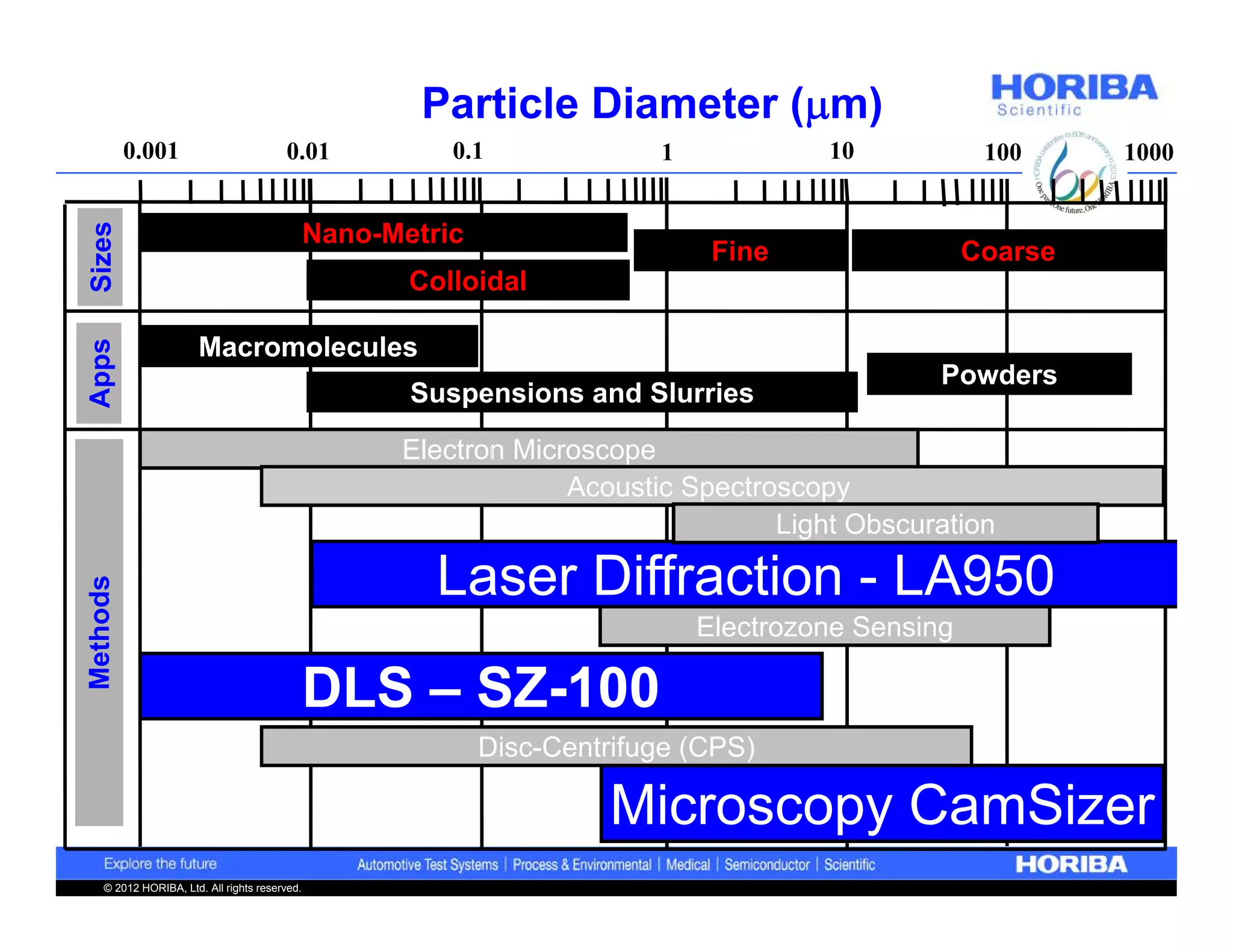
Particle Diameter (m)
          0.001                         0.01             0.1              1            10            100     1000


                                               Nano-Metric
Sizes


                                                                               Fine                 Coarse
                                                      Colloidal

                       Macromolecules
Apps


                                                                                                Powders
                                                      Suspensions and Slurries

                                                     Electron Microscope
                                                                  Acoustic Spectroscopy
                                                                                  Light Obscuration

                                                        Laser Diffraction - LA950
Methods


                                                                              Electrozone Sensing

                                               DLS – SZ-100
                                                             Disc-Centrifuge (CPS)

                                                                      Microscopy CamSizer
    © 2012 HORIBA, Ltd. All rights reserved.
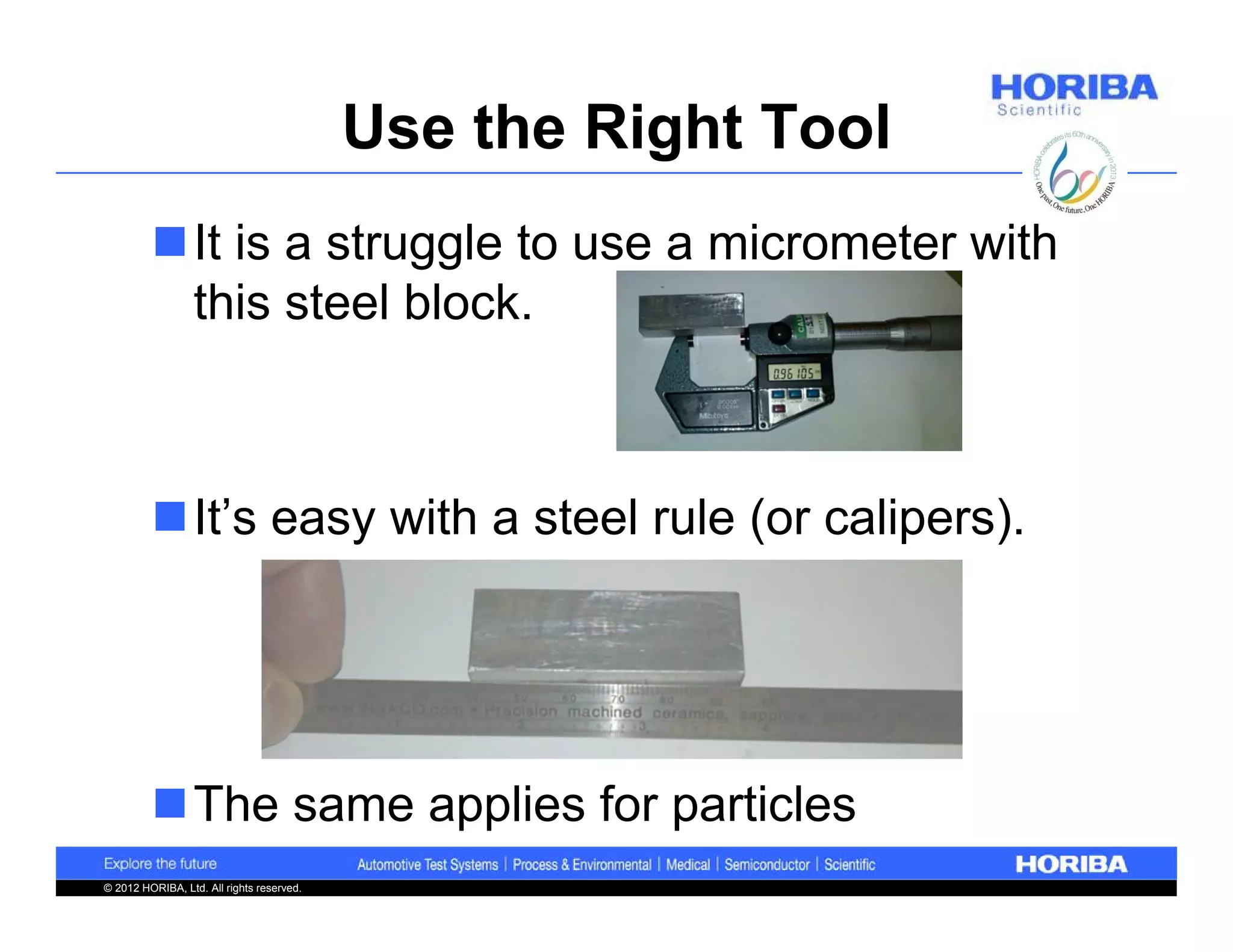
Use the Right Tool
         It is a struggle to use a micrometer with
          this steel block.


         It’s easy with a steel rule (or calipers).


         The same applies for particles
© 2012 HORIBA, Ltd. All rights reserved.
Particle Sizes over 1 micron
         Note that the upper limit of DLS is at 8
          microns. This depends on particle
          density and other factors.
         Rule of thumb: If your particles are
          routinely bigger than 1 micron, consider
          laser diffraction.
         Particles that are too big often appear
          as 10~20 microns in DLS results. You
          will not be trapped by big particles that
          seem small.
© 2012 HORIBA, Ltd. All rights reserved.
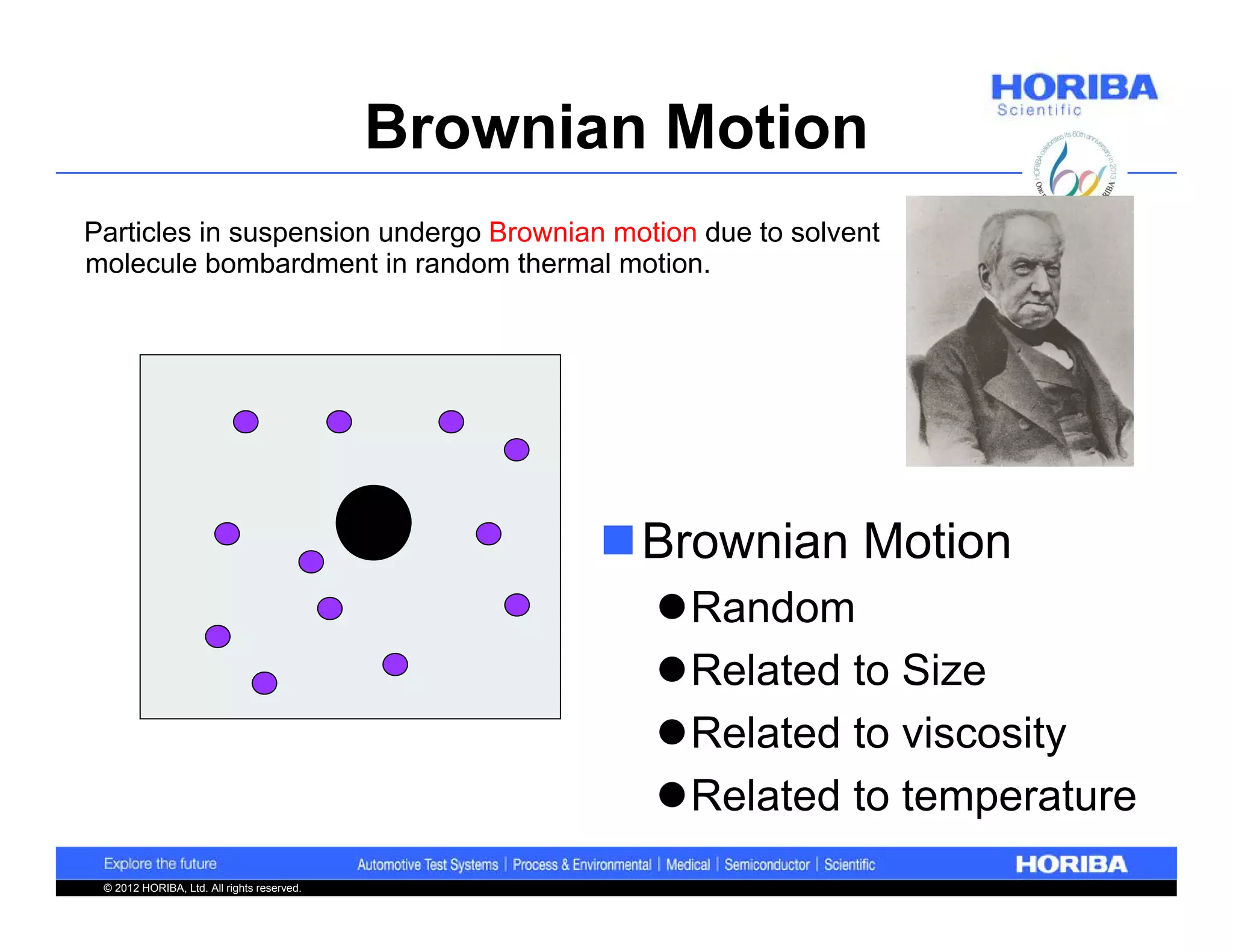
Brownian Motion
Particles in suspension undergo Brownian motion due to solvent
molecule bombardment in random thermal motion.


                                                   Brownian Motion
                                                     Random
                                                     Related to Size
                                                     Related to viscosity
                                                     Related to temperature
 © 2012 HORIBA, Ltd. All rights reserved.
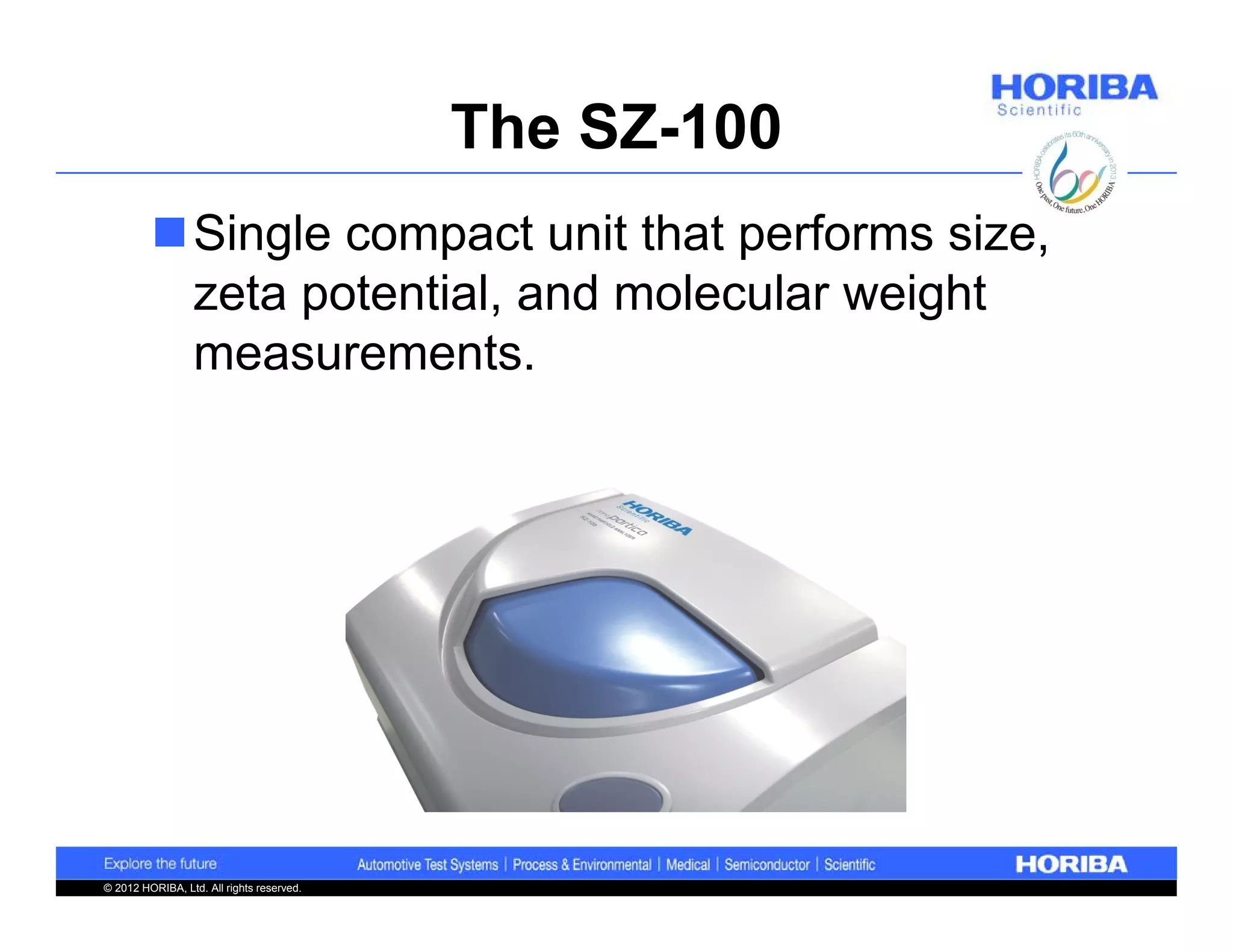
The SZ-100
         Single compact unit that performs size,
          zeta potential, and molecular weight
          measurements.


© 2012 HORIBA, Ltd. All rights reserved.
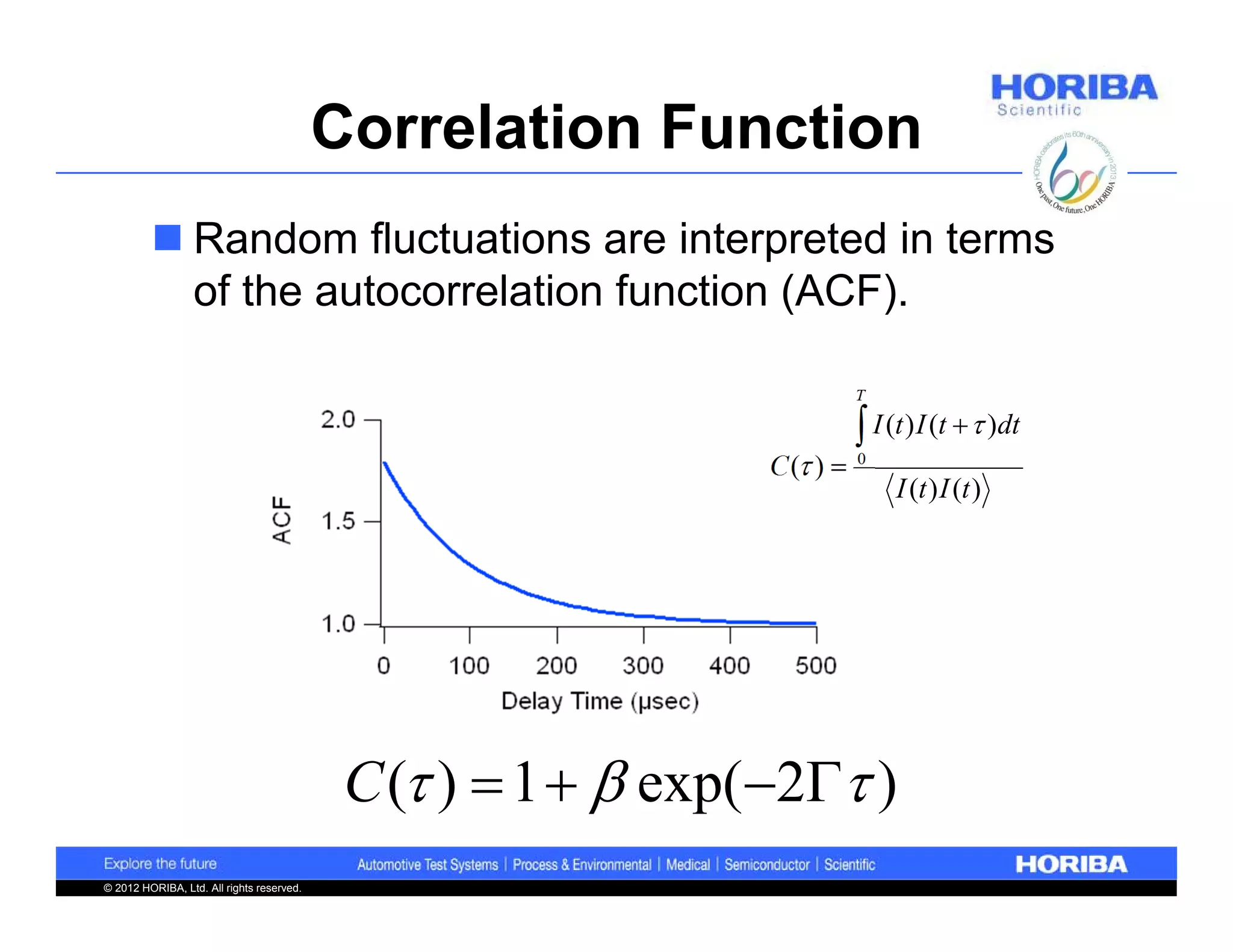
Correlation Function
          Random fluctuations are interpreted in terms
           of the autocorrelation function (ACF).

                                                                          T

                                                                           I (t ) I (t   )dt
                                                               C ( )    0
                                                                               I (t ) I (t )


                                            C ( )  1   exp(2 )
© 2012 HORIBA, Ltd. All rights reserved.
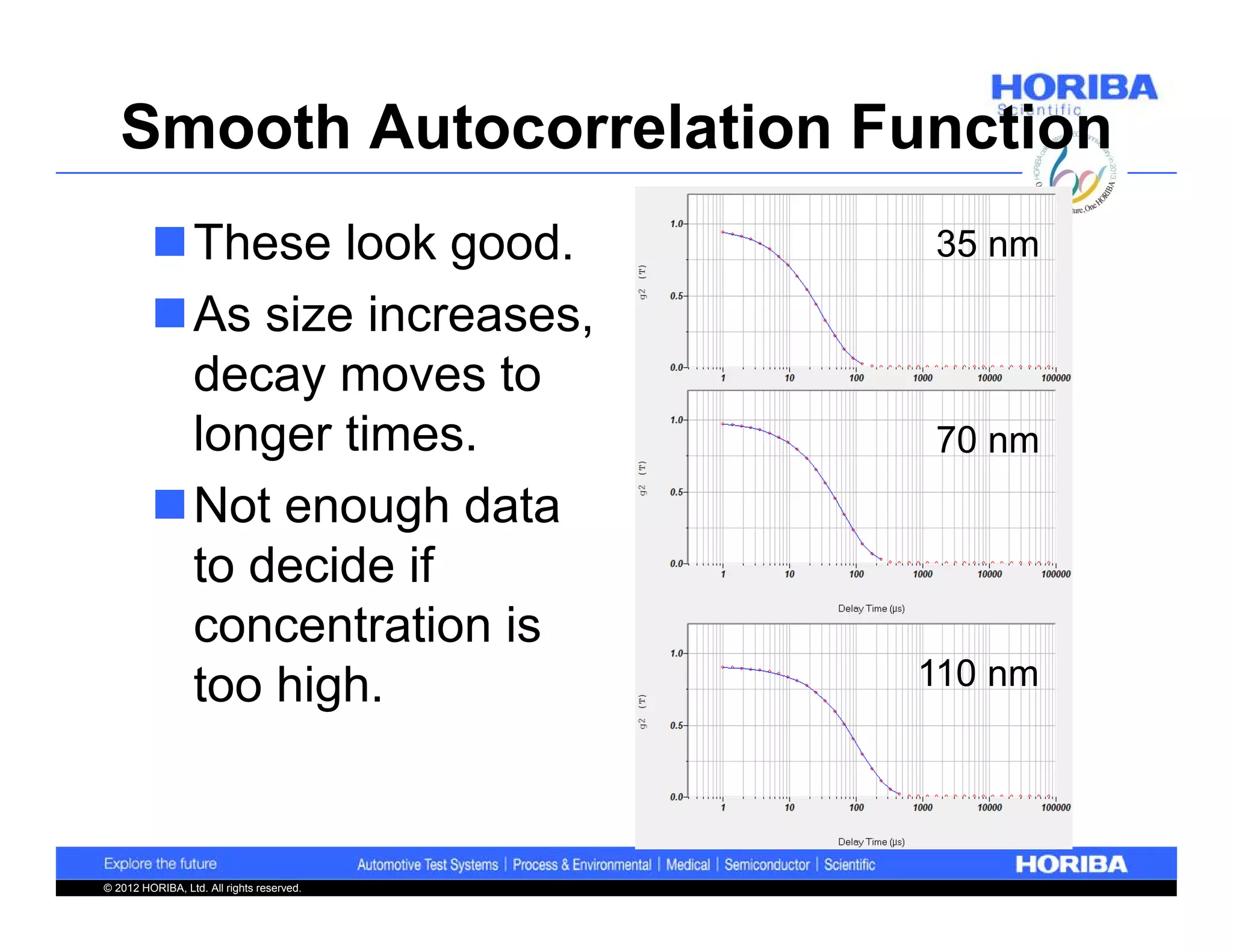
Smooth Autocorrelation Function
         These look good.                 35 nm
         As size increases,
          decay moves to
          longer times.                    70 nm
         Not enough data
          to decide if
          concentration is
          too high.                        110 nm


© 2012 HORIBA, Ltd. All rights reserved.
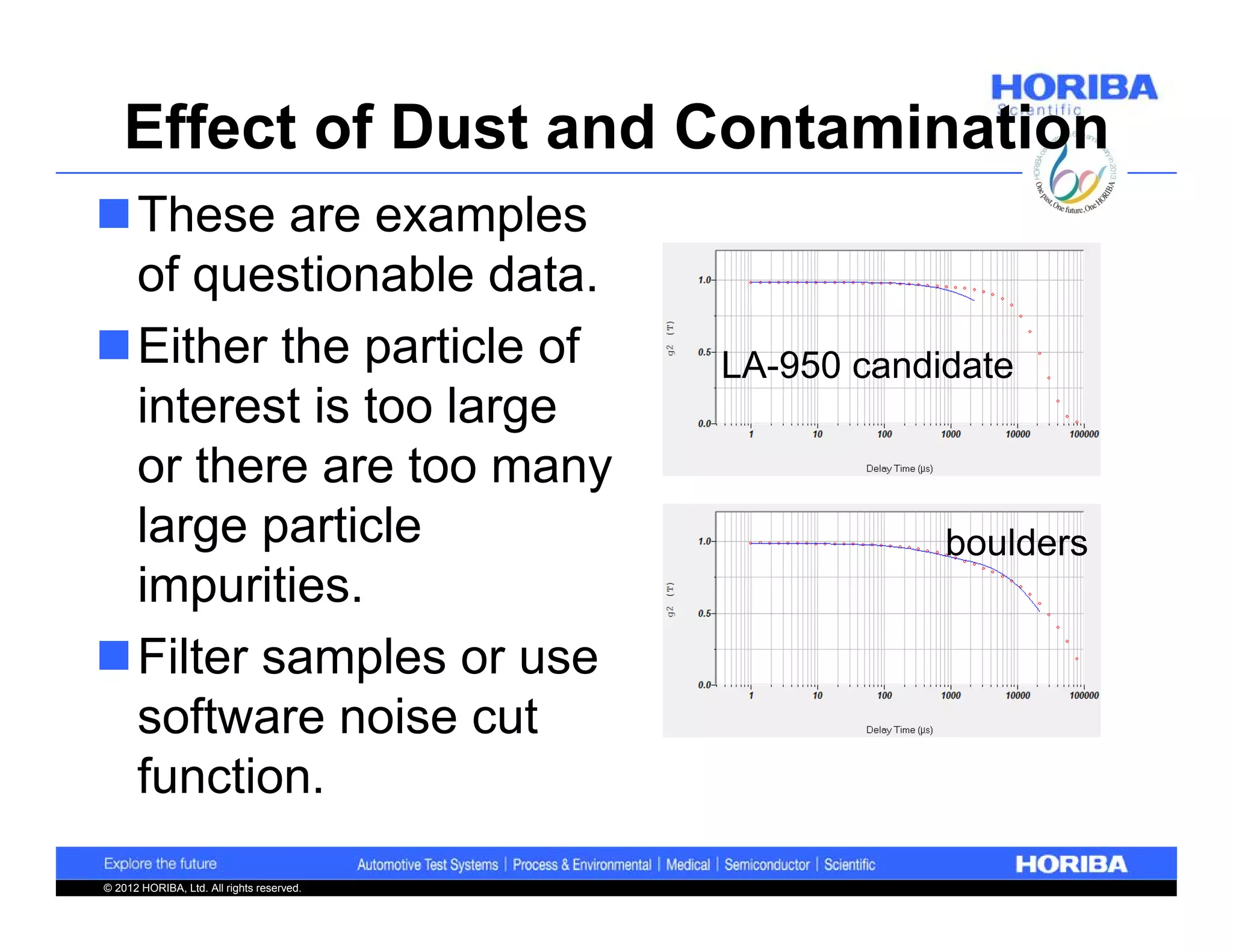
Effect of Dust and Contamination
These are examples
 of questionable data.
Either the particle of                    LA-950 candidate
 interest is too large
 or there are too many
 large particle                                        boulders
 impurities.
Filter samples or use
 software noise cut
 function.
© 2012 HORIBA, Ltd. All rights reserved.
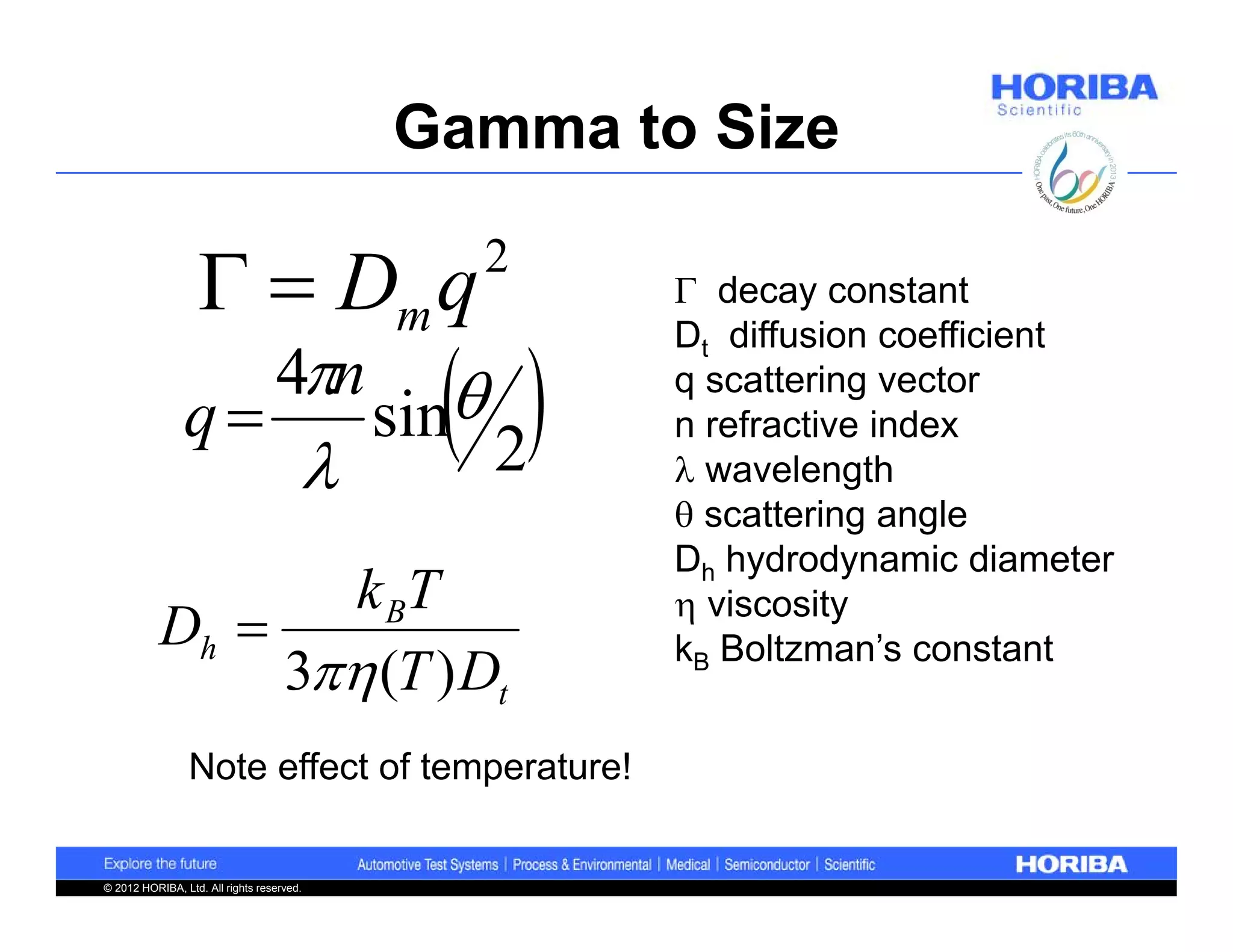
Gamma to Size

                     Dm q                       2
                                                       decay constant


                                              2
                                                      Dt diffusion coefficient
                                  4n
                                           sin
                                                      q scattering vector
                q                                    n refractive index
                                                      wavelength
                                                       scattering angle
                                                      Dh hydrodynamic diameter
                  k BT                                 viscosity
           Dh                                        kB Boltzman’s constant
                3 (T ) Dt
                 Note effect of temperature!


© 2012 HORIBA, Ltd. All rights reserved.
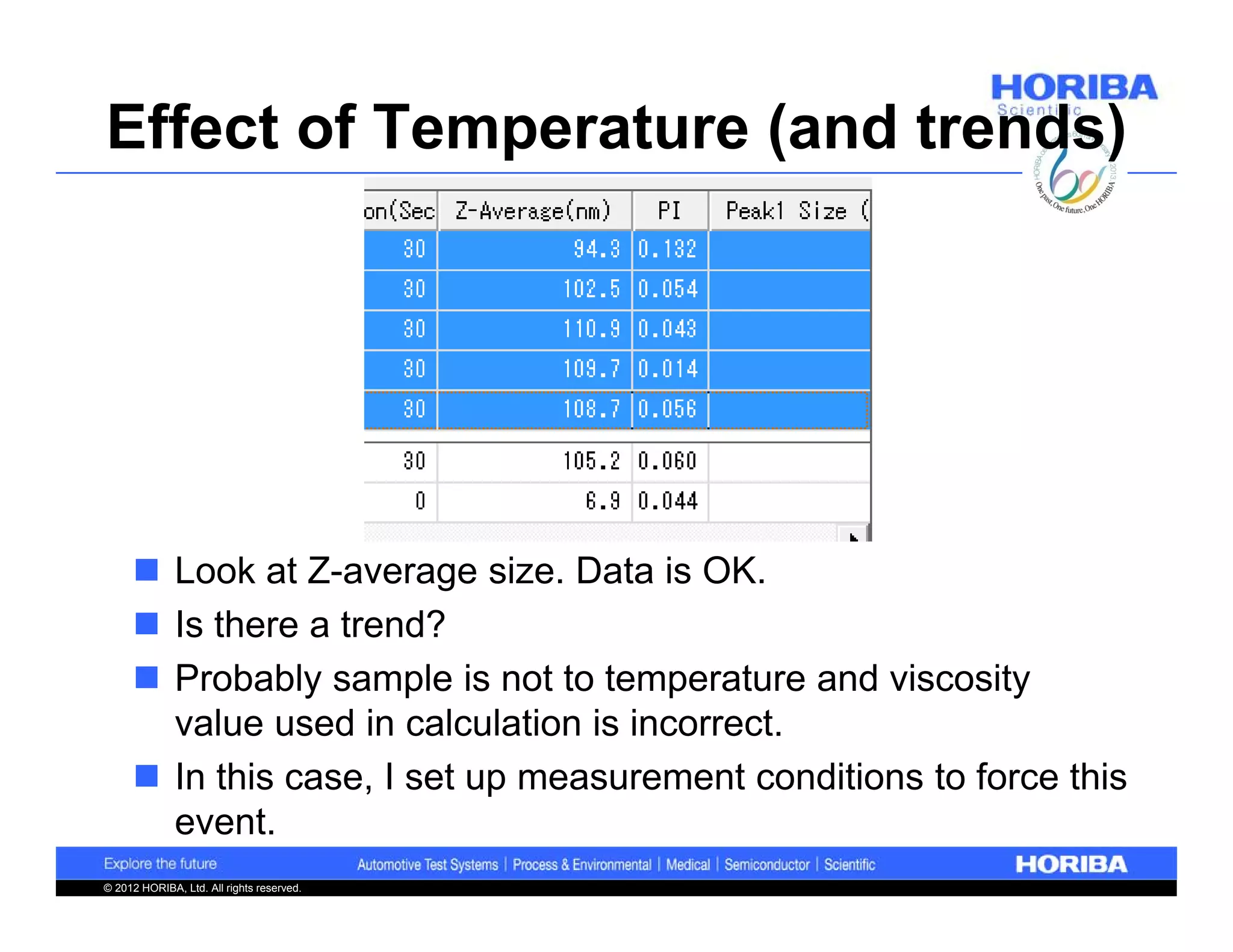
Effect of Temperature (and trends)


      Look at Z-average size. Data is OK.
      Is there a trend?
      Probably sample is not to temperature and viscosity
       value used in calculation is incorrect.
      In this case, I set up measurement conditions to force this
       event.
© 2012 HORIBA, Ltd. All rights reserved.
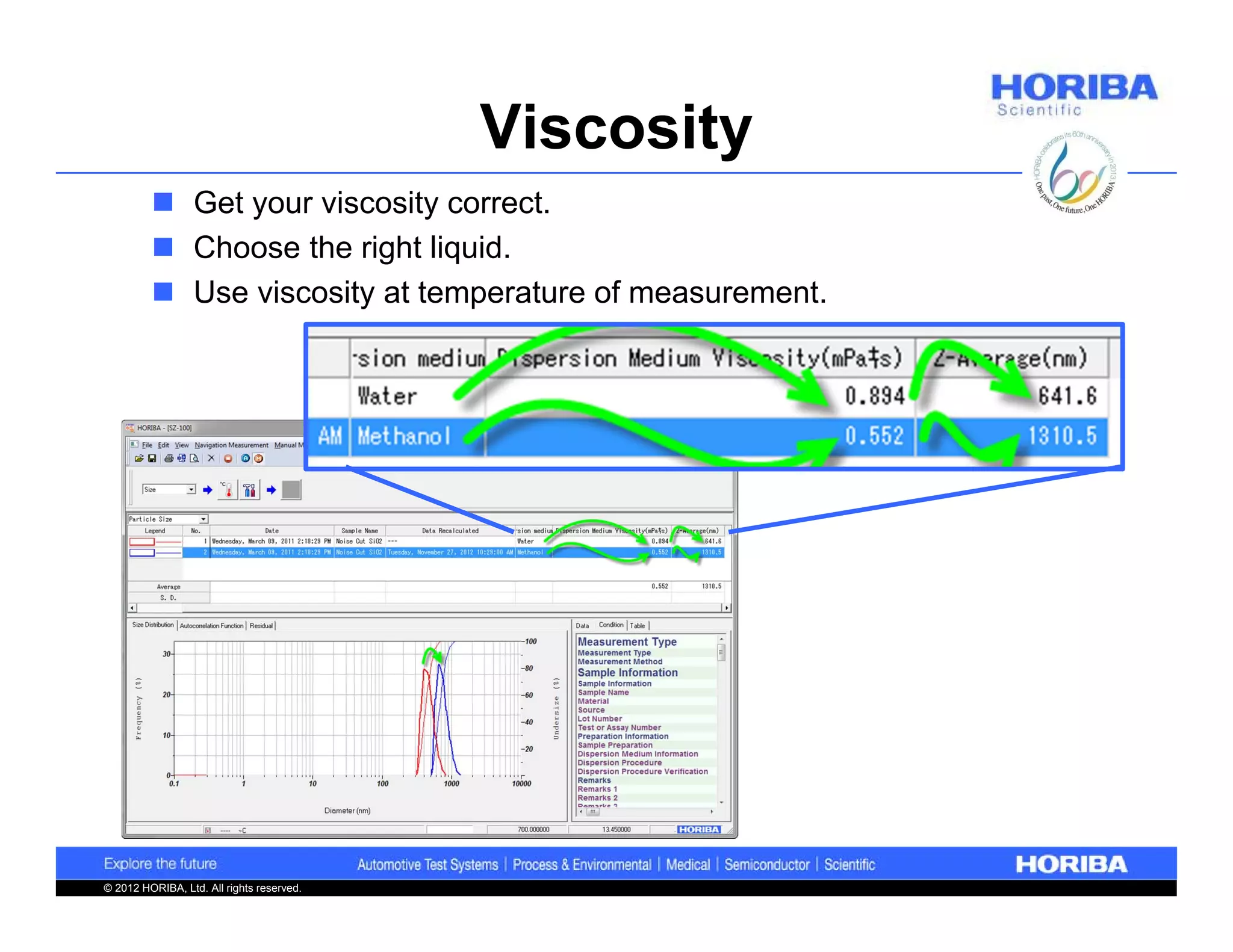
Viscosity
          Get your viscosity correct.
          Choose the right liquid.
          Use viscosity at temperature of measurement.


© 2012 HORIBA, Ltd. All rights reserved.
Why Z-average?
         Numerically stable
                    Result is not overly sensitive to noise in the
                     data.
                    Important for QC work
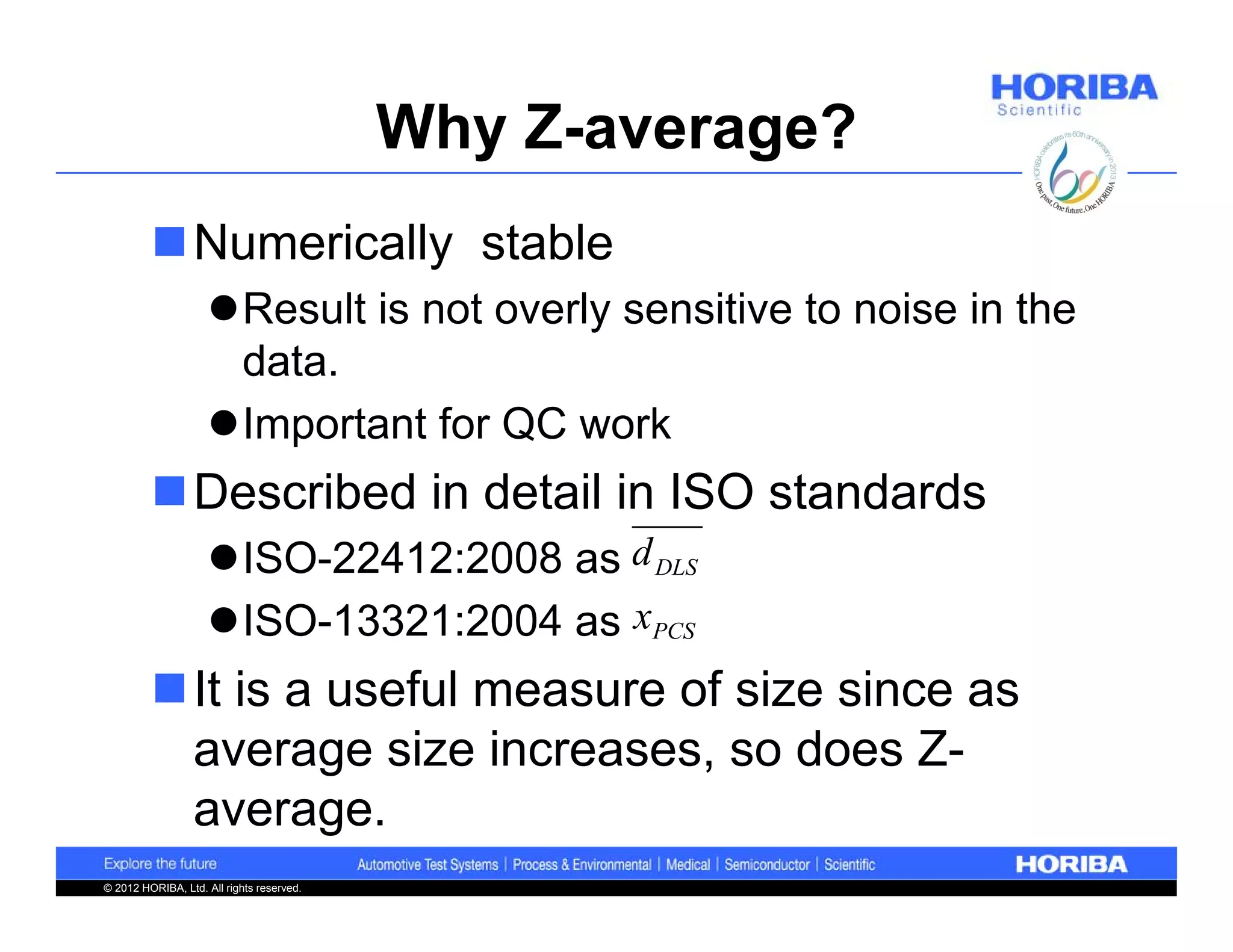
         Described in detail in ISO standards
                    ISO-22412:2008 as d DLS
                    ISO-13321:2004 as xPCS
         It is a useful measure of size since as
          average size increases, so does Z-
          average.
© 2012 HORIBA, Ltd. All rights reserved.
Huh? What is the Z-average?

                                   Determined by a mathematical method known as
                                                    cumulants.


© 2012 HORIBA, Ltd. All rights reserved.
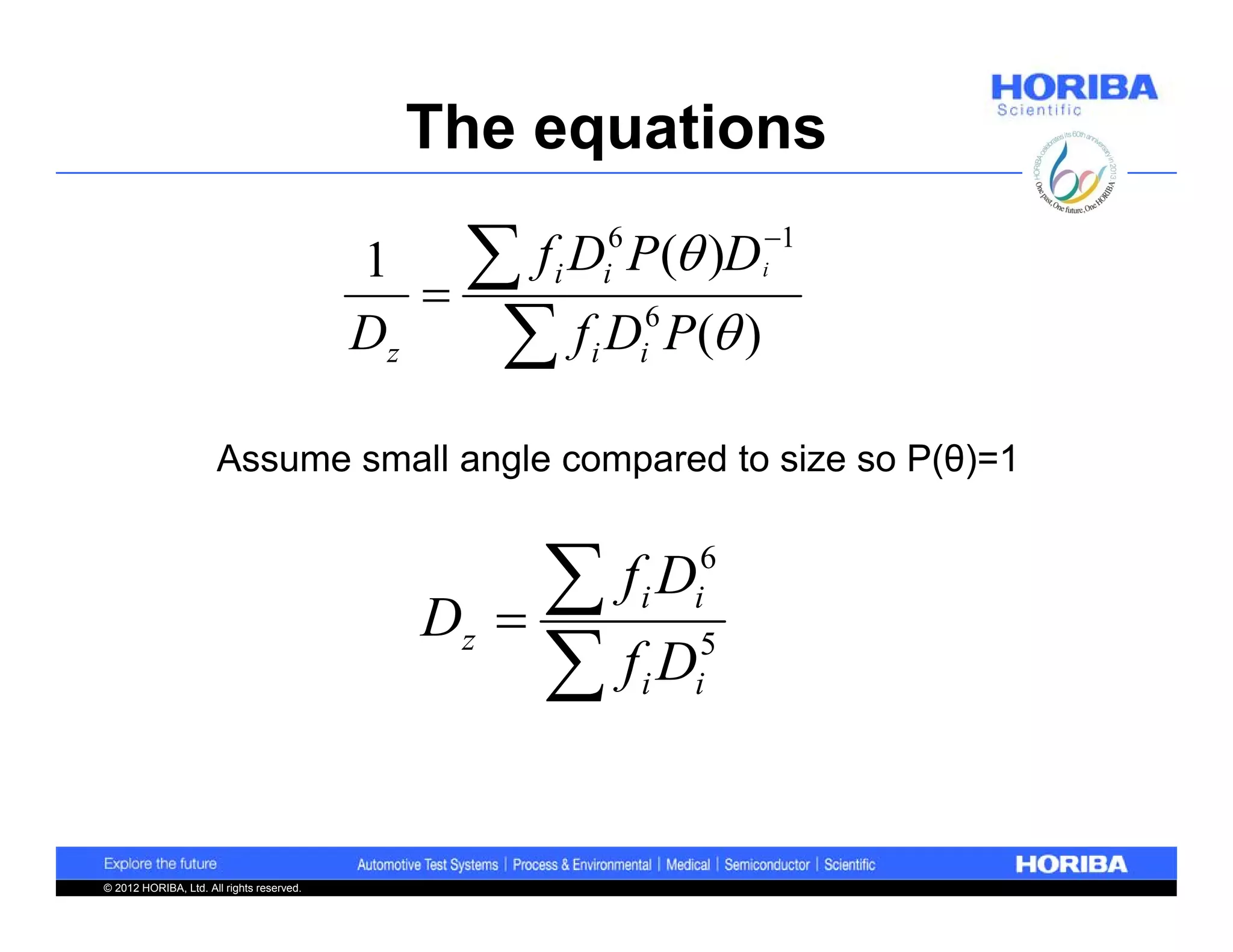
The equations

                                           1
                                              
                                                   f D P( )D
                                                     i       i
                                                              6             1
                                                                            i


                                           Dz       f D P( )
                                                         i        i
                                                                   6


                      Assume small angle compared to size so P(θ)=1


                                             Dz    
                                                     fD          i    i
                                                                        6


                                                     fD          i    i
                                                                        5


© 2012 HORIBA, Ltd. All rights reserved.
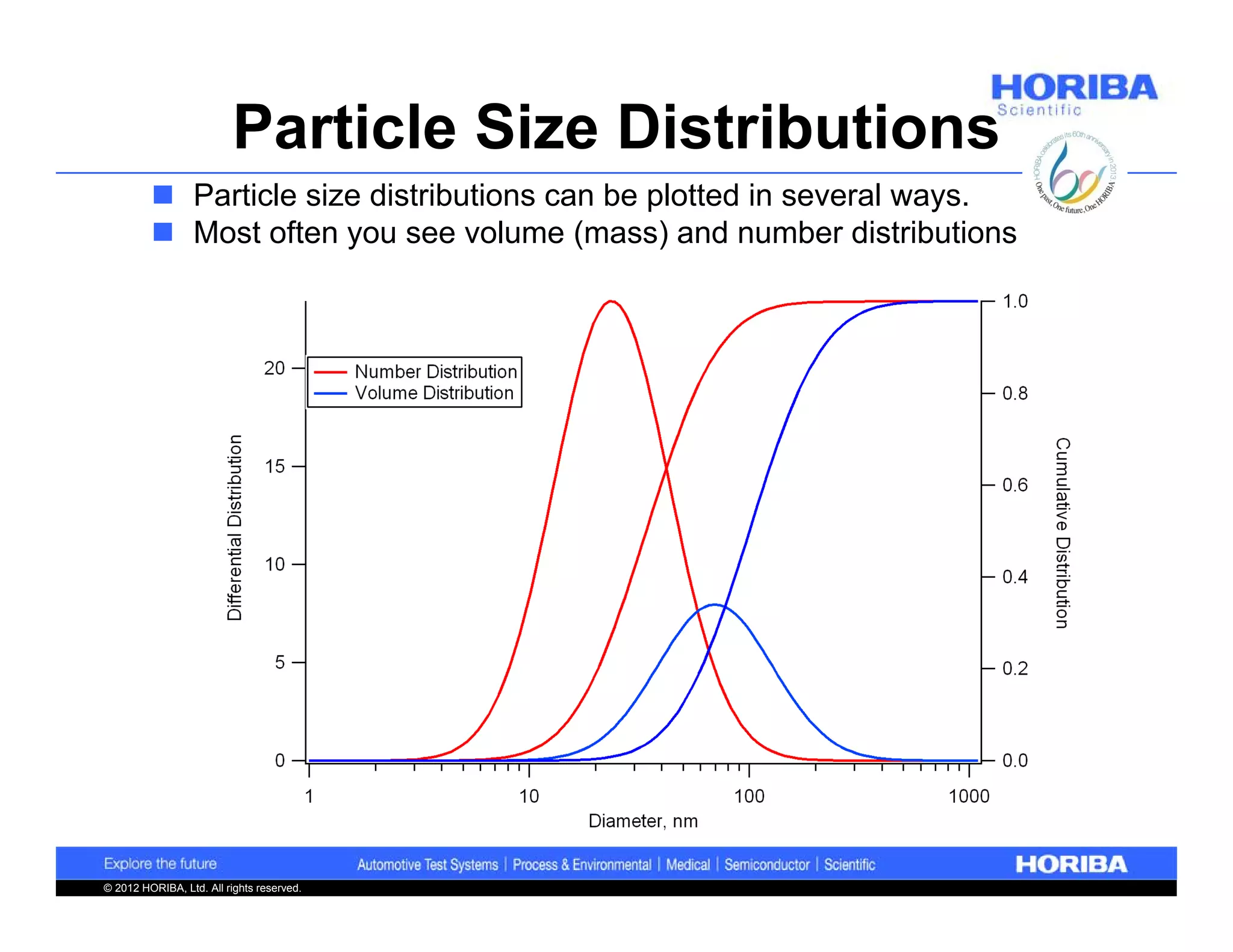
Particle Size Distributions
          Particle size distributions can be plotted in several ways.
          Most often you see volume (mass) and number distributions


© 2012 HORIBA, Ltd. All rights reserved.
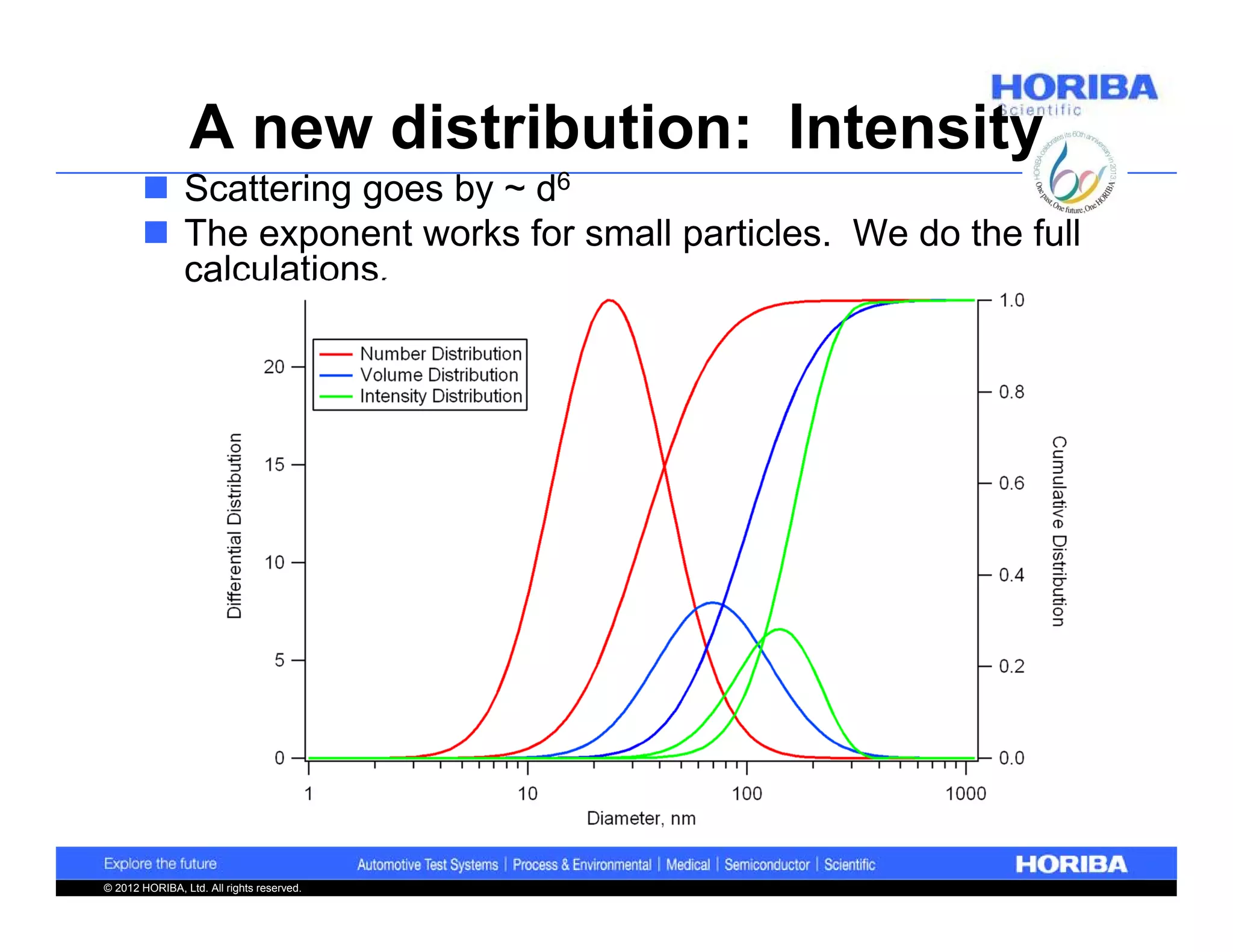
A new distribution: Intensity
        Scattering goes by ~ d6
        The exponent works for small particles. We do the full
         calculations.


© 2012 HORIBA, Ltd. All rights reserved.
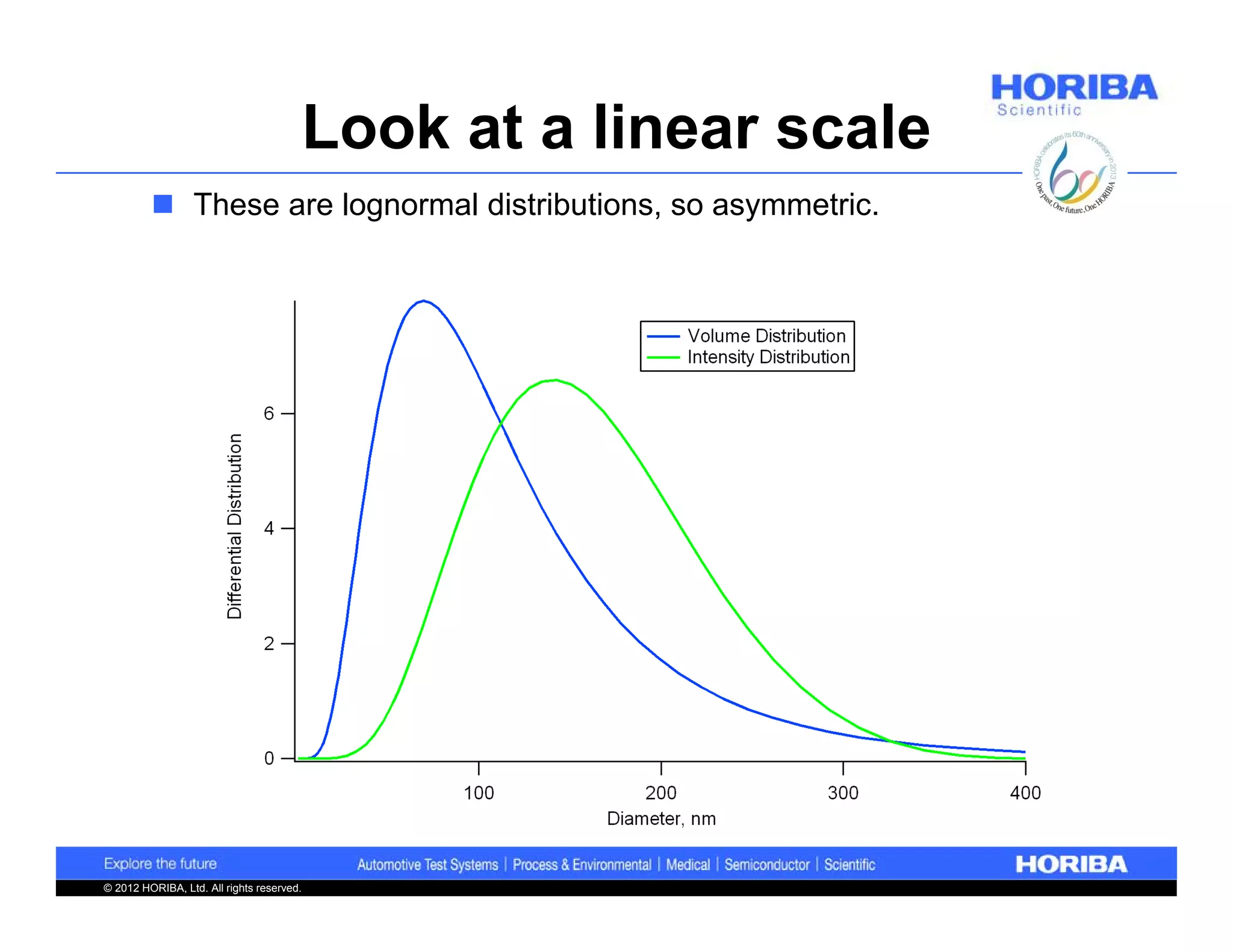
Look at a linear scale
          These are lognormal distributions, so asymmetric.


© 2012 HORIBA, Ltd. All rights reserved.
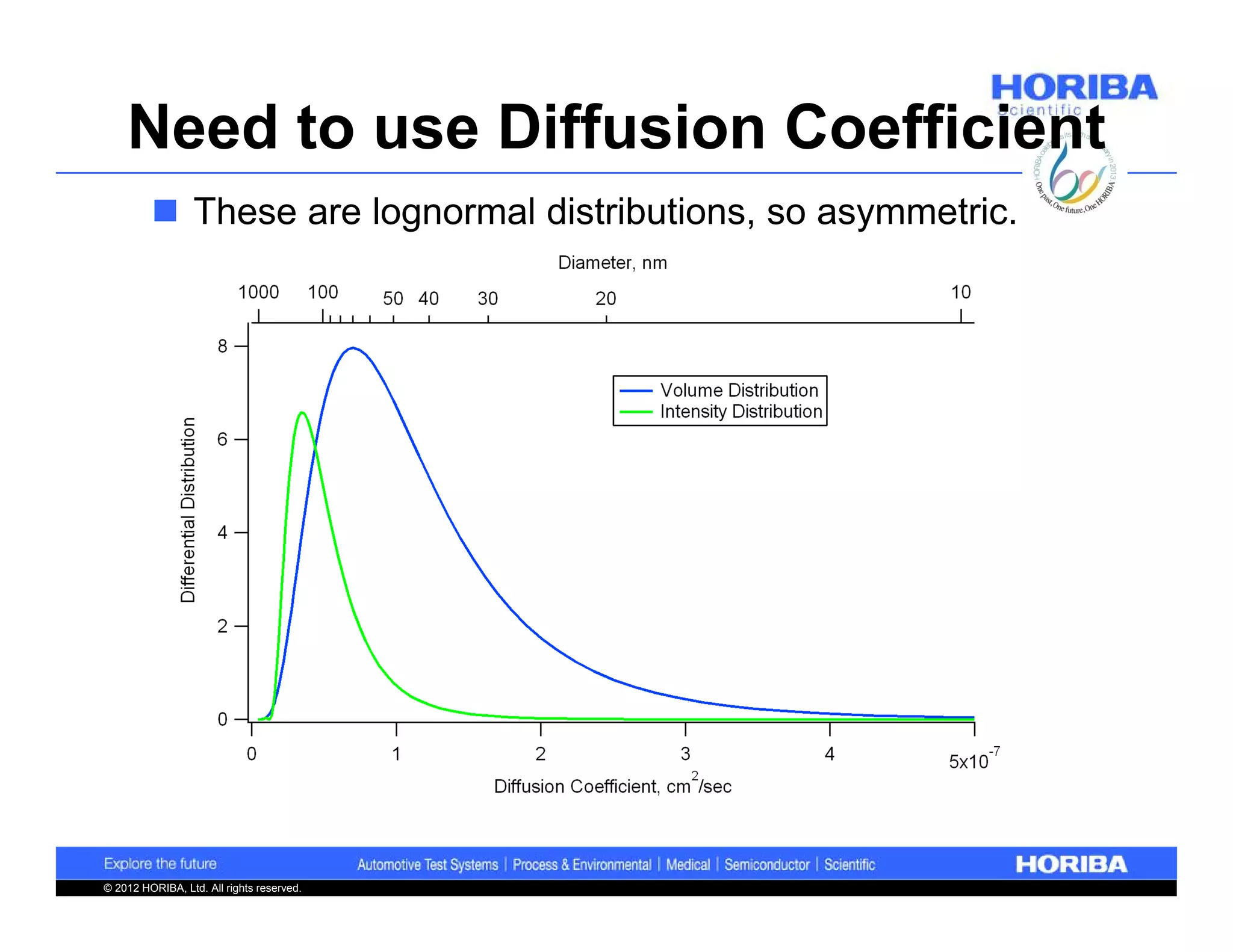
Need to use Diffusion Coefficient
          These are lognormal distributions, so asymmetric.


© 2012 HORIBA, Ltd. All rights reserved.
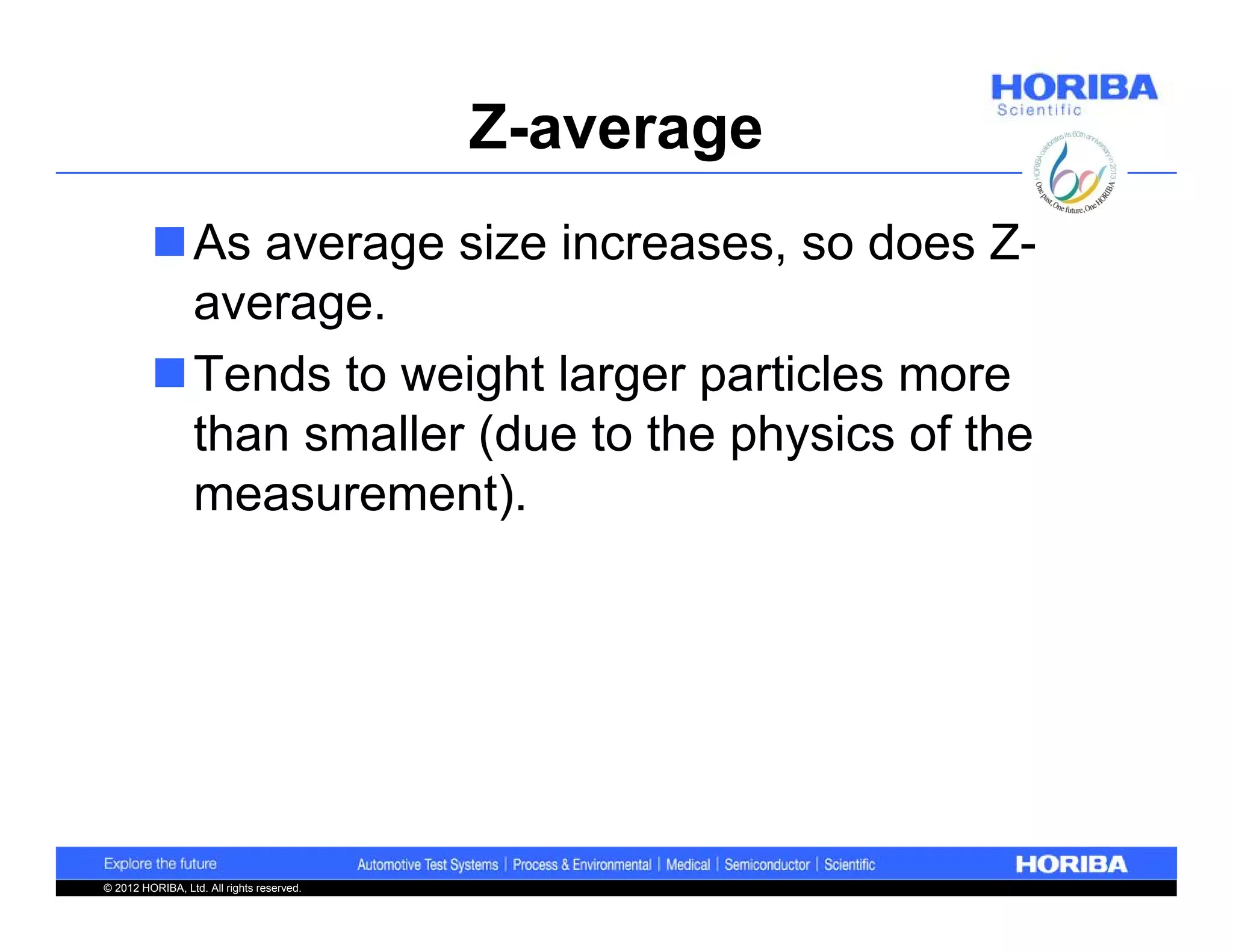
Z-average
         As average size increases, so does Z-
          average.
         Tends to weight larger particles more
          than smaller (due to the physics of the
          measurement).


© 2012 HORIBA, Ltd. All rights reserved.
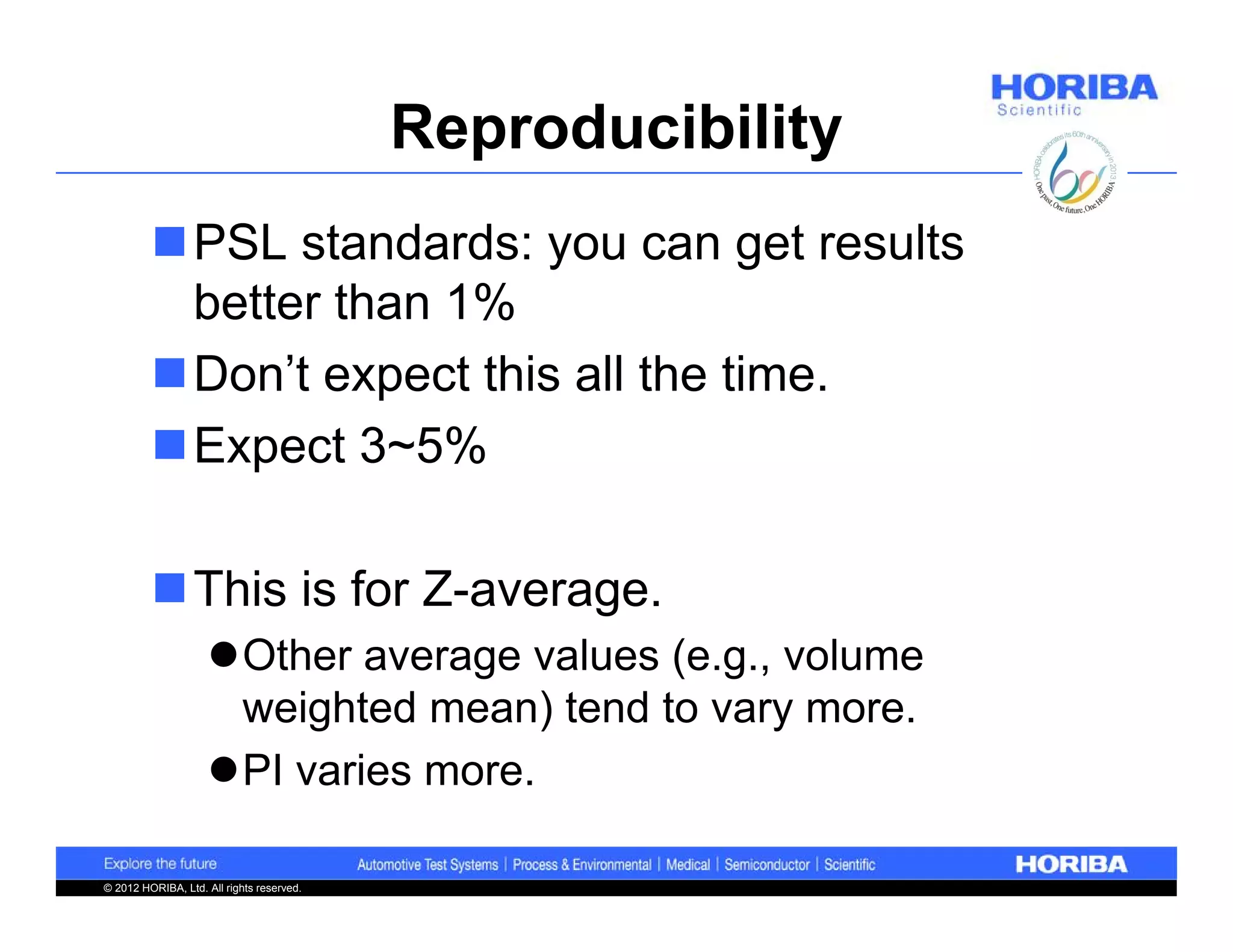
Reproducibility
         PSL standards: you can get results
          better than 1%
         Don’t expect this all the time.
         Expect 3~5%

         This is for Z-average.
                    Other average values (e.g., volume
                     weighted mean) tend to vary more.
                    PI varies more.

© 2012 HORIBA, Ltd. All rights reserved.
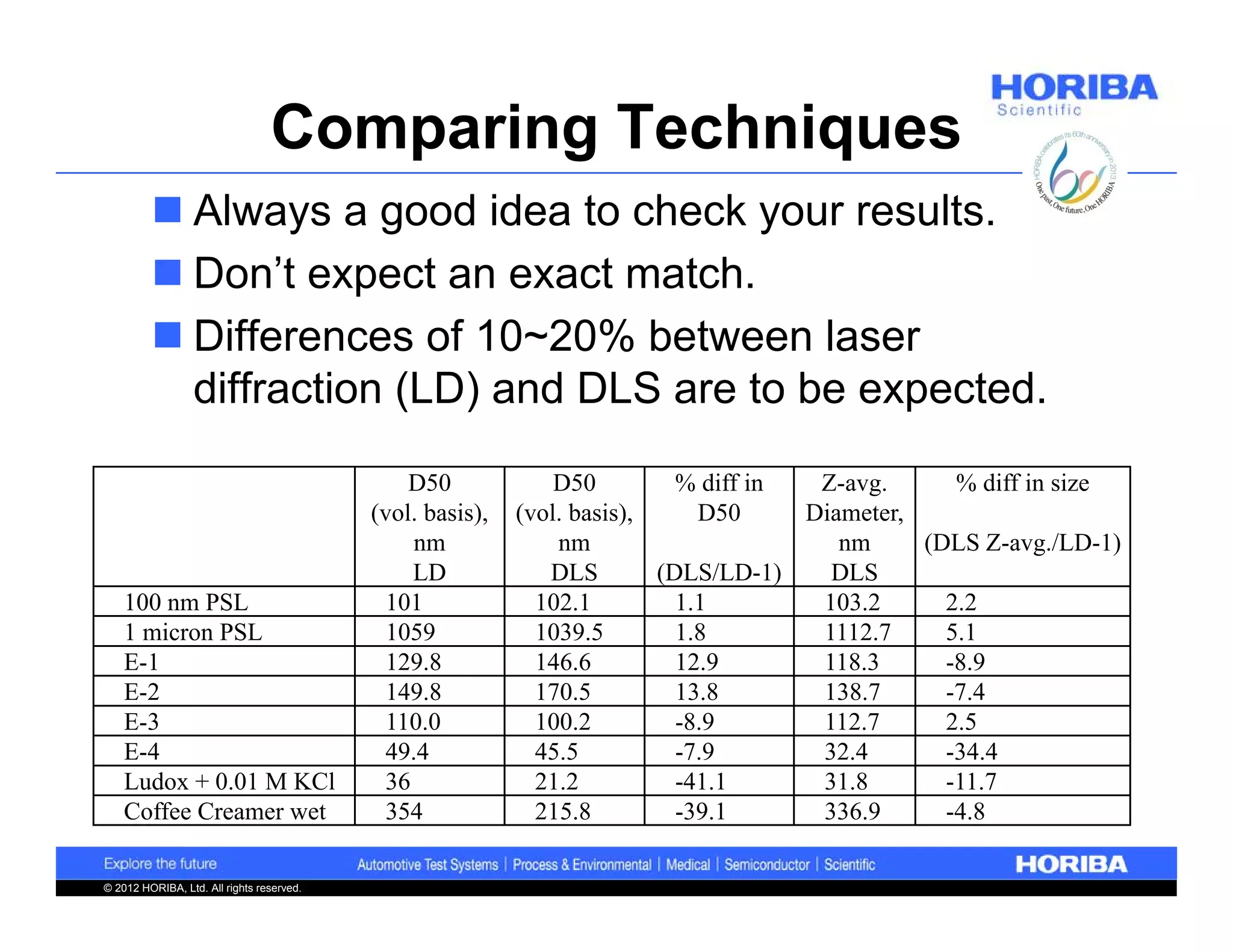
Comparing Techniques
          Always a good idea to check your results.
          Don’t expect an exact match.
          Differences of 10~20% between laser
           diffraction (LD) and DLS are to be expected.

                                               D50             D50         % diff in  Z-avg.      % diff in size
                                           (vol. basis),   (vol. basis),     D50     Diameter,
                                               nm              nm                       nm     (DLS Z-avg./LD-1)
                                               LD             DLS        (DLS/LD-1)    DLS
    100 nm PSL                               101             102.1         1.1        103.2      2.2
    1 micron PSL                             1059            1039.5        1.8        1112.7     5.1
    E-1                                     129.8            146.6         12.9       118.3      -8.9
    E-2                                     149.8            170.5         13.8       138.7      -7.4
    E-3                                     110.0            100.2         -8.9       112.7      2.5
    E-4                                     49.4             45.5          -7.9       32.4       -34.4
    Ludox + 0.01 M KCl                      36               21.2          -41.1      31.8       -11.7
    Coffee Creamer wet                       354             215.8         -39.1      336.9      -4.8

© 2012 HORIBA, Ltd. All rights reserved.
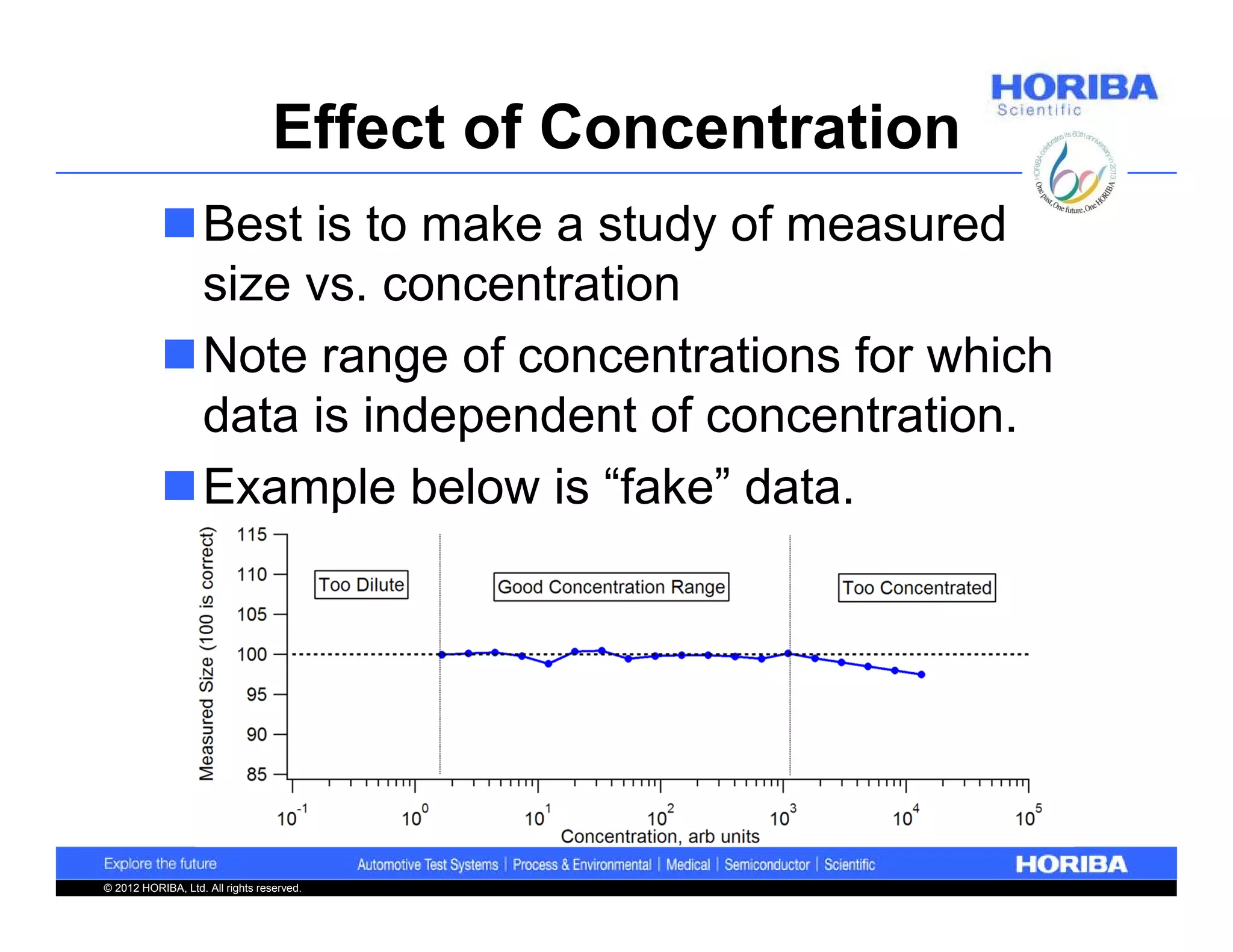
Effect of Concentration
           Best is to make a study of measured
            size vs. concentration
           Note range of concentrations for which
            data is independent of concentration.
           Example below is “fake” data.


© 2012 HORIBA, Ltd. All rights reserved.
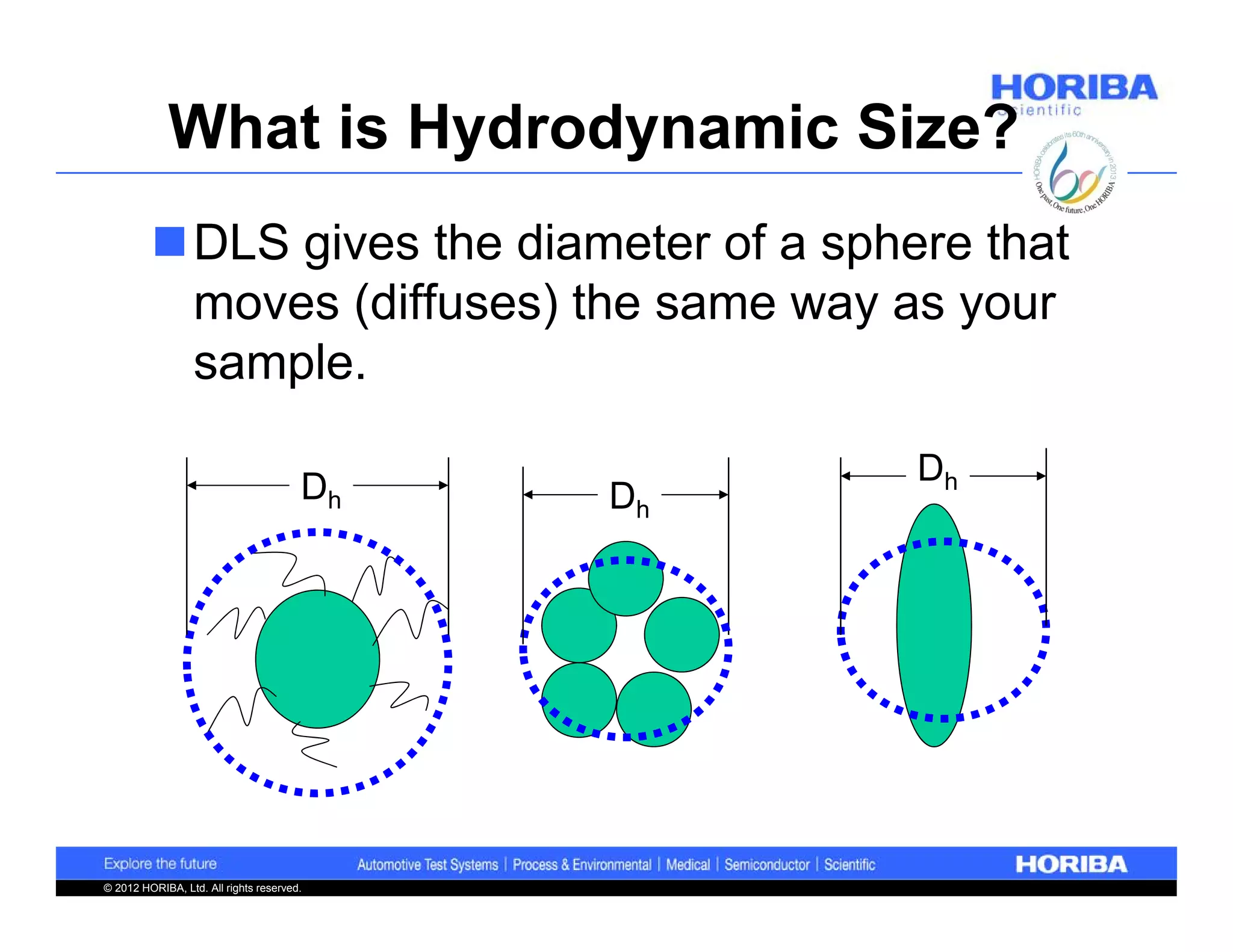
What is Hydrodynamic Size?
         DLS gives the diameter of a sphere that
          moves (diffuses) the same way as your
          sample.

                                                 Dh
                                       Dh   Dh


© 2012 HORIBA, Ltd. All rights reserved.
Why DLS?
         Non-invasive measurement
         Fast results
         Requires only small quantities of
          sample
         Good for detecting trace amounts of
          aggregate
         Good technique for macro-molecular
          sizing


© 2012 HORIBA, Ltd. All rights reserved.
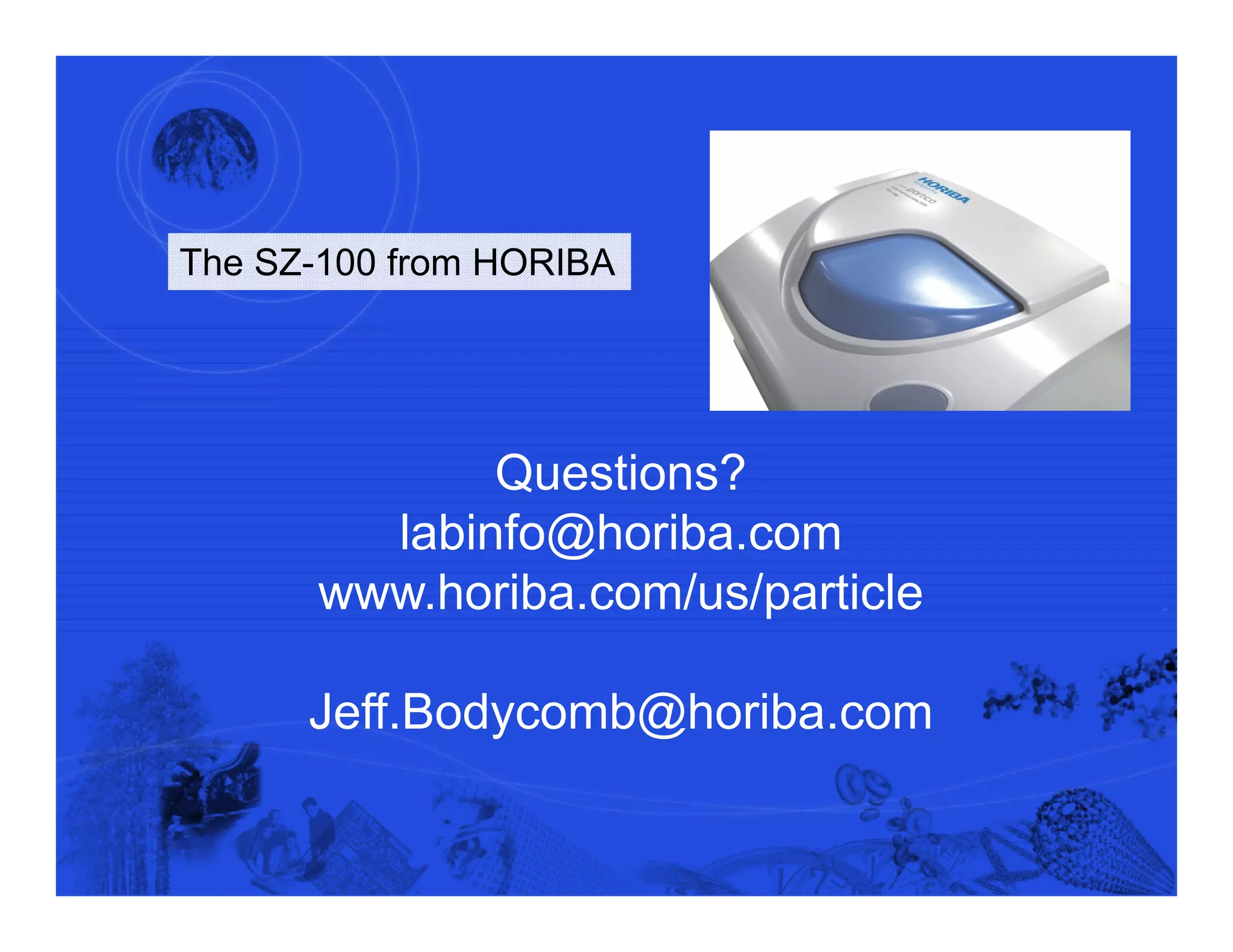
The SZ-100 from HORIBA


                                                  Questions?
                                             labinfo@horiba.com
                                           www.horiba.com/us/particle

                                           Jeff.Bodycomb@horiba.com


© 2012 HORIBA, Ltd. All rights reserved.
ありがとうございました
                                                                             Cảm ơn
                                                       ขอบคุณครับ      谢谢
                                           Gracias
   ُْ
  ‫اشكر‬                                                                         Grazie
                                 Σας ευχαριστούμε                   ध यवाद
Tacka dig                                                                    நன்ற
                                             Danke
                                                                               Obrigado
              감사합니다                                  Большое спасибо


© 2012 HORIBA, Ltd. All rights reserved.

Interpreting and Understanding Dynamic Light Scattering Size Data

  • 1.
    Interpreting and Understanding Dynamic Light Scattering Data Jeffrey Bodycomb, Ph.D. HORIBA Scientific www.horiba.com/us/particle © 2012 HORIBA, Ltd. All rights reserved.
  • 2.
    Outline “Kitchen sink” talk. I cover a range of topics with an emphasis on conclusions rather than derivations. Introduction Looking at the ACF Effect of temperature and what it means to you. The Z-average Effect of concentration Hydrodynamic size © 2012 HORIBA, Ltd. All rights reserved.
  • 3.
    What is DynamicLight Scattering? Dynamic light scattering refers to measurement and interpretation of light scattering data on a microsecond time scale. Dynamic light scattering can be used to determine Particle/molecular size Size distribution Relaxations in complex fluids © 2012 HORIBA, Ltd. All rights reserved.
  • 4.
    Particle Diameter (m) 0.001 0.01 0.1 1 10 100 1000 Nano-Metric Sizes Fine Coarse Colloidal Macromolecules Apps Powders Suspensions and Slurries Electron Microscope Acoustic Spectroscopy Light Obscuration Laser Diffraction - LA950 Methods Electrozone Sensing DLS – SZ-100 Disc-Centrifuge (CPS) Microscopy CamSizer © 2012 HORIBA, Ltd. All rights reserved.
  • 5.
    Use the RightTool It is a struggle to use a micrometer with this steel block. It’s easy with a steel rule (or calipers). The same applies for particles © 2012 HORIBA, Ltd. All rights reserved.
  • 6.
    Particle Sizes over1 micron Note that the upper limit of DLS is at 8 microns. This depends on particle density and other factors. Rule of thumb: If your particles are routinely bigger than 1 micron, consider laser diffraction. Particles that are too big often appear as 10~20 microns in DLS results. You will not be trapped by big particles that seem small. © 2012 HORIBA, Ltd. All rights reserved.
  • 7.
    Brownian Motion Particles insuspension undergo Brownian motion due to solvent molecule bombardment in random thermal motion. Brownian Motion Random Related to Size Related to viscosity Related to temperature © 2012 HORIBA, Ltd. All rights reserved.
  • 8.
    The SZ-100 Single compact unit that performs size, zeta potential, and molecular weight measurements. © 2012 HORIBA, Ltd. All rights reserved.
  • 9.
    Correlation Function  Random fluctuations are interpreted in terms of the autocorrelation function (ACF). T  I (t ) I (t   )dt C ( )  0 I (t ) I (t ) C ( )  1   exp(2 ) © 2012 HORIBA, Ltd. All rights reserved.
  • 10.
    Smooth Autocorrelation Function These look good. 35 nm As size increases, decay moves to longer times. 70 nm Not enough data to decide if concentration is too high. 110 nm © 2012 HORIBA, Ltd. All rights reserved.
  • 11.
    Effect of Dustand Contamination These are examples of questionable data. Either the particle of LA-950 candidate interest is too large or there are too many large particle boulders impurities. Filter samples or use software noise cut function. © 2012 HORIBA, Ltd. All rights reserved.
  • 12.
    Gamma to Size   Dm q 2  decay constant  2 Dt diffusion coefficient 4n sin q scattering vector q n refractive index   wavelength  scattering angle Dh hydrodynamic diameter k BT  viscosity Dh  kB Boltzman’s constant 3 (T ) Dt Note effect of temperature! © 2012 HORIBA, Ltd. All rights reserved.
  • 13.
    Effect of Temperature(and trends)  Look at Z-average size. Data is OK.  Is there a trend?  Probably sample is not to temperature and viscosity value used in calculation is incorrect.  In this case, I set up measurement conditions to force this event. © 2012 HORIBA, Ltd. All rights reserved.
  • 14.
    Viscosity  Get your viscosity correct.  Choose the right liquid.  Use viscosity at temperature of measurement. © 2012 HORIBA, Ltd. All rights reserved.
  • 15.
    Why Z-average? Numerically stable Result is not overly sensitive to noise in the data. Important for QC work Described in detail in ISO standards ISO-22412:2008 as d DLS ISO-13321:2004 as xPCS It is a useful measure of size since as average size increases, so does Z- average. © 2012 HORIBA, Ltd. All rights reserved.
  • 16.
    Huh? What isthe Z-average? Determined by a mathematical method known as cumulants. © 2012 HORIBA, Ltd. All rights reserved.
  • 17.
    The equations 1   f D P( )D i i 6 1 i Dz  f D P( ) i i 6 Assume small angle compared to size so P(θ)=1 Dz  fD i i 6 fD i i 5 © 2012 HORIBA, Ltd. All rights reserved.
  • 18.
    Particle Size Distributions  Particle size distributions can be plotted in several ways.  Most often you see volume (mass) and number distributions © 2012 HORIBA, Ltd. All rights reserved.
  • 19.
    A new distribution:Intensity  Scattering goes by ~ d6  The exponent works for small particles. We do the full calculations. © 2012 HORIBA, Ltd. All rights reserved.
  • 20.
    Look at alinear scale  These are lognormal distributions, so asymmetric. © 2012 HORIBA, Ltd. All rights reserved.
  • 21.
    Need to useDiffusion Coefficient  These are lognormal distributions, so asymmetric. © 2012 HORIBA, Ltd. All rights reserved.
  • 22.
    Z-average As average size increases, so does Z- average. Tends to weight larger particles more than smaller (due to the physics of the measurement). © 2012 HORIBA, Ltd. All rights reserved.
  • 23.
    Reproducibility PSL standards: you can get results better than 1% Don’t expect this all the time. Expect 3~5% This is for Z-average. Other average values (e.g., volume weighted mean) tend to vary more. PI varies more. © 2012 HORIBA, Ltd. All rights reserved.
  • 24.
    Comparing Techniques  Always a good idea to check your results.  Don’t expect an exact match.  Differences of 10~20% between laser diffraction (LD) and DLS are to be expected. D50 D50 % diff in Z-avg. % diff in size (vol. basis), (vol. basis), D50 Diameter, nm nm nm (DLS Z-avg./LD-1) LD DLS (DLS/LD-1) DLS 100 nm PSL 101 102.1 1.1 103.2 2.2 1 micron PSL 1059 1039.5 1.8 1112.7 5.1 E-1 129.8 146.6 12.9 118.3 -8.9 E-2 149.8 170.5 13.8 138.7 -7.4 E-3 110.0 100.2 -8.9 112.7 2.5 E-4 49.4 45.5 -7.9 32.4 -34.4 Ludox + 0.01 M KCl 36 21.2 -41.1 31.8 -11.7 Coffee Creamer wet 354 215.8 -39.1 336.9 -4.8 © 2012 HORIBA, Ltd. All rights reserved.
  • 25.
    Effect of Concentration Best is to make a study of measured size vs. concentration Note range of concentrations for which data is independent of concentration. Example below is “fake” data. © 2012 HORIBA, Ltd. All rights reserved.
  • 26.
    What is HydrodynamicSize? DLS gives the diameter of a sphere that moves (diffuses) the same way as your sample. Dh Dh Dh © 2012 HORIBA, Ltd. All rights reserved.
  • 27.
    Why DLS? Non-invasive measurement Fast results Requires only small quantities of sample Good for detecting trace amounts of aggregate Good technique for macro-molecular sizing © 2012 HORIBA, Ltd. All rights reserved.
  • 28.
    The SZ-100 fromHORIBA Questions? labinfo@horiba.com www.horiba.com/us/particle Jeff.Bodycomb@horiba.com © 2012 HORIBA, Ltd. All rights reserved.
  • 29.
    ありがとうございました Cảm ơn ขอบคุณครับ 谢谢 Gracias ُْ ‫اشكر‬ Grazie Σας ευχαριστούμε ध यवाद Tacka dig நன்ற Danke Obrigado 감사합니다 Большое спасибо © 2012 HORIBA, Ltd. All rights reserved.