JSPM’S Jayawantrao Sawant CollegeOf Engineering, Hadapsar, Pune
28
Department of Computer EngineeringThird
Year (A.Y. 2023 – 2024)
310255 : Internship
Presented by –
Student Name – Swapnil Bansode
Roll number : 3204
Guided by – Dr. Mansi Bhonsle
Computer Dept.
JSPM’s JSCO
Contents / Agenda
• Acknowledgement
• Internship Offer Letter
• Abstract
• Introduction.
•Title/Problem statement/Objectives.
• Motivation/Scope and rationale of the study.
• Methodological Details
• Results/ Analysis / Inferences .
• Suggestions/ Recommendations for improvement to industry.
• Attendance Record/ weekly Report
• List of Reference (Library books, magazines and other sources).
• Internship Place Details.
• Internship completion certificate.
• Conclusion
Course Objectives
• To encourage and provide opportunities for students to
get professional/personal experience through
internships.
• To learn and understand real life/industrial situations.
• To get familiar with various tools and technologies used
in industries and their applications.
• To nurture professional and societal ethics.
• To create awareness of social, economic and
administrative considerations in the working
environment of industry organizations.
Course Outcomes
 CO1:To demonstrate professional competence through
industry internship.
 CO2:To apply knowledge gained through internships to
complete academic activities in a professional manner.
 CO3:To choose appropriate technology and tools to solve
given problem.
 CO4:To demonstrate abilities of a responsible professional
and use ethical practices in day-to-day life.
 CO5: Create network and social circle and developing
relationships with industry people.
 CO6:To analyze various career opportunities and decide
carrier goals
Duration
Internship is to be completed after semester 5 and before
commencement of semester 6 of at least 4 to 6 weeks; and it
is to be assessed and evaluated in semester 6.
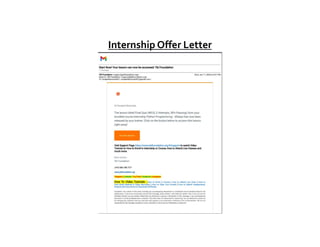
Internship Offer Letter
Abstract
Python currently is one of the most popular programming
languages, and as such, it has become vital for students to
understand this concept in this language.
Throughout the course, emphasis is placed on practical
application, with hands-on exercises and coding assignments
reinforcing theoretical concepts.
By completing the YBI Foundation Python with DSA course,
students gain valuable skills that are highly sought after in the
technology industry.
Whether pursuing a career in software development, data
analysis, or artificial intelligence, graduates of the course are
well-prepared to tackle complex programming tasks and excel in
their chosen fields.
Title/Problem statement/Objectives.
1. To provide students with a solid foundation in Python programming
language, covering fundamental syntax, control structures, and object-
oriented programming principles.
2. To introduce students to essential data structures such as arrays, linked
lists, stacks, queues, trees, and graphs, and elucidate their applications in
solving real-world problems.
3. To familiarize students with fundamental algorithms and algorithmic
techniques including sorting, searching, recursion, and dynamic
programming.
4. To cultivate algorithmic thinking and problem-solving skills among
students, enabling them to approach computational challenges
systematically and efficiently.
Motivation/Scope and rationale of the study.
The motivation behind theYBI Foundation Python with Data Structures and
Algorithms (DSA) course stems from the increasing demand for individuals skilled in
programming and algorithmic problem-solving across various industries.
The scope of theYBI Foundation Python with DSA course is multifaceted,
encompassing both theoretical knowledge and practical application.
The rationale behind the study lies in the recognition of Python's widespread
adoption and versatility, making it an ideal language for beginners and experienced
programmers alike.
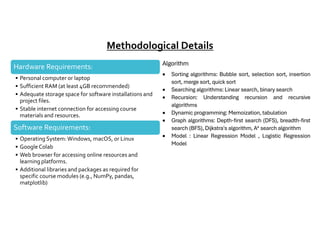
Methodological Details
Algorithm
 Sorting algorithms: Bubble sort, selection sort, insertion
sort, merge sort, quick sort
 Searching algorithms: Linear search, binary search
 Recursion: Understanding recursion and recursive
algorithms
 Dynamic programming: Memoization, tabulation
 Graph algorithms: Depth-first search (DFS), breadth-first
search (BFS), Dijkstra's algorithm, A* search algorithm
 Model : Linear Regression Model , Logistic Regression
Model
Hardware Requirements:
• Personal computer or laptop
• Sufficient RAM (at least 4GB recommended)
• Adequate storage space for software installations and
project files.
• Stable internet connection for accessing course
materials and resources.
Software Requirements:
• Operating System:Windows, macOS, or Linux
• Google Colab
• Web browser for accessing online resources and
learning platforms.
• Additional libraries and packages as required for
specific course modules (e.g., NumPy, pandas,
matplotlib)
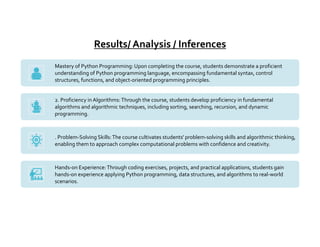
Results/ Analysis / Inferences
Mastery of Python Programming: Upon completing the course, students demonstrate a proficient
understanding of Python programming language, encompassing fundamental syntax, control
structures, functions, and object-oriented programming principles.
2. Proficiency in Algorithms:Through the course, students develop proficiency in fundamental
algorithms and algorithmic techniques, including sorting, searching, recursion, and dynamic
programming.
. Problem-Solving Skills:The course cultivates students' problem-solving skills and algorithmic thinking,
enabling them to approach complex computational problems with confidence and creativity.
Hands-on Experience:Through coding exercises, projects, and practical applications, students gain
hands-on experience applying Python programming, data structures, and algorithms to real-world
scenarios.
Suggestions/ Recommendations for
improvement to industry.
Enhance Practical Application: Increase the focus on hands-on, practical
learning experiences by including more coding exercises, projects, and
real-world applications.
Provide Industry-Relevant Case Studies: Integrate industry-relevant case
studies and examples into the course curriculum to illustrate how Python
programming and DSA concepts are applied in real-world scenarios.
Incorporate Feedback Mechanisms: Implement feedback mechanisms to
gather input from students regarding their learning experiences, course
content, and areas for improvement.
Weekly
Report
NameOFTHETOPIC/MODULECOMPLETED
Day
Date
Week 1
Introduction
Monday
18-12-2023
Scope of AI and Data Skills
Wednesday
20-12-2023
Internship Class 1(Introduction to Python)
Friday
22-12-2023
Week 2
Internship Class 2(Introduction to Google Colab)
Monday
25-12-2023
Python Libraries
Wednesday
27-12-2023
Read Data As DataFrame, Explore DataFrame
Friday
29-12-2023
Week 3
Create Kaggle Account
Monday
01-01-2023
Internship Class 3(Train Test Split)
Wednesday
03-01-2023
InternshipClass 4(Linear Regression Models)
Friday
05-01-2023
Week 4
InternshipClass 5(Logistic Regression Models)
Monday
08-01-2023
Fundamental Practice Projects
Wednesday
10-01-2023
Final Project
Friday
12-01-2023
Week 5
Final Quiz
Wednesday
17-01-2023
List of
Reference
[1]YBI FOUNDATION :
HTTPS://WWW.YBIFOUNDATION.O
RG/COURSE/PYTHON-DSA-
INTERNSHIP2
[2] KAGGLE :
HTTPS://WWW.KAGGLE.COM/COD
E/AGAILLOTY/USE-PANDAS-TO-
EXPLORE-DATA
[3] WIKIPEDIA :
HTTPS://EN.WIKIPEDIA.ORG/WIKI/
DATA_STRUCTURE
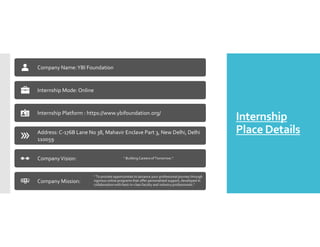
Internship
Place Details
Company Name:YBI Foundation
Internship Mode: Online
Internship Platform : https://www.ybifoundation.org/
Address: C-176B Lane No 38, Mahavir Enclave Part 3, New Delhi, Delhi
110059
CompanyVision: " Building Careers of Tomorrow."
Company Mission:
" To provide opportunities to advance your professional journey through
rigorous online programs that offer personalised support, developed in
collaboration with best-in-class faculty and industry professionals."
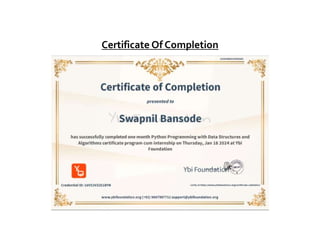
Certificate Of Completion

Internship PPT on YBI Dfata sciencepdf.pdf

  • 1.
    JSPM’S Jayawantrao SawantCollegeOf Engineering, Hadapsar, Pune 28 Department of Computer EngineeringThird Year (A.Y. 2023 – 2024) 310255 : Internship Presented by – Student Name – Swapnil Bansode Roll number : 3204 Guided by – Dr. Mansi Bhonsle Computer Dept. JSPM’s JSCO
  • 2.
    Contents / Agenda •Acknowledgement • Internship Offer Letter • Abstract • Introduction. •Title/Problem statement/Objectives. • Motivation/Scope and rationale of the study. • Methodological Details • Results/ Analysis / Inferences . • Suggestions/ Recommendations for improvement to industry. • Attendance Record/ weekly Report • List of Reference (Library books, magazines and other sources). • Internship Place Details. • Internship completion certificate. • Conclusion
  • 3.
    Course Objectives • Toencourage and provide opportunities for students to get professional/personal experience through internships. • To learn and understand real life/industrial situations. • To get familiar with various tools and technologies used in industries and their applications. • To nurture professional and societal ethics. • To create awareness of social, economic and administrative considerations in the working environment of industry organizations.
  • 4.
    Course Outcomes  CO1:Todemonstrate professional competence through industry internship.  CO2:To apply knowledge gained through internships to complete academic activities in a professional manner.  CO3:To choose appropriate technology and tools to solve given problem.  CO4:To demonstrate abilities of a responsible professional and use ethical practices in day-to-day life.  CO5: Create network and social circle and developing relationships with industry people.  CO6:To analyze various career opportunities and decide carrier goals
  • 5.
    Duration Internship is tobe completed after semester 5 and before commencement of semester 6 of at least 4 to 6 weeks; and it is to be assessed and evaluated in semester 6.
  • 6.
  • 7.
    Abstract Python currently isone of the most popular programming languages, and as such, it has become vital for students to understand this concept in this language. Throughout the course, emphasis is placed on practical application, with hands-on exercises and coding assignments reinforcing theoretical concepts. By completing the YBI Foundation Python with DSA course, students gain valuable skills that are highly sought after in the technology industry. Whether pursuing a career in software development, data analysis, or artificial intelligence, graduates of the course are well-prepared to tackle complex programming tasks and excel in their chosen fields.
  • 8.
    Title/Problem statement/Objectives. 1. Toprovide students with a solid foundation in Python programming language, covering fundamental syntax, control structures, and object- oriented programming principles. 2. To introduce students to essential data structures such as arrays, linked lists, stacks, queues, trees, and graphs, and elucidate their applications in solving real-world problems. 3. To familiarize students with fundamental algorithms and algorithmic techniques including sorting, searching, recursion, and dynamic programming. 4. To cultivate algorithmic thinking and problem-solving skills among students, enabling them to approach computational challenges systematically and efficiently.
  • 9.
    Motivation/Scope and rationaleof the study. The motivation behind theYBI Foundation Python with Data Structures and Algorithms (DSA) course stems from the increasing demand for individuals skilled in programming and algorithmic problem-solving across various industries. The scope of theYBI Foundation Python with DSA course is multifaceted, encompassing both theoretical knowledge and practical application. The rationale behind the study lies in the recognition of Python's widespread adoption and versatility, making it an ideal language for beginners and experienced programmers alike.
  • 10.
    Methodological Details Algorithm  Sortingalgorithms: Bubble sort, selection sort, insertion sort, merge sort, quick sort  Searching algorithms: Linear search, binary search  Recursion: Understanding recursion and recursive algorithms  Dynamic programming: Memoization, tabulation  Graph algorithms: Depth-first search (DFS), breadth-first search (BFS), Dijkstra's algorithm, A* search algorithm  Model : Linear Regression Model , Logistic Regression Model Hardware Requirements: • Personal computer or laptop • Sufficient RAM (at least 4GB recommended) • Adequate storage space for software installations and project files. • Stable internet connection for accessing course materials and resources. Software Requirements: • Operating System:Windows, macOS, or Linux • Google Colab • Web browser for accessing online resources and learning platforms. • Additional libraries and packages as required for specific course modules (e.g., NumPy, pandas, matplotlib)
  • 11.
    Results/ Analysis /Inferences Mastery of Python Programming: Upon completing the course, students demonstrate a proficient understanding of Python programming language, encompassing fundamental syntax, control structures, functions, and object-oriented programming principles. 2. Proficiency in Algorithms:Through the course, students develop proficiency in fundamental algorithms and algorithmic techniques, including sorting, searching, recursion, and dynamic programming. . Problem-Solving Skills:The course cultivates students' problem-solving skills and algorithmic thinking, enabling them to approach complex computational problems with confidence and creativity. Hands-on Experience:Through coding exercises, projects, and practical applications, students gain hands-on experience applying Python programming, data structures, and algorithms to real-world scenarios.
  • 12.
    Suggestions/ Recommendations for improvementto industry. Enhance Practical Application: Increase the focus on hands-on, practical learning experiences by including more coding exercises, projects, and real-world applications. Provide Industry-Relevant Case Studies: Integrate industry-relevant case studies and examples into the course curriculum to illustrate how Python programming and DSA concepts are applied in real-world scenarios. Incorporate Feedback Mechanisms: Implement feedback mechanisms to gather input from students regarding their learning experiences, course content, and areas for improvement.
  • 13.
    Weekly Report NameOFTHETOPIC/MODULECOMPLETED Day Date Week 1 Introduction Monday 18-12-2023 Scope ofAI and Data Skills Wednesday 20-12-2023 Internship Class 1(Introduction to Python) Friday 22-12-2023 Week 2 Internship Class 2(Introduction to Google Colab) Monday 25-12-2023 Python Libraries Wednesday 27-12-2023 Read Data As DataFrame, Explore DataFrame Friday 29-12-2023 Week 3 Create Kaggle Account Monday 01-01-2023 Internship Class 3(Train Test Split) Wednesday 03-01-2023 InternshipClass 4(Linear Regression Models) Friday 05-01-2023 Week 4 InternshipClass 5(Logistic Regression Models) Monday 08-01-2023 Fundamental Practice Projects Wednesday 10-01-2023 Final Project Friday 12-01-2023 Week 5 Final Quiz Wednesday 17-01-2023
  • 14.
    List of Reference [1]YBI FOUNDATION: HTTPS://WWW.YBIFOUNDATION.O RG/COURSE/PYTHON-DSA- INTERNSHIP2 [2] KAGGLE : HTTPS://WWW.KAGGLE.COM/COD E/AGAILLOTY/USE-PANDAS-TO- EXPLORE-DATA [3] WIKIPEDIA : HTTPS://EN.WIKIPEDIA.ORG/WIKI/ DATA_STRUCTURE
  • 15.
    Internship Place Details Company Name:YBIFoundation Internship Mode: Online Internship Platform : https://www.ybifoundation.org/ Address: C-176B Lane No 38, Mahavir Enclave Part 3, New Delhi, Delhi 110059 CompanyVision: " Building Careers of Tomorrow." Company Mission: " To provide opportunities to advance your professional journey through rigorous online programs that offer personalised support, developed in collaboration with best-in-class faculty and industry professionals."
  • 16.