S
Health Science Internship:
MUSC GI Department
May 2015 – July 2015
Kaitlyn Greiner
Introduction
S The following presentation delivers an
overview of my summer 2015 internship at
MUSC, including information on the following
topics:
S Internship Site Description
S Site Mission and Goals
S Department Description
S Internship Preceptor
S Roles and Duties
S Clinical Shadowing
S Research Projects
S Weekly Conferences
S PA Class Lecture
S Conclusion
S References
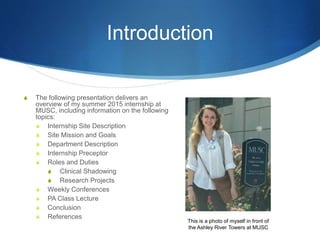
This is a photo of myself in front of
the Ashley River Towers at MUSC
MUSC Site Description
S Established in 1824
S First medical school in the South and a
nationally recognized academic medical
center
S Leader in latest advances in medicine,
research, and technology
S Multidisciplinary team approach to patient
care
S Focus:
S To provide state-of-the-art patient care
S “Changing what’s possible in health
care”
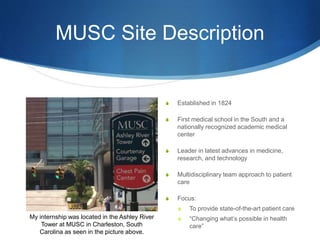
My internship was located in the Ashley River
Tower at MUSC in Charleston, South
Carolina as seen in the picture above.
MUSC Site Description
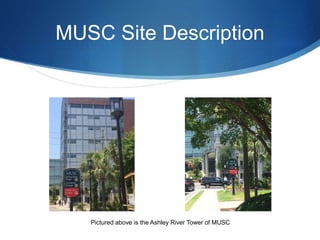
Pictured above is the Ashley River Tower of MUSC
MUSC Mission Statement
S Mission
S To improve health and maximize quality of life through
education, research, and patient care
S Site Goals
S To be a leading and transformative Academic Health Center
S Integrity, Trust, Respect, Social Responsibility, Fiscal
Responsibility, Cultural Competence, Adaptability,
Sustainability
Department Description:
GI Surgery Clinic
S Many pre and post-op patients are seen here on a daily
basis.
S The pre-op patients are examined and evaluated for
surgery.
S The post-op patients are seen often in the clinic to watch for
signs of complications and to make sure they are healing
properly.
S The most common conditions that I observed were
patients with pancreatitis, gastroparesis, and hernias.
Department Description:
GI Surgery Clinic
I interned in the GI surgery department of MUSC. Pictured above is the office of the GI
surgery clinic in which I worked.
Internship Preceptor
S Stefanie Owczarski
S Physician Assistant
S Clinical Instructor
S GI Surgery Department
Pictured above is my
internship preceptor
Roles & Duties
S One of my main roles was to shadow Stefanie in the clinic. During
this time, I obtained hands-on experience.
S For example, I was able to reset a gastric pacer on a patient with
gastroparesis.
S In between seeing patients, I worked on research projects and
practiced using the medical record database, Epic, in the clinic
office.
S On Thursdays, my primary duty was to work on research projects
for my internship preceptor and another PA.
S In addition, I attended several weekly conferences involving
resident presentations.
Clinical Shadowing
S I shadowed Stefanie when seeing
patients in the clinic on Tuesdays,
Wednesdays, and sometimes
Fridays.
S On Tuesdays and Wednesdays,
Stefanie and I worked alongside
world-renowned physicians when
seeing patients.
S On Fridays, she ran her own clinic
and we primarily saw gastroparesis
patients.
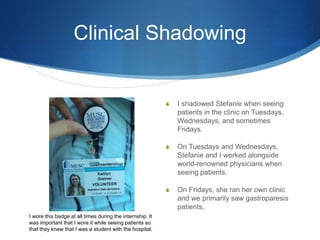
I wore this badge at all times during the internship. It
was important that I wore it while seeing patients so
that they knew that I was a student with the hospital.
Research Projects
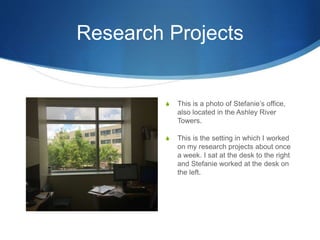
S This is a photo of Stefanie’s office,
also located in the Ashley River
Towers.
S This is the setting in which I worked
on my research projects about once
a week. I sat at the desk to the right
and Stefanie worked at the desk on
the left.
Research Projects
S I became familiar with
the patient chart
database, Epic, and
inputted data from this
database into the
Redcap database.
S The Redcap database is
where my two research
projects were located.
S Link to projects:
https://redcap.musc.edu
Research Projects
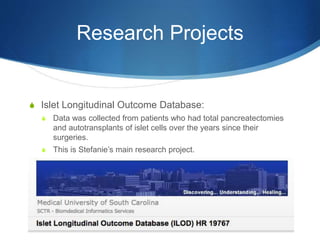
S Islet Longitudinal Outcome Database:
S Data was collected from patients who had total pancreatectomies
and autotransplants of islet cells over the years since their
surgeries.
S This is Stefanie’s main research project.
Research Projects
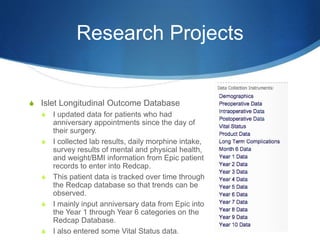
S Islet Longitudinal Outcome Database
S I updated data for patients who had
anniversary appointments since the day of
their surgery.
S I collected lab results, daily morphine intake,
survey results of mental and physical health,
and weight/BMI information from Epic patient
records to enter into Redcap.
S This patient data is tracked over time through
the Redcap database so that trends can be
observed.
S I mainly input anniversary data from Epic into
the Year 1 through Year 6 categories on the
Redcap Database.
S I also entered some Vital Status data.
Research Projects
S All Pancreas Database
S Data was collected from patients who had other various GI
surgeries besides pancreatectomies for only 90 days since their
surgeries.
S This is another PA’s research project who also works with GI
surgery.
Research Projects
S All Pancreas Database
S For this project, I input the
Demographics and Preoperative Data.
S I collected demographics, pre-op
diagnoses and symptoms, past
medical history, survey results of
mental and physical health, previous
surgeries, test results and
descriptions, lab results, and
comorbidity indices.
S I was able to learn about the
symptoms and test results and then
identify the corresponding surgery for
these problems.
Research Projects
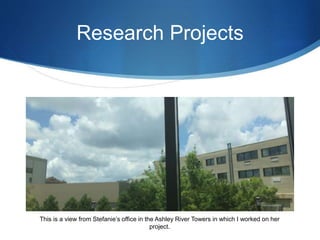
This is a view from Stefanie’s office in the Ashley River Towers in which I worked on her
project.
Weekly Conferences
S This is a photo of the outside of the
Drug Discovery Building.
S In this building, Stefanie and I
attended Surgical Grand Rounds and
Morbidity and Mortality conferences.
S These conferences mostly consisted
of residents presenting recent
complications as an educational
opportunity.
S Doctors, professors, residents, and
PA’s attended these conferences.
Weekly Conferences
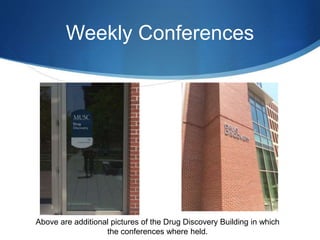
Above are additional pictures of the Drug Discovery Building in which
the conferences where held.
Weekly Conferences
The conferences were held at 7am every Tuesday morning and lasted about an hour. After
the conference, I walked to the Ashley River Tower where clinic was to begin at 8am.
PA Class Lecture
S I had the opportunity to sit in for a
lecture that Stefanie gave to a PA
class at MUSC. She serves as a
guest speaker for the PA class
about once a year.
S Her lecture was mainly about the
pancreas and what goes on in the
GI surgery department. She also
talked about her roles and
experiences as a PA.
Conclusion
S During this internship, I was able to learn about various GI surgeries and
conditions.
S I was able to observe how a team of health professionals work together in
a surgery clinic.
S Through this internship, I was able to see how a teaching hospital
operates and how MUSC integrates research and education into patient
care.
S This internship gave me the opportunity to learn how to read and interpret
patient records and how this data can be used for research.
S This was a truly invaluable experience for me as a student preparing to
enter the healthcare field.
References
S http://mcintranet.musc.edu/communications/resources/fa
cts.htm
S http://academicdepartments.musc.edu/muscdiversity/visi
on.html

Internship powerpoint

  • 1.
    S Health Science Internship: MUSCGI Department May 2015 – July 2015 Kaitlyn Greiner
  • 2.
    Introduction S The followingpresentation delivers an overview of my summer 2015 internship at MUSC, including information on the following topics: S Internship Site Description S Site Mission and Goals S Department Description S Internship Preceptor S Roles and Duties S Clinical Shadowing S Research Projects S Weekly Conferences S PA Class Lecture S Conclusion S References This is a photo of myself in front of the Ashley River Towers at MUSC
  • 3.
    MUSC Site Description SEstablished in 1824 S First medical school in the South and a nationally recognized academic medical center S Leader in latest advances in medicine, research, and technology S Multidisciplinary team approach to patient care S Focus: S To provide state-of-the-art patient care S “Changing what’s possible in health care” My internship was located in the Ashley River Tower at MUSC in Charleston, South Carolina as seen in the picture above.
  • 4.
    MUSC Site Description Picturedabove is the Ashley River Tower of MUSC
  • 5.
    MUSC Mission Statement SMission S To improve health and maximize quality of life through education, research, and patient care S Site Goals S To be a leading and transformative Academic Health Center S Integrity, Trust, Respect, Social Responsibility, Fiscal Responsibility, Cultural Competence, Adaptability, Sustainability
  • 6.
    Department Description: GI SurgeryClinic S Many pre and post-op patients are seen here on a daily basis. S The pre-op patients are examined and evaluated for surgery. S The post-op patients are seen often in the clinic to watch for signs of complications and to make sure they are healing properly. S The most common conditions that I observed were patients with pancreatitis, gastroparesis, and hernias.
  • 7.
    Department Description: GI SurgeryClinic I interned in the GI surgery department of MUSC. Pictured above is the office of the GI surgery clinic in which I worked.
  • 8.
    Internship Preceptor S StefanieOwczarski S Physician Assistant S Clinical Instructor S GI Surgery Department Pictured above is my internship preceptor
  • 9.
    Roles & Duties SOne of my main roles was to shadow Stefanie in the clinic. During this time, I obtained hands-on experience. S For example, I was able to reset a gastric pacer on a patient with gastroparesis. S In between seeing patients, I worked on research projects and practiced using the medical record database, Epic, in the clinic office. S On Thursdays, my primary duty was to work on research projects for my internship preceptor and another PA. S In addition, I attended several weekly conferences involving resident presentations.
  • 10.
    Clinical Shadowing S Ishadowed Stefanie when seeing patients in the clinic on Tuesdays, Wednesdays, and sometimes Fridays. S On Tuesdays and Wednesdays, Stefanie and I worked alongside world-renowned physicians when seeing patients. S On Fridays, she ran her own clinic and we primarily saw gastroparesis patients. I wore this badge at all times during the internship. It was important that I wore it while seeing patients so that they knew that I was a student with the hospital.
  • 11.
    Research Projects S Thisis a photo of Stefanie’s office, also located in the Ashley River Towers. S This is the setting in which I worked on my research projects about once a week. I sat at the desk to the right and Stefanie worked at the desk on the left.
  • 12.
    Research Projects S Ibecame familiar with the patient chart database, Epic, and inputted data from this database into the Redcap database. S The Redcap database is where my two research projects were located. S Link to projects: https://redcap.musc.edu
  • 13.
    Research Projects S IsletLongitudinal Outcome Database: S Data was collected from patients who had total pancreatectomies and autotransplants of islet cells over the years since their surgeries. S This is Stefanie’s main research project.
  • 14.
    Research Projects S IsletLongitudinal Outcome Database S I updated data for patients who had anniversary appointments since the day of their surgery. S I collected lab results, daily morphine intake, survey results of mental and physical health, and weight/BMI information from Epic patient records to enter into Redcap. S This patient data is tracked over time through the Redcap database so that trends can be observed. S I mainly input anniversary data from Epic into the Year 1 through Year 6 categories on the Redcap Database. S I also entered some Vital Status data.
  • 15.
    Research Projects S AllPancreas Database S Data was collected from patients who had other various GI surgeries besides pancreatectomies for only 90 days since their surgeries. S This is another PA’s research project who also works with GI surgery.
  • 16.
    Research Projects S AllPancreas Database S For this project, I input the Demographics and Preoperative Data. S I collected demographics, pre-op diagnoses and symptoms, past medical history, survey results of mental and physical health, previous surgeries, test results and descriptions, lab results, and comorbidity indices. S I was able to learn about the symptoms and test results and then identify the corresponding surgery for these problems.
  • 17.
    Research Projects This isa view from Stefanie’s office in the Ashley River Towers in which I worked on her project.
  • 18.
    Weekly Conferences S Thisis a photo of the outside of the Drug Discovery Building. S In this building, Stefanie and I attended Surgical Grand Rounds and Morbidity and Mortality conferences. S These conferences mostly consisted of residents presenting recent complications as an educational opportunity. S Doctors, professors, residents, and PA’s attended these conferences.
  • 19.
    Weekly Conferences Above areadditional pictures of the Drug Discovery Building in which the conferences where held.
  • 20.
    Weekly Conferences The conferenceswere held at 7am every Tuesday morning and lasted about an hour. After the conference, I walked to the Ashley River Tower where clinic was to begin at 8am.
  • 21.
    PA Class Lecture SI had the opportunity to sit in for a lecture that Stefanie gave to a PA class at MUSC. She serves as a guest speaker for the PA class about once a year. S Her lecture was mainly about the pancreas and what goes on in the GI surgery department. She also talked about her roles and experiences as a PA.
  • 22.
    Conclusion S During thisinternship, I was able to learn about various GI surgeries and conditions. S I was able to observe how a team of health professionals work together in a surgery clinic. S Through this internship, I was able to see how a teaching hospital operates and how MUSC integrates research and education into patient care. S This internship gave me the opportunity to learn how to read and interpret patient records and how this data can be used for research. S This was a truly invaluable experience for me as a student preparing to enter the healthcare field.
  • 23.