Correlations Between Failed Large to Mid-Sized
Nonprofits: A Closer Look at Why Nonprofits Fail
Shelly Espejo
Sandra Guerra, Program Administrator, The
Fordham Center for NonProfit Leaders
PURPOSE
SIGNIFICANCE
METHODOLOGY
OUTCOMES EVALUATION
ACKNOWLEDGEMENTS
Analyze traits that contribute to the
failure of nonprofits to create a strategic
method for success.
• Nonprofit organizations play a
critical role in building and
supporting the well-being of New
Yorkers.
• Nonprofits enable 2.5 million New
Yorkers to contribute to their
communities.
I would like to give a special thank
you to Sandra Guerra, Internship
Preceptor, Ann Marie Hill, Internship
Coordinator, and the staff of the
Fordham Center for NonProfit
Leaders for their contribution and
support.
•Reduce staff
•Invest in infrastructure
•Training and accounting
systems
Capitalizing the
Sector
• Avoid repeated audits
• Reduce costs
• Highly-designed,
appropriated evaluated
program
Program
Collaboration
•Implement a financial/
pragmatic reporting
system
•Enhance board members
and staff engagement
Risk Assessment
• Organizations with budgets less
than $1 million are less likely to be
in financial distress.
• Underfunded government are
making payments of 80₵ or less of
each dollar of program’s actual
cost.
• Underfunding and contract
payments delays leads to costly
borrowing, acquiring interest not
covered by government contracts.
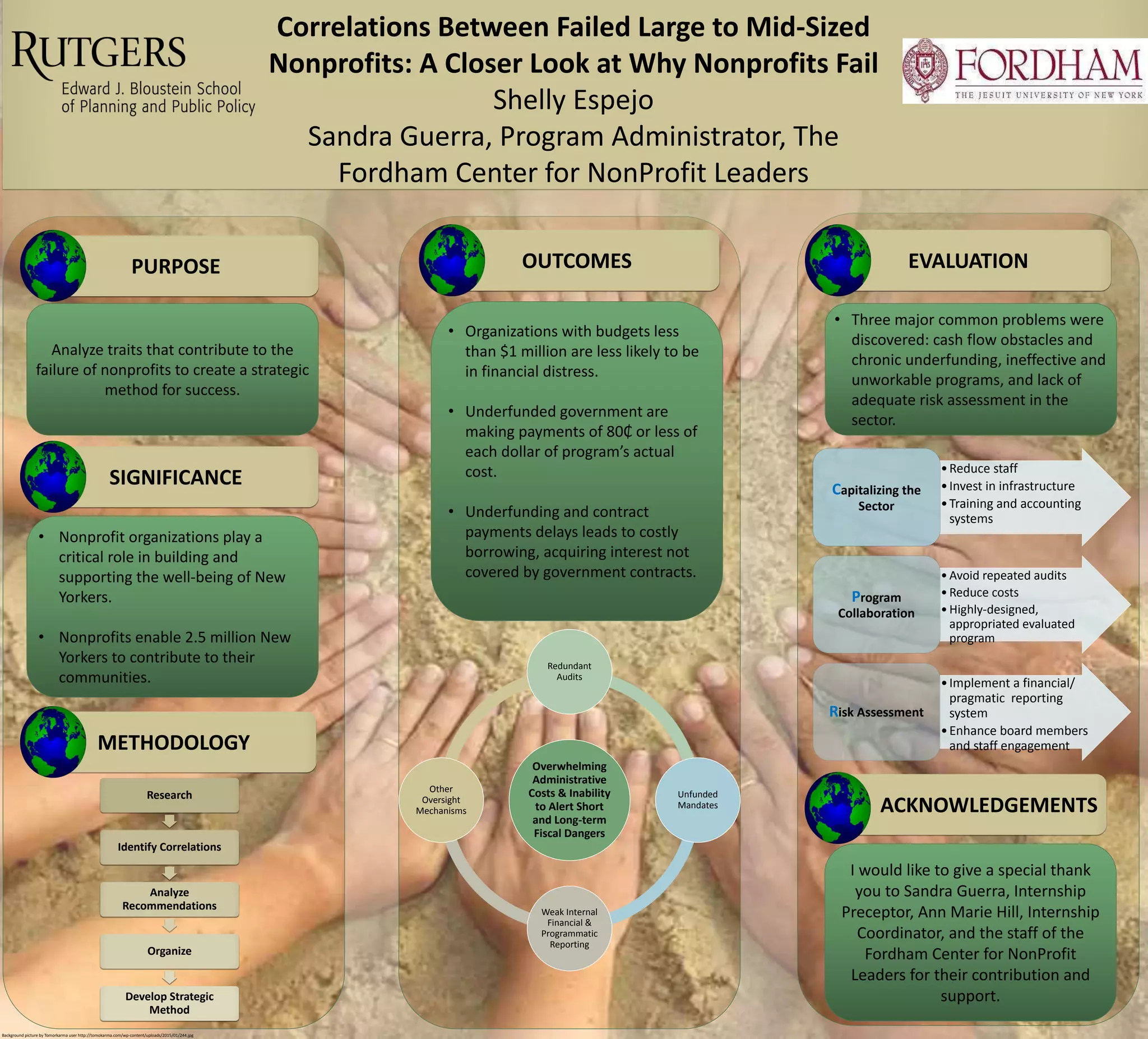
• Three major common problems were
discovered: cash flow obstacles and
chronic underfunding, ineffective and
unworkable programs, and lack of
adequate risk assessment in the
sector.
Research
Identify Correlations
Analyze
Recommendations
Organize
Develop Strategic
Method
Background picture by Tomorkarma user http://tomokarma.com/wp-content/uploads/2015/01/244.jpg
Overwhelming
Administrative
Costs & Inability
to Alert Short
and Long-term
Fiscal Dangers
Redundant
Audits
Unfunded
Mandates
Weak Internal
Financial &
Programmatic
Reporting
Other
Oversight
Mechanisms

Internship Poster Presentation- SESPEJO

  • 1.
    Correlations Between FailedLarge to Mid-Sized Nonprofits: A Closer Look at Why Nonprofits Fail Shelly Espejo Sandra Guerra, Program Administrator, The Fordham Center for NonProfit Leaders PURPOSE SIGNIFICANCE METHODOLOGY OUTCOMES EVALUATION ACKNOWLEDGEMENTS Analyze traits that contribute to the failure of nonprofits to create a strategic method for success. • Nonprofit organizations play a critical role in building and supporting the well-being of New Yorkers. • Nonprofits enable 2.5 million New Yorkers to contribute to their communities. I would like to give a special thank you to Sandra Guerra, Internship Preceptor, Ann Marie Hill, Internship Coordinator, and the staff of the Fordham Center for NonProfit Leaders for their contribution and support. •Reduce staff •Invest in infrastructure •Training and accounting systems Capitalizing the Sector • Avoid repeated audits • Reduce costs • Highly-designed, appropriated evaluated program Program Collaboration •Implement a financial/ pragmatic reporting system •Enhance board members and staff engagement Risk Assessment • Organizations with budgets less than $1 million are less likely to be in financial distress. • Underfunded government are making payments of 80₵ or less of each dollar of program’s actual cost. • Underfunding and contract payments delays leads to costly borrowing, acquiring interest not covered by government contracts. • Three major common problems were discovered: cash flow obstacles and chronic underfunding, ineffective and unworkable programs, and lack of adequate risk assessment in the sector. Research Identify Correlations Analyze Recommendations Organize Develop Strategic Method Background picture by Tomorkarma user http://tomokarma.com/wp-content/uploads/2015/01/244.jpg Overwhelming Administrative Costs & Inability to Alert Short and Long-term Fiscal Dangers Redundant Audits Unfunded Mandates Weak Internal Financial & Programmatic Reporting Other Oversight Mechanisms