McKinsey Global Institute
Ten IT-enabled
business trends for
the decade ahead
May 2013
Updated research
Copyright © McKinsey & Company 2013
The McKinsey Global Institute
The McKinsey Global Institute (MGI), the business and economics research
arm of McKinsey & Company, was established in 1990 to develop a deeper
understanding of the evolving global economy. Our goal is to provide leaders
in the commercial, public, and social sectors with the facts and insights on
which to base management and policy decisions.
MGI research combines the disciplines of economics and management,
employing the analytical tools of economics with the insights of business
leaders. Our “micro-to-macro” methodology examines microeconomic
industry trends to better understand the broad macroeconomic forces
affecting business strategy and public policy. MGI’s in-depth reports have
covered more than 20 countries and 30 industries. Current research focuses
on six themes: productivity and growth; natural resources; labor markets;
the evolution of global financial markets; the economic impact of technology
and innovation; and urbanization. Recent reports have assessed job
creation, resource productivity, cities of the future, the economic impact of
the Internet, and the future of manufacturing.
MGI is led by McKinsey & Company directors Richard Dobbs and James
Manyika. Yougang Chen, Michael Chui, Susan Lund, and Jaana Remes
serve as MGI principals. Project teams are led by the MGI principals
and a group of senior fellows, and include consultants from McKinsey &
Company’s offices around the world. These teams draw on McKinsey &
Company’s global network of partners and industry and management
experts. In addition, leading economists, including Nobel laureates, act as
research advisers.
The partners of McKinsey & Company fund MGI’s research; it is not
commissioned by any business, government, or other institution.
For further information about MGI and to download reports, please visit
www.mckinsey.com/mgi.
McKinsey Global Institute
Michael Chui
James Manyika
Jacques Bughin
Brad Brown
Roger Roberts
Joi Danielson
Shalabh Gupta
Ten IT-enabled
business trends for
the decade ahead
May 2013
Updated research
Acknowledgments
The authors wish to thank Alex Marrs for his substantial contributions to
this paper.
The authors would also like to acknowledge the contributions of the following
McKinsey colleagues: Julie Avrane-Chopard, Tucker Bailey, Charlie Barthold,
Michael Bloch, Sean Brown, David Cheifetz, David Edelman, Lisa Ellis, Drew
Erdmann, Will Forrest, Chandra Gnanasambandam, Peter Groves , James
Kaplan, Stephen Kelly, Eileen Lau, Richard Lee, Sam Marwaha, Brian Milch,
Suraj Moraje, Abid Mohsin, Mona Mourshed, Nakul Narayan, Mark Patel, Vivian
Riefberg, Humphry Rolleston, Jimmy Sarakatsannis, Stefan Schmitgen, Johnson
Sikes, Patrick Viguerie, Peter Weed, and Paul Willmott.
We are grateful to our external advisers Hal R. Varian, chief economist at Google
and emeritus professor in the School of Information, the Haas School of Business,
and the Department of Economics at the University of California at Berkeley; and
Erik Brynjolfsson, Schussel Family professor of management at the MIT Sloan
School of Management, director of the MIT Center for Digital Business, and
research associate at the National Bureau of Economic Research.
We also benefited from the guidance and insight of several technology and
business leaders, including Bruno Lanvin, executive director of INSEAD’s eLab;
Chamath Palihapitiya, founder and managing partner of The Social+Capital
Partnership; Eric Schmidt, executive chairman of Google; David Mann, McKinsey
alumnus; Vivek Wadhwa, vice president of Academics and Innovation at
Singularity University; Ann Winblad, managing director of Hummer Winblad
Venture Partners; David Kirkpatrick, founder and CEO of Techonomy Media;
Paddy Cosgrave of F.ounders; and Robert Shaw at Atos SE.
Ten IT-enabled business trends for the decade ahead
McKinsey Global Institute
Contents
Introduction	1
1.	 The social matrix	 3
2.	 The Internet of All Things	 7
3.	 Big data, advanced analytics	 11
4.	 Realizing anything as a service 	 16
5.	 Automation of knowledge work 	 19
6.	 Integrated digital/physical experiences 	 23
7.	 Me + free + ease 	 27
8.	 The e-volution of commerce	 31
9.	 The next three billion digital citizens 	 34
10.	Transformation of government, health care, and education	 37
Conclusion	43
1Ten IT-enabled business trends for the decade ahead
McKinsey Global Institute
Introduction
Progress in information technology is transformative. Every year brings faster
processing speeds, greater storage capacity, bigger data sets, and more
advanced software. Ways of connecting, sharing, collaborating, and doing
business become richer, more varied, and more powerful, enabled to a large
extent by expanding IT capabilities.
Understanding how these capabilities are evolving is critically important for
companies. The IT-enabled business trends we discuss here provide fresh
opportunities for companies to create new sources of value—new products, new
ways of touching customers, and new tools for improving operating efficiency.
They also have the potential to shift profit pools, disrupt markets and commercial
relationships, undermine existing market leaders, and shift value to consumers or
among producers.
This white paper builds on and updates previous work by McKinsey experts that
has appeared in The McKinsey Quarterly.1
Some of the trends that were just
surfacing in 2007 or 2010 are now gathering greater momentum. For example,
one of the major ideas we explored in 2010 was finding ways to get more value
from interactions—the knowledge sharing, negotiations, conversations, and
independent judgments that define the jobs of professionals and other knowledge
workers. These employees are the highest paid and most high-impact workers in
most organizations, but they have not benefited fully from the productivity gains
that technology affords. Three years later, in this paper we highlight the new
software tools that can automate tasks that were once thought to be beyond
machines, including some of the work that interaction workers perform.
What was the Internet of Things in 2010 has morphed into the Internet of All
Things in this paper, reflecting how rapidly this trend is spreading. This technology
involves using sensors and actuators to track and manage machinery and other
physical assets across a network. The earliest approach in this trend, using
radio-frequency identification (RFID) tags, was a highlight of our 2007 report. That
the Internet of Things continues to evolve should not be a surprise; technology
adoption can take a decade or more, depending on the complexity and the
hurdles. Thanks to the mobile Internet and advances in sensors, we believe that
Internet of Things adoption rates will soon accelerate.
Big data is another technology that merited attention in 2010 and does so again.
It, too, is experiencing accelerating growth, thanks to advances in processing
capabilities. Moreover, new types of data analytics enable more real-time
analysis, as well as closed-loop systems that, based on big data flows, can make
autonomous decisions—for example, to release inventory into the distribution
system based on shelf-level retail data.
1	 Jacques Bughin, Michael Chui, and James Manyika, “Clouds, big data, and smart assets:
Ten tech-enabled business trends to watch,” The McKinsey Quarterly, August 2010; James
Manyika, Roger P. Roberts, and Kara L. Sprague, “Eight business technology trends to
watch,” The McKinsey Quarterly, December 2007.
2
Many trends reflect the growing dominance of the Internet as an enabling
technology, as well as a model and metaphor for commercial and social
interactions. Twenty years into the Internet revolution, businesses and consumers
have come to expect that information is a Google search away, friends and
associates are always available on social networking sites, and goods and
services (including public goods such as education and government services)
can be had instantly from an online vendor anywhere in the world at any time of
the day.
Similarly, the physical and digital worlds are converging as things in the physical
world become Web-enabled and physical spaces (e.g., stores and public spaces)
become interactive environments in which things—a rack of shirts, for example—
can convey information about themselves to a mobile Internet device: pricing,
availability, matching items, and so on. The Internet of Things is rapidly gaining
momentum, bringing millions of devices and objects into the connected world and
enabling whole new ways of managing assets and operations.
The Web continues to enable and inspire new business models that could have
disruptive impact. The peer-to-peer distribution model that began with music files
and which we described in 2010 in our discussion of “anything as a service” has
morphed into the “sharing economy,” in which almost every possible commodity
(e.g., rental cars, unused office space, or accounting help) can be ordered on the
Web. This provides opportunities for companies to monetize idle assets, but it
also has the potential to disintermediate and disrupt markets and industries.
If companies can embrace Web-based business and operating models,
they stand to gain far more than they lose. Social technologies, for example,
are emerging as more than a powerful means of connecting with markets;
they also are a means of communication and collaboration within and
between businesses that has the potential to vastly improve productivity and
organizational effectiveness.
Nobody can predict how these trends will translate into economic value. The
McKinsey Global Institute has estimated the potential economic impact that might
arise from likely major applications of cloud computing, the Internet of Things
and automation of knowledge work by 2025. MGI also estimates that half of the
impact of the mobile Internet through 2025 will arise in developing economies,
where it will most likely be the means by which 3 billion new users connect to the
Internet. Altogether, these applications could have economic impact of $10 trillion
to $20 trillion annually in 2025, including consumer surplus.
In the coming decade, we see a brave new world where instant access to
knowledge and the efficiency of the Web are applied more broadly and where
the physical and digital worlds blend (wearable computers that monitor human
health are no longer science fiction). One of the most exciting trends is the
prospect of as many as three billion new consumers (and producers) joining
the global economy via the mobile Internet. This was a trend we saw building in
2010, and it may exceed earlier expectations. Overnight, people in some of the
poorest places in the world are leapfrogging into the Internet age, using the Web
to join the formal economy, to manage their finances and health care, and even
to set up virtual shop. The mobile Internet is also a two-way street, helping global
companies tap into a vast new market.
3Ten IT-enabled business trends for the decade ahead
McKinsey Global Institute
Social technology is a massive technological and social phenomenon—but
its power as a business tool is still being discovered.2
Never before has a
communications medium been adopted as quickly or as widely as social media.
It took commercial television 13 years to reach 50 million households and Internet
service providers three years to sign their 50 millionth subscriber. But it took
Facebook just a year and Twitter even less time to reach the same milestone.
Socially enabled applications will become ubiquitous, allowing liking, commenting,
and information sharing across a large array of activities. We will live and
conduct business in a social matrix, where virtually all resources can be found—
collaborators, talent, customers, funders. The social matrix will enable new forms
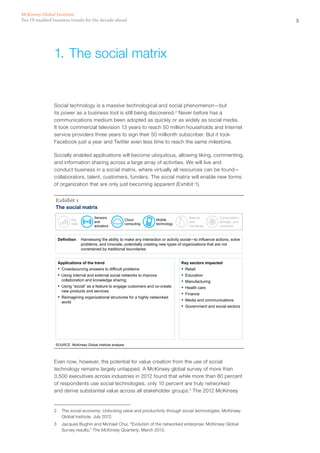
of organization that are only just becoming apparent (Exhibit 1).
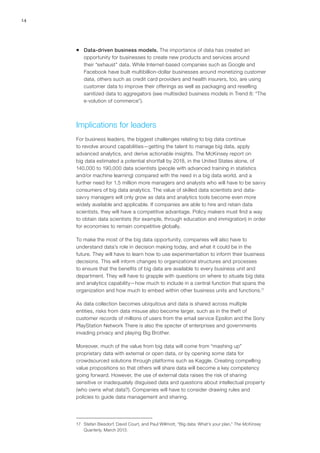
The social matrix
SOURCE: McKinsey Global Institute analysis
Exhibit 1
Definition Harnessing the ability to make any interaction or activity social—to influence actions, solve
problems, and innovate, potentially creating new types of organizations that are not
constrained by traditional boundaries
Applications of the trend
▪ Crowdsourcing answers to difficult problems
▪ Using internal and external social networks to improve
collaboration and knowledge sharing
▪ Using “social” as a feature to engage customers and co-create
new products and services
▪ Reimagining organizational structures for a highly networked
world
Key sectors impacted
▪ Retail
▪ Education
▪ Manufacturing
▪ Health care
▪ Finance
▪ Media and communications
▪ Government and social sectors
Big
data
Sensors
and
actuators
Cloud
computing
Mobile
technology
Natural
user
interfaces
Computation,
storage, and
networks
Even now, however, the potential for value creation from the use of social
technology remains largely untapped. A McKinsey global survey of more than
3,500 executives across industries in 2012 found that while more than 80 percent
of respondents use social technologies, only 10 percent are truly networked
and derive substantial value across all stakeholder groups.3
The 2012 McKinsey
2	 The social economy: Unlocking value and productivity through social technologies, McKinsey
Global Institute, July 2012.
3	 Jacques Bughin and Michael Chui, “Evolution of the networked enterprise: McKinsey Global
Survey results,” The McKinsey Quarterly, March 2013.
1.	The social matrix
4
Global Institute report on the social economy concluded that two-thirds of
the value available from the use of social technologies can be found through
improving collaboration and coordination within and across organizations—uses
that are far less developed than social-based marketing and sales applications
and which will require significant organizational change.4
Applications of the trend
In addition to the familiar role that social media now plays in marketing, we see at
least four applications of social technologies that will be important for businesses
and other organizations in the next few years: as an increasingly powerful
platform for distributed problem solving, a collaboration and coordination tool, a
feature that can be added to any digital activity to create new capabilities, and as
the basis for new types of business organizations.5
ƒƒ Distributed problem solving. Enterprises increasingly use social networks to
solve problems, often by “crowdsourcing” answers from consumers, experts,
employees, and talented amateurs. Even very large companies with extensive
internal capabilities are creating open competitions in which participants
offer ideas for new product features, provide software codes, or help with
customer service. In some cases, companies are crowdsourcing freelance and
temporary talent to work on a project.
Many organizations rely on distributed problem solving, tapping the brain
power of customers and experts from within and outside the company for
breakthrough thinking. Pharmaceutical major Boehringer Ingelheim sponsored
a competition on Kaggle (a platform for data-analysis contests) to predict the
likelihood that a new drug molecule would cause genetic mutations. The
winning team, from among nearly 9,000 competitors, combined experience in
insurance, physics, and neuroscience; and its analysis beat existing predictive
methods by more than 25 percent. RTL Group, the European entertainment
network, uses social media to create viewer feedback loops for popular shows
such as “The X Factor”, helping increase audience size.
ƒƒ Collaboration and communication. The MGI research noted that reading
and answering email, searching for information, and collaborating with
colleagues consume a large percentage of knowledge worker time. By using
a social platform to communicate and share information, MGI estimates,
companies can see improvements of as much as 25 percent in knowledge
worker productivity by more efficiently and effectively communicating and
finding information and expertise, partly by uncovering the “dark matter” that
would otherwise lie buried in corporate emails. Communications on social
platforms form an easily searchable record, providing valuable answers
to questions for everyone who has access, not just the email recipient.
Potentially, this represents what could be a great leap in productivity for what
are usually a company’s most highly paid personnel—the knowledge workers.
4	Ibid.
5	 Roxane Divol, David Edelman, and Hugo Sarrazin, “Demystifying social media,” The McKinsey
Quarterly, April 2012; Roland Deiser and Sylvain Newton, “Six social-media skills every leader
needs,” The McKinsey Quarterly, February 2013.
5Ten IT-enabled business trends for the decade ahead
McKinsey Global Institute
Kraft Foods, which had launched an internal social network in 2011, saw the
potential to raise the level of collaboration and knowledge sharing across
the corporation by investing in a more powerful social technology platform.
The new system supports microblogging, automatic content tagging, and
easy creation and maintenance of subgroups for communities of practice
(e.g., pricing experts). This has accelerated knowledge sharing, leading to
shorter product development cycles, as well as quicker responses to actions
of competitors.
Firms are exploring using social media tools to reduce email, which is
responsible for more than a quarter of the typical office worker’s time. French
IT services provider Atos SE pledged in 2011 to become a “zero email”
company by 2014 and aims to boost employee productivity by replacing email
with a collaborative social networking platform.
ƒƒ Social as a feature of everything. The ability to add social capabilities to any
digitally enabled communication or transaction can make social technology
pervasive. “Social” is a feature that can be embedded in products, markets,
business systems, entertainment programming, and public institutions.
Social networks allow us to “like” things and could soon evolve to allow us
to mark the things we “want,” potentially signaling greater commercial intent.
We can share our experiences with our network of friends and connections
by posting pictures and tweets or by updating our status. These activities
could become more automatic, such as through standing instructions to our
smartphones to share certain activities with groups of friends, and therefore
even more common.
Virtually any economic activity that is carried out electronically can now be
social. So, for example, when Macy’s buyers are getting ready to commit to
next season’s styles, they include what they have learned from social media:
recently, the company used 2,500 “likes” on its Facebook page to decide to
carry jeans in “very vivid” blue, orange, and red instead of pastels and later
solicited feedback from nearly 4,000 customers to decide about stocking
another design. At Walmart, instead of figuring out next week’s specials by
themselves, marketers run a “Toyland Tuesday” panel on social media, where
consumers hit the “like” button to select two toys that will be discounted the
following week.
ƒƒ A reimagining of the organization. Social technology is giving rise to new
organizational models. Not only can social technology enable coworkers
to collaborate easily across time and space, but it also can redefine the
boundaries of the organization and change them as needed. For example,
using social platforms, companies can quickly reach into the social matrix
and assemble teams of internal and external talent, hook up partners and
customers, and complete projects more quickly and with greater expertise.
Then they can disband teams and reform others as needed or deploy
resources on multiple projects more easily. Companies can outsource
problems to customers and use social media to drive engagement and
innovation at the same time. Enterprises can be “born global” or “micro-
multinational,” bringing together capabilities from different parts of the world
from their inception rather than gradually growing into new geographies. It
is no longer hard to imagine a company being founded with its executive
6
management in the United States, software development in India,
manufacturing in China, and sales and marketing functions spread around
the world.
Implications for leaders
In the era of the social matrix, leaders of major organizations have unprecedented
opportunities to improve the way their employees solve problems, collaborate,
and interact with customers. Companies are starting to realize the potential of the
social matrix to raise productivity—and creativity—but can do much more.
Leaders should use social tools to improve internal collaboration, an area of
immense opportunity, as many leading companies described above have found.
In many cases, organization structures can be completely reimagined due to
the ease of collaborating across geographic or organizational boundaries. They
can also reimagine the process of solving difficult problems and embrace the
opportunity to collaborate with the brightest minds outside their organizations,
as long as they can ensure that the company’s intellectual property is not
compromised in the process. In the information age, leaders of consumer-facing
companies in particular should use co-creation both to solve problems and
engage their customers.
Key questions
ƒƒ How can you use the social matrix to locate and harness talent and capability
outside your organization to solve problems?
ƒƒ How can your company use social networks to improve collaboration and
communication within the organization as well as with external stakeholders
such as suppliers and customers?
ƒƒ How is your enterprise improving its offerings to customers by noting their
likes, wants, and other behaviors in the social matrix?
ƒƒ Are there alternate organizational models enabled by the rise of social
networks that your company can employ to drive value?
7Ten IT-enabled business trends for the decade ahead
McKinsey Global Institute
Sensors, actuators, and other means of connecting things in the physical world
to networks are proliferating at astounding rates. More than 12 billion devices
around the world, including computers and smartphones, are connected to
the Internet. And the number of devices connected to networks is expected to
increase dramatically within the next decade, with estimates ranging from more
than 50 billion devices to more than a trillion.6
This has the potential to transform
activities such as manufacturing, building infrastructure, providing health care,
and managing supply chains by monitoring and optimizing activities and assets at
a very granular level. Any activity that “touches” multiple things or people across
the value chain is a candidate for reimagining with the help of networked sensors
and actuators.
The proliferation of devices and applications is so rapid that this trend, which in
2010 we called the Internet of Things (IoT), we have expanded to call the Internet
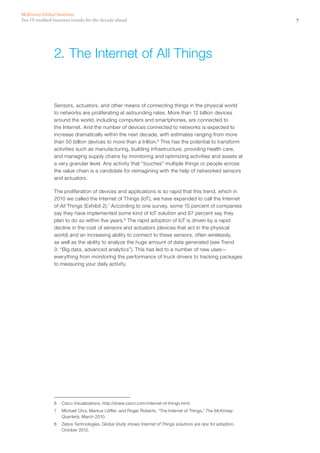
of All Things (Exhibit 2).7
According to one survey, some 15 percent of companies
say they have implemented some kind of IoT solution and 67 percent say they
plan to do so within five years.8
The rapid adoption of IoT is driven by a rapid
decline in the cost of sensors and actuators (devices that act in the physical
world) and an increasing ability to connect to these sensors, often wirelessly,
as well as the ability to analyze the huge amount of data generated (see Trend
3: “Big data, advanced analytics”). This has led to a number of new uses—
everything from monitoring the performance of truck drivers to tracking packages
to measuring your daily activity.
6	 Cisco Visualizations, http://share.cisco.com/internet-of-things.html.
7	 Michael Chui, Markus Löffler, and Roger Roberts, “The Internet of Things,” The McKinsey
Quarterly, March 2010.
8	 Zebra Technologies, Global study shows Internet of Things solutions are ripe for adoption,
October 2012.
2.	The Internet of All Things
8
The Internet of All Things
SOURCE: McKinsey Global Institute analysis
Exhibit 2
Definition Linking machinery, equipment, and other physical assets with networked sensors and
actuators to capture data and manage performance, enabling machines to collaborate and
even act on new information independently
Applications of the trend
▪ Remote monitoring of assets, systems, and even people
▪ Improving preventive maintenance and performance
management using real-time data
▪ Optimizing performance of complex systems, including through
closed-loop (autonomous) decision making
▪ Providing “Quantified Self” applications for people to monitor
their physical states
Key sectors impacted
▪ Manufacturing
▪ Mining and natural resources
▪ Infrastructure and utilities
▪ Transportation
▪ Agriculture
▪ Health care
▪ Retail
▪ Government and social sectors
Big
data
Sensors
and
actuators
Cloud
computing
Mobile
technology
Natural
user
interfaces
Computation,
storage, and
networks
Applications of the trend
Over the next few years, we see networked sensors and actuators proliferating
and affecting companies, systems, and individuals in numerous ways. While
many companies are already employing the Internet of Things in pioneering ways,
others managing complex systems are starting to realize their potential. IoT use
by individuals is still in its infancy, though it promises to generate interesting
applications in areas such as health care and systems optimization. Here are
some examples:
ƒƒ Remote monitoring. Monitoring will constitute many Internet of Things
applications. By placing sensors, transmitters, or RFID tags on machinery
and other assets or on pallets, containers, or packages, companies are
able to monitor how equipment is performing or being used and to track
merchandise and parts as they make their way through supply chains.
For example, FedEx’s SenseAware program allows customers to track the
progress of packages almost continuously. Customers place a small device—
about the size of a mobile phone—into a package. The device includes a
global positioning system as well as sensors to monitor such conditions as
temperature, light exposure, relative humidity, and barometric pressure, which
are critical to some cargo such as biological samples or sensitive electronic
equipment. The device is programmed to relay its location and atmospheric
conditions periodically so customers can know the exact whereabouts of
their packages—and learn immediately when they deviate off course or
when ambient conditions change significantly. This type of continuous data
availability obviously has implications for companies that operate long and
complex supply chains.
9Ten IT-enabled business trends for the decade ahead
McKinsey Global Institute
Another example of monitoring is using sensors to track the health of physical
systems and make maintenance continuous and effective. Sensors have
been attached to bridges to continuously monitor structural health, replacing
periodic checks by human inspectors. In the United States, the new Interstate
35W bridge in Minneapolis, is equipped with sensors to monitor the stresses
and deterioration that led to the sudden collapse of its predecessor bridge in
2007. General Electric collects hundreds of terabytes of streaming data daily
from sensors in its gas turbines and monitors the data in real time to identify
anomalies before they cause equipment shutdowns and power outages.
Similarly, hard disk drives and other equipment can sense imminent failure
and can preemptively inform the user or even the manufacturer, potentially
opening up opportunities to provide tailored maintenance services (see Trend
4: “Realizing anything as a service”).
ƒƒ System optimization. Beyond monitoring how machinery, assets, and
workers are performing, companies are using IoT applications to run
complex systems, often through closed-loop systems that can automatically
make decisions based on sensing input. Smart grids for electricity, water,
and transportation networks are cropping up around the world. In these
systems, sensors pick up performance data and actuators are used to take
appropriate action—such as coordinating traffic signals based on the number
and movement of vehicles in a city. In Mannheim, Germany, for example, the
electric utility is using smart grid technology to confirm whether repairs have
been made effectively, helping improve system performance.
ƒƒ Quantified Self and consumer health. A category of emerging IoT-enabled
services is aimed at helping people monitor their own physical states. The
“quantified self” movement allows consumers to become highly involved in
their health care by using devices for monitoring medical conditions such as
high blood pressure or maintaining a continuous record of physical activity.
Nike+ running shoes come with embedded sensors that record speed and
distance, which the runner can view on a smartphone app to build a training
program. Nike+ FuelBand, Fitbit, and the Jawbone UP are wearable sensors
that are designed to continuously record physical activity; some devices can
even monitor sleep patterns. When combined with medical sensors like the
Proteus ingestible sensors, which can relay information via smartphone to a
physician, these systems promise to provide a new level of health and disease
management that could generate more continuous data to help consumers
better manage their own health.
Implications for leaders
The explosion of Internet of Things applications provides many opportunities for
businesses to improve performance and create new service offerings. Huge profit
pools associated with the current ways of managing people and assets, collecting
data, and optimizing systems could be at risk as IoT creates new ways to monitor
and increasingly manage processes. As the number of connected devices
increases, old sources of competitive advantage will likely give way to new ones.
10
In the coming years, automated closed-loop systems that can carry out tasks
independently based on incoming data and which can be used to manage
systems such as smart electric grids are likely to be adopted more widely. They
may be used to manage machines, processes, and even the health of human
beings. Indeed, MGI estimates that health-care will make up the lion’s share of the
$3 trillion to $6 trillion in annual impact of the Internet of Things applications that
they sized. This could include significant reductions in the cost of chronic disease
care through remote monitoring.
An important challenge for companies will be to apply advanced analytical tools
to the flood of data that will flow from IoT devices and unlock the true value of
this trend. They will also be challenged to ensure that their networks are secure
so that nobody can seize control of machines on the factory floor or disrupt
supply chains.
Key questions
ƒƒ How can your organization create value and improve business processes by
collecting and analyzing data through networked sensors added to machinery,
employee work spaces, or customer touch points?
ƒƒ How can companies employ IoT to implement automated closed-loop systems
to increase efficiency and optimize in real time?
ƒƒ How can companies combine IoT capabilities with advanced analytics to
create innovative new products and services?
11Ten IT-enabled business trends for the decade ahead
McKinsey Global Institute
“Big data” is everywhere. With frequent media coverage, it has become well
known in business. As our world becomes more networked and our activities
more digital, data is more abundant, more diverse, and more available in real time.
Organizations are harnessing big data to develop insights to fine-tune systems,
inform decision making, and develop products that were previously impossible.
However, many organizations still struggle to adopt big data and fully capture
its potential. At the same time, the capabilities to analyze big data to drive deep
insight are growing rapidly, raising the stakes for everyone (Exhibit 3).9
Big data, advanced analytics
SOURCE: McKinsey Global Institute analysis
Exhibit 3
Definition Growing ability to collect, analyze, experiment with, and act on ever-larger and more
complex data sets; harnessing real-time data flows (e.g., from the Internet of Things and
the social matrix) for nuanced insights that improve decision making and results
Applications of the trend
▪ Improving performance management through access to timely
data
▪ Using advanced analytics of massive data sets for
experimentation and research
▪ Using behavioral data for unprecedented consumer micro-
segmentation
▪ Enabling closed-loop systems that make decisions by
considering a multitude of factors, at speeds impossible for
humans to match
▪ Automating knowledge work, such as analyzing thousands of
law cases or millions of medical records
▪ Creating new business models that monetize “exhaust” data
from core operations
Key sectors impacted
▪ Media and communications
▪ Manufacturing
▪ Finance
▪ Government and social sectors
▪ Health care
▪ Retail
▪ Education
▪ Transportation
▪ Mining and natural resources
Big
data
Sensors
and
actuators
Cloud
computing
Mobile
technology
Natural
user
interfaces
Computation,
storage, and
networks
Despite the fame of big data, its potential is far from being fully realized.
According to survey data, 85 percent of organizations plan to use big data, but
only 17 percent believe they have adequate capabilities to make full use of the
technology.10
This has provided an advantage for data-driven companies that
have been early adopters; another study found that the companies that have
embraced big data are 4 percent more productive than their peers and have
6 percent higher profitability.11
9	 Big data: The next frontier for innovation, competition, and productivity, McKinsey Global
Institute, May 2011.
10	 Paul Barth and Randy Bean, “Who’s really using big data,” Harvard Business Review (blog
network), September 2012.
11	 Erik Brynjolfsson, Lorin Hitt, and Heekyung Kim, “Strength in numbers: How does data-driven
decision making affect firm performance?” Social Science Research Network, April 2011.
3.	Big data, advanced analytics
12
Meanwhile, the need for big data capabilities continues to grow as the amount
of data in the world doubles every two years.12
A growing number of activities—
communications, trade and commerce, media consumption and work—generate
extensive digital data. The proliferation of networked sensors through the Internet
of Things and smartphones is leading to more activities having a digital footprint
and consequently, more data. Matching step with growth in data is the increasing
power of advanced analytics. As predicted by Moore’s law, computational
capacity continues to double every 18 months. Combined with cloud computing
and advances in user interfaces and visualization techniques, this progress is
increasing the power to rapidly analyze data and deliver insight. It is also raising
new challenges and requiring new skill sets.
The potential of big data is huge, fast growing, and challenging to capture. We
believe leaders of every organization face a growing imperative to harness big
data and advanced analytics. This involves building the necessary capabilities in
their organizations and embracing innovative uses of data in core activities.
Applications of the trend
Though big data can be applied to most fields of work, we have identified six
areas with huge potential for impact in the years ahead.
ƒƒ Real-time monitoring and transparency. Making data more accessible in a
timely manner can create tremendous value for organizations, especially where
it had been siloed and can now be used to expose variations in performance.
The McKinsey Global Institute’s 2011 report on big data found cases in which
access to big data had a direct impact on performance. A national tax agency,
for example, was able to redeploy 20 percent of its employees by putting
housing transfer records online rather than having workers request the data
(which came on CD-ROMs) and manually searching.
Many governments are adopting “open data” policies to improve
transparency of their programs and increase citizen engagement, often
leading to unexpected discoveries. Two open data startups supported by
the UK government analyzed the National Health Service’s spending on
cholesterol medication in 2011–12 and found opportunities to save more than
£200 million.13
The mayor’s office in New York uses a Citywide Performance
Reporting tool that collates information from more than 40 city agencies and is
used for public reporting and performance management.
A related real-time application is monitoring sentiment. By using big data feeds
that include news reports, blog posts, tweets, and social media content, it is
possible to detect subtle shifts in sentiment. It has been reported that the Arab
Spring could have been predicted from the social media chatter in Cairo and
other cities in the region in the months prior to the uprisings.14
12	 John Gantz and David Reinsel, The digital universe in 2020: Big data, bigger digital shadows,
and biggest growth in the Far East, International Data Corporation (IDC), December 2012.
13	 “Beggar thy neighbor,” The Economist, December 8, 2012.
14	 Supercomputer predicts revolution, BBC Technology News, September 9, 2011.
13Ten IT-enabled business trends for the decade ahead
McKinsey Global Institute
ƒƒ Experimentation to inform business decisions. As organizations create and
store more transaction data in digital form, they can amass more accurate and
detailed performance data, and they can analyze and experiment to discover
needs, expose variability, and improve performance.
Various consumer-facing Web services such as Amazon or Netflix continually
test options for landing pages, content, layout, and images with thousands
of customers to optimize design and drive value, a practice known as
A/B testing.
ƒƒ Micro-segmentation and customization. With the abundance of digital data
from multiple touch points as well as the development of sophisticated tools to
analyze the data, organizations can create highly specific segmentations and
tailor products and services precisely to meet those needs.
Arkansas-based Acxiom offers clients such as HSBC, Toyota, and Ford
profiles of more than 500 million customers worldwide. Each record has more
than 1,500 data points, which are gleaned from analyzing more than 50 trillion
data transactions annually. President Obama’s winning campaign in 2012 ran
more than 60,000 computer simulations every day to segment prospective
voters and tailor outreach emails and other messages to individual voters.15
ƒƒ Closed-loop decision making. Automated systems are being developed
that can act on information gleaned from big data analyses. Such closed-loop
systems (so-called because they work without additional outside input) are
useful in fast-moving markets where they can exploit subtle shifts in demand
or pricing.
The City of Los Angeles recently synchronized 4,500 traffic signals in a 469
square mile area to ease traffic flow. A centralized computer system combines
real-time feeds from magnetic sensors at intersections and hundreds of
cameras with historical data to make second-by-second decisions. It has been
able to increase average speed in the city by 16 percent.16
Similar time savings are expected from autonomous vehicles, which can
be programmed to maximize traffic flow. Google’s self-driving car is able to
collect and integrate input from multiple sources such as location sensors
and camera feedback in real time with geospatial data to make decisions on
distance, speed, and direction without human intervention.
ƒƒ Automation of knowledge work. Big data can enable augmentation and
automation of some kinds of knowledge work, especially the type that
requires applying patterns from a large amount of data. Case-based aspects
of medicine or law and services like real-time translation that require pattern-
matching across vast databases can increasingly be automated (see Trend 5:
“Automation of knowledge work”).
15	 Noam Shpancer, “Announcing the real election winner,” Psychology Today, November
19, 2012.
16	 “To fight gridlock, Los Angeles synchronizes every red light,” The New York Times, April
1, 2013.
14
ƒƒ Data-driven business models. The importance of data has created an
opportunity for businesses to create new products and services around
their “exhaust” data. While Internet-based companies such as Google and
Facebook have built multibillion-dollar businesses around monetizing customer
data, others such as credit card providers and health insurers, too, are using
customer data to improve their offerings as well as packaging and reselling
sanitized data to aggregators (see multisided business models in Trend 8: “The
e-volution of commerce”).
Implications for leaders
For business leaders, the biggest challenges relating to big data continue
to revolve around capabilities—getting the talent to manage big data, apply
advanced analytics, and derive actionable insights. The McKinsey report on
big data estimated a potential shortfall by 2018, in the United States alone, of
140,000 to 190,000 data scientists (people with advanced training in statistics
and/or machine learning) compared with the need in a big data world, and a
further need for 1.5 million more managers and analysts who will have to be savvy
consumers of big data analytics. The value of skilled data scientists and data-
savvy managers will only grow as data and analytics tools become even more
widely available and applicable. If companies are able to hire and retain data
scientists, they will have a competitive advantage. Policy makers must find a way
to obtain data scientists (for example, through education and immigration) in order
for economies to remain competitive globally.
To make the most of the big data opportunity, companies will also have to
understand data’s role in decision making today, and what it could be in the
future. They will have to learn how to use experimentation to inform their business
decisions. This will inform changes to organizational structures and processes
to ensure that the benefits of big data are available to every business unit and
department. They will have to grapple with questions on where to situate big data
and analytics capability—how much to include in a central function that spans the
organization and how much to embed within other business units and functions.17
As data collection becomes ubiquitous and data is shared across multiple
entities, risks from data misuse also become larger, such as in the theft of
customer records of millions of users from the email service Epsilon and the Sony
PlayStation Network There is also the specter of enterprises and governments
invading privacy and playing Big Brother.
Moreover, much of the value from big data will come from “mashing up”
proprietary data with external or open data, or by opening some data for
crowdsourced solutions through platforms such as Kaggle. Creating compelling
value propositions so that others will share data will become a key competency
going forward. However, the use of external data raises the risk of sharing
sensitive or inadequately disguised data and questions about intellectual property
(who owns what data?). Companies will have to consider drawing rules and
policies to guide data management and sharing.
17	 Stefan Biesdorf, David Court, and Paul Willmott, “Big data: What’s your plan,” The McKinsey
Quarterly, March 2013.
15Ten IT-enabled business trends for the decade ahead
McKinsey Global Institute
At the same time, organizations that presciently develop capabilities to collect,
analyze, and monetize data—their own or from hybrid sources—could position
themselves for unprecedented opportunities.
Key questions
ƒƒ What data does your company have access to, both internally and externally?
ƒƒ What are the key business decisions you could improve by bringing big data
analytics and experimentation to bear?
ƒƒ How can you segment your customer base and customize products and
services using big data?
ƒƒ Are you collecting the right kind of data and using it to perform service or
management experiments?
ƒƒ Can you automate some processes and tasks by using big data and
implementing advanced analytics?
ƒƒ How can your organization be better structured to leverage and respond to
big data?
ƒƒ Can your organization create a data-driven business model, especially by
monetizing exhaust data?
16
The Internet model for acquiring resources through pay-as-you-go models
or by tapping into “the cloud” is being applied in new ways every day, giving
companies the opportunity to become more “asset-light” (i.e., renting rather
than buying capital goods and other resources) and to be paid for use of assets
that would otherwise be idle. Enterprises are finding the utility of tapping into
this trend, replacing expensive infrastructure and assets with discrete service
purchases, especially in software solutions and IT infrastructure. They are
realizing the benefits of changing capital expenditure to operating costs and
enjoying the flexibility to let demand drive consumption. At the same time, they
are exploiting the power of this trend to monetize their own assets, providing
consumers solutions that are light on upfront investment and high on flexibility
and convenience (Exhibit 4).
This is changing the way many companies do business. Enterprises are migrating
their services to private or public “clouds”—shared pools of computing resources
such as networks, servers, storage, and applications that can be rapidly and
conveniently provisioned. This allows the companies to pay only for the IT
resources they consume, as well as delivering software through new as-a-service
models, potentially saving more than a quarter of their earlier IT spending and
increasing convenience for their end-consumers. Meanwhile, new services such
as car sharing by the hour or even by the minute are growing rapidly, with more
than 1.7 million members globally and rising.
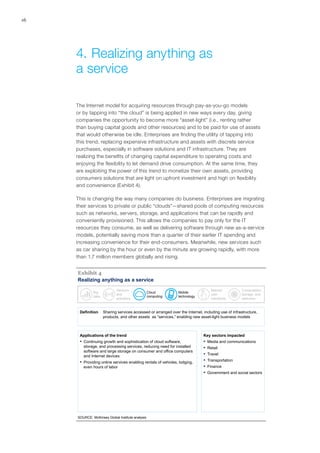
Realizing anything as a service
SOURCE: McKinsey Global Institute analysis
Exhibit 4
Definition Sharing services accessed or arranged over the Internet, including use of infrastructure,
products, and other assets as “services,” enabling new asset-light business models
Applications of the trend
▪ Continuing growth and sophistication of cloud software,
storage, and processing services, reducing need for installed
software and large storage on consumer and office computers
and Internet devices
▪ Providing online services enabling rentals of vehicles, lodging,
even hours of labor
Key sectors impacted
▪ Media and communications
▪ Retail
▪ Travel
▪ Transportation
▪ Finance
▪ Government and social sectors
Big
data
Sensors
and
actuators
Cloud
computing
Mobile
technology
Natural
user
interfaces
Computation,
storage, and
networks
4.	Realizing anything as
a service
17Ten IT-enabled business trends for the decade ahead
McKinsey Global Institute
Applications of the trend
In the next five years, the continuing growth of online services will give
organizations increasing flexibility in how they organize themselves and how they
use their capital through at least two main routes—leveraging the cloud for their
own IT needs as well as new services to customers and using IT to leverage
underused assets such as office space.
ƒƒ Cloud for everything and everyone. As companies overcome anxiety about
trusting vital functions to cloud-based services, they are finding not only
savings and flexibility, but also a level of reliability and resilience that they
could not deliver in-house.
Cosmetics maker Revlon transferred more than 500 IT applications to a private
cloud hosted and managed by an external provider to help manage the 20
to 30 terabytes of data generated every week from global operations. The
chief information officer estimates that the company saved $70 million in the
first two years and cut data center energy use by 70 percent. When its data
center in Venezuela burned down, the company was able to move its digital
operations to New Jersey in two hours. Shaw Industries, a 30,000-employee
carpet-making company owned by Berkshire Hathaway, switched to a
cloud-based office suite in 2012 after estimating that it would cost less than
10 percent of buying and installing comparable enterprise software.
Cloud services are starting to affect large established markets, such as the
over $10 billion customer relationship management (CRM) software market.
Several major companies are moving thousands of employees from legacy
systems to cloud-based platforms—Hewlett-Packard is moving its global sales
teams to salesforce.com, Microsoft is moving to its own Dynamics CRM, and
IBM is migrating to the open source SugarCRM.
Cloud is now pervasive in services for consumers—movies and music are
increasingly stored on and delivered through Netflix and Spotify and other
cloud services. Documents are stored online, and many services that required
downloading and installing files now provide access through mobile apps.
ƒƒ Physical assets as a service. The range of things that are available as a
service continues to expand. Rent the Runway and Bag Borrow or Steal are
online services that let customers rent designer clothing, handbags, and
accessories. BookRenter and Chegg rent textbooks to college students for a
month or a semester. The barriers for entry are low for enterprising individuals
who want to make money from the use of a bicycle or car, and peer-to-peer
services are multiplying (see Trend 8: “The e-volution of commerce”).
Increasingly, companies are becoming suppliers of assets as services.
Companies with trucking fleets are renting idle vehicles by the day or the hour.
A growing number of companies with excess office space—a development
partially enabled by cloud services that connect virtual teams effectively—
are finding that they can generate revenue by offering spaces for short-term
uses. The Los Angeles Times has rented space to film crews, for example.
LiquidSpace is an online service that started by connecting people who need
temporary office space with companies that had empty offices and cubicles
to rent. Recently, the service has begun booking hotel meeting rooms by
the hour.
18
Implications for leaders
Executives should be thinking about how they can participate on both sides of the
anything-as-service phenomenon—as consumers of services and as providers.
They should also consider how services can help them reduce capital assets and
deploy money in other ways. Leaders should be thinking about creative ways to
monetize their assets. At the same time, companies need to evolve their business
models to prepare for more customers turning from buyers into renters.
Key questions
ƒƒ Which products can be provided as a service, and how can IT enable you to
do so?
ƒƒ How can you use the cloud to reach new customers with existing or
new services?
ƒƒ How can you make your processes more efficient and cost-effective as a
result of your partners/suppliers having provided more of their offerings as
a service?
ƒƒ How can you ensure security and privacy when using a public or
private cloud?
ƒƒ As customers adopt more “asset-light” lifestyles, which existing products/
services come under threat, and which can be redesigned?
19Ten IT-enabled business trends for the decade ahead
McKinsey Global Institute
The force of automation that has been felt in production work such as automotive
assembly and transaction work such as dispensing cash in a bank or booking
travel tickets is now beginning to be felt in types of knowledge work that were
not previously possible or practical to hand over to machines. This has enormous
implications for augmenting the capabilities of so-called interaction workers
(professionals, managers, and administrative support staff), who often represent
the most expensive and high-impact employees in an organization. Knowledge
work automation is made possible by advances in big data analytics, machine
learning, and natural user interfaces (for example, the ability of a computer to
interpret instructions in natural human language), combined with unprecedented
computing power and connectivity.
Knowledge work automation has the potential to affect more than 230 million
knowledge workers around the world and nearly $9 trillion in employment
costs. This presents huge opportunities as well as challenges to leaders across
business, society, and government and across multiple sectors of the economy
(Exhibit 5).
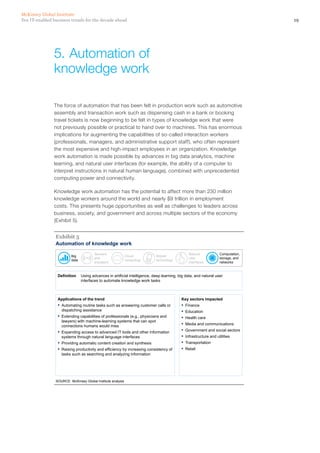
Automation of knowledge work
SOURCE: McKinsey Global Institute analysis
Exhibit 5
Definition Using advances in artificial intelligence, deep learning, big data, and natural user
interfaces to automate knowledge work tasks
Applications of the trend
▪ Automating routine tasks such as answering customer calls or
dispatching assistance
▪ Extending capabilities of professionals (e.g., physicians and
lawyers) with machine-learning systems that can spot
connections humans would miss
▪ Expanding access to advanced IT tools and other information
systems through natural language interfaces
▪ Providing automatic content creation and synthesis
▪ Raising productivity and efficiency by increasing consistency of
tasks such as searching and analyzing information
Key sectors impacted
▪ Finance
▪ Education
▪ Health care
▪ Media and communications
▪ Government and social sectors
▪ Infrastructure and utilities
▪ Transportation
▪ Retail
Big
data
Sensors
and
actuators
Cloud
computing
Mobile
technology
Natural
user
interfaces
Computation,
storage, and
networks
5.	Automation of
knowledge work
20
Applications of the trend
ƒƒ Information gathering and searching. Knowledge workers in our data-
driven economy often spend a huge amount of time and effort gathering data.
Developments in natural language processing and contextual understanding
are finally making machines able to search information and uncover patterns
and relationships, all at superhuman speed and efficiency.
Clearwell, based in Silicon Valley, analyzes documents for pretrial discovery—
the process of finding relevant information to use in a trial, which often requires
combing through thousands or millions of documents. It recently analyzed
more than half a million legal documents in less than three days for a client—a
process that earlier took large teams of lawyers several weeks. Social media
tools help enterprises with wide networks track product reviews and customer
complaints on Facebook and Twitter—impossible for humans with hundreds of
thousands of relevant posts daily but possible with automated algorithms that
look for patterns and can distinguish between tones in posts.
ƒƒ Automating communication. Many jobs that have traditionally involved
humans understanding other humans and communicating with them are now
getting automated as machines become better at understanding language and
processing speech. The Canadian Automobile Association of Saskatchewan
now uses computers to answer calls from motorists and dispatch roadside
assistance, saving 60 to 80 percent in cost per call compared with an
outsourced call center and cutting transaction time in half. Translation apps,
integrated into smartphones and Web browsers, can instantly translate entire
Web pages and could soon allow tourists to “speak” the local language by
talking into their apps.
ƒƒ Problem-solving expertise. Advances in big data analytics and deep learning
(programs that mimic how the human brain discerns patterns among objects,
sounds, or other kinds of information) now make it possible for machines to
process huge data sets and high-volume data feeds in near real time and see
patterns the human brain cannot. IBM’s Watson computer achieved fame by
beating human champions in the TV quiz program “Jeopardy!” Now, IBM has
teamed up with oncologists at Memorial Sloan-Kettering Cancer Center in
New York to develop a decision-support application for cancer diagnosis and
treatment using Watson. The application has “trained” on 600,000 medical
evidence reports and 1.5 million patient records and clinical trial reports and is
continuously learning from the latest medical research and cases.
ƒƒ Personal assistants. Machines are now being employed as assistants to
users, sometimes even before they know they need it. Apple’s Siri digital
assistant can take in voice queries and return search results, look up the
weather, make calls, or offer a choice of nearby restaurants. Google Now
attempts to second-guess the user based on behavior and context and
preemptively provide information—flight details on reaching the airport, traffic
conditions when leaving home in the morning, and even nearby photo spots.
21Ten IT-enabled business trends for the decade ahead
McKinsey Global Institute
ƒƒ Content creation and synthesis. While machines are not yet at the final
frontier of truly “creative” tasks, they are increasingly able to create structured
content based on simple rules. Narrative Science offers a service that
automatically generates content such as marketing materials and financial
reports by scanning technical documents and data. Yahoo! recently purchased
Summly, a news app that uses an extraction algorithm to summarize news
stories for subscribers.
Implications for leaders
As these techniques are applied to more kinds of knowledge work, companies
will have the opportunity to automate many tasks, redesign jobs, and do things
never before possible even with the best human workforces. However, this will
involve significant investment in technology as well as a change in organizational
culture. Business leaders will have to rethink the way they structure their
organizations when some knowledge work tasks can be automated. The value at
stake is considerable. Based on an analysis of how automated knowledge tools
might be applied across several different types of tasks around the world, MGI
estimates annual impact of $5 to $7 trillion in 2025.
While some kinds of knowledge work could be automated and some jobs could
be eliminated, others positions could increase in value; there will be greater need
for workers who have a deep understanding of statistics and analytics. The right
talent could command a higher premium, and companies that source competitive
advantage from access to talent and expertise should plan ahead for an era of
low-cost Watsons and high-priced human talent to manage the “workforce.”
At the same time, leaders across business and society will have to tackle the
implications for workers. Technological advances have historically displaced some
jobs and created others—eventually. Governments and businesses will have to
share the responsibility to ensure preparedness by retraining workforces and
redesigning education.
Another set of implications involve ethics and liability. As Watson and other
automated knowledge tools move into such areas as health care or security and
are tasked with making decisions based on probabilities and heuristics, law and
policy will have to be upgraded to accommodate issues around liability arising
from automation, such as situations when automated choices are contentious
or incorrect.
22
Key questions
ƒƒ What opportunities can you identify in making your organization’s work easier
and more efficient, e.g., in information gathering, automating communication,
or problem solving?
ƒƒ What could be some risks created by automating services or tasks earlier
performed by humans or under close human supervision, e.g., communicating
with customers?
ƒƒ How can you recruit the right employees for your organization and then train
and retrain them suitably?
ƒƒ How can your organization employ personal assistance tools at scale to
improve business processes?
ƒƒ How can society prepare its members for success in the automated age?
In particular, is the current system of education equipping children with the
necessary skills?
23Ten IT-enabled business trends for the decade ahead
McKinsey Global Institute
The borders of the digital and physical world have been blurring for many years,
as consumers learned to shop in virtual stores and meet each other in virtual
spaces. In those cases, the online world was replicating specific experiences of
the physical world. Increasingly, we are witnessing an inversion of these early
examples, as mobile Internet and advances in natural user interfaces give the
physical world digital characteristics. As our experiences—from retail stores
to factory floors—become rich with digital information, we see the potential for
increasingly melded digital and physical experiences (Exhibit 6).
Integrated digital/physical experiences
SOURCE: McKinsey Global Institute analysis
Exhibit 6
Definition Blending digital interactions with physical experiences such as shopping, often by
providing data and information to mobile Internet devices
Applications of the trend
▪ Digitally enhancing consumer experiences across touch points,
in particular for advertising and retail
▪ Improving workforce productivity through the use of tactile,
mobile devices
▪ Increasing interaction of digital content with everyday physical
experiences through next-generation devices, user interfaces,
and connectivity
Key sectors impacted
▪ Media and communications
▪ Retail
▪ Education
▪ Finance
▪ Transportation
Big
data
Sensors
and
actuators
Cloud
computing
Mobile
technology
Natural
user
interfaces
Computation,
storage, and
networks
Applications of the trend
Integrated digital/physical experiences are being used to transform our
experiences as consumers or employees, improving productivity and enriching
daily activities.
ƒƒ Consumer experiences. Companies today are forging new ties to consumers
by bringing digital augmentation to experiences that have remained resolutely
physical for decades. Tesco, the UK-based grocery chain, and Delhaize,
based in Belgium, have tested virtual store display in subways in South Korea
and Brussels, respectively, which allow commuters to “shop” via mobile
devices and have the chosen items delivered. Tesco was so pleased with the
6.	Integrated digital/physical
experiences
24
response that it introduced the virtual store displays in the United Kingdom.
Macy’s installed “magic mirror” displays in dressing rooms in some of its
stores to allow shoppers to “try on” clothes on 72-inch mirror displays. Several
car companies now offer heads-up displays on windshields that show such
data as speed, directions, traffic warnings, and cruise settings, eliminating the
need to take eyes away from the road to examine the dashboard.
Other companies have created striking promotions by using smartphones to
augment static objects. In a Valentine’s Day promotion, Starbucks instructed
customers to look at their cups through their smartphone video cameras to
see special animations. Samsung promoted its Galaxy S3 smartphones with
NFC (near field communication) billboards that invite customers to download
digital content by holding their smartphones close to the sign.
ƒƒ Work experiences. Businesses are exploring the potential of simple tools like
tablets as well as cutting-edge tools—many of which began as technologies
for entertainment or games—to integrate the digital into physical work activities
to improve productivity, sales, and product development.
A University of Chicago study in 2011 found that iPads helped improve patient
care by reducing the time needed to place treatment orders and allowing
residents to pull up visual aids to illustrate complicated diagnoses or surgical
procedures to patients. Several companies are using tablets to provide a more
comprehensive and interactive sales experience to customers. Consumer
electronics retailer Best Buy and automotive players Mazda and BMW are
equipping their sales staffs with iPads to walk customers through the buying
process and pull up information for them.
Boeing uses virtual reality glasses to assist factory workers in the
complex assembly of the 747 aircraft by reducing the need to consult
manuals, through annotated pop-ups that point to drilling locations or
display proper connections between as many as 50 pins and wires during
connector assembly.
ƒƒ Augmenting personal lives. Though digital tools have been part of our lives
for some time, a new generation of devices and applications enabling richness
and interactivity has the potential to fundamentally alter everyday experiences.
With the current generation of smartphones and tablets, we can now point our
smartphones to different parts of the night sky and see the position of stars
and heavenly bodies, or point them to everyday items such as street signs in
a foreign language and obtain real-time translations. Location-aware social
networking apps tell us who’s around, where we might want to go, and what
we might be interested in doing.
Next-generation mobile devices seem poised to push this trend even further.
Google is planning to market Glass, a set of eyeglasses with camera and
Bluetooth connectivity that can project digital information and images, like a
map of the neighborhoods, in the user’s field of vision. It is part of a trend of
wearable products by several companies that includes wraparound glasses for
immersive gaming and virtual reality ski goggles that use a heads-up display
to show skiers their location and speed (using GPS data), along with the time
and temperature, in real time.
25Ten IT-enabled business trends for the decade ahead
McKinsey Global Institute
While many examples of this trend bring digital information into our physical
experiences, some translate physical action into digital experiences.
Nintendo’s Wii and Microsoft’s Xbox Kinect game consoles allow players
to use physical movements and gestures to control action on the screen.
The upcoming MYO armband goes a step further—it aims to convert arm
movements into wireless signals by using electrical activity in muscles, freeing
users from having to stand in front of a camera or screen.
Implications for leaders
Customers today have an “always on” lifestyle—they are in constant engagement
with online services through a number of mobile, tactile devices that are
becoming smarter, easier to use and, as a consequence, more pervasive in the
human experience. A 2012 McKinsey survey in the United States found that the
average respondent spends three hours a day on mobile devices, up from one
hour in 2008, while continuing to spend about five hours watching television,
often engaging with “multiple screens” simultaneously. The information available
to and consumed by the average individual has increased dramatically, even as
many of us finding it daunting. These transformations in lifestyles represent major
challenges and opportunities.
Businesses, whether they deal with other businesses or with consumers, must
examine their processes for points where immersive experiences, interactive
touch points, or custom apps can improve effectiveness. They should rethink their
strategies for incorporating new digital platforms (for example, smartphones and
tablets) into their product design, the media they depend on to advertise, and the
ways in which they collect customer feedback.
They also have the chance to apply these tools to improve their own productivity
and reimagine the physical experiences of employees. As the clutter in people’s
lives from the surfeit of apps and devices increases in the years ahead, there
will be opportunities to develop tools that help consumers and employees alike
prioritize and organize personal information.
Finally, integrated digital/physical experiences represent opportunities to
significantly improve personal lives through such tools as automated personal
assistants, IT tools for learning, communication, and collaboration. Customers
will soon come to expect the digital/physical experience when they leave home,
and retailers and other consumer-facing businesses that do not understand this
technology and make it part of their skill sets will run the risk of being left behind.
At the same time, businesses and policy makers should consider the impact of
these pervasive and rapid changes on society. The integration of digital aspects
into activities also makes individuals more vulnerable to transgressions of privacy.
The rapid pace of change of IT challenges educators as well as individuals, who
can find consumer technology becoming obsolete in a few years or months.
26
Key questions
ƒƒ What digital information or features would make physical experiences today
more intuitive and valuable to customers?
ƒƒ How can you integrate digital and physical experiences to increase
productivity, innovation, and safety in the workplace?
ƒƒ How can you use IT to make consumer experiences richer and create value for
your individual life?
27Ten IT-enabled business trends for the decade ahead
McKinsey Global Institute
After two decades of shopping, reading, watching, seeking information, and
interacting on the Internet, our expectations have changed. Whether dealing with
customer service representatives, researching vendor websites, or shopping
in a bricks-and-mortar store, customers expect more services to be free,
personalized, and easy to use without instructions. When they don’t find these
things, they are likely to voice their disappointment on Facebook or Twitter.
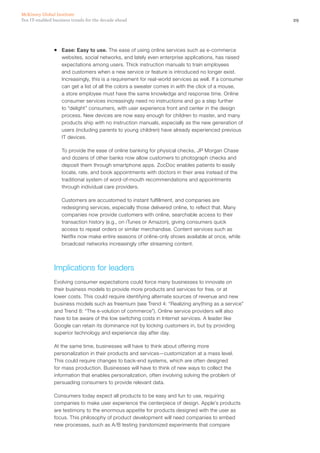
This presents major challenges for business (Exhibit 7). Even among online-
only businesses, the bar continues to rise. Customers want easier interactions,
seamless transactions, and more features—all for free. Competitors are a mouse-
click away, and any leader that falters is soon in danger. On the Internet—and
increasingly in the offline world—the customer has more power than ever.
Me + free + ease
SOURCE: McKinsey Global Institute analysis
Exhibit 7
Definition Rising consumer expectations for instant access to information, transparency,
customization, low prices, and ease of use, based on the model of Internet services, now
being applied offline as well
Applications of the trend
▪ Responding to increased pressure from consumers to provide
services for free and creating the need for companies to
search for alternate revenue pools
▪ Personalizing customer service, often through customization at
scale
▪ Growing expectation of extreme ease of use and
instantaneous results
Key sectors impacted
▪ Media and communications
▪ Retail
▪ Education
▪ Manufacturing
▪ Finance
▪ Health care
Big
data
Sensors
and
actuators
Cloud
computing
Mobile
technology
Natural
user
interfaces
Computation,
storage, and
networks
Applications of the trend
ƒƒ Free. As the Internet has become the primary medium of information and
media consumption over the past decade, customers have grown accustomed
to consuming for free. Many of the Internet’s most popular services replaced
paid offline services and ushered in an era of “free”—obtaining information
through Google and Wikipedia instead of encyclopedias and consulting
Craigslist instead of classified ads. Customers read free online editions instead
7.	 Me + free + ease
28
of physical newspapers, and access music and movies through peer-to-peer
sharing websites. The extension of “free” into new areas continues to this day.
Once the concept of free takes hold, it becomes risky to then expect
consumers to pay. Video game maker Electronic Arts lost 400,000 of the
1.7 million online players of its Star Wars multiplayer game in 2012 because
customers expected the game to be free. It found out that 40 percent of
players were willing to come back if they didn’t have to pay. Now, the game is
available on a “freemium” basis: free for the first 50 levels and paid for the rest.
Across customer-facing industries, companies are experiencing resistance to
paying, acutely so for things that have been free. When US banks proposed
monthly maintenance fees for debit cards, instant outrage spread on social
media sites and the plans were quickly withdrawn. However, as business
models have evolved, some granular consumer-pay models have worked.
Music-sharing pioneer Napster, for example, sparked intense debate on
intellectual property rights and was strongly resisted by incumbents. But it
ultimately laid the path for iTunes and “freemium” content provision such as
the New York Times paywall, which allows ten articles per month for free
but requires a paid subscription to read more (see Trend 8: “The e-volution
of commerce”).
Now, when consumers venture into bricks-and-mortar stores, they continue
to use the Internet to compare prices, read reviews, and even order online.
Best Buy is countering “showrooming”—the practice of shoppers testing
products in stores but purchasing online—by launching a program aimed at
combining in-store service with Internet-like pricing. Knowledgeable sales
representatives greet shoppers and answer questions on product features. If a
question requires more information, the representatives have tablets to access
additional data—including pricing from 19 online retailers.
ƒƒ Me: Personalized. Consumers expect to be treated as individuals who are
valuable to the companies they give their business to. While this is challenging
in complex, multi-channel environments, companies that are able to offer
personalized service are rewarded with greater loyalty and sales.
Personalization of services is most easily visible in online experiences such as
customized Web search results based on the user’s preferences and networks
on social media. Use history is used by Spotify for music and Apple for app
recommendations. Similarly, Facebook and Amazon present completely
customized landing pages, recommendations, and even deals.
Companies with physical products as well as offline services are also
recognizing the need for personalization. Nike allows customers to design
their own shoes from templates and even offers “inspirations.” Retailers Tesco
and Safeway use data from loyalty programs to customize marketing offers,
essentially adjusting prices for specific customers, increasing sales as well as
customer engagement. A major credit card processor found that investing in
higher-caliber call-center representatives who can offer single-point, personal
service pays handsomely. Each representative is trained on common issues
and is encouraged to take care of the customer’s request without passing on
the call to a specialist. Representatives are incentivized on service provided
instead of time saved on the call. The result is a 10 percent improvement in
customer service margins and higher customer service ratings.
29Ten IT-enabled business trends for the decade ahead
McKinsey Global Institute
ƒƒ Ease: Easy to use. The ease of using online services such as e-commerce
websites, social networks, and lately even enterprise applications, has raised
expectations among users. Thick instruction manuals to train employees
and customers when a new service or feature is introduced no longer exist.
Increasingly, this is a requirement for real-world services as well. If a consumer
can get a list of all the colors a sweater comes in with the click of a mouse,
a store employee must have the same knowledge and response time. Online
consumer services increasingly need no instructions and go a step further
to “delight” consumers, with user experience front and center in the design
process. New devices are now easy enough for children to master, and many
products ship with no instruction manuals, especially as the new generation of
users (including parents to young children) have already experienced previous
IT devices.
To provide the ease of online banking for physical checks, JP Morgan Chase
and dozens of other banks now allow customers to photograph checks and
deposit them through smartphone apps. ZocDoc enables patients to easily
locate, rate, and book appointments with doctors in their area instead of the
traditional system of word-of-mouth recommendations and appointments
through individual care providers.
Customers are accustomed to instant fulfillment, and companies are
redesigning services, especially those delivered online, to reflect that. Many
companies now provide customers with online, searchable access to their
transaction history (e.g., on iTunes or Amazon), giving consumers quick
access to repeat orders or similar merchandise. Content services such as
Netflix now make entire seasons of online-only shows available at once, while
broadcast networks increasingly offer streaming content.
Implications for leaders
Evolving consumer expectations could force many businesses to innovate on
their business models to provide more products and services for free, or at
lower costs. This could require identifying alternate sources of revenue and new
business models such as freemium (see Trend 4: “Realizing anything as a service”
and Trend 8: “The e-volution of commerce”). Online service providers will also
have to be aware of the low switching costs in Internet services. A leader like
Google can retain its dominance not by locking customers in, but by providing
superior technology and experience day after day.
At the same time, businesses will have to think about offering more
personalization in their products and services—customization at a mass level.
This could require changes to back-end systems, which are often designed
for mass production. Businesses will have to think of new ways to collect the
information that enables personalization, often involving solving the problem of
persuading consumers to provide relevant data.
Consumers today expect all products to be easy and fun to use, requiring
companies to make user experience the centerpiece of design. Apple’s products
are testimony to the enormous appetite for products designed with the user as
focus. This philosophy of product development will need companies to embed
new processes, such as A/B testing (randomized experiments that compare
30
variants, as in comparing the effectiveness of landing pages) into their product
life cycle. They could tap the opportunity provided by social media to see how
consumers are really using their products, instead of relying on focus groups or
surveys, or they could catalyze viral adoption and marketing.
Key questions
ƒƒ Do you need to change your business model to more effectively monetize your
products and services, especially as core pricing comes under pressure from
consumer expectations?
ƒƒ How do you distinguish your service or product so customers remain willing
to pay for it instead of unfavorably comparing it with what is available online or
from others a click away?
ƒƒ How should you tailor your product offering to varied customer tastes
and expectations?
ƒƒ Can your products and services be made easier to use and learn?
ƒƒ How can you leverage increased customer scrutiny and feedback to
your advantage?
31Ten IT-enabled business trends for the decade ahead
McKinsey Global Institute
As with other IT-enabled business activities, e-commerce is getting a jolt
from the rise of the mobile Internet and the evolution of base technologies
that reduce costs and vastly simplify the process of doing business and
completing transactions online. As a result, barriers to entry have fallen, and new
marketplaces, new kinds of payment systems, and new business models are
emerging (Exhibit 8).
The e-volution of commerce
SOURCE: McKinsey Global Institute analysis
Exhibit 8
Definition Low-cost, high-speed, seamless exchange of information enables new types of online
markets, payment systems, and business models
Applications of the trend
▪ Spurring growth of new marketplaces, enabled by the “sharing
economy,” providing a platform for individuals to monetize their
unused assets and offer services to a wide pool of consumers
▪ Using advancements in IT to enable faster, cheaper, secure,
and less intrusive financial transactions in developed and
developing markets
▪ Changing consumer preferences and expectations driving
development of new business models like “multisided” and
“freemium”
Key sectors impacted
▪ Retail
▪ Finance
▪ Transportation
▪ Media and communications
Big
data
Sensors
and
actuators
Cloud
computing
Mobile
technology
Natural
user
interfaces
Computation,
storage, and
networks
Applications of the trend
ƒƒ New marketplaces. The barriers to entry into e-commerce have fallen to the
point where individuals who have a room to let or can knit a sweater can tap
into a global market of customers. Airbnb, the poster child of the “sharing
economy,” brokers deals between travelers and people with spare rooms to
let in their homes or apartments, essentially performing the same service as
hotels or travel portals but in a parallel “peer-to-peer” market.
Peer-to-peer markets enabled by new e-commerce platforms are springing up
for sharing everything from bicycles and boats to hours of labor. RelayRides
and Getaround allow car owners to operate their own Zipcar-like services,
offering the use of their private vehicles by the hour or by the day. Amazon’s
Mechanical Turk and TaskRabbit host online marketplaces where independent
contractors bid for jobs such as proofreading documents or carrying out
chores, such as pet-sitting or housecleaning.
8.	The e-volution of commerce
32
Although these new marketplaces are just beginning to disrupt traditional
businesses, established companies are taking them seriously. Airbnb booked
more than ten million overnight stays in 2012 and could soon be selling
more room nights than major international hotel chains. General Motors has
established a technology partnership with RelayRides to stay on top of a trend
that could affect its sales, and Avis acquired Zipcar in 2013. Daimler launched
its Car2Go service that rents out small electric cars by the minute in cities in
Germany, as well as in Amsterdam and San Diego.
ƒƒ Payment systems. New services are attempting to disrupt traditional
transaction models, with mobile payments leading the way. They are having
an impact on huge markets like the global credit card industry, which handles
$6 trillion worth of transactions a year, collecting more than $100 billion to
$200 billion in fees.
Square, for example offers a small, portable card reader that can plug into
most smartphones and can be set up to accept credit cards in minutes. The
ease of setup and operation, combined with lower processing fees, helped
Square’s transaction volume jump tenfold in two years; more than 60 percent
of its clients had never previously accepted credit cards. Payments giant
Visa invested in Square in 2011. Another investor, Starbucks, is deploying
Square Wallet, an application that stores a user’s credit card information on
a smartphone, in its US stores. It is also working on a touchless smartphone
payment system: the cashier simply confirms that the user matches the picture
that pops up on the register display, and the value is deducted from the
smartphone. Leading retailers including 7-Eleven, Best Buy, CVS, and Walmart
have announced a plan to jointly develop a mobile payment network.
New mobile payment platforms are also leveraging the cloud and big data in
providing additional services to client businesses. Businesses using Braintree
can offer customers the option of paying through credentials they might have
entered earlier for a different merchant, while Square enables clients to access
their sales data from anywhere and set up loyalty programs.
New payment systems have also led to the emergence of virtual currencies.
Safaricom’s M-Pesa service in Kenya and Tanzania now allows more than
15 million users to transfer money through mobile phones, making mobile
minutes interchangeable with money. The volume of online transactions has
led to the emergence of new currencies, with the open source bitcoin recently
crossing $1 billion in circulation.
ƒƒ New business models. Businesses are faced with a growing imperative to
create “multisided” business models that create value through interactions
with multiple stakeholders, as opposed to traditional one-on-one models.
Facebook and Google provide their marquee services for free and generate
enormous value for advertisers by offering deep insights into customers’
preferences and connections. Personal finance website Mint generates
revenue through lead generation by recommending products to users.
Credit card companies monetize the valuable and highly relevant transaction
data they record from millions of consumers by creating consumer analysis
products that are sold to marketers.
Other models enabled by digital services include “freemium” online services
such as LinkedIn and Pandora—in which a group of customers gets free
33Ten IT-enabled business trends for the decade ahead
McKinsey Global Institute
services while another pays a premium for special features—and niche
services like Etsy, which enables suppliers of a variety of handmade craft and
vintage items to reach customers.
Implications for leaders
Business leaders will need to pay careful attention to these new forms of
e-commerce, which could be disruptive to some traditional business models.
Banks, card issuers, and other players in payments will be affected directly by the
growth of new payment systems. Peer-to-peer rental businesses for hotels and
automobiles and even for raising capital could be highly disruptive.
On the plus side, great opportunities could be created for large organizations to
participate in these new markets and monetize assets. Large organizations may
be able to resell some of the data that they collect in the course of doing business
or rent out proprietary software. New markets for contract work could provide an
opportunity for companies to create flexible capacity and crowdsource specific
tasks more effectively.
Key questions
ƒƒ How can the “sharing economy” disrupt your business model?
ƒƒ How can you use next-generation transactions to make your customer
experience more seamless?
ƒƒ How can you use your company’s assets, e.g., data or infrastructure, to create
new products for existing, or new, customers?
34
In the coming decade, 2.5 billion to 3 billion more users could be connected to
the Internet (Exhibit 9). Most of this growth will occur in developing economies,
where McKinsey research suggests that by 2025, more than 1.8 billion people will
move up into the global consumer class—those who earn enough to buy goods
and services after meeting basic needs.
The next three billion digital citizens
SOURCE: McKinsey Global Institute analysis
Exhibit 9
Definition Emerging opportunities as three billion people join the digital economy using the mobile
Internet—driving financial inclusion, entrepreneurship, and the development of new
business models
Applications of the trend
▪ Extending financial inclusion to the “unbanked,” often through
deployment of mobile payment and banking services
▪ Encouraging economic development through the growth of
local entrepreneurship, driven by expanding access to digital
services
▪ Customizing products and services to markets by local and
multinational companies alike
Key sectors impacted
▪ Retail
▪ Finance
▪ Health care
▪ Government and social sectors
▪ Agriculture
▪ Education
Big
data
Sensors
and
actuators
Cloud
computing
Mobile
technology
Natural
user
interfaces
Computation,
storage, and
networks
The leading agent for connecting these billions of consumers will be mobile
computing devices, particularly smartphones. In the past decade, sales of mobile
handsets have grown at more than 20 percent a year in Africa and 15 percent in
Asia and Latin America, or three to four times the growth rate in North America
and Western Europe. Both China and India now have more than one billion mobile
handsets and are among the largest number of Internet connections in the world.
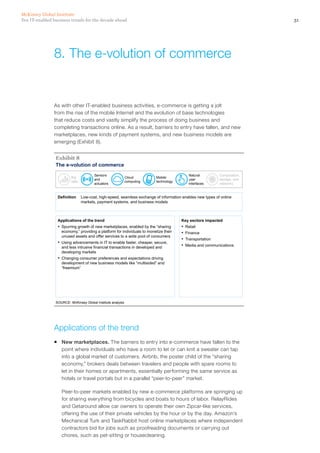
However, smartphone penetration in India is only 10 percent and though it is
higher in China at 43 percent, the ongoing transition to 4G networks and cheaper
smartphones are expected to keep the market for smartphones in China growing
above the global rate of growth of 40 percent.
This rapid rise in connectivity could be a key driver in the development of
communities in less developed regions, by facilitating financial inclusion and local
entrepreneurship, as well as a source of opportunity to businesses wanting to be
a part of the next three billion digital citizens’ path toward upward mobility.
9.	The next three billion
digital citizens
35Ten IT-enabled business trends for the decade ahead
McKinsey Global Institute
Applications of the trend
Millions of people will leapfrog from little contact with the wider world to owning a
mobile device that connects them with the global digital economy, in many cases
acquiring Internet connectivity before gaining access to running water or reliable
electricity. New mobile computing devices and form factors will emerge to serve
these users and move rapidly down the cost curve, enabling new applications
and sources of value. This will have enormous implications for how economies
develop, how global competition unfolds, and how today’s leading companies
pursue growth opportunities. MGI estimates that the impact of the mobile Internet
in applications it has sized that are related to the next three billion Internet users
could generate economic value of $2 trillion to $5 trillion annually, nearly half of
which would be consumer surplus--a measure of the benefits that would arise
from widespread adoption of the mobile Internet in developing economies.
ƒƒ Financial inclusion. One of the most important drivers of economic growth
and consumption in any economy is the size of the population that has access
to financial services. Mobile payment schemes have been highly successful in
several developing countries. Safaricom’s M-Pesa mobile banking system has
doubled its subscriber base in Kenya in the past two years and has more than
15 million subscribers in Kenya alone, plus 9 million in Tanzania.
Banks in emerging economies are pioneering services for the millions of
unbanked citizens. Dutch-Bangla Bank Limited launched a mobile banking
service in Bangladesh and signed up more than a million subscribers within
just ten months. A half-million customers have opened bank accounts with
Standard Bank in South Africa via mobile phones, which reduced origination
costs for the bank by 80 percent.
ƒƒ Local entrepreneurship and economic development. Rapidly expanding
access to digital services encourages entrepreneurship and development
of new IT-enabled businesses in the developing world.18 Some of these
new ventures have attracted international attention. Google invested seed
money in Kenya’s iHub project, an incubator for entrepreneurs building the
foundation for technology infrastructure in the region. Ushahidi (“testimony” in
Swahili) created a website after the disputed 2007 election in Kenya to collect
eyewitness accounts of violence and place them on Google Maps. Since
then, it has been used by volunteers in Haiti in 2010 and by pro-democracy
demonstrators in Libya in 2011. Souktel’s JobMatch service in the West Bank
helps young people cut the time to find jobs from an average of 12 weeks to
less than 1 week, while increasing wages up to 50 percent.
ƒƒ “Glocal” innovation. Multinational companies and local businesses alike
are developing products and IT-enabled business models specifically for
local conditions, despite infrastructural challenges. These so-called glocal
services are sometimes based on adaptations of global offerings for specific
local tastes and conditions, and sometimes reflect local innovation that can
be adapted for other regions. Technology products not only have to be priced
correctly, but they may have to have completely different sets of features. Also,
because credit and debit cards are not widely used in emerging economies,
leading Chinese and Indian e-commerce companies accept cash on delivery
18	 Online and upcoming: The Internet’s impact on aspiring countries, McKinsey High Tech
Practice, January 2012.
36
for more than half of all transactions. MTN Group, the leading telecom
operator in Africa, replaced prepaid scratch cards in Nigeria with a Virtual
Top-Up service for sale of airtime to gain greater visibility into the performance
of retailers, which are often multiple levels removed from the company
wholesalers. Unilever has adopted a glocal strategy for channel management
in developing areas. It provides mobile devices to rural distributors, including
traditional mom-and-pop stores, which relay information such as stock levels
and pricing back to the company. The data is used to improve demand
forecasting, inventory management, and marketing strategy, increasing rural
store sales by up to a third.
Implications for leaders
Connecting three billion more consumers to the digital economy represents an
unprecedented growth opportunity—but one that will challenge companies. A
combination of online and offline strategies will be needed, as will a range of
investments in talent and capabilities. The markets in which the next three billion
are located may be small today but are growing several times faster than
developed markets. Business leaders will have to make crucial decisions on
how they allocate their capital and talent to position themselves for success in
these markets over the coming decade. To do so effectively, they will need to
abandon many assumptions on what consumers want and how best to reach and
serve them.
Key questions
ƒƒ How should companies configure resources in a world where major
developed markets are growing slowly or declining and emerging markets are
growing rapidly?
ƒƒ In which emerging markets and relevant product categories should leaders
attempt to get strong early mover positions?
ƒƒ How can companies make their products and services “glocal”—customized
to local tastes, while achieving global scale?
ƒƒ How can companies innovate to offer quality products and services at
attractive price points to these potential customers while remaining profitable?
ƒƒ How can companies take advantage of IT-enabled entrepreneurship in
emerging economies?
37Ten IT-enabled business trends for the decade ahead
McKinsey Global Institute
The Internet and sophisticated IT tools have brought sweeping change to how
companies interact with customers, manage operations, engage talent, and
collaborate with partners, often driving major productivity gains. However, such
benefits have been less apparent in government, health care, and education.
These vital services account for nearly a third of global GDP but have lagged
in productivity growth. Until recently, they have been slow to adopt Web-based
platforms, big data analytics, and other IT innovations. However, we believe
government, health care, and education can enter a new era of IT-enabled
productivity growth (Exhibit 10). Indeed, the growing power and accessibility of IT
is meeting with escalating pressure to deliver better public and social services at
lower cost, increasingly overcoming deep resistance to change.
Transformation of government, health care, and education
SOURCE: McKinsey Global Institute analysis
Exhibit 10
Definition Using the growing power and reach of IT to boost productivity in government, health care,
and education—sectors that have not benefited fully from previous waves of IT—to
improve service delivery and increase transparency
Applications of the trend
▪ Government: using IT to provide more “e-services,” optimize
resources and save costs, and engage citizens
▪ Health care: improving access to basic health care, as well as
developing innovative solutions to tough problems
▪ Education: adopting new pedagogies that make learning more
accessible, anytime and anyplace, and modular and engaging,
often driven by the growth of new platforms for delivery and
applied to areas like employee training
Key sectors impacted
▪ Government and social sectors
▪ Health care
▪ Education
▪ Infrastructure and utilities
Big
data
Sensors
and
actuators
Cloud
computing
Mobile
technology
Natural
user
interfaces
Computation,
storage, and
networks
10.	Transformation of
government, health care,
and education
38
Applications of the trend
GOVERNMENT
Globally, government spending accounts for about $13 trillion annually, or about
19 percent of world GDP. Governments at every level—national, regional, and
municipal—are starting to more fully leverage IT tools to improve their services.
In addition to providing e-government services, such as the ability to pay taxes
or parking tickets online or obtain documents, licenses, and permits, these
governments often use their websites and social technologies to engage citizens.
ƒƒ E-services. E-government services in many countries have improved service
delivery and reduced waste. In India, the government has enrolled nearly
300 million citizens in its Aadhaar scheme, the world’s largest biometric
identity program. The system will be used to make more than $50 billion
a year in direct cash transfers to poor citizens and is expected to save the
government more than $6 billion by plugging leaks (e.g., fraudulent payments).
In Nigeria, the government’s Payments Systems Vision 2020 program aims to
move all government spending and remittances to electronic payments and
provide much greater transparency and accountability.
ƒƒ Resource optimization and innovation. Governments are adopting cloud
computing, crowdsourcing, and other IT-enabled techniques that have helped
businesses cut costs and discover breakthrough ideas. The US government
introduced a “Cloud First” policy in 2011, a plan to shift a quarter of the
$80 billion in annual federal spending to the cloud from in-house data centers,
with a goal of saving 20 to 30 percent on the cost of the shifted work. The UK
government also has adopted a cloud-first policy, which it estimates will save
50 to 90 percent on a total cost of ownership basis on some services. In the
Philippines, the Department of Agriculture keeps track of more than 500 rural
infrastructure projects using GPS-enabled cameras and tablets and a geo-
tagging system to locate their feeds. This avoids having to pay for inspectors
to travel to remote and often hazardous areas. Cities from San Jose in the
United States to Brasov in Romania save power by adjusting street lights
dynamically, while the transport authority in Singapore optimizes future bus
routes based on users’ input on anticipated travel needs.
ƒƒ Citizen engagement. The power of social technologies to organize political
activity has been demonstrated around the world, notably in the Arab Spring
of 2011. Social technologies can also help government understand and serve
citizens, in much the same way that marketers engage purchasers online to
learn more about how products and services are being used.
Iceland, for example, passed a new constitution in October 2012 that
incorporates feedback received on Twitter and Facebook. South Korea’s
ePeople site invites citizens to submit petitions online for policy changes or to
report corruption. Government employees moderate online discussions about
submitted petitions, and the government is committed to reporting back on
its decisions.
39Ten IT-enabled business trends for the decade ahead
McKinsey Global Institute
HEALTH CARE
Public expenditure on health care as a share of GDP ranges from 4 to 5 percent
in India and China to 11 to 12 percent for Western Europe to nearly 18 percent
for the United States. Across wealthy Organisation for Economic Co-operation
and Development nations, the average is about 12 percent. Around the world, the
annual cost of health care is $7.5 trillion, about $3 trillion of which is supplied by
private providers. Controlling health care spending and improving outcomes for
patients are goals shared by nations around the world. Many of the IT-enabled
approaches we describe in this report are being applied today, but significant
potential remains in scaling up and effectively operationalizing IT to capture the
full benefits. A McKinsey Global Institute report estimated a potential of more
than $300 billion in annual value to US health care alone from using big data to
simultaneously optimize for the cost and quality of treatments.19
ƒƒ Improving access to health care. Just as the Internet has enabled new
modes of delivering products and services—reaching more consumers
at lower cost—IT-enabled systems can deliver health-care services more
efficiently and on a large scale. In rural Bangladesh, for example, 90 percent
of births occur outside of hospitals or health clinics, leading to higher risks
for mothers and infants. Since the launch of a mobile notification system
that alerts health clinics to dispatch a nurse-midwife team when labor starts,
89 percent of births take place with trained health workers in attendance.
Some of the most exciting developments in health care involve remote
diagnostics and other technologies that not only reduce costs but also
empower patients to take part in their own care. Qualcomm, in partnership
with Life Care Networks and the Community Health Association of China,
launched a cardiovascular monitoring system that allows patients to self-
administer an electrocardiogram and transmit the data in real time to a
dedicated team of physicians in Beijing who can diagnose and suggest
treatment by phone. Kenya has one doctor for every 7,000 people (the
United States has one for every 420), and the average income is $4.50 per
day, so Safaricom launched a call-in service that connects callers one-on-one
with a doctor for a small fee ($0.12 per minute). It received 200,000 calls in the
first year.
ƒƒ Innovative health-care solutions. In addition to expanding access to basic
health care, IT tools play an important role in creating innovative approaches
to managing complex health-care organizations and new approaches to
clinical care. New York City’s 1,100-bed Mount Sinai Medical Center is working
with GE on a system that uses smart tags to track what is happening to
patients and equipment. This allows the hospital to track the flow of hundreds
of patients, treatments, and assets in real time. The hospital estimates that the
resulting efficiencies could allow it to treat 10,000 more patients each year,
while generating $120 million in savings and revenue over several years.
As noted in the chapter on automated knowledge work,, IBM’s Watson
supercomputer has been enlisted to assist in clinical care at Memorial Sloan-
Kettering Cancer Center, to recommend care based on its extensive database
of medical research and patient records.
19	 Big data: The next frontier for innovation, competition, and productivity, McKinsey Global
Institute, May 2011
40
EDUCATION
Around the world, nations spend $3.5 trillion annually, or about 4.5 percent of
GDP, on education. In the United States, where college tuition costs have doubled
in the past decade, the cost of education is over 7 percent of GDP. In most
places, major educational institutions are structured today as they were in the
19th century and deliver their services in much the same ways. We believe the
trends described in this report will combine to force educators to rethink models
of learning and embrace new platforms and modes of teaching.
ƒƒ New pedagogies. Educators are applying IT to existing systems as well
as creating new ways to make learning more adaptive, asynchronous (i.e.,
students can learn at their own pace), modular, and engaging. Education
Elements and 2Revolutions partner with schools and districts to redesign
learning models to be more competency-based and learner-focused by using
a mix of offline and online instruction. DreamBox is an online K–5 mathematics
teaching tool that is applying gamification to learning environments.
DreamBox’s online courseware immerses students in environments such as
theme parks with adventure zones and animated characters to make learning
fun. Using algorithms to evaluate responses, the system can adapt to each
student’s learning experience and offer additional instruction as needed. As a
result, several schools have improved student test scores.
MOOCs (massive open online courses) are leading the charge in creating new
pathways for learning. Khan Academy teaches subjects in ten-minute modules
and has amassed 4,000 videos that have been viewed more than 244 million
times. Students can learn at their own pace and earn badges or points as they
progress. Other platforms, such as edX and Udacity, have partnerships with
top universities including the Massachusetts Institute of Technology, Harvard
University, and Stanford University. Coursera, a fast-growing MOOC platform
started by Stanford professors in 2012, now offers courses from more than
60 universities around the world and is registering one million students every
month. In February 2013, the American Council on Education, an association
that advises 1,800 member colleges, recommended five MOOCs offered by
universities on Coursera for credit.
ƒƒ New delivery mechanisms. Devices such as smartphones and tablets
are entering the classroom, serving as channels to deliver personalized IT-
enabled content. The Indian government is running trials of the under-$50
Aakash tablet to link more than 25,000 colleges in an e-learning program,
potentially bringing quality teaching tools to millions of students. The South
Korean government is building a cloud-based system to enable downloads of
e-textbooks to government-funded tablets that are scheduled to be distributed
to students by 2015. Meanwhile, students are using smartphones for
everything from learning about topics like the periodic table through interactive
apps to recording lectures and notes.
41Ten IT-enabled business trends for the decade ahead
McKinsey Global Institute
ƒƒ Teacher development. Research has consistently shown that teacher
quality has more to do with outcomes than almost any other factor. New
IT-enabled approaches are helping teachers improve their performance
through collaboration, personalization of learning plans, and access to highly
effective teachers. LearnZillion, which trains teachers by providing videos of
master teachers, is being used by more than 100,000 teachers. Kickboard’s
Web-based system helps teachers manage their classes by tracking student
performance in real time, which allows for timely and targeted intervention.
More than 150,000 teachers use BetterLesson to share and download
instructional content from a searchable database. They can co-create
courses through collaboration tools such as real-time lesson-plan editing,
which lightens the load for individual teachers while increasing the quality of
lesson plans. Teachers are encouraged to modify and improve materials they
download, iteratively improving the quality of content.
ƒƒ Employee training. IT tools are not limited in their application to traditional
educational institutions. Businesses and even governments are applying
them to make training more effective. Marriott, Siemens, and GE Healthcare
are using games to train employees in the basics of running hotels, plants,
or hospitals in engaging ways. Blue Shield of California, a non-profit health
insurer, has launched employee health and productivity programs that use IT
tools like mobile apps to teach employees how to manage their health. After
the program was implemented, the rate of smoking among employees fell by
half, the incidence of hypertension dropped by two-thirds, and the company
was able to cut the annual increase in health costs from double digits to single
digits over three years.
Implications for leaders
Unleashing the power of the connected enterprise in government, health care,
and education will force significant change and present many challenges.
Governments, which are responsible for delivering health care and education in
addition to other services, will need to take a comprehensive view of where and
how to invest. They will need to effectively manage system implementations,
assemble lean IT operations, develop innovative IT-enabled services, and cultivate
deep technology expertise.
Far-reaching political and social considerations are at stake. Government, health
care, and education provide critical services that have a direct impact on billions
of lives. They are among the largest employers in many economies. Education
plays a major role in economic functioning and development. By successfully
harnessing IT in these areas, policy makers have an opportunity to improve lives
and solve global problems.
42
Key questions
ƒƒ Government
—— How can the experience of pioneering governments that have successfully
implemented and managed innovative IT capabilities be applied by others?
—— How can governments harness social networks to work on public
goods projects?
ƒƒ Health care
—— How best can at-scale IT solutions be introduced into public
health initiatives?
—— What incentives or resources can governments and public institutions
provide to increase investment and research in information and
communications technology in health care?
ƒƒ Education
—— How can traditional educators create a distinctive offline experience
as digital, less expensive alternatives compete head-to-head on
teaching quality?
—— How can educators be equipped to integrate technology in a transformative
way into teaching and learning? How can schools and educators learn
which solutions exist and which are most effective?
43Ten IT-enabled business trends for the decade ahead
McKinsey Global Institute
The IT-enabled trends we have described in this paper are not only among
the most significant in terms of economic impact, but they also point to how
advances in technology will change society, the economy, and the workplace in
coming years. These trends can extend the powers of managers, workers, and
entrepreneurs, opening up new avenues to growth. They may also disrupt long-
standing commercial, social, and political relationships and alter the dynamics
of entire industry sectors. As these trends gather force, business leaders, policy
makers, and the public have many issues to consider:
ƒƒ The trade-off between privacy and utility. The world is entering an era
of pervasive connectedness, in which billions of people will be socializing,
sharing information, shopping, launching businesses, and banking on
the Internet. Businesses and governments will use the Web to monitor
equipment, make payments, and store data. Every move an individual
makes on the Internet will potentially be tracked. This connectedness could
generate massive surplus and enable new ways for businesses to offer more
personalized, targeted services; it can also enable breaches of privacy and
abuse of private information. Consumers, businesses, and policy makers
must evaluate the trade-offs between the benefits of connectedness and
these risks. The difficulty in striking the right balance is reflected in the debate
around the European Union’s data protection regulations, which could restrict
certain types of Internet tracking. Business groups oppose the measure as too
restrictive and damaging to Internet commerce.
We must also consider questions on ownership of digital information, which
in many cases is more valuable than physical assets. Data is generated in all
manner of interactions but is often “mashed up” with other data from various
sources to create value. Clarity on ownership of data can help determine fair
use of the data and allocation of value accruing from its use. More directly, it
is essential to frame policies to ensure fair compensation to rights owners and
artists while making their work widely available.20
ƒƒ The cybersecurity imperative. With digital information becoming pervasive
to the way businesses, governments, and individuals work and interact,
the volume as well as value of data has increased tremendously. Pervasive
digitization has added speed and accuracy to our lives, but it has also created
an imperative to protect the data that makes us vulnerable.
Prominent cyberattacks in recent years illustrate how massive the security
breaches can be. The consumer records of more than 100 million visitors
to Sony websites was stolen in 2011. The Stuxnet virus compromised Iran’s
nuclear centrifuges. More recently, attacks on major media websites in
the United States have helped change the attitude of affected parties from
20	 World Economic Forum, Norms and values in digital media: Shaping solutions for a new era,
McKinsey & Company, January 2013.
Conclusion
44
containing the damage to their reputations to engaging in a dialogue on
cybersecurity. The need for cybersecurity will only grow as trillions of bytes
of consumer data join business and government data as profitable targets for
criminals and terrorists.21
Business and government leaders must acknowledge the importance of
cybersecurity and must act on it. Government must take steps to guard
against the increasingly sophisticated capabilities of criminals and terrorists
(and rogue states) to disrupt and destabilize entire economies. At the same
time, employees and citizens must be taught to take security seriously and
exercise caution when surfing the Internet, opening emails that might contain
viruses, or even answering telephone calls that appear to be coming from
trusted sources.
ƒƒ An urgent need for skills. Even now, as the global economy slowly recovers
from the financial crisis and unemployment rates remain high in advanced
economies, companies report that they cannot find qualified candidates for
job openings. Skill gaps appear in many fields but are most pronounced in
work requiring specific technical skills. This gap will only grow wider: jobs for
graduates in science, technology, engineering, and mathematics (the STEM
fields) will grow 1.7 times as fast as non-STEM jobs, and the United States will
need one million more graduates in these disciplines than will emerge from
universities at current rates of enrollment. Currently, only 13 percent of US
graduates major in STEM fields, compared with a quarter in India and nearly
40 percent in China.
The skill challenge will grow to even larger dimensions as the automation
of knowledge work gains momentum. With computers taking on a growing
number of knowledge work tasks, higher-level skills will become increasingly
important. Employees will need to be creative problem solvers with a
strong aptitude for science and technology. Businesses will need to provide
continuous skill training to upgrade the capabilities of workers whose jobs
have been redesigned; governments will have to rethink education for the new
age. Breakthroughs in teaching technologies will help, but it is unclear what
the roles of industry and government will be in creating a workforce that has
the right skills for evolving jobs.
ƒƒ Embracing transparency. As consumers, citizens, and even business-to-
business customers become more accustomed to operating in the digital
realm, where real-time information and instant price discovery are the norm,
governments and companies will be forced to embrace greater openness with
their customers, clients, and citizens. Customers demand total transparency,
and they expect to be heard. With the advent of social media, customers are
increasingly vocal about their preferences and reactions and can quickly have
a disproportionate impact on a company’s reputation. Conversely, we see that
companies and institutions that are seen to be open and willing to engage with
customers and clients often enjoy greater brand loyalty. When Maker’s Mark
whiskey decided to reduce the alcohol content in its bourbon, it was met with
an immediate backlash on social media. The company reversed the decision
within a week and earned praise from loyal customers for its “You spoke. We
listened.” apology.
21	 John Dowdy, Joseph Hubback, Dennis Layton, and James Solyom, “Can you hack it?
Managing the cybersecurity challenge,” McKinsey on Government, Autumn 2011.
45Ten IT-enabled business trends for the decade ahead
McKinsey Global Institute
This applies to governments as well as marketing organizations. Events
ranging from the geopolitics-altering Arab Spring to the protests around the
Stop Online Piracy Act in the United States have proven the power of social
media to tap into public sentiment and turn discontent into political action.
Governments and elected officials are paying attention. From South Korea to
the United States and the United Kingdom, nations are opening up access to
information and engaging citizens online.
ƒƒ Empowering the front lines. The Internet model of non-hierarchical
connectivity has implications for how companies organize and manage.
Organizations can use the Web to decentralize and shift more power to the
front lines—to store managers, suppliers, and even customers. With access
to the same data and tools that the back office has—and to the information
they gather in their locations—store managers can be entrusted with greater
decision-making powers.
Customers can be engaged in co-creating, evaluating, and marketing
products, helping increase loyalty and even reducing costs. Intuit, for example,
relies on a pool of customer experts to answer consumer queries about its
products and has found that these amateurs offer more accurate answers
than customer service experts.
IT itself is undergoing a “re-missioning”—moving beyond being a centralized
enabler to becoming a core capability in every part of the business. Cloud
and big data analytics are creating both the capability and the imperative for
employees with deep business knowledge to define and marshal their own
IT capabilities. IT tools and know-how must now be embedded within every
function, business unit, and team. The inevitable result is acceleration in
changes in business driven by IT.
McKinsey Global Institute
May 2013
Copyright © McKinsey & Company
www.mckinsey.com/mgi
@McKinsey_MGI
McKinseyGlobalInstitute

Ten IT-enabled business trends for the decade ahead

  • 1.
    McKinsey Global Institute TenIT-enabled business trends for the decade ahead May 2013 Updated research
  • 2.
    Copyright © McKinsey& Company 2013 The McKinsey Global Institute The McKinsey Global Institute (MGI), the business and economics research arm of McKinsey & Company, was established in 1990 to develop a deeper understanding of the evolving global economy. Our goal is to provide leaders in the commercial, public, and social sectors with the facts and insights on which to base management and policy decisions. MGI research combines the disciplines of economics and management, employing the analytical tools of economics with the insights of business leaders. Our “micro-to-macro” methodology examines microeconomic industry trends to better understand the broad macroeconomic forces affecting business strategy and public policy. MGI’s in-depth reports have covered more than 20 countries and 30 industries. Current research focuses on six themes: productivity and growth; natural resources; labor markets; the evolution of global financial markets; the economic impact of technology and innovation; and urbanization. Recent reports have assessed job creation, resource productivity, cities of the future, the economic impact of the Internet, and the future of manufacturing. MGI is led by McKinsey & Company directors Richard Dobbs and James Manyika. Yougang Chen, Michael Chui, Susan Lund, and Jaana Remes serve as MGI principals. Project teams are led by the MGI principals and a group of senior fellows, and include consultants from McKinsey & Company’s offices around the world. These teams draw on McKinsey & Company’s global network of partners and industry and management experts. In addition, leading economists, including Nobel laureates, act as research advisers. The partners of McKinsey & Company fund MGI’s research; it is not commissioned by any business, government, or other institution. For further information about MGI and to download reports, please visit www.mckinsey.com/mgi.
  • 3.
    McKinsey Global Institute MichaelChui James Manyika Jacques Bughin Brad Brown Roger Roberts Joi Danielson Shalabh Gupta Ten IT-enabled business trends for the decade ahead May 2013 Updated research
  • 4.
    Acknowledgments The authors wishto thank Alex Marrs for his substantial contributions to this paper. The authors would also like to acknowledge the contributions of the following McKinsey colleagues: Julie Avrane-Chopard, Tucker Bailey, Charlie Barthold, Michael Bloch, Sean Brown, David Cheifetz, David Edelman, Lisa Ellis, Drew Erdmann, Will Forrest, Chandra Gnanasambandam, Peter Groves , James Kaplan, Stephen Kelly, Eileen Lau, Richard Lee, Sam Marwaha, Brian Milch, Suraj Moraje, Abid Mohsin, Mona Mourshed, Nakul Narayan, Mark Patel, Vivian Riefberg, Humphry Rolleston, Jimmy Sarakatsannis, Stefan Schmitgen, Johnson Sikes, Patrick Viguerie, Peter Weed, and Paul Willmott. We are grateful to our external advisers Hal R. Varian, chief economist at Google and emeritus professor in the School of Information, the Haas School of Business, and the Department of Economics at the University of California at Berkeley; and Erik Brynjolfsson, Schussel Family professor of management at the MIT Sloan School of Management, director of the MIT Center for Digital Business, and research associate at the National Bureau of Economic Research. We also benefited from the guidance and insight of several technology and business leaders, including Bruno Lanvin, executive director of INSEAD’s eLab; Chamath Palihapitiya, founder and managing partner of The Social+Capital Partnership; Eric Schmidt, executive chairman of Google; David Mann, McKinsey alumnus; Vivek Wadhwa, vice president of Academics and Innovation at Singularity University; Ann Winblad, managing director of Hummer Winblad Venture Partners; David Kirkpatrick, founder and CEO of Techonomy Media; Paddy Cosgrave of F.ounders; and Robert Shaw at Atos SE.
  • 5.
    Ten IT-enabled businesstrends for the decade ahead McKinsey Global Institute Contents Introduction 1 1. The social matrix 3 2. The Internet of All Things 7 3. Big data, advanced analytics 11 4. Realizing anything as a service 16 5. Automation of knowledge work 19 6. Integrated digital/physical experiences 23 7. Me + free + ease 27 8. The e-volution of commerce 31 9. The next three billion digital citizens 34 10. Transformation of government, health care, and education 37 Conclusion 43
  • 7.
    1Ten IT-enabled businesstrends for the decade ahead McKinsey Global Institute Introduction Progress in information technology is transformative. Every year brings faster processing speeds, greater storage capacity, bigger data sets, and more advanced software. Ways of connecting, sharing, collaborating, and doing business become richer, more varied, and more powerful, enabled to a large extent by expanding IT capabilities. Understanding how these capabilities are evolving is critically important for companies. The IT-enabled business trends we discuss here provide fresh opportunities for companies to create new sources of value—new products, new ways of touching customers, and new tools for improving operating efficiency. They also have the potential to shift profit pools, disrupt markets and commercial relationships, undermine existing market leaders, and shift value to consumers or among producers. This white paper builds on and updates previous work by McKinsey experts that has appeared in The McKinsey Quarterly.1 Some of the trends that were just surfacing in 2007 or 2010 are now gathering greater momentum. For example, one of the major ideas we explored in 2010 was finding ways to get more value from interactions—the knowledge sharing, negotiations, conversations, and independent judgments that define the jobs of professionals and other knowledge workers. These employees are the highest paid and most high-impact workers in most organizations, but they have not benefited fully from the productivity gains that technology affords. Three years later, in this paper we highlight the new software tools that can automate tasks that were once thought to be beyond machines, including some of the work that interaction workers perform. What was the Internet of Things in 2010 has morphed into the Internet of All Things in this paper, reflecting how rapidly this trend is spreading. This technology involves using sensors and actuators to track and manage machinery and other physical assets across a network. The earliest approach in this trend, using radio-frequency identification (RFID) tags, was a highlight of our 2007 report. That the Internet of Things continues to evolve should not be a surprise; technology adoption can take a decade or more, depending on the complexity and the hurdles. Thanks to the mobile Internet and advances in sensors, we believe that Internet of Things adoption rates will soon accelerate. Big data is another technology that merited attention in 2010 and does so again. It, too, is experiencing accelerating growth, thanks to advances in processing capabilities. Moreover, new types of data analytics enable more real-time analysis, as well as closed-loop systems that, based on big data flows, can make autonomous decisions—for example, to release inventory into the distribution system based on shelf-level retail data. 1 Jacques Bughin, Michael Chui, and James Manyika, “Clouds, big data, and smart assets: Ten tech-enabled business trends to watch,” The McKinsey Quarterly, August 2010; James Manyika, Roger P. Roberts, and Kara L. Sprague, “Eight business technology trends to watch,” The McKinsey Quarterly, December 2007.
  • 8.
    2 Many trends reflectthe growing dominance of the Internet as an enabling technology, as well as a model and metaphor for commercial and social interactions. Twenty years into the Internet revolution, businesses and consumers have come to expect that information is a Google search away, friends and associates are always available on social networking sites, and goods and services (including public goods such as education and government services) can be had instantly from an online vendor anywhere in the world at any time of the day. Similarly, the physical and digital worlds are converging as things in the physical world become Web-enabled and physical spaces (e.g., stores and public spaces) become interactive environments in which things—a rack of shirts, for example— can convey information about themselves to a mobile Internet device: pricing, availability, matching items, and so on. The Internet of Things is rapidly gaining momentum, bringing millions of devices and objects into the connected world and enabling whole new ways of managing assets and operations. The Web continues to enable and inspire new business models that could have disruptive impact. The peer-to-peer distribution model that began with music files and which we described in 2010 in our discussion of “anything as a service” has morphed into the “sharing economy,” in which almost every possible commodity (e.g., rental cars, unused office space, or accounting help) can be ordered on the Web. This provides opportunities for companies to monetize idle assets, but it also has the potential to disintermediate and disrupt markets and industries. If companies can embrace Web-based business and operating models, they stand to gain far more than they lose. Social technologies, for example, are emerging as more than a powerful means of connecting with markets; they also are a means of communication and collaboration within and between businesses that has the potential to vastly improve productivity and organizational effectiveness. Nobody can predict how these trends will translate into economic value. The McKinsey Global Institute has estimated the potential economic impact that might arise from likely major applications of cloud computing, the Internet of Things and automation of knowledge work by 2025. MGI also estimates that half of the impact of the mobile Internet through 2025 will arise in developing economies, where it will most likely be the means by which 3 billion new users connect to the Internet. Altogether, these applications could have economic impact of $10 trillion to $20 trillion annually in 2025, including consumer surplus. In the coming decade, we see a brave new world where instant access to knowledge and the efficiency of the Web are applied more broadly and where the physical and digital worlds blend (wearable computers that monitor human health are no longer science fiction). One of the most exciting trends is the prospect of as many as three billion new consumers (and producers) joining the global economy via the mobile Internet. This was a trend we saw building in 2010, and it may exceed earlier expectations. Overnight, people in some of the poorest places in the world are leapfrogging into the Internet age, using the Web to join the formal economy, to manage their finances and health care, and even to set up virtual shop. The mobile Internet is also a two-way street, helping global companies tap into a vast new market.
  • 9.
    3Ten IT-enabled businesstrends for the decade ahead McKinsey Global Institute Social technology is a massive technological and social phenomenon—but its power as a business tool is still being discovered.2 Never before has a communications medium been adopted as quickly or as widely as social media. It took commercial television 13 years to reach 50 million households and Internet service providers three years to sign their 50 millionth subscriber. But it took Facebook just a year and Twitter even less time to reach the same milestone. Socially enabled applications will become ubiquitous, allowing liking, commenting, and information sharing across a large array of activities. We will live and conduct business in a social matrix, where virtually all resources can be found— collaborators, talent, customers, funders. The social matrix will enable new forms of organization that are only just becoming apparent (Exhibit 1). The social matrix SOURCE: McKinsey Global Institute analysis Exhibit 1 Definition Harnessing the ability to make any interaction or activity social—to influence actions, solve problems, and innovate, potentially creating new types of organizations that are not constrained by traditional boundaries Applications of the trend ▪ Crowdsourcing answers to difficult problems ▪ Using internal and external social networks to improve collaboration and knowledge sharing ▪ Using “social” as a feature to engage customers and co-create new products and services ▪ Reimagining organizational structures for a highly networked world Key sectors impacted ▪ Retail ▪ Education ▪ Manufacturing ▪ Health care ▪ Finance ▪ Media and communications ▪ Government and social sectors Big data Sensors and actuators Cloud computing Mobile technology Natural user interfaces Computation, storage, and networks Even now, however, the potential for value creation from the use of social technology remains largely untapped. A McKinsey global survey of more than 3,500 executives across industries in 2012 found that while more than 80 percent of respondents use social technologies, only 10 percent are truly networked and derive substantial value across all stakeholder groups.3 The 2012 McKinsey 2 The social economy: Unlocking value and productivity through social technologies, McKinsey Global Institute, July 2012. 3 Jacques Bughin and Michael Chui, “Evolution of the networked enterprise: McKinsey Global Survey results,” The McKinsey Quarterly, March 2013. 1. The social matrix
  • 10.
    4 Global Institute reporton the social economy concluded that two-thirds of the value available from the use of social technologies can be found through improving collaboration and coordination within and across organizations—uses that are far less developed than social-based marketing and sales applications and which will require significant organizational change.4 Applications of the trend In addition to the familiar role that social media now plays in marketing, we see at least four applications of social technologies that will be important for businesses and other organizations in the next few years: as an increasingly powerful platform for distributed problem solving, a collaboration and coordination tool, a feature that can be added to any digital activity to create new capabilities, and as the basis for new types of business organizations.5 ƒƒ Distributed problem solving. Enterprises increasingly use social networks to solve problems, often by “crowdsourcing” answers from consumers, experts, employees, and talented amateurs. Even very large companies with extensive internal capabilities are creating open competitions in which participants offer ideas for new product features, provide software codes, or help with customer service. In some cases, companies are crowdsourcing freelance and temporary talent to work on a project. Many organizations rely on distributed problem solving, tapping the brain power of customers and experts from within and outside the company for breakthrough thinking. Pharmaceutical major Boehringer Ingelheim sponsored a competition on Kaggle (a platform for data-analysis contests) to predict the likelihood that a new drug molecule would cause genetic mutations. The winning team, from among nearly 9,000 competitors, combined experience in insurance, physics, and neuroscience; and its analysis beat existing predictive methods by more than 25 percent. RTL Group, the European entertainment network, uses social media to create viewer feedback loops for popular shows such as “The X Factor”, helping increase audience size. ƒƒ Collaboration and communication. The MGI research noted that reading and answering email, searching for information, and collaborating with colleagues consume a large percentage of knowledge worker time. By using a social platform to communicate and share information, MGI estimates, companies can see improvements of as much as 25 percent in knowledge worker productivity by more efficiently and effectively communicating and finding information and expertise, partly by uncovering the “dark matter” that would otherwise lie buried in corporate emails. Communications on social platforms form an easily searchable record, providing valuable answers to questions for everyone who has access, not just the email recipient. Potentially, this represents what could be a great leap in productivity for what are usually a company’s most highly paid personnel—the knowledge workers. 4 Ibid. 5 Roxane Divol, David Edelman, and Hugo Sarrazin, “Demystifying social media,” The McKinsey Quarterly, April 2012; Roland Deiser and Sylvain Newton, “Six social-media skills every leader needs,” The McKinsey Quarterly, February 2013.
  • 11.
    5Ten IT-enabled businesstrends for the decade ahead McKinsey Global Institute Kraft Foods, which had launched an internal social network in 2011, saw the potential to raise the level of collaboration and knowledge sharing across the corporation by investing in a more powerful social technology platform. The new system supports microblogging, automatic content tagging, and easy creation and maintenance of subgroups for communities of practice (e.g., pricing experts). This has accelerated knowledge sharing, leading to shorter product development cycles, as well as quicker responses to actions of competitors. Firms are exploring using social media tools to reduce email, which is responsible for more than a quarter of the typical office worker’s time. French IT services provider Atos SE pledged in 2011 to become a “zero email” company by 2014 and aims to boost employee productivity by replacing email with a collaborative social networking platform. ƒƒ Social as a feature of everything. The ability to add social capabilities to any digitally enabled communication or transaction can make social technology pervasive. “Social” is a feature that can be embedded in products, markets, business systems, entertainment programming, and public institutions. Social networks allow us to “like” things and could soon evolve to allow us to mark the things we “want,” potentially signaling greater commercial intent. We can share our experiences with our network of friends and connections by posting pictures and tweets or by updating our status. These activities could become more automatic, such as through standing instructions to our smartphones to share certain activities with groups of friends, and therefore even more common. Virtually any economic activity that is carried out electronically can now be social. So, for example, when Macy’s buyers are getting ready to commit to next season’s styles, they include what they have learned from social media: recently, the company used 2,500 “likes” on its Facebook page to decide to carry jeans in “very vivid” blue, orange, and red instead of pastels and later solicited feedback from nearly 4,000 customers to decide about stocking another design. At Walmart, instead of figuring out next week’s specials by themselves, marketers run a “Toyland Tuesday” panel on social media, where consumers hit the “like” button to select two toys that will be discounted the following week. ƒƒ A reimagining of the organization. Social technology is giving rise to new organizational models. Not only can social technology enable coworkers to collaborate easily across time and space, but it also can redefine the boundaries of the organization and change them as needed. For example, using social platforms, companies can quickly reach into the social matrix and assemble teams of internal and external talent, hook up partners and customers, and complete projects more quickly and with greater expertise. Then they can disband teams and reform others as needed or deploy resources on multiple projects more easily. Companies can outsource problems to customers and use social media to drive engagement and innovation at the same time. Enterprises can be “born global” or “micro- multinational,” bringing together capabilities from different parts of the world from their inception rather than gradually growing into new geographies. It is no longer hard to imagine a company being founded with its executive
  • 12.
    6 management in theUnited States, software development in India, manufacturing in China, and sales and marketing functions spread around the world. Implications for leaders In the era of the social matrix, leaders of major organizations have unprecedented opportunities to improve the way their employees solve problems, collaborate, and interact with customers. Companies are starting to realize the potential of the social matrix to raise productivity—and creativity—but can do much more. Leaders should use social tools to improve internal collaboration, an area of immense opportunity, as many leading companies described above have found. In many cases, organization structures can be completely reimagined due to the ease of collaborating across geographic or organizational boundaries. They can also reimagine the process of solving difficult problems and embrace the opportunity to collaborate with the brightest minds outside their organizations, as long as they can ensure that the company’s intellectual property is not compromised in the process. In the information age, leaders of consumer-facing companies in particular should use co-creation both to solve problems and engage their customers. Key questions ƒƒ How can you use the social matrix to locate and harness talent and capability outside your organization to solve problems? ƒƒ How can your company use social networks to improve collaboration and communication within the organization as well as with external stakeholders such as suppliers and customers? ƒƒ How is your enterprise improving its offerings to customers by noting their likes, wants, and other behaviors in the social matrix? ƒƒ Are there alternate organizational models enabled by the rise of social networks that your company can employ to drive value?
  • 13.
    7Ten IT-enabled businesstrends for the decade ahead McKinsey Global Institute Sensors, actuators, and other means of connecting things in the physical world to networks are proliferating at astounding rates. More than 12 billion devices around the world, including computers and smartphones, are connected to the Internet. And the number of devices connected to networks is expected to increase dramatically within the next decade, with estimates ranging from more than 50 billion devices to more than a trillion.6 This has the potential to transform activities such as manufacturing, building infrastructure, providing health care, and managing supply chains by monitoring and optimizing activities and assets at a very granular level. Any activity that “touches” multiple things or people across the value chain is a candidate for reimagining with the help of networked sensors and actuators. The proliferation of devices and applications is so rapid that this trend, which in 2010 we called the Internet of Things (IoT), we have expanded to call the Internet of All Things (Exhibit 2).7 According to one survey, some 15 percent of companies say they have implemented some kind of IoT solution and 67 percent say they plan to do so within five years.8 The rapid adoption of IoT is driven by a rapid decline in the cost of sensors and actuators (devices that act in the physical world) and an increasing ability to connect to these sensors, often wirelessly, as well as the ability to analyze the huge amount of data generated (see Trend 3: “Big data, advanced analytics”). This has led to a number of new uses— everything from monitoring the performance of truck drivers to tracking packages to measuring your daily activity. 6 Cisco Visualizations, http://share.cisco.com/internet-of-things.html. 7 Michael Chui, Markus Löffler, and Roger Roberts, “The Internet of Things,” The McKinsey Quarterly, March 2010. 8 Zebra Technologies, Global study shows Internet of Things solutions are ripe for adoption, October 2012. 2. The Internet of All Things
  • 14.
    8 The Internet ofAll Things SOURCE: McKinsey Global Institute analysis Exhibit 2 Definition Linking machinery, equipment, and other physical assets with networked sensors and actuators to capture data and manage performance, enabling machines to collaborate and even act on new information independently Applications of the trend ▪ Remote monitoring of assets, systems, and even people ▪ Improving preventive maintenance and performance management using real-time data ▪ Optimizing performance of complex systems, including through closed-loop (autonomous) decision making ▪ Providing “Quantified Self” applications for people to monitor their physical states Key sectors impacted ▪ Manufacturing ▪ Mining and natural resources ▪ Infrastructure and utilities ▪ Transportation ▪ Agriculture ▪ Health care ▪ Retail ▪ Government and social sectors Big data Sensors and actuators Cloud computing Mobile technology Natural user interfaces Computation, storage, and networks Applications of the trend Over the next few years, we see networked sensors and actuators proliferating and affecting companies, systems, and individuals in numerous ways. While many companies are already employing the Internet of Things in pioneering ways, others managing complex systems are starting to realize their potential. IoT use by individuals is still in its infancy, though it promises to generate interesting applications in areas such as health care and systems optimization. Here are some examples: ƒƒ Remote monitoring. Monitoring will constitute many Internet of Things applications. By placing sensors, transmitters, or RFID tags on machinery and other assets or on pallets, containers, or packages, companies are able to monitor how equipment is performing or being used and to track merchandise and parts as they make their way through supply chains. For example, FedEx’s SenseAware program allows customers to track the progress of packages almost continuously. Customers place a small device— about the size of a mobile phone—into a package. The device includes a global positioning system as well as sensors to monitor such conditions as temperature, light exposure, relative humidity, and barometric pressure, which are critical to some cargo such as biological samples or sensitive electronic equipment. The device is programmed to relay its location and atmospheric conditions periodically so customers can know the exact whereabouts of their packages—and learn immediately when they deviate off course or when ambient conditions change significantly. This type of continuous data availability obviously has implications for companies that operate long and complex supply chains.
  • 15.
    9Ten IT-enabled businesstrends for the decade ahead McKinsey Global Institute Another example of monitoring is using sensors to track the health of physical systems and make maintenance continuous and effective. Sensors have been attached to bridges to continuously monitor structural health, replacing periodic checks by human inspectors. In the United States, the new Interstate 35W bridge in Minneapolis, is equipped with sensors to monitor the stresses and deterioration that led to the sudden collapse of its predecessor bridge in 2007. General Electric collects hundreds of terabytes of streaming data daily from sensors in its gas turbines and monitors the data in real time to identify anomalies before they cause equipment shutdowns and power outages. Similarly, hard disk drives and other equipment can sense imminent failure and can preemptively inform the user or even the manufacturer, potentially opening up opportunities to provide tailored maintenance services (see Trend 4: “Realizing anything as a service”). ƒƒ System optimization. Beyond monitoring how machinery, assets, and workers are performing, companies are using IoT applications to run complex systems, often through closed-loop systems that can automatically make decisions based on sensing input. Smart grids for electricity, water, and transportation networks are cropping up around the world. In these systems, sensors pick up performance data and actuators are used to take appropriate action—such as coordinating traffic signals based on the number and movement of vehicles in a city. In Mannheim, Germany, for example, the electric utility is using smart grid technology to confirm whether repairs have been made effectively, helping improve system performance. ƒƒ Quantified Self and consumer health. A category of emerging IoT-enabled services is aimed at helping people monitor their own physical states. The “quantified self” movement allows consumers to become highly involved in their health care by using devices for monitoring medical conditions such as high blood pressure or maintaining a continuous record of physical activity. Nike+ running shoes come with embedded sensors that record speed and distance, which the runner can view on a smartphone app to build a training program. Nike+ FuelBand, Fitbit, and the Jawbone UP are wearable sensors that are designed to continuously record physical activity; some devices can even monitor sleep patterns. When combined with medical sensors like the Proteus ingestible sensors, which can relay information via smartphone to a physician, these systems promise to provide a new level of health and disease management that could generate more continuous data to help consumers better manage their own health. Implications for leaders The explosion of Internet of Things applications provides many opportunities for businesses to improve performance and create new service offerings. Huge profit pools associated with the current ways of managing people and assets, collecting data, and optimizing systems could be at risk as IoT creates new ways to monitor and increasingly manage processes. As the number of connected devices increases, old sources of competitive advantage will likely give way to new ones.
  • 16.
    10 In the coming years,automated closed-loop systems that can carry out tasks independently based on incoming data and which can be used to manage systems such as smart electric grids are likely to be adopted more widely. They may be used to manage machines, processes, and even the health of human beings. Indeed, MGI estimates that health-care will make up the lion’s share of the $3 trillion to $6 trillion in annual impact of the Internet of Things applications that they sized. This could include significant reductions in the cost of chronic disease care through remote monitoring. An important challenge for companies will be to apply advanced analytical tools to the flood of data that will flow from IoT devices and unlock the true value of this trend. They will also be challenged to ensure that their networks are secure so that nobody can seize control of machines on the factory floor or disrupt supply chains. Key questions ƒƒ How can your organization create value and improve business processes by collecting and analyzing data through networked sensors added to machinery, employee work spaces, or customer touch points? ƒƒ How can companies employ IoT to implement automated closed-loop systems to increase efficiency and optimize in real time? ƒƒ How can companies combine IoT capabilities with advanced analytics to create innovative new products and services?
  • 17.
    11Ten IT-enabled businesstrends for the decade ahead McKinsey Global Institute “Big data” is everywhere. With frequent media coverage, it has become well known in business. As our world becomes more networked and our activities more digital, data is more abundant, more diverse, and more available in real time. Organizations are harnessing big data to develop insights to fine-tune systems, inform decision making, and develop products that were previously impossible. However, many organizations still struggle to adopt big data and fully capture its potential. At the same time, the capabilities to analyze big data to drive deep insight are growing rapidly, raising the stakes for everyone (Exhibit 3).9 Big data, advanced analytics SOURCE: McKinsey Global Institute analysis Exhibit 3 Definition Growing ability to collect, analyze, experiment with, and act on ever-larger and more complex data sets; harnessing real-time data flows (e.g., from the Internet of Things and the social matrix) for nuanced insights that improve decision making and results Applications of the trend ▪ Improving performance management through access to timely data ▪ Using advanced analytics of massive data sets for experimentation and research ▪ Using behavioral data for unprecedented consumer micro- segmentation ▪ Enabling closed-loop systems that make decisions by considering a multitude of factors, at speeds impossible for humans to match ▪ Automating knowledge work, such as analyzing thousands of law cases or millions of medical records ▪ Creating new business models that monetize “exhaust” data from core operations Key sectors impacted ▪ Media and communications ▪ Manufacturing ▪ Finance ▪ Government and social sectors ▪ Health care ▪ Retail ▪ Education ▪ Transportation ▪ Mining and natural resources Big data Sensors and actuators Cloud computing Mobile technology Natural user interfaces Computation, storage, and networks Despite the fame of big data, its potential is far from being fully realized. According to survey data, 85 percent of organizations plan to use big data, but only 17 percent believe they have adequate capabilities to make full use of the technology.10 This has provided an advantage for data-driven companies that have been early adopters; another study found that the companies that have embraced big data are 4 percent more productive than their peers and have 6 percent higher profitability.11 9 Big data: The next frontier for innovation, competition, and productivity, McKinsey Global Institute, May 2011. 10 Paul Barth and Randy Bean, “Who’s really using big data,” Harvard Business Review (blog network), September 2012. 11 Erik Brynjolfsson, Lorin Hitt, and Heekyung Kim, “Strength in numbers: How does data-driven decision making affect firm performance?” Social Science Research Network, April 2011. 3. Big data, advanced analytics
  • 18.
    12 Meanwhile, the needfor big data capabilities continues to grow as the amount of data in the world doubles every two years.12 A growing number of activities— communications, trade and commerce, media consumption and work—generate extensive digital data. The proliferation of networked sensors through the Internet of Things and smartphones is leading to more activities having a digital footprint and consequently, more data. Matching step with growth in data is the increasing power of advanced analytics. As predicted by Moore’s law, computational capacity continues to double every 18 months. Combined with cloud computing and advances in user interfaces and visualization techniques, this progress is increasing the power to rapidly analyze data and deliver insight. It is also raising new challenges and requiring new skill sets. The potential of big data is huge, fast growing, and challenging to capture. We believe leaders of every organization face a growing imperative to harness big data and advanced analytics. This involves building the necessary capabilities in their organizations and embracing innovative uses of data in core activities. Applications of the trend Though big data can be applied to most fields of work, we have identified six areas with huge potential for impact in the years ahead. ƒƒ Real-time monitoring and transparency. Making data more accessible in a timely manner can create tremendous value for organizations, especially where it had been siloed and can now be used to expose variations in performance. The McKinsey Global Institute’s 2011 report on big data found cases in which access to big data had a direct impact on performance. A national tax agency, for example, was able to redeploy 20 percent of its employees by putting housing transfer records online rather than having workers request the data (which came on CD-ROMs) and manually searching. Many governments are adopting “open data” policies to improve transparency of their programs and increase citizen engagement, often leading to unexpected discoveries. Two open data startups supported by the UK government analyzed the National Health Service’s spending on cholesterol medication in 2011–12 and found opportunities to save more than £200 million.13 The mayor’s office in New York uses a Citywide Performance Reporting tool that collates information from more than 40 city agencies and is used for public reporting and performance management. A related real-time application is monitoring sentiment. By using big data feeds that include news reports, blog posts, tweets, and social media content, it is possible to detect subtle shifts in sentiment. It has been reported that the Arab Spring could have been predicted from the social media chatter in Cairo and other cities in the region in the months prior to the uprisings.14 12 John Gantz and David Reinsel, The digital universe in 2020: Big data, bigger digital shadows, and biggest growth in the Far East, International Data Corporation (IDC), December 2012. 13 “Beggar thy neighbor,” The Economist, December 8, 2012. 14 Supercomputer predicts revolution, BBC Technology News, September 9, 2011.
  • 19.
    13Ten IT-enabled businesstrends for the decade ahead McKinsey Global Institute ƒƒ Experimentation to inform business decisions. As organizations create and store more transaction data in digital form, they can amass more accurate and detailed performance data, and they can analyze and experiment to discover needs, expose variability, and improve performance. Various consumer-facing Web services such as Amazon or Netflix continually test options for landing pages, content, layout, and images with thousands of customers to optimize design and drive value, a practice known as A/B testing. ƒƒ Micro-segmentation and customization. With the abundance of digital data from multiple touch points as well as the development of sophisticated tools to analyze the data, organizations can create highly specific segmentations and tailor products and services precisely to meet those needs. Arkansas-based Acxiom offers clients such as HSBC, Toyota, and Ford profiles of more than 500 million customers worldwide. Each record has more than 1,500 data points, which are gleaned from analyzing more than 50 trillion data transactions annually. President Obama’s winning campaign in 2012 ran more than 60,000 computer simulations every day to segment prospective voters and tailor outreach emails and other messages to individual voters.15 ƒƒ Closed-loop decision making. Automated systems are being developed that can act on information gleaned from big data analyses. Such closed-loop systems (so-called because they work without additional outside input) are useful in fast-moving markets where they can exploit subtle shifts in demand or pricing. The City of Los Angeles recently synchronized 4,500 traffic signals in a 469 square mile area to ease traffic flow. A centralized computer system combines real-time feeds from magnetic sensors at intersections and hundreds of cameras with historical data to make second-by-second decisions. It has been able to increase average speed in the city by 16 percent.16 Similar time savings are expected from autonomous vehicles, which can be programmed to maximize traffic flow. Google’s self-driving car is able to collect and integrate input from multiple sources such as location sensors and camera feedback in real time with geospatial data to make decisions on distance, speed, and direction without human intervention. ƒƒ Automation of knowledge work. Big data can enable augmentation and automation of some kinds of knowledge work, especially the type that requires applying patterns from a large amount of data. Case-based aspects of medicine or law and services like real-time translation that require pattern- matching across vast databases can increasingly be automated (see Trend 5: “Automation of knowledge work”). 15 Noam Shpancer, “Announcing the real election winner,” Psychology Today, November 19, 2012. 16 “To fight gridlock, Los Angeles synchronizes every red light,” The New York Times, April 1, 2013.
  • 20.
    14 ƒƒ Data-driven businessmodels. The importance of data has created an opportunity for businesses to create new products and services around their “exhaust” data. While Internet-based companies such as Google and Facebook have built multibillion-dollar businesses around monetizing customer data, others such as credit card providers and health insurers, too, are using customer data to improve their offerings as well as packaging and reselling sanitized data to aggregators (see multisided business models in Trend 8: “The e-volution of commerce”). Implications for leaders For business leaders, the biggest challenges relating to big data continue to revolve around capabilities—getting the talent to manage big data, apply advanced analytics, and derive actionable insights. The McKinsey report on big data estimated a potential shortfall by 2018, in the United States alone, of 140,000 to 190,000 data scientists (people with advanced training in statistics and/or machine learning) compared with the need in a big data world, and a further need for 1.5 million more managers and analysts who will have to be savvy consumers of big data analytics. The value of skilled data scientists and data- savvy managers will only grow as data and analytics tools become even more widely available and applicable. If companies are able to hire and retain data scientists, they will have a competitive advantage. Policy makers must find a way to obtain data scientists (for example, through education and immigration) in order for economies to remain competitive globally. To make the most of the big data opportunity, companies will also have to understand data’s role in decision making today, and what it could be in the future. They will have to learn how to use experimentation to inform their business decisions. This will inform changes to organizational structures and processes to ensure that the benefits of big data are available to every business unit and department. They will have to grapple with questions on where to situate big data and analytics capability—how much to include in a central function that spans the organization and how much to embed within other business units and functions.17 As data collection becomes ubiquitous and data is shared across multiple entities, risks from data misuse also become larger, such as in the theft of customer records of millions of users from the email service Epsilon and the Sony PlayStation Network There is also the specter of enterprises and governments invading privacy and playing Big Brother. Moreover, much of the value from big data will come from “mashing up” proprietary data with external or open data, or by opening some data for crowdsourced solutions through platforms such as Kaggle. Creating compelling value propositions so that others will share data will become a key competency going forward. However, the use of external data raises the risk of sharing sensitive or inadequately disguised data and questions about intellectual property (who owns what data?). Companies will have to consider drawing rules and policies to guide data management and sharing. 17 Stefan Biesdorf, David Court, and Paul Willmott, “Big data: What’s your plan,” The McKinsey Quarterly, March 2013.
  • 21.
    15Ten IT-enabled businesstrends for the decade ahead McKinsey Global Institute At the same time, organizations that presciently develop capabilities to collect, analyze, and monetize data—their own or from hybrid sources—could position themselves for unprecedented opportunities. Key questions ƒƒ What data does your company have access to, both internally and externally? ƒƒ What are the key business decisions you could improve by bringing big data analytics and experimentation to bear? ƒƒ How can you segment your customer base and customize products and services using big data? ƒƒ Are you collecting the right kind of data and using it to perform service or management experiments? ƒƒ Can you automate some processes and tasks by using big data and implementing advanced analytics? ƒƒ How can your organization be better structured to leverage and respond to big data? ƒƒ Can your organization create a data-driven business model, especially by monetizing exhaust data?
  • 22.
    16 The Internet modelfor acquiring resources through pay-as-you-go models or by tapping into “the cloud” is being applied in new ways every day, giving companies the opportunity to become more “asset-light” (i.e., renting rather than buying capital goods and other resources) and to be paid for use of assets that would otherwise be idle. Enterprises are finding the utility of tapping into this trend, replacing expensive infrastructure and assets with discrete service purchases, especially in software solutions and IT infrastructure. They are realizing the benefits of changing capital expenditure to operating costs and enjoying the flexibility to let demand drive consumption. At the same time, they are exploiting the power of this trend to monetize their own assets, providing consumers solutions that are light on upfront investment and high on flexibility and convenience (Exhibit 4). This is changing the way many companies do business. Enterprises are migrating their services to private or public “clouds”—shared pools of computing resources such as networks, servers, storage, and applications that can be rapidly and conveniently provisioned. This allows the companies to pay only for the IT resources they consume, as well as delivering software through new as-a-service models, potentially saving more than a quarter of their earlier IT spending and increasing convenience for their end-consumers. Meanwhile, new services such as car sharing by the hour or even by the minute are growing rapidly, with more than 1.7 million members globally and rising. Realizing anything as a service SOURCE: McKinsey Global Institute analysis Exhibit 4 Definition Sharing services accessed or arranged over the Internet, including use of infrastructure, products, and other assets as “services,” enabling new asset-light business models Applications of the trend ▪ Continuing growth and sophistication of cloud software, storage, and processing services, reducing need for installed software and large storage on consumer and office computers and Internet devices ▪ Providing online services enabling rentals of vehicles, lodging, even hours of labor Key sectors impacted ▪ Media and communications ▪ Retail ▪ Travel ▪ Transportation ▪ Finance ▪ Government and social sectors Big data Sensors and actuators Cloud computing Mobile technology Natural user interfaces Computation, storage, and networks 4. Realizing anything as a service
  • 23.
    17Ten IT-enabled businesstrends for the decade ahead McKinsey Global Institute Applications of the trend In the next five years, the continuing growth of online services will give organizations increasing flexibility in how they organize themselves and how they use their capital through at least two main routes—leveraging the cloud for their own IT needs as well as new services to customers and using IT to leverage underused assets such as office space. ƒƒ Cloud for everything and everyone. As companies overcome anxiety about trusting vital functions to cloud-based services, they are finding not only savings and flexibility, but also a level of reliability and resilience that they could not deliver in-house. Cosmetics maker Revlon transferred more than 500 IT applications to a private cloud hosted and managed by an external provider to help manage the 20 to 30 terabytes of data generated every week from global operations. The chief information officer estimates that the company saved $70 million in the first two years and cut data center energy use by 70 percent. When its data center in Venezuela burned down, the company was able to move its digital operations to New Jersey in two hours. Shaw Industries, a 30,000-employee carpet-making company owned by Berkshire Hathaway, switched to a cloud-based office suite in 2012 after estimating that it would cost less than 10 percent of buying and installing comparable enterprise software. Cloud services are starting to affect large established markets, such as the over $10 billion customer relationship management (CRM) software market. Several major companies are moving thousands of employees from legacy systems to cloud-based platforms—Hewlett-Packard is moving its global sales teams to salesforce.com, Microsoft is moving to its own Dynamics CRM, and IBM is migrating to the open source SugarCRM. Cloud is now pervasive in services for consumers—movies and music are increasingly stored on and delivered through Netflix and Spotify and other cloud services. Documents are stored online, and many services that required downloading and installing files now provide access through mobile apps. ƒƒ Physical assets as a service. The range of things that are available as a service continues to expand. Rent the Runway and Bag Borrow or Steal are online services that let customers rent designer clothing, handbags, and accessories. BookRenter and Chegg rent textbooks to college students for a month or a semester. The barriers for entry are low for enterprising individuals who want to make money from the use of a bicycle or car, and peer-to-peer services are multiplying (see Trend 8: “The e-volution of commerce”). Increasingly, companies are becoming suppliers of assets as services. Companies with trucking fleets are renting idle vehicles by the day or the hour. A growing number of companies with excess office space—a development partially enabled by cloud services that connect virtual teams effectively— are finding that they can generate revenue by offering spaces for short-term uses. The Los Angeles Times has rented space to film crews, for example. LiquidSpace is an online service that started by connecting people who need temporary office space with companies that had empty offices and cubicles to rent. Recently, the service has begun booking hotel meeting rooms by the hour.
  • 24.
    18 Implications for leaders Executivesshould be thinking about how they can participate on both sides of the anything-as-service phenomenon—as consumers of services and as providers. They should also consider how services can help them reduce capital assets and deploy money in other ways. Leaders should be thinking about creative ways to monetize their assets. At the same time, companies need to evolve their business models to prepare for more customers turning from buyers into renters. Key questions ƒƒ Which products can be provided as a service, and how can IT enable you to do so? ƒƒ How can you use the cloud to reach new customers with existing or new services? ƒƒ How can you make your processes more efficient and cost-effective as a result of your partners/suppliers having provided more of their offerings as a service? ƒƒ How can you ensure security and privacy when using a public or private cloud? ƒƒ As customers adopt more “asset-light” lifestyles, which existing products/ services come under threat, and which can be redesigned?
  • 25.
    19Ten IT-enabled businesstrends for the decade ahead McKinsey Global Institute The force of automation that has been felt in production work such as automotive assembly and transaction work such as dispensing cash in a bank or booking travel tickets is now beginning to be felt in types of knowledge work that were not previously possible or practical to hand over to machines. This has enormous implications for augmenting the capabilities of so-called interaction workers (professionals, managers, and administrative support staff), who often represent the most expensive and high-impact employees in an organization. Knowledge work automation is made possible by advances in big data analytics, machine learning, and natural user interfaces (for example, the ability of a computer to interpret instructions in natural human language), combined with unprecedented computing power and connectivity. Knowledge work automation has the potential to affect more than 230 million knowledge workers around the world and nearly $9 trillion in employment costs. This presents huge opportunities as well as challenges to leaders across business, society, and government and across multiple sectors of the economy (Exhibit 5). Automation of knowledge work SOURCE: McKinsey Global Institute analysis Exhibit 5 Definition Using advances in artificial intelligence, deep learning, big data, and natural user interfaces to automate knowledge work tasks Applications of the trend ▪ Automating routine tasks such as answering customer calls or dispatching assistance ▪ Extending capabilities of professionals (e.g., physicians and lawyers) with machine-learning systems that can spot connections humans would miss ▪ Expanding access to advanced IT tools and other information systems through natural language interfaces ▪ Providing automatic content creation and synthesis ▪ Raising productivity and efficiency by increasing consistency of tasks such as searching and analyzing information Key sectors impacted ▪ Finance ▪ Education ▪ Health care ▪ Media and communications ▪ Government and social sectors ▪ Infrastructure and utilities ▪ Transportation ▪ Retail Big data Sensors and actuators Cloud computing Mobile technology Natural user interfaces Computation, storage, and networks 5. Automation of knowledge work
  • 26.
    20 Applications of thetrend ƒƒ Information gathering and searching. Knowledge workers in our data- driven economy often spend a huge amount of time and effort gathering data. Developments in natural language processing and contextual understanding are finally making machines able to search information and uncover patterns and relationships, all at superhuman speed and efficiency. Clearwell, based in Silicon Valley, analyzes documents for pretrial discovery— the process of finding relevant information to use in a trial, which often requires combing through thousands or millions of documents. It recently analyzed more than half a million legal documents in less than three days for a client—a process that earlier took large teams of lawyers several weeks. Social media tools help enterprises with wide networks track product reviews and customer complaints on Facebook and Twitter—impossible for humans with hundreds of thousands of relevant posts daily but possible with automated algorithms that look for patterns and can distinguish between tones in posts. ƒƒ Automating communication. Many jobs that have traditionally involved humans understanding other humans and communicating with them are now getting automated as machines become better at understanding language and processing speech. The Canadian Automobile Association of Saskatchewan now uses computers to answer calls from motorists and dispatch roadside assistance, saving 60 to 80 percent in cost per call compared with an outsourced call center and cutting transaction time in half. Translation apps, integrated into smartphones and Web browsers, can instantly translate entire Web pages and could soon allow tourists to “speak” the local language by talking into their apps. ƒƒ Problem-solving expertise. Advances in big data analytics and deep learning (programs that mimic how the human brain discerns patterns among objects, sounds, or other kinds of information) now make it possible for machines to process huge data sets and high-volume data feeds in near real time and see patterns the human brain cannot. IBM’s Watson computer achieved fame by beating human champions in the TV quiz program “Jeopardy!” Now, IBM has teamed up with oncologists at Memorial Sloan-Kettering Cancer Center in New York to develop a decision-support application for cancer diagnosis and treatment using Watson. The application has “trained” on 600,000 medical evidence reports and 1.5 million patient records and clinical trial reports and is continuously learning from the latest medical research and cases. ƒƒ Personal assistants. Machines are now being employed as assistants to users, sometimes even before they know they need it. Apple’s Siri digital assistant can take in voice queries and return search results, look up the weather, make calls, or offer a choice of nearby restaurants. Google Now attempts to second-guess the user based on behavior and context and preemptively provide information—flight details on reaching the airport, traffic conditions when leaving home in the morning, and even nearby photo spots.
  • 27.
    21Ten IT-enabled businesstrends for the decade ahead McKinsey Global Institute ƒƒ Content creation and synthesis. While machines are not yet at the final frontier of truly “creative” tasks, they are increasingly able to create structured content based on simple rules. Narrative Science offers a service that automatically generates content such as marketing materials and financial reports by scanning technical documents and data. Yahoo! recently purchased Summly, a news app that uses an extraction algorithm to summarize news stories for subscribers. Implications for leaders As these techniques are applied to more kinds of knowledge work, companies will have the opportunity to automate many tasks, redesign jobs, and do things never before possible even with the best human workforces. However, this will involve significant investment in technology as well as a change in organizational culture. Business leaders will have to rethink the way they structure their organizations when some knowledge work tasks can be automated. The value at stake is considerable. Based on an analysis of how automated knowledge tools might be applied across several different types of tasks around the world, MGI estimates annual impact of $5 to $7 trillion in 2025. While some kinds of knowledge work could be automated and some jobs could be eliminated, others positions could increase in value; there will be greater need for workers who have a deep understanding of statistics and analytics. The right talent could command a higher premium, and companies that source competitive advantage from access to talent and expertise should plan ahead for an era of low-cost Watsons and high-priced human talent to manage the “workforce.” At the same time, leaders across business and society will have to tackle the implications for workers. Technological advances have historically displaced some jobs and created others—eventually. Governments and businesses will have to share the responsibility to ensure preparedness by retraining workforces and redesigning education. Another set of implications involve ethics and liability. As Watson and other automated knowledge tools move into such areas as health care or security and are tasked with making decisions based on probabilities and heuristics, law and policy will have to be upgraded to accommodate issues around liability arising from automation, such as situations when automated choices are contentious or incorrect.
  • 28.
    22 Key questions ƒƒ Whatopportunities can you identify in making your organization’s work easier and more efficient, e.g., in information gathering, automating communication, or problem solving? ƒƒ What could be some risks created by automating services or tasks earlier performed by humans or under close human supervision, e.g., communicating with customers? ƒƒ How can you recruit the right employees for your organization and then train and retrain them suitably? ƒƒ How can your organization employ personal assistance tools at scale to improve business processes? ƒƒ How can society prepare its members for success in the automated age? In particular, is the current system of education equipping children with the necessary skills?
  • 29.
    23Ten IT-enabled businesstrends for the decade ahead McKinsey Global Institute The borders of the digital and physical world have been blurring for many years, as consumers learned to shop in virtual stores and meet each other in virtual spaces. In those cases, the online world was replicating specific experiences of the physical world. Increasingly, we are witnessing an inversion of these early examples, as mobile Internet and advances in natural user interfaces give the physical world digital characteristics. As our experiences—from retail stores to factory floors—become rich with digital information, we see the potential for increasingly melded digital and physical experiences (Exhibit 6). Integrated digital/physical experiences SOURCE: McKinsey Global Institute analysis Exhibit 6 Definition Blending digital interactions with physical experiences such as shopping, often by providing data and information to mobile Internet devices Applications of the trend ▪ Digitally enhancing consumer experiences across touch points, in particular for advertising and retail ▪ Improving workforce productivity through the use of tactile, mobile devices ▪ Increasing interaction of digital content with everyday physical experiences through next-generation devices, user interfaces, and connectivity Key sectors impacted ▪ Media and communications ▪ Retail ▪ Education ▪ Finance ▪ Transportation Big data Sensors and actuators Cloud computing Mobile technology Natural user interfaces Computation, storage, and networks Applications of the trend Integrated digital/physical experiences are being used to transform our experiences as consumers or employees, improving productivity and enriching daily activities. ƒƒ Consumer experiences. Companies today are forging new ties to consumers by bringing digital augmentation to experiences that have remained resolutely physical for decades. Tesco, the UK-based grocery chain, and Delhaize, based in Belgium, have tested virtual store display in subways in South Korea and Brussels, respectively, which allow commuters to “shop” via mobile devices and have the chosen items delivered. Tesco was so pleased with the 6. Integrated digital/physical experiences
  • 30.
    24 response that itintroduced the virtual store displays in the United Kingdom. Macy’s installed “magic mirror” displays in dressing rooms in some of its stores to allow shoppers to “try on” clothes on 72-inch mirror displays. Several car companies now offer heads-up displays on windshields that show such data as speed, directions, traffic warnings, and cruise settings, eliminating the need to take eyes away from the road to examine the dashboard. Other companies have created striking promotions by using smartphones to augment static objects. In a Valentine’s Day promotion, Starbucks instructed customers to look at their cups through their smartphone video cameras to see special animations. Samsung promoted its Galaxy S3 smartphones with NFC (near field communication) billboards that invite customers to download digital content by holding their smartphones close to the sign. ƒƒ Work experiences. Businesses are exploring the potential of simple tools like tablets as well as cutting-edge tools—many of which began as technologies for entertainment or games—to integrate the digital into physical work activities to improve productivity, sales, and product development. A University of Chicago study in 2011 found that iPads helped improve patient care by reducing the time needed to place treatment orders and allowing residents to pull up visual aids to illustrate complicated diagnoses or surgical procedures to patients. Several companies are using tablets to provide a more comprehensive and interactive sales experience to customers. Consumer electronics retailer Best Buy and automotive players Mazda and BMW are equipping their sales staffs with iPads to walk customers through the buying process and pull up information for them. Boeing uses virtual reality glasses to assist factory workers in the complex assembly of the 747 aircraft by reducing the need to consult manuals, through annotated pop-ups that point to drilling locations or display proper connections between as many as 50 pins and wires during connector assembly. ƒƒ Augmenting personal lives. Though digital tools have been part of our lives for some time, a new generation of devices and applications enabling richness and interactivity has the potential to fundamentally alter everyday experiences. With the current generation of smartphones and tablets, we can now point our smartphones to different parts of the night sky and see the position of stars and heavenly bodies, or point them to everyday items such as street signs in a foreign language and obtain real-time translations. Location-aware social networking apps tell us who’s around, where we might want to go, and what we might be interested in doing. Next-generation mobile devices seem poised to push this trend even further. Google is planning to market Glass, a set of eyeglasses with camera and Bluetooth connectivity that can project digital information and images, like a map of the neighborhoods, in the user’s field of vision. It is part of a trend of wearable products by several companies that includes wraparound glasses for immersive gaming and virtual reality ski goggles that use a heads-up display to show skiers their location and speed (using GPS data), along with the time and temperature, in real time.
  • 31.
    25Ten IT-enabled businesstrends for the decade ahead McKinsey Global Institute While many examples of this trend bring digital information into our physical experiences, some translate physical action into digital experiences. Nintendo’s Wii and Microsoft’s Xbox Kinect game consoles allow players to use physical movements and gestures to control action on the screen. The upcoming MYO armband goes a step further—it aims to convert arm movements into wireless signals by using electrical activity in muscles, freeing users from having to stand in front of a camera or screen. Implications for leaders Customers today have an “always on” lifestyle—they are in constant engagement with online services through a number of mobile, tactile devices that are becoming smarter, easier to use and, as a consequence, more pervasive in the human experience. A 2012 McKinsey survey in the United States found that the average respondent spends three hours a day on mobile devices, up from one hour in 2008, while continuing to spend about five hours watching television, often engaging with “multiple screens” simultaneously. The information available to and consumed by the average individual has increased dramatically, even as many of us finding it daunting. These transformations in lifestyles represent major challenges and opportunities. Businesses, whether they deal with other businesses or with consumers, must examine their processes for points where immersive experiences, interactive touch points, or custom apps can improve effectiveness. They should rethink their strategies for incorporating new digital platforms (for example, smartphones and tablets) into their product design, the media they depend on to advertise, and the ways in which they collect customer feedback. They also have the chance to apply these tools to improve their own productivity and reimagine the physical experiences of employees. As the clutter in people’s lives from the surfeit of apps and devices increases in the years ahead, there will be opportunities to develop tools that help consumers and employees alike prioritize and organize personal information. Finally, integrated digital/physical experiences represent opportunities to significantly improve personal lives through such tools as automated personal assistants, IT tools for learning, communication, and collaboration. Customers will soon come to expect the digital/physical experience when they leave home, and retailers and other consumer-facing businesses that do not understand this technology and make it part of their skill sets will run the risk of being left behind. At the same time, businesses and policy makers should consider the impact of these pervasive and rapid changes on society. The integration of digital aspects into activities also makes individuals more vulnerable to transgressions of privacy. The rapid pace of change of IT challenges educators as well as individuals, who can find consumer technology becoming obsolete in a few years or months.
  • 32.
    26 Key questions ƒƒ Whatdigital information or features would make physical experiences today more intuitive and valuable to customers? ƒƒ How can you integrate digital and physical experiences to increase productivity, innovation, and safety in the workplace? ƒƒ How can you use IT to make consumer experiences richer and create value for your individual life?
  • 33.
    27Ten IT-enabled businesstrends for the decade ahead McKinsey Global Institute After two decades of shopping, reading, watching, seeking information, and interacting on the Internet, our expectations have changed. Whether dealing with customer service representatives, researching vendor websites, or shopping in a bricks-and-mortar store, customers expect more services to be free, personalized, and easy to use without instructions. When they don’t find these things, they are likely to voice their disappointment on Facebook or Twitter. This presents major challenges for business (Exhibit 7). Even among online- only businesses, the bar continues to rise. Customers want easier interactions, seamless transactions, and more features—all for free. Competitors are a mouse- click away, and any leader that falters is soon in danger. On the Internet—and increasingly in the offline world—the customer has more power than ever. Me + free + ease SOURCE: McKinsey Global Institute analysis Exhibit 7 Definition Rising consumer expectations for instant access to information, transparency, customization, low prices, and ease of use, based on the model of Internet services, now being applied offline as well Applications of the trend ▪ Responding to increased pressure from consumers to provide services for free and creating the need for companies to search for alternate revenue pools ▪ Personalizing customer service, often through customization at scale ▪ Growing expectation of extreme ease of use and instantaneous results Key sectors impacted ▪ Media and communications ▪ Retail ▪ Education ▪ Manufacturing ▪ Finance ▪ Health care Big data Sensors and actuators Cloud computing Mobile technology Natural user interfaces Computation, storage, and networks Applications of the trend ƒƒ Free. As the Internet has become the primary medium of information and media consumption over the past decade, customers have grown accustomed to consuming for free. Many of the Internet’s most popular services replaced paid offline services and ushered in an era of “free”—obtaining information through Google and Wikipedia instead of encyclopedias and consulting Craigslist instead of classified ads. Customers read free online editions instead 7. Me + free + ease
  • 34.
    28 of physical newspapers,and access music and movies through peer-to-peer sharing websites. The extension of “free” into new areas continues to this day. Once the concept of free takes hold, it becomes risky to then expect consumers to pay. Video game maker Electronic Arts lost 400,000 of the 1.7 million online players of its Star Wars multiplayer game in 2012 because customers expected the game to be free. It found out that 40 percent of players were willing to come back if they didn’t have to pay. Now, the game is available on a “freemium” basis: free for the first 50 levels and paid for the rest. Across customer-facing industries, companies are experiencing resistance to paying, acutely so for things that have been free. When US banks proposed monthly maintenance fees for debit cards, instant outrage spread on social media sites and the plans were quickly withdrawn. However, as business models have evolved, some granular consumer-pay models have worked. Music-sharing pioneer Napster, for example, sparked intense debate on intellectual property rights and was strongly resisted by incumbents. But it ultimately laid the path for iTunes and “freemium” content provision such as the New York Times paywall, which allows ten articles per month for free but requires a paid subscription to read more (see Trend 8: “The e-volution of commerce”). Now, when consumers venture into bricks-and-mortar stores, they continue to use the Internet to compare prices, read reviews, and even order online. Best Buy is countering “showrooming”—the practice of shoppers testing products in stores but purchasing online—by launching a program aimed at combining in-store service with Internet-like pricing. Knowledgeable sales representatives greet shoppers and answer questions on product features. If a question requires more information, the representatives have tablets to access additional data—including pricing from 19 online retailers. ƒƒ Me: Personalized. Consumers expect to be treated as individuals who are valuable to the companies they give their business to. While this is challenging in complex, multi-channel environments, companies that are able to offer personalized service are rewarded with greater loyalty and sales. Personalization of services is most easily visible in online experiences such as customized Web search results based on the user’s preferences and networks on social media. Use history is used by Spotify for music and Apple for app recommendations. Similarly, Facebook and Amazon present completely customized landing pages, recommendations, and even deals. Companies with physical products as well as offline services are also recognizing the need for personalization. Nike allows customers to design their own shoes from templates and even offers “inspirations.” Retailers Tesco and Safeway use data from loyalty programs to customize marketing offers, essentially adjusting prices for specific customers, increasing sales as well as customer engagement. A major credit card processor found that investing in higher-caliber call-center representatives who can offer single-point, personal service pays handsomely. Each representative is trained on common issues and is encouraged to take care of the customer’s request without passing on the call to a specialist. Representatives are incentivized on service provided instead of time saved on the call. The result is a 10 percent improvement in customer service margins and higher customer service ratings.
  • 35.
    29Ten IT-enabled businesstrends for the decade ahead McKinsey Global Institute ƒƒ Ease: Easy to use. The ease of using online services such as e-commerce websites, social networks, and lately even enterprise applications, has raised expectations among users. Thick instruction manuals to train employees and customers when a new service or feature is introduced no longer exist. Increasingly, this is a requirement for real-world services as well. If a consumer can get a list of all the colors a sweater comes in with the click of a mouse, a store employee must have the same knowledge and response time. Online consumer services increasingly need no instructions and go a step further to “delight” consumers, with user experience front and center in the design process. New devices are now easy enough for children to master, and many products ship with no instruction manuals, especially as the new generation of users (including parents to young children) have already experienced previous IT devices. To provide the ease of online banking for physical checks, JP Morgan Chase and dozens of other banks now allow customers to photograph checks and deposit them through smartphone apps. ZocDoc enables patients to easily locate, rate, and book appointments with doctors in their area instead of the traditional system of word-of-mouth recommendations and appointments through individual care providers. Customers are accustomed to instant fulfillment, and companies are redesigning services, especially those delivered online, to reflect that. Many companies now provide customers with online, searchable access to their transaction history (e.g., on iTunes or Amazon), giving consumers quick access to repeat orders or similar merchandise. Content services such as Netflix now make entire seasons of online-only shows available at once, while broadcast networks increasingly offer streaming content. Implications for leaders Evolving consumer expectations could force many businesses to innovate on their business models to provide more products and services for free, or at lower costs. This could require identifying alternate sources of revenue and new business models such as freemium (see Trend 4: “Realizing anything as a service” and Trend 8: “The e-volution of commerce”). Online service providers will also have to be aware of the low switching costs in Internet services. A leader like Google can retain its dominance not by locking customers in, but by providing superior technology and experience day after day. At the same time, businesses will have to think about offering more personalization in their products and services—customization at a mass level. This could require changes to back-end systems, which are often designed for mass production. Businesses will have to think of new ways to collect the information that enables personalization, often involving solving the problem of persuading consumers to provide relevant data. Consumers today expect all products to be easy and fun to use, requiring companies to make user experience the centerpiece of design. Apple’s products are testimony to the enormous appetite for products designed with the user as focus. This philosophy of product development will need companies to embed new processes, such as A/B testing (randomized experiments that compare
  • 36.
    30 variants, as incomparing the effectiveness of landing pages) into their product life cycle. They could tap the opportunity provided by social media to see how consumers are really using their products, instead of relying on focus groups or surveys, or they could catalyze viral adoption and marketing. Key questions ƒƒ Do you need to change your business model to more effectively monetize your products and services, especially as core pricing comes under pressure from consumer expectations? ƒƒ How do you distinguish your service or product so customers remain willing to pay for it instead of unfavorably comparing it with what is available online or from others a click away? ƒƒ How should you tailor your product offering to varied customer tastes and expectations? ƒƒ Can your products and services be made easier to use and learn? ƒƒ How can you leverage increased customer scrutiny and feedback to your advantage?
  • 37.
    31Ten IT-enabled businesstrends for the decade ahead McKinsey Global Institute As with other IT-enabled business activities, e-commerce is getting a jolt from the rise of the mobile Internet and the evolution of base technologies that reduce costs and vastly simplify the process of doing business and completing transactions online. As a result, barriers to entry have fallen, and new marketplaces, new kinds of payment systems, and new business models are emerging (Exhibit 8). The e-volution of commerce SOURCE: McKinsey Global Institute analysis Exhibit 8 Definition Low-cost, high-speed, seamless exchange of information enables new types of online markets, payment systems, and business models Applications of the trend ▪ Spurring growth of new marketplaces, enabled by the “sharing economy,” providing a platform for individuals to monetize their unused assets and offer services to a wide pool of consumers ▪ Using advancements in IT to enable faster, cheaper, secure, and less intrusive financial transactions in developed and developing markets ▪ Changing consumer preferences and expectations driving development of new business models like “multisided” and “freemium” Key sectors impacted ▪ Retail ▪ Finance ▪ Transportation ▪ Media and communications Big data Sensors and actuators Cloud computing Mobile technology Natural user interfaces Computation, storage, and networks Applications of the trend ƒƒ New marketplaces. The barriers to entry into e-commerce have fallen to the point where individuals who have a room to let or can knit a sweater can tap into a global market of customers. Airbnb, the poster child of the “sharing economy,” brokers deals between travelers and people with spare rooms to let in their homes or apartments, essentially performing the same service as hotels or travel portals but in a parallel “peer-to-peer” market. Peer-to-peer markets enabled by new e-commerce platforms are springing up for sharing everything from bicycles and boats to hours of labor. RelayRides and Getaround allow car owners to operate their own Zipcar-like services, offering the use of their private vehicles by the hour or by the day. Amazon’s Mechanical Turk and TaskRabbit host online marketplaces where independent contractors bid for jobs such as proofreading documents or carrying out chores, such as pet-sitting or housecleaning. 8. The e-volution of commerce
  • 38.
    32 Although these newmarketplaces are just beginning to disrupt traditional businesses, established companies are taking them seriously. Airbnb booked more than ten million overnight stays in 2012 and could soon be selling more room nights than major international hotel chains. General Motors has established a technology partnership with RelayRides to stay on top of a trend that could affect its sales, and Avis acquired Zipcar in 2013. Daimler launched its Car2Go service that rents out small electric cars by the minute in cities in Germany, as well as in Amsterdam and San Diego. ƒƒ Payment systems. New services are attempting to disrupt traditional transaction models, with mobile payments leading the way. They are having an impact on huge markets like the global credit card industry, which handles $6 trillion worth of transactions a year, collecting more than $100 billion to $200 billion in fees. Square, for example offers a small, portable card reader that can plug into most smartphones and can be set up to accept credit cards in minutes. The ease of setup and operation, combined with lower processing fees, helped Square’s transaction volume jump tenfold in two years; more than 60 percent of its clients had never previously accepted credit cards. Payments giant Visa invested in Square in 2011. Another investor, Starbucks, is deploying Square Wallet, an application that stores a user’s credit card information on a smartphone, in its US stores. It is also working on a touchless smartphone payment system: the cashier simply confirms that the user matches the picture that pops up on the register display, and the value is deducted from the smartphone. Leading retailers including 7-Eleven, Best Buy, CVS, and Walmart have announced a plan to jointly develop a mobile payment network. New mobile payment platforms are also leveraging the cloud and big data in providing additional services to client businesses. Businesses using Braintree can offer customers the option of paying through credentials they might have entered earlier for a different merchant, while Square enables clients to access their sales data from anywhere and set up loyalty programs. New payment systems have also led to the emergence of virtual currencies. Safaricom’s M-Pesa service in Kenya and Tanzania now allows more than 15 million users to transfer money through mobile phones, making mobile minutes interchangeable with money. The volume of online transactions has led to the emergence of new currencies, with the open source bitcoin recently crossing $1 billion in circulation. ƒƒ New business models. Businesses are faced with a growing imperative to create “multisided” business models that create value through interactions with multiple stakeholders, as opposed to traditional one-on-one models. Facebook and Google provide their marquee services for free and generate enormous value for advertisers by offering deep insights into customers’ preferences and connections. Personal finance website Mint generates revenue through lead generation by recommending products to users. Credit card companies monetize the valuable and highly relevant transaction data they record from millions of consumers by creating consumer analysis products that are sold to marketers. Other models enabled by digital services include “freemium” online services such as LinkedIn and Pandora—in which a group of customers gets free
  • 39.
    33Ten IT-enabled businesstrends for the decade ahead McKinsey Global Institute services while another pays a premium for special features—and niche services like Etsy, which enables suppliers of a variety of handmade craft and vintage items to reach customers. Implications for leaders Business leaders will need to pay careful attention to these new forms of e-commerce, which could be disruptive to some traditional business models. Banks, card issuers, and other players in payments will be affected directly by the growth of new payment systems. Peer-to-peer rental businesses for hotels and automobiles and even for raising capital could be highly disruptive. On the plus side, great opportunities could be created for large organizations to participate in these new markets and monetize assets. Large organizations may be able to resell some of the data that they collect in the course of doing business or rent out proprietary software. New markets for contract work could provide an opportunity for companies to create flexible capacity and crowdsource specific tasks more effectively. Key questions ƒƒ How can the “sharing economy” disrupt your business model? ƒƒ How can you use next-generation transactions to make your customer experience more seamless? ƒƒ How can you use your company’s assets, e.g., data or infrastructure, to create new products for existing, or new, customers?
  • 40.
    34 In the comingdecade, 2.5 billion to 3 billion more users could be connected to the Internet (Exhibit 9). Most of this growth will occur in developing economies, where McKinsey research suggests that by 2025, more than 1.8 billion people will move up into the global consumer class—those who earn enough to buy goods and services after meeting basic needs. The next three billion digital citizens SOURCE: McKinsey Global Institute analysis Exhibit 9 Definition Emerging opportunities as three billion people join the digital economy using the mobile Internet—driving financial inclusion, entrepreneurship, and the development of new business models Applications of the trend ▪ Extending financial inclusion to the “unbanked,” often through deployment of mobile payment and banking services ▪ Encouraging economic development through the growth of local entrepreneurship, driven by expanding access to digital services ▪ Customizing products and services to markets by local and multinational companies alike Key sectors impacted ▪ Retail ▪ Finance ▪ Health care ▪ Government and social sectors ▪ Agriculture ▪ Education Big data Sensors and actuators Cloud computing Mobile technology Natural user interfaces Computation, storage, and networks The leading agent for connecting these billions of consumers will be mobile computing devices, particularly smartphones. In the past decade, sales of mobile handsets have grown at more than 20 percent a year in Africa and 15 percent in Asia and Latin America, or three to four times the growth rate in North America and Western Europe. Both China and India now have more than one billion mobile handsets and are among the largest number of Internet connections in the world. However, smartphone penetration in India is only 10 percent and though it is higher in China at 43 percent, the ongoing transition to 4G networks and cheaper smartphones are expected to keep the market for smartphones in China growing above the global rate of growth of 40 percent. This rapid rise in connectivity could be a key driver in the development of communities in less developed regions, by facilitating financial inclusion and local entrepreneurship, as well as a source of opportunity to businesses wanting to be a part of the next three billion digital citizens’ path toward upward mobility. 9. The next three billion digital citizens
  • 41.
    35Ten IT-enabled businesstrends for the decade ahead McKinsey Global Institute Applications of the trend Millions of people will leapfrog from little contact with the wider world to owning a mobile device that connects them with the global digital economy, in many cases acquiring Internet connectivity before gaining access to running water or reliable electricity. New mobile computing devices and form factors will emerge to serve these users and move rapidly down the cost curve, enabling new applications and sources of value. This will have enormous implications for how economies develop, how global competition unfolds, and how today’s leading companies pursue growth opportunities. MGI estimates that the impact of the mobile Internet in applications it has sized that are related to the next three billion Internet users could generate economic value of $2 trillion to $5 trillion annually, nearly half of which would be consumer surplus--a measure of the benefits that would arise from widespread adoption of the mobile Internet in developing economies. ƒƒ Financial inclusion. One of the most important drivers of economic growth and consumption in any economy is the size of the population that has access to financial services. Mobile payment schemes have been highly successful in several developing countries. Safaricom’s M-Pesa mobile banking system has doubled its subscriber base in Kenya in the past two years and has more than 15 million subscribers in Kenya alone, plus 9 million in Tanzania. Banks in emerging economies are pioneering services for the millions of unbanked citizens. Dutch-Bangla Bank Limited launched a mobile banking service in Bangladesh and signed up more than a million subscribers within just ten months. A half-million customers have opened bank accounts with Standard Bank in South Africa via mobile phones, which reduced origination costs for the bank by 80 percent. ƒƒ Local entrepreneurship and economic development. Rapidly expanding access to digital services encourages entrepreneurship and development of new IT-enabled businesses in the developing world.18 Some of these new ventures have attracted international attention. Google invested seed money in Kenya’s iHub project, an incubator for entrepreneurs building the foundation for technology infrastructure in the region. Ushahidi (“testimony” in Swahili) created a website after the disputed 2007 election in Kenya to collect eyewitness accounts of violence and place them on Google Maps. Since then, it has been used by volunteers in Haiti in 2010 and by pro-democracy demonstrators in Libya in 2011. Souktel’s JobMatch service in the West Bank helps young people cut the time to find jobs from an average of 12 weeks to less than 1 week, while increasing wages up to 50 percent. ƒƒ “Glocal” innovation. Multinational companies and local businesses alike are developing products and IT-enabled business models specifically for local conditions, despite infrastructural challenges. These so-called glocal services are sometimes based on adaptations of global offerings for specific local tastes and conditions, and sometimes reflect local innovation that can be adapted for other regions. Technology products not only have to be priced correctly, but they may have to have completely different sets of features. Also, because credit and debit cards are not widely used in emerging economies, leading Chinese and Indian e-commerce companies accept cash on delivery 18 Online and upcoming: The Internet’s impact on aspiring countries, McKinsey High Tech Practice, January 2012.
  • 42.
    36 for more thanhalf of all transactions. MTN Group, the leading telecom operator in Africa, replaced prepaid scratch cards in Nigeria with a Virtual Top-Up service for sale of airtime to gain greater visibility into the performance of retailers, which are often multiple levels removed from the company wholesalers. Unilever has adopted a glocal strategy for channel management in developing areas. It provides mobile devices to rural distributors, including traditional mom-and-pop stores, which relay information such as stock levels and pricing back to the company. The data is used to improve demand forecasting, inventory management, and marketing strategy, increasing rural store sales by up to a third. Implications for leaders Connecting three billion more consumers to the digital economy represents an unprecedented growth opportunity—but one that will challenge companies. A combination of online and offline strategies will be needed, as will a range of investments in talent and capabilities. The markets in which the next three billion are located may be small today but are growing several times faster than developed markets. Business leaders will have to make crucial decisions on how they allocate their capital and talent to position themselves for success in these markets over the coming decade. To do so effectively, they will need to abandon many assumptions on what consumers want and how best to reach and serve them. Key questions ƒƒ How should companies configure resources in a world where major developed markets are growing slowly or declining and emerging markets are growing rapidly? ƒƒ In which emerging markets and relevant product categories should leaders attempt to get strong early mover positions? ƒƒ How can companies make their products and services “glocal”—customized to local tastes, while achieving global scale? ƒƒ How can companies innovate to offer quality products and services at attractive price points to these potential customers while remaining profitable? ƒƒ How can companies take advantage of IT-enabled entrepreneurship in emerging economies?
  • 43.
    37Ten IT-enabled businesstrends for the decade ahead McKinsey Global Institute The Internet and sophisticated IT tools have brought sweeping change to how companies interact with customers, manage operations, engage talent, and collaborate with partners, often driving major productivity gains. However, such benefits have been less apparent in government, health care, and education. These vital services account for nearly a third of global GDP but have lagged in productivity growth. Until recently, they have been slow to adopt Web-based platforms, big data analytics, and other IT innovations. However, we believe government, health care, and education can enter a new era of IT-enabled productivity growth (Exhibit 10). Indeed, the growing power and accessibility of IT is meeting with escalating pressure to deliver better public and social services at lower cost, increasingly overcoming deep resistance to change. Transformation of government, health care, and education SOURCE: McKinsey Global Institute analysis Exhibit 10 Definition Using the growing power and reach of IT to boost productivity in government, health care, and education—sectors that have not benefited fully from previous waves of IT—to improve service delivery and increase transparency Applications of the trend ▪ Government: using IT to provide more “e-services,” optimize resources and save costs, and engage citizens ▪ Health care: improving access to basic health care, as well as developing innovative solutions to tough problems ▪ Education: adopting new pedagogies that make learning more accessible, anytime and anyplace, and modular and engaging, often driven by the growth of new platforms for delivery and applied to areas like employee training Key sectors impacted ▪ Government and social sectors ▪ Health care ▪ Education ▪ Infrastructure and utilities Big data Sensors and actuators Cloud computing Mobile technology Natural user interfaces Computation, storage, and networks 10. Transformation of government, health care, and education
  • 44.
    38 Applications of thetrend GOVERNMENT Globally, government spending accounts for about $13 trillion annually, or about 19 percent of world GDP. Governments at every level—national, regional, and municipal—are starting to more fully leverage IT tools to improve their services. In addition to providing e-government services, such as the ability to pay taxes or parking tickets online or obtain documents, licenses, and permits, these governments often use their websites and social technologies to engage citizens. ƒƒ E-services. E-government services in many countries have improved service delivery and reduced waste. In India, the government has enrolled nearly 300 million citizens in its Aadhaar scheme, the world’s largest biometric identity program. The system will be used to make more than $50 billion a year in direct cash transfers to poor citizens and is expected to save the government more than $6 billion by plugging leaks (e.g., fraudulent payments). In Nigeria, the government’s Payments Systems Vision 2020 program aims to move all government spending and remittances to electronic payments and provide much greater transparency and accountability. ƒƒ Resource optimization and innovation. Governments are adopting cloud computing, crowdsourcing, and other IT-enabled techniques that have helped businesses cut costs and discover breakthrough ideas. The US government introduced a “Cloud First” policy in 2011, a plan to shift a quarter of the $80 billion in annual federal spending to the cloud from in-house data centers, with a goal of saving 20 to 30 percent on the cost of the shifted work. The UK government also has adopted a cloud-first policy, which it estimates will save 50 to 90 percent on a total cost of ownership basis on some services. In the Philippines, the Department of Agriculture keeps track of more than 500 rural infrastructure projects using GPS-enabled cameras and tablets and a geo- tagging system to locate their feeds. This avoids having to pay for inspectors to travel to remote and often hazardous areas. Cities from San Jose in the United States to Brasov in Romania save power by adjusting street lights dynamically, while the transport authority in Singapore optimizes future bus routes based on users’ input on anticipated travel needs. ƒƒ Citizen engagement. The power of social technologies to organize political activity has been demonstrated around the world, notably in the Arab Spring of 2011. Social technologies can also help government understand and serve citizens, in much the same way that marketers engage purchasers online to learn more about how products and services are being used. Iceland, for example, passed a new constitution in October 2012 that incorporates feedback received on Twitter and Facebook. South Korea’s ePeople site invites citizens to submit petitions online for policy changes or to report corruption. Government employees moderate online discussions about submitted petitions, and the government is committed to reporting back on its decisions.
  • 45.
    39Ten IT-enabled businesstrends for the decade ahead McKinsey Global Institute HEALTH CARE Public expenditure on health care as a share of GDP ranges from 4 to 5 percent in India and China to 11 to 12 percent for Western Europe to nearly 18 percent for the United States. Across wealthy Organisation for Economic Co-operation and Development nations, the average is about 12 percent. Around the world, the annual cost of health care is $7.5 trillion, about $3 trillion of which is supplied by private providers. Controlling health care spending and improving outcomes for patients are goals shared by nations around the world. Many of the IT-enabled approaches we describe in this report are being applied today, but significant potential remains in scaling up and effectively operationalizing IT to capture the full benefits. A McKinsey Global Institute report estimated a potential of more than $300 billion in annual value to US health care alone from using big data to simultaneously optimize for the cost and quality of treatments.19 ƒƒ Improving access to health care. Just as the Internet has enabled new modes of delivering products and services—reaching more consumers at lower cost—IT-enabled systems can deliver health-care services more efficiently and on a large scale. In rural Bangladesh, for example, 90 percent of births occur outside of hospitals or health clinics, leading to higher risks for mothers and infants. Since the launch of a mobile notification system that alerts health clinics to dispatch a nurse-midwife team when labor starts, 89 percent of births take place with trained health workers in attendance. Some of the most exciting developments in health care involve remote diagnostics and other technologies that not only reduce costs but also empower patients to take part in their own care. Qualcomm, in partnership with Life Care Networks and the Community Health Association of China, launched a cardiovascular monitoring system that allows patients to self- administer an electrocardiogram and transmit the data in real time to a dedicated team of physicians in Beijing who can diagnose and suggest treatment by phone. Kenya has one doctor for every 7,000 people (the United States has one for every 420), and the average income is $4.50 per day, so Safaricom launched a call-in service that connects callers one-on-one with a doctor for a small fee ($0.12 per minute). It received 200,000 calls in the first year. ƒƒ Innovative health-care solutions. In addition to expanding access to basic health care, IT tools play an important role in creating innovative approaches to managing complex health-care organizations and new approaches to clinical care. New York City’s 1,100-bed Mount Sinai Medical Center is working with GE on a system that uses smart tags to track what is happening to patients and equipment. This allows the hospital to track the flow of hundreds of patients, treatments, and assets in real time. The hospital estimates that the resulting efficiencies could allow it to treat 10,000 more patients each year, while generating $120 million in savings and revenue over several years. As noted in the chapter on automated knowledge work,, IBM’s Watson supercomputer has been enlisted to assist in clinical care at Memorial Sloan- Kettering Cancer Center, to recommend care based on its extensive database of medical research and patient records. 19 Big data: The next frontier for innovation, competition, and productivity, McKinsey Global Institute, May 2011
  • 46.
    40 EDUCATION Around the world,nations spend $3.5 trillion annually, or about 4.5 percent of GDP, on education. In the United States, where college tuition costs have doubled in the past decade, the cost of education is over 7 percent of GDP. In most places, major educational institutions are structured today as they were in the 19th century and deliver their services in much the same ways. We believe the trends described in this report will combine to force educators to rethink models of learning and embrace new platforms and modes of teaching. ƒƒ New pedagogies. Educators are applying IT to existing systems as well as creating new ways to make learning more adaptive, asynchronous (i.e., students can learn at their own pace), modular, and engaging. Education Elements and 2Revolutions partner with schools and districts to redesign learning models to be more competency-based and learner-focused by using a mix of offline and online instruction. DreamBox is an online K–5 mathematics teaching tool that is applying gamification to learning environments. DreamBox’s online courseware immerses students in environments such as theme parks with adventure zones and animated characters to make learning fun. Using algorithms to evaluate responses, the system can adapt to each student’s learning experience and offer additional instruction as needed. As a result, several schools have improved student test scores. MOOCs (massive open online courses) are leading the charge in creating new pathways for learning. Khan Academy teaches subjects in ten-minute modules and has amassed 4,000 videos that have been viewed more than 244 million times. Students can learn at their own pace and earn badges or points as they progress. Other platforms, such as edX and Udacity, have partnerships with top universities including the Massachusetts Institute of Technology, Harvard University, and Stanford University. Coursera, a fast-growing MOOC platform started by Stanford professors in 2012, now offers courses from more than 60 universities around the world and is registering one million students every month. In February 2013, the American Council on Education, an association that advises 1,800 member colleges, recommended five MOOCs offered by universities on Coursera for credit. ƒƒ New delivery mechanisms. Devices such as smartphones and tablets are entering the classroom, serving as channels to deliver personalized IT- enabled content. The Indian government is running trials of the under-$50 Aakash tablet to link more than 25,000 colleges in an e-learning program, potentially bringing quality teaching tools to millions of students. The South Korean government is building a cloud-based system to enable downloads of e-textbooks to government-funded tablets that are scheduled to be distributed to students by 2015. Meanwhile, students are using smartphones for everything from learning about topics like the periodic table through interactive apps to recording lectures and notes.
  • 47.
    41Ten IT-enabled businesstrends for the decade ahead McKinsey Global Institute ƒƒ Teacher development. Research has consistently shown that teacher quality has more to do with outcomes than almost any other factor. New IT-enabled approaches are helping teachers improve their performance through collaboration, personalization of learning plans, and access to highly effective teachers. LearnZillion, which trains teachers by providing videos of master teachers, is being used by more than 100,000 teachers. Kickboard’s Web-based system helps teachers manage their classes by tracking student performance in real time, which allows for timely and targeted intervention. More than 150,000 teachers use BetterLesson to share and download instructional content from a searchable database. They can co-create courses through collaboration tools such as real-time lesson-plan editing, which lightens the load for individual teachers while increasing the quality of lesson plans. Teachers are encouraged to modify and improve materials they download, iteratively improving the quality of content. ƒƒ Employee training. IT tools are not limited in their application to traditional educational institutions. Businesses and even governments are applying them to make training more effective. Marriott, Siemens, and GE Healthcare are using games to train employees in the basics of running hotels, plants, or hospitals in engaging ways. Blue Shield of California, a non-profit health insurer, has launched employee health and productivity programs that use IT tools like mobile apps to teach employees how to manage their health. After the program was implemented, the rate of smoking among employees fell by half, the incidence of hypertension dropped by two-thirds, and the company was able to cut the annual increase in health costs from double digits to single digits over three years. Implications for leaders Unleashing the power of the connected enterprise in government, health care, and education will force significant change and present many challenges. Governments, which are responsible for delivering health care and education in addition to other services, will need to take a comprehensive view of where and how to invest. They will need to effectively manage system implementations, assemble lean IT operations, develop innovative IT-enabled services, and cultivate deep technology expertise. Far-reaching political and social considerations are at stake. Government, health care, and education provide critical services that have a direct impact on billions of lives. They are among the largest employers in many economies. Education plays a major role in economic functioning and development. By successfully harnessing IT in these areas, policy makers have an opportunity to improve lives and solve global problems.
  • 48.
    42 Key questions ƒƒ Government ——How can the experience of pioneering governments that have successfully implemented and managed innovative IT capabilities be applied by others? —— How can governments harness social networks to work on public goods projects? ƒƒ Health care —— How best can at-scale IT solutions be introduced into public health initiatives? —— What incentives or resources can governments and public institutions provide to increase investment and research in information and communications technology in health care? ƒƒ Education —— How can traditional educators create a distinctive offline experience as digital, less expensive alternatives compete head-to-head on teaching quality? —— How can educators be equipped to integrate technology in a transformative way into teaching and learning? How can schools and educators learn which solutions exist and which are most effective?
  • 49.
    43Ten IT-enabled businesstrends for the decade ahead McKinsey Global Institute The IT-enabled trends we have described in this paper are not only among the most significant in terms of economic impact, but they also point to how advances in technology will change society, the economy, and the workplace in coming years. These trends can extend the powers of managers, workers, and entrepreneurs, opening up new avenues to growth. They may also disrupt long- standing commercial, social, and political relationships and alter the dynamics of entire industry sectors. As these trends gather force, business leaders, policy makers, and the public have many issues to consider: ƒƒ The trade-off between privacy and utility. The world is entering an era of pervasive connectedness, in which billions of people will be socializing, sharing information, shopping, launching businesses, and banking on the Internet. Businesses and governments will use the Web to monitor equipment, make payments, and store data. Every move an individual makes on the Internet will potentially be tracked. This connectedness could generate massive surplus and enable new ways for businesses to offer more personalized, targeted services; it can also enable breaches of privacy and abuse of private information. Consumers, businesses, and policy makers must evaluate the trade-offs between the benefits of connectedness and these risks. The difficulty in striking the right balance is reflected in the debate around the European Union’s data protection regulations, which could restrict certain types of Internet tracking. Business groups oppose the measure as too restrictive and damaging to Internet commerce. We must also consider questions on ownership of digital information, which in many cases is more valuable than physical assets. Data is generated in all manner of interactions but is often “mashed up” with other data from various sources to create value. Clarity on ownership of data can help determine fair use of the data and allocation of value accruing from its use. More directly, it is essential to frame policies to ensure fair compensation to rights owners and artists while making their work widely available.20 ƒƒ The cybersecurity imperative. With digital information becoming pervasive to the way businesses, governments, and individuals work and interact, the volume as well as value of data has increased tremendously. Pervasive digitization has added speed and accuracy to our lives, but it has also created an imperative to protect the data that makes us vulnerable. Prominent cyberattacks in recent years illustrate how massive the security breaches can be. The consumer records of more than 100 million visitors to Sony websites was stolen in 2011. The Stuxnet virus compromised Iran’s nuclear centrifuges. More recently, attacks on major media websites in the United States have helped change the attitude of affected parties from 20 World Economic Forum, Norms and values in digital media: Shaping solutions for a new era, McKinsey & Company, January 2013. Conclusion
  • 50.
    44 containing the damageto their reputations to engaging in a dialogue on cybersecurity. The need for cybersecurity will only grow as trillions of bytes of consumer data join business and government data as profitable targets for criminals and terrorists.21 Business and government leaders must acknowledge the importance of cybersecurity and must act on it. Government must take steps to guard against the increasingly sophisticated capabilities of criminals and terrorists (and rogue states) to disrupt and destabilize entire economies. At the same time, employees and citizens must be taught to take security seriously and exercise caution when surfing the Internet, opening emails that might contain viruses, or even answering telephone calls that appear to be coming from trusted sources. ƒƒ An urgent need for skills. Even now, as the global economy slowly recovers from the financial crisis and unemployment rates remain high in advanced economies, companies report that they cannot find qualified candidates for job openings. Skill gaps appear in many fields but are most pronounced in work requiring specific technical skills. This gap will only grow wider: jobs for graduates in science, technology, engineering, and mathematics (the STEM fields) will grow 1.7 times as fast as non-STEM jobs, and the United States will need one million more graduates in these disciplines than will emerge from universities at current rates of enrollment. Currently, only 13 percent of US graduates major in STEM fields, compared with a quarter in India and nearly 40 percent in China. The skill challenge will grow to even larger dimensions as the automation of knowledge work gains momentum. With computers taking on a growing number of knowledge work tasks, higher-level skills will become increasingly important. Employees will need to be creative problem solvers with a strong aptitude for science and technology. Businesses will need to provide continuous skill training to upgrade the capabilities of workers whose jobs have been redesigned; governments will have to rethink education for the new age. Breakthroughs in teaching technologies will help, but it is unclear what the roles of industry and government will be in creating a workforce that has the right skills for evolving jobs. ƒƒ Embracing transparency. As consumers, citizens, and even business-to- business customers become more accustomed to operating in the digital realm, where real-time information and instant price discovery are the norm, governments and companies will be forced to embrace greater openness with their customers, clients, and citizens. Customers demand total transparency, and they expect to be heard. With the advent of social media, customers are increasingly vocal about their preferences and reactions and can quickly have a disproportionate impact on a company’s reputation. Conversely, we see that companies and institutions that are seen to be open and willing to engage with customers and clients often enjoy greater brand loyalty. When Maker’s Mark whiskey decided to reduce the alcohol content in its bourbon, it was met with an immediate backlash on social media. The company reversed the decision within a week and earned praise from loyal customers for its “You spoke. We listened.” apology. 21 John Dowdy, Joseph Hubback, Dennis Layton, and James Solyom, “Can you hack it? Managing the cybersecurity challenge,” McKinsey on Government, Autumn 2011.
  • 51.
    45Ten IT-enabled businesstrends for the decade ahead McKinsey Global Institute This applies to governments as well as marketing organizations. Events ranging from the geopolitics-altering Arab Spring to the protests around the Stop Online Piracy Act in the United States have proven the power of social media to tap into public sentiment and turn discontent into political action. Governments and elected officials are paying attention. From South Korea to the United States and the United Kingdom, nations are opening up access to information and engaging citizens online. ƒƒ Empowering the front lines. The Internet model of non-hierarchical connectivity has implications for how companies organize and manage. Organizations can use the Web to decentralize and shift more power to the front lines—to store managers, suppliers, and even customers. With access to the same data and tools that the back office has—and to the information they gather in their locations—store managers can be entrusted with greater decision-making powers. Customers can be engaged in co-creating, evaluating, and marketing products, helping increase loyalty and even reducing costs. Intuit, for example, relies on a pool of customer experts to answer consumer queries about its products and has found that these amateurs offer more accurate answers than customer service experts. IT itself is undergoing a “re-missioning”—moving beyond being a centralized enabler to becoming a core capability in every part of the business. Cloud and big data analytics are creating both the capability and the imperative for employees with deep business knowledge to define and marshal their own IT capabilities. IT tools and know-how must now be embedded within every function, business unit, and team. The inevitable result is acceleration in changes in business driven by IT.
  • 52.
    McKinsey Global Institute May2013 Copyright © McKinsey & Company www.mckinsey.com/mgi @McKinsey_MGI McKinseyGlobalInstitute