Testing 101
What is Software?
Software is a set of instructions, data or programs used to operate computers
and execute specific tasks.
Types of Software
Broadly classified as:
 System Software
- designed to run a computer's hardware and provides a platform for
applications to run on top of
e.g.: OS, device drivers
 Application Software
- fulfills a specific need or performs tasks
e.g.: Desktop, Web and Mobile Apps
Apart from this we also have software's
like…
 Programming software
 compilers, debuggers, interpreters etc..
 Middleware
 mediates between application and system software or between two different kinds of application
software
 middleware enables communication and data management for distributed applications
e.g.: Tomcat server, Apache Kafka
 Embedded software
 written to control machines or devices that are not typically thought of as computers, commonly
known as embedded systems.
 It is typically specialized for the hardware that it runs on and has time and memory constraints.
The software development lifecycle is a framework
that project managers use to describe the stages and
tasks associated with designing software.
 The first steps are planning the effort and then analyzing the needs of the individuals
who will use the software and creating detailed requirements.
 The design phase aims to specify how to fulfill those user requirements.
 The next is step is implementation, where development work is completed.
 Then software testing happens.
 The maintenance phase involves any tasks required to keep the system running.
What is Testing?
Simple everyday-life usage:
‘when we are testing something, we are checking whether it is OK’.
Why is testing needed?
Testing is necessary because we all make mistakes.
Does it matter if there are mistakes in what we do?
Does it matter if we don't find some of those flaws?
mistakes – some are unimportant, but some of them are expensive or
dangerous
we need to consider the context within which we use the term mistake
Testing Principle - Software systems context
 Testing is context dependent
Testing is done differently in different contexts.
For example, safety-critical software is tested differently from an e-commerce site.
 Software systems are part of our lives.
 Banking, Cars, Washing Machines etc.,
 We all have had an experience with software that did not work as expected:
 an error when paying bill,
 a delay when waiting for a credit card to process
 a website that did not load correctly
 Not all software systems carry the same level of risk and not all problems have the
same impact when they occur.
Software systems context …
RISK
 A risk is something that has not happened yet, and it may never happen; it is a
potential problem.
 We are concerned about these potential problems because, if one of them did
happen, we'd feel a negative impact.
 When we discuss risks, we need to consider how likely it is that the problem
would occur and the impact if it happens.
 Higher the risk associated with the industry using the software, the more likely
it is that a standard for testing will exist. The avionics, motor, medical and
pharmaceutical industries all have standards covering the testing of software.
Software systems context …
 Some of the problems we encounter when using software are quite trivial, but
others can be costly and damaging - with loss of money, time or business
reputation - and even may result in injury or death.
 If the name in your mark sheet is spelt wrong, it can be fixed, but consumes
your time.
 If the company website has some spelling mistakes in the text, potential
customers may be put off the company as it looks unprofessional.
 If a software program miscalculates the dosage of medicine administered to a
patient, it will lead to severe reactions and even to death.
Causes of software defects
Why is it that software systems sometimes don't
work correctly?
 People make mistakes
 Mistakes in using the software - this may lead directly to a
problem - the software is used incorrectly and so does not
behave as we expected. - ERROR
 Mistakes during the design and build - these mistakes mean that
there are flaws in the software itself. – DEFECT or BUG or FAULT
FAILURE is
 Defects cause the system to fail to do what it should do
 or do something it shouldn’t
Failures to a software system can be caused by
 errors in the specification, design and implementation of the
software and system;
 errors in use of the system;
 environmental conditions;
 intentional damage;
 potential consequences of earlier errors, intentional damage, defects
and failures.
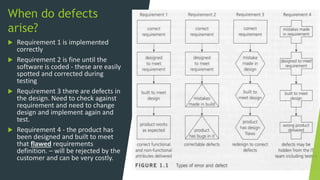
When do defects
arise?
 Requirement 1 is implemented
correctly
 Requirement 2 is fine until the
software is coded - these are easily
spotted and corrected during
testing
 Requirement 3 there are defects in
the design. Need to check against
requirement and need to change
design and implement again and
test.
 Requirement 4 - the product has
been designed and built to meet
that flawed requirements
definition. – will be rejected by the
customer and can be very costly.
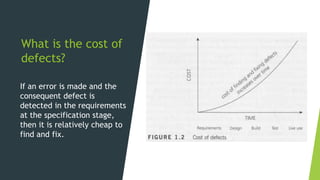
What is the cost of
defects?
If an error is made and the
consequent defect is
detected in the requirements
at the specification stage,
then it is relatively cheap to
find and fix.
Quality
 Testing helps us to measure the quality of software
 the number of defects found,
 the number of tests run,
 and the system covered by the tests
 functional attributes of the software - printing a report correctly
 non-functional software requirements - printing a report quickly enough
 A well-designed test will uncover defects if they are present and so, if such a
test passes, we will rightly be more confident in the software and be able to
assert that the overall level of risk of using the system has been reduced.
What is Quality?
 Projects aim to deliver software to specification.
 validation - 'is this the right specification?’
 verification -'is the system correct to specification?’
 Requirement to add the same product max 3 times to cart
7 principles of Software Testing
 Testing shows presence of defects
 Exhaustive testing is not possible
 Early testing
 Defect clustering
 Pesticide paradox
 Testing is context dependent
 Absence of errors fallacy
1. Is the software defect free?
Testing shows presence of defects, not their
absence
 Testing can show that defects are present but cannot prove that there are no
defects.
 Testing reduces the probability of undiscovered defects remaining in the
software but, even if no defects are found, it is not a proof of correctness.
2. How much testing is enough?
Exhaustive testing is impossible
 Testing everything (all combinations of inputs and preconditions) is not feasible except
for trivial cases.
 Instead of exhaustive testing, we use risks and priorities to focus testing efforts.
 carry out a risk assessment to decide how much testing to do.
 vary the testing effort based on the level of risk in different areas.
 Additionally, testing should provide sufficient information to stakeholders to make informed
decisions about the release of the software or system we're testing, for the next
development step or handover to customers.
 The effort put into the quality assurance and testing activities needs to be tailored to the
risks and costs associated with the project.
 Because of the limits in the budget, the time, and in testing we need to decide how we will
focus our testing, based on the risks.
3. When can we meet our test objectives?
Early testing
 Testing activities should start as early as possible in the software or system
development life cycle and should be focused on defined objectives.
 Many types of review and testing activities-take place at different stages in the
life cycle. These have different objectives.
 Early testing - such as early test design and review activities - finds defects early
on when they are cheap to find and fix.
4. Focusing on defects can help us plan our tests
Defect clustering
 A small number of modules contain most of the defects discovered during pre-release
testing or show the most operational failures.
 This happen because an area of the code is particularly complex and tricky, or because
changing software and other products tends to cause knock-on defects.
 Testers will often use this information when making their risk assessment for planning
the tests and will focus on known 'hot spots’.
 carry out root cause analysis to prevent defects and failures happening again and
perhaps to identify the cause of clusters and potential future clusters.
5. The defect clusters change over time
Pesticide paradox
 If the same tests are repeated, eventually the same set of test cases will no longer
find any new bugs.
 To overcome this 'pesticide paradox', the test cases need to be regularly reviewed
and revised, and new and different tests need to be written to exercise different
parts of the software or system to potentially find more defects.
 As the 'hot spots' for bugs get cleaned up we need to move our focus elsewhere, to
the next set of risks.
 Over time, our focus may change from finding coding bugs, to looking at the
requirements and design documents for defects, and to looking for process
improvements so that we prevent defects in the product.
6. Not all software systems carry the same
level of risk
Testing is context dependent
 Testing is done differently in different contexts.
For example, safety-critical software is tested differently from an e-commerce
site.
7. If we don't find defects does that mean the
users will accept the software?
Absence of errors fallacy
 Finding and fixing defects does not help if the system built is unusable and does not fulfill
the users' needs and expectations.
 The people and organizations who buy and use the software - are not interested in
defects or numbers of defects, except when they are directly affected by the instability
of the software.
 The people using software are more interested in the software supporting them in
completing tasks efficiently and effectively. The software must meet their needs.
 It is for this reason that the requirements and design defects are so important, and why
reviews and inspections are such a fundamental part of the entire test activity.
The driving test - an analogy for software testing
 In a driving test, the examiner critically assesses the candidate's driving, noting every
mistake, large or small, made by the driver under test.
 The examiner takes the driver through a route which tests many possible driving activities,
such as road junctions of different types, control and maneuvering of the car, ability to stop
safely in an emergency, and awareness of the road, other road users and hazards. Some of the
activities must be tested.
 At the end of the test, the examiner makes a judgment about the driver's performance.
 Has the driver passed the test or failed? The examiner bases the judgment on:
 the number and severity of the failures identified,
 whether the driver has been able to meet the driving requirements.
 A single severe fault is enough to fail the whole test, but a small number of minor faults
might still mean the test is passed.
 Many minor faults would reduce the confidence of the examiner in the quality —of the driving
to the point where the driver cannot pass.
Software tester and driving test examiner
compared
 Planning and preparation - Both the examiner and the tester need a plan of action and
need to prepare for the test, which is not exhaustive, but is representative and allows
risk-based decisions about the outcome.
 Static and dynamic - Both dynamic (driving the car or executing the software) and static
(questions to the driver or a review of the software) tests are useful.
 Evaluation - The examiner and the tester must make an objective evaluation, log the
test outcome and report factual observations about the test.
 Determine that they satisfy specified requirements - The examiner and tester both
check against requirements to carry out particular tasks successfully.
 Demonstrate that they are fit for purpose - The examiner and the tester are not
evaluating for perfection but for meeting sufficient of the attributes required to pass the
test.
 Detect defects - The examiner and tester both look for and log faults.
Plan of Action
 As a tester or test manager, you will be involved in
 planning and control of the testing,
 choosing test conditions,
 designing test cases based on those test conditions,
 executing them and checking results,
 evaluating whether enough testing has been done by Examining
completion (or exit) criteria,
 reporting on the testing process and system under test and presenting test
completion (or summary) reports.

ISTQBCH1 Manual Testing.pptx

  • 1.
  • 2.
    What is Software? Softwareis a set of instructions, data or programs used to operate computers and execute specific tasks.
  • 3.
    Types of Software Broadlyclassified as:  System Software - designed to run a computer's hardware and provides a platform for applications to run on top of e.g.: OS, device drivers  Application Software - fulfills a specific need or performs tasks e.g.: Desktop, Web and Mobile Apps
  • 4.
    Apart from thiswe also have software's like…  Programming software  compilers, debuggers, interpreters etc..  Middleware  mediates between application and system software or between two different kinds of application software  middleware enables communication and data management for distributed applications e.g.: Tomcat server, Apache Kafka  Embedded software  written to control machines or devices that are not typically thought of as computers, commonly known as embedded systems.  It is typically specialized for the hardware that it runs on and has time and memory constraints.
  • 5.
    The software developmentlifecycle is a framework that project managers use to describe the stages and tasks associated with designing software.  The first steps are planning the effort and then analyzing the needs of the individuals who will use the software and creating detailed requirements.  The design phase aims to specify how to fulfill those user requirements.  The next is step is implementation, where development work is completed.  Then software testing happens.  The maintenance phase involves any tasks required to keep the system running.
  • 6.
    What is Testing? Simpleeveryday-life usage: ‘when we are testing something, we are checking whether it is OK’. Why is testing needed? Testing is necessary because we all make mistakes. Does it matter if there are mistakes in what we do? Does it matter if we don't find some of those flaws? mistakes – some are unimportant, but some of them are expensive or dangerous we need to consider the context within which we use the term mistake
  • 7.
    Testing Principle -Software systems context  Testing is context dependent Testing is done differently in different contexts. For example, safety-critical software is tested differently from an e-commerce site.  Software systems are part of our lives.  Banking, Cars, Washing Machines etc.,  We all have had an experience with software that did not work as expected:  an error when paying bill,  a delay when waiting for a credit card to process  a website that did not load correctly  Not all software systems carry the same level of risk and not all problems have the same impact when they occur.
  • 8.
    Software systems context… RISK  A risk is something that has not happened yet, and it may never happen; it is a potential problem.  We are concerned about these potential problems because, if one of them did happen, we'd feel a negative impact.  When we discuss risks, we need to consider how likely it is that the problem would occur and the impact if it happens.  Higher the risk associated with the industry using the software, the more likely it is that a standard for testing will exist. The avionics, motor, medical and pharmaceutical industries all have standards covering the testing of software.
  • 9.
    Software systems context…  Some of the problems we encounter when using software are quite trivial, but others can be costly and damaging - with loss of money, time or business reputation - and even may result in injury or death.  If the name in your mark sheet is spelt wrong, it can be fixed, but consumes your time.  If the company website has some spelling mistakes in the text, potential customers may be put off the company as it looks unprofessional.  If a software program miscalculates the dosage of medicine administered to a patient, it will lead to severe reactions and even to death.
  • 10.
    Causes of softwaredefects Why is it that software systems sometimes don't work correctly?  People make mistakes  Mistakes in using the software - this may lead directly to a problem - the software is used incorrectly and so does not behave as we expected. - ERROR  Mistakes during the design and build - these mistakes mean that there are flaws in the software itself. – DEFECT or BUG or FAULT FAILURE is  Defects cause the system to fail to do what it should do  or do something it shouldn’t
  • 11.
    Failures to asoftware system can be caused by  errors in the specification, design and implementation of the software and system;  errors in use of the system;  environmental conditions;  intentional damage;  potential consequences of earlier errors, intentional damage, defects and failures.
  • 12.
    When do defects arise? Requirement 1 is implemented correctly  Requirement 2 is fine until the software is coded - these are easily spotted and corrected during testing  Requirement 3 there are defects in the design. Need to check against requirement and need to change design and implement again and test.  Requirement 4 - the product has been designed and built to meet that flawed requirements definition. – will be rejected by the customer and can be very costly.
  • 13.
    What is thecost of defects? If an error is made and the consequent defect is detected in the requirements at the specification stage, then it is relatively cheap to find and fix.
  • 14.
    Quality  Testing helpsus to measure the quality of software  the number of defects found,  the number of tests run,  and the system covered by the tests  functional attributes of the software - printing a report correctly  non-functional software requirements - printing a report quickly enough  A well-designed test will uncover defects if they are present and so, if such a test passes, we will rightly be more confident in the software and be able to assert that the overall level of risk of using the system has been reduced.
  • 15.
    What is Quality? Projects aim to deliver software to specification.  validation - 'is this the right specification?’  verification -'is the system correct to specification?’  Requirement to add the same product max 3 times to cart
  • 16.
    7 principles ofSoftware Testing  Testing shows presence of defects  Exhaustive testing is not possible  Early testing  Defect clustering  Pesticide paradox  Testing is context dependent  Absence of errors fallacy
  • 17.
    1. Is thesoftware defect free? Testing shows presence of defects, not their absence  Testing can show that defects are present but cannot prove that there are no defects.  Testing reduces the probability of undiscovered defects remaining in the software but, even if no defects are found, it is not a proof of correctness.
  • 18.
    2. How muchtesting is enough? Exhaustive testing is impossible  Testing everything (all combinations of inputs and preconditions) is not feasible except for trivial cases.  Instead of exhaustive testing, we use risks and priorities to focus testing efforts.  carry out a risk assessment to decide how much testing to do.  vary the testing effort based on the level of risk in different areas.  Additionally, testing should provide sufficient information to stakeholders to make informed decisions about the release of the software or system we're testing, for the next development step or handover to customers.  The effort put into the quality assurance and testing activities needs to be tailored to the risks and costs associated with the project.  Because of the limits in the budget, the time, and in testing we need to decide how we will focus our testing, based on the risks.
  • 19.
    3. When canwe meet our test objectives? Early testing  Testing activities should start as early as possible in the software or system development life cycle and should be focused on defined objectives.  Many types of review and testing activities-take place at different stages in the life cycle. These have different objectives.  Early testing - such as early test design and review activities - finds defects early on when they are cheap to find and fix.
  • 20.
    4. Focusing ondefects can help us plan our tests Defect clustering  A small number of modules contain most of the defects discovered during pre-release testing or show the most operational failures.  This happen because an area of the code is particularly complex and tricky, or because changing software and other products tends to cause knock-on defects.  Testers will often use this information when making their risk assessment for planning the tests and will focus on known 'hot spots’.  carry out root cause analysis to prevent defects and failures happening again and perhaps to identify the cause of clusters and potential future clusters.
  • 21.
    5. The defectclusters change over time Pesticide paradox  If the same tests are repeated, eventually the same set of test cases will no longer find any new bugs.  To overcome this 'pesticide paradox', the test cases need to be regularly reviewed and revised, and new and different tests need to be written to exercise different parts of the software or system to potentially find more defects.  As the 'hot spots' for bugs get cleaned up we need to move our focus elsewhere, to the next set of risks.  Over time, our focus may change from finding coding bugs, to looking at the requirements and design documents for defects, and to looking for process improvements so that we prevent defects in the product.
  • 22.
    6. Not allsoftware systems carry the same level of risk Testing is context dependent  Testing is done differently in different contexts. For example, safety-critical software is tested differently from an e-commerce site.
  • 23.
    7. If wedon't find defects does that mean the users will accept the software? Absence of errors fallacy  Finding and fixing defects does not help if the system built is unusable and does not fulfill the users' needs and expectations.  The people and organizations who buy and use the software - are not interested in defects or numbers of defects, except when they are directly affected by the instability of the software.  The people using software are more interested in the software supporting them in completing tasks efficiently and effectively. The software must meet their needs.  It is for this reason that the requirements and design defects are so important, and why reviews and inspections are such a fundamental part of the entire test activity.
  • 24.
    The driving test- an analogy for software testing  In a driving test, the examiner critically assesses the candidate's driving, noting every mistake, large or small, made by the driver under test.  The examiner takes the driver through a route which tests many possible driving activities, such as road junctions of different types, control and maneuvering of the car, ability to stop safely in an emergency, and awareness of the road, other road users and hazards. Some of the activities must be tested.  At the end of the test, the examiner makes a judgment about the driver's performance.  Has the driver passed the test or failed? The examiner bases the judgment on:  the number and severity of the failures identified,  whether the driver has been able to meet the driving requirements.  A single severe fault is enough to fail the whole test, but a small number of minor faults might still mean the test is passed.  Many minor faults would reduce the confidence of the examiner in the quality —of the driving to the point where the driver cannot pass.
  • 25.
    Software tester anddriving test examiner compared  Planning and preparation - Both the examiner and the tester need a plan of action and need to prepare for the test, which is not exhaustive, but is representative and allows risk-based decisions about the outcome.  Static and dynamic - Both dynamic (driving the car or executing the software) and static (questions to the driver or a review of the software) tests are useful.  Evaluation - The examiner and the tester must make an objective evaluation, log the test outcome and report factual observations about the test.  Determine that they satisfy specified requirements - The examiner and tester both check against requirements to carry out particular tasks successfully.  Demonstrate that they are fit for purpose - The examiner and the tester are not evaluating for perfection but for meeting sufficient of the attributes required to pass the test.  Detect defects - The examiner and tester both look for and log faults.
  • 26.
    Plan of Action As a tester or test manager, you will be involved in  planning and control of the testing,  choosing test conditions,  designing test cases based on those test conditions,  executing them and checking results,  evaluating whether enough testing has been done by Examining completion (or exit) criteria,  reporting on the testing process and system under test and presenting test completion (or summary) reports.