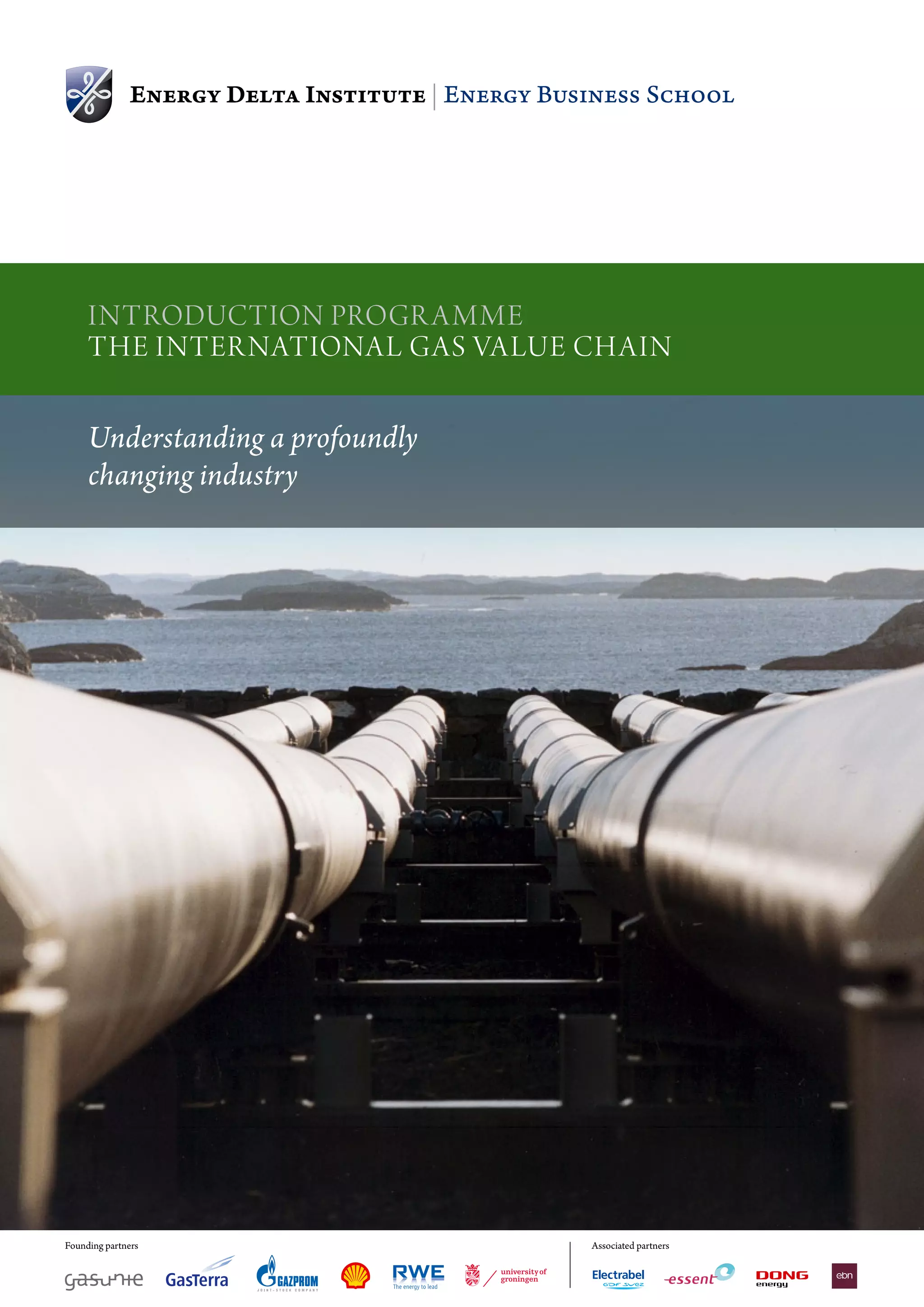
IntroductIon Progr amme
     the InternatIonal gas Value chaIn

     Understanding a profoundly
     changing industry


Founding partners                 Associated partners
IntroductIon Progr amme
the InternatIonal gas Value chaIn

The gas business can be described as a series of steps in a chain that begins at the gas molecules in the underground reservoir and
ends at the user’s burner. At each step value is added. The gas industry has long been characterized by a sense of ‘business as usual’.
This is no longer the case. New suppliers are entering the markets. Some in the traditional way, with pipelines; but more and more
by means of LNG.


given the billions of dollars involved, geo-         More specifically...                               Your profile
politics are becoming an increasingly more           the course gives the participant a thorough        You are relatively new to the gas business and
important feature of the gas market, not in the      knowledge of and crucial insights into:            you want to have a comprehensive overview of
least because a slight hick-up in supplies can       • the various elements of the gas value chain      the entire gas value chain. or: you have been
cause serious (economic) damage. markets are           and their characteristics.                       working in the gas business for a longer period
being opened to competition. new players are         • the processes and implications of markets        but you want to learn more about other parts
entering these markets and new services and            in transition.                                   of the gas value chain and the interaction with
risk management tools are being introduced.          • the role and tools of risk management.           your expertise. Furthermore, your interests and
regulatory forces are a relatively new               • how to deal with security of supply and          work are not confined to a local focus but you
phenomenon to today’s gas industry. all this           climate issues (co2 trading).                    are looking for a more international exposure as
profoundly changes traditional business rules.       • the way to manage the need for flexibility.      well. You have a good command of the english
market opening means that consumers are              • the role of governments as important             language and you want to play an active role in
becoming customers.                                    stakeholders.                                    the discussions and the case work.

edI has developed the International gas Value        the IgVc gives participants the unique             The programme structure
chain course (IgVc), a programme that                opportunity to meet world-class experts in the     the 5-day course deals with the
investigates the effects of all these changes on     gas business and to exchange ideas with them.      following main topics:
the gas business.                                    Participants will study in an international        • the core processes and dynamics of
                                                     setting that will allow them to share views with      the gas industry.
Why the International Gas                            fellow participants from countries around the      • the roles of the various stakeholders.
Value Chain?                                         globe.                                             • the changes and large issues currently taking
to understand the gas value chain and to be                                                                place in the international gas business.
successful in your gas career (adding value to
your part of the chain) you need to understand
the changes the industry is going through.
IgVc gives participants a comprehensive over-          The location
view on today’s and tomorrow’s gas industry.           edI is appropriately located on top of
this course provides in-depth insights in the          Western europe’s largest gas field, right
structures and dynamics of the gas business, as        in the heart of the dutch energy Valley
well as a systematic description of all vital ele-     region. this is why the IgVc will take
ments of the gas value chain, with a focus on the      place at edI’s headquarters, the
european gas market. current developments in           hampshire hotel-Plaza groningen
the gas industry are described from a historic         conference centre and hotel.
perspective and possible future developments           the hampshire hotel is attractively
are explained.                                         situated on lake “hoornse meer”, a stone’s
                                                       throw away from the pleasant city of
                                                       groningen, one of the netherland’s
                                                       most attractive historic cities.
Sharing the Energy of Knowledge.


                                                                                                               “...a solid understanding
                                                                                                                of the processes from
                                                                                                                well to burner...”
                                                                                                                Key	lecturers	IGVC	


the lectures will be supported by case studies
that cover the main elements of the learning
                                                        european gas industry including gasterra B.V.,
                                                        n.V. nederlandse gasunie, nederlandse
                                                                                                               the programme
material provided during the course, such as            aardolie maatschappij B.V. (nam) and shell.            in more detail
the effects of liberalization, lng vs. pipeline
options, defining risks, and so forth. the IgVc         to stimulate your learning process, you will be        DAY 1
gives participants a perfect opportunity to take        asked to play an active role during the course.        •	   Introduction	to	natural	gas
a close look at the gas markets worldwide and           Participants will be working on case studies           •	   The	gas	industry
exchange experiences and views with both                – in groups – to facilitate acquiring hands-on         •	   Gas	consumers
fellow participants and highly qualified field          experience and applying the theoretical                •	   From	upstream	to	downstream
experts.                                                concepts taught earlier during the day.                •	   International	supplies	to	markets

The educational partners                                Certification                                          DAY 2
Key lecturers of the IgVc are dick de Jong              upon successful completion of the course the           •	   Market	reform:	liberalization	&		
(senior fellow of clingendael International             participant will receive a certificate on behalf of    	    regulation
energy Programme and former shell) and                  the university of groningen.                           •	   Markets	in	transition:		
 Jean Vermeire, former general director of                                                                     	    the	logistics	of	the	gas	market
distrigas and current member of the super-                                                                     •	   Access	and	tariffication	of	infrastructure
visory board of n.V. nederlandse gasunie.                                                                      •	   Pipeline	tariffs
to guarantee both high quality and a varied                                                                    •	   LNG
programme, they are supported by a carefully
selected group of leading experts from the                                                                     DAY 3
                                                                                                               •	   Prices
                                                                                                               •	   Contracts
                                                                                                               •	   Changing	business	models
“The outlook for natural gas is very positive. Market growth will be significant,                              •	   Strategies	for	coping	in	a	competitive		
especially for power generation, driven by economic and environmental considerations.                          	    market
A supply gap is occupying the industry which is thus challenged to secure sufficient gas                       •	   The	Asian	gas	market
resources. A completely different supply gap is looming in the field of human resources.
The rapidly changing gas markets require new skills and knowledge for companies to                             DAY 4
stay at the top. It is no surprise that companies ask themselves the question whether                          •	   The	North	American	gas	market
they have also secured the best human resources. If you want to stay at the top constant                       •	   The	European	gas	market
training and development are crucial. “We have recognized that we need to bring our “gas managers of           •	   Security	of	Supply
the future” from a good general knowledge level to the skills and knowledge relevant for the gas industry      •	   Russian	gas	developments
of the 21st century. The training programmes of Energy Delta Institute provide us with a unique                •	   Russian	gas	and	Europe
opportunity to do just this. In an international setting with participants from around the world our
employees can meet and discuss with the top experts the hot topics of the industry, becoming part of a         DAY 5
large and unique international knowledge network.”                                                             •	 Portfolio	management
                                                                                                               •	 Exercise
Marcel	Kramer,	Chairman	of	the	Executive	Board	and	CEO	N.V.	Nederlandse	Gasunie                                •	 Presentations	and	discussion
Sharing the Energy of Knowledge.


“When we set up this course, we had three objectives in mind.                                                                       “When I took the course, I was
We wanted to provide the participants with a solid                                                                                  relatively new to the gas industry
understanding of the processes from well to burner within                                                                           and I wanted to take a course that
the international gas value chain – how do they function;                                                                           would offer me a good and relevant
what are the ways of doing business, what are the new                                                                               overview of the value chain in the
developments; how and why do strategies change; and what                                                                            sector. I must say that the course was
are the risks and rewards and how are they managed, etc.?                                                                           very interesting and enlightening.
Basically, this is classical transfer of knowledge – be it that the lecturers are either academics                                  What appealed to me was that many of the lecturers
or, most often, experienced top industry managers. We also want to provide a set of practical                                       were senior field experts who know this business
problem-solving competencies and tools in the natural gas business. In this course we have                                          very well and know how to bring matters across.
participants who are, for the most part, already employed in the energy sector, so they can                                         As I work in the downstream part of the chain,
also build on their own experiences. For this second objective we introduce practical exercises.                                    it was very interesting to learn more about the
In it, the participants analyze a problem – as a group – in order to come up with a workable                                        upstream part and the issues the people there
solution or strategy. Our third objective – and certainly not the least important one – is to                                       encounter and have to solve... and how they do it.
provide a form of interaction in which participants from different backgrounds and countries                                        I also learned much more about the international
can exchange views, ideas, experiences, etc. with fellow-participants and teacher-experts:                                          aspects of our sector. What was really interesting to
People working at the commercial end of the chain talk to people in the upstream part of the                                        me was to learn about the impact of international
chain and vice versa; Russians talking to Dutch talking to Scandinavians, and so on.                                                political decisions on our industry. Was the course
Such discussions not only broaden the horizons of the participants, they also provide                                               relevant to my day-to-day job? Oh, absolutely. It
excellent networking opportunities. The reactions of our participants show that this                                                gave me a better insight in aspects that are not
is an aspect of the course that they genuinely appreciate.                                                                          directly in my field of view, but that I do need to take
                                                                                                                                    into account.”
Dick	de	Jong,	key	lecturer	
Senior	fellow	of	Clingendael	International	Energy	Programme                                                                         Carl	Lönnqvist,	alumnus	
                                                                                                                                    Portfolio	Manager,	Electrabel,	Belgium
Jean	Vermeire,	key	lecturer
Former	General	Director	of	Distrigas,
member	of	the	Supervisory	Board	of	N.V.	Nederlandse	Gasunie


About Energy Delta Institute
energy delta Institute (edI) is an international energy business school, with a primary focus on natural gas. edI was founded
in 2003 by n.V. nederlandse gasunie, gasterra B.V., oao gazprom and the university of groningen, later joined by shell
and rWe. The energy community has come to appreciate edI both as a platform of knowledge exchange between partners
and participants alike. The changing energy world is forcing energy companies to innovate in order to stay competitive.
In addition, the energy sector is confronting the possibility of a growing shortage of qualified personnel in the coming decades.
The sector has only one choice: to invest in knowledge.                                                                               T	 +31	(0)	50	524	83	00
                                                                                                                                      F	 +31	(0)	50	524	83	01
edI’s main objective is to contribute to the professional development of current and future energy managers. edI coordinates
                                                                                                                                      E		 info@energydelta.nl
research projects and organises training programmes with a focus on the economic, management, legal and geopolitical
aspects of the energy business.                                                                                                       I	 www.energydelta.org

International Gas Value Chain Course

  • 1.
    IntroductIon Progr amme the InternatIonal gas Value chaIn Understanding a profoundly changing industry Founding partners Associated partners
  • 2.
    IntroductIon Progr amme theInternatIonal gas Value chaIn The gas business can be described as a series of steps in a chain that begins at the gas molecules in the underground reservoir and ends at the user’s burner. At each step value is added. The gas industry has long been characterized by a sense of ‘business as usual’. This is no longer the case. New suppliers are entering the markets. Some in the traditional way, with pipelines; but more and more by means of LNG. given the billions of dollars involved, geo- More specifically... Your profile politics are becoming an increasingly more the course gives the participant a thorough You are relatively new to the gas business and important feature of the gas market, not in the knowledge of and crucial insights into: you want to have a comprehensive overview of least because a slight hick-up in supplies can • the various elements of the gas value chain the entire gas value chain. or: you have been cause serious (economic) damage. markets are and their characteristics. working in the gas business for a longer period being opened to competition. new players are • the processes and implications of markets but you want to learn more about other parts entering these markets and new services and in transition. of the gas value chain and the interaction with risk management tools are being introduced. • the role and tools of risk management. your expertise. Furthermore, your interests and regulatory forces are a relatively new • how to deal with security of supply and work are not confined to a local focus but you phenomenon to today’s gas industry. all this climate issues (co2 trading). are looking for a more international exposure as profoundly changes traditional business rules. • the way to manage the need for flexibility. well. You have a good command of the english market opening means that consumers are • the role of governments as important language and you want to play an active role in becoming customers. stakeholders. the discussions and the case work. edI has developed the International gas Value the IgVc gives participants the unique The programme structure chain course (IgVc), a programme that opportunity to meet world-class experts in the the 5-day course deals with the investigates the effects of all these changes on gas business and to exchange ideas with them. following main topics: the gas business. Participants will study in an international • the core processes and dynamics of setting that will allow them to share views with the gas industry. Why the International Gas fellow participants from countries around the • the roles of the various stakeholders. Value Chain? globe. • the changes and large issues currently taking to understand the gas value chain and to be place in the international gas business. successful in your gas career (adding value to your part of the chain) you need to understand the changes the industry is going through. IgVc gives participants a comprehensive over- The location view on today’s and tomorrow’s gas industry. edI is appropriately located on top of this course provides in-depth insights in the Western europe’s largest gas field, right structures and dynamics of the gas business, as in the heart of the dutch energy Valley well as a systematic description of all vital ele- region. this is why the IgVc will take ments of the gas value chain, with a focus on the place at edI’s headquarters, the european gas market. current developments in hampshire hotel-Plaza groningen the gas industry are described from a historic conference centre and hotel. perspective and possible future developments the hampshire hotel is attractively are explained. situated on lake “hoornse meer”, a stone’s throw away from the pleasant city of groningen, one of the netherland’s most attractive historic cities.
  • 3.
    Sharing the Energyof Knowledge. “...a solid understanding of the processes from well to burner...” Key lecturers IGVC the lectures will be supported by case studies that cover the main elements of the learning european gas industry including gasterra B.V., n.V. nederlandse gasunie, nederlandse the programme material provided during the course, such as aardolie maatschappij B.V. (nam) and shell. in more detail the effects of liberalization, lng vs. pipeline options, defining risks, and so forth. the IgVc to stimulate your learning process, you will be DAY 1 gives participants a perfect opportunity to take asked to play an active role during the course. • Introduction to natural gas a close look at the gas markets worldwide and Participants will be working on case studies • The gas industry exchange experiences and views with both – in groups – to facilitate acquiring hands-on • Gas consumers fellow participants and highly qualified field experience and applying the theoretical • From upstream to downstream experts. concepts taught earlier during the day. • International supplies to markets The educational partners Certification DAY 2 Key lecturers of the IgVc are dick de Jong upon successful completion of the course the • Market reform: liberalization & (senior fellow of clingendael International participant will receive a certificate on behalf of regulation energy Programme and former shell) and the university of groningen. • Markets in transition: Jean Vermeire, former general director of the logistics of the gas market distrigas and current member of the super- • Access and tariffication of infrastructure visory board of n.V. nederlandse gasunie. • Pipeline tariffs to guarantee both high quality and a varied • LNG programme, they are supported by a carefully selected group of leading experts from the DAY 3 • Prices • Contracts • Changing business models “The outlook for natural gas is very positive. Market growth will be significant, • Strategies for coping in a competitive especially for power generation, driven by economic and environmental considerations. market A supply gap is occupying the industry which is thus challenged to secure sufficient gas • The Asian gas market resources. A completely different supply gap is looming in the field of human resources. The rapidly changing gas markets require new skills and knowledge for companies to DAY 4 stay at the top. It is no surprise that companies ask themselves the question whether • The North American gas market they have also secured the best human resources. If you want to stay at the top constant • The European gas market training and development are crucial. “We have recognized that we need to bring our “gas managers of • Security of Supply the future” from a good general knowledge level to the skills and knowledge relevant for the gas industry • Russian gas developments of the 21st century. The training programmes of Energy Delta Institute provide us with a unique • Russian gas and Europe opportunity to do just this. In an international setting with participants from around the world our employees can meet and discuss with the top experts the hot topics of the industry, becoming part of a DAY 5 large and unique international knowledge network.” • Portfolio management • Exercise Marcel Kramer, Chairman of the Executive Board and CEO N.V. Nederlandse Gasunie • Presentations and discussion
  • 4.
    Sharing the Energyof Knowledge. “When we set up this course, we had three objectives in mind. “When I took the course, I was We wanted to provide the participants with a solid relatively new to the gas industry understanding of the processes from well to burner within and I wanted to take a course that the international gas value chain – how do they function; would offer me a good and relevant what are the ways of doing business, what are the new overview of the value chain in the developments; how and why do strategies change; and what sector. I must say that the course was are the risks and rewards and how are they managed, etc.? very interesting and enlightening. Basically, this is classical transfer of knowledge – be it that the lecturers are either academics What appealed to me was that many of the lecturers or, most often, experienced top industry managers. We also want to provide a set of practical were senior field experts who know this business problem-solving competencies and tools in the natural gas business. In this course we have very well and know how to bring matters across. participants who are, for the most part, already employed in the energy sector, so they can As I work in the downstream part of the chain, also build on their own experiences. For this second objective we introduce practical exercises. it was very interesting to learn more about the In it, the participants analyze a problem – as a group – in order to come up with a workable upstream part and the issues the people there solution or strategy. Our third objective – and certainly not the least important one – is to encounter and have to solve... and how they do it. provide a form of interaction in which participants from different backgrounds and countries I also learned much more about the international can exchange views, ideas, experiences, etc. with fellow-participants and teacher-experts: aspects of our sector. What was really interesting to People working at the commercial end of the chain talk to people in the upstream part of the me was to learn about the impact of international chain and vice versa; Russians talking to Dutch talking to Scandinavians, and so on. political decisions on our industry. Was the course Such discussions not only broaden the horizons of the participants, they also provide relevant to my day-to-day job? Oh, absolutely. It excellent networking opportunities. The reactions of our participants show that this gave me a better insight in aspects that are not is an aspect of the course that they genuinely appreciate. directly in my field of view, but that I do need to take into account.” Dick de Jong, key lecturer Senior fellow of Clingendael International Energy Programme Carl Lönnqvist, alumnus Portfolio Manager, Electrabel, Belgium Jean Vermeire, key lecturer Former General Director of Distrigas, member of the Supervisory Board of N.V. Nederlandse Gasunie About Energy Delta Institute energy delta Institute (edI) is an international energy business school, with a primary focus on natural gas. edI was founded in 2003 by n.V. nederlandse gasunie, gasterra B.V., oao gazprom and the university of groningen, later joined by shell and rWe. The energy community has come to appreciate edI both as a platform of knowledge exchange between partners and participants alike. The changing energy world is forcing energy companies to innovate in order to stay competitive. In addition, the energy sector is confronting the possibility of a growing shortage of qualified personnel in the coming decades. The sector has only one choice: to invest in knowledge. T +31 (0) 50 524 83 00 F +31 (0) 50 524 83 01 edI’s main objective is to contribute to the professional development of current and future energy managers. edI coordinates E info@energydelta.nl research projects and organises training programmes with a focus on the economic, management, legal and geopolitical aspects of the energy business. I www.energydelta.org