





Internal Linking
the secret superpower
that anyone can use
Slideshare.Net/dixonhjones
@Dixon_Jones
Dixon Jones
InLinks
Why do we think
Carrots help us see in the Dark?
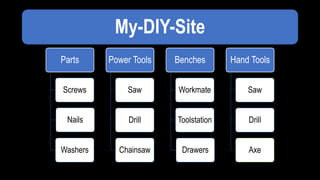
My-DIY-Site
Parts
Screws
Nails
Washers
Power Tools
Saw
Drill
Chainsaw
Benches
Workmate
Toolstation
Drawers
Hand Tools
Saw
Drill
Axe
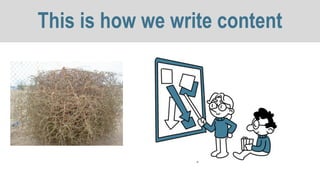
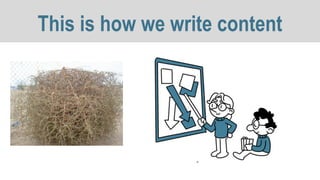
This is how we write content
Who is
This?
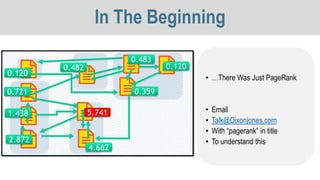
In The Beginning
• …There Was Just PageRank
• Email
• Talk@Dixonjones.com
• With “pagerank” in title
• To understand this
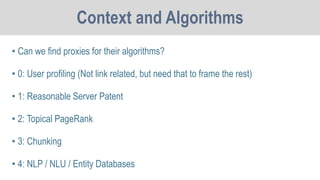
• Can we find proxies for their algorithms?
• 0: User profiling (Not link related, but need that to frame the rest)
• 1: Reasonable Server Patent
• 2: Topical PageRank
• 3: Chunking
• 4: NLP / NLU / Entity Databases
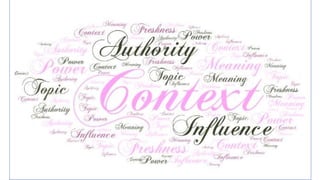
Context and Algorithms
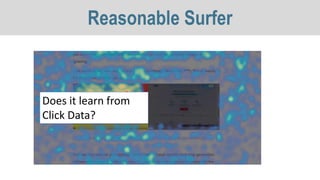
Reasonable Surfer
Does it learn from
Click Data?
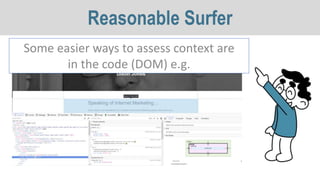
Some easier ways to assess context are
in the code (DOM) e.g.
Reasonable Surfer
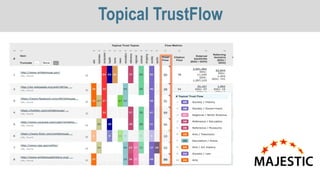
Topical PageRank
Topical TrustFlow
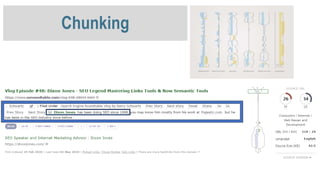
Chunking
NLP / NLU
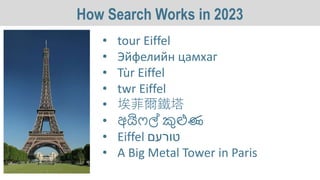
How Search Works in 2023
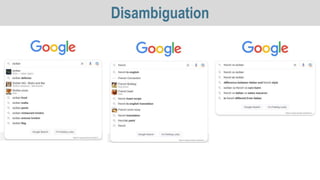
• tour Eiffel
• Эйфелийн цамхаг
• Tùr Eiffel
• twr Eiffel
• 埃菲爾鐵塔
• අයිෆල් කුළුණ
• Eiffel ‫טורעם‬
• A Big Metal Tower in Paris
Disambiguation
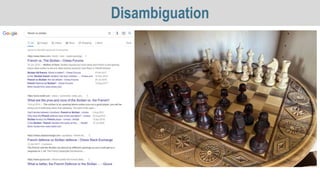
Disambiguation
How does Google Know
This?
& Why does knowing this give your
website and business a marketing
edge?
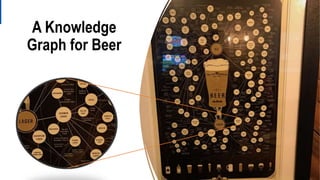
A Knowledge
Graph for Beer
KGID:
T678 KGID:
P256
9
KGID:
C987 KGID:
E123
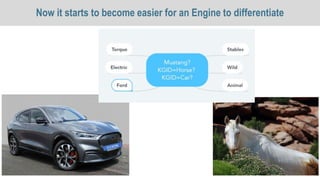
Now it starts to become easier for an Engine to differentiate
This is how we write content
BUT…
“I Already have 300
Pages” (or 3,000)
How on earth do I do that?
Option 1:
Read Every Page again and
hard code all the links
Option 2:
Connect links using
Keywords
Option 3:
Build your own Knowledge
Graph and use it to build
the links for you
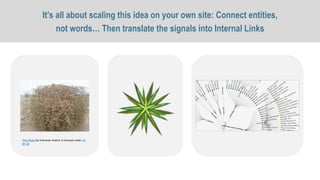
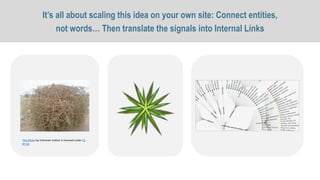
It’s all about scaling this idea on your own site: Connect entities,
not words… Then translate the signals into Internal Links
This Photo by Unknown Author is licensed under CC
BY-SA
It’s all about scaling this idea on your own site: Connect entities,
not words… Then translate the signals into Internal Links
This Photo by Unknown Author is licensed under CC
BY-SA
Benefit
Case Studies available at:
https://inlinks.net/p/category/case-studies/
That is Just The Start
With a Knowledge Graphs, NLP and Google suggest you can:
1: Internally Link entities
2: Create great Content Schema fast
3: Create better content around topic clusters
4: Plan Content using A Gap Analyses of Entities recommended by Google Suggest,
based on your EXISTING content
Why do we think
Carrots help us see in the Dark?
This Photo by Unknown Author is licensed under CC BY
• PageRank:
• Brin, S. and Page, L., 1998. The anatomy of a large-scale hypertextual web search engine.
• https://blog.majestic.com/company/understanding-googles-algorithm-how-pagerank-works/
• Reasonable Surfer
• http://www.seobythesea.com/2016/04/googles-reasonable-surfer-patent-updated/
• Ideas around Topical PageRank
• Jardine, J. and Teufel, S., 2014, April. Topical PageRank: A model of scientific expertise for bibliographic search. In Proceedings of the 14th Conference of the
European Chapter of the Association for Computational Linguistics (pp. 501-510).
• Chunking
• Jain, A. and Grover, V., 2013. System and method for logical chunking and restructuring websites. U.S. Patent Application 13/887,656.
• Prakash, A. and Saha, S.K., 2014. Experiments on Document Chunking and Query Formation for Plagiarism Source Retrieval. In CLEF (Working Notes) (pp.
990-996).
• NLP / NLU
• https://inlinks.net/p/semantic-seo-guide/
Further reading
Internal Linking - The Topic Clustering Way edited.pptx

Internal Linking - The Topic Clustering Way edited.pptx

  • 1.
    Internal Linking the secretsuperpower that anyone can use Slideshare.Net/dixonhjones @Dixon_Jones Dixon Jones InLinks
  • 2.
    Why do wethink Carrots help us see in the Dark?
  • 3.
  • 4.
    This is howwe write content
  • 5.
  • 7.
    In The Beginning •…There Was Just PageRank • Email • Talk@Dixonjones.com • With “pagerank” in title • To understand this
  • 9.
    • Can wefind proxies for their algorithms? • 0: User profiling (Not link related, but need that to frame the rest) • 1: Reasonable Server Patent • 2: Topical PageRank • 3: Chunking • 4: NLP / NLU / Entity Databases Context and Algorithms
  • 10.
    Reasonable Surfer Does itlearn from Click Data?
  • 11.
    Some easier waysto assess context are in the code (DOM) e.g. Reasonable Surfer
  • 12.
  • 13.
  • 14.
  • 15.
  • 18.
    How Search Worksin 2023 • tour Eiffel • Эйфелийн цамхаг • Tùr Eiffel • twr Eiffel • 埃菲爾鐵塔 • අයිෆල් කුළුණ • Eiffel ‫טורעם‬ • A Big Metal Tower in Paris
  • 19.
  • 20.
  • 21.
    How does GoogleKnow This? & Why does knowing this give your website and business a marketing edge?
  • 22.
  • 23.
  • 24.
    Now it startsto become easier for an Engine to differentiate
  • 25.
    This is howwe write content
  • 26.
    BUT… “I Already have300 Pages” (or 3,000) How on earth do I do that?
  • 27.
    Option 1: Read EveryPage again and hard code all the links
  • 28.
  • 29.
    Option 3: Build yourown Knowledge Graph and use it to build the links for you
  • 30.
    It’s all aboutscaling this idea on your own site: Connect entities, not words… Then translate the signals into Internal Links This Photo by Unknown Author is licensed under CC BY-SA
  • 35.
    It’s all aboutscaling this idea on your own site: Connect entities, not words… Then translate the signals into Internal Links This Photo by Unknown Author is licensed under CC BY-SA
  • 36.
    Benefit Case Studies availableat: https://inlinks.net/p/category/case-studies/
  • 37.
    That is JustThe Start With a Knowledge Graphs, NLP and Google suggest you can: 1: Internally Link entities 2: Create great Content Schema fast 3: Create better content around topic clusters 4: Plan Content using A Gap Analyses of Entities recommended by Google Suggest, based on your EXISTING content
  • 38.
    Why do wethink Carrots help us see in the Dark?
  • 39.
    This Photo byUnknown Author is licensed under CC BY
  • 40.
    • PageRank: • Brin,S. and Page, L., 1998. The anatomy of a large-scale hypertextual web search engine. • https://blog.majestic.com/company/understanding-googles-algorithm-how-pagerank-works/ • Reasonable Surfer • http://www.seobythesea.com/2016/04/googles-reasonable-surfer-patent-updated/ • Ideas around Topical PageRank • Jardine, J. and Teufel, S., 2014, April. Topical PageRank: A model of scientific expertise for bibliographic search. In Proceedings of the 14th Conference of the European Chapter of the Association for Computational Linguistics (pp. 501-510). • Chunking • Jain, A. and Grover, V., 2013. System and method for logical chunking and restructuring websites. U.S. Patent Application 13/887,656. • Prakash, A. and Saha, S.K., 2014. Experiments on Document Chunking and Query Formation for Plagiarism Source Retrieval. In CLEF (Working Notes) (pp. 990-996). • NLP / NLU • https://inlinks.net/p/semantic-seo-guide/ Further reading

Editor's Notes

  • #3 Why do we think Carrots help us see in the dark? Actually, they don’t… it’s a story that our parents told us as kids. There’s a really good reason why we were all told, but the parents don’t know it. It saved lives. I’ll tell you why a bit later.
  • #4 You might expect a talk about Internal Linking to send you to here. But this is not how we write content!
  • #9 But the PageRank algorithm did not take context into account
  • #10 So – how can a Search Engine use algorithms to infer some of this context for the user? And how can we find proxies for their algorithms? 0: User profiling (Not link related, but need that to frame the rest) 1: Reasonable Server Patent 2: Topical PageRank 3: Chunking
  • #12 Links in Paragraphs contain context, but links in Navigation don’t Links above the fold carry more weight than links below the fold? Links in the Mobile view are more important that ones in Desktop view.? First paragraph after an H1-H3 is contextually more relevant than others?
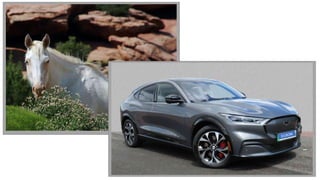
  • #17 I am very proud of my new car. Has anyone gone all electric yet? This is the new Mustang and I really love it. But here’s the issue with the word “Mustang”… This is also a beautiful beast. But when it comes to the keyword “Mustang” it’s an entirely different animal.
  • #18 I am also the proud owner of this car. Anyone want to guess what it is called? Bulldog… Pilgrim Bulldog. The point is that words are just that… words. They LABEL ideas and concepts. As SEOs we call these concepts TOPICS and as scientists, The word is “Entities”.
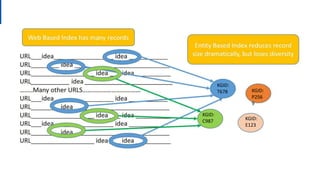
  • #23 So what does a knowledge graph look like? Well every website’s knowledge graph tends to look very different. It is really a database of the frequency of ideas expressed on a website. I do love this poster that I saw in a local pub, which is pretty much a knowledge graph of Beer. I like to bring complex concept back to real world examples that we can see and digest as humans. The Entity “German Lager” is part of the lager family. - It is connected to Munich Lager and Vienna Lager - Of which Samuel Adams Boston Lager is a type Google grabs ideas and augments its records by reading YOUR content, whether it is in pictures, text, increasingly spoken word and video, News or countless other formats as Google collates the information.
  • #24 Google reads content, page by page, noticing entity by entity, then uses that to augment its entity within it Knowledge Graph. Google Call this their “Natural Language AI” (previously NLP API) but it compresses content into Machine readable nuggets and the also have another one for Pictures and another for spoken word. Schema helps Google to associate the correct concept to the correct record in ots knowledge graph. But you HAVE to reflect reality in your schema…
  • #25 So now it becomes obvious what we mean when SEOs say “context”. I imagine a web page or web site now as a list of entity ID numbers! But be VERY careful describing your new MachE as being “wild”! Or about talking about its “untamed” setting… *Talking about keywords JUST BECAUSE they are in a list, is a HUGE mistake.
  • #37 The benefit of acting on this talk. Here are 3 separate case studies, not all using our tools, but all using this approach for SEO. Everyone OK with this as a talk?
  • #39 Why do we think Carrots help us see in the dark? Actually, they don’t… it’s a story that our parents told us as kids. There’s a really good reason why we were all told, but the parents don’t know it. It saved lives. I’ll tell you why a bit later.