INTERNAL CONTROL
(CASH and BANK)
Internal control consists of the policies and procedures adopted within a business in
order to:
1. optimize resources, and
2. prevent and detect errors and irregularities.
Internal control consists of the policies and procedures adopted within a business in
order to:
3. Safeguard its assets
4. Maintain the accuracy and reliability of its accounting records
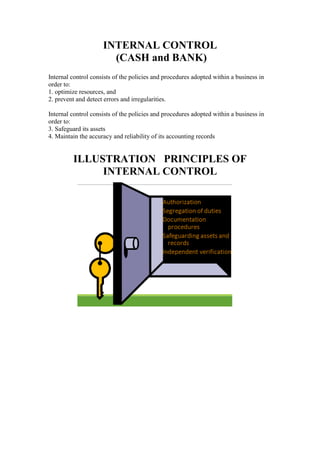
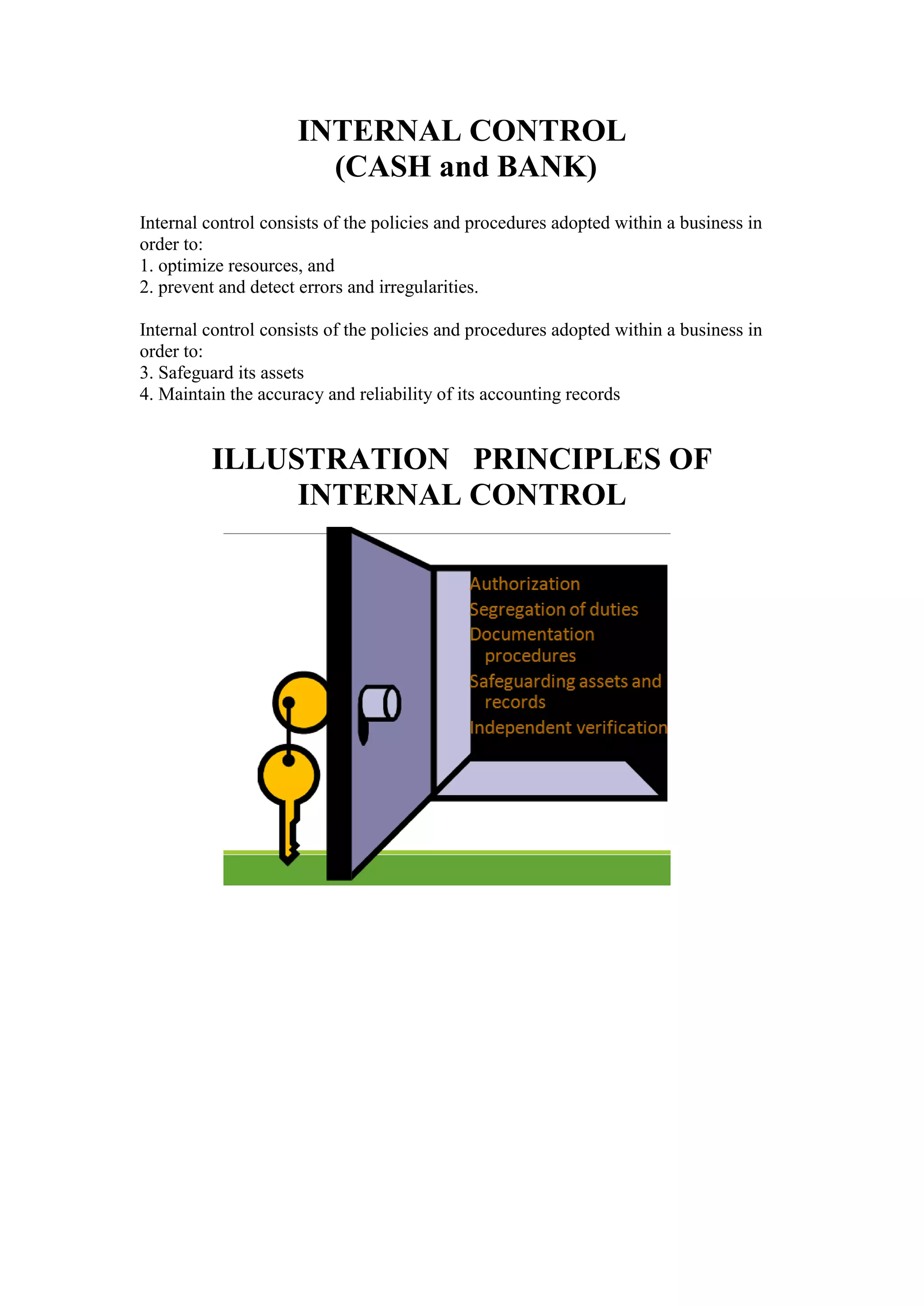
ILLUSTRATION PRINCIPLES OF
INTERNAL CONTROL
PRINCIPLES OF INTERNAL CONTROL
Authorization of transactions and activities:
Authorization by the proper individual is important. Control is most effective
when only one person is responsible for a given task.
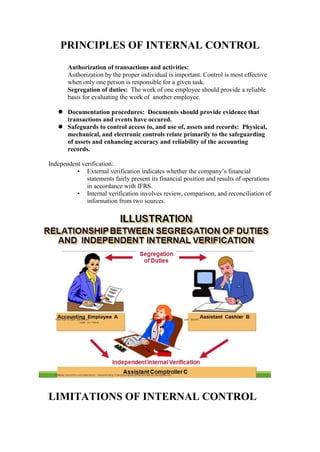
Segregation of duties: The work of one employee should provide a reliable
basis for evaluating the work of another employee.
 Documentation procedures: Documents should provide evidence that
transactions and events have occured.
 Safeguards to control access to, and use of, assets and records: Physical,
mechanical, and electronic controls relate primarily to the safeguarding
of assets and enhancing accuracy and reliability of the accounting
records.
Independent verification:
• External verification indicates whether the company’s financial
statements fairly present its financial position and results of operations
in accordance with IFRS.
• Internal verification involves review, comparison, and reconciliation of
information from two sources.
LIMITATIONS OF INTERNAL CONTROL
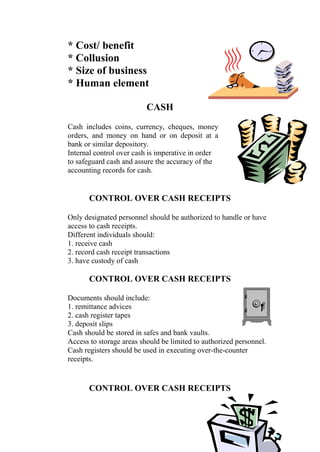
* Cost/ benefit
* Collusion
* Size of business
* Human element
CASH
Cash includes coins, currency, cheques, money
orders, and money on hand or on deposit at a
bank or similar depository.
Internal control over cash is imperative in order
to safeguard cash and assure the accuracy of the
accounting records for cash.
CONTROL OVER CASH RECEIPTS
Only designated personnel should be authorized to handle or have
access to cash receipts.
Different individuals should:
1. receive cash
2. record cash receipt transactions
3. have custody of cash
CONTROL OVER CASH RECEIPTS
Documents should include:
1. remittance advices
2. cash register tapes
3. deposit slips
Cash should be stored in safes and bank vaults.
Access to storage areas should be limited to authorized personnel.
Cash registers should be used in executing over-the-counter
receipts.
CONTROL OVER CASH RECEIPTS
Daily cash counts and daily comparisons of total
receipts should be made.
All personnel who handle cash receipts should
be bonded and required to take vacations.
An important tool in control of over-the-counter
receipts is cash registers that are visible to
customers.
CONTROL OVER CASH DISBURSEMENTS
Payments are made by cheque rather than by cash, except
for petty cash transactions.
Only specified individuals should be authorized to sign
cheques.
Different departments or individuals should be assigned the
duties of approving an item for payment and paying it.
Prenumbered cheques should be used and each cheque should
be supported by an approved invoice or other document.
Blank cheques should be stored in a safe.
1. Access should be restricted to authorized personnel.
2. A cheque writer machine should be used to imprint the
amount on the cheque in indelible ink.
Each cheque should be compared with the approved invoice before it is issued.
Following payment, the approved invoice should be stamped PAID.
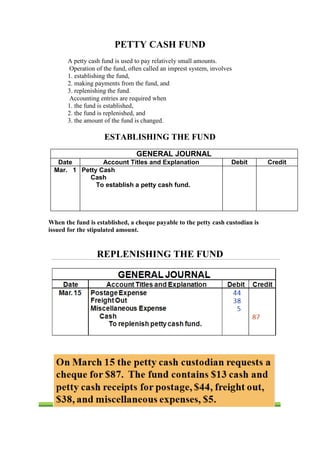
PETTY CASH FUND
A petty cash fund is used to pay relatively small amounts.
Operation of the fund, often called an imprest system, involves
1. establishing the fund,
2. making payments from the fund, and
3. replenishing the fund.
Accounting entries are required when
1. the fund is established,
2. the fund is replenished, and
3. the amount of the fund is changed.
ESTABLISHING THE FUND
GENERAL JOURNAL
Date Account Titles and Explanation Debit Credit
Mar. 1 Petty Cash
Cash
To establish a petty cash fund.
When the fund is established, a cheque payable to the petty cash custodian is
issued for the stipulated amount.
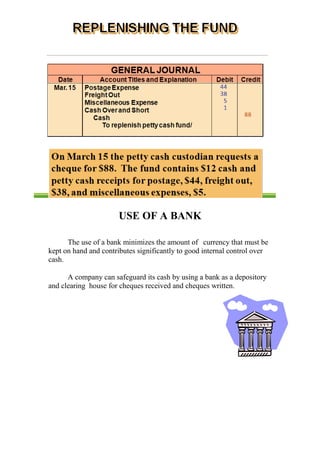
REPLENISHING THE FUND
USE OF A BANK
The use of a bank minimizes the amount of currency that must be
kept on hand and contributes significantly to good internal control over
cash.
A company can safeguard its cash by using a bank as a depository
and clearing house for cheques received and cheques written.
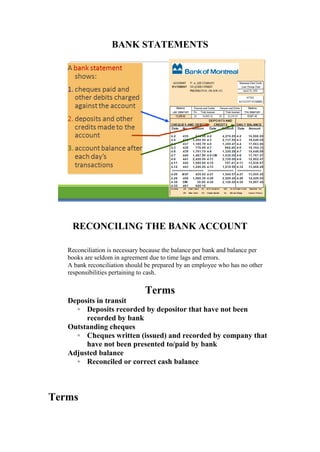
BANK STATEMENTS
RECONCILING THE BANK ACCOUNT
Reconciliation is necessary because the balance per bank and balance per
books are seldom in agreement due to time lags and errors.
A bank reconciliation should be prepared by an employee who has no other
responsibilities pertaining to cash.
Terms
Deposits in transit
◦ Deposits recorded by depositor that have not been
recorded by bank
Outstanding cheques
◦ Cheques written (issued) and recorded by company that
have not been presented to/paid by bank
Adjusted balance
◦ Reconciled or correct cash balance
Terms
Debit memoranda
◦ Charges against depositor’s account (e.g.
service charges, RC (returned)/NSF
(insufficient funds) cheques)
Credit memoranda
◦ Amounts that increase depositor’s account
(e.g., interest earned)
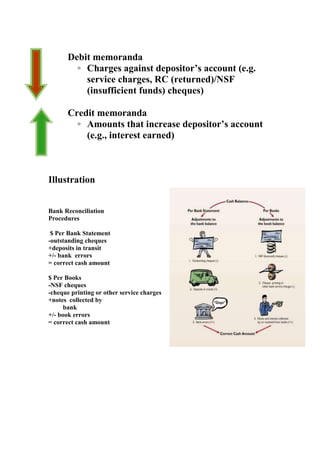
Illustration
Bank Reconciliation
Procedures
$ Per Bank Statement
-outstanding cheques
+deposits in transit
+/- bank errors
= correct cash amount
$ Per Books
-NSF cheques
-cheque printing or other service charges
+notes collected by
bank
+/- book errors
= correct cash amount
Reconciling Journal Entries
Books
◦ Each reconciling item in determining the adjusted
balance per books MUST be journalized and posted
Bank
◦ Do NOT journalize any entries on bank side
REPORTING CASH
Cash reported on the Balance Sheet includes:
1. Cash on hand
2. Cash in banks
3. Petty cash
Cash is listed first in the balance sheet because it is the
most liquid asset.
CASH EQUIVALENTS
Cash equivalents are highly liquid investments, with maturities of
three months or less when purchased, that can be converted into a
specific amount of cash.
Examples include money market funds, short-term notes, and
treasury bills.
USING THE INFORMATION IN THE FINANCIAL
STATEMENTS
 Most important asset
 Pervasive impact
 Vulnerable to theft or misuse
 Balancing act needed to ensure sufficient, but not excess, quantity
USING THE INFORMATION IN THE
FINANCIAL STATEMENTS
Cash Flow Statement : shows where cash came from and
what is was used for.
Management report: states management’s responsibility for
internal controls.

INTERNAL CONTROL.doc

  • 1.
    INTERNAL CONTROL (CASH andBANK) Internal control consists of the policies and procedures adopted within a business in order to: 1. optimize resources, and 2. prevent and detect errors and irregularities. Internal control consists of the policies and procedures adopted within a business in order to: 3. Safeguard its assets 4. Maintain the accuracy and reliability of its accounting records ILLUSTRATION PRINCIPLES OF INTERNAL CONTROL
  • 2.
    PRINCIPLES OF INTERNALCONTROL Authorization of transactions and activities: Authorization by the proper individual is important. Control is most effective when only one person is responsible for a given task. Segregation of duties: The work of one employee should provide a reliable basis for evaluating the work of another employee.  Documentation procedures: Documents should provide evidence that transactions and events have occured.  Safeguards to control access to, and use of, assets and records: Physical, mechanical, and electronic controls relate primarily to the safeguarding of assets and enhancing accuracy and reliability of the accounting records. Independent verification: • External verification indicates whether the company’s financial statements fairly present its financial position and results of operations in accordance with IFRS. • Internal verification involves review, comparison, and reconciliation of information from two sources. LIMITATIONS OF INTERNAL CONTROL
  • 3.
    * Cost/ benefit *Collusion * Size of business * Human element CASH Cash includes coins, currency, cheques, money orders, and money on hand or on deposit at a bank or similar depository. Internal control over cash is imperative in order to safeguard cash and assure the accuracy of the accounting records for cash. CONTROL OVER CASH RECEIPTS Only designated personnel should be authorized to handle or have access to cash receipts. Different individuals should: 1. receive cash 2. record cash receipt transactions 3. have custody of cash CONTROL OVER CASH RECEIPTS Documents should include: 1. remittance advices 2. cash register tapes 3. deposit slips Cash should be stored in safes and bank vaults. Access to storage areas should be limited to authorized personnel. Cash registers should be used in executing over-the-counter receipts. CONTROL OVER CASH RECEIPTS
  • 4.
    Daily cash countsand daily comparisons of total receipts should be made. All personnel who handle cash receipts should be bonded and required to take vacations. An important tool in control of over-the-counter receipts is cash registers that are visible to customers. CONTROL OVER CASH DISBURSEMENTS Payments are made by cheque rather than by cash, except for petty cash transactions. Only specified individuals should be authorized to sign cheques. Different departments or individuals should be assigned the duties of approving an item for payment and paying it. Prenumbered cheques should be used and each cheque should be supported by an approved invoice or other document. Blank cheques should be stored in a safe. 1. Access should be restricted to authorized personnel. 2. A cheque writer machine should be used to imprint the amount on the cheque in indelible ink. Each cheque should be compared with the approved invoice before it is issued. Following payment, the approved invoice should be stamped PAID.
  • 5.
    PETTY CASH FUND Apetty cash fund is used to pay relatively small amounts. Operation of the fund, often called an imprest system, involves 1. establishing the fund, 2. making payments from the fund, and 3. replenishing the fund. Accounting entries are required when 1. the fund is established, 2. the fund is replenished, and 3. the amount of the fund is changed. ESTABLISHING THE FUND GENERAL JOURNAL Date Account Titles and Explanation Debit Credit Mar. 1 Petty Cash Cash To establish a petty cash fund. When the fund is established, a cheque payable to the petty cash custodian is issued for the stipulated amount. REPLENISHING THE FUND
  • 6.
    USE OF ABANK The use of a bank minimizes the amount of currency that must be kept on hand and contributes significantly to good internal control over cash. A company can safeguard its cash by using a bank as a depository and clearing house for cheques received and cheques written.
  • 7.
    BANK STATEMENTS RECONCILING THEBANK ACCOUNT Reconciliation is necessary because the balance per bank and balance per books are seldom in agreement due to time lags and errors. A bank reconciliation should be prepared by an employee who has no other responsibilities pertaining to cash. Terms Deposits in transit ◦ Deposits recorded by depositor that have not been recorded by bank Outstanding cheques ◦ Cheques written (issued) and recorded by company that have not been presented to/paid by bank Adjusted balance ◦ Reconciled or correct cash balance Terms
  • 8.
    Debit memoranda ◦ Chargesagainst depositor’s account (e.g. service charges, RC (returned)/NSF (insufficient funds) cheques) Credit memoranda ◦ Amounts that increase depositor’s account (e.g., interest earned) Illustration Bank Reconciliation Procedures $ Per Bank Statement -outstanding cheques +deposits in transit +/- bank errors = correct cash amount $ Per Books -NSF cheques -cheque printing or other service charges +notes collected by bank +/- book errors = correct cash amount
  • 9.
    Reconciling Journal Entries Books ◦Each reconciling item in determining the adjusted balance per books MUST be journalized and posted Bank ◦ Do NOT journalize any entries on bank side REPORTING CASH Cash reported on the Balance Sheet includes: 1. Cash on hand 2. Cash in banks 3. Petty cash Cash is listed first in the balance sheet because it is the most liquid asset. CASH EQUIVALENTS Cash equivalents are highly liquid investments, with maturities of three months or less when purchased, that can be converted into a specific amount of cash. Examples include money market funds, short-term notes, and treasury bills.
  • 10.
    USING THE INFORMATIONIN THE FINANCIAL STATEMENTS  Most important asset  Pervasive impact  Vulnerable to theft or misuse  Balancing act needed to ensure sufficient, but not excess, quantity USING THE INFORMATION IN THE FINANCIAL STATEMENTS Cash Flow Statement : shows where cash came from and what is was used for. Management report: states management’s responsibility for internal controls.