INTERIOR
DESIGN
BOHEMIAN
STYLE
NAME: ABU BACKER
REG. NO : 181011101002
B.Arch 3rd
yr 6th
sem
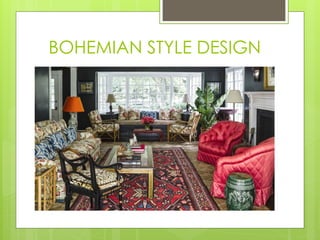
BOHEMIAN STYLE DESIGN
BOHEMIAN
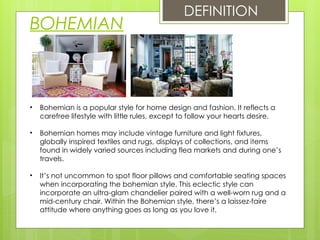
• Bohemian is a popular style for home design and fashion. It reflects a
carefree lifestyle with little rules, except to follow your hearts desire.
• Bohemian homes may include vintage furniture and light fixtures,
globally inspired textiles and rugs, displays of collections, and items
found in widely varied sources including flea markets and during one’s
travels.
• It’s not uncommon to spot floor pillows and comfortable seating spaces
when incorporating the bohemian style. This eclectic style can
incorporate an ultra-glam chandelier paired with a well-worn rug and a
mid-century chair. Within the Bohemian style, there’s a laissez-faire
attitude where anything goes as long as you love it.
DEFINITION
CHARACTERISTICS
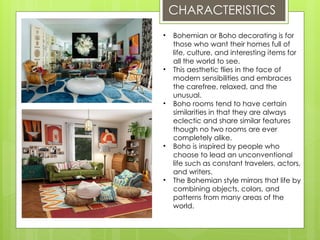
• Bohemian or Boho decorating is for
those who want their homes full of
life, culture, and interesting items for
all the world to see.
• This aesthetic flies in the face of
modern sensibilities and embraces
the carefree, relaxed, and the
unusual.
• Boho rooms tend to have certain
similarities in that they are always
eclectic and share similar features
though no two rooms are ever
completely alike.
• Boho is inspired by people who
choose to lead an unconventional
life such as constant travelers, actors,
and writers.
• The Bohemian style mirrors that life by
combining objects, colors, and
patterns from many areas of the
world.
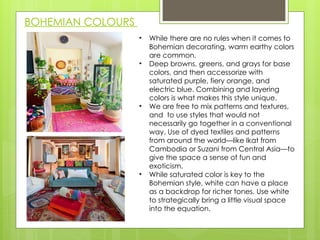
BOHEMIAN COLOURS
• While there are no rules when it comes to
Bohemian decorating, warm earthy colors
are common.
• Deep browns, greens, and grays for base
colors, and then accessorize with
saturated purple, fiery orange, and
electric blue. Combining and layering
colors is what makes this style unique.
• We are free to mix patterns and textures,
and to use styles that would not
necessarily go together in a conventional
way. Use of dyed textiles and patterns
from around the world—like Ikat from
Cambodia or Suzani from Central Asia—to
give the space a sense of fun and
exoticism.
• While saturated color is key to the
Bohemian style, white ​
can have a place
as a backdrop for richer tones. Use white
to strategically bring a little visual space
into the equation.
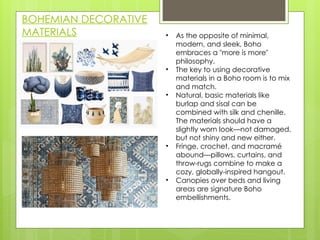
BOHEMIAN DECORATIVE
MATERIALS • As the opposite of minimal,
modern, and sleek, Boho
embraces a "more is more"
philosophy.
• The key to using decorative
materials in a Boho room is to mix
and match.
• Natural, basic materials like
burlap and sisal can be
combined with silk and chenille.
The materials should have a
slightly worn look—not damaged,
but not shiny and new either.
• Fringe, crochet, and macramé
abound—pillows, curtains, and
throw-rugs combine to make a
cozy, globally-inspired hangout.
• Canopies over beds and living
areas are signature Boho
embellishments.
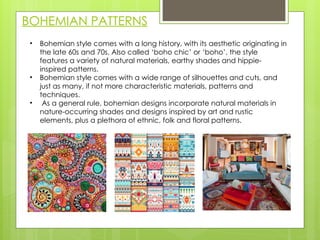
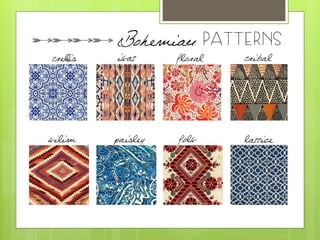
BOHEMIAN PATTERNS
• Bohemian style comes with a long history, with its aesthetic originating in
the late 60s and 70s. Also called ‘boho chic’ or ‘boho’, the style
features a variety of natural materials, earthy shades and hippie-
inspired patterns.
• Bohemian style comes with a wide range of silhouettes and cuts, and
just as many, if not more characteristic materials, patterns and
techniques.
• As a general rule, bohemian designs incorporate natural materials in
nature-occurring shades and designs inspired by art and rustic
elements, plus a plethora of ethnic, folk and floral patterns.
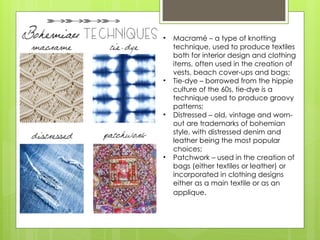
• Macramé – a type of knotting
technique, used to produce textiles
both for interior design and clothing
items, often used in the creation of
vests, beach cover-ups and bags;
• Tie-dye – borrowed from the hippie
culture of the 60s, tie-dye is a
technique used to produce groovy
patterns;
• Distressed – old, vintage and worn-
out are trademarks of bohemian
style, with distressed denim and
leather being the most popular
choices;
• Patchwork – used in the creation of
bags (either textiles or leather) or
incorporated in clothing designs
either as a main textile or as an
applique.
BOHEMIAN FURNITURE
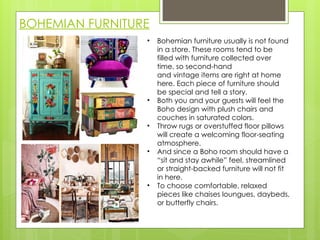
• Bohemian furniture usually is not found
in a store. These rooms tend to be
filled with furniture collected over
time, so second-hand
and vintage items are right at home
here. Each piece of furniture should
be special and tell a story.
• Both you and your guests will feel the
Boho design with plush chairs and
couches in saturated colors.
• Throw rugs or overstuffed floor pillows
will create a welcoming floor-seating
atmosphere.
• And since a Boho room should have a
“sit and stay awhile” feel, streamlined
or straight-backed furniture will not fit
in here.
• To choose comfortable, relaxed
pieces like chaises loungues, daybeds,
or butterfly chairs.
LIGHTTING AND
ACCESCORIES
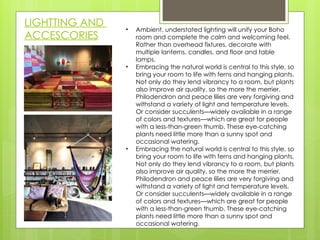
• Ambient, understated lighting will unify your Boho
room and complete the calm and welcoming feel.
Rather than overhead fixtures, decorate with
multiple lanterns, candles, and floor and table
lamps.
• Embracing the natural world is central to this style, so
bring your room to life with ferns and hanging plants.
Not only do they lend vibrancy to a room, but plants
also improve air quality, so the more the merrier.
Philodendron and peace lilies are very forgiving and
withstand a variety of light and temperature levels.
Or consider succulents—widely available in a range
of colors and textures—which are great for people
with a less-than-green thumb. These eye-catching
plants need little more than a sunny spot and
occasional watering.
• Embracing the natural world is central to this style, so
bring your room to life with ferns and hanging plants.
Not only do they lend vibrancy to a room, but plants
also improve air quality, so the more the merrier.
Philodendron and peace lilies are very forgiving and
withstand a variety of light and temperature levels.
Or consider succulents—widely available in a range
of colors and textures—which are great for people
with a less-than-green thumb. These eye-catching
plants need little more than a sunny spot and
occasional watering.

INTERIOR DESIGN - BOHEMIAN STYLE.pdf

  • 1.
    INTERIOR DESIGN BOHEMIAN STYLE NAME: ABU BACKER REG.NO : 181011101002 B.Arch 3rd yr 6th sem
  • 2.
  • 3.
    BOHEMIAN • Bohemian isa popular style for home design and fashion. It reflects a carefree lifestyle with little rules, except to follow your hearts desire. • Bohemian homes may include vintage furniture and light fixtures, globally inspired textiles and rugs, displays of collections, and items found in widely varied sources including flea markets and during one’s travels. • It’s not uncommon to spot floor pillows and comfortable seating spaces when incorporating the bohemian style. This eclectic style can incorporate an ultra-glam chandelier paired with a well-worn rug and a mid-century chair. Within the Bohemian style, there’s a laissez-faire attitude where anything goes as long as you love it. DEFINITION
  • 4.
    CHARACTERISTICS • Bohemian orBoho decorating is for those who want their homes full of life, culture, and interesting items for all the world to see. • This aesthetic flies in the face of modern sensibilities and embraces the carefree, relaxed, and the unusual. • Boho rooms tend to have certain similarities in that they are always eclectic and share similar features though no two rooms are ever completely alike. • Boho is inspired by people who choose to lead an unconventional life such as constant travelers, actors, and writers. • The Bohemian style mirrors that life by combining objects, colors, and patterns from many areas of the world.
  • 5.
    BOHEMIAN COLOURS • Whilethere are no rules when it comes to Bohemian decorating, warm earthy colors are common. • Deep browns, greens, and grays for base colors, and then accessorize with saturated purple, fiery orange, and electric blue. Combining and layering colors is what makes this style unique. • We are free to mix patterns and textures, and to use styles that would not necessarily go together in a conventional way. Use of dyed textiles and patterns from around the world—like Ikat from Cambodia or Suzani from Central Asia—to give the space a sense of fun and exoticism. • While saturated color is key to the Bohemian style, white ​ can have a place as a backdrop for richer tones. Use white to strategically bring a little visual space into the equation.
  • 6.
    BOHEMIAN DECORATIVE MATERIALS •As the opposite of minimal, modern, and sleek, Boho embraces a "more is more" philosophy. • The key to using decorative materials in a Boho room is to mix and match. • Natural, basic materials like burlap and sisal can be combined with silk and chenille. The materials should have a slightly worn look—not damaged, but not shiny and new either. • Fringe, crochet, and macramé abound—pillows, curtains, and throw-rugs combine to make a cozy, globally-inspired hangout. • Canopies over beds and living areas are signature Boho embellishments.
  • 7.
    BOHEMIAN PATTERNS • Bohemianstyle comes with a long history, with its aesthetic originating in the late 60s and 70s. Also called ‘boho chic’ or ‘boho’, the style features a variety of natural materials, earthy shades and hippie- inspired patterns. • Bohemian style comes with a wide range of silhouettes and cuts, and just as many, if not more characteristic materials, patterns and techniques. • As a general rule, bohemian designs incorporate natural materials in nature-occurring shades and designs inspired by art and rustic elements, plus a plethora of ethnic, folk and floral patterns.
  • 9.
    • Macramé –a type of knotting technique, used to produce textiles both for interior design and clothing items, often used in the creation of vests, beach cover-ups and bags; • Tie-dye – borrowed from the hippie culture of the 60s, tie-dye is a technique used to produce groovy patterns; • Distressed – old, vintage and worn- out are trademarks of bohemian style, with distressed denim and leather being the most popular choices; • Patchwork – used in the creation of bags (either textiles or leather) or incorporated in clothing designs either as a main textile or as an applique.
  • 10.
    BOHEMIAN FURNITURE • Bohemianfurniture usually is not found in a store. These rooms tend to be filled with furniture collected over time, so second-hand and vintage items are right at home here. Each piece of furniture should be special and tell a story. • Both you and your guests will feel the Boho design with plush chairs and couches in saturated colors. • Throw rugs or overstuffed floor pillows will create a welcoming floor-seating atmosphere. • And since a Boho room should have a “sit and stay awhile” feel, streamlined or straight-backed furniture will not fit in here. • To choose comfortable, relaxed pieces like chaises loungues, daybeds, or butterfly chairs.
  • 11.
    LIGHTTING AND ACCESCORIES • Ambient,understated lighting will unify your Boho room and complete the calm and welcoming feel. Rather than overhead fixtures, decorate with multiple lanterns, candles, and floor and table lamps. • Embracing the natural world is central to this style, so bring your room to life with ferns and hanging plants. Not only do they lend vibrancy to a room, but plants also improve air quality, so the more the merrier. Philodendron and peace lilies are very forgiving and withstand a variety of light and temperature levels. Or consider succulents—widely available in a range of colors and textures—which are great for people with a less-than-green thumb. These eye-catching plants need little more than a sunny spot and occasional watering. • Embracing the natural world is central to this style, so bring your room to life with ferns and hanging plants. Not only do they lend vibrancy to a room, but plants also improve air quality, so the more the merrier. Philodendron and peace lilies are very forgiving and withstand a variety of light and temperature levels. Or consider succulents—widely available in a range of colors and textures—which are great for people with a less-than-green thumb. These eye-catching plants need little more than a sunny spot and occasional watering.