INTERACTIVE READ-ALOUDS
4
DR. KRISTIN WEBBER
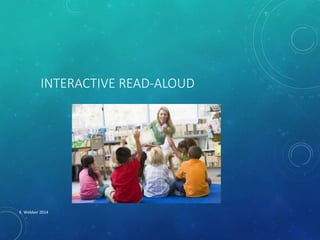
INTERACTIVE READ-ALOUD
K. Webber 2014
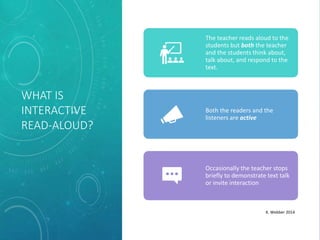
WHAT IS
INTERACTIVE
READ-ALOUD?
K. Webber 2014
The teacher reads aloud to the
students but both the teacher
and the students think about,
talk about, and respond to the
text.
Both the readers and the
listeners are active
Occasionally the teacher stops
briefly to demonstrate text talk
or invite interaction
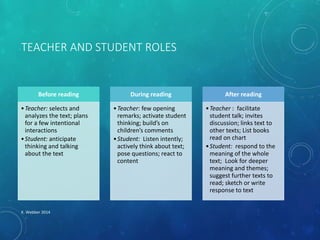
TEACHER AND STUDENT ROLES
K. Webber 2014
Before reading
•Teacher: selects and
analyzes the text; plans
for a few intentional
interactions
•Student: anticipate
thinking and talking
about the text
During reading
•Teacher: few opening
remarks; activate student
thinking; build’s on
children’s comments
•Student: Listen intently;
actively think about text;
pose questions; react to
content
After reading
•Teacher : facilitate
student talk; invites
discussion; links text to
other texts; List books
read on chart
•Student: respond to the
meaning of the whole
text; Look for deeper
meaning and themes;
suggest further texts to
read; sketch or write
response to text
SELECTING TEXTS
K. Webber 2014
Texts students
will enjoy
Texts that
connect to the
curriculum
Texts that
highlight
language
Poetic texts
Texts to learn
more about
genres
Texts to
expand
thinking
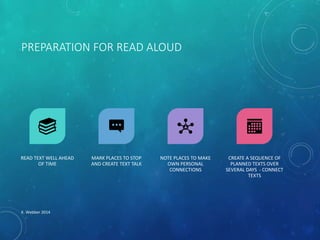
PREPARATION FOR READ ALOUD
K. Webber 2014
READ TEXT WELL AHEAD
OF TIME
MARK PLACES TO STOP
AND CREATE TEXT TALK
NOTE PLACES TO MAKE
OWN PERSONAL
CONNECTIONS
CREATE A SEQUENCE OF
PLANNED TEXTS OVER
SEVERAL DAYS - CONNECT
TEXTS
SETTING
• Students need to be comfortable seated
• Everyone can hear easily and see anything in the text
the teacher decides to show.
• Need to be able to “turn and talk”
K. Webber 2014
READING THE TEXT
K. Webber 2014
Opening moves
Set tone for the lesson
Sets expectations for active listening
Reading the text
Use voice inflection
Make eye contact
Do not discuss every little thing in the
text
Discussion and Self-evaluation
Record student thinking on a chart
Reflect on meaning of a whole text
Creating a visual record
Record of reading
Optional written or artistic response
SHARED TALK ABOUT
TEXT
• Intentional Conversation
• Conversational moves directed
toward the goal of instruction
• “lifts the thinking” of the students
• Focuses on the reading process and
the particular text being shared
• Opportunity to probe deeper

Interactive read aloud

  • 1.
  • 2.
  • 3.
    WHAT IS INTERACTIVE READ-ALOUD? K. Webber2014 The teacher reads aloud to the students but both the teacher and the students think about, talk about, and respond to the text. Both the readers and the listeners are active Occasionally the teacher stops briefly to demonstrate text talk or invite interaction
  • 4.
    TEACHER AND STUDENTROLES K. Webber 2014 Before reading •Teacher: selects and analyzes the text; plans for a few intentional interactions •Student: anticipate thinking and talking about the text During reading •Teacher: few opening remarks; activate student thinking; build’s on children’s comments •Student: Listen intently; actively think about text; pose questions; react to content After reading •Teacher : facilitate student talk; invites discussion; links text to other texts; List books read on chart •Student: respond to the meaning of the whole text; Look for deeper meaning and themes; suggest further texts to read; sketch or write response to text
  • 5.
    SELECTING TEXTS K. Webber2014 Texts students will enjoy Texts that connect to the curriculum Texts that highlight language Poetic texts Texts to learn more about genres Texts to expand thinking
  • 6.
    PREPARATION FOR READALOUD K. Webber 2014 READ TEXT WELL AHEAD OF TIME MARK PLACES TO STOP AND CREATE TEXT TALK NOTE PLACES TO MAKE OWN PERSONAL CONNECTIONS CREATE A SEQUENCE OF PLANNED TEXTS OVER SEVERAL DAYS - CONNECT TEXTS
  • 7.
    SETTING • Students needto be comfortable seated • Everyone can hear easily and see anything in the text the teacher decides to show. • Need to be able to “turn and talk” K. Webber 2014
  • 8.
    READING THE TEXT K.Webber 2014 Opening moves Set tone for the lesson Sets expectations for active listening Reading the text Use voice inflection Make eye contact Do not discuss every little thing in the text Discussion and Self-evaluation Record student thinking on a chart Reflect on meaning of a whole text Creating a visual record Record of reading Optional written or artistic response
  • 9.
    SHARED TALK ABOUT TEXT •Intentional Conversation • Conversational moves directed toward the goal of instruction • “lifts the thinking” of the students • Focuses on the reading process and the particular text being shared • Opportunity to probe deeper