Interacting with Objects Language Materiality
and Social Activity 1st Edition Maurice Nevile
(Ed.) download
https://ebookname.com/product/interacting-with-objects-language-
materiality-and-social-activity-1st-edition-maurice-nevile-ed/
Get Instant Ebook Downloads – Browse at https://ebookname.com
Instant digital products (PDF, ePub, MOBI) available
Download now and explore formats that suit you...
Active Education Lessons for Integrating Physical
Activity with Language Arts Math Science and Social
Studies Lessons for Integrating Physical Activity with
Language Arts Math Science and Social Studies 1st
Edition Julian A. Reed
https://ebookname.com/product/active-education-lessons-for-
integrating-physical-activity-with-language-arts-math-science-
and-social-studies-lessons-for-integrating-physical-activity-
with-language-arts-math-science-and-social-studi/
Interacting with Geospatial Technologies 1st Edition
Muki Haklay
https://ebookname.com/product/interacting-with-geospatial-
technologies-1st-edition-muki-haklay/
Language talent and brain activity 1st Edition Grzegorz
Dogil
https://ebookname.com/product/language-talent-and-brain-
activity-1st-edition-grzegorz-dogil/
Communication Skills for Adult Nurses 1st Edition
Abayomi Mcewen
https://ebookname.com/product/communication-skills-for-adult-
nurses-1st-edition-abayomi-mcewen/
Suicidal Utopian Delusions in the 21st Century 2nd
Edition Michael Starks
https://ebookname.com/product/suicidal-utopian-delusions-in-
the-21st-century-2nd-edition-michael-starks/
Quantitative Geology of Late Jurassic Epicontinental
Sediments in the Jura Mountains of Switzerland 1st
Edition Reinhart A. Gygi (Auth.)
https://ebookname.com/product/quantitative-geology-of-late-
jurassic-epicontinental-sediments-in-the-jura-mountains-of-
switzerland-1st-edition-reinhart-a-gygi-auth/
Physics Pharmacology and Physiology for Anaesthetists
Key Concepts for the FRCA 1st Edition Matthew E. Cross
https://ebookname.com/product/physics-pharmacology-and-
physiology-for-anaesthetists-key-concepts-for-the-frca-1st-
edition-matthew-e-cross/
Beyond Economic Growth 2nd Edition Tatyana Soubbotina
https://ebookname.com/product/beyond-economic-growth-2nd-edition-
tatyana-soubbotina/
Phenomenon Everything You Need to Know About The
Paranormal 1ST Edition Sylvia Browne
https://ebookname.com/product/phenomenon-everything-you-need-to-
know-about-the-paranormal-1st-edition-sylvia-browne/
Oxford American Handbook of Cardiology Oxford American
Handbooks in Medicine 1st Edition Jeffrey Bender
https://ebookname.com/product/oxford-american-handbook-of-
cardiology-oxford-american-handbooks-in-medicine-1st-edition-
jeffrey-bender/
Interacting with Objects
Language, materiality, and social activity
Edited by
Maurice Nevile
University of Southern Denmark
Pentti Haddington
University of Oulu
Trine Heinemann
University of Southern Denmark
Mirka Rauniomaa
University of Oulu
John Benjamins Publishing Company
Amsterdam/Philadelphia
Library of Congress Cataloging-in-Publication Data
Interacting with Objects : Language, materiality, and social activity / Edited by Maurice
Nevile, Pentti Haddington, Trine Heinemann and Mirka Rauniomaa.
p. cm.
Includes bibliographical references and index.
1. Communication models. 2. Semiotics. 3. Gesture. 4. Nonverbal communication.
5. Social interaction. 6. Symbolic interactionism. I. Nevile, Maurice, editor.
II. Haddington, Pentti, editor. III. Heinemann, Trine, editor. IV. Rauniomaa,
Mirka, editor.
P93.55.I48 2014
302.2--dc23			 2014014850
isbn 978 90 272 1213 9 (Hb ; alk. paper)
isbn 978 90 272 6983 6 (Eb)
© 2014 – John Benjamins B.V.
No part of this book may be reproduced in any form, by print, photoprint, microfilm, or any
other means, without written permission from the publisher.
John Benjamins Publishing Co. · P.O. Box 36224 · 1020 me Amsterdam · The Netherlands
John Benjamins North America · P.O. Box 27519 · Philadelphia pa 19118-0519 · usa
8
TM
The paper used in this publication meets the minimum requirements of
the American National Standard for Information Sciences – Permanence
of Paper for Printed Library Materials, ansi z39.48-1984.
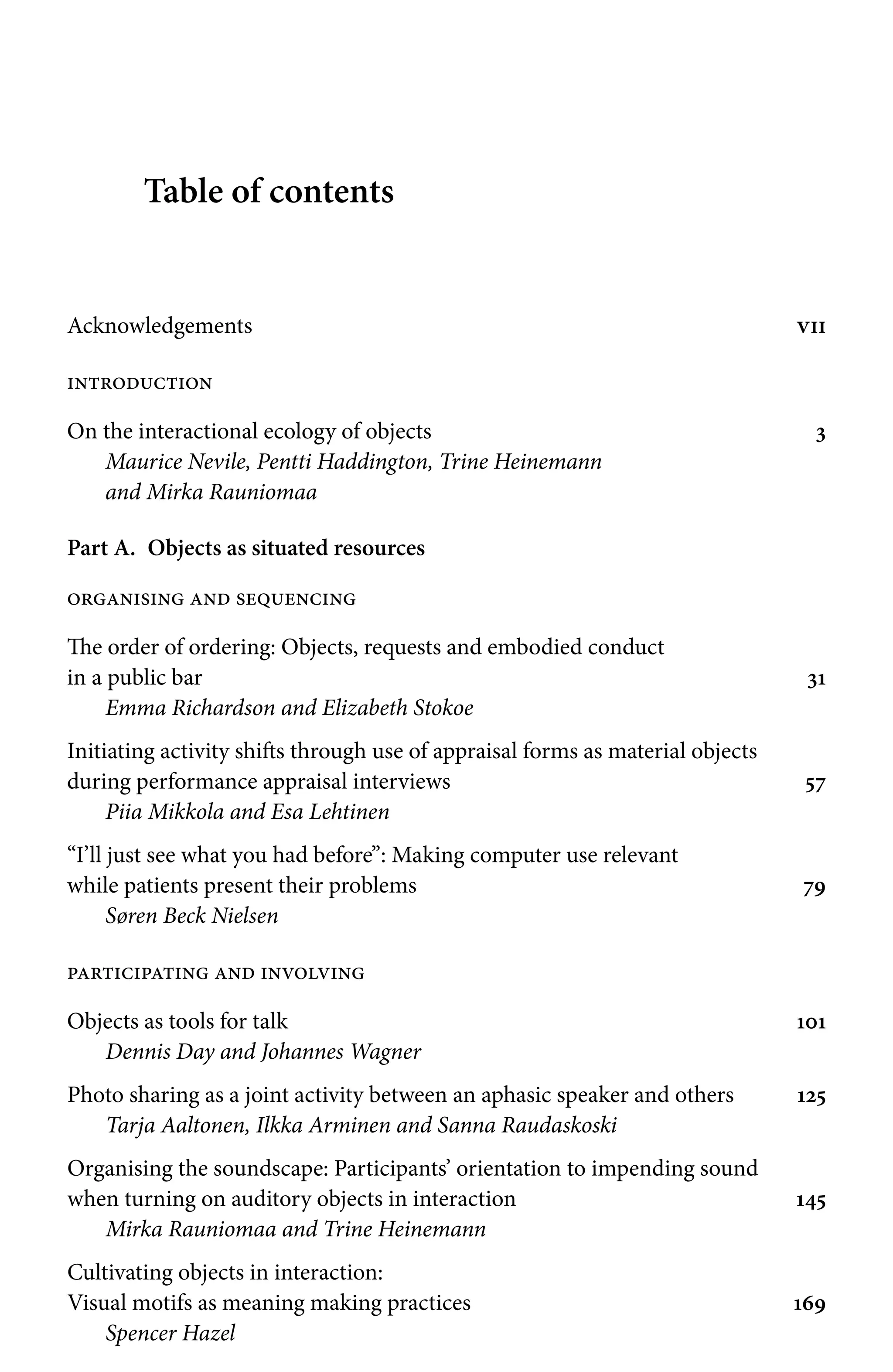
Table of contents
Acknowledgements vii
introduction
On the interactional ecology of objects 3
Maurice Nevile, Pentti Haddington, Trine Heinemann
and Mirka Rauniomaa
Part A. Objects as situated resources
organising and sequencing
The order of ordering: Objects, requests and embodied conduct
in a public bar 31
Emma Richardson and Elizabeth Stokoe
Initiating activity shifts through use of appraisal forms as material objects
during performance appraisal interviews 57
Piia Mikkola and Esa Lehtinen
“I’ll just see what you had before”: Making computer use relevant
while patients present their problems 79
Søren Beck Nielsen
participating and involving
Objects as tools for talk 101
Dennis Day and Johannes Wagner
Photo sharing as a joint activity between an aphasic speaker and others 125
Tarja Aaltonen, Ilkka Arminen and Sanna Raudaskoski
Organising the soundscape: Participants’ orientation to impending sound
when turning on auditory objects in interaction 145
Mirka Rauniomaa and Trine Heinemann
Cultivating objects in interaction:
Visual motifs as meaning making practices 169
Spencer Hazel
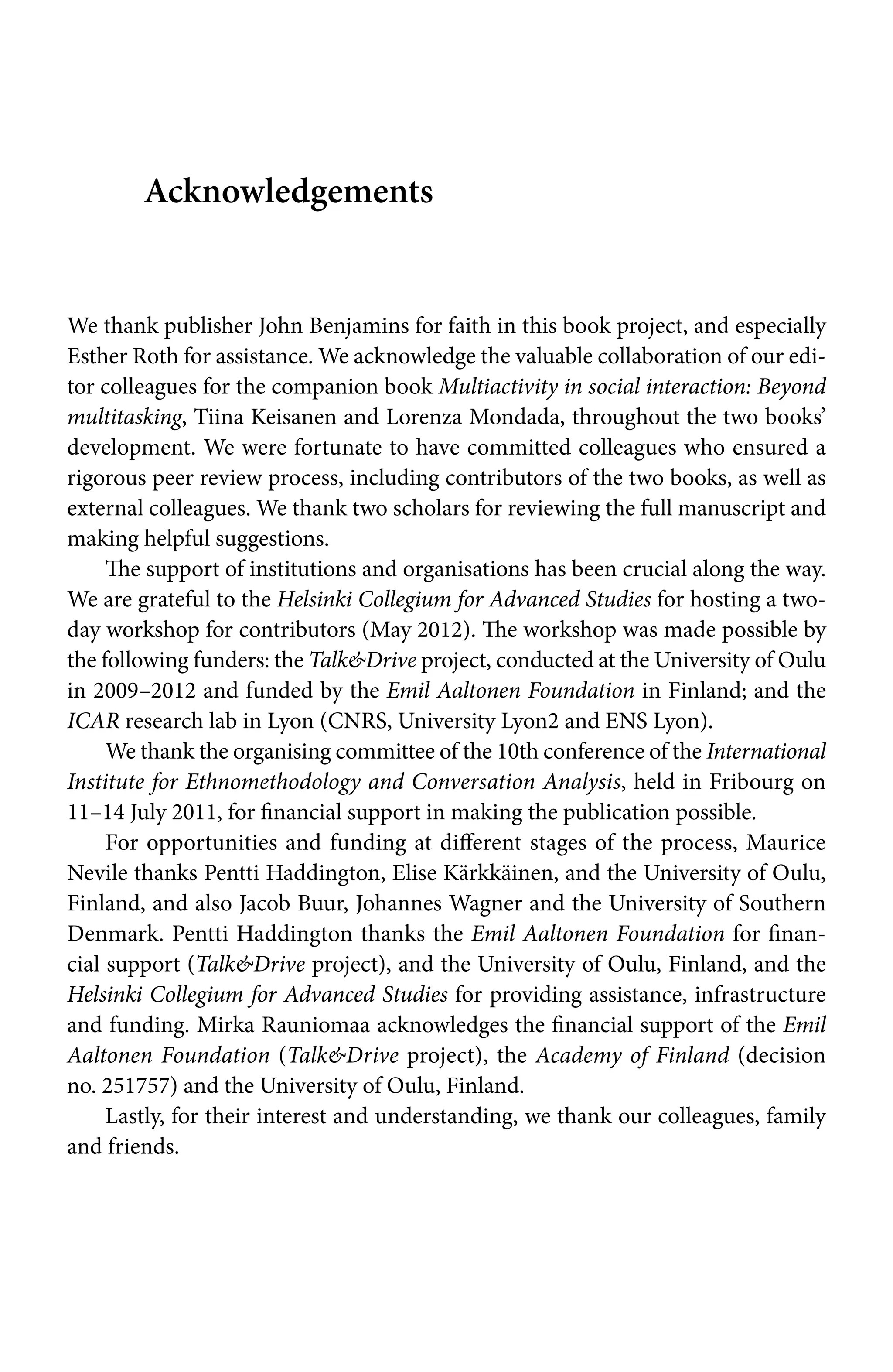
vi Interacting with Objects
Part B.╇ Objects as practical accomplishments
shaping and creating
Cooking instructions and the shaping of things in the kitchen 199
Lorenza Mondada
To follow the materials: The detection, diagnosis and correction
of mistakes in craft education 227
Anna Ekström and Oskar Lindwall
�
Having a ball: Immaterial objects in dance instruction 249
Leelo Keevallik
experiencing and identifying 269
�
Establishing joint orientation towards commercial objects
in a self-service store: How practices of categorisation matter 271
Elwys De Stefani
Artworks as touchable objects:
Guiding perception in a museum tour for blind people 295
Yaël Kreplak and Chloé Mondémé
Incidental and essential objects in interaction:
Paper documents in journalistic work 319
Alexandra Weilenmann and Gustav Lymer
Envisioning the plan in interaction:
Configuring pipes during a plumbers’ meeting 339
Shinichiro Sakai, Ron Korenaga, Yoshifumi Mizukawa
and Motoko Igarashi
Instructed objects 357
Timothy Koschmann and Alan Zemel
epilogue
Trajectories of the object in interaction 381
Ben Matthews
Person index 389
Subject index 391
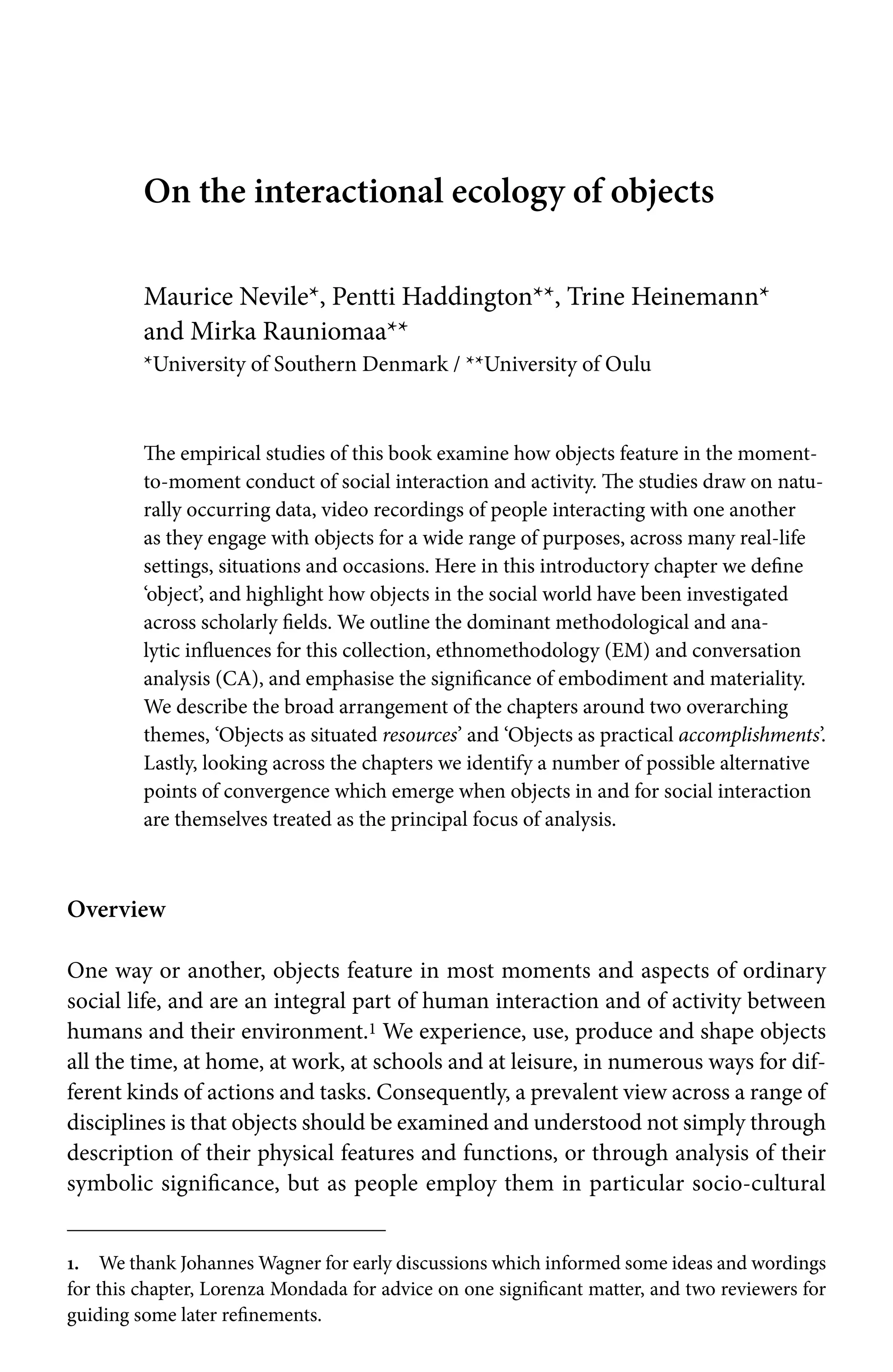
Acknowledgements
We thank publisher John Benjamins for faith in this book project, and especially
Esther Roth for assistance. We acknowledge the valuable collaboration of our edi-
tor colleagues for the companion book Multiactivity in social interaction: Beyond
multitasking, Tiina Keisanen and Lorenza Mondada, throughout the two books’
development. We were fortunate to have committed colleagues who ensured a
rigorous peer review process, including contributors of the two books, as well as
external colleagues. We thank two scholars for reviewing the full manuscript and
making helpful suggestions.
The support of institutions and organisations has been crucial along the way.
We are grateful to the Helsinki Collegium for Advanced Studies for hosting a two-
day workshop for contributors (May 2012). The workshop was made possible by
the following funders: the TalkDrive project, conducted at the University of Oulu
in 2009–2012 and funded by the Emil Aaltonen Foundation in Finland; and the
ICAR research lab in Lyon (CNRS, University Lyon2 and ENS Lyon).
We thank the organising committee of the 10th conference of the International
Institute for Ethnomethodology and Conversation Analysis, held in Fribourg on
11–14 July 2011, for financial support in making the publication possible.
For opportunities and funding at different stages of the process, Maurice
Nevile thanks Pentti Haddington, Elise Kärkkäinen, and the University of Oulu,
Finland, and also Jacob Buur, Johannes Wagner and the University of Southern
Denmark. Pentti Haddington thanks the Emil Aaltonen Foundation for finan-
cial support (TalkDrive project), and the University of Oulu, Finland, and the
Helsinki Collegium for Advanced Studies for providing assistance, infrastructure
and funding. Mirka Rauniomaa acknowledges the financial support of the Emil
Aaltonen Foundation (TalkDrive project), the Academy of Finland (decision
no. 251757) and the University of Oulu, Finland.
Lastly, for their interest and understanding, we thank our colleagues, family
and friends.
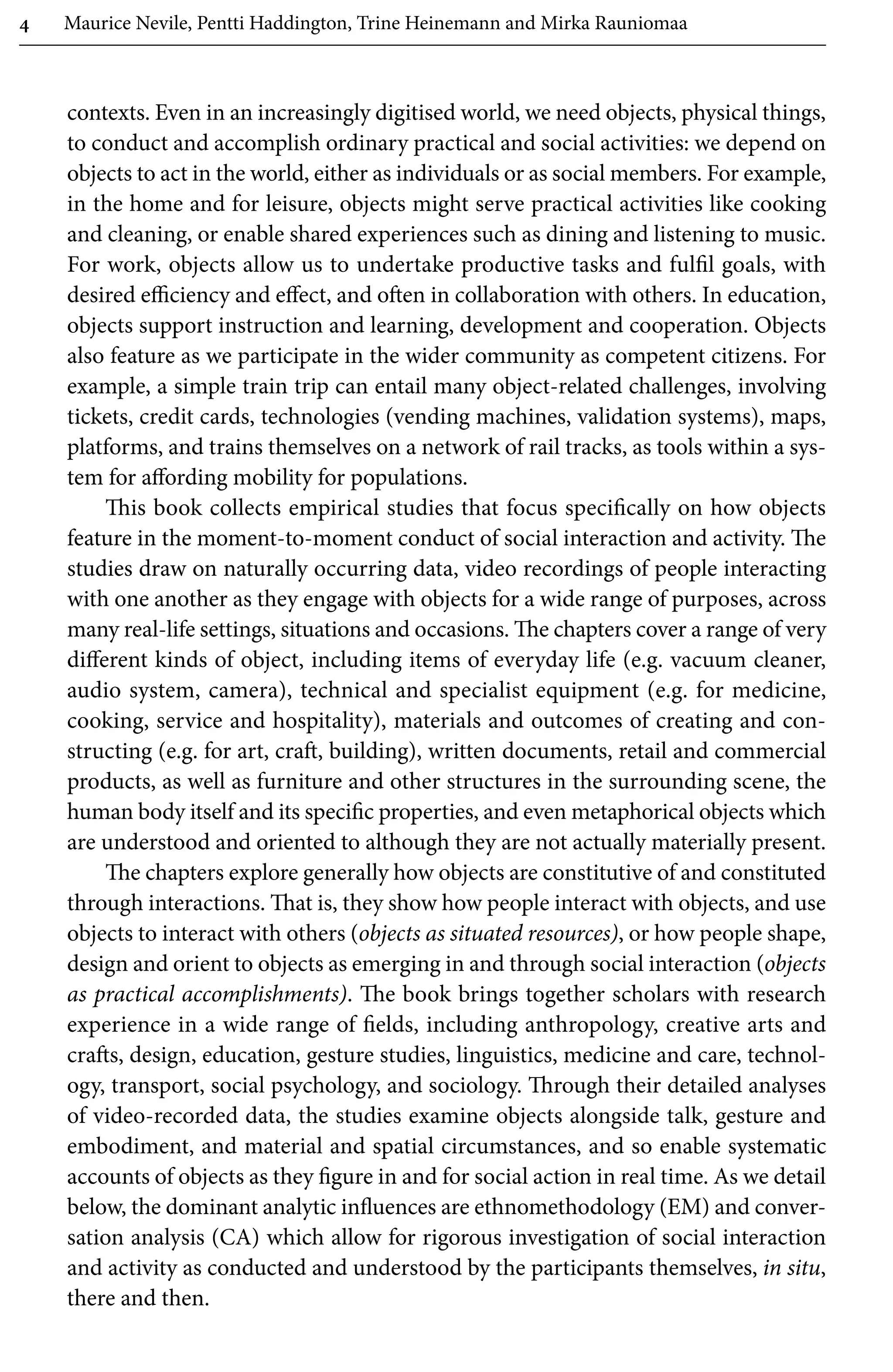
introduction
On the interactional ecology of objects
Maurice Nevile*, Pentti Haddington**, Trine Heinemann*
and Mirka Rauniomaa**
*University of Southern Denmark / **University of Oulu
The empirical studies of this book examine how objects feature in the moment-
to-moment conduct of social interaction and activity. The studies draw on natu-
rally occurring data, video recordings of people interacting with one another
as they engage with objects for a wide range of purposes, across many real-life
settings, situations and occasions. Here in this introductory chapter we define
‘object’, and highlight how objects in the social world have been investigated
across scholarly fields. We outline the dominant methodological and ana-
lytic influences for this collection, ethnomethodology (EM) and conversation
analysis (CA), and emphasise the significance of embodiment and materiality.
We describe the broad arrangement of the chapters around two overarching
themes, ‘Objects as situated resources’ and ‘Objects as practical accomplishments’.
Lastly, looking across the chapters we identify a number of possible alternative
points of convergence which emerge when objects in and for social interaction
are themselves treated as the principal focus of analysis.
Overview
One way or another, objects feature in most moments and aspects of ordinary
social life, and are an integral part of human interaction and of activity between
humans and their environment.1 We experience, use, produce and shape objects
all the time, at home, at work, at schools and at leisure, in numerous ways for dif-
ferent kinds of actions and tasks. Consequently, a prevalent view across a range of
disciplines is that objects should be examined and understood not simply through
description of their physical features and functions, or through analysis of their
symbolic significance, but as people employ them in particular socio-cultural
1. We thank Johannes Wagner for early discussions which informed some ideas and wordings
for this chapter, Lorenza Mondada for advice on one significant matter, and two reviewers for
guiding some later refinements.
4 Maurice Nevile, Pentti Haddington, Trine Heinemann and Mirka Rauniomaa
contexts. Even in an increasingly digitised world, we need objects, physical things,
to conduct and accomplish ordinary practical and social activities: we depend on
objects to act in the world, either as individuals or­as social members. For example,
in the home and for leisure, objects might serve practical activities like cooking
and cleaning, or enable shared experiences such as dining and listening to music.
For work, objects allow us to undertake productive tasks and fulfil goals, with
desired efficiency and effect, and often in collaboration with others. In education,
objects support instruction and learning, development and cooperation. Objects
also feature as we participate in the wider community as competent citizens. For
example, a simple train trip can entail many object-related challenges, involving
tickets, credit cards, technologies (vending machines, validation systems), maps,
platforms, and trains themselves on a network of rail tracks, as tools within a sys-
tem for affording mobility for populations.
This book collects empirical studies that focus specifically on how objects
feature in the moment-to-moment conduct of social interaction and activity. The
studies draw on naturally occurring data, video recordings of people interacting
with one another as they engage with objects for a wide range of purposes, across
many real-life settings, situations and occasions. The chapters cover a range of very
different kinds of object, including items of everyday life (e.g. vacuum cleaner,
audio system, camera), technical and specialist equipment (e.g. for medicine,
cooking, service and hospitality), materials and outcomes of creating and con-
structing (e.g. for art, craft, building), written documents, retail and commercial
products, as well as furniture and other structures in the surrounding scene, the
human body itself and its specific properties, and even metaphorical objects which
are understood and oriented to although they are not actually materially present.
The chapters explore generally how objects are constitutive of and constituted
through interactions. That is, they show how people interact with objects, and use
objects to interact with others (objects as situated resources), or how people shape,
design and orient to objects as emerging in and through social interaction (objects
as practical accomplishments). The book brings together scholars with research
experience in a wide range of fields, including anthropology, creative arts and
crafts, design, education, gesture studies, linguistics, medicine and care, technol-
ogy, transport, social psychology, and sociology. Through their detailed analyses
of video-recorded data, the studies examine objects alongside talk, gesture and
embodiment, and material and spatial circumstances, and so enable systematic
accounts of objects as they figure in and for social action in real time. As we detail
below, the dominant analytic influences are ethnomethodology (EM) and conver-
sation analysis (CA) which allow for rigorous investigation of social interaction
and activity as conducted and understood by the participants themselves, in situ,
there and then.
Interactional ecology of objects 5
The contributors to this book appreciate that there is a need to understand
better and more precisely how objects feature for building meaningful and
successful social interaction. Chapters focus on objects in their own terms as
significant and consequential for the nature of social encounters and for how
those encounters progress. The book therefore develops an emerging empha-
sis in research on social interaction where language and embodied conduct are
analysed relative to their material environments (for recent collections see e.g.
Haddington, Keisanen,  Nevile, 2012; Haddington, Mondada,  Nevile, 2013b;
McIlvenny, Broth,  Haddington, 2009; Mondada  Schmitt, 2010; Sidnell 
Stivers, 2005; Streeck, Goodwin,  LeBaron, 2011). In this chapter we introduce
the value of examining objects in this way, and indicate how a rich understanding
of objects can emerge through the empirical chapters. We position the book first
briefly relative to interest in objects across some different scholarly traditions, in
general, and then, after a short overview of key developments in ethnomethodol-
ogy and conversation analysis, relative to interests of research on language and
social interaction, in particular.
Objects in the social world
By ‘objects’ we mean generally those elements of the physical world that we can
experience sensorially, i.e. that we typically see, hear and touch. For example, we
can handle and manipulate objects; move, arrange or place them; create, assemble
or transform them; dismantle or destroy them; represent, recall or imagine them;
and so on. As objects are located in space, we can orient and move our bodies
according to their presence (e.g. around and over them), we can point to objects,
and we can also refer to and talk about objects, identifying and making them rel-
evant, recognisable and intelligible, perhaps from the surrounding environment
or drawing on shared understanding and experience. Objects are familiar to us all,
we know and categorise them generally in a range of ways. Objects can be tools,
devices, technologies, appliances, equipment, instruments, goods, products, vehi-
cles, furniture, toys, clothing, materials, jewellery, food, containers, utensils, weap-
ons, decorations, gifts, and so on. Objects can be understood and treated variously
as rare or common, natural or manufactured, as familiar or unfamiliar, as precious
or disposable, as simple or complex, as private or public, as relatively permanent
or as disposable, as beautiful or ugly, as useful or useless, as accessible or inacces-
sible. The human body itself can also be understood or treated as an object. It is a
physical entity that can be positioned relative to others or in surrounding space,
and employed wholly or partially, for instance, to direct, protect or obstruct, or to
be scrutinised (C. Goodwin, 2007; Heath, 1986; Koschmann, LeBaron, Goodwin,
6 Maurice Nevile, Pentti Haddington, Trine Heinemann and Mirka Rauniomaa
Zemel,  Dunnington, 2007; Nishizaka, 2007), or it can be damaged and be sub-
sequently mended or augmented (Egbert  Deppermann, 2012).
Objects are of course an interest, or even the principal focus, of many scholarly
disciplines and fields of practice, which can study the nature and characteristics
of objects, and more relevantly the significance of objects in society and for social
life, perhaps in particular situations and settings, or periods of time. For exam-
ple, for archaeology, anthropology, and history, objects can provide evidence for
and support theories of socio-cultural and economic practices, beliefs, significant
changes and events occurring over time, and the constitution, communication and
organisation of populations (e.g. Appadurai, 1986; Hodder, 1991; D. Miller, 1987;
P. Miller, 2013; Schiffer  Miller, 1999). In more sociological strands of research,
there is likewise an interest in objects’ role for forming and indicating social affili-
ations and statuses, for example through ownership, use, circulation or disposal,
or otherwise for the conduct of institutions and organisations (e.g. Bourdieu, 1979;
Douglas  Isherwood, 1996; Gregson  Crewe, 2003; Lunt  Livingstone, 1992;
and see Engeström  Blackler, 2005).
There is also a large and growing interest among scholars from a range of
backgrounds in objects and material culture, considering the meaning of objects
for individuals and the impact of objects for the mind, as well as the role of objects
for engaging in contemporary social life (e.g. Attfield, 2000; Dant, 1999, 2005;
Leonardi, Nardi,  Kallinikos, 2012; Malafouris  Renfrew, 2010; Turkle, 2007).
Research in psychology and education has concerned, for example, objects’ sig-
nificance for how individuals perceive and experience the nature of the physical
world, and their own place within it, or for how objects support thinking, learning,
and collaboration (e.g. Cobb, 2002; Csikszentmihalyi  Rochberg-Halton, 1981;
Gibson, 1977, 1979; Hutchins, 1995a, 1995b; Schliemann, 2002; Stafford, 2009). In
design and innovation, objects may be the outcome of processes of creative think-
ing, cooperation, negotiation, and making, or might themselves be an integral
part of facilitating and accomplishing such processes (e.g. Busch, 2005; Costall 
Dreier, 2006; Hallam  Ingold, 2007; Levi-Strauss, 1962; Norman, 1988; Parsons,
2009; Verbeek, 2006). Within creative arts and crafts, objects may be understood
and valued for their possible aesthetic or functional qualities, exhibited technical
skill, for their expression, representation, and interpretation of ideas and emo-
tions, or for responses and for the experiences they can engender (e.g. Keller 
Dixon Keller, 1996; Sennett, 2008). Furthermore, in studies dealing with science
and technology, objects can be seen as social actors, as entities that can be active
within and influence larger social networks or systems of meaning and practice
(e.g. Latour, 1987, 2005; Suchman, Trigg,  Blomberg, 2002).
Interactional ecology of objects 7
Objects have also received attention in philosophy and related disciplines,
where the nature and characteristics of objects figure in reflections on, for example,
experience, existence, materiality, reality, signification, representation, perception,
mind, cognition, consciousness, and kinds of entities (e.g. Koslicki, 2008; Laycock,
2006; Merricks, 2001; K. Miller, 2008; Quine, 1960; Thomasson, 2007; Velmans,
2009; Wetzel, 2009). In studies of language, objects occur in discussions of ref-
erential descriptions in logic, typically drawing on writing or isolated and con-
structed examples (e.g. Frege, 1893/1952; Halliday, 1985; Kaplan, 1989). However,
it has also been noted that in processes of activity and interaction, participants
create and negotiate a variety of reference forms in the moment to establish shared
understanding of what is happening and what to do next (Hanks, 1990).
Generally then, in the social sciences and humanities, approaches to objects
across disciplines have involved theorising or documenting the materiality and
practices of object use and consumption (e.g. objects as commodities). Or, they
provide abstract or large-scale accounts and notions of socio-cultural changes
and trends in people’s experiences of objects, perhaps of the past or emerging
in the present and for the future, including the role, influence and impact of
objects for individuals or groups (e.g. objects as devices or tools). They might
be concerned with wider issues of people’s relations and attitudes to objects, the
meaning and significance of objects, the symbolic or other value of objects (e.g.
aesthetics of objects), or can seek to develop typologies of the ways objects appear
and figure in human experience. Such research draws on various forms of data
and a range of analytic methods, including surveys or interviews, recollections
or reflections, ethnographic observations, document analyses, statistical analyses,
or experiments.
Our interest and approach in this collection is therefore quite different. Studies
here explore how objects reveal something of how participants, in situ and in the
moment, act socially and meaningfully, to construct and interpret both their prac-
tical activities and also objects themselves. Through talk and interaction, objects
can, for example, be noticed, appreciated, assessed, imagined, created and made
sense of, or can be given and received, shared or distributed, shown and demon-
strated, described and explained, or disputed. In work and institutional settings,
objects can also serve as tools and technologies of various kinds as participants
collaborate to organise and perform tasks. Indeed, just what counts as an ‘object’,
and is treated as an object, is something that participants determine together as
they interact with one another.
8 Maurice Nevile, Pentti Haddington, Trine Heinemann and Mirka Rauniomaa
Researching social interaction:
Ethnomethodology and conversation analysis
The studies in this book are informed by the analytic thinking and methodologi-
cal principles of ethnomethodology and conversation analysis. In this section, we
briefly outline the background and development of these approaches, connect-
ing to the specific theme of the book, objects in social interaction. First, we dis-
cuss early developments in social sciences that led researchers to understand the
importance of studying the order of everyday social interaction, and to recognise
the central role that conversation has in creating and maintaining that order. We
then move on to show how these developments have prompted researchers of
social interaction to explore and better understand the role of embodiment, mate-
rialilty, and multimodality.
Observable conduct and displayed understandings
The studies of this collection show that objects have certain social potential, in
interaction, which is worth examining systematically: objects have properties
which are qualitatively different but importantly connect to language and bodily
conduct (e.g. gaze, gesture, posture). The studies explore such differences and con-
nections by focusing on how participants use, create, and understand objects, their
features and possible materiality. An object can be drawn on to build action and
understanding, or to accomplish a joint understanding of exactly what the object
is and how it is relevant and significant for the participants engaged in joint activi-
ties. We see how objects are employed, oriented to, shaped, created or manipulated
across a range of interactional contexts and languages. In this, the studies here
share their inspiration with one or more of three historically and theoretically
linked approaches to social interaction: Erving Goffman’s thinking on ‘interaction
order’ (e.g. Goffman, 1963, 1971), Harold Garfinkel’s ethnomethodology (e.g. 1967
[1984], 2002; and see Francis  Hester, 2004; Heritage, 1984) and conversation
analysis (e.g. ten Have, 2007; Pomerantz  Fehr, 1997; Schegloff, 2007; Sidnell,
2011; Sidnell  Stivers, 2013). Goffman can be credited with promoting the idea
that social order is enacted and established in the face-to-face domain of every-
day life, and so that this is a worthy and viable domain to study sense-making
practices and social organisation without making or relying on guesses or claims
about the content of the individual’s mind, or intentions. Garfinkel’s contempo-
rary ethnomethodology similarly proposed that everyday interaction constituted
a legitimate domain of (sociological) study, but with the focus being on members’
common-sense knowledge and methods, i.e. how participants in interaction make
Interactional ecology of objects 9
sense of and create order in their everyday lives. The thinking of both Goffman
and Garfinkel were major influences on conversation analysis, which developed
in the late 1960s. The birth of conversation analysis is associated with the work
and thinking of Harvey Sacks (Sacks, 1992), who had worked with both Goffman
and Garfinkel. Sacks and his collaborators, Gail Jefferson and Emanuel Schegloff,
although obviously inspired by both Goffman and Garfinkel, were ultimately
interested in revealing the ‘machinery’ of interaction (Sacks, 1992, vol. 2, p. 169),
i.e. the structure and organisation of naturally occurring interaction, and how
interaction contributes to the construction of social order.
The analytic focus of ethnomethodological conversation analysis (EMCA)
is therefore on social action, the observable verbal and embodied conduct and
understanding of social participants, in physical contexts. EMCA investigates and
describes social action from an emic (Pike, 1967) perspective, which means that
analysis is driven by demonstrable evidence of the participants’ own view – their
creation, treatment and understanding – of the events and actions as they occur.
Furthermore, EMCA considers social action in terms of emergence and sequen-
tiality, i.e. how social actions are locally situated and produced. In this sense, any
action can be seen to be shaped or projected by events or actions that preceded it,
while simultaneously shaping, projecting, and making relevant what may follow.
Through an emic approach and attention to sequentiality, EMCA offers an analytic
viewpoint to social action that is based on an “architecture of intersubjectivity’’
(Heritage, 1984, p.254; Schegloff, 1992): participants display their understanding of
a prior action in the next action, thus offering a ‘‘proof procedure’’ (Sacks, Schegloff,
 Jefferson, 1974, p. 728) for the analysis. In other words, analyses rely on how the
participants themselves, through their moment-to-moment verbal and embodied
conduct, display to one another their understanding of what they are doing, and
of what is going on. Any verbal utterance or embodied conduct, or a combination
of these, may be understood in different ways, depending on how it is formatted
and designed (i.e. its constituent parts, and their arrangement) and when – in what
sequential context – it is produced (see Schegloff, 2007, p. 2; Schegloff  Sacks,
1973). In short, EMCA focuses on how participants understand each contribution
to interaction as it is produced in situ. So a fundamental guiding question for ana-
lysts and participants alike is ‘why that now?’ (Schegloff  Sacks, 1973).
To summarise, ethnomethodological conversation analysis provides insights
and tools for a qualitative, deductive and empirical analysis of interaction – and
so can examine the way objects feature in and for interaction. Methodologically,
the studies here are distinguished by their emphasis on video recordings made
in/of real-life, naturally occurring situations (for broad discussions of issues and
methods, see e.g. Haddington et al., 2013b; Heath, Hindmarsh,  Luff, 2010;
10 Maurice Nevile, Pentti Haddington, Trine Heinemann and Mirka Rauniomaa
Knoblauch, 2012). In addition to video recordings, analyses are supported with
detailed transcriptions (written and other forms of representation) that include
not only what people say and do but also how and when they do so, including
details of ‘troubles’, such as mistakes, hitches, hesitations, absences, and overlaps
(moments of simultaneous talk by different participants), and their related ‘repairs’
(see Schegloff, 1979). Such rigorous and precise analytic attention is important
because EMCA research has shown that these kinds of details can be consequen-
tial for participants’ conduct in social interaction – we know that participants
themselves attend to them.
Embodiment and materiality: Resources for interaction
In this book, the interest in objects in particular arises from a now rapidly grow-
ing recognition of the significance and value of embodiment and materiality as
features of naturally occurring social interaction, and/or of actions and practices
of particular settings and situations (for an overview see Haddington, Mondada,
 Nevile, 2013a, pp. 12–16). Indeed, Nevile (2013b, in prep.) suggests there has
been an ‘embodied turn’ in the direction and development of EMCA research (and
see Nevile, 2014), part of a wider ‘corporeal turn’ across the humanities and social
sciences (Sheets-Johnstone, 2009; Tambornino, 2002). Conversation analysis espe-
cially, as a discipline, has sometimes been associated with the analysis of talk only,
and so the interest in other resources employed by participants, such as embodied
conduct or multimodality, is noted as evidence of “an increasing awareness of the
relevance of the full array of visible and audible resources to social interaction”
(Deppermann, 2013b, p. 2; and see earlier Sidnell  Stivers, 2005). Early EMCA
literature did to some extent focus primarily on language practices, and it seems
that this focus was a result of the just-emerging status of video recording technol-
ogy at the time, rather than a pre-determined methodological decision to priori-
tise language. That early work did not refrain from recognising the relevance of
the material surround for the analysis (see C. Goodwin, 1981; Sacks  Schegloff,
2002). Goffman’s (1963) notion of ‘focused encounters’, for instance, was largely
defined through co-presence, which in fact seems to exclude interactions only con-
ducted through language, such as telephone conversations (C. Goodwin, 1981).
Additionally, Pomerantz’s (1984) work on preference organisation in assessment
pairs readily recognised that visible and even tacit access to the same environment
was relevant for how assessments were formatted. Other specifically non-verbal
features of social action, for example gaze, were also investigated in related work
at least as early as the 1960s and 1970s (e.g. Argyle  Cook, 1976; Kendon, 1967;
see detailed discussion in Leeds-Hurwitz, 1987).
Interactional ecology of objects 11
In the late 1970s, Charles and Marjorie Goodwin, working exclusively with
video recordings, began their highly influential work attesting the various semiotic
resources that participants employ in ordinary social interaction (C. Goodwin,
1979, 1981; Goodwin  Goodwin, 1986), and later also in institutional and work
settings, which are often rich in technologies (C. Goodwin, 1994, 1995, 1996;
M.H. Goodwin, 1995; Goodwin  Goodwin, 1996, 1997). Other key influences
included studies of doctor-patient interaction (Heath, 1986; Psathas, 1990), and
Schegloff’s (1998) analyses of a postural positioning he termed ‘body torque’. Apart
from numerous individual papers and chapters over the past 15 years or so, grow-
ing interest in embodiment and materiality is evident also within book-length
studies of single settings or kinds of interaction (e.g. Filipi, 2009; Heath, 2013;
Heath  Luff, 2000; Nevile, 2004a; Rendle-Short, 2006), and in recent collections
of interaction studies, either with a general scope (Deppermann, 2013a; Stivers 
Sidnell, 2005; Streeck et al., 2011), or for a more specific setting or focus, e.g. on
space and place (Hausendorf, Mondada,  Schmitt, 2012; McIlvenny et al., 2009),
cars (Haddington et al., 2012), mobility (Haddington et al., 2013b), or multiactiv-
ity (Haddington, Keisanen, Mondada,  Nevile, 2014). Interests and analyses are
also often informed by insights from gesture research (e.g. Kendon, 1990, 2004;
Streeck, 2009, 2013), and converge with some of the assumptions of the pioneers
in gesture studies, who argued that gesture and talk are not separate ‘modules’ for
communication but originate from the very same linguistic, cognitive and social
mechanisms (McNeill, 1981).
The present collection, then, can be seen as a natural continuation of interest
in human social action as an amalgam of talk, bodily conduct and other forms
of material and spatial involvement. Studies that are informed by Garfinkel’s and
Goffman’s work, and rely on ethnomethodology and conversation analysis, have
developed an understanding of the multimodality of social action in various eve-
ryday and work-life contexts. They have shown that it is necessary to consider the
broader physical context in order to investigate how participants engage in and
make sense of their everyday lives. This collection centres precisely on how people
interact with objects, use objects to interact with others, or shape, design and ori-
ent to objects in and through social interaction. In the following section we reflect
on relevant previous and more recent ethnomethodological and conversation-
analytic research that has contributed to the understanding of how objects and
materiality feature in social interaction.
12 Maurice Nevile, Pentti Haddington, Trine Heinemann and Mirka Rauniomaa
Early contributions to the study of materiality and social interaction
Within the recognition for empirical research of the role of embodied and material
aspects of interaction, objects’ particular significance has begun to be recognised,
but less often have interaction studies treated objects as their specific focus. As
early examples, Lynch, Livingston,  Garfinkel (1983) and Lynch (1985) analysed
the arrangement of objects as a resource for organising and conducting laboratory
work (cf. Garfinkel, Lynch,  Livingston, 1981), while others examined the role of
objects in the activities of particular groups and professional communities, espe-
cially for seeing and demonstrating to accomplish collaboration or joint under-
standing (C. Goodwin, 1994, 1995; Goodwin  Goodwin, 1997; Ochs, Gonzales,
 Jacoby, 1996; Psathas, 1992; Streeck, 1996). Notable also were Suchman’s (1987;
and see 2007) landmark research on individuals’ situated use of technology, and
Psathas’ (1979; 1986; 1991) concern for maps and direction-giving in interaction.
C. Goodwin (1984, also 1981) considered objects within ordinary conversations,
for example how the casual telling of a story during a meal between family and
friends involves precise coordination of talk with handling and distributing food-
related objects.
Following this earlier research, studies have begun to reveal how objects, as
an important part of people’s ordinary lives, can be tied to and constituent of the
situated, embodied, material and spatial circumstances of social interaction, either
in everyday domestic situations or in institutional and work settings. There is an
emerging sense of how participants use or recruit objects, orient or refer to objects,
create, manipulate and make sense of objects, and so on:
– to support thinking, perception and learning, to facilitate views and interpreta-
tions of the world (e.g. C. Goodwin, 1994; Heath, 2006; Hindmarsh  Heath,
2000; Kääntä  Piirainen-Marsh, 2013; Koschmann, Dunnington,  Kim,
2012; Macbeth, 1994; Nishizaka, 2006, 2011);
– to build collaborative action and understanding, or demonstrate and claim
knowledge (e.g. Brassac, Fixmer, Mondada,  Vinck, 2008; Fasulo  Monzoni,
2009; Ford, 1999; C. Goodwin, 2003; Laurier  Brown, 2011; Mondada, 2007,
2012c; Nevile, 2004b, 2009, 2013a);
– to affect orientation or change within the surrounding environment (e.g. Arnold,
2012; C. Goodwin, 2000; Koschmann, LeBaron, Goodwin,  Feltovich, 2006;
Laurier  Brown, 2008; Mondada, 2012a);
– to initiate and organise events and courses of action (e.g. Donovan, Heinemann,
Matthews,  Buur, 2011; Haddington  Rauniomaa, 2011; Heath, 2013; Heath
 Luff, 2013; Keisanen  Rauniomaa, 2012; Kidwell  Zimmerman, 2007;
Mondada, 2012b; Svinhufvud  Vehviläinen, 2013; Wootton, 1994);
Interactional ecology of objects 13
– to monitor changing circumstances and attend to the progress of activities (e.g.
Broth, 2008, 2009; Heath  Hindmarsh, 2000; Heath  Luff, 2000; Koschmann
et al., 2006; Nevile, 2004a);
– to realise or facilitate particular forms of participation and involvement (e.g.
Evaldsson, 2004; Glenn  LeBaron, 2011; Goodwin  Goodwin, 2012;
Landgrebe  Heinemann, in press; Luff  Heath, 2002; Nevile  Haddington,
2010; Noy, 2012; Rae, 2001);
– to create and represent, for processes of design and innovation (e.g. Alby 
Zucchermaglio, 2007; Nielsen, 2012; Heinemann, Mitchell,  Buur, 2009;
Luck, 2010; Murphy, 2012; Phillabaum, 2005);
– to be mobile and experience mobile views of the world (e.g. Haddington et al.,
2012; Haddington et al., 2013b; Nevile, 2004a);
and
– to experience, attend to and act upon the human body (e.g. Hindmarsh et al.,
2011; Koschmann et al., 2007; Koschmann, LeBaron, Goodwin,  Feltovich,
2011; Mondada, 2003; Nishizaka, 2007).
Importantly however, most of this research has considered objects as just one
among many resources or aspects for interaction, and only rarely are objects
themselves, and their specific features and contributions, the primary focus
(some exceptions are Brassac et al., 2008; Eriksson, 2009; C. Goodwin, 2010;
Heath  Hindmarsh, 2000; Heinemann et al., 2009; Hindmarsh  Heath, 2003;
Koschmann et al., 2012; Nishizaka, 2006; Pitsch, 2012; Streeck, 1996; Zinken 
Ogiermann, 2013).
Contributions of this book: A focus on objects
Building on this emerging sense of the significance of objects in and for social
interaction, the chapters in this book all take their point of departure in one or
more objects, to demonstrate how these objects manifest as participants’ resources
situated within and for actions and activities, or are themselves accomplished
through and by participants’ practical actions and activities. The chapters cover
very different objects, such as paper, technologies, art, edibles, materials and uten-
sils, the human body, and even immaterial and abstract objects. We see the differ-
ent ways in which objects are experienced, created or made sense of, for instance
through manipulating, pointing, seeing, hearing, and referencing. Lastly, the chap-
ters show objects in interaction across a range of contexts, for example at the doc-
tor’s office or in the surgical theatre, at an exhibition, in the workplace or home,
in education and training, in the car, and at the pub. Common to all the chapters
14 Maurice Nevile, Pentti Haddington, Trine Heinemann and Mirka Rauniomaa
is that it is the objects themselves, and their specific contribution to interaction,
that are the primary foci of analysis.
The book presents 15 empirical chapters, which are arranged broadly around
two overarching themes: (A) Objects as situated resources; and (B) Objects as
practical accomplishments. The chapters in Part A are organised under the sec-
tions ‘Organising and sequencing’ and ‘Participating and involving’. These chapters
focus on how, by handling, indexing or orienting to physically available objects,
participants can manage interactional demands and relevancies, such as shifts in
activity, sequence organisation, turn-taking, and the nature and form of partici-
pation. For example, these chapters highlight how objects’ availability, and the
access to and control of objects, can influence the ability to participate, or how
participants negotiate and coordinate their use of or orientation to objects. The
chapters in Part B are organised under the sections ‘Shaping and creating’ and
‘Experiencing and identifying’. These chapters focus on how objects are formed,
constituted and potentially altered through interaction, as participants forge rep-
resentations, interpretations and abstractions of objects as identifiably this or that.
For example, these chapters particularly highlight how participants handle and
shape objects to create shared realisations of what objects are, or can or should be,
and so how they might be perceived, understood, and treated.
Beyond this main distinction, looking across all the chapters we can identify
a number of possible alternative points of convergence, when objects in and for
social interaction are themselves treated as the principal focus of analysis:
Objects for instructing: Objects are created, manipulated, shaped and interpreted
within and for instructional activities. For example: how does the articulation
of instructions from a professional chef relate to the eventual transformation of
edible ingredients into a dish during a cooking class (Mondada)?; how do dance
teachers manipulate immaterial objects into being to accomplish the pedagogical
task of conveying dance formations to a class of students (Keevallik)?; how does
an interview form contribute to discussions about subordinates’ performance and
future development at the workplace (Mikkola  Lehtinen)?; how is a feature of
the body recognised and acted upon for surgery (Koschmann  Zemel)?
Objects for knowing: Objects are oriented to, labelled, described and handled to man-
ifest knowing and knowledge. For example: how is practised and technical expert
knowledge, relative to novice trainees, realised in situ in diagnostic and corrective
abilities, for instance for the human body (Koschmann  Zemel) or craft materials
(Ekström  Lindwall)?; how does conversation featured around personal pictures
allow an aphasic man greater opportunities for participation (Aaltonen, Arminen,
 Raudaskoski)?; how does the distributed knowledge of a plumber working in
Interactional ecology of objects 15
the field come into play for handling and manipulating blueprints and sketches at
a plumbing meeting (Sakai, Korenaga, Mizukawa,  Igarashi)?
Objects for order: Objects are used to manage interactional order and organisa-
tion. For example: how does an interview form allow for negotiating activity shifts
in performance appraisal interviews (Mikkola  Lehtinen)?; what role does the
possession of arbitrary objects such as Styrofoam forms and pieces of wood play
for the organisation of turn-taking in design workshops (Day  Wagner)?; how
do a doctor’s shift of attention from patient to desk-top computer, or a driver’s
turning on the car radio, or a bartender’s logging of a customer’s order into the
sales till, influence the overall sequence organisation of an activity (Beck Nielsen;
Rauniomaa  Heinemann; Richardson  Stokoe)?
Objects for time and occasion: Objects become salient and significant at and for par-
ticular moments and occasions within temporally emerging courses of activity, and to
project new activity. For example: how do participants in a university advice meet-
ing refer to objects over time to re-occasion their mention at subsequent points
(Hazel)?; how do designers and product stakeholders coordinate and time their
talk about an object to effect its exchange between parties, such that reaching for
an object may be understood as a claim to talk (Day  Wagner)?
Objects as meaningful: Objects are employed as meaningful (semiotic) resources,
to augment communication, and to afford participation and action. For exam-
ple: how can a digital camera serve as a resource for a man with aphasia, allow-
ing him to participate in interaction and initiate actions (Aaltonen, Arminen 
Raudaskoski)?; how do participants draw on material objects such as documents
and table-top surfaces to create leitmotifs to serve as referential resources for sub-
sequent talk (Hazel)?; how do the material properties of artworks allow both see-
ing and blind people to appreciate their aesthetics (Kreplak  Mondémé)?
Objects as relevant: Objects are made relevant through participants’ pointing, refer-
encing, naming and touching. For example: how, and where, do bartenders in a pub
recruit and index objects such as the sales till and tables (Richardson  Stokoe)?;
which items on a supermarket shelf do shoppers orient to, and in what ways (De
Stefani)?; how do objects such as post-it notes, press-releases and other journalis-
tic documents become resources for designing and understanding action, either
as incidental or essential objects (Weilenmann  Lymer)?
Objects as invoked: Objects are invoked within practices, procedures and entitle-
ments of collaborative work and action. For example: how is the coordination of
disparate work in a plumbing company accomplished and made accountable
16 Maurice Nevile, Pentti Haddington, Trine Heinemann and Mirka Rauniomaa
through sketches and blueprints that can be talked about and altered (Sakai,
Korenaga, Mizukawa  Igarashi)?; how are different aspects of journalistic work
accomplished through pointing, moving, visibly looking at and showing paper
documents (Weilenmann  Lymer)?; what effects does physical access have on
participants’ roles and responsibilities at the doctor’s office, where the patient can
maybe view the computer screen but cannot operate the keyboard (Beck Nielsen)?;
how is an immaterial object realised and understood, to offer demonstration and
guidance to others (Keevallik)?
Objects as constituted: Objects, their features and affordances, are oriented to and
locally constituted for the purposes at hand. For example: how is the aesthetic expe-
rience of art constituted for blind people in a museum (Kreplak  Mondémé)?;
how does an object’s potential for producing sound affect the overall organisation
of interaction (Rauniomaa  Heinemann)?; how do students in craft education
detect mistakes in their felt-making, crocheting and machine knitting, through
their inspection and manipulation of materials (Ekström  Lindwall)?; how is the
irreversibility of ingredients’ transformation recognised and acted upon by novices
in a cooking class (Mondada)?
Objects as negotiated: An object’s significance and value for action is negotiated in
and through interaction. For example: how is a clinical diagnosis accomplished or
discovered, through participants’ sense-making procedures and informed by the
object under scrutiny (Koschmann  Zemel)?; how do shoppers in a supermarket
negotiate whether or not an object on a shelf is purchasable (De Stefani)?
The chapters in this book advance knowledge specifically of the role and signifi-
cance of objects in and for social interaction. They explore and clarify the many
ways in which participants use objects in interaction, what kinds of roles and func-
tions objects have in interaction, how the participants negotiate access to objects
and how this influences participation and serves to organise interaction, and how
objects may be constituted through interaction and through participants’ joint
sense-making practices, such as naming, referencing, shaping or manipulating.
In sum, the studies in this book show how objects play an important role in the
moment as we interact with one another in our everyday lives.
Exploring the Variety of Random
Documents with Different Content
deferret.—Gregor. Turon. Ex Vitis Patrum, vol. ii. p. 449.: see
also same page, note 3.
W. B. MacCabe.
Allow me to inform Lord Braybrooke that the custom of throwing a
shoe, taken from the left foot, after persons for good luck, has been
practised in Norfolk from time immemorial, not only at weddings, but
on all occasions where good luck is required. Some forty years ago a
cattle dealer desired his wife to trull her left shoe arter him, when
he started for Norwich to buy a lottery-ticket. As he drove off on his
errand, he looked round to see if she performed the charm, and
consequently he received the shoe in his face, with such force as to
black his eyes. He went and bought his ticket, which turned up a
prize of 600l.; and his son has assured me that his father always
attributed his luck to the extra dose of shoe which he got.
E. G. R.
The custom of throwing an old shoe after a person departing from
home, as a mode of wishing him good luck and prosperity in his
undertaking, is not confined to Scotland and the northern counties,
nor to weddings. It prevails more or less, I believe, throughout the
kingdom. I have seen it in Cheshire, and frequently in towns upon
the sea-coast. I once received one upon my shoulder, at Swansea,
which was intended for a young sailor leaving his home to embark
upon a trading voyage.
Edw. Hawkins.
OWEN GLYNDWR [OWEN AP GRIFFITH
VYCHAN, LORD OF GLYNDWRDWY].
(Vol. vii., p. 205.)
The arms referred to by Mr. Woodward are those on the great seal
and privy seal of the irregular and wild Glendower, as Prince of
Wales, attached to two documents deposited in the Hotel Soubise, at
Paris, in the Cartons I. 623. and I. 392., relating, it is supposed, to
the furnishing of troops to the Welsh prince by Charles VI., king of
France. Casts of these seals were taken by the indefatigable Mr.
Doubleday, to whom the Seal department of the British Museum,
over which he presides, is so much indebted; and impressions were
exhibited by Sir Henry Ellis at a meeting of the Society of
Antiquaries, on the 12th of December, 1833. Engravings of them,
accompanied by the following notice, were communicated by Sir
Henry to the Archæologia, and will be found in that publication, vol.
xxv. plate lxx. fig. 2, 3. page 616., and ibid. pp. 619, 620.:
The great seal has an obverse and reverse. On the obverse
Owen is represented, with a bifid beard, very similar to Rich. II.,
seated under a canopy of Gothic tracery: the half body of a wolf
forming the arms of his chair on each side: the background is
ornamented with a mantle semée of lions, held up by angels. At
his feet are two lions. A sceptre is in his right hand, but he has
no crown. The inscription: 'Owenus ... Princeps Wallie.' On the
reverse of the great seal Owen is represented on horseback, in
armour; in his right hand, which is extended, he holds a sword,
and with his left his shield, charged with, Quarterly, four lions
rampant; a drapery, probably a kerchief de plesaunce, or
handkerchief won at a tournament, pendant from his right wrist.
Lions rampant also appear upon the mantle of the horse. On his
helmet, as well as on his horse's head, is the Welsh dragon
[passant]. The area of the seal is diapered with roses. The
inscription on this side seems to fill the gap upon the obverse
'Owenus Dei gratia ... Wallie.'
The privy seal represents the four lions rampant towards the
spectator's left, on a shield, surmounted by an open coronet
[crown]: the dragon[3] of Wales, as a supporter, on the dexter
side; on the sinister, a lion. The inscription seems to have been
'Sigillum Oweni Principis Wallie.' No impression of this seal is
probably now to be found either in Wales or England. Its
workmanship shows that Owen Glyndwr possessed a taste for
art beyond the types of the seals of his predecessors.
The dragon is a favourite figure with Cambrian bards; and, not to
multiply instances, the following lines may be cited from the poem of
the Hirlas Horn, by Owen Cyfeilioc, Prince of Powys Wenwynwyn,—
Mathraval's[4] Lord, the Poet and the Prince,
father of Gwenwynwyn, Prince of Powys Wenwynwyn (the Gwenwen
of Sir Walter Scott's Betrothed):—
A dytwc i Rufut waywrutelyn
Gwin a gwydyr goleu yn ei gylchyn
Dragon Arwystli arwystyl tervyn
Dragon Owein hael o hil Kynvyn[5]
Dragon iw dechren ac niw dychryn cat
Cyvlavan argrat cymyw erlyn.
Myvyrian Archaiology of Wales: London,
1801, 8vo., vol. i. p. 265.
And bear to Grufydd, the crimson-lanced foe,
Wine with pellucid glass around it;
The Dragon of Arwstli, safeguard of the borders,
The Dragon of Owen, the generous of the race of Cynvyn,
A Dragon from his beginning, and never scared by a conflict
Of triumphant slaughter, or afflicting chase.
Gray, whose Bard indicates the inspiration with which he had
seized the poetry and traditions of the Cymri, thus refers to the red
dragon as the cognizance of the Welsh monarchs, in his Triumphs of
Owen [ap Griffith, Prince of North Wales]:
Dauntless, on his native sands,
The Dragon, son of Mona, stands;
In glittering arms and glory dress'd
High he rears his ruby crest.
The dragon and lion have been attributed to the Welsh monarchs, as
insignia, from an early period, and the former is ascribed,
traditionally, to the great Cadwallader.
In the Archæologia, vol. xx. p. 579. plate xxix. p. 578., are
descriptions of engravings of the impressions of two seals appendant
to charters of Edward, son of Edward IV., and Arthur, son of Henry
VII., as Princes of Wales, the obverse of each bearing three lions in
pale passant, reguardant, having their tails between their legs,
reflected upon their backs, upon a shield surmounted by a cap of
maintenance: Prince Edward's shield has on each side a lion as a
supporter, holding single feathers, with the motto Ich dien. On
Prince Arthur's seal, the feathers are supported by dragons. Thomas
William King, Rouge Dragon, in a letter to Sir Samuel Meyrick, dated
4th September, 1841, published in the Archæologia, vol. xxix. p.
408., Appendix, regards the lions on these shields as to the ensigns
attributed at the period of the seals to certain Welsh princes, and the
dragon as the badge of Cadwallader.
In a MS. (for reference to which I am indebted to the courtesy of Sir
Frederick Madden), which was recently sold at Sotheby's, containing
translations by Johannes Boerius, presented to Henry, Prince of
Wales, son of Henry VII., about 1505, there is a beautiful
illumination containing the arms of that prince: Quarterly France and
England, with the red dragon as the dexter, and the greyhound of
the House of York as the sinister, supporter.
The red fierye dragō beeten upō white and greene
sarcenet was the charge of a standard offered by Henry VII. at St.
Paul's, on his entry into London after his victory at Bosworth Field;
and this standard was represented on the corner of his tomb, held
by an angel (Willement's Regal Heraldry, 4to., London, 1821, p. 57.).
The red dragon rampant was assumed as a supporter by Henry VII.
in indication of his Welsh descent, and was borne as a supporter,
either on the dexter or sinister side of the shield, by all the other
English monarchs of the House of Tudor, with the exception of
Queen Mary, who substituted for it an eagle: and among the badges
attributed to our present sovereign is, in respect of Wales, a dragon
passant, wings elevated gu., upon a mount vert.
It may be assumed, with little doubt, that the colour of the dragon
borne by Owen Glyndwr was rouge; and although the colour of the
other supporter of his shield, the lion, is not susceptible of such
positive inference, it may be conjectured to have been sable, the
colour of the lion, the principal charge on his hereditary shield.
To Mr. Woodward's immediate Query as to the blazon—colour of the
field and charges—of the arms on these seals, I can afford no direct
answer, never having met with any trace of these arms in the
extensive collections of Welsh MSS. to which I have had access.
These ensigns may have been adopted by Owen as arms of
dominion (as those of Ireland by the English sovereigns) on his
assumption of the principality of Wales, a suggestion countenanced,
if not established, by four lions quarterly (Quarterly gules and or,
four lions rampant, counterchanged) being assigned to Griffith ap
Llewelyn (killed April, 28 Hen. III., 1244, in attempting to escape
from the Tower), eldest son of Llewelyn ap Iorwerth, prince of Wales
(dead 31st November, 25 Hen. III., 1240), father of the ill-fated and
gallant Llewelyn ap Griffith, last sovereign of Wales, slain at Builth,
December 10, 8 Ed. I., 1282. Further confirmation is, perhaps,
afforded to this suggestion by Owen having, it is understood,
vindicated his assumption of the Cambrian throne as heir of the
three sovereign dynasties of North Wales, South Wales, and Powys
respectively,—of the last, as male representative, through the Lords
of Bromfield, of Madoc ap Meredith, the last monarch of that
principality; and of the two former as their heir-general, in respect of
his mother, Elenor, sister of Owen (ap Thomas ap Llewelyn), Lord,
with his paternal uncle, Owen ap Llewelyn ap Owen, of the comot
[hundred] of Iscoed, September 20, 1344, Representative paternally
of the sovereigns of South Wales, and, by female descent, of those
of North Wales[6], through Griffith ap Llewelyn above named.
The hereditary arms of Owen's paternal line, the Lords of
Glyndwrdwy, are those of his ancestor, Griffith Maelor ap Madoc, of
Dinas Bran, Lord of Bromfield, Yale, Chirk, Glyndwrdwy, c., who
died A.D. 1191, viz. Paly of eight argent and gules, over all a lion
rampant sable, thus differenced, apparently, from The Black Lion
of Powys (Argent a lion rampant sable), the royal ensigns of his
father, Madoc ap Meredith, last sovereign Prince of Powys, who died
at Winchester in 1160. I am unable to refer to any seal of the Lords
of Glyndwrdwy, or of the Lords of Bromfield, bearing the family arms
of their line; but they are thus given invariably by the Cambrian
heralds, and, so far, are susceptible of proof by the most authentic
MS. authorities of the Principality. It is, however, remarkable, that
the Heraldic Visitations of Wales of Lewis Dwnn, appointed in 1580
Deputy-Herald for all Wales, by Robert Cook Clarenceux, and William
Flower Norroy King-at Arms, published in 1846 by the Welsh MSS.
Society, contain no pedigree of the house of Glyndwrdwy. Of the
descendants, if any, of Owen Glyndwr himself, beyond his children, I
am not aware that there is any authentic pedigree, or other
satisfactory proof; and there seems to be presumptive evidence that
in 12 Henry VI., 1433—a period so recent as nineteen years from the
last date, 19th February, 1 Henry V., 1414, on which Owen is
ascertained to have been alive (Rymer's Fœdera, ix. p. 330.),—his
issue was limited to a daughter and heir, Alice, wife of Sir John
Scudamore, Knt., described in a petition of John, Earl of Somerset,
to whom Owen's domains, on his attainder, had been granted by his
brother, Henry IV., as
Un John Skydmore, Chivaler, et Alice sa femme, pretendantz la
dite Alice etre file et heir au dit Owyn (Glyndwr).—Rot. Parl. 12
Hen. VI.
I have not found evidence to show that there were any children of
Alice's marriage with Scudamore; and, assuming the failure of her
issue, and also the extinction of Owen's other offspring, the
representation of the three dynasties—
. . . . . . . the long line
Of our old royalty—
reverted to that of his only brother, Tudor ap Griffith Vychan, a
witness, as Tudor de Glyndore, in the Scrope and Grosvenor
controversy, 3rd September, 1386, and then twenty-four years and
upwards, who is stated to have been killed under Owen's banner at
the battle of Mynydd Pwll-Melyn, near Grosmont, Monmouthshire,
fought 11th March, 1405. Tudor's daughter and heir, Lowry [Lady] of
Gwyddelwern in Edeirnion, una Baron. de Edurnyon, became the
wife of Griffith ap Einion of Corsygedol, living 1400 and 1415; and
from this marriage descend the eminent Merionethshire House of
Corsygedol (represented by the co-heirs of the late Sir Thomas
Mostyn, Bart., of Mostyn and Corsygedol; namely, his nephew, the
Honorable Edward Mostyn Lloyd Mostyn, of Mostyn and Corsygedol,
M.P., Lord Lieutenant of Merionethshire, and Sir Thomas's sister,
Anna Maria, Lady Vaughan, mother of Sir Robert Williames Vaughan,
Bart., of Nannau) and its derivative branches, the Yales of Plas-yn-
Yale, co. Denbigh, and the Rogers-Wynns of Bryntangor in the same
county; the former represented by the Lloyds of Plymog, and the
latter by the Hughes's of Gwerclas in Edeirnion, Lords of Kymmer-yn-
Edeirnion, co. Merioneth, and Barons of Edeirnion. These families,
co-representatives of the three Cambrian dynasties, all quarter, with
the arms of South Wales and North Wales, the ensigns I have
referred to as the hereditary bearings of the Lords of Glyndwrdwy.
Independently of the adoption of these ensigns in the Welsh MSS. in
the British Museum, College of Heralds, and other depositories, it
may be mentioned that they are quartered in an ancient shield of
the Vaughans of Corsygedol, suspended in the hall of Corsygedol,—
one of the finest and most picturesque mansions in the Principality,
—and that they appear in the splendid emblazoned Genealogy of the
House of Gwerclas, compiled in 1650 by Robert Vaughan, Esq., of
Hengwrt, the Camden and Dugdale united of Wales.[7] The arms in
question are ascribed to the line of Bromfield and Glyndwrdwy, and,
as quarterings to the families just named, by Mr. Burke's well-known
Armory, the first and, indeed, only work, in conjunction with the
Welsh genealogies in that gentleman's Peerage and Baronetage, and
Landed Gentry, affording satisfactory, or any approach to systematic
and complete, treatment of Cambrian heraldry and family history. Mr.
Charles Knight also, highly and justly estimated, no less for a refined
appreciation of our historic archæology, than for careful research,
adopts these arms as the escutcheon of Owen in the beautiful
artistic designs which adorn and illustrate the First Part of the drama
of King Henry IV., in his Pictorial edition of Shakspeare. (Histories,
vol. i. p. 170.)
The shield of the Lords of Glyndwrdwy, as marshalled by Welsh
heralds, displays quarterly the arms assigned to their direct paternal
ancestors, as successively adopted previous to the period when
armorial bearings became hereditary. Thus marshalled, the paternal
arms of Owen Glyndwr are as follows: 1st and 4th, Paly of eight,
argent and gules, over all a lion rampant sable, for Griffith Maelor,
Lord of Bromfield, son of Madoc ap Meredith, Prince of Powys-
Fadog; 2nd, Argent, a lion rampant sable (The Black Lion of
Powys) for Madoc, Prince of Powys-Fadog, son of Meredith, Prince
of Powys, son of Bleddyn, King of Powys; 3rd, Or, a lion rampant
gules, for Bleddyn ap Cyfnfyn, King of Powys.[8] None of these
ensigns is referable to a period anterior to that within which armorial
bearings are attributed to the Anglo-Norman monarchs.
The lion rampant is common to all branches of the line of Powys; but
the bearing peculiar to its last monarch, Madoc ap Meredith, The
Black Lion of Powys, without a difference, has been transmitted
exclusively to the Hughes's, Baronial Lords of Kymmer-yn-Edeirnion,
and the other descendants of Owen Brogyntyn, Lord of Edeirnion,
younger son of Madoc; of whom, with the exception of the family
just named, it is presumed there is no existing male branch. The
same arms were borne by Iorwerth Goch, Lord of Mochnant, also a
younger son of Madoc; but they are now only borne subordinately in
the second quarter by that chief's descendant, Sir John Roger
Kynaston of Hardwick, Bart., and by the other branches of the
Kynastons; the first quarter having been yielded to the arms of
(Touchet) Lord Audley, assumed by Sir Roger Kynaston of Hordley,
Knt., after the battle of Blore in 1459, at which Lord Audley is said to
have fallen by the hand of Sir Roger. As already stated, Griffith
Maelor, Madoc's eldest son, bore the black lion differenced, as did
also the twin sons of the latter, viz. Cynric Efell, Lord of Eglwys Egle,
ancestor of the distinguished line of Davies of Gwysaney in
Flintshire, whose ensigns were Gules, on a bend, argent, a lion
passant sable; and Einion Efell, progenitor of the Edwards's of Ness
Strange, and of other North Wallian families, who bore Party per
fess, sable and argent, a lion rampant counterchanged. The
ancestor of the Vaughans of Nannau, Barts.,—Cadwgan (designated
by Camden the renowned Briton), younger son of Blyddyn, king of
Powys, sometime associated in the sovereignty with his elder brother
Meredith, exhibited, it is stated, on his banner an azure lion on a
golden ground; ensigns transmitted to the early Lords of Nannau
and their descendants, with the exception—probably the only one—
of the Vaughans of Wengraig and Hengwrt, represented paternally
by the Vaughans of Nannau and Hengwrt, Baronets, who,
transferring these arms to the second quarter, bear in the first,
Quarterly, or and gules, four lions rampant counterchanged. The
Wenwynwyn branch of the dynasty of Powys continued, or at a later
period resumed, the red lion rampant on a gold ground, ascribed to
Blyddyn ap Cynfyn; and it is not a little interesting, that recently a
beautiful silver seal, in perfect preservation, of Hawys Gadarn,
heiress of that princely line, who by the gift of Edward II. became
the wife of John de Cherlton, was found near Oswestry, representing
her standing, holding two shields: the one in her right hand charged
with her own arms, the lion rampant; that in the left with those of
Cherlton, two lions passant. The legend around the seal is S'HAWISIE
DNE DE KEVEOLOC.
The original seal is now in the Museum of Chester, and was
exhibited, I believe, by the Honorary Curator, the Rev. William
Massie, at a recent meeting of the Society of Antiquaries. Of this
venerable relic I possess an impression in wax; and of the great and
privy seals of Owen Glyndwr, beautiful casts in sulphur; and I shall
have pleasure in leaving them with the editor of N.  Q. for the
inspection of Mr. Woodward, should that gentleman desire it.
John ap William ap John.
Inner Temple.
March 7, 1853.
Footnote 3:(return)
This supporter, and the crest, as also the supporter which I shall mention
presently, attached to the respective shields of Arthur Prince of Wales, and of
Henry Prince of Wales, sons of Henry VII., is in fact a Wyvern, having, like the
dragon, a tail resembling that of a snake, but differing from the dragon in the
omission of the two hind legs. The supporter in respect of Wales, afterwards
alluded to as assumed by the English monarchs of the House of Tudor, was a
dragon strictly.
Footnote 4:(return)
Mathraval, in the vale of Meifod, in Montgomeryshire, the palace of the sovereigns
of Powys, erected by Rhodri Mawr, King of Wales:
Where Warnway [Vwrnwy] rolls its waters underneath
Ancient Mathraval's venerable walls,
Cyveilioc's princely and paternal seat.
Southey's Madoc.
Footnote 5:(return)
Cynfyn, father of Bleddyn, King of Powys, by his consort Angharad, Queen of
Powys, derived from Mervyn, King of Powys, third son of Rhodri Mawr (the Great),
King of all Wales, progenitor of the three Dynasties of North Wales, South Wales,
and Powys:
... chi fu di noi
E de' nostri avi illustri il ceppo vechio.
Footnote 6:(return)
His [Owen Glyndwr's] father's name was Gryffyd Vychan: his mother's, Elena, of
royal blood, and from whom he afterwards claimed the throne of Wales. She was
eldest daughter of Thomas ap Llewelyn ap Owen, by his wife Elinor Goch, or Elinor
the Red, daughter and heiress to Catherine, one of the daughters of Llewelyn, last
Prince of Wales, and wife to Philip ap Ivor of Iscoed.—A Tour in Wales [by
Pennant]: Lond. 4to. 1778, p. 302.
Footnote 7:(return)
Of this celebrated antiquary, the author of British Antiquities Revived, and other
valuable antiquarian works, the friend of Archbishop Ussher, Selden, Sir Simon
d'Ewes, Sir John Vaughan, c., it is observed in the Cambrian Register, In
genealogy he was so skilled, and his knowledge on that subject derived from such
genuine sources, that Hengwrt became the Heralds' College of the Principality, and
no pedigree was current until it had obtained his sanction.
His MSS. and library, formerly at Hengwrt, have been transferred to Rûg in
Edeirnion, the present seat of his descendant, Sir Robert Vaughan of Nannau; and
it may be confidently stated, that in variety, extent, rarity, and value, they surpass
any existing collection, public or private, of documents relating to the Principality.
Many of them are unique, and indispensable for the elucidation of Cambrian
literature and antiquities; and their possessor, by entrusting, to some gentleman
competent to the task, the privilege of preparing a catalogue raisonnée of them,
would confer a public benefit which could not be too highly appreciated.
To the noble collections of Gloddaeth, Corsygedol, and Mostyn, now united at
Mostyn, as also to that of Wynnstay, the same observation might be extended.
Footnote 8:(return)
The golden lion on a red field may have been displayed on the standard of
Bleddyn ap Cynfyn, but, from analogy to the arms assigned to the English
monarchs of a corresponding period, it can, as armorial bearings, be only
regarded, it is apprehended, as attributive. Of the armorial bearings of the English
monarchs of the House of Normandy, if any were used by them, we are left totally
without contemporary evidences. The arms of William the Conqueror, which have
been for ages attributed to him and the two succeeding monarchs, are taken from
the cornice of Queen Elizabeth's monument, in the north aisle of Henry VII.'s
Chapel at Westminster. The arms assigned to Stephen are adopted on the
authority of Nicholas Upton, in his treatise De Militari Officio, b. iv. p. 129., printed
in 1654. For those of Henry II., there is no earlier authority than the cornice of
Queen Elizabeth's monument, and it is on the second seal used by Richard I. after
his return from captivity, that, for the first time, we find his shield distinctly
adorned with the three lions passant guardant in pale, as they have been borne by
subsequent English monarchs. (Willement's Regal Heraldry.)
COLERIDGE'S CHRISTABEL—CHRISTOBELL, A
GOTHIC TALE.
(Vol. vii., p. 206.).
Your correspondent S. Y. ought not to have charged the editors of
Coleridge's Poems with negligence, until he had shown that the lines
he quotes were inserted in the original edition of Christabel. They
have not the musical flow of Coleridge's versification, but rather the
dash and vivacity of Scott. At all events, they are not to be found in
the second edition of Christabel (1816), nor in any subsequent
edition. Indeed, I do not think that Coleridge made any alteration in
the poem since its composition in 1797 and 1800. I referred to two
reviews of Coleridge's Poems published in Blackwood in 1819 and
1834; but found no trace of S. Y.'s lines. An old volume of
Blackwood is rather a vague mode of reference. It is somewhat
curious that, previous to the publication of Christabel, there
appeared a conclusion to that splendid fragment. It was entitled
Christobell, a Gothic Tale, and was published in the European
Magazine for April, 1815. It is dated March, 1815, and signed V.;
and was reprinted in Fraser's Magazine for January, 1835. It is stated
to be written as a sequel to a beautiful legend of a fair lady and her
father, deceived by a witch in the guise of a noble knight's daughter.
It commences thus:
Whence comes the wavering light which falls
On Langdale's lonely chapel-walls?
The noble mother of Christobell
Lies in that lone and drear chapelle.
The writer of the review in Blackwood (Dec. 1839) of Mr. Tupper's
lame and impotent conclusion to Christabel, remarks that—
Mr. Tupper does not seem to know that Christabel was
continued many years ago, in a style that perplexed the public,
and pleased even Coleridge. The ingenious writer meant it for a
mere jeu d'esprit.
Query: Who was this ingenious writer?
While on the subject of Christabel, I may note a parallelism in
reference to a line in Part I.:
Her face, oh call it fair, not pale!
E smarrisce il bel volto in un colore,
Che non è pallidezza, ma candore.
Tasso, G. Lib. c. ii. st. 26.
J. M. B.
S. Y. is severe over much and under informed, in his strictures on
the editors of Coleridge's Works (1852), when he blames them for
not giving Coleridge the credit of lines which did not belong to him.
The lines which S. Y. quotes, and a great many more,—in fact, a
third part of Christabel,—were sent to Blackwood's Magazine in
1820, by the late Dr. William Maginn, as a first fruits of those
imitations and parodies for which he afterwards became so famous.
The success of his imitation of Coleridge's style is proved by the
indignation of your correspondent. It is no small honour to the
memory and talents of the gifted but erratic Maginn, that the want
of his lines should be deemed a defect or omission in one of the
most beautiful poems in the English language. But in future, before
he condemns editors for carelessness, S. Y. should be sure that he
himself is correct.
A. B. R.
Belmont.
PHOTOGRAPHIC NOTES AND QUERIES.
Economical Way of Iodizing Paper.—The extravagant price of the salt
called iodide of potassium has led me to experiments as to whether
paper could not be iodized in another form; and having been
successful, I offer the process to the readers of N.  Q. Having
verified it three times, I can safely say that it is quite as effectual as
using the above salt.
The first solution to be made, is a saturated solution of iodine. Put
about sixty grains of iodine (the quantity is not of importance) into
an ounce bottle, and add proof spirits of wine; set it near the fire
on the hob; and when it is nearly boiling, agitate, and it will soon
become a concentrated essence: take now a bottle of clear glass,
called a quart bottle, and put in it about two ounces of what is called
carbonate of potash (nothing more than purified pearlash); fill up
with water to within an inch of the neck, and agitate; when it is
dissolved, add any of the other approved sensitives, in discretionable
doses, such as fluoride or bromide of potassa, ammoniac salt, or
common salt—it may have about sixty grains of the latter; and when
all are dissolved, add the iodine. This is added by degrees, and
shaken; and when it is a pale yellow, it may be considered to be
ready for iodizing: from some experiments, I am led to believe that a
greater quantity of iodine may, if necessary, be added, only the
colour should not be dark. And should the operator reach this point,
a few drops of solution of cyanide of potassium may be added, until
the pale colour returns. Bromine water I believe may be added, but
that I have not used hitherto, and therefore cannot answer for its
effects. The paper then having its usual wash of nitrate of silver, is
then floated on the solution about one minute, and the accustomed
process gone through as described by most photographers. It is only
disposed to require a pretty strong solution of silver, say thirty grains
to the ounce of water. This I attribute to the potash being in a little
more caustic condition than when recrystallised with iodine. And the
only difference in the above formula between the two states is, that
the iodine in the medical preparation is incorporated by means of
iron filings with the water, which I only interpret into being a
cheaper method; which makes its high price the more scandalous,
and I hope this method will save photographers from the imposition:
the price of a quart of iodide of potassium would be about six
shillings, by the above about ten-pence. And I can safely say, it is
quite as effectual: theoretically, it appears to be better, because
iodine is exceedingly difficult to preserve after being dissolved and
recrystallised. And much of it is lost in the preparing iodized paper:
as, for instance, the usual way generally requires floating on free
iodine at the last; and with the formula here given, after using once,
some small quantity of tincture of iodine should be added before
putting away, as the silver laid upon the surface of the paper
absorbs more of the iodine than the potash. Therefore, a very pale
yellow may be its usual test for efficiency, and the equivalent will be
maintained.
N.B.—Potash varying much in its alkaline property, some samples will
remain colourless with addition of iodine; in which case the
judgment must guide as to the quantity of iodine. It should not
exceed the ounce of tincture: about two drachms may be added
after using it for paper.
Weld Taylor.
7. Conduit Street West.
Queries on Sir W. Newton's Process.—The process of Sir W. Newton
is nearly similar to one I have successfully used for some years, and
I can recommend it as effective and simple.
A difficulty I have lately found, has been with my iodized paper,
which, when freshly used, is well enough; but if kept a month or
two, will only allow of the paper being prepared to take views just
before using. I should much like to know how this occurs.
If Sir W. Newton would answer the following Queries, he would add
to the obligations that many others besides myself are under to him:
1. What paper does he use for positives, and what for negatives?
2. Is it not better to dissolve the silver and iodide of potassium in
three ounces of water each instead of one (see N.  Q., Vol. vii.,
pp. 151. 277.)?
3. Is spring water fit for washing the iodized paper; if it contains
either sulphate or bicarbonate of lime or muriate of soda?
4. How long ought the iodized paper to keep good?
5. How long should the negative paper (on a moderately warm day)
keep after being made sensitive, before exposing to the action of
light; and how soon after that should it be developed?
John Stewart.
Brighton.
Suggestion to Photographers.—The Rev. Charles Forster, in his One
Primeval Language (p. 96.), speaks of the desirableness of obtaining
copies of two great inscriptions in the Djebel Mokatteb,—one in
forty-one, the other in sixty-seven lines, supposed to have been
written by the Israelites during their exode. In the words, however,
of the Comte d'Antraigues, which he quotes in p. 84: Il faudroit six
mois d'un travail opiniâtre, pour dessiner la totalité de ces
caractères. Is not this a temptation to some of your photographic
friends, who may be turning their steps to the East during the
ensuing season, to possess themselves of a treasure which by the
application of their art they might acquire almost in as many
minutes?
Verbum sat.
Replies to Minor Queries.
Portrait of Pope (Vol. vii., p. 180.).—I cannot at this movement reply
to Mr. J. Knight's Query, but perhaps can correct an error in it. There
was no White of Derby; but Edward[9]
Wright of that city, was an
artist of high repute. And I have in my possession a portrait of Pope
done by him. On the back of this portrait is the following inscription:
Edward Wright, the painter of this picture, was an intimate
friend of Mr. Richardson, and obtained leave from him to copy
the portrait of Mr. Pope; which Mr. R. was then painting, and
had nearly finished. When the outline was sketched out by E.
Wright, he happened to meet Mr. Pope at dinner, and on
mentioning to him how he was employed, Mr. Pope said: 'Why
should you take a copy, when the original is at your service? I
will come and sit to you.' He did so, and this picture was
finished from Mr. Pope himself. This account I had from the late
William Wright, Esq., my honoured uncle, who had the picture
from the painter himself. At Mr. Wright's death, it came to his
widow, who gave it to my brother[10]; at whose decease, it
came to me.
William Falconer, M.D., F.R.S.
Bath, March 21, 1803.
The size of the picture is two feet five inches and a quarter by two
feet one-eighth of an inch. It is a profile. It has never been
engraved, and is in good condition.
R. W. F.
Bath.
Footnote 9:(return)
[Joseph was the Christian name of the celebrated painter usually styled Wright of
Derby.—Ed.]
Footnote 10:(return)
Thomas Falconer, Esq., of Chester.
Conundrum (Vol. vi., p. 602.).—Though I cannot answer the Query of
Rufus, as to the manner in which the species of conundrum
communicated by him may be designated, I beg to inclose an
answer to it, thinking you might perhaps deem it worthy of insertion:
Cold, sinful, sorrowful, this earth,
And all who seek in it their rest;
But though such mother gives us birth,
Let us not call ourselves unblest.
Though weak and earthly be our frame,
Within it dwells a nobler part;
A holy, heavenly, living flame
Pervades and purifies the heart.
To loving, glowing hearts in joy,
Shall not our hearths and homes abound?
May not glad praise our lips employ,
And, though on earth, half heaven be found?
E. H. G.
Herbé's Costumes Français (Vol. vii., p. 182.).—In answer to the
Query by Pictor, Mr. Philip Darell begs to state, that in the library at
Calehill there is a copy of M. Herbé's book. It is the last edition
(Paris, 1840), and purports to be augmentée d'un examen critique
et des preuves positives, c. It begins by owning to certain errors
in the former edition; in consequence of which M. Herbé had
travelled through all France to obtain the means of correcting them
in various localities.
P. D.
Calehill, Kent.
Curious Fact in Natural Philosophy (Vol. vii., p. 206.).—In Young's
Natural Philosophy it is said, that if the cup of a barometer is placed
in a vessel somewhat larger than the cup, so contrived that the tube
of the barometer may fit air-tight in the top of the vessel, and if two
holes are made in the vessel on opposite sides, a current of air
driven in at one hole will cause the mercury to fall. Is not the case of
the cards analogous to this? and might not the cause be, that the
current of air carries away with it some of that contained between
the cards, and so that the air is sufficiently rarefied to cause a
pressure upwards greater than that caused by the current
downwards, and the effect of gravity? Might not the sudden fall of
the barometer before storms be from a cause similar in some degree
to this?
A. B. C.
Oxford.
Haud cum Jesu itis, qui itis cum Jesuitis.—In N.  Q. for Feb. 7,
1852, a correspondent, L. H. J. T., asks for some clue to the above.
Last March a friend of mine purchased in Paris, at a book-stall on the
Quai D'Orsay, a manuscript book, very beautifully written, and in the
old binding of the time, which appears to be the transcript of a
printed volume. Its title is Le Jésuit sécularisé. A Cologne: chez
Jacques Milebram. 1683.
It is a dialogue between Dorval, abbé et docteur en the
, et
Maimbourg, Jésuit sécularisé; and at the end (p. 197.) is a long
Latin ballad, entitled Canticum Jesuiticum, filling eight small 8vo.
pages, the opening stanza of which is
Opulentas civitates
Ubi sunt commoditates
Semper quærunt isti patres.
And the conclusion of the whole is, in effect, the line of which your
correspondent speaks:
Vita namque Christiana
Abhorret ab hâc doctrinâ
Tanquam fictâ et insanâ.
Ergo
Vos qui cum Jesu itis,
Non ite cum Jesuitis.
I should be glad to be certified by any of your correspondents of the
actual existence of the printed volume, which probably was sought
for and destroyed by the authorities on account of its pestilent
contents.
C. H. H.
Westdean, Sussex.
Tradescant Family (Vol. iii., p. 393.).—In further illustration of this
subject, and for the information of your correspondents who have
taken an interest in the restoration of the tomb in Lambeth
churchyard, I beg through you to say that I have found the will of
the grandsire, John Tradescant, of South Lambeth, co. Surrey,
Gardener: it is dated January 8, 1637, and proved May 2, 1638, so
that the period of his death may be fairly placed in that year, as
suggested by Mr. Pinkerton's extracts from the churchwardens'
accounts (Vol. iii., p. 394.); and the defect in the parish register for
some months following July, 1637, will account for no entry being
found of his actual burial. The younger Tradescant was his only
child, and at the date of the will he had two grandchildren, John and
Frances Tradescant. His son was the residuary legatee, with a
proviso, that if he should desire to part with or sell his cabinet, he
should first offer the same to the Prince. His brother-in-law,
Alexander Norman, and Mr. William Ward, were the executors, and
proved the will. As Mr. Pinkerton stated that he was on the trace of
new and curious matter respecting the Tradescants, he may find it
useful to know that John Tradescant the elder held the lease of
some property at Woodham Water in Essex, and two houses in Long
Acre and Covent Garden.
G.
Arms of Joan d'Arc (Vol. vii., p. 210.).—I believe I can answer the
inquiry of Bend. The family of Joan d'Arc was ennobled by Charles
VII. in December, 1429, with a grant of the following magnificent
armorial coat, viz. Azure, between two fleurs-de-lys, or, a sword in
pale, point upwards (the hilt or the blade argent), in chief, on the
sword's point, an open crown, fleur-de-lysé, or.
In consequence of the proud distinction thus granted, of bearing for
their arms the fleur-de-lys of France, the family assumed the name
of Du Lys d'Arc, which their descendants continued to bear, until (as
was supposed) the line became extinct in the last century, in the
person of Coulombe du Lys, Prior of Coutras, who died in 1760; but
the fact is, that the family still exists in this country in the
descendants of a Count Du Lys, who settled in Hampshire as a
refugee at the revocation of the Edict of Nantes (he having
embraced the Protestant religion). His eldest male descendant, and
(as I believe) the representative of the ancient and noble family of
Du Lys d'Arc, derived from a brother of the Maid of Orleans, is a
most worthy friend and neighbour of mine, the Rev. J. T. Lys, Fellow
of Exeter College, whose ancestors, since the period of their
settlement in England, thought proper to drop the foreign title, and
to curtail their name to its present form.
W. Sneyd.
Denton.
Judæus Odor (Vol. vii., p. 207.).—The lines are to be found in the
London Magazine, May, 1820, p. 504.:
Even the notion, which is not yet entirely extinct among the
vulgar (though Sir T. Browne satisfactorily refuted it by
abundant arguments deduced from reason and experience)—
the notion that they have a peculiar and disagreeable smell, is,
perhaps, older than he imagined. Venantius, a bishop of
Poictiers, in the sixth century, who holds a place in every corpus
poetarum, says:
'Abluitur Judæus odor baptismate divo,
Et nova progenies reddita surgit aquis.
Vincens ambrosios suavi spiramine rores,
Vertice perfuso, chrismatis efflat odor.'
Venant. Poemat., lib. 4. xx.
'Cosa maravigliosa,' says an Italian author, 'che ricevuto il santo
Battesimo, non puzzano più.'
I believe the reference lib. 4. xx. is inaccurate. At least I have not
succeeded in finding the lines. That may be an excusable mistake:
not so the citing an Italian author, instead of giving his name, or
saying that the writer had forgotten it.
The power of baptism over the Judæus odor is spoken of familiarly
in the Epistolæ Obscurorum Virorum:
Nuper quando unus dixit mihi quod non credit, quod
Pfefferkorn adhuc est bonus Christianus: quia dixit quod vidit
eum ante unum annum, et adhuc fœtebat sicut alius Judæus, et
tamen dicunt communiter, quod quando Judæi baptizantur, non
amplius fœtent; ergo credit quod Pfefferkorn habet adhuc
nequam post aures. Et quando Theologi credunt quod est
optimus Christianus, tunc erit iterum Judæus, et fides non est ei
danda, quia omnes homines habent malam suspicionem de
Judæis baptizatis. . . . Sed respondeo vobis ad illam objectum:
Vos dicitis quod Pfefferkorn fœtet. Posito casu, quod est verum,
sicut non credo, neque unquam intellexi, dico quod est alia
causa hujus fœtoris. Quia Johannes Pfefferkorn, quando fuit
Judæus, fuit macellarius, et macellarii communiter etiam
fœtent: tunc omnes qui audierunt, dixerunt quod est bona
ratio.—Ed. Münch: Leipzig, 1827, p. 209.
A modern instance of belief in the odor is in, but cannot decently
be quoted from, The Stage, a Poem, by John Brown, p 22.: London,
1819.
H. B. C.
U. U. Club.
Philip d'Auvergne (Vol. vii., p. 236.).—This cadet of a Jersey family,
whose capture, when a lieutenant in our royal navy, led to his being
in Paris as a prisoner on parole, and thereby eventually to his
adoption by the last Prince of Bouillon, was a person of too much
notoriety to make it necessary to tell the tale of his various fortunes
in your columns; of his imprisonment in the Bastile, and
subsequently for a short period in the Temple; his residence at Mont
Orgueil Castle in Jersey, for the purpose of managing
communications with royalists or other agents, on the opposite
French coast; or the dates of his successive commissions in the
navy, in which he got upon the list of rear-admirals in 1805, and was
a vice-admiral of the blue in 1810.
I have not access at present to any list of the Lives of Public
Characters, but think I can recollect that there was an account given
of him in that publication; and there can be no doubt but that any
necrology, of the date of his death, would contain details at some
length.
I suspect there is mistake in Brooke's Gazetteer, as quoted by E. H.
A., for I feel rather confident that the reigning duke had no son
living when he made over the succession to one whom he did not
know to be a relation, though bearing the family name.
As, however, this adopted representative of the Dukes De Bouillon
has been mentioned, it may be a fit occasion to ask if any of your
Jersey readers can tell what became, at his death, of a beautifully
preserved and illuminated French translation of the Scriptures, which
he showed to your correspondent in 1814, as having been the gift of
the Black Prince's captive, King John of France, to the Duc De Berri,
his son, from whom it had passed into the possession of the Ducs
De Bouillon. His highness (for the concession of this style was still a
result of his dukedom) said, that he had lent this Bible for a while to
the British Antiquarian Society, which had engraved some costumes
and figures from the vignettes which adorned the initials of chapters.
H. W.
Dr. Parr's A. E. A. O. (Vol. vii., p. 156.).—The learned doctor indulged
in boundless exultation at the unavailing efforts of mankind to give
significancy to the above cabalistical combination of vowels. The
combination was formed in the following, manner:—S[a]muel P[a]rr
engaged his friend H[e]nry H[o]mer to assist him in correcting the
press; and so he took the A. E. of their Christian names, and the A.
O. of their surnames, to form a puzzle which, like many other
puzzles, is scarcely worth solution.
Œdipus.
Jewish Lineaments (Vol. vi., p. 362.).—Is this Query put in reference
to the individual or the race? In either case the lineaments would
wear out. In the first, intermarriage would soon destroy them, as I
have an instance in my own family, wherein the person, though only
three removes from true Jewish blood, retains only the faintest trace
of Jewish ancestry. In the second instance, the cause of the change
is more subtle. The Jew, as long as he adheres to Judaism, mingles
with Hebrew people, adopts their manners, shares their pursuits,
and imbibes their tone of thought. Just as the character is reflected
in the countenance, so will he maintain his Jewish looks; but as soon
as he adopts Christian views, and mingles with Christian people, he
will lose those peculiarities of countenance, the preservation of
which depended on his former career. We see examples of this in
those Franks who have resided for a long time in the East, adopting
the dress and customs of the people they have mingled with. Such
persons acquire an Eastern tone of countenance, and many have
been mistaken by their friends for veritable Turks or Arabs, the
countenance having acquired the expression of the people with
whom they have mingled most freely. The same fact is illustrated in
the countenances of aged couples, especially in country places.
Frequently these, though widely distinct in appearance when first
married, grow at last exactly like each other, and in old age are
sometimes scarcely to be distinguished by the features.
If not quite to the purpose, these instances illustrate the
correspondence of the life and the looks, which is the philosophy of
the Query on Jewish lineaments.
Shirley Hibberd.
Sotadic Verses (Vol. vi., pp. 209. 352. 445.).—There is an English
example of this kind of line, attributed, I think, to Taylor the Water
Poet:
Lewd did I live  evil I did dwel.
To make this perfect, however, and must not be written at full
length, and dwell must be content with half its usual amount of
liquid.
It is difficult to make sense of any of the Latin Sotadics quoted in N.
 Q., except that beginning Signa te, c. Even the clue given by
the mention of the legend in p. 209. does not enable one to find a
meaning in Roma tibi, c.
Can any of your readers tell me whence comes the following Sotadic
Elegiac poem, and construe it for me?
Salta, tu levis es; summus se si velut Atlas,
(Omina ne sinimus,) suminis es animo.
Sin, oro, caret arcanâ cratera coronis
Unam arcas, animes semina sacra manu.
Angere regnato, mutatum, o tangere regna,
Sana tero, tauris si ruat oret anas:
Milo subi rivis, summus si viribus olim,
Muta sedes; animal lamina sede satum.
Tangeret, i videas, illisae divite regnat;
Welcome to our website – the ideal destination for book lovers and
knowledge seekers. With a mission to inspire endlessly, we offer a
vast collection of books, ranging from classic literary works to
specialized publications, self-development books, and children's
literature. Each book is a new journey of discovery, expanding
knowledge and enriching the soul of the reade
Our website is not just a platform for buying books, but a bridge
connecting readers to the timeless values of culture and wisdom. With
an elegant, user-friendly interface and an intelligent search system,
we are committed to providing a quick and convenient shopping
experience. Additionally, our special promotions and home delivery
services ensure that you save time and fully enjoy the joy of reading.
Let us accompany you on the journey of exploring knowledge and
personal growth!
ebookname.com

Interacting with Objects Language Materiality and Social Activity 1st Edition Maurice Nevile (Ed.)
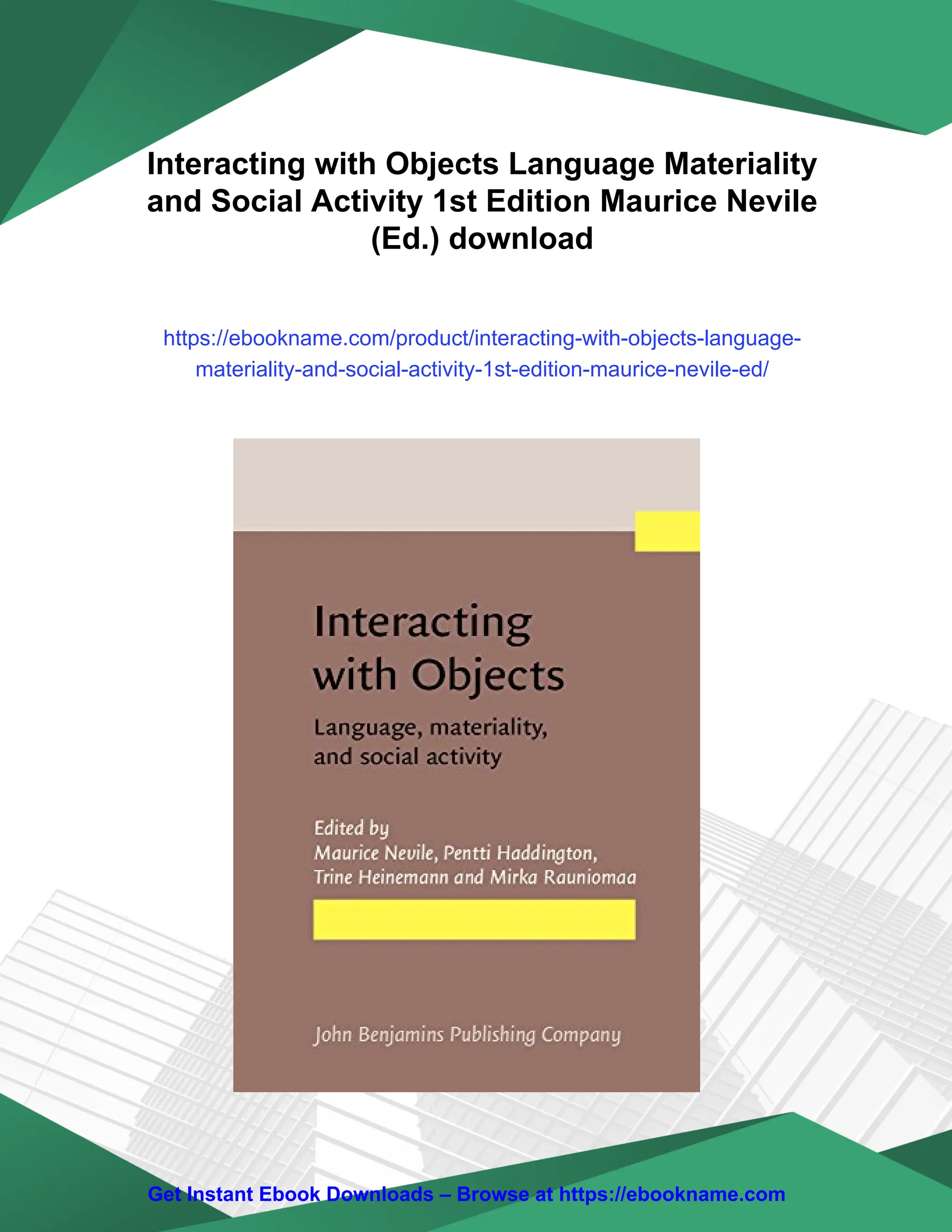
  • 1.
    Interacting with ObjectsLanguage Materiality and Social Activity 1st Edition Maurice Nevile (Ed.) download https://ebookname.com/product/interacting-with-objects-language- materiality-and-social-activity-1st-edition-maurice-nevile-ed/ Get Instant Ebook Downloads – Browse at https://ebookname.com
  • 2.
    Instant digital products(PDF, ePub, MOBI) available Download now and explore formats that suit you... Active Education Lessons for Integrating Physical Activity with Language Arts Math Science and Social Studies Lessons for Integrating Physical Activity with Language Arts Math Science and Social Studies 1st Edition Julian A. Reed https://ebookname.com/product/active-education-lessons-for- integrating-physical-activity-with-language-arts-math-science- and-social-studies-lessons-for-integrating-physical-activity- with-language-arts-math-science-and-social-studi/ Interacting with Geospatial Technologies 1st Edition Muki Haklay https://ebookname.com/product/interacting-with-geospatial- technologies-1st-edition-muki-haklay/ Language talent and brain activity 1st Edition Grzegorz Dogil https://ebookname.com/product/language-talent-and-brain- activity-1st-edition-grzegorz-dogil/ Communication Skills for Adult Nurses 1st Edition Abayomi Mcewen https://ebookname.com/product/communication-skills-for-adult- nurses-1st-edition-abayomi-mcewen/
  • 3.
    Suicidal Utopian Delusionsin the 21st Century 2nd Edition Michael Starks https://ebookname.com/product/suicidal-utopian-delusions-in- the-21st-century-2nd-edition-michael-starks/ Quantitative Geology of Late Jurassic Epicontinental Sediments in the Jura Mountains of Switzerland 1st Edition Reinhart A. Gygi (Auth.) https://ebookname.com/product/quantitative-geology-of-late- jurassic-epicontinental-sediments-in-the-jura-mountains-of- switzerland-1st-edition-reinhart-a-gygi-auth/ Physics Pharmacology and Physiology for Anaesthetists Key Concepts for the FRCA 1st Edition Matthew E. Cross https://ebookname.com/product/physics-pharmacology-and- physiology-for-anaesthetists-key-concepts-for-the-frca-1st- edition-matthew-e-cross/ Beyond Economic Growth 2nd Edition Tatyana Soubbotina https://ebookname.com/product/beyond-economic-growth-2nd-edition- tatyana-soubbotina/ Phenomenon Everything You Need to Know About The Paranormal 1ST Edition Sylvia Browne https://ebookname.com/product/phenomenon-everything-you-need-to- know-about-the-paranormal-1st-edition-sylvia-browne/
  • 4.
    Oxford American Handbookof Cardiology Oxford American Handbooks in Medicine 1st Edition Jeffrey Bender https://ebookname.com/product/oxford-american-handbook-of- cardiology-oxford-american-handbooks-in-medicine-1st-edition- jeffrey-bender/
  • 6.
  • 8.
    Interacting with Objects Language,materiality, and social activity Edited by Maurice Nevile University of Southern Denmark Pentti Haddington University of Oulu Trine Heinemann University of Southern Denmark Mirka Rauniomaa University of Oulu John Benjamins Publishing Company Amsterdam/Philadelphia
  • 9.
    Library of CongressCataloging-in-Publication Data Interacting with Objects : Language, materiality, and social activity / Edited by Maurice Nevile, Pentti Haddington, Trine Heinemann and Mirka Rauniomaa. p. cm. Includes bibliographical references and index. 1. Communication models. 2. Semiotics. 3. Gesture. 4. Nonverbal communication. 5. Social interaction. 6. Symbolic interactionism. I. Nevile, Maurice, editor. II. Haddington, Pentti, editor. III. Heinemann, Trine, editor. IV. Rauniomaa, Mirka, editor. P93.55.I48 2014 302.2--dc23 2014014850 isbn 978 90 272 1213 9 (Hb ; alk. paper) isbn 978 90 272 6983 6 (Eb) © 2014 – John Benjamins B.V. No part of this book may be reproduced in any form, by print, photoprint, microfilm, or any other means, without written permission from the publisher. John Benjamins Publishing Co. · P.O. Box 36224 · 1020 me Amsterdam · The Netherlands John Benjamins North America · P.O. Box 27519 · Philadelphia pa 19118-0519 · usa 8 TM The paper used in this publication meets the minimum requirements of the American National Standard for Information Sciences – Permanence of Paper for Printed Library Materials, ansi z39.48-1984.
  • 10.
    Table of contents Acknowledgementsvii introduction On the interactional ecology of objects 3 Maurice Nevile, Pentti Haddington, Trine Heinemann and Mirka Rauniomaa Part A. Objects as situated resources organising and sequencing The order of ordering: Objects, requests and embodied conduct in a public bar 31 Emma Richardson and Elizabeth Stokoe Initiating activity shifts through use of appraisal forms as material objects during performance appraisal interviews 57 Piia Mikkola and Esa Lehtinen “I’ll just see what you had before”: Making computer use relevant while patients present their problems 79 Søren Beck Nielsen participating and involving Objects as tools for talk 101 Dennis Day and Johannes Wagner Photo sharing as a joint activity between an aphasic speaker and others 125 Tarja Aaltonen, Ilkka Arminen and Sanna Raudaskoski Organising the soundscape: Participants’ orientation to impending sound when turning on auditory objects in interaction 145 Mirka Rauniomaa and Trine Heinemann Cultivating objects in interaction: Visual motifs as meaning making practices 169 Spencer Hazel
  • 11.
    vi Interacting withObjects Part B.╇ Objects as practical accomplishments shaping and creating Cooking instructions and the shaping of things in the kitchen 199 Lorenza Mondada To follow the materials: The detection, diagnosis and correction of mistakes in craft education 227 Anna Ekström and Oskar Lindwall Â� Having a ball: Immaterial objects in dance instruction 249 Leelo Keevallik experiencing and identifying 269 Â� Establishing joint orientation towards commercial objects in a self-service store: How practices of categorisation matter 271 Elwys De Stefani Artworks as touchable objects: Guiding perception in a museum tour for blind people 295 Yaël Kreplak and Chloé Mondémé Incidental and essential objects in interaction: Paper documents in journalistic work 319 Alexandra Weilenmann and Gustav Lymer Envisioning the plan in interaction: Configuring pipes during a plumbers’ meeting 339 Shinichiro Sakai, Ron Korenaga, Yoshifumi Mizukawa and Motoko Igarashi Instructed objects 357 Timothy Koschmann and Alan Zemel epilogue Trajectories of the object in interaction 381 Ben Matthews Person index 389 Subject index 391
  • 12.
    Acknowledgements We thank publisherJohn Benjamins for faith in this book project, and especially Esther Roth for assistance. We acknowledge the valuable collaboration of our edi- tor colleagues for the companion book Multiactivity in social interaction: Beyond multitasking, Tiina Keisanen and Lorenza Mondada, throughout the two books’ development. We were fortunate to have committed colleagues who ensured a rigorous peer review process, including contributors of the two books, as well as external colleagues. We thank two scholars for reviewing the full manuscript and making helpful suggestions. The support of institutions and organisations has been crucial along the way. We are grateful to the Helsinki Collegium for Advanced Studies for hosting a two- day workshop for contributors (May 2012). The workshop was made possible by the following funders: the TalkDrive project, conducted at the University of Oulu in 2009–2012 and funded by the Emil Aaltonen Foundation in Finland; and the ICAR research lab in Lyon (CNRS, University Lyon2 and ENS Lyon). We thank the organising committee of the 10th conference of the International Institute for Ethnomethodology and Conversation Analysis, held in Fribourg on 11–14 July 2011, for financial support in making the publication possible. For opportunities and funding at different stages of the process, Maurice Nevile thanks Pentti Haddington, Elise Kärkkäinen, and the University of Oulu, Finland, and also Jacob Buur, Johannes Wagner and the University of Southern Denmark. Pentti Haddington thanks the Emil Aaltonen Foundation for finan- cial support (TalkDrive project), and the University of Oulu, Finland, and the Helsinki Collegium for Advanced Studies for providing assistance, infrastructure and funding. Mirka Rauniomaa acknowledges the financial support of the Emil Aaltonen Foundation (TalkDrive project), the Academy of Finland (decision no. 251757) and the University of Oulu, Finland. Lastly, for their interest and understanding, we thank our colleagues, family and friends.
  • 14.
  • 16.
    On the interactionalecology of objects Maurice Nevile*, Pentti Haddington**, Trine Heinemann* and Mirka Rauniomaa** *University of Southern Denmark / **University of Oulu The empirical studies of this book examine how objects feature in the moment- to-moment conduct of social interaction and activity. The studies draw on natu- rally occurring data, video recordings of people interacting with one another as they engage with objects for a wide range of purposes, across many real-life settings, situations and occasions. Here in this introductory chapter we define ‘object’, and highlight how objects in the social world have been investigated across scholarly fields. We outline the dominant methodological and ana- lytic influences for this collection, ethnomethodology (EM) and conversation analysis (CA), and emphasise the significance of embodiment and materiality. We describe the broad arrangement of the chapters around two overarching themes, ‘Objects as situated resources’ and ‘Objects as practical accomplishments’. Lastly, looking across the chapters we identify a number of possible alternative points of convergence which emerge when objects in and for social interaction are themselves treated as the principal focus of analysis. Overview One way or another, objects feature in most moments and aspects of ordinary social life, and are an integral part of human interaction and of activity between humans and their environment.1 We experience, use, produce and shape objects all the time, at home, at work, at schools and at leisure, in numerous ways for dif- ferent kinds of actions and tasks. Consequently, a prevalent view across a range of disciplines is that objects should be examined and understood not simply through description of their physical features and functions, or through analysis of their symbolic significance, but as people employ them in particular socio-cultural 1. We thank Johannes Wagner for early discussions which informed some ideas and wordings for this chapter, Lorenza Mondada for advice on one significant matter, and two reviewers for guiding some later refinements.
  • 17.
    4 Maurice Nevile,Pentti Haddington, Trine Heinemann and Mirka Rauniomaa contexts. Even in an increasingly digitised world, we need objects, physical things, to conduct and accomplish ordinary practical and social activities: we depend on objects to act in the world, either as individuals or­as social members. For example, in the home and for leisure, objects might serve practical activities like cooking and cleaning, or enable shared experiences such as dining and listening to music. For work, objects allow us to undertake productive tasks and fulfil goals, with desired efficiency and effect, and often in collaboration with others. In education, objects support instruction and learning, development and cooperation. Objects also feature as we participate in the wider community as competent citizens. For example, a simple train trip can entail many object-related challenges, involving tickets, credit cards, technologies (vending machines, validation systems), maps, platforms, and trains themselves on a network of rail tracks, as tools within a sys- tem for affording mobility for populations. This book collects empirical studies that focus specifically on how objects feature in the moment-to-moment conduct of social interaction and activity. The studies draw on naturally occurring data, video recordings of people interacting with one another as they engage with objects for a wide range of purposes, across many real-life settings, situations and occasions. The chapters cover a range of very different kinds of object, including items of everyday life (e.g. vacuum cleaner, audio system, camera), technical and specialist equipment (e.g. for medicine, cooking, service and hospitality), materials and outcomes of creating and con- structing (e.g. for art, craft, building), written documents, retail and commercial products, as well as furniture and other structures in the surrounding scene, the human body itself and its specific properties, and even metaphorical objects which are understood and oriented to although they are not actually materially present. The chapters explore generally how objects are constitutive of and constituted through interactions. That is, they show how people interact with objects, and use objects to interact with others (objects as situated resources), or how people shape, design and orient to objects as emerging in and through social interaction (objects as practical accomplishments). The book brings together scholars with research experience in a wide range of fields, including anthropology, creative arts and crafts, design, education, gesture studies, linguistics, medicine and care, technol- ogy, transport, social psychology, and sociology. Through their detailed analyses of video-recorded data, the studies examine objects alongside talk, gesture and embodiment, and material and spatial circumstances, and so enable systematic accounts of objects as they figure in and for social action in real time. As we detail below, the dominant analytic influences are ethnomethodology (EM) and conver- sation analysis (CA) which allow for rigorous investigation of social interaction and activity as conducted and understood by the participants themselves, in situ, there and then.
  • 18.
    Interactional ecology ofobjects 5 The contributors to this book appreciate that there is a need to understand better and more precisely how objects feature for building meaningful and successful social interaction. Chapters focus on objects in their own terms as significant and consequential for the nature of social encounters and for how those encounters progress. The book therefore develops an emerging empha- sis in research on social interaction where language and embodied conduct are analysed relative to their material environments (for recent collections see e.g. Haddington, Keisanen, Nevile, 2012; Haddington, Mondada, Nevile, 2013b; McIlvenny, Broth, Haddington, 2009; Mondada Schmitt, 2010; Sidnell Stivers, 2005; Streeck, Goodwin, LeBaron, 2011). In this chapter we introduce the value of examining objects in this way, and indicate how a rich understanding of objects can emerge through the empirical chapters. We position the book first briefly relative to interest in objects across some different scholarly traditions, in general, and then, after a short overview of key developments in ethnomethodol- ogy and conversation analysis, relative to interests of research on language and social interaction, in particular. Objects in the social world By ‘objects’ we mean generally those elements of the physical world that we can experience sensorially, i.e. that we typically see, hear and touch. For example, we can handle and manipulate objects; move, arrange or place them; create, assemble or transform them; dismantle or destroy them; represent, recall or imagine them; and so on. As objects are located in space, we can orient and move our bodies according to their presence (e.g. around and over them), we can point to objects, and we can also refer to and talk about objects, identifying and making them rel- evant, recognisable and intelligible, perhaps from the surrounding environment or drawing on shared understanding and experience. Objects are familiar to us all, we know and categorise them generally in a range of ways. Objects can be tools, devices, technologies, appliances, equipment, instruments, goods, products, vehi- cles, furniture, toys, clothing, materials, jewellery, food, containers, utensils, weap- ons, decorations, gifts, and so on. Objects can be understood and treated variously as rare or common, natural or manufactured, as familiar or unfamiliar, as precious or disposable, as simple or complex, as private or public, as relatively permanent or as disposable, as beautiful or ugly, as useful or useless, as accessible or inacces- sible. The human body itself can also be understood or treated as an object. It is a physical entity that can be positioned relative to others or in surrounding space, and employed wholly or partially, for instance, to direct, protect or obstruct, or to be scrutinised (C. Goodwin, 2007; Heath, 1986; Koschmann, LeBaron, Goodwin,
  • 19.
    6 Maurice Nevile,Pentti Haddington, Trine Heinemann and Mirka Rauniomaa Zemel, Dunnington, 2007; Nishizaka, 2007), or it can be damaged and be sub- sequently mended or augmented (Egbert Deppermann, 2012). Objects are of course an interest, or even the principal focus, of many scholarly disciplines and fields of practice, which can study the nature and characteristics of objects, and more relevantly the significance of objects in society and for social life, perhaps in particular situations and settings, or periods of time. For exam- ple, for archaeology, anthropology, and history, objects can provide evidence for and support theories of socio-cultural and economic practices, beliefs, significant changes and events occurring over time, and the constitution, communication and organisation of populations (e.g. Appadurai, 1986; Hodder, 1991; D. Miller, 1987; P. Miller, 2013; Schiffer Miller, 1999). In more sociological strands of research, there is likewise an interest in objects’ role for forming and indicating social affili- ations and statuses, for example through ownership, use, circulation or disposal, or otherwise for the conduct of institutions and organisations (e.g. Bourdieu, 1979; Douglas Isherwood, 1996; Gregson Crewe, 2003; Lunt Livingstone, 1992; and see Engeström Blackler, 2005). There is also a large and growing interest among scholars from a range of backgrounds in objects and material culture, considering the meaning of objects for individuals and the impact of objects for the mind, as well as the role of objects for engaging in contemporary social life (e.g. Attfield, 2000; Dant, 1999, 2005; Leonardi, Nardi, Kallinikos, 2012; Malafouris Renfrew, 2010; Turkle, 2007). Research in psychology and education has concerned, for example, objects’ sig- nificance for how individuals perceive and experience the nature of the physical world, and their own place within it, or for how objects support thinking, learning, and collaboration (e.g. Cobb, 2002; Csikszentmihalyi Rochberg-Halton, 1981; Gibson, 1977, 1979; Hutchins, 1995a, 1995b; Schliemann, 2002; Stafford, 2009). In design and innovation, objects may be the outcome of processes of creative think- ing, cooperation, negotiation, and making, or might themselves be an integral part of facilitating and accomplishing such processes (e.g. Busch, 2005; Costall Dreier, 2006; Hallam Ingold, 2007; Levi-Strauss, 1962; Norman, 1988; Parsons, 2009; Verbeek, 2006). Within creative arts and crafts, objects may be understood and valued for their possible aesthetic or functional qualities, exhibited technical skill, for their expression, representation, and interpretation of ideas and emo- tions, or for responses and for the experiences they can engender (e.g. Keller Dixon Keller, 1996; Sennett, 2008). Furthermore, in studies dealing with science and technology, objects can be seen as social actors, as entities that can be active within and influence larger social networks or systems of meaning and practice (e.g. Latour, 1987, 2005; Suchman, Trigg, Blomberg, 2002).
  • 20.
    Interactional ecology ofobjects 7 Objects have also received attention in philosophy and related disciplines, where the nature and characteristics of objects figure in reflections on, for example, experience, existence, materiality, reality, signification, representation, perception, mind, cognition, consciousness, and kinds of entities (e.g. Koslicki, 2008; Laycock, 2006; Merricks, 2001; K. Miller, 2008; Quine, 1960; Thomasson, 2007; Velmans, 2009; Wetzel, 2009). In studies of language, objects occur in discussions of ref- erential descriptions in logic, typically drawing on writing or isolated and con- structed examples (e.g. Frege, 1893/1952; Halliday, 1985; Kaplan, 1989). However, it has also been noted that in processes of activity and interaction, participants create and negotiate a variety of reference forms in the moment to establish shared understanding of what is happening and what to do next (Hanks, 1990). Generally then, in the social sciences and humanities, approaches to objects across disciplines have involved theorising or documenting the materiality and practices of object use and consumption (e.g. objects as commodities). Or, they provide abstract or large-scale accounts and notions of socio-cultural changes and trends in people’s experiences of objects, perhaps of the past or emerging in the present and for the future, including the role, influence and impact of objects for individuals or groups (e.g. objects as devices or tools). They might be concerned with wider issues of people’s relations and attitudes to objects, the meaning and significance of objects, the symbolic or other value of objects (e.g. aesthetics of objects), or can seek to develop typologies of the ways objects appear and figure in human experience. Such research draws on various forms of data and a range of analytic methods, including surveys or interviews, recollections or reflections, ethnographic observations, document analyses, statistical analyses, or experiments. Our interest and approach in this collection is therefore quite different. Studies here explore how objects reveal something of how participants, in situ and in the moment, act socially and meaningfully, to construct and interpret both their prac- tical activities and also objects themselves. Through talk and interaction, objects can, for example, be noticed, appreciated, assessed, imagined, created and made sense of, or can be given and received, shared or distributed, shown and demon- strated, described and explained, or disputed. In work and institutional settings, objects can also serve as tools and technologies of various kinds as participants collaborate to organise and perform tasks. Indeed, just what counts as an ‘object’, and is treated as an object, is something that participants determine together as they interact with one another.
  • 21.
    8 Maurice Nevile,Pentti Haddington, Trine Heinemann and Mirka Rauniomaa Researching social interaction: Ethnomethodology and conversation analysis The studies in this book are informed by the analytic thinking and methodologi- cal principles of ethnomethodology and conversation analysis. In this section, we briefly outline the background and development of these approaches, connect- ing to the specific theme of the book, objects in social interaction. First, we dis- cuss early developments in social sciences that led researchers to understand the importance of studying the order of everyday social interaction, and to recognise the central role that conversation has in creating and maintaining that order. We then move on to show how these developments have prompted researchers of social interaction to explore and better understand the role of embodiment, mate- rialilty, and multimodality. Observable conduct and displayed understandings The studies of this collection show that objects have certain social potential, in interaction, which is worth examining systematically: objects have properties which are qualitatively different but importantly connect to language and bodily conduct (e.g. gaze, gesture, posture). The studies explore such differences and con- nections by focusing on how participants use, create, and understand objects, their features and possible materiality. An object can be drawn on to build action and understanding, or to accomplish a joint understanding of exactly what the object is and how it is relevant and significant for the participants engaged in joint activi- ties. We see how objects are employed, oriented to, shaped, created or manipulated across a range of interactional contexts and languages. In this, the studies here share their inspiration with one or more of three historically and theoretically linked approaches to social interaction: Erving Goffman’s thinking on ‘interaction order’ (e.g. Goffman, 1963, 1971), Harold Garfinkel’s ethnomethodology (e.g. 1967 [1984], 2002; and see Francis Hester, 2004; Heritage, 1984) and conversation analysis (e.g. ten Have, 2007; Pomerantz Fehr, 1997; Schegloff, 2007; Sidnell, 2011; Sidnell Stivers, 2013). Goffman can be credited with promoting the idea that social order is enacted and established in the face-to-face domain of every- day life, and so that this is a worthy and viable domain to study sense-making practices and social organisation without making or relying on guesses or claims about the content of the individual’s mind, or intentions. Garfinkel’s contempo- rary ethnomethodology similarly proposed that everyday interaction constituted a legitimate domain of (sociological) study, but with the focus being on members’ common-sense knowledge and methods, i.e. how participants in interaction make
  • 22.
    Interactional ecology ofobjects 9 sense of and create order in their everyday lives. The thinking of both Goffman and Garfinkel were major influences on conversation analysis, which developed in the late 1960s. The birth of conversation analysis is associated with the work and thinking of Harvey Sacks (Sacks, 1992), who had worked with both Goffman and Garfinkel. Sacks and his collaborators, Gail Jefferson and Emanuel Schegloff, although obviously inspired by both Goffman and Garfinkel, were ultimately interested in revealing the ‘machinery’ of interaction (Sacks, 1992, vol. 2, p. 169), i.e. the structure and organisation of naturally occurring interaction, and how interaction contributes to the construction of social order. The analytic focus of ethnomethodological conversation analysis (EMCA) is therefore on social action, the observable verbal and embodied conduct and understanding of social participants, in physical contexts. EMCA investigates and describes social action from an emic (Pike, 1967) perspective, which means that analysis is driven by demonstrable evidence of the participants’ own view – their creation, treatment and understanding – of the events and actions as they occur. Furthermore, EMCA considers social action in terms of emergence and sequen- tiality, i.e. how social actions are locally situated and produced. In this sense, any action can be seen to be shaped or projected by events or actions that preceded it, while simultaneously shaping, projecting, and making relevant what may follow. Through an emic approach and attention to sequentiality, EMCA offers an analytic viewpoint to social action that is based on an “architecture of intersubjectivity’’ (Heritage, 1984, p.254; Schegloff, 1992): participants display their understanding of a prior action in the next action, thus offering a ‘‘proof procedure’’ (Sacks, Schegloff, Jefferson, 1974, p. 728) for the analysis. In other words, analyses rely on how the participants themselves, through their moment-to-moment verbal and embodied conduct, display to one another their understanding of what they are doing, and of what is going on. Any verbal utterance or embodied conduct, or a combination of these, may be understood in different ways, depending on how it is formatted and designed (i.e. its constituent parts, and their arrangement) and when – in what sequential context – it is produced (see Schegloff, 2007, p. 2; Schegloff Sacks, 1973). In short, EMCA focuses on how participants understand each contribution to interaction as it is produced in situ. So a fundamental guiding question for ana- lysts and participants alike is ‘why that now?’ (Schegloff Sacks, 1973). To summarise, ethnomethodological conversation analysis provides insights and tools for a qualitative, deductive and empirical analysis of interaction – and so can examine the way objects feature in and for interaction. Methodologically, the studies here are distinguished by their emphasis on video recordings made in/of real-life, naturally occurring situations (for broad discussions of issues and methods, see e.g. Haddington et al., 2013b; Heath, Hindmarsh, Luff, 2010;
  • 23.
    10 Maurice Nevile,Pentti Haddington, Trine Heinemann and Mirka Rauniomaa Knoblauch, 2012). In addition to video recordings, analyses are supported with detailed transcriptions (written and other forms of representation) that include not only what people say and do but also how and when they do so, including details of ‘troubles’, such as mistakes, hitches, hesitations, absences, and overlaps (moments of simultaneous talk by different participants), and their related ‘repairs’ (see Schegloff, 1979). Such rigorous and precise analytic attention is important because EMCA research has shown that these kinds of details can be consequen- tial for participants’ conduct in social interaction – we know that participants themselves attend to them. Embodiment and materiality: Resources for interaction In this book, the interest in objects in particular arises from a now rapidly grow- ing recognition of the significance and value of embodiment and materiality as features of naturally occurring social interaction, and/or of actions and practices of particular settings and situations (for an overview see Haddington, Mondada, Nevile, 2013a, pp. 12–16). Indeed, Nevile (2013b, in prep.) suggests there has been an ‘embodied turn’ in the direction and development of EMCA research (and see Nevile, 2014), part of a wider ‘corporeal turn’ across the humanities and social sciences (Sheets-Johnstone, 2009; Tambornino, 2002). Conversation analysis espe- cially, as a discipline, has sometimes been associated with the analysis of talk only, and so the interest in other resources employed by participants, such as embodied conduct or multimodality, is noted as evidence of “an increasing awareness of the relevance of the full array of visible and audible resources to social interaction” (Deppermann, 2013b, p. 2; and see earlier Sidnell Stivers, 2005). Early EMCA literature did to some extent focus primarily on language practices, and it seems that this focus was a result of the just-emerging status of video recording technol- ogy at the time, rather than a pre-determined methodological decision to priori- tise language. That early work did not refrain from recognising the relevance of the material surround for the analysis (see C. Goodwin, 1981; Sacks Schegloff, 2002). Goffman’s (1963) notion of ‘focused encounters’, for instance, was largely defined through co-presence, which in fact seems to exclude interactions only con- ducted through language, such as telephone conversations (C. Goodwin, 1981). Additionally, Pomerantz’s (1984) work on preference organisation in assessment pairs readily recognised that visible and even tacit access to the same environment was relevant for how assessments were formatted. Other specifically non-verbal features of social action, for example gaze, were also investigated in related work at least as early as the 1960s and 1970s (e.g. Argyle Cook, 1976; Kendon, 1967; see detailed discussion in Leeds-Hurwitz, 1987).
  • 24.
    Interactional ecology ofobjects 11 In the late 1970s, Charles and Marjorie Goodwin, working exclusively with video recordings, began their highly influential work attesting the various semiotic resources that participants employ in ordinary social interaction (C. Goodwin, 1979, 1981; Goodwin Goodwin, 1986), and later also in institutional and work settings, which are often rich in technologies (C. Goodwin, 1994, 1995, 1996; M.H. Goodwin, 1995; Goodwin Goodwin, 1996, 1997). Other key influences included studies of doctor-patient interaction (Heath, 1986; Psathas, 1990), and Schegloff’s (1998) analyses of a postural positioning he termed ‘body torque’. Apart from numerous individual papers and chapters over the past 15 years or so, grow- ing interest in embodiment and materiality is evident also within book-length studies of single settings or kinds of interaction (e.g. Filipi, 2009; Heath, 2013; Heath Luff, 2000; Nevile, 2004a; Rendle-Short, 2006), and in recent collections of interaction studies, either with a general scope (Deppermann, 2013a; Stivers Sidnell, 2005; Streeck et al., 2011), or for a more specific setting or focus, e.g. on space and place (Hausendorf, Mondada, Schmitt, 2012; McIlvenny et al., 2009), cars (Haddington et al., 2012), mobility (Haddington et al., 2013b), or multiactiv- ity (Haddington, Keisanen, Mondada, Nevile, 2014). Interests and analyses are also often informed by insights from gesture research (e.g. Kendon, 1990, 2004; Streeck, 2009, 2013), and converge with some of the assumptions of the pioneers in gesture studies, who argued that gesture and talk are not separate ‘modules’ for communication but originate from the very same linguistic, cognitive and social mechanisms (McNeill, 1981). The present collection, then, can be seen as a natural continuation of interest in human social action as an amalgam of talk, bodily conduct and other forms of material and spatial involvement. Studies that are informed by Garfinkel’s and Goffman’s work, and rely on ethnomethodology and conversation analysis, have developed an understanding of the multimodality of social action in various eve- ryday and work-life contexts. They have shown that it is necessary to consider the broader physical context in order to investigate how participants engage in and make sense of their everyday lives. This collection centres precisely on how people interact with objects, use objects to interact with others, or shape, design and ori- ent to objects in and through social interaction. In the following section we reflect on relevant previous and more recent ethnomethodological and conversation- analytic research that has contributed to the understanding of how objects and materiality feature in social interaction.
  • 25.
    12 Maurice Nevile,Pentti Haddington, Trine Heinemann and Mirka Rauniomaa Early contributions to the study of materiality and social interaction Within the recognition for empirical research of the role of embodied and material aspects of interaction, objects’ particular significance has begun to be recognised, but less often have interaction studies treated objects as their specific focus. As early examples, Lynch, Livingston, Garfinkel (1983) and Lynch (1985) analysed the arrangement of objects as a resource for organising and conducting laboratory work (cf. Garfinkel, Lynch, Livingston, 1981), while others examined the role of objects in the activities of particular groups and professional communities, espe- cially for seeing and demonstrating to accomplish collaboration or joint under- standing (C. Goodwin, 1994, 1995; Goodwin Goodwin, 1997; Ochs, Gonzales, Jacoby, 1996; Psathas, 1992; Streeck, 1996). Notable also were Suchman’s (1987; and see 2007) landmark research on individuals’ situated use of technology, and Psathas’ (1979; 1986; 1991) concern for maps and direction-giving in interaction. C. Goodwin (1984, also 1981) considered objects within ordinary conversations, for example how the casual telling of a story during a meal between family and friends involves precise coordination of talk with handling and distributing food- related objects. Following this earlier research, studies have begun to reveal how objects, as an important part of people’s ordinary lives, can be tied to and constituent of the situated, embodied, material and spatial circumstances of social interaction, either in everyday domestic situations or in institutional and work settings. There is an emerging sense of how participants use or recruit objects, orient or refer to objects, create, manipulate and make sense of objects, and so on: – to support thinking, perception and learning, to facilitate views and interpreta- tions of the world (e.g. C. Goodwin, 1994; Heath, 2006; Hindmarsh Heath, 2000; Kääntä Piirainen-Marsh, 2013; Koschmann, Dunnington, Kim, 2012; Macbeth, 1994; Nishizaka, 2006, 2011); – to build collaborative action and understanding, or demonstrate and claim knowledge (e.g. Brassac, Fixmer, Mondada, Vinck, 2008; Fasulo Monzoni, 2009; Ford, 1999; C. Goodwin, 2003; Laurier Brown, 2011; Mondada, 2007, 2012c; Nevile, 2004b, 2009, 2013a); – to affect orientation or change within the surrounding environment (e.g. Arnold, 2012; C. Goodwin, 2000; Koschmann, LeBaron, Goodwin, Feltovich, 2006; Laurier Brown, 2008; Mondada, 2012a); – to initiate and organise events and courses of action (e.g. Donovan, Heinemann, Matthews, Buur, 2011; Haddington Rauniomaa, 2011; Heath, 2013; Heath Luff, 2013; Keisanen Rauniomaa, 2012; Kidwell Zimmerman, 2007; Mondada, 2012b; Svinhufvud Vehviläinen, 2013; Wootton, 1994);
  • 26.
    Interactional ecology ofobjects 13 – to monitor changing circumstances and attend to the progress of activities (e.g. Broth, 2008, 2009; Heath Hindmarsh, 2000; Heath Luff, 2000; Koschmann et al., 2006; Nevile, 2004a); – to realise or facilitate particular forms of participation and involvement (e.g. Evaldsson, 2004; Glenn LeBaron, 2011; Goodwin Goodwin, 2012; Landgrebe Heinemann, in press; Luff Heath, 2002; Nevile Haddington, 2010; Noy, 2012; Rae, 2001); – to create and represent, for processes of design and innovation (e.g. Alby Zucchermaglio, 2007; Nielsen, 2012; Heinemann, Mitchell, Buur, 2009; Luck, 2010; Murphy, 2012; Phillabaum, 2005); – to be mobile and experience mobile views of the world (e.g. Haddington et al., 2012; Haddington et al., 2013b; Nevile, 2004a); and – to experience, attend to and act upon the human body (e.g. Hindmarsh et al., 2011; Koschmann et al., 2007; Koschmann, LeBaron, Goodwin, Feltovich, 2011; Mondada, 2003; Nishizaka, 2007). Importantly however, most of this research has considered objects as just one among many resources or aspects for interaction, and only rarely are objects themselves, and their specific features and contributions, the primary focus (some exceptions are Brassac et al., 2008; Eriksson, 2009; C. Goodwin, 2010; Heath Hindmarsh, 2000; Heinemann et al., 2009; Hindmarsh Heath, 2003; Koschmann et al., 2012; Nishizaka, 2006; Pitsch, 2012; Streeck, 1996; Zinken Ogiermann, 2013). Contributions of this book: A focus on objects Building on this emerging sense of the significance of objects in and for social interaction, the chapters in this book all take their point of departure in one or more objects, to demonstrate how these objects manifest as participants’ resources situated within and for actions and activities, or are themselves accomplished through and by participants’ practical actions and activities. The chapters cover very different objects, such as paper, technologies, art, edibles, materials and uten- sils, the human body, and even immaterial and abstract objects. We see the differ- ent ways in which objects are experienced, created or made sense of, for instance through manipulating, pointing, seeing, hearing, and referencing. Lastly, the chap- ters show objects in interaction across a range of contexts, for example at the doc- tor’s office or in the surgical theatre, at an exhibition, in the workplace or home, in education and training, in the car, and at the pub. Common to all the chapters
  • 27.
    14 Maurice Nevile,Pentti Haddington, Trine Heinemann and Mirka Rauniomaa is that it is the objects themselves, and their specific contribution to interaction, that are the primary foci of analysis. The book presents 15 empirical chapters, which are arranged broadly around two overarching themes: (A) Objects as situated resources; and (B) Objects as practical accomplishments. The chapters in Part A are organised under the sec- tions ‘Organising and sequencing’ and ‘Participating and involving’. These chapters focus on how, by handling, indexing or orienting to physically available objects, participants can manage interactional demands and relevancies, such as shifts in activity, sequence organisation, turn-taking, and the nature and form of partici- pation. For example, these chapters highlight how objects’ availability, and the access to and control of objects, can influence the ability to participate, or how participants negotiate and coordinate their use of or orientation to objects. The chapters in Part B are organised under the sections ‘Shaping and creating’ and ‘Experiencing and identifying’. These chapters focus on how objects are formed, constituted and potentially altered through interaction, as participants forge rep- resentations, interpretations and abstractions of objects as identifiably this or that. For example, these chapters particularly highlight how participants handle and shape objects to create shared realisations of what objects are, or can or should be, and so how they might be perceived, understood, and treated. Beyond this main distinction, looking across all the chapters we can identify a number of possible alternative points of convergence, when objects in and for social interaction are themselves treated as the principal focus of analysis: Objects for instructing: Objects are created, manipulated, shaped and interpreted within and for instructional activities. For example: how does the articulation of instructions from a professional chef relate to the eventual transformation of edible ingredients into a dish during a cooking class (Mondada)?; how do dance teachers manipulate immaterial objects into being to accomplish the pedagogical task of conveying dance formations to a class of students (Keevallik)?; how does an interview form contribute to discussions about subordinates’ performance and future development at the workplace (Mikkola Lehtinen)?; how is a feature of the body recognised and acted upon for surgery (Koschmann Zemel)? Objects for knowing: Objects are oriented to, labelled, described and handled to man- ifest knowing and knowledge. For example: how is practised and technical expert knowledge, relative to novice trainees, realised in situ in diagnostic and corrective abilities, for instance for the human body (Koschmann Zemel) or craft materials (Ekström Lindwall)?; how does conversation featured around personal pictures allow an aphasic man greater opportunities for participation (Aaltonen, Arminen, Raudaskoski)?; how does the distributed knowledge of a plumber working in
  • 28.
    Interactional ecology ofobjects 15 the field come into play for handling and manipulating blueprints and sketches at a plumbing meeting (Sakai, Korenaga, Mizukawa, Igarashi)? Objects for order: Objects are used to manage interactional order and organisa- tion. For example: how does an interview form allow for negotiating activity shifts in performance appraisal interviews (Mikkola Lehtinen)?; what role does the possession of arbitrary objects such as Styrofoam forms and pieces of wood play for the organisation of turn-taking in design workshops (Day Wagner)?; how do a doctor’s shift of attention from patient to desk-top computer, or a driver’s turning on the car radio, or a bartender’s logging of a customer’s order into the sales till, influence the overall sequence organisation of an activity (Beck Nielsen; Rauniomaa Heinemann; Richardson Stokoe)? Objects for time and occasion: Objects become salient and significant at and for par- ticular moments and occasions within temporally emerging courses of activity, and to project new activity. For example: how do participants in a university advice meet- ing refer to objects over time to re-occasion their mention at subsequent points (Hazel)?; how do designers and product stakeholders coordinate and time their talk about an object to effect its exchange between parties, such that reaching for an object may be understood as a claim to talk (Day Wagner)? Objects as meaningful: Objects are employed as meaningful (semiotic) resources, to augment communication, and to afford participation and action. For exam- ple: how can a digital camera serve as a resource for a man with aphasia, allow- ing him to participate in interaction and initiate actions (Aaltonen, Arminen Raudaskoski)?; how do participants draw on material objects such as documents and table-top surfaces to create leitmotifs to serve as referential resources for sub- sequent talk (Hazel)?; how do the material properties of artworks allow both see- ing and blind people to appreciate their aesthetics (Kreplak Mondémé)? Objects as relevant: Objects are made relevant through participants’ pointing, refer- encing, naming and touching. For example: how, and where, do bartenders in a pub recruit and index objects such as the sales till and tables (Richardson Stokoe)?; which items on a supermarket shelf do shoppers orient to, and in what ways (De Stefani)?; how do objects such as post-it notes, press-releases and other journalis- tic documents become resources for designing and understanding action, either as incidental or essential objects (Weilenmann Lymer)? Objects as invoked: Objects are invoked within practices, procedures and entitle- ments of collaborative work and action. For example: how is the coordination of disparate work in a plumbing company accomplished and made accountable
  • 29.
    16 Maurice Nevile,Pentti Haddington, Trine Heinemann and Mirka Rauniomaa through sketches and blueprints that can be talked about and altered (Sakai, Korenaga, Mizukawa Igarashi)?; how are different aspects of journalistic work accomplished through pointing, moving, visibly looking at and showing paper documents (Weilenmann Lymer)?; what effects does physical access have on participants’ roles and responsibilities at the doctor’s office, where the patient can maybe view the computer screen but cannot operate the keyboard (Beck Nielsen)?; how is an immaterial object realised and understood, to offer demonstration and guidance to others (Keevallik)? Objects as constituted: Objects, their features and affordances, are oriented to and locally constituted for the purposes at hand. For example: how is the aesthetic expe- rience of art constituted for blind people in a museum (Kreplak Mondémé)?; how does an object’s potential for producing sound affect the overall organisation of interaction (Rauniomaa Heinemann)?; how do students in craft education detect mistakes in their felt-making, crocheting and machine knitting, through their inspection and manipulation of materials (Ekström Lindwall)?; how is the irreversibility of ingredients’ transformation recognised and acted upon by novices in a cooking class (Mondada)? Objects as negotiated: An object’s significance and value for action is negotiated in and through interaction. For example: how is a clinical diagnosis accomplished or discovered, through participants’ sense-making procedures and informed by the object under scrutiny (Koschmann Zemel)?; how do shoppers in a supermarket negotiate whether or not an object on a shelf is purchasable (De Stefani)? The chapters in this book advance knowledge specifically of the role and signifi- cance of objects in and for social interaction. They explore and clarify the many ways in which participants use objects in interaction, what kinds of roles and func- tions objects have in interaction, how the participants negotiate access to objects and how this influences participation and serves to organise interaction, and how objects may be constituted through interaction and through participants’ joint sense-making practices, such as naming, referencing, shaping or manipulating. In sum, the studies in this book show how objects play an important role in the moment as we interact with one another in our everyday lives.
  • 30.
    Exploring the Varietyof Random Documents with Different Content
  • 31.
    deferret.—Gregor. Turon. ExVitis Patrum, vol. ii. p. 449.: see also same page, note 3. W. B. MacCabe. Allow me to inform Lord Braybrooke that the custom of throwing a shoe, taken from the left foot, after persons for good luck, has been practised in Norfolk from time immemorial, not only at weddings, but on all occasions where good luck is required. Some forty years ago a cattle dealer desired his wife to trull her left shoe arter him, when he started for Norwich to buy a lottery-ticket. As he drove off on his errand, he looked round to see if she performed the charm, and consequently he received the shoe in his face, with such force as to black his eyes. He went and bought his ticket, which turned up a prize of 600l.; and his son has assured me that his father always attributed his luck to the extra dose of shoe which he got. E. G. R. The custom of throwing an old shoe after a person departing from home, as a mode of wishing him good luck and prosperity in his undertaking, is not confined to Scotland and the northern counties, nor to weddings. It prevails more or less, I believe, throughout the kingdom. I have seen it in Cheshire, and frequently in towns upon the sea-coast. I once received one upon my shoulder, at Swansea, which was intended for a young sailor leaving his home to embark upon a trading voyage. Edw. Hawkins. OWEN GLYNDWR [OWEN AP GRIFFITH VYCHAN, LORD OF GLYNDWRDWY]. (Vol. vii., p. 205.) The arms referred to by Mr. Woodward are those on the great seal and privy seal of the irregular and wild Glendower, as Prince of
  • 32.
    Wales, attached totwo documents deposited in the Hotel Soubise, at Paris, in the Cartons I. 623. and I. 392., relating, it is supposed, to the furnishing of troops to the Welsh prince by Charles VI., king of France. Casts of these seals were taken by the indefatigable Mr. Doubleday, to whom the Seal department of the British Museum, over which he presides, is so much indebted; and impressions were exhibited by Sir Henry Ellis at a meeting of the Society of Antiquaries, on the 12th of December, 1833. Engravings of them, accompanied by the following notice, were communicated by Sir Henry to the Archæologia, and will be found in that publication, vol. xxv. plate lxx. fig. 2, 3. page 616., and ibid. pp. 619, 620.: The great seal has an obverse and reverse. On the obverse Owen is represented, with a bifid beard, very similar to Rich. II., seated under a canopy of Gothic tracery: the half body of a wolf forming the arms of his chair on each side: the background is ornamented with a mantle semée of lions, held up by angels. At his feet are two lions. A sceptre is in his right hand, but he has no crown. The inscription: 'Owenus ... Princeps Wallie.' On the reverse of the great seal Owen is represented on horseback, in armour; in his right hand, which is extended, he holds a sword, and with his left his shield, charged with, Quarterly, four lions rampant; a drapery, probably a kerchief de plesaunce, or handkerchief won at a tournament, pendant from his right wrist. Lions rampant also appear upon the mantle of the horse. On his helmet, as well as on his horse's head, is the Welsh dragon [passant]. The area of the seal is diapered with roses. The inscription on this side seems to fill the gap upon the obverse 'Owenus Dei gratia ... Wallie.' The privy seal represents the four lions rampant towards the spectator's left, on a shield, surmounted by an open coronet [crown]: the dragon[3] of Wales, as a supporter, on the dexter side; on the sinister, a lion. The inscription seems to have been 'Sigillum Oweni Principis Wallie.' No impression of this seal is probably now to be found either in Wales or England. Its
  • 33.
    workmanship shows thatOwen Glyndwr possessed a taste for art beyond the types of the seals of his predecessors. The dragon is a favourite figure with Cambrian bards; and, not to multiply instances, the following lines may be cited from the poem of the Hirlas Horn, by Owen Cyfeilioc, Prince of Powys Wenwynwyn,— Mathraval's[4] Lord, the Poet and the Prince, father of Gwenwynwyn, Prince of Powys Wenwynwyn (the Gwenwen of Sir Walter Scott's Betrothed):— A dytwc i Rufut waywrutelyn Gwin a gwydyr goleu yn ei gylchyn Dragon Arwystli arwystyl tervyn Dragon Owein hael o hil Kynvyn[5] Dragon iw dechren ac niw dychryn cat Cyvlavan argrat cymyw erlyn. Myvyrian Archaiology of Wales: London, 1801, 8vo., vol. i. p. 265. And bear to Grufydd, the crimson-lanced foe, Wine with pellucid glass around it; The Dragon of Arwstli, safeguard of the borders, The Dragon of Owen, the generous of the race of Cynvyn, A Dragon from his beginning, and never scared by a conflict Of triumphant slaughter, or afflicting chase. Gray, whose Bard indicates the inspiration with which he had seized the poetry and traditions of the Cymri, thus refers to the red dragon as the cognizance of the Welsh monarchs, in his Triumphs of Owen [ap Griffith, Prince of North Wales]: Dauntless, on his native sands, The Dragon, son of Mona, stands; In glittering arms and glory dress'd
  • 34.
    High he rearshis ruby crest. The dragon and lion have been attributed to the Welsh monarchs, as insignia, from an early period, and the former is ascribed, traditionally, to the great Cadwallader. In the Archæologia, vol. xx. p. 579. plate xxix. p. 578., are descriptions of engravings of the impressions of two seals appendant to charters of Edward, son of Edward IV., and Arthur, son of Henry VII., as Princes of Wales, the obverse of each bearing three lions in pale passant, reguardant, having their tails between their legs, reflected upon their backs, upon a shield surmounted by a cap of maintenance: Prince Edward's shield has on each side a lion as a supporter, holding single feathers, with the motto Ich dien. On Prince Arthur's seal, the feathers are supported by dragons. Thomas William King, Rouge Dragon, in a letter to Sir Samuel Meyrick, dated 4th September, 1841, published in the Archæologia, vol. xxix. p. 408., Appendix, regards the lions on these shields as to the ensigns attributed at the period of the seals to certain Welsh princes, and the dragon as the badge of Cadwallader. In a MS. (for reference to which I am indebted to the courtesy of Sir Frederick Madden), which was recently sold at Sotheby's, containing translations by Johannes Boerius, presented to Henry, Prince of Wales, son of Henry VII., about 1505, there is a beautiful illumination containing the arms of that prince: Quarterly France and England, with the red dragon as the dexter, and the greyhound of the House of York as the sinister, supporter. The red fierye dragō beeten upō white and greene sarcenet was the charge of a standard offered by Henry VII. at St. Paul's, on his entry into London after his victory at Bosworth Field; and this standard was represented on the corner of his tomb, held by an angel (Willement's Regal Heraldry, 4to., London, 1821, p. 57.). The red dragon rampant was assumed as a supporter by Henry VII. in indication of his Welsh descent, and was borne as a supporter,
  • 35.
    either on thedexter or sinister side of the shield, by all the other English monarchs of the House of Tudor, with the exception of Queen Mary, who substituted for it an eagle: and among the badges attributed to our present sovereign is, in respect of Wales, a dragon passant, wings elevated gu., upon a mount vert. It may be assumed, with little doubt, that the colour of the dragon borne by Owen Glyndwr was rouge; and although the colour of the other supporter of his shield, the lion, is not susceptible of such positive inference, it may be conjectured to have been sable, the colour of the lion, the principal charge on his hereditary shield. To Mr. Woodward's immediate Query as to the blazon—colour of the field and charges—of the arms on these seals, I can afford no direct answer, never having met with any trace of these arms in the extensive collections of Welsh MSS. to which I have had access. These ensigns may have been adopted by Owen as arms of dominion (as those of Ireland by the English sovereigns) on his assumption of the principality of Wales, a suggestion countenanced, if not established, by four lions quarterly (Quarterly gules and or, four lions rampant, counterchanged) being assigned to Griffith ap Llewelyn (killed April, 28 Hen. III., 1244, in attempting to escape from the Tower), eldest son of Llewelyn ap Iorwerth, prince of Wales (dead 31st November, 25 Hen. III., 1240), father of the ill-fated and gallant Llewelyn ap Griffith, last sovereign of Wales, slain at Builth, December 10, 8 Ed. I., 1282. Further confirmation is, perhaps, afforded to this suggestion by Owen having, it is understood, vindicated his assumption of the Cambrian throne as heir of the three sovereign dynasties of North Wales, South Wales, and Powys respectively,—of the last, as male representative, through the Lords of Bromfield, of Madoc ap Meredith, the last monarch of that principality; and of the two former as their heir-general, in respect of his mother, Elenor, sister of Owen (ap Thomas ap Llewelyn), Lord, with his paternal uncle, Owen ap Llewelyn ap Owen, of the comot [hundred] of Iscoed, September 20, 1344, Representative paternally
  • 36.
    of the sovereignsof South Wales, and, by female descent, of those of North Wales[6], through Griffith ap Llewelyn above named. The hereditary arms of Owen's paternal line, the Lords of Glyndwrdwy, are those of his ancestor, Griffith Maelor ap Madoc, of Dinas Bran, Lord of Bromfield, Yale, Chirk, Glyndwrdwy, c., who died A.D. 1191, viz. Paly of eight argent and gules, over all a lion rampant sable, thus differenced, apparently, from The Black Lion of Powys (Argent a lion rampant sable), the royal ensigns of his father, Madoc ap Meredith, last sovereign Prince of Powys, who died at Winchester in 1160. I am unable to refer to any seal of the Lords of Glyndwrdwy, or of the Lords of Bromfield, bearing the family arms of their line; but they are thus given invariably by the Cambrian heralds, and, so far, are susceptible of proof by the most authentic MS. authorities of the Principality. It is, however, remarkable, that the Heraldic Visitations of Wales of Lewis Dwnn, appointed in 1580 Deputy-Herald for all Wales, by Robert Cook Clarenceux, and William Flower Norroy King-at Arms, published in 1846 by the Welsh MSS. Society, contain no pedigree of the house of Glyndwrdwy. Of the descendants, if any, of Owen Glyndwr himself, beyond his children, I am not aware that there is any authentic pedigree, or other satisfactory proof; and there seems to be presumptive evidence that in 12 Henry VI., 1433—a period so recent as nineteen years from the last date, 19th February, 1 Henry V., 1414, on which Owen is ascertained to have been alive (Rymer's Fœdera, ix. p. 330.),—his issue was limited to a daughter and heir, Alice, wife of Sir John Scudamore, Knt., described in a petition of John, Earl of Somerset, to whom Owen's domains, on his attainder, had been granted by his brother, Henry IV., as Un John Skydmore, Chivaler, et Alice sa femme, pretendantz la dite Alice etre file et heir au dit Owyn (Glyndwr).—Rot. Parl. 12 Hen. VI. I have not found evidence to show that there were any children of Alice's marriage with Scudamore; and, assuming the failure of her
  • 37.
    issue, and alsothe extinction of Owen's other offspring, the representation of the three dynasties— . . . . . . . the long line Of our old royalty— reverted to that of his only brother, Tudor ap Griffith Vychan, a witness, as Tudor de Glyndore, in the Scrope and Grosvenor controversy, 3rd September, 1386, and then twenty-four years and upwards, who is stated to have been killed under Owen's banner at the battle of Mynydd Pwll-Melyn, near Grosmont, Monmouthshire, fought 11th March, 1405. Tudor's daughter and heir, Lowry [Lady] of Gwyddelwern in Edeirnion, una Baron. de Edurnyon, became the wife of Griffith ap Einion of Corsygedol, living 1400 and 1415; and from this marriage descend the eminent Merionethshire House of Corsygedol (represented by the co-heirs of the late Sir Thomas Mostyn, Bart., of Mostyn and Corsygedol; namely, his nephew, the Honorable Edward Mostyn Lloyd Mostyn, of Mostyn and Corsygedol, M.P., Lord Lieutenant of Merionethshire, and Sir Thomas's sister, Anna Maria, Lady Vaughan, mother of Sir Robert Williames Vaughan, Bart., of Nannau) and its derivative branches, the Yales of Plas-yn- Yale, co. Denbigh, and the Rogers-Wynns of Bryntangor in the same county; the former represented by the Lloyds of Plymog, and the latter by the Hughes's of Gwerclas in Edeirnion, Lords of Kymmer-yn- Edeirnion, co. Merioneth, and Barons of Edeirnion. These families, co-representatives of the three Cambrian dynasties, all quarter, with the arms of South Wales and North Wales, the ensigns I have referred to as the hereditary bearings of the Lords of Glyndwrdwy. Independently of the adoption of these ensigns in the Welsh MSS. in the British Museum, College of Heralds, and other depositories, it may be mentioned that they are quartered in an ancient shield of the Vaughans of Corsygedol, suspended in the hall of Corsygedol,— one of the finest and most picturesque mansions in the Principality, —and that they appear in the splendid emblazoned Genealogy of the House of Gwerclas, compiled in 1650 by Robert Vaughan, Esq., of Hengwrt, the Camden and Dugdale united of Wales.[7] The arms in
  • 38.
    question are ascribedto the line of Bromfield and Glyndwrdwy, and, as quarterings to the families just named, by Mr. Burke's well-known Armory, the first and, indeed, only work, in conjunction with the Welsh genealogies in that gentleman's Peerage and Baronetage, and Landed Gentry, affording satisfactory, or any approach to systematic and complete, treatment of Cambrian heraldry and family history. Mr. Charles Knight also, highly and justly estimated, no less for a refined appreciation of our historic archæology, than for careful research, adopts these arms as the escutcheon of Owen in the beautiful artistic designs which adorn and illustrate the First Part of the drama of King Henry IV., in his Pictorial edition of Shakspeare. (Histories, vol. i. p. 170.) The shield of the Lords of Glyndwrdwy, as marshalled by Welsh heralds, displays quarterly the arms assigned to their direct paternal ancestors, as successively adopted previous to the period when armorial bearings became hereditary. Thus marshalled, the paternal arms of Owen Glyndwr are as follows: 1st and 4th, Paly of eight, argent and gules, over all a lion rampant sable, for Griffith Maelor, Lord of Bromfield, son of Madoc ap Meredith, Prince of Powys- Fadog; 2nd, Argent, a lion rampant sable (The Black Lion of Powys) for Madoc, Prince of Powys-Fadog, son of Meredith, Prince of Powys, son of Bleddyn, King of Powys; 3rd, Or, a lion rampant gules, for Bleddyn ap Cyfnfyn, King of Powys.[8] None of these ensigns is referable to a period anterior to that within which armorial bearings are attributed to the Anglo-Norman monarchs. The lion rampant is common to all branches of the line of Powys; but the bearing peculiar to its last monarch, Madoc ap Meredith, The Black Lion of Powys, without a difference, has been transmitted exclusively to the Hughes's, Baronial Lords of Kymmer-yn-Edeirnion, and the other descendants of Owen Brogyntyn, Lord of Edeirnion, younger son of Madoc; of whom, with the exception of the family just named, it is presumed there is no existing male branch. The same arms were borne by Iorwerth Goch, Lord of Mochnant, also a younger son of Madoc; but they are now only borne subordinately in
  • 39.
    the second quarterby that chief's descendant, Sir John Roger Kynaston of Hardwick, Bart., and by the other branches of the Kynastons; the first quarter having been yielded to the arms of (Touchet) Lord Audley, assumed by Sir Roger Kynaston of Hordley, Knt., after the battle of Blore in 1459, at which Lord Audley is said to have fallen by the hand of Sir Roger. As already stated, Griffith Maelor, Madoc's eldest son, bore the black lion differenced, as did also the twin sons of the latter, viz. Cynric Efell, Lord of Eglwys Egle, ancestor of the distinguished line of Davies of Gwysaney in Flintshire, whose ensigns were Gules, on a bend, argent, a lion passant sable; and Einion Efell, progenitor of the Edwards's of Ness Strange, and of other North Wallian families, who bore Party per fess, sable and argent, a lion rampant counterchanged. The ancestor of the Vaughans of Nannau, Barts.,—Cadwgan (designated by Camden the renowned Briton), younger son of Blyddyn, king of Powys, sometime associated in the sovereignty with his elder brother Meredith, exhibited, it is stated, on his banner an azure lion on a golden ground; ensigns transmitted to the early Lords of Nannau and their descendants, with the exception—probably the only one— of the Vaughans of Wengraig and Hengwrt, represented paternally by the Vaughans of Nannau and Hengwrt, Baronets, who, transferring these arms to the second quarter, bear in the first, Quarterly, or and gules, four lions rampant counterchanged. The Wenwynwyn branch of the dynasty of Powys continued, or at a later period resumed, the red lion rampant on a gold ground, ascribed to Blyddyn ap Cynfyn; and it is not a little interesting, that recently a beautiful silver seal, in perfect preservation, of Hawys Gadarn, heiress of that princely line, who by the gift of Edward II. became the wife of John de Cherlton, was found near Oswestry, representing her standing, holding two shields: the one in her right hand charged with her own arms, the lion rampant; that in the left with those of Cherlton, two lions passant. The legend around the seal is S'HAWISIE DNE DE KEVEOLOC. The original seal is now in the Museum of Chester, and was exhibited, I believe, by the Honorary Curator, the Rev. William
  • 40.
    Massie, at arecent meeting of the Society of Antiquaries. Of this venerable relic I possess an impression in wax; and of the great and privy seals of Owen Glyndwr, beautiful casts in sulphur; and I shall have pleasure in leaving them with the editor of N. Q. for the inspection of Mr. Woodward, should that gentleman desire it. John ap William ap John. Inner Temple. March 7, 1853. Footnote 3:(return) This supporter, and the crest, as also the supporter which I shall mention presently, attached to the respective shields of Arthur Prince of Wales, and of Henry Prince of Wales, sons of Henry VII., is in fact a Wyvern, having, like the dragon, a tail resembling that of a snake, but differing from the dragon in the omission of the two hind legs. The supporter in respect of Wales, afterwards alluded to as assumed by the English monarchs of the House of Tudor, was a dragon strictly. Footnote 4:(return) Mathraval, in the vale of Meifod, in Montgomeryshire, the palace of the sovereigns of Powys, erected by Rhodri Mawr, King of Wales: Where Warnway [Vwrnwy] rolls its waters underneath Ancient Mathraval's venerable walls, Cyveilioc's princely and paternal seat. Southey's Madoc. Footnote 5:(return) Cynfyn, father of Bleddyn, King of Powys, by his consort Angharad, Queen of Powys, derived from Mervyn, King of Powys, third son of Rhodri Mawr (the Great), King of all Wales, progenitor of the three Dynasties of North Wales, South Wales, and Powys: ... chi fu di noi E de' nostri avi illustri il ceppo vechio. Footnote 6:(return)
  • 41.
    His [Owen Glyndwr's]father's name was Gryffyd Vychan: his mother's, Elena, of royal blood, and from whom he afterwards claimed the throne of Wales. She was eldest daughter of Thomas ap Llewelyn ap Owen, by his wife Elinor Goch, or Elinor the Red, daughter and heiress to Catherine, one of the daughters of Llewelyn, last Prince of Wales, and wife to Philip ap Ivor of Iscoed.—A Tour in Wales [by Pennant]: Lond. 4to. 1778, p. 302. Footnote 7:(return) Of this celebrated antiquary, the author of British Antiquities Revived, and other valuable antiquarian works, the friend of Archbishop Ussher, Selden, Sir Simon d'Ewes, Sir John Vaughan, c., it is observed in the Cambrian Register, In genealogy he was so skilled, and his knowledge on that subject derived from such genuine sources, that Hengwrt became the Heralds' College of the Principality, and no pedigree was current until it had obtained his sanction. His MSS. and library, formerly at Hengwrt, have been transferred to Rûg in Edeirnion, the present seat of his descendant, Sir Robert Vaughan of Nannau; and it may be confidently stated, that in variety, extent, rarity, and value, they surpass any existing collection, public or private, of documents relating to the Principality. Many of them are unique, and indispensable for the elucidation of Cambrian literature and antiquities; and their possessor, by entrusting, to some gentleman competent to the task, the privilege of preparing a catalogue raisonnée of them, would confer a public benefit which could not be too highly appreciated. To the noble collections of Gloddaeth, Corsygedol, and Mostyn, now united at Mostyn, as also to that of Wynnstay, the same observation might be extended. Footnote 8:(return) The golden lion on a red field may have been displayed on the standard of Bleddyn ap Cynfyn, but, from analogy to the arms assigned to the English monarchs of a corresponding period, it can, as armorial bearings, be only regarded, it is apprehended, as attributive. Of the armorial bearings of the English monarchs of the House of Normandy, if any were used by them, we are left totally without contemporary evidences. The arms of William the Conqueror, which have been for ages attributed to him and the two succeeding monarchs, are taken from the cornice of Queen Elizabeth's monument, in the north aisle of Henry VII.'s Chapel at Westminster. The arms assigned to Stephen are adopted on the authority of Nicholas Upton, in his treatise De Militari Officio, b. iv. p. 129., printed in 1654. For those of Henry II., there is no earlier authority than the cornice of Queen Elizabeth's monument, and it is on the second seal used by Richard I. after his return from captivity, that, for the first time, we find his shield distinctly
  • 42.
    adorned with thethree lions passant guardant in pale, as they have been borne by subsequent English monarchs. (Willement's Regal Heraldry.) COLERIDGE'S CHRISTABEL—CHRISTOBELL, A GOTHIC TALE. (Vol. vii., p. 206.). Your correspondent S. Y. ought not to have charged the editors of Coleridge's Poems with negligence, until he had shown that the lines he quotes were inserted in the original edition of Christabel. They have not the musical flow of Coleridge's versification, but rather the dash and vivacity of Scott. At all events, they are not to be found in the second edition of Christabel (1816), nor in any subsequent edition. Indeed, I do not think that Coleridge made any alteration in the poem since its composition in 1797 and 1800. I referred to two reviews of Coleridge's Poems published in Blackwood in 1819 and 1834; but found no trace of S. Y.'s lines. An old volume of Blackwood is rather a vague mode of reference. It is somewhat curious that, previous to the publication of Christabel, there appeared a conclusion to that splendid fragment. It was entitled Christobell, a Gothic Tale, and was published in the European Magazine for April, 1815. It is dated March, 1815, and signed V.; and was reprinted in Fraser's Magazine for January, 1835. It is stated to be written as a sequel to a beautiful legend of a fair lady and her father, deceived by a witch in the guise of a noble knight's daughter. It commences thus: Whence comes the wavering light which falls On Langdale's lonely chapel-walls? The noble mother of Christobell Lies in that lone and drear chapelle. The writer of the review in Blackwood (Dec. 1839) of Mr. Tupper's lame and impotent conclusion to Christabel, remarks that—
  • 43.
    Mr. Tupper doesnot seem to know that Christabel was continued many years ago, in a style that perplexed the public, and pleased even Coleridge. The ingenious writer meant it for a mere jeu d'esprit. Query: Who was this ingenious writer? While on the subject of Christabel, I may note a parallelism in reference to a line in Part I.: Her face, oh call it fair, not pale! E smarrisce il bel volto in un colore, Che non è pallidezza, ma candore. Tasso, G. Lib. c. ii. st. 26. J. M. B. S. Y. is severe over much and under informed, in his strictures on the editors of Coleridge's Works (1852), when he blames them for not giving Coleridge the credit of lines which did not belong to him. The lines which S. Y. quotes, and a great many more,—in fact, a third part of Christabel,—were sent to Blackwood's Magazine in 1820, by the late Dr. William Maginn, as a first fruits of those imitations and parodies for which he afterwards became so famous. The success of his imitation of Coleridge's style is proved by the indignation of your correspondent. It is no small honour to the memory and talents of the gifted but erratic Maginn, that the want of his lines should be deemed a defect or omission in one of the most beautiful poems in the English language. But in future, before he condemns editors for carelessness, S. Y. should be sure that he himself is correct. A. B. R. Belmont. PHOTOGRAPHIC NOTES AND QUERIES.
  • 44.
    Economical Way ofIodizing Paper.—The extravagant price of the salt called iodide of potassium has led me to experiments as to whether paper could not be iodized in another form; and having been successful, I offer the process to the readers of N. Q. Having verified it three times, I can safely say that it is quite as effectual as using the above salt. The first solution to be made, is a saturated solution of iodine. Put about sixty grains of iodine (the quantity is not of importance) into an ounce bottle, and add proof spirits of wine; set it near the fire on the hob; and when it is nearly boiling, agitate, and it will soon become a concentrated essence: take now a bottle of clear glass, called a quart bottle, and put in it about two ounces of what is called carbonate of potash (nothing more than purified pearlash); fill up with water to within an inch of the neck, and agitate; when it is dissolved, add any of the other approved sensitives, in discretionable doses, such as fluoride or bromide of potassa, ammoniac salt, or common salt—it may have about sixty grains of the latter; and when all are dissolved, add the iodine. This is added by degrees, and shaken; and when it is a pale yellow, it may be considered to be ready for iodizing: from some experiments, I am led to believe that a greater quantity of iodine may, if necessary, be added, only the colour should not be dark. And should the operator reach this point, a few drops of solution of cyanide of potassium may be added, until the pale colour returns. Bromine water I believe may be added, but that I have not used hitherto, and therefore cannot answer for its effects. The paper then having its usual wash of nitrate of silver, is then floated on the solution about one minute, and the accustomed process gone through as described by most photographers. It is only disposed to require a pretty strong solution of silver, say thirty grains to the ounce of water. This I attribute to the potash being in a little more caustic condition than when recrystallised with iodine. And the only difference in the above formula between the two states is, that the iodine in the medical preparation is incorporated by means of iron filings with the water, which I only interpret into being a cheaper method; which makes its high price the more scandalous,
  • 45.
    and I hopethis method will save photographers from the imposition: the price of a quart of iodide of potassium would be about six shillings, by the above about ten-pence. And I can safely say, it is quite as effectual: theoretically, it appears to be better, because iodine is exceedingly difficult to preserve after being dissolved and recrystallised. And much of it is lost in the preparing iodized paper: as, for instance, the usual way generally requires floating on free iodine at the last; and with the formula here given, after using once, some small quantity of tincture of iodine should be added before putting away, as the silver laid upon the surface of the paper absorbs more of the iodine than the potash. Therefore, a very pale yellow may be its usual test for efficiency, and the equivalent will be maintained. N.B.—Potash varying much in its alkaline property, some samples will remain colourless with addition of iodine; in which case the judgment must guide as to the quantity of iodine. It should not exceed the ounce of tincture: about two drachms may be added after using it for paper. Weld Taylor. 7. Conduit Street West. Queries on Sir W. Newton's Process.—The process of Sir W. Newton is nearly similar to one I have successfully used for some years, and I can recommend it as effective and simple. A difficulty I have lately found, has been with my iodized paper, which, when freshly used, is well enough; but if kept a month or two, will only allow of the paper being prepared to take views just before using. I should much like to know how this occurs. If Sir W. Newton would answer the following Queries, he would add to the obligations that many others besides myself are under to him: 1. What paper does he use for positives, and what for negatives?
  • 46.
    2. Is itnot better to dissolve the silver and iodide of potassium in three ounces of water each instead of one (see N. Q., Vol. vii., pp. 151. 277.)? 3. Is spring water fit for washing the iodized paper; if it contains either sulphate or bicarbonate of lime or muriate of soda? 4. How long ought the iodized paper to keep good? 5. How long should the negative paper (on a moderately warm day) keep after being made sensitive, before exposing to the action of light; and how soon after that should it be developed? John Stewart. Brighton. Suggestion to Photographers.—The Rev. Charles Forster, in his One Primeval Language (p. 96.), speaks of the desirableness of obtaining copies of two great inscriptions in the Djebel Mokatteb,—one in forty-one, the other in sixty-seven lines, supposed to have been written by the Israelites during their exode. In the words, however, of the Comte d'Antraigues, which he quotes in p. 84: Il faudroit six mois d'un travail opiniâtre, pour dessiner la totalité de ces caractères. Is not this a temptation to some of your photographic friends, who may be turning their steps to the East during the ensuing season, to possess themselves of a treasure which by the application of their art they might acquire almost in as many minutes? Verbum sat.
  • 47.
    Replies to MinorQueries. Portrait of Pope (Vol. vii., p. 180.).—I cannot at this movement reply to Mr. J. Knight's Query, but perhaps can correct an error in it. There was no White of Derby; but Edward[9] Wright of that city, was an artist of high repute. And I have in my possession a portrait of Pope done by him. On the back of this portrait is the following inscription: Edward Wright, the painter of this picture, was an intimate friend of Mr. Richardson, and obtained leave from him to copy the portrait of Mr. Pope; which Mr. R. was then painting, and had nearly finished. When the outline was sketched out by E. Wright, he happened to meet Mr. Pope at dinner, and on mentioning to him how he was employed, Mr. Pope said: 'Why should you take a copy, when the original is at your service? I will come and sit to you.' He did so, and this picture was finished from Mr. Pope himself. This account I had from the late William Wright, Esq., my honoured uncle, who had the picture from the painter himself. At Mr. Wright's death, it came to his widow, who gave it to my brother[10]; at whose decease, it came to me. William Falconer, M.D., F.R.S. Bath, March 21, 1803. The size of the picture is two feet five inches and a quarter by two feet one-eighth of an inch. It is a profile. It has never been engraved, and is in good condition. R. W. F. Bath. Footnote 9:(return)
  • 48.
    [Joseph was theChristian name of the celebrated painter usually styled Wright of Derby.—Ed.] Footnote 10:(return) Thomas Falconer, Esq., of Chester. Conundrum (Vol. vi., p. 602.).—Though I cannot answer the Query of Rufus, as to the manner in which the species of conundrum communicated by him may be designated, I beg to inclose an answer to it, thinking you might perhaps deem it worthy of insertion: Cold, sinful, sorrowful, this earth, And all who seek in it their rest; But though such mother gives us birth, Let us not call ourselves unblest. Though weak and earthly be our frame, Within it dwells a nobler part; A holy, heavenly, living flame Pervades and purifies the heart. To loving, glowing hearts in joy, Shall not our hearths and homes abound? May not glad praise our lips employ, And, though on earth, half heaven be found? E. H. G. Herbé's Costumes Français (Vol. vii., p. 182.).—In answer to the Query by Pictor, Mr. Philip Darell begs to state, that in the library at Calehill there is a copy of M. Herbé's book. It is the last edition (Paris, 1840), and purports to be augmentée d'un examen critique et des preuves positives, c. It begins by owning to certain errors in the former edition; in consequence of which M. Herbé had travelled through all France to obtain the means of correcting them in various localities. P. D.
  • 49.
    Calehill, Kent. Curious Factin Natural Philosophy (Vol. vii., p. 206.).—In Young's Natural Philosophy it is said, that if the cup of a barometer is placed in a vessel somewhat larger than the cup, so contrived that the tube of the barometer may fit air-tight in the top of the vessel, and if two holes are made in the vessel on opposite sides, a current of air driven in at one hole will cause the mercury to fall. Is not the case of the cards analogous to this? and might not the cause be, that the current of air carries away with it some of that contained between the cards, and so that the air is sufficiently rarefied to cause a pressure upwards greater than that caused by the current downwards, and the effect of gravity? Might not the sudden fall of the barometer before storms be from a cause similar in some degree to this? A. B. C. Oxford. Haud cum Jesu itis, qui itis cum Jesuitis.—In N. Q. for Feb. 7, 1852, a correspondent, L. H. J. T., asks for some clue to the above. Last March a friend of mine purchased in Paris, at a book-stall on the Quai D'Orsay, a manuscript book, very beautifully written, and in the old binding of the time, which appears to be the transcript of a printed volume. Its title is Le Jésuit sécularisé. A Cologne: chez Jacques Milebram. 1683. It is a dialogue between Dorval, abbé et docteur en the , et Maimbourg, Jésuit sécularisé; and at the end (p. 197.) is a long Latin ballad, entitled Canticum Jesuiticum, filling eight small 8vo. pages, the opening stanza of which is Opulentas civitates Ubi sunt commoditates Semper quærunt isti patres.
  • 50.
    And the conclusionof the whole is, in effect, the line of which your correspondent speaks: Vita namque Christiana Abhorret ab hâc doctrinâ Tanquam fictâ et insanâ. Ergo Vos qui cum Jesu itis, Non ite cum Jesuitis. I should be glad to be certified by any of your correspondents of the actual existence of the printed volume, which probably was sought for and destroyed by the authorities on account of its pestilent contents. C. H. H. Westdean, Sussex. Tradescant Family (Vol. iii., p. 393.).—In further illustration of this subject, and for the information of your correspondents who have taken an interest in the restoration of the tomb in Lambeth churchyard, I beg through you to say that I have found the will of the grandsire, John Tradescant, of South Lambeth, co. Surrey, Gardener: it is dated January 8, 1637, and proved May 2, 1638, so that the period of his death may be fairly placed in that year, as suggested by Mr. Pinkerton's extracts from the churchwardens' accounts (Vol. iii., p. 394.); and the defect in the parish register for some months following July, 1637, will account for no entry being found of his actual burial. The younger Tradescant was his only child, and at the date of the will he had two grandchildren, John and Frances Tradescant. His son was the residuary legatee, with a proviso, that if he should desire to part with or sell his cabinet, he should first offer the same to the Prince. His brother-in-law, Alexander Norman, and Mr. William Ward, were the executors, and proved the will. As Mr. Pinkerton stated that he was on the trace of new and curious matter respecting the Tradescants, he may find it useful to know that John Tradescant the elder held the lease of
  • 51.
    some property atWoodham Water in Essex, and two houses in Long Acre and Covent Garden. G. Arms of Joan d'Arc (Vol. vii., p. 210.).—I believe I can answer the inquiry of Bend. The family of Joan d'Arc was ennobled by Charles VII. in December, 1429, with a grant of the following magnificent armorial coat, viz. Azure, between two fleurs-de-lys, or, a sword in pale, point upwards (the hilt or the blade argent), in chief, on the sword's point, an open crown, fleur-de-lysé, or. In consequence of the proud distinction thus granted, of bearing for their arms the fleur-de-lys of France, the family assumed the name of Du Lys d'Arc, which their descendants continued to bear, until (as was supposed) the line became extinct in the last century, in the person of Coulombe du Lys, Prior of Coutras, who died in 1760; but the fact is, that the family still exists in this country in the descendants of a Count Du Lys, who settled in Hampshire as a refugee at the revocation of the Edict of Nantes (he having embraced the Protestant religion). His eldest male descendant, and (as I believe) the representative of the ancient and noble family of Du Lys d'Arc, derived from a brother of the Maid of Orleans, is a most worthy friend and neighbour of mine, the Rev. J. T. Lys, Fellow of Exeter College, whose ancestors, since the period of their settlement in England, thought proper to drop the foreign title, and to curtail their name to its present form. W. Sneyd. Denton. Judæus Odor (Vol. vii., p. 207.).—The lines are to be found in the London Magazine, May, 1820, p. 504.: Even the notion, which is not yet entirely extinct among the vulgar (though Sir T. Browne satisfactorily refuted it by abundant arguments deduced from reason and experience)— the notion that they have a peculiar and disagreeable smell, is,
  • 52.
    perhaps, older thanhe imagined. Venantius, a bishop of Poictiers, in the sixth century, who holds a place in every corpus poetarum, says: 'Abluitur Judæus odor baptismate divo, Et nova progenies reddita surgit aquis. Vincens ambrosios suavi spiramine rores, Vertice perfuso, chrismatis efflat odor.' Venant. Poemat., lib. 4. xx. 'Cosa maravigliosa,' says an Italian author, 'che ricevuto il santo Battesimo, non puzzano più.' I believe the reference lib. 4. xx. is inaccurate. At least I have not succeeded in finding the lines. That may be an excusable mistake: not so the citing an Italian author, instead of giving his name, or saying that the writer had forgotten it. The power of baptism over the Judæus odor is spoken of familiarly in the Epistolæ Obscurorum Virorum: Nuper quando unus dixit mihi quod non credit, quod Pfefferkorn adhuc est bonus Christianus: quia dixit quod vidit eum ante unum annum, et adhuc fœtebat sicut alius Judæus, et tamen dicunt communiter, quod quando Judæi baptizantur, non amplius fœtent; ergo credit quod Pfefferkorn habet adhuc nequam post aures. Et quando Theologi credunt quod est optimus Christianus, tunc erit iterum Judæus, et fides non est ei danda, quia omnes homines habent malam suspicionem de Judæis baptizatis. . . . Sed respondeo vobis ad illam objectum: Vos dicitis quod Pfefferkorn fœtet. Posito casu, quod est verum, sicut non credo, neque unquam intellexi, dico quod est alia causa hujus fœtoris. Quia Johannes Pfefferkorn, quando fuit Judæus, fuit macellarius, et macellarii communiter etiam fœtent: tunc omnes qui audierunt, dixerunt quod est bona ratio.—Ed. Münch: Leipzig, 1827, p. 209.
  • 53.
    A modern instanceof belief in the odor is in, but cannot decently be quoted from, The Stage, a Poem, by John Brown, p 22.: London, 1819. H. B. C. U. U. Club. Philip d'Auvergne (Vol. vii., p. 236.).—This cadet of a Jersey family, whose capture, when a lieutenant in our royal navy, led to his being in Paris as a prisoner on parole, and thereby eventually to his adoption by the last Prince of Bouillon, was a person of too much notoriety to make it necessary to tell the tale of his various fortunes in your columns; of his imprisonment in the Bastile, and subsequently for a short period in the Temple; his residence at Mont Orgueil Castle in Jersey, for the purpose of managing communications with royalists or other agents, on the opposite French coast; or the dates of his successive commissions in the navy, in which he got upon the list of rear-admirals in 1805, and was a vice-admiral of the blue in 1810. I have not access at present to any list of the Lives of Public Characters, but think I can recollect that there was an account given of him in that publication; and there can be no doubt but that any necrology, of the date of his death, would contain details at some length. I suspect there is mistake in Brooke's Gazetteer, as quoted by E. H. A., for I feel rather confident that the reigning duke had no son living when he made over the succession to one whom he did not know to be a relation, though bearing the family name. As, however, this adopted representative of the Dukes De Bouillon has been mentioned, it may be a fit occasion to ask if any of your Jersey readers can tell what became, at his death, of a beautifully preserved and illuminated French translation of the Scriptures, which he showed to your correspondent in 1814, as having been the gift of the Black Prince's captive, King John of France, to the Duc De Berri,
  • 54.
    his son, fromwhom it had passed into the possession of the Ducs De Bouillon. His highness (for the concession of this style was still a result of his dukedom) said, that he had lent this Bible for a while to the British Antiquarian Society, which had engraved some costumes and figures from the vignettes which adorned the initials of chapters. H. W. Dr. Parr's A. E. A. O. (Vol. vii., p. 156.).—The learned doctor indulged in boundless exultation at the unavailing efforts of mankind to give significancy to the above cabalistical combination of vowels. The combination was formed in the following, manner:—S[a]muel P[a]rr engaged his friend H[e]nry H[o]mer to assist him in correcting the press; and so he took the A. E. of their Christian names, and the A. O. of their surnames, to form a puzzle which, like many other puzzles, is scarcely worth solution. Œdipus. Jewish Lineaments (Vol. vi., p. 362.).—Is this Query put in reference to the individual or the race? In either case the lineaments would wear out. In the first, intermarriage would soon destroy them, as I have an instance in my own family, wherein the person, though only three removes from true Jewish blood, retains only the faintest trace of Jewish ancestry. In the second instance, the cause of the change is more subtle. The Jew, as long as he adheres to Judaism, mingles with Hebrew people, adopts their manners, shares their pursuits, and imbibes their tone of thought. Just as the character is reflected in the countenance, so will he maintain his Jewish looks; but as soon as he adopts Christian views, and mingles with Christian people, he will lose those peculiarities of countenance, the preservation of which depended on his former career. We see examples of this in those Franks who have resided for a long time in the East, adopting the dress and customs of the people they have mingled with. Such persons acquire an Eastern tone of countenance, and many have been mistaken by their friends for veritable Turks or Arabs, the countenance having acquired the expression of the people with whom they have mingled most freely. The same fact is illustrated in
  • 55.
    the countenances ofaged couples, especially in country places. Frequently these, though widely distinct in appearance when first married, grow at last exactly like each other, and in old age are sometimes scarcely to be distinguished by the features. If not quite to the purpose, these instances illustrate the correspondence of the life and the looks, which is the philosophy of the Query on Jewish lineaments. Shirley Hibberd. Sotadic Verses (Vol. vi., pp. 209. 352. 445.).—There is an English example of this kind of line, attributed, I think, to Taylor the Water Poet: Lewd did I live evil I did dwel. To make this perfect, however, and must not be written at full length, and dwell must be content with half its usual amount of liquid. It is difficult to make sense of any of the Latin Sotadics quoted in N. Q., except that beginning Signa te, c. Even the clue given by the mention of the legend in p. 209. does not enable one to find a meaning in Roma tibi, c. Can any of your readers tell me whence comes the following Sotadic Elegiac poem, and construe it for me? Salta, tu levis es; summus se si velut Atlas, (Omina ne sinimus,) suminis es animo. Sin, oro, caret arcanâ cratera coronis Unam arcas, animes semina sacra manu. Angere regnato, mutatum, o tangere regna, Sana tero, tauris si ruat oret anas: Milo subi rivis, summus si viribus olim, Muta sedes; animal lamina sede satum. Tangeret, i videas, illisae divite regnat;
  • 56.
    Welcome to ourwebsite – the ideal destination for book lovers and knowledge seekers. With a mission to inspire endlessly, we offer a vast collection of books, ranging from classic literary works to specialized publications, self-development books, and children's literature. Each book is a new journey of discovery, expanding knowledge and enriching the soul of the reade Our website is not just a platform for buying books, but a bridge connecting readers to the timeless values of culture and wisdom. With an elegant, user-friendly interface and an intelligent search system, we are committed to providing a quick and convenient shopping experience. Additionally, our special promotions and home delivery services ensure that you save time and fully enjoy the joy of reading. Let us accompany you on the journey of exploring knowledge and personal growth! ebookname.com