The Integumentary System
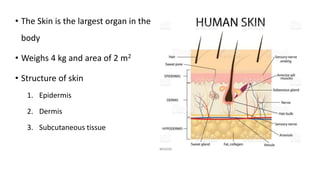
• The Skin is the largest organ in the
body
• Weighs 4 kg and area of 2 m2
• Structure of skin
1. Epidermis
2. Dermis
3. Subcutaneous tissue
• Epidermis
• stratified squamous epithelium
• adheres to the dermis partly by the interlocking of its
downward projections (epidermal ridges or pegs) with
upward projections of the dermis (dermal papillae)
• has no blood vessels
• thickness from less than 0.1 mm on the eyelids to
nearly 1 mm on the palms and soles thickness is kept
constant by cells dividing in the deepest (basal or
germinative) layer
• The journey from the basal layer to the surface
(epidermal turnover or transit time) takes 30 to 60 days.
• Layers of Epidermis
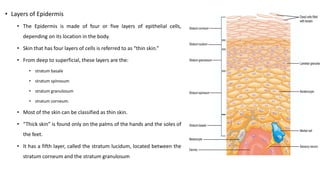
• The Epidermis is made of four or five layers of epithelial cells,
depending on its location in the body.
• Skin that has four layers of cells is referred to as “thin skin.”
• From deep to superficial, these layers are the:
• stratum basale
• stratum spinosum
• stratum granulosum
• stratum corneum.
• Most of the skin can be classified as thin skin.
• “Thick skin” is found only on the palms of the hands and the soles of
the feet.
• It has a fifth layer, called the stratum lucidum, located between the
stratum corneum and the stratum granulosum
• Stratum Basale
• The stratum basale (also called the stratum
germinativum) is the deepest epidermal layer and
attaches the epidermis to the basal lamina, below which
lie the layers of the dermis.
• The cells in the stratum basale bond to the dermis via
intertwining collagen fibers, referred to as the basement
membrane.
• A finger-like projection, or fold, known as the dermal
papilla is found in the superficial portion of the dermis.
• Dermal papillae increase the strength of the connection
between the epidermis and dermis; the greater the
folding, the stronger the connections made.
• Stratum Basale
• The stratum basale is a single layer of cells primarily
made of basal cells.
• A basal cell is a cuboidal-shaped stem cell that is a
precursor of the keratinocytes of the epidermis.
• All of the keratinocytes are produced from this single
layer of cells, which are constantly going through
mitosis to produce new cells.
• As new cells are formed, the existing cells are pushed
superficially away from the stratum basale.
• Stratum Basale
• Two other cell types are found dispersed among the
basal cells in the stratum basale.
• The first is a Merkel cell, which functions as a receptor
and is responsible for stimulating sensory nerves that
the brain perceives as touch.
• These cells are especially abundant on the surfaces of
the hands and feet.
• The second is a melanocyte, a cell that produces the
pigment melanin.
• Melanin gives hair and skin its color, and also helps
protect the living cells of the epidermis from ultraviolet
(UV) radiation damage.
• Stratum Spinosum
• The stratum spinosum is composed of eight to 10
layers of keratinocytes, formed as a result of cell
division in the stratum basale.
• Interspersed among the keratinocytes of this layer is
a type of dendritic cell called the Langerhans cell,
which functions as a macrophage by engulfing
bacteria, foreign particles, and damaged cells that
occur in this layer.
• Stratum Spinosum
• The stratum spinosum is composed of eight to 10 layers of keratinocytes,
formed as a result of cell division in the stratum basale.
• Interspersed among the keratinocytes of this layer is a type of dendritic cell
called the Langerhans cell, which functions as a macrophage by engulfing
bacteria, foreign particles, and damaged cells that occur in this layer.
• The keratinocytes in the stratum spinosum begin the synthesis of keratin and
release a water-repelling glycolipid that helps prevent water loss from the
body, making the skin relatively waterproof.
• As new keratinocytes are produced atop the stratum basale, the keratinocytes
of the stratum spinosum are pushed into the stratum granulosum.
• Stratum Granulosum
• The stratum granulosum has a grainy appearance due to
further changes to the keratinocytes as they are pushed from
the stratum spinosum.
• The cells (three to five layers deep) become flatter, their cell
membranes thicken, and they generate large amounts of the
proteins keratin, which is fibrous, and keratohyalin, which
accumulates as lamellar granules within the cells.
• These two proteins make up the bulk of the keratinocyte
mass in the stratum granulosum and give the layer its grainy
appearance.
• The nuclei and other cell organelles disintegrate as the cells
die, leaving behind the keratin, keratohyalin, and cell
membranes that will form the stratum lucidum, the stratum
corneum, and the accessory structures of hair and nails.
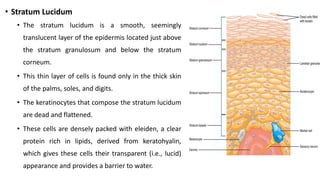
• Stratum Lucidum
• The stratum lucidum is a smooth, seemingly
translucent layer of the epidermis located just above
the stratum granulosum and below the stratum
corneum.
• This thin layer of cells is found only in the thick skin
of the palms, soles, and digits.
• The keratinocytes that compose the stratum lucidum
are dead and flattened.
• These cells are densely packed with eleiden, a clear
protein rich in lipids, derived from keratohyalin,
which gives these cells their transparent (i.e., lucid)
appearance and provides a barrier to water.
• Stratum Corneum
• The stratum corneum is the most superficial layer of the
epidermis and is the layer exposed to the outside
environment
• The increased keratinization (also called cornification) of
the cells in this layer gives it its name.
• There are usually 15 to 30 layers of cells in the stratum
corneum.
• This dry, dead layer helps prevent the penetration of
microbes and the dehydration of underlying tissues, and
provides a mechanical protection against abrasion for the
more delicate, underlying layers.
• Stratum Corneum
• Cells in this layer are shed periodically and are
replaced by cells pushed up from the stratum
granulosum (or stratum lucidum in the case of
the palms and soles of feet).
• The entire layer is replaced during a period of
about 4 weeks.
• Cosmetic procedures, such as
microdermabrasion, help remove some of the
dry, upper layer and aim to keep the skin looking
“fresh” and healthy.
• Stratum Corneum
• Cells in this layer are shed periodically and are
replaced by cells pushed up from the stratum
granulosum (or stratum lucidum in the case of
the palms and soles of feet).
• The entire layer is replaced during a period of
about 4 weeks.
• Cosmetic procedures, such as
microdermabrasion, help remove some of the
dry, upper layer and aim to keep the skin looking
“fresh” and healthy.
• Cells of the Epidermis
• Keratinocytes 85% , contain:
• desmosoms (which contain desmoplakins,
desmogleins and desmocollins)
• Cytoplasmic continuity between keratinocytes occurs
at gap junctions
• Tonofilaments which are small fibres running from
the cytoplasm to the desmosomes and are packed
into bundles called tonofibrils
• Cells of the Epidermis
• Melanocytes
• Synthesize Melanin
• migrate from the neural crest
• Each dendritic melanocyte associates with a number of
keratinocytes, forming an ‘epidermal melanin unit’
• Their cytoplasm contains discrete organelles, the
melanosomes, containing varying amounts of the
pigment melanin .
• This is ‘injected’ into surrounding keratinocytes to
provide them with pigmentation to help protect the skin
against damaging ultraviolet radiation
• Cells of the Epidermis
• Langerhans cells
• originating in the bone marrow
• have a key role in many immune reactions.
• they take up exogenous antigen, process it and
present it to T lymphocytes either in the skin or in the
local lymph nodes
• immunosurveillance for viral and tumour antigens
• ultraviolet radiation can induce skin tumours both by
causing mutations in the epidermal cells, and by
decreasing the number of epidermal Langerhans cells
• Merkel cells
• act as transducers for fine touch
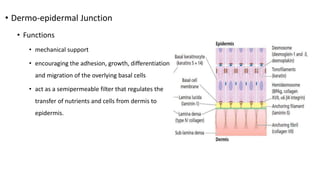
• Dermo-epidermal Junction
• Functions
• mechanical support
• encouraging the adhesion, growth, differentiation
and migration of the overlying basal cells
• act as a semipermeable filter that regulates the
transfer of nutrients and cells from dermis to
epidermis.
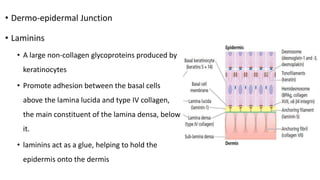
• Dermo-epidermal Junction
• lamina densa
• contain
• Anchoring fibrils (of type VII collagen)
• dermal microfibril bundles
• single small collagen fibres (types I and III) extend from
the papillary dermis to the deep part of the lamina densa.
• lamina lucida
• contains the adhesive macromolecules
• laminin-1
• entactin
• Fine anchoring filaments (of laminin-5) which cross the
lamina lucida and connect the lamina densa to the plasma
membrane of the basal cells
• Dermo-epidermal Junction
• plasma membrane of basal cells
• has hemidesmosomes containing:
• Bullous pemphigoid antigens
• collagen XVII
• α6 β4 Integrin
• Dermo-epidermal Junction
• Laminins
• A large non-collagen glycoproteins produced by
keratinocytes
• Promote adhesion between the basal cells
above the lamina lucida and type IV collagen,
the main constituent of the lamina densa, below
it.
• laminins act as a glue, helping to hold the
epidermis onto the dermis
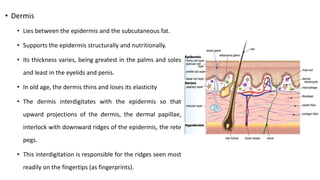
• Dermis
• Lies between the epidermis and the subcutaneous fat.
• Supports the epidermis structurally and nutritionally.
• Its thickness varies, being greatest in the palms and soles
and least in the eyelids and penis.
• In old age, the dermis thins and loses its elasticity
• The dermis interdigitates with the epidermis so that
upward projections of the dermis, the dermal papillae,
interlock with downward ridges of the epidermis, the rete
pegs.
• This interdigitation is responsible for the ridges seen most
readily on the fingertips (as fingerprints).
• Fibres of the Dermis
• When the skin is stretched, collagen, with its high
tensile strength, prevents tearing, and the elastic
fibres, intermingled with the collagen, later return it
to the unstretched state
• Types of fibres
• Collagen makes up 70–80% of the dry weight of the
dermis.
• Reticulin fibres are fine collagen fibres, seen in foetal
skin and around the blood vessels and appendages of
adult skin.
• Elastic fibres account for about 2% of the dry weight of
adult dermis.
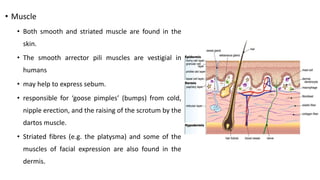
• Muscle
• Both smooth and striated muscle are found in the
skin.
• The smooth arrector pili muscles are vestigial in
humans
• may help to express sebum.
• responsible for ‘goose pimples’ (bumps) from cold,
nipple erection, and the raising of the scrotum by the
dartos muscle.
• Striated fibres (e.g. the platysma) and some of the
muscles of facial expression are also found in the
dermis.
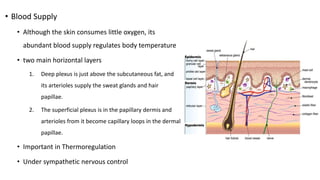
• Blood Supply
• Although the skin consumes little oxygen, its
abundant blood supply regulates body temperature
• two main horizontal layers
1. Deep plexus is just above the subcutaneous fat, and
its arterioles supply the sweat glands and hair
papillae.
2. The superficial plexus is in the papillary dermis and
arterioles from it become capillary loops in the dermal
papillae.
• Important in Thermoregulation
• Under sympathetic nervous control
• Cutaneous lymphatics
• lymphatics begin as blind-ended capillaries in
the dermal papilla and pass to a superficial
lymphatic plexus in the papillary dermis.
• there are also two deeper horizontal plexuses,
and collecting lymphatics from the deeper one
run with the veins in the superficial fascia.
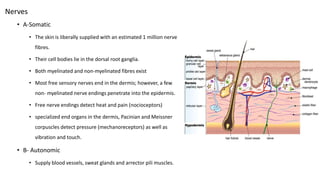
Nerves
• A-Somatic
• The skin is liberally supplied with an estimated 1 million nerve
fibres.
• Their cell bodies lie in the dorsal root ganglia.
• Both myelinated and non-myelinated fibres exist
• Most free sensory nerves end in the dermis; however, a few
non- myelinated nerve endings penetrate into the epidermis.
• Free nerve endings detect heat and pain (nocioceptors)
• specialized end organs in the dermis, Pacinian and Meissner
corpuscles detect pressure (mechanoreceptors) as well as
vibration and touch.
• B- Autonomic
• Supply blood vessels, sweat glands and arrector pili muscles.

Integumentary System.pptx

  • 1.
  • 2.
    • The Skinis the largest organ in the body • Weighs 4 kg and area of 2 m2 • Structure of skin 1. Epidermis 2. Dermis 3. Subcutaneous tissue
  • 5.
    • Epidermis • stratifiedsquamous epithelium • adheres to the dermis partly by the interlocking of its downward projections (epidermal ridges or pegs) with upward projections of the dermis (dermal papillae) • has no blood vessels • thickness from less than 0.1 mm on the eyelids to nearly 1 mm on the palms and soles thickness is kept constant by cells dividing in the deepest (basal or germinative) layer • The journey from the basal layer to the surface (epidermal turnover or transit time) takes 30 to 60 days.
  • 6.
    • Layers ofEpidermis • The Epidermis is made of four or five layers of epithelial cells, depending on its location in the body. • Skin that has four layers of cells is referred to as “thin skin.” • From deep to superficial, these layers are the: • stratum basale • stratum spinosum • stratum granulosum • stratum corneum. • Most of the skin can be classified as thin skin. • “Thick skin” is found only on the palms of the hands and the soles of the feet. • It has a fifth layer, called the stratum lucidum, located between the stratum corneum and the stratum granulosum
  • 8.
    • Stratum Basale •The stratum basale (also called the stratum germinativum) is the deepest epidermal layer and attaches the epidermis to the basal lamina, below which lie the layers of the dermis. • The cells in the stratum basale bond to the dermis via intertwining collagen fibers, referred to as the basement membrane. • A finger-like projection, or fold, known as the dermal papilla is found in the superficial portion of the dermis. • Dermal papillae increase the strength of the connection between the epidermis and dermis; the greater the folding, the stronger the connections made.
  • 9.
    • Stratum Basale •The stratum basale is a single layer of cells primarily made of basal cells. • A basal cell is a cuboidal-shaped stem cell that is a precursor of the keratinocytes of the epidermis. • All of the keratinocytes are produced from this single layer of cells, which are constantly going through mitosis to produce new cells. • As new cells are formed, the existing cells are pushed superficially away from the stratum basale.
  • 10.
    • Stratum Basale •Two other cell types are found dispersed among the basal cells in the stratum basale. • The first is a Merkel cell, which functions as a receptor and is responsible for stimulating sensory nerves that the brain perceives as touch. • These cells are especially abundant on the surfaces of the hands and feet. • The second is a melanocyte, a cell that produces the pigment melanin. • Melanin gives hair and skin its color, and also helps protect the living cells of the epidermis from ultraviolet (UV) radiation damage.
  • 11.
    • Stratum Spinosum •The stratum spinosum is composed of eight to 10 layers of keratinocytes, formed as a result of cell division in the stratum basale. • Interspersed among the keratinocytes of this layer is a type of dendritic cell called the Langerhans cell, which functions as a macrophage by engulfing bacteria, foreign particles, and damaged cells that occur in this layer.
  • 12.
    • Stratum Spinosum •The stratum spinosum is composed of eight to 10 layers of keratinocytes, formed as a result of cell division in the stratum basale. • Interspersed among the keratinocytes of this layer is a type of dendritic cell called the Langerhans cell, which functions as a macrophage by engulfing bacteria, foreign particles, and damaged cells that occur in this layer. • The keratinocytes in the stratum spinosum begin the synthesis of keratin and release a water-repelling glycolipid that helps prevent water loss from the body, making the skin relatively waterproof. • As new keratinocytes are produced atop the stratum basale, the keratinocytes of the stratum spinosum are pushed into the stratum granulosum.
  • 13.
    • Stratum Granulosum •The stratum granulosum has a grainy appearance due to further changes to the keratinocytes as they are pushed from the stratum spinosum. • The cells (three to five layers deep) become flatter, their cell membranes thicken, and they generate large amounts of the proteins keratin, which is fibrous, and keratohyalin, which accumulates as lamellar granules within the cells. • These two proteins make up the bulk of the keratinocyte mass in the stratum granulosum and give the layer its grainy appearance. • The nuclei and other cell organelles disintegrate as the cells die, leaving behind the keratin, keratohyalin, and cell membranes that will form the stratum lucidum, the stratum corneum, and the accessory structures of hair and nails.
  • 14.
    • Stratum Lucidum •The stratum lucidum is a smooth, seemingly translucent layer of the epidermis located just above the stratum granulosum and below the stratum corneum. • This thin layer of cells is found only in the thick skin of the palms, soles, and digits. • The keratinocytes that compose the stratum lucidum are dead and flattened. • These cells are densely packed with eleiden, a clear protein rich in lipids, derived from keratohyalin, which gives these cells their transparent (i.e., lucid) appearance and provides a barrier to water.
  • 15.
    • Stratum Corneum •The stratum corneum is the most superficial layer of the epidermis and is the layer exposed to the outside environment • The increased keratinization (also called cornification) of the cells in this layer gives it its name. • There are usually 15 to 30 layers of cells in the stratum corneum. • This dry, dead layer helps prevent the penetration of microbes and the dehydration of underlying tissues, and provides a mechanical protection against abrasion for the more delicate, underlying layers.
  • 16.
    • Stratum Corneum •Cells in this layer are shed periodically and are replaced by cells pushed up from the stratum granulosum (or stratum lucidum in the case of the palms and soles of feet). • The entire layer is replaced during a period of about 4 weeks. • Cosmetic procedures, such as microdermabrasion, help remove some of the dry, upper layer and aim to keep the skin looking “fresh” and healthy.
  • 18.
    • Stratum Corneum •Cells in this layer are shed periodically and are replaced by cells pushed up from the stratum granulosum (or stratum lucidum in the case of the palms and soles of feet). • The entire layer is replaced during a period of about 4 weeks. • Cosmetic procedures, such as microdermabrasion, help remove some of the dry, upper layer and aim to keep the skin looking “fresh” and healthy.
  • 19.
    • Cells ofthe Epidermis • Keratinocytes 85% , contain: • desmosoms (which contain desmoplakins, desmogleins and desmocollins) • Cytoplasmic continuity between keratinocytes occurs at gap junctions • Tonofilaments which are small fibres running from the cytoplasm to the desmosomes and are packed into bundles called tonofibrils
  • 20.
    • Cells ofthe Epidermis • Melanocytes • Synthesize Melanin • migrate from the neural crest • Each dendritic melanocyte associates with a number of keratinocytes, forming an ‘epidermal melanin unit’ • Their cytoplasm contains discrete organelles, the melanosomes, containing varying amounts of the pigment melanin . • This is ‘injected’ into surrounding keratinocytes to provide them with pigmentation to help protect the skin against damaging ultraviolet radiation
  • 21.
    • Cells ofthe Epidermis • Langerhans cells • originating in the bone marrow • have a key role in many immune reactions. • they take up exogenous antigen, process it and present it to T lymphocytes either in the skin or in the local lymph nodes • immunosurveillance for viral and tumour antigens • ultraviolet radiation can induce skin tumours both by causing mutations in the epidermal cells, and by decreasing the number of epidermal Langerhans cells • Merkel cells • act as transducers for fine touch
  • 22.
    • Dermo-epidermal Junction •Functions • mechanical support • encouraging the adhesion, growth, differentiation and migration of the overlying basal cells • act as a semipermeable filter that regulates the transfer of nutrients and cells from dermis to epidermis.
  • 23.
    • Dermo-epidermal Junction •lamina densa • contain • Anchoring fibrils (of type VII collagen) • dermal microfibril bundles • single small collagen fibres (types I and III) extend from the papillary dermis to the deep part of the lamina densa. • lamina lucida • contains the adhesive macromolecules • laminin-1 • entactin • Fine anchoring filaments (of laminin-5) which cross the lamina lucida and connect the lamina densa to the plasma membrane of the basal cells
  • 24.
    • Dermo-epidermal Junction •plasma membrane of basal cells • has hemidesmosomes containing: • Bullous pemphigoid antigens • collagen XVII • α6 β4 Integrin
  • 25.
    • Dermo-epidermal Junction •Laminins • A large non-collagen glycoproteins produced by keratinocytes • Promote adhesion between the basal cells above the lamina lucida and type IV collagen, the main constituent of the lamina densa, below it. • laminins act as a glue, helping to hold the epidermis onto the dermis
  • 26.
    • Dermis • Liesbetween the epidermis and the subcutaneous fat. • Supports the epidermis structurally and nutritionally. • Its thickness varies, being greatest in the palms and soles and least in the eyelids and penis. • In old age, the dermis thins and loses its elasticity • The dermis interdigitates with the epidermis so that upward projections of the dermis, the dermal papillae, interlock with downward ridges of the epidermis, the rete pegs. • This interdigitation is responsible for the ridges seen most readily on the fingertips (as fingerprints).
  • 28.
    • Fibres ofthe Dermis • When the skin is stretched, collagen, with its high tensile strength, prevents tearing, and the elastic fibres, intermingled with the collagen, later return it to the unstretched state • Types of fibres • Collagen makes up 70–80% of the dry weight of the dermis. • Reticulin fibres are fine collagen fibres, seen in foetal skin and around the blood vessels and appendages of adult skin. • Elastic fibres account for about 2% of the dry weight of adult dermis.
  • 29.
    • Muscle • Bothsmooth and striated muscle are found in the skin. • The smooth arrector pili muscles are vestigial in humans • may help to express sebum. • responsible for ‘goose pimples’ (bumps) from cold, nipple erection, and the raising of the scrotum by the dartos muscle. • Striated fibres (e.g. the platysma) and some of the muscles of facial expression are also found in the dermis.
  • 30.
    • Blood Supply •Although the skin consumes little oxygen, its abundant blood supply regulates body temperature • two main horizontal layers 1. Deep plexus is just above the subcutaneous fat, and its arterioles supply the sweat glands and hair papillae. 2. The superficial plexus is in the papillary dermis and arterioles from it become capillary loops in the dermal papillae. • Important in Thermoregulation • Under sympathetic nervous control
  • 31.
    • Cutaneous lymphatics •lymphatics begin as blind-ended capillaries in the dermal papilla and pass to a superficial lymphatic plexus in the papillary dermis. • there are also two deeper horizontal plexuses, and collecting lymphatics from the deeper one run with the veins in the superficial fascia.
  • 32.
    Nerves • A-Somatic • Theskin is liberally supplied with an estimated 1 million nerve fibres. • Their cell bodies lie in the dorsal root ganglia. • Both myelinated and non-myelinated fibres exist • Most free sensory nerves end in the dermis; however, a few non- myelinated nerve endings penetrate into the epidermis. • Free nerve endings detect heat and pain (nocioceptors) • specialized end organs in the dermis, Pacinian and Meissner corpuscles detect pressure (mechanoreceptors) as well as vibration and touch. • B- Autonomic • Supply blood vessels, sweat glands and arrector pili muscles.