INTEGRATION TESTING
OBJECT ORIENTED SOFTWARE ENGINEERING
Devadharshini U
1st MSc IT
CONTENT
INTRODUCTION
UNIT TESTING
ADVANTAGE
DISADVANTAGE
TYPES
CASE STUDY
SUMMARY
INTRODUCTION
Integration testing is the process of testing the interface between two software units
or modules.
It focuses on determining the correctness of the interface. The purpose of integration
testing is to expose faults in the interaction between integrated units.
Once all the modules have been unit-tested, integration testing is performed.
Integration testing is the second level of the software testing process comes after unit
testing.
In this testing, units or individual components of the software are tested in a
group
UNIT TESTING
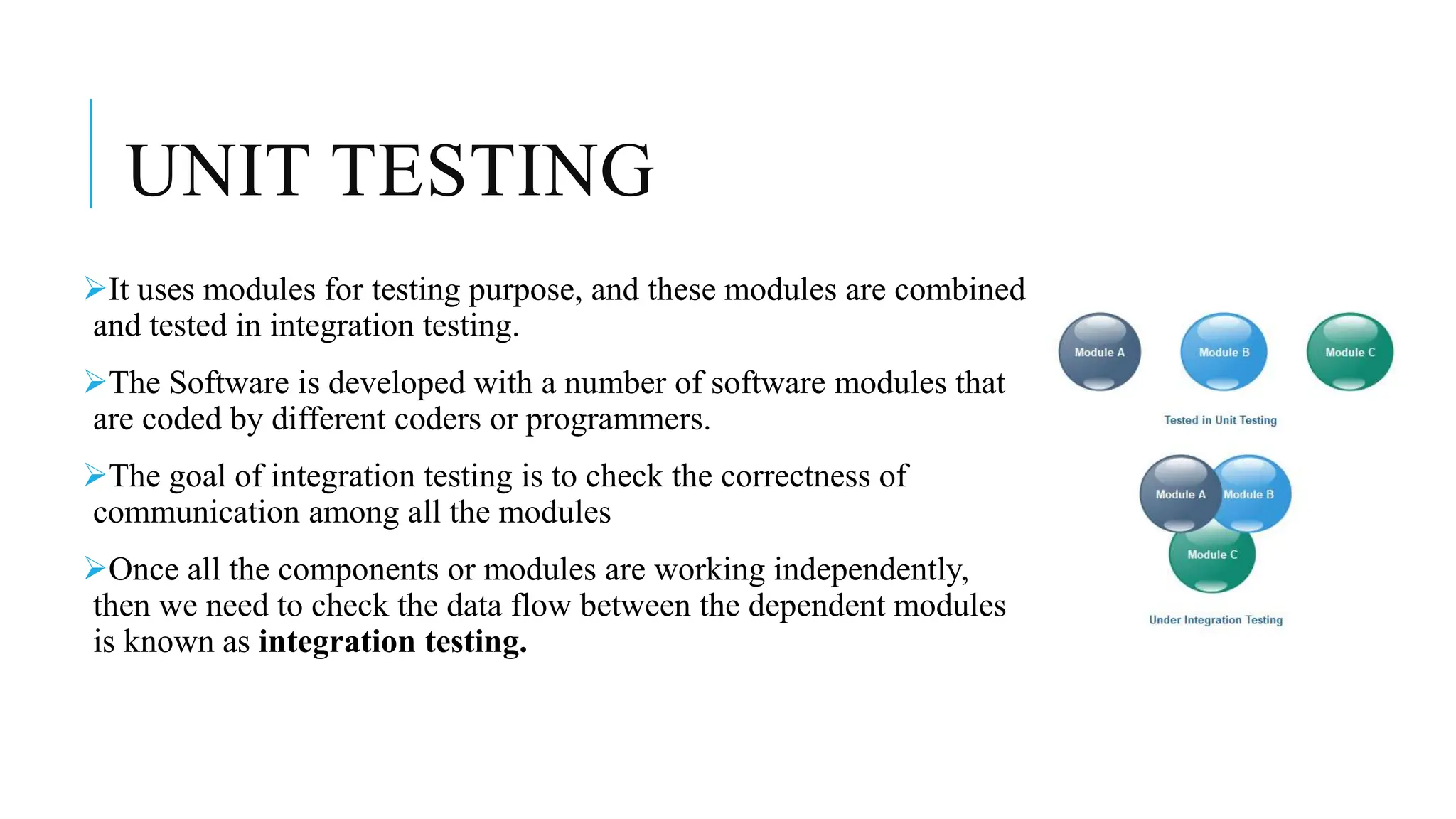
It uses modules for testing purpose, and these modules are combined
and tested in integration testing.
The Software is developed with a number of software modules that
are coded by different coders or programmers.
The goal of integration testing is to check the correctness of
communication among all the modules
Once all the components or modules are working independently,
then we need to check the data flow between the dependent modules
is known as integration testing.
ADVANTAGE
Detects integration issues early
Validates interfaces
Tests end-to-end scenarios
Assures system behavior
Identifies boundary issues
Enhances system reliability
DISADVANTAGE
Complexity
Time-consuming
Costly
Dependencies
Maintenance
Overhead
TYPES
Incremental
Big Bang
Top-down
Bottom-up
Sandwich
Hybrid
TYPES
1.Incremental Integration Testing:
Components are integrated incrementally.
New functionalities are added gradually.
Testing starts with basic functionality.
Continuously builds upon existing features.
Facilitates early bug detection.
Ensures smoother integration.
2.Big Bang Integration Testing:
All components are integrated
simultaneously.
Done at the end of development.
Identifies system-level issues.
Less granular than incremental.
Requires comprehensive testing.
Riskier due to delayed integration.
TYPES
3.Top-down Integration Testing:
Begins with higher-level modules.
Simulates user interactions first.
Mocks lower-level components.
Identifies early system-level issues.
Requires stubs or drivers.
Suitable for layered architectures.
4.Bottom-up Integration Testing:
Starts with lower-level modules.
Tests individual components first.
Simulates interactions upwards.
Identifies early component-level issues.
Requires stubs or drivers.
Suitable for modular architectures.
TYPES
5.Sandwich Integration Testing:
Combination of top-down and bottom-up.
Tests from both ends towards the middle.
Facilitates rapid integration.
Reduces dependencies on stubs.
Identifies issues across layers.
Requires coordination between teams.
6.Hybrid Integration Testing:
Combines multiple integration approaches.
Adapts to project requirements.
Maximizes testing effectiveness.
Balances resource allocation.
Offers flexibility.
Tailored to specific contexts.
CASE STUDY
Background:
A startup is developing a new social media platform called ConnectMe. The platform
aims to provide users with features such as posting updates, messaging, and photo
sharing.
Challenges:
Interconnected Features: “Connect Me” integrates various features like posting
updates, messaging, and photo sharing, which must work seamlessly together.
Third-Party Integrations: The platform integrates with third-party services for
authentication and analytics, adding complexity to the integration process.
User Engagement: Ensuring a smooth user experience across different features and
devices is essential for user engagement and retention.
CASE STUDY
Integration Testing Approach:
The integration testing strategy for “Connect Me” involves a combination of top-down and
bottom-up approaches, focusing on validating feature interactions and third-party integrations.
Keys
Environment Setup: Mimic production setup, add sample data.
Test Planning: Identify key features, define integration scenarios.
Test Execution: Conduct top-down and bottom-up testing, validate third-party integrations.
Regression Testing: Ensure existing features remain stable.
End-to-End Testing: Validate user workflows and system performance.
Defect Tracking: Document and prioritize integration-related issues.
CASE STUDY
OUTPUT
Early Issue Identification: Integration testing helps identify critical defects early in the
development process, minimizing the risk of post-deployment issues.
Improved User Experience: Thorough testing of feature interactions ensures a seamless user
experience, driving user engagement and retention.
Reliable Third-Party Integrations: Integration testing validates the reliability and
performance of third-party integrations, ensuring smooth platform operation.
Enhanced Product Quality: By adopting a systematic approach to integration testing,
“Connect Me” can deliver a robust and user-friendly social media platform that meets user
expectations and drives growth.
SUMMARY
Integration testing is essential for ensuring the reliability, performance, and user experience
of complex software platforms like “Connect Me”.
By implementing a comprehensive integration testing strategy, the startup can build
confidence in the platform's functionality and reliability, setting the stage for successful launch
and adoption by users.
THANK YOU

INTEGRATION TESTING IN software development.pptx

  • 1.
    INTEGRATION TESTING OBJECT ORIENTEDSOFTWARE ENGINEERING Devadharshini U 1st MSc IT
  • 2.
  • 3.
    INTRODUCTION Integration testing isthe process of testing the interface between two software units or modules. It focuses on determining the correctness of the interface. The purpose of integration testing is to expose faults in the interaction between integrated units. Once all the modules have been unit-tested, integration testing is performed. Integration testing is the second level of the software testing process comes after unit testing. In this testing, units or individual components of the software are tested in a group
  • 4.
    UNIT TESTING It usesmodules for testing purpose, and these modules are combined and tested in integration testing. The Software is developed with a number of software modules that are coded by different coders or programmers. The goal of integration testing is to check the correctness of communication among all the modules Once all the components or modules are working independently, then we need to check the data flow between the dependent modules is known as integration testing.
  • 5.
    ADVANTAGE Detects integration issuesearly Validates interfaces Tests end-to-end scenarios Assures system behavior Identifies boundary issues Enhances system reliability
  • 6.
  • 7.
  • 8.
    TYPES 1.Incremental Integration Testing: Componentsare integrated incrementally. New functionalities are added gradually. Testing starts with basic functionality. Continuously builds upon existing features. Facilitates early bug detection. Ensures smoother integration. 2.Big Bang Integration Testing: All components are integrated simultaneously. Done at the end of development. Identifies system-level issues. Less granular than incremental. Requires comprehensive testing. Riskier due to delayed integration.
  • 9.
    TYPES 3.Top-down Integration Testing: Beginswith higher-level modules. Simulates user interactions first. Mocks lower-level components. Identifies early system-level issues. Requires stubs or drivers. Suitable for layered architectures. 4.Bottom-up Integration Testing: Starts with lower-level modules. Tests individual components first. Simulates interactions upwards. Identifies early component-level issues. Requires stubs or drivers. Suitable for modular architectures.
  • 10.
    TYPES 5.Sandwich Integration Testing: Combinationof top-down and bottom-up. Tests from both ends towards the middle. Facilitates rapid integration. Reduces dependencies on stubs. Identifies issues across layers. Requires coordination between teams. 6.Hybrid Integration Testing: Combines multiple integration approaches. Adapts to project requirements. Maximizes testing effectiveness. Balances resource allocation. Offers flexibility. Tailored to specific contexts.
  • 11.
    CASE STUDY Background: A startupis developing a new social media platform called ConnectMe. The platform aims to provide users with features such as posting updates, messaging, and photo sharing. Challenges: Interconnected Features: “Connect Me” integrates various features like posting updates, messaging, and photo sharing, which must work seamlessly together. Third-Party Integrations: The platform integrates with third-party services for authentication and analytics, adding complexity to the integration process. User Engagement: Ensuring a smooth user experience across different features and devices is essential for user engagement and retention.
  • 12.
    CASE STUDY Integration TestingApproach: The integration testing strategy for “Connect Me” involves a combination of top-down and bottom-up approaches, focusing on validating feature interactions and third-party integrations. Keys Environment Setup: Mimic production setup, add sample data. Test Planning: Identify key features, define integration scenarios. Test Execution: Conduct top-down and bottom-up testing, validate third-party integrations. Regression Testing: Ensure existing features remain stable. End-to-End Testing: Validate user workflows and system performance. Defect Tracking: Document and prioritize integration-related issues.

  • 13.
    CASE STUDY OUTPUT Early IssueIdentification: Integration testing helps identify critical defects early in the development process, minimizing the risk of post-deployment issues. Improved User Experience: Thorough testing of feature interactions ensures a seamless user experience, driving user engagement and retention. Reliable Third-Party Integrations: Integration testing validates the reliability and performance of third-party integrations, ensuring smooth platform operation. Enhanced Product Quality: By adopting a systematic approach to integration testing, “Connect Me” can deliver a robust and user-friendly social media platform that meets user expectations and drives growth.
  • 14.
    SUMMARY Integration testing isessential for ensuring the reliability, performance, and user experience of complex software platforms like “Connect Me”. By implementing a comprehensive integration testing strategy, the startup can build confidence in the platform's functionality and reliability, setting the stage for successful launch and adoption by users.
  • 15.