1/8
Integrating GenAI for Business Process Automation
successive.tech/blog/integrating-genai-for-business-process-automation
Business automation is the process of automating and integrating all the necessary
activities and processes using automation software and solutions. To achieve automation
and better operations efficiency, enterprises combine all the isolated automated
processes and form a comprehensive working culture. With the evolution of technologies
and improved understanding of managing different technologies together, businesses
transformed and promoted collaborative and functional working within the organization.
The last and the most effective business automation was made possible with robotic
process automation or RPA. Robotic process automation has formed the core of many
digital transformation strategies and enabled companies to automate several rule-based
processes such as document processing, data entry, invoice processing, data deletion,
employee onboarding, transaction monitoring, and many others, saving time and money.
Nonetheless, robotic process automation enables business automation in a wide range
and across use cases, but it also has limitations that drive the need for improvement and
better technologies.
Organizations that want to fully automate operation processes and save their employee
time for most productive jobs can now switch to GenAI automation. Generative AI is now
considered the next generation of RPA. Integrating generative AI capabilities over existing
RPA-based business operations has the potential to introduce new levels of adaptability
and advanced automation systems. In this blog post, we will discuss how Generative AI
has significantly influenced various industries for business automation with specialized AI,
which Generative AI model is ideal for specific business use cases, and how
implementing generative AI models improves operational efficiency and reduces cost.
RPA in Business Process Automation: Implications and
Limitations
Fundamentally, RPA has transformed how businesses operate by automating repetitive
and rule-based tasks across industries. Good candidates for robotic process automation
have included high-volume tasks that are recurring, time-sensitive, and involve multiple
people, such as card activation and fraud claims discovery in banking and finance, claims
processing in insurance, report automation and system reconciliation in healthcare,
service order management and quality reporting in hi-tech and telecom, and account
setup and meter-reading validation in energy and utilities.
While RPA has transformed business operations by automating routine tasks, it faces
limitations in handling tasks that require human judgment, complex decision-making, or
unstructured data processing. This gap necessitates the integration of advanced
solutions, such as Generative AI, to enhance system capabilities. AI-driven operations,
2/8
supported by generative models, enable organizations to develop processes that form the
backbone required to support evolving business requirements and to achieve continuous
improvement, staying effective and efficient.
Types of Generative AI Models and their Functions
Generative AI is known to create different content assets in forms like text, images, audio,
and videos. Different Generative AI architectures are leveraged to develop and train LLM
models to produce specific types of synthetic data based on industry use cases. Each
architecture combines a different set of AI, ML, and Deep Learning technologies to create
and automate new data generation requirements. Let’s understand them in detail and
figure out how these models are relevant in supporting business process automation.
Text-to-Text Generators
Text-to-text generators are sophisticated language models trained on massive amounts of
data that generate coherent text from input prompts, enhancing text-based tasks. The
training makes the model capable of analyzing patterns, understanding context, and
generating text just like humans. It produces text when provided ‘input’ known as a
prompt, which comprises a few keywords, a topic, a sentence, or even a complete
question.
ChatGPT 4 and BERT are some of the best text-to-text generator examples, but these
build on foundation models. Industries that want to truly leverage Generative AI need to
invest in building text-to-text generators on RAG architecture. RAG stands for Retrieval-
Augmented Generation, which addresses the limitations of the foundation model and
3/8
enhances its capabilities by retrieving data from outside a foundation model, for example,
domain-specific knowledge sources such as a collection of medical articles, legal
documents, or technical manuals.
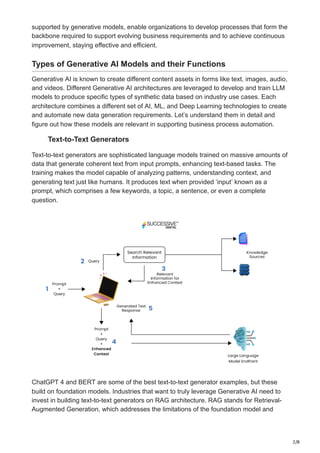
RAG works on the principles of retrieval, augmentation, and generation where when a
prompt is given, it retrieves information from multiple data sources, such as document
repositories, databases, or APIs. This level of capabilities allows the model to have
additional relevant context from specialized data, and enables it to augment the prompt
with more accurate and contextually relevant outputs that fit to domain specific queries.
Question answering, Abstractive question answering, Jeopardy Question Generation, and
fact verifications are some of the use cases where RAG models are highly effective
solutions. By retrieving relevant data from external sources and incorporating it into the
generation process, RAG models produce outputs that are both contextually accurate and
factually grounded. Here are some real-world industry-specific RAG use cases:
Healthcare Clinical Decision Support
Legal Contract Analysis and Drafting
Finance Investment Research and Analysis
E-commerce Personalized Product Recommendations
Pharmaceuticals Drug Discovery and Research
Read more about how to leverage chunking and spitting strategies for optimizing text
input in RAG model
Text-to-Image Generators
Text-to-image generators are generative AI models that are trained to take textual
prompts and create images out of the text description. The model is helpful for creative
and design tasks as well as solving complex image generation and customization
requirements. It leverages Generative Adversarial Network (GAN) architecture and trains
two neural networks to compete against each other to generate more authentic new data
from a given training dataset. One is known as a generator, and the other is known as a
discriminator. Both are trained together, and the generator generates new data from the
given prompt and tries to make it as relevant as possible. Discriminator, on the other
hand, works as a predictor and determines whether the generated data is fake or real.
Generative Adversarial Networks (GANs) are transforming industries by creating realistic
images and controlling factors like setting, style, and location. The model also performs
tasks like image-to-image translation, super-resolution, and 3D object generation,
enhancing creative processes and improving visual quality. These versatile capabilities
make GAN integration essential across various industries and automate several job
functions. Here are some real-world industry-specific GAN use cases:
Medical Imaging Super-Resolution and Modality Translation in Healthcare
Vehicle Design and Virtual Prototyping in Automotive
Quality Inspection and Defect Detection in Manufacturing
4/8
Character Design and Animation in Entertainment
Crop Monitoring and Yield Prediction in Agriculture
Network Optimization and Signal Enhancement in Telecommunications
Virtual Property Staging and Visualization in Real Estate
Image-to-Image Generators
Image to image generators comprise four different generative AI models that work
together to transform one image into another, aiding in image enhancement and
manipulation. These generators include GAN, VAE, CNN, and transformers. Image to
image generators combine the strengths of each of the generators to produce high-
quality, contextually accurate, and visually appealing images.
In an image-to-image generator model, transformers are integrated into GANs or VAEs to
enhance certain aspects of image generation, such as capturing the overall structure or
context of the image. Henceforth, within the image-to-image generator pipeline, CNNs
extract features from the input image, which are then encoded into a latent space using
VAEs or passed through transformer layers to capture global context. GANs, consisting of
a generator and a discriminator (both often built with CNNs), are then used to generate
high-quality images. The generator produces new images, while the discriminator
ensures their realism. Integrated transformers help here to enhance the model’s ability to
maintain the global structure of images based on specific architecture used in the model
development.
Image-to-image generators hold the potential to transform industries by enhancing
visualization and customization capabilities within images. In healthcare, integrating these
models can convert low-quality medical scans into high-resolution images for accurate
diagnoses, while in automotive and fashion, these can be leveraged for rapid design
prototyping. Here are some real-world industry specific use-cases of the image-to-image
generator model:
Visual Effects and Scene Transformation in Entertainment
Medical Image Translation and Enhancement in Healthcare
Design Prototyping and Modification in Automotive
Infrastructure Monitoring and Damage Assessment in Energy
Product Image Enhancement and Customization in Retail
Image-to-Text Generators
Image-to-text generators are advanced AI models designed to convert visual content into
descriptive text, facilitating tasks such as image captioning and visual understanding.
These generators typically involve a combination of CNNs, RNNs, Transformers,
Reinforcement Learning, and VAE models. Each model plays a crucial role in the
process, ensuring the generated text is accurate, contextually relevant, and coherent.
In an image-to-text generator model, CNNs are responsible for extracting detailed
features from the input image, capturing essential visual elements such as objects,
textures, and spatial relationships. These features are then passed through RNNs, which
5/8
are adept at handling sequential data, to generate descriptive text based on the extracted
visual features. In this generator pipeline, transformers are integrated to improve the
model’s ability to understand and generate text that considers global context and long-
range dependencies within the image. Reinforcement Learning is also employed to fine-
tune the model, optimizing the generated text to maximize specific evaluation metrics like
accuracy or readability. VAEs are used to encode image features into a latent space,
contributing to the generation of diverse and meaningful textual descriptions.
The combined use of CNNs, RNNs, Transformers, Reinforcement Learning, and VAEs in
image-to-text generators results in a robust system capable of translating complex visual
data into human-readable descriptions. This technology has broad applications across
various industries, enabling different businesses to automate and enhance processes that
rely on visual content interpretation. Here are some real-world industry specific use-cases
of the image-to-text generator model:
Automating medical image report generation for faster diagnoses
Converting visual evidence into detailed descriptions for streamlined
documentation.
Enhancing product listings with automatically generated descriptions from images.
Generating captions for images and videos to improve content accessibility.
Automatically generate reports from surveillance footage by describing visual
events.
How does RPA and Generative AI correlate?
Integrating Generative AI over RPA-based processes can enable systems to make
decisions based on domain-specific business knowledge. RPA systems are designed to
perform rule-based tasks, but their reliance on predefined rules can diminish efficiency
when facing more complex scenarios. Generative AI can help continuously optimize
machine learning algorithms to support more efficient and faster automation at scale. In
addition to scaling rule-based automation, Generative AI leverages unstructured data to
enhance decision-making. Not all organizational tasks are rule-based; some require
cognitive decision-making, particularly when dealing with unstructured data or anomalous
tasks. Generative AI bridges this gap by creating models that inform decisions based on
the data they have been trained on, ensuring that while RPA handles repetitive, rule-
based tasks, Generative AI manages tasks that require cognitive insights or human-in-
the-loop decision-making. This combination leads to a more holistic and adaptive
automation strategy capable of addressing a wider range of business needs.
Gen AI Use Cases in Industry-Wide Business Process Automation
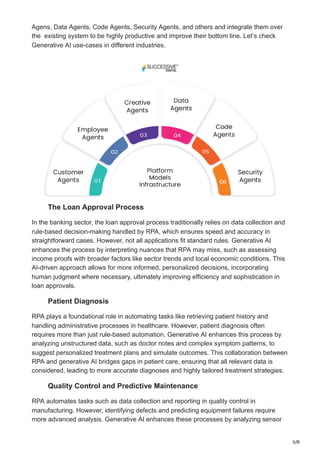
Generative AI ensures intelligent automation to streamline business processes. Using the
available Gen AI models, platforms, and cloud infrastructure, organizations can build
Generative AI powered agents such as Customer Agents, Employee Agents, Creative
6/8
Agens, Data Agents, Code Agents, Security Agents, and others and integrate them over
the existing system to be highly productive and improve their bottom line. Let’s check
Generative AI use-cases in different industries.
The Loan Approval Process
In the banking sector, the loan approval process traditionally relies on data collection and
rule-based decision-making handled by RPA, which ensures speed and accuracy in
straightforward cases. However, not all applications fit standard rules. Generative AI
enhances the process by interpreting nuances that RPA may miss, such as assessing
income proofs with broader factors like sector trends and local economic conditions. This
AI-driven approach allows for more informed, personalized decisions, incorporating
human judgment where necessary, ultimately improving efficiency and sophistication in
loan approvals.
Patient Diagnosis
RPA plays a foundational role in automating tasks like retrieving patient history and
handling administrative processes in healthcare. However, patient diagnosis often
requires more than just rule-based automation. Generative AI enhances this process by
analyzing unstructured data, such as doctor notes and complex symptom patterns, to
suggest personalized treatment plans and simulate outcomes. This collaboration between
RPA and generative AI bridges gaps in patient care, ensuring that all relevant data is
considered, leading to more accurate diagnoses and highly tailored treatment strategies.
Quality Control and Predictive Maintenance
RPA automates tasks such as data collection and reporting in quality control in
manufacturing. However, identifying defects and predicting equipment failures require
more advanced analysis. Generative AI enhances these processes by analyzing sensor
7/8
data directly from machinery, identifying subtle patterns that indicate potential issues, and
flagging required maintenance. AI-powered predictive analytics also optimize
maintenance schedules, improve mechanical efficiency, and reduce engine carbon
emissions. This partnership ensures higher product quality, reduces downtime, and
enhances operational efficiency.
Real-Time Assistance and Enhanced Interactions
In customer service, RPA automates routine tasks like answering FAQs and routing
inquiries. However, real-time assistance and understanding customer emotions require
more sophisticated capabilities. Generative AI, powered by natural language processing
(NLP) and sentiment analysis, enables voice-based queries to be recognized and
addressed immediately. AI can understand the content and tone of customer interactions,
directing them to human agents when necessary. With text-to-speech and NLP, AI can
instantly respond to text queries, reducing wait times and enhancing the overall customer
experience. Digital customer service agents also support human agents by offering
advice and guidance, ultimately boosting customer satisfaction and streamlining the
service process.
Personalized Interactions and Targeted Engagement
AI is revolutionizing customer experience by enabling personalized interactions at scale
through chatbots, digital assistants, and customer interfaces. These technologies deliver
tailored experiences and targeted advertisements, enhancing customer engagement. For
instance, AI-powered platforms like Amazon suggest reordering frequently purchased
items and recommend related products. McDonald’s leverages AI, combined with NLP, to
advance its automated order-taking (AOT) technology, scaling across markets and
accommodating various languages and dialects. Similarly, Spotify and YouTube use AI to
curate personalized content, suggesting new artists or videos based on customer
preferences, thus enhancing user satisfaction and loyalty.
Strategies for Successful GenAI Integration
Existing RPA investments remain vital to business operations. The introduction of
Generative AI should be viewed as an enhancement, not a replacement. By layering
Generative AI onto current RPA systems, organizations can maintain their foundational
automation while adding a dynamic layer of intelligence. Just as human skills are
continuously upgraded, RPA bots can be “trained” with Generative AI capabilities, making
them more versatile and effective in handling complex tasks.
Assessing Solutions
Begin by conducting a thorough review of existing processes to pinpoint areas where
Generative AI can complement RPA, particularly in complex decision-making scenarios
that benefit from human-in-the-loop involvement. Assess your infrastructure’s capacity to
8/8
support AI, considering the need for data preparation, labeling, and high-quality, diverse
datasets. Collaborate with specialized AI solution providers and experts to ensure that the
technology aligns with your business objectives and maximizes its potential.
Workforce Training
To successfully integrate Generative AI, it’s essential to foster a culture of continuous
learning. Provide comprehensive training programs that focus on AI technology usage,
understanding AI-generated decisions, and establishing effective feedback mechanisms.
Encourage collaboration between AI experts and staff to facilitate hands-on learning and
ensure that your workforce is equipped to work alongside AI, leveraging it to enhance
creativity and critical thinking.
Transition Management
Effective integration of Generative AI begins with pilot projects to test its impact and
effectiveness. Set clear success metrics and continuously monitor AI-enhanced
processes to ensure they meet your goals. Compliance with regulatory and ethical
standards is crucial—ensure that AI applications adhere to all relevant guidelines. Lastly,
prepare for the organizational changes that AI integration will bring, managing the
transition smoothly to minimize disruption and maximize benefits.
Conclusion
Integrating Generative AI into business process automation represents a significant
evolution from traditional rule-based RPA systems to intelligent decision-making without
human intervention. By combining the rule-based precision of RPA with the cognitive
capabilities of Generative AI, businesses can automate a wider array of processes,
handle complex decision-making tasks, and effectively manage unstructured data.
Building Generative AI applications as an additional layer over existing automated system
layers will help companies enhance operational efficiency and drive innovation across
industries. As businesses embark on this journey, strategic planning, workforce training,
and continuous monitoring are essential to ensure that the integration of Generative AI
complements existing systems and paves the way for sustainable growth and competitive
advantage.

Integrating GenAI for Business Process Automation

  • 1.
    1/8 Integrating GenAI forBusiness Process Automation successive.tech/blog/integrating-genai-for-business-process-automation Business automation is the process of automating and integrating all the necessary activities and processes using automation software and solutions. To achieve automation and better operations efficiency, enterprises combine all the isolated automated processes and form a comprehensive working culture. With the evolution of technologies and improved understanding of managing different technologies together, businesses transformed and promoted collaborative and functional working within the organization. The last and the most effective business automation was made possible with robotic process automation or RPA. Robotic process automation has formed the core of many digital transformation strategies and enabled companies to automate several rule-based processes such as document processing, data entry, invoice processing, data deletion, employee onboarding, transaction monitoring, and many others, saving time and money. Nonetheless, robotic process automation enables business automation in a wide range and across use cases, but it also has limitations that drive the need for improvement and better technologies. Organizations that want to fully automate operation processes and save their employee time for most productive jobs can now switch to GenAI automation. Generative AI is now considered the next generation of RPA. Integrating generative AI capabilities over existing RPA-based business operations has the potential to introduce new levels of adaptability and advanced automation systems. In this blog post, we will discuss how Generative AI has significantly influenced various industries for business automation with specialized AI, which Generative AI model is ideal for specific business use cases, and how implementing generative AI models improves operational efficiency and reduces cost. RPA in Business Process Automation: Implications and Limitations Fundamentally, RPA has transformed how businesses operate by automating repetitive and rule-based tasks across industries. Good candidates for robotic process automation have included high-volume tasks that are recurring, time-sensitive, and involve multiple people, such as card activation and fraud claims discovery in banking and finance, claims processing in insurance, report automation and system reconciliation in healthcare, service order management and quality reporting in hi-tech and telecom, and account setup and meter-reading validation in energy and utilities. While RPA has transformed business operations by automating routine tasks, it faces limitations in handling tasks that require human judgment, complex decision-making, or unstructured data processing. This gap necessitates the integration of advanced solutions, such as Generative AI, to enhance system capabilities. AI-driven operations,
  • 2.
    2/8 supported by generativemodels, enable organizations to develop processes that form the backbone required to support evolving business requirements and to achieve continuous improvement, staying effective and efficient. Types of Generative AI Models and their Functions Generative AI is known to create different content assets in forms like text, images, audio, and videos. Different Generative AI architectures are leveraged to develop and train LLM models to produce specific types of synthetic data based on industry use cases. Each architecture combines a different set of AI, ML, and Deep Learning technologies to create and automate new data generation requirements. Let’s understand them in detail and figure out how these models are relevant in supporting business process automation. Text-to-Text Generators Text-to-text generators are sophisticated language models trained on massive amounts of data that generate coherent text from input prompts, enhancing text-based tasks. The training makes the model capable of analyzing patterns, understanding context, and generating text just like humans. It produces text when provided ‘input’ known as a prompt, which comprises a few keywords, a topic, a sentence, or even a complete question. ChatGPT 4 and BERT are some of the best text-to-text generator examples, but these build on foundation models. Industries that want to truly leverage Generative AI need to invest in building text-to-text generators on RAG architecture. RAG stands for Retrieval- Augmented Generation, which addresses the limitations of the foundation model and
  • 3.
    3/8 enhances its capabilitiesby retrieving data from outside a foundation model, for example, domain-specific knowledge sources such as a collection of medical articles, legal documents, or technical manuals. RAG works on the principles of retrieval, augmentation, and generation where when a prompt is given, it retrieves information from multiple data sources, such as document repositories, databases, or APIs. This level of capabilities allows the model to have additional relevant context from specialized data, and enables it to augment the prompt with more accurate and contextually relevant outputs that fit to domain specific queries. Question answering, Abstractive question answering, Jeopardy Question Generation, and fact verifications are some of the use cases where RAG models are highly effective solutions. By retrieving relevant data from external sources and incorporating it into the generation process, RAG models produce outputs that are both contextually accurate and factually grounded. Here are some real-world industry-specific RAG use cases: Healthcare Clinical Decision Support Legal Contract Analysis and Drafting Finance Investment Research and Analysis E-commerce Personalized Product Recommendations Pharmaceuticals Drug Discovery and Research Read more about how to leverage chunking and spitting strategies for optimizing text input in RAG model Text-to-Image Generators Text-to-image generators are generative AI models that are trained to take textual prompts and create images out of the text description. The model is helpful for creative and design tasks as well as solving complex image generation and customization requirements. It leverages Generative Adversarial Network (GAN) architecture and trains two neural networks to compete against each other to generate more authentic new data from a given training dataset. One is known as a generator, and the other is known as a discriminator. Both are trained together, and the generator generates new data from the given prompt and tries to make it as relevant as possible. Discriminator, on the other hand, works as a predictor and determines whether the generated data is fake or real. Generative Adversarial Networks (GANs) are transforming industries by creating realistic images and controlling factors like setting, style, and location. The model also performs tasks like image-to-image translation, super-resolution, and 3D object generation, enhancing creative processes and improving visual quality. These versatile capabilities make GAN integration essential across various industries and automate several job functions. Here are some real-world industry-specific GAN use cases: Medical Imaging Super-Resolution and Modality Translation in Healthcare Vehicle Design and Virtual Prototyping in Automotive Quality Inspection and Defect Detection in Manufacturing
  • 4.
    4/8 Character Design andAnimation in Entertainment Crop Monitoring and Yield Prediction in Agriculture Network Optimization and Signal Enhancement in Telecommunications Virtual Property Staging and Visualization in Real Estate Image-to-Image Generators Image to image generators comprise four different generative AI models that work together to transform one image into another, aiding in image enhancement and manipulation. These generators include GAN, VAE, CNN, and transformers. Image to image generators combine the strengths of each of the generators to produce high- quality, contextually accurate, and visually appealing images. In an image-to-image generator model, transformers are integrated into GANs or VAEs to enhance certain aspects of image generation, such as capturing the overall structure or context of the image. Henceforth, within the image-to-image generator pipeline, CNNs extract features from the input image, which are then encoded into a latent space using VAEs or passed through transformer layers to capture global context. GANs, consisting of a generator and a discriminator (both often built with CNNs), are then used to generate high-quality images. The generator produces new images, while the discriminator ensures their realism. Integrated transformers help here to enhance the model’s ability to maintain the global structure of images based on specific architecture used in the model development. Image-to-image generators hold the potential to transform industries by enhancing visualization and customization capabilities within images. In healthcare, integrating these models can convert low-quality medical scans into high-resolution images for accurate diagnoses, while in automotive and fashion, these can be leveraged for rapid design prototyping. Here are some real-world industry specific use-cases of the image-to-image generator model: Visual Effects and Scene Transformation in Entertainment Medical Image Translation and Enhancement in Healthcare Design Prototyping and Modification in Automotive Infrastructure Monitoring and Damage Assessment in Energy Product Image Enhancement and Customization in Retail Image-to-Text Generators Image-to-text generators are advanced AI models designed to convert visual content into descriptive text, facilitating tasks such as image captioning and visual understanding. These generators typically involve a combination of CNNs, RNNs, Transformers, Reinforcement Learning, and VAE models. Each model plays a crucial role in the process, ensuring the generated text is accurate, contextually relevant, and coherent. In an image-to-text generator model, CNNs are responsible for extracting detailed features from the input image, capturing essential visual elements such as objects, textures, and spatial relationships. These features are then passed through RNNs, which
  • 5.
    5/8 are adept athandling sequential data, to generate descriptive text based on the extracted visual features. In this generator pipeline, transformers are integrated to improve the model’s ability to understand and generate text that considers global context and long- range dependencies within the image. Reinforcement Learning is also employed to fine- tune the model, optimizing the generated text to maximize specific evaluation metrics like accuracy or readability. VAEs are used to encode image features into a latent space, contributing to the generation of diverse and meaningful textual descriptions. The combined use of CNNs, RNNs, Transformers, Reinforcement Learning, and VAEs in image-to-text generators results in a robust system capable of translating complex visual data into human-readable descriptions. This technology has broad applications across various industries, enabling different businesses to automate and enhance processes that rely on visual content interpretation. Here are some real-world industry specific use-cases of the image-to-text generator model: Automating medical image report generation for faster diagnoses Converting visual evidence into detailed descriptions for streamlined documentation. Enhancing product listings with automatically generated descriptions from images. Generating captions for images and videos to improve content accessibility. Automatically generate reports from surveillance footage by describing visual events. How does RPA and Generative AI correlate? Integrating Generative AI over RPA-based processes can enable systems to make decisions based on domain-specific business knowledge. RPA systems are designed to perform rule-based tasks, but their reliance on predefined rules can diminish efficiency when facing more complex scenarios. Generative AI can help continuously optimize machine learning algorithms to support more efficient and faster automation at scale. In addition to scaling rule-based automation, Generative AI leverages unstructured data to enhance decision-making. Not all organizational tasks are rule-based; some require cognitive decision-making, particularly when dealing with unstructured data or anomalous tasks. Generative AI bridges this gap by creating models that inform decisions based on the data they have been trained on, ensuring that while RPA handles repetitive, rule- based tasks, Generative AI manages tasks that require cognitive insights or human-in- the-loop decision-making. This combination leads to a more holistic and adaptive automation strategy capable of addressing a wider range of business needs. Gen AI Use Cases in Industry-Wide Business Process Automation Generative AI ensures intelligent automation to streamline business processes. Using the available Gen AI models, platforms, and cloud infrastructure, organizations can build Generative AI powered agents such as Customer Agents, Employee Agents, Creative
  • 6.
    6/8 Agens, Data Agents,Code Agents, Security Agents, and others and integrate them over the existing system to be highly productive and improve their bottom line. Let’s check Generative AI use-cases in different industries. The Loan Approval Process In the banking sector, the loan approval process traditionally relies on data collection and rule-based decision-making handled by RPA, which ensures speed and accuracy in straightforward cases. However, not all applications fit standard rules. Generative AI enhances the process by interpreting nuances that RPA may miss, such as assessing income proofs with broader factors like sector trends and local economic conditions. This AI-driven approach allows for more informed, personalized decisions, incorporating human judgment where necessary, ultimately improving efficiency and sophistication in loan approvals. Patient Diagnosis RPA plays a foundational role in automating tasks like retrieving patient history and handling administrative processes in healthcare. However, patient diagnosis often requires more than just rule-based automation. Generative AI enhances this process by analyzing unstructured data, such as doctor notes and complex symptom patterns, to suggest personalized treatment plans and simulate outcomes. This collaboration between RPA and generative AI bridges gaps in patient care, ensuring that all relevant data is considered, leading to more accurate diagnoses and highly tailored treatment strategies. Quality Control and Predictive Maintenance RPA automates tasks such as data collection and reporting in quality control in manufacturing. However, identifying defects and predicting equipment failures require more advanced analysis. Generative AI enhances these processes by analyzing sensor
  • 7.
    7/8 data directly frommachinery, identifying subtle patterns that indicate potential issues, and flagging required maintenance. AI-powered predictive analytics also optimize maintenance schedules, improve mechanical efficiency, and reduce engine carbon emissions. This partnership ensures higher product quality, reduces downtime, and enhances operational efficiency. Real-Time Assistance and Enhanced Interactions In customer service, RPA automates routine tasks like answering FAQs and routing inquiries. However, real-time assistance and understanding customer emotions require more sophisticated capabilities. Generative AI, powered by natural language processing (NLP) and sentiment analysis, enables voice-based queries to be recognized and addressed immediately. AI can understand the content and tone of customer interactions, directing them to human agents when necessary. With text-to-speech and NLP, AI can instantly respond to text queries, reducing wait times and enhancing the overall customer experience. Digital customer service agents also support human agents by offering advice and guidance, ultimately boosting customer satisfaction and streamlining the service process. Personalized Interactions and Targeted Engagement AI is revolutionizing customer experience by enabling personalized interactions at scale through chatbots, digital assistants, and customer interfaces. These technologies deliver tailored experiences and targeted advertisements, enhancing customer engagement. For instance, AI-powered platforms like Amazon suggest reordering frequently purchased items and recommend related products. McDonald’s leverages AI, combined with NLP, to advance its automated order-taking (AOT) technology, scaling across markets and accommodating various languages and dialects. Similarly, Spotify and YouTube use AI to curate personalized content, suggesting new artists or videos based on customer preferences, thus enhancing user satisfaction and loyalty. Strategies for Successful GenAI Integration Existing RPA investments remain vital to business operations. The introduction of Generative AI should be viewed as an enhancement, not a replacement. By layering Generative AI onto current RPA systems, organizations can maintain their foundational automation while adding a dynamic layer of intelligence. Just as human skills are continuously upgraded, RPA bots can be “trained” with Generative AI capabilities, making them more versatile and effective in handling complex tasks. Assessing Solutions Begin by conducting a thorough review of existing processes to pinpoint areas where Generative AI can complement RPA, particularly in complex decision-making scenarios that benefit from human-in-the-loop involvement. Assess your infrastructure’s capacity to
  • 8.
    8/8 support AI, consideringthe need for data preparation, labeling, and high-quality, diverse datasets. Collaborate with specialized AI solution providers and experts to ensure that the technology aligns with your business objectives and maximizes its potential. Workforce Training To successfully integrate Generative AI, it’s essential to foster a culture of continuous learning. Provide comprehensive training programs that focus on AI technology usage, understanding AI-generated decisions, and establishing effective feedback mechanisms. Encourage collaboration between AI experts and staff to facilitate hands-on learning and ensure that your workforce is equipped to work alongside AI, leveraging it to enhance creativity and critical thinking. Transition Management Effective integration of Generative AI begins with pilot projects to test its impact and effectiveness. Set clear success metrics and continuously monitor AI-enhanced processes to ensure they meet your goals. Compliance with regulatory and ethical standards is crucial—ensure that AI applications adhere to all relevant guidelines. Lastly, prepare for the organizational changes that AI integration will bring, managing the transition smoothly to minimize disruption and maximize benefits. Conclusion Integrating Generative AI into business process automation represents a significant evolution from traditional rule-based RPA systems to intelligent decision-making without human intervention. By combining the rule-based precision of RPA with the cognitive capabilities of Generative AI, businesses can automate a wider array of processes, handle complex decision-making tasks, and effectively manage unstructured data. Building Generative AI applications as an additional layer over existing automated system layers will help companies enhance operational efficiency and drive innovation across industries. As businesses embark on this journey, strategic planning, workforce training, and continuous monitoring are essential to ensure that the integration of Generative AI complements existing systems and paves the way for sustainable growth and competitive advantage.