DEPARTMENT OF BIOTECHNOLOGY
XBT602-UPSTREAM PROCESSING
TOPIC:TYPES OF CONTROLLER: INTEGRAL
CONTROLLER AND TUNING OF CONTROLLER
PRESENTED BY:
S VARRSHA(121011101435)
III rd year
B. Tech-biotechnology
SUBMITTED TO:
Ms.P Mala
Assistant Professor
Periyar Maniammai Institute Of Science
And Technology
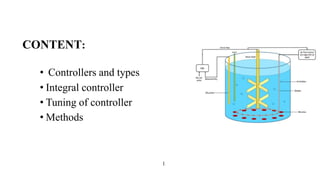
CONTENT:
• Controllers and types
• Integral controller
• Tuning of controller
• Methods
1
CONTROLLER:
• A controller in a fermenter is a device or system used to monitor and
regulate various parameters during the fermentation process, such as
temperature, pH, agitation speed, and dissolved oxygen levels.
• It helps maintain optimal conditions for the growth of microorganisms
or the production of desired compounds, ensuring efficient and
consistent fermentation outcomes.
2
TYPES OF CONTROLLER:
• Controllers in fermenter can be classified into three types:
1)Proportional controller
2) Integral controller
3)Derivative controller
3
INTEGRAL CONTROLLER:
• In a fermenter, an integral controller is a type of feedback control
mechanism used to regulate specific parameters such as temperature,
pH, dissolved oxygen, or agitation speed. The integral controller
continuously integrates the error signal over time and uses this
integrated error to adjust the control action.
• Integral control is valuable in fermenters because it helps to reduce
steady-state errors and ensures that the controlled parameters are
maintained close to their desired set points over time, leading to more
stable and consistent fermentation processes.
4
INTEGRAL CONTROLLER:
For example, in a temperature control system, if the actual temperature
deviates from the desired set point, the integral controller calculates the
accumulated error over time and applies a corrective action to bring
the temperature back to the set point. This corrective action could
involve adjusting the heating or cooling system to maintain the
desired temperature inside the fermenter.
5
FEATURES OF INTEGRAL
CONTROLLER:
• Integral Controllers improve the steady-state accuracy by decreasing
the steady state error.
• As the steady-state accuracy improves, the stability also improves.
• They also help in reducing the unwanted offsets produced by the
system.
• It can help in reducing the noise signals produced by the system.
• Integral Controllers receive error signals from sensors throughout the
process.
6
Advantages Of Integral Controller:
•Due to their unique ability, Integral Controllers
can return the controlled variable back to the
exact set point following a disturbance that’s
why these are known as reset controllers.
Disadvantages of Integral Controller:
•It tends to make the system unstable because it
responds slowly towards the produced error.
7
TUNING OF CONTROLLER:
• Tuning of a controller in a fermenter refers to the process of adjusting
the controller’s parameters to optimize its performance and ensure
effective regulation of fermentation parameters such as temperature,
pH, dissolved oxygen, or agitation speed.
• The tuning process involves adjusting parameters such as
proportional gain time , integral signal time, and derivative time in
control system. This typically requires careful experimentation and
analysis to find the optimal values for these parameters based on the
specific characteristics of the fermentation process, the dynamics of
the system, and the desired control objectives.
8
METHODS:
•There are various methods for tuning controllers in fermenters, includes
1) Manual tuning, where operators adjust the parameters based on their
experience and knowledge of the system.
2) Automatic tuning, where algorithms are used to optimize the parameters
based on system responses and performance criteria.
GOALS :
The goal of tuning is to ensure that the controller can effectively regulate the
fermentation parameters, minimize deviations from the set points, and maintain
optimal conditions for microbial growth and product formation throughout the
fermentation process. Properly tuned controllers contribute to the responsiveness,
robustness, efficiency, reproducibility, and consistency of fermentation processes.
9
MCQ’s
1) Integral controllers are also known as
A) Restore controller
B) Reset controller
C) Error controller
D) Growth controller
2) Integral controller decreases_________ errors
A) Random error
B) Transient error
C) Steady-state error
D) Systematic error
MCQ's-Ans
1) Integral controllers are also known as
A) Restore controller
B) Reset controller
C) Error controller
D) Growth controller
2) Integral controller decreases_________ errors
A) Random error
B) Transient error
C) Steady-state error
D) Systematic error
MCQ’s
3) How many types are involved in tuning of controller?
A) 1
B) 2
C) 3
D) 4
4) An important parameter involved in tuning process to achieve stability?
A) Temperature
B) pH
C) Pressure
D) Time
MCQ's-Ans
3) How many types are involved in tuning of controller?
A) 1
B) 2
C) 3
D) 4
4) An important parameter involved in tuning process to achieve stability?
A) Temperature
B) pH
C) Pressure
D) Time
Reference:
• https://www.electrical4u.com/types-of-controllers-proportional-
integral-derivative-controllers/
•https://www.controlglobal.com/control/loop-
control/article/11315980/criteria-and-procedure-for-controller-tuning
Integral controller, tuning of controller

Integral controller, tuning of controller

  • 1.
    DEPARTMENT OF BIOTECHNOLOGY XBT602-UPSTREAMPROCESSING TOPIC:TYPES OF CONTROLLER: INTEGRAL CONTROLLER AND TUNING OF CONTROLLER PRESENTED BY: S VARRSHA(121011101435) III rd year B. Tech-biotechnology SUBMITTED TO: Ms.P Mala Assistant Professor Periyar Maniammai Institute Of Science And Technology
  • 2.
    CONTENT: • Controllers andtypes • Integral controller • Tuning of controller • Methods 1
  • 3.
    CONTROLLER: • A controllerin a fermenter is a device or system used to monitor and regulate various parameters during the fermentation process, such as temperature, pH, agitation speed, and dissolved oxygen levels. • It helps maintain optimal conditions for the growth of microorganisms or the production of desired compounds, ensuring efficient and consistent fermentation outcomes. 2
  • 4.
    TYPES OF CONTROLLER: •Controllers in fermenter can be classified into three types: 1)Proportional controller 2) Integral controller 3)Derivative controller 3
  • 5.
    INTEGRAL CONTROLLER: • Ina fermenter, an integral controller is a type of feedback control mechanism used to regulate specific parameters such as temperature, pH, dissolved oxygen, or agitation speed. The integral controller continuously integrates the error signal over time and uses this integrated error to adjust the control action. • Integral control is valuable in fermenters because it helps to reduce steady-state errors and ensures that the controlled parameters are maintained close to their desired set points over time, leading to more stable and consistent fermentation processes. 4
  • 6.
    INTEGRAL CONTROLLER: For example,in a temperature control system, if the actual temperature deviates from the desired set point, the integral controller calculates the accumulated error over time and applies a corrective action to bring the temperature back to the set point. This corrective action could involve adjusting the heating or cooling system to maintain the desired temperature inside the fermenter. 5
  • 7.
    FEATURES OF INTEGRAL CONTROLLER: •Integral Controllers improve the steady-state accuracy by decreasing the steady state error. • As the steady-state accuracy improves, the stability also improves. • They also help in reducing the unwanted offsets produced by the system. • It can help in reducing the noise signals produced by the system. • Integral Controllers receive error signals from sensors throughout the process. 6
  • 8.
    Advantages Of IntegralController: •Due to their unique ability, Integral Controllers can return the controlled variable back to the exact set point following a disturbance that’s why these are known as reset controllers. Disadvantages of Integral Controller: •It tends to make the system unstable because it responds slowly towards the produced error. 7
  • 9.
    TUNING OF CONTROLLER: •Tuning of a controller in a fermenter refers to the process of adjusting the controller’s parameters to optimize its performance and ensure effective regulation of fermentation parameters such as temperature, pH, dissolved oxygen, or agitation speed. • The tuning process involves adjusting parameters such as proportional gain time , integral signal time, and derivative time in control system. This typically requires careful experimentation and analysis to find the optimal values for these parameters based on the specific characteristics of the fermentation process, the dynamics of the system, and the desired control objectives. 8
  • 10.
    METHODS: •There are variousmethods for tuning controllers in fermenters, includes 1) Manual tuning, where operators adjust the parameters based on their experience and knowledge of the system. 2) Automatic tuning, where algorithms are used to optimize the parameters based on system responses and performance criteria. GOALS : The goal of tuning is to ensure that the controller can effectively regulate the fermentation parameters, minimize deviations from the set points, and maintain optimal conditions for microbial growth and product formation throughout the fermentation process. Properly tuned controllers contribute to the responsiveness, robustness, efficiency, reproducibility, and consistency of fermentation processes. 9
  • 11.
    MCQ’s 1) Integral controllersare also known as A) Restore controller B) Reset controller C) Error controller D) Growth controller 2) Integral controller decreases_________ errors A) Random error B) Transient error C) Steady-state error D) Systematic error
  • 12.
    MCQ's-Ans 1) Integral controllersare also known as A) Restore controller B) Reset controller C) Error controller D) Growth controller 2) Integral controller decreases_________ errors A) Random error B) Transient error C) Steady-state error D) Systematic error
  • 13.
    MCQ’s 3) How manytypes are involved in tuning of controller? A) 1 B) 2 C) 3 D) 4 4) An important parameter involved in tuning process to achieve stability? A) Temperature B) pH C) Pressure D) Time
  • 14.
    MCQ's-Ans 3) How manytypes are involved in tuning of controller? A) 1 B) 2 C) 3 D) 4 4) An important parameter involved in tuning process to achieve stability? A) Temperature B) pH C) Pressure D) Time
  • 15.