Electronic Instrumentation
Lecturer Touseef Yaqoob
1
Instrument Classification
1)Active Instrument
2)Passive Instruments
Instruments are either active or passive
according to whether the instrument
output is entirely produced by the
quantity being measured or whether the
quantity being measured simply
modulates the magnitude of some
external power source.
Electronic Instrumentation
Lecturer Touseef Yaqoob
2
Examples
An example of passive instrument is
the pressure measuring device in
which the pressure of the fluid is
translated into movement of a
pointer against a scale.
An example of a active instrument is a
float-type petrol-tank level indicator.
Electronic Instrumentation
Lecturer Touseef Yaqoob
3
Points to remember
 In active instruments the external power source
is usually electrical in form, but in some cases it
can be pneumatic or hydraulic.
 One important difference between active and
passive instruments is the level of measurement
resolution which can be obtained.
 Passive instruments are normally cheaper to
manufacture then active instruments.
Electronic Instrumentation
Lecturer Touseef Yaqoob
4
Static characteristics of
instruments
 Accuracy
 Precision/repeatability
 Tolerance
 Range or span
 Bias
 Linearity
 Sensitivity of measurement
 Sensitivity to disturbance
 Hysteresis
 Dead space
 Threshold
 Resolution
Electronic Instrumentation
Lecturer Touseef Yaqoob
5
Accuracy:
Accuracy is the extent to which a reading
might be wrong, and is often quoted as a
percentage of full-scale reading of an
instrument.
Precision:
Precision is a term which describes an
instrument’s degree of freedom from random
errors.
Electronic Instrumentation
Lecturer Touseef Yaqoob
6
Tolerance:
Tolerance is a term which is closely related to
accuracy and defines the maximum error
which is to be expected in some value.
Range or Span:
The range or span of an instrument defines
the minimum and maximum values of a
quantity that the instrument is designed to
measure.
Electronic Instrumentation
Lecturer Touseef Yaqoob
7
Bias:
Bias describes a constant error which exists
over the full range of measurement of an
instrument.
Linearity:
It is normally describes that the output reading of
an instrument is linearly proportional to the
quantity being measured.
Sensitivity:
Sensitivity is a measure of the change in
instrument output which occurs when the
quantity being measured changes by a given
amount.
Electronic Instrumentation
Lecturer Touseef Yaqoob
8
Sensitivity to disturbance:
Sensitivity to disturbance is a measure of
the magnitude of change in static
characteristic of a instrument due to
environmental changes.
Such changes effect instrument in two main
ways.
1) Zero drift
2) Sensitivity drift (Scale factor drift)
Electronic Instrumentation
Lecturer Touseef Yaqoob
9
Hysteresis:
The non-coincidence
between loading and
unloading curves is
known as hysteresis.
Dead space:
Dead space is defined
as the range of
different input values
over which there is no
change in output
value.
Electronic Instrumentation
Lecturer Touseef Yaqoob
10
Threshold:
The minimum level of input before the change
in the instrument output reading is of large
enough magnitude to be detectable is known
as the threshold of the instrument.
Resolution:
The minimum reading that can be taken from
instruments.
Electronic Instrumentation
Lecturer Touseef Yaqoob
11
The Dynamic Response of
Measuring Instruments
The dynamic response of a measuring
instrument is the change in the output y
caused by a change in the input x. Both x and
y are functions of time t .
Classes of Linear Instruments
Zero Order Instruments
First Order Instruments
Second Order Instruments
Electronic Instrumentation
Lecturer Touseef Yaqoob
12
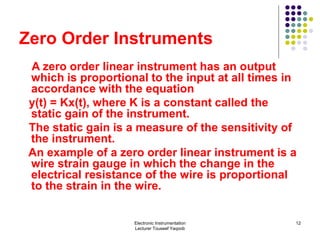
Zero Order Instruments
A zero order linear instrument has an output
which is proportional to the input at all times in
accordance with the equation
y(t) = Kx(t), where K is a constant called the
static gain of the instrument.
The static gain is a measure of the sensitivity of
the instrument.
An example of a zero order linear instrument is a
wire strain gauge in which the change in the
electrical resistance of the wire is proportional
to the strain in the wire.
Electronic Instrumentation
Lecturer Touseef Yaqoob
13
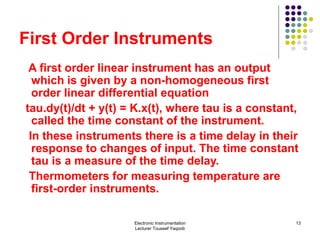
First Order Instruments
A first order linear instrument has an output
which is given by a non-homogeneous first
order linear differential equation
tau.dy(t)/dt + y(t) = K.x(t), where tau is a constant,
called the time constant of the instrument.
In these instruments there is a time delay in their
response to changes of input. The time constant
tau is a measure of the time delay.
Thermometers for measuring temperature are
first-order instruments.
Electronic Instrumentation
Lecturer Touseef Yaqoob
14
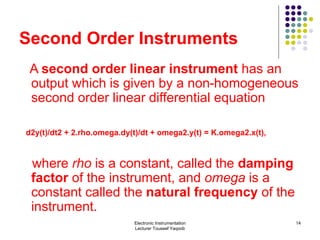
Second Order Instruments
A second order linear instrument has an
output which is given by a non-homogeneous
second order linear differential equation
d2y(t)/dt2 + 2.rho.omega.dy(t)/dt + omega2.y(t) = K.omega2.x(t),
where rho is a constant, called the damping
factor of the instrument, and omega is a
constant called the natural frequency of the
instrument.
Electronic Instrumentation
Lecturer Touseef Yaqoob
15
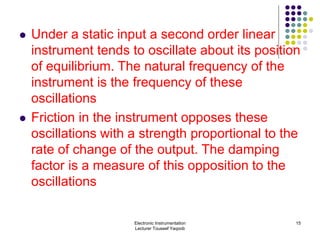
 Under a static input a second order linear
instrument tends to oscillate about its position
of equilibrium. The natural frequency of the
instrument is the frequency of these
oscillations
 Friction in the instrument opposes these
oscillations with a strength proportional to the
rate of change of the output. The damping
factor is a measure of this opposition to the
oscillations
Electronic Instrumentation
Lecturer Touseef Yaqoob
16
 An example of a second order linear instrument is a
galvanometer which measures an electrical current by the
torque on a coil carrying the current in a magnetic field. The
rotation of the coil is opposed by a spring. The strength of
the spring and the moment of inertia of the coil determine
the natural frequency of the instrument. The damping of the
oscillations is by mechanical friction and electrical eddy
currents.
 Another example of a second order linear instrument is a U-
tube manometer for measuring pressure differences. The
liquid in the U-tube tends to oscillate from side to side in the
tube with a frequency determined by the weight of the liquid.
The damping factor is determined by viscosity in the liquid
and friction between the liquid and the sides of the tube.

Instrument Classification : Active & Passive Instrument

  • 1.
    Electronic Instrumentation Lecturer TouseefYaqoob 1 Instrument Classification 1)Active Instrument 2)Passive Instruments Instruments are either active or passive according to whether the instrument output is entirely produced by the quantity being measured or whether the quantity being measured simply modulates the magnitude of some external power source.
  • 2.
    Electronic Instrumentation Lecturer TouseefYaqoob 2 Examples An example of passive instrument is the pressure measuring device in which the pressure of the fluid is translated into movement of a pointer against a scale. An example of a active instrument is a float-type petrol-tank level indicator.
  • 3.
    Electronic Instrumentation Lecturer TouseefYaqoob 3 Points to remember  In active instruments the external power source is usually electrical in form, but in some cases it can be pneumatic or hydraulic.  One important difference between active and passive instruments is the level of measurement resolution which can be obtained.  Passive instruments are normally cheaper to manufacture then active instruments.
  • 4.
    Electronic Instrumentation Lecturer TouseefYaqoob 4 Static characteristics of instruments  Accuracy  Precision/repeatability  Tolerance  Range or span  Bias  Linearity  Sensitivity of measurement  Sensitivity to disturbance  Hysteresis  Dead space  Threshold  Resolution
  • 5.
    Electronic Instrumentation Lecturer TouseefYaqoob 5 Accuracy: Accuracy is the extent to which a reading might be wrong, and is often quoted as a percentage of full-scale reading of an instrument. Precision: Precision is a term which describes an instrument’s degree of freedom from random errors.
  • 6.
    Electronic Instrumentation Lecturer TouseefYaqoob 6 Tolerance: Tolerance is a term which is closely related to accuracy and defines the maximum error which is to be expected in some value. Range or Span: The range or span of an instrument defines the minimum and maximum values of a quantity that the instrument is designed to measure.
  • 7.
    Electronic Instrumentation Lecturer TouseefYaqoob 7 Bias: Bias describes a constant error which exists over the full range of measurement of an instrument. Linearity: It is normally describes that the output reading of an instrument is linearly proportional to the quantity being measured. Sensitivity: Sensitivity is a measure of the change in instrument output which occurs when the quantity being measured changes by a given amount.
  • 8.
    Electronic Instrumentation Lecturer TouseefYaqoob 8 Sensitivity to disturbance: Sensitivity to disturbance is a measure of the magnitude of change in static characteristic of a instrument due to environmental changes. Such changes effect instrument in two main ways. 1) Zero drift 2) Sensitivity drift (Scale factor drift)
  • 9.
    Electronic Instrumentation Lecturer TouseefYaqoob 9 Hysteresis: The non-coincidence between loading and unloading curves is known as hysteresis. Dead space: Dead space is defined as the range of different input values over which there is no change in output value.
  • 10.
    Electronic Instrumentation Lecturer TouseefYaqoob 10 Threshold: The minimum level of input before the change in the instrument output reading is of large enough magnitude to be detectable is known as the threshold of the instrument. Resolution: The minimum reading that can be taken from instruments.
  • 11.
    Electronic Instrumentation Lecturer TouseefYaqoob 11 The Dynamic Response of Measuring Instruments The dynamic response of a measuring instrument is the change in the output y caused by a change in the input x. Both x and y are functions of time t . Classes of Linear Instruments Zero Order Instruments First Order Instruments Second Order Instruments
  • 12.
    Electronic Instrumentation Lecturer TouseefYaqoob 12 Zero Order Instruments A zero order linear instrument has an output which is proportional to the input at all times in accordance with the equation y(t) = Kx(t), where K is a constant called the static gain of the instrument. The static gain is a measure of the sensitivity of the instrument. An example of a zero order linear instrument is a wire strain gauge in which the change in the electrical resistance of the wire is proportional to the strain in the wire.
  • 13.
    Electronic Instrumentation Lecturer TouseefYaqoob 13 First Order Instruments A first order linear instrument has an output which is given by a non-homogeneous first order linear differential equation tau.dy(t)/dt + y(t) = K.x(t), where tau is a constant, called the time constant of the instrument. In these instruments there is a time delay in their response to changes of input. The time constant tau is a measure of the time delay. Thermometers for measuring temperature are first-order instruments.
  • 14.
    Electronic Instrumentation Lecturer TouseefYaqoob 14 Second Order Instruments A second order linear instrument has an output which is given by a non-homogeneous second order linear differential equation d2y(t)/dt2 + 2.rho.omega.dy(t)/dt + omega2.y(t) = K.omega2.x(t), where rho is a constant, called the damping factor of the instrument, and omega is a constant called the natural frequency of the instrument.
  • 15.
    Electronic Instrumentation Lecturer TouseefYaqoob 15  Under a static input a second order linear instrument tends to oscillate about its position of equilibrium. The natural frequency of the instrument is the frequency of these oscillations  Friction in the instrument opposes these oscillations with a strength proportional to the rate of change of the output. The damping factor is a measure of this opposition to the oscillations
  • 16.
    Electronic Instrumentation Lecturer TouseefYaqoob 16  An example of a second order linear instrument is a galvanometer which measures an electrical current by the torque on a coil carrying the current in a magnetic field. The rotation of the coil is opposed by a spring. The strength of the spring and the moment of inertia of the coil determine the natural frequency of the instrument. The damping of the oscillations is by mechanical friction and electrical eddy currents.  Another example of a second order linear instrument is a U- tube manometer for measuring pressure differences. The liquid in the U-tube tends to oscillate from side to side in the tube with a frequency determined by the weight of the liquid. The damping factor is determined by viscosity in the liquid and friction between the liquid and the sides of the tube.