SpeedSecrets.com
Being A Better Instructor
What?
When?
How?
Programming
‣ We do what we do because we’re
programmed to do so
‣ We don’t do what we want because we
either don’t have the right program, or…
‣ We access the wrong program
You’re a “Programmer.”
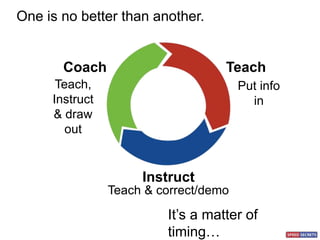
Types of training…
One is no better than another.
It’s a matter of
timing…
Teach
Instruct
Coach
Put info
in
Teach & correct/demo
Teach,
Instruct
& draw
out
Teach novices; coach advanced
students. But always… coach when
you can.
You’re a “Teacher, Instructor
& Coach.”
Get to the core of the problem.
"Ogres are like
onions. They have
layers." - Shrek
Focus on the solution, not the problem.
You’re an “Onion-Peeler.”
Objectives…
No more than 3, please.
“Work on being smoother” “Focus on slower
movements of the
steering wheel. How? By
looking farther ahead.”
“Great job last session.
Do more of that next
session.”
“You did a great job of
looking far ahead last
session. Next session, I
want you to exaggerate
how far ahead you look.”
Vague Objectives Clear/Concise Objectives
Setting objectives…
Provide clear, well-define objectives
– and no more than 3.
You’re a “Strategizer.”
Where do you get
your plan from?
Have a plan. Work the plan.
You’re a “Planner.”
‣ Ask, listen, coach - draw
out knowledge, rather
than just stuffing it in
‣ Body language,
gesturing... Yours &
student's
‣ Change cadence, volume
when talking
‣ Students learn more from
your actions than they do
from your words.
Communicate with your mouth,
ears & body.
You’re a “Communicator.”
You cannot not think about
something.
“Try not. Do or do not. There is
no try.” - Yoda
Tell your students what to do,
not what not to do.
You’re a “Focus-er.”
Feedback: There are 2 types?
1. Confirming
2. Corrective
“You’re not
smooth”
“Practice a
slower brake
release”
“You’re not
looking far
enough ahead”
“Look through
the apex to the
exit point”
Describes the
Problem
Focused on
Solution
Feedback: Focus on the solution
Vaguely
Constructive
“Drive
smoother”
“Look ahead”
“Practice a slower brake
release”
“Slow release”
“Look through apex to exit
point”
“Look to exit”
Long Description Short Description/Trigger
Feedback: Build triggers
You’re a “Feedback-Giver.”
LEARNINGPROGRESSION
TIME
If your student doesn’t appear to be
learning, just wait… he/she will soon.
You’re a “Learning Manager.”
Awareness
leads to
changes in
behavior.
Make sure your student has a strong
Mental Image of the task, and an
Awareness of what he’s doing now.
MI + A = G
You’re an “Awareness-Builder.”
Take Responsibility & Control
Take Control. Take Responsibility.
You’re “Responsible.”
CONFIDENCE
SKILL
CONFIDENCE
SKILL
CONFIDENCE
SKILL
Driver #1 Driver #2 Driver #3
Balance Confidence with Skill.
You’re a “Confidence / Skill
Manager.”
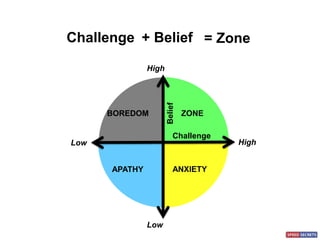
Low
Low
High
High
Belief
Challenge
ZONEBOREDOM
APATHY ANXIETY
Challenge + Belief = Zone
You’re a “Zone Influencer.”
You’re a…
1. “Programmer”
2. “Teacher, Instructor
& Coach”
3. “Onion-Peeler”
4. “Strategizer”
5. “Planner”
6. “Communicator”
7. “Focus-er”
8. “Feedback Giver”
9. “Learning Manager”
10. “Awareness-Builder”
11. “Responsible”
12. “Confidence / Skill
Manager”
13. “Zone Influencer”
14. And…
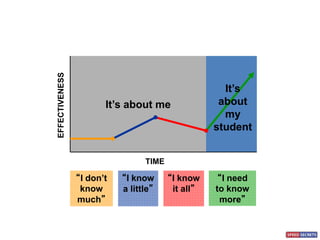
It’s about me
TIME
EFFECTIVENESS
“I don’t
know
much”
“I know
a little”
“I know
it all”
“I need
to know
more”
It’s
about
my
student
Remember what it’s all about:
Our students.
You’re here for your
Students.
Know When To Stop
 Students have a limit…
 Respect it
Reversed Q&A
Being A Better Instructor
 How do I deal with a novice student, in an
ultra-performance car – and the electronic
“nannies” are the only thing keeping him
on track?
 How do I manage around the “driver aids”
– how do I help my students while stability
control is active?
What To Do?
 How do I deal with an advanced driver
who is a better driver than me? What do I
teach?
What To Do?
 How do I identify & correct small errors
before they become BIG ones?
 How do I control a driver?
 How do I know whether I’m in control or
not?
What To Do?
 How do I build trust & a relationship with
my student before hitting the track?
What To Do?
 How do I create a “teaching plan”?
What To Do?
 How do I deal with “problem students”?
What To Do?
 How do I provide a fun, great “customer
experience” for my students?
What To Do?
Common Errors
Being A Better Instructor
Bad programmingNot looking far
enough ahead
“Look ahead”; point
to focus point
Un-smooth with
controls
Bad programming Build awareness of
smoothness - rating
Doesn’t drive
correct line
Lack of programming;
lack of reference points;
not looking far enough
ahead
Mental imagery;
Sensory Input
sessions; “Look
ahead”; point to
focus points
ERROR CAUSE SOLUTION
Early turn-in
Bad/lack of
programming; not
looking through turn;
lack of reference point
“Look ahead”; point
to focus point;
Sensory Input
session
Late turn-in
Bad/lack of
programming; not
looking through turn;
lack of reference point
“Look ahead”; point
to focus point;
Sensory Input
session
Not using all
the track
Lack of programming;
not looking far enough
ahead; lack of
awareness
Remind “Look
ahead”; ask “How
close to edge of
track is car?”
ERROR CAUSE SOLUTION
Too much
corner entry
speed
Lack of sensory input;
bad programming; lack
of knowledge (slow in-
fast out)
Sensory Input
session; slow in-
fast out discussion
Too little corner
entry speed
Lack of sensory input;
bad programming
Sensory Input
session; “Focus on
E-o-B point”;
“Release brakes”
Unbalances the
car
Bad programming; lack
of sensory input
Sensory Input
session; awareness
of smoothness -
rating
ERROR CAUSE SOLUTION
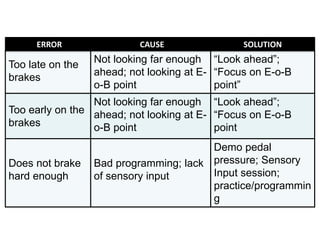
Too late on the
brakes
Not looking far enough
ahead; not looking at E-
o-B point
“Look ahead”;
“Focus on E-o-B
point”
Too early on the
brakes
Not looking far enough
ahead; not looking at E-
o-B point
“Look ahead”;
“Focus on E-o-B
point
Does not brake
hard enough
Bad programming; lack
of sensory input
Demo pedal
pressure; Sensory
Input session;
practice/programmin
g
ERROR CAUSE SOLUTION
No feel for the
limits of traction
Lack of sensory input Sensory Input
session
Doesn’t feel
under/oversteer
Lack of sensory input;
lack of knowledge
Sensory Input
session; knowledge
discussion
Inconsistent Lack of sensory input
Sensory Input
session
ERROR CAUSE SOLUTION
Brake release
too early
Bad programming; lack
of sensory input; not
looking at E-o-B point
Sensory Input
session; “Focus on
E-o-B point”
Brake release
too late
Bad programming; lack
of sensory input; not
looking at E-o-B point
Sensory Input
session; “Focus on
E-o-B point”
Holds breath Bad programming
Exaggerate your
breathing;
“Breathe”
Examples
Being A Better Instructor
Novice Norman
 Drives a ‘07 5-Series.
 Friend convinced him to attend school,
but he’s not sure he should be here.
 Lacks skills, and is very nervous.
 Struggling with the line – drives from cone
to cone, and is slow.
Newbie Ned
 Drives a ’07 Cayman.
 Good skills, very nervous, but has always
dreamed of doing this.
 Brakes very early for all corners; when
you tell him to brake later he begins to
shake and looks like he could almost start
crying.
Intermediate Ida
 Drives a ‘07 Mini Cooper S.
 Has good skills, but is too cautious.
 Drives a good line, brakes well, smooth
heel & toe downshifts, over-slows for the
corners and waits too long to begin
accelerating.
Confident Cathy
 Drives a ‘05 Boxster S.
 Has limited skills, but is over-confident.
 Does not know how to heel & toe, braking
is too late (rushes into the turns), wants to
steer with one hand (other hand on
shifter), uses throttle like on-off switch,
enters Turn 5A way too fast and then
messes up 5B and 6.
Advanced Andy
 Drives a ‘01 M5.
 Great skills, very experienced, confident,
great attitude.
 As you ride with him you can’t find
anything to instruct him on; but he’s
asking for your help – he wants to get
better, but seems to be on a (very high)
plateau.
Natural Nelly
 Drives a mid-90s 911 - this is her 2nd time
on the track.
 Great skills, marginal experience, lacking
confident.
 Does all the right stuff, but doesn’t know
why – and that makes her nervous.
Inconsistent Ingo
 Drives an E30 BMW – and it’s in rough
shape.
 Does it right sometimes, and then not
right the next lap.
 Can drive the line, but inconsistently; is
smooth for a lap or so, then it’s almost as
if he gets lost; doesn’t seem to make the
same mistake twice, but keeps making
mistakes.
Timid Timmy
 Drives new 3-Series.
 Has more skills than confidence; is overly-
cautious.
 Drives a very precise & consistent line;
smooth with the controls.
 Is very quiet – about all he will say is “Yes,
okay” to everything you say.
 He could be much faster if he just pushed a
little more, but can’t seem to convince him to
do so.
Quiet Quincy
 Drives a Boxster.
 Is very aggressive driver with good skills, but
won’t say anything.
 He tends to rush everything: too late on the
brakes, too much corner entry speed, and
therefore slow coming out of the corner; he
gets away with it because he has good
control skills (but he’d be faster if he slowed
down).
 You can’t seem to communicate with him
because he won’t respond – but he turns
into a “monster” once he’s on the track.
Racey Roger
 Drives a ‘08 M3.
 Wants to chase down every other car on
the track; he’s very competitive.
 Likes to brag about how much faster he is
than others.
 He’s very rough with his braking,
downshifting, steering and throttle; his line
is okay unless he’s chasing someone –
then he follows the other car.
Ego Eddy
 Drives Porsche GT-3, R-compound tires,
adjustable shocks, 5-point harness &
racing seat, shows up at track wearing
driving suit.
 Likes to talk about how great he is… and
then wants to show you how great he is.
 Good skills, but not great – if he slowed
down & worked on skills he would do
better.
 Tends to turn in early and get on throttle
too abruptly – but car lets him get away
Aggressive Alex
 Drives an E36 with R-compound tires, roll
hoop, 5-point harness & racing seat.
 Good skills, but rough with them.
 Fast corner entry speed; a little slow on
exit, but not terrible.
 Very confident.
Rough Ron
 Drives a ’80 Porsche Turbo.
 Abrupt use of the controls (brakes,
throttle, steering).
 Border-line on lacking confidence.
 Doesn’t seem to have a feel for what the
car is doing – when he upsets balance, he
doesn’t recognize it.
Talkative Tom
 Drives a E30 M3.
 He talks to you all the time – won’t stop!
 Has average skills and confidence, but
inconsistent.
 Wants to know why he’s not advancing.

Instructor Training Sample

  • 1.
  • 2.
  • 5.
    Programming ‣ We dowhat we do because we’re programmed to do so ‣ We don’t do what we want because we either don’t have the right program, or… ‣ We access the wrong program
  • 6.
  • 7.
  • 8.
    One is nobetter than another. It’s a matter of timing… Teach Instruct Coach Put info in Teach & correct/demo Teach, Instruct & draw out
  • 9.
    Teach novices; coachadvanced students. But always… coach when you can.
  • 10.
    You’re a “Teacher,Instructor & Coach.”
  • 11.
    Get to thecore of the problem. "Ogres are like onions. They have layers." - Shrek
  • 12.
    Focus on thesolution, not the problem.
  • 13.
  • 14.
  • 15.
    “Work on beingsmoother” “Focus on slower movements of the steering wheel. How? By looking farther ahead.” “Great job last session. Do more of that next session.” “You did a great job of looking far ahead last session. Next session, I want you to exaggerate how far ahead you look.” Vague Objectives Clear/Concise Objectives Setting objectives…
  • 16.
    Provide clear, well-defineobjectives – and no more than 3.
  • 17.
  • 18.
    Where do youget your plan from?
  • 19.
    Have a plan.Work the plan.
  • 20.
  • 21.
    ‣ Ask, listen,coach - draw out knowledge, rather than just stuffing it in ‣ Body language, gesturing... Yours & student's ‣ Change cadence, volume when talking
  • 22.
    ‣ Students learnmore from your actions than they do from your words.
  • 23.
    Communicate with yourmouth, ears & body.
  • 24.
  • 25.
    You cannot notthink about something. “Try not. Do or do not. There is no try.” - Yoda
  • 26.
    Tell your studentswhat to do, not what not to do.
  • 27.
  • 28.
  • 29.
    Feedback: There are2 types? 1. Confirming 2. Corrective
  • 30.
    “You’re not smooth” “Practice a slowerbrake release” “You’re not looking far enough ahead” “Look through the apex to the exit point” Describes the Problem Focused on Solution Feedback: Focus on the solution Vaguely Constructive “Drive smoother” “Look ahead”
  • 31.
    “Practice a slowerbrake release” “Slow release” “Look through apex to exit point” “Look to exit” Long Description Short Description/Trigger Feedback: Build triggers
  • 32.
  • 33.
  • 34.
    If your studentdoesn’t appear to be learning, just wait… he/she will soon.
  • 35.
  • 36.
  • 37.
    Make sure yourstudent has a strong Mental Image of the task, and an Awareness of what he’s doing now. MI + A = G
  • 38.
  • 39.
  • 40.
    Take Control. TakeResponsibility.
  • 41.
  • 42.
  • 43.
  • 44.
    You’re a “Confidence/ Skill Manager.”
  • 45.
  • 46.
    You’re a “ZoneInfluencer.”
  • 47.
    You’re a… 1. “Programmer” 2.“Teacher, Instructor & Coach” 3. “Onion-Peeler” 4. “Strategizer” 5. “Planner” 6. “Communicator” 7. “Focus-er” 8. “Feedback Giver” 9. “Learning Manager” 10. “Awareness-Builder” 11. “Responsible” 12. “Confidence / Skill Manager” 13. “Zone Influencer” 14. And…
  • 48.
    It’s about me TIME EFFECTIVENESS “Idon’t know much” “I know a little” “I know it all” “I need to know more” It’s about my student
  • 49.
    Remember what it’sall about: Our students.
  • 50.
    You’re here foryour Students.
  • 51.
    Know When ToStop  Students have a limit…  Respect it
  • 52.
    Reversed Q&A Being ABetter Instructor
  • 53.
     How doI deal with a novice student, in an ultra-performance car – and the electronic “nannies” are the only thing keeping him on track?  How do I manage around the “driver aids” – how do I help my students while stability control is active? What To Do?
  • 54.
     How doI deal with an advanced driver who is a better driver than me? What do I teach? What To Do?
  • 55.
     How doI identify & correct small errors before they become BIG ones?  How do I control a driver?  How do I know whether I’m in control or not? What To Do?
  • 56.
     How doI build trust & a relationship with my student before hitting the track? What To Do?
  • 57.
     How doI create a “teaching plan”? What To Do?
  • 58.
     How doI deal with “problem students”? What To Do?
  • 59.
     How doI provide a fun, great “customer experience” for my students? What To Do?
  • 60.
    Common Errors Being ABetter Instructor
  • 61.
    Bad programmingNot lookingfar enough ahead “Look ahead”; point to focus point Un-smooth with controls Bad programming Build awareness of smoothness - rating Doesn’t drive correct line Lack of programming; lack of reference points; not looking far enough ahead Mental imagery; Sensory Input sessions; “Look ahead”; point to focus points ERROR CAUSE SOLUTION
  • 62.
    ERROR CAUSE SOLUTION Earlyturn-in Bad/lack of programming; not looking through turn; lack of reference point “Look ahead”; point to focus point; Sensory Input session Late turn-in Bad/lack of programming; not looking through turn; lack of reference point “Look ahead”; point to focus point; Sensory Input session Not using all the track Lack of programming; not looking far enough ahead; lack of awareness Remind “Look ahead”; ask “How close to edge of track is car?”
  • 63.
    ERROR CAUSE SOLUTION Toomuch corner entry speed Lack of sensory input; bad programming; lack of knowledge (slow in- fast out) Sensory Input session; slow in- fast out discussion Too little corner entry speed Lack of sensory input; bad programming Sensory Input session; “Focus on E-o-B point”; “Release brakes” Unbalances the car Bad programming; lack of sensory input Sensory Input session; awareness of smoothness - rating
  • 64.
    ERROR CAUSE SOLUTION Toolate on the brakes Not looking far enough ahead; not looking at E- o-B point “Look ahead”; “Focus on E-o-B point” Too early on the brakes Not looking far enough ahead; not looking at E- o-B point “Look ahead”; “Focus on E-o-B point Does not brake hard enough Bad programming; lack of sensory input Demo pedal pressure; Sensory Input session; practice/programmin g
  • 65.
    ERROR CAUSE SOLUTION Nofeel for the limits of traction Lack of sensory input Sensory Input session Doesn’t feel under/oversteer Lack of sensory input; lack of knowledge Sensory Input session; knowledge discussion Inconsistent Lack of sensory input Sensory Input session
  • 66.
    ERROR CAUSE SOLUTION Brakerelease too early Bad programming; lack of sensory input; not looking at E-o-B point Sensory Input session; “Focus on E-o-B point” Brake release too late Bad programming; lack of sensory input; not looking at E-o-B point Sensory Input session; “Focus on E-o-B point” Holds breath Bad programming Exaggerate your breathing; “Breathe”
  • 67.
  • 68.
    Novice Norman  Drivesa ‘07 5-Series.  Friend convinced him to attend school, but he’s not sure he should be here.  Lacks skills, and is very nervous.  Struggling with the line – drives from cone to cone, and is slow.
  • 69.
    Newbie Ned  Drivesa ’07 Cayman.  Good skills, very nervous, but has always dreamed of doing this.  Brakes very early for all corners; when you tell him to brake later he begins to shake and looks like he could almost start crying.
  • 70.
    Intermediate Ida  Drivesa ‘07 Mini Cooper S.  Has good skills, but is too cautious.  Drives a good line, brakes well, smooth heel & toe downshifts, over-slows for the corners and waits too long to begin accelerating.
  • 71.
    Confident Cathy  Drivesa ‘05 Boxster S.  Has limited skills, but is over-confident.  Does not know how to heel & toe, braking is too late (rushes into the turns), wants to steer with one hand (other hand on shifter), uses throttle like on-off switch, enters Turn 5A way too fast and then messes up 5B and 6.
  • 72.
    Advanced Andy  Drivesa ‘01 M5.  Great skills, very experienced, confident, great attitude.  As you ride with him you can’t find anything to instruct him on; but he’s asking for your help – he wants to get better, but seems to be on a (very high) plateau.
  • 73.
    Natural Nelly  Drivesa mid-90s 911 - this is her 2nd time on the track.  Great skills, marginal experience, lacking confident.  Does all the right stuff, but doesn’t know why – and that makes her nervous.
  • 74.
    Inconsistent Ingo  Drivesan E30 BMW – and it’s in rough shape.  Does it right sometimes, and then not right the next lap.  Can drive the line, but inconsistently; is smooth for a lap or so, then it’s almost as if he gets lost; doesn’t seem to make the same mistake twice, but keeps making mistakes.
  • 75.
    Timid Timmy  Drivesnew 3-Series.  Has more skills than confidence; is overly- cautious.  Drives a very precise & consistent line; smooth with the controls.  Is very quiet – about all he will say is “Yes, okay” to everything you say.  He could be much faster if he just pushed a little more, but can’t seem to convince him to do so.
  • 76.
    Quiet Quincy  Drivesa Boxster.  Is very aggressive driver with good skills, but won’t say anything.  He tends to rush everything: too late on the brakes, too much corner entry speed, and therefore slow coming out of the corner; he gets away with it because he has good control skills (but he’d be faster if he slowed down).  You can’t seem to communicate with him because he won’t respond – but he turns into a “monster” once he’s on the track.
  • 77.
    Racey Roger  Drivesa ‘08 M3.  Wants to chase down every other car on the track; he’s very competitive.  Likes to brag about how much faster he is than others.  He’s very rough with his braking, downshifting, steering and throttle; his line is okay unless he’s chasing someone – then he follows the other car.
  • 78.
    Ego Eddy  DrivesPorsche GT-3, R-compound tires, adjustable shocks, 5-point harness & racing seat, shows up at track wearing driving suit.  Likes to talk about how great he is… and then wants to show you how great he is.  Good skills, but not great – if he slowed down & worked on skills he would do better.  Tends to turn in early and get on throttle too abruptly – but car lets him get away
  • 79.
    Aggressive Alex  Drivesan E36 with R-compound tires, roll hoop, 5-point harness & racing seat.  Good skills, but rough with them.  Fast corner entry speed; a little slow on exit, but not terrible.  Very confident.
  • 80.
    Rough Ron  Drivesa ’80 Porsche Turbo.  Abrupt use of the controls (brakes, throttle, steering).  Border-line on lacking confidence.  Doesn’t seem to have a feel for what the car is doing – when he upsets balance, he doesn’t recognize it.
  • 81.
    Talkative Tom  Drivesa E30 M3.  He talks to you all the time – won’t stop!  Has average skills and confidence, but inconsistent.  Wants to know why he’s not advancing.