French Society in 1830
“


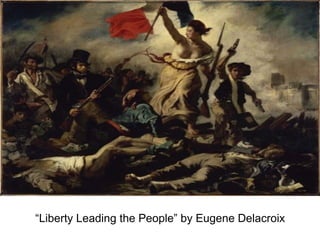
“Liberty Leading the People” by Eugene Delacroix
History of Painting

    Painted in 1830 by Eugene Delacroix.

    Eugene Delacroix was famous for capturing
    moments of extreme emotion in his paintings.

    “Liberty Leading the People,” is symbolic to the
    French Revolution in 1830.

    Delacroix created this painting in the aftermath
    of Paris' “Three Glorious Days,” which occurred
    on July 27-29, 1830. During these days a
    widespread revolt overthrew the regime of
    Charles X.
French Revolution of 1830

    Aslo referred as the July Revolution because it
    occurred on July 27-29.

    The reason for the rebellion is because Charles
    X planned to reinstate systems that were prior
    to the French Revolution in 1789. After he
    pledged one billion francs to the aristocracy in
    reparations for property loss during the
    revolution in 1789, he abolished free press and
    the legislature, as well as restricting suffrage
    rights. Three days after the fighting broke out.
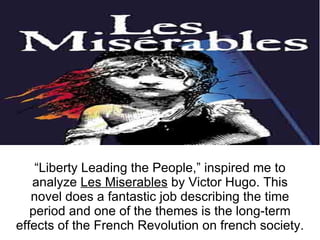
“Liberty Leading the People,” inspired me to
   analyze Les Miserables by Victor Hugo. This
   novel does a fantastic job describing the time
   period and one of the themes is the long-term
effects of the French Revolution on french society.
About the Author

    Victor Hugo was born on 1802 in Besancon,
    France.

    The French Revolution in 1830 greatly inspired
    Hugo's writing and he began producing a steady
    stream of work.

    He loved politics and was elected to France's
    National Assembly.

    Hugo's politics became very leftist and he was
    forced to flee France in 1851, but he returned in
    1870 as a national hero.

    His political concerns dominate much of his writing
    such as Les Miserables, which provides a detailed
    vision of French society during this time.
Summary

    Convict Jean Valjean is released from prison
    after serving 19 years for stealing bread.

    Jean Valjean promises to become an honest
    man and moves to Montreuil, where he later
    owns a factory and becomes the mayor. He
    even changed his name so no one would know
    who he was.

    A woman named Fantine finds work at Valjean's
    factory, but is fired because she has a daughter
    out of wedlock.

    Fantine resorts to prostitution so she can pay
    the family taking care of her daughter, Cosette.

    Javert, the police chief of the town, arrests Fantine,
    but Valjean intervenes and promises to take care
    of Fantine and Cosette.

    After Fantine dies Jean Valjean goes after Cosette
    and they flee from Javert.

    Years later Cosette falls in love with a boy who is
    leading an uprising. During the uprising they
    capture Javert and Valjean volunteers to execute
    him, but ends up letting him go.

    Javert goes on the hunt for Valjean and when he
    catches up to him, Javert realizes what he is doing
    is wrong and kills himself.

    In the end Cosette gets married to Marius and
    Valjean lives a normal life without hiding from the
    police and dies peacefully.
http://www.youtube.com/watch?v=Oni72F17xaw
Annotated Bibliography
Benford, Susan. "Famous Paintings Reviewed." Famous
      Paintings: Liberty Leading the People, 1830.
     Masterpiece Cards, 2012. Web. 02 Apr. 2012
     In this article, Susan Benford gave a lot of
      information about the painting, “Liberty Leading the
      People,” and the French Revolution in 1830. She
      also gave information of the artist Eugene Delacroix,
      such that he liked to paint things that had a lot of
      emotion.
Art Game Board Game. Prestel. 2003
    This is where I got my picture that inspired me. The
     picture that I chose was, “Liberty Leading the
     People,” by Eugene Delacroix.
Hugo, Victor. Les Miserables. Carleton, 1862. Print.
    A convist is released from jail and eventually becomes
    an honest man. Unfortunately his past is still haunting
    him and he is forced to hide from the police. After
    adopting a girl he tries his best to raise he right and
    stay safe. In the end his daughter gets married and he
    lives a normal life without having to hide.
Sparknotes. "Les Misérables." SparkNotes. SparkNotes,
    2012. Web. 02 Apr. 2012.
       On this website I learned a great amount of things
   about Victor Hugo. The Revolution in 1830 inspired
    him greatly and help him produce a steady stream
    of work. He loved politics and his political concerns
  dominated much of his writing.

Inquiry 3 semester 2

  • 1.
  • 2.
    “ “Liberty Leading thePeople” by Eugene Delacroix
  • 3.
    History of Painting  Painted in 1830 by Eugene Delacroix.  Eugene Delacroix was famous for capturing moments of extreme emotion in his paintings.  “Liberty Leading the People,” is symbolic to the French Revolution in 1830.  Delacroix created this painting in the aftermath of Paris' “Three Glorious Days,” which occurred on July 27-29, 1830. During these days a widespread revolt overthrew the regime of Charles X.
  • 4.
    French Revolution of1830  Aslo referred as the July Revolution because it occurred on July 27-29.  The reason for the rebellion is because Charles X planned to reinstate systems that were prior to the French Revolution in 1789. After he pledged one billion francs to the aristocracy in reparations for property loss during the revolution in 1789, he abolished free press and the legislature, as well as restricting suffrage rights. Three days after the fighting broke out.
  • 5.
    “Liberty Leading thePeople,” inspired me to analyze Les Miserables by Victor Hugo. This novel does a fantastic job describing the time period and one of the themes is the long-term effects of the French Revolution on french society.
  • 6.
    About the Author  Victor Hugo was born on 1802 in Besancon, France.  The French Revolution in 1830 greatly inspired Hugo's writing and he began producing a steady stream of work.  He loved politics and was elected to France's National Assembly.  Hugo's politics became very leftist and he was forced to flee France in 1851, but he returned in 1870 as a national hero.  His political concerns dominate much of his writing such as Les Miserables, which provides a detailed vision of French society during this time.
  • 7.
    Summary  Convict Jean Valjean is released from prison after serving 19 years for stealing bread.  Jean Valjean promises to become an honest man and moves to Montreuil, where he later owns a factory and becomes the mayor. He even changed his name so no one would know who he was.  A woman named Fantine finds work at Valjean's factory, but is fired because she has a daughter out of wedlock.  Fantine resorts to prostitution so she can pay the family taking care of her daughter, Cosette.
  • 8.
    Javert, the police chief of the town, arrests Fantine, but Valjean intervenes and promises to take care of Fantine and Cosette.  After Fantine dies Jean Valjean goes after Cosette and they flee from Javert.  Years later Cosette falls in love with a boy who is leading an uprising. During the uprising they capture Javert and Valjean volunteers to execute him, but ends up letting him go.  Javert goes on the hunt for Valjean and when he catches up to him, Javert realizes what he is doing is wrong and kills himself.  In the end Cosette gets married to Marius and Valjean lives a normal life without hiding from the police and dies peacefully.
  • 9.
  • 10.
    Annotated Bibliography Benford, Susan."Famous Paintings Reviewed." Famous Paintings: Liberty Leading the People, 1830. Masterpiece Cards, 2012. Web. 02 Apr. 2012 In this article, Susan Benford gave a lot of information about the painting, “Liberty Leading the People,” and the French Revolution in 1830. She also gave information of the artist Eugene Delacroix, such that he liked to paint things that had a lot of emotion. Art Game Board Game. Prestel. 2003 This is where I got my picture that inspired me. The picture that I chose was, “Liberty Leading the People,” by Eugene Delacroix.
  • 11.
    Hugo, Victor. LesMiserables. Carleton, 1862. Print. A convist is released from jail and eventually becomes an honest man. Unfortunately his past is still haunting him and he is forced to hide from the police. After adopting a girl he tries his best to raise he right and stay safe. In the end his daughter gets married and he lives a normal life without having to hide. Sparknotes. "Les Misérables." SparkNotes. SparkNotes, 2012. Web. 02 Apr. 2012. On this website I learned a great amount of things about Victor Hugo. The Revolution in 1830 inspired him greatly and help him produce a steady stream of work. He loved politics and his political concerns dominated much of his writing.