Innovation
for the food and
drink supply chain
Scientific and
technical needs
food and drink innovation
Campden BRI
2015-2017
Needs_Cover1_Layout 1 17/12/2014 08:56 Page 1
Contents
1 Introduction
3 Matrix - strategic themes and the
drivers for industry needs
4 Primary production, raw materials
and ingredients
6 Manufacturing and supply
8 Product and packaging
10 Food, drink and the consumer
12 About Campden BRI
Compiled, written and designed by
Campden BRI with sincere thanks to the
hundreds of industrial colleagues from
all parts of the food and drink supply chain,
who gave their time, energy and ideas during
the consultation process.
© Campden BRI 2014
Innovation
for the food and
drink supply chain
Scientific and
technical needs
Needs_Cover1_Layout 1 17/12/2014 08:57 Page 2
1
Introduction
Steven Walker,
Director-General
The production, preservation, manufacturing,
distribution and sale of food and drink rely heavily
on science and technology. This document (and
its associated website) maps out the food and
drink supply chain needs that can be addressed
through innovations in science, technology and
their application.
Many of these needs are ‘pre-competitive’, whilst
others will fuel innovations closer to market - the
exercise addressed the full spectrum in this
respect. No restriction was placed on whether
the needs would be met through basic, strategic
or applied pre-competitive activities or through
more ‘near-market’ innovations. However, it is a
statement of ‘needs’, not of solutions or
approaches to addressing those needs.
We have been providing an industrial statement
of needs since 1996 - updated on a ‘three-year
refresh’ cycle. This helps to ensure that the
ongoing developments in industry and in science
and technology are continually reviewed in the
context of the major strategic issues. Although
some of the needs expressed are quite pertinent
to a 3-5 year timescale, many are in fact long-
standing and are likely to demand innovation
(and the continued improvements this brings)
well beyond this timescale.
I would like to personally thank the hundreds of
industrial colleagues from all parts of the food and
drink supply chain who gave their time, energy and
ideas. I hope you find the document as useful as
we do.
Why?
The document has been produced to encourage the
application of science and technology to address the
needs identified by industry itself. Campden BRI will use
this statement of needs in two specific ways:
• First, it will help us to target our support for industry
through activities such as technical services, research
and development, knowledge and skills development,
and information provision
• Second, through our work with government
departments, agencies, funding bodies, standards
organisations and other third parties, we can raise
awareness of the issues industry faces and the needs
arising from these that have to be addressed - both
at a tactical and strategic level
How?
The needs mapped out here were identified through an
extensive consultation with Campden BRI members via:
• our 13 Member Interest Groups (which have a
collective membership of over 3,000 industrialists)
overseen by our Scientific and Technical Committee
(made up of 40 senior personnel from various
sectors and stages in the supply chain);
• an on-line survey of our international membership
base which spans 2,400 companies in 75 countries;
• gathering of ‘collective intelligence’ highlighting key
issues, by Campden BRI scientists and technologists
through our extensive day-to-day discussions with
members, other clients, and collaborative
organisations in the public and private sectors.
This is the largest consultation of the sector in
identifying its own needs. The process has also taken
account of other relevant initiatives and documents
(see ‘Related documents’ - page 2).
Scope
The consultation involved the whole supply chain -
from primary production through processing and
manufacturing to retail and food service - as well as
companies that supply into this chain.
The four main themes into which the needs are
classified reflect this ‘whole supply chain’ approach -
from primary production through manufacturing and
supply of the product and packaging, to food, drink and
the consumer. No restriction was placed on whether
the needs would be met through basic, strategic or
applied pre-competitive activities or through more
‘near-market’ innovations.
During the consultation there was considerable
discussion about the ‘drivers’ creating the needs. These
are more fluid, but through the consultation it became
evident that the primary drivers are currently:
InnovationFdSupply_2015jls6100_Layout 1 17/12/2014 11:13 Page 1
• Safety
• Quality and value
• Nutrition, health and well-being
• Environmental sustainability
• Resilience and efficiency
• Skills and knowledge
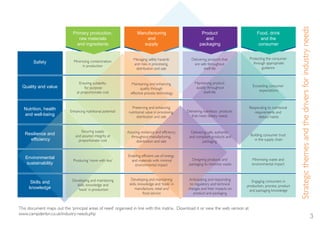
Considered together, the drivers and the supply chain
form the matrix shown on page 3, which illustrates
how a particular driver might create different needs at
different points in the chain. For example - ‘food
safety’ creates the need for assurance systems through
primary production and manufacturing whilst with the
finished product there might be a need for tools for
analysing particular hazards should a problem arise.
This document maps out the ‘principal areas of need’
organised in line with this matrix. As the document
spans the whole supply chain - from primary
production to manufacturing and supply (including
retail and food service) as well as the final product and
the consumers’ response - it does not list detailed
sector-specific needs. However, each sub-section of
the document can be viewed in the context of a sector
or supply chain stage - for example, for that sector’s
raw materials, ingredients, processes and practices.
Commonly expressed needs
Through the consultation a number of recurring needs
arose which were common to different parts of the
supply chain or from distinct but related drivers. Some
of these are worth highlighting:
• Assuring product safety through assurance and
analytical tools
• Encouraging consumer well-being through a healthy
diet
• Protecting consumers and industry from food fraud
• Encouraging sustainable practices such as better
crop protection and reduced use of resources
• Tackling industry’s ‘skills shortage’
Addressing the needs
This document is a statement of needs - what it is that
the food and drink supply chain needs from science,
technology and their practical application in order to
continue delivering safe and wholesome products that
meet the needs and wants of consumers.
The needs will be addressed through a number of
activities, examples of which include:
• The Campden BRI member-funded pre-competitive
research programme and tailored, company-specific
innovation projects
• Scientific, technical and knowledge based services
(e.g. courses, seminars, publications and databases)
from Campden BRI
• Research in other organisations (e.g. universities,
research institutes, RTOs) and individual companies
• Raising awareness of industry needs amongst
government departments, agencies, funding bodies,
standards organisations and other third parties - to
stimulate and inform new approaches in the
application of science and technology
• Collective provision of innovation, technical support
and ‘routine’ services through strategic collaboration
between wide-ranging, inter-disciplinary and
internationally dispersed third parties that serve the
food and drink supply chain globally
Related documents
Although the contents of this document are largely
based on an extensive consultation with Campden BRI
members along and supplying into the food and drink
supply chain, it takes account of a number of related
documents and initiatives, including the following which
might be of interest to the reader:
A UK strategy for agricultural technologies (Defra - July
2013) - www.gov.uk/government/publications/uk-
agricultural-technologies-strategy
A pre-competitive vision for the UK’s food & drink
industries (Biosciences Knowledge Transfer Network,
Technology Strategy Board, and the Food and Drink
Federation - 2013) - www.connect.innovateuk.org/
web/biosciencesktn/documents
Feeding The Future - Innovation Requirements for
Primary Food Production in the UK to 2030 -
www.feedingthefuture.info
Priority research questions for the UK food system
(Global Food Security - 2014) www.foodsecurity.ac.uk
Anticipatory Foresight Project - Institute of Food
Technologists - www.ift.org
Creating the future of food - SIK - The Swedish
Institute for Food and Biotechnology - www.sik.se
2
InnovationFdSupply_2015jls6100_Layout 1 17/12/2014 11:13 Page 2
3
Primary production,
raw materials
and ingredients
ging
Food, drink
and the
consumer
Strategicthemesandthedriversforindustryneeds
This document maps out the ‘principal areas of need’ organised in line with this matrix. Download it or view the web version at
www.campdenbri.co.uk/industry-needs.php
Minimising contamination
in production
Ensuring suitability
for purpose
at proportionate cost
Enhancing nutritional potential
Securing supply
and assured integrity at
proportionate cost
Producing ‘more with less’
Developing and maintaining
skills, knowledge and
‘tools’ in production
Managing safety hazards
and risks in processing,
distribution and sale
Maintaining and enhancing
quality through
effective process technology
Preserving and enhancing
nutritional value in processing,
distribution and sale
Assuring resilience and efficiency
throughout manufacturing,
distribution and sale
Enabling efficient use of energy
and materials with minimal
environmental impact
Developing and maintaining
skills, knowledge and ‘tools’ in
manufacture, retail and
food service
Delivering products that
are safe throughout
shelf-life
Maintaining product
quality throughout
shelf-life
Delivering nutritious products
that meet dietary needs
Delivering safe, authentic
and compliant products and
packaging
Designing products and
packaging to minimise waste
Anticipating and responding
to regulatory and technical
changes and their impacts on
product and packaging
Protecting the consumer
through appropriate
guidance
Exceeding consumer
expectations
Responding to nutritional
requirements and
dietary habits
Building consumer trust
in the supply chain
Minimising waste and
environmental impact
Engaging consumers in
production, process, product
and packaging knowledge
Primary production,
raw materials
and ingredients
Manufacturing
and
supply
Product
and
packaging
Food, drink
and the
consumer
Safety
Quality and value
Nutrition, health
and well-being
Resilience and
efficiency
Environmental
sustainability
Skills and
knowledge
InnovationFdSupply_2015jls6100_Layout 1 17/12/2014 11:13 Page 3
4
Primary
production,
raw materials
and
ingredients
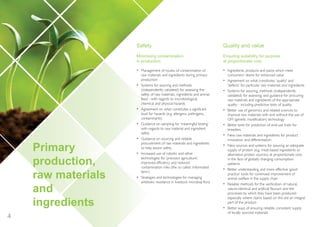
Quality and value
Ensuring suitability for purpose
at proportionate cost
• Ingredients, products and packs which meet
consumers’ desire for enhanced value
• Agreement on what constitutes ‘quality’ and
‘defects’ for particular raw materials and ingredients
• Systems for assuring, methods (independently
validated) for assessing, and guidance for procuring
raw materials and ingredients of the appropriate
quality - including predictive tests of quality
• Better use of genomics and related sciences to
improve raw materials with and without the use of
GM (genetic modification) technology
• Better tests for prediction of end-use traits for
breeders
• New raw materials and ingredients for product
innovation and differentiation
• New sources and systems for assuring an adequate
supply of protein (e.g. meat-based ingredients or
alternative protein sources) at proportionate cost,
in the face of globally changing consumption
patterns
• Better understanding and more effective ‘good
practice’ tools for continued improvement of
animal welfare in the supply chain
• Reliable methods for the verification of natural,
nature-identical and artificial flavours and the
processes by which they have been produced -
especially where claims based on this are an integral
part of the product
• Better ways of ensuring reliable, consistent supply
of locally sourced materials
Safety
Minimising contamination
in production
• Management of routes of contamination of
raw materials and ingredients during primary
production
• Systems for assuring and methods
(independently validated) for assessing the
safety of raw materials, ingredients and animal
feed - with regards to microbiological,
chemical and physical hazards
• Agreement on what constitutes a significant
level for hazards (e.g. allergens, pathogens,
contaminants)
• Guidance on sampling for ‘meaningful testing’
with regards to raw material and ingredient
safety
• Guidance on sourcing and reliable
procurement of raw materials and ingredients
to help assure safety
• Increased use of robotic and other
technologies for ‘precision agriculture’,
improved efficiency and reduced
contamination risks (the so called ‘informated
farm’)
• Strategies and technologies for managing
antibiotic resistance in livestock microbial flora
InnovationFdSupply_2015jls6100_Layout 1 17/12/2014 11:13 Page 4
Nutrition, health and well-being
Enhancing nutritional potential
• New raw materials and ingredients to facilitate
innovation with products aimed at groups with
special dietary needs - for example, for
reformulating products to reduce fat, sugar or salt
or achieve free-from status
• Ways of assessing and addressing the impact of
using lower cost ingredients on nutritional and
dietary quality
• Use of novel or neglected crop varieties that
offer high nutritional or health benefits
Resilience and efficiency
Securing supply and assured integrity
at proportionate cost
• Systems for assuring the identity and authenticity
of raw materials, ingredients and animal feed -
including traceability, assurance systems, risk
assessment, horizon scanning and intelligence
management
• Rapid and reliable verification of ‘authenticity’
attributes such as GM status, species of origin,
presence of allergens, geographical origin, organic
status, and free range status, and - where problems
arise - distinguishing between adventitious
contamination and deliberate substitution/fraud
• New pesticides, biological control and integrated
systems to protect crops against pests and
diseases of the future
• Developing crops that are less susceptible to
pests and climate change or more resistant to
environmental stresses and more variable
growing conditions
• Better understanding of and tools to pre-empt or
deal with seasonal and regional variations in raw
material and ingredient yield and quality -
including ability to cope with raw materials of
more variable quality
Environmental sustainability
Producing ‘more with less’
• Systems, technologies and practices for
‘sustainable intensification’ to secure the supply of
raw materials, ingredients and other inputs as
affected by environmental, economic and political
factors
• More efficient use of phosphates, water and
energy
• Technologies and systems to identify waste
streams, maximise efficiency and reduce (not just
‘displace’) waste during primary production
• Better understanding and more effective ‘good
practice’ tools for soil protection
• Supporting ‘urban farming’ through guidance to
adopt sustainable practices and prevent
contamination risks
• Better systems and methods for recovering and
recycling flexible packaging
• Use of IT systems to better match supply and
demand within the supply chain (thereby
reducing waste of unwanted / unsold product)
• Mechanisms for balancing the implications of
conflicting drivers (e.g. nutritious diets based
primarily on locally sourced, seasonal products)
Skills and knowledge
Developing and maintaining skills,
knowledge and ‘tools’ in production
• Simplified and harmonised specifications and
standards for raw materials and ingredients, to
increase business efficiency
• Approaches for addressing the skills shortages
faced in primary production
• Better guidance on legislation controlling waste
disposal and on routes for disposal of unavoidable
waste
• Better public communication of primary
production practices and their importance in
ensuring a secure, sustainable food supply
5
Consultation
through 29
industrial meetings
InnovationFdSupply_2015jls6100_Layout 1 17/12/2014 11:13 Page 5
Safety
Managing safety hazards and risks
in processing, distribution and sale
• Management of food-borne hazards and threats -
from availability of definitive information on
specified hazards (e.g. known and emerging
pathogens, allergens, known and emerging
chemical species, foreign bodies) through
continued cultivation of a food safety culture to
the practical implementation of systems such as
HACCP, TACCP, risk management and due
diligence testing
• Preventing cross-contamination that could
introduce safety hazards (e.g. pathogens, allergens,
chemical contaminants, foreign bodies) during
manufacturing and distribution
• Better hazard management through improved
understanding of the fate of specific hazards during
established and emerging processes (e.g.
formation, degradation, removal in waste / spent
materials)
• Rigorous assessment of and controls for the
hazards posed by ‘re-used’ and recycled materials
and resources in the production chain
• Guidance for interpreting and acting on
‘presumptive’ and ‘interim’ analytical results -
balancing the need to maintain safety with the
avoidance of unnecessary ‘scares’
• Robust systems for ensuring process efficacy and
validation (thermal and non-thermal) for control
of hazards in specific products - including, for
example, developments such as ‘low temperature
cooking’
• Better hygienic design of equipment, production
environments and buildings - enshrining good
hygienic design / easy ‘clean-ability’ throughout
manufacturing operations
• Efficient and cost-effective operative hygiene
systems and cleaning methods for plant,
equipment and facilities in manufacturing, retail
and food service environments
• Reliable detection and prevention of difficult-to-
detect foreign bodies (e.g. plastic)
Quality and value
Maintaining and enhancing quality through
effective process technology
• Improvements to established and emerging
technologies and processes for enhanced product
quality, production efficiency and product safety -
and strategies for their introduction at
proportionate cost
• Prevention of cross-contamination during
manufacturing and distribution that could
compromise product quality (e.g. authenticity,
free-from claims)
• More effective on-line technology for monitoring
and predicting product quality during production
• More flexible approaches to manufacturing to
enable rapid but efficient (low waste) responses to
customer requirements
6
Worldwide food, drink
and allied industries
Manufacturing
and supply
InnovationFdSupply_2015jls6100_Layout 1 17/12/2014 11:13 Page 6
Nutrition, health and well-being
Preserving and enhancing nutritional value
in processing, distribution and sale
• Optimisation of existing and emerging processes to
retain nutritional value through product shelf-life
• New technologies and processes to assist the
development and production of products aimed
specifically at improving diet and health
• Minimising the impact of low cost production on
nutritional quality, and methods for improving this
where needed
Resilience and efficiency
Assuring resilience and efficiency
throughout manufacturing, distribution
and sale
• Systems for assuring supply chain integrity and
preventing / tackling food fraud - including analytical
methods, systems for intelligence gathering, effective
horizon scanning and ways of assessing and
managing risk
• Lean, efficient and flexible manufacturing practices
• Effective systems for crisis management -
anticipating and responding to incidents involving
safety, food fraud and food quality
• Better in-line and near-line analytical methods for
relevant parameters - including reliable, factory-safe,
user-friendly (non-specialist) and portable test kits for
testing products and the environment in the factory
• Better cost-benefit analysis tools for investment in
capital equipment and manufacturing infrastructure
• Mechanisms for simplifying the supply chain (e.g.
technical support for more local sourcing)
• Better traceability systems (e.g. electronic,
integrated) throughout the supply chain - especially
for blended commodities (palm oil, cocoa, flour)
• Rationalised, simplified, harmonised and cost-
effective customer specifications, standards and
auditing to increase manufacturing business
efficiency without compromising product quality
• Ways of implementing quality management systems
and working practices in multi-lingual and multi-
cultural manufacturing sites
• Systems and equipment for the protection of the
health, safety and welfare of industry operatives
(e.g. production staff, laboratory personnel) -
including appropriate consideration of these aspects
at the planning and design phase
Environmental sustainability
Enabling efficient use of energy and
materials with minimal environmental impact
• Creation of production systems with built-in
‘sustainable practices’ (e.g. reduced energy input,
environmentally-friendly sanitation methods)
• Technologies, benchmarking systems and best
practice guidance for saving and/or recovering water,
energy and other resources and reducing waste,
without displacing the problem (e.g. carbon footprint)
• More effective use of co-products to reduce waste
• New ways to extend product shelf-life to reduce
waste (within the supply chain and with consumers)
and extend markets (wider distribution)
Skills and knowledge
Developing and maintaining skills,
knowledge and ‘tools’ in manufacture, retail
and food service
• Systems for combining, analysing, sharing and
exploiting ‘big data’ - from genomics and associated
sciences, through analytical and measurement data,
to ‘augmented and virtual sensing’, the ‘Internet of
things’, social media and brand analyses
• Methods for effective knowledge and technology
transfer within and into the food and drinks sector -
including links between the academic and industry
communities, and tailored and targeted delivery of
information
• Mechanisms for industry input into advising on
practical aspects of implementing legislation
• Appropriate, proportionate and evidence-based
regulatory controls with equitable and just
enforcement
• Approaches for addressing the skills shortages
faced by manufacturers and their suppliers
• Promoting careers within the food, drink
and allied industries
• Better public communication of
manufacturing practices, including
existing and emerging technologies, and
their importance in ensuring a secure,
sustainable food supply
7
InnovationFdSupply_2015jls6100_Layout 1 17/12/2014 11:13 Page 7
Safety
Delivering products that are safe
throughout shelf-life
• Systems for assuring and independently validated
methods for rapidly and cost-effectively assessing
the safety and spoilage of food and drink
products - especially new and emerging products
(e.g. intermediate moisture, low temperature
cooking)
• Promotion of the functional benefits of
ingredients, additives and packaging as an integral
part of maintaining product safety
• Establishing limits of key components (e.g. sugar,
salt, preservatives) and their ‘clean label
alternatives’ in reformulated products, so that
preservation efficiency and product safety are
not compromised
• Smart packaging technologies that assist in
assuring product safety and extending shelf-life
• Better product protection through tamper-
evident packaging
Quality and value
Maintaining product quality
throughout shelf-life
• Clear definitions of product quality - including
sensory, physical, chemical, nutritional and
microbiological attributes / criteria - and the way
in which it is measured and perceived
• Systems for assuring and independently validated
methods for rapidly and cost-effectively assessing
the quality and spoilage of food and drink
products
• Clean label replacements for or ways of reducing
sugar, fat, salt, preservatives, other additives and
other components without compromising
product quality or shelf-life
• Use of new and refined processing, preservation
and packaging technologies to improve quality,
preserve nutritional value and/or extend product
shelf-life without compromising product safety
• Clearer guidance on shelf-life determination for
different product types
• Methods for predicting and measuring colour
and texture of food and drink products to assess
final quality, stability through shelf-life and the
impact of processes and reformulation
• Test methods for the performance, integrity and
‘openability’ of new packaging formats (e.g. light-
weighted, new materials)
• Agreed risk assessment, analytical protocols and
management tools for packaging materials and
their components and their interaction with the
food or drink product
• Better understanding, management and
measurement of packaging component migration
• Replacements for specified packaging
components such as bis-phenol A
Product
and
packaging
8
InnovationFdSupply_2015jls6100_Layout 1 17/12/2014 11:14 Page 8
Nutrition, health and well-being
Delivering nutritious products
that meet dietary needs
• Better understanding of the science underlying
and technologies available to support products
targeted at specific dietary needs (e.g. diabetes,
cardiovascular disease, elderly, free-from)
• Reformulation of products to create healthier
alternatives without compromising product
safety or quality
• Guidance, information and services for
supporting nutrition and health claims on
products
Resilience and efficiency
Delivering safe, authentic and compliant
products and packaging
• Guidance on, systems for assuring and methods
for verifying the identity, authenticity and
labelling compliance of food and drink products -
including those developed for specific diets (e.g.
free-from, kosher, halal, organic)
• Systems and support for assessing risks (e.g.
safety, fraud) to help target product analysis
Environmental sustainability
Designing products and packaging
to minimise waste
• Better use of technology to reduce product
waste (e.g. extended shelf-life, portioning,
intelligent packaging)
• Reduced environmental impact of packaging
(e.g. light-weighting, reusability, biodegradability)
which provides appropriate functionality (e.g.
barrier properties, physical strength) and is
compatible with process, product and quality
• Reformulation of products to reduce use of
finite resources that are difficult to recover /
reuse (e.g. phosphates)
Skills and knowledge
Anticipating and responding to regulatory
and technical changes and their impacts
on product and packaging
• Systems and support for anticipating regulatory
changes and their impact on products
• Guidance on labelling legislation in different
geographical areas
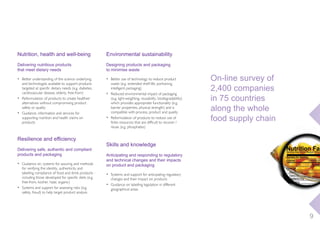
On-line survey of
2,400 companies
in 75 countries
along the whole
food supply chain
9
InnovationFdSupply_2015jls6100_Layout 1 17/12/2014 11:14 Page 9
101
Food, drink
and the
consumer
Safety
Protecting the consumer through
appropriate guidance
• Provision of evidence-based guidance for
consumers on food safety hazards (e.g. allergens,
microorganisms, natural toxicants) and consumer
responsibilities in helping to manage these (e.g.
storage, handling, cooking)
• Better approaches to encouraging and enabling
consumers to contribute to the culture of food
safety (e.g. food handling, hygiene, storage, smart
technologies)
• Guidance for business on managing food allergies
and intolerances, especially with regards to
thresholds, labelling, manufacturing and
information provision
Quality and value
Exceeding consumer expectations
• Continued improvement (speed, reliability, scale,
interpretation, exploitability) of methods for
sensory analysis and access to these - including
knowledge transfer between academia and
industry
• Instrumental methods for measuring sensory
qualities of products to complement or as an
alternative to sensory techniques and panels
• Analysis and use of consumer perceptions of
product quality - including the foodstuff,
packaging and wider product attributes (e.g.
brand, claims) - and how these influence choice
• Methods for better measurement of consumer
satisfaction with products
Nutrition, health and well-being
Responding to nutritional requirements
and dietary habits
• Ways to improve consumer health and well-
being through understanding of the relationship
between diet and health for individuals, groups
(e.g. age, health conditions, ethnicity) and
populations, at the genomic to physiological levels
• Influencing purchasing decisions through better
understanding of consumer perception of diet
and health issues and associated behaviours
• Understanding the links between nutritional
value, price, product quality, product claims,
marketing information and other factors on
consumer dietary choices
• Provision of evidence-based guidance for
consumers on diet and health
• Simple tools and techniques to help consumers
plan and manage their diet (intake of key
nutrients and energy)
InnovationFdSupply_2015jls6100_Layout 1 17/12/2014 11:14 Page 10
Resilience and efficiency
Building consumer trust in the supply
chain
• New approaches to building and retaining
consumer confidence and trust in the food and
drink supply chain - and its processes and
practices
Environmental sustainability
Minimising waste and environmental
impact
• Systems to promote sustainable but healthy
consumption
• Promotion of an informed debate on waste-
related issues (e.g. shelf-life, product storage and
durability marks, purchasing patterns) through
better understanding of consumer perceptions
of food and drink waste
• A more informed debate on packaging-related
issues (e.g. product protection, recycling, waste,
migration) through better understanding of
consumer perceptions of and attitudes towards
packaging
• Communicating to consumers the pros and cons
of new production, processing and preservation
techniques in the context of sustainable food
production and waste reduction strategies
Skills and knowledge
Engaging consumers in production,
process, product and packaging
knowledge
• Provision of evidence-based information to
consumers on food and drink and the
technologies underlying their primary
production, manufacturing, distribution, as well as
environmental impact - for a more rational and
‘risk informed’ debate
• Better agreement on the role of government,
industry and other groups (e.g. media, single-
interest groups) in promoting a more rational
and ‘risk informed’ debate
• Better understanding of consumer resistance to
new and emerging technologies in food
production and provision to consumers of
relevant evidence-based information
• Better approaches to improving ‘food literacy’
(e.g. cooking, food safety, healthy eating) through
education, healthcare and more generally
• Understanding the role and contribution of
social media to the wider debate on food and
assessment of the implications of this for the
supply chain
• Working with consumers on phenomena such as
the ‘sharing economy’ and ‘ambient intelligence’
(Internet of things) to deliver products and
processes that meet consumer needs
11
572 face-to-face
contributions
and 61 written
submissions
InnovationFdSupply_2015jls6100_Layout 1 17/12/2014 11:14 Page 11
12
About
Campden BRI
Vision
To be the partner of choice for the development and
application of technical knowledge and commercially
relevant solutions for the food and drink chain.
Social media
Facebook - find out more about our history and our
lighter side www.facebook.com/campdenbripage
Twitter - regular tweets to keep up to date with our
latest news and activities
https://twitter.com/campdenbri
YouTube - a range of videos providing an insight into the
science and technology underpinning food and drink
production www.youtube.com/campdenbri
LinkedIn - company updates providing our latest news
www.linkedin.com/company/campden-bri
iTunes - subscribe to our podcasts
Practical application
of technical excellence
for the food and drink chain
The practical application of technical
excellence lies at the heart of all that we do -
practical scientific, technical and knowledge
support to the food and drink chain.
We work closely with industry to ensure the
absolute relevance of all our activities - from
analysis and testing, process validation and
safety assurance to product innovation,
consumer studies and training, events,
databases and publications.
Our activities are all underpinned by a strong
programme of research and innovation -
steered by industry to ensure maximum
industrial relevance.
Membership-based, we provide services to
companies all along the supply chain, with
discounts and additional benefits for
companies that come into membership.
Campden BRI, Station Road, Chipping Campden, Gloucestershire, GL55 6LD, UK.
+44(0)1386 842000 information@campdenbri.co.uk www.campdenbri.co.uk
InnovationFdSupply_2015jls6100_Layout 1 17/12/2014 11:14 Page 12
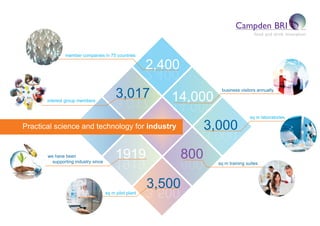
member companies in 75 countries
interest group members
Practical science and technology for industry
2,400
3,017
we have been
supporting industry since
1919
business visitors annually
14,000
sq m laboratories
3,000
sq m training suites
800
sq m pilot plant
3,500
food and drink innovation
Campden BRI
Needs_Cover1_Layout 1 17/12/2014 08:57 Page 3
With industry, for industry
2,400 companies in 75 countries surveyed
29 industrial meetings
572 face to face contributions
61 written submissions
7th issue since 1996
The consultation
© Campden BRI 2014
Needs_Cover1_Layout 1 17/12/2014 08:58 Page 4

Innovation Needs 2015

  • 1.
    Innovation for the foodand drink supply chain Scientific and technical needs food and drink innovation Campden BRI 2015-2017 Needs_Cover1_Layout 1 17/12/2014 08:56 Page 1
  • 2.
    Contents 1 Introduction 3 Matrix- strategic themes and the drivers for industry needs 4 Primary production, raw materials and ingredients 6 Manufacturing and supply 8 Product and packaging 10 Food, drink and the consumer 12 About Campden BRI Compiled, written and designed by Campden BRI with sincere thanks to the hundreds of industrial colleagues from all parts of the food and drink supply chain, who gave their time, energy and ideas during the consultation process. © Campden BRI 2014 Innovation for the food and drink supply chain Scientific and technical needs Needs_Cover1_Layout 1 17/12/2014 08:57 Page 2
  • 3.
    1 Introduction Steven Walker, Director-General The production,preservation, manufacturing, distribution and sale of food and drink rely heavily on science and technology. This document (and its associated website) maps out the food and drink supply chain needs that can be addressed through innovations in science, technology and their application. Many of these needs are ‘pre-competitive’, whilst others will fuel innovations closer to market - the exercise addressed the full spectrum in this respect. No restriction was placed on whether the needs would be met through basic, strategic or applied pre-competitive activities or through more ‘near-market’ innovations. However, it is a statement of ‘needs’, not of solutions or approaches to addressing those needs. We have been providing an industrial statement of needs since 1996 - updated on a ‘three-year refresh’ cycle. This helps to ensure that the ongoing developments in industry and in science and technology are continually reviewed in the context of the major strategic issues. Although some of the needs expressed are quite pertinent to a 3-5 year timescale, many are in fact long- standing and are likely to demand innovation (and the continued improvements this brings) well beyond this timescale. I would like to personally thank the hundreds of industrial colleagues from all parts of the food and drink supply chain who gave their time, energy and ideas. I hope you find the document as useful as we do. Why? The document has been produced to encourage the application of science and technology to address the needs identified by industry itself. Campden BRI will use this statement of needs in two specific ways: • First, it will help us to target our support for industry through activities such as technical services, research and development, knowledge and skills development, and information provision • Second, through our work with government departments, agencies, funding bodies, standards organisations and other third parties, we can raise awareness of the issues industry faces and the needs arising from these that have to be addressed - both at a tactical and strategic level How? The needs mapped out here were identified through an extensive consultation with Campden BRI members via: • our 13 Member Interest Groups (which have a collective membership of over 3,000 industrialists) overseen by our Scientific and Technical Committee (made up of 40 senior personnel from various sectors and stages in the supply chain); • an on-line survey of our international membership base which spans 2,400 companies in 75 countries; • gathering of ‘collective intelligence’ highlighting key issues, by Campden BRI scientists and technologists through our extensive day-to-day discussions with members, other clients, and collaborative organisations in the public and private sectors. This is the largest consultation of the sector in identifying its own needs. The process has also taken account of other relevant initiatives and documents (see ‘Related documents’ - page 2). Scope The consultation involved the whole supply chain - from primary production through processing and manufacturing to retail and food service - as well as companies that supply into this chain. The four main themes into which the needs are classified reflect this ‘whole supply chain’ approach - from primary production through manufacturing and supply of the product and packaging, to food, drink and the consumer. No restriction was placed on whether the needs would be met through basic, strategic or applied pre-competitive activities or through more ‘near-market’ innovations. During the consultation there was considerable discussion about the ‘drivers’ creating the needs. These are more fluid, but through the consultation it became evident that the primary drivers are currently: InnovationFdSupply_2015jls6100_Layout 1 17/12/2014 11:13 Page 1
  • 4.
    • Safety • Qualityand value • Nutrition, health and well-being • Environmental sustainability • Resilience and efficiency • Skills and knowledge Considered together, the drivers and the supply chain form the matrix shown on page 3, which illustrates how a particular driver might create different needs at different points in the chain. For example - ‘food safety’ creates the need for assurance systems through primary production and manufacturing whilst with the finished product there might be a need for tools for analysing particular hazards should a problem arise. This document maps out the ‘principal areas of need’ organised in line with this matrix. As the document spans the whole supply chain - from primary production to manufacturing and supply (including retail and food service) as well as the final product and the consumers’ response - it does not list detailed sector-specific needs. However, each sub-section of the document can be viewed in the context of a sector or supply chain stage - for example, for that sector’s raw materials, ingredients, processes and practices. Commonly expressed needs Through the consultation a number of recurring needs arose which were common to different parts of the supply chain or from distinct but related drivers. Some of these are worth highlighting: • Assuring product safety through assurance and analytical tools • Encouraging consumer well-being through a healthy diet • Protecting consumers and industry from food fraud • Encouraging sustainable practices such as better crop protection and reduced use of resources • Tackling industry’s ‘skills shortage’ Addressing the needs This document is a statement of needs - what it is that the food and drink supply chain needs from science, technology and their practical application in order to continue delivering safe and wholesome products that meet the needs and wants of consumers. The needs will be addressed through a number of activities, examples of which include: • The Campden BRI member-funded pre-competitive research programme and tailored, company-specific innovation projects • Scientific, technical and knowledge based services (e.g. courses, seminars, publications and databases) from Campden BRI • Research in other organisations (e.g. universities, research institutes, RTOs) and individual companies • Raising awareness of industry needs amongst government departments, agencies, funding bodies, standards organisations and other third parties - to stimulate and inform new approaches in the application of science and technology • Collective provision of innovation, technical support and ‘routine’ services through strategic collaboration between wide-ranging, inter-disciplinary and internationally dispersed third parties that serve the food and drink supply chain globally Related documents Although the contents of this document are largely based on an extensive consultation with Campden BRI members along and supplying into the food and drink supply chain, it takes account of a number of related documents and initiatives, including the following which might be of interest to the reader: A UK strategy for agricultural technologies (Defra - July 2013) - www.gov.uk/government/publications/uk- agricultural-technologies-strategy A pre-competitive vision for the UK’s food & drink industries (Biosciences Knowledge Transfer Network, Technology Strategy Board, and the Food and Drink Federation - 2013) - www.connect.innovateuk.org/ web/biosciencesktn/documents Feeding The Future - Innovation Requirements for Primary Food Production in the UK to 2030 - www.feedingthefuture.info Priority research questions for the UK food system (Global Food Security - 2014) www.foodsecurity.ac.uk Anticipatory Foresight Project - Institute of Food Technologists - www.ift.org Creating the future of food - SIK - The Swedish Institute for Food and Biotechnology - www.sik.se 2 InnovationFdSupply_2015jls6100_Layout 1 17/12/2014 11:13 Page 2
  • 5.
    3 Primary production, raw materials andingredients ging Food, drink and the consumer Strategicthemesandthedriversforindustryneeds This document maps out the ‘principal areas of need’ organised in line with this matrix. Download it or view the web version at www.campdenbri.co.uk/industry-needs.php Minimising contamination in production Ensuring suitability for purpose at proportionate cost Enhancing nutritional potential Securing supply and assured integrity at proportionate cost Producing ‘more with less’ Developing and maintaining skills, knowledge and ‘tools’ in production Managing safety hazards and risks in processing, distribution and sale Maintaining and enhancing quality through effective process technology Preserving and enhancing nutritional value in processing, distribution and sale Assuring resilience and efficiency throughout manufacturing, distribution and sale Enabling efficient use of energy and materials with minimal environmental impact Developing and maintaining skills, knowledge and ‘tools’ in manufacture, retail and food service Delivering products that are safe throughout shelf-life Maintaining product quality throughout shelf-life Delivering nutritious products that meet dietary needs Delivering safe, authentic and compliant products and packaging Designing products and packaging to minimise waste Anticipating and responding to regulatory and technical changes and their impacts on product and packaging Protecting the consumer through appropriate guidance Exceeding consumer expectations Responding to nutritional requirements and dietary habits Building consumer trust in the supply chain Minimising waste and environmental impact Engaging consumers in production, process, product and packaging knowledge Primary production, raw materials and ingredients Manufacturing and supply Product and packaging Food, drink and the consumer Safety Quality and value Nutrition, health and well-being Resilience and efficiency Environmental sustainability Skills and knowledge InnovationFdSupply_2015jls6100_Layout 1 17/12/2014 11:13 Page 3
  • 6.
    4 Primary production, raw materials and ingredients Quality andvalue Ensuring suitability for purpose at proportionate cost • Ingredients, products and packs which meet consumers’ desire for enhanced value • Agreement on what constitutes ‘quality’ and ‘defects’ for particular raw materials and ingredients • Systems for assuring, methods (independently validated) for assessing, and guidance for procuring raw materials and ingredients of the appropriate quality - including predictive tests of quality • Better use of genomics and related sciences to improve raw materials with and without the use of GM (genetic modification) technology • Better tests for prediction of end-use traits for breeders • New raw materials and ingredients for product innovation and differentiation • New sources and systems for assuring an adequate supply of protein (e.g. meat-based ingredients or alternative protein sources) at proportionate cost, in the face of globally changing consumption patterns • Better understanding and more effective ‘good practice’ tools for continued improvement of animal welfare in the supply chain • Reliable methods for the verification of natural, nature-identical and artificial flavours and the processes by which they have been produced - especially where claims based on this are an integral part of the product • Better ways of ensuring reliable, consistent supply of locally sourced materials Safety Minimising contamination in production • Management of routes of contamination of raw materials and ingredients during primary production • Systems for assuring and methods (independently validated) for assessing the safety of raw materials, ingredients and animal feed - with regards to microbiological, chemical and physical hazards • Agreement on what constitutes a significant level for hazards (e.g. allergens, pathogens, contaminants) • Guidance on sampling for ‘meaningful testing’ with regards to raw material and ingredient safety • Guidance on sourcing and reliable procurement of raw materials and ingredients to help assure safety • Increased use of robotic and other technologies for ‘precision agriculture’, improved efficiency and reduced contamination risks (the so called ‘informated farm’) • Strategies and technologies for managing antibiotic resistance in livestock microbial flora InnovationFdSupply_2015jls6100_Layout 1 17/12/2014 11:13 Page 4
  • 7.
    Nutrition, health andwell-being Enhancing nutritional potential • New raw materials and ingredients to facilitate innovation with products aimed at groups with special dietary needs - for example, for reformulating products to reduce fat, sugar or salt or achieve free-from status • Ways of assessing and addressing the impact of using lower cost ingredients on nutritional and dietary quality • Use of novel or neglected crop varieties that offer high nutritional or health benefits Resilience and efficiency Securing supply and assured integrity at proportionate cost • Systems for assuring the identity and authenticity of raw materials, ingredients and animal feed - including traceability, assurance systems, risk assessment, horizon scanning and intelligence management • Rapid and reliable verification of ‘authenticity’ attributes such as GM status, species of origin, presence of allergens, geographical origin, organic status, and free range status, and - where problems arise - distinguishing between adventitious contamination and deliberate substitution/fraud • New pesticides, biological control and integrated systems to protect crops against pests and diseases of the future • Developing crops that are less susceptible to pests and climate change or more resistant to environmental stresses and more variable growing conditions • Better understanding of and tools to pre-empt or deal with seasonal and regional variations in raw material and ingredient yield and quality - including ability to cope with raw materials of more variable quality Environmental sustainability Producing ‘more with less’ • Systems, technologies and practices for ‘sustainable intensification’ to secure the supply of raw materials, ingredients and other inputs as affected by environmental, economic and political factors • More efficient use of phosphates, water and energy • Technologies and systems to identify waste streams, maximise efficiency and reduce (not just ‘displace’) waste during primary production • Better understanding and more effective ‘good practice’ tools for soil protection • Supporting ‘urban farming’ through guidance to adopt sustainable practices and prevent contamination risks • Better systems and methods for recovering and recycling flexible packaging • Use of IT systems to better match supply and demand within the supply chain (thereby reducing waste of unwanted / unsold product) • Mechanisms for balancing the implications of conflicting drivers (e.g. nutritious diets based primarily on locally sourced, seasonal products) Skills and knowledge Developing and maintaining skills, knowledge and ‘tools’ in production • Simplified and harmonised specifications and standards for raw materials and ingredients, to increase business efficiency • Approaches for addressing the skills shortages faced in primary production • Better guidance on legislation controlling waste disposal and on routes for disposal of unavoidable waste • Better public communication of primary production practices and their importance in ensuring a secure, sustainable food supply 5 Consultation through 29 industrial meetings InnovationFdSupply_2015jls6100_Layout 1 17/12/2014 11:13 Page 5
  • 8.
    Safety Managing safety hazardsand risks in processing, distribution and sale • Management of food-borne hazards and threats - from availability of definitive information on specified hazards (e.g. known and emerging pathogens, allergens, known and emerging chemical species, foreign bodies) through continued cultivation of a food safety culture to the practical implementation of systems such as HACCP, TACCP, risk management and due diligence testing • Preventing cross-contamination that could introduce safety hazards (e.g. pathogens, allergens, chemical contaminants, foreign bodies) during manufacturing and distribution • Better hazard management through improved understanding of the fate of specific hazards during established and emerging processes (e.g. formation, degradation, removal in waste / spent materials) • Rigorous assessment of and controls for the hazards posed by ‘re-used’ and recycled materials and resources in the production chain • Guidance for interpreting and acting on ‘presumptive’ and ‘interim’ analytical results - balancing the need to maintain safety with the avoidance of unnecessary ‘scares’ • Robust systems for ensuring process efficacy and validation (thermal and non-thermal) for control of hazards in specific products - including, for example, developments such as ‘low temperature cooking’ • Better hygienic design of equipment, production environments and buildings - enshrining good hygienic design / easy ‘clean-ability’ throughout manufacturing operations • Efficient and cost-effective operative hygiene systems and cleaning methods for plant, equipment and facilities in manufacturing, retail and food service environments • Reliable detection and prevention of difficult-to- detect foreign bodies (e.g. plastic) Quality and value Maintaining and enhancing quality through effective process technology • Improvements to established and emerging technologies and processes for enhanced product quality, production efficiency and product safety - and strategies for their introduction at proportionate cost • Prevention of cross-contamination during manufacturing and distribution that could compromise product quality (e.g. authenticity, free-from claims) • More effective on-line technology for monitoring and predicting product quality during production • More flexible approaches to manufacturing to enable rapid but efficient (low waste) responses to customer requirements 6 Worldwide food, drink and allied industries Manufacturing and supply InnovationFdSupply_2015jls6100_Layout 1 17/12/2014 11:13 Page 6
  • 9.
    Nutrition, health andwell-being Preserving and enhancing nutritional value in processing, distribution and sale • Optimisation of existing and emerging processes to retain nutritional value through product shelf-life • New technologies and processes to assist the development and production of products aimed specifically at improving diet and health • Minimising the impact of low cost production on nutritional quality, and methods for improving this where needed Resilience and efficiency Assuring resilience and efficiency throughout manufacturing, distribution and sale • Systems for assuring supply chain integrity and preventing / tackling food fraud - including analytical methods, systems for intelligence gathering, effective horizon scanning and ways of assessing and managing risk • Lean, efficient and flexible manufacturing practices • Effective systems for crisis management - anticipating and responding to incidents involving safety, food fraud and food quality • Better in-line and near-line analytical methods for relevant parameters - including reliable, factory-safe, user-friendly (non-specialist) and portable test kits for testing products and the environment in the factory • Better cost-benefit analysis tools for investment in capital equipment and manufacturing infrastructure • Mechanisms for simplifying the supply chain (e.g. technical support for more local sourcing) • Better traceability systems (e.g. electronic, integrated) throughout the supply chain - especially for blended commodities (palm oil, cocoa, flour) • Rationalised, simplified, harmonised and cost- effective customer specifications, standards and auditing to increase manufacturing business efficiency without compromising product quality • Ways of implementing quality management systems and working practices in multi-lingual and multi- cultural manufacturing sites • Systems and equipment for the protection of the health, safety and welfare of industry operatives (e.g. production staff, laboratory personnel) - including appropriate consideration of these aspects at the planning and design phase Environmental sustainability Enabling efficient use of energy and materials with minimal environmental impact • Creation of production systems with built-in ‘sustainable practices’ (e.g. reduced energy input, environmentally-friendly sanitation methods) • Technologies, benchmarking systems and best practice guidance for saving and/or recovering water, energy and other resources and reducing waste, without displacing the problem (e.g. carbon footprint) • More effective use of co-products to reduce waste • New ways to extend product shelf-life to reduce waste (within the supply chain and with consumers) and extend markets (wider distribution) Skills and knowledge Developing and maintaining skills, knowledge and ‘tools’ in manufacture, retail and food service • Systems for combining, analysing, sharing and exploiting ‘big data’ - from genomics and associated sciences, through analytical and measurement data, to ‘augmented and virtual sensing’, the ‘Internet of things’, social media and brand analyses • Methods for effective knowledge and technology transfer within and into the food and drinks sector - including links between the academic and industry communities, and tailored and targeted delivery of information • Mechanisms for industry input into advising on practical aspects of implementing legislation • Appropriate, proportionate and evidence-based regulatory controls with equitable and just enforcement • Approaches for addressing the skills shortages faced by manufacturers and their suppliers • Promoting careers within the food, drink and allied industries • Better public communication of manufacturing practices, including existing and emerging technologies, and their importance in ensuring a secure, sustainable food supply 7 InnovationFdSupply_2015jls6100_Layout 1 17/12/2014 11:13 Page 7
  • 10.
    Safety Delivering products thatare safe throughout shelf-life • Systems for assuring and independently validated methods for rapidly and cost-effectively assessing the safety and spoilage of food and drink products - especially new and emerging products (e.g. intermediate moisture, low temperature cooking) • Promotion of the functional benefits of ingredients, additives and packaging as an integral part of maintaining product safety • Establishing limits of key components (e.g. sugar, salt, preservatives) and their ‘clean label alternatives’ in reformulated products, so that preservation efficiency and product safety are not compromised • Smart packaging technologies that assist in assuring product safety and extending shelf-life • Better product protection through tamper- evident packaging Quality and value Maintaining product quality throughout shelf-life • Clear definitions of product quality - including sensory, physical, chemical, nutritional and microbiological attributes / criteria - and the way in which it is measured and perceived • Systems for assuring and independently validated methods for rapidly and cost-effectively assessing the quality and spoilage of food and drink products • Clean label replacements for or ways of reducing sugar, fat, salt, preservatives, other additives and other components without compromising product quality or shelf-life • Use of new and refined processing, preservation and packaging technologies to improve quality, preserve nutritional value and/or extend product shelf-life without compromising product safety • Clearer guidance on shelf-life determination for different product types • Methods for predicting and measuring colour and texture of food and drink products to assess final quality, stability through shelf-life and the impact of processes and reformulation • Test methods for the performance, integrity and ‘openability’ of new packaging formats (e.g. light- weighted, new materials) • Agreed risk assessment, analytical protocols and management tools for packaging materials and their components and their interaction with the food or drink product • Better understanding, management and measurement of packaging component migration • Replacements for specified packaging components such as bis-phenol A Product and packaging 8 InnovationFdSupply_2015jls6100_Layout 1 17/12/2014 11:14 Page 8
  • 11.
    Nutrition, health andwell-being Delivering nutritious products that meet dietary needs • Better understanding of the science underlying and technologies available to support products targeted at specific dietary needs (e.g. diabetes, cardiovascular disease, elderly, free-from) • Reformulation of products to create healthier alternatives without compromising product safety or quality • Guidance, information and services for supporting nutrition and health claims on products Resilience and efficiency Delivering safe, authentic and compliant products and packaging • Guidance on, systems for assuring and methods for verifying the identity, authenticity and labelling compliance of food and drink products - including those developed for specific diets (e.g. free-from, kosher, halal, organic) • Systems and support for assessing risks (e.g. safety, fraud) to help target product analysis Environmental sustainability Designing products and packaging to minimise waste • Better use of technology to reduce product waste (e.g. extended shelf-life, portioning, intelligent packaging) • Reduced environmental impact of packaging (e.g. light-weighting, reusability, biodegradability) which provides appropriate functionality (e.g. barrier properties, physical strength) and is compatible with process, product and quality • Reformulation of products to reduce use of finite resources that are difficult to recover / reuse (e.g. phosphates) Skills and knowledge Anticipating and responding to regulatory and technical changes and their impacts on product and packaging • Systems and support for anticipating regulatory changes and their impact on products • Guidance on labelling legislation in different geographical areas On-line survey of 2,400 companies in 75 countries along the whole food supply chain 9 InnovationFdSupply_2015jls6100_Layout 1 17/12/2014 11:14 Page 9
  • 12.
    101 Food, drink and the consumer Safety Protectingthe consumer through appropriate guidance • Provision of evidence-based guidance for consumers on food safety hazards (e.g. allergens, microorganisms, natural toxicants) and consumer responsibilities in helping to manage these (e.g. storage, handling, cooking) • Better approaches to encouraging and enabling consumers to contribute to the culture of food safety (e.g. food handling, hygiene, storage, smart technologies) • Guidance for business on managing food allergies and intolerances, especially with regards to thresholds, labelling, manufacturing and information provision Quality and value Exceeding consumer expectations • Continued improvement (speed, reliability, scale, interpretation, exploitability) of methods for sensory analysis and access to these - including knowledge transfer between academia and industry • Instrumental methods for measuring sensory qualities of products to complement or as an alternative to sensory techniques and panels • Analysis and use of consumer perceptions of product quality - including the foodstuff, packaging and wider product attributes (e.g. brand, claims) - and how these influence choice • Methods for better measurement of consumer satisfaction with products Nutrition, health and well-being Responding to nutritional requirements and dietary habits • Ways to improve consumer health and well- being through understanding of the relationship between diet and health for individuals, groups (e.g. age, health conditions, ethnicity) and populations, at the genomic to physiological levels • Influencing purchasing decisions through better understanding of consumer perception of diet and health issues and associated behaviours • Understanding the links between nutritional value, price, product quality, product claims, marketing information and other factors on consumer dietary choices • Provision of evidence-based guidance for consumers on diet and health • Simple tools and techniques to help consumers plan and manage their diet (intake of key nutrients and energy) InnovationFdSupply_2015jls6100_Layout 1 17/12/2014 11:14 Page 10
  • 13.
    Resilience and efficiency Buildingconsumer trust in the supply chain • New approaches to building and retaining consumer confidence and trust in the food and drink supply chain - and its processes and practices Environmental sustainability Minimising waste and environmental impact • Systems to promote sustainable but healthy consumption • Promotion of an informed debate on waste- related issues (e.g. shelf-life, product storage and durability marks, purchasing patterns) through better understanding of consumer perceptions of food and drink waste • A more informed debate on packaging-related issues (e.g. product protection, recycling, waste, migration) through better understanding of consumer perceptions of and attitudes towards packaging • Communicating to consumers the pros and cons of new production, processing and preservation techniques in the context of sustainable food production and waste reduction strategies Skills and knowledge Engaging consumers in production, process, product and packaging knowledge • Provision of evidence-based information to consumers on food and drink and the technologies underlying their primary production, manufacturing, distribution, as well as environmental impact - for a more rational and ‘risk informed’ debate • Better agreement on the role of government, industry and other groups (e.g. media, single- interest groups) in promoting a more rational and ‘risk informed’ debate • Better understanding of consumer resistance to new and emerging technologies in food production and provision to consumers of relevant evidence-based information • Better approaches to improving ‘food literacy’ (e.g. cooking, food safety, healthy eating) through education, healthcare and more generally • Understanding the role and contribution of social media to the wider debate on food and assessment of the implications of this for the supply chain • Working with consumers on phenomena such as the ‘sharing economy’ and ‘ambient intelligence’ (Internet of things) to deliver products and processes that meet consumer needs 11 572 face-to-face contributions and 61 written submissions InnovationFdSupply_2015jls6100_Layout 1 17/12/2014 11:14 Page 11
  • 14.
    12 About Campden BRI Vision To bethe partner of choice for the development and application of technical knowledge and commercially relevant solutions for the food and drink chain. Social media Facebook - find out more about our history and our lighter side www.facebook.com/campdenbripage Twitter - regular tweets to keep up to date with our latest news and activities https://twitter.com/campdenbri YouTube - a range of videos providing an insight into the science and technology underpinning food and drink production www.youtube.com/campdenbri LinkedIn - company updates providing our latest news www.linkedin.com/company/campden-bri iTunes - subscribe to our podcasts Practical application of technical excellence for the food and drink chain The practical application of technical excellence lies at the heart of all that we do - practical scientific, technical and knowledge support to the food and drink chain. We work closely with industry to ensure the absolute relevance of all our activities - from analysis and testing, process validation and safety assurance to product innovation, consumer studies and training, events, databases and publications. Our activities are all underpinned by a strong programme of research and innovation - steered by industry to ensure maximum industrial relevance. Membership-based, we provide services to companies all along the supply chain, with discounts and additional benefits for companies that come into membership. Campden BRI, Station Road, Chipping Campden, Gloucestershire, GL55 6LD, UK. +44(0)1386 842000 information@campdenbri.co.uk www.campdenbri.co.uk InnovationFdSupply_2015jls6100_Layout 1 17/12/2014 11:14 Page 12
  • 15.
    member companies in75 countries interest group members Practical science and technology for industry 2,400 3,017 we have been supporting industry since 1919 business visitors annually 14,000 sq m laboratories 3,000 sq m training suites 800 sq m pilot plant 3,500 food and drink innovation Campden BRI Needs_Cover1_Layout 1 17/12/2014 08:57 Page 3
  • 16.
    With industry, forindustry 2,400 companies in 75 countries surveyed 29 industrial meetings 572 face to face contributions 61 written submissions 7th issue since 1996 The consultation © Campden BRI 2014 Needs_Cover1_Layout 1 17/12/2014 08:58 Page 4