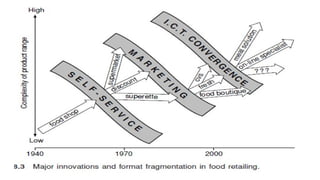
Food supply chain development and management chapter
1.
CH – 1
FOODSUPPLY CHAIN DEVELOPMENT AND
MANAGEMENT
Mr. Ermiyas O.
Dire Dawa University
INTRODUCTION
2.
CH – Outlines
Introduction
Need food supply chain
The global agrifood system
Actors in food supply chain
key factors for the evolution and development of modern
food supply chain
Product development
3.
INTRODUCTION
• Food isone of the pillars upon which society is built.
• It is fundamental to health, happiness and political stability.
• There will always be challenges in how society develops, how it changes, in the
relationships between peoples, classes and nations.
• Food supply chain management is developing as a research discipline in its own
right.
• Food supply chain management aims
To guarantee the provision of safe and healthy products that are fully traceable
from ‘farm to fork’.
4.
Why we NeedFood Supply Chain
• To Maintain the relationships with their customers and suppliers.
• The need for increased efficiency in enterprise operations perseveres,
modern management thinking advocates the collaboration among business
partners.
• To development in Information and communication Technology (ICT) increased
huge amounts of data exchange in SCM.
• This is especially true in agifood supply chains, because of shelf-life
constraints of food and agricultural products and increased consumer attention
to safe and environment/animal-friendly production methods
5.
The Global Agri-FoodSystem
• A number of recent trends that include globalization, urbanization and
agro-industrialization, are placing increasing demands on the organization
of agrifood chains and networks.
• This is also affecting the ways in which food is produced, processed and
delivered to the market.
• Perishable food pdt can nowadays be shipped from halfway around the
world at fairly competitive prices.
• Demand and supply are no longer restricted to nations or regions, but have
become international processes.
• The latter covers the development and implementation of enhanced quality,
logistics and information systems.
6.
The Global AgriFoodSystem … Cont..
• In a global agrifood system, companies have to work continuously on
innovations in products, processes and forms of cooperation.
• The series of processes, operations and entities that help to take the food from
its raw material state to our plates is known as the food supply chain.
• A Supply chain is a sequence of suppliers, transporters, warehouses,
manufacturers, Wholesalers/distributors, retail outlets and final customers.
The Actors inFood Supply Chain
1) Producers:
• As the world’s population continues to grow, there is increased pressure on the food system to
double food production by 2050.
• In addition to the population challenges, the rapid industrialization of developing countries has
increased lifestyle and consumption patterns in these countries.
• The FSC starts at the producer end, which supplies food in its raw form – grains, fruits, vegetables, meat,
fish, poultry and so on.
• The producers are farmers who are a part of the agriculture industry.
• Every country requires a strong food production sector as it affects both food availability for the population
and economic sustainability for the food sector
• This provides additional challenges to the meat supply chains.
9.
2) Processors:
• Processorsare the entities in the food supply chain that transform the food
products supplied by the food producers into products that meet consumer
requirements.
• This process is also known as food manufacturing.
• Food-processing companies are diverse in nature and will process products at
different stages: for example,
Meat slaughtering and processing;
Preservation of fresh fruits and vegetables either by freezing,
puréeing or juicing;
Milling of grains;
Making confectionery and bakery products; and
Other types of food manufacturing.
10.
The Actors inFood Supply Chain… Cont
3) Retailers and Distributers:
• Distributors are companies that act as the link b/n producers, processors and
markets.
• Distribution companies are very important entities, especially when the supply
chains are global and have to cross international boundaries, as distributors
have to deal with local regulations.
• Retailing is a process that showcases the product for the consumer
• The retailer stage in the chain provides the consumer with the variety of core
and innovative products that the food sector has to offer.
12.
The Actors inFood Supply Chain
4) Hospitality Sector:
• The hospitality sector is a key entity within the food supply chain.
• Although it is not directly a retailer or distributor as such, it is an important
link between the producer/processor and the consumer.
• Food service agencies, hotels, restaurants and takeaway places will source raw
material from the producers or processors and transform the food to suit the
requirements of the final consumer.
13.
The Actors inFood Supply Chain
5) Consumers:
• The consumer is the final entity in the food supply chain.
• The economic sustainability of the chain depends upon the consumers buying
the products and providing the necessary cash to travel upstream through the
supply chain.
• Reducing food wastage at the consumer end has been a major focus among
governments and food-sector organizations in Europe.
• Food safety is a major concern for consumers and all food supply chain
entities have to take the necessary steps to avoid food contamination.
14.
KEY FACTORS FORTHE EVOLUTION AND DEVELOPMENT OF
MODERN FOOD SUPPLY CHAIN
Quality:
• Quality is the degree of correspondence between customers’ expectations
and their realization.
• Quality and its assurance have become important supply chain
management tools.
• In SCM carried out different quality assurance schemes, production and
manufacturing to retailers protocols.
• Application of quality management systems like HACCP and ISO
15.
KEY FACTORS FORTHE EVOLUTION AND
DEVELOPMENT OF MODERN FOOD SUPPLY CHAIN
Technology:
• The food supply chain includes a technological dimension.
• Its evolution is made possible by different innovations and development
essential for its efficiency and ability to increase production
• It include accurate weighing, refrigeration, controlled bacterial growth
inhibition etc.
• This advances had many application of research in biology, genetics,
biochemistry, chemical engineering etc.
16.
KEY FACTORS FORTHE EVOLUTION AND DEVELOPMENT OF
MODERN FOOD SUPPLY CHAIN
Logistics:
• Various researchers have argued that logistics is a key business
process that provides increased customer satisfaction.
• ‘the process of strategically managing the procurement,
movement and storage of materials, parts and finished through
the organization
• Its marketing channels in such a way that current and future
profitability are maximized through cost-effective fulfillment of
orders’.
17.
KEY FACTORS FORTHE EVOLUTION AND DEVELOPMENT OF
MODERN FOOD SUPPLY CHAIN
Information technology
• IT applications support the movement of products and product exam.
Bar coding for identifying product location in retail and stores to record
movement onto and off vehicles.
• Electronic data interaction (EDI) and Electronic point of sales (EPoS)
for reading of barcodes and facilitating quick response technology in
retail operation.
• The use of the Internet in the food supply chain is a relatively recent
innovation largely favored by food suppliers and multiple retailers.
18.
KEY FACTORS FORTHE EVOLUTION AND DEVELOPMENT OF MODERN
FOOD SUPPLY CHAIN
Regulatory framework
• The food supply chain is affected by the socio-political environment.
• The text will refer to the regulatory framework defined by national
and international law.
• This regulatory framework reflects increased consumer concerns
about food safety, labelling and product traceability.
19.
KEY FACTORS FORTHE EVOLUTION AND DEVELOPMENT OF
MODERN FOOD SUPPLY CHAIN
Consumers:
• Consumers drive the supply chain; ‘demand chain’.
• A development in the food supply chain that advocates this view is
efficient consumer response (ECR).
• Economic analysis is applied to obtain a better understanding of
consumer behavior.
• Achieve extra insight into the strategic direction of change in food
consumption.
20.
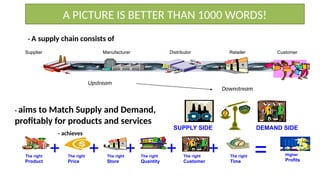
A PICTURE ISBETTER THAN 1000 WORDS!
- A supply chain consists of
- aims to Match Supply and Demand,
profitably for products and services
SUPPLY SIDE DEMAND SIDE
The right
Product
Higher
Profits
The right
Time
The right
Customer
The right
Quantity
The right
Store
The right
Price
=
+
+ +
+ +
- achieves
Supplier Manufacturer Distributor Retailer Customer
Upstream
Downstream
21.
Factors influencing foodsupply chains
• The food sector is a very complex environment influenced by industrial,
technological, economic, social and political factors that shape the availability
of food, the nature of the food product and the delivery of the food to our
plates.
• Agriculture production
• Involvement of various governmental/non-governmental actors.
• Processing and maintaining quality.
• Consumer and market choices.
• Local authorities.
• Logistics companies; and
22.
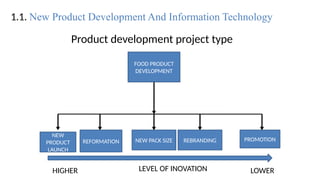
Product development projecttype
FOOD PRODUCT
DEVELOPMENT
PROMOTION
REBRANDING
NEW PACK SIZE
NEW
PRODUCT
LAUNCH
REFORMATION
HIGHER LOWER
LEVEL OF INOVATION
1.1. New Product Development And Information Technology
23.
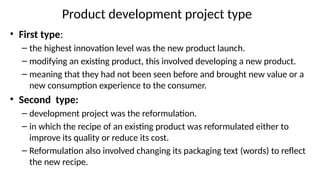
Product development projecttype
• First type:
– the highest innovation level was the new product launch.
– modifying an existing product, this involved developing a new product.
– meaning that they had not been seen before and brought new value or a
new consumption experience to the consumer.
• Second type:
– development project was the reformulation.
– in which the recipe of an existing product was reformulated either to
improve its quality or reduce its cost.
– Reformulation also involved changing its packaging text (words) to reflect
the new recipe.
24.
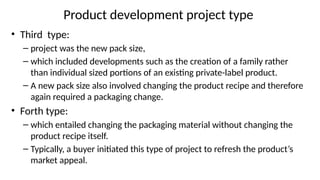
Product development projecttype
• Third type:
– project was the new pack size,
– which included developments such as the creation of a family rather
than individual sized portions of an existing private-label product.
– A new pack size also involved changing the product recipe and therefore
again required a packaging change.
• Forth type:
– which entailed changing the packaging material without changing the
product recipe itself.
– Typically, a buyer initiated this type of project to refresh the product’s
market appeal.
25.
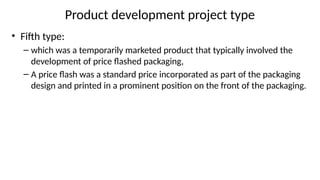
Product development projecttype
• Fifth type:
– which was a temporarily marketed product that typically involved the
development of price flashed packaging,
– A price flash was a standard price incorporated as part of the packaging
design and printed in a prominent position on the front of the packaging.
26.
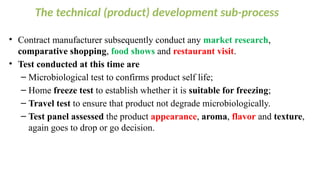
The technical (product)development sub-process
• Contract manufacturer subsequently conduct any market research,
comparative shopping, food shows and restaurant visit.
• Test conducted at this time are
– Microbiological test to confirms product self life;
– Home freeze test to establish whether it is suitable for freezing;
– Travel test to ensure that product not degrade microbiologically.
– Test panel assessed the product appearance, aroma, flavor and texture,
again goes to drop or go decision.
27.
Temperature Controlled Supplychain
• The modern costumer required food in the store to be good quality
• Food products maintained in temperature controlled environment.
• There are several temperature levels for food to suit different types of
product groups.
• We might identify frozen, cold chill, medium chill and exotic chill.
• Frozen Is -25 C for ice cream
• -18 C for other foods and food ingredients
• For fresh meat and poultry is 0 C to +1 C.
• Medium chill is +5 C for dairy products,
• Exotic Chill is +10 C to +15 C for potatoes, eggs, exotic fruits and
bananas.
28.
What is ColdChain?
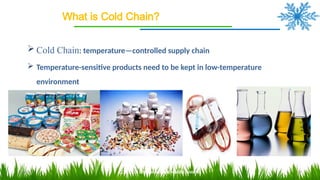
Cold Chain: temperature—controlled supply chain
Temperature-sensitive products need to be kept in low-temperature
environment
Group 11 28
ECLT 5710 Distributed and Mobile Systems
29.
• Some productsneeds cold or frozen storage
– Frozen food, milk, and tofu etc.
• Extend the shelf life of fresh food
• Prevent loss and improve food safety
– 20% -30% food loss occurs in transportation or storage
Importance Of Temperature Controlled Supply Chain
30.
The Relationship betweenTemperature and Shelf Life
Product Transportation Shelf Life (at 1 o
C) Shelf Life (at 3 o
C) Shelf Life (at 5 o
C)
Meat 2.5 days 7 days 5.5 days 4.5 days
Sea Food 2.5 days 5 days 3 days 1 days
Salad 2.5 days 12.5 days 10.5 days 7.5 days
31.
Transportation
Mainly use suppliersor third party for distribution.
0.3% refrigerated trucks
15% fresh food was transported using refrigerated trucks in China; 90% in the
developed countries
• 80%-90% fruits, vegetables, meats and aquatic products are transported using
normal trucks.
• 29.67% retailers own refrigerated truck
• 36.26% use suppliers’ refrigerated trucks
• 13.19% use the third party refrigerated trucks rented by suppliers.
• 5.34% use the third party refrigerated trucks rented by supermarket.
Editor's Notes
#4 Fierce competition in today’s global markets and the heightened expectations of consumers have forced business enterprises to invest in and focus attention on, the relationships with their customers and suppliers.
While the need for increased efficiency in enterprise operations persists, modern management thinking advocates the collaboration among business partners and the responsiveness to client needs as additional thrusts towards a successful competitive strategy.
It is within this context that Supply Chain Management (SCM) has become part of the senior management agenda in western countries since the 1990s, particularly in the manufacturing and retailing industries.
More recently, interest in SCM has also been growing in the agrifood industry, both in developed and developing countries.
Moreover, agrifood businesses increasingly realize that they no longer compete as solely autonomous entities. Instead, competition occurs more and more among entire supply chains.
The increased interest in SCM has also been spurred by developments in Information and Communication Technology (ICT) that enable frequent exchange of huge amounts of information among chain participants, for purposes of coordination.
#28 And such temperature-controlled supply chain is call cold chain. And these temperature-sensitive products need to be kept in a low-temperature environment during production, storage, transportation and marketing to ensure the freshness and quality of goods.
Typical temperature sensitive products include frozen food, pharmaceutical drugs, blood and chemicals.