DOS AND DON´T OF A JOB
INTERVIEW


  By: Karlos De León
Dos
      Responsibility
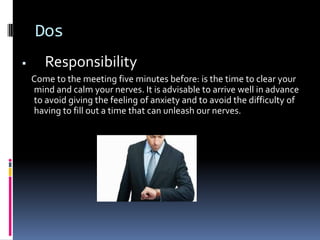
    Come to the meeting five minutes before: is the time to clear your
    mind and calm your nerves. It is advisable to arrive well in advance
    to avoid giving the feeling of anxiety and to avoid the difficulty of
    having to fill out a time that can unleash our nerves.
•Listen

If the interviewer talks and talks non-stop, do not interrupt.
•Decent to the occasion

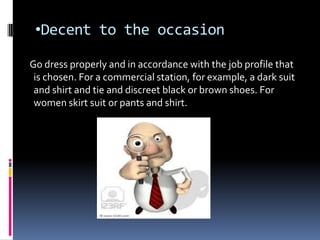
Go dress properly and in accordance with the job profile that
 is chosen. For a commercial station, for example, a dark suit
 and shirt and tie and discreet black or brown shoes. For
 women skirt suit or pants and shirt.
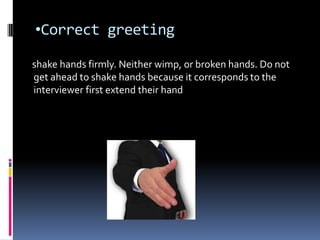
•Correct greeting

shake hands firmly. Neither wimp, or broken hands. Do not
get ahead to shake hands because it corresponds to the
interviewer first extend their hand
Don´t
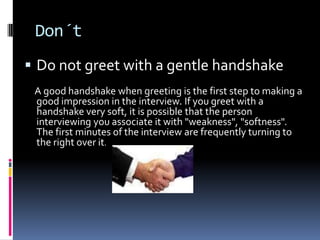
 Do not greet with a gentle handshake
 A good handshake when greeting is the first step to making a
 good impression in the interview. If you greet with a
 handshake very soft, it is possible that the person
 interviewing you associate it with "weakness", "softness".
 The first minutes of the interview are frequently turning to
 the right over it.
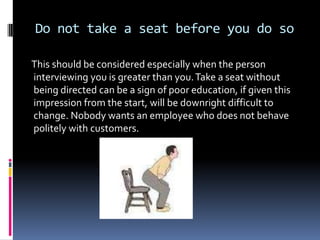
Do not take a seat before you do so

This should be considered especially when the person
interviewing you is greater than you. Take a seat without
being directed can be a sign of poor education, if given this
impression from the start, will be downright difficult to
change. Nobody wants an employee who does not behave
politely with customers.
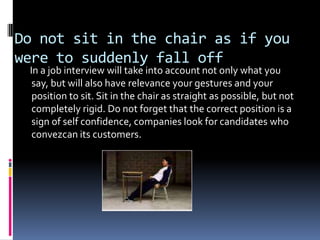
Do not sit in the chair as if you
were to suddenly fall off
 In a job interview will take into account not only what you
  say, but will also have relevance your gestures and your
  position to sit. Sit in the chair as straight as possible, but not
  completely rigid. Do not forget that the correct position is a
  sign of self confidence, companies look for candidates who
  convezcan its customers.
•Do not start to stutter if
 critical questions are
Considers that the person interviewing you will surely find
 some weaknesses in your resume. These weaknesses must
 be recognized by you, for example, what did you do during
 the time when looking for work?, Why you left a particular
 job?, Etc. .., are questions that must be prepared and avoid
 thus unpleasant surprises.

Ingles

  • 1.
    DOS AND DON´TOF A JOB INTERVIEW By: Karlos De León
  • 2.
    Dos  Responsibility Come to the meeting five minutes before: is the time to clear your mind and calm your nerves. It is advisable to arrive well in advance to avoid giving the feeling of anxiety and to avoid the difficulty of having to fill out a time that can unleash our nerves.
  • 3.
    •Listen If the interviewertalks and talks non-stop, do not interrupt.
  • 4.
    •Decent to theoccasion Go dress properly and in accordance with the job profile that is chosen. For a commercial station, for example, a dark suit and shirt and tie and discreet black or brown shoes. For women skirt suit or pants and shirt.
  • 5.
    •Correct greeting shake handsfirmly. Neither wimp, or broken hands. Do not get ahead to shake hands because it corresponds to the interviewer first extend their hand
  • 6.
    Don´t  Do notgreet with a gentle handshake A good handshake when greeting is the first step to making a good impression in the interview. If you greet with a handshake very soft, it is possible that the person interviewing you associate it with "weakness", "softness". The first minutes of the interview are frequently turning to the right over it.
  • 7.
    Do not takea seat before you do so This should be considered especially when the person interviewing you is greater than you. Take a seat without being directed can be a sign of poor education, if given this impression from the start, will be downright difficult to change. Nobody wants an employee who does not behave politely with customers.
  • 8.
    Do not sitin the chair as if you were to suddenly fall off In a job interview will take into account not only what you say, but will also have relevance your gestures and your position to sit. Sit in the chair as straight as possible, but not completely rigid. Do not forget that the correct position is a sign of self confidence, companies look for candidates who convezcan its customers.
  • 9.
    •Do not startto stutter if critical questions are Considers that the person interviewing you will surely find some weaknesses in your resume. These weaknesses must be recognized by you, for example, what did you do during the time when looking for work?, Why you left a particular job?, Etc. .., are questions that must be prepared and avoid thus unpleasant surprises.