Relationship status:
"It's complicated"
Managing products in a global
company with distributed teams
Inga Latham
CPO, SiteMinder
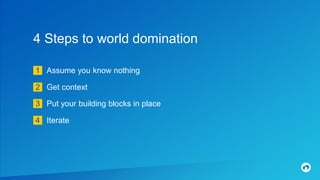
1. Assume you know nothing
2. Get context
4 Steps to world domination
3. Put your building blocks in place
4. Iterate
“What does she know?”
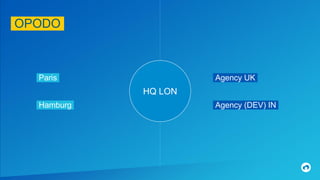
OPODO.
HQ LON
Paris.
Hamburg.
Agency UK.
Agency (DEV) IN.
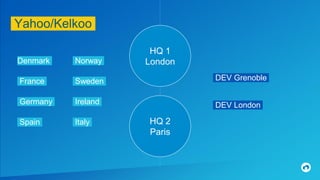
Yahoo/Kelkoo.
HQ 2
Paris
Denmark. Norway.
France. Sweden.
Germany. Ireland.
Spain. Italy.
DEV Grenoble.
DEV London.
HQ 1
London
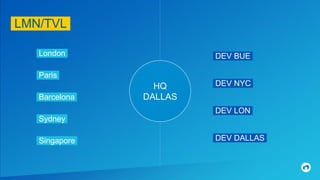
LMN/TVL.
HQ
DALLAS
London.
Paris.
Barcelona.
Sydney.
Singapore.
DEV BUE.
DEV NYC.
DEV LON.
DEV DALLAS.
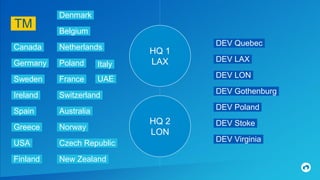
TM.
HQ 2
LON
Denmark.
Belgium.
Canada. Netherlands.
Germany. Poland.
Sweden. France.
Ireland. Switzerland.
Spain. Australia.
Greece. Norway.
USA. Czech Republic.
Finland. New Zealand.
DEV Quebec.
DEV LAX.
DEV LON.
DEV Gothenburg.
DEV Poland.
DEV Stoke.
DEV Virginia.
HQ 1
LAXItaly.
UAE.
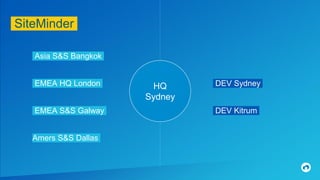
SiteMinder.
HQ
Sydney
Asia S&S Bangkok.
EMEA HQ London.
EMEA S&S Galway.
Amers S&S Dallas.
DEV Sydney.
DEV Kitrum.
1.
Assume you
know nothing...
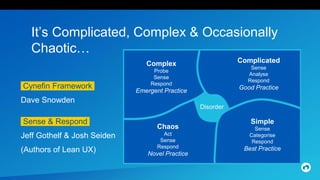
It’s Complicated, Complex & Occasionally
Chaotic…
Cynefin Framework.
Dave Snowden
Complex
Probe
Sense
Respond
Emergent Practice
Chaos
Act
Sense
Respond
Novel Practice
Complicated
Sense
Analyse
Respond
Good Practice
Simple
Sense
Categorise
Respond
Best Practice
Disorder
Sense & Respond.
Jeff Gothelf & Josh Seiden
(Authors of Lean UX)
2.
Get Context
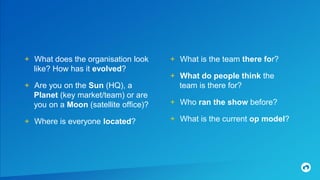
+ What does the organisation look
like? How has it evolved?
+ Are you on the Sun (HQ), a
Planet (key market/team) or are
you on a Moon (satellite office)?
+ Where is everyone located?
+ What is the team there for?
+ What do people think the
team is there for?
+ Who ran the show before?
+ What is the current op model?
3.
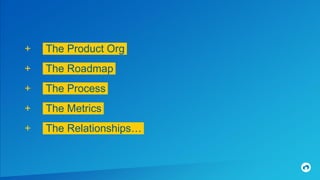
The Building Blocks
+ The Product Org.
+ The Roadmap.
+ The Process.
+ The Metrics.
+ The Relationships….
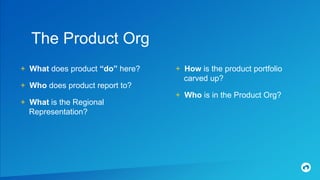
+ What does product “do” here?
+ Who does product report to?
+ What is the Regional
Representation?
The Product Org
+ How is the product portfolio
carved up?
+ Who is in the Product Org?
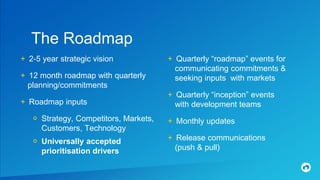
The Roadmap
+ 2-5 year strategic vision
+ 12 month roadmap with quarterly
planning/commitments
+ Roadmap inputs
० Strategy, Competitors, Markets,
Customers, Technology
० Universally accepted
prioritisation drivers
+ Quarterly “roadmap” events for
communicating commitments &
seeking inputs with markets
+ Quarterly “inception” events
with development teams
+ Monthly updates
+ Release communications
(push & pull)
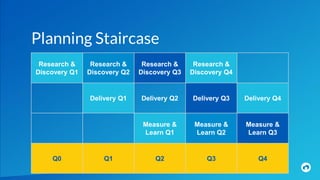
Research &
Discovery Q1
Research &
Discovery Q2
Research &
Discovery Q3
Research &
Discovery Q4
Delivery Q1 Delivery Q2 Delivery Q3 Delivery Q4
Measure &
Learn Q1
Measure &
Learn Q2
Measure &
Learn Q3
Q0 Q1 Q2 Q3 Q4
Planning Staircase
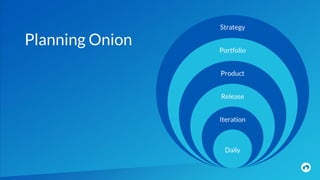
Planning Onion
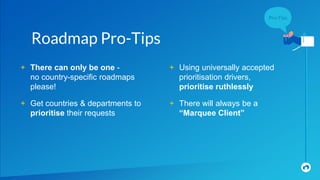
+ There can only be one -
no country-specific roadmaps
please!
+ Get countries & departments to
prioritise their requests
Roadmap Pro-Tips
+ Using universally accepted
prioritisation drivers,
prioritise ruthlessly
+ There will always be a
“Marquee Client”
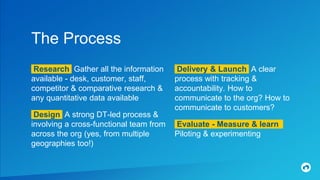
The Process
Research: Gather all the information
available - desk, customer, staff,
competitor & comparative research &
any quantitative data available
Design: A strong DT-led process &
involving a cross-functional team from
across the org (yes, from multiple
geographies too!)
Delivery & Launch: A clear
process with tracking &
accountability. How to
communicate to the org? How to
communicate to customers?
Evaluate - Measure & learn:
Piloting & experimenting
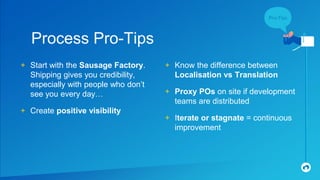
+ Start with the Sausage Factory.
Shipping gives you credibility,
especially with people who don’t
see you every day…
+ Create positive visibility
Process Pro-Tips
+ Know the difference between
Localisation vs Translation
+ Proxy POs on site if development
teams are distributed
+ Iterate or stagnate = continuous
improvement
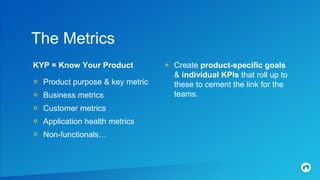
KYP = Know Your Product
० Product purpose & key metric
० Business metrics
० Customer metrics
० Application health metrics
० Non-functionals…
The Metrics
+ Create product-specific goals
& individual KPIs that roll up to
these to cement the link for the
teams.
+ Get to know everyone
+ ID influencers & engage OFTEN
+ Create positive visibility
The Relationships
+ Have a mole in each location
+ Collaboration vs cooperation
+ Know the cultural differences
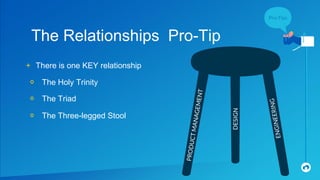
The Relationships Pro-Tip
+ There is one KEY relationship
० The Holy Trinity
० The Triad
० The Three-legged Stool
+ Structure your time
+ Be consistent - with your time &
with how you show up every day
+ Favour face-to-face or voice
comms over email
+ Regularly inspect & measure
what people are doing
Product Leader Pro-Tips
+ The Product Org = Your Product
+ Use “The Process” & design a
team that meets the objectives
what of the business needs
Product to be
4.
Iterate: Sensing & Respond
Sense – Listen/Observe:
० The teams/markets
० Customers
० Your Product Team
० Your peers
Respond:
० Create a “Voice” for
Product
० Ensure the Roadmap
reflects the inputs you have
been given
1. Assume you know nothing
2. Get context
3. Put your building blocks in place
4. Iterate
5. Keep your sense of humour!
6. Develop a thick skin
4 Steps to world domination & 2 for sanity
It’s mostly complicated.
It’s a little bit complex.
It’s very occasionally simple & seldom truly chaotic.
It’ll be tough.
It’ll be uncomfortable.
But I promise you, you’ll learn every day & ...
IIt’ll be fun!!

Inga Latham - Relationship Status: It's complicated

  • 1.
    Relationship status: "It's complicated" Managingproducts in a global company with distributed teams Inga Latham CPO, SiteMinder
  • 2.
    1. Assume youknow nothing 2. Get context 4 Steps to world domination 3. Put your building blocks in place 4. Iterate
  • 3.
  • 4.
  • 5.
    Yahoo/Kelkoo. HQ 2 Paris Denmark. Norway. France.Sweden. Germany. Ireland. Spain. Italy. DEV Grenoble. DEV London. HQ 1 London
  • 6.
  • 7.
    TM. HQ 2 LON Denmark. Belgium. Canada. Netherlands. Germany.Poland. Sweden. France. Ireland. Switzerland. Spain. Australia. Greece. Norway. USA. Czech Republic. Finland. New Zealand. DEV Quebec. DEV LAX. DEV LON. DEV Gothenburg. DEV Poland. DEV Stoke. DEV Virginia. HQ 1 LAXItaly. UAE.
  • 8.
    SiteMinder. HQ Sydney Asia S&S Bangkok. EMEAHQ London. EMEA S&S Galway. Amers S&S Dallas. DEV Sydney. DEV Kitrum.
  • 9.
  • 10.
    It’s Complicated, Complex& Occasionally Chaotic… Cynefin Framework. Dave Snowden Complex Probe Sense Respond Emergent Practice Chaos Act Sense Respond Novel Practice Complicated Sense Analyse Respond Good Practice Simple Sense Categorise Respond Best Practice Disorder Sense & Respond. Jeff Gothelf & Josh Seiden (Authors of Lean UX)
  • 11.
  • 12.
    + What doesthe organisation look like? How has it evolved? + Are you on the Sun (HQ), a Planet (key market/team) or are you on a Moon (satellite office)? + Where is everyone located? + What is the team there for? + What do people think the team is there for? + Who ran the show before? + What is the current op model?
  • 13.
  • 14.
    + The ProductOrg. + The Roadmap. + The Process. + The Metrics. + The Relationships….
  • 15.
    + What doesproduct “do” here? + Who does product report to? + What is the Regional Representation? The Product Org + How is the product portfolio carved up? + Who is in the Product Org?
  • 16.
    The Roadmap + 2-5year strategic vision + 12 month roadmap with quarterly planning/commitments + Roadmap inputs ० Strategy, Competitors, Markets, Customers, Technology ० Universally accepted prioritisation drivers + Quarterly “roadmap” events for communicating commitments & seeking inputs with markets + Quarterly “inception” events with development teams + Monthly updates + Release communications (push & pull)
  • 17.
    Research & Discovery Q1 Research& Discovery Q2 Research & Discovery Q3 Research & Discovery Q4 Delivery Q1 Delivery Q2 Delivery Q3 Delivery Q4 Measure & Learn Q1 Measure & Learn Q2 Measure & Learn Q3 Q0 Q1 Q2 Q3 Q4 Planning Staircase
  • 18.
  • 19.
    + There canonly be one - no country-specific roadmaps please! + Get countries & departments to prioritise their requests Roadmap Pro-Tips + Using universally accepted prioritisation drivers, prioritise ruthlessly + There will always be a “Marquee Client”
  • 20.
    The Process Research: Gatherall the information available - desk, customer, staff, competitor & comparative research & any quantitative data available Design: A strong DT-led process & involving a cross-functional team from across the org (yes, from multiple geographies too!) Delivery & Launch: A clear process with tracking & accountability. How to communicate to the org? How to communicate to customers? Evaluate - Measure & learn: Piloting & experimenting
  • 21.
    + Start withthe Sausage Factory. Shipping gives you credibility, especially with people who don’t see you every day… + Create positive visibility Process Pro-Tips + Know the difference between Localisation vs Translation + Proxy POs on site if development teams are distributed + Iterate or stagnate = continuous improvement
  • 22.
    KYP = KnowYour Product ० Product purpose & key metric ० Business metrics ० Customer metrics ० Application health metrics ० Non-functionals… The Metrics + Create product-specific goals & individual KPIs that roll up to these to cement the link for the teams.
  • 23.
    + Get toknow everyone + ID influencers & engage OFTEN + Create positive visibility The Relationships + Have a mole in each location + Collaboration vs cooperation + Know the cultural differences
  • 24.
    The Relationships Pro-Tip +There is one KEY relationship ० The Holy Trinity ० The Triad ० The Three-legged Stool
  • 25.
    + Structure yourtime + Be consistent - with your time & with how you show up every day + Favour face-to-face or voice comms over email + Regularly inspect & measure what people are doing Product Leader Pro-Tips + The Product Org = Your Product + Use “The Process” & design a team that meets the objectives what of the business needs Product to be
  • 26.
    4. Iterate: Sensing &Respond Sense – Listen/Observe: ० The teams/markets ० Customers ० Your Product Team ० Your peers Respond: ० Create a “Voice” for Product ० Ensure the Roadmap reflects the inputs you have been given
  • 27.
    1. Assume youknow nothing 2. Get context 3. Put your building blocks in place 4. Iterate 5. Keep your sense of humour! 6. Develop a thick skin 4 Steps to world domination & 2 for sanity
  • 28.
    It’s mostly complicated. It’sa little bit complex. It’s very occasionally simple & seldom truly chaotic. It’ll be tough. It’ll be uncomfortable. But I promise you, you’ll learn every day & ... IIt’ll be fun!!