Information Sources In Patents Guides To Information Sources 2nd Stephen R Adams
Information Sources In Patents Guides To Information Sources 2nd Stephen R Adams
Information Sources In Patents Guides To Information Sources 2nd Stephen R Adams
Information Sources In Patents Guides To Information Sources 2nd Stephen R Adams
Information Sources In Patents Guides To Information Sources 2nd Stephen R Adams
1.
Information Sources InPatents Guides To
Information Sources 2nd Stephen R Adams download
https://ebookbell.com/product/information-sources-in-patents-
guides-to-information-sources-2nd-stephen-r-adams-1661374
Explore and download more ebooks at ebookbell.com
2.
Here are somerecommended products that we believe you will be
interested in. You can click the link to download.
Information Sources In Patents 4th Completely Rev Ed Stephen Adams
https://ebookbell.com/product/information-sources-in-patents-4th-
completely-rev-ed-stephen-adams-50919582
Information Sources In Patents 3rd Completely Revised Edition Stephen
Adams
https://ebookbell.com/product/information-sources-in-patents-3rd-
completely-revised-edition-stephen-adams-50919584
Information Sources In Patents 2nd Completely New Edition Stephen
Adams
https://ebookbell.com/product/information-sources-in-patents-2nd-
completely-new-edition-stephen-adams-50939256
Patients Making Meaning Theorizing Sources Of Information And Forms Of
Support In Womens Health Bryna Siegel Finer Cathryn Molloy And Jamie
Whitefarnham
https://ebookbell.com/product/patients-making-meaning-theorizing-
sources-of-information-and-forms-of-support-in-womens-health-bryna-
siegel-finer-cathryn-molloy-and-jamie-whitefarnham-56739336
3.
Information Sources InArt Art History And Design Reprint 2015 Simon
Ford Editor
https://ebookbell.com/product/information-sources-in-art-art-history-
and-design-reprint-2015-simon-ford-editor-50939252
Information Sources In Womens Studies And Feminism Hope Olson Editor
https://ebookbell.com/product/information-sources-in-womens-studies-
and-feminism-hope-olson-editor-50939258
Information Sources In The Social Sciences Reprint 2018 David Fisher
Editor Sandra Price Editor Terry Hanstock Editor
https://ebookbell.com/product/information-sources-in-the-social-
sciences-reprint-2018-david-fisher-editor-sandra-price-editor-terry-
hanstock-editor-50939262
Information Sources In Engineering 4th Edition Roderick A Macleod
Editor Jim Corlett Editor
https://ebookbell.com/product/information-sources-in-engineering-4th-
edition-roderick-a-macleod-editor-jim-corlett-editor-50939270
Guide To Information Sources In Mathematics And Statistics Reference
Sources In Science And Technology Tucker
https://ebookbell.com/product/guide-to-information-sources-in-
mathematics-and-statistics-reference-sources-in-science-and-
technology-tucker-55477710
5.
STEPHEN R. ADAMS
InformationSources
in
Patents
2nd completely new edition
K · G · Saur
G
U
I
D
E
S
T
O
I
N
F
O
R
M
A
T
I
O
N
S
O
U
R
C
E
S
GUIDES TO INFORMATIONSOURCES
A series under the General Editorship of
Ia C. McIlwaine,
M. W. Hill and
Nancy J. Williamson
Other titles:
Information Sources for the Press and Broadcast Media
edited by Sarah Adair
Information Sources in Architecture and Construction (Second edition)
edited by Valerie J. Nurcombe
Information Sources in Art, Art History and Design
edited by Simon Ford
Information Sources in Development Studies
edited by Sheila Allcock
Information Sources in Finance and Banking
by Ray Lester
Information Sources in Grey Literature (Fourth edition)
by C. P
. Auger
Information Sources in Law (Second edition)
edited by Jules Winterton and Elizabeth M. Moys
Information Sources in Music
edited by Lewis Foreman
Information Sources in Official Publications
edited by Valerie J. Nurcombe
Information Sources in Polymers and Plastics
edited by R.T. Adkins
Information Sources in the Earth Sciences (Second edition)
edited by David N. Wood, Joan E. Hardy and Anthony P
. Harvey
Information Sources in the Life Sciences (Fourth edition)
edited by H.V. Wyatt
Information Sources in the Social Sciences
edited by David Fisher, Sandra P
. Price and Terry Hanstock
Information Sources in Women's Studies and Feminism
edited by Hope A. Olson
Information Sources in Engineering, Fourth edition
edited by Roderick A. MacLeod and Jim Corlett
8.
GUIDES TO INFORMATIONSOURCES
Stephen R. Adams
Information Sources in
Patents
2nd completely new edition
K · G · Saur München 2006
Contents
List of Figuresand Tables xii
Series Editor’s Foreword xv
Preface xviii
Part I: Patent processes and documentation 1
1 Principles of patenting 3
Legal processes 3
Defining a patent 4
The concept of priority 5
The historical examination process for patents 6
The development of deferred examination and
early publication 9
A typical sequence in modern patent examination 10
Patents as information tools 12
Language of publication 12
Patents as accessible documents 13
Patent families 15
Bibliographic standards and the form of a patent document 18
Special document types 22
Alternative forms of intellectual property (IP) rights 22
Patent amendments and corrections 23
Bibliographical amendments 24
Legal amendments 24
Patent-related protection mechanisms 25
Utility models 25
Supplementary Protection Certificates 26
2 The European Patent system 30
History and development 30
Member states and extension states 32
1111
2
3
4
5
6
7
8
9
10111
1
2
3
4
5
6
7
81111
9
20111
1
2
3
4
5
6
7
8
9
30111
1
2
3
4
5
6
7
8
9
40111
1
2
3
4
51111
12.
EP patent documents– centralised and nationalised
procedures 33
Formal examination and search report 33
Unexamined publication 33
Grant publication 34
Post-grant publications 36
Other post-grants events 36
European classification 38
Databases and database-specific aspects 38
Relationships with the European Union 40
The effect of European Regulations and Directives 40
The Community Patent 41
3 The United States patent system 43
Historical aspects 43
Recent law changes 45
US patent documents 46
Application procedure 46
Examination, early publication and grant 48
Post-grant activities 52
Databases and database-specific aspects 53
The US patent classification 57
4 The Japanese patent system 59
History of Japanese patents 59
Japanese patent documentation and recent law changes 61
Normal progress to grant 61
Japanese B1 publications 63
The importance of utility models 64
Databases and database-specific aspects 65
The Japanese patent classification and indexing systems 69
5 Major national and regional patent systems 71
National systems 71
Canada 71
Historical aspects and current law 71
National patent documentation 72
Databases and database-specific aspects 74
France 74
Historical aspects and current law 74
National patent documentation 75
Databases and database-specific aspects 76
Germany 77
Historical aspects and current law 77
National patent documentation 79
Databases and database-specific aspects 81
1111
2
3
4
5
6
7
8
9
10111
1
2
3
4
5
61111
7
81111
9
20111
1
2
3
4
5
6
7
8
9
30111
1
2
3
4
5
6
7
8
9
40111
1
2
3
4
5111
䉳viii CONTENTS
13.
Italy 83
Historical aspectsand current law 83
National patent documentation 85
Databases and database-specific aspects 85
United Kingdom 87
Historical aspects and current law 87
National patent documentation 90
Databases and database-specific aspects 92
Russian Federation 93
Historical aspects and current law 93
National patent documentation 94
Databases and database-specific aspects 95
The Patent Co-operation Treaty (PCT) 96
PCT documentation 97
Databases covering the PCT system 101
Regional patent systems 106
The Eurasian Patent Office 106
Africa – ARIPO and OAPI 108
The Gulf Co-operation Council (GCC) 110
Future developments in regional patent systems 110
Part II – databases and search techniques 113
6 Patent guides and libraries 115
General directories and reference works 115
United Kingdom patent libraries 116
United States patent libraries 117
German patent libraries 117
The European Patlib network 118
Japanese patent libraries 118
7 National and international patent information sources 121
Paper sources 121
Optical disk (CD-ROM, DVD) 122
Integrated disk-internet products via MIMOSA 126
Proprietary electronic databases 127
World Patent Index (WPI) (Thomson) 127
Patent Citation Index (PCI) (Thomson) 138
PlusPat and FamPat (Questel-Orbit) 139
API Encompass and WPAM (Questel-Orbit) 140
INPADOC PFS and Open Patent Services 141
Pharm (Questel-Orbit) 143
Other Thomson bibliographic products 145
Drug Patents International (DPI) 145
GeneSeq 146
1111
2
3
4
5
6
7
8
9
10111
1
2
3
4
5
6
7
81111
9
20111
1
2
3
4
5
6
7
8
9
30111
1
2
3
4
5
6
7
8
9
40111
1
2
3
4
51111
CONTENTS ix䉴
14.
Chemical Abstracts/Marpat 146
MMS(Questel-Orbit) 149
ChinaPats 150
Korean patents 151
Public internet sources 151
National patent office websites 152
Chinese Patent Office 152
Korean Patent Office 152
Patent Office portal sites 153
Surf-IP (Singapore Patent Office) 153
esp@cenet®
(European Patent Office) 153
DEPATISnet (German Patent and Trade Mark
Office) 154
Controlled-Access internet 155
Password- or account-based systems 155
Patent Warehouse/Total Patent (Lexis-Nexis
Univentio) 155
PatBase (Minesoft/RWS) 157
Delphion (Thomson) 157
WIPS Global 158
MicroPatent Patent Index (MPI) (MicroPatent) 160
QPAT (Questel-Orbit) 161
Encrypted systems 161
8 Common search types (I) – Alerting searches 164
Standard bulletins 164
In-house strategies 167
Specialist suppliers 168
9 Common search types (II) – Patentability and freedom-to-
operate searches 169
The patentability search 169
The infringement search 173
10 Common search types (III) – Portfolio and legal status
searches 177
The portfolio search 177
Legal status 179
Services from patent offices 179
PAIR and Image File Wrapper 180
epoline ® – Web register and file inspection 181
Multi-country coverage (INPADOC-PRS) 182
Commercial sources for United States legal status 185
Japanese legal status – Patolis 187
Validity and opposition searching 187
1111
2
3
4
5
6
7
8
9
10111
1
2
3
4
5
61111
7
81111
9
20111
1
2
3
4
5
6
7
8
9
30111
1
2
3
4
5
6
7
8
9
40111
1
2
3
4
5111
䉳x CONTENTS
15.
11 Commercial intelligence190
State-of-the-art searches 190
Patent analysis tools and techniques 192
12 Specialist techniques 194
Searching of citations 194
Patent classification 195
The International Patent Classification and its derivatives 196
The US Patent Classification 200
Additional non-word elements 200
13 Future developments 203
The impact of the World Trade Organisation and WIPO 203
The TRIPS Agreement 203
The Patent Law Treaty (PLT) 204
The Future of patent searching? 204
Annex A: USPTO classification 206
Annex B: Historical JPO classification 214
Annex C: Classes of the IPC (Seventh edition) 217
Appendix 1: Glossary of patenting terms 220
Appendix 2: Contact list for major database producers, hosts
and libraries 224
Appendix 3: Index of abbreviations 226
Index 231
1111
2
3
4
5
6
7
8
9
10111
1
2
3
4
5
6
7
81111
9
20111
1
2
3
4
5
6
7
8
9
30111
1
2
3
4
5
6
7
8
9
40111
1
2
3
4
51111
CONTENTS xi䉴
16.
List of Figuresand Tables
FIGURES
Figure 1: Example time line for processing a patent family 11
Figure 2: The formation of a patent family 17
Figure 3: EPO search report header 34
Figure 4: Contents of European search report 35
Figure 5: US front page showing provisional filing data
(INID 60) 49
Figure 6: Title header of a US Statutory Invention
Registration 51
Figure 7: Japanese publication and grant dates 63
Figure 8: Japanese national classification (INID field 52) 70
Figure 9: Front page data – French unexamined
publication 76
Figure 10: UK republication of a PCT application entering
national phase 91
Figure 11: Publication sequence under the PCT system 98
Figure 12: Designated states listing on PCT front page 100
Figure 13: Eurasian Patent Office – unexamined publication 107
Figure 14: Eurasian Patent Office – granted patent 108
Figure 15: Gulf Co-operation Council Patent Office –
gazette entry 111
Figure 16: MIMOSA application searching ESPACE-ACCESS
disks 126
Figure 17: Hot link to esp@cenet 127
Figure 18: Hot link to WIPO classification site 127
Figure 19: An example of a Markush (generic) chemical
structure 149
Figure 20: Example record from epoline Register 183
Figure 21: EPO file inspection – table of contents 184
1111
2
3
4
5
6
7
8
9
10111
1
2
3
4
5
61111
7
81111
9
20111
1
2
3
4
5
6
7
8
9
30111
1
2
3
4
5
6
7
8
9
40111
1
2
3
4
5111
17.
TABLES
Table 1: Multi-lingualpatent publishing authorities 14
Table 2: Key WIPO standards for bibliographic control of
patents 19
Table 3: Some commonly occurring national and regional
codes 19
Table 4: Some important INID codes 21
Table 5: Membership of the European Patent Organisation 31
Table 6: European Patent publication stages 37
Table 7: Summary of current (2004) EPO document codes 37
Table 8: European Patent databases 39
Table 9: Publication milestones in US patent history 44
Table 10: US application number series codes 47
Table 11: US publication sequence 48
Table 12: US Re-issue applications 52
Table 13: Summary of current US KD codes 53
Table 14: United States patent databases 55
Table 15: Japanese Imperial era and calendar dates 60
Table 16: Japanese patent publication stages and number
formats 62
Table 17: A Japanese accelerated examination process in
chronological order 64
Table 18: Japanese utility model publication stages and
number formats 64
Table 19: Japanese patent databases 66
Table 20: Subject coverage of PAJ 67
Table 21: Canadian patent databases 73
Table 22: French patent databases 77
Table 23: German Intellectual Property Right numbering
codes 80
Table 24: German KD codes and sequences 81
Table 25: German patent databases 82
Table 26: Italian province codes 86
Table 27: Italian patent databases 87
Table 28: Typical GB grant sequence 91
Table 29: Application process for Supplementary Protection
Certificate in the UK 92
Table 30: United Kingdom patent databases 93
Table 31: Russian patent databases 96
Table 32: Member states of the PCT, as of September 2005 102
Table 33: Publication language breakdown under the PCT,
2004 104
Table 34: PCT databases 105
Table 35: EPO disk-based products 124
1111
2
3
4
5
6
7
8
9
10111
1
2
3
4
5
6
7
81111
9
20111
1
2
3
4
5
6
7
8
9
30111
1
2
3
4
5
6
7
8
9
40111
1
2
3
4
51111
LIST OF TABLES AND FIGURES xiii䉴
18.
Table 36: Testdisks / discontinued series 125
Table 37: A selection of non-EPO disk-based products 125
Table 38: Chemical Patents Index (CPI) sections 128
Table 39: Non-chemical sections of WPI 129
Table 40: Country coverage for selected multi-country
databases 132
Table 41: Example CPI Manual Code hierarchy 137
Table 42: Example Chemical fragmentation code hierarchy 138
Table 43: Pharm country coverage 144
Table 44: Main DEPATISnet country coverage 155
Table 45: Univentio full-text sources 156
Table 46: Delphion file content 158
Table 47: Country coverage of WIPS service 159
Table 48: MicroPatent full text availability 160
Table 49: The Thomson Derwent range of current awareness
products 166
Table 50: INPADOC PRS coverage as of 2005 186
Table 51: IPC revision periods 197
Table 52: Variations in classification for members of the same
patent family 199
1111
2
3
4
5
6
7
8
9
10111
1
2
3
4
5
61111
7
81111
9
20111
1
2
3
4
5
6
7
8
9
30111
1
2
3
4
5
6
7
8
9
40111
1
2
3
4
5111
䉳xiv LIST OF TABLES AND FIGURES
19.
Series Editor’s Foreword
Inthe first years of the 21st century, there is a popular belief that the
Internet gives us easy world-wide access to all the information anyone can
reasonably need. Experience, especially by those researching topics in depth,
proves otherwise. It is ironic that, despite all the technical advances in
information handling that have been made and the masses of information
that assail us on every side, it remains as difficult as ever to ensure that one
has what one wants when one needs it.
Of course the computer and the Internet have made a huge difference
to our information gathering habits, especially in the hands of those who,
through experience, have gained skill in their use, an ability to contain the
amount of information within manageable limits and discrimination in
assessing the reliability and adequacy of the resources accessed. No one
nowadays would be without the Internet but it is only one among several
sources each of which has its value according to the searcher’s needs. In all
cases, the speed and effectiveness of a search can be greatly enhanced by
the advice of those who are experts in the techniques and in the subject
field involved.
The aim of each volume of this K. G. Saur series of Guides to Infor-
mation Sources is simple. It is to reduce the time which needs to be spent
on patient searching; to recommend the best starting point and sources
most likely to yield the desired information. To do this we bring you the
knowledge and experience of specialist practitioners in the field. Each
author regularly uses the information sources and services described and
any tricks of the trade that the author has learnt are passed on.
Like all subject and sector guides, the sources discussed have had to
be selected. The criteria for selection will be given by the individual editors
and will differ from subject to subject. However, the overall objective is
constant: that of providing a way into a subject to those new to the field
and to identify major new or possibly unexplored sources to those who
already have some acquaintance with it.
1111
2
3
4
5
6
7
8
9
10111
1
2
3
4
5
6
7
81111
9
20111
1
2
3
4
5
6
7
8
9
30111
1
2
3
4
5
6
7
8
9
40111
1
2
3
4
51111
20.
Nowadays two majorproblems face those who are embarking upon
research or who are in charge of wide-ranging collections of information.
One is the increasingly specialised knowledge of the user and concomitant
ignorance of other potentially useful disciplines. The second is the trend
towards cross-disciplinary studies. This has led to a great mixing of acad-
emic programmes – and a number of imprecisely defined fields of study.
The editors are only too aware of the difficulties such hybrid subject fields
raise for those requiring information and Guides for these sectors are being
established as well as those for the traditional “hard disciplines”. In addi-
tion to commissioning new titles, constant attention is given to the pro-
duction of updated editions for subject fields which are fast moving and
subject to rapid development.
The Internet now gives access to many new sources (and to some, but
not all, of the old ones) and being discipline-free can be particularly attrac-
tive to those working in new fields. At the same time it gives access to an
overwhelming mass of information, some of it well organized and easy to
interrogate, much incoherent and ill-organized. On top of this there is the
great output of new information from the media, advertising, meetings and
conferences, regulatory bodies, letters, reports, office memoranda, maga-
zines, junk mail, electronic mail, fax, bulletin boards and so on and so on.
Inevitably it all tends to make one very reluctant to add to the load by
seeking out books and journals. Yet they, and the other traditional types
of printed material, remain for many purposes the most reliable sources of
information. Quality encyclopaedias are excellent for an overview of a topic
but there are also many other time saving reviews and digests of informa-
tion. One still needs to look things up in databooks, to consult the full text
of patent specifications, standards and reports, both official and commer-
cial, and to study maps and atlases. Increasingly these are available on
CD-ROM as well as in print and choice depends on one’s circumstances.
Some archives are becoming available electronically but the vast majority
are still in paper form. Many institutions are making some at least of their
expertise available on websites but contact with individuals there is often
still necessary for in depth studies. It is also worth remembering that
consulting a reference book frequently produces a more rapid result than
consulting an online source.
Fortunately, in these times when the amount being published is
increasing rapidly, it is rarely necessary to consult everything that has been
published on the topic of one’s interest. Usually much proves to be irrele-
vant or repetitive. Some publications (including in that term websites and
e-journals) prove to be sadly lacking in important detail and present broad
generalizations flimsily bridged with arches of waffle. Many publications
contain errors. In such cases the need to check against other publications,
first making sure that they are not simply derivative, adds greatly to the
time of a search. In an academic field there is normally a “pecking order”
of journals, the better ones generally having a “peer review” system which
1111
2
3
4
5
6
7
8
9
10111
1
2
3
4
5
61111
7
81111
9
20111
1
2
3
4
5
6
7
8
9
30111
1
2
3
4
5
6
7
8
9
40111
1
2
3
4
5111
䉳xvi SERIES EDITOR’S FOREWORD
21.
self-published articles onthe web do not (though there are moves to intro-
duce a peer review process to some web-published journals). Research
workers soon learn – it is part of their training – which sources in their
field of study to use and rely on, which journals, co-workers and director-
ies are trustworthy and to what extent. However, when searching outside
their own field of expertise and for other people, lay researchers and infor-
mation workers alike, serious problems have to be overcome. This makes
the need for evaluative guides, such as those in this series, even more essen-
tial. The series attempts to achieve evaluation in two ways: first through a
careful selection of sources, so that only those which are considered worthy
are included, and second through the comments which are provided on
those sources.
Guides to the literature and other sources of information have a long
and distinguished history. Some of them retain their value for many years
as all or part of their content is still relevant but not repeated in later works.
Where appropriate these are included in the sources referred to in this series
along with the wealth of new sources which make new Guides and new
editions essential.
Michael W. Hill
Ia C. McIlwaine
1111
2
3
4
5
6
7
8
9
10111
1
2
3
4
5
6
7
81111
9
20111
1
2
3
4
5
6
7
8
9
30111
1
2
3
4
5
6
7
8
9
40111
1
2
3
4
51111
SERIES EDITOR’S FOREWORD xvii䉴
22.
Preface
Since the firstedition of this book, edited by Peter Auger and published in
1992, a complete revolution has taken place in the dissemination of patent
information. Technical developments – most notably the internet – have
caused great changes in the information industry, including the patent
sector. Perhaps the largest influence has been upon the nature of the data-
bases emerging from different suppliers, which in turn affects our choice
of the “right” database for a particular patent search. In writing a book
which purports to be a “Guide to Information Sources” in the subject, I
therefore feel duty-bound to give some space to considering how the current
range of products has developed over time, and to provide some back-
ground on how patent publications come to be at all, rather than merely
provide a shopping list of alternative search files.
A fundamental point to recognise is that patent offices are required
to publish information, as an integral part of the patenting process. The
commitment to provide such data to the public was foreseen by the framers
of the 1883 Paris Convention, who included Article 12, which states that:
12(1) Each country of the Union undertakes to establish a
special industrial property service and a central office for the
communication to the public of patents, utility models, indus-
trial designs and trademarks. [i.e. to establish a patent office]
12(2) This service shall publish an official periodical journal.
It shall publish regularly:
(a) the names of the proprietors of patents granted, with a
brief designation of the inventions patented; [i.e. to produce
some form of gazette]
Despite the clear requirements of Article 12, there was – and still is – consid-
erable variation in the degree of enthusiasm and commitment with which
countries complied with this aspect of their operations. Some of the larger,
1111
2
3
4
5
6
7
8
9
10111
1
2
3
4
5
61111
7
81111
9
20111
1
2
3
4
5
6
7
8
9
30111
1
2
3
4
5
6
7
8
9
40111
1
2
3
4
5111
23.
well-established offices, suchas the United States, the United Kingdom,
Germany and France, have a history of producing regular documentation;
others have a less-impressive record. For many patent offices, however,
generating this information is seen as essentially a spin-off product from
the primary function of the office, namely to examine and grant patents.
Few patent offices believed that the development of sophisticated retrieval
tools should be part of their function.
During the 1950’s to 1970’s, the commercial information sector took
the lead in developing patent information into a more ‘industry-friendly’
tool. The raw ‘first-level’ data from the patent offices were obtained by
pioneer information companies such as Derwent Publications in the UK
and Information For Industry (IFI) in the US, and re-issued as ‘value-added’
products, such as printed bulletins or batch-searchable (later online, inter-
active) electronic files. The patent offices were happy to co-operate with
this, as it provided a means of getting their information out to a wider
audience than the small numbers of industrial users who could reach their
public search rooms. Through to the early 1990’s, the patent offices gener-
ally saw no mandate – or opportunity – to enhance their role by becoming
direct suppliers to the end user.
With the advent of the internet, the established chain of distribution
(patent office-database producer-host-user) has begun to break down.
Many patent offices are using the internet to supply their first-level data
directly to the user. Some database producers have either begun to buy into
the host industry, or to sell their products on a web-based platform, circum-
venting the hosts completely. As a consequence, users are being exposed to
patent information products from multiple suppliers, with varying degrees
of refinement. The same basic data set may now be available through many
routes, resulting in a proliferation of products and services.
Efficient searching depends upon both the data quality and the plat-
form used to search it, and free internet sites offering first-level data from
the major patent offices cannot deliver to every type of user, nor for every
type of search requirement. Research-based industries rely upon good
patent searching for their commercial survival, and are prepared to pay for
access to premium tools if they provide the necessary degree of insurance
against accidental duplication of research or – worse – infringement of
others’ rights. Despite the growth in browser-based systems, these users
largely continue to rely upon the established value-added data sources, with
sophisticated command languages, developed prior to the internet.
It is clear that the information sector has not seen the end of devel-
opment in browser-based tools, and they will certainly have a role to play
in the future of patent information systems. However, it will always remain
true that the choice of ‘best database’ for a patent search will be influenced
by a complex combination of the information need (data source), the tech-
nical requirements (search engine) and the available budget (free or fee). It
is the hope of the author that this work will help with the decision-making
1111
2
3
4
5
6
7
8
9
10111
1
2
3
4
5
6
7
81111
9
20111
1
2
3
4
5
6
7
8
9
30111
1
2
3
4
5
6
7
8
9
40111
1
2
3
4
51111
PREFACE xix䉴
24.
process, irrespective ofwhether the user is a beginner or more experienced
searcher.
I would like to give my sincere acknowledgement to the many friends
and colleagues in the industry, who through useful discussions – both elec-
tronic and verbal – have contributed to the shape and substance of this
book. There are too many to name individually, but many are co-workers
in one or more of the various user groups in the UK, Europe and the United
States. I hope that I have done justice in capturing your expertise for the
benefit of all.
SRA
1111
2
3
4
5
6
7
8
9
10111
1
2
3
4
5
61111
7
81111
9
20111
1
2
3
4
5
6
7
8
9
30111
1
2
3
4
5
6
7
8
9
40111
1
2
3
4
5111
䉳xx PREFACE
Principles of patenting
1
䉴LEGAL PROCESSES
The English word ‘patent’ is derived from a Latin phrase litterae patentes,
meaning ‘open letter’. For centuries, a ‘letters patent’ was a circular commu-
nication from the State (be it monarchy or republic) to its subjects or
citizens, to announce the conferring of certain privileges upon an individual.
Typically, the opening sentences might address the letter “to all to whom
these presents come”. Letters patent are still issued in the United Kingdom
by the College of Arms when a grant of arms is made to a new peer. Other
uses are for the creation of a public office (e.g. Queen Victoria issued Letters
Patent when creating the post of Governor-General of Australia), on the
creation of a new public body, the transfer of land rights or in the commis-
sioning an individual to a certain task, in which case the letters patent could
be seen as a form of passport or warrant of authority.
Letters patent were also issued in order to confer a State monopoly
right over a trade or craft. During the 14th and 15th centuries in England,
the Crown used the grant of monopoly rights to control trade in cloth and
the manufacture of glass. This procedure was open to abuse, and the
creation of future monopolies was banned by the Statute of Monopolies in
1623. However, this statute specifically excluded Letters Patent for “the
sole working or making of any manner of new manufactures” issued to
their inventors – in other words, modern-day patents for inventions. By the
mid-19th century, the most common usage of a letters patent was for
exactly this purpose, to confer rights in a new invention for a limited period,
and consequently the layman’s understanding of the word ‘patent’ has come
to be limited to a patent for invention.
The retrieval and use of early patents is a fascinating field in its own
right, and one which calls for distinct information skills. On the develop-
ment of patents, readers are referred to the introductory chapter of
Liebesny’s classic book1
or the more recent work by Grubb2
. A good source
1111
2
3
4
5
6
7
8
9
10111
1
2
3
4
5
6
7
81111
9
20111
1
2
3
4
5
6
7
8
9
30111
1
2
3
4
5
6
7
8
9
40111
1
2
3
4
51111
27.
for setting patentsin the wider context of the whole of intellectual prop-
erty is the 1997 publication by the World Intellectual Property Organization
(WIPO) in Geneva, particularly the section on the history and evolution of
intellectual property3
. This is now out of print, and the successor publica-
tion4
unfortunately contains less of this background material.
From the point of view of the information specialist, rather than the
attorney, the prime importance of patents is not the legal rights to work
an invention which they confer upon the patent holder, but the volume of
technical information which is laid open to the public as a result of the
granting procedure for the patent. The British Library in London holds
stocks in excess of fifty million patent documents, capturing the progress
of technology from the 17th century to the present day, in many countries
around the world. The bulk of this present book will be devoted to the use
of modern-day patent documents (say, from around 1950 to the present),
but that is not to say that the older material is useless. Students of the
history of technology can gain great insight from the examination of orig-
inal patents for invention from the Industrial Revolution onwards. An
comprehensive overview of the English system and its social context is
provided by McLeod5
. Retrieval of older documents presents distinct chal-
lenges, for which the reader is referred to the work by van Dulken6
for
British patents, or the briefer outline chapter by Comfort7
in relation to the
United States. Further afield, background information on some historical
patent series for a range of countries can be found in the survey by Rimmer8
,
at the beginning of each country chapter.
Defining a patent
There are many definitions of a patent. One possible definition (from refer-
ence 2, p.1) is that a patent is:
• a grant of exclusive rights
• by the state
• for a limited time
in respect of a new and useful invention.
Each of those three aspects has a bearing upon our perception of
patents and how we can use them as information tools.
In respect to “a grant of exclusive rights”, this implies that a patent
is not ‘for the taking’. The popular press often refers to patents as being
‘registered’, as if one merely has to turn up at some Dickensian establish-
ment and submit your application to a large rubber-stamp, in order to
walk away as a satisfied patent-holder. The word ‘grant’ carries with it the
implication that certain fixed criteria need to be satisfied in order for
the application to be allowed. Failure to satisfy these criteria will result in
the patent being refused, irrespective of how good (or how expensive!) the
1111
2
3
4
5
6
7
8
9
10111
1
2
3
4
5
61111
7
81111
9
20111
1
2
3
4
5
6
7
8
9
30111
1
2
3
4
5
6
7
8
9
40111
1
2
3
4
5111
䉳4 PATENT PROCESSES AND DOCUMENTATION
28.
research behind thepatent application has been. In the information context
we should never overlook the legal implications of the documents which
we are using – many published patent applications are destined never to
emerge as granted patents.
The second aspect is that a patent is “by the state”. This implies that
patents are not universal. There has never been a single global patent
system, granted by a central authority and having effect in all the territo-
ries of the world. There are a very few regional patent systems, which grant
on behalf of a limited number of countries, but these are the exception
rather than the rule. In general, if an inventor wants to protect their inven-
tion by patent, they must apply in each and every country individually,
complying with local filing requirements and having their case examined
under local laws. One consequence of this is that the same invention may
be allowed patent protection in one country but refused it in another. In
countries for which no protection is sought, no protection is obtained.
The final aspect of our definition is that a patent is “for a limited
time”. Again, the popular media image of patents sometimes portrays them
as tools with which multi-national companies can dominate trade in a
particular invention in perpetuity. The fact is that all patents eventually
expire. The most common term of a modern patent is 20 years, counted
from the date of filing the application. In addition to expiry at the end of
this period, a substantial proportion of granted patents never reach their
20th birthday, but die earlier. If the owner finds that their invention is less
of a commercial success than they hoped, they can choose to allow the
case to lapse when the next round of renewal fees becomes due. Once a
patent expires or lapses, any third party can enter this previously protected
market space, and start to operate the invention, without being liable to
the erstwhile patent holder for any royalty or other licence.
The consequences of our three-part definition are multiple. For the
information user, it is clear that we need to pay close attention to the
various dates associated with a patent, its status (e.g. How far is it along
the process towards grant? or, Is it still in force?) and its geographical limits.
If a database fails to address these issues, it will be of less use in certain
types of patent searching than one which does. We will see the implications
of this in later chapters of this book.
The concept of priority
Before discussing the historical and current processes used in examining
patents, it is necessary to introduce a very important idea, namely that of
‘priority’.
The legal concept of priority was first created by the International
Convention for the Protection of Industrial Property, signed in Paris in 1883
and commonly referred to as the “Paris Convention”9
. Signatory states are
1111
2
3
4
5
6
7
8
9
10111
1
2
3
4
5
6
7
81111
9
20111
1
2
3
4
5
6
7
8
9
30111
1
2
3
4
5
6
7
8
9
40111
1
2
3
4
51111
PRINCIPLES OF PATENTING 5䉴
29.
referred to asbelonging to the ‘Paris Union’ or simply as ‘Union countries’.
In Article 4 of this document, it is stated that:
A (1) Any person who has duly filed an application for a patent.
. . . in one of the countries of the Union. . . . shall enjoy, for the
purpose of filing in the other countries, a right of priority. . . .
C (1) The periods of priority referred to above shall be twelve
months for patents. . . .
The essential result of this Article is that a patent applicant is allowed a
period of 12 months from their first filing (which usually takes place in
their home country) in which to lodge corresponding applications for the
same invention in other countries. Provided they file within this deadline,
their corresponding applications will be treated as if they were filed on the
first date, which is thus referred to as the ‘priority date’. This reciprocal
treatment by other Union countries means that an company or individual
inventor may make multiple applications for patent protection of the same
invention in many countries around the world, and be assured that they
will be given equal treatment when examined – in effect, their applications
are treated as they were all filed simultaneously. By September 2004, there
were 168 countries in the Paris Union, giving a very wide applicability to
this right of priority.
The existence of the right of priority has a fundamental effect upon
the activities of the patent information specialist. Firstly, it affects which
part of the literature has to be searched, for each of the major search types
discussed in Chapter 8 onwards. Secondly, the priority details – reproduced
on the front page of modern patent documents – are used in the compil-
ing of databases of patent documents, and need to be understood if the
output from a search is to make sense. The priority details are used by
database producers as the common key to link individual national publi-
cations relating to the same invention into a so-called ‘patent family’. The
construction of patent families is discussed in later in this chapter.
The historical examination process for patents
It is often remarked that the process of granting a patent is a ‘bargain’ or
‘contract’ between the patentee and the national patenting authority. The
national authority (usually but not invariably a government department)
issues a statement – in the form of the grant certificate – which establishes
a prima facie right of the patent holder to prevent other people making,
selling, using or importing the defined invention without their prior permis-
sion. Clearly, third parties cannot be expected to avoid infringement if they
do not know what they have to avoid. Hence, the reverse side of the bargain
is for the patentee to allow the full details of their invention (in the form
1111
2
3
4
5
6
7
8
9
10111
1
2
3
4
5
61111
7
81111
9
20111
1
2
3
4
5
6
7
8
9
30111
1
2
3
4
5
6
7
8
9
40111
1
2
3
4
5111
䉳6 PATENT PROCESSES AND DOCUMENTATION
30.
of a descriptivedocument, the patent specification) to be made available to
the public.
For many years, the publication of details of the invention only
occurred once – at the point when the patent was about to be granted or
had just been granted. To initiate the process of examination, the applicant
was required to pay certain statutory fees to the patenting authority (for
simplicity, I will use the term ‘patent office’ hereafter, although it may not
occur in the actual title of the organisation concerned). In return for these
so-called examination fees, the patent office would complete the legal steps
required to ensure that the application complied with their national
patentability requirements. These steps varied enormously, from a simple
check to ensure that the pages were correct in layout and that certain bibli-
ographic details were complete, through to a rigorous examination of the
entire contents of the application, line-by-line. After examination had been
completed, the patent was granted and the specification published.
The problem with this approach is that all the steps in the procedure
– and all the fees which the applicant must pay – have to be completed
before any document sees the light of day. In the course of many years,
patent offices started to take longer to complete the examination stage and
backlogs started to develop.
The worst backlogs were experienced in those countries which
required a particularly strict examination process. During a typical exam-
ination, the patent office seeks to establish whether the invention complies
with a number of legally defined criteria of patentability. These would
generally include:
(a) Novelty
(b) Inventive step
(c) Industrial applicability
(d) Non-excluded material
The simplest criteria to satisfy are usually (c) and (d) – it is generally fairly
straightforward for the applicant to show that their invention has some
usefulness in industry, and does not fall into one of the classes of non-
patentable material, such as being a literary or artistic work (which is
covered by copyright and hence excluded from the patent law), or a set
of rules for playing a game. The classes of excluded material can be modi-
fied from time to time; for example, the Patents Act 1977 in the United
Kingdom has been amended since it first passed, in order to bring certain
micro-biological inventions within the scope of permitted patentable
subject-matter.
The harder parts of the examination process come in establishing (a)
and (b). Criterion (a), novelty, is on the face of it fairly easy to establish –
either the invention is new or it is not. However, different countries have
historically had different definitions of novelty. In some places, an appli-
cation may be regarded as new if its subject matter has not be published
1111
2
3
4
5
6
7
8
9
10111
1
2
3
4
5
6
7
81111
9
20111
1
2
3
4
5
6
7
8
9
30111
1
2
3
4
5
6
7
8
9
40111
1
2
3
4
51111
PRINCIPLES OF PATENTING 7䉴
31.
in earlier patentsfrom the same country within the previous 50 years; that
is, there is a limitation both in terms of the type of publication consulted
and in the time-scale concerned. At the other extreme, a definition of so-
called ‘universal novelty’ is increasingly being used, which requires that no
publication of any sort (including non-print media and verbal disclosures)
may occur anywhere in the world prior to the filing date of the invention.
Clearly, this sort of definition of novelty places a much greater burden on
the patent office, as there will be a much larger volume of literature to
screen in order to establish novelty.
The size of this literature (the prior publications or, as it is often called,
the ‘prior art’) is affected by the right of the priority. This is because the
filing date of a patent application is an intrinsic part of the definition of
novelty. To illustrate, consider the United Kingdom Patents Act 1977, at
section 2(1)–(2):
2(1) An invention shall be taken to be new if it does not form
part of the state of the art.
2(2) The state of the art in the case of an invention shall be
taken to comprise all matter (whether a product, a process,
information about either, or anything else) which has at any
time before the priority date of that invention been made avail-
able to the public (whether in the United Kingdom or elsewhere)
by written or oral description, by use or in any other way. [my
emphasis]
In other words, the priority date becomes a cut-off point in defining which
literature should be considered against our application. Anything published
after that date will not, on its own, damage the chances of obtaining a
patent, whereas a careless disclosure by the inventor, or a competitor’s
publication, occurring before the priority date may indeed jeopardise the
application on the grounds of lack of novelty. This is not a unique British
situation – corresponding laws exist in many other countries.
Possibly the hardest criterion to satisfy is (b), that of inventive step
(or, as it referred to in some countries, non-obviousness). The essential task
for the patent office during examination is to answer the question, “Is this
application a trivial extension of what is already known, or does it have
inventive merit?”. In practice, this process may involve taking several pieces
of prior knowledge and trying to prove whether or not they point unam-
biguously to the invention. This can be the cause of much argument between
applicant and examiner before grant, and between patent holder and third
parties after the grant.
Given the above criteria for patentability, and its application during
a sequential examination process, it was perhaps inevitable that most patent
offices around the world were facing a manpower crisis by the early 1960’s.
As each application had to be rigorously compared with an extensive set
1111
2
3
4
5
6
7
8
9
10111
1
2
3
4
5
61111
7
81111
9
20111
1
2
3
4
5
6
7
8
9
30111
1
2
3
4
5
6
7
8
9
40111
1
2
3
4
5111
䉳8 PATENT PROCESSES AND DOCUMENTATION
32.
of previous publications(the ‘prior art’) and argued for inventive step, it
could take many years for an application to be granted. During this period,
the applicant was uncertain whether they could take steps to commercialise
their invention, and third parties were generally in ignorance of pending
cases. This could have the costly result of a third party making exten-
sive preparations to operate an invention, only to be faced at the last
minute with a granted patent and the threat of litigation. Clearly, the patent
office’s processes had to be reviewed, and the revised system of deferred
examination was created.
The development of deferred examination
and early publication
The factors leading up to the development of the deferred examination
process have been reviewed elsewhere (10
and references therein). Briefly,
the first country to adopt the system was the Netherlands, effective from
1964, followed shortly afterwards by West Germany in 1968 and Japan in
1970. During the 1970’s, it became the method of choice for most patent
offices as they revised their patent laws.
The characteristic of deferred examination was the separation of the
expensive procedure of substantive examination from the relatively cheaper
steps of establishing a search report against the prior art. This built in extra
‘thinking time’ for the applicant, between receiving the search report and
having to pay the substantive examination fees. The hope was that this
would result in a higher percentage of voluntarily withdrawn cases, leaving
the patent offices to concentrate on the ‘real’ inventions. In return for this
flexibility, most deferred examination laws required that an application was
published whilst it was still pending (sometimes referred to as being ‘laid
OPI’ or Open to Public Inspection). As a result, the main feature of the
system for the information specialist is that each “patent” is published twice
– once as an unexamined application and a second time (if granted) as the
final patent itself.
One complication, when compared with the traditional system of
only publishing after grant, was the effect upon bibliographic control.
With single publication – such as happened in the United States from 1836
until 2001 – documents could be identified with a simple running series
of publication numbers. Under the new regime, incorporating early publi-
cation, it was necessary to devise a system which allowed the user to
distinguish between multiple stages of processing – usually two documents,
the early published unexamined case and the later granted patent. Some
countries did this by using a distinct number series for each set of
documents, whilst others introduced a system of alphanumeric suffixes to
the publication number. These suffixes were picked up by the database
producers and have gradually become formalised into the present-day
1111
2
3
4
5
6
7
8
9
10111
1
2
3
4
5
6
7
81111
9
20111
1
2
3
4
5
6
7
8
9
30111
1
2
3
4
5
6
7
8
9
40111
1
2
3
4
51111
PRINCIPLES OF PATENTING 9䉴
33.
system of Kind-of-Document(KD) codes, which will be discussed in more
detail in later chapters, for each country.
Under deferred examination, the same processes of examination
against patentability criteria are used as for the historical one-stage system,
so delays in pendency still occur. However, the information specialist – and
industry in general – is no longer penalised by the lack of information
coming out of the patent office. The early publication of pending applica-
tions, typically around 18 months after the earliest filing date, serves to
warn industry that a case has been filed. This information helps them to
keep track of developments in their field of technology, and to become
aware of competing applications which might impinge upon their activi-
ties, and which could be an infringement threat if they are granted. As a
result of the deferred examination system, patents have, over the last
50 years, become a hugely important tool for commercial current aware-
ness. They are used by scientists and technologists, lawyers, marketing and
financial experts and others to monitor, evaluate and guide research and
development activities all over the world.
A typical sequence in modern patent examination
By following one invention, we can start to see the range of processing
activities which take place across different patent offices during pendency.
In Figure 1, the columns indicate activity carried out by a single patent
office, and the vertical axis represents time, increasing from top to bottom
of the page.
A number of points can be taken from this Figure.
Firstly, it is clear that each member of the family receives its unique
national filing application number, in a wide variety of formats. For
example, the European Patent Office (EPO) number has a decimal and
check-digit at the end, whereas the US number has an additional series code
08 at the beginning.
Secondly, we can see that although the case started life in the
Netherlands, there is no Dutch publication as such. It is important to realise
that there is no absolute reason why a patent family should include a publi-
cation from the country of origin. Often, a ‘home’ filing may be used simply
to establish a priority, and then allowed to lapse in favour of the applica-
tions in other countries, where protection is sought, or under a regional
system which incorporates the home country. In this case, the Dutch appli-
cation was cited as priority under the Paris Convention, to create a so-called
“Convention filing” under the European Patent Office system. Since the
EPO includes the Netherlands amongst its members, the emerging granted
European Patent provides protection within the Netherlands by this route.
Thirdly, we see that although the EPO unexamined case was published
promptly around the 18-month mark after priority, the Japanese member
䉳10 PATENT PROCESSES AND DOCUMENTATION
was substantially delayed,and did not publish until some 9 months later,
or 27 months from priority. This is somewhat unusual, and in this case
was due to a large backlog of cases during a Japanese Patent Office (JPO)
automation project. The guideline of “18 months after priority” for the
unexamined publication is not fixed in law, and can be subject to this degree
of variation.
Finally, we note an example of the use of KD codes, with the European
patent. The unexamined case is numbered EP 455300-A, and it retains this
through to the later grant stage, but with the suffix changed to a –B. Some
authorities retain the number across stages, others use a new number – in
which case the KD code becomes vital to determine the nature of the docu-
ment. We also see that after the grant of the EP-B, some countries republish
translations of the document in their local language, and these enter the
bibliographic record in their own right (in this case, for Germany and
Austria). More detail on this will be discussed in Chapter 2.
䉴 PATENTS AS INFORMATION TOOLS
Language of publication
One of the issues surrounding the use of patents as information tools is that
of language. As noted above, in our definition of a patent, these documents
are territorial and political – they only have effect in a specified country. As
such, they are published in the national language of the country granting
the patent. This can be a hindrance to effective communication, especially
considering the large numbers of patent applications published in Asian
anguages such as Japanese, Chinese or Korean, which are effectively lost
to most Western researchers. Although English is accepted as the primary
language of communication in science and technology, any suggestion that
all patents be published in English is fraught with political difficulties.
Unlike other scientific and literature, where the bulk of the expected
user community usually has some knowledge of technical English, patent
documents have multiple roles, and consequently multiple readerships. The
same published patent document has to stand as both
• a statement of the technical nature of the invention, which
requires the use of technically precise language, and
• a legally binding description of the precise nature of the trading
monopoly which the patentee can exert.
This dual role means that all the parties – legal, technical, industrial and
commercial – which may be affected by the scope of a patent need to be
able to access its contents in an efficient manner. For many, that means
that it should be available in their national language.
1111
2
3
4
5
6
7
8
9
10111
1
2
3
4
5
61111
7
81111
9
20111
1
2
3
4
5
6
7
8
9
30111
1
2
3
4
5
6
7
8
9
40111
1
2
3
4
5111
䉳12 PATENT PROCESSES AND DOCUMENTATION
36.
Despite the factthat translation into national languages is an expen-
sive process, it therefore has an important function. If the government of
a country is granting to a private enterprise the means with which to control
a defined sector of industry within that country, then it is only reasonable
that the citizens of that country (or at least its affected industrialists and
the courts) are granted the corresponding means quickly and effectively to
understand the legal extent of that control. This can only really be achieved
if the claims of a patent document are readily available in the national
language. The arguments concerning how to implement this dissemination
without inordinate cost have been central to the discussion in Europe
concerning the Community Patent for many years.
The issue of communicating patent contents to their user community
has traditionally been solved – in part – by commercial information
providers, who have undertaken the systematic collection of multi-lingual
patents and created abstracts of each in a common language – usually
English. In recent years, particularly since the advent of the Internet as a
search tool, there has been a greater emphasis on so-called ‘first-level’ data
released by the patent offices, in their national language. This has brought
a great advantage in terms of the speed of availability of the data, but
at the expense of searching convenience. In order to take advantage of the
full range of first-level data sources, the searcher must be multi-lingual.
There is now a move to utilise machine translation technology, in an
attempt to create full text databases in English from a multiplicity of orig-
inal document types. For the moment, however, the searcher should be
aware that multiple publication languages are the norm. In the event that
a patent is challenged in the courts, it will certainly be the national language
version which will be in dispute. At Table 1, there are some examples of
patent publishing authorities which allow the use of more than one
language in their publications. Some countries use a multi-lingual gazette,
whilst in others, both gazette and specifications can appear in more than
one language.
There has been a trend in recent years for more patent offices to issue
official English-language abstracts of its patent publications, in addition to
adopting English as a second language for issuance of basic bibliographic
data through the national Gazette. However, the bulk on national patent
applications still issue in the national language of the country concerned.
Patents as accessible documents
Irrespective of the ‘human’ language involved, all patent publications to a
great extent are published in ‘patentese’, a peculiar mixture of technical
and legal terminology. The business of learning to interpret the text of a
patent (and particularly the claims, which will be discussed below) is really
outside of the scope of this book. The role of the information specialist is
1111
2
3
4
5
6
7
8
9
10111
1
2
3
4
5
6
7
81111
9
20111
1
2
3
4
5
6
7
8
9
30111
1
2
3
4
5
6
7
8
9
40111
1
2
3
4
51111
PRINCIPLES OF PATENTING 13䉴
37.
to locate thedocuments – they should then work in close co-operation with
a qualified patent agent or attorney in order to understand the implications
of the documents for the particular commercial decision facing the user.
However, it is helpful if the information specialist can get at least a basic
understanding of the legal principles involved. Various introductory texts
in the legal field can help, for example the book by Philips11
and the previ-
ously cited work by Grubb2
. There is also a useful booklet produced by
the American Chemical Society, which provides an inventor’s-eye view of
the US patent system and discusses some important concepts specific to the
American law12
. A similar approach is taken by Amernick13
, again consid-
ering only the US situation.
Despite many efforts over the years, it is still sadly true that patents
are regarded as ‘difficult’ documents, and frequently ignored by small busi-
nesses. The most recent evidence for this is contained in a large-scale survey
by the European Patent Office14
, which underlined many of the lessons of
an earlier report15
, but there are other examples in the literature of the
extent of use (or non-use) of patent documents in industry and academia
(see, for example, the papers by Hall et al.16
, Schofield17
and earlier work
by Stephenson18
). The advent of the internet has certainly boosted the acces-
sibility of patents, in terms of getting them onto people’s desks, but there
1111
2
3
4
5
6
7
8
9
10111
1
2
3
4
5
61111
7
81111
9
20111
1
2
3
4
5
6
7
8
9
30111
1
2
3
4
5
6
7
8
9
40111
1
2
3
4
5111
䉳14 PATENT PROCESSES AND DOCUMENTATION
Table 1: Multi-lingual patent publishing authorities
Country / authority of publication Publication languages
Australia May be any one of the PCT languages
(see below) at the first publication stage;
English at the grant stage
Belgium French, Dutch, German
Canada English, French
Cuba Spanish, English, Russian (Gazette)
Egypt English, Arabic (Gazette)
European Patent Office English, German, French
Finland Finnish, Swedish
Israel English, Hebrew
Korea (South) Korean, English (Gazette)
Kyrgyzstan Kyrgyz, Russian (Gazette)
Luxembourg French, German
Macedonia Macedonian, English (Gazette)
Moldova Romanian, Russian
PCT English, French, German, Japanese, Russian,
Spanish, Chinese
South Africa English, Afrikaans
Switzerland German, French, Italian
Uzbekistan Uzbek, Russian (Gazette)
38.
still remains abasic problem with information literacy. The processes for
locating the right documents out of the many millions ‘available’, and using
them in practical situations, are still far from routine.
Patent families
As discussed earlier in this chapter, the concept of the patent family arises
from the use of priority details when compiling a patent database with
multiple country coverage. If a number of patent applications are filed to
protect the same invention in different parts of the world, the corresponding
published patent applications and granted patents will clearly contain a
technically equivalent text, albeit in the national language of the publishing
authority. For example, if an invention originates in the United Kingdom
but protection is applied for in Japan, the United States, France and
Germany as well, it is conceivable that the database producer will be faced
with at least 5 different documents in four different languages, effectively
disclosing the same technical details.
Rather than create new records and abstracts for each document
in this cluster, various database producers – such as the Derwent WPI file,
INPADOC, Chemical Abstracts and the free EPO esp@cenet ® service –
have devised a mechanism for identifying the duplicates and grouping them
together. In this way, the database producer will only have to go to the
effort of indexing each invention once. Later documents with corresponding
subject matter can be added to the cluster – the so-called patent family –
without further comment. This is not only cost-effective for the producer,
but also saves time for the searcher, who will not have to de-duplicate their
search results manually.
The main criterion for grouping technically equivalent patent docu-
ments into a family is the priority details. Since all applications which claim
the same priority under the Paris Convention are – by definition under
Article 4 – relating to the ‘same invention’, the database producer is able
to group together all documents citing such priority into a family cluster.
At its simplest, a patent family can be defined as “all patent documents
which have priority details in common.” However, it should be emphasised
that the process is not as precise as might appear, for two reasons:
a) The definition of a family is not defined by law, but by each
database producer for their own convenience. It is therefore
quite possible that the family structure produced by one
database will vary from the structure in another, due to
differing rules of application. For many families, there will be
very similar results; the main cause of variation is where one or
more cases in the family claims multiple priorities. Some rules
will put these members into a second distinct family, whilst
others will group all cases into a single large family.
1111
2
3
4
5
6
7
8
9
10111
1
2
3
4
5
6
7
81111
9
20111
1
2
3
4
5
6
7
8
9
30111
1
2
3
4
5
6
7
8
9
40111
1
2
3
4
51111
PRINCIPLES OF PATENTING 15䉴
39.
b) The useof priority data to group family members does not
preclude the possibility that the legal rights pertaining to any
given member may vary from the others. This happens when,
for example, the claims of one case may be cut down under the
local examination requirements more than the claims in a
corresponding case. The changes in subject matter created by
examination do not get reflected in the priority data, which is
the grouping criterion. Consequently, whilst it is reasonable to
assume that the technical disclosure in all family members will
be substantially the same, the same assumption should not be
made concerning the enforceable rights for each family
member.
The formation of a patent family can be seen in Figure 2. Each of the
published documents indicated by the heavy boxes is a patent application
or granted patent which claims priority under the Paris Convention from
the initial filing in the United States, indicated by the light box at top left.
This priority filing is not itself laid open until it emerges as either a US
patent or another case claiming priority from it. Each member of the family
can be linked with its parent by means of the cross-references on the front
page, using INID field code series 30 (for more on INID codes, see the
section on Bibliographic Standards later in this chapter). When patent data-
base producers receive the corresponding published documents (or more
commonly, the electronic data-feed from patent offices, which includes the
front-page data), they are able to link together the family members and
treat them as if they were identical documents for indexing purposes.
Some database producers use the concept of ‘basic’ and ‘equivalent’
to assist in defining the patent family. The first appearance of an invention
described in a patent document – irrespective of the country from which it
comes – is treated as a ‘basic’, and usually fully abstracted and indexed
according to the producer’s policy. Any later-published documents which
claim the same priority as the basic are termed ‘equivalents’, and added to
the same family with minimal added value indexing applied. This means
that indexing effort can be concentrated on new documents, and that other
members of the family can be retrieved as if they were fully indexed, by
virtue of being put into the same database record.
It is important to note in this context that the basic is not necessarily
published by the same country that originated the invention. For example,
under the old US patent law when US cases were slow to publish, many
database records list an EP or German family member as the basic, since
it was the first to appear in the public domain, and the later published US
family member is classed as an equivalent.
It is equally important to remember that there is no guarantee that a
family member will ever appear which corresponds to the country of
priority filing. This is particularly true in cases which are filed in one of the
䉳16 PATENT PROCESSES AND DOCUMENTATION
member states ofthe EPO. Applicants in these countries will often file a
national priority case (for example, in the United Kingdom) and use this
to file a corresponding EPO case within the Convention year. The parent
national case can then be safely abandoned, and patent protection in that
country obtained by means of a designation on the corresponding EP
patent. In our example, no national (GB-A) publication will ever appear
corresponding to the original filed priority document.
As indicated above, different database producers use distinct sets of
rules for creating families. It is important when searching that the appro-
priate documentation is consulted to ensure that the searcher is thoroughly
familiar with the implications of the rules for the database in use. Few
comparative studies of any detail have been published, although conference
papers such as the one by Austin19
have compiled some useful examples.
Some useful examples are provided in the WIPO Handbook on Industrial
Property Information and Documentation20
, which recognises and defines
five types of family (simple, complex, extended, national and artificial).
However, this does not include all the variations from different database
producers, and should be supplemented by consulting the Knowledge Base
on the website of the PIUG. This can be found by using the Knowledge
Base link off the home page <http://www.piug.org>, or the direct URL
<http://www.piug.org/patfam.html>.
䉴 BIBLIOGRAPHIC STANDARDS AND THE
FORM OF A PATENT DOCUMENT
One of the advantages of working with patent documents is the extent to
which their citation and physical form is controlled by well-established stan-
dards. Since the late 1970’s, patent documents from all over the world have
become increasingly fitted to a common format, which makes it easier to
use the original documents, and easier for database producers to compile
them into a common record format.
The major technical standards relating to patent documents are
promulgated by the World Intellectual Property Organization (WIPO),
based in Geneva. Initially produced on paper, many are now available on
the WIPO website, in the section on the Standing Committee on Informa-
tion Technologies (SCIT). The list of standards available is at <http://www.
wipo.int/scit/en/standards/standards.htm>, and it is also possible to find the
working documents relating to their revision, in the section devoted to
the work of the Standards and Documentation Working Group (SDWG).
The entire set of standards is available in CD-ROM format21
, as PDF files.
The most significant bibliographic standards are shown in Table 2.
Of the standards in this Table, at least one (ST.3) was under consideration
for revision at the 2004 meeting of the SDWG.
1111
2
3
4
5
6
7
8
9
10111
1
2
3
4
5
61111
7
81111
9
20111
1
2
3
4
5
6
7
8
9
30111
1
2
3
4
5
6
7
8
9
40111
1
2
3
4
5111
䉳18 PATENT PROCESSES AND DOCUMENTATION
42.
The ST.3 standardfor two-letter country codes is based upon the
international standard ISO 3166, with some additions for non-state author-
ities. The most-commonly occurring national codes, plus the active regional
codes, appear in Table 3 – refer to the main standard for the full listing.
Users should note that a number of codes have changed as a result of
1111
2
3
4
5
6
7
8
9
10111
1
2
3
4
5
6
7
81111
9
20111
1
2
3
4
5
6
7
8
9
30111
1
2
3
4
5
6
7
8
9
40111
1
2
3
4
51111
PRINCIPLES OF PATENTING 19䉴
Table 2: Key WIPO standards for bibliographic control of patents
Standard Latest Title
number revision
ST. 1 Sep. 2001 Recommendation concerning the minimum data elements
required to uniquely identify a patent document.
ST.3 Feb. 2004 Two-letter codes for the representation of states, other
entities and organizations.
ST. 6 Apr. 2003 Numbering of published patent documents.
ST. 9 Feb. 2004 Bibliographic data on and relating to patents and SPCs.
ST. 13 Nov. 1997 Numbering of applications for patents, SPCs, designs and
layout-designs of IC.
ST. 16 Jun. 2001 Standard code for the identification of different kinds of patent
documents.
ST. 50 Nov. 1998 Corrections, alterations and supplements relating to patent
information.
Table 3: Some commonly occurring national and regional codes
Code Country / regional publishing authority
AP African Regional Industrial Property Organisation [English-speaking Africa]
CA Canada
CN China
DE Germany
EA Eurasian Patent Office [some former Soviet Union states]
EP European Patent Office
FR France
GB United Kingdom
GC Patent Office of the Cooperation Council for the Arab States of the Gulf
IT Italy
JP Japan
KR South Korea
OA Organisation Africaine de la Propriété Industrielle [French-speaking Africa]
RU Russian Federation
US United States
WO Patent Co-operation Treaty
43.
political developments inrecent decades – see the corresponding chapters
or sections on individual countries in this book, or the appendix to the
main standard, for details. Refer to Table 5 for the codes for individual
members of the European Patent Office.
Appendix 1 to standard ST. 9 is a particularly important introduc-
tion for users new to patent information. It defines a set of field tags, called
INID codes, which are used on the front pages of patent documents to
define certain key data elements. The INID codes (Internationally agreed
Numbers for the Identification of bibliographic Data) appear in brackets
or a ring on the printed front page, in Roman numerals, and can be
extremely helpful to locate the significant data item when a user is unfa-
miliar with the language of the document. Many of the codes have
corresponding machine-readable tags in SGML, which are used to speed
up the loading of electronic records by commercial patent database
producers. The full listing of INID codes is in ST.9, but some key ones are
noted in Table 4.
Moving beyond the front page, most modern patent documents also
adhere to a common sequence of elements. Not all elements will be present
in every case, but a typical sequence will be:
• the ‘front page’ data, which may spread over two or more
physical pages, comprising the data defined by INID code
• the detailed description (disclosure) of the invention, which
may be sub-divided into sections such as
• technical preamble, describing the need for the
invention and earlier attempts to meet that need
• description, giving general guidelines on how the
invention is made and used
• examples, consisting of more detailed, step-by-step
implementation of the invention (in the case of a chemical
patent, this is typically a set of synthetic methods)
• efficacy data (for pharmaceutical and agrochemical
patents, including drug trial or glasshouse trial results)
• claims, providing a precise definition of those invention aspects
for which the applicant is seeking legal protection
• a set of drawings, particularly important for mechanical
inventions
• a search report, in the case of an unexamined patent
application, consisting of the retrieved literature which, in the
opinion of the examiner, constitute the most likely obstacles to
patentability for the application.
Patent documents from the United States vary from this format, by moving
the drawings section to the front, immediately after the front page data.
Their granted patents also have a listing of ‘references cited’ as part of the
front page data, which is sometimes mistakenly referred to as a ‘search
1111
2
3
4
5
6
7
8
9
10111
1
2
3
4
5
61111
7
81111
9
20111
1
2
3
4
5
6
7
8
9
30111
1
2
3
4
5
6
7
8
9
40111
1
2
3
4
5111
䉳20 PATENT PROCESSES AND DOCUMENTATION
44.
1111
2
3
4
5
6
7
8
9
10111
1
2
3
4
5
6
7
81111
9
20111
1
2
3
4
5
6
7
8
9
30111
1
2
3
4
5
6
7
8
9
40111
1
2
3
4
51111
PRINCIPLES OF PATENTING21䉴
Table 4: Some important INID codes
Code number Shortened definition
(Series 10) (Identification of the publication)
11 Number of the patent, SPC or patent document
12 Kind of publication (plain language)
13 Kind of publication (using Kind-of-Document code from ST.16)
19 Country code (ST.3), or other identification, of the publishing office or
organization
(Series 20) (Local filing details)
21 Number(s) assigned to the application(s)
22 Date(s) of filing the application(s)
(Series 30) (Priority details)
31 Priority application number(s)
32 Priority application date(s)
33 Country in which priority application was filed
(Series 40) (Publication dates)
41 Date of making available to the public an unexamined patent document
(view or copy on request)
42 Date of making available to the public an examined patent document
(view or copy on request)
43 Date of making available to the public an unexamined patent document
(printed specification)
44 Date of making available to the public an examined patent document
(printed specification)
45 Date of publication by printing of a granted patent
(Series 50) (Technical information)
51 International Patent Classification
52 Domestic or national classification
54 Title of the invention
57 Abstract or claim
58 Field of search
(Series 70) (Identification of parties)
71 Name of applicant
72 Name of inventor
73 Name of grantee
75 Name of inventor who is also applicant
(Series 80) (Data relating to international conventions)
81 Designated states according to the PCT
84 Designated states under regional patent conventions
45.
report’. As willbe discussed in the chapter on the United States (Chapter
3), differences in the legal process here mean that this is not an exactly
equivalent data element.
䉴 SPECIAL DOCUMENT TYPES
With the proliferation of databases available, it is important to be aware
that not all sources contain the same data, even if they superficially cover
the same country from the same starting date. Patents are just one part of
a spectrum of intellectual property rights, each generating its own national
registers and databases. A given source may contain all the patent and
patent-like documents produced by that country, or only a selection, and
accordingly indicate a different answer to a given query. Three areas need
to be considered; alternative forms of IP rights, patent amendments &
corrections and patent-related protection mechanisms.
Alternative forms of intellectual property (IP) rights
In most countries of the world, the same authority (IP office) will be respon-
sible for issuing a range of different IP rights. Historically, these were quite
distinct and searches tended to be confined to a single right. However, in
recent years some of the boundaries around each set of rights have become
a little more blurred, at least from the information retrieval point of view.
In the case of designs, the protection is focussed upon the aesthetic
aspects of the appearance of a product. It is therefore quite feasible for a
given product to be protected both by patent (for the technical innovation)
and by registration of the design. For example, in the pharmaceutical
industry, a marketed drug may contain a patented active ingredient and
also have design protection for the size, shape or colour of the pill itself.
The message for the searcher is to be aware that, even if a search for patent
protection on a product returns a negative answer, that product may still
have some enforceable rights behind it, and it would be extremely unwise
to undertake copying the product until all avenues have been investigated.
In the same way, trade marks are words or graphic devices which
distinguish a given product (or, in the case of a service mark in some juris-
dictions, a service) from those offered by competing companies in the same
sector. The use of a trade mark guarantees that certain goods and services
originate from a recognised supplier, and infringement of the mark occurs
if the same or a similar mark is used without permission by another
supplier, in such a way as to create confusion in the mind of the consumer.
When originally created, trade marks were derived from the medieval guild
marks, and were limited in application to words (real or invented) and
1111
2
3
4
5
6
7
8
9
10111
1
2
3
4
5
61111
7
81111
9
20111
1
2
3
4
5
6
7
8
9
30111
1
2
3
4
5
6
7
8
9
40111
1
2
3
4
5111
䉳22 PATENT PROCESSES AND DOCUMENTATION
46.
designs (logos). Inrecent years, trade marks have been granted for designs
of vehicles, certain shapes, colours, sounds and even smells. As with regis-
tered designs, this has had the result that a given invention may attract
multiple intellectual property rights, any or all of which may have been
applied for by the inventor. If the invention being researched has any
substantial element to it which could be protected by alternative IP rights,
it is a wise precaution to search the corresponding databases as well as the
obvious patent sources.
A detailed discussion of the search sources for registered designs and
trade marks is beyond the scope of this book. However, readers are advised
to start by contacting the appropriate national patent office, who will be
able to advise on their web-based sources, as a starting point for more
detailed searching. A good directory listing is available at the British Library
website; under Collections, consult the section on “Patents, trade marks
and designs”, which provides a series of links on the subject of trade marks
at <http://www.bl.uk/collections/patents/tmlinks.html> and for designs at
<http://www.bl.uk/collections/patents/deslinks.html>
In addition to designs and trade marks, some other countries in
the world have special IP rights for such areas as plant varieties, software
or semi-conductor topographies (the design of chip masks for semi-
conductors). Depending upon the jurisdiction of the searcher, it is helpful
to be aware of which alternate protection routes are available, since indus-
tries may employ a mixture of IP rights around the same product. For
example, some advocates of open-source software tend to use copyright as
their principal protection mechanism, whilst other companies will use the
conventional patent system.
Patent amendments and corrections
Patent documents and databases containing them are generated by a process
which includes a long chain of human activity. As such, they are not
immune from errors. The European Patent Office, which operates some of
the largest bibliographic databases in the field, estimate that they make up
to 1,000,000 corrections per year to the data flowing into their database
production centres, from over 70 countries. However, not all producers are
this painstaking in their approach, with the consequence that the same
search conducted over several databases may well produce different results,
simply because of errors in the source data. Clearly, this is not a desirable
situation, and by the mid-1990’s, major industry users were lobbying for
the introduction of a more rigorous method of handling corrections. This
was finally agreed in 1998 with the introduction of WIPO Standard ST.50
“Guidelines for issuing corrections, alterations and supplements relating
to patent information.” This provides a framework for patent offices to
announce amendments at any stage in the public processing of a patent
1111
2
3
4
5
6
7
8
9
10111
1
2
3
4
5
6
7
81111
9
20111
1
2
3
4
5
6
7
8
9
30111
1
2
3
4
5
6
7
8
9
40111
1
2
3
4
51111
PRINCIPLES OF PATENTING 23䉴
47.
application, on anymedia. For example, if a patent office issues an
announcement both in its paper gazette and on a CD-ROM product, it is
possible that the first will be correct but the second may get corrupted in
the production process. The ST.50 guidelines allow the patent office to issue
medium-specific correction notices.
The types of notification which ST.50 addresses fall mainly into the
class of bibliographical amendments. The information specialist also needs
to be aware of legal amendments – that is, when a document progresses
from one version to the next by virtue of the normal patent office procedure.
Bibliographical amendments
A bibliographical amendment may be required as a result of a simple
recording error, such as a mistake in the name of an inventor on the front
page, or a transposition of two digits in an application or priority number.
At the time of writing, the European Patent Office, the United States Patent
and Trademark Office (USPTO) and the WIPO are operating all or parts
of ST.50, to issue corrections which enter the formal bibliographic record.
Details of the operation and the special KD codes used are dealt with in
Chapters 2, 3, and 5, respectively.
Legal amendments
A legal amendment may come in one of two forms. In a few cases, progres-
sion from one stage of the legal procedure to the next is implicit in the
issue of a new document. For example, the grant of a European Patent is
formally notified by the issue of a notice in the European Patent Bulletin,
but this is accompanied by the simultaneous publication of the specifica-
tion, bearing the EP-B code. Hence, simply by monitoring the publication
of a document series, the user is operating a de facto monitoring of a change
in legal status.
However, a substantial majority of legal amendments are issued not
in the form of documents, but as notices in the appropriate patent office’s
official journal (often referred to as a ‘Gazette’, even if that word does not
appear in the title). These notices of change in status may include, for
example, a re-assignment to a third party (either through sale of the patent,
or as a result of company merger, acquisition or demerger activity), the
notice of payment of renewal fees, indications of certain legal proceedings
involving the patent, term extensions and so on. Although such Gazette
notices often fall into recognised chapters within the Gazette, they are not
accompanied by a new document issue. The principal sources for tracking
such changes are either the Gazette itself (in paper or electronic form),
or a specialist register or database. Individual registers are increas-
ingly becoming available via the internet, using data supplied by the
national patent office and often mounted on a patent office server. The only
1111
2
3
4
5
6
7
8
9
10111
1
2
3
4
5
61111
7
81111
9
20111
1
2
3
4
5
6
7
8
9
30111
1
2
3
4
5
6
7
8
9
40111
1
2
3
4
5111
䉳24 PATENT PROCESSES AND DOCUMENTATION
48.
database which collatesand publishes legal status changes for a range of
countries is the INPADOC file produced by the European Patent Office; it
currently has some legal status information for approximately 45 countries.
Patent-related protection mechanisms
This book is devoted to the information aspects of patents, but the informa-
tion specialist should be aware of a number of other ‘patent-like’ intellectual
property rights. They may be found during searches within patent data-
bases, or sometimes as special sub-sets or document types. The two most
important variations on the conventional patent are the utility model and
the supplementary protection certificate (SPC).
Utility models
The utility model is used as a parallel protection mechanism in a number
of countries. It is not possible to protect the same invention simultaneously
by both utility model and patent, so if an applicant reaches the situation
where both have been granted, they must make a choice of which to main-
tain, and withdraw the other.
The characteristics of a utility model are that it is granted for a shorter
period than a conventional patent (typically between 6 and 10 years, instead
of 20 for the patent), and the examination process is less rigorous than that
for a patent. In some countries, utility models are not examined at all unless
challenged by a third party; in others, they may be examined against the
novelty criteria, but not against inventive step. Utility model protection is
usually not available for all the classes of patentable subject matter – a
typical exclusion is that utility models may not be available for chemical
compounds or processes of manufacturing them.
The background to the utility model system is often based upon the
desire to promote the concept of intellectual property rights to small indus-
tries. These companies may be producing products which represent a small,
but nonetheless useful, advance on known technology, and for which there
is a time-limited demand in the marketplace. For such products, the proce-
dure of obtaining full patent protection may not be cost-effective; the
product may be out-of-date by the time the patent is granted. The utility
model, with a lower hurdle to cross, is granted relatively quickly (months
rather than years), and provides a simple mechanism for such products to
have a reduced level of protection.
Utility model protection is an attractive option for mechanical prod-
ucts, and indeed in past years it has been part of some utility model laws
that the applicant has had to supply a three-dimensional model of their
product as part of the application process. Given the limited range of prod-
ucts which benefit, and the limited term of the protection, it is not surprising
1111
2
3
4
5
6
7
8
9
10111
1
2
3
4
5
6
7
81111
9
20111
1
2
3
4
5
6
7
8
9
30111
1
2
3
4
5
6
7
8
9
40111
1
2
3
4
51111
PRINCIPLES OF PATENTING 25䉴
49.
that the systemis commonly used by inventors from within the country
granting the protection. Two of the best-established utility model systems
are in Germany and Japan, and in both countries, a substantial proportion
of the applicants are local inventors.
Utility models appear under a variety of names, and the corresponding
documentation in a variety of formats. The archetypal German Gebrauchs-
muster (Gbm) and Japanese utility models (Kokai jitsuyo shin’an koho)
have a distinct document numbering series and use the kind-of-document
code U. In Ireland, the same system is known as a ‘short-term patent’, whilst
in France, they are ‘certificats d’utilité’ and in Australia there is the ‘inno-
vation patent’, which replaced the earlier ‘petty patent’. Taiwan presents
an interesting approach, in that its patents and utility models are published
in successive contiguously numbered blocks each week, with only the
kind-of-document suffix to distinguish them.
Few of the commercial databases have bothered to include utility
models in their coverage, at least until recent years. However, they still
form part of the state of the art, and should be considered for inclusion in
a search whenever the subject matter is appropriate. The searcher may have
to make their best efforts based upon free-of-charge web-based services
from the originating patent office, or arrange for a visit to the patent office
in question to obtain access to in-house indexes.
Supplementary Protection Certificates
Despite the discussion in earlier sections which emphasised that all patents
eventually expire after a fixed term, it is a long-established practice in many
countries to make provision for extension of the term of a patent under
particular circumstances. For example, one of James Watt’s early patents
on “a new method of lessening the consumption of steam and fuel in
fire engines” (today, we would call it a steam engine), was granted on
5th January 1769. It would normally have had a term of 14 years, expiring
in 1783. However, by 1774, Watt had a new commercial partner, Matthew
Boulton, who was concerned about the relatively short period of life left
in this seminal patent, and also had experience of lobbying in Parliament.
By early 1775, a petition for a special Act of Parliament had been submitted,
as this was the only process available at the time for a patent term exten-
sion. After much debate, on 22nd May 1775, the Act was passed allowing
a 25 year extension, giving an expiry date of 1800. Furthermore, the same
Act extended the effect of the patent into Scotland. The importance of this
extension can be seen from the fact that it was not until the late 1790’s
that Watt was in a position to commence infringement action against some
of the Cornish mine owners who had copied his engine. The settlement
eventually netted several million pounds in today’s terms.
Today, the pharmaceutical industry is probably the most sensitive
on the issue of patent term. This is for two reasons. Firstly, drugs are
1111
2
3
4
5
6
7
8
9
10111
1
2
3
4
5
61111
7
81111
9
20111
1
2
3
4
5
6
7
8
9
30111
1
2
3
4
5
6
7
8
9
40111
1
2
3
4
5111
䉳26 PATENT PROCESSES AND DOCUMENTATION
50.
relatively easy tocopy, and new manufacturers will be waiting to enter the
market as soon as the patent on a successful drug expires. This means that
the inventing company can see their profit margin eroded very rapidly after
patent expiry, as new (generic) forms begin to be sold. Hence, they need
to be able to make as much profit as possible whilst the patent is in force;
this income has to support both the cost of marketing the successful drug
and the research costs invested in the many candidate drugs which have
failed. As a consequence, the longer that an inventing company can hold
off generic competition, the greater its chances of being able to make a
financial return over the lifetime of the drug.
The second reason which affects the pharmaceutical industry is that
they are effectively prohibited by law from utilising the full life of their
patents. In most sectors, once a patent has been obtained, the holder can
go to market, secure in the knowledge that they will be able to warn off
competitors. However, in the pharmaceutical sector, there may be a gap of
several years between the grant of the patent on a drug and the date when
it is launched on the market. This period is taken up by a strict regime
of government testing, to prove safety and efficacy. Until these tests are
completed and a Marketing Authorisation (MA) awarded, the product
cannot be sold. This means that a granted patent effectively sits idle on the
shelf for several years, until the MA is available. A typical timescale may
be that the patent is granted 4–6 years after initial discovery, but the MA
is not granted until a further 5 years, leaving as little as 9 years during
which the drug can be sold under patent protection.
In order to address these issues, various national governments and the
European Union have devised schemes to extend the protection for a
marketed drug beyond the original expiry date of the patent. Different
countries have adopted distinct mechanisms, but all are based upon a
formula designed to restore part or all of the lost exclusivity period.
There are essentially two mechanisms being used to obtain term exten-
sion. The first is to extend the term of the original patent – this is the
approach used in the US and Japan. The alternative approach, used in the
European Union, is to create an entirely new legal instrument, which only
enters into force upon patent expiry. This new instrument is usually referred
to as a Supplementary Protection Certificate, or SPC.
The US introduced comprehensive provisions for term extension in
1984 (often called the Hatch/Waxman Act), followed by Japan in 1988.
The European Union has two provisions, dating from 1992 and 1996
respectively. Unfortunately for the information specialist, the introduction
of these provisions was not straightforward – both France and Italy imple-
mented national SPC legislation before the EC Regulations entered into
force, so some products may be extended under these laws rather than the
wider EU system.
At the time of writing, only Canada (from amongst the G8 coun-
tries reviewed in detail in later chapters) does not have provision for
1111
2
3
4
5
6
7
8
9
10111
1
2
3
4
5
6
7
81111
9
20111
1
2
3
4
5
6
7
8
9
30111
1
2
3
4
5
6
7
8
9
40111
1
2
3
4
51111
PRINCIPLES OF PATENTING 27䉴
51.
pharmaceutical patent termextension. In addition, the EU states recognise
an equivalent scheme covering agrochemicals, which also face a regime of
marketing authorisation.
The information aspects of term extension will be discussed in more
detail in the country chapters, and also in the context of legal status searches
in Chapter 10.
䉴 REFERENCES
1. “Mainly on patents; the use of industrial property and its literature.” F. Liebesny
(ed.) London: Butterworths, 1972. ISBN 0–408–70368–7.
2. “Patents for chemicals, pharmaceuticals and biotechnology: fundamentals of
global law, practice and strategy”. P.W. Grubb. Oxford: Clarendon Press, 1999.
ISBN 0–19–876520–7. New (fourth) edition due November 2004, ISBN
0–19–927378–2.
3. “Intellectual Property Reading Material”. WIPO Publication No. 476(E). Geneva:
WIPO, 1997. ISBN 92–805–0629–3.
4. “WIPO Intellectual Property Handbook: Policy, Law and Use” WIPO Publication
No. 489(E). Geneva: WIPO, 2001. ISBN 92–805–1004–8. or via <http://www.
wipo.int/about-ip/en/iprm/index.htm>
5. “Inventing the Industrial Revolution: the English patent system 1660–1800”.
C. McLeod. Cambridge: Cambridge University Press, 1988. ISBN 0–521–30104–1
(hbk.). Reprinted 2002, pbk, ISBN 0–521–89399–2.
6. “British Patents of Invention, 1617–1977: a guide for researchers.” S. van Dulken.
London: British Library: 1999. ISBN 0–7123–0817–2.
7. “Finding Grandpa’s Patent: using patent information for historical or genealogical
research.” J. Comfort, pp. 39–56 :in “Patent and Trademark Information:
uses and perspectives.” V. Baldwin (ed.) New York: Haworth Press, 2004.
ISBN 0–7890–0425–9.
8. “International Guide to Official Industrial Property Publications.” B. Rimmer;
S. van Dulken (3rd revised edition). London: British Library, 1992. ISBN
0–7123–0791–5.
9. “Paris Convention for the Protection of Industrial Property 1883”. Official
English text. WIPO Publication 201(E). Geneva: WIPO, 1979, reprinted 1996.
ISBN 92–805–0291–3.
10. “A comparison of early publication practices in the United States and Europe”.
S. Adams, World Patent Information 25(2), 117–122 (2003).
11. “Introduction to Intellectual Property Law”. J. Phillips; A. Firth. London:
Butterworths, 1995. ISBN 0–406–04515–1.
12. “What every chemist should know about patents.” L-N. McLeland (ed.),
ACS Joint Board-Council Committee on Patents and Related Matters.
Washington DC: American Chemical Society, 2002 (3rd edition).
1111
2
3
4
5
6
7
8
9
10111
1
2
3
4
5
61111
7
81111
9
20111
1
2
3
4
5
6
7
8
9
30111
1
2
3
4
5
6
7
8
9
40111
1
2
3
4
5111
䉳28 PATENT PROCESSES AND DOCUMENTATION
52.
13. “Patent lawfor the nonlawyer: a guide for the engineer, technologist and
manager.” B.A. Amernick. New York: Van Nostrand Reinhold, / London:
Chapman and Hall, 1991. ISBN 0–442–00177–0.
14. “Usage profiles of patent information among current and potential users; report
on the main results of the survey commissioned by the European Patent Office”.
R. Doornbos; R. Gras; J. Toth. Amsterdam: Motivaction Research & Strategy,
2003. Available from the EPO at <http://www.european-patent-
office.org/news/info/survey2003/epo_user_survey.pdf>.
15. “Utilisation of patent protection in Europe; representative survey carried out on
behalf of the European Patent Office, Munich.” Published as volume 3 in the
EPOScript series (ISSN 1021–9390). Munich: European Patent Office, 1994.
16. “Barriers to the use of patent information in UK small and medium-sized
enterprises. Part 1: Questionnaire survey.” M. Hall ; C. Oppenheim ; M. Sheen.
Journal of Information Science 25(5), 335–350 (1999) and “Barriers to the use of
patent information in UK small and medium-sized enterprises. Part 2(1): Results
of in-depth interviews.” .” M. Hall ; C. Oppenheim ; M. Sheen. Journal of
Information Science 26(2), 87–99 (2000).
17. “Patent information usage by chemists in universities.” H. Schofield :in Proc.
Chemical Information Conference, Nimes, 21–23 October 1996, pp.111–120.
H. Collier (ed). Calne: Infonortics Ltd, 1996.
18. “The use of patent information in industry”. J. Stephenson. World Patent
Information, 4(4), 164–171 (1982).
19. “Patent families and where to find them.” R. Austin. Proc. PIUG Annual
Conference, 22–27 May 2004, Baltimore, MD, USA, 2004
20. “Glossary of terms concerning industrial property information and
documentation.” Appendix III to Part 10, of the WIPO Handbook on Industrial
Property Information and Documentation.”. WIPO Publication No. CD208.
Geneva: WIPO, 2003. ISBN 92–805–0352–9.
21. “WIPO Standards, Recommendations and Guidelines concerning industrial
property information and documentation. Part 3 of the “WIPO Handbook on
Industrial Property Information and Documentation.”. WIPO Publication No.
CD208. Geneva: WIPO, 2003. ISBN 92–805–0352–9.
1111
2
3
4
5
6
7
8
9
10111
1
2
3
4
5
6
7
81111
9
20111
1
2
3
4
5
6
7
8
9
30111
1
2
3
4
5
6
7
8
9
40111
1
2
3
4
51111
PRINCIPLES OF PATENTING 29䉴
53.
The European Patent
2system
The European Patent system is the best known example of a regional patent
system, in which a central body takes on the function of examining and
granting patents on behalf of its member states. As such, it breaks the ‘one
country, one patent’ rule and has important implications for the searcher.
Regional patent systems are not a totally modern phenomenon. In the
United Kingdom, prior to 1852, there were separate systems granting
patents in England (which included Wales), Scotland and Ireland. During
the 1950’s, the four Scandinavian countries (Denmark, Norway, Sweden
and Finland) tried to set up a Nordic patent system, and got as far as passing
identical legislation with a view to facilitating this process. However, the
principal regional patent system in the modern era is the European Patent
Office (EPO), founded on a diplomatic Convention signed in Munich on
5th October 1973, the European Patent Convention (EPC). Technically,
this Convention brought into existence the European Patent Organisation,
which comprises two organs, the European Patent Office and the Admin-
istrative Council. The latter supervises the work of the Office and sets
general policy directions.
The main European Patent Office website can be found at
<www.european-patent-office.org>, which provides links to much of the
documentation and databases produced by the EPO.
䉴 HISTORY AND DEVELOPMENT
The EPO started operation in 1978, and is now recognised as one of the
most influential patent offices in the world, alongside the US and Japanese
offices. Table 5 shows the membership as of 1st July 2005, in chronolog-
ical order of their joining. Candidates for membership over the next year
include Malta and Norway.
1111
2
3
4
5
6
7
8
9
10111
1
2
3
4
5
61111
7
81111
9
20111
1
2
3
4
5
6
7
8
9
30111
1
2
3
4
5
6
7
8
9
40111
1
2
3
4
5111
54.
1111
2
3
4
5
6
7
8
9
10111
1
2
3
4
5
6
7
81111
9
20111
1
2
3
4
5
6
7
8
9
30111
1
2
3
4
5
6
7
8
9
40111
1
2
3
4
51111
THE EUROPEAN PATENTSYSTEM 31䉴
Table 5: Membership of the European Patent Organisation
Country name ST.3 Date of Membership status
Country entry
Code into force
Belgium BE 07-Oct-1977 Member
France FR 07-Oct-1977 Member
Germany DE 07-Oct-1977 Member
Luxembourg LU 07-Oct-1977 Member
Netherlands NL 07-Oct-1977 Member
Switzerland CH 07-Oct-1977 Member
United Kingdom GB 07-Oct-1977 Member
Sweden SE 01-May-1978 Member
Italy IT 01-Dec-1978 Member
Austria AT 01-May-1979 Member
Liechtenstein LI 01-Apr-1980 Member
Greece GR 01-Oct-1986 Member
Spain ES 01-Oct-1986 Member
Denmark DK 01-Jan-1990 Member
Monaco MC 01-Dec-1991 Member
Ireland IE 01-Aug-1992 Member
Portugal PT 01-Sep-1992 Member
Albania AL 01-Feb-1996 Extension state
Finland FI 01-Mar-1996 Member
Macedonia MK 01-Nov-1997 Extension state
Cyprus CY 01-Apr-1998 Member
Turkey TR 01-Nov-2000 Member
Bulgaria BG 01-Jul-2002 Member
Czech Republic CZ 01-Jul-2002 Member
Estonia EE 01-Jul-2002 Member
Slovakia SK 01-Jul-2002 Member
Slovenia SI 01-Dec-2002 Member (extension state 1 Mar 1994 –
30 Nov 2002)
Hungary HU 01-Jan-2003 Member
Romania RO 01-Mar-2003 Member (extension state 15 Oct 1996 –
28 Feb 2003)
Poland PL 01-Mar-2004 Member
Croatia HR 01-Apr-2004 Extension state
Iceland IS 01-Nov-2004 Member
Serbia & YU 01-Nov-2004 Extension state
Montenegro
Bosnia & BA 01-Dec-2004 Extension state
Herzegovina
Lithuania LT 01-Dec-2004 Member (extension state 5 Jul 1994 –
30 Nov 2004)
Latvia LV 01-Jul-2005 Member (extension state 1 May 1995 –
30 Jun 2005)
monopoly and thereduction of the duty, has in a great measure
destroyed the English manufacture of spurious tea from indigenous
leaves. The extent to which this formerly took place may be judged
from a report of the Committee of the House of Commons, in 1783,
which states that no less than four millions of pounds were annually
manufactured from sloe and ash leaves in different parts of England;
and this, be it remembered, when the whole quantity of genuine tea
sold by the East-India Company did not amount to more than six
millions of pounds annually.
If the better class of black and all green teas[4] are thus vilely
adulterated, the reader may fancy he can at least take refuge in
coffee—alas! in too many cases he will only avoid Scylla to fall into
Charybdis. Coffee, as generally sold in the metropolis and in all large
towns, is adulterated even more than tea. The Treasury minute,
which allowed it to be mixed with chicory, is at the head and front of
the offending. In the year 1840, this celebrated minute was issued
by the sanction of the then Chancellor of the Exchequer, Sir C.
Wood, the immediate consequence of which was that grocers began
to mix it with pure coffee in very large quantities, quite forgetting to
inform the public of the nature of the mixture, and neglecting at the
same time to lower the price. The evil became so flagrant that upon
the installation of the Derby administration Mr. Disraeli promised to
rescind this license to adulterate; but before the promise was
redeemed, the administration was rescinded itself. Mr. Gladstone,
upon his acceptance of office, loath, it appears, to injure the chicory
interest, modified the original minute, but allowed the amalgamation
to continue, provided the package was labelled “Mixture of Chicory
and Coffee.” It was speedily found, however, that this announcement
became so confounded with other printing on the label that it was
not easily distinguishable, and in consequence it was provided that
the words, “This is sold as a mixture of Chicory and Coffee,” should
be printed by themselves on one side of the canister. It may be
asked what is the nature of this ingredient, that the right to mix it
with coffee should be maintained by two Chancellors of the
Exchequer, during a period of fifteen years, as jealously as though it
57.
were some importantprinciple of our constitution? Chicory, to say
the best of it, is an insipid root, totally destitute of any nourishing or
refreshing quality, being utterly deficient in any nitrogenized
principle, whilst there are strong doubts whether it is not absolutely
hurtful to the nervous system. Professor Beer, the celebrated oculist
of Vienna, forbids the use of it to his patients, considering it to be
the cause of amaurotic blindness. Even supposing it to be perfectly
harmless, we have a material of the value of 8d. a pound, which the
grocer is allowed to mix, ad libitum, with one worth 1s. 4d. If the
poor got the benefit of the adulteration, there might be some excuse
for permitting the admixture of chicory, but it is proved that the
combination is sold in many shops at the same price as pure coffee.
Analyses made by Dr. Hassall of upwards of a hundred different
samples of coffee, purchased in all parts of the metropolis before the
issuing of the order for the labelling of the packages ‘chicory and
coffee,’ proved that, in a great number of cases, articles sold as
“finest Mocha,” “choice Jamaica coffee,” “superb coffee,” &c.,
contained, in some instances, very little coffee at all; in others “only
a fifth, a third, half,” &c., the rest being made up mainly of chicory.
Nothing is more indicative of the barefaced frauds perpetrated by
grocers upon the public than the manner in which they go out of
their way to puff in the grossest style the most abominable trash.
The report of the sanitary commission gives many examples of these
puff and announcements, which, we are informed, are kept set up at
the printers, and may be had in any quantities. We quote one as an
example:—
“John ——’s Coffee,
“The richness, flavour, and strength of which are not to be
surpassed.
“Coffee has now become an article of consumption among all classes
of the community. Hence the importance of supplying an article of
such a character as to encourage its consumption in preference to
beverages the use of which promotes a vast amount of misery.
58.
“John ——’s coffeemeets the requirement of the age, and, as a
natural result, the celebrity to which it has attained is wholly
unparalleled. Its peculiarity consists in its possessing that rich
aromatic flavour, combined with great strength and deliciousness,
which is to be found alone in the choicest mountain growths. It may,
with perfect truth, be stated that no article connected with domestic
economy has given such general satisfaction, and the demand for it
is rapidly increasing.
“John ——’s establishment, both for extent and capability, is the first
in the empire.
“Observe!
“Every canister of John ——’s coffee bears his signature, without
which none is genuine.”
At the end of this puff the analyst places the words—
“Adulterated with a considerable quantity of chicory!”
More erudite grocers treat us to the puff literary, as in the following
instance:—
“Rich-flavoured coffees fresh-roasted daily.
“Use of Coffee in Turkey.
“Sandys, the translator of ‘Ovid’s Metamorphoses,’ and who travelled
in Turkey in 1610, gives the following passage in his ‘Travailes,’ page
51 (edit. 1657). Speaking of the Turks, he says, ‘Although they be
destitute of taverns, yet they have their coffee-houses, which
sometimes resemble them. There sit they chatting most of the day,
and sip of a drink called coffa, of the berry that it is made of, in little
china dishes, as hot as they can suffer it, black as soot, which
helpeth, as they say, digestion, and procureth alacrity.’”
This pleasant sample of the puff indirect has also appended to it the
naked sentence—
59.
“Adulterated with chicory,of which not less than half the sample
consists.”
The worst kinds of adulterated coffee are to be found in that which
is sold in canisters. The value of the tin envelope cannot be less than
2d., and, as the coffee so sold is charged at the same price as that
in a paper wrapper, it must be evident that a more extensive
adulteration is necessary in order to make up the difference. Such,
upon examination, proves to be the case, as it appeared—
“That the whole twenty-nine packages, bottles, and canisters
submitted to analysis, with a single exception,[5] were adulterated.
“That in these twenty-eight adulterated samples the falsification
consisted of so-called chicory, which in many instances constituted
the chief part of the article.
“That three of the samples contained mangold-wurzel, and two of
them roasted wheat-flour.”
We have said it often happens that the adulterations are adulterated.
Chicory is an instance of it. The original fraud is found to have
ramified in an endless manner; and Sir Charles Wood will doubtless
be astonished to hear of the hideous crop of falsifications his most
unfortunate order has caused to spring out of the ground.
Immediately the process of transforming chicory into coffee became
legalized by the Government, that article came into very extensive
consumption, and factories were set up especially for its secret
manufacture. The reason for this secrecy may be gathered from the
list of articles which are made to subserve the purpose: roasted
wheat, ground acorns, roasted carrots, scorched beans, roasted
parsnips, mangold-wurzel, lupin-seeds, dog’s biscuits, burnt sugar,
red earth, roasted horse-chestnuts,—and above and beyond all
baked horses’ and bullocks’ livers. This statement rests upon the
authority of Mr. P. G. Simmonds, in a work entitled “Coffee as it is,
and as it ought to be:”—
60.
“In various partsof the metropolis,” he says, “but more especially in
the east, are to be found ‘liver bakers.’ These men take the livers of
oxen and horses, bake them, and grind them into a powder, which
they sell to the low-priced coffeeshop-keepers, at from fourpence to
sixpence per lb., horse’s liver coffee being the highest price. It may
be known by allowing the coffee to stand until cold, when a thick
pellicle or skin will be found on the top. It goes farther than coffee,
and is generally mixed with chicory, and other vegetable imitations
of coffee.”
In confirmation of this horrible statement the sanitary commissioners
of the Lancet state that, on analysis, this substance, which
“possessed a disagreeable animal smell, ... consisted of some
imperfectly-charred animal matter.”
The new regulation, enjoining grocers to sell coffee and chicory
properly labelled as such, is, no doubt, observed in respectable
shops; but in the low neighbourhoods the mixture as before is
passed off for genuine Mocha. However, the purchaser has the
means of protection in his own hands. If he prefers coffee pure, let
him buy the roasted berry and grind it himself; he will thus be sure
of having the real article, and will get it in greater perfection than by
purchasing it ready ground.
In close proximity to the tea and coffee-pots stand the milk-jug and
the sugar-basin. What find we here? A few years ago the town was
frightened from its propriety by a little work entitled “Observations
on London Milk,” published by a medical gentleman of the name of
Rugg, which gave some fearful disclosures relative to the manner in
which London milk was adulterated. Dr. Hassall’s analyses go to
show that, with the exception of the produce of the “iron-tailed
cow,” none of the supposed defilements really exist, and that the
milkman is a sadly maligned individual. Water is added in quantities
varying in different samples from 10 to 50 per cent.; and in the more
unfashionable parts of the town all the cream is abstracted to be
forwarded to the West-end. If milk must be adulterated in large
61.
towns, water isundoubtedly the most harmless ingredient; at the
same time it will be seen what a fraud is perpetrated upon the public
by selling milky water at 4d. a quart.
That the London milking-pail goes as often to the pump as to the
cow we have no manner of doubt. To bring the diluted goods up to a
delicate cream colour, it is common to swing round a ball of annatto
in the can; and other careful observers and writers upon the
adulteration of food have detected flour, starch, and treacle. All
medical men know that children are often violently disordered by
their morning or evening portion,—an effect which could not come
from the mere admixture of water—and we must confess that we
ourselves believe the milkman to be a very wicked fellow.
We are afraid, if we look into the sugar-basin, we shall not find much
more comfort than in the milk-jug. We refer here to the ordinary
brown sugars, such as are generally used at the breakfast-table for
coffee. It is scarcely possible to procure moist sugar which is not
infested with animalculæ of the acari genus, a most disgusting class
of creatures. In many samples of sugars they swarm to that extent
that the mass moves with them; and in almost every case, by
dissolving a spoonful in a wine-glass of water, dozens of them can
be detected by the naked eye, either floating upon the liquid or
adhering to the edge of the glass. Those who are in the habit of
“handling” sugars, as it is termed, are liable to a skin affection called
the grocer’s itch, which is believed to be occasioned by these living
inhabitants of our sugar-basins. Horrible as it is to think that such
creatures are an article in daily use, we cannot charge the grocer
directly with their introduction; the evil is, however, increased by the
manner in which he mixes, or “handles,” as it is termed in the trade,
higher-priced sugars with muscovados, bastards, and other inferior
kinds, in which the animalculæ abound.
In addition to this foreign animal element, grocers sometimes mix
flour with their sugar, and, if we are to put any credit in popular
belief, sand; but of the presence of this gritty ingredient we have
never seen any trustworthy evidence. Nevertheless we have said
62.
enough to showthat the tea-dealer and grocer do their best to
supply the proverbial “peck of dirt” which all of us must eat before
we die. Would that we were fed with nothing more deleterious or
repulsive! Let us see, however, the base admixtures one is liable to
swallow in taking—
A Cup of Tea or a Cup of Coffee.
In the Tea. In the Coffee.
If Green— Chicory.
Prussian-blue. In the Chicory.
Turmeric. Roast wheat.
China clay or French chalk. " acorn.
Used tea-leaves. " mangold-wurzel.
Copperas. " beans.
If Black— " carrots.
Gum. " parsnips
Black lead. " lupin-seeds.
Dutch pink. " dog-biscuits.
Used tea-leaves. " horse-chestnuts.
Leaves of the ash, sloe,
hawthorn,
and of many other kinds.
Oxide of iron.
Mahogany sawdust.
Baked horse’s liver.
" bullock’s liver.
In the Milk. In the Milk.
On an average 25 per cent. of
water.
Water 25 per cent.
Annatto. Annatto.
Treacle. Flour.
Flour. Treacle.
63.
Oxide of iron.Oxide of iron.
And other unknown ingredients.
And other unknown
ingredients.
In the Sugar. In the Sugar.
If Brown— If Brown—
Wheat flour. Wheat flour.
Hundreds of the sugar-insect.
Hundreds of the sugar-
insect.
If White— If White—
Albumen of bullock’s blood.
Albumen of bullock’s
blood.
As we perceive the teetotalers are petitioning Parliament and
agitating the towns for the closing of public-houses, we beg to
present them, in either hand, with a cup of the above mixtures, with
the humble hope that means will be found by them to supply the
British public with some drink a little less deleterious to health, a
little more pleasant to the palate, and somewhat less disgusting to
the feelings. Some of the sugar impurities may be avoided by using
the crystallized East-Indian kind—the size of the crystals not
permitting of its being adulterated with inferior sorts.
We shall not dwell upon cocoa further than to state that it is a still
rarer thing to obtain it pure than either tea or coffee. The almost
universal adulterations are sugar, starch, and flours together with
red colouring matter, generally some ferruginous earth; whilst, as far
as we can see, what is termed homœopathic cocoa is only
distinguished from other kinds by the small quantity of that
substance contained in it.
There is scarcely an article on the breakfast-table, in fact, which is
what it seems to be. The butter, if salt, is adulterated with between
20 and 30 per cent. of water. A merchant in this trade tells the
Lancet that “between 40,000 and 50,000 casks of adulterated butter
64.
are annually soldin London, and the trade knows it as well as they
know a bad shilling.” Lard when cheap also finds its way to the
butter-tub. Perhaps those who flatter themselves that they use
nothing but “Epping” will not derive much consolation from the
following letter, also published in the same journal:—
“To the Editor of the Lancet.
“Sir,—Having taken apartments in the house of a butterman, I was
suddenly awoke at three o’clock one morning with a noise in the
lower part of the house, and alarmed on perceiving a light below the
door of my bed-room; conceiving the house to be on fire, I hurried
down stairs. I found the whole family busily occupied, and, on my
expressing alarm at the house being on fire, they jocosely informed
me they were merely making Epping butter. They unhesitatingly
informed me of the whole process. For this purpose they made use
of fresh-salted butter of a very inferior quality: this was repeatedly
washed with water in order to free it from the salt. This being
accomplished, the next process was to wash it frequently with milk,
and the manufacture was completed by the addition of a small
quantity of sugar. The amateurs of fresh Epping butter were supplied
with this dainty, which yielded my ingenious landlord a profit of at
least 100 per cent., besides establishing his shop as being supplied
with Epping butter from one of the first-rate dairies.—I am, sir, your
obedient servant,
“A Student.”
If we try marmalade as a succedaneum, we are no better off—at
least if we put any faith in “real Dundee, an excellent substitute for
butter,” to be seen piled in heaps in the cheap grocers’ windows. Dr.
Hassall’s analysis proves that this dainty is adulterated to a large
extent with turnips, apples, and carrots: we need not grumble so
much at these vegetable products, excepting on the score that it is a
fraud to sell them at 7d. a pound; but there is the more startling fact
that, in twelve out of fourteen samples analysed, copper was
detected, and sometimes in large and deleterious quantities!
65.
Accum, in his“Death in the Pot,” quotes, from cookery-books of
reputation in his day, recipes which make uninitiated persons stare.
For instance, “Modern Cookery, or the English Housewife,” gives the
following serious directions “to make Greening:”—“Take a bit of
verdigris the bigness of an hazel-nut, finely powdered, half a pint of
distilled vinegar, and a bit of alum-powder, with a little baysalt; put
all in a bottle and shake it, and let it stand till clear. Put a small
teaspoonful into codlings, or whatever you wish to green!”
Again, the “English Housekeeper,” a book which ran through
eighteen editions, directs—“to make pickles green boil them with
halfpence, or allow them to stand for twenty-four hours in copper or
brass pans!” Has the notable housewife ever wondered to herself
how it is that all the pickles of the shops are of so much more
inviting colour than her own? We will satisfy her curiosity in a word—
she has forgotten the “bit of verdigris the bigness of a hazel-nut,” for
it is now proved beyond doubt that to this complexion do they come
by the use of copper, introduced for the sole purpose of making
them of a lively green. The analyses of twenty samples of pickles
bought of the most respectable tradesmen proved, firstly, that the
vinegar in the bottles owed most of its strength to the introduction
of sulphuric acid; secondly, that, out of sixteen different pickles
analysed for the purpose, copper was detected in various amounts.
Thus, “two of the samples contained a small quantity; eight rather
much, one a considerable quantity, three a very considerable
quantity; in one copper was present in a highly deleterious amount,
and in two in poisonous amounts. The largest quantity of this metal
was found in the bottles consisting entirely of green vegetables,
such as gherkins and beans.”
We trust after this the good housewife will feel jealous no longer, but
rest satisfied that the home-made article, if less inviting and vivid in
colour, is at least more wholesome. A simple test to discover the
presence of copper in such articles is to place a bright knitting-
needle in the vinegar, and let it remain there for a few hours, when
the deleterious metal will speedily form a coating over it, dense or
66.
thin, according tothe amount which exists. Wherever large
quantities are found, it is wilfully inserted for the purpose of
producing the bright green colour, but a small quantity may find its
way into the pickles in the process of boiling in copper pans. Messrs.
Crosse and Blackwell, the great pickle and preserve manufacturers in
Soho, immediately they became aware, from the analyses of the
Lancet, that such was the case, in a very praiseworthy manner
substituted silver and glass, at a great expense, for all their former
vessels. The danger arising from the introduction of this virulent
poison into our food would not be so great if it were confined to
pickles, of which the quantity taken is small at each meal, but it is
used to paint all kinds of preserves, and fruits for winter pies and
tarts are bloomed with death. The papa who presents his children
the box of sweetmeats bedded in coloured paper, and enclosed in an
elegant casket, may be corroding unawares the very springs of their
existence. As a general rule, it is found that the red fruits, such as
currants, raspberries, and cherries, are uncontaminated with this
deleterious metal, but owe their deep hue to some red colouring
matter, such as a decoction of logwood or an infusion of beetroot, in
the same way that common white cabbage is converted into red by
the nefarious pickle-merchant. The green fruits are not all
deleterious in the same degree; there seems to be an ascending
scale of virulence, much after the following manner:—Limes,
gooseberries, rhubarb, greengages, olives—the last-mentioned fruit,
especially those of French preparation, generally containing
verdigris, or the acetate of copper, in highly dangerous quantities.
The Lancet publishes a letter from Mr. Bernays, F.C.S., dated from
the Chemical Library, Derby, in which he shows the necessity of
watchfulness in the purchase of these articles of food:—
“Of this,” he says, “I will give you a late instance. I had bought a
bottle of preserved gooseberries from one of the most respectable
grocers in the town, and had its contents transferred to a pie. It
struck me that the gooseberries looked fearfully green when cooked;
and in eating one with a steel fork its intense bitterness sent me in
search of the sugar. After having sweetened and mashed the
67.
gooseberries, with thesame steel fork, I was about to convey some
to my mouth, when I observed the prongs to be completely coated
with a thin film of bright metallic copper. My testimony can be borne
out by the evidence of others, two of whom dined at my table.”
It was fortunate that these three gentlemen used steel forks, which
instantly disclosed the mischief; if they had chanced to use silver, all
three might have fallen victims to these poisonous conserves.
But we are not yet at the worst. When Catherine de’ Medici wished
to get rid of obnoxious persons in an “artistic” manner, she was in
the habit of presenting them with delicately made sweetmeats, or
trinkets, in which death lurked in the most engaging manner; she
carried—
“Pure death in an earring, a casket,
A signet, a fan-mount, a filigree basket.”
Her poisoned feasts are matters of history, at which people shudder
as they read; but we question if the diabolical revenge and
coldblooded wickedness of an Italian woman ever invented much
more deadly trifles than our low, cheap confectioners do on the
largest scale. We select from some of these articles of bonbonerie
the following feast, which we set before doting mothers, in order
that they may see what deadly dainties are prepared for the especial
delectation of their children:—
“A Fish.
“Purchased in Shepherd’s Market, May Fair.
“The tip of the nose and the gills of the fish are coloured with the
usual pink, while the back and sides are highly painted with that
virulent poison arsenite of copper.”
“A Pigeon.
“Purchased in Drury Lane.
68.
“The pigments employedfor colouring this pigeon are light yellow
for the beak, red for the eyes, and orange yellow for the base or
stand. The yellow colour consists of the light kind of chromate of
lead, for the eyes bisulphate of mercury, and for the stand the
deeper varieties of chromate of lead, or orange chrome.”
“Apples.
“Purchased in James Street, Covent Garden.
“The apples in this sample are coloured yellow, and on one side
deep red; the yellow colour extending to a considerable depth in the
substance of the sugar. The red consists of the usual non-metallic
pigment, and the yellow is due to the presence of chromate of lead in
really poisonous amount!”
“A Cock.
“Purchased in Drury Lane.
“The beak of the bird is coloured bright yellow, the comb brilliant
red, the wings and tail are variegated, black, two different reds, and
yellow; while the stand, as in most of these sugar ornaments, is
painted green. The yellow of the beak consists of chromate of lead;
the comb and part of the red colour on the back and wings is
vermilion; while the second red colour on the wings and tail is the
usual pink non-metallic colouring matter, and the stripes of yellow
consist of gamboge; lastly, the green of the stand is middle Brunswick
green, and, therefore, contains chromate of lead. In the colouring of
this article, then, no less than three active poisons are employed, as
well as that drastic purgative gamboge!”
“Oranges.
“Purchased in Pilgrim Street, Doctors’ Commons.
69.
“This is avery unnatural imitation of an orange, it being coloured
with a coarse and very uneven coating of red lead.”
“Mixed Sugar Ornaments.
“Purchased in Middle Row, Holborn.
“The confectionery in this parcel is made up into a variety of forms
and devices, as hats, jugs, baskets, and dishes of fruit and
vegetables. One of the hats is coloured yellow with chromate of lead,
and has a green hatband round it, coloured with arsenite of copper; a
second hat is white, with a blue hatband, the pigment being
Prussian-blue. The baskets are coloured yellow with chromate of lead.
Into the colouring of the pears and peaches the usual non-metallic
pigment, together with chromate of lead and middle Brunswick green,
enter largely; while the carrots represented in a dish are coloured
throughout with a red oxide of lead, and the tops with Brunswick green.
This is one of the worst of all the samples of coloured sugar
confectionery submitted to analysis, as it contains no less than four
deadly poisons!”
The painted feast contains, then, among its highly injurious
ingredients, ferrocyanide of iron or Prussian-blue, Antwerp-blue,
gamboge, and ultramarine, and among its deadly poisons the three
chrome yellows, red lead, white lead, vermilion, the three Brunswick
greens, and Scheele’s green or arsenite of copper. The wonder is
that, considering we set such poison-traps for children, ten times
more enticing and quite as deadly as those used to bane rats, that
the greater number of youngsters who partake of them are not at
once despatched; and so undoubtedly they would be if nurses were
not cautious about these coloured parts, which have always enjoyed
a bad name under the general denomination of “trash and messes.”
As it is, we are informed by Dr. Letheby that “no less than seventy
cases of poisoning have been traced to this source” within three
years!
70.
In France, Belgium,and Switzerland the colouring of confectionery
with poisonous pigments is prohibited, and the vendors are held
responsible for all accidents which may occur to persons from eating
their sugar confectionery. It is absolutely essential that some such
prohibition should be made in England. Arsenic, according to law,
must be sold coloured with soot, in order that its hue may prevent
its being used by mistake for other substances; how absurd it is that
we should allow other poisons, quite as virulent, to be mixed with
the food of children and adults, merely for the sake of the colour! All
kinds of sugar-plums, comfits, and “kisses,” in addition to being
often adulterated with large quantities of plaster of Paris, are always
open to the suspicion of being poisoned. Necessity cannot be urged
for the continuance of this wicked practice, as there are plenty of
vegetable pigments which, if not quite as vivid as the acrid mineral
ones, are sufficiently so to please the eye. Of late years a peculiar
lozenge has been introduced, in which the flavour of certain fruits is
singularly imitated. Thus we have essence of jargonel drops,
essence of pine-apple drops, and many others of a most delicate
taste. They really are so delicious that we scarcely like to create a
prejudice against them; but the truth is great, and must prevail: all
these delicate essences are made from a preparation of æther and
rancid cheese and butter.
The manufacturer, perhaps unaware of the cumulative action of
many of his chemicals, thinks that the small quantity can do no
harm. We have seen, in the matter of preserved fruits and sugar
confectionery, how fallacious is that idea. But the practice of
adulteration often leads to lamentable results of the same nature,
which are quite unintentional on the part of their perpetrators, and
which occur in the most roundabout manner. An instance of this is
related by Accum, which goes directly to the point. A gentleman,
perceiving that an attack of colic always supervened upon taking
toasted Gloucestershire cheese at an inn at which he was in the
habit of stopping, and having also noticed that a kitten which had
partaken of its rind was rendered violently sick, had the food
analyzed, when it was found that lead was present in it in poisonous
71.
quantities. Following uphis inquiries, he ascertained that the maker
of the cheese, not finding his annatto sufficiently deep in colour, had
resorted to the expedient of colouring the commodity with vermilion.
This mixture, although pernicious and discreditable, was not
absolutely poisonous, and certainly could not account for the
disastrous effects of the food on the human system. Trying back still
further, however, it was at last found that the druggist who sold the
vermilion had mixed with it a portion of red lead, imagining that the
pigment was only required for house paint. “Thus,” as Accum
remarks, “the druggist sold his vermilion, in a regular way of trade,
adulterated with red lead, to increase his profit, without any
suspicion of the use to which it would be applied; and the purchaser
who adulterated the annatto, presuming that the vermilion was
genuine, had no hesitation in heightening the colour of his annatto
with so harmless an adjunct. Thus, through the diversified and
circulatory operations of commerce, a portion of deadly poison may
find admission into the necessaries of life in a way that can attach
no criminality to the parties through whose hands it has successively
passed.” The curious aspect of this circuitous kind of poisoning is,
that it occurs through the belief of each adulterating rogue in the
honesty of his neighbour.
If we could possibly eliminate, from the mass of human disease, that
occasioned by the constant use of deleterious food, we should find
that it amounted to a very considerable percentage on the whole,
and that one of the best friends of the doctor would prove to be the
adulterator. But even our refuge fails us in our hour of need; the
tools of the medical man, like those of the sappers and miners
before Sebastopol, often turn out to be worthless. Drugs and
medical comforts are perhaps adulterated as extensively as any
other article. To mention only a few familiar and household
medicines for instance: Epsom salts are adulterated with sulphate of
soda; carbonate of soda with sulphate of soda—a very injurious
substitute. Mercury is sometimes falsified with lead, tin, and
bismuth; gentian with the poisonous drugs aconite and belladonna;
rhubarb with turmeric and gamboge; cantharides with black pepper;
72.
and cod-liver andcastor-oils with common and inferior oils; whilst
opium, one of the sheet-anchors of the physician, is adulterated to
the greatest extent in a dozen different ways. Medical comforts are
equally uncertain. Thus potato-flour forms full half of the so-called
arrowroots of commerce; sago-meal is another very common
ingredient in this nourishing substance. Out of fifty samples of so-
styled arrowroot, Dr. Hassall found twenty-two adulterated, many of
them consisting entirely of potato-flour and sago-meal. One half of
the common oatmeals to be met with are adulterated with barley-
meal, a much less nutritious substance—an important fact, which
boards of guardians should be acquainted with. Honey is
sophisticated with flour-starch and sugar-starch. And lastly, we wish
to say something important to mothers. Put no faith in the hundred
and one preparations of farinaceous food for infants which are
paraded under so many attractive titles. They are all composed of
wheat-flour, potato-flour, sago, &c.,—very familiar ingredients, which
would not take with anxious parents unless christened with
extraordinary names, for which their compounders demand an
extraordinary charge. To invalids we would also say, place no
reliance on the Revalentas and Ervalentas advertised through the
country as cures for all imaginary diseases. They consist almost
entirely of lentil-powder, barley-flour, &c., which are charged cent.
per cent. above their real value.
Of all the articles we have touched upon, not one is so important as
water. It mixes more or less with all our solid food, and forms nine-
tenths of all our drinks. Man himself, as a sanitary writer has
observed, is in great part made up of this element, and if you were
to put him under a press you would squeeze out of him 8½ pailfuls.
That it should be furnished pure to the consumer is of the first
importance in a sanitary and economic point of view. We are afraid,
however, that but feeble attempts have been made to secure this
advantage to the metropolis. At present London, with its two and a
half millions of population, is mainly supplied by nine water
companies, six of which derive their supply from the Thames, one
from the New River, one from the Ravensbourne, and a third from
73.
ponds and wells.Besides this supply, which ramifies like a network
over the whole metropolis, we find dotted about both public and
private wells of various qualities. We do not intend to follow Dr.
Hassall into his microscopic representations of the organic matter,
vegetable and animal, by which the customers of one company can
compare the water served to them with that dealt out to others, and
thus at a glance assure themselves that they have not more than
their share of many-legged, countless-jointed, hideous animalculæ,
which look formidable enough to frighten one from ever touching a
drop of London water, but shall content ourselves with giving the
general characteristics of the whole of them. With one exception
they were all of a hardness ranging from 11 to 18 degrees. This
hardness depends upon the earthy salts present, such as sulphates
and bicarbonates of lime and magnesia. They were also to some
extent saline, as all the salt used in the metropolis ultimately finds
its way into the Thames, or great sewer-stream. Not long ago two,
at least, of these six Thames water companies procured their supply
within a short distance of the mouths of great drains, and all of them
resorted to the river at different points below Battersea, or that
portion of it which receives the drainage of the metropolis, and is
consequently crowded with animal and vegetable matter, both living
and dead, and thick with the mud stirred up by the passage to and
fro of the steamers. The violent outcry made, however, by the Board
of Health, caused an Act to be passed by parliament against the
supply of the sewage rates, and now all the companies taking their
supplies from the Thames, are compelled to go at least as high as
Kingston, and to submit them to a process of filtration; but even at
this point the river is in some degree sewage-tainted, and the
chemically-combined portion of baser matter cannot be removed by
any filter.
The impurities of the Thames are not all we have to deal with—its
hardness must cost the Londoners hundreds of thousands a year in
the article of soap alone. The action upon lead is also marked; hence
we find poisonous carbonates of that metal held in solution.
Plumbers are well aware of this fact, and frequently meet with
74.
leaden cisterns deeplycorroded. This corrosion may arise from
either chemical or voltaic action. The junction of lead and solder, or
iron, immersed in water impregnated with salts or acid of any kind,
will cause erosion of the metal. A familiar instance of this is seen in
the rapid manner in which iron railings rust away just where they are
socketed in the stonework with lead. The presence of a piece of
mortar on the lead of a cistern may even set up this action, and
result in giving a whole family the colic.
The pumps of the metropolis are liable to even more contamination
than river-water, inasmuch as the soil surrounding them is saturated
with the sewage of innumerable cesspools, and with that arising
from the leakage of imperfect drains. Medical men entertained the
opinion that the terrible outbreak of cholera in Broad Street, Golden
Square, in 1854, arose from the fact that the people in the
neighbourhood were in the habit of visiting a public pump which was
proved to be foul with drain-water, and the handle of which was
taken off, to prevent further mischief. Some of these public pumps
appear to yield excellent water—cold, clear, and palatable; but the
presence of these qualities by no means proves that they are pure.
The bright sparkling icy water issuing from the famous Aldgate
pump, according to Mr. Simon, the city officer of health, owes its
most prized qualities to the nitrates which have filtered into the well
from the decaying animal matter in an adjoining churchyard.
The porter and stout of the metropolis have long been famous. The
virtues of the latter drink are celebrated all over the world; and a
royal duke, ascribed the great mortality among the guards in the
East to the want of their favourite beverage. No doubt the pure
liquor, as it comes from the great brewers, is wholesome and
strengthening; but it no sooner gets into the possession of the
publicans than, in a great majority of cases, the article is made up. A
stranger would naturally suppose that the foaming tankard of Meux’s
entire which he quaffs at the “Marquis of Granby” has an identical
flavour with that at the “Blue Boar,” where the same brewer’s name
shines resplendent on the house-front. Not a bit of it: one shall be
75.
smooth, pleasantly bitter,slightly acid, and beaded with a fine and
persistent froth; the other, bitter with the bitterness of soot, salt,
clammy, sweet, and frothing with a coarse and evanescent froth.
The body of the liquor is undoubtedly the same, but the variations
are all supplied by the publicans and sinners. We do not make
émeutes, as they are continually doing in Bavaria, on account of our
beer; but we have strong feelings on a matter of such national
importance; and the wicked ways of brewers and publicans have
been made, over and over again, the subject of parliamentary
inquiry. The reports of various committees prove that, in times past,
porter and stout were doctored in the most ingenious manner, and
so universally and unreservedly, that a trade sprang up termed
brewers’ druggists, whose whole business it was to supply to the
manufacturers and retailers of the national beverage, ingredients for
its adulteration; nay, to such an extent did the taste for falsifying
beer and porter extend, that one genius, hight Jackson, wrote a
hand-book to show the brewers how to make Beer without any Malt
or Hops at all! Accum has preserved, in his now antique pages,
some of the recipes in vogue in his day. The boldness with which our
fathers went to work is amusing. For instance, Mr. Child, in his
“Practical Treatise on Brewing,” after having made his non-
professional reader aghast by mentioning a score of pernicious
articles to be used in beer, remarks, in the mildest possible manner,
—
“That, however much they may surprise—however pernicious or
disagreeable they may appear, he has always found them requisite
in the brewing of porter, and he thinks they must invariably be used
by those who wish to continue the taste, flavour, and effervescence
of the beer. And, though several acts of Parliament have been
passed to prevent porter brewers from using many of them, yet the
author can affirm, from experience, he could never produce the
present flavoured porter without them. The intoxicating qualities of
porter are to be ascribed to the various drugs intermixed with it. It is
evident some porter is more heady than other, and it arises from the
greater or less quantity of stupefying ingredients. Malt, to produce
76.
intoxication, must beused in such large quantities as would very
much diminish, if not totally exclude, the brewer’s profit.”
It is clear from this extract that Mr. Child considered the end of all
successful brewing was to make people dead-drunk at the cheapest
possible rate, regardless of consequences. Among the ingredients
that Mr. Morris, another instructor in the art of brewing, tells us are
requisite to produce a popular article, are—cocculus indicus and
beans, as intoxicators; calamus aromaticus, as a substitute for hops;
quassia, as a bitter; coriander-seeds to give flavour; capsicums,
carraway-seeds, ginger, and grains of paradise, to give warmth;
whilst oyster-shells are recommended to afford a touch of youth to
old beer, and alum to give a “smack of age” to new; and when it is
desired to bring it more rapidly “forward,” the presiding Hecate is
told to drop sulphuric acid into her brew; by this means an imitation
of the age of eighteen months was given in a few instants. Even the
“fine cauliflower head,” which is held to be the sign of excellence in
stout, was—and, for all we know, still is—artificially made by mixing
with the article a detestable compound called “beer-headings,”
composed of common green vitriol, alum, and salt, and sometimes
by the simple addition of salts of steel. That these articles were
commonly employed we have the evidence of the Excise
Department, which published a long list of such ingredients seized
by them on the premises of brewers and brewers’ druggists.[6] Many
of these glaring adulterations are probably no longer in general use,
although, from the evidence given before a recent committee of the
House of Commons, it is believed that sulphuric acid, salt of steel,
sulphate of iron, and cocculus indicus are still resorted to by the
smaller brewers, especially those living in the country—a belief very
much strengthened by the very odd taste we sometimes find in ales
and porters, and which is certainly not derived from malt and hops.
The common method of adulterating the national liquor is by mixing
water with it. This is done almost universally by the publican, and to
a very extraordinary extent. A comparison between the per-centage
of alcohol to be found in a given number of samples of porter and
stout, procured from what is termed brewers’ taps, or agents, with
77.
that existing ina similar number of samples purchased of publicans,
proves this fact in a very convincing manner. Dr. Hassall informs us
that, with regard to the stouts,—
“The alcohol—of specific gravity 796, temperature 60° Fahr.—
contained in the former samples ranged from 7·15 per cent. the
highest, to 4·53 the lowest; whereas that of the stouts procured
from publicans varied, with one exception, from 4·87 per cent. to
3·25 per cent.”
The same difference of strength also existed between the various
samples of porter procured from the two sources; the amount of
alcohol in that obtained from the taps varying from 4·51 per cent. to
2·42 per cent., whereas that purchased of publicans ranged from
3·97 per cent. to 1·81 per cent. The mixture of water, of course,
reduces the colour, to bring up which both burnt sugar and molasses
are extensively used; and, in order that “the appetite may grow with
what it feeds on,” tobacco and salt are copiously added by the
publican. Beer, porter, and stout are also liable to be contaminated
by the presence of lead. The universal use of pumping machines and
the storing of the casks in the cellars, sometimes at a considerable
distance from the bar, necessitates the use of long leaden pipes, in
passing through which the liquid, if “stale” or sour, oxidates a portion
of the lead. This fact is so well known both to public and publican,
that the first pot or two drawn in the morning is generally set aside,
as, from having lain all night in the pipe, it is justly considered
injurious. The liberality of the barmaid in thus sacrificing a portion of
the liquor is more apparent than real. The reader has, perhaps,
noticed that most public-house counters are fitted up with metal
tops, in which gratings are inserted to drain off all the spilt liquor,
drainings of glasses, heel-taps of pots, &c.: down these gratings
goes “the first draught,” with its dose of oxide of lead. The
receptacle below, which contains all this refuse together with that at
the bottoms of barrels, the publican either returns to the brewer, or
empties it himself into half-filled casks.
78.
The public werevery needlessly alarmed some years ago by a
statement made by M. Payen, a celebrated French chemist, that
strychnine was being made for England, where it was used in the
manufacture of the bitter beer of this country. This statement was
copied by the Medical Times, and from thence, finding its way to
Printing-house Square, became generally diffused, to the horror and
discomfiture of pale-ale drinkers; and not without reason, when it is
remembered that one-sixth of a grain of this poison has been known
to prove fatal, and a very much smaller quantity daily taken, to have
the effect of inducing tetanic spasms, and of otherwise seriously
injuring the nervous system. We are happy to be able to state that
the lovers of Bass and Allsopp may quaff their tonic draught in future
without any fear of such terrible results. The bitterness of pale ale
has been found, on analysis, to be entirely due to the extract of
hops. Furthermore, this beverage, when selected from the stores of
the brewers or their agents, has universally proved to be perfectly
pure. We say, from the stores of the Burton brewers or their agents,
because there is no absolute certainty of procuring the article
genuine from any other source. The label on the bottle is no sure
guarantee; for used bottles, with their labels intact, are in many
instances refilled by publicans with an inferior article, and sold, of
course, at the price of the real. We have good reason to believe that
this trick is very often practised in a variety of instances, to the
manifest injury of the public and brewers.
Wine is far too wide a subject to be treated here. The great mass of
ports at a cheap and moderate price are made up, it is well known,
of several kinds, and doctored according to cost. There is one
compound, however, which particularly claims our attention,
“publicans’ port.” We are all of us familiar with the announcement to
be seen in the windows of such tradesmen, “Fine old crusty port, 2s.
9d. a bottle;” and the extraordinary thing is, that upon opening the
sample we often find that it is crusted, and that the cork is deeply
stained. How can they afford to sell an article bearing the
appearance of such age and quality at so low a price? The answer is
simple: wine, crust, and stained cork are fabricated. There is a
79.
manufactory in London,where, by a chemical process, they get up
beeswing to perfection, and deposit it in the bottles so as exactly to
imitate the natural crust; here corks are also stained to assume any
age that is required. The wine itself contains a very little inferior
port, the rest being composed of cheap red French wine, brandy,
and logwood as a colouring matter, if required. The port wine sold
over the bar at 3d. a glass—and we are assured that this article is
making its way in preference to gin in the low neighbourhoods, one
gin palace, to our knowledge, selling a butt a week over the counter
—is an inferior article even to this, and its taste is quite sufficient to
prove that only an infinitesimal portion of it ever came from Oporto.
London gin, under a hundred names, is notoriously a compound.
Most people flatter themselves that its peculiar flavour is due to the
admixture of sugar and juniper-berries alone. It is, however, a much
more elaborate concoction than the public imagine. Those
accustomed to the unsweetened West Country gin think the London
article only fit to drink when raw, and in many cases they are right;
for the publican and inferior spirit-dealers, like milkmen, are great
customers of the pump. It appears that some of the samples
examined by the analyst contained only half as much alcohol as was
present in others; and as the gin of commerce is never above proof,
it follows that these specimens were scarcely as good as “stiff” gin-
and-water. So much for the pure spirit; now for the fancy work or
“flavourings.” The quantity of sugar in the samples examined ranged
from 3 oz. 4 drms. 23 grains, to 13 oz. 4 drms.; two of them
contained oil of cinnamon, or, more probably, of cassia; seven
contained cayenne pepper, some of them in very large quantities;
and most of the samples contained combined sulphates; whilst there
is good authority for stating that sulphate of zinc, or white vitriol, is
often used. The very “beaded bubbles winking at the brim,” which
are considered to be a proof of the strength of the article, are
produced artificially. Mr. Mitchell, in his “Handbook of Commerce,”
states that this is done by adding a mixture compounded of alum,
carbonate of potash, almond-oil, sulphuric acid, and spirits of wine.
“The earth hath bubbles as the water hath, and these are of them.”
80.
One would thinkthat it would be to the interest of the trade to keep
their illicit practices “dark:” but the publican has his “Handbook” to
teach him how to adulterate spirit as well as beer. For instance, in a
little work on Brewing and Distilling, written by a Mr. Shannon, the
following recipe is given:—
“To reduce unsweetened Gin.
A tun of fine gin 252 gallons.
Water 36 "
Which added together makes 288 "
The doctor is now put on, and it is further
reduced with water
19 "
Which gives 307 gallons.
“This done, let one pound of alum be just covered with water, and
dissolved by boiling; rummage the whole together, and pour in the
alum, and the whole will be fine in a few days.”
We wonder that Mr. Gough, the great temperance advocate, never
armed himself with one of these recipes, in order to convince people
of the noxious liquids they are invited to drink under the most
inviting names. In every quarter of the town we see gin-palaces
seizing upon the corner houses of the streets, just as scrofula seizes
upon the joints of the human frame, and through their ever-open
doors streams of squalid wretches are continually pouring in and
out. Could they be informed that they enter to gulp oil of vitriol, oil
of turpentine, and sulphuric acid, among other acrid and deleterious
compounds—that the tap of the publican spouts corroding fire, like
that which leaped up from the wooden table at the command of
Mephistopheles, in Auerbach’s cellar, they would feel inclined to
exclaim with Siebald to the fiend:—
“What, sir, how dare you practise thus
Your hocus-pocus upon us?”
81.
Welcome to ourwebsite – the perfect destination for book lovers and
knowledge seekers. We believe that every book holds a new world,
offering opportunities for learning, discovery, and personal growth.
That’s why we are dedicated to bringing you a diverse collection of
books, ranging from classic literature and specialized publications to
self-development guides and children's books.
More than just a book-buying platform, we strive to be a bridge
connecting you with timeless cultural and intellectual values. With an
elegant, user-friendly interface and a smart search system, you can
quickly find the books that best suit your interests. Additionally,
our special promotions and home delivery services help you save time
and fully enjoy the joy of reading.
Join us on a journey of knowledge exploration, passion nurturing, and
personal growth every day!
ebookbell.com

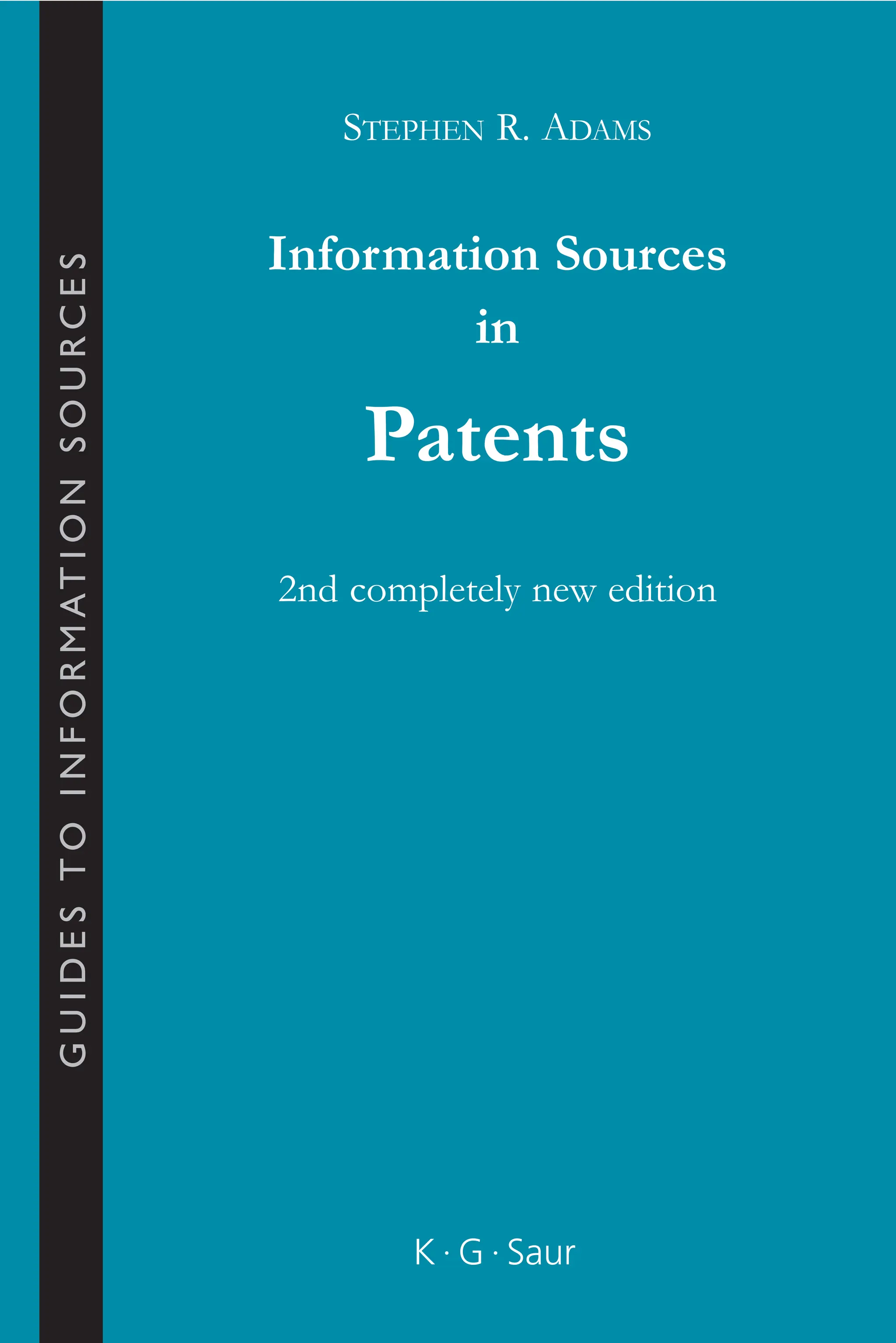

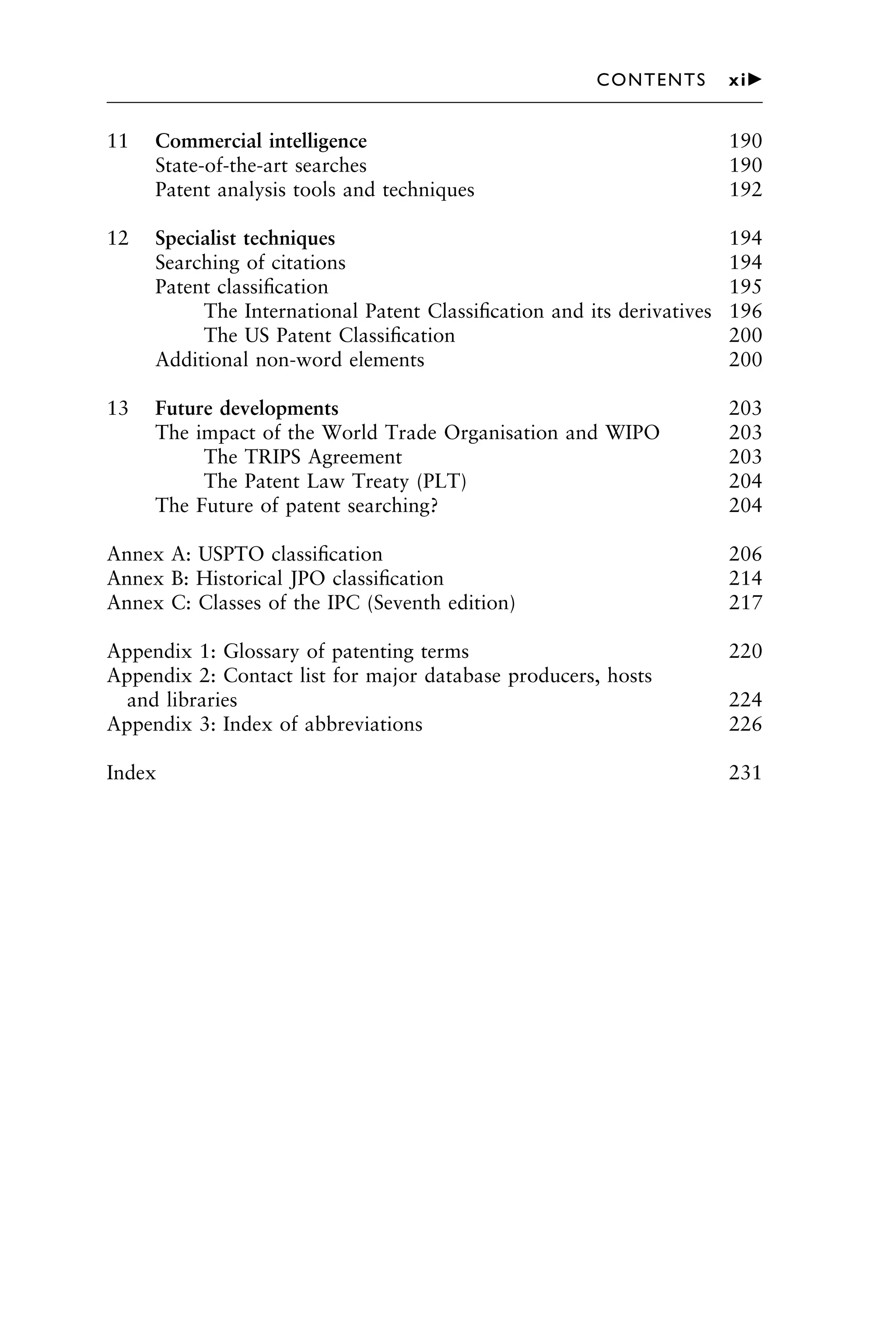
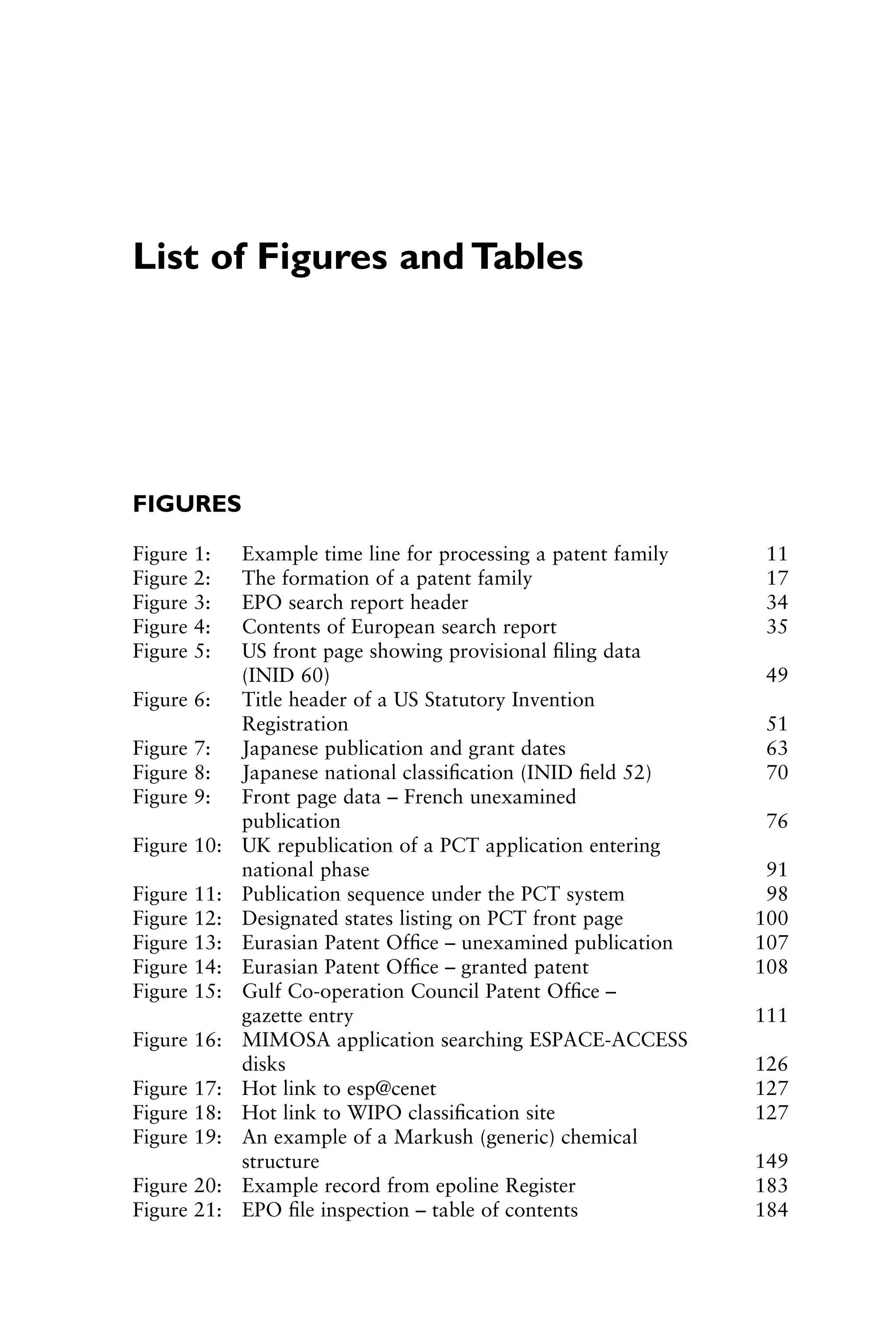
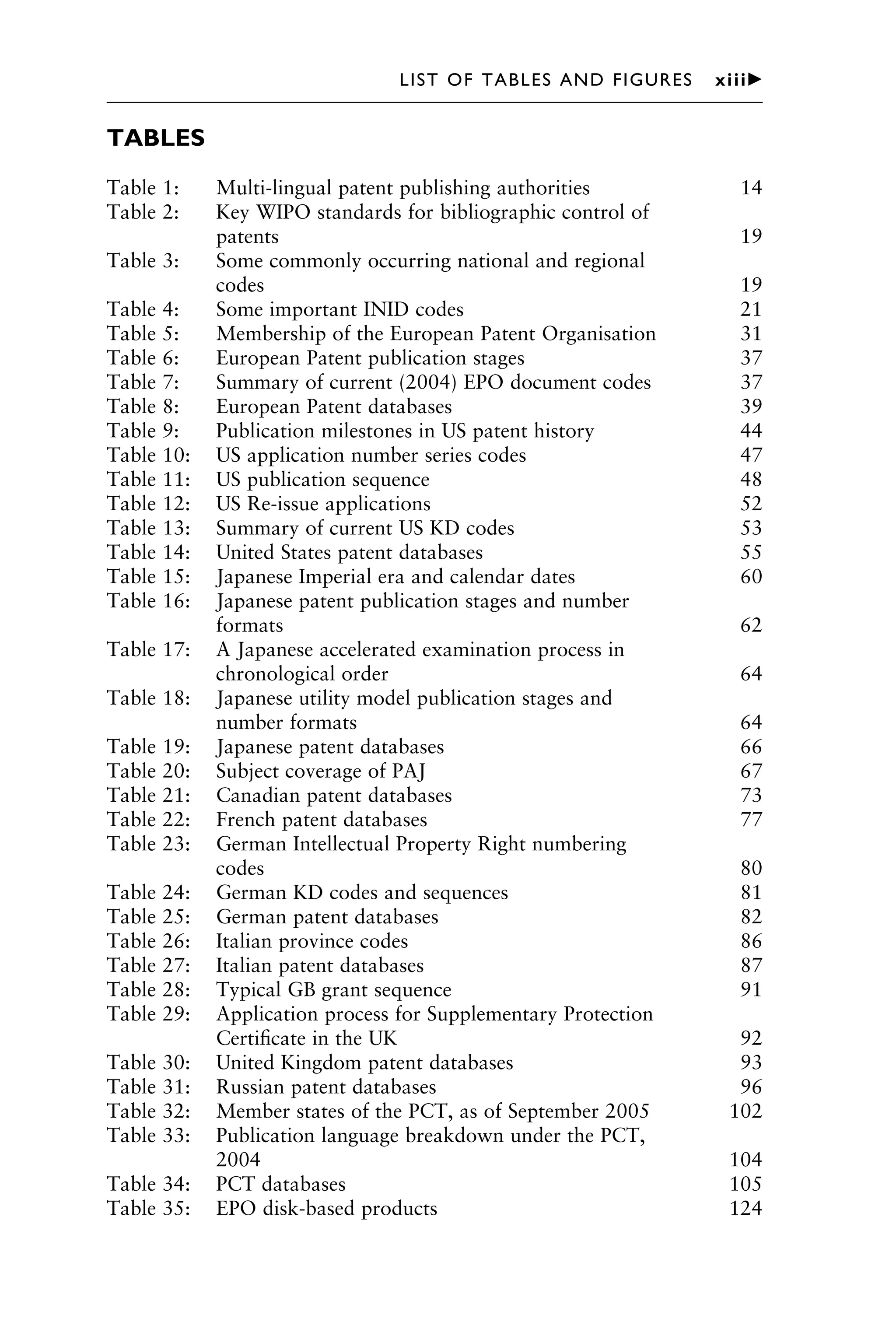
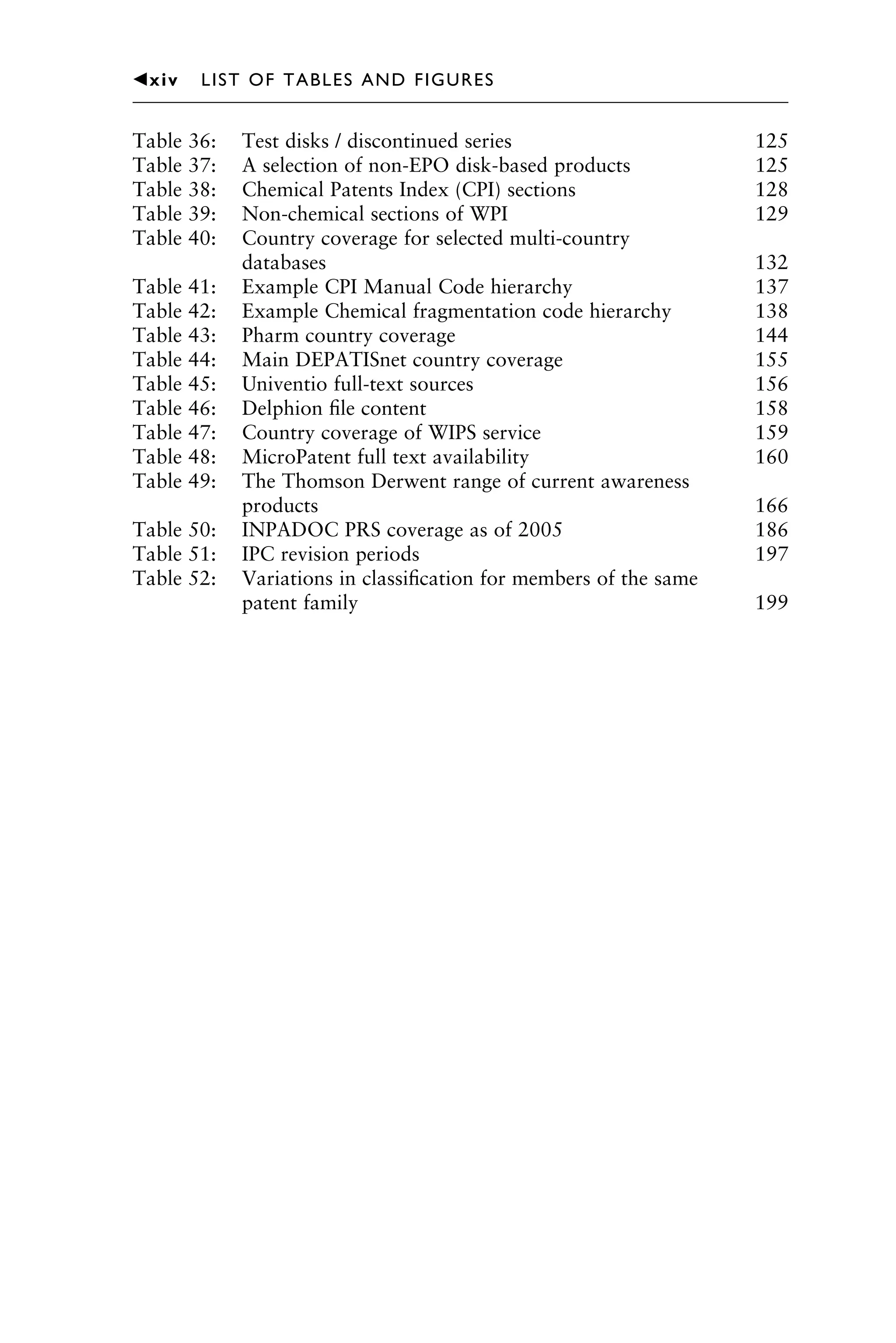
![Preface
Since the first edition of this book, edited by Peter Auger and published in
1992, a complete revolution has taken place in the dissemination of patent
information. Technical developments – most notably the internet – have
caused great changes in the information industry, including the patent
sector. Perhaps the largest influence has been upon the nature of the data-
bases emerging from different suppliers, which in turn affects our choice
of the “right” database for a particular patent search. In writing a book
which purports to be a “Guide to Information Sources” in the subject, I
therefore feel duty-bound to give some space to considering how the current
range of products has developed over time, and to provide some back-
ground on how patent publications come to be at all, rather than merely
provide a shopping list of alternative search files.
A fundamental point to recognise is that patent offices are required
to publish information, as an integral part of the patenting process. The
commitment to provide such data to the public was foreseen by the framers
of the 1883 Paris Convention, who included Article 12, which states that:
12(1) Each country of the Union undertakes to establish a
special industrial property service and a central office for the
communication to the public of patents, utility models, indus-
trial designs and trademarks. [i.e. to establish a patent office]
12(2) This service shall publish an official periodical journal.
It shall publish regularly:
(a) the names of the proprietors of patents granted, with a
brief designation of the inventions patented; [i.e. to produce
some form of gazette]
Despite the clear requirements of Article 12, there was – and still is – consid-
erable variation in the degree of enthusiasm and commitment with which
countries complied with this aspect of their operations. Some of the larger,
1111
2
3
4
5
6
7
8
9
10111
1
2
3
4
5
61111
7
81111
9
20111
1
2
3
4
5
6
7
8
9
30111
1
2
3
4
5
6
7
8
9
40111
1
2
3
4
5111](https://image.slidesharecdn.com/830687-250529085150-b9ed72b0/75/Information-Sources-In-Patents-Guides-To-Information-Sources-2nd-Stephen-R-Adams-22-2048.jpg)

![in earlier patents from the same country within the previous 50 years; that
is, there is a limitation both in terms of the type of publication consulted
and in the time-scale concerned. At the other extreme, a definition of so-
called ‘universal novelty’ is increasingly being used, which requires that no
publication of any sort (including non-print media and verbal disclosures)
may occur anywhere in the world prior to the filing date of the invention.
Clearly, this sort of definition of novelty places a much greater burden on
the patent office, as there will be a much larger volume of literature to
screen in order to establish novelty.
The size of this literature (the prior publications or, as it is often called,
the ‘prior art’) is affected by the right of the priority. This is because the
filing date of a patent application is an intrinsic part of the definition of
novelty. To illustrate, consider the United Kingdom Patents Act 1977, at
section 2(1)–(2):
2(1) An invention shall be taken to be new if it does not form
part of the state of the art.
2(2) The state of the art in the case of an invention shall be
taken to comprise all matter (whether a product, a process,
information about either, or anything else) which has at any
time before the priority date of that invention been made avail-
able to the public (whether in the United Kingdom or elsewhere)
by written or oral description, by use or in any other way. [my
emphasis]
In other words, the priority date becomes a cut-off point in defining which
literature should be considered against our application. Anything published
after that date will not, on its own, damage the chances of obtaining a
patent, whereas a careless disclosure by the inventor, or a competitor’s
publication, occurring before the priority date may indeed jeopardise the
application on the grounds of lack of novelty. This is not a unique British
situation – corresponding laws exist in many other countries.
Possibly the hardest criterion to satisfy is (b), that of inventive step
(or, as it referred to in some countries, non-obviousness). The essential task
for the patent office during examination is to answer the question, “Is this
application a trivial extension of what is already known, or does it have
inventive merit?”. In practice, this process may involve taking several pieces
of prior knowledge and trying to prove whether or not they point unam-
biguously to the invention. This can be the cause of much argument between
applicant and examiner before grant, and between patent holder and third
parties after the grant.
Given the above criteria for patentability, and its application during
a sequential examination process, it was perhaps inevitable that most patent
offices around the world were facing a manpower crisis by the early 1960’s.
As each application had to be rigorously compared with an extensive set
1111
2
3
4
5
6
7
8
9
10111
1
2
3
4
5
61111
7
81111
9
20111
1
2
3
4
5
6
7
8
9
30111
1
2
3
4
5
6
7
8
9
40111
1
2
3
4
5111
䉳8 PATENT PROCESSES AND DOCUMENTATION](https://image.slidesharecdn.com/830687-250529085150-b9ed72b0/75/Information-Sources-In-Patents-Guides-To-Information-Sources-2nd-Stephen-R-Adams-31-2048.jpg)
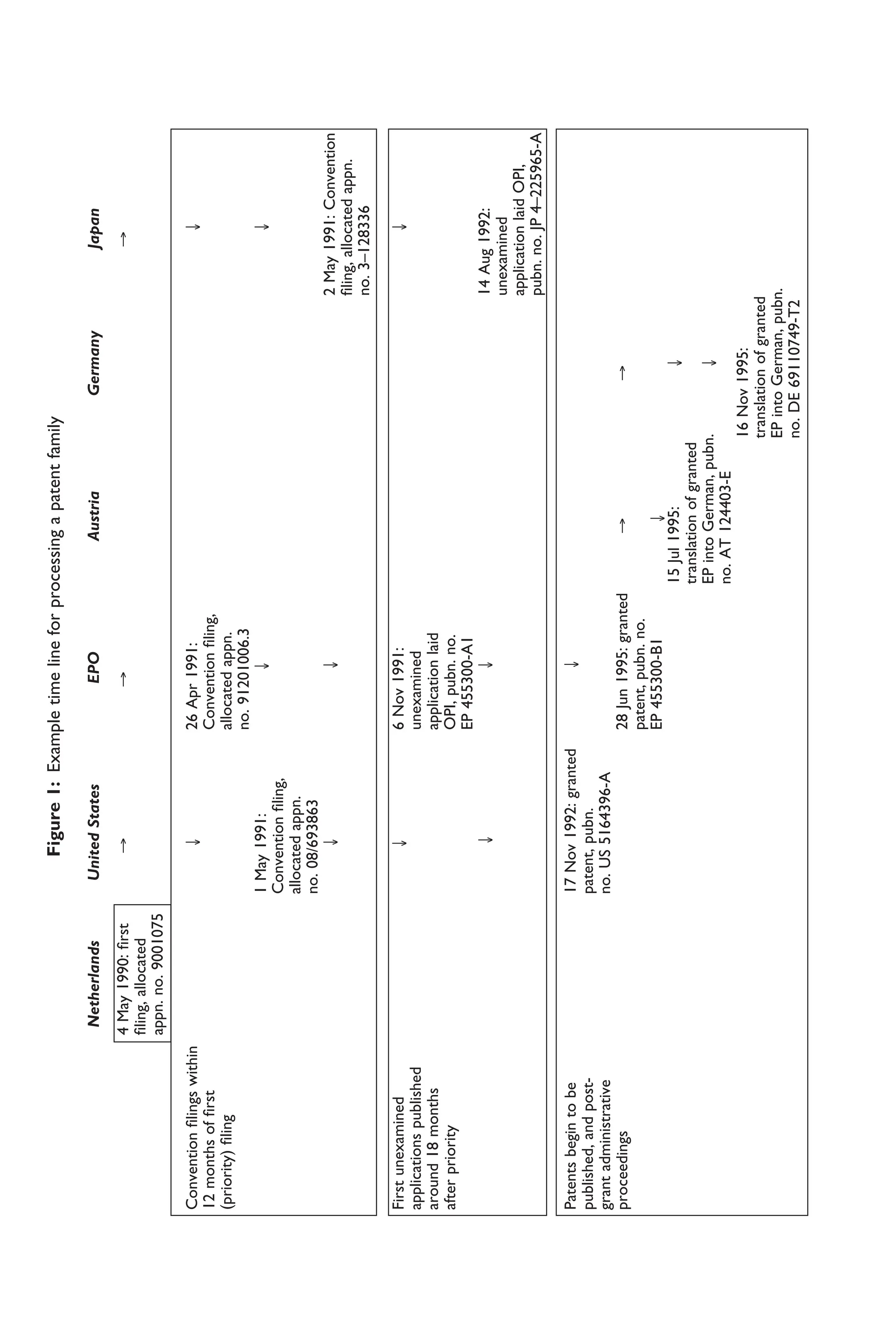
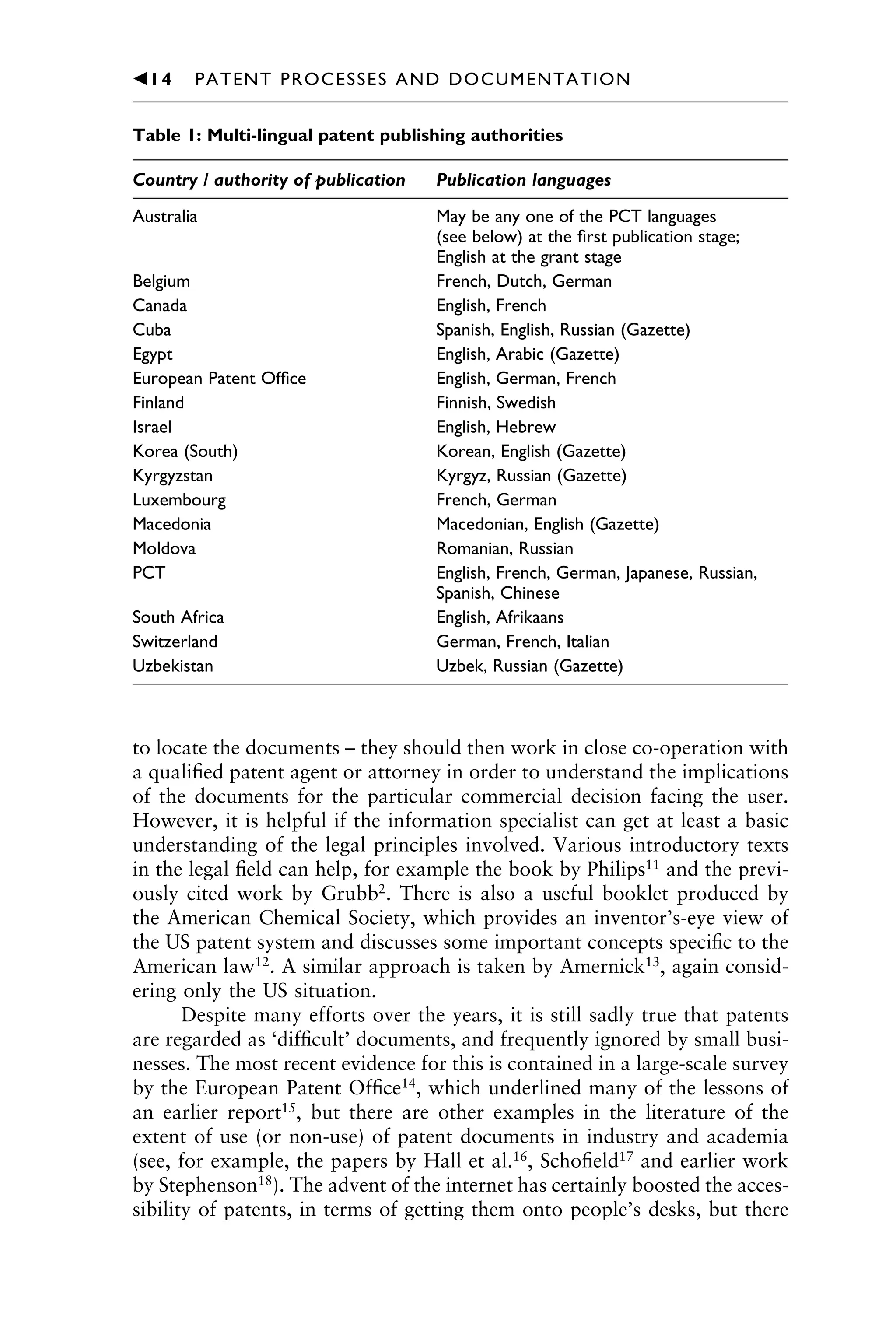
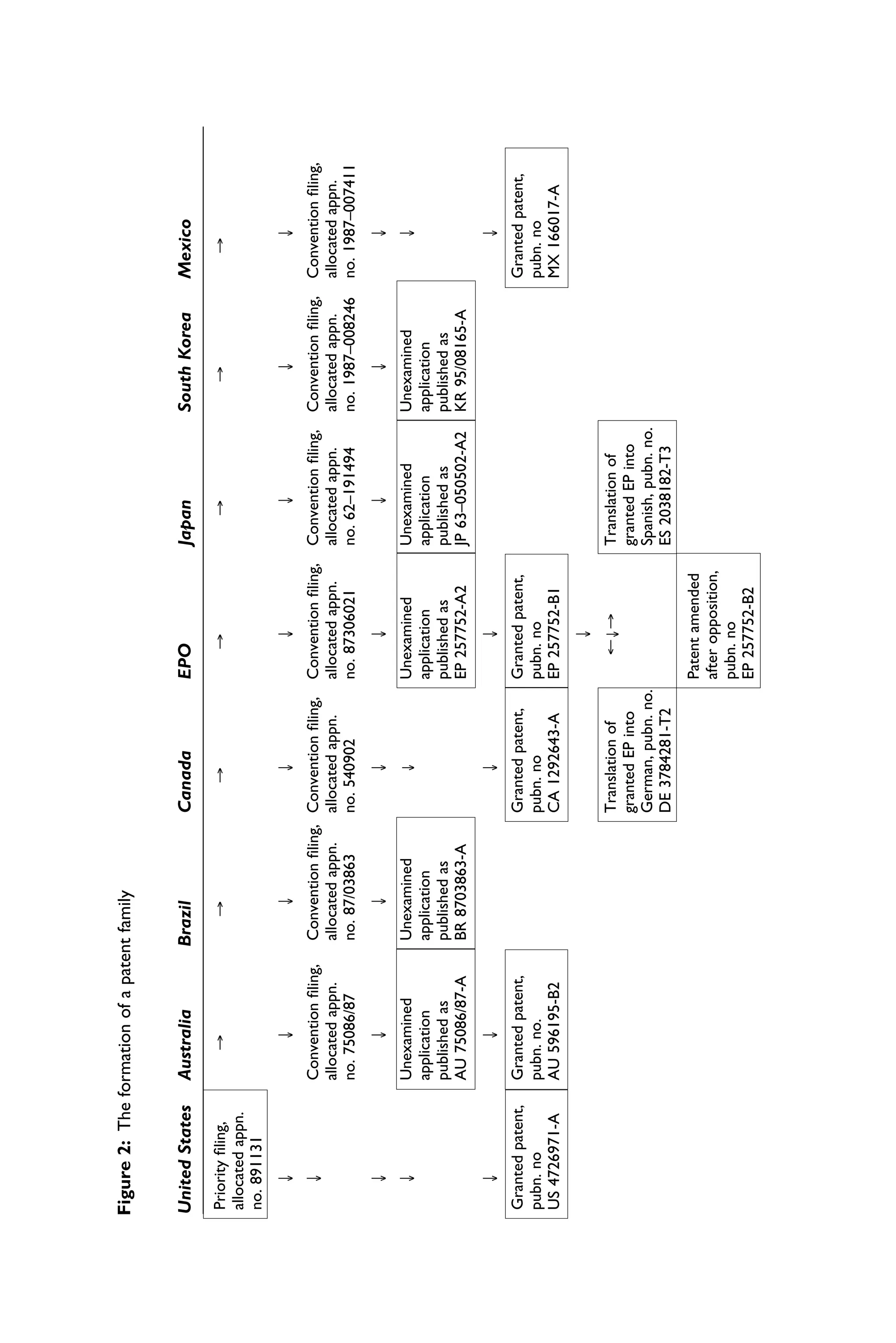
![The ST.3 standard for two-letter country codes is based upon the
international standard ISO 3166, with some additions for non-state author-
ities. The most-commonly occurring national codes, plus the active regional
codes, appear in Table 3 – refer to the main standard for the full listing.
Users should note that a number of codes have changed as a result of
1111
2
3
4
5
6
7
8
9
10111
1
2
3
4
5
6
7
81111
9
20111
1
2
3
4
5
6
7
8
9
30111
1
2
3
4
5
6
7
8
9
40111
1
2
3
4
51111
PRINCIPLES OF PATENTING 19䉴
Table 2: Key WIPO standards for bibliographic control of patents
Standard Latest Title
number revision
ST. 1 Sep. 2001 Recommendation concerning the minimum data elements
required to uniquely identify a patent document.
ST.3 Feb. 2004 Two-letter codes for the representation of states, other
entities and organizations.
ST. 6 Apr. 2003 Numbering of published patent documents.
ST. 9 Feb. 2004 Bibliographic data on and relating to patents and SPCs.
ST. 13 Nov. 1997 Numbering of applications for patents, SPCs, designs and
layout-designs of IC.
ST. 16 Jun. 2001 Standard code for the identification of different kinds of patent
documents.
ST. 50 Nov. 1998 Corrections, alterations and supplements relating to patent
information.
Table 3: Some commonly occurring national and regional codes
Code Country / regional publishing authority
AP African Regional Industrial Property Organisation [English-speaking Africa]
CA Canada
CN China
DE Germany
EA Eurasian Patent Office [some former Soviet Union states]
EP European Patent Office
FR France
GB United Kingdom
GC Patent Office of the Cooperation Council for the Arab States of the Gulf
IT Italy
JP Japan
KR South Korea
OA Organisation Africaine de la Propriété Industrielle [French-speaking Africa]
RU Russian Federation
US United States
WO Patent Co-operation Treaty](https://image.slidesharecdn.com/830687-250529085150-b9ed72b0/75/Information-Sources-In-Patents-Guides-To-Information-Sources-2nd-Stephen-R-Adams-42-2048.jpg)
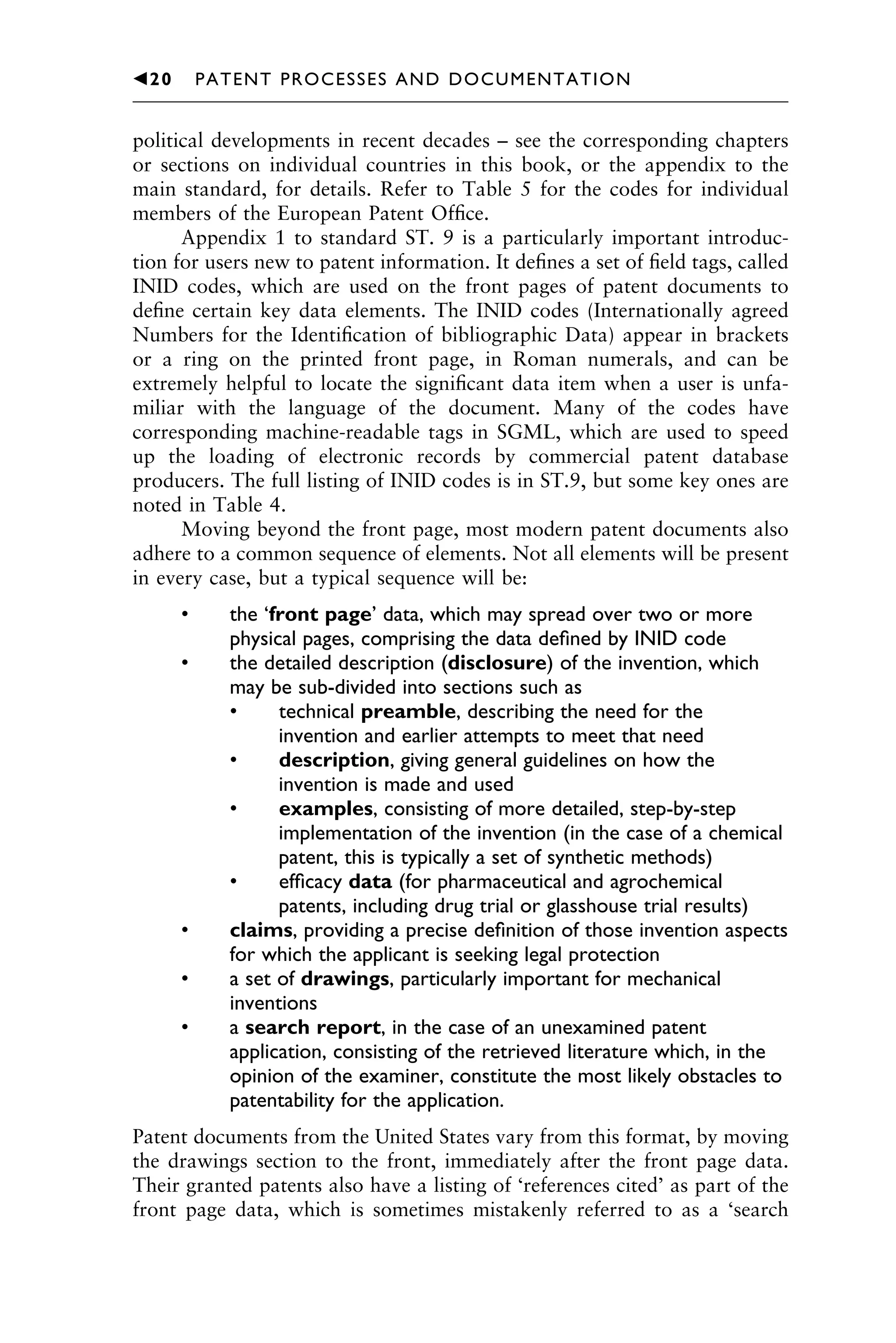
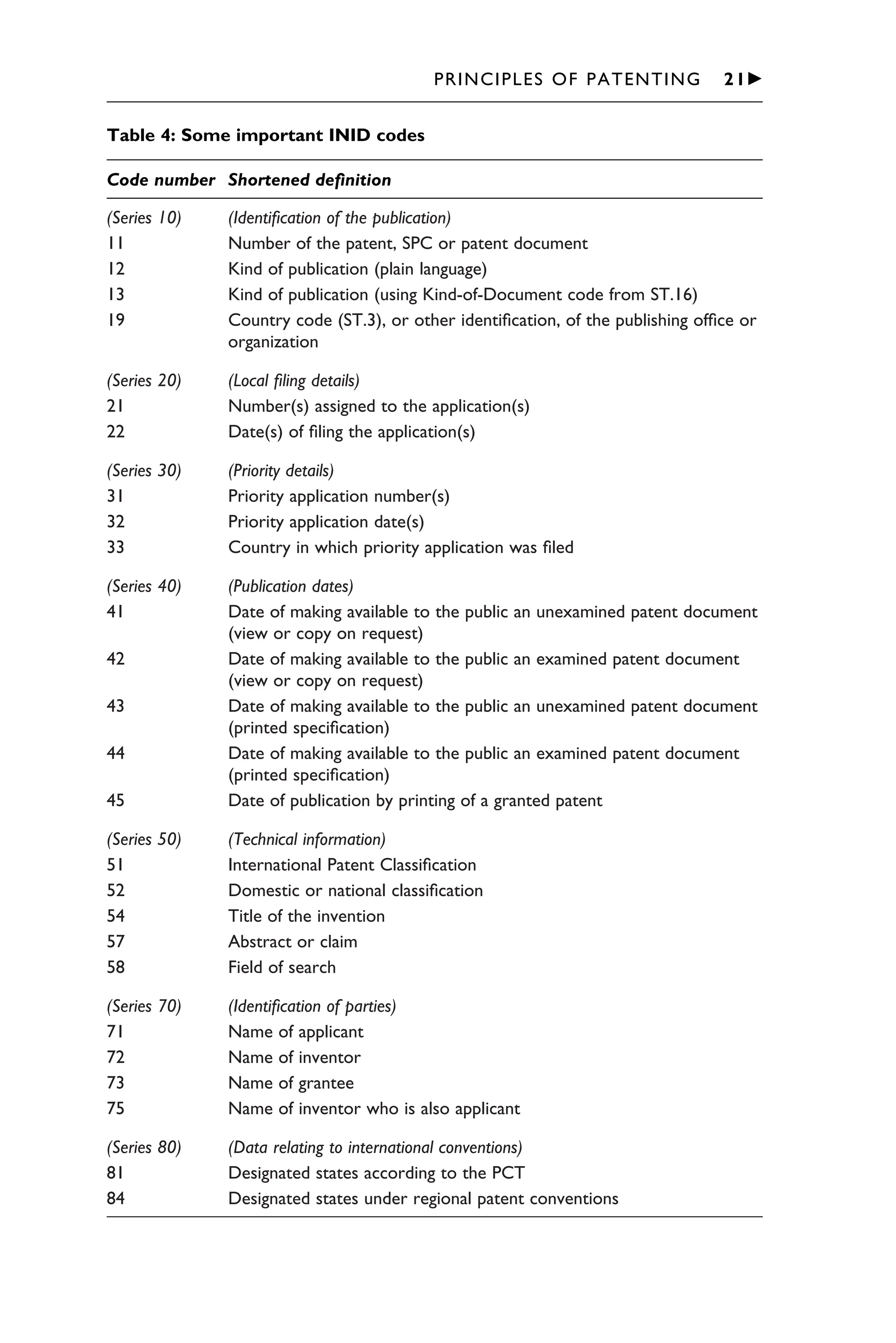
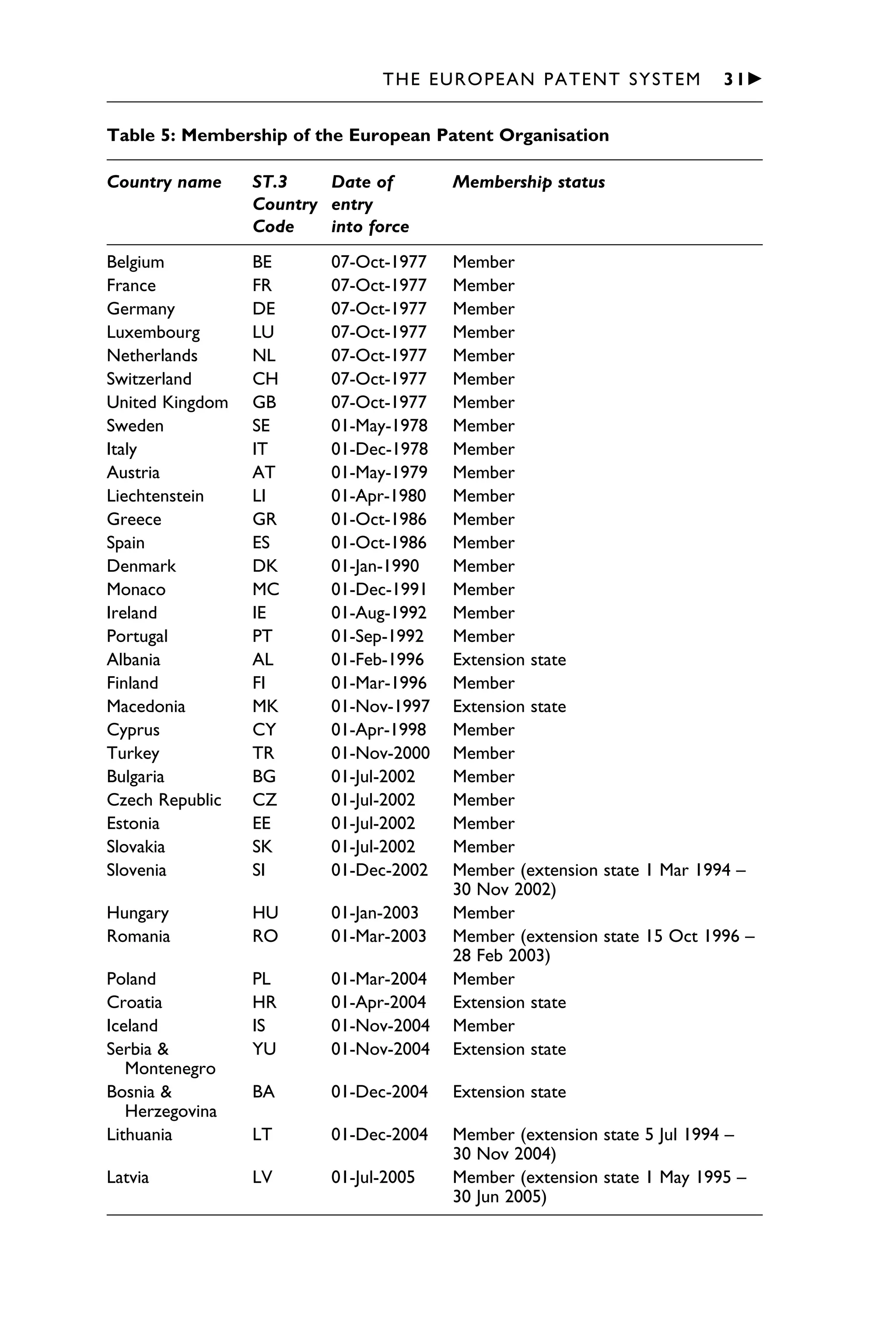

![monopoly and the reduction of the duty, has in a great measure
destroyed the English manufacture of spurious tea from indigenous
leaves. The extent to which this formerly took place may be judged
from a report of the Committee of the House of Commons, in 1783,
which states that no less than four millions of pounds were annually
manufactured from sloe and ash leaves in different parts of England;
and this, be it remembered, when the whole quantity of genuine tea
sold by the East-India Company did not amount to more than six
millions of pounds annually.
If the better class of black and all green teas[4] are thus vilely
adulterated, the reader may fancy he can at least take refuge in
coffee—alas! in too many cases he will only avoid Scylla to fall into
Charybdis. Coffee, as generally sold in the metropolis and in all large
towns, is adulterated even more than tea. The Treasury minute,
which allowed it to be mixed with chicory, is at the head and front of
the offending. In the year 1840, this celebrated minute was issued
by the sanction of the then Chancellor of the Exchequer, Sir C.
Wood, the immediate consequence of which was that grocers began
to mix it with pure coffee in very large quantities, quite forgetting to
inform the public of the nature of the mixture, and neglecting at the
same time to lower the price. The evil became so flagrant that upon
the installation of the Derby administration Mr. Disraeli promised to
rescind this license to adulterate; but before the promise was
redeemed, the administration was rescinded itself. Mr. Gladstone,
upon his acceptance of office, loath, it appears, to injure the chicory
interest, modified the original minute, but allowed the amalgamation
to continue, provided the package was labelled “Mixture of Chicory
and Coffee.” It was speedily found, however, that this announcement
became so confounded with other printing on the label that it was
not easily distinguishable, and in consequence it was provided that
the words, “This is sold as a mixture of Chicory and Coffee,” should
be printed by themselves on one side of the canister. It may be
asked what is the nature of this ingredient, that the right to mix it
with coffee should be maintained by two Chancellors of the
Exchequer, during a period of fifteen years, as jealously as though it](https://image.slidesharecdn.com/830687-250529085150-b9ed72b0/75/Information-Sources-In-Patents-Guides-To-Information-Sources-2nd-Stephen-R-Adams-56-2048.jpg)
![“Adulterated with chicory, of which not less than half the sample
consists.”
The worst kinds of adulterated coffee are to be found in that which
is sold in canisters. The value of the tin envelope cannot be less than
2d., and, as the coffee so sold is charged at the same price as that
in a paper wrapper, it must be evident that a more extensive
adulteration is necessary in order to make up the difference. Such,
upon examination, proves to be the case, as it appeared—
“That the whole twenty-nine packages, bottles, and canisters
submitted to analysis, with a single exception,[5] were adulterated.
“That in these twenty-eight adulterated samples the falsification
consisted of so-called chicory, which in many instances constituted
the chief part of the article.
“That three of the samples contained mangold-wurzel, and two of
them roasted wheat-flour.”
We have said it often happens that the adulterations are adulterated.
Chicory is an instance of it. The original fraud is found to have
ramified in an endless manner; and Sir Charles Wood will doubtless
be astonished to hear of the hideous crop of falsifications his most
unfortunate order has caused to spring out of the ground.
Immediately the process of transforming chicory into coffee became
legalized by the Government, that article came into very extensive
consumption, and factories were set up especially for its secret
manufacture. The reason for this secrecy may be gathered from the
list of articles which are made to subserve the purpose: roasted
wheat, ground acorns, roasted carrots, scorched beans, roasted
parsnips, mangold-wurzel, lupin-seeds, dog’s biscuits, burnt sugar,
red earth, roasted horse-chestnuts,—and above and beyond all
baked horses’ and bullocks’ livers. This statement rests upon the
authority of Mr. P. G. Simmonds, in a work entitled “Coffee as it is,
and as it ought to be:”—](https://image.slidesharecdn.com/830687-250529085150-b9ed72b0/75/Information-Sources-In-Patents-Guides-To-Information-Sources-2nd-Stephen-R-Adams-59-2048.jpg)
![intoxication, must be used in such large quantities as would very
much diminish, if not totally exclude, the brewer’s profit.”
It is clear from this extract that Mr. Child considered the end of all
successful brewing was to make people dead-drunk at the cheapest
possible rate, regardless of consequences. Among the ingredients
that Mr. Morris, another instructor in the art of brewing, tells us are
requisite to produce a popular article, are—cocculus indicus and
beans, as intoxicators; calamus aromaticus, as a substitute for hops;
quassia, as a bitter; coriander-seeds to give flavour; capsicums,
carraway-seeds, ginger, and grains of paradise, to give warmth;
whilst oyster-shells are recommended to afford a touch of youth to
old beer, and alum to give a “smack of age” to new; and when it is
desired to bring it more rapidly “forward,” the presiding Hecate is
told to drop sulphuric acid into her brew; by this means an imitation
of the age of eighteen months was given in a few instants. Even the
“fine cauliflower head,” which is held to be the sign of excellence in
stout, was—and, for all we know, still is—artificially made by mixing
with the article a detestable compound called “beer-headings,”
composed of common green vitriol, alum, and salt, and sometimes
by the simple addition of salts of steel. That these articles were
commonly employed we have the evidence of the Excise
Department, which published a long list of such ingredients seized
by them on the premises of brewers and brewers’ druggists.[6] Many
of these glaring adulterations are probably no longer in general use,
although, from the evidence given before a recent committee of the
House of Commons, it is believed that sulphuric acid, salt of steel,
sulphate of iron, and cocculus indicus are still resorted to by the
smaller brewers, especially those living in the country—a belief very
much strengthened by the very odd taste we sometimes find in ales
and porters, and which is certainly not derived from malt and hops.
The common method of adulterating the national liquor is by mixing
water with it. This is done almost universally by the publican, and to
a very extraordinary extent. A comparison between the per-centage
of alcohol to be found in a given number of samples of porter and
stout, procured from what is termed brewers’ taps, or agents, with](https://image.slidesharecdn.com/830687-250529085150-b9ed72b0/75/Information-Sources-In-Patents-Guides-To-Information-Sources-2nd-Stephen-R-Adams-76-2048.jpg)