INFORMATION DOCUMENT 
 
Drawn up pursuant to Article 71 of the Regulation implementing 
Legislative Decree No. 58 of 24 February, 1998, setting forth the 
rules governing issuers and adopted by CONOSOB by means of 
resolution No. 11971 of 14 May 1999 (as subsequently amended 
and supplemented) 
 
*** 
concerning the acquisition of 99.993% of the share capital of GE 
Capital Interbanca S.p.A. 
	
Information Document made available on 5 December 2016 
PREAMBLE 
This information document (the "Information Document") has been prepared by the Issuer in accordance with 
Article 71 of the Issuers Regulation and related outline No. 3 of Attachment 3B, for the purpose of providing 
exhaustive  information  on  the  Transaction  involving  the  acquisition  of  the  Interest,  which  was  closed  on  30 
November 2016 and announced to the market on the same date. 
More specifically, pursuant to the Agreement entered into on 28 July 2016 between the Seller and Banca IFIS, on 
30  November  the  Seller  sold  to  Banca  IFIS  no.  72,440,331  shares  representing  99.993%  of  Interbanca’s  share 
capital. 
This  Information  Document  was  filed  at  the  registered  office  of  the  Issuer  on  5  December  2016  and  is  also 
available on the Issuer’s website site www.bancaifis.it and on the website of Borsa Italiana www.borsaitaliana.it. 
 
Certain  information  and  statements  contained  in  this  Information  Document  that  are  not  information  and 
statements on historical facts, are to be deemed forward‐looking statements, even if such statements are not 
specifically  defined  as  such.  These  statements  include,  by  way  of  example  and  without  limitation,  the  plans, 
intentions and expectations concerning the Transaction referred to in this Information Document, the financing of 
the  Transaction,  as  well  as  the  results,  benefits,  synergies,  profits,  costs,  timeframes  and  other  outcomes 
expected from this Transaction.  
The  forward‐looking  statements  refer  to  future  –  not  past  –  events  and  are  no  guarantee  of  the  future 
performance. The statements are based on current expectations and projections about future events and, by 
their  nature,  address  matters  that,  to  different  degrees,  are  uncertain  and  subject  to  inherent  risks  and 
uncertainties. They relate to events and depend on circumstances that may or may not take place or exist in the 
future and, as such, no reliance should be placed upon them. The actual results may materially differ from those 
expressed in such statements due to a variety of factors, including changes in the general economic, financial and 
market conditions, and other changes in business conditions, most of which are outside the control of Banca IFIS.  
Banca IFIS expressly disclaims and does not assume any liability for mistakes and/or inaccuracies in relation to any 
of these forward‐looking statements and/or in connection with any use by any person of such forward‐looking 
statements. Any forward‐looking information contained in this Information Document speaks only as at the date 
thereof. 
Banca IFIS undertakes no obligation to update, revise or correct its projections or forward‐looking statements as a 
result of new developments or otherwise. Names, organizations and company names contained herein may be 
the trademarks of the respective owners. This Information Document does not constitute investment advise, or a 
solicitation, recommendation, or invitation for the purchase or sale of financial products and/or of any kind of 
financial services as contemplated by the laws of any jurisdiction. 
 
3
	
PRO‐FORMA SUMMARY AND PER SHARE FIGURES CONCERNING THE ISSUER AND INTERBANCA AS AT 30 JUNE 
2016 
The following tables show briefly the consolidated economic and financial data of Banca IFIS and Interbanca and 
the  pro‐forma  data  of  Banca  IFIS  including  Interbanca,  as  well  as  the  relating  per  share  indicators  for  the  six 
months ended on 30 June 2016. 
The  summary  figures  indicated  below  were  drawn  from  the  pro‐forma  consolidated  statements  reported  in 
Chapter 5, and must be read in conjunction with the description of the hypotheses and the criteria adopted for 
the drafting of the pro‐forma consolidated statements and the other information contained therein.  
 
Pro-forma consolidated balance sheet as at June 30, 2016
Assets (in thousands of Euros) BIFIS Group Pro-forma
10. Cash and cash equivalents 35 38
20. Financial assets held for trading 366 45,123
40. Available for sale financial assets 1,027,770 1,142,078
60. Due from banks 153,877 294,128
70. Loans to customers 3,355,998 5,680,994
100. Equity investments - 754
120. Property, plant and equipment and investment property 56,729 103,747
130. Intangible assets 8,929 10,379
- of which goodwill 795 795
140. Tax assets 64,595 585,420
150. Non-current assets and disposal groups held for sale - 210,325
160. Other assets 74,899 168,812
Total assets 4,743,198 8,241,798
Liabilities and Equity (in thousands of Euros)
10. Due to banks 43,587 55,648
20. Due to customers 3,928,261 5,957,873
30. Securities issued - 632,312
40. Financial liabilities held for trading 13 52,675
80. Tax liabilities 16,180 30,109
100. Other liabilities 187,612 299,632
110. Post-employment benefits 1,545 7,878
120. Provisions for risks and charges 3,803 27,003
-
Group Equity 562,197 1,178,597
- of which gain on bargain purchase - 616,400
Non controlling interests - 71
Total Liabilities and Equity 4,743,198 8,241,798  
4
	
 
Pro-forma consolidated Income Statement 1
st
semester 2016 (in thousands of Euro)
Item BIFIS Group Pro-forma
10. Interest income and similar revenues 151,465 229,893
20. Interest expense and similar charges (21,909) (41,025)
30. Net interest income 129,556 188,868
40. Commission income 29,547 39,168
50. Commission expense (2,583) (6,887)
60. Net commission income 26,964 32,281
70. Dividends and similar revenues - 5
80. Net profit (loss) from trading (332) (7,900)
100. Profit (loss) from sale or buyback of: 11,189 11,447
a) receivables 5,694 5,694
b) available for sale financial assets 5,495 5,753
120. Net banking income 167,377 224,701
130. Net impairment losses/reversal on: (32,215) (32,270)
a) receivables (28,216) (28,216)
b) available for sale financial assets (3,999) (4,337)
d) other financial transactions - 283
140. Net profit from financial activities 135,162 192,431
170. Net income from banking and insurance activities 135,162 192,431
180. Administrative expenses: (74,067) (140,269)
a) personnel expenses (27,595) (51,485)
b) other administrative expenses (46,472) (88,784)
190. Net allocations to provisions for risks and charges (1,633) (3,723)
200. Net adjustments to/recoveries on tangible assets (846) (1,644)
210. Net impairment losses/reversal on plant, property and equipmen (1,161) (1,557)
220. Other operating income (expenses) 910 4,615
230. Operating costs (76,797) (142,578)
240. Profits (Losses) on disposal of investments - 44
280. Pre-tax profit (loss) from continuing operations 58,365 49,897
290. Income taxes for the year relating to current operations (19,245) (28,798)
300. Profit (Loss) after tax from continuing operations 39,120 21,099
320. Profit (loss) for the year 39,120 21,099
330. Non controlling interests - (3)
Gain on bargain purchase - 616,400
340. Profit (loss) attributable to the parent company 39,120 637,501  
 
KPIs per share
BIFIS Group Pro-forma
Outstanding shares 53,076,576 53,076,576
Earnings per share (EPS) 0.74 12.01
Equity per share 10.59 22.21
 
5
	
DEFINITIONS AND GLOSSARY 
A list of the main definitions and terms used in this Information Document is provided below. These definitions 
and terms (whether used in the plural or singular form), unless otherwise specified, have the meaning indicated 
below.  
"Agreement"  means  the  preliminary  agreement  concerning  the 
purchase  and  sale  of  the  Interest,  governing  the 
Transaction,  entered  into  on  28  July  2016  between 
the Seller and the Purchaser, as lastly amended on 30 
November 2016. 
"Banca IFIS Group"  means jointly Banca IFIS and the companies directly or 
indirectly owned by the Issuer. 
"Borsa Italiana"  means Borsa Italiana S.p.A.. 
"CONSOB"  means the Commissione Nazionale per le Società e la 
Borsa (Italian commission for companies and the stock 
exchange). 
"Execution Date"   means 28 July 2016, the date on which the Agreement 
was entered into. 
"IFIS Factoring"  means IFIS Factoring S.r.l., having its registered office 
in  Milan  (MI),  via  Borghetto  5,  with  a  fully  paid‐up 
share capital of Euro 123,240,000, registered with the 
Companies  Register  of  Venice,  registration  number, 
tax code and VAT number 11990630151. 
"IFIS Finance"   means IFIS Finance Sp. z o.o, a company incorporated 
under the Laws of Poland, having its registered office 
in Warsaw, Wspolna 62, with a share capital of Zloty 
47,000,000,  registration  number  KRS  0000156397, 
wholly  owned  by  Banca  IFIS  as  at  the  Information 
Document Date. 
"IFIS Leasing"  means IFIS Leasing S.p.A., having its registered office 
in  Mondovì  (CN),  via  Vecchia  di  Cuneo  136  (Loc. 
Pogliola),  with  a  fully  paid‐up  share  capital  of  Euro 
41,000,000, registered with the Companies Register of 
Cuneo,  registration  number,  tax  code  and  VAT 
number 00596300046. 
"IFIS Rental Services"  means IFIS Rental Services S.r.l., having its registered 
office in Milan (MI), via Borghetto, 5, with a fully paid‐
up share capital of Euro 6,000,000.00, registered with 
the Companies Register of Milan, registration number, 
tax code and VAT number 09635390967. 
"Information Document Date"  means  the  date  of  publication  of  this  Information 
Document. 
"Information Document"  means  this  information  document,  drawn  up  by  the 
Issuer in compliance with the Issuers Regulation. 
"Interbanca Group"  means jointly Interbanca and the Investees. 
6
	
"Interbanca"  means  GE  Capital  Interbanca  S.p.A.,  having  its 
registered office in Milan (MI), Corso Venezia 56, with 
a  fully  paid‐up  share  capital  of  Euro  217,335,282, 
registered  with  the  Companies  Register  of  Milan, 
registration  number,  tax  code  and  VAT  number 
00776620155. 
"Intercompany Debt"  means  the  debt  outstanding  at  the  Transaction 
Performance  Date  between  the  companies  of  the 
Interbanca Group and the Seller’s group. 
"Interest"  means No. 72,440,331 shares with a par value of Euro 
3 each, representing 99.993% of the share capital of 
Interbanca. 
"Interim Report as at 30 September 2016"  means the interim report as at 30 September 2016 of 
Banca IFIS. 
"Investees"  means  jointly  IFIS  Leasing,  IFIS  Factoring  and  IFIS 
Rental Services. 
"Issuers Regulation"  means  the  regulation  adopted  by  CONSOB  under 
resolution No. 11971 of 14 May 1999, as subsequently 
amended and supplemented. 
"Preliminary Price"  means the amount of Euro 160,000,000 paid as at the 
Execution Date by Banca IFIS to the Seller subject to 
the Price Adjustment.  
"Price Adjustment"  means the Preliminary Price adjustment mechanism. 
"Purchaser" or "Issuer" or "Banca IFIS"  means Banca IFIS S.p.A., having its registered office in 
Mestre  (VE),  via  Terraglio  63,  with  a  fully  paid‐up 
share  capital  of  Euro  53,811,095.00,  registered  with 
the  Companies  Register  of  Venice,  registration 
number,  tax  code  and  VAT  number  02505630109, 
registered with the Bank Register under No. 5508. 
"Seller"  means  GE  Capital  International  Holdings  Limited,  a 
company incorporated under the Laws of the United 
Kingdom, having its registered office in London, in The 
Ark, 201 Talgarth Road, company number 9666321.  
"Transaction Performance Date"  means  30  November  2016,  the  date  on  which  the 
Transaction was performed. 
"Transaction"  means  the  transaction  involving  the  acquisition  by 
Banca  IFIS  of  the  Seller’s  Interest  and  the 
simultaneous repayment of debt to the Seller by the 
Interbanca  Group also by partial refinancing to third 
parties.. 
"TUB"  means the Legislative Decree No. 385 of 1 September 
1993,  (Testo  Unico  delle  leggi  in  materia  bancaria  e 
creditizia, consolidated law on banking and credit), as 
subsequently amended and supplemented. 
 
7
	
Contents 
 
 
1.  WARNINGS ........................................................................................................................................................ 8 
2.  INFORMATION RELATING TO THE TRANSACTION............................................................................................13 
3.  SIGNIFICANT EFFECTS OF THE TRANSACTION..................................................................................................20 
4.  FINANCIAL INFORMATION RELATING TO THE ACQUIRED OPERATIONS..........................................................22 
5.  PRO‐FORMA FINANCIAL INFORMATION RELATING TO THE ISSUER ................................................................36 
6.  PROSPECTS OF the ISSUER AND ITS GROUP.....................................................................................................46
8
	
	
1. WARNINGS 
A summary of the following potential risk factors regarding the Transaction subject of this Information Document 
is outlined below.  
It should be noted that additional risks and uncertain events, currently unforeseeable or which are considered to 
be improbable at present, could equally influence the Issuer's business activity, economic and financial conditions 
and outlook. 
For a more complete analysis of the risk profiles underlying the Transaction, the considerations detailed below 
are  to  be  read  together  with  the  other  information  included  in  the  Information  Document,  in  the  Half‐Yearly 
Report  2016  and  in  the  Interim  Report  as  at  30  September  2016  which  are  available  on  the  Issuer's  Internet 
website: www.bancaifis.it.  
 
1.1 RISK FACTORS ARISING FROM THE TRANSACTION 
1.1.1 Risks associated with the Transaction 
The Interbanca Group’s acquisition entails the typical risks of an investment in significant interests in the capital 
of  companies  with  unlisted  shares,  and  in  particular,  the  possibility  that  the  interest  acquired  is  subject  to 
depreciation  due  to:  (i)  the  occurrence  of  contingent  liabilities  and/or  unsubstantiated  assets  not  recognised 
and/or  unforeseeable  at  the  Transaction  completion  date,  in  the  financial  position  of  Interbanca,  or  of  the 
Investees; or (ii) other factors unforeseeable at the Transaction completion date.  
Despite the fact that the Seller has provided contractual warranties and indemnities in the Agreement, which are 
in line with market practice, the occurrence of the possibilities represented could entail negative effects regarding 
the financial position and the reputation of the Interbanca Group and the Issuer. 
 
1.1.2 Risks associated with the integration process 
The Transaction entails the risks which are typical of integration operations with a new corporate group, with 
particular reference to the necessary management coordination, integration of the existing IT systems, functions 
and services with those of the new group. This integration process could be completed on the basis of timeframes 
and  methods  which  differ  from  those  planned  by  the  Issuer  and  entail  greater  costs  unforeseeable  at  the 
Transaction completion date with possible negative effects on the financial position of the Interbanca Group and 
the Issuer. 
A potential risk exists at the date of this Information Document related to the success of the integration process, 
also with reference to the centralisation of the operating structure of the group member companies from the 
administrative point of view and of the IT systems, as well as in terms of rationalisation of the products and 
services offered, and with reference to the harmonisation of the resources with the group's management policy. 
The Issuer considers that the new group resulting from the Transaction could benefit from synergies arising, inter 
alia, from lower costs and greater revenues, despite the existence of the above‐mentioned risks. Achieving these 
synergies will depend, inter alia, on the capacity to efficiently integrate the different entities and increase their 
productivity  by  reducing  costs.  There  is  the  risk  that  failing  to  implement  all  or  part  of  the  above‐mentioned 
synergies could produce negative effects, inter alia, in terms of smaller cost savings and smaller revenue increases 
9
	
generated by the expected synergies. Furthermore, the complete integration of the Issuer and of the Interbanca 
Group could entail the occurrence of unforeseen problems, the need to sustain unexpected costs and liabilities or 
reduced revenues also resulting from possible negative synergies and require an extraordinary activity compared 
to the ordinary operations, all of which could have consequent negative ‒ and even significant ‒ impacts, on the 
Issuer's economic, equity and/or financial position. 
 
1.1.3 Risks associated with the estimates and forecasts associated with the Transaction 
The valuation process performed for the purposes of the Transaction entails estimates and forecasts relating, 
inter  alia,  to  the  activities,  the  results  of  the  activities,  the  business  lines  through  which  the  Issuer  and  the 
Interbanca Group operate, the growth outlook and the respective risk factors associated with the Issuer and the 
Interbanca Group, also with regard to the outcome of the Transaction. These estimates and forecasts are based 
on the data available to the Issuer, and, even if considered reasonable at present, could be subject to margins of 
uncertainty in the future. Factors exist which could cause differences in the actual growth and/or in the post‐
Transaction  results  compared  to  the  outcome  explicitly  or  implicitly  expressed  in  terms  of  estimates  and 
forecasts. 
The actual occurrence of one or more negative scenarios, which include the uncertainties associated with the 
process  of  estimating  the  various  quantities,  could  give  rise  to  different  results  compared  to  the  results 
represented in the estimates and forecasts contained in the valuation process performed for the purposes of the 
Transaction.  
 
1.1.4 Risks associated with equity adequacy 
Banking laws and regulations establish rules regarding the capital adequacy of banks in order to establish prudent 
levels of the capital to be held, qualifying their quality and assessing the possible risk mitigation instruments. 
The  Issuer's  capital  coefficients  at  the  Information  Document  Date  were  higher  than  the  minimum  levels 
envisaged by prudential legislation. The data relating to the Issuer's Common equity tier 1, risk‐weighted assets 
and CET 1 ratio and the same pro‐forma figures as at 30 June 2016 are detailed below: 
Capital ratios
(€/mln) BIFIS Group Pro-forma
Common equity tier 1 (CET 1) 452 1,004
Risk weighted assets 3,432 6,964
CET 1 ratio 13.17% 14.41%
 
 
1.1.5 Risks associated with credit quality deterioration 
The Bank has made some considerations regarding the credit quality of the portfolio subject to acquisition, and 
has made further adjustment estimates, with the consequent foreseen increase for the coverage ratios of the 
various credit categories, for the purposes of a preliminary price allocation regarding the assets and liabilities 
subject to acquisition, as required by the reference accounting standards, and supported by the outcome of a 
specific due diligence activity performed by a leading auditing firm with reference to 31 December 2015.  
10
	
The  risks  associated  with  a  further  deterioration  of  the  portfolio  credits  are  considered  to  be  probable,  but 
implausible;  however,  reasons  for  an  unexpected  deterioration  in  the  quality  of  the  assets  can  be  found  in  a 
further deterioration of the generalised economic situation or the reference sector of the financed enterprises. 
 
1.1.6 Risks associated with the average extension of maturities 
The  incorporation  of  the  Interbanca  Group's  new  corporate  perimeter  introduces  a  natural  extension  of  the 
maturities of assets compared to the existing position for Banca IFIS, by reason of the Target's business model, 
since the Target provides funding with maturities which are longer, on average. 
In this regard the simulations performed show how the banking Group to be established is more exposed to the 
risk of increased interest rates, a risk to be found in the different composition between assets and liabilities with 
reference to the type of rate to which the entries are index‐linked. The estimated impact, however, is limited.  
Therefore, the extent of this risk is also to be read together with the prospects associated with the monetary 
policies applied by the European Central Bank, as well as the economy's overall performance; both factors are 
difficult to be foreseen without introducing a significant margin of uncertainty.  
 
1.1.7 Liquidity risk 
The liquidity  risk represents the risk  that the Issuer is unable to honour its payment commitments which are 
certain  or  expected  with  reasonable  certainty,  when  they  become  due.  Two  forms  of  liquidity  risk  can  be 
identified: (a) funding liquidity risk, namely, the risk that the Issuer is unable to honour its payment commitments 
and its obligations efficiently due to its inability to secure funding, without prejudice to its core activity and/or its 
financial position; and (b) market liquidity risk, namely, the risk that the Issuer is unable to sell a financial asset 
without incurring capital account losses due to the reference market's limited liquidity and/or as a consequence 
of  the  time  period  in  which  the  transaction  must  be  carried  out.  The  availability  of  liquidity  intended  for  the 
various activities, as well as the possibility of accessing long‐term funding are essential to achieve the Issuer's 
strategic objectives. In particular, liquidity and long‐term funding are essential so that the Issuer is able to honour 
the  foreseen  or  unforeseen  cash  payment  or  payment  on  delivery  obligations,  in  order  not  to  prejudice  the 
Group's current operations or financial position. The Group's ability to raise liquidity could be prejudiced by the 
Group's inability to access the debt market, the inability to sell its assets or to settle/refinance its investments. 
These events could arise  due to a  deterioration of the risk profile or other  problems related to the  Group, a 
deterioration of market conditions, a lack of confidence in the financial markets, uncertainties and speculation 
relating to the solvency of the market participants, or operational problems related to third parties. A limited 
capacity to find the necessary liquidity on the market at favourable conditions or the difficulty of accessing long‐
term  funding  at  favourable  conditions  could  have  negative  effects  on  the  Group's  results  and  on  its  financial 
position. 
The key indicators used by the Issuer to assess the liquidity profile are as follows: 
 Liquidity Coverage Ratio (LCR): this represents the short‐term liquidity indicator and corresponds to the 
ratio  between  the  amount  of  high  quality  liquidity  assets  and  the  total  net  cash  outflows  during  the 
following 30 calendar days; the indicator is subject to a minimum regulatory requirement of 70% since 
January 2016, and it will rise to 80% in 2017 and 100% in 2018. 
 Net  Stable  Funding  Ratio  (NSFR):  this  represents  the  structural  liquidity  indicator  at  12  months  and 
corresponds to the ratio between the available amount of stable funding and the mandatory amount of 
11
	
stable  funding;  this  indicator  will  be  subject  to  a  minimum  regulatory  requirement  commencing  from 
2018 (or commencing from a different date that will be established at a European level at the time the 
relating technical parameters will be defined, which are not yet available at the Registration Document 
Date), and should be higher than 100% on the basis of the agreements reached in the framework of the 
Basel Committee (Basel 3); and 
 Loan to Deposit Ratio: this represents the ratio between loans to customers and direct funding, excluding 
transactions with central counterparties. 
The simulations performed reflect findings which do not indicate alarm elements, however, there remains the risk 
that the estimated aggregates and their unwinding time frame may generate deviations and margins of error as 
specified in relation to the risks associated with the estimates and forecasts relating to the Transaction; therefore, 
these deviations may introduce elements of uncertainty with regard to the estimates of the indicators described 
above. 
It  should  be  noted  that  the  Bank's  position  at  the  proposed  deal  closure  date  has  sufficient  capacity  with 
reference to the liquidity risk associated with financing the Transaction. 
 
1.2 RISKS ASSOCIATED WITH PREPARING THE PRO‐FORMA DATA 
This Information Document contains the pro‐forma consolidated balance sheet as at 30 June 2016 and the pro‐
forma consolidated income statement for the period ended as at 30 June 2016 (the "Pro‐forma Consolidated 
Statements") and the respective explanatory notes, prepared solely to reflect retroactively the significant effects 
of the Transaction as if the Transaction had been completed during the period to which the above‐mentioned 
pro‐forma  data  refer.  The  information  contained  in  the  Pro‐forma  Consolidated  Statements  represents  a 
simulation of the possible effects which could have been produced, if the Transaction had been completed at the 
above‐mentioned date and are provided only for purposes of illustration. In particular, there are limits associated 
with  the  very  nature  of  the  pro‐forma  data,  since  the  Pro‐forma  Consolidated  Statements  are  constructed  to 
reflect retroactively the significant effects of subsequent transactions, despite compliance with the commonly 
accepted  rules  and  the  adoption  of  reasonable  assumptions,  accompanied  by  the  necessary  certificates. 
Consequently,  there  is  a  risk  that  if  the  Transaction  had  really  been  completed  at  the  dates  considered  as  a 
reference  to  prepare  the  Pro‐forma  Consolidated  Statements,  then  the  results  represented  in  the  Pro‐Forma 
Consolidated Statements would not necessarily have been obtained. 
It should be noted that the pro‐forma data do not reflect forward‐looking data and under no circumstance do 
they intend to represent a forecast of the Group's future post‐Transaction results, since the pro‐forma data were 
only  prepared  in  order  to  represent  the  effects  of  the  Transaction  which  can  be  isolated  and  are  objectively 
measurable, without taking into account the potential effects due to changes in the management's policies and 
operating decisions consequential or following the Transaction, and therefore, are not to be used in this sense. 
Therefore,  the  gain  on  bargain  purchase  shown  in  the  Pro‐forma  Consolidated  Statements  conventionally 
represents the difference between the acquisition price and the fair value preliminarily determined for the assets 
and liabilities acquired; the final quantification of the gain on bargain purchase will be subject to fluctuations 
related to the following two aspects: 
• the  purchase  price  will  be  definitively  determined  at  the  completion  of  price  adjustment  activities 
planned in the acquisition agreement; 
12
	
• the determination of the fair value of assets and liabilities of Interbanca Group over the book values of 
recognition and measurement of other assets, liabilities and contingent liabilities, possibly not currently 
recognized in the balance sheet and income statements of the acquired entity, it must be updated with 
reference to the effective date of acquisition. 
If  other  identified  tangible  and  intangible  assets  with  finite  useful  lives,  or  other  assets  and  liabilities  will  be 
identified at the closing of the purchase price allocation process, future income statements will also reflect the 
effects of these allocations, not included in the Pro‐forma Consolidated Income Statement. 
Lastly,  due  to  the  different  purposes  of  the  pro‐forma  data  compared  to  the  data  of  the  historical  financial 
statements and of the different ways to calculate the effects with reference to the balance sheet and the income 
statement, the Pro‐forma Consolidated Statements are to be read and interpreted separately without attempting 
to establish any accounting relationship between them. 
Therefore,  investors  are  invited  not  to  rely  on  the  Pro‐forma  Consolidated  Statements  when  taking  their 
investment decisions. 
Please  refer  to  Chapter  5  of  this  Information  Document  for  further  information  regarding  the  Pro‐forma 
Consolidated Statements. 
 
1.2.1 Risks associated with information relating to Interbanca contained in the Information Document 
The  Information  Document  contains  some  information  relating  to  Interbanca,  and  in  particular,  includes 
information  regarding  the  Pro‐forma  Consolidated  Statements  contained  in  Chapter  5  of  this  Document.  The 
Issuer  disclaims  any  liability  in  relation  to  the  truthfulness  and  correctness  of  the  information  relating  to 
Interbanca contained in the Information Document, and for which no autonomous and independent verification 
activities have been performed. 
Also for this reason, the possible emergence of potential, contingent or prior liabilities or operational problems 
relating to the group whose parent company is Interbanca cannot be excluded. With reference to these possible 
liabilities or  operational  problems,  the Issuer could be called  upon  to  bear costs and expenses that were not 
foreseeable at the Information Document Date, and which could have negative effects on the Issuer's economic, 
equity and/or financial position. 
13
	
 
2. INFORMATION RELATING TO THE TRANSACTION 
2.1 SUMMARY DESCRIPTION OF THE PROCEDURES AND TERMS AND CONDITIONS OF THE TRANSACTION 
2.1.1 Description of Interbanca, the Investees and the assets subject to the Acquisition 
The transaction concerns the Issuer's acquisition of the Interest representing 99.993% of the share capital of GE 
Capital  Interbanca  S.p.A.  (hereafter,  also  referred  to  as  "Interbanca")  from  GE  Capital  International  Holdings 
Limited. 
At  the  Information  Document  Date  Interbanca  holds,  directly  or  indirectly,  100%  of  the  share  capital  of  IFIS 
Factoring,  IFIS  Leasing  and  IFIS  Rental  Services.  It  should  be  noted  that  the  Investees  changed  their  company 
name after the Transaction. The company names prior to the Transaction were, respectively, GE Capital Finance 
S.r.l., GE Capital Servizi Finanziari and Ge Capital Services 2 S.r.l. 
The chart below illustrates the structure of the Banca IFIS Group after completion of the Transaction: 


A description of Interbanca and the Investees and the principal services offered by them is provided below. 
Interbanca was established in Milan in 1961, when "Interbanca ‐ Banca per i Finanziamenti a Medio Termine" was 
established  on  the  initiative  of  "Banco  Ambrosiano",  "Banca  d'America  e  d'Italia"  and  "Banca  Nazionale 
dell'Agricoltura"  as  the  banking  institution  for  providing  medium  and  long‐term  loans  and  structured  finance 
operations. 
The Bank was subsequently controlled by "Banca Antonveneta" (from 1997), by "ABN AMRO" (from 2006), by 
"Banco Santander" and by "Banca Monte dei Paschi di Siena" (from 2007). 
Interbanca was acquired by the American General Electric group in 2009; the General Electric group already had a 
presence in Italy for many years on the leasing and factoring markets. The GE Capital Interbanca Banking Group 
14
	
was  then  created  in  2010,  as  a  single  and  advanced  banking  platform  capable  of  supporting  entrepreneurial 
projects with a long‐term outlook, also with customised solutions, adhering to the most demanding sustainability 
criteria.  
In Italy, Interbanca offers enterprises a specialised range of products and services, also through the Investees, as 
described in greater detail below. 
Lending 
The Lending sector includes extraordinary finance products and products intended for the capital market offered 
directly by Interbanca. In particular, the Lending sector includes the following solutions: 
 Corporate  lending:  medium  and  long‐term  financial  solutions  to  help  companies  implement 
structural investments which sustain business competitiveness in consideration of the continuing 
evolution of technology, commercial growth objectives and the quest for efficiency in products and 
business  processes;  financial  support  referred  to  the  operating  cycle,  with  well‐structured 
interventions  ranging  from  the  advance  payment  of  multi‐year  contracts  to  covering  funding 
requirements  associated  with  specific  production  investments,  up  to  supporting  the  working 
capital. 
 Finanza  strutturata  (structured  finance):  solutions  designed  to  provide  financial  support  in 
acquisition and divestment transactions, so‐called acquisition finance. In addition, the Interbanca 
Group operates side‐by‐side with the principal private equity funds present in Italy or directly with 
the companies to structure and implement transactions designed to achieve growth, reorganisation 
or generational change over. Interbanca is active on the primary and secondary market as the lead 
arranger or as a participant in domestic and international syndicated transactions. 
Factoring 
The Factoring proposal is managed by IFIS Factoring and includes instruments for financing, risk coverage and 
business  loan  management  with  the  aim  of  simplifying  the  company's  business  operations,  optimising  the 
resources dedicated to production and commercial operations and accelerating the working capital turnover. 
Leasing 
The Leasing proposal is divided as follows: 
 Leasing autoveicoli (motor vehicle leasing): leasing products to finance company vehicles – from 
passenger  cars  to  commercial  vehicles  –  with  diversified  solutions  based  on  requirements;  IFIS 
Leasing has been working in the passenger car and commercial vehicle finance lease business for 35 
years, manages more than 35,000 customers and has a car pool of approximately 40,000 vehicles. 
IFIS Leasing supports customers and partners through a customised consulting service provided by 
a  dedicated  commercial  organisation  and  the  widespread  presence  of  a  network  of  selected 
agencies throughout the country. 
 Leasing  e  noleggio  di  beni  strumentali  (leasing  and  hire  of  capital  goods):  providing  financial 
services,  in  particular,  leasing  and  operating  leases  to  support  equipment  investments  in  the 
following  sectors:  IT,  TLC,  Office  Equipment,  Medical  and  industrial  machinery.  The  activity 
performed by IFIS Rental Services operates through direct distribution, but also via a network of 
agencies and avails of framework and strategic agreements entered into with some of the world's 
15
	
largest  manufacturers,  for  example,  Apple  and  Fujitsu,  to  propose  leasing  and  operating  lease 
contracts to its entrepreneurial customers. 
	
2.1.2 Procedure, terms and conditions of the Transaction and the respective payment forms and timing 
The  paragraphs  below  describe  the  main  terms  and  conditions  of  the  Transaction,  as  outlined  in  the  share 
purchase and sale Agreement entered into between Banca IFIS and GE Capital International Holdings Limited on 
28 July 2016. 
Price 
The  Agreement  envisages  a  preliminary  acquisition  price  (paid  to  the  Seller  by  Banca  IFIS  at  the  Transaction 
Performance Date) equal to euro 160,000,000 (the "Preliminary Price"), subject to an adjustment mechanism, 
Euro per Euro, to be calculated on the basis of the equity situation at the Transaction Performance Date. This 
price  adjustment  mechanism  (the  "Price  Adjustment")  is  based  on  the  difference  between  the  value  of  the 
shareholders’ equity of the Interbanca Group member companies as at 31 December 2015 and the corresponding 
value resulting from the equity situation at the Transaction Performance Date, and more precisely:  
 if the shareholders' equity of the Interbanca Group member companies at the Transaction Performance 
Date is less than the shareholders' equity of the foregoing member companies as at 31 December 2015, 
taking into account a specific contractual deductible envisaged with reference to the value adjustments 
with respect to receivables, the Preliminary Price will be reduced, Euro per Euro; 
 if the shareholders' equity of the Interbanca Group member companies at the Transaction Performance 
Date  is  higher  than  the  shareholders'  equity  of  the  foregoing  member  companies  as  at  31  December 
2015, the Preliminary Price will remain unchanged.  
The  financial  position  of  the  Interbanca  Group  member  companies  at  the  Transaction  Performance  Date,  as 
provided by the Agreement, will be prepared by Banca IFIS that will submit it to the Seller within 90 calendar days 
from the Transaction Performance Date; the Seller will have 30 calendar days to examine the financial position 
and  possibly  to  challenge  the  situation  by  resorting  to  an  independent  expert.  The  balance  price  will  be 
established,  possibly  adjusted  in  accordance  with  the  mechanism  outlined  above,  after  these  deadlines  have 
expired, if no objections have been raised.  
Debt repayment of Interbanca Group member companies to the Seller's group 
In addition to payment of the price described in the paragraph above, the Agreement envisages the commitment 
of Banca IFIS to ensure that the Interbanca Group member companies repay the outstanding debt between the 
Interbanca  Group  member  companies  and  the  Seller's  group  at  the  Transaction  Performance  Date  (the 
"Intercompany  Debt")  on  the  basis  of  an  estimate  prepared  by  the  Seller  ten  working  days  prior  to  the 
Transaction Performance Date. The actual amount of the Intercompany Debt will be determined subsequently in 
the balance sheet duly prepared for the purposes of the price adjustment referred to in the paragraph above. If 
this  amount  is  lower  than  the  amount  paid  by  the  Interbanca  Group  member  companies  at  the  Transaction 
Performance Date, the Seller shall refund the difference to the Interbanca Group member companies within ten 
working days from the date of such determination, whereas, if the amount is higher than the amount paid by the 
Interbanca  Group  member  companies  at  the  Transaction  Performance  Date,  the  Interbanca  Group  member 
companies shall pay this difference to the Seller within ten working days from the date of such determination. 
Furthermore,  the  Agreement  also  envisages  that  if  the  amount  of  the  Intercompany  Debt  at  the  Transaction 
Performance Date exceeds euro 2,200 million, this surplus shall be paid in full by the Interbanca Group member 
16
	
companies to GE Capital in monthly instalments corresponding to an amount of not less than euro 30 million; 
lastly, the Agreement envisages that Banca IFIS is entitled to request the deferment (up to ten working days from 
the  Transaction  Performance  Date)  of  the  repayment  of  part  of  the  Intercompany  Debt  corresponding  to  a 
maximum amount equal to euro 600 million. 
The amount of the Intercompany Debt was estimated to euro 2,100,035,092 (of which a non significant amount in 
USD)  at  the  Transaction  Performance  Date  and  the  Interbanca  Group  member  companies  have  paid  euro 
1,800,035,092 (of which a non significant amount in USD), since Banca IFIS availed itself of the right to defer 
repayment of part of the debt for an amount corresponding to euro 300 million. This residual amount will be 
repaid by the Interbanca Group member companies within 10 working days from the Transaction Performance 
Date  partially  using  the  current  cash  funds  resulting  from  the  securitisation  of  their  assets  described  in  the 
paragraph below. 
Conditions precedent 
The Agreement envisages the following conditions precedent at the Transaction closing date: 
 the European Central Bank's authorisation regarding the acquisition of 99.993% of the share capital of 
Interbanca;  
 the Bank of Italy's authorisation regarding the acquisition of 100% of the share capital of IFIS Leasing and 
IFIS Factoring; and  
 the Italian antitrust Authority (Autorità Garante della Concorrenza e del Mercato) authorisation regarding 
the Transaction. 
The authorisations issued by the competent Supervisory Authorities were received on 29 November 2016, while 
the authorisation issued by the Italian antitrust Authority regarding the Transaction was received on 5 October 
2016.  
Representations, warranties and special indemnities 
In line with market practice, the Agreement envisages that the Seller is required to provide a structured set of 
representations  and  warranties  relating  to  Interbanca  and  to  the  other  Investees.  Similarly,  the  Agreement 
envisages a limited set of representations and warranties issued by Banca IFIS which concern, in particular, the 
capacity of Banca IFIS to complete the Transaction. 
In  addition,  the  Agreement  envisages  a  series  of  special  indemnities  issued  by  the  Seller  in  relation  to  the 
principal outstanding disputes against the Interbanca Group member companies. 
 
2.1.3 Funding sources 
Banca IFIS has availed itself of its own cash and cash equivalent funds amounting to euro 1,960,035,092 (of which 
a non significant amount in USD) in order to meet the financial obligations associated with the payment of the 
Preliminary  Price  and  to  repay  the  estimated  Intercompany  Debt,  which  correspond  to  a  total  of  euro 
2,260,035,092 (of which a non significant amount in USD) at the Transaction Performance Date, whereas for the 
remaining euro 300 million, Banca IFIS will draw on the financial capacity resulting from divesting assets held by 
the  Interbanca  Group  member  companies,  after  having  exercised  the  right  to  defer  payment  envisaged 
contractually and described in the paragraph above. 
17
	
In fact, with regard to this latter aspect, the structuring of two private securitisations with respect to assets held 
by Interbanca and IFIS Leasing, and corresponding to a total plafond of euro 990 million granted by the banking 
consortium composed of Banca IMI S.p.A., Deutsche Bank AG London Branch, and Citibank, N.A. London Branch 
that  has  guaranteed  the  subscription  of  the  negotiable  securities  issue,  will  generate  financial  resources 
amounting to approximately euro 550 million at their closing, which will be used, in part, to settle the deferred 
payment of euro 300 million of which Banca IFIS availed itself. 
In particular, the securitisation of Leasing receivables envisages the assignment without recourse to SPV Indigo 
Lease S.r.l. of a credit portfolio resulting from Car leasing agreements entered into by IFIS Leasing with its direct 
customers. An issue of securities amounting to euro 370 million is expected from the business activities engaged 
in to‐date. The transaction closing date is foreseen on 14 December 2016. 
As regards the securitisation of the Lending receivables, this envisages the assignment without recourse to SPV 
Indigo Loan S.r.l. of a credit portfolio resulting from financing agreements entered into by Interbanca with its 
customers. An issue of securities amounting to euro 180 million is expected from the business activities engaged 
in to‐date. The transaction closing date is foreseen on 22 December 2016. 
 
2.2 REASONS AND PURPOSES OF THE TRANSACTION 
2.2.1 Reasons for the Transaction with particular regard to the Issuer’s management objectives 
The corporate Transaction will enable Banca IFIS to continue pursuing the  growth of its business activities by 
combining an increasingly marked attention to the basic elements which form the foundation of the Bank's well‐
established growth and a "bordering" and calculated extension of the market position achieved by refocusing a 
number of the Target’s market segments.  
The principal strategic guidelines for the post‐Transaction intervention will concern the following aspects: 
 strengthening  the  presence  of  Banca  IFIS  on  the  reference  market,  with  the  objective  of  achieving  a 
leading role in the working capital sector for Italian Small and Medium‐Sized Businesses (SMEs) and to 
expand the activity in the sectors related to the historical sectors of Banca IFIS with medium/long term 
financing; 
 extending the range of products offered to customers with both growth and retention objectives; 
 cross‐selling  opportunities  with  the  existing  customers  of  Banca  IFIS  and  the  Target’s  customers  by 
exploiting the complementary nature of the services provided, above all, with reference to leasing and 
factoring; 
 the selective commercial re‐launch of the Target's business activities, and for the new financing initiative, 
privileging transactions with smaller counterparties which optimise the risk/return ratio and transactions 
in niche market sectors, for example, companies in the restructuring phase; 
 rationalising  and  streamlining  the  Target's  operating  model  with  approval  compared  to  the  operating 
model adopted by Banca IFIS; and 
 optimising  the  management  activities  of  the  non‐performing  portfolio  for  the  lending  segment, 
characterised by Corporate Non‐Performing Loans (NPL) positions. Creating the operating conditions –
also thanks to the expertise gained in the DRL (Distressed Retail Loans) business – to define industrialised 
18
	
recovery processes will enable the development of a single NPL management platform transverse to the 
different types of asset class, where the market allows. 
 
2.2.2 An indication of the programmes developed by the Issuer relating to Interbanca and to the Investees 
After  the  Transaction  has  been  completed,  Banca  IFIS  intends  to  pursue  a  progressive  corporate  streamlining 
programme  during  the  forthcoming  financial  years,  and  however,  within  2018,  through  the  merger  by 
incorporation  in  Banca  IFIS  of  Interbanca,  IFIS  Leasing,  IFIS  Factoring  and  IFIS  Rental  Services.  Once  this 
programme  has  been  completed,  the  Bank  will  be  characterised  by  a  particularly  streamlined  corporate  and 
governance structure that will be in line with its own "divisional" layout in terms of business lines and with an 
effective  and  efficient  decision‐making  chain.  The  management  and  coordination  mechanisms  will  be  fully 
implemented  in  this  context,  and  in  any  event,  will  be  initiated  immediately  to  ensure  that  all  the  Parent 
Company's  functions  exercise  a  meaningful  policy‐making  and  control  action  with  regard  to  the  operational 
activities, primarily through the provision of constant and detailed information flows. 
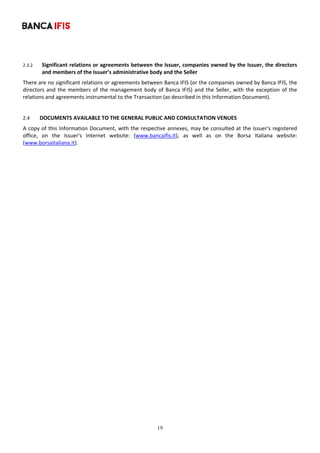
The chart below illustrates the structure of the Banca IFIS Group after the above‐mentioned merger operation: 


2.3 RELATIONS WITH THE ACQUIRED COMPANIES AND/OR WITH THE SELLER 
2.3.1 Significant relations existing at the Transaction performance date maintained by the Issuer, directly or 
indirectly, with Interbanca and the Investees 
The Banca IFIS Group did not have significant relations at the Transaction Performance Date, either directly or 
indirectly through subsidiaries, with Interbanca and with the other Investees or with the Seller's group. 


19
	
2.3.2 Significant relations or agreements between the Issuer, companies owned by the Issuer, the directors 
and members of the Issuer’s administrative body and the Seller 
There are no significant relations or agreements between Banca IFIS (or the companies owned by Banca IFIS, the 
directors and the members of the management body of Banca IFIS) and the Seller, with the exception of the 
relations and agreements instrumental to the Transaction (as described in this Information Document). 
 
2.4 DOCUMENTS AVAILABLE TO THE GENERAL PUBLIC AND CONSULTATION VENUES 
A copy of this Information Document, with the respective annexes, may be consulted at the Issuer's registered 
office,  on  the  Issuer's  Internet  website:  (www.bancaifis.it),  as  well  as  on  the  Borsa  Italiana  website: 
(www.borsaitaliana.it). 
20
	
3. SIGNIFICANT EFFECTS OF THE TRANSACTION 
3.1 SIGNIFICANT EFFECTS OF THE TRANSACTION ON THE KEY FACTORS AFFECTING AND CHARACTERISING 
THE ACTIVITIES OF THE ISSUER AND THE TYPE OF BUSINESS 
This Transaction is part of the growth strategies of Banca IFIS, whose primary objective is to preserve and further 
strengthen its role as a leading Banking Group in the Italian business system and, particularly, in the micro, small 
and medium businesses segment with reference to trade receivables, non‐performing loans and tax receivables. 
The Transaction will allow the Bank to naturally integrate the range of products and services offered to its target 
customers, which is confirmed to be the Italian Small and Medium‐Sized Businesses (SMEs). The integration of the 
"product catalogue" to include the financial and operating leasing segment, as well as secured and unsecured 
medium to long‐term loans, will be supported by an expansion of the trading network and by the significant new 
business development potential of sharing customer databases.  
It is on the basis of these strategic guidelines that Banca IFIS intends to pursue the integration with Interbanca, 
which, therefore, does not give rise to any changes in the strategic approach of the Issuer and of its nature as a 
banking institution supporting the Italian production sector, refocusing – where possible – the new production on 
the target SME which Banca IFIS is historically associated with and which over the past few years has proven to be 
able to guarantee increasing margins compared to market averages.  
From  an  organizational  and  operating  viewpoint,  the  divisional  model  of  Banca  IFIS  will  be  implemented 
progressively through the creation of specific business units and the activation of a number of enabling factors 
that will allow to approach the market and customers, by maximizing their relational experience while, at the 
same time, guaranteeing a prompt and effective identification of the credit solution that best suits their needs. 
These factors include by way of example: 
 the definition of a structured training program for all distribution platforms and of customer credit rating; 
 the setting‐up of monitoring instruments for the purpose of highlighting the commercial and operational 
effectiveness of the approach adopted; and 
 the introduction of support IT procedures. 
From the customer’s viewpoint, the benefits envisaged through the adoption of the model will be the perception 
of the Bank as the sole reference point for access to the specialised services capable of interpreting its needs, of 
establishing a long‐term relationship and sharing development plans. 
 
3.2 IMPLICATIONS  OF  THE  TRANSACTION  ON  THE  STRATEGIC  POLICIES  CONCERNING  THE  COMMERCIAL, 
FINANCIAL  AND  CENTRALISED  SERVICE  PROVISION  ARRANGEMENTS  BETWEEN  THE  ISSUER’S  GROUP 
COMPANIES 
Strengthening the presence of Banca IFIS on the reference market and expanding the Bank’s activities in sectors 
adjacent  to  the  one  it  historically  operates  in  by  introducing  in  the  commercial  offer  financial  and  operating 
leasing solutions and a wide range of medium to long‐term loans, will allow to pursue challenging objectives in 
terms of business development and customer retention. 
Selectively  re‐launching  the  business  activities  of  the  Interbanca  Group,  by  preferring,  for  the  new  financing 
initiative, to operate with counterparties of smaller size that can maximize the risk‐to‐return ratio, fully meets the 
established  strategic  policies  of  Banca  IFIS,  which  directs  the  development  of  its  portfolio  towards  SMEs  and 
21
	
focuses the new credit production according to the level of attractiveness of the economic sectors of the different 
geographical areas and the current positioning of the Bank.  
22
	
4. FINANCIAL INFORMATION RELATING TO THE ACQUIRED OPERATIONS 
4.1 FINANCIAL INFORMATION RELATING TO THE ACQUIREE  
The following paragraphs set forth: 
 consolidated financial information (that is, balance sheet and income statement) as at and for the year 
ended 31 December 2015 of the GE Capital Interbanca Group, and comparative information as at and for 
the year ended 31 December 2014;  
 abbreviated consolidated financial information (balance sheet and income statement) as at and for the six 
months ended 30 June 2016, and comparative information; and 
 some notes regarding the principal items on the balance sheet and income statement, as determined 
based upon the aforementioned financial information. 
The  information  has  been  obtained  from  the  consolidated  financial  statements  of  the  GE  Capital  Interbanca 
Group as at and for the years ended 31 December 2014 and 2015, and its Consolidated Half‐Yearly Report 2016. 
Please refer to those documents for further information – they are publicly available on the website of Banca IFIS 
(www.bancaifis.it),  in  the  section  Institutional  Investor  Relations,  under  the  heading  Financial  Statements  and 
Reports. 
Amounts  shown  in  the  financial  statements  and  the  explanatory  notes  reported  in  these  paragraphs  are  in 
thousands of euros, except where indicated otherwise. 
Consolidation perimeter 
As at 31 December 2015, the GE Capital Interbanca Group comprised the parent company GE Capital Interbanca 
S.p.A. and the companies part of the Banking Group:  
 GE Capital Servizi Finanziari S.p.A.; 
 GE Capital Finance S.r.l.. 
In addition to the companies within the group, the consolidation perimeter also includes GE Capital Services S.r.l., 
a non‐financial company that operates in the long‐term hire of capital equipment.  
The aforementioned equity interests are fully consolidated. 
 
4.1.1 Consolidated balance sheets and income statements as at and for the Interbanca Group's two most 
recent financial years  
The following table sets forth consolidated balance sheets, income statements, and some explanatory notes, as at 
and for the years ended 31 December 2014 and 2015, of the GE Capital Interbanca group, which were prepared in 
accordance  with  IAS/IFRS,  pursuant  to  the  terms  of  the  Bank  of  Italy's  Circular  No.  262,  "Banks'  financial 
statements: layouts and preparation", dated 22 December 2005, as amended. 
The financial statements in question have been audited, as described in Paragraph 4.1.2, below. 
23
	
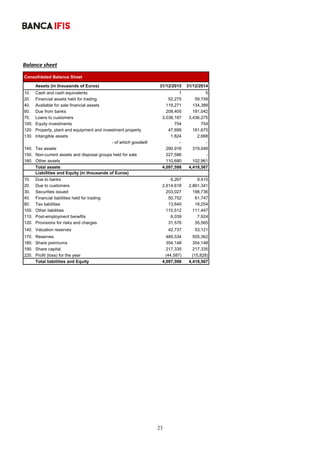
Balance sheet 
Consolidated Balance Sheet
Assets (in thousands of Euros) 31/12/2015 31/12/2014
10. Cash and cash equivalents 1 5
20. Financial assets held for trading 52,275 59,749
40. Available for sale financial assets 119,271 134,389
60. Due from banks 208,405 181,042
70. Loans to customers 3,038,187 3,436,275
100. Equity investments 754 754
120. Property, plant and equipment and investment property 47,699 181,675
130. Intangible assets 1,824 2,668
- of which goodwill - -
140. Tax assets 290,916 319,049
150. Non-current assets and disposal groups held for sale 227,586 -
160. Other assets 110,680 102,961
Total assets 4,097,598 4,418,567
Liabilities and Equity (in thousands of Euros)
10. Due to banks 8,267 9,415
20. Due to customers 2,614,618 2,861,341
30. Securities issued 203,027 198,736
40. Financial liabilities held for trading 50,752 61,747
80. Tax liabilities 13,640 18,254
100. Other liabilities 110,512 111,447
110. Post-employment benefits 6,039 7,924
120. Provisions for risks and charges 31,576 35,565
140. Valuation reserves 42,737 53,121
170. Reserves 489,534 505,362
180. Share premiums 354,148 354,148
190. Share capital 217,335 217,335
220. Profit (loss) for the year (44,587) (15,828)
Total liabilities and Equity 4,097,598 4,418,567  
 
24
	
Loans to customers 
Total loans to customers decreased by 11.6% compared to 31 December 2014. Part of the decrease is attributable 
to the reclassification of euro 228 million of assets related to portfolios of mortgage loans and salary‐backed loans 
("cessione del quinto dello stipendio" or CQS), to non‐current assets held for sale, in application of IFRS 5. The 
reclassification reflected the prospective sale of those assets by GE Capital Servizi Finanziari S.p.A., anticipated to 
take place in 2016. Disregarding the reclassification of euro 228 million of mortgage loans and salary‐backed loans 
(CQS) described above, the reduction would have been 5%, mostly related to reduced cash flows as a result of 
exposures that were extinguished early (euro 289 million from the lending portfolio), and to impairments that 
were recognised. 
Total new loans made during 2015 amounted to Euro 2,552 million, an increase of 5.8% over the total new loans 
of Euro 2,412 million made during 2014. The largest growth in absolute terms came from factoring, which saw 
new  originations  of  approximately  Euro  1,672  million,  an  increase  of  5.6%  over  the  originations  during  2014. 
There  was  also  growth  in  "regulated  finance  leases",  which  increased  by  12.5%  to  Euro  358  million;  and 
"unregulated finance leases", which increased by 2.6% to Euro 201 million. In terms of lending, total loans made 
during 2015 amounted to approximately euro 270 million, an increase of 3% compared to the Euro 262 million of 
loans made during 2014. 
Credit quality  
The following table sets forth a breakdown of gross and net loans, to banks and customers, by risk class. 
in thousands of Euros
Gross exposure
at 31/12/2015
(A)
Impaiment
losses at
31/12/2015
(B)
Net exposure at
31/12/2015
(C)
%
(C)
% coverage
ratio
(B/A)
Gross
exposure at
31/12/2014
Net exposure at
31/12/2014
(D)
% chg.
(C/D)
Impaired Loans 1,158,651 649,552 509,099 15.7% 56.1% 1,226,505 529,048 -3.8%
Non performing 549,410 432,058 117,352 3.6% 78.6% 557,508 141,383 -17.0%
Unlikely to pay 482,089 144,411 337,678 10.4% 30.0% 515,186 329,980 2.3%
Past due impaired 127,152 73,083 54,069 1.7% 57.5% 153,811 57,685 -6.3%
Performing Loans 2,773,016 35,523 2,737,493 84.3% 1.3% 3,153,880 3,088,269 -11.4%
Total 3,931,667 685,075 3,246,592 100.0% 17.4% 4,380,385 3,617,317 -10.2%  
 
The  broad‐based  improvement  in  the  various  components  of  net  non‐performing  loans  (which  decreased  by 
3.8%)  is  principally  related  to  the  aforementioned  reclassification  of  the  assets  related  to  mortgage  loan  and 
salary‐backed loan portfolios.  
Without that reclassification, there would have been an increase to net non‐performing loans of 3.7%.   
25
	
Key indicators of credit risk for cash credit, by risk classification  
Amounts in % 31/12/2015 31/12/2014
Gross impaired loans / Total gross loans 29.5 28.0
Net impaired loans / Total net loans 15.7 14.6
Net impaired loans / Equity 48.1 47.5
Gross non performing loans / Total gross loans 14.0 12.7
Net non performing loans / Total net loans 3.6 3.9
Net non performing loans / Equity 11.1 12.7
Gross unlikely to pay / Total gross loans 12.3 14.2
Net unlikely to pay / Total net loans 10.4 9.8
Net unlikely to pay / Equity 31.9 31.7
Gross past due impaired exposures / Total gross loans 3.2 1.1
Net past due impaired exposures / Total net loans 1.7 1.0
Net past due impaired exposures / Equity 5.1 3.2  
 
Assets held for sale 
This  item  regards  the  initiative  by  the  controlling  shareholder  of  GE  Capital  Interbanca  for  the  sale  of  the 
mortgage loan and salary‐backed loan portfolios held by the subsidiary GE Capital Servizi Finanziari S.p.A., which 
is anticipated to be forthcoming. As mentioned earlier, pursuant to IFRS 5 those assets have been classified under 
this item, for an amount of euro 228 million. 
 
Funding 
Total funding decreased by 7.9%  compared to 31 December 2014, a change  which reflected, in addition to a 
decrease in loans, a cancellation of approximately euro 126 million related to funding connected with operations 
in the lease of company car fleets that the associated GE Capital Services S.r.l. previously carried on and which 
were sold during 2015. 
in thousands of Euros 31/12/2015 31/12/2014 % chg.
Due to banks 8,267 9,415 -12.2%
Due to customers 2,614,618 2,861,341 -8.6%
Securities issued 203,027 198,736 2.2%
Total 2,825,912 3,069,492 -7.9%
 
 
in thousands of Euros 31/12/2015 % 31/12/2014 %
Group loans 2,274,113 87.0% 2,546,223 89.0%
Corporate deposits and current accounts 197,167 7.5% 150,818 5.3%
Intercompany deposits and current accounts 120,535 4.6% 144,710 5.1%
Deposits held as collateral 9,196 0.4% 9,196 0.3%
Other amounts due to customers 13,607 0.5% 10,394 0.4%
Total 2,614,618 100.0% 2,861,341 100.0%
 
26
	
 
In terms of amounts due to customers, a breakdown of which is set forth in the above table, 89% of the finance 
lines are made up of intercompany funding granted by financial companies of the GE Capital Group. The 8.6% 
decrease reflected a decrease in loans, and also the cancellation of approximately euro 107 million of funding 
connected  with  operations  in  the  lease  of  company  car  fleets  that  the  associated  GE  Capital  Services  S.r.l. 
previously carried on and which were sold during 2015. The item "Intercompany deposits and current accounts" 
comprised amounts used under cash pooling arrangements with financial companies of the GE Capital group to 
meet  temporary  liquidity  needs.  Funding  from  corporate  customers  ‒  a  service  that  supports  businesses  in 
managing  their  surplus  liquidity  and  optimising  returns  by  opening  time  deposits  ‒  increased  during  2015 
compared to the previous year, as a result of trends in cash management among the customers themselves. 
Funding  in  the  form  of  securities  is  comprised  almost  entirely  of  bond  issues.  As  at  31  December  2015,  four 
totalling approximately euro 80 million were outstanding, and two of these were listed on Milan's MOT. 
During 2015, no bonds were issued. 
 
Tax assets 
Current tax assets amounted to euro 65.8 million. Of this, euro 48.7 million related to a tax credit arising out of 
the conversion of a deferred tax asset in accordance with the terms of Law No. 214/2011.  
The remaining euro 17.1 million regarded IRAP and IRES credits related to previous financial years.  
With respect to the deferred tax assets, as a result of the tax legislation in this area, and bearing in mind the 
contractual consequences of the parent company having opted for national consolidated tax treatment, deferred 
tax assets were recognised in respect both of IRES and IRAP, in relation only to losses and loan impairments, 
deduction of part of which has been deferred to subsequent years in accordance with Article 13 of Law Decree 
83/2015. 
Prepaid taxes related to tax losses in prior years from 2009 to 2015 have not been recognised in respect of that 
part  that  cannot  be  converted  into  a  tax  credit,  as  well  as  other  smaller  deductible  temporary  differences, 
totalling euro 77.9 million, because there remains uncertainty as to when and how future taxable amounts will be 
generated in an amount sufficient for their recovery.  
The amount of this item, approximately euro 225 million, decreased by euro 15 million relative to 31 December 
2014. That decrease was principally the result of the conversion into tax credits of deferred tax assets pursuant to 
Law 214/2011, connected with loan impairments of approximately euro 6.8 million, and the release of euro 12.1 
million of the loan impairment reserve for the related prepaid taxes, following the realisation during 2015 of loan 
losses that satisfied the legal requirements for their deductibility to be recognised, net of new prepaid taxes of 
euro 5.5 million that arose during the year, which principally regarded loan losses and impairments that were 
recognised during 2015 and which for both IRES and IRAP purposes were deductible in subsequent years . 
 
Shareholders' equity, own funds and prudential requirements 
As at 31 December 2015, total capital and reserves, including the loss for the year, was euro 1,059.2 million, a 
decrease of 4.9% compared to the equivalent figure as at 31 December 2014.  
The principal changes regarded: 
27
	
 reductions to valuation reserves of euro 10.4 million, as a result of changes to the fair value measurement of 
AFS  financial  instruments  and  divestments  that  took  place,  and  actuarial  changes  to  post‐employment 
benefits; and 
 the reduction by the loss for the year, of euro 44.6 million. 
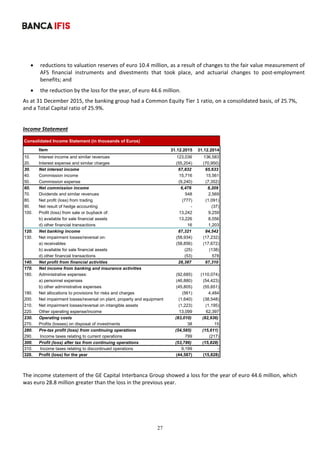
As at 31 December 2015, the banking group had a Common Equity Tier 1 ratio, on a consolidated basis, of 25.7%, 
and a Total Capital ratio of 25.9%. 
 
Income Statement 
Consolidated Income Statement (in thousands of Euros)
Item 31.12.2015 31.12.2014
10. Interest income and similar revenues 123,036 136,583
20. Interest expense and similar charges (55,204) (70,950)
30. Net interest income 67,832 65,633
40. Commission income 15,716 15,561
50. Commission expense (9,240) (7,352)
60. Net commission income 6,476 8,209
70. Dividends and similar revenues 548 2,569
80. Net profit (loss) from trading (777) (1,091)
90. Net result of hedge accounting - (37)
100. Profit (loss) from sale or buyback of: 13,242 9,259
b) available for sale financial assets 13,226 8,056
d) other financial transactions 16 1,203
120. Net banking income 87,321 84,542
130. Net impairment losses/reversal on: (58,934) (17,232)
a) receivables (58,856) (17,672)
b) available for sale financial assets (25) (138)
d) other financial transactions (53) 578
140. Net profit from financial activities 28,387 67,310
170. Net income from banking and insurance activities
180. Administrative expenses: (92,685) (110,074)
a) personnel expenses (46,880) (54,423)
b) other administrative expenses (45,805) (55,651)
190. Net allocations to provisions for risks and charges (561) 4,484
200. Net impairment losses/reversal on plant, property and equipment (1,640) (38,548)
210. Net impairment losses/reversal on intangible assets (1,223) (1,195)
220. Other operating expense/income 13,099 62,397
230. Operating costs (83,010) (82,936)
270. Profits (losses) on disposal of investments 38 15
280. Pre-tax profit (loss) from continuing operations (54,585) (15,611)
290. Income taxes relating to current operations 799 (217)
300. Profit (loss) after tax from continuing operations (53,786) (15,828)
310. Income taxes relating to discontinued operations 9,199 -
320. Profit (loss) for the year (44,587) (15,828)  
 
The income statement of the GE Capital Interbanca Group showed a loss for the year of euro 44.6 million, which 
was euro 28.8 million greater than the loss in the previous year.  
28
	
The increased loss is principally the result of impairments recognised in loans to customers, which was negatively 
affected by approximately euro 41.2 million over the year, a change which substantially related to Interbanca's 
lending portfolio. 
In  making  comparisons  with  the  2014  income  statement,  one  has  to  consider  that  the  various  income 
components reflected the long‐term motor vehicle leasing operations that were assigned on 2 November 2015, 
while the proceeds of that sale, together with the income statement effects that accrued through to the date of 
sale, which totalled euro 9.2 million, were recognised in the income statement for the year 2015 under "Income 
from disposal groups net of taxes". 
With respect to individual items on the income statement, the following should be noted. 
 
Net interest income 
The net contribution by net interest income amounted to approximately euro 67.8 million, an increase of 3% over 
the contribution in 2014. 
Net income reflected a smaller  contribution from  GE Capital Interbanca, which continued to show a  decrease in 
customer loans, with extraordinary early repayments over the year that totalled approximately euro 289 million. 
Subsidiaries benefitted over the year from improvements to the interest rates charged on credit facilities when they 
came up for renewal. 
 
Net commission income 
This item was positive in 2015 by euro 6.5 million, a decrease of 21.1% compared to the prior year. The positive 
component, from the supply of services, amounted to euro 15.7 million, in line with the figures for 2014. 
Commission  expenses  increased  by  euro  1.8  million  compared  to  2014,  which  was  entirely  attributable  to  the 
increased fees for absence of use that accrued on the GE Capital Group's funding lines. 
 
Profit from sale of available‐for‐sale financial assets  
This item includes profit from the sale of certain equity interests recognised among available‐for‐sale financial assets 
that resulted from restructurings of clients that were in temporary difficulty. 
 
Net impairment losses on loans, financial assets and security 
With respect to the credit risk assessment, net impairments were negative by approximately euro 58.9 million, an 
increase in that figure of more than euro 41 million compared to 2014.     
Technical  writedowns  amounted  to  euro  79.1  million,  and  principally  regarded  the  Bank's  non‐performing  loan 
portfolio, which represented euro 60.1 million of that, while the performing loan portfolio saw euro 20.2 million of 
value  recovered,  which  reflected  both  improvements  to  credit  quality  and  a  decrease  in  the  size  of  the  lending 
portfolio. 
 
 
29
	
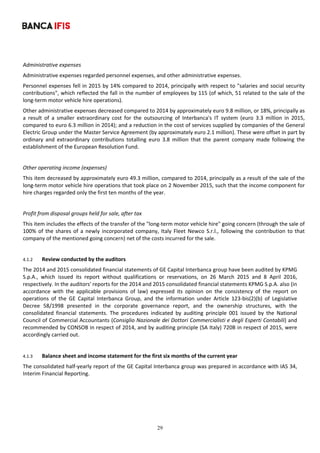
Administrative expenses 
Administrative expenses regarded personnel expenses, and other administrative expenses. 
Personnel expenses fell in 2015 by 14% compared to 2014, principally with respect to "salaries and social security 
contributions", which reflected the fall in the number of employees by 115 (of which, 51 related to the sale of the 
long‐term motor vehicle hire operations).  
Other administrative expenses decreased compared to 2014 by approximately euro 9.8 million, or 18%, principally as 
a  result  of  a  smaller  extraordinary  cost  for  the  outsourcing  of  Interbanca's  IT  system  (euro  3.3  million  in  2015, 
compared to euro 6.3 million in 2014); and a reduction in the cost of services supplied by companies of the General 
Electric Group under the Master Service Agreement (by approximately euro 2.1 million). These were offset in part by 
ordinary  and  extraordinary  contributions  totalling  euro  3.8  million  that  the  parent  company  made  following  the 
establishment of the European Resolution Fund.  
 
Other operating income (expenses) 
This item decreased by approximately euro 49.3 million, compared to 2014, principally as a result of the sale of the 
long‐term motor vehicle hire operations that took place on 2 November 2015, such that the income component for 
hire charges regarded only the first ten months of the year.  
 
Profit from disposal groups held for sale, after tax 
This item includes the effects of the transfer of the "long‐term motor vehicle hire" going concern (through the sale of 
100% of the shares of a newly incorporated company, Italy Fleet Newco S.r.l., following the contribution to that 
company of the mentioned going concern) net of the costs incurred for the sale. 
 
4.1.2 Review conducted by the auditors 
The 2014 and 2015 consolidated financial statements of GE Capital Interbanca group have been audited by KPMG 
S.p.A.,  which  issued  its  report  without  qualifications  or  reservations,  on  26  March  2015  and  8  April  2016, 
respectively. In the auditors' reports for the 2014 and 2015 consolidated financial statements KPMG S.p.A. also (in 
accordance  with  the  applicable  provisions  of  law)  expressed  its  opinion  on  the  consistency  of  the  report  on 
operations  of  the  GE  Capital  Interbanca  Group,  and  the  information  under  Article  123‐bis(2)(b)  of  Legislative 
Decree  58/1998  presented  in  the  corporate  governance  report,  and  the  ownership  structures,  with  the 
consolidated  financial  statements.  The  procedures  indicated  by  auditing  principle  001  issued  by  the  National 
Council of Commercial Accountants (Consiglio Nazionale dei Dottori Commercialisti e degli Esperti Contabili) and 
recommended by CONSOB in respect of 2014, and by auditing principle (SA Italy) 720B in respect of 2015, were 
accordingly carried out.	
	
4.1.3 Balance sheet and income statement for the first six months of the current year 
The consolidated half‐yearly report of the GE Capital Interbanca group was prepared in accordance with IAS 34, 
Interim Financial Reporting.  
30
	
There were no intervening changes to the consolidation perimeter or to the relevant accounting standards from 
31 December 2015. 
 
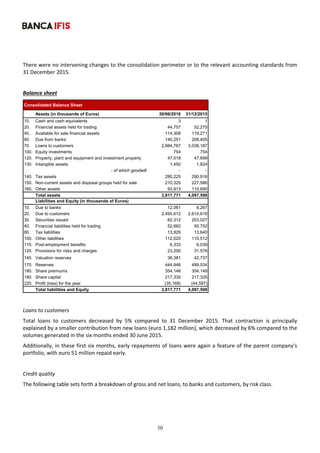
Balance sheet 
Consolidated Balance Sheet
Assets (in thousands of Euros) 30/06/2016 31/12/2015
10. Cash and cash equivalents 3 1
20. Financial assets held for trading 44,757 52,275
40. Available for sale financial assets 114,308 119,271
60. Due from banks 140,251 208,405
70. Loans to customers 2,884,767 3,038,187
100. Equity investments 754 754
120. Property, plant and equipment and investment property 47,018 47,699
130. Intangible assets 1,450 1,824
- of which goodwill - -
140. Tax assets 280,225 290,916
150. Non-current assets and disposal groups held for sale 210,325 227,586
160. Other assets 93,913 110,680
Total assets 3,817,771 4,097,598
Liabilities and Equity (in thousands of Euros)
10. Due to banks 12,061 8,267
20. Due to customers 2,495,612 2,614,618
30. Securities issued 82,312 203,027
40. Financial liabilities held for trading 52,662 50,752
80. Tax liabilities 13,929 13,640
100. Other liabilities 112,020 110,512
110. Post-employment benefits 6,333 6,039
120. Provisions for risks and charges 23,200 31,576
140. Valuation reserves 38,381 42,737
170. Reserves 444,946 489,534
180. Share premiums 354,148 354,148
190. Share capital 217,335 217,335
220. Profit (loss) for the year (35,168) (44,587)
Total liabilities and Equity 3,817,771 4,097,598  
 
Loans to customers 
Total  loans  to  customers  decreased  by  5%  compared  to  31  December  2015.  That  contraction  is  principally 
explained by a smaller contribution from new loans (euro 1,182 million), which decreased by 6% compared to the 
volumes generated in the six months ended 30 June 2015. 
Additionally, in these first six months, early repayments of loans were again a feature of the parent company's 
portfolio, with euro 51 million repaid early. 
 
Credit quality  
The following table sets forth a breakdown of gross and net loans, to banks and customers, by risk class.  
31
	
in thousands of Euros
Gross
exposure at
30/06/2016
(A)
Impaiment
losses at
30/06/2016
(B)
Net exposure
at 30/06/2016
(C) %
% coverage
ratio
(B/A)
Gross exposure
at 31/12/2015
Net exposure
at 31/12/2015
% chg.
(C/D)
Impaired loans 1,140,678 675,814 464,864 15.4% 59.2% 1,158,651 509,099 -8.7%
Non performing 593,384 478,079 115,305 3.8% 80.6% 549,410 117,352 -1.7%
Unlikely to pay 481,592 168,983 312,609 10.3% 35.1% 482,089 337,678 -7.4%
Past due impaired 65,702 28,752 36,950 1.2% 43.8% 127,152 54,069 -31.7%
Performing loans 2,585,488 25,334 2,560,154 84.6% 1.0% 2,773,016 2,737,493 -6.5%
Total 3,726,166 701,148 3,025,018 100.0% 18.8% 3,931,667 3,246,592 -6.8%  
  
The performing portfolios on the Group's various platforms are measured collectively, using calculation criteria 
based principally on historical statistics and estimates of Losses Given Default (LGD). These processes resulted in a 
collective  impairment  of  the  balances  of  approximately  euro  25.3  million,  equivalent  to  1.0%  of  the  whole 
performing portfolio, compared to 1.3% as at 31 December 2015, as a result of a general improvement in credit 
quality.  
In terms of overall exposure, net impaired loans decreased by 8.7%; and coverage of impaired loans was 59.2%, 
an increase from 56.1% as at 31 December 2015. Coverage of bad loans reached approximately 80% as at 30 June 
2016. 
 
Assets held for sale 
This  item  regards  the  initiative  by  the  controlling  shareholder  of  GE  Capital  Interbanca  for  the  sale  of  the 
mortgage loan and salary‐backed loan portfolios held by the subsidiary GE Capital Servizi Finanziari S.p.A., which 
is anticipated to be forthcoming. As set forth in the 2015 financial statements, pursuant to IFRS 5 those assets 
have been classified under this item, for an amount of euro 210.3 million. 
 
Funding 
Overall funding decreased by 8.3% compared to 31 December 2015, principally as a result of the maturity of two 
bond issues totalling euro 122.4 million. 
The composition of amounts due to customers was substantially unchanged from that shown as at 31 December 
2015.  
 
Tax assets  
Current tax assets amounted to euro 73.3 million, principally related to a tax credit of euro 57.5 million arising out 
of the conversion of a deferred tax asset, in accordance with the terms of Law No. 214/2011.  
Deferred  tax  assets  of  euro  206  million  principally  comprised  deferred  tax  assets  pursuant  to  Law  214/2011 
connected with loan impairments recognised in the financial statements of euro 192 million, for which the Group 
has opted to continue to convert into current tax assets. The amount decreased by euro 18 million compared to 
31 December 2015, as a result of the conversion made based on the presence of non‐consolidated losses in the 
financial  statements  as  at  and  for  the  year  ended  31  December  2015  of  GE  Capital  Interbanca  S.p.A.  and  GE 
Capital Finance S.r.l.. 
32
	
Shareholders' equity  
As at 30 June 2016, total capital and reserves, including the loss for the six months, was euro 1,020 million, a 
decrease of 3.7% compared to the equivalent figure as at 31 December 2015.  
The principal changes regarded: 
 reductions to valuation reserves of euro 4,5 million, as a result of changes to the fair value measurement 
of AFS financial instruments and divestments that took place, and actuarial changes to post‐employment 
benefits; and 
 the loss for the period of euro 35.2 million. 
With regard to the prudential requirements, on a consolidated basis as at 30 June 2016 the Group's Common 
Equity Tier 1 ratio and Total Capital ratio were, at 26.9% and 27.0% respectively, both higher than required. 
In calculating Own Funds as at 30 June 2016, with regard to Article 3 of Regulation (EU) No. 575/2013 and the 
application  of  stricter  requirements  than  expected,  the  deductions  from  CET1  included  the  effects  upon  the 
balance sheet of the loss estimated at approximately euro 65.5 million from the anticipated sale of mortgage loan 
assets  by  GE  Capital  Servizi  Finanziari  S.p.A.  that  is  expected  to  occur  by  the  end  of  2016.
33
	
Income statement 
Consolidated Income Statement (in thousands of Euros)
Item 1
st
sem 2016 1
st
sem 2015
10. Interest income and similar revenues 56,898 61,377
20. Interest expense and similar charges (21,463) (28,329)
30. Net interest income 35,435 33,048
40. Commission income 9,621 7,416
50. Commission expense (4,304) (4,588)
60. Net commission income 5,317 2,828
70. Dividends and similar revenues 5 548
80. Net profit (loss) from trading (7,568) (628)
100. Profit (loss) from sale or buyback of: 258 251
b) available for sale financial assets 258 251
120. Net banking income 33,447 36,047
130. Net impairment losses/reversal on: (16,912) (7,302)
a) receivables (16,857) (7,884)
b) available for sale financial assets (338) (25)
d) other financial transactions 283 607
140. Net profit from financial activities 16,535 28,745
170. Net income from banking and insurance activities
180. Administrative expenses: (51,087) (43,713)
a) personnel expenses (23,890) (24,561)
b) other administrative expenses (27,197) (19,152)
190. Net allocations to provisions for risks and charges (2,090) (2,571)
200. Net impairment losses/reversal on plant, property and equipment (798) (781)
210. Net impairment losses/reversal on intangible assets (396) (499)
220. Other operating expense/income 3,705 6,379
230. Operating costs (50,666) (41,185)
240. Utile (perdita) delle partecipazioni 44 23
280. Pre-tax profit (loss) from continuing operations (34,087) (12,417)
290. Income taxes relating to current operations (1,081) 1,485
300. Profit (loss) after tax from continuing operations (35,168) (10,932)
310. Income taxes relating to discontinued operations - (2,255)
320. Profit (loss) for the year (35,168) (13,187)  
 
The consolidated income statement of the GE Capital Interbanca group showed a loss of euro 35.2 million in the 
six months ended 30 June 2016. 
The result in the period reflected impairments of loans and derivatives that increased by euro 16.6 million, and 
operating costs that were higher by approximately euro 9.5 million, principally as a result of the charge incurred 
for the conversion of deferred tax assets of euro 5.5 million, and also euro 3.2 million of costs incurred by way of 
price adjustment, upon completion of the transaction for the sale of the long‐term motor vehicle hire operations 
that took place in 2015. It also reflected a larger contribution from net interest income, principally as a result of a 
lower intercompany funding costs that applied to new lines.  
Net interest income 
The contribution by net interest income amounted to approximately euro 35.4 million, an increase of 7.2% over 
the contribution in the six months ended 30 June 2015 of euro 33.0 million. 
34
	
The improvement principally regarded both lower funding costs, and greater late‐payment interest collected in 
the period, notwithstanding the loss of margin as a result of the fall in loans to customers, which featured a good 
deal of early repayment of loans by corporate customers during the period, which totalled approximately euro 51 
million. 
 
Net commission income 
Net commission income amounted to approximately euro 5.3 million, an increase of euro 2.5 million over the 
figure for the first six months of 2015.  
That growth  was substantially due  to the recognition of  commission income  related to a  particular corporate 
transaction, where the failure to restructure the debt, and the position's impairment, meant that the item and its 
impairment  were  both  recognised  together,  the  latter  among  the  loan  impairments.  Commission  expenses 
included fees for non‐use of funding lines from the GE Capital Group, which were approximately euro 0.4 million 
lower in the period.  
 
Net impairment losses on loans, financial assets and security 
Net loan impairments were negative by approximately euro 16.9 million, an improvement of euro 9.0 million 
compared to the six months ended 30 June 2015.  
Technical writedowns amounted to euro 27.6 million, principally from the Bank's non‐performing portfolio, which 
was generated prior to the acquisition by General Electric.  
The performing loan portfolio saw euro 11.0 million of value recovered, which reflected both improvements to 
credit quality and a decrease in the size of Interbanca's lending portfolio. 
 
Administrative expenses 
Administrative expenses regarded personnel expenses and other administrative expenses. 
The personnel expenses decreased compared to the six months ended 30 June 2015, by approximately euro 0.7 
million or 2.7%. That change reflected a fall in the average number of employees, and is significant also in light of 
the extraordinary expense of approximately euro 1.8 million that was incurred in relation  to a retention plan 
addressed to a number of the group's employees, who were identified as key to the successful completion of the 
complex and extraordinary sale transaction involving the Bank and its subsidiaries. 
Other administrative expenses rose compared to the six months ended 30 June 2015 by approximately euro 8 
million, or 42%. This change was principally the result of: the fee incurred in connection with the conversion of 
prepaid  taxes  of  euro  5.5  million;  euro  2.8  million  of  higher  costs  for  services  supplied  by  companies  of  the 
General Electric Group, on the basis of the Master Service Agreement, including royalties for the use of the GE 
name and mark; and the 2016 contribution to the Single Resolution Fund of euro 0.7 million. 
The  six  months  ended  30  June  2015  had  also  featured  approximately  euro  2.6  million  of  extraordinary  costs 
incurred in starting up the outsourcing of the IT system.  
 
 
35
	
Net income for the period 
Net of income taxes, the result for the period was a loss of euro 35.2 million, an increased loss compared to the 
first six months of the previous year, which was euro 13.2 million. 
36
	
 
5. PRO‐FORMA FINANCIAL INFORMATION RELATING TO THE ISSUER 
5.1 PRO‐FORMA BALANCE SHEETS AND INCOME STATEMENTS 
This section sets forth Pro‐Forma Consolidated Statements as at 30 June 2016, and related explicatory notes. This 
information has been prepared solely for information purposes, and only in order to retrospectively reflect the 
material effects of the acquisition of the controlling stake of 99.993% of the share capital of GE Capital Interbanca 
S.p.A	in accordance with the provisions of the Agreement, and the resulting settlement of the existing financial 
relationships between the Seller and Interbanca Group, partially by autonomous refinancing of the latter  (the 
''Transaction"), as if the Transaction had occurred as at the reference date of the pro‐forma consolidated balance 
sheet and at the beginning of the period of the pro‐forma consolidated income statement. 
As a result of the Transaction, which has been structured as an acquisition of a controlling stake, the banking 
Group ("Banca IFIS") will be arranged as follows: 
 Banca IFIS as parent company; 
 Interbanca S.p.A., a wholly‐owned subsidiary holding a banking licence; 
 IFIS Finance, a Polish‐law financial company, already a wholly‐owned subsidiary of Banca IFIS; 
 IFIS Factoring and IFIS Leasing, two financial companies for the purposes of Article 106 TUB specialising in 
factoring and leasing respectively, and wholly‐owned subsidiaries of Interbanca S.p.A.. 
Banca IFIS will also control a non‐financial company specialising in operating finance leases, IFIS Rental Services, 
not included within the perimeter of the banking Group, as more particularly described in paragraph 2.1.1, above. 
The Acquisition was authorised by the relevant regulatory authorities on 29 November 2016. 
 
5.2 PRO‐FORMA CONSOLIDATED STATEMENTS AND EXPLANATORY NOTES AS AT 30 JUNE 2016 
5.2.1 Basis of preparation of the Pro‐Forma Consolidated Statements 
The Pro‐Forma Consolidated Statements was prepared based on the consolidated abbreviated interim financial 
statements of Banca IFIS and the GE Capital Interbanca Group as at and for the six months ended 30 June 2016, 
which were prepared in accordance with IAS/IFRS as adopted by the European Union and applying the pro‐forma 
adjustments that are described below.  
The consolidated abbreviated interim financial statements of Banca IFIS as at and for the period ended 30 June 
2016 has been the subject of a limited review by the audit firm EY S.p.A. (formerly Reconta Ernst & Young S.p.A.) 
and on 28 July 2016 it issued a report without qualifications. 
The pro‐forma consolidated abbreviated interim financial statements of the GE Capital Interbanca Group as at 
and for the six months ended 30 June 2016 has been the subject of a limited review by the audit firm KPMG 
S.p.A., and on 29 September 2016 it issued a report without qualifications. 
Regarding the accounting standards adopted by the Banca IFIS Group and the GE Capital Interbanca Group in 
preparing the historical consolidated information, please refer to Part A – Accounting Policies, of their respective 
consolidated interim reports as at and for the six months ended 30 June 2016, prepared by Banca IFIS S.p.A. and 
GE Capital Interbanca S.p.A. in accordance with IAS/IFRS, as approved by the European Commission ("IAS/IFRS"). 
Based on the preliminary analyses carried out, currently those standards are substantially consistent between the 
37
	
two groups. There may however be some differences as a result of different methodologies or parameters used in 
measuring assets and liabilities. 
The  Pro‐Forma  Consolidated  Statements  and  the  explanatory  notes  were  prepared  only  in  order  to 
retrospectively reflect the material effects of the Transaction, as if it had occurred in the period to which the pro‐
forma information relates. The Pro‐Forma Consolidated Statements represent a simulation of the possible effects 
that could arise if the Transaction had been carried out on that date and is provided only for illustrative purposes. 
More specifically, in accordance with CONSOB Communication DEM/1052803 of 5 July 2001, the Transaction's 
effects are reflected retrospectively in the pro‐forma consolidated balance sheet as if it had been performed on 
30 June 2016, and in the pro‐forma consolidated income statement as if it had been performed on 1 January 
2016. 
In order to interpret correctly the Pro‐Forma Consolidated Statements, one must consider the following aspects: 
 since  these  are  accounts  constructed  upon  assumptions,  the  results  set  forth  in  the  Pro‐Forma 
Consolidated Statements would not necessarily have been achieved, had the Transaction actually taken 
place on the reference dates for the preparation of the pro‐forma information; 
 in  preparing  the  pro‐forma  information,  a  purchase  price  allocation  (PPA)  was  made  on  a  preliminary 
basis,  based  on  assumptions  and  estimates  that  may  differ  from  the  final  PPA.  That  provisional  PPA 
resulted in almost all the fair value differences being attributed to the item loans, as shown in the tables 
below. Since this was a preliminary estimate, there was no detailed analysis to identify a more accurate 
classification of the items in the financial statements, and accordingly the classification of the pro‐forma 
adjustments may be different when the final PPA is made; and 
 the pro‐forma information is not forward‐looking, in that it has been prepared in order solely to represent 
the  effects  of  the  Transaction's  performance  that  may  be  isolated  and  measured  objectively,  without 
taking  account  of  the  potential  effects  resulting  from  changes  to  the  management's  policies  or 
operational decisions consequent to the Acquisition's performance. 
 
Additionally, in light of the different purpose that the pro‐forma information serves, compared to the historical 
interim  information,  and  the  differences  in  the  approaches  to  calculating  the  effects  in  the  pro‐forma 
consolidated  balance  sheet  and  the  pro‐forma  consolidated  income  statement,  the  Pro‐Forma  Consolidated 
Statements  should  be  read  and  interpreted  separately,  without  attempting  to  establish  any  accounting 
relationship between them. 
 
The acquisition of Interbanca by Banca IFIS will be represented by applying the International Financial Reporting 
Standard  3,  as  adopted  under  Commission  Regulation  (EC)  No.  495/2009  of  3  June  2009  ("IFRS  3").  IFRS  3.4 
establishes  that  an  "entity  shall  account  for  each  business  combination  by  applying  the  acquisition  method", 
which implies the following stages: 
(a) identifying the acquirer 
IAS/IFRS require that an acquirer be identified for every business combination. Under IAS/IFRS, the acquirer is 
identified as the entity that obtains control, meaning the power to govern the financial and operating policies of 
an  entity,  so  as  to  obtain  benefits  from  its  activities.  In  connection  with  the  Transaction,  Banca  IFIS  S.p.A.  is 
considered the acquirer. 
38
	
(b) determining the acquisition date 
The acquisition date is the date on which the acquirer obtains control of the acquiree (IFRS 3.8 and Appendix A).  
In connection with the Transaction, it is assumed that the acquisition date is the date on which the consideration 
is legally transferred, and the Interbanca shares transferred to Banca IFIS. 
(c) determining the cost of the combination 
IFRS  3  requires  that  the  costs  of  a  business  combination  be  determined  as  the  sum,  at  fair  value,  on  the 
acquisition date, of: (i) the assets acquired; (ii) the liabilities assumed; and (iii) any capital instruments issued by 
the acquirer in exchange for control of the acquiree. 
Accordingly, in the Transaction the acquisition cost is substantially represented by the acquisition‐date fair value 
of the consideration paid by Banca IFIS S.p.A. to obtain 99.993% of the shares representing the share capital of 
Interbanca S.p.A., an amount of up to euro 160 million (being subject to possible price adjustments as described 
in Chapter 2 herein). 
(d) Purchase Price Allocation 
The cost of the combination must be accounted for by applying the purchase method, the final stage of which 
requires the acquirer to allocate, as at the acquisition date, the cost of the combination (thus, making a purchase 
price allocation) to the assets acquired, the liabilities assumed, and any identifiable contingent liabilities of the 
acquiree, recognising them at fair value as at that date. This requires the acquiree's balance sheet to be prepared 
as  at  the  moment  at  which  the  Transaction  becomes  effective,  measuring,  at  fair  value,  the  entity's  assets, 
liabilities, and contingent liabilities. 
The residual difference between the fair value of the consideration paid, and the fair value of the assets net of the 
liabilities and contingent liabilities acquired, taking account also of intangible assets not previously recognised in 
the accounts of the acquiree (such as trade marks): 
 if positive, is recognised as goodwill; 
 if negative, is recognised in the income statement of the entity resulting from the business combination (a 
gain on bargain purchase or badwill). 
IFRS 3 allows provisional amounts to be reported for fair value of the assets, liabilities and contingent liabilities of 
the entity identified for accounting purposes as the acquiree, and thus the provisional allocation of the difference 
between the consideration paid and the net fair value of the acquired assets and liabilities. The acquirer must 
however  recognise  impairments  or  recoveries  of  value  to  the  provisional  amounts,  and  complete  the  initial 
accounting of the acquisition within 12 months of the acquisition date, and with effect from that date. 
In preparing the Pro‐Forma Consolidated Statements, a preliminary measurement has been made of the fair value 
of the identifiable assets, liabilities and contingent liabilities of the acquiree. These fair value amounts shall in any 
event be determined as at the acquisition date using valuation techniques and sources of information that are 
consistent with those used by the acquirer in preparing its financial statements, with 12 months available from 
the date of effectiveness of the transaction for determining the final amounts. 
Accordingly, the gain on bargain purchase shown in the Pro‐Forma Consolidated Statements typically represents 
the difference between the purchase price and the fair value of the acquired assets and liabilities, as determined 
on a preliminary basis. The final measurement of the gain on bargain purchase will thus be subject to changes 
connected with: 
39
	
1) the purchase price, the final value of which shall be calculated upon completion of the price adjustment 
contemplated by the acquisition agreement; and 
2) determination of the fair value of the Interbanca Group's assets and liabilities, relative to the carrying 
amounts and the measurement of additional assets, liabilities and contingent liabilities, which may also 
not  currently  be  recognised  in  the  acquiree's  financial  information,  which  must  be  updated  with 
reference to the actual acquisition date.  
If  other  identified  tangible  and  intangible  assets  with  finite  useful  lives,  or  other  assets  and  liabilities  will  be 
identified at the closing of the purchase price allocation process, future income statements will also reflect the 
effects of these allocations, not included in the Pro‐forma Consolidated Income Statement. 
Finally, all the impairments and/or recoveries of value reflected in the Pro‐Forma Consolidated Statements as at 
and for the six months ended 30 June 2016 are expected to have a recurring effect upon the post‐acquisition 
group, except for that related to impairment losses on receivables and the recognition of the gain on bargain 
purchase in the Pro‐Forma Consolidated Statements, which by its nature is non‐recurring. 
 
5.2.2 Pro‐Forma Consolidated Statements as at 30 June 2016 
Pro-forma consolidated balance sheet as at June 30, 2016
Assets (in thousands of Euros) BIFIS Group IB Group
Adjustment pro-
forma
Pro-forma
10. Cash and cash equivalents 35 3 - 38
20. Financial assets held for trading 366 44,757 - 45,123
40. Available for sale financial assets 1,027,770 114,308 - 1,142,078
60. Due from banks 153,877 140,251 - 294,128
70. Loans to customers 3,355,998 2,884,767 (559,771) 5,680,994
100. Equity investments - 754 - 754
120. Property, plant and equipment and investment property 56,729 47,018 - 103,747
130. Intangible assets 8,929 1,450 - 10,379
- of which goodwill 795 - - 795
140. Tax assets 64,595 280,225 240,600 585,420
150. Non-current assets and disposal groups held for sale - 210,325 - 210,325
160. Other assets 74,899 93,913 - 168,812
Total assets 4,743,198 3,817,771 (319,171) 8,241,798
Liabilities and Equity (in thousands of Euros)
10. Due to banks 43,587 12,061 - 55,648
20. Due to customers 3,928,261 2,495,612 (466,000) 5,957,873
30. Securities issued - 82,312 550,000 632,312
40. Financial liabilities held for trading 13 52,662 - 52,675
80. Tax liabilities 16,180 13,929 - 30,109
100. Other liabilities 187,612 112,020 - 299,632
110. Post-employment benefits 1,545 6,333 - 7,878
120. Provisions for risks and charges 3,803 23,200 - 27,003
- -
Group Equity 562,197 1,019,642 (403,242) 1,178,597
- of which gain on bargain purchase - - 616,400 616,400
Non controlling interests - - 71 71
Total Liabilities and Equity 4,743,198 3,817,771 (319,171) 8,241,798  
40
	
 
Pro-forma consolidated Income Statement 1
st
semester 2016 (in thousands of Euro)
Item BIFIS Group IB Group
Adjustment
pro-forma
Pro-forma
10. Interest income and similar revenues 151,465 56,898 21,530 229,893
20. Interest expense and similar charges (21,909) (21,463) 2,347 (41,025)
30. Net interest income 129,556 35,435 23,877 188,868
40. Commission income 29,547 9,621 - 39,168
50. Commission expense (2,583) (4,304) - (6,887)
60. Net commission income 26,964 5,317 - 32,281
70. Dividends and similar revenues - 5 - 5
80. Net profit (loss) from trading (332) (7,568) - (7,900)
100. Profit (loss) from sale or buyback of: 11,189 258 - 11,447
a) receivables 5,694 - - 5,694
b) available for sale financial assets 5,495 258 - 5,753
120. Net banking income 167,377 33,447 23,877 224,701
130. Net impairment losses/reversal on: (32,215) (16,912) 16,857 (32,270)
a) receivables (28,216) (16,857) 16,857 (28,216)
b) available for sale financial assets (3,999) (338) - (4,337)
d) other financial transactions - 283 - 283
140. Net profit from financial activities 135,162 16,535 40,734 192,431
170. Net income from banking and insurance activities 135,162 16,535 40,734 192,431
180. Administrative expenses: (74,067) (51,087) (15,115) (140,269)
a) personnel expenses (27,595) (23,890) - (51,485)
b) other administrative expenses (46,472) (27,197) (15,115) (88,784)
190. Net allocations to provisions for risks and charges (1,633) (2,090) - (3,723)
200. Net adjustments to/recoveries on tangible assets (846) (798) - (1,644)
210. Net impairment losses/reversal on plant, property and equipmen (1,161) (396) - (1,557)
220. Other operating income (expenses) 910 3,705 - 4,615
230. Operating costs (76,797) (50,666) (15,115) (142,578)
240. Profits (Losses) on disposal of investments - 44 - 44
280. Pre-tax profit (loss) from continuing operations 58,365 (34,087) 25,619 49,897
290. Income taxes for the year relating to current operations (19,245) (1,081) (8,472) (28,798)
300. Profit (Loss) after tax from continuing operations 39,120 (35,168) 17,147 21,099
320. Profit (loss) for the year 39,120 (35,168) 17,147 21,099
330. Non controlling interests - - (3) (3)
Gain on bargain purchase - - 616,400 616,400
340. Profit (loss) attributable to the parent company 39,120 (35,168) 633,549 637,501  
 
Assumptions made in preparing the Pro‐Forma Consolidated Statements as at 30 June 2016 
The  accounting  standards  adopted  in  preparing  the  Pro‐Forma  Consolidated  Statements  were  those  used  in 
preparing the abbreviated consolidated half‐yearly reports as at 30 June 2016 of the Banca IFIS and GE Capital 
Interbanca groups, which is to say, IAS/IFRS as adopted by the European Union. Those abbreviated consolidated 
half‐yearly reports were prepared in condensed form, in accordance with IAS 34, Interim Financial Reporting. 
Based on IAS/IFRS, the Transaction results in a business combination achieved through the acquisition of 99.993% 
of the share  capital of  GE Capital Interbanca S.p.A.  by Banca IFIS S.p.A. Please see the previous section for a 
description of the principal features of IFRS 3. 
41
	
As indicated above, the purchase cost is represented by the consideration paid to obtain the controlling stake, 
and  should  be  considered  preliminary,  in  that  not  all  the  information  necessary  for  its  final  determination  is 
available as yet. For further information, please see Chapter 2 of this document. 
Accordingly,  for  the  purpose  of  determining  the  price  for  the  Transaction,  this  has  been  assumed  to  be  the 
Preliminary Price, without price adjustment. 
 
Description  of  the  pro‐forma  adjustments  to  the  historical  consolidated  financial  information  as  at  30  June 
2016 
The Pro‐Forma Consolidated Statements as at and for the six months ended 30 June 2016 presents: 
 in the column headed, "BIFIS group", the abbreviated consolidated interim accounts of the Banca IFIS 
Group; 
 in  the  column  headed,  "IB  group",  the  abbreviated  consolidated  interim  accounts  of  the  Ge  Capital 
Interbanca Group; 
 in the column headed, "Pro‐forma adjustments", the adjustments related to the perimeter, the purchase 
of the stake, the repayment of the funding, and the entries arising out of the preliminary purchase price 
allocation paid at fair value for the assets acquired and the liabilities assumed; and 
 in the column headed, "Pro‐forma", figures from the pro‐forma consolidated balance sheet as at 30 June 
2016, and the pro‐forma consolidated income statement for the six months ended 30 June 2016, being 
the sum of the previous columns. 
Specifically, in the column, Pro‐forma adjustments, the most significant adjustments made to each item were as 
follows: 
 "Loans to customers" includes an adjustment of euro 76 million regarding the proper identification of the 
acquisition perimeter, in light of a carve‐out transaction that was completed prior to the Performance 
Date,  and  the  best  preliminary  estimate  of  the  fair  value  of  the  loans  to  customers  being  acquired, 
including the impairment testing that sought to quantify its lower profitability compared to the acquirer's 
main markets, based on the preliminary data available; 
 "Tax assets" includes the tax benefits considered capable of recognition and not previously recognised in 
Interbanca's financial statements, since the conditions for recovering an amount of approximately of euro 
97 million were not satisfied; and the tax effects of the fair value differences that have been preliminarily 
calculated at approximately euro 144 million; 
 "Amounts due to customers" includes a reduction of euro 76 million related to the loans included in the 
carve‐out transaction referred to above, and a reduction of euro 550 million as the effect of replacing the 
borrowing from GE with debt instruments issued under securitisations by the Interbanca Group, offset in 
part by an euro 160 million increase in borrowing to pay the Preliminary Price;  
 "Issued securities" includes the amount of the instruments issued under the securitisations referred to 
above;  
 "Interest income" represents the positive adjustment made to the income statement of the profitability 
of the acquired loan exposures whose fair value reduction has been preliminarily estimated, as discussed 
above; 
42
	
 "Impairment losses/reversal on: (a) receivables" reflects the reversal of the impairments already taken 
into consideration upon assumption that such impairments entirely regard positions whose fair value was 
already subject to impairment; 
 "Administrative  expenses:  (b)  other  administrative  expenses"  includes  the  costs  associated  with  the 
acquisition as a whole;  
 "Gain on bargain purchase" represents the difference between the purchase price paid (assumed to be 
the Preliminary Price, without any price adjustment) and the preliminary assessment, at the acquisition 
date,  of  the  fair  value  of  the  acquired  assets,  assumed  liabilities  and  contingent  liabilities,  of  the 
Interbanca Group.   
 
5.3 PRO‐FORMA INDICATORS PER SHARE IN THE ISSUER 
The following table sets forth the main pro‐forma indicators per share in the Issuer, and the comparative amounts 
as at and for the six months ended 30 June 2016: 
  
KPIs per share
BIFIS Group Pro-forma
Outstanding shares 53,076,576 53,076,576
Earnings per share (EPS) 0.74 12.01
Equity per share 10.59 22.21
 
43
	
	
5.4 AUDITOR’S REPORT ON THE PRO‐FORMA FINANCIAL INFORMATION 
  
44
45
46
	
	
6. PROSPECTS OF THE ISSUER AND ITS GROUP 
6.1 GENERAL OBSERVATIONS ON THE ISSUER’S PERFORMANCE SINCE THE END OF ITS LAST FINANCIAL YEAR  
This section sets out the main information regarding the performance of Banca IFIS S.p.A., as reported in the 
Consolidated Half‐Yearly Report at 30 June 2016, and the accompanying press release. 
Total funding was euro 3,971.8 million at 30 June 2016, a decrease of 35.4% compared to 31 December 2015; 
98.9% of the former amount is represented by Amounts due to customers (compared to 89.2% at 31 December 
2015), and 1.1% by Amounts due to banks (10.8% al 31 December 2015).  
As  at  30  June  2016,  Amounts  due  to  customers  stood  at  euro  3,928.3  million.  The  item  includes  repurchase 
agreements  that  have  government  bonds  as  their  underlying,  and  Cassa  di  Compensazione  e  Garanzia  as 
counterparty, which amounted to euro 270 million (compared to euro 2,279.0 million at 31 December 2015), 
following sales of securities in the three months ended 31 March 2016. Retail funding was euro 3,550.4 million at 
30 June 2016, of which euro 3,486.4 million related to rendimax accounts and euro 64.0 million to contomax 
accounts. This represented an increase of 14% over the figure of euro 3,113.1 million as at 31 December 2015, 
which partly reflected the introduction of new rendimax maturities of three, four and five years.  
Amounts due to banks amounted to euro 43.6 million, compared to euro 663.0 million as at 31 December 2015. 
This  represented  a  decrease  of  93.4%,  following  the  early  repayment  of  the  TLTRO  tranche  that  had  been 
executed  in  December  2014.  Changes  in  market  conditions  meant  that  funding  could  be  obtained  on  more 
advantageous terms than were available when that tranche was issued. The remainder of the amounts due to 
banks comprised interbank deposits.  
Total amounts due to customers were euro 3,356.0 million, a decrease of 2.4% compared to euro 3,437.1 million 
as  at  31  December  2015.  More  specifically,  the  DRL  loans  increased  following  new  acquisitions  and  also  the 
release, at amortised cost, of a material part of the portfolio that pending completion of the preparations for its 
release had previously been carried at its purchase cost. Loans in the trade receivables segment fell by 3.1%, 
following  the  strategy  of  refocusing  on  smaller  but  more  profitable  segments.  Tax  credits  decreased  after 
significant collections recognised over the six months ended 30 June 2016. There was a decrease as a result of the 
reduction of margin lending for the repurchase agreements on the MTS platform, with Cassa di Compensazione e 
Garanzia as counterparty, in light of a reduction in the amount of the securities portfolio available for refinancing. 
Net non‐performing exposures in the trade receivables segment only were made up as follows: 
o net  bad  loans  amounted  to  euro  31.0  million,  an  increase  of  0.2%  and  as  such  substantially 
unchanged  from  31  December  2015.  The  ratio  between  net  bad  loans  and  net  loans  of  the 
segment  was  1.1%,  and  therefore  also  unchanged  from  31  December  2015.  Net  bad  loans 
represented  5.5%  of  shareholders'  equity,  compared  to  5.4%  as  at  31  December  2015.  The 
coverage ratio was 88.4% as at 30 June 2016, compared to 87.9% as at 31 December 2015; 
o net  unlikely‐to‐pay  loans  stood  at  euro  55.4  million,  compared  to  euro  39.6  million  at  31 
December  2015,  an  increase  of  40.0%  that  was  principally  due  to  two  individually  significant 
positions  that  had  previously  been  classified  as  net  past  due  non‐performing  exposures,  and 
performing. The coverage ratio was 28.2% (compared to 32.1% as at 31 December 2015); and 
o net past due non‐performing exposures amounted to euro 108.9 million, compared to euro 58.2 
million as at 31 December 2015, an increase of 87.1%. The increase reflected past‐due loans to 
the public administration definitively purchased, which increased from euro 1.2 million as at 31 
47
	
December 2015 to euro 46.0 million as at 30 June 2016 (of which euro 43.8 million in the utility 
segment). The coverage ratio was 1.6%, compared to 2.6% as at 31 December 2015. 
Net banking income1
 amounted to euro 150.9 million, a decrease of 43.1% compared to the six months ended 30 
June 2015, when it was euro 265.4 million. Net of the euro 124.5 million of profit realised in April 2015 from the 
restructuring of the government bond portfolio, as at 30 June 2016 net banking income increased by 7.1%. There 
was a significant increase in  the DRL segment  (euro 61.1 million, or 202.8%); and increases also in the Trade 
receivables and Tax receivables segments (euro 81.4 million, or 5.3%, and euro 8.0 million, or 6.7%, respectively). 
On the other hand, the Governance and Services segment fell sharply (euro 0.4 million, a decrease of 99.8%), 
reflecting both a smaller contribution from interest as a result of the shrinking of the government bond portfolio, 
and an increase in the cost of funding as a result of the increase in volumes. With reference to net commission 
income  in  particular,  this  amounted  to  euro  27.0  million,  a  decrease  of  7.8%  compared  to  30  June  2015. 
Commission income was euro 29.6 million, compared to euro 31.6 million as at 30 June 2015, and was derived 
principally from factoring commissions applied to the turnover produced by individual customers (factored with 
and without recourse, and under flat or monthly fee arrangements), and from the other fees that are usually 
required from customers for the supply of services. 
Commission expenses amounted to euro 2.6 million, compared to euro 2.3 million in the six months ended 30 
June  2015.  These  essentially  related  to  approved  banks'  brokering,  other  credit  brokerage,  and  fees  paid  to 
correspondent banks and factors. 
Net impairment losses2
 amounted to euro 15.8 million, of which euro 11.8 million regarded loans to customers 
(compared  to  euro  13.4  million  as  at  30  June  2015,  a  decrease  of  12.5%),  and  euro  4.0  million  regarded  the 
impairment of unlisted equity instruments. 
Operating costs were euro 76.8 million in the period, compared to euro 51.8 million in the six months ended 30 
June 2015, an increase of 48.2%. The increase was mainly attributable to other administrative expenses, as a 
result of an increase in activity within the DRL segment, in particular with reference to start‐up costs for recovery 
operations, and collection costs. Personnel expenses increased by 16.5% to euro 27.6 million in the period, from 
euro 23.7 million as at 30 June 2015. The increase was related to the 120 appointments made in the first half of 
2016 (which increased personnel numbers by 22.4%). This was done in line with the aim of providing greater 
structure to some business support areas and services, especially within the DRL segment. As at 30 June 2016, the 
Group  had  807  employees.  The  cost/income  ratio  (operating  costs  to  net  banking  income)  in  the  six  months 
ended 30 June 2016 was 50.9%, compared to 19.5% in the same period in the prior year. 
For further information regarding the performance of Banca IFIS, please refer to the Half‐Yearly Report 2016 and 
the Interim Report as at 30 September 2016, both of which may be found on its website at www.bancaifis.it. The 
Interim Report as at 30 September 2016 has not been audited. 
																																																								
1 Net impairments of loans from within the DRL segment, of which there were euro 16.4 million as at 30 June 2016 and euro 3.1 million as at 30 June 2015, 
have been reclassified as Interest income and similar revenues, in order to provide an account that better reflects the particular features of that business, in 
which the net impairments are an integral part of the return. 
2	Net impairments of loans from within the DRL segment, of which there were euro 16.4 million as at 30 June 2016 and euro 3.1 million as at 30 June 2015, 
have been reclassified as Interest income and similar revenues, in order to provide an account that better reflects the particular features of that business, in 
which the net impairments are an integral part of the return. 
48
	
 
6.2 PROSPECTS FOR THE CURRENT FINANCIAL YEAR 
The prospects for the current financial year are positive. A further increase in the number of customers in the 
segment  of  SMEs  working  capital  financing  is  expected,  to  such  an  extent  as  to  counteract  the  decrease  in 
margins  that  has  been  taking  place  since  many  quarters,  particularly  with  respect  to  the  customers  with  the 
relatively  best  creditworthiness.  The  development  of  the  line  of  business  in  the  pharma‐industrial  sector  is 
currently  continuing  to  progress,  while  the  pharmacy  financing  segment,  is  increasing,  albeit  moderately.  The 
segment of receivables due from the public administration is currently undergoing an interesting development, 
with increasing volumes expected in the final part of the financial year and an increasing prospected margin. 
In the Distressed Retail Loans (DRL) segment, a significant increase in margins is expected for the financial year, 
together  with  an  –  albeit  less  than  proportional  ‒  increase,  in  the  cost  for  the  execution  of  the  orders.  The 
volumes in the financial year will increase significantly more than expected, as will the transfers of portfolios, 
mainly with reference to segments that the Bank deems it more efficient to monetize. 
The segment of tax receivables deriving from insolvency proceedings or solvent persons is continuing to develop, 
in a market that, however, shows a decrease in margins, and faster cash flows than expected.  
After  the  strong  reduction,  almost  to  zero,  in  the  volumes  of  the  Italian  government  bonds  held,  the 
Governance&Services Business Unit has limited its business operations almost exclusively to the management of 
funding, carried out through the rendimax online savings accounts and the contomax online current accounts. 
Although the funding is significantly positive, a material increase in the cost of funding is expected also as an 
element of a strategy aimed at supporting the Bank by providing it with a part of the means deemed appropriate 
to complete the acquisition of the Interbanca Group. 
In 2016 the Interbanca Group course of business will be influenced by the particularly delicate phase it is going 
through, as the company has been on sale since mid‐2015, and, therefore, it has not been particularly oriented to 
the  development  of  new  volumes.  Factoring  is  still  concentrated  on  a  limited  number  of  customers  which, 
however,  are  of  a  significant  size,  with  limited  profitability  and  low  risk.  In  this  segment,  the  trading  and 
operational integration with the activities of the Bank will  be promptly  carried out. In  the leasing segment, a 
substantial stability is expected, as well as a recovery in the following quarters. In the medium‐term funding, the 
decrease in lending opportunities with an adequate profitability and low risk will be reflected in a substantial 
runoff of the "historical" portfolio, with the implementation of new activities characterized by higher profitability 
and a strictly controlled risk. 
The  Consolidated  Income  Statement  of  2016  will  feature  a  significant  badwill  that  cannot  be  allocated  as  a 
decrease  in  assets  or  an  increase  in  liabilities.  Even  without  considering  this  effect,  the  expectations  for  the 
remaining part of the financial year are however positive and set good foundations also for the following years. 
	
*** 
 
Chief Executive Officer 
 
Mr Giovanni Bossi 
49


Gruppo Banca IFIS: diamo valore al tuo lavoro. 

Information Document

  • 1.
  • 2.
    PREAMBLE  This information document (the "Information Document") has been prepared by the Issuer in accordance with  Article 71 of the Issuers Regulation and related outline No. 3 of Attachment 3B, for the purpose of providing  exhaustive  information  on the  Transaction  involving  the  acquisition  of  the  Interest,  which  was  closed  on  30  November 2016 and announced to the market on the same date.  More specifically, pursuant to the Agreement entered into on 28 July 2016 between the Seller and Banca IFIS, on  30  November  the  Seller  sold  to  Banca  IFIS  no.  72,440,331  shares  representing  99.993%  of  Interbanca’s  share  capital.  This  Information  Document  was  filed  at  the  registered  office  of  the  Issuer  on  5  December  2016  and  is  also  available on the Issuer’s website site www.bancaifis.it and on the website of Borsa Italiana www.borsaitaliana.it.    Certain  information  and  statements  contained  in  this  Information  Document  that  are  not  information  and  statements on historical facts, are to be deemed forward‐looking statements, even if such statements are not  specifically  defined  as  such.  These  statements  include,  by  way  of  example  and  without  limitation,  the  plans,  intentions and expectations concerning the Transaction referred to in this Information Document, the financing of  the  Transaction,  as  well  as  the  results,  benefits,  synergies,  profits,  costs,  timeframes  and  other  outcomes  expected from this Transaction.   The  forward‐looking  statements  refer  to  future  –  not  past  –  events  and  are  no  guarantee  of  the  future  performance. The statements are based on current expectations and projections about future events and, by  their  nature,  address  matters  that,  to  different  degrees,  are  uncertain  and  subject  to  inherent  risks  and  uncertainties. They relate to events and depend on circumstances that may or may not take place or exist in the  future and, as such, no reliance should be placed upon them. The actual results may materially differ from those  expressed in such statements due to a variety of factors, including changes in the general economic, financial and  market conditions, and other changes in business conditions, most of which are outside the control of Banca IFIS.   Banca IFIS expressly disclaims and does not assume any liability for mistakes and/or inaccuracies in relation to any  of these forward‐looking statements and/or in connection with any use by any person of such forward‐looking  statements. Any forward‐looking information contained in this Information Document speaks only as at the date  thereof.  Banca IFIS undertakes no obligation to update, revise or correct its projections or forward‐looking statements as a  result of new developments or otherwise. Names, organizations and company names contained herein may be  the trademarks of the respective owners. This Information Document does not constitute investment advise, or a  solicitation, recommendation, or invitation for the purchase or sale of financial products and/or of any kind of  financial services as contemplated by the laws of any jurisdiction.   
  • 3.
    3 PRO‐FORMA SUMMARY AND PER SHARE FIGURES CONCERNING THE ISSUER AND INTERBANCA AS AT 30 JUNE  2016  The following tables show briefly the consolidated economic and financial data of Banca IFIS and Interbanca and  the  pro‐forma  data of  Banca  IFIS  including  Interbanca,  as  well  as  the  relating  per  share  indicators  for  the  six  months ended on 30 June 2016.  The  summary  figures  indicated  below  were  drawn  from  the  pro‐forma  consolidated  statements  reported  in  Chapter 5, and must be read in conjunction with the description of the hypotheses and the criteria adopted for  the drafting of the pro‐forma consolidated statements and the other information contained therein.     Pro-forma consolidated balance sheet as at June 30, 2016 Assets (in thousands of Euros) BIFIS Group Pro-forma 10. Cash and cash equivalents 35 38 20. Financial assets held for trading 366 45,123 40. Available for sale financial assets 1,027,770 1,142,078 60. Due from banks 153,877 294,128 70. Loans to customers 3,355,998 5,680,994 100. Equity investments - 754 120. Property, plant and equipment and investment property 56,729 103,747 130. Intangible assets 8,929 10,379 - of which goodwill 795 795 140. Tax assets 64,595 585,420 150. Non-current assets and disposal groups held for sale - 210,325 160. Other assets 74,899 168,812 Total assets 4,743,198 8,241,798 Liabilities and Equity (in thousands of Euros) 10. Due to banks 43,587 55,648 20. Due to customers 3,928,261 5,957,873 30. Securities issued - 632,312 40. Financial liabilities held for trading 13 52,675 80. Tax liabilities 16,180 30,109 100. Other liabilities 187,612 299,632 110. Post-employment benefits 1,545 7,878 120. Provisions for risks and charges 3,803 27,003 - Group Equity 562,197 1,178,597 - of which gain on bargain purchase - 616,400 Non controlling interests - 71 Total Liabilities and Equity 4,743,198 8,241,798  
  • 4.
    4   Pro-forma consolidated IncomeStatement 1 st semester 2016 (in thousands of Euro) Item BIFIS Group Pro-forma 10. Interest income and similar revenues 151,465 229,893 20. Interest expense and similar charges (21,909) (41,025) 30. Net interest income 129,556 188,868 40. Commission income 29,547 39,168 50. Commission expense (2,583) (6,887) 60. Net commission income 26,964 32,281 70. Dividends and similar revenues - 5 80. Net profit (loss) from trading (332) (7,900) 100. Profit (loss) from sale or buyback of: 11,189 11,447 a) receivables 5,694 5,694 b) available for sale financial assets 5,495 5,753 120. Net banking income 167,377 224,701 130. Net impairment losses/reversal on: (32,215) (32,270) a) receivables (28,216) (28,216) b) available for sale financial assets (3,999) (4,337) d) other financial transactions - 283 140. Net profit from financial activities 135,162 192,431 170. Net income from banking and insurance activities 135,162 192,431 180. Administrative expenses: (74,067) (140,269) a) personnel expenses (27,595) (51,485) b) other administrative expenses (46,472) (88,784) 190. Net allocations to provisions for risks and charges (1,633) (3,723) 200. Net adjustments to/recoveries on tangible assets (846) (1,644) 210. Net impairment losses/reversal on plant, property and equipmen (1,161) (1,557) 220. Other operating income (expenses) 910 4,615 230. Operating costs (76,797) (142,578) 240. Profits (Losses) on disposal of investments - 44 280. Pre-tax profit (loss) from continuing operations 58,365 49,897 290. Income taxes for the year relating to current operations (19,245) (28,798) 300. Profit (Loss) after tax from continuing operations 39,120 21,099 320. Profit (loss) for the year 39,120 21,099 330. Non controlling interests - (3) Gain on bargain purchase - 616,400 340. Profit (loss) attributable to the parent company 39,120 637,501     KPIs per share BIFIS Group Pro-forma Outstanding shares 53,076,576 53,076,576 Earnings per share (EPS) 0.74 12.01 Equity per share 10.59 22.21  
  • 5.
    5 DEFINITIONS AND GLOSSARY  A list of the main definitions and terms used in this Information Document is provided below. These definitions  and terms (whether used in the plural or singular form), unless otherwise specified, have the meaning indicated  below.   "Agreement"  means  the preliminary  agreement  concerning  the  purchase  and  sale  of  the  Interest,  governing  the  Transaction,  entered  into  on  28  July  2016  between  the Seller and the Purchaser, as lastly amended on 30  November 2016.  "Banca IFIS Group"  means jointly Banca IFIS and the companies directly or  indirectly owned by the Issuer.  "Borsa Italiana"  means Borsa Italiana S.p.A..  "CONSOB"  means the Commissione Nazionale per le Società e la  Borsa (Italian commission for companies and the stock  exchange).  "Execution Date"   means 28 July 2016, the date on which the Agreement  was entered into.  "IFIS Factoring"  means IFIS Factoring S.r.l., having its registered office  in  Milan  (MI),  via  Borghetto  5,  with  a  fully  paid‐up  share capital of Euro 123,240,000, registered with the  Companies  Register  of  Venice,  registration  number,  tax code and VAT number 11990630151.  "IFIS Finance"   means IFIS Finance Sp. z o.o, a company incorporated  under the Laws of Poland, having its registered office  in Warsaw, Wspolna 62, with a share capital of Zloty  47,000,000,  registration  number  KRS  0000156397,  wholly  owned  by  Banca  IFIS  as  at  the  Information  Document Date.  "IFIS Leasing"  means IFIS Leasing S.p.A., having its registered office  in  Mondovì  (CN),  via  Vecchia  di  Cuneo  136  (Loc.  Pogliola),  with  a  fully  paid‐up  share  capital  of  Euro  41,000,000, registered with the Companies Register of  Cuneo,  registration  number,  tax  code  and  VAT  number 00596300046.  "IFIS Rental Services"  means IFIS Rental Services S.r.l., having its registered  office in Milan (MI), via Borghetto, 5, with a fully paid‐ up share capital of Euro 6,000,000.00, registered with  the Companies Register of Milan, registration number,  tax code and VAT number 09635390967.  "Information Document Date"  means  the  date  of  publication  of  this  Information  Document.  "Information Document"  means  this  information  document,  drawn  up  by  the  Issuer in compliance with the Issuers Regulation.  "Interbanca Group"  means jointly Interbanca and the Investees. 
  • 6.
    6 "Interbanca"  means  GE Capital  Interbanca  S.p.A.,  having  its  registered office in Milan (MI), Corso Venezia 56, with  a  fully  paid‐up  share  capital  of  Euro  217,335,282,  registered  with  the  Companies  Register  of  Milan,  registration  number,  tax  code  and  VAT  number  00776620155.  "Intercompany Debt"  means  the  debt  outstanding  at  the  Transaction  Performance  Date  between  the  companies  of  the  Interbanca Group and the Seller’s group.  "Interest"  means No. 72,440,331 shares with a par value of Euro  3 each, representing 99.993% of the share capital of  Interbanca.  "Interim Report as at 30 September 2016"  means the interim report as at 30 September 2016 of  Banca IFIS.  "Investees"  means  jointly  IFIS  Leasing,  IFIS  Factoring  and  IFIS  Rental Services.  "Issuers Regulation"  means  the  regulation  adopted  by  CONSOB  under  resolution No. 11971 of 14 May 1999, as subsequently  amended and supplemented.  "Preliminary Price"  means the amount of Euro 160,000,000 paid as at the  Execution Date by Banca IFIS to the Seller subject to  the Price Adjustment.   "Price Adjustment"  means the Preliminary Price adjustment mechanism.  "Purchaser" or "Issuer" or "Banca IFIS"  means Banca IFIS S.p.A., having its registered office in  Mestre  (VE),  via  Terraglio  63,  with  a  fully  paid‐up  share  capital  of  Euro  53,811,095.00,  registered  with  the  Companies  Register  of  Venice,  registration  number,  tax  code  and  VAT  number  02505630109,  registered with the Bank Register under No. 5508.  "Seller"  means  GE  Capital  International  Holdings  Limited,  a  company incorporated under the Laws of the United  Kingdom, having its registered office in London, in The  Ark, 201 Talgarth Road, company number 9666321.   "Transaction Performance Date"  means  30  November  2016,  the  date  on  which  the  Transaction was performed.  "Transaction"  means  the  transaction  involving  the  acquisition  by  Banca  IFIS  of  the  Seller’s  Interest  and  the  simultaneous repayment of debt to the Seller by the  Interbanca  Group also by partial refinancing to third  parties..  "TUB"  means the Legislative Decree No. 385 of 1 September  1993,  (Testo  Unico  delle  leggi  in  materia  bancaria  e  creditizia, consolidated law on banking and credit), as  subsequently amended and supplemented.   
  • 7.
    7 Contents      1.  WARNINGS ........................................................................................................................................................8  2.  INFORMATION RELATING TO THE TRANSACTION............................................................................................13  3.  SIGNIFICANT EFFECTS OF THE TRANSACTION..................................................................................................20  4.  FINANCIAL INFORMATION RELATING TO THE ACQUIRED OPERATIONS..........................................................22  5.  PRO‐FORMA FINANCIAL INFORMATION RELATING TO THE ISSUER ................................................................36  6.  PROSPECTS OF the ISSUER AND ITS GROUP.....................................................................................................46
  • 8.
    8 1. WARNINGS  A summary of the following potential risk factors regarding the Transaction subject of this Information Document  is outlined below.   It should be noted that additional risks and uncertain events, currently unforeseeable or which are considered to  be improbable at present, could equally influence the Issuer's business activity, economic and financial conditions  and outlook.  For a more complete analysis of the risk profiles underlying the Transaction, the considerations detailed below  are  to be  read  together  with  the  other  information  included  in  the  Information  Document,  in  the  Half‐Yearly  Report  2016  and  in  the  Interim  Report  as  at  30  September  2016  which  are  available  on  the  Issuer's  Internet  website: www.bancaifis.it.     1.1 RISK FACTORS ARISING FROM THE TRANSACTION  1.1.1 Risks associated with the Transaction  The Interbanca Group’s acquisition entails the typical risks of an investment in significant interests in the capital  of  companies  with  unlisted  shares,  and  in  particular,  the  possibility  that  the  interest  acquired  is  subject  to  depreciation  due  to:  (i)  the  occurrence  of  contingent  liabilities  and/or  unsubstantiated  assets  not  recognised  and/or  unforeseeable  at  the  Transaction  completion  date,  in  the  financial  position  of  Interbanca,  or  of  the  Investees; or (ii) other factors unforeseeable at the Transaction completion date.   Despite the fact that the Seller has provided contractual warranties and indemnities in the Agreement, which are  in line with market practice, the occurrence of the possibilities represented could entail negative effects regarding  the financial position and the reputation of the Interbanca Group and the Issuer.    1.1.2 Risks associated with the integration process  The Transaction entails the risks which are typical of integration operations with a new corporate group, with  particular reference to the necessary management coordination, integration of the existing IT systems, functions  and services with those of the new group. This integration process could be completed on the basis of timeframes  and  methods  which  differ  from  those  planned  by  the  Issuer  and  entail  greater  costs  unforeseeable  at  the  Transaction completion date with possible negative effects on the financial position of the Interbanca Group and  the Issuer.  A potential risk exists at the date of this Information Document related to the success of the integration process,  also with reference to the centralisation of the operating structure of the group member companies from the  administrative point of view and of the IT systems, as well as in terms of rationalisation of the products and  services offered, and with reference to the harmonisation of the resources with the group's management policy.  The Issuer considers that the new group resulting from the Transaction could benefit from synergies arising, inter  alia, from lower costs and greater revenues, despite the existence of the above‐mentioned risks. Achieving these  synergies will depend, inter alia, on the capacity to efficiently integrate the different entities and increase their  productivity  by  reducing  costs.  There  is  the  risk  that  failing  to  implement  all  or  part  of  the  above‐mentioned  synergies could produce negative effects, inter alia, in terms of smaller cost savings and smaller revenue increases 
  • 9.
    9 generated by the expected synergies. Furthermore, the complete integration of the Issuer and of the Interbanca  Group could entail the occurrence of unforeseen problems, the need to sustain unexpected costs and liabilities or  reduced revenues also resulting from possible negative synergies and require an extraordinary activity compared  to the ordinary operations, all of which could have consequent negative ‒ and even significant ‒ impacts, on the  Issuer's economic, equity and/or financial position.    1.1.3 Risks associated with the estimates and forecasts associated with the Transaction  The valuation process performed for the purposes of the Transaction entails estimates and forecasts relating,  inter  alia, to  the  activities,  the  results  of  the  activities,  the  business  lines  through  which  the  Issuer  and  the  Interbanca Group operate, the growth outlook and the respective risk factors associated with the Issuer and the  Interbanca Group, also with regard to the outcome of the Transaction. These estimates and forecasts are based  on the data available to the Issuer, and, even if considered reasonable at present, could be subject to margins of  uncertainty in the future. Factors exist which could cause differences in the actual growth and/or in the post‐ Transaction  results  compared  to  the  outcome  explicitly  or  implicitly  expressed  in  terms  of  estimates  and  forecasts.  The actual occurrence of one or more negative scenarios, which include the uncertainties associated with the  process  of  estimating  the  various  quantities,  could  give  rise  to  different  results  compared  to  the  results  represented in the estimates and forecasts contained in the valuation process performed for the purposes of the  Transaction.     1.1.4 Risks associated with equity adequacy  Banking laws and regulations establish rules regarding the capital adequacy of banks in order to establish prudent  levels of the capital to be held, qualifying their quality and assessing the possible risk mitigation instruments.  The  Issuer's  capital  coefficients  at  the  Information  Document  Date  were  higher  than  the  minimum  levels  envisaged by prudential legislation. The data relating to the Issuer's Common equity tier 1, risk‐weighted assets  and CET 1 ratio and the same pro‐forma figures as at 30 June 2016 are detailed below:  Capital ratios (€/mln) BIFIS Group Pro-forma Common equity tier 1 (CET 1) 452 1,004 Risk weighted assets 3,432 6,964 CET 1 ratio 13.17% 14.41%     1.1.5 Risks associated with credit quality deterioration  The Bank has made some considerations regarding the credit quality of the portfolio subject to acquisition, and  has made further adjustment estimates, with the consequent foreseen increase for the coverage ratios of the  various credit categories, for the purposes of a preliminary price allocation regarding the assets and liabilities  subject to acquisition, as required by the reference accounting standards, and supported by the outcome of a  specific due diligence activity performed by a leading auditing firm with reference to 31 December 2015.  
  • 10.
    10 The  risks  associated with  a  further  deterioration  of  the  portfolio  credits  are  considered  to  be  probable,  but  implausible;  however,  reasons  for  an  unexpected  deterioration  in  the  quality  of  the  assets  can  be  found  in  a  further deterioration of the generalised economic situation or the reference sector of the financed enterprises.    1.1.6 Risks associated with the average extension of maturities  The  incorporation  of  the  Interbanca  Group's  new  corporate  perimeter  introduces  a  natural  extension  of  the  maturities of assets compared to the existing position for Banca IFIS, by reason of the Target's business model,  since the Target provides funding with maturities which are longer, on average.  In this regard the simulations performed show how the banking Group to be established is more exposed to the  risk of increased interest rates, a risk to be found in the different composition between assets and liabilities with  reference to the type of rate to which the entries are index‐linked. The estimated impact, however, is limited.   Therefore, the extent of this risk is also to be read together with the prospects associated with the monetary  policies applied by the European Central Bank, as well as the economy's overall performance; both factors are  difficult to be foreseen without introducing a significant margin of uncertainty.     1.1.7 Liquidity risk  The liquidity  risk represents the risk  that the Issuer is unable to honour its payment commitments which are  certain  or  expected  with  reasonable  certainty,  when  they  become  due.  Two  forms  of  liquidity  risk  can  be  identified: (a) funding liquidity risk, namely, the risk that the Issuer is unable to honour its payment commitments  and its obligations efficiently due to its inability to secure funding, without prejudice to its core activity and/or its  financial position; and (b) market liquidity risk, namely, the risk that the Issuer is unable to sell a financial asset  without incurring capital account losses due to the reference market's limited liquidity and/or as a consequence  of  the  time  period  in  which  the  transaction  must  be  carried  out.  The  availability  of  liquidity  intended  for  the  various activities, as well as the possibility of accessing long‐term funding are essential to achieve the Issuer's  strategic objectives. In particular, liquidity and long‐term funding are essential so that the Issuer is able to honour  the  foreseen  or  unforeseen  cash  payment  or  payment  on  delivery  obligations,  in  order  not  to  prejudice  the  Group's current operations or financial position. The Group's ability to raise liquidity could be prejudiced by the  Group's inability to access the debt market, the inability to sell its assets or to settle/refinance its investments.  These events could arise  due to a  deterioration of the risk profile or other  problems related to the  Group, a  deterioration of market conditions, a lack of confidence in the financial markets, uncertainties and speculation  relating to the solvency of the market participants, or operational problems related to third parties. A limited  capacity to find the necessary liquidity on the market at favourable conditions or the difficulty of accessing long‐ term  funding  at  favourable  conditions  could  have  negative  effects  on  the  Group's  results  and  on  its  financial  position.  The key indicators used by the Issuer to assess the liquidity profile are as follows:   Liquidity Coverage Ratio (LCR): this represents the short‐term liquidity indicator and corresponds to the  ratio  between  the  amount  of  high  quality  liquidity  assets  and  the  total  net  cash  outflows  during  the  following 30 calendar days; the indicator is subject to a minimum regulatory requirement of 70% since  January 2016, and it will rise to 80% in 2017 and 100% in 2018.   Net  Stable  Funding  Ratio  (NSFR):  this  represents  the  structural  liquidity  indicator  at  12  months  and  corresponds to the ratio between the available amount of stable funding and the mandatory amount of 
  • 11.
    11 stable  funding;  this indicator  will  be  subject  to  a  minimum  regulatory  requirement  commencing  from  2018 (or commencing from a different date that will be established at a European level at the time the  relating technical parameters will be defined, which are not yet available at the Registration Document  Date), and should be higher than 100% on the basis of the agreements reached in the framework of the  Basel Committee (Basel 3); and   Loan to Deposit Ratio: this represents the ratio between loans to customers and direct funding, excluding  transactions with central counterparties.  The simulations performed reflect findings which do not indicate alarm elements, however, there remains the risk  that the estimated aggregates and their unwinding time frame may generate deviations and margins of error as  specified in relation to the risks associated with the estimates and forecasts relating to the Transaction; therefore,  these deviations may introduce elements of uncertainty with regard to the estimates of the indicators described  above.  It  should  be  noted  that  the  Bank's  position  at  the  proposed  deal  closure  date  has  sufficient  capacity  with  reference to the liquidity risk associated with financing the Transaction.    1.2 RISKS ASSOCIATED WITH PREPARING THE PRO‐FORMA DATA  This Information Document contains the pro‐forma consolidated balance sheet as at 30 June 2016 and the pro‐ forma consolidated income statement for the period ended as at 30 June 2016 (the "Pro‐forma Consolidated  Statements") and the respective explanatory notes, prepared solely to reflect retroactively the significant effects  of the Transaction as if the Transaction had been completed during the period to which the above‐mentioned  pro‐forma  data  refer.  The  information  contained  in  the  Pro‐forma  Consolidated  Statements  represents  a  simulation of the possible effects which could have been produced, if the Transaction had been completed at the  above‐mentioned date and are provided only for purposes of illustration. In particular, there are limits associated  with  the  very  nature  of  the  pro‐forma  data,  since  the  Pro‐forma  Consolidated  Statements  are  constructed  to  reflect retroactively the significant effects of subsequent transactions, despite compliance with the commonly  accepted  rules  and  the  adoption  of  reasonable  assumptions,  accompanied  by  the  necessary  certificates.  Consequently,  there  is  a  risk  that  if  the  Transaction  had  really  been  completed  at  the  dates  considered  as  a  reference  to  prepare  the  Pro‐forma  Consolidated  Statements,  then  the  results  represented  in  the  Pro‐Forma  Consolidated Statements would not necessarily have been obtained.  It should be noted that the pro‐forma data do not reflect forward‐looking data and under no circumstance do  they intend to represent a forecast of the Group's future post‐Transaction results, since the pro‐forma data were  only  prepared  in  order  to  represent  the  effects  of  the  Transaction  which  can  be  isolated  and  are  objectively  measurable, without taking into account the potential effects due to changes in the management's policies and  operating decisions consequential or following the Transaction, and therefore, are not to be used in this sense.  Therefore,  the  gain  on  bargain  purchase  shown  in  the  Pro‐forma  Consolidated  Statements  conventionally  represents the difference between the acquisition price and the fair value preliminarily determined for the assets  and liabilities acquired; the final quantification of the gain on bargain purchase will be subject to fluctuations  related to the following two aspects:  • the  purchase  price  will  be  definitively  determined  at  the  completion  of  price  adjustment  activities  planned in the acquisition agreement; 
  • 12.
    12 • the determination of the fair value of assets and liabilities of Interbanca Group over the book values of  recognition and measurement of other assets, liabilities and contingent liabilities, possibly not currently  recognized in the balance sheet and income statements of the acquired entity, it must be updated with  reference to the effective date of acquisition.  If  other identified  tangible  and  intangible  assets  with  finite  useful  lives,  or  other  assets  and  liabilities  will  be  identified at the closing of the purchase price allocation process, future income statements will also reflect the  effects of these allocations, not included in the Pro‐forma Consolidated Income Statement.  Lastly,  due  to  the  different  purposes  of  the  pro‐forma  data  compared  to  the  data  of  the  historical  financial  statements and of the different ways to calculate the effects with reference to the balance sheet and the income  statement, the Pro‐forma Consolidated Statements are to be read and interpreted separately without attempting  to establish any accounting relationship between them.  Therefore,  investors  are  invited  not  to  rely  on  the  Pro‐forma  Consolidated  Statements  when  taking  their  investment decisions.  Please  refer  to  Chapter  5  of  this  Information  Document  for  further  information  regarding  the  Pro‐forma  Consolidated Statements.    1.2.1 Risks associated with information relating to Interbanca contained in the Information Document  The  Information  Document  contains  some  information  relating  to  Interbanca,  and  in  particular,  includes  information  regarding  the  Pro‐forma  Consolidated  Statements  contained  in  Chapter  5  of  this  Document.  The  Issuer  disclaims  any  liability  in  relation  to  the  truthfulness  and  correctness  of  the  information  relating  to  Interbanca contained in the Information Document, and for which no autonomous and independent verification  activities have been performed.  Also for this reason, the possible emergence of potential, contingent or prior liabilities or operational problems  relating to the group whose parent company is Interbanca cannot be excluded. With reference to these possible  liabilities or  operational  problems,  the Issuer could be called  upon  to  bear costs and expenses that were not  foreseeable at the Information Document Date, and which could have negative effects on the Issuer's economic,  equity and/or financial position. 
  • 13.
    13   2. INFORMATION RELATING TO THE TRANSACTION  2.1 SUMMARY DESCRIPTION OF THE PROCEDURES AND TERMS AND CONDITIONS OF THE TRANSACTION  2.1.1Description of Interbanca, the Investees and the assets subject to the Acquisition  The transaction concerns the Issuer's acquisition of the Interest representing 99.993% of the share capital of GE  Capital  Interbanca  S.p.A.  (hereafter,  also  referred  to  as  "Interbanca")  from  GE  Capital  International  Holdings  Limited.  At  the  Information  Document  Date  Interbanca  holds,  directly  or  indirectly,  100%  of  the  share  capital  of  IFIS  Factoring,  IFIS  Leasing  and  IFIS  Rental  Services.  It  should  be  noted  that  the  Investees  changed  their  company  name after the Transaction. The company names prior to the Transaction were, respectively, GE Capital Finance  S.r.l., GE Capital Servizi Finanziari and Ge Capital Services 2 S.r.l.  The chart below illustrates the structure of the Banca IFIS Group after completion of the Transaction:        A description of Interbanca and the Investees and the principal services offered by them is provided below.  Interbanca was established in Milan in 1961, when "Interbanca ‐ Banca per i Finanziamenti a Medio Termine" was  established  on  the  initiative  of  "Banco  Ambrosiano",  "Banca  d'America  e  d'Italia"  and  "Banca  Nazionale  dell'Agricoltura"  as  the  banking  institution  for  providing  medium  and  long‐term  loans  and  structured  finance  operations.  The Bank was subsequently controlled by "Banca Antonveneta" (from 1997), by "ABN AMRO" (from 2006), by  "Banco Santander" and by "Banca Monte dei Paschi di Siena" (from 2007).  Interbanca was acquired by the American General Electric group in 2009; the General Electric group already had a  presence in Italy for many years on the leasing and factoring markets. The GE Capital Interbanca Banking Group 
  • 14.
    14 was  then  created in  2010,  as  a  single  and  advanced  banking  platform  capable  of  supporting  entrepreneurial  projects with a long‐term outlook, also with customised solutions, adhering to the most demanding sustainability  criteria.   In Italy, Interbanca offers enterprises a specialised range of products and services, also through the Investees, as  described in greater detail below.  Lending  The Lending sector includes extraordinary finance products and products intended for the capital market offered  directly by Interbanca. In particular, the Lending sector includes the following solutions:   Corporate  lending:  medium  and  long‐term  financial  solutions  to  help  companies  implement  structural investments which sustain business competitiveness in consideration of the continuing  evolution of technology, commercial growth objectives and the quest for efficiency in products and  business  processes;  financial  support  referred  to  the  operating  cycle,  with  well‐structured  interventions  ranging  from  the  advance  payment  of  multi‐year  contracts  to  covering  funding  requirements  associated  with  specific  production  investments,  up  to  supporting  the  working  capital.   Finanza  strutturata  (structured  finance):  solutions  designed  to  provide  financial  support  in  acquisition and divestment transactions, so‐called acquisition finance. In addition, the Interbanca  Group operates side‐by‐side with the principal private equity funds present in Italy or directly with  the companies to structure and implement transactions designed to achieve growth, reorganisation  or generational change over. Interbanca is active on the primary and secondary market as the lead  arranger or as a participant in domestic and international syndicated transactions.  Factoring  The Factoring proposal is managed by IFIS Factoring and includes instruments for financing, risk coverage and  business  loan  management  with  the  aim  of  simplifying  the  company's  business  operations,  optimising  the  resources dedicated to production and commercial operations and accelerating the working capital turnover.  Leasing  The Leasing proposal is divided as follows:   Leasing autoveicoli (motor vehicle leasing): leasing products to finance company vehicles – from  passenger  cars  to  commercial  vehicles  –  with  diversified  solutions  based  on  requirements;  IFIS  Leasing has been working in the passenger car and commercial vehicle finance lease business for 35  years, manages more than 35,000 customers and has a car pool of approximately 40,000 vehicles.  IFIS Leasing supports customers and partners through a customised consulting service provided by  a  dedicated  commercial  organisation  and  the  widespread  presence  of  a  network  of  selected  agencies throughout the country.   Leasing  e  noleggio  di  beni  strumentali  (leasing  and  hire  of  capital  goods):  providing  financial  services,  in  particular,  leasing  and  operating  leases  to  support  equipment  investments  in  the  following  sectors:  IT,  TLC,  Office  Equipment,  Medical  and  industrial  machinery.  The  activity  performed by IFIS Rental Services operates through direct distribution, but also via a network of  agencies and avails of framework and strategic agreements entered into with some of the world's 
  • 15.
    15 largest  manufacturers,  for example,  Apple  and  Fujitsu,  to  propose  leasing  and  operating  lease  contracts to its entrepreneurial customers.  2.1.2 Procedure, terms and conditions of the Transaction and the respective payment forms and timing  The  paragraphs  below  describe  the  main  terms  and  conditions  of  the  Transaction,  as  outlined  in  the  share  purchase and sale Agreement entered into between Banca IFIS and GE Capital International Holdings Limited on  28 July 2016.  Price  The  Agreement  envisages  a  preliminary  acquisition  price  (paid  to  the  Seller  by  Banca  IFIS  at  the  Transaction  Performance Date) equal to euro 160,000,000 (the "Preliminary Price"), subject to an adjustment mechanism,  Euro per Euro, to be calculated on the basis of the equity situation at the Transaction Performance Date. This  price  adjustment  mechanism  (the  "Price  Adjustment")  is  based  on  the  difference  between  the  value  of  the  shareholders’ equity of the Interbanca Group member companies as at 31 December 2015 and the corresponding  value resulting from the equity situation at the Transaction Performance Date, and more precisely:    if the shareholders' equity of the Interbanca Group member companies at the Transaction Performance  Date is less than the shareholders' equity of the foregoing member companies as at 31 December 2015,  taking into account a specific contractual deductible envisaged with reference to the value adjustments  with respect to receivables, the Preliminary Price will be reduced, Euro per Euro;   if the shareholders' equity of the Interbanca Group member companies at the Transaction Performance  Date  is  higher  than  the  shareholders'  equity  of  the  foregoing  member  companies  as  at  31  December  2015, the Preliminary Price will remain unchanged.   The  financial  position  of  the  Interbanca  Group  member  companies  at  the  Transaction  Performance  Date,  as  provided by the Agreement, will be prepared by Banca IFIS that will submit it to the Seller within 90 calendar days  from the Transaction Performance Date; the Seller will have 30 calendar days to examine the financial position  and  possibly  to  challenge  the  situation  by  resorting  to  an  independent  expert.  The  balance  price  will  be  established,  possibly  adjusted  in  accordance  with  the  mechanism  outlined  above,  after  these  deadlines  have  expired, if no objections have been raised.   Debt repayment of Interbanca Group member companies to the Seller's group  In addition to payment of the price described in the paragraph above, the Agreement envisages the commitment  of Banca IFIS to ensure that the Interbanca Group member companies repay the outstanding debt between the  Interbanca  Group  member  companies  and  the  Seller's  group  at  the  Transaction  Performance  Date  (the  "Intercompany  Debt")  on  the  basis  of  an  estimate  prepared  by  the  Seller  ten  working  days  prior  to  the  Transaction Performance Date. The actual amount of the Intercompany Debt will be determined subsequently in  the balance sheet duly prepared for the purposes of the price adjustment referred to in the paragraph above. If  this  amount  is  lower  than  the  amount  paid  by  the  Interbanca  Group  member  companies  at  the  Transaction  Performance Date, the Seller shall refund the difference to the Interbanca Group member companies within ten  working days from the date of such determination, whereas, if the amount is higher than the amount paid by the  Interbanca  Group  member  companies  at  the  Transaction  Performance  Date,  the  Interbanca  Group  member  companies shall pay this difference to the Seller within ten working days from the date of such determination.  Furthermore,  the  Agreement  also  envisages  that  if  the  amount  of  the  Intercompany  Debt  at  the  Transaction  Performance Date exceeds euro 2,200 million, this surplus shall be paid in full by the Interbanca Group member 
  • 16.
    16 companies to GE Capital in monthly instalments corresponding to an amount of not less than euro 30 million;  lastly, the Agreement envisages that Banca IFIS is entitled to request the deferment (up to ten working days from  the  Transaction  Performance Date)  of  the  repayment  of  part  of  the  Intercompany  Debt  corresponding  to  a  maximum amount equal to euro 600 million.  The amount of the Intercompany Debt was estimated to euro 2,100,035,092 (of which a non significant amount in  USD)  at  the  Transaction  Performance  Date  and  the  Interbanca  Group  member  companies  have  paid  euro  1,800,035,092 (of which a non significant amount in USD), since Banca IFIS availed itself of the right to defer  repayment of part of the debt for an amount corresponding to euro 300 million. This residual amount will be  repaid by the Interbanca Group member companies within 10 working days from the Transaction Performance  Date  partially  using  the  current  cash  funds  resulting  from  the  securitisation  of  their  assets  described  in  the  paragraph below.  Conditions precedent  The Agreement envisages the following conditions precedent at the Transaction closing date:   the European Central Bank's authorisation regarding the acquisition of 99.993% of the share capital of  Interbanca;    the Bank of Italy's authorisation regarding the acquisition of 100% of the share capital of IFIS Leasing and  IFIS Factoring; and    the Italian antitrust Authority (Autorità Garante della Concorrenza e del Mercato) authorisation regarding  the Transaction.  The authorisations issued by the competent Supervisory Authorities were received on 29 November 2016, while  the authorisation issued by the Italian antitrust Authority regarding the Transaction was received on 5 October  2016.   Representations, warranties and special indemnities  In line with market practice, the Agreement envisages that the Seller is required to provide a structured set of  representations  and  warranties  relating  to  Interbanca  and  to  the  other  Investees.  Similarly,  the  Agreement  envisages a limited set of representations and warranties issued by Banca IFIS which concern, in particular, the  capacity of Banca IFIS to complete the Transaction.  In  addition,  the  Agreement  envisages  a  series  of  special  indemnities  issued  by  the  Seller  in  relation  to  the  principal outstanding disputes against the Interbanca Group member companies.    2.1.3 Funding sources  Banca IFIS has availed itself of its own cash and cash equivalent funds amounting to euro 1,960,035,092 (of which  a non significant amount in USD) in order to meet the financial obligations associated with the payment of the  Preliminary  Price  and  to  repay  the  estimated  Intercompany  Debt,  which  correspond  to  a  total  of  euro  2,260,035,092 (of which a non significant amount in USD) at the Transaction Performance Date, whereas for the  remaining euro 300 million, Banca IFIS will draw on the financial capacity resulting from divesting assets held by  the  Interbanca  Group  member  companies,  after  having  exercised  the  right  to  defer  payment  envisaged  contractually and described in the paragraph above. 
  • 17.
    17 In fact, with regard to this latter aspect, the structuring of two private securitisations with respect to assets held  by Interbanca and IFIS Leasing, and corresponding to a total plafond of euro 990 million granted by the banking  consortium composed of Banca IMI S.p.A., Deutsche Bank AG London Branch, and Citibank, N.A. London Branch  that  has  guaranteed the  subscription  of  the  negotiable  securities  issue,  will  generate  financial  resources  amounting to approximately euro 550 million at their closing, which will be used, in part, to settle the deferred  payment of euro 300 million of which Banca IFIS availed itself.  In particular, the securitisation of Leasing receivables envisages the assignment without recourse to SPV Indigo  Lease S.r.l. of a credit portfolio resulting from Car leasing agreements entered into by IFIS Leasing with its direct  customers. An issue of securities amounting to euro 370 million is expected from the business activities engaged  in to‐date. The transaction closing date is foreseen on 14 December 2016.  As regards the securitisation of the Lending receivables, this envisages the assignment without recourse to SPV  Indigo Loan S.r.l. of a credit portfolio resulting from financing agreements entered into by Interbanca with its  customers. An issue of securities amounting to euro 180 million is expected from the business activities engaged  in to‐date. The transaction closing date is foreseen on 22 December 2016.    2.2 REASONS AND PURPOSES OF THE TRANSACTION  2.2.1 Reasons for the Transaction with particular regard to the Issuer’s management objectives  The corporate Transaction will enable Banca IFIS to continue pursuing the  growth of its business activities by  combining an increasingly marked attention to the basic elements which form the foundation of the Bank's well‐ established growth and a "bordering" and calculated extension of the market position achieved by refocusing a  number of the Target’s market segments.   The principal strategic guidelines for the post‐Transaction intervention will concern the following aspects:   strengthening  the  presence  of  Banca  IFIS  on  the  reference  market,  with  the  objective  of  achieving  a  leading role in the working capital sector for Italian Small and Medium‐Sized Businesses (SMEs) and to  expand the activity in the sectors related to the historical sectors of Banca IFIS with medium/long term  financing;   extending the range of products offered to customers with both growth and retention objectives;   cross‐selling  opportunities  with  the  existing  customers  of  Banca  IFIS  and  the  Target’s  customers  by  exploiting the complementary nature of the services provided, above all, with reference to leasing and  factoring;   the selective commercial re‐launch of the Target's business activities, and for the new financing initiative,  privileging transactions with smaller counterparties which optimise the risk/return ratio and transactions  in niche market sectors, for example, companies in the restructuring phase;   rationalising  and  streamlining  the  Target's  operating  model  with  approval  compared  to  the  operating  model adopted by Banca IFIS; and   optimising  the  management  activities  of  the  non‐performing  portfolio  for  the  lending  segment,  characterised by Corporate Non‐Performing Loans (NPL) positions. Creating the operating conditions – also thanks to the expertise gained in the DRL (Distressed Retail Loans) business – to define industrialised 
  • 18.
    18 recovery processes will enable the development of a single NPL management platform transverse to the  different types of asset class, where the market allows.    2.2.2 An indication of the programmes developed by the Issuer relating to Interbanca and to the Investees  After  the Transaction  has  been  completed,  Banca  IFIS  intends  to  pursue  a  progressive  corporate  streamlining  programme  during  the  forthcoming  financial  years,  and  however,  within  2018,  through  the  merger  by  incorporation  in  Banca  IFIS  of  Interbanca,  IFIS  Leasing,  IFIS  Factoring  and  IFIS  Rental  Services.  Once  this  programme  has  been  completed,  the  Bank  will  be  characterised  by  a  particularly  streamlined  corporate  and  governance structure that will be in line with its own "divisional" layout in terms of business lines and with an  effective  and  efficient  decision‐making  chain.  The  management  and  coordination  mechanisms  will  be  fully  implemented  in  this  context,  and  in  any  event,  will  be  initiated  immediately  to  ensure  that  all  the  Parent  Company's  functions  exercise  a  meaningful  policy‐making  and  control  action  with  regard  to  the  operational  activities, primarily through the provision of constant and detailed information flows.  The chart below illustrates the structure of the Banca IFIS Group after the above‐mentioned merger operation:        2.3 RELATIONS WITH THE ACQUIRED COMPANIES AND/OR WITH THE SELLER  2.3.1 Significant relations existing at the Transaction performance date maintained by the Issuer, directly or  indirectly, with Interbanca and the Investees  The Banca IFIS Group did not have significant relations at the Transaction Performance Date, either directly or  indirectly through subsidiaries, with Interbanca and with the other Investees or with the Seller's group.         
  • 19.
    19 2.3.2 Significant relations or agreements between the Issuer, companies owned by the Issuer, the directors  and members of the Issuer’s administrative body and the Seller  There are no significant relations or agreements between Banca IFIS (or the companies owned by Banca IFIS, the  directors and the members of the management body of Banca IFIS) and the Seller, with the exception of the  relations and agreements instrumental to the Transaction (as described in this Information Document).    2.4 DOCUMENTS AVAILABLE TO THE GENERAL PUBLIC AND CONSULTATION VENUES  A copy of this Information Document, with the respective annexes, may be consulted at the Issuer's registered  office, on  the  Issuer's  Internet  website:  (www.bancaifis.it),  as  well  as  on  the  Borsa  Italiana  website:  (www.borsaitaliana.it). 
  • 20.
    20 3. SIGNIFICANT EFFECTS OF THE TRANSACTION  3.1 SIGNIFICANT EFFECTS OF THE TRANSACTION ON THE KEY FACTORS AFFECTING AND CHARACTERISING  THE ACTIVITIES OF THE ISSUER AND THE TYPE OF BUSINESS  This Transaction is part of the growth strategies of Banca IFIS, whose primary objective is to preserve and further  strengthen its role as a leading Banking Group in the Italian business system and, particularly, in the micro, small  and medium businesses segment with reference to trade receivables, non‐performing loans and tax receivables.  The Transaction will allow the Bank to naturally integrate the range of products and services offered to its target  customers, which is confirmed to be the Italian Small and Medium‐Sized Businesses (SMEs). The integration of the  "product catalogue" to include the financial and operating leasing segment, as well as secured and unsecured  medium to long‐term loans, will be supported by an expansion of the trading network and by the significant new  business development potential of sharing customer databases.   It is on the basis of these strategic guidelines that Banca IFIS intends to pursue the integration with Interbanca,  which, therefore, does not give rise to any changes in the strategic approach of the Issuer and of its nature as a  banking institution supporting the Italian production sector, refocusing – where possible – the new production on  the target SME which Banca IFIS is historically associated with and which over the past few years has proven to be  able to guarantee increasing margins compared to market averages.   From an  organizational  and  operating  viewpoint,  the  divisional  model  of  Banca  IFIS  will  be  implemented  progressively through the creation of specific business units and the activation of a number of enabling factors  that will allow to approach the market and customers, by maximizing their relational experience while, at the  same time, guaranteeing a prompt and effective identification of the credit solution that best suits their needs.  These factors include by way of example:   the definition of a structured training program for all distribution platforms and of customer credit rating;   the setting‐up of monitoring instruments for the purpose of highlighting the commercial and operational  effectiveness of the approach adopted; and   the introduction of support IT procedures.  From the customer’s viewpoint, the benefits envisaged through the adoption of the model will be the perception  of the Bank as the sole reference point for access to the specialised services capable of interpreting its needs, of  establishing a long‐term relationship and sharing development plans.    3.2 IMPLICATIONS  OF  THE  TRANSACTION  ON  THE  STRATEGIC  POLICIES  CONCERNING  THE  COMMERCIAL,  FINANCIAL  AND  CENTRALISED  SERVICE  PROVISION  ARRANGEMENTS  BETWEEN  THE  ISSUER’S  GROUP  COMPANIES  Strengthening the presence of Banca IFIS on the reference market and expanding the Bank’s activities in sectors  adjacent  to  the  one  it  historically  operates  in  by  introducing  in  the  commercial  offer  financial  and  operating  leasing solutions and a wide range of medium to long‐term loans, will allow to pursue challenging objectives in  terms of business development and customer retention.  Selectively  re‐launching  the  business  activities  of  the  Interbanca  Group,  by  preferring,  for  the  new  financing  initiative, to operate with counterparties of smaller size that can maximize the risk‐to‐return ratio, fully meets the  established  strategic  policies  of  Banca  IFIS,  which  directs  the  development  of  its  portfolio  towards  SMEs  and 
  • 21.
  • 22.
    22 4. FINANCIAL INFORMATION RELATING TO THE ACQUIRED OPERATIONS  4.1 FINANCIAL INFORMATION RELATING TO THE ACQUIREE   The following paragraphs set forth:  consolidated financial information (that is, balance sheet and income statement) as at and for the year  ended 31 December 2015 of the GE Capital Interbanca Group, and comparative information as at and for  the year ended 31 December 2014;    abbreviated consolidated financial information (balance sheet and income statement) as at and for the six  months ended 30 June 2016, and comparative information; and   some notes regarding the principal items on the balance sheet and income statement, as determined  based upon the aforementioned financial information.  The  information  has  been  obtained  from  the  consolidated  financial  statements  of  the  GE  Capital  Interbanca  Group as at and for the years ended 31 December 2014 and 2015, and its Consolidated Half‐Yearly Report 2016.  Please refer to those documents for further information – they are publicly available on the website of Banca IFIS  (www.bancaifis.it),  in  the  section  Institutional  Investor  Relations,  under  the  heading  Financial  Statements  and  Reports.  Amounts  shown  in  the  financial  statements  and  the  explanatory  notes  reported  in  these  paragraphs  are  in  thousands of euros, except where indicated otherwise.  Consolidation perimeter  As at 31 December 2015, the GE Capital Interbanca Group comprised the parent company GE Capital Interbanca  S.p.A. and the companies part of the Banking Group:    GE Capital Servizi Finanziari S.p.A.;   GE Capital Finance S.r.l..  In addition to the companies within the group, the consolidation perimeter also includes GE Capital Services S.r.l.,  a non‐financial company that operates in the long‐term hire of capital equipment.   The aforementioned equity interests are fully consolidated.    4.1.1 Consolidated balance sheets and income statements as at and for the Interbanca Group's two most  recent financial years   The following table sets forth consolidated balance sheets, income statements, and some explanatory notes, as at  and for the years ended 31 December 2014 and 2015, of the GE Capital Interbanca group, which were prepared in  accordance  with  IAS/IFRS,  pursuant  to  the  terms  of  the  Bank  of  Italy's  Circular  No.  262,  "Banks'  financial  statements: layouts and preparation", dated 22 December 2005, as amended.  The financial statements in question have been audited, as described in Paragraph 4.1.2, below. 
  • 23.
    23 Balance sheet  Consolidated Balance Sheet Assets(in thousands of Euros) 31/12/2015 31/12/2014 10. Cash and cash equivalents 1 5 20. Financial assets held for trading 52,275 59,749 40. Available for sale financial assets 119,271 134,389 60. Due from banks 208,405 181,042 70. Loans to customers 3,038,187 3,436,275 100. Equity investments 754 754 120. Property, plant and equipment and investment property 47,699 181,675 130. Intangible assets 1,824 2,668 - of which goodwill - - 140. Tax assets 290,916 319,049 150. Non-current assets and disposal groups held for sale 227,586 - 160. Other assets 110,680 102,961 Total assets 4,097,598 4,418,567 Liabilities and Equity (in thousands of Euros) 10. Due to banks 8,267 9,415 20. Due to customers 2,614,618 2,861,341 30. Securities issued 203,027 198,736 40. Financial liabilities held for trading 50,752 61,747 80. Tax liabilities 13,640 18,254 100. Other liabilities 110,512 111,447 110. Post-employment benefits 6,039 7,924 120. Provisions for risks and charges 31,576 35,565 140. Valuation reserves 42,737 53,121 170. Reserves 489,534 505,362 180. Share premiums 354,148 354,148 190. Share capital 217,335 217,335 220. Profit (loss) for the year (44,587) (15,828) Total liabilities and Equity 4,097,598 4,418,567    
  • 24.
    24 Loans to customers  Total loans to customers decreased by 11.6% compared to 31 December 2014. Part of the decrease is attributable  to the reclassification of euro 228 million of assets related to portfolios of mortgage loans and salary‐backed loans  ("cessione del quinto dello stipendio" or CQS), to non‐current assets held for sale, in application of IFRS 5. The  reclassification reflected the prospective sale of those assets by GE Capital Servizi Finanziari S.p.A., anticipated to  take place in 2016. Disregarding the reclassification of euro 228 million of mortgage loans and salary‐backed loans  (CQS) described above, the reduction would have been 5%, mostly related to reduced cash flows as a result of  exposures that were extinguished early (euro 289 million from the lending portfolio), and to impairments that  were recognised.  Total new loans made during 2015 amounted to Euro 2,552 million, an increase of 5.8% over the total new loans  of Euro 2,412 million made during 2014. The largest growth in absolute terms came from factoring, which saw  new  originations  of approximately  Euro  1,672  million,  an  increase  of  5.6%  over  the  originations  during  2014.  There  was  also  growth  in  "regulated  finance  leases",  which  increased  by  12.5%  to  Euro  358  million;  and  "unregulated finance leases", which increased by 2.6% to Euro 201 million. In terms of lending, total loans made  during 2015 amounted to approximately euro 270 million, an increase of 3% compared to the Euro 262 million of  loans made during 2014.  Credit quality   The following table sets forth a breakdown of gross and net loans, to banks and customers, by risk class.  in thousands of Euros Gross exposure at 31/12/2015 (A) Impaiment losses at 31/12/2015 (B) Net exposure at 31/12/2015 (C) % (C) % coverage ratio (B/A) Gross exposure at 31/12/2014 Net exposure at 31/12/2014 (D) % chg. (C/D) Impaired Loans 1,158,651 649,552 509,099 15.7% 56.1% 1,226,505 529,048 -3.8% Non performing 549,410 432,058 117,352 3.6% 78.6% 557,508 141,383 -17.0% Unlikely to pay 482,089 144,411 337,678 10.4% 30.0% 515,186 329,980 2.3% Past due impaired 127,152 73,083 54,069 1.7% 57.5% 153,811 57,685 -6.3% Performing Loans 2,773,016 35,523 2,737,493 84.3% 1.3% 3,153,880 3,088,269 -11.4% Total 3,931,667 685,075 3,246,592 100.0% 17.4% 4,380,385 3,617,317 -10.2%     The  broad‐based  improvement  in  the  various  components  of  net  non‐performing  loans  (which  decreased  by  3.8%)  is  principally  related  to  the  aforementioned  reclassification  of  the  assets  related  to  mortgage  loan  and  salary‐backed loan portfolios.   Without that reclassification, there would have been an increase to net non‐performing loans of 3.7%.   
  • 25.
    25 Key indicators of credit risk for cash credit, by risk classification   Amounts in %31/12/2015 31/12/2014 Gross impaired loans / Total gross loans 29.5 28.0 Net impaired loans / Total net loans 15.7 14.6 Net impaired loans / Equity 48.1 47.5 Gross non performing loans / Total gross loans 14.0 12.7 Net non performing loans / Total net loans 3.6 3.9 Net non performing loans / Equity 11.1 12.7 Gross unlikely to pay / Total gross loans 12.3 14.2 Net unlikely to pay / Total net loans 10.4 9.8 Net unlikely to pay / Equity 31.9 31.7 Gross past due impaired exposures / Total gross loans 3.2 1.1 Net past due impaired exposures / Total net loans 1.7 1.0 Net past due impaired exposures / Equity 5.1 3.2     Assets held for sale  This  item  regards  the  initiative  by  the  controlling  shareholder  of  GE  Capital  Interbanca  for  the  sale  of  the  mortgage loan and salary‐backed loan portfolios held by the subsidiary GE Capital Servizi Finanziari S.p.A., which  is anticipated to be forthcoming. As mentioned earlier, pursuant to IFRS 5 those assets have been classified under  this item, for an amount of euro 228 million.    Funding  Total funding decreased by 7.9%  compared to 31 December 2014, a change  which reflected, in addition to a  decrease in loans, a cancellation of approximately euro 126 million related to funding connected with operations  in the lease of company car fleets that the associated GE Capital Services S.r.l. previously carried on and which  were sold during 2015.  in thousands of Euros 31/12/2015 31/12/2014 % chg. Due to banks 8,267 9,415 -12.2% Due to customers 2,614,618 2,861,341 -8.6% Securities issued 203,027 198,736 2.2% Total 2,825,912 3,069,492 -7.9%     in thousands of Euros 31/12/2015 % 31/12/2014 % Group loans 2,274,113 87.0% 2,546,223 89.0% Corporate deposits and current accounts 197,167 7.5% 150,818 5.3% Intercompany deposits and current accounts 120,535 4.6% 144,710 5.1% Deposits held as collateral 9,196 0.4% 9,196 0.3% Other amounts due to customers 13,607 0.5% 10,394 0.4% Total 2,614,618 100.0% 2,861,341 100.0%  
  • 26.
    26   In terms of amounts due to customers, a breakdown of which is set forth in the above table, 89% of the finance  lines are made up of intercompany funding granted by financial companies of the GE Capital Group. The 8.6%  decrease reflected a decrease in loans, and also the cancellation of approximately euro 107 million of funding  connected  with  operations in  the  lease  of  company  car  fleets  that  the  associated  GE  Capital  Services  S.r.l.  previously carried on and which were sold during 2015. The item "Intercompany deposits and current accounts"  comprised amounts used under cash pooling arrangements with financial companies of the GE Capital group to  meet  temporary  liquidity  needs.  Funding  from  corporate  customers  ‒  a  service  that  supports  businesses  in  managing  their  surplus  liquidity  and  optimising  returns  by  opening  time  deposits  ‒  increased  during  2015  compared to the previous year, as a result of trends in cash management among the customers themselves.  Funding  in  the  form  of  securities  is  comprised  almost  entirely  of  bond  issues.  As  at  31  December  2015,  four  totalling approximately euro 80 million were outstanding, and two of these were listed on Milan's MOT.  During 2015, no bonds were issued.    Tax assets  Current tax assets amounted to euro 65.8 million. Of this, euro 48.7 million related to a tax credit arising out of  the conversion of a deferred tax asset in accordance with the terms of Law No. 214/2011.   The remaining euro 17.1 million regarded IRAP and IRES credits related to previous financial years.   With respect to the deferred tax assets, as a result of the tax legislation in this area, and bearing in mind the  contractual consequences of the parent company having opted for national consolidated tax treatment, deferred  tax assets were recognised in respect both of IRES and IRAP, in relation only to losses and loan impairments,  deduction of part of which has been deferred to subsequent years in accordance with Article 13 of Law Decree  83/2015.  Prepaid taxes related to tax losses in prior years from 2009 to 2015 have not been recognised in respect of that  part  that  cannot  be  converted  into  a  tax  credit,  as  well  as  other  smaller  deductible  temporary  differences,  totalling euro 77.9 million, because there remains uncertainty as to when and how future taxable amounts will be  generated in an amount sufficient for their recovery.   The amount of this item, approximately euro 225 million, decreased by euro 15 million relative to 31 December  2014. That decrease was principally the result of the conversion into tax credits of deferred tax assets pursuant to  Law 214/2011, connected with loan impairments of approximately euro 6.8 million, and the release of euro 12.1  million of the loan impairment reserve for the related prepaid taxes, following the realisation during 2015 of loan  losses that satisfied the legal requirements for their deductibility to be recognised, net of new prepaid taxes of  euro 5.5 million that arose during the year, which principally regarded loan losses and impairments that were  recognised during 2015 and which for both IRES and IRAP purposes were deductible in subsequent years .    Shareholders' equity, own funds and prudential requirements  As at 31 December 2015, total capital and reserves, including the loss for the year, was euro 1,059.2 million, a  decrease of 4.9% compared to the equivalent figure as at 31 December 2014.   The principal changes regarded: 
  • 27.
    27  reductions to valuation reserves of euro 10.4 million, as a result of changes to the fair value measurement of  AFS  financial instruments  and  divestments  that  took  place,  and  actuarial  changes  to  post‐employment  benefits; and   the reduction by the loss for the year, of euro 44.6 million.  As at 31 December 2015, the banking group had a Common Equity Tier 1 ratio, on a consolidated basis, of 25.7%,  and a Total Capital ratio of 25.9%.    Income Statement  Consolidated Income Statement (in thousands of Euros) Item 31.12.2015 31.12.2014 10. Interest income and similar revenues 123,036 136,583 20. Interest expense and similar charges (55,204) (70,950) 30. Net interest income 67,832 65,633 40. Commission income 15,716 15,561 50. Commission expense (9,240) (7,352) 60. Net commission income 6,476 8,209 70. Dividends and similar revenues 548 2,569 80. Net profit (loss) from trading (777) (1,091) 90. Net result of hedge accounting - (37) 100. Profit (loss) from sale or buyback of: 13,242 9,259 b) available for sale financial assets 13,226 8,056 d) other financial transactions 16 1,203 120. Net banking income 87,321 84,542 130. Net impairment losses/reversal on: (58,934) (17,232) a) receivables (58,856) (17,672) b) available for sale financial assets (25) (138) d) other financial transactions (53) 578 140. Net profit from financial activities 28,387 67,310 170. Net income from banking and insurance activities 180. Administrative expenses: (92,685) (110,074) a) personnel expenses (46,880) (54,423) b) other administrative expenses (45,805) (55,651) 190. Net allocations to provisions for risks and charges (561) 4,484 200. Net impairment losses/reversal on plant, property and equipment (1,640) (38,548) 210. Net impairment losses/reversal on intangible assets (1,223) (1,195) 220. Other operating expense/income 13,099 62,397 230. Operating costs (83,010) (82,936) 270. Profits (losses) on disposal of investments 38 15 280. Pre-tax profit (loss) from continuing operations (54,585) (15,611) 290. Income taxes relating to current operations 799 (217) 300. Profit (loss) after tax from continuing operations (53,786) (15,828) 310. Income taxes relating to discontinued operations 9,199 - 320. Profit (loss) for the year (44,587) (15,828)     The income statement of the GE Capital Interbanca Group showed a loss for the year of euro 44.6 million, which  was euro 28.8 million greater than the loss in the previous year.  
  • 28.
    28 The increased loss is principally the result of impairments recognised in loans to customers, which was negatively  affected by approximately euro 41.2 million over the year, a change which substantially related to Interbanca's  lending portfolio.  In  making  comparisons with  the  2014  income  statement,  one  has  to  consider  that  the  various  income  components reflected the long‐term motor vehicle leasing operations that were assigned on 2 November 2015,  while the proceeds of that sale, together with the income statement effects that accrued through to the date of  sale, which totalled euro 9.2 million, were recognised in the income statement for the year 2015 under "Income  from disposal groups net of taxes".  With respect to individual items on the income statement, the following should be noted.    Net interest income  The net contribution by net interest income amounted to approximately euro 67.8 million, an increase of 3% over  the contribution in 2014.  Net income reflected a smaller  contribution from  GE Capital Interbanca, which continued to show a  decrease in  customer loans, with extraordinary early repayments over the year that totalled approximately euro 289 million.  Subsidiaries benefitted over the year from improvements to the interest rates charged on credit facilities when they  came up for renewal.    Net commission income  This item was positive in 2015 by euro 6.5 million, a decrease of 21.1% compared to the prior year. The positive  component, from the supply of services, amounted to euro 15.7 million, in line with the figures for 2014.  Commission  expenses  increased  by  euro  1.8  million  compared  to  2014,  which  was  entirely  attributable  to  the  increased fees for absence of use that accrued on the GE Capital Group's funding lines.    Profit from sale of available‐for‐sale financial assets   This item includes profit from the sale of certain equity interests recognised among available‐for‐sale financial assets  that resulted from restructurings of clients that were in temporary difficulty.    Net impairment losses on loans, financial assets and security  With respect to the credit risk assessment, net impairments were negative by approximately euro 58.9 million, an  increase in that figure of more than euro 41 million compared to 2014.      Technical  writedowns  amounted  to  euro  79.1  million,  and  principally  regarded  the  Bank's  non‐performing  loan  portfolio, which represented euro 60.1 million of that, while the performing loan portfolio saw euro 20.2 million of  value  recovered,  which  reflected  both  improvements  to  credit  quality  and  a  decrease  in  the  size  of  the  lending  portfolio.     
  • 29.
    29 Administrative expenses  Administrative expenses regarded personnel expenses, and other administrative expenses.  Personnel expenses fell in 2015 by 14% compared to 2014, principally with respect to "salaries and social security  contributions", which reflected the fall in the number of employees by 115 (of which, 51 related to the sale of the  long‐term motor vehicle hire operations).   Other administrative expenses decreased compared to 2014 by approximately euro 9.8 million, or 18%, principally as  a  result  of a  smaller  extraordinary  cost  for  the  outsourcing  of  Interbanca's  IT  system  (euro  3.3  million  in  2015,  compared to euro 6.3 million in 2014); and a reduction in the cost of services supplied by companies of the General  Electric Group under the Master Service Agreement (by approximately euro 2.1 million). These were offset in part by  ordinary  and  extraordinary  contributions  totalling  euro  3.8  million  that  the  parent  company  made  following  the  establishment of the European Resolution Fund.     Other operating income (expenses)  This item decreased by approximately euro 49.3 million, compared to 2014, principally as a result of the sale of the  long‐term motor vehicle hire operations that took place on 2 November 2015, such that the income component for  hire charges regarded only the first ten months of the year.     Profit from disposal groups held for sale, after tax  This item includes the effects of the transfer of the "long‐term motor vehicle hire" going concern (through the sale of  100% of the shares of a newly incorporated company, Italy Fleet Newco S.r.l., following the contribution to that  company of the mentioned going concern) net of the costs incurred for the sale.    4.1.2 Review conducted by the auditors  The 2014 and 2015 consolidated financial statements of GE Capital Interbanca group have been audited by KPMG  S.p.A.,  which  issued  its  report  without  qualifications  or  reservations,  on  26  March  2015  and  8  April  2016,  respectively. In the auditors' reports for the 2014 and 2015 consolidated financial statements KPMG S.p.A. also (in  accordance  with  the  applicable  provisions  of  law)  expressed  its  opinion  on  the  consistency  of  the  report  on  operations  of  the  GE  Capital  Interbanca  Group,  and  the  information  under  Article  123‐bis(2)(b)  of  Legislative  Decree  58/1998  presented  in  the  corporate  governance  report,  and  the  ownership  structures,  with  the  consolidated  financial  statements.  The  procedures  indicated  by  auditing  principle  001  issued  by  the  National  Council of Commercial Accountants (Consiglio Nazionale dei Dottori Commercialisti e degli Esperti Contabili) and  recommended by CONSOB in respect of 2014, and by auditing principle (SA Italy) 720B in respect of 2015, were  accordingly carried out. 4.1.3 Balance sheet and income statement for the first six months of the current year  The consolidated half‐yearly report of the GE Capital Interbanca group was prepared in accordance with IAS 34,  Interim Financial Reporting.  
  • 30.
    30 There were no intervening changes to the consolidation perimeter or to the relevant accounting standards from  31 December 2015.    Balance sheet  Consolidated Balance Sheet Assets(in thousands of Euros) 30/06/2016 31/12/2015 10. Cash and cash equivalents 3 1 20. Financial assets held for trading 44,757 52,275 40. Available for sale financial assets 114,308 119,271 60. Due from banks 140,251 208,405 70. Loans to customers 2,884,767 3,038,187 100. Equity investments 754 754 120. Property, plant and equipment and investment property 47,018 47,699 130. Intangible assets 1,450 1,824 - of which goodwill - - 140. Tax assets 280,225 290,916 150. Non-current assets and disposal groups held for sale 210,325 227,586 160. Other assets 93,913 110,680 Total assets 3,817,771 4,097,598 Liabilities and Equity (in thousands of Euros) 10. Due to banks 12,061 8,267 20. Due to customers 2,495,612 2,614,618 30. Securities issued 82,312 203,027 40. Financial liabilities held for trading 52,662 50,752 80. Tax liabilities 13,929 13,640 100. Other liabilities 112,020 110,512 110. Post-employment benefits 6,333 6,039 120. Provisions for risks and charges 23,200 31,576 140. Valuation reserves 38,381 42,737 170. Reserves 444,946 489,534 180. Share premiums 354,148 354,148 190. Share capital 217,335 217,335 220. Profit (loss) for the year (35,168) (44,587) Total liabilities and Equity 3,817,771 4,097,598     Loans to customers  Total  loans  to  customers  decreased  by  5%  compared  to  31  December  2015.  That  contraction  is  principally  explained by a smaller contribution from new loans (euro 1,182 million), which decreased by 6% compared to the  volumes generated in the six months ended 30 June 2015.  Additionally, in these first six months, early repayments of loans were again a feature of the parent company's  portfolio, with euro 51 million repaid early.    Credit quality   The following table sets forth a breakdown of gross and net loans, to banks and customers, by risk class.  
  • 31.
    31 in thousands ofEuros Gross exposure at 30/06/2016 (A) Impaiment losses at 30/06/2016 (B) Net exposure at 30/06/2016 (C) % % coverage ratio (B/A) Gross exposure at 31/12/2015 Net exposure at 31/12/2015 % chg. (C/D) Impaired loans 1,140,678 675,814 464,864 15.4% 59.2% 1,158,651 509,099 -8.7% Non performing 593,384 478,079 115,305 3.8% 80.6% 549,410 117,352 -1.7% Unlikely to pay 481,592 168,983 312,609 10.3% 35.1% 482,089 337,678 -7.4% Past due impaired 65,702 28,752 36,950 1.2% 43.8% 127,152 54,069 -31.7% Performing loans 2,585,488 25,334 2,560,154 84.6% 1.0% 2,773,016 2,737,493 -6.5% Total 3,726,166 701,148 3,025,018 100.0% 18.8% 3,931,667 3,246,592 -6.8%      The performing portfolios on the Group's various platforms are measured collectively, using calculation criteria  based principally on historical statistics and estimates of Losses Given Default (LGD). These processes resulted in a  collective  impairment  of  the  balances  of  approximately  euro  25.3  million,  equivalent  to  1.0%  of  the  whole  performing portfolio, compared to 1.3% as at 31 December 2015, as a result of a general improvement in credit  quality.   In terms of overall exposure, net impaired loans decreased by 8.7%; and coverage of impaired loans was 59.2%,  an increase from 56.1% as at 31 December 2015. Coverage of bad loans reached approximately 80% as at 30 June  2016.    Assets held for sale  This  item  regards  the  initiative  by  the  controlling  shareholder  of  GE  Capital  Interbanca  for  the  sale  of  the  mortgage loan and salary‐backed loan portfolios held by the subsidiary GE Capital Servizi Finanziari S.p.A., which  is anticipated to be forthcoming. As set forth in the 2015 financial statements, pursuant to IFRS 5 those assets  have been classified under this item, for an amount of euro 210.3 million.    Funding  Overall funding decreased by 8.3% compared to 31 December 2015, principally as a result of the maturity of two  bond issues totalling euro 122.4 million.  The composition of amounts due to customers was substantially unchanged from that shown as at 31 December  2015.     Tax assets   Current tax assets amounted to euro 73.3 million, principally related to a tax credit of euro 57.5 million arising out  of the conversion of a deferred tax asset, in accordance with the terms of Law No. 214/2011.   Deferred  tax  assets  of  euro  206  million  principally  comprised  deferred  tax  assets  pursuant  to  Law  214/2011  connected with loan impairments recognised in the financial statements of euro 192 million, for which the Group  has opted to continue to convert into current tax assets. The amount decreased by euro 18 million compared to  31 December 2015, as a result of the conversion made based on the presence of non‐consolidated losses in the  financial  statements  as  at  and  for  the  year  ended  31  December  2015  of  GE  Capital  Interbanca  S.p.A.  and  GE  Capital Finance S.r.l.. 
  • 32.
    32 Shareholders' equity   As at 30 June 2016, total capital and reserves, including the loss for the six months, was euro 1,020 million, a  decrease of 3.7% compared to the equivalent figure as at 31 December 2015.   The principal changes regarded:   reductions to valuation reserves of euro 4,5 million, as a result of changes to the fair value measurement  of AFS financial instruments and divestments that took place, and actuarial changes to post‐employment  benefits; and   the loss for the period of euro 35.2 million.  With regard to the prudential requirements, on a consolidated basis as at 30 June 2016 the Group's Common  Equity Tier 1 ratio and Total Capital ratio were, at 26.9% and 27.0% respectively, both higher than required.  In calculating Own Funds as at 30 June 2016, with regard to Article 3 of Regulation (EU) No. 575/2013 and the  application of  stricter  requirements  than  expected,  the  deductions  from  CET1  included  the  effects  upon  the  balance sheet of the loss estimated at approximately euro 65.5 million from the anticipated sale of mortgage loan  assets  by  GE  Capital  Servizi  Finanziari  S.p.A.  that  is  expected  to  occur  by  the  end  of  2016.
  • 33.
    33 Income statement  Consolidated Income Statement(in thousands of Euros) Item 1 st sem 2016 1 st sem 2015 10. Interest income and similar revenues 56,898 61,377 20. Interest expense and similar charges (21,463) (28,329) 30. Net interest income 35,435 33,048 40. Commission income 9,621 7,416 50. Commission expense (4,304) (4,588) 60. Net commission income 5,317 2,828 70. Dividends and similar revenues 5 548 80. Net profit (loss) from trading (7,568) (628) 100. Profit (loss) from sale or buyback of: 258 251 b) available for sale financial assets 258 251 120. Net banking income 33,447 36,047 130. Net impairment losses/reversal on: (16,912) (7,302) a) receivables (16,857) (7,884) b) available for sale financial assets (338) (25) d) other financial transactions 283 607 140. Net profit from financial activities 16,535 28,745 170. Net income from banking and insurance activities 180. Administrative expenses: (51,087) (43,713) a) personnel expenses (23,890) (24,561) b) other administrative expenses (27,197) (19,152) 190. Net allocations to provisions for risks and charges (2,090) (2,571) 200. Net impairment losses/reversal on plant, property and equipment (798) (781) 210. Net impairment losses/reversal on intangible assets (396) (499) 220. Other operating expense/income 3,705 6,379 230. Operating costs (50,666) (41,185) 240. Utile (perdita) delle partecipazioni 44 23 280. Pre-tax profit (loss) from continuing operations (34,087) (12,417) 290. Income taxes relating to current operations (1,081) 1,485 300. Profit (loss) after tax from continuing operations (35,168) (10,932) 310. Income taxes relating to discontinued operations - (2,255) 320. Profit (loss) for the year (35,168) (13,187)     The consolidated income statement of the GE Capital Interbanca group showed a loss of euro 35.2 million in the  six months ended 30 June 2016.  The result in the period reflected impairments of loans and derivatives that increased by euro 16.6 million, and  operating costs that were higher by approximately euro 9.5 million, principally as a result of the charge incurred  for the conversion of deferred tax assets of euro 5.5 million, and also euro 3.2 million of costs incurred by way of  price adjustment, upon completion of the transaction for the sale of the long‐term motor vehicle hire operations  that took place in 2015. It also reflected a larger contribution from net interest income, principally as a result of a  lower intercompany funding costs that applied to new lines.   Net interest income  The contribution by net interest income amounted to approximately euro 35.4 million, an increase of 7.2% over  the contribution in the six months ended 30 June 2015 of euro 33.0 million. 
  • 34.
    34 The improvement principally regarded both lower funding costs, and greater late‐payment interest collected in  the period, notwithstanding the loss of margin as a result of the fall in loans to customers, which featured a good  deal of early repayment of loans by corporate customers during the period, which totalled approximately euro 51  million.    Net commission income  Net commission income amounted to approximately euro 5.3 million, an increase of euro 2.5 million over the  figure for the first six months of 2015.   That growth  was substantially due  to the recognition of commission income  related to a  particular corporate  transaction, where the failure to restructure the debt, and the position's impairment, meant that the item and its  impairment  were  both  recognised  together,  the  latter  among  the  loan  impairments.  Commission  expenses  included fees for non‐use of funding lines from the GE Capital Group, which were approximately euro 0.4 million  lower in the period.     Net impairment losses on loans, financial assets and security  Net loan impairments were negative by approximately euro 16.9 million, an improvement of euro 9.0 million  compared to the six months ended 30 June 2015.   Technical writedowns amounted to euro 27.6 million, principally from the Bank's non‐performing portfolio, which  was generated prior to the acquisition by General Electric.   The performing loan portfolio saw euro 11.0 million of value recovered, which reflected both improvements to  credit quality and a decrease in the size of Interbanca's lending portfolio.    Administrative expenses  Administrative expenses regarded personnel expenses and other administrative expenses.  The personnel expenses decreased compared to the six months ended 30 June 2015, by approximately euro 0.7  million or 2.7%. That change reflected a fall in the average number of employees, and is significant also in light of  the extraordinary expense of approximately euro 1.8 million that was incurred in relation  to a retention plan  addressed to a number of the group's employees, who were identified as key to the successful completion of the  complex and extraordinary sale transaction involving the Bank and its subsidiaries.  Other administrative expenses rose compared to the six months ended 30 June 2015 by approximately euro 8  million, or 42%. This change was principally the result of: the fee incurred in connection with the conversion of  prepaid  taxes  of  euro  5.5  million;  euro  2.8  million  of  higher  costs  for  services  supplied  by  companies  of  the  General Electric Group, on the basis of the Master Service Agreement, including royalties for the use of the GE  name and mark; and the 2016 contribution to the Single Resolution Fund of euro 0.7 million.  The  six  months  ended  30  June  2015  had  also  featured  approximately  euro  2.6  million  of  extraordinary  costs  incurred in starting up the outsourcing of the IT system.      
  • 35.
  • 36.
    36   5. PRO‐FORMA FINANCIAL INFORMATION RELATING TO THE ISSUER  5.1 PRO‐FORMA BALANCE SHEETS AND INCOME STATEMENTS  This section sets forth Pro‐Forma Consolidated Statements as at 30 June 2016, and related explicatory notes. This  information has been prepared solely for information purposes, and only in order to retrospectively reflect the  material effects of the acquisition of the controlling stake of 99.993% of the share capital of GE Capital Interbanca  S.p.A in accordance with the provisions of the Agreement, and the resulting settlement of the existing financial  relationships between the Seller and Interbanca Group, partially by autonomous refinancing of the latter  (the  ''Transaction"), as if the Transaction had occurred as at the reference date of the pro‐forma consolidated balance  sheet and at the beginning of the period of the pro‐forma consolidated income statement.  As a result of the Transaction, which has been structured as an acquisition of a controlling stake, the banking  Group ("Banca IFIS") will be arranged as follows:  Banca IFIS as parent company;   Interbanca S.p.A., a wholly‐owned subsidiary holding a banking licence;   IFIS Finance, a Polish‐law financial company, already a wholly‐owned subsidiary of Banca IFIS;   IFIS Factoring and IFIS Leasing, two financial companies for the purposes of Article 106 TUB specialising in  factoring and leasing respectively, and wholly‐owned subsidiaries of Interbanca S.p.A..  Banca IFIS will also control a non‐financial company specialising in operating finance leases, IFIS Rental Services,  not included within the perimeter of the banking Group, as more particularly described in paragraph 2.1.1, above.  The Acquisition was authorised by the relevant regulatory authorities on 29 November 2016.    5.2 PRO‐FORMA CONSOLIDATED STATEMENTS AND EXPLANATORY NOTES AS AT 30 JUNE 2016  5.2.1 Basis of preparation of the Pro‐Forma Consolidated Statements  The Pro‐Forma Consolidated Statements was prepared based on the consolidated abbreviated interim financial  statements of Banca IFIS and the GE Capital Interbanca Group as at and for the six months ended 30 June 2016,  which were prepared in accordance with IAS/IFRS as adopted by the European Union and applying the pro‐forma  adjustments that are described below.   The consolidated abbreviated interim financial statements of Banca IFIS as at and for the period ended 30 June  2016 has been the subject of a limited review by the audit firm EY S.p.A. (formerly Reconta Ernst & Young S.p.A.)  and on 28 July 2016 it issued a report without qualifications.  The pro‐forma consolidated abbreviated interim financial statements of the GE Capital Interbanca Group as at  and for the six months ended 30 June 2016 has been the subject of a limited review by the audit firm KPMG  S.p.A., and on 29 September 2016 it issued a report without qualifications.  Regarding the accounting standards adopted by the Banca IFIS Group and the GE Capital Interbanca Group in  preparing the historical consolidated information, please refer to Part A – Accounting Policies, of their respective  consolidated interim reports as at and for the six months ended 30 June 2016, prepared by Banca IFIS S.p.A. and  GE Capital Interbanca S.p.A. in accordance with IAS/IFRS, as approved by the European Commission ("IAS/IFRS").  Based on the preliminary analyses carried out, currently those standards are substantially consistent between the 
  • 37.
    37 two groups. There may however be some differences as a result of different methodologies or parameters used in  measuring assets and liabilities.  The  Pro‐Forma  Consolidated Statements  and  the  explanatory  notes  were  prepared  only  in  order  to  retrospectively reflect the material effects of the Transaction, as if it had occurred in the period to which the pro‐ forma information relates. The Pro‐Forma Consolidated Statements represent a simulation of the possible effects  that could arise if the Transaction had been carried out on that date and is provided only for illustrative purposes.  More specifically, in accordance with CONSOB Communication DEM/1052803 of 5 July 2001, the Transaction's  effects are reflected retrospectively in the pro‐forma consolidated balance sheet as if it had been performed on  30 June 2016, and in the pro‐forma consolidated income statement as if it had been performed on 1 January  2016.  In order to interpret correctly the Pro‐Forma Consolidated Statements, one must consider the following aspects:   since  these  are  accounts  constructed  upon  assumptions,  the  results  set  forth  in  the  Pro‐Forma  Consolidated Statements would not necessarily have been achieved, had the Transaction actually taken  place on the reference dates for the preparation of the pro‐forma information;   in  preparing  the  pro‐forma  information,  a  purchase  price  allocation  (PPA)  was  made  on  a  preliminary  basis,  based  on  assumptions  and  estimates  that  may  differ  from  the  final  PPA.  That  provisional  PPA  resulted in almost all the fair value differences being attributed to the item loans, as shown in the tables  below. Since this was a preliminary estimate, there was no detailed analysis to identify a more accurate  classification of the items in the financial statements, and accordingly the classification of the pro‐forma  adjustments may be different when the final PPA is made; and   the pro‐forma information is not forward‐looking, in that it has been prepared in order solely to represent  the  effects  of  the  Transaction's  performance  that  may  be  isolated  and  measured  objectively,  without  taking  account  of  the  potential  effects  resulting  from  changes  to  the  management's  policies  or  operational decisions consequent to the Acquisition's performance.    Additionally, in light of the different purpose that the pro‐forma information serves, compared to the historical  interim  information,  and  the  differences  in  the  approaches  to  calculating  the  effects  in  the  pro‐forma  consolidated  balance  sheet  and  the  pro‐forma  consolidated  income  statement,  the  Pro‐Forma  Consolidated  Statements  should  be  read  and  interpreted  separately,  without  attempting  to  establish  any  accounting  relationship between them.    The acquisition of Interbanca by Banca IFIS will be represented by applying the International Financial Reporting  Standard  3,  as  adopted  under  Commission  Regulation  (EC)  No.  495/2009  of  3  June  2009  ("IFRS  3").  IFRS  3.4  establishes  that  an  "entity  shall  account  for  each  business  combination  by  applying  the  acquisition  method",  which implies the following stages:  (a) identifying the acquirer  IAS/IFRS require that an acquirer be identified for every business combination. Under IAS/IFRS, the acquirer is  identified as the entity that obtains control, meaning the power to govern the financial and operating policies of  an  entity,  so  as  to  obtain  benefits  from  its  activities.  In  connection  with  the  Transaction,  Banca  IFIS  S.p.A.  is  considered the acquirer. 
  • 38.
    38 (b) determining the acquisition date  The acquisition date is the date on which the acquirer obtains control of the acquiree (IFRS 3.8 and Appendix A).   In connection with the Transaction, it is assumed that the acquisition date is the date on which the consideration  is legally transferred, and the Interbanca shares transferred to Banca IFIS.  (c) determining the cost of the combination  IFRS 3  requires  that  the  costs  of  a  business  combination  be  determined  as  the  sum,  at  fair  value,  on  the  acquisition date, of: (i) the assets acquired; (ii) the liabilities assumed; and (iii) any capital instruments issued by  the acquirer in exchange for control of the acquiree.  Accordingly, in the Transaction the acquisition cost is substantially represented by the acquisition‐date fair value  of the consideration paid by Banca IFIS S.p.A. to obtain 99.993% of the shares representing the share capital of  Interbanca S.p.A., an amount of up to euro 160 million (being subject to possible price adjustments as described  in Chapter 2 herein).  (d) Purchase Price Allocation  The cost of the combination must be accounted for by applying the purchase method, the final stage of which  requires the acquirer to allocate, as at the acquisition date, the cost of the combination (thus, making a purchase  price allocation) to the assets acquired, the liabilities assumed, and any identifiable contingent liabilities of the  acquiree, recognising them at fair value as at that date. This requires the acquiree's balance sheet to be prepared  as  at  the  moment  at  which  the  Transaction  becomes  effective,  measuring,  at  fair  value,  the  entity's  assets,  liabilities, and contingent liabilities.  The residual difference between the fair value of the consideration paid, and the fair value of the assets net of the  liabilities and contingent liabilities acquired, taking account also of intangible assets not previously recognised in  the accounts of the acquiree (such as trade marks):   if positive, is recognised as goodwill;   if negative, is recognised in the income statement of the entity resulting from the business combination (a  gain on bargain purchase or badwill).  IFRS 3 allows provisional amounts to be reported for fair value of the assets, liabilities and contingent liabilities of  the entity identified for accounting purposes as the acquiree, and thus the provisional allocation of the difference  between the consideration paid and the net fair value of the acquired assets and liabilities. The acquirer must  however  recognise  impairments  or  recoveries  of  value  to  the  provisional  amounts,  and  complete  the  initial  accounting of the acquisition within 12 months of the acquisition date, and with effect from that date.  In preparing the Pro‐Forma Consolidated Statements, a preliminary measurement has been made of the fair value  of the identifiable assets, liabilities and contingent liabilities of the acquiree. These fair value amounts shall in any  event be determined as at the acquisition date using valuation techniques and sources of information that are  consistent with those used by the acquirer in preparing its financial statements, with 12 months available from  the date of effectiveness of the transaction for determining the final amounts.  Accordingly, the gain on bargain purchase shown in the Pro‐Forma Consolidated Statements typically represents  the difference between the purchase price and the fair value of the acquired assets and liabilities, as determined  on a preliminary basis. The final measurement of the gain on bargain purchase will thus be subject to changes  connected with: 
  • 39.
    39 1) the purchase price, the final value of which shall be calculated upon completion of the price adjustment  contemplated by the acquisition agreement; and  2) determination of the fair value of the Interbanca Group's assets and liabilities, relative to the carrying  amounts and the measurement of additional assets, liabilities and contingent liabilities, which may also  not currently  be  recognised  in  the  acquiree's  financial  information,  which  must  be  updated  with  reference to the actual acquisition date.   If  other  identified  tangible  and  intangible  assets  with  finite  useful  lives,  or  other  assets  and  liabilities  will  be  identified at the closing of the purchase price allocation process, future income statements will also reflect the  effects of these allocations, not included in the Pro‐forma Consolidated Income Statement.  Finally, all the impairments and/or recoveries of value reflected in the Pro‐Forma Consolidated Statements as at  and for the six months ended 30 June 2016 are expected to have a recurring effect upon the post‐acquisition  group, except for that related to impairment losses on receivables and the recognition of the gain on bargain  purchase in the Pro‐Forma Consolidated Statements, which by its nature is non‐recurring.    5.2.2 Pro‐Forma Consolidated Statements as at 30 June 2016  Pro-forma consolidated balance sheet as at June 30, 2016 Assets (in thousands of Euros) BIFIS Group IB Group Adjustment pro- forma Pro-forma 10. Cash and cash equivalents 35 3 - 38 20. Financial assets held for trading 366 44,757 - 45,123 40. Available for sale financial assets 1,027,770 114,308 - 1,142,078 60. Due from banks 153,877 140,251 - 294,128 70. Loans to customers 3,355,998 2,884,767 (559,771) 5,680,994 100. Equity investments - 754 - 754 120. Property, plant and equipment and investment property 56,729 47,018 - 103,747 130. Intangible assets 8,929 1,450 - 10,379 - of which goodwill 795 - - 795 140. Tax assets 64,595 280,225 240,600 585,420 150. Non-current assets and disposal groups held for sale - 210,325 - 210,325 160. Other assets 74,899 93,913 - 168,812 Total assets 4,743,198 3,817,771 (319,171) 8,241,798 Liabilities and Equity (in thousands of Euros) 10. Due to banks 43,587 12,061 - 55,648 20. Due to customers 3,928,261 2,495,612 (466,000) 5,957,873 30. Securities issued - 82,312 550,000 632,312 40. Financial liabilities held for trading 13 52,662 - 52,675 80. Tax liabilities 16,180 13,929 - 30,109 100. Other liabilities 187,612 112,020 - 299,632 110. Post-employment benefits 1,545 6,333 - 7,878 120. Provisions for risks and charges 3,803 23,200 - 27,003 - - Group Equity 562,197 1,019,642 (403,242) 1,178,597 - of which gain on bargain purchase - - 616,400 616,400 Non controlling interests - - 71 71 Total Liabilities and Equity 4,743,198 3,817,771 (319,171) 8,241,798  
  • 40.
    40   Pro-forma consolidated IncomeStatement 1 st semester 2016 (in thousands of Euro) Item BIFIS Group IB Group Adjustment pro-forma Pro-forma 10. Interest income and similar revenues 151,465 56,898 21,530 229,893 20. Interest expense and similar charges (21,909) (21,463) 2,347 (41,025) 30. Net interest income 129,556 35,435 23,877 188,868 40. Commission income 29,547 9,621 - 39,168 50. Commission expense (2,583) (4,304) - (6,887) 60. Net commission income 26,964 5,317 - 32,281 70. Dividends and similar revenues - 5 - 5 80. Net profit (loss) from trading (332) (7,568) - (7,900) 100. Profit (loss) from sale or buyback of: 11,189 258 - 11,447 a) receivables 5,694 - - 5,694 b) available for sale financial assets 5,495 258 - 5,753 120. Net banking income 167,377 33,447 23,877 224,701 130. Net impairment losses/reversal on: (32,215) (16,912) 16,857 (32,270) a) receivables (28,216) (16,857) 16,857 (28,216) b) available for sale financial assets (3,999) (338) - (4,337) d) other financial transactions - 283 - 283 140. Net profit from financial activities 135,162 16,535 40,734 192,431 170. Net income from banking and insurance activities 135,162 16,535 40,734 192,431 180. Administrative expenses: (74,067) (51,087) (15,115) (140,269) a) personnel expenses (27,595) (23,890) - (51,485) b) other administrative expenses (46,472) (27,197) (15,115) (88,784) 190. Net allocations to provisions for risks and charges (1,633) (2,090) - (3,723) 200. Net adjustments to/recoveries on tangible assets (846) (798) - (1,644) 210. Net impairment losses/reversal on plant, property and equipmen (1,161) (396) - (1,557) 220. Other operating income (expenses) 910 3,705 - 4,615 230. Operating costs (76,797) (50,666) (15,115) (142,578) 240. Profits (Losses) on disposal of investments - 44 - 44 280. Pre-tax profit (loss) from continuing operations 58,365 (34,087) 25,619 49,897 290. Income taxes for the year relating to current operations (19,245) (1,081) (8,472) (28,798) 300. Profit (Loss) after tax from continuing operations 39,120 (35,168) 17,147 21,099 320. Profit (loss) for the year 39,120 (35,168) 17,147 21,099 330. Non controlling interests - - (3) (3) Gain on bargain purchase - - 616,400 616,400 340. Profit (loss) attributable to the parent company 39,120 (35,168) 633,549 637,501     Assumptions made in preparing the Pro‐Forma Consolidated Statements as at 30 June 2016  The  accounting  standards  adopted  in  preparing  the  Pro‐Forma  Consolidated  Statements  were  those  used  in  preparing the abbreviated consolidated half‐yearly reports as at 30 June 2016 of the Banca IFIS and GE Capital  Interbanca groups, which is to say, IAS/IFRS as adopted by the European Union. Those abbreviated consolidated  half‐yearly reports were prepared in condensed form, in accordance with IAS 34, Interim Financial Reporting.  Based on IAS/IFRS, the Transaction results in a business combination achieved through the acquisition of 99.993%  of the share  capital of  GE Capital Interbanca S.p.A.  by Banca IFIS S.p.A. Please see the previous section for a  description of the principal features of IFRS 3. 
  • 41.
    41 As indicated above, the purchase cost is represented by the consideration paid to obtain the controlling stake,  and  should  be considered  preliminary,  in  that  not  all  the  information  necessary  for  its  final  determination  is  available as yet. For further information, please see Chapter 2 of this document.  Accordingly,  for  the  purpose  of  determining  the  price  for  the  Transaction,  this  has  been  assumed  to  be  the  Preliminary Price, without price adjustment.    Description  of  the  pro‐forma  adjustments  to  the  historical  consolidated  financial  information  as  at  30  June  2016  The Pro‐Forma Consolidated Statements as at and for the six months ended 30 June 2016 presents:   in the column headed, "BIFIS group", the abbreviated consolidated interim accounts of the Banca IFIS  Group;   in  the  column  headed,  "IB  group",  the  abbreviated  consolidated  interim  accounts  of  the  Ge  Capital  Interbanca Group;   in the column headed, "Pro‐forma adjustments", the adjustments related to the perimeter, the purchase  of the stake, the repayment of the funding, and the entries arising out of the preliminary purchase price  allocation paid at fair value for the assets acquired and the liabilities assumed; and   in the column headed, "Pro‐forma", figures from the pro‐forma consolidated balance sheet as at 30 June  2016, and the pro‐forma consolidated income statement for the six months ended 30 June 2016, being  the sum of the previous columns.  Specifically, in the column, Pro‐forma adjustments, the most significant adjustments made to each item were as  follows:   "Loans to customers" includes an adjustment of euro 76 million regarding the proper identification of the  acquisition perimeter, in light of a carve‐out transaction that was completed prior to the Performance  Date,  and  the  best  preliminary  estimate  of  the  fair  value  of  the  loans  to  customers  being  acquired,  including the impairment testing that sought to quantify its lower profitability compared to the acquirer's  main markets, based on the preliminary data available;   "Tax assets" includes the tax benefits considered capable of recognition and not previously recognised in  Interbanca's financial statements, since the conditions for recovering an amount of approximately of euro  97 million were not satisfied; and the tax effects of the fair value differences that have been preliminarily  calculated at approximately euro 144 million;   "Amounts due to customers" includes a reduction of euro 76 million related to the loans included in the  carve‐out transaction referred to above, and a reduction of euro 550 million as the effect of replacing the  borrowing from GE with debt instruments issued under securitisations by the Interbanca Group, offset in  part by an euro 160 million increase in borrowing to pay the Preliminary Price;    "Issued securities" includes the amount of the instruments issued under the securitisations referred to  above;    "Interest income" represents the positive adjustment made to the income statement of the profitability  of the acquired loan exposures whose fair value reduction has been preliminarily estimated, as discussed  above; 
  • 42.
    42  "Impairment losses/reversal on: (a) receivables" reflects the reversal of the impairments already taken  into consideration upon assumption that such impairments entirely regard positions whose fair value was  already subject to impairment;   "Administrative expenses:  (b)  other  administrative  expenses"  includes  the  costs  associated  with  the  acquisition as a whole;    "Gain on bargain purchase" represents the difference between the purchase price paid (assumed to be  the Preliminary Price, without any price adjustment) and the preliminary assessment, at the acquisition  date,  of  the  fair  value  of  the  acquired  assets,  assumed  liabilities  and  contingent  liabilities,  of  the  Interbanca Group.      5.3 PRO‐FORMA INDICATORS PER SHARE IN THE ISSUER  The following table sets forth the main pro‐forma indicators per share in the Issuer, and the comparative amounts  as at and for the six months ended 30 June 2016:     KPIs per share BIFIS Group Pro-forma Outstanding shares 53,076,576 53,076,576 Earnings per share (EPS) 0.74 12.01 Equity per share 10.59 22.21  
  • 43.
  • 44.
  • 45.
  • 46.
    46 6. PROSPECTS OF THE ISSUER AND ITS GROUP  6.1 GENERAL OBSERVATIONS ON THE ISSUER’S PERFORMANCE SINCE THE END OF ITS LAST FINANCIAL YEAR   This section sets out the main information regarding the performance of Banca IFIS S.p.A., as reported in the  Consolidated Half‐Yearly Report at 30 June 2016, and the accompanying press release.  Total funding was euro 3,971.8 million at 30 June 2016, a decrease of 35.4% compared to 31 December 2015;  98.9% of the former amount is represented by Amounts due to customers (compared to 89.2% at 31 December  2015), and 1.1% by Amounts due to banks (10.8% al 31 December 2015).   As at  30  June  2016,  Amounts  due  to  customers  stood  at  euro  3,928.3  million.  The  item  includes  repurchase  agreements  that  have  government  bonds  as  their  underlying,  and  Cassa  di  Compensazione  e  Garanzia  as  counterparty, which amounted to euro 270 million (compared to euro 2,279.0 million at 31 December 2015),  following sales of securities in the three months ended 31 March 2016. Retail funding was euro 3,550.4 million at  30 June 2016, of which euro 3,486.4 million related to rendimax accounts and euro 64.0 million to contomax  accounts. This represented an increase of 14% over the figure of euro 3,113.1 million as at 31 December 2015,  which partly reflected the introduction of new rendimax maturities of three, four and five years.   Amounts due to banks amounted to euro 43.6 million, compared to euro 663.0 million as at 31 December 2015.  This  represented  a  decrease  of  93.4%,  following  the  early  repayment  of  the  TLTRO  tranche  that  had  been  executed  in  December  2014.  Changes  in  market  conditions  meant  that  funding  could  be  obtained  on  more  advantageous terms than were available when that tranche was issued. The remainder of the amounts due to  banks comprised interbank deposits.   Total amounts due to customers were euro 3,356.0 million, a decrease of 2.4% compared to euro 3,437.1 million  as  at  31  December  2015.  More  specifically,  the  DRL  loans  increased  following  new  acquisitions  and  also  the  release, at amortised cost, of a material part of the portfolio that pending completion of the preparations for its  release had previously been carried at its purchase cost. Loans in the trade receivables segment fell by 3.1%,  following  the  strategy  of  refocusing  on  smaller  but  more  profitable  segments.  Tax  credits  decreased  after  significant collections recognised over the six months ended 30 June 2016. There was a decrease as a result of the  reduction of margin lending for the repurchase agreements on the MTS platform, with Cassa di Compensazione e  Garanzia as counterparty, in light of a reduction in the amount of the securities portfolio available for refinancing.  Net non‐performing exposures in the trade receivables segment only were made up as follows:  o net  bad  loans  amounted  to  euro  31.0  million,  an  increase  of  0.2%  and  as  such  substantially  unchanged  from  31  December  2015.  The  ratio  between  net  bad  loans  and  net  loans  of  the  segment  was  1.1%,  and  therefore  also  unchanged  from  31  December  2015.  Net  bad  loans  represented  5.5%  of  shareholders'  equity,  compared  to  5.4%  as  at  31  December  2015.  The  coverage ratio was 88.4% as at 30 June 2016, compared to 87.9% as at 31 December 2015;  o net  unlikely‐to‐pay  loans  stood  at  euro  55.4  million,  compared  to  euro  39.6  million  at  31  December  2015,  an  increase  of  40.0%  that  was  principally  due  to  two  individually  significant  positions  that  had  previously  been  classified  as  net  past  due  non‐performing  exposures,  and  performing. The coverage ratio was 28.2% (compared to 32.1% as at 31 December 2015); and  o net past due non‐performing exposures amounted to euro 108.9 million, compared to euro 58.2  million as at 31 December 2015, an increase of 87.1%. The increase reflected past‐due loans to  the public administration definitively purchased, which increased from euro 1.2 million as at 31 
  • 47.
    47 December 2015 to euro 46.0 million as at 30 June 2016 (of which euro 43.8 million in the utility  segment). The coverage ratio was 1.6%, compared to 2.6% as at 31 December 2015.  Net banking income1  amounted to euro 150.9 million, a decrease of 43.1% compared to the six months ended 30  June 2015, when it was euro 265.4 million. Net of the euro 124.5 million of profit realised in April 2015 from the  restructuring of the government bond portfolio, as at 30 June 2016 net banking income increased by 7.1%. There  was a significant increase in  the DRL segment  (euro 61.1 million, or 202.8%); and increases also in the Trade  receivables and Tax receivables segments (euro 81.4 million, or 5.3%, and euro 8.0 million, or 6.7%, respectively).  On the other hand, the Governance and Services segment fell sharply (euro 0.4 million, a decrease of 99.8%),  reflecting both a smaller contribution from interest as a result of the shrinking of the government bond portfolio,  and an increase in the cost of funding as a result of the increase in volumes. With reference to net commission  income in  particular,  this  amounted  to  euro  27.0  million,  a  decrease  of  7.8%  compared  to  30  June  2015.  Commission income was euro 29.6 million, compared to euro 31.6 million as at 30 June 2015, and was derived  principally from factoring commissions applied to the turnover produced by individual customers (factored with  and without recourse, and under flat or monthly fee arrangements), and from the other fees that are usually  required from customers for the supply of services.  Commission expenses amounted to euro 2.6 million, compared to euro 2.3 million in the six months ended 30  June  2015.  These  essentially  related  to  approved  banks'  brokering,  other  credit  brokerage,  and  fees  paid  to  correspondent banks and factors.  Net impairment losses2  amounted to euro 15.8 million, of which euro 11.8 million regarded loans to customers  (compared  to  euro  13.4  million  as  at  30  June  2015,  a  decrease  of  12.5%),  and  euro  4.0  million  regarded  the  impairment of unlisted equity instruments.  Operating costs were euro 76.8 million in the period, compared to euro 51.8 million in the six months ended 30  June 2015, an increase of 48.2%. The increase was mainly attributable to other administrative expenses, as a  result of an increase in activity within the DRL segment, in particular with reference to start‐up costs for recovery  operations, and collection costs. Personnel expenses increased by 16.5% to euro 27.6 million in the period, from  euro 23.7 million as at 30 June 2015. The increase was related to the 120 appointments made in the first half of  2016 (which increased personnel numbers by 22.4%). This was done in line with the aim of providing greater  structure to some business support areas and services, especially within the DRL segment. As at 30 June 2016, the  Group  had  807  employees.  The  cost/income  ratio  (operating  costs  to  net  banking  income)  in  the  six  months  ended 30 June 2016 was 50.9%, compared to 19.5% in the same period in the prior year.  For further information regarding the performance of Banca IFIS, please refer to the Half‐Yearly Report 2016 and  the Interim Report as at 30 September 2016, both of which may be found on its website at www.bancaifis.it. The  Interim Report as at 30 September 2016 has not been audited.  1 Net impairments of loans from within the DRL segment, of which there were euro 16.4 million as at 30 June 2016 and euro 3.1 million as at 30 June 2015,  have been reclassified as Interest income and similar revenues, in order to provide an account that better reflects the particular features of that business, in  which the net impairments are an integral part of the return.  2 Net impairments of loans from within the DRL segment, of which there were euro 16.4 million as at 30 June 2016 and euro 3.1 million as at 30 June 2015,  have been reclassified as Interest income and similar revenues, in order to provide an account that better reflects the particular features of that business, in  which the net impairments are an integral part of the return. 
  • 48.
    48   6.2 PROSPECTS FOR THE CURRENT FINANCIAL YEAR  The prospects for the current financial year are positive. A further increase in the number of customers in the  segment  of SMEs  working  capital  financing  is  expected,  to  such  an  extent  as  to  counteract  the  decrease  in  margins  that  has  been  taking  place  since  many  quarters,  particularly  with  respect  to  the  customers  with  the  relatively  best  creditworthiness.  The  development  of  the  line  of  business  in  the  pharma‐industrial  sector  is  currently  continuing  to  progress,  while  the  pharmacy  financing  segment,  is  increasing,  albeit  moderately.  The  segment of receivables due from the public administration is currently undergoing an interesting development,  with increasing volumes expected in the final part of the financial year and an increasing prospected margin.  In the Distressed Retail Loans (DRL) segment, a significant increase in margins is expected for the financial year,  together  with  an  –  albeit  less  than  proportional  ‒  increase,  in  the  cost  for  the  execution  of  the  orders.  The  volumes in the financial year will increase significantly more than expected, as will the transfers of portfolios,  mainly with reference to segments that the Bank deems it more efficient to monetize.  The segment of tax receivables deriving from insolvency proceedings or solvent persons is continuing to develop,  in a market that, however, shows a decrease in margins, and faster cash flows than expected.   After  the  strong  reduction,  almost  to  zero,  in  the  volumes  of  the  Italian  government  bonds  held,  the  Governance&Services Business Unit has limited its business operations almost exclusively to the management of  funding, carried out through the rendimax online savings accounts and the contomax online current accounts.  Although the funding is significantly positive, a material increase in the cost of funding is expected also as an  element of a strategy aimed at supporting the Bank by providing it with a part of the means deemed appropriate  to complete the acquisition of the Interbanca Group.  In 2016 the Interbanca Group course of business will be influenced by the particularly delicate phase it is going  through, as the company has been on sale since mid‐2015, and, therefore, it has not been particularly oriented to  the  development  of  new  volumes.  Factoring  is  still  concentrated  on  a  limited  number  of  customers  which,  however,  are  of  a  significant  size,  with  limited  profitability  and  low  risk.  In  this  segment,  the  trading  and  operational integration with the activities of the Bank will  be promptly  carried out. In  the leasing segment, a  substantial stability is expected, as well as a recovery in the following quarters. In the medium‐term funding, the  decrease in lending opportunities with an adequate profitability and low risk will be reflected in a substantial  runoff of the "historical" portfolio, with the implementation of new activities characterized by higher profitability  and a strictly controlled risk.  The  Consolidated  Income  Statement  of  2016  will  feature  a  significant  badwill  that  cannot  be  allocated  as  a  decrease  in  assets  or  an  increase  in  liabilities.  Even  without  considering  this  effect,  the  expectations  for  the  remaining part of the financial year are however positive and set good foundations also for the following years.  ***    Chief Executive Officer    Mr Giovanni Bossi 
  • 49.