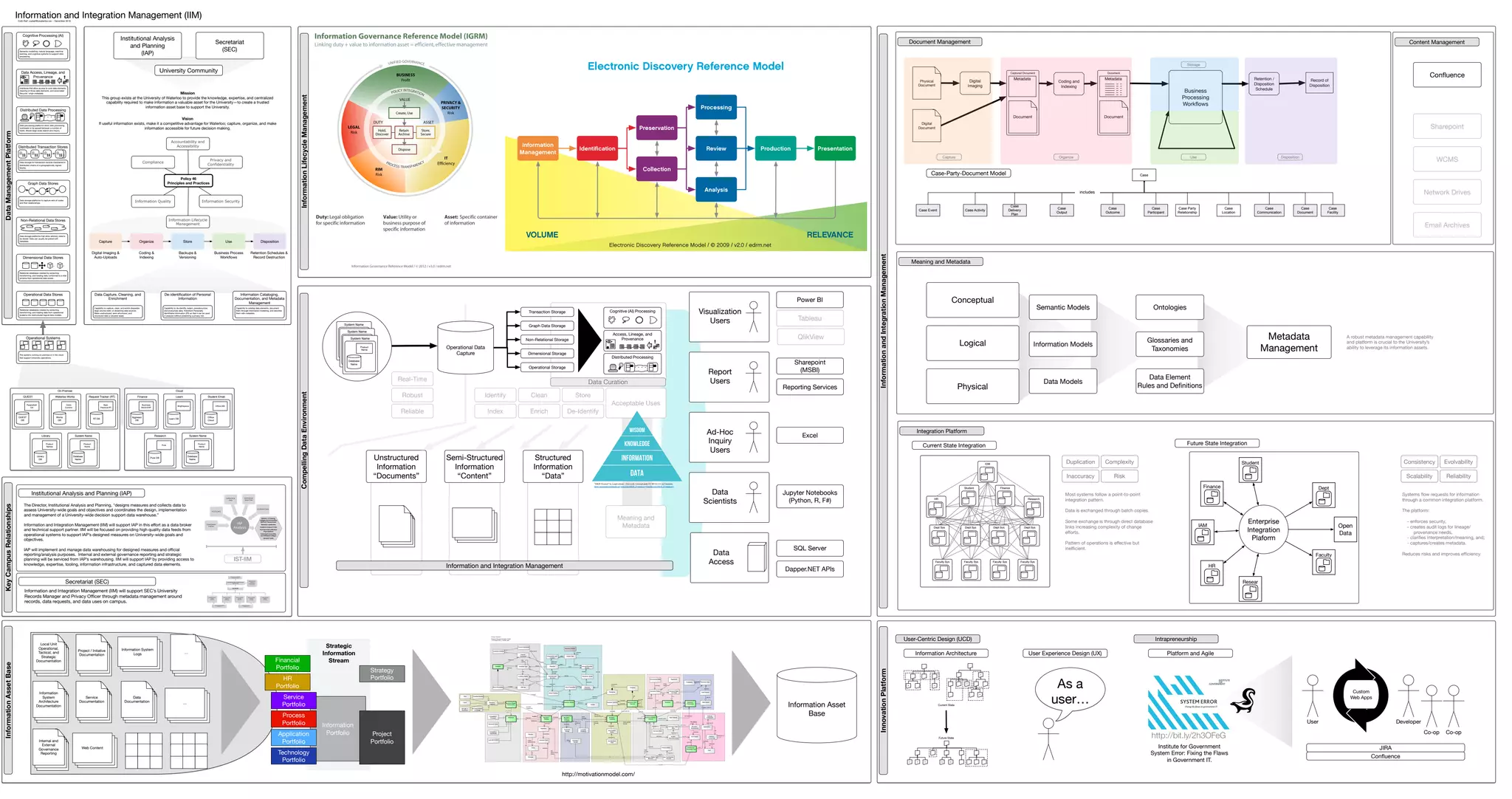
Information and Integration Management (IIM)Colin Bell <cpbell@uwaterloo.ca> - December 2016
Operational Data Stores
Relational databases created by extracting,
transforming, and loading data from operational
systems into restructured logical data models.
Dimensional Data Stores
Relational databases created by extracting,
transforming, and loading data conformed to a star
schema from operational data stores.
Non-Relational Data Stores
Data storage platforms that allow arbitrary data to
be stored. Data can usually be paired with
metadata.
Graph Data Stores
Data storage platforms to capture sets of nodes
and their relationships.
Distributed Data Processing
Data processing platforms allow data processing
workloads to be spread between a number of
hosts. Allows large scale search and inquiry.
Distributed Transaction Stores
Data storage for transaction records maintained in
distributed chains of cryptographically signed
blocks.
Data Access, Lineage, and
Provenance
Interfaces that allow access to core data elements,
meaning of those data elements, and associated
lifecycle / origin metadata
Cognitive Processing (AI)
Semantic modelling, natural language, machine
learning, and cognitive systems to support data
processing.
DataManagementPlatform
On-Premise
QUEST
QUEST
DB
PeopleSoft
CS
Waterloo Works
Works
DB
Orbis
Comms.
Request Tracker (RT)
RT DB
Best
Practical RT
Library
Library
DB
Product
Names
System Name
Database
Name
Product
Name
Operational Systems
The systems running on-premise or in the cloud
that support University operations.
Cloud
Finance
Aggresso
DB
Business
World ERP
Learn
Learn DB
Brightspace
Student Email
Office
Cloud
Office 365
Research
Pure DB
Pure
System Name
Database
Name
Product
Name
InformationLifecycleManagement
KeyCampusRelationships
Secretariat (SEC)
Information and Integration Management (IIM) will support SEC’s University
Records Manager and Privacy Officer through metadata management around
records, data requests, and data uses on campus.
Institutional Analysis and Planning (IAP)
The Director, Institutional Analysis and Planning, "designs measures and collects data to
assess University-wide goals and objectives and coordinates the design, implementation
and management of a University-wide decision support data warehouse.”
Information and Integration Management (IIM) will support IAP in this effort as a data broker
and technical support partner. IIM will be focused on providing high quality data feeds from
operational systems to support IAP’s designed measures on University-wide goals and
objectives.
IAP will implement and manage data warehousing for designed measures and official
reporting/analysis purposes. Internal and external governance reporting and strategic
planning will be serviced from IAP’s warehousing. IIM will support IAP by providing access to
knowledge, expertise, tooling, information infrastructure, and captured data elements.
IST-IIM
Data Capture, Cleaning, and
Enrichment
Capability to capture, clean, and enrich disparate
large volume static or streaming data sources.
Make unstructured, semi-structured, and
structured data a valuable asset.
De-identification of Personal
Information
Capability to de-identify, redact, pseudonymize,
and anonymize data. Transform Personally
Identifiable Information (PII) so that it can be used
in analysis without presenting a privacy risk.
Information Cataloging,
Documentation, and Metadata
Management
Capability to catalog data elements, document
them through information modelling, and describe
them with metadata.
Institutional Analysis
and Planning
(IAP)
Secretariat
(SEC)
University Community
Mission
This group exists at the University of Waterloo to provide the knowledge, expertise, and centralized
capability required to make information a valuable asset for the University—to create a trusted
information asset base to support the University.
Vision
If useful information exists, make it a competitive advantage for Waterloo; capture, organize, and make
information accessible for future decision making.
Policy 46
Principles and Practices
Accountability and
Accessibility
Privacy and
Confidentiality
Compliance
Information Quality Information Security
Information Lifecycle
Management
Capture Organize Store Use Disposition
Digital Imaging &
Auto-Uploads
Coding &
Indexing
Backups &
Versioning
Business Process
Workflows
Retention Schedules &
Record Destruction
IndexCatalog
SearchDiscover
Access Uses
Privacy Risk
Document Management
Physical
Document
Digital
Document
Digital
Imaging
Captured Document
Document
Metadata
Coding and
Indexing
Document
Document
Metadata
Business
Processing
Workflows
Retention /
Disposition
Schedule
Record of
Disposition
Case
Delivery
Plan
Case
Case Event Case Activity
Case
Communication
Case
Participant
Case
Output
Case
Outcome
Case
Document
includes
Case
Facility
Case Party
Relationship
Case
Location
Case-Party-Document Model
Content Management
Sharepoint
WCMS
Network Drives
Email Archives
Confluence
InformationandIntegrationManagement
Meaning and Metadata
Physical
Logical
Conceptual
Data Models
Information Models
Semantic Models Ontologies
Glossaries and
Taxonomies
Data Element
Rules and Definitions
Metadata
Management
A robust metadata management capability
and platform is crucial to the University’s
ability to leverage its information assets.
Capture Organize
Storage
Use Disposition
Integration Platform
Current State Integration Future State Integration
Most systems follow a point-to-point
integration pattern.
Data is exchanged through batch copies.
Some exchange is through direct database
links increasing complexity of change
efforts.
Pattern of operations is effective but
inefficient.
Duplication Complexity
Inaccuracy Risk
Dept Sys Dept Sys Dept Sys Dept Sys
Faculty Sys Faculty Sys Faculty Sys Faculty Sys
HR
Student Finance
Research
IDM
ReliabilityScalability
EvolvabilityConsistency
Systems flow requests for information
through a common integration platform.
The platform:
- enforces security,
- creates audit logs for lineage/
provenance needs,
- clarifies interpretation/meaning, and;
- captures/creates metadata.
Reduces risks and improves efficiency.
Student
HR
Finance
IAM
Resear
ch
Dept
Sys
Faculty
Open
Data
Enterprise
Integration
Plaform
InnovationPlatform
User-Centric Design (UCD)
Information Architecture User Experience Design (UX) Platform and Agile
Current State
Future State
X Y
Y
Y
X
Y YY X X
Intrapreneurship
As a
user…
http://bit.ly/2h3OFeG
Institute for Government
System Error: Fixing the Flaws
in Government IT.
User Developer
Co-op Co-op
Custom
Web Apps
JIRA
Confluence
CompellingDataEnvironment
System Name
Database
Name
Product
Name
System Name
Database
Name
Product
Name
System Name
Database
Name
Product
Name
Operational Data
Capture
Real-Time
Robust
Reliable
Operational Storage
Dimensional Storage
Non-Relational Storage
Graph Data Storage
Distributed Processing
Transaction Storage
Access, Lineage, and
Provenance
Cognitive (AI) Processing
Identify
De-Identify
Clean
EnrichIndex
Store
Acceptable Uses
Report
Users
Data
Scientists
Data
Access
"DIKW Pyramid" by Longlivetheux - Own work. Licensed under CC BY-SA 4.0 via Commons
https://commons.wikimedia.org/wiki/File:DIKW_Pyramid.svg#/media/File:DIKW_Pyramid.svg
Unstructured
Information
“Documents”
Semi-Structured
Information
“Content”
Structured
Information
“Data”
Tableau
Jupyter Notebooks
(Python, R, F#)
Sharepoint
(MSBI)
Visualization
Users
Power BI
Reporting Services
SQL Server
Dapper.NET APIs
Ad-Hoc
Inquiry
Users
Excel
Meaning and
Metadata
Information and Integration Management
Data Curation
QlikView
InformationAssetBase
Local Unit
Operational,
Tactical, and
Strategic
Documentation
Information
System
Architecture
Documentation
Internal and
External
Governance
Reporting
Project / Initative
Documentation
Web Content
Service
Documentation
Information System
Logs
Data
Documentation
…
…
http://motivationmodel.com/
Information Asset
Base
Information
Portfolio
Process
Portfolio
Service
Portfolio
HR
Portfolio
Financial
Portfolio Strategy
Portfolio
Technology
Portfolio
Strategic
Information
Stream
Application
Portfolio
Project
Portfolio

Information and Integration Management Vision

  • 1.
    Information and IntegrationManagement (IIM)Colin Bell <cpbell@uwaterloo.ca> - December 2016 Operational Data Stores Relational databases created by extracting, transforming, and loading data from operational systems into restructured logical data models. Dimensional Data Stores Relational databases created by extracting, transforming, and loading data conformed to a star schema from operational data stores. Non-Relational Data Stores Data storage platforms that allow arbitrary data to be stored. Data can usually be paired with metadata. Graph Data Stores Data storage platforms to capture sets of nodes and their relationships. Distributed Data Processing Data processing platforms allow data processing workloads to be spread between a number of hosts. Allows large scale search and inquiry. Distributed Transaction Stores Data storage for transaction records maintained in distributed chains of cryptographically signed blocks. Data Access, Lineage, and Provenance Interfaces that allow access to core data elements, meaning of those data elements, and associated lifecycle / origin metadata Cognitive Processing (AI) Semantic modelling, natural language, machine learning, and cognitive systems to support data processing. DataManagementPlatform On-Premise QUEST QUEST DB PeopleSoft CS Waterloo Works Works DB Orbis Comms. Request Tracker (RT) RT DB Best Practical RT Library Library DB Product Names System Name Database Name Product Name Operational Systems The systems running on-premise or in the cloud that support University operations. Cloud Finance Aggresso DB Business World ERP Learn Learn DB Brightspace Student Email Office Cloud Office 365 Research Pure DB Pure System Name Database Name Product Name InformationLifecycleManagement KeyCampusRelationships Secretariat (SEC) Information and Integration Management (IIM) will support SEC’s University Records Manager and Privacy Officer through metadata management around records, data requests, and data uses on campus. Institutional Analysis and Planning (IAP) The Director, Institutional Analysis and Planning, "designs measures and collects data to assess University-wide goals and objectives and coordinates the design, implementation and management of a University-wide decision support data warehouse.” Information and Integration Management (IIM) will support IAP in this effort as a data broker and technical support partner. IIM will be focused on providing high quality data feeds from operational systems to support IAP’s designed measures on University-wide goals and objectives. IAP will implement and manage data warehousing for designed measures and official reporting/analysis purposes. Internal and external governance reporting and strategic planning will be serviced from IAP’s warehousing. IIM will support IAP by providing access to knowledge, expertise, tooling, information infrastructure, and captured data elements. IST-IIM Data Capture, Cleaning, and Enrichment Capability to capture, clean, and enrich disparate large volume static or streaming data sources. Make unstructured, semi-structured, and structured data a valuable asset. De-identification of Personal Information Capability to de-identify, redact, pseudonymize, and anonymize data. Transform Personally Identifiable Information (PII) so that it can be used in analysis without presenting a privacy risk. Information Cataloging, Documentation, and Metadata Management Capability to catalog data elements, document them through information modelling, and describe them with metadata. Institutional Analysis and Planning (IAP) Secretariat (SEC) University Community Mission This group exists at the University of Waterloo to provide the knowledge, expertise, and centralized capability required to make information a valuable asset for the University—to create a trusted information asset base to support the University. Vision If useful information exists, make it a competitive advantage for Waterloo; capture, organize, and make information accessible for future decision making. Policy 46 Principles and Practices Accountability and Accessibility Privacy and Confidentiality Compliance Information Quality Information Security Information Lifecycle Management Capture Organize Store Use Disposition Digital Imaging & Auto-Uploads Coding & Indexing Backups & Versioning Business Process Workflows Retention Schedules & Record Destruction IndexCatalog SearchDiscover Access Uses Privacy Risk Document Management Physical Document Digital Document Digital Imaging Captured Document Document Metadata Coding and Indexing Document Document Metadata Business Processing Workflows Retention / Disposition Schedule Record of Disposition Case Delivery Plan Case Case Event Case Activity Case Communication Case Participant Case Output Case Outcome Case Document includes Case Facility Case Party Relationship Case Location Case-Party-Document Model Content Management Sharepoint WCMS Network Drives Email Archives Confluence InformationandIntegrationManagement Meaning and Metadata Physical Logical Conceptual Data Models Information Models Semantic Models Ontologies Glossaries and Taxonomies Data Element Rules and Definitions Metadata Management A robust metadata management capability and platform is crucial to the University’s ability to leverage its information assets. Capture Organize Storage Use Disposition Integration Platform Current State Integration Future State Integration Most systems follow a point-to-point integration pattern. Data is exchanged through batch copies. Some exchange is through direct database links increasing complexity of change efforts. Pattern of operations is effective but inefficient. Duplication Complexity Inaccuracy Risk Dept Sys Dept Sys Dept Sys Dept Sys Faculty Sys Faculty Sys Faculty Sys Faculty Sys HR Student Finance Research IDM ReliabilityScalability EvolvabilityConsistency Systems flow requests for information through a common integration platform. The platform: - enforces security, - creates audit logs for lineage/ provenance needs, - clarifies interpretation/meaning, and; - captures/creates metadata. Reduces risks and improves efficiency. Student HR Finance IAM Resear ch Dept Sys Faculty Open Data Enterprise Integration Plaform InnovationPlatform User-Centric Design (UCD) Information Architecture User Experience Design (UX) Platform and Agile Current State Future State X Y Y Y X Y YY X X Intrapreneurship As a user… http://bit.ly/2h3OFeG Institute for Government System Error: Fixing the Flaws in Government IT. User Developer Co-op Co-op Custom Web Apps JIRA Confluence CompellingDataEnvironment System Name Database Name Product Name System Name Database Name Product Name System Name Database Name Product Name Operational Data Capture Real-Time Robust Reliable Operational Storage Dimensional Storage Non-Relational Storage Graph Data Storage Distributed Processing Transaction Storage Access, Lineage, and Provenance Cognitive (AI) Processing Identify De-Identify Clean EnrichIndex Store Acceptable Uses Report Users Data Scientists Data Access "DIKW Pyramid" by Longlivetheux - Own work. Licensed under CC BY-SA 4.0 via Commons https://commons.wikimedia.org/wiki/File:DIKW_Pyramid.svg#/media/File:DIKW_Pyramid.svg Unstructured Information “Documents” Semi-Structured Information “Content” Structured Information “Data” Tableau Jupyter Notebooks (Python, R, F#) Sharepoint (MSBI) Visualization Users Power BI Reporting Services SQL Server Dapper.NET APIs Ad-Hoc Inquiry Users Excel Meaning and Metadata Information and Integration Management Data Curation QlikView InformationAssetBase Local Unit Operational, Tactical, and Strategic Documentation Information System Architecture Documentation Internal and External Governance Reporting Project / Initative Documentation Web Content Service Documentation Information System Logs Data Documentation … … http://motivationmodel.com/ Information Asset Base Information Portfolio Process Portfolio Service Portfolio HR Portfolio Financial Portfolio Strategy Portfolio Technology Portfolio Strategic Information Stream Application Portfolio Project Portfolio